


Community hub
Recent from talks
Contribute something
Nothing was collected or created yet.
Silverchair
View on Wikipedia
Silverchair were an Australian rock band, which formed in 1992 as Innocent Criminals in Newcastle, New South Wales, with Daniel Johns on vocals and guitars, Ben Gillies on drums, and Chris Joannou on bass guitar. The group got their big break in mid-1994 when they won a national demo competition conducted by SBS TV show Nomad and ABC radio station Triple J. The band was signed by Murmur and were successful in Australia and internationally. Silverchair has sold over 10 million albums worldwide.[1][2]
Key Information


Silverchair have won more ARIA Music Awards than any other artist in history, earning 21 wins from 49 nominations. They also received six APRA Awards, with Johns winning three songwriting awards in 2008. All five of their studio albums debuted at number one on the ARIA Albums Chart: Frogstomp (1995), Freak Show (1997), Neon Ballroom (1999), Diorama (2002), and Young Modern (2007). Three singles reached the number-one slot on the related ARIA Singles Chart: "Tomorrow" (1994), "Freak" (1997), and "Straight Lines" (2007).
Silverchair's alternative rock sound evolved throughout their career, with differing styles on specific albums growing more ambitious over the years, from grunge on their first two albums to later works displaying orchestral and art rock influences. The songwriting and singing of Johns had evolved steadily while the band had developed an increased element of complexity.
In 2003, following the release of Diorama the previous year, Silverchair went on hiatus. The band reunited at the 2005 Wave Aid concerts released their fifth album, Young Modern, in 2007; and played the Across the Great Divide tour with contemporaries Powderfinger. In May 2011, Silverchair announced an indefinite hiatus.
History
[edit]1994–1997: Formation and early grunge releases
[edit]Silverchair's founders, Ben Gillies and Daniel Johns, attended the same primary school in the Newcastle suburb of Merewether.[3] At "age 11 or 12", singer-guitarist Johns and drummer Gillies rapped over an electronic keyboard's demo button under their first band name, The Silly Men.[4][5] As teenagers, they started playing music together more prominently—in one class, they built a stage out of desks and played rap songs for their schoolmates.[6] When they moved on to Newcastle High School, fellow student Chris Joannou joined the pair on bass guitar. In 1994, they formed Innocent Criminals with Tobin Finnane as a second guitarist, but he soon left.[7][8][9] They played numerous shows around the Hunter Region in their early teens; their repertoire included cover versions of Led Zeppelin, Deep Purple, and Black Sabbath.[10][11] In 1994, Innocent Criminals entered YouthRock—a national competition for school-based bands—and placed first ahead of older competition.[12] The band recorded demos of "Acid Rain", "Cicada", "Pure Massacre", and "Tomorrow" early in the year at Platinum Sound Studios.[8]
In April, the band's mainstream breakthrough came when they won a national competition called Pick Me, using their demo of "Tomorrow".[8][11] The competition was conducted by the SBS TV show Nomad and Australian Broadcasting Corporation (ABC) alternative radio station Triple J.[8][11] As part of the prize, Triple J recorded the song and ABC filmed a video, which was aired on 16 June.[8][9] For the video's broadcast, they had changed their name to Silverchair (styled as silverchair until 2002).[8][10][13] In a 1994 interview with Melbourne magazine Buzz, the band claimed the name derived from a radio request for "Sliver" by Nirvana and "Berlin Chair" by You Am I being mixed up as Silver Chair.[10][14] It was later revealed they were named for the C. S. Lewis–penned novel The Silver Chair from The Chronicles of Narnia series.[15][16] Aside from Innocent Criminals, the band has used The George Costanza Trio and Short Elvis as aliases.[13][17][18]
Following a bidding war between rival labels, Silverchair signed a three-album recording contract with Sony Music subsidiary Murmur Records.[8][10] Initially, the group were managed by their parents.[19] Sony A&R manager John Watson, who was jointly responsible for signing the group, subsequently left the label to become their band manager. In September, their Triple J recording of "Tomorrow" was released as a four-track extended play.[8][20] From late October, it spent six weeks at number-one on the ARIA Singles Chart.[21][22] In 1995, a re-recorded version of "Tomorrow" (and a new video) was made for the United States market, becoming the most played song on US modern rock radio that year.[9]
Silverchair's debut album, Frogstomp, was recorded in nine days, with production by Kevin Shirley (Lime Spiders, Peter Wells) and released in March 1995.[23][24][25] At the time of recording, the band members were 15 years old and still attending high school.[9][23] Frogstomp's lyrical concepts were fiction-based, drawing inspiration from television, hometown tragedies, and perceptions of the pain of friends. The album was well received: AllMusic and Rolling Stone rated it in four and four-and-a-half stars, respectively, praising the intensity of the album, especially "Tomorrow".[23][24]
Frogstomp was a number-one album in Australia and New Zealand.[21][26] It reached the Billboard 200 Top 10, making Silverchair the first Australian band to do so since INXS.[9] It was certified as a US double-platinum album by the RIAA, triple-platinum in Canada by the CRIA, and multi-platinum in Australia.[8][27][28] The album sold more than 4 million copies worldwide.[9][11] Paste magazine called this album the "last stand" of grunge.[29] As Frogstomp and "Tomorrow" continued to gain popularity through 1995, the group toured the US, where they supported Red Hot Chili Peppers in June, the Ramones in September, and played on the roof of Radio City Music Hall at the MTV Music Awards. In September 1995, during Silverchair's tour in the United States, Johns was hit with a bottle of alcohol in Santa Monica, California while performing "Israel's Son" and the injury required half a dozen stitches near his left eyebrow.[30] In between touring, they continued their secondary education in Newcastle.[8][31] At the ARIA Music Awards of 1995, the band won five awards out of nine nominations. To collect their awards on the night, they sent Josh Shirley, the young son of the album's producer.[13] At the ceremony, they performed Radio Birdman's "New Race" with Tim Rogers (of You Am I); in 2019, Dan Condon of Double J rated this as one of the "7 great performances from the history of the ARIA Awards."[32] On 9 December 1995, Silverchair played "Pure Massacre" and "Tomorrow" on Saturday Night Live.[33][34]
In a January 1996 murder case, the defendant counsel for Brian Bassett, 16, and Nicholaus McDonald, 18, of McCleary, Washington, claimed that the pair listened to "Israel's Son", from Frogstomp, which contributed to the 10 August 1995 murders of Bassett's parents and a younger brother.[35][36] McDonald's lawyer cited the lyrics "Hate is what I feel for you/I want you to know that I want you dead" which were "almost a script. They're relevant to everything that happened".[37] The band's manager, Watson, issued a statement that they did not condone nor intend any such acts of violence.[36][37] Prosecutors rejected the defence case and convinced the jury that the murder was committed to "steal money and belongings and run off to California."[35]
Silverchair began recording their second studio album, Freak Show, in May 1996 while experiencing the success of Frogstomp in Australia and the US. Produced by Nick Launay (Birthday Party, Models, Midnight Oil) and released in February 1997,[10][20] the album reached number one in Australia and yielded three top-10 singles: "Freak", "Abuse Me", and "Cemetery".[21] Its fourth single, "The Door", reached No. 25.[21] The songs focused on the anger and backlash that the expectations of Frogstomp brought upon the band.[38] Freak Show was certified gold in the US, 2× platinum in Australia, and global sales eventually exceeded 1.5 million copies.[27][39][40]
1997–2003: Artistic experimentation, critical and commercial success
[edit]By late 1997, the trio had completed their secondary education, and, from May 1998, they worked on their third album, Neon Ballroom, with Launay producing again.[8][20] It was released in March 1999 and peaked at the number-one position in Australia.[21] Australian rock music historian Ian McFarlane said, "As well as being the band's best album to date, it was universally acknowledged as one of the best albums of the year."[8] The band originally intended to take a 12-month break, but in the end they decided to devote their time to making music.[41] Neon Ballroom provided three Australian top-20 singles: "Anthem for the Year 2000", "Ana's Song (Open Fire)" and "Miss You Love"; a fourth single, "Paint Pastel Princess", did not reach the top 50.[21] The albums charted well internationally: Freak Show reached No. 2 in Canada, and Neon Ballroom reached No. 5.[42] Both reached the top 40 on the United Kingdom Albums Chart.[43] "Abuse Me" reached No. 4 on Billboard's Hot Modern Rock Tracks and Hot Mainstream Rock Tracks charts.[44] "Ana's Song (Open Fire)" peaked at No. 12 on the Hot Modern Rock Tracks.[44]
In 1999, Johns announced that he had developed the eating disorder anorexia nervosa due to anxiety.[45] Johns noted that the lyrics to "Ana's Song (Open Fire)" dealt with his disorder, where he would "eat what he needed ... to stay awake."[46] He revealed that his eating problems developed from the time of Freak Show and when Neon Ballroom was written he "hated music, really everything about it", but he felt that he "couldn't stop doing it; I felt like a slave to it."[47] Johns sought therapy and medication but felt "It's easier for me to express it through music and lyrics".[45] During the process of recording Neon Ballroom, according to Gillies in an article by British publication The Guardian, "work" was used to describe the band by Johns.[48]
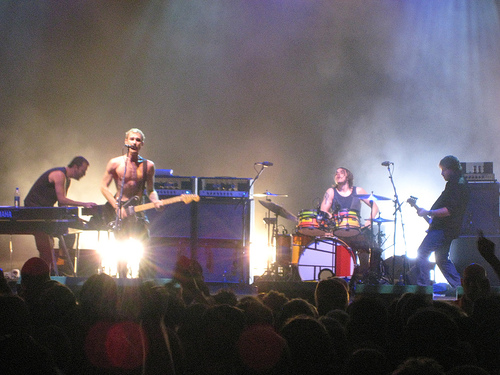
Silverchair added an auxiliary keyboardist, Sam Holloway (ex-Cordrazine), for the Neon Ballroom Tour.[8] The US leg had the group playing with The Offspring and Red Hot Chili Peppers, while Silverchair's tour of UK and European had The Living End as the support act.[8] Rolling Stone's Neva Chonin attributed their chart success to the album's more "mature" sound.[49] In Europe and South America it became the group's most successful album to date. The group appeared at festivals in Reading and Edgefest, amongst others.[50] Following the tour, the band announced that they would be taking a 12-month break.[51] Their only live performance in 2000 was at the Falls Festival on New Year's Eve.[41][52] On 21 January 2001, the band played to 250,000 people at Rock in Rio, a show they described as the highlight of their career until that point.[51]
After the release of Neon Ballroom, Silverchair's three-album contract with Sony Music had ended. The group eventually signed with Atlantic Records for North and South America, and they formed their own label with Watson, Eleven: A Music Company (distributed by EMI), for Australia and Asia.[3][53] In November 2000, after the group had left the label, Sony issued The Best Of: Volume 1 without the band's involvement.[51] Johns disavowed the compilation, saying, "We thought about putting out ads in the street press to make people aware that we weren't endorsing it, but that would have blown the whole thing out of proportion ... If people want to buy it, they can buy it[,] but I wouldn't buy it if I was a Silverchair fan."[41]

In June 2001, Silverchair entered a studio in Sydney with producer David Bottrill (Tool, Peter Gabriel, King Crimson) to start work on their fourth album, Diorama. Johns formally assumed the role of a co-producer.[54] The album name means "a world within a world".[55] Most tracks came from Johns' new-found method of writing material on a piano, a technique he developed during the band's break after Neon Ballroom.[55][56]
In order to complete the vision for Diorama, several other musicians contributed to the album, including Van Dyke Parks, who provided orchestral arrangements to "Tuna in the Brine", "Luv Your Life", and "Across the Night".[57] Paul Mac (from Itch-E and Scratch-E) and Jim Moginie (from Midnight Oil) both on piano also collaborated with the band.[58] While recording Diorama, Johns referred to himself as an artist, rather than simply being in a "rock band". Upon its release, critics commented that the album was more artistic than previous works.[59][60]
Early in December, the first single, "The Greatest View", was released to Australian radio networks. Its physical release in January 2002 coincided with the band's appearance on the Big Day Out tour.[61] Early in 2002, Johns was diagnosed with reactive arthritis, which made it difficult for him to play the guitar, and subsequent performances supporting the album's release were cancelled.[6][62][63] In March 2002, Diorama was issued and topped the ARIA Albums Chart; it became their fourth number-one album and spent 50 weeks in the top 50.[21][64]
Four singles were released from the album: "The Greatest View", "Without You", "Luv Your Life" and "Across the Night"; "The Greatest View" charted highest, reaching No. 3.[21] In October, Silverchair were successful at the ARIA Music Awards of 2002, winning five awards, including 'Best Rock Album' and 'Best Group', and 'Producer of the Year' for Johns.[65] The band played "The Greatest View" at the ceremony; the song was also nominated for 'Best Video'.[66] Two singles (and a related video) were nominated for further ARIA Awards in 2003.[65] Following the 2002 ARIA Awards, the band announced their first indefinite hiatus. Johns said it was necessary "given the fact the band were together for over a decade and yet were only, on average, 23 years old".[9][67] From March to June 2003, Silverchair undertook the Across the Night Tour to perform Diorama.[68] Their hometown performance on 19 April was recorded as Live from Faraway Stables for a 2-CD and 2-DVD release in November.[68] After the tour finished in June, the group announced another indefinite hiatus.[68]
2003–2005: Extended break and side projects
[edit]In 2000, while also working with Silverchair, Johns and Mac released an internet-only EP, I Can't Believe It's Not Rock.[41] In mid-2003, during Silverchair's hiatus, the pair re-united and formed The Dissociatives, releasing a self-titled album in April 2004.[69] The duo provided the theme music for the popular ABC-TV music quiz show Spicks and Specks by reworking a 1966 Bee Gees hit of the same name.[70] Johns also collaborated with then-wife Natalie Imbruglia on her Counting Down the Days album, released in April 2005.[71]
Joannou worked with blues rock group The Mess Hall; he co-produced—with Matt Lovell—their six-track extended play Feeling Sideways, which was released in May 2003.[72] The album was nominated for the ARIA Award for 'Best Independent Release' in 2003.[73] Joannou and Lovell co-produced The Mess Hall's studio album Notes from a Ceiling, which was issued in June 2005.[74] Joannou and Lovell received a nomination at the ARIA Music Awards of 2005 for 'Producer of the Year'.[75] In 2003, Gillies formed Tambalane with Wes Carr, initially as a song-writing project, and they released a self-titled album in 2005 and toured Australia.[76]
The 2004 Boxing Day tsunami resulted in the WaveAid fundraising concert held in January 2005; Silverchair performed to help raise funds for aid organisations working in disaster-affected areas. As a result of WaveAid, the band decided to resume working together.[77] Gillies explained the band's reunion as due to a special "chemistry" between band members, telling the Sydney Morning Herald, "It only took us 15 years, but recently we've realised, 'We've really got something special and we should just go for it.'"[78]
2005–2011: Return from hiatus
[edit]
After performing at WaveAid, Silverchair reunited, and by late 2005 began preparations for their next studio album, Young Modern. Johns had written about 50 songs during the hiatus for a possible solo album or other project but decided to use them for Silverchair.[67] In 2006, after five weeks' practice, the group demoed tracks in the Hunter Region before recording at Los Angeles' Seedy Underbelly Studios with Launay as producer.[20][79] Parks again arranged orchestral tracks for the band—they travelled to Prague to record with the Czech Philharmonic Orchestra.[10] The group also used Mac, Luke Steele (The Sleepy Jackson, Empire of the Sun) and Julian Hamilton (The Presets, The Dissociatives). Hamilton also co-wrote songs with Johns.[80] Silverchair self-funded the album's production to ease the pressures they faced when working with a record label.[9][79]
The band toured extensively before releasing the album, performing at Homebake and numerous other shows. Both Mac and Hamilton joined the tour as auxiliary members providing keyboards. In October, they performed a cover of Midnight Oil's 1981 single "Don't Wanna Be the One" at the ARIA Music Awards of 2006 as part of that band's induction into the ARIA Hall of Fame.[81] During the performance, Johns spray-painted "PG 4 PM" (Peter Garrett for Prime Minister) on a stage wall, paying tribute to that band's frontman, who was at that time a Federal Member of Parliament and Minister for the Environment, Heritage and the Arts.[82][83]
Young Modern was released in March 2007, as was the first single, "Straight Lines". Three more singles—"Reflections of a Sound", "If You Keep Losing Sleep", and "Mind Reader"—were released later. Young Modern became the fifth Silverchair album to top the ARIA Albums chart; they became the first artists to have five number-one albums on the ARIA Albums chart.[84][85] "Straight Lines" also became the band's third number-one single in Australia.[21] In June 2007, Silverchair and fellow Australian band Powderfinger announced the Across the Great Divide Tour. The tour promoted the efforts of Reconciliation Australia in mending the 17-year gap in life expectancy between Indigenous and non-Indigenous children.[86][87] Support acts on the tour were John Butler, Missy Higgins, Kev Carmody, Troy Cassar-Daley, Clare Bowditch and Deborah Conway.[86][87]
"Young Modern" and "Straight Lines" each won three awards at the ARIA Music Awards of 2007, taking Silverchair's total to 20.[65][88] The group also won three APRA Awards for their song "Straight Lines", including Songwriter of the Year, which Johns was awarded for a record third time.[89] At the ARIA Music Awards of 2008, Silverchair and Powderfinger each won Best Music DVD for Across the Great Divide, for Silverchair this was their 21st win from 49 nominations.[65][90]

According to Silverchair's website, as of June 2009, the group had begun work on the follow-up to Young Modern; they had spent three weeks recording in Australia with future sessions earmarked for later that year. No release date was set, but the band uploaded in-studio videos of them working on several tracks to their official website. In December, Johns called in to Triple J's breakfast show, Robbie, Marieke and The Doctor, and discussed the band's new album which they were working on in Newcastle. He told them, "the main difference is there's a lot of experimentation with instruments and synths... I think there's only guitar on four songs out of fifty so far," but added the new material is "surprisingly rocky given there's no guitar."[91] In April 2010, via the band's website, Joannou announced they would perform two new songs called "16" and "Machina Collecta" at May's Groovin' the Moo festival. He said work was progressing well and confirmed there was, as yet, no title for the proposed album and that they were simply referring to it as Album No. 6.[92] The final concert of the festival was at Bunbury on 15 May,[92] while what would turn out to be the band's final live appearance was a controversial set at the Northern Territory's Bassinthegrass festival a week later on 22 May.[93] By year's end, work on the album had stopped because each member had pursued other interests.[9]
2011–present: Breakup and "indefinite hibernation"
[edit]On 25 May 2011, Silverchair announced an indefinite hibernation:[9]
We formed Silverchair nearly 20 years ago when we were just 12 years old. Today we stand by the same rules now as we did back then... if the band stops being fun and if it's no longer fulfilling creatively, then we need to stop... Despite our best efforts over the last year or so, it's become increasingly clear that the spark simply isn't there between the three of us at the moment. Therefore after much soul searching we wanted to let you know that we're putting Silverchair into "indefinite hibernation" and we've decided to each do our own thing for the foreseeable future.
— Daniel, Ben and Chris, chairpage.com (Silverchair Official Website), 25 May 2011.[94]
Sydney Morning Herald's music writer, Bernard Zuel, said the band's use of "indefinite hibernation" was a way to soften the blow of the group's break-up for fans; he expected future reunions and performances for worthy causes.[95] By June, Gillies was in the final stages of about 12 months of working on his solo album, and he said that it was not a continuation of his earlier work with Tambalane.[96] In October, Johns was working on the soundtrack for My Mind's Own Melody—a short film.[97] In May 2012, Johns recorded the new anthem for Qantas, titled "Atlas". It is the first piece of commercial music Johns has composed. A remastered version of Frogstomp, which included bonus content, was released on 27 March 2015.[98]
The members of Silverchair have occasionally stated that they have not ruled out a reunion.[99][100] Gillies has said that there are plans to release a new Silverchair album, which was almost finished before the hiatus.[101]
On 17 November 2017, the Silverchair tribute compilation album Spawn (Again): A Tribute to Silverchair was released by UNFD,[102] with Johns saying he came to "appreciate" the experience. The album is composed of cover songs by Australian bands signed onto UNFD as a tribute to Silverchair, to celebrate the 20th anniversary of their album Freak Show.[103]
Speaking to The Daily Telegraph in 2018, Daniel Johns expressed his love for the band—and appreciation of what the band had produced—but said he had no desire to reform the band.[104] In May 2020, a picture of Johns playing electric guitar appeared online, leading to the Newcastle Herald speculating that a reunion was possible.[105] However, in October 2021, when Johns was interviewed by Carrie Bickmore on the Australian news-current affairs and talk show The Project, he once again affirmed that the band will not reunite, while also stating that he still plans to work on new music but has no intentions to perform live again.[106][107] In a separate interview with Carrie Bickmore, Johns elaborated further, stating that during his time with Silverchair, he had been the victim of sustained verbal abuse from the public because of his association with the band, which greatly impacted his mental health. Johns was open to musical collaboration with his former bandmates but not as a continuation of Silverchair as a band.[108]
On 5 February 2021, it was announced that Silverchair's music would be distributed by Sony Music Entertainment Australia.[109][110]
Musical style
[edit]Silverchair are primarily an alternative rock band,[8][112][113] who started out as grunge[114][115] and post-grunge,[114][116] but expanded into art rock,[117] progressive rock,[117] hardcore punk[115] and baroque pop.[115][118] Much of the band's early work was inspired by Nirvana, Tool, Pearl Jam, Soundgarden, Alice in Chains and Black Sabbath.[8][119] According to Ian McFarlane, "Frogstomp captured the tempo of the times with its mix of Soundgarden/Pearl Jam/Bush post-grunge noise and teenage lyrical angst."[8]
In their early years, the perceived stylistic similarities led to Silverchair being derisively dubbed as 'Silverhighchair', 'not Soundgarden but Kindergarden' and 'Nirvana in Pyjamas' by the Australian media.[8][10][120] The latter is a sarcastic conflated reference to the band's youth and the popular Australian children's TV series Bananas in Pyjamas. McFarlane stated, "Freak Show and tracks like 'Freak' were firmly in Nirvana territory with a hint of Led Zeppelin's Eastern mysticism".[8] Gillies noted that the band were inspired by the Seattle Sound, as well as The Beatles and The Doors, and were highly impressionable in their youth.[121] Johns admitted that "We were always influenced a lot by Black Sabbath and Led Zeppelin[;] it just so happened that we weren't very good at playing that style of music. So we were put in the whole grunge category because it was such a garage-y, heavy music term."[122]
Australian rock music journalist Ed Nimmervoll felt that Johns "had never intended to use his problems for inspiration, but in the end the music was the best way to unburden himself. Neon Ballroom took six months to record. The album's passion and musical sophistication proved to the world that silverchair were a force to be reckoned with".[10] According to 100 Best Australian Albums, by three fellow journalists—John O'Donnell, Toby Creswell and Craig Mathieson—Neon Ballroom's lead-in track, "Emotion Sickness", described Johns' life in the 1990s and "addressed [his] desire to move beyond the imitative sounds of Silverchair's first two albums ... and create something new and original".[45] "Ana's Song (Open Fire)" directly focussed on his eating disorder; "[it] became a hit all over the world and opened up for discussion the fact that males could also be affected by anorexia."[45]
AllMusic's Stephen Thomas Erlewine felt Diorama "was a shockingly creative and impressive step forward that showed the band shedding its grunge past and adding horns, strings, and mature lyrics to its arsenal."[9] Fellow AllMusic reviewer Bradley Torreano noted that "they somehow kept going and kept improving ... Silverchair has grown up and put together a fine mix of orchestral pop and rock on Diorama."[123] Bernard Zuel described how the Diorama concert tour marked a move from hard rock towards art rock: "they stepped out of the arenas and barns and 'got classy' ... finally having admitted to harbouring artistic ambition (a very un-Australian band thing to do), they've proved they have the ability".[124]

In writing Young Modern, Johns tried to make the music sound very simple despite a complex musical structure. The lyrics were written after the music was created, sometimes as late as the day of recording. As Johns dreads writing lyrics, he suggested that the band could produce an instrumental album at some stage in the future.[125] Johns is the band's primary songwriter, and notes that while Joannou and Gillies do not have significant influence on what he writes, they are key to the band's overall sound.[126] For that album, Hamilton co-wrote four songs with Johns including the APRA Award-winning "Straight Lines".[89][111] Joannou believed that Young Modern was simpler than Diorama but "still as complex underneath with simple pop song elements". He said that much of the band's success resulted from trying to push themselves harder in recording and writing. Self-producing has allowed the band to do so without the pressures of a record label.[127]
Gillies notes that Silverchair will often "run the risk of losing fans" with their work, and this was evident in the changes in musical direction in Diorama and Young Modern.[121] However, he described this as a good thing, describing the fact "that we haven't been pigeonholed, and people really don't know what to expect" as one of the attractive elements of the band. Despite the ups and downs of success at a young age, Gillies says that he and the band "appreciate what we've achieved and what we've got" in their careers.[121] The band have received six APRA Awards, with Johns winning three songwriting awards at the 2008 ceremony.[89][128]
Critical reception
[edit]Frogstomp was described as similar to Nirvana and Pearl Jam; Erlewine noted that it followed in "the alternative rock tradition" of those bands.[24] Erlewine also stated that "their songwriting abilities aren't as strong" as those of their peers.[24] Contrarily, Rolling Stone claimed that the band had risen above their peers, applauding Johns' "ragged vocals".[23] Herald Sun journalist Nue Te Koha praised Frogstomp for "breaking the drought of Australian music making an impact overseas".[13] However, he felt "It is highly debatable whether the three teens have gone to the world with a new sound or something identifiably Australian ... Silverchair's image and sound are blatantly ... Nirvana meets Pearl Jam".[13] Nimmervoll disputed Te Koha's view, "It's not original, it's not Australian. Bah, humbug ... It's just as well Britain didn't say the same thing when The Beatles reinvented American R&B".[13]
Freak Show saw the band show more of their own musical style rather than copying others,[129] and thus received more praise for its songwriting than its predecessor. Yahoo! Music's Sandy Masuo described the lyrics as "moving" and "emotional".[130] Johns' vocal delivery was complimented: "[his] bittersweet, crackly voice tops the ample power chordage ... [he] hits shivery, emotional notes that convey both sweet idealism and disappointment".[131] Zuel felt that with this album, the band "have outgrown the jokes, predictions and their own understated teenage ambitions to find they have become (gasp!) career musicians."[132]
In 100 Best Australian Albums (2010), their third album, Neon Ballroom, was placed at No. 25, according to its authors.[45] Entertainment Weekly approved of the further advancement in Neon Ballroom, commenting on "plush strings on these adult arrangements".[133] There were once again significant advancements in songwriting; Johns was described as "furious, motivated, and all grown up".[133] However, Rolling Stone said the album seemed confused, commenting that Silverchair "can't decide what they want to do" with their music.[49] Meanwhile, Diorama was seen as an extension of the band's originality, with its "[h]eavy orchestration, unpredictable melodic shifts and a whimsical pop sensibility".[134] According to PopMatters' Nikki Tranter, the album stood out in an otherwise dull Australian music market.[57]
AllMusic's Clayton Bolger described Young Modern as an improvement by the band, praising "catchy melodic hooks, inspired lyrical themes, and stunning string arrangements". He claimed the album was the pinnacle of the band's development.[111] PopMatters' Nick Pearson saw the opposite, claiming that "[o]nce you reach the level of intellectual maturity where you can tell the difference between cryptic but poetic lyrics and nonsensical crap, you have outgrown Silverchair".[135] Pearson called the album an attempt to secure a safer territory and assure sales, after the success of past works, calling it more boring than its predecessors.[135] Other reviewers noted influences from cult British band XTC.[136][137]
In July 2009, "Tomorrow" was voted number 33 by the Australian public in Triple J's Hottest 100 of all time.[138] As of January 2018, the group have sold 9 million albums worldwide.[3][53] At the annual ARIA Music Awards, Silverchair holds the record for the most nominated artist, with 49, and the most awards won, with 21. Their breakthrough year was in 1995, when they won five out of nine nominations, including 'Best New Talent', and 'Breakthrough Artist' for both album and single categories.[139] Their most successful year was at the 2007 ceremony, where they won six of eight nominations.[65][88] In November 2020, the 1994 EP recording of the song "Tomorrow" was inducted into the NFSA (National Film and Sound Archive of Australia).[140][141]
Members
[edit]- Ben Gillies – drums, percussion[142]
- Chris Joannou – bass guitar[143]
- Daniel Johns – vocals, guitar, piano, harpsichord, orchestral arrangements[144]
Live Auxiliary Members
[edit]- Tobin Finnane – rhythm guitar (1992–1994, only in Innocent Criminals)[8]
- Sam Holloway – keyboards, samples (1999–2002)[8][145][146]
- Paul Mac – keyboards, piano, remixing, programming (1999, 2001, 2006–2008)[147]
- Julian Hamilton – keyboards, backing vocals (2002–2005)
- Stuart Hunter - keyboards, backing vocals (2003 - 2005)
- Adam Sofo - keyboards (2007–2008)[148]
- Unknown - keyboard, vocals (2010)
- Unknown - keyboard (2010)
Discography
[edit]Studio albums
- Frogstomp (1995)
- Freak Show (1997)
- Neon Ballroom (1999)
- Diorama (2002)
- Young Modern (2007)
See also
[edit]


References
[edit]General
- Apter, Jeff (2008). A New Tomorrow: The Silverchair Story. Milsons Point: Random House Australia. ISBN 978-1-74166-483-6.
- Erlewine, Stephen Thomas. "Silverchair > Biography". AllMusic. Archived from the original on 25 May 2024. Retrieved 12 October 2011.
- Mathieson, Craig (1996). Hi Fi Days: The Future of Australian Rock. St Leonards: Allen & Unwin. ISBN 978-1-86448-232-4.
- McFarlane, Ian (1999). "Whammo Homepage". Encyclopedia of Australian Rock and Pop. St Leonards, NSW: Allen & Unwin. ISBN 1-86508-072-1. Archived from the original on 5 April 2004. Retrieved 1 October 2011. Note: Archived [on-line] copy has limited functionality.
- Spencer, Chris; McHenry, Paul; Nowara, Zbig (2007) [1989]. "'silverchair' entry". The Who's Who of Australian Rock. Moonlight Publishing. ISBN 978-1-86503-891-9.
Specific
- ^ "Silverchair – Biography". chairpage.com. Archived from the original on 8 April 2007. Retrieved 11 August 2020.
- ^ "Reflections of a Sound: 20 Years of Silverchair". Artist Waves – a voice of the artist platform. 2 December 2015. Retrieved 11 August 2020.
- ^ a b c Carr, Matt (26 May 2011). "Silverchair take "indefinite" Break". Newcastle Herald. Archived from the original on 27 May 2011. Retrieved 12 October 2011.
- ^ James Sullivan (30 June 1997). "Baby's Got the Blues / They're young! They're hot! They're just miserable!". CT Insider. Retrieved 31 May 2022.
- ^ 04-09-2003 : Daniel Johns Interview on The Panel (Melbourne, Aus), December 2016, retrieved 31 May 2022
- ^ a b Munro, Kelsey (1 April 2006). "Escape Act". Rolling Stone Australia. Archived from the original on 1 October 2011. Retrieved 13 October 2011.
- ^ "Chairpage News Archive".
- ^ a b c d e f g h i j k l m n o p q r s t u McFarlane, 'silverchair' entry. Archived from the original on 19 April 2004. Retrieved 1 October 2011.
- ^ a b c d e f g h i j k Erlewine, "Silverchair > Biography".
- ^ a b c d e f g h Nimmervoll, Ed. "Silverchair". HowlSpace – The Living History of Our Music. White Room Electronic Publishing Pty Ltd. Archived from the original on 22 January 2012. Retrieved 13 October 2011.
- ^ a b c d "Silverchair". Music Australia. National Library of Australia. 10 April 2003. Archived from the original on 13 April 2014. Retrieved 13 October 2011.
- ^ "Past performers". YouthRock. Archived from the original on 22 April 2008. Retrieved 3 February 2008.
- ^ a b c d e f Jenkins, Jeff; Meldrum, Ian (2007). Molly Meldrum presents 50 years of rock in Australia. Melbourne, Vic: Wilkinson Publishing. pp. 86, 231, 261–262. ISBN 978-1-921332-11-1.
- ^ "Interview with Silverchair". Buzz Magazine. 1 September 1994. Archived from the original on 13 December 2010. Retrieved 1 October 2011.
- ^ Harmsworth, Andrei (26 May 2011). "Silverchair Announce Split Because 'Being in a Band Is No Fun Anymore'". Metro. Archived from the original on 7 September 2011. Retrieved 12 October 2011.
- ^ Sennett, Sean; Groth, Simon, eds. (2010). "Silverchair – No Complaints from the 'Chair". Off the Record: 25 Years of Music. Brisbane, QLD: University of Queensland Press. pp. 223–224. ISBN 978-0-7022-3863-5.
- ^ "That's the Breaks, Keanu". Chicago Tribune. 24 December 1996. Archived from the original on 17 May 2013. Retrieved 14 October 2011.
- ^ "Silverchair Perform As "Short Elvis" in Concert at the Gaelic Theatre in Sydney – March 16, 2006". WireImage (Getty Images). 16 March 2006. Archived from the original on 17 April 2009. Retrieved 14 October 2011.
- ^ "silverchair Speak Out!". Smash Hits. EMAP Limited. January 1995. Archived from the original on 13 February 2003. Retrieved 1 October 2011.
- ^ a b c d Spencer, et al.
- ^ a b c d e f g h i Hung, Steffen. "Silverchair Discography". Australian Charts Portal. Hung Medien. Archived from the original on 23 October 2012. Retrieved 13 October 2011.
- ^ Hung, Steffen. "Silverchair – "Tomorrow"". Australian Charts Portal. Hung Medien. Archived from the original on 18 January 2012. Retrieved 13 October 2011.
- ^ a b c d "Silverchair: Frogstomp". Rolling Stone. 2 February 1998. Archived from the original on 6 July 2007. Retrieved 13 February 2008.
- ^ a b c d Erlewine, Stephen Thomas. "Frogstomp > Review". AllMusic. Archived from the original on 14 October 2011. Retrieved 14 October 2011.
- ^ "Kevin Shirley > Credits". AllMusic. Archived from the original on 14 October 2011. Retrieved 13 October 2011.
- ^ Hung, Steffen. "Silverchair – Frogstomp". Australian Charts Portal. Hung Medien. Archived from the original on 20 June 2022. Retrieved 14 October 2011.
- ^ a b "Gold and Platinum – Silverchair". RIAA. Archived from the original on 16 December 2012. Retrieved 17 February 2008.
- ^ "Canadian Certifications – Silverchair". Music Canada. 14 October 2011. Archived from the original on 14 June 2012.
- ^ Danaher, Michael (4 August 2014). "The 50 Best Grunge Songs". pastemagazine.com. Paste. Archived from the original on 11 February 2017. Retrieved 8 February 2017.
- ^ "Chairpage News Archive". Archived from the original on 1 August 2024. Retrieved 14 June 2025.
- ^ "Artist :: Silverchair". Australian Music Online. Archived from the original on 31 July 2008. Retrieved 12 March 2008.
- ^ Condon, Dan (26 November 2019). "7 Great Performances from the History of the ARIA Awards – Music Reads". Double J. Retrieved 24 December 2020.
- ^ "Chairpage News Archive".
- ^ "Chairpage News Archive".
- ^ a b "Teen Sentenced to 65 Years for His Part in Murders". Kitsap Sun (Charles D Horton III). 22 February 1996. Archived from the original on 25 April 2012. Retrieved 15 October 2011.
- ^ a b "Attorney wants to open teen's murder trial with rock song". Seattle Post-Intelligencer. 18 January 1996. Archived from the original on 17 May 2011. Retrieved 15 October 2011.
- ^ a b Elliott, Paul (1997). "Roo Fighters". Kerrang!. Archived from the original on 5 March 2016. Retrieved 15 October 2011.
- ^ Wooldridge, Simon (February 1997). "Freak Show Review". Juice.
- ^ "ARIA Charts – Accreditations – 1997 Albums". Australian Recording Industry Association (ARIA). Archived from the original on 13 October 2011. Retrieved 15 October 2011.
- ^ "silverchair". rage. Australian Broadcasting Corporation (ABC). 4 September 1999. Archived from the original on 11 November 2012. Retrieved 15 October 2011.
- ^ a b c d Richard, Kingsmill (29 November 2000). "Daniel Johns of silverchair speaks to Richard Kingsmill". Triple J (Australian Broadcasting Corporation (ABC)). Archived from the original on 29 January 2009. Retrieved 4 October 2011.
- ^ "Silverchair > Charts & Awards > Billboard Albums". AllMusic. Archived from the original on 25 May 2024. Retrieved 15 October 2011.
- ^ Roberts, David, ed. (2006). British Hit Singles & Albums (19th ed.). HIT Entertainment. ISBN 1-904994-10-5.
- ^ a b "Silverchair > Charts & Awards > Billboard Singles". AllMusic. Archived from the original on 25 May 2024. Retrieved 15 October 2011.
- ^ a b c d e O'Donnell, John; Creswell, Toby; Mathieson, Craig (October 2010). "25: Silverchair – Neon Ballroom". 100 Best Australian Albums. Prahran, Vic: Hardie Grant Books. pp. 90–91. ISBN 978-1-74066-955-9.
- ^ Fisher, Blair R (11 July 1999). "Silverchair Frontman Reveals Battle with Anorexia". Rolling Stone. Archived from the original on 30 January 2009. Retrieved 4 October 2011.
- ^ Sams, Christine (6 June 2004). "Anorexia almost killed me: Daniel Johns". Sydney Morning Herald. Archived from the original on 3 October 2011. Retrieved 15 October 2011.
- ^ Jolly, Nathan (20 October 2023). "Silverchair's Ben Gillies and Chris Joannou on rifts, Daniel Johns and finding closure: 'We're still in indefinite hibernation'". The Guardian. Retrieved 1 August 2024.
- ^ a b Chonin, Neva (18 March 1999). "Silverchair: Neon Ballroom". Rolling Stone. Archived from the original on 6 July 2007. Retrieved 5 February 2008.
- ^ Young, Daniel (29 August 1999). "Reading Festival – Reading, UK". Silverchair. Archived from the original on 1 October 2011. Retrieved 15 October 2011.
- ^ a b c "Band: silverchair – Stories and Highlights". Long Way to the Top. Australian Broadcasting Corporation (ABC). 2001. Archived from the original on 26 October 2011. Retrieved 15 October 2011.
- ^ Thomas, Les. "Silverchair, The Falls Festival, Lorne, Victoria, 31 December 2000". Massive Magazine. Silverchair. Archived from the original on 1 October 2011. Retrieved 15 October 2011.
- ^ a b "Silverchair Signs with Eleven: Eleven signs with EMI". Silverchair. Archived from the original on 1 October 2011. Retrieved 15 October 2011.
- ^ Farinella, David John (1 January 2003). "Silverchair's Diorama album – recording the new Silverchair rock CD". Mix. Archived from the original on 17 February 2012. Retrieved 15 October 2011.
- ^ a b Claire (2009). "Diorama". RollerCoaster. Australian Broadcasting Corporation (ABC). Archived from the original on 6 November 2012. Retrieved 15 October 2011.
- ^ Neilsen, Mark (22 April 2002). "Another Point of View". Drum Media.
- ^ a b Tranter, Nikki (6 September 2002). "Silverchair: Diorama". PopMatters. Sarah Zupko. Archived from the original on 23 April 2009. Retrieved 8 February 2008.
- ^ "Diorama – Silverchair > Credits". AllMusic. Archived from the original on 25 May 2024. Retrieved 15 October 2011.
- ^ Kemp, Mark (8 August 2002). "Silverchair: Diorama". Rolling Stone. No. 902. Archived from the original on 10 July 2007. Retrieved 6 October 2011.
- ^ "Great Australian Albums:Diorama – Silverchair". Dymocks. Archived from the original on 27 September 2011. Retrieved 15 October 2011.
- ^ "Press – Sydney, Australia (Big Day Out)". Chairpage.com (Silverchair). 26 January 2002. Archived from the original on 1 October 2011. Retrieved 15 October 2011.
- ^ "Dr Kerryn Phelps, Health Editor, with Steve Leibmann, Channel Nine, Today". Australian Medical Association. 6 May 2002. Archived from the original on 12 August 2011. Retrieved 12 October 2011.
- ^ "Daniel Johns wows fans with buff bod". Nine News. NineMSN (Nine Entertainment, Microsoft). 6 August 2007. Archived from the original on 5 June 2011. Retrieved 12 October 2011.
- ^ Hung, Steffen. "Silverchair – Diorama". Australian Charts Portal. Hung Medien. Archived from the original on 31 August 2011. Retrieved 12 October 2011.
- ^ a b c d e "Winners by artist: Silverchair". Australian Recording Industry Association (ARIA). Archived from the original on 10 February 2009. Retrieved 1 October 2011.
- ^ "Silverchair to Bring Diorama Alive at ARIAs". Silverchair. 12 October 2002. Archived from the original on 1 October 2011. Retrieved 16 October 2011.
- ^ a b MacNeil, Jason (13 July 2007). "Silverchair makes most of break". JAM! Music (CANOE (Quebecor Media)). Archived from the original on 16 July 2012. Retrieved 16 October 2011.
- ^ a b c "Silverchair". Music Australia. National Library of Australia. 3 April 2007. Archived from the original on 3 February 2014. Retrieved 16 October 2011.
- ^ "The Dissociatives". Triple J (Australian Broadcasting Corporation (ABC)). 2 April 2004. Archived from the original on 30 October 2011. Retrieved 16 October 2011.
- ^ "About the Program – Credit List (08/12/2010)". Spicks and Specks. Australian Broadcasting Corporation (ABC). 8 December 2010. Archived from the original on 24 November 2011. Retrieved 17 October 2011.
- ^ O'Brien, Jon. "Counting Down the Days – Natalie Imbruglia – Review". AllMusic. Archived from the original on 25 May 2024. Retrieved 17 October 2011.
- ^ "Releases :: Feeling Sideways". Australian Music Online. Archived from the original on 8 June 2008. Retrieved 6 October 2011.
- ^ "Awards by artist: The Mess Hall". Australian Record Industry Association. Archived from the original on 11 June 2008. Retrieved 9 February 2008.
- ^ "Notes From A Ceiling". Australian Music Online. 2005. Archived from the original on 9 September 2006. Retrieved 31 May 2006.
- ^ "ARIA Awards – History: Winners by Year 2005: 19th Annual ARIA Awards". Australian Recording Industry Association (ARIA). Retrieved 6 October 2011.
- ^ "Tambalane". Australian Music Online. Archived from the original on 21 May 2008. Retrieved 6 October 2011.
- ^ Yates, Rod (30 October 2007). "Silverchair's Daniel Johns tells of his musical journey". PerthNow. The Sunday Times. Archived from the original on 28 October 2008. Retrieved 12 March 2008.
- ^ Munro, Kelsey (1 December 2006). "Homecoming Heroes". Sydney Morning Herald. Archived from the original on 21 September 2014. Retrieved 17 October 2011.
- ^ a b Erlewine, Stephen Thomas; Leahey, Andrew. "Silverchair". Billboard. Retrieved 17 October 2011.
- ^ "Young modern / Silverchair ;". catalogue. National Library of Australia. Archived from the original on 13 May 2015. Retrieved 17 October 2011.
- ^ "ARIA Awards – History: Winners by Year 2006: 20th Annual ARIA Awards". Australian Recording Industry Association (ARIA). Retrieved 6 October 2011.
- ^ Sams, Christine (6 November 2006). "Your access-all ARIAs pass". Sydney Morning Herald. Archived from the original on 25 May 2024. Retrieved 18 October 2011.
- ^ "Obama Recruits Kanye West, Arcade Fire Let Loose". Channel V. Archived from the original on 11 June 2008. Retrieved 12 March 2008.
- ^ "Silverchair Make Chart History". DIG Radio. Australian Broadcasting Corporation (ABC). 12 April 2007. Archived from the original on 11 November 2012. Retrieved 18 October 2011.
- ^ Rod Yates (30 October 2007). "Silverchair's Daniel Johns tells of his musical journey". PerthNow. news.com.au. Archived from the original on 28 October 2008. Retrieved 27 April 2008.
- ^ a b Tedeschi, Claire (2007). "Across the Great Divide for Reconcile.org.au" (PDF). Reconciliation Australia. Archived from the original (PDF) on 13 April 2008. Retrieved 18 October 2011.
- ^ a b Dunn, Emily (13 June 2007). "In concert – rock and reconciliation". Brisbane Times. Archived from the original on 30 September 2011. Retrieved 18 October 2011.
- ^ a b "ARIA Awards – History: Winners by Year 2007: 21st Annual ARIA Awards". Australian Recording Industry Association (ARIA). Archived from the original on 18 November 2007. Retrieved 6 October 2011.
- ^ a b c Adams, Cameron (17 June 2008). "Silverchair's Straight Lines wins top APRA award". Herald Sun. Archived from the original on 20 June 2008. Retrieved 19 June 2008.
- ^ "ARIA Awards – History: Winners by Year 2008: 22nd Annual ARIA Awards". Australian Recording Industry Association (ARIA). Retrieved 6 October 2011.
- ^ Daniel Johns (interviewee), Robbie Buck, Marieke Hardy, Lindsay "The Doctor" McDougall (interviewers) (3 December 2009). Daniel Johns on the New Silverchair Album. Robbie, Marieke and The Doctor. Triple J (Australian Broadcasting Corporation (ABC)). Event occurs at 2:48. Archived from the original on 18 June 2012. Retrieved 18 October 2011.
- ^ a b Ruckus, Eddie (14 May 2010). "Silverchair's Controversial New Sound". Rock News. Triple M. Archived from the original on 25 May 2024. Retrieved 18 October 2011.
- ^ Anger as Silverchair C-bombs audience
- ^ "Chairpage News: Silverchair News". Silverchair Official Website. 25 May 2011. Archived from the original on 2 October 2011. Retrieved 7 October 2011.
- ^ "Silverchair lose their spark, but deny split". ABC Newcastle (Australian Broadcasting Corporation (ABC)). 26 May 2011. Archived from the original on 31 December 2012. Retrieved 18 October 2011.
- ^ Lau, Kristie (12 June 2011). "Silverchair drummer works on solo album". The Sydney Morning Herald. Archived from the original on 23 September 2011. Retrieved 18 October 2011.
- ^ Halliwell, Elle (1 October 2011). "New Spice to Life for Daniel Johns". The Sunday Telegraph. Archived from the original on 9 March 2016. Retrieved 18 October 2011.
- ^ "Silverchair – News Archive – Silverchair Frogstomp Turns 20 Today". chairpage.com. Retrieved 22 July 2019.
- ^ "Could A Silverchair Reunion Be in the Works?". Take 40. 27 October 2012. Archived from the original on 30 November 2012. Retrieved 4 August 2013.
- ^ "Silverchair Bass Player Chris Joannou Says That A Reunion Isn't Off The Cards". Take 40. 15 January 2013. Archived from the original on 21 April 2014. Retrieved 4 August 2013.
- ^ "Silverchair Have Half-Finished Album Says Drummer, Reunion Will Happen". Tone Deaf. 26 October 2012. Retrieved 17 October 2015.
- ^ "Spawn (Again): A Tribute To Silverchair | Releases". UNFD. Retrieved 17 November 2021.
- ^ "Daniel Johns on Upcoming Silverchair Tribute Album: "I Didn't Know What To Think"". Music Feeds. 12 November 2017. Retrieved 17 November 2021.
- ^ "Dailytelegraph.com.au | Subscribe to The Daily Telegraph for exclusive stories". dailytelegraph.com.au. Retrieved 5 July 2020.
- ^ "Daniel Johns pulls out the electric guitar, sparking speculation of a Silverchair revival". dailytelegraph.com.au. 21 May 2020. Retrieved 11 July 2020.
- ^ "Silverchair's Daniel Johns May Never Perform Live Again, Band Won't Reunite". nme.com. 20 October 2021. Retrieved 24 October 2021.
- ^ "Silverchair's Daniel Johns May Never Perform Live Again, Band Won't Reunite". Loudwire. 20 October 2021. Retrieved 24 October 2021.
- ^ "Daniel Johns Opens up About His Struggles, Rehab and What the Future Holds". YouTube. 31 August 2022.
- ^ Brandle, Lars (5 February 2021). "Silverchair unites catalogue with Sony Music Australia". The Music Network. Retrieved 1 August 2024.
- ^ "Sony Music Australia Acquires Silverchair's Full Catalogue With New Deal". themusic.com.au. 5 February 2021. Retrieved 1 August 2024.
- ^ a b c Bolger, Clayton. "Young Modern > Review". AllMusic. Archived from the original on 25 May 2024. Retrieved 19 October 2011.
- ^ "It's a break, not a split: Silverchair". Leader. 25 May 2011.
- ^ "Whatever Happened To: Silverchair". Consequence Of Sound. 13 October 2021.
- ^ a b "Silverchair". AllMusic. Retrieved 21 July 2025.
- ^ a b c "Silverchair: Young Modern". PopMatters. 21 May 2007. Retrieved 20 July 2025.
- ^ Pinfold, William (15 July 2015). "Frogstomp: 20th Anniversary Deluxe Edition". Record Collector Magazine. Retrieved 8 August 2025.
- ^ a b Price, Jason (24 July 2007). "Silverchair - 'Young Modern' - CD Review". Icon Vs. Icon. Retrieved 20 July 2025.
- ^ "Daniel Johns". Mystic Sons. 22 September 2017. Retrieved 7 August 2025.
- ^ "Quick Silverchair Messenger". Rolling Stone. 27 December 1996. Archived from the original on 8 June 2008. Retrieved 18 March 2008.
- ^ Howitt, Bernie. Focus Study: Grunge. NSW HSC Online (Thesis). Charles Sturt University. Archived from the original on 3 October 2011. Retrieved 13 October 2011.
- ^ a b c Brownlee, Clint (18 July 2007). "Seattlest Interview: Silverchair Drummer Ben Gillies". Seattlest. Gothamist LLC. Archived from the original on 3 April 2012. Retrieved 19 October 2011.
- ^ "Long Way To The Top". Australian Broadcasting Corporation. 16 March 2015. Archived from the original on 16 March 2015. Retrieved 8 February 2022.
- ^ Torreano, Bradley. "Diorama – Silverchair". AllMusic. Archived from the original on 25 May 2024. Retrieved 18 October 2011.
- ^ Zuel, Bernard (12 April 2003). "Silverchair, State Theatre". The Sydney Morning Herald. Archived from the original on 11 November 2012. Retrieved 19 October 2011.
- ^ Broadley, Erin (16 August 2007). "Interviews > Daniel Johns of Silverchair". SuicideGirls. Archived from the original on 27 September 2010. Retrieved 19 October 2011.
- ^ Follos, Tim (24 July 2007). "Young Moderns: Silverchair". Express. Archived from the original on 29 September 2013. Retrieved 19 October 2008.
- ^ Bolling, Stephanie. "Silverchair: Interview with Chris Joannou". reax. Archived from the original on 10 October 2008. Retrieved 16 February 2008.
- ^ "APRA Music Awards – 2008 Nominations". Australasian Performing Right Association. Archived from the original on 15 June 2008. Retrieved 19 June 2008.
- ^ Erlewine, Stephen Thomas. "Freak Show > Overview". AllMusic. Archived from the original on 25 May 2024. Retrieved 19 October 2011.
- ^ Masuo, Sandy (12 April 1997). "Freak Show". Yahoo! Music. Archived from the original on 4 December 2008. Retrieved 19 October 2011.
- ^ Ali, Lorraine (27 January 1997). "Freak Show | Album Reviews". Rolling Stone. Archived from the original on 30 January 2012. Retrieved 19 October 2011.
- ^ Zuel, Bernard (3 April 1997). "Men at Work, Boys at Play". Metro. Sydney Morning Herald. p. 4. Archived from the original on 30 March 2012. Retrieved 19 October 2011.
- ^ a b Lanham, Tom (19 March 1999). "Neon Ballroom". Entertainment Weekly. Archived from the original on 6 June 2011. Retrieved 19 October 2011.
- ^ Kemp, Mark (8 August 2002). "Silverchair: Diorama". Rolling Stone. Archived from the original on 10 July 2007. Retrieved 13 February 2008.
- ^ a b Pearson, Nick (22 May 2007). "Silverchair: Young Modern". PopMatters. Sarah Zupko. Archived from the original on 5 August 2011. Retrieved 19 October 2011.
- ^ Everson, John (2 August 2007). "Foo Fighters, Silverchair, Sound the Alarm". The Star Newspapers (SouthtownStar). Archived from the original on 8 October 2011. Retrieved 19 October 2011.
- ^ "Silverchair – Young Modern CD Album". CD Universe (Muze Inc). 24 July 2007. Archived from the original on 8 March 2016. Retrieved 19 October 2011.
- ^ "Countdown: Hottest 100 – Of All Time 31–40". Triple J (Australian Broadcasting Corporation (ABC)). July 2009. Archived from the original on 24 November 2011. Retrieved 19 October 2011.
- ^ "ARIA Awards – History: Winners by Year 1995: 9th Annual ARIA Awards". Australian Recording Industry Association (ARIA). Archived from the original on 26 September 2007. Retrieved 6 October 2011.
- ^ "Tomorrow by Silverchair | National Film and Sound Archive of Australia". National Film and Sound Archive of Australia. 2020. Retrieved 1 August 2024.
- ^ Bruce, Jasper (19 November 2020). "'Tomorrow' by Silverchair added to National Film & Sound Archive's 'Sounds of Australia' library". NME. Retrieved 1 August 2024.
- ^ "Ben Gillies > Credits". AllMusic. Archived from the original on 25 May 2024. Retrieved 16 October 2011.
- ^ "Chris Joannou > Credits". AllMusic. Archived from the original on 25 May 2024. Retrieved 16 October 2011.
- ^ "Daniel Johns > Credits". AllMusic. Archived from the original on 25 May 2024. Retrieved 16 October 2011.
- ^ Cohen, Randy (30 March 1999). "Interview with Silverchair". Rock Publication. Rock Publication Inc. Archived from the original on 25 April 2012. Retrieved 7 October 2011.
- ^ "Sam Holloway". 11 April 2012. Archived from the original on 11 April 2012. Retrieved 10 November 2024.
- ^ "Paul Mac > Credits". AllMusic. Archived from the original on 25 May 2024. Retrieved 16 October 2011.
- ^ "Julian Hamilton > Credits". AllMusic. Archived from the original on 25 May 2024. Retrieved 16 October 2011.
External links
[edit]
- Official website

- Silverchair at AllMusic
- Silverchair discography at Discogs
- Silverchair discography at MusicBrainz

| International | |
|---|---|
| National | |
| Artists | |
| People | |
Silverchair
View on GrokipediaHistory
Formation and early breakthrough (1992–1996)
Silverchair formed in 1992 in Merewether, a suburb of Newcastle, New South Wales, Australia, when school friends Daniel Johns (lead vocals and guitar), Ben Gillies (drums), and Chris Joannou (bass guitar) began jamming together as the Innocent Criminals.[5] Initially aged 12 and 13, the trio practiced in Gillies' family garage, covering songs by bands such as Nirvana and Pearl Jam while developing original material influenced by the grunge movement.[9] A brief second guitarist, Tobin Finane, joined early but departed shortly after, leaving the core lineup intact.[10] By 1994, the band renamed itself Silverchair, drawing the name from a radio DJ's garbled request blending Nirvana's "Sliver" and You Am I's "Berlin Chair," as recounted in a contemporary interview.[10] They recorded a demo tape featuring the track "Tomorrow," written by Johns, and submitted it to Triple J's Unearthed competition for unsigned bands.[11] The song's raw energy and adolescent angst resonated, leading to national airplay after winning the contest, which propelled the band to widespread attention in Australia.[12] This exposure secured a recording contract with Murmur Records, a Sony Music Australia imprint, and Columbia Records internationally.[5] The "Tomorrow" EP, released in September 1994, topped the Australian ARIA singles chart and earned the band Breakthrough Artist awards.[13] Capitalizing on the momentum, Silverchair recorded their debut album Frogstomp in just nine days at Sydney's Festival Studios in late 1994, with producer Kevin Shirley overseeing the sessions to capture their live intensity.[14] Frogstomp, released on 27 March 1995, featured re-recorded versions of "Tomorrow" and other early tracks like "Israel's Son" and "Pure Massacre," achieving triple platinum status in Australia within months and peaking at number one on the ARIA Albums Chart.[13] The album's grunge-infused sound, marked by heavy riffs and Johns' soaring vocals, resonated globally, reaching number nine on the US Billboard 200 and selling over three million copies worldwide by 1996, marking Silverchair as one of the youngest bands to achieve such commercial success.[11] Follow-up singles "Israel's Son" and "Freak" further solidified their breakthrough, with the band touring extensively amid intense media scrutiny over their youth and Nirvana comparisons.[9]Commercial peak and grunge era (1996–1999)
Silverchair's debut album Frogstomp sustained strong commercial momentum into 1996, having peaked at number nine on the Billboard 200 and sold two million copies in the United States by early that year.[15] The band's breakthrough earned them the Outstanding Achievement Award at the 1996 ARIA Awards, alongside a nomination for Best Group for the single "Blind."[16] This period solidified their status as one of Australia's leading young rock acts, with Frogstomp achieving multi-platinum certification domestically and contributing to their growing international profile amid the grunge-influenced alternative rock scene. Recording for their second album, Freak Show, commenced in May 1996 and concluded later that year, with the record released on February 4, 1997, via Murmur and Epic Records.[17] The album debuted at number one on the ARIA Albums Chart for one week and maintained a presence in the top ranks, reflecting sustained fan demand.[18] Lead single "Freak," released in January 1997, topped the ARIA Singles Chart, marking the band's second number-one hit after "Tomorrow," while follow-up "Abuse Me" also achieved high sales, earning nominations for Highest Selling Single at the 1997 ARIA Awards.[19] Freak Show itself received nominations for Album of the Year, Best Group, and Best Independent Release, ultimately winning Best Cover Art.[20] Global sales for the album reached approximately 810,000 units, underscoring its role in extending the band's commercial peak.[3] Freak Show exemplified Silverchair's immersion in the grunge era's aesthetic, featuring raw, distortion-heavy guitar riffs, introspective lyrics on alienation and abuse, and a stylistic alignment with 1990s alternative rock precedents like Nirvana, though delivered by teenagers from Newcastle.[21] The band supported the album with the extensive Freak Show Tour, encompassing 45 documented performances, alongside continued promotion of Frogstomp through additional live dates.[22] By 1999, Silverchair capped this phase with a U.S. tour and the release of Neon Ballroom on March 8, which debuted at number one on the ARIA Albums Chart and earned them the Channel V Oz Artist of the Year award at the ARIA ceremony, though it hinted at emerging experimentation beyond strict grunge confines.[23][24] This era represented their highest commercial visibility, with catalog sales building toward six million units worldwide by the early 2000s.[4]Artistic evolution and challenges (1999–2002)
Neon Ballroom, Silverchair's third studio album, was released on 8 March 1999, representing a departure from the band's earlier grunge-heavy sound toward more orchestral and emotionally raw compositions.[24] The album featured introspective lyrics addressing themes of isolation, depression, and personal turmoil, with tracks like "Ana's Song (Open Fire)" explicitly drawing from frontman Daniel Johns' battle with anorexia nervosa, which he first publicly disclosed in March 1999 just before the album's promotional tour.[25] Critics noted the maturation in songwriting and production, crediting producer Nick Launay for enhancing the band's shift to a broader sonic palette including strings and piano, which contrasted their prior riff-driven style.[26] Despite achieving commercial success with singles like "Anthem for the Year 2000" peaking at number three on the ARIA Singles Chart, the period brought severe personal challenges for Johns, exacerbating his physical and mental health decline. By late 1999, his anorexia had severely weakened his immune system, compounded by veganism and paranoid delusions about contaminated food.[25] In 2000, Johns developed reactive arthritis, leading to inflammation in his knees and partial paralysis on his left side, which rendered him bedridden at times and unable to perform basic tasks like playing guitar.[27] A specialist warned him of potentially fatal complications, advising nightly farewells to his family.[27] These health crises forced Silverchair into an indefinite hiatus starting in mid-2000, canceling international tours and festival appearances, including pulling out of the Gone South Festival in March 2002 due to a viral knee infection.[28] During this two-year period, the band members pursued individual recovery and creative work; Johns composed from bed, experimenting with piano and conceptual structures that emphasized melody over aggression. Drummer Ben Gillies formed side project Tambalane, releasing a self-titled album in 2002.[29] The culmination of this era was Diorama, released on 31 August 2002, which amplified the artistic evolution with ambitious orchestral arrangements, brass sections, and themes of hope amid adversity, produced again by Launay at Sydney's Studios 301.[30] However, Johns' ongoing arthritis prevented full-scale touring, rescheduling dates to 2003 and limiting live promotion, though the album debuted at number one on the ARIA Albums Chart.[31] This phase underscored the tension between creative ambition and the physical toll of Johns' conditions, marking a pivot to more vulnerable, chamber-pop influenced rock.[26]Extended hiatus and recovery (2002–2007)
Following the release of their fourth studio album Diorama on August 20, 2002, Silverchair entered an extended hiatus primarily due to frontman Daniel Johns' severe health complications, including reactive arthritis that temporarily paralyzed the left side of his body, rendering him unable to play guitar or perform basic functions like getting out of bed.[32] [27] Johns was diagnosed with reactive arthritis shortly after the band's Big Day Out performance in January 2002, exacerbating existing struggles with anorexia nervosa and depression during the hiatus period.[33] [34] During the break from 2003 to 2005, the band's core members pursued individual projects while maintaining loose ties. Drummer Ben Gillies formed the side project Tambalane in 2002, releasing a self-titled album featuring acoustic-oriented material distinct from Silverchair's rock sound.[35] Bassist Chris Joannou focused on personal interests outside music, though specific band-related activities remained minimal amid Johns' recovery.[36] The hiatus allowed Johns to prioritize treatment, with the band avoiding formal commitments to facilitate his rehabilitation from physical and mental health challenges.[34] Silverchair reconvened in late 2005, performing their first shows in approximately 2.5 years at the Wave Aid benefit concerts on January 29, 2005, in Sydney and Melbourne to support tsunami relief efforts.[37] This reunion sparked renewed collaboration, leading to the development of their fifth album, Young Modern. Johns produced elaborate demos twice over, providing a foundation for the recording process that emphasized a return to energetic rock elements while incorporating orchestral arrangements.[38] Recording for Young Modern took place primarily at Seedy Underbelly Studios in Los Angeles, with producer Nick Launay handling engineering and additional production by Johns; orchestral strings were captured in Prague for tracks requiring them.[39] [40] The album, reflecting the band's recovery and matured songwriting, was released on March 31, 2007, marking a commercial and critical resurgence with tracks blending pop hooks, psychedelia, and raw guitar-driven energy.[41]Final album and dissolution (2007–2011)
Silverchair's fifth studio album, Young Modern, was released on 31 March 2007 in Australia.[42] The album was recorded primarily at Seedy Underbelly Studio in Los Angeles, with additional sessions at the Panic Room in Sydney and orchestral elements captured at Smecky Studios in Prague.[43] It featured a polished pop rock sound, diverging further from the band's grunge origins toward expansive production and melodic structures.[38] The band supported Young Modern with extensive touring, including dates in 2007, 2008, and 2010, such as the Across the Great Divide concert series alongside Powderfinger to raise funds for Indigenous Australian communities.[44] Following these activities, Silverchair attempted to develop material for a sixth studio album, but efforts stalled amid creative disagreements and unproductive sessions.[45] On 25 May 2011, the band announced an "indefinite hibernation," stating that Silverchair was "no longer fulfilling creatively" and that the members would pursue individual projects.[46] Lead singer and songwriter Daniel Johns later attributed the decision primarily to his own loss of excitement for the band, describing continued collaboration as feeling increasingly like "a job."[47] This effectively marked the end of the group's activities as a unit, with no further recordings or performances.[48]Post-breakup activities and tensions (2011–present)
Following the band's announcement of an indefinite hiatus on May 20, 2011, Silverchair members pursued separate paths, with frontman Daniel Johns citing personal health struggles including reactive arthritis as a factor in his decision to end the group.[49] Johns initially withdrew from public life for several years, later describing a period of identity loss and reluctance to continue as the "rock n roll lead," though he gradually re-engaged in music production.[50] By 2022, he released solo material and affirmed Silverchair's enduring impact while ruling out any reunion, emphasizing his exhaustion with the band's dynamics.[51] In September 2025, Johns announced his first live performances in five years, focusing on solo electronic and experimental sets in Sydney, though he maintained no interest in reforming Silverchair.[52] Drummer Ben Gillies experienced acute anxiety post-breakup, including a severe attack that temporarily halted his surfing, but he later recovered and diversified into business ventures such as owning a liquor company and contributing to music writing.[53][54] Gillies co-authored the 2023 memoir Love & Pain: The Epic Times and Crooked Lines of Life Inside and Outside Silverchair with bassist Chris Joannou, detailing the band's history without Johns' involvement.[55] In March 2025, he participated in events marking the 30th anniversary of Silverchair's debut album Frogstomp, including interviews reflecting on its legacy.[56] Joannou transitioned to venture capital, becoming a partner at Blackbird Ventures, while facing personal challenges including the closure of a restaurant venture and family losses.[57] Like Gillies, he contributed to the 2023 memoir and 2025 anniversary activities, focusing on archival celebrations rather than new performances.[55][56] Tensions among the members have persisted, rooted in the unilateral nature of the 2011 split—Johns reportedly informed the band's manager of his intent to "broke up the band" without directly consulting Gillies and Joannou initially.[8] By 2022, Johns publicly described the decision as necessary to preserve his health and confirmed the friendships had irreparably broken, with no reconciliation prospects.[58] In 2023, disputes escalated when Gillies and Joannou's ABC documentary A Silver Lining—which explored the band's dissolution—was removed from iView after Johns contested its portrayal, claiming they denied him songwriting credits and input despite his requests.[59] Gillies and Joannou, in their memoir and interviews, expressed unresolved grievances over credit allocations and Johns' dominance in creative decisions, while maintaining they sought dialogue but received none.[55][60] The 2025 Frogstomp anniversary proceeded without Johns, underscoring the ongoing estrangement, with no verified reunion discussions materializing despite occasional fan speculation.[61][62]Musical style and influences
Grunge roots and initial sound
Silverchair's grunge roots trace back to their formation in 1992 in Merewether, a suburb of Newcastle, New South Wales, where schoolmates Daniel Johns (vocals and guitar), Ben Gillies (drums), and Chris Joannou (bass)—all born in 1979—initially operated under the name Innocent Criminals.[63] The trio's early music was shaped by the prevailing grunge wave from Seattle, with Johns, Gillies, and Joannou immersing themselves in covers and originals inspired by the raw, heavy sound of American alternative rock acts.[64] Their debut album, Frogstomp, released on 27 March 1995 by Murmur Records when the band members were 15 years old, crystallized this initial grunge-oriented style.[65] The record featured distorted, riff-driven guitars, aggressive percussion, and sludgy bass lines, paired with Johns' strained, emotive vocals evoking adolescent turmoil and angst—themes central to grunge's ethos of alienation and intensity.[64] Tracks such as "Tomorrow," "Israel's Son," and "Pure Massacre" exemplified building tension leading to chaotic releases, with producer Kevin Shirley highlighting the band's embrace of influences including Nirvana, Pearl Jam, Soundgarden, and Helmet, though noting the sound risked appearing overly derivative.[64] [65] Critics and observers often drew direct parallels to Nirvana, particularly in Johns' vocal delivery and lyrical rawness, positioning Silverchair as a post-grunge export that captured the genre's heaviness while infusing youthful energy.[64] Shirley remarked that the band "thought that perhaps they sounded more derivative than they would have liked," yet the album's unpolished aggression and precocious execution—recorded in just nine days—underscored their authentic engagement with grunge's causal dynamics of distortion and emotional catharsis over polished production.[64] This phase represented Silverchair's purest adherence to grunge conventions before later artistic shifts, achieving commercial validation through Frogstomp's multi-platinum status and global chart success driven by its unfiltered sonic intensity.[63]Shift to experimentation and maturity
Following the release of Freak Show in 1997, Silverchair transitioned from their initial grunge and post-grunge foundations toward a more experimental alternative rock sound, evident on Neon Ballroom (March 6, 1999).[63] This album incorporated intricate guitar riffs, complex rhythms, and orchestral strings, diverging from the straightforward heavy distortion of prior works to create labyrinthine arrangements and vertical dynamics.[66] Tracks like "Emotion Sickness" featured chaotic piano contributions from classical pianist David Helfgott, blending rock intensity with classical flourishes for a warped, immersive depth.[67] Produced by Nick Launay, the record addressed darker personal themes such as drug use and emotional turmoil, reflecting frontman Daniel Johns' push to evolve beyond teenage grunge mimicry amid his reactive arthritis diagnosis in 1998.[68][31] This experimentation intensified on Diorama (August 31, 2002), where grunge heaviness was largely supplanted by string sections, horn arrangements, and layered production, marking a mature pivot toward orchestral pop-rock structures.[69] Produced by David Bottrill, the album's songs, including "The Greatest View" and "Luv Your Life," explored themes of depression, escapism, and self-reflection with greater lyrical sophistication, influenced by Johns' health struggles and desire for emotional authenticity over genre constraints.[70][31] The band's maturation stemmed from Johns' songwriting growth—he, at age 12 during formation, sought broader sonic palettes, reducing vocal stylings akin to Eddie Vedder and incorporating ambient and progressive elements.[71] By Young Modern (March 31, 2007), Silverchair's sound had fully embraced eclecticism, mixing psychedelic rock, falsetto harmonies, and producer Nick Launay's return for a polished yet ambitious palette that prioritized musical ambition over commercial grunge revival.[63] This evolution, driven by the trio's refusal to stagnate—despite fan backlash and label pressures—demonstrated causal progression from adolescent imitation to adult artistry, broadening influences to include orchestral and alternative acts while retaining core rock energy.[31] The shift yielded critical reevaluation, with outlets noting the band's escape from "grunge kid" labels through verifiable technical and thematic advancement.[72]Band members and contributions
Core trio and roles
Silverchair's core lineup comprised three members from Newcastle, New South Wales: Daniel Johns, Ben Gillies, and Chris Joannou, who handled lead vocals and guitar, drums, and bass guitar, respectively.[73] This trio formed the band's foundation from its inception in 1992 through its 2011 hiatus, with no permanent changes to the membership.[5] Johns, born on 22 April 1979, emerged as the creative force, composing the majority of the band's material and delivering raw, emotive vocals influenced by grunge pioneers. [5] Gillies, also born in 1979, provided the rhythmic backbone on drums and percussion, occasionally contributing backing vocals and co-writing tracks, particularly in later albums where songwriting credits became more collaborative.[73] His style evolved from aggressive grunge beats to more intricate patterns, supporting the band's shift toward progressive and orchestral elements. Joannou, born on 10 November 1979, anchored the low end with bass guitar, focusing on solid grooves that complemented Johns' riff-heavy guitar work; he too participated in backing vocals and shared songwriting input, though less prominently than his bandmates.[74] [73] The trio's roles extended beyond instruments: Johns' introspective lyrics and arrangements drove artistic direction, while Gillies and Joannou's contributions ensured tight live performances, as evidenced by their rapid rise from school garage jams to international tours by age 15.[5] Despite occasional tensions over credits—detailed in Gillies and Joannou's 2022 memoir Love and Pain—the members' complementary skills sustained Silverchair's output of five studio albums.[55]Supporting musicians and collaborators
Silverchair operated primarily as a three-piece band, with Daniel Johns on lead vocals and guitar, Ben Gillies on drums, and Chris Joannou on bass, both in studio recordings and live performances throughout their career. The group rarely employed permanent touring members, maintaining a raw power-trio dynamic that characterized their concerts, as evidenced by live releases like Live from Faraway Stables (2003), which feature only the core lineup. No additional musicians are credited on their early albums Frogstomp (1995) and Freak Show (1997), where production by Kevin Shirley emphasized the band's self-contained sound without session players.[75] Beginning with Neon Ballroom (1999), Silverchair incorporated orchestral elements, with cellist Jane Scarpantoni contributing string arrangements to enhance tracks like "Emotion Sickness" and "Anthem for the Year 2000," adding depth to the album's raw emotional intensity.[76] This marked a shift toward more layered production, though the core band still handled primary instrumentation. The most notable collaborations occurred on Diorama (2002), where composer Van Dyke Parks provided orchestral arrangements for three tracks: "Across the Night," "Tuna in the Brine," and "Luv Your Life." Parks' contributions, drawing from his background in intricate, Beach Boys-associated orchestration, helped realize Johns' vision for symphonic rock elements amid the album's power ballads and experimental structures.[77] Produced by David Bottrill and Nick Launay, the album also featured session work on Hammond organ by David Truelove, though specific track credits remain limited in public documentation. No further significant session musicians appear on their final album Young Modern (2007), which returned to a band-centric approach under Launay's production. These sporadic collaborations reflected Silverchair's evolution from grunge simplicity to ambitious arrangements, without altering their foundational trio identity.Discography
Studio albums
Silverchair released five studio albums from 1995 to 2007, all debuting at number one on the ARIA Albums Chart. The band's total album sales exceed six million units worldwide.[78]| Album | Release date | Label(s) | Selected certifications |
|---|---|---|---|
| Frogstomp | 27 March 1995 | Murmur (AUS), Epic (international) | ARIA: 6× Platinum; RIAA: 2× Platinum |
| Freak Show | 4 February 1997 | Murmur, Epic | ARIA: 3× Platinum |
| Neon Ballroom | 8 March 1999 | Murmur, Epic | ARIA: 3× Platinum |
| Diorama | 31 March 2002 | Eleven | ARIA: 3× Platinum |
| Young Modern | 31 March 2007 | Eleven | ARIA: 2× Platinum |
Key singles and chart performance
Silverchair's breakthrough came with their debut single "Tomorrow", released on September 16, 1994, which topped the ARIA Singles Chart for six weeks and sold over 100,000 copies in Australia. The track also reached number one on the Billboard Modern Rock Tracks chart in the United States and peaked at number 59 on the UK Singles Chart. "Freak", the lead single from their 1997 album Freak Show, similarly achieved number one status on the ARIA Singles Chart, marking the band's second such success. Their 2007 single "Straight Lines" debuted at number one on the ARIA Singles Chart and maintained the position for four consecutive weeks, becoming one of their most commercially potent releases. Other notable singles included "Abuse Me" and "Pure Massacre" from Freak Show, which peaked at numbers two and three respectively on the ARIA chart, contributing to the album's strong domestic performance. From Diorama (2002), "The Greatest View" reached number three on the ARIA Singles Chart. "Ana's Song (Open Fire)" from Neon Ballroom (1999) peaked at number 12 on both the ARIA Singles Chart and the Billboard Modern Rock Tracks chart.| Single | Album | Release Date | ARIA Peak | US Modern Rock Peak | UK Peak |
|---|---|---|---|---|---|
| Tomorrow | Frogstomp | Sep 16, 1994 | 1 | 1 | 59 |
| Freak | Freak Show | Feb 1997 | 1 | - | 34 |
| Straight Lines | Young Modern | Mar 20, 2007 | 1 | - | - |
| The Greatest View | Diorama | Jul 2002 | 3 | 36 | - |
| Ana's Song (Open Fire) | Neon Ballroom | Apr 1999 | 12 | 12 | - |
Commercial success and achievements
Sales figures and certifications
Silverchair's debut album Frogstomp (1995) sold over 2.5 million copies worldwide, marking the band's commercial breakthrough. It received RIAA certification for 2× Platinum status in the United States, representing shipments of 2 million units, and ARIA 6× Platinum certification in Australia for 420,000 units. Additional certifications included 3× Platinum from Music Canada for 300,000 units, Platinum from Recorded Music NZ for 15,000 units, and Silver from the BPI in the United Kingdom for 60,000 units.[90] The follow-up Freak Show (1997) achieved Platinum certification in Australia but saw diminished international sales compared to Frogstomp, with no RIAA Platinum awards. Neon Ballroom (1999) and Diorama (2002) each earned multi-Platinum status in Australia, with Diorama specifically certified 3× Platinum by ARIA for over 210,000 units sold domestically, making it the band's fastest-selling album in that market during its initial release period. Young Modern (2007), the band's final studio album, also reached Platinum in Australia. No other Silverchair albums received RIAA Platinum certifications beyond Frogstomp.[91] Overall, Silverchair's recorded output has sold an estimated 5.26 million album copies worldwide, with approximately 3 million in the United States and strong domestic performance in Australia driving much of the total. Higher figures exceeding 10 million, occasionally cited in media, likely incorporate singles, compilations, or unverified estimates but lack consistent certification backing across primary industry databases.[3]| Album | Australia (ARIA) | United States (RIAA) | Canada (Music Canada) | Other |
|---|---|---|---|---|
| Frogstomp (1995) | 6× Platinum (420,000) | 2× Platinum (2,000,000) | 3× Platinum (300,000) | NZ: Platinum (15,000); UK: Silver (60,000) |
| Freak Show (1997) | Platinum | - | - | - |
| Neon Ballroom (1999) | 2× Platinum | - | - | - |
| Diorama (2002) | 3× Platinum | - | - | - |
| Young Modern (2007) | Platinum | - | - | - |