Hubbry Logo
Simply connected spaceSimply connected spaceMain
Open search
Simply connected space
Community hub
Simply connected space
logo
7 pages, 0 posts
0 subscribers
Be the first to start a discussion here.
Simply connected space
from Wikipedia

In topology, a topological space is called simply connected (or 1-connected, or 1-simply connected[1]) if it is path-connected and every path between two points can be continuously transformed into any other such path while preserving the two endpoints in question. Intuitively, this corresponds to a space that has no disjoint parts and no holes that go completely through it, because two paths going around different sides of such a hole cannot be continuously transformed into each other. The fundamental group of a topological space is an indicator of the failure for the space to be simply connected: a path-connected topological space is simply connected if and only if its fundamental group is trivial.

Definition and equivalent formulations

[edit]
This shape represents a set that is not simply connected, because any loop that encloses one or more of the holes cannot be contracted to a point without exiting the region.

A topological space is called simply connected if it is path-connected and any loop in defined by can be contracted to a point: there exists a continuous map such that restricted to is Here, and denotes the unit circle and closed unit disk in the Euclidean plane respectively.

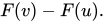
An equivalent formulation is this: is simply connected if and only if it is path-connected, and whenever and are two paths (that is, continuous maps) with the same start and endpoint ( and ), then can be continuously deformed into while keeping both endpoints fixed. Explicitly, there exists a homotopy such that and

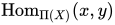
A topological space is simply connected if and only if is path-connected and the fundamental group of at each point is trivial, i.e. consists only of the identity element. Similarly, is simply connected if and only if for all points the set of morphisms in the fundamental groupoid of has only one element.[2]

In complex analysis: an open subset is simply connected if and only if both and its complement in the Riemann sphere are connected. The set of complex numbers with imaginary part strictly greater than zero and less than one furnishes an example of an unbounded, connected, open subset of the plane whose complement is not connected. It is nevertheless simply connected. A relaxation of the requirement that be connected leads to an exploration of open subsets of the plane with connected extended complement. For example, a (not necessarily connected) open set has a connected extended complement exactly when each of its connected components is simply connected.

Informal discussion

[edit]

Informally, an object in our space is simply connected if it consists of one piece and does not have any "holes" that pass all the way through it. For example, neither a doughnut nor a coffee cup (with a handle) is simply connected, but a hollow rubber ball is simply connected. In two dimensions, a circle is not simply connected, but a disk and a line are. Spaces that are connected but not simply connected are called non-simply connected or multiply connected.

A sphere is simply connected because every loop can be contracted (on the surface) to a point.


The definition rules out only handle-shaped holes. A sphere (or, equivalently, a rubber ball with a hollow center) is simply connected, because any loop on the surface of a sphere can contract to a point even though it has a "hole" in the hollow center. The stronger condition, that the object has no holes of any dimension, is called contractibility.

Examples

[edit]
A torus is not a simply connected surface. Neither of the two colored loops shown here can be contracted to a point without leaving the surface. A solid torus is also not simply connected because the purple loop cannot contract to a point without leaving the solid.
  • The Euclidean plane is simply connected, but minus the origin is not. If then both and minus the origin are simply connected.
  • Analogously: the n-dimensional sphere is simply connected if and only if
  • Every convex subset of is simply connected.
  • A torus, the (elliptic) cylinder, the Möbius strip, the projective plane and the Klein bottle are not simply connected.
  • Every topological vector space is simply connected; this includes Banach spaces and Hilbert spaces.
  • For the special orthogonal group is not simply connected and the special unitary group is simply connected.
  • The one-point compactification of is not simply connected (even though is simply connected).
  • The long line is simply connected, but its compactification, the extended long line is not (since it is not even path connected).

Properties

[edit]

A surface (two-dimensional topological manifold) is simply connected if and only if it is connected and its genus (the number of handles of the surface) is 0.

A universal cover of any (suitable) space is a simply connected space which maps to via a covering map.

If and are homotopy equivalent and is simply connected, then so is

The image of a simply connected set under a continuous function need not be simply connected. Take for example the complex plane under the exponential map: the image is which is not simply connected.

The notion of simple connectedness is important in complex analysis because of the following facts:

  • The Cauchy's integral theorem states that if is a simply connected open subset of the complex plane and is a holomorphic function, then has an antiderivative on and the value of every line integral in with integrand depends only on the end points and of the path, and can be computed as The integral thus does not depend on the particular path connecting and
  • The Riemann mapping theorem states that any non-empty open simply connected subset of (except for itself) is conformally equivalent to the unit disk.

The notion of simple connectedness is also a crucial condition in the Poincaré conjecture.

See also

[edit]

References

[edit]
Revisions and contributorsEdit on WikipediaRead on Wikipedia
from Grokipedia
In , a simply connected space is a path-connected in which every closed path, or loop, is null-, meaning it can be continuously deformed to a constant path at a single point while remaining within the . This property implies that the has no "holes" in the sense that loops cannot encircle any obstructions that prevent contraction. Equivalently, a is simply connected if its is trivial, i.e., π1(X)={e}\pi_1(X) = \{e\}, capturing the absence of non-trivial homotopy classes of loops based at any point. Key examples of simply connected spaces include the Euclidean spaces Rn\mathbb{R}^n for any n1n \geq 1, as any loop in such a space can be straightened via linear homotopy. Higher-dimensional spheres SnS^n for n2n \geq 2 are also simply connected, whereas the circle S1S^1 is not, since loops around it have non-zero winding numbers that prevent contraction. Convex subsets of Rn\mathbb{R}^n inherit this property, and homeomorphic images preserve simply connectedness. In two dimensions, a bounded domain is simply connected if both the domain and its complement in the plane are connected. Simply connected spaces play a central role in and related fields, such as providing a foundation for higher groups and classifying spaces up to equivalence. In , a simply connected domain in the allows every to possess an throughout the domain, and the of any over a closed vanishes, generalizing Cauchy's . This connectivity condition also enables the existence of analytic branches of multi-valued functions, like the logarithm, in such domains excluding the origin.

Foundational Concepts

Path-Connectedness

A XX is path-connected if, for any two points x,yXx, y \in X, there exists a continuous path γ:[0,1]X\gamma: [0,1] \to X such that γ(0)=x\gamma(0) = x and γ(1)=y\gamma(1) = y. This property ensures that every pair of points in the space can be joined by a continuous within the space itself. Path-connectedness is a stronger condition than mere connectedness: every path-connected space is connected, but the converse does not hold. A classic counterexample is the topologist's sine , defined as the set S={(x,sin(1/x))0<x1}{(0,y)1y1}S = \{(x, \sin(1/x)) \mid 0 < x \leq 1\} \cup \{(0, y) \mid -1 \leq y \leq 1\} in R2\mathbb{R}^2 with the subspace topology; this space is connected because it cannot be partitioned into two nonempty disjoint open sets, yet it is not path-connected since no continuous path exists from the origin (0,0)(0,0) to a point like (1,sin1)(1, \sin 1) on the oscillating . Euclidean spaces Rn\mathbb{R}^n for n1n \geq 1 exemplify path-connected spaces, where the straight-line segment γ(t)=(1t)x+ty\gamma(t) = (1-t)x + ty for t[0,1]t \in [0,1] provides a continuous path between any two points x,yRnx, y \in \mathbb{R}^n. In contrast, a discrete with more than one point, such as {a,b}\{a, b\} with the discrete topology where singletons are open, is disconnected (hence not path-connected), as it decomposes into two nonempty disjoint open sets {a}\{a\} and {b}\{b\}. Path-connectedness serves as a foundational requirement for simply connected spaces because the standard definition of simple connectedness combines path-connectedness with the property that every loop—a continuous path from a point to itself—is null-homotopic. Without path-connectedness, a space might consist of separate components where paths (and thus loops) cannot connect across them, preventing a unified notion of loop contractibility across the entire ; a brief proof outline proceeds by supposing XX is not path-connected, so it has at least two path components, each of which would require separate homotopical analysis, contradicting the global uniformity assumed in simple connectedness.

Loops and Homotopy

In topological spaces, loops serve as a key construct for analyzing connectivity via continuous deformations. A loop based at a point x0x_0 in a XX is a continuous path γ:[0,1]X\gamma: [0,1] \to X such that γ(0)=γ(1)=x0\gamma(0) = \gamma(1) = x_0. Homotopy provides the mechanism for deforming one loop into another while fixing the basepoint. Two loops γ0,γ1:[0,1]X\gamma_0, \gamma_1: [0,1] \to X based at x0x_0 are homotopic if there exists a continuous H:[0,1]×[0,1]XH: [0,1] \times [0,1] \to X satisfying H(s,0)=γ0(s),H(s,1)=γ1(s),\begin{align*} H(s,0) &= \gamma_0(s), \\ H(s,1) &= \gamma_1(s), \end{align*} and H(0,t)=H(1,t)=x0H(0,t) = H(1,t) = x_0 for all s,t[0,1]s,t \in [0,1]. This HH traces a continuous family of loops interpolating between γ0\gamma_0 and γ1\gamma_1, with the basepoint held constant throughout. Homotopy defines an on the set of loops based at x0x_0, grouping them into equivalence classes denoted [γ][\gamma], where two loops belong to the same class if they are . These classes encode the distinct types of loops up to deformation, forming the foundation for homotopy-theoretic invariants. A distinction exists between based homotopy and free homotopy of loops. Based homotopy, as defined above, requires the basepoint to remain fixed at x0x_0 during the entire deformation. Free homotopy, however, applies to loops that may have varying basepoints or allows the basepoint to move, as long as each stage of the deformation remains a closed path. While both are useful, based homotopy is central to the study of pointed spaces and the .

Definition and Characterizations

Formal Definition

In , a topological space XX is defined to be simply connected if it is path-connected and every loop based at any point in XX is null-. A loop in XX is a continuous γ:[0,1]X\gamma: [0,1] \to X such that γ(0)=γ(1)\gamma(0) = \gamma(1), and it is null-homotopic if there exists a continuous H:[0,1]×[0,1]XH: [0,1] \times [0,1] \to X such that H(s,0)=γ(s)H(s,0) = \gamma(s) for all s[0,1]s \in [0,1], H(0,t)=H(1,t)H(0,t) = H(1,t) for all t[0,1]t \in [0,1], and H(s,1)H(s,1) is constant for all s[0,1]s \in [0,1]. This means the loop can be continuously deformed to a constant while remaining within XX. Some formulations of the definition additionally require XX to be locally path-connected, ensuring that the path components are open sets and that homotopy classes of loops are independent of the basepoint choice. This condition helps guarantee that the is well-defined without additional complications in non-locally path-connected spaces. Simply connectedness is a homotopy invariant: if two spaces are homotopy equivalent, then one is simply connected the other is.

Equivalent Formulations

A simply connected space admits several equivalent characterizations in , most prominently through the . The π1(X,x0)\pi_1(X, x_0) of a pointed (X,x0)(X, x_0) is constructed as the set of classes of based loops in XX at the basepoint x0x_0, equipped with a group structure under of loops. To form π1(X,x0)\pi_1(X, x_0), consider loops γ:[0,1]X\gamma: [0,1] \to X with γ(0)=γ(1)=x0\gamma(0) = \gamma(1) = x_0. Two loops γ\gamma and δ\delta are homotopic relative to the basepoint if there exists a continuous map H:[0,1]×[0,1]XH: [0,1] \times [0,1] \to X such that H(s,0)=H(s,1)=x0H(s,0) = H(s,1) = x_0 for all ss, H(0,t)=γ(t)H(0,t) = \gamma(t), and H(1,t)=δ(t)H(1,t) = \delta(t). The homotopy classes [γ][\gamma] form the elements of π1(X,x0)\pi_1(X, x_0), with the constant loop as the identity element. The group operation is defined by [γ][δ]=[γδ][\gamma] \cdot [\delta] = [\gamma \ast \delta], where γδ\gamma \ast \delta is the reparametrized concatenation: (γδ)(t)=γ(2t)(\gamma \ast \delta)(t) = \gamma(2t) for t[0,1/2]t \in [0, 1/2] and (γδ)(t)=δ(2t1)(\gamma \ast \delta)(t) = \delta(2t - 1) for t[1/2,1]t \in [1/2, 1]. The inverse of [γ][\gamma] is the class of the reversed loop γ1(t)=γ(1t)\gamma^{-1}(t) = \gamma(1 - t). This construction yields a group whose triviality (i.e., π1(X,x0)={e}\pi_1(X, x_0) = \{e\}, where ee is the identity) is independent of the choice of basepoint x0x_0 for path-connected XX. A path-connected space XX is simply connected if and only if π1(X,x0)\pi_1(X, x_0) is the for any (equivalently, some) basepoint x0Xx_0 \in X. This algebraic condition captures the topological notion that every based loop in XX is nullhomotopic, meaning homotopic to the constant loop at x0x_0. Equivalently, the first groupoid of XX—whose objects are points of XX and whose morphisms are classes of paths between them—is such that there is a unique class of paths between any two points in XX, reflecting the absence of "holes" detectable by loops. Other equivalent formulations include the condition that every continuous map f:S1Xf: S^1 \to X (where S1S^1 is the unit circle) extends to a continuous map f~:D2X\tilde{f}: D^2 \to X (where D2D^2 is the unit disk), or is nullhomotopic. In , a space XX is 1-connected if it is path-connected and π1(X,x0)\pi_1(X, x_0) is trivial, which aligns precisely with the definition of simply connected.

Intuitive Understanding

Informal Description

A simply connected space intuitively lacks "holes" in a topological sense, meaning that any closed loop drawn within the space can be continuously shrunk down to a single point without leaving the space or encountering obstructions. This property captures the idea of a space being "hole-free," allowing loops to deform freely, much like how a loop on the surface of a can always be contracted to a point, whereas a loop encircling the hole of a cannot be shrunk without breaking or leaving the surface. A helpful visualization for this concept is the rubber band : imagine placing a rubber band around an object representing the ; in a simply connected , the band can always be slid off the object entirely or shrunk to a point without getting caught, whereas in a with holes, the band may become trapped around an obstruction and cannot be removed or contracted continuously. In two dimensions, for an in the R2\mathbb{R}^2, being simply connected aligns with the intuition that the complement of the set in the plane has no bounded connected components, tying into the , which ensures that simple closed curves separate the plane into an interior and exterior without additional enclosed regions. This absence of bounded "islands" in the complement reinforces the ability of loops to contract freely. Path-connectedness is essential in this context because it guarantees the space is in one piece, allowing loops to roam throughout the entire space without being confined to disconnected regions, thereby enabling the consistent application of the shrinking property across the whole domain.

Distinction from Contractibility

A contractible space is a topological space that is homotopy equivalent to a single point, meaning there exists a continuous deformation of the space onto itself that shrinks it to that point while preserving the topology. This equivalence implies that all homotopy groups of the space, including the zeroth homotopy group π0\pi_0, are trivial. In contrast, a simply connected space is defined as a path-connected topological space with a trivial fundamental group π1\pi_1, indicating that every loop based at a point can be continuously contracted to that point. While every contractible space is simply connected—since homotopy equivalence to a point ensures path-connectedness and π1\pi_1 triviality—the converse does not hold, as simply connectedness only requires the triviality of π1\pi_1 and path-connectedness, without constraining higher homotopy groups. A classic example illustrating this distinction is the 2-sphere S2S^2, which is simply connected (π1(S2)=0\pi_1(S^2) = 0) but not contractible, as it cannot be continuously deformed to a point due to its nontrivial second π2(S2)=Z\pi_2(S^2) = \mathbb{Z}. Conversely, an infinite-dimensional , as a convex subset of a , is contractible via the straight-line from any point, deforming it continuously to that point. The implications of this difference are significant in : contractible spaces have the homotopy type of a point and thus in all dimensions, whereas simply connected spaces may exhibit complex higher-dimensional structure despite lacking 1-dimensional holes. The serves as the primary distinguisher for π1\pi_1, highlighting why simply connectedness is a weaker condition.

Examples

Simply Connected Examples

Euclidean spaces Rn\mathbb{R}^n for n1n \geq 1 provide the prototypical examples of simply connected spaces, as they are path-connected and possess trivial fundamental groups π1(Rn)={e}\pi_1(\mathbb{R}^n) = \{e\}. These spaces lack any topological "holes" that could prevent loops from contracting to a point, making every closed path homotopic to the constant path. The nn-spheres SnS^n for n2n \geq 2 are also simply connected, with π1(Sn)={e}\pi_1(S^n) = \{e\}, in contrast to the circle S1S^1. Any loop on SnS^n can be continuously deformed to a point due to the sphere's higher-dimensional connectivity, which allows paths to avoid encircling non-existent one-dimensional voids. Convex subsets of Rn\mathbb{R}^n, such as balls, half-spaces, or polyhedra, inherit simply connectedness from the ambient , as straight-line segments provide unique paths between points, ensuring all loops are null-homotopic. This property holds because convexity guarantees path-connectedness and the absence of obstructions to . The special unitary groups SU(n)SU(n) for n2n \geq 2 are compact, connected Lie groups that are simply connected, with π1(SU(n))={e}\pi_1(SU(n)) = \{e\}. Their universal covering is trivial, reflecting the group's structure without elements that would indicate non-trivial loops. In , trees—acyclic connected graphs—are simply connected spaces when viewed as one-dimensional CW-complexes, as they admit no non-trivial loops and are contractible to a point. Every path in a is unique, ensuring that the fundamental group vanishes.

Counterexamples

A classic counterexample of a path-connected space that is not simply connected is the circle S1S^1, which can be viewed as the unit circle in the plane. The π1(S1)\pi_1(S^1) is isomorphic to the integers Z\mathbb{Z}, generated by the homotopy class of a loop that winds once around the circle, such as the map ω(s)=(cos2πs,sin2πs)\omega(s) = (\cos 2\pi s, \sin 2\pi s) for s[0,1]s \in [0,1]. This nontrivial implies that loops winding multiple times around S1S^1 cannot be continuously contracted to a point within the space, reflecting the one-dimensional "hole" inherent to the circle's . The torus T2T^2, obtained as the product space S1×S1S^1 \times S^1, provides another path-connected space that fails to be simply connected. Its fundamental group is π1(T2)ZZ\pi_1(T^2) \cong \mathbb{Z} \oplus \mathbb{Z}, abelianized from the free group on two generators corresponding to loops along the meridian (around the central hole) and the (through the tube). These two independent directions of winding prevent arbitrary loops from being null-homotopic, as demonstrated by Seifert-van Kampen theorem applied to the torus's cell structure. Removing a single point from the yields R2{0}\mathbb{R}^2 \setminus \{0\}, a that is path-connected but not simply connected. The π1(R2{0})Z\pi_1(\mathbb{R}^2 \setminus \{0\}) \cong \mathbb{Z}, arising from loops that encircle the origin, which cannot be contracted without passing through the punctured point. This deformation retracts onto S1S^1, inheriting the latter's nontrivial and illustrating how a puncture creates an obstruction to loop contraction in an otherwise simply connected ambient . The special orthogonal groups SO(n)SO(n) for n3n \geq 3 serve as important counterexamples from theory, being path-connected matrix groups that are not simply connected. Specifically, π1(SO(n))Z/2Z\pi_1(SO(n)) \cong \mathbb{Z}/2\mathbb{Z} for n3n \geq 3, reflecting a twofold covering by the Spin(n)Spin(n), where loops corresponding to rotations by 2π2\pi are nontrivial but become contractible in the cover. This binary structure arises from the topology of rotations in dimensions three and higher, preventing full simple connectedness despite the group's connectedness. The , constructed as the union of circles of radius 1/n1/n centered at (1/n,0)(1/n, 0) in the plane for n=1,2,n = 1, 2, \dots, with all circles passing through the origin, is a compact, path-connected subspace of R2\mathbb{R}^2 that is not simply connected. Its π1\pi_1 is uncountable and highly non-free, generated by infinitely many loops shrinking toward the origin, which cannot all be simultaneously contracted due to the infinite accumulation at a single point. This example highlights subtler obstructions beyond finite generators, where the local wildness at the origin complicates even though the space is path-connected.

Topological Properties

Fundamental Properties

Simply connected spaces exhibit several core intrinsic properties that highlight their structural simplicity in terms of . A key feature is homotopy invariance: if two path-connected spaces XX and YY are equivalent, then XX is simply connected if and only if YY is simply connected. This holds because homotopy equivalences induce isomorphisms on the π1\pi_1, preserving the triviality of π1(X)={e}\pi_1(X) = \{e\}. Similarly, retracts inherit this property; if AA is a retract of a simply connected space XX, then AA is simply connected. The retraction provides a split injection on fundamental groups, and since π1(X)=0\pi_1(X) = 0, it forces π1(A)=0\pi_1(A) = 0. Another fundamental property concerns products: the of simply connected path-connected spaces is itself simply connected. For path-connected spaces XX and YY, the satisfies π1(X×Y)π1(X)×π1(Y)\pi_1(X \times Y) \cong \pi_1(X) \times \pi_1(Y), so if both factors have trivial π1\pi_1, the product does as well. This extends to finite products and underscores the stability of simply connectedness under direct constructions. In the context of surfaces, simply connectedness imposes strong restrictions on topology. For closed orientable surfaces, only the 2-sphere (genus 0) is simply connected, as higher-genus surfaces have non-trivial π1\pi_1 generated by loops around handles. Among non-compact 2-manifolds, the Euclidean plane R2\mathbb{R}^2 (topologically a disk, also genus 0 in the open sense) exemplifies a simply connected surface, where every loop contracts to a point without obstruction. Regarding local versus global behavior, simply connectedness is a global property reflecting the contractibility of all loops, but in nice spaces such as manifolds or CW-complexes, it aligns with simply connectedness. Manifolds are locally Euclidean, and since Rn\mathbb{R}^n (for n1n \geq 1) is simply connected, local neighborhoods inherit trivial π1\pi_1, ensuring the global triviality propagates consistently. This harmony distinguishes simply connected spaces from those with local holes that prevent global contraction, like the punctured plane.

Relation to Covering Spaces

In topology, for a path-connected and locally path-connected space XX, the universal X~\tilde{X} is a simply connected of XX, unique up to over XX, and the group of deck transformations of this cover is isomorphic to the π1(X)\pi_1(X). This isomorphism arises because the universal cover has trivial fundamental group, so the deck group acts freely and properly discontinuously on X~\tilde{X}, reflecting the action of π1(X)\pi_1(X) on the fibers. A space XX is simply connected if and only if it is its own universal , meaning every of XX is trivial, i.e., a of copies of XX. In this case, the π1(X)\pi_1(X) is trivial, so there are no non-trivial connected covers. A classic example is the circle S1S^1, whose universal cover is the real line R\mathbb{R} via the exponential map p:RS1p: \mathbb{R} \to S^1, te2πitt \mapsto e^{2\pi i t}, which is simply connected, with deck transformations given by the integer translations Z\mathbb{Z} acting on R\mathbb{R}. More generally, there is a Galois correspondence between subgroups of π1(X)\pi_1(X) and isomorphism classes of connected covering spaces of XX: normal subgroups correspond to regular covers (where the deck group acts transitively), and the full π1(X)\pi_1(X) corresponds to the universal cover. This bijection classifies all covers in terms of the fundamental group, with simply connectedness implying the trivial subgroup is the only one, hence only the trivial cover.

Applications

In Complex Analysis

In complex analysis, the concept of simply connectedness plays a pivotal role in establishing key results about holomorphic functions on domains in the . A simply connected domain in C\mathbb{C}, intuitively lacking "holes," ensures that closed contours can be contracted to a point within the domain, which is crucial for theorems. One foundational application is , which states that if ff is holomorphic in a simply connected domain ΩC\Omega \subset \mathbb{C} and γ\gamma is a closed contour in Ω\Omega, then γf(z)dz=0\int_\gamma f(z) \, dz = 0. This vanishing holds because the simply connectedness allows the use of in the complex setting, decomposing the integral into exact differentials without residues from enclosed singularities. Building on this, the extends the implications to and . Specifically, if ff is holomorphic in a simply connected domain ΩC\Omega \subset \mathbb{C}, then ff admits a single-valued FF in Ω\Omega, meaning F(z)=f(z)F'(z) = f(z) and FF is well-defined without branches. This result arises from the fact that in simply connected domains, all closed paths are homotopic to a point, preventing —path-dependent variations in analytic continuations—that would otherwise require multi-valued functions. Consequently, primitives exist globally, simplifying computations of definite integrals and enabling uniform behavior of holomorphic functions across the domain. The further underscores the uniformity of simply connected domains, asserting that any proper simply connected open subset ΩC\Omega \subset \mathbb{C} (with ΩC\Omega \neq \mathbb{C}) is conformally equivalent to the open unit disk D={zC:z<1}\mathbb{D} = \{ z \in \mathbb{C} : |z| < 1 \}. There exists a biholomorphic map f:ΩDf: \Omega \to \mathbb{D} that preserves angles and is one-to-one, normalizing the domain for further analysis. A canonical example is the unit disk itself, which is simply connected and serves as the for uniformization; this equivalence facilitates the study of boundary behavior and functions via Poisson integrals on D\mathbb{D}. Historically, the integration of simply connectedness into gained prominence in the early 20th century through the , independently proved by and Paul Koebe in 1907, which classifies all simply connected Riemann surfaces as conformally equivalent to , plane, or disk. This development, rooted in Bernhard Riemann's 1851 ideas but rigorously established later, bridged and function theory, influencing advancements in conformal mapping and modular forms.

In Manifolds and Lie Groups

In , simply connected manifolds play a central role in classification theorems. Perelman's proof of the in 2003 established that every closed, simply connected is homeomorphic to the S3S^3. This result, part of the broader , implies that such manifolds admit one of eight Thurston geometries, with the being the only one for simply connected cases, resolving a longstanding problem in . Lie groups provide concrete examples of simply connected spaces in the context of continuous symmetries. The SU(n)SU(n) for n2n \geq 2 is simply connected, meaning its is trivial, which facilitates the construction of faithful representations in and . In contrast, the special SO(n)SO(n) for n3n \geq 3 is not simply connected, with π1(SO(n))Z/2Z\pi_1(SO(n)) \cong \mathbb{Z}/2\mathbb{Z}. A key illustration is the universal cover of SO(3)SO(3), which is SU(2)SU(2), and SU(2)Spin(3)SU(2) \cong \mathrm{Spin}(3), demonstrating how simply connectedness resolves topological obstructions in rotation groups. This covering relationship highlights the role of simply connected covers in lifting representations from non-simply connected Lie groups. Calabi-Yau manifolds, which are Ricci-flat Kähler manifolds with trivial first , often appear as simply connected spaces in compactifications. In heterotic string models, simply connected Calabi-Yau threefolds equipped with vector bundles yield and vacua, preserving and enabling realistic spectra. A fundamental theorem in states that finite-dimensional complex representations of connected, simply connected groups are equivalent to representations of their Lie algebras, implying no nontrivial classes arise in the passage from algebra to group. This equivalence ensures that all continuous representations are "single-valued" and determined solely by infinitesimal data, without projective ambiguities present in non-simply connected cases. Recent advances in , emerging post-2010, reinterpret simply connected spaces through univalent foundations, where types correspond to homotopy types and identities to paths. This framework, formalized in the book, provides a synthetic approach to , enabling constructive proofs of properties like simply connectedness without classical set-theoretic assumptions.

References

Add your contribution
Related Hubs
User Avatar
No comments yet.