


Community hub
Recent from talks
Contribute something
Nothing was collected or created yet.
Sisu Auto
View on Wikipedia | This article needs to be updated. (August 2019) |
Oy Sisu Auto Ab is a truck manufacturer based in Raseborg, Finland. Its name comes from the Finnish word sisu meaning guts, grit and determination.
Key Information


Sisu Auto has a subsidiary company, Sisu Defence, producing high mobility tactical vehicles for military use.
Production
[edit]
.jpg)
Civil trucks
[edit]The currently available Sisu Polar variants are with three, four or five axles in various layouts. The applications are:
- Sisu Crane – crane trucks
- Sisu Rock – dump trucks
- Sisu Roll – hook loader
- Sisu Timber – timber trucks
- Sisu Works – road maintenance trucks
- Sisu Carrier – heavy machinery carrier
Military trucks
[edit]- Sisu 4×4
- Sisu 6×6
- Sisu 8×8
- Sisu 10×10
History
[edit]1931 to 1939
[edit]The company was established on 1 April 1931 as Oy Suomen Autoteollisuus Ab (SAT). It originated from two neighbouring Helsinki-based automobile coach builders, Autokoritehdas and Autoteollisuus-Bilindustri, both of which had fallen into financial troubles by the beginning of the 1930s. The banks, which were funding both companies, pressed them to put together their operations under one company. The founders were Emil Anton Winckelmann, Lars Wilhelm Åberg and Karl Arthur Nordgren. In the first company meeting the company general manager was selected John Hellsten and the technical manager was appointed Tor Nessling.[3]
At first SAT continued the coachbuilding business which it had inherited from its predecessors, but also put into practice the plan of building own vehicles, which was evolved already earlier, when Autoteollisuus-Bilindustri had ordered few Volvo chassis for outfitting. These chassis formed the basis for the first pre-series of vehicles.[3]
As soon as the business started, SAT started to seek a good brand for its products. In the early summer of 1932 the company set up a name competition which was advertised in the main newspapers of Helsinki. The competition got a lot of attention and some 3000–4000 suggestions were received. The jury met in Hotel Kämp in Helsinki to select the winner in the middle of June 1932. Three candidates were selected: Sisu ("guts; stamina; stubbornness, determination"), Karhu ("bear") and Haukka ("hawk"). Eventually, Sisu became selected.[4] As many people had suggested the successful name, the winner of the 1,000-mark prize was selected by lottery – he was young Veikko Arohonka, actually signed up by his older brother Eino, who later became a writer.[5]

The first nine Sisus, models S-321 and S-323, were handed over to the customers in 1932. Six of them were lorries and one was a bus. The first production series, based heavily on Volvo components, were made in 1933.[6]
Beginning of domestic vehicle production led to an odd episode – the Finnish government became concerned about losing toll incomes because of the locally built vehicles. In 1933 Dr. Juho Jännes was assigned to investigate the financial impact of domestically produced automobiles. The outcome was that if 500 of the vehicles annually sold in Finland were produced domestically, the state would lose 700,000 marks because of reduced toll income but the benefit due to employment effect would be between 17–27 million marks.[7]
John Hellsten was replaced by Tor Nessling as general manager in 1932. Nessling started to develop the business determinedly; the technical challenges caused by weak locally produced parts were resolved by time and the degree of domestic work could be increased. Another, persistent problem was the continuous lack of cash reserves.[8] Nessling tried to lobby the government underlining the positive effect of domestic vehicle production, but he was not listened, and the state reduced the tolls of imported vehicles making competition more intense. The company owners did not believe in the potential of domestic vehicle industry and Nessling could obtain a large part of the shares from the funding banks for relatively cheap, eventually owning 80% of SAT.[9] The continuous pressure and repeating setbacks did not discourage the personnel and management, who did what ever it took to solve out the challenges. Over time the technical quality was reached to a such level that SAT could convince the customers that the relatively high price of Sisus, compared to imported vehicles, pays off due to their robustness.[8]

In 1934 The Volvo-based S-321 and S-341 series were followed by short-lived SO-series, which was already in 1935 replaced by the SH-series,[10] with which SB-series was produced in parallel 1938–1941.[11] The first three-axle lorry was produced in 1935.[8]
The first country where Sisus were exported was Estonia, where SAT sold the first SH-2 chassis in 1936. Due to the contemporary Estonian taxation system, complete vehicles could not be exported there, and therefore the cabins and superstructures were built locally. More units were sold in 1938. Latvia was the first country where complete Sisus were exported. The city of Riga bought a series of forward control buses powered by Hercules diesel engines which were delivered in 1937 and 1938. The complete number of vehicles exported to the Baltic states before the Second World War is not known but the business was regarded successful.[11]
1939 to 1945: Second World War
[edit]Changes in line of production
[edit]When the Winter War broke out, as a strategically important company SAT went under military administration. A part of the production was moved to Järvenpää and Lahti. The company produced for example aerial bombs and transportation devices for them.[12]
Right after the Winter War in spring 1940 SAT started producing an own carburettor type under name Häkä for carbon monoxide fuel. Technically the carburettor was not one of the most successful of its kind. The development work was continued with subsidies of the state until it was finally filed in 1946 as unnecessary due to improved availability of petrol.[13]
SAT started own engine production in 1940 under Hercules licence.[14] This together with tram building[15] and 1942 started axle production[16] led to lack of space in the factory area. The first plans of moving some of the production out from Helsinki were made already before the war.[15] The plan was put into practice due to the war which made the factory located in the capital vulnerable to Soviet air raids.[17] In 1942 the construction of new premises began in Karis, which was out but sufficiently reachable from Helsinki. Coach- and cabin building was transferred first, after which the tram production followed; building of lorries stayed exclusively in Helsinki until 1950.[15]
The 1942 introduced Sisu S-15 bus chassis was the first Sisu entirely built by using domestically produced components.[13]
The scope of production remained diverse until the 1950s partly due to war reparation industry. SAT produced parts for Finnish paper machine builders and other engineering companies.[18]
Yhteissisu
[edit]
At the same time when SAT built the new factory in Karis, the Finnish Defence Forces reported needing thousands of vehicles in the near future.[19] SAT suggested building the factory larger in order to meet the demand. However, the importers of other makes as well as some politicians suspected that SAT tried to use the war to gain a dominant position in the Finnish market.[17] Eventually, an agreement was reached in 1943 when SAT, the state and a number of Finnish companies set up a separate company Yhteissisu to produce lorries. SAT and Yhteissisu signed a contract about transferring Sisu S-21 lorry production to Yhteissisu.[20] Vanaja municipality next to Hämeenlinna was selected for the factory location.[21]
The war was over before Yhteissisu could start serial production at the full scale.[22] Yhteissisu had the right to use the Sisu-brand until June 1948. When this expired, the company was renamed Vanajan Autotehdas (VAT) and its products were named Vanaja. VAT became a strong competitor to SAT in the Finnish market which was small but still protected by import restrictions.[23]
According to the contract with Yhteissisu, SAT was not allowed to produce lorries during the five years' period. SAT made Sisu S-15 buses but some of the chassis were fitted with lorry cabins and superstructures.[16]
1945 to 1969: Growth and diversification
[edit]In 1949 SAT made a return to lorry production with the Sisu K-23.[24] The first heavy forward control lorries were the 1956 produced B-56 and 1958 introduced B-72, both of them being built on bus chassis.[25] The small forward control lorry Nalle-Sisu KB-24 came to market in 1955.[26] Other notable models introduced in the 1950s are the heavy dumper trucks K-36,[27] the first 6×4 driven Sisu, K-32,[28] and K-44 with a North European specialty, 4×4+2 layout.[29]
SAT started partnership with Leyland Motors Ltd. in 1950. The background originates to friendship between the general managers of both companies, Tor Nessling and Donald Stokes. For a while the SAT test department investigated for possibilities of producing Leyland engines under licence; trials for better output and torque were made on test bench with turbocharged applications, before Leyland even had taken such into production. As a part of the partnership SAT became representative of Leyland products in Finland.[30]

The 1954–1959 produced trams equipped with two-axle bogies featured progressive steel structure technology that Valmet and Tampella later copied for their jointly developed tram type. SAT produced 4×4-driven "rail trucks" for railway maintenance work under assignment of the Finnish State Railways in the 1950s. The first ones, JXB 7, JXB 12 and JXB 13 were equipped with a one-man cabin; later came JA-4 and JA-5 with cabins for three. The mechanical crane was replaced by a hydraulic one in the 1966–1972 produced JA-9SV, JA-12, JA-14 and JA-16. From 1958 SAT produced rail control vehicles which were equipped with coachwork similar to forward control buses. Some of them were produced jointly with Kiitokori and VAT. Also some KB-48 4×4 road-rail lorries were delivered. Altogether SAT delivered 150 rail trucks of various types to the State Railways. In 1963–1970 SAT produced three types of two-axle light diesel locomotives. The Sisu JA-7 were powered by Leyland diesels and the railway company used designations Tka 2 and Tka 3.[18]
SAT sold a number of Hercules-based Sisu AMG engines to Dutch DAF and got as payment total 96 pieces of forward control DAF models K-50, P-50 and A-50 in 1951. The vehicles were delivered without engines, some of them were lacking of gearboxes and electric components. They were equipped with the same Sisu AMG engines and other Sisu parts at the Fleminginkatu factory in Helsinki. The last units were sold in 1954.[31]
In 1951 and 1955–1957 SAT imported total 105 Trojan vans. The first imported vehicles undertook many changes before they met the requirements. Some of them got a Finnish made body. In 1956 SAT built a series of ten DKW Schnellasters from CKD kits imported from West Germany; they were sold with name Donau-Sisu. Additionally, some modifications were made for SAT-imported Aveling-Barford and Avelin Austin graders and dumper trucks and also Leyland Terrier and BMC Mastiff lorries.[31]

In the 1950s Finland was the most important market for Colombian coffee. Finland and Colombia signed a bilateral trade agreement in 1959 and Colombian coffee was paid with Sisus thereafter. The trading was handled via Banco Cafetero until it changed multilateral in 1968. Colombia grew the most important export destination of Sisus.[32] SAT had plans of starting local production in Medellín jointly with Leyland Motors but the project was eventually cancelled due to financial risks.[33] In the early 1970s the Andean Community of Nations decided about starting its own lorry production and the successful trading came to end after about 1200 sold units.[32]
The Karis factory grew the main production facility, when the new 157-metre-long assembly hall with nearly 100-metre production line was opened in 1961.[34]
In 1961 SAT produced the ballast tractor K-50SS which is still the largest automobile ever built in Nordic countries.[35] The first European serial built lorry with a hydraulically tiltable forward control cabin, Sisu KB-112,[36] was introduced in 1962. The 1965 introduced[37] Sisu K-148 featured bonnet and wings produced from reinforced plastic.[38] Due to lower costs and better durability the solution was soon applied on the whole conventional cabin model range.[39]
During the 1960s SAT made a number of innovations, experiments and extended to new areas. In 1961 the radial type hydraulic motor Sisu Nemo was patented. The main use was powering of trailer axles but Nemos were installed also in number of other applications.[40] The 1963 introduced K-138 features another innovation of the same period: vertical ejector exhaust pipe that dilutes exhaust gases. At the early 1960s also wide tyres to substitute double wheels were tested; the experiment done together with Nokia did not, however lead to production.[41]
In 1964 Leyland Motors became minority owner of SAT. The other owners were Tor and his wife Maj Nessling, and Arne Söderberg.[30]
SAT got another significant facility in Hämeenlinna in 1968 when the company was merged with Vanajan Autotehdas. Production of Vanaja lorries was run down and all civil lorry production was concentrated in Karis. Instead, production of bus and mobile crane chassis, terminal tractors and military lorries were transferred to Hämeenlinna.[34]
1970 to 1993: Modernisation and restructuring
[edit].jpg)


The well-proven Vanaja lifting tandem system found its way to new conventional cabin R-series and forward control M-series.[42]
General Manager Tor Nessling resigned in 1970, after leading the company for nearly four decades. He was replaced by Erik Gillberg.[43] Before that, the state had become an owner of the company in the VAT merger first with 17.2 percent share. The state grew its share in the company gradually. In 1976 the state signed the so-called tripartite agreement with British Leyland International and Saab-Scania, which both held 10% share of SAT thereafter.[44]
General Manager Gillberg led SAT through an extensive renewal of the whole product range. The Sisu S-series lorries were a result of this; the first example, light forward control SK 150 was introduced in 1980.[43] The new model series was designed in a such manner, that the same cabin modules could be used for conventional cabins as well as forward control models at different heights. Due to this, the company could offer a comprehensive selection of cabins for different purposes.[45] The development programme had, however, demanded excessive amount of money and the company main owner, the state, removed Gillberg from office at end of 1983. He was replaced by Jorma S. Jerkku who immediately started a heavy reorganisation programme. The company management was cut smaller and moved from Fleminginkatu to Konala in 1985. After some other functions were moved to Karis and Hämeenlinna, the Fleminginkatu premises were sold. Car sales, as well as Iveco representation were discontinued at the end of 1988. In the same year the plastics factory in Mäntyharju was separated under name Simex Oy and sold. Although Jerkku's actions were shocking to many, he by all odds stabilised the company.[43] On the other hand, the new organisation setup led to fragmentation of engineering operations between lorry, terminal tractor and military vehicle segments, and significant loss of synergy.[46]
1994 to 2003: Merger and break-up
[edit]In 1993 Jorma S. Jerkku was replaced by the company Vice President Heikki Luostarinen. Already year after that he was followed by Christer Granskog. A period of turmoil started: in April 1994 Sisu-Auto bought from Valmet its Transmec unit and tractor production; as a consequence, Valmet became minority owner in Sisu-Auto with 24.13% share. As also Valmet was state-owned, the state of Finland owned directly and indirectly total 99.01% part of Sisu-Auto.[47] The new company name was Oy Sisu Ab and its business units were Sisu Tractors with 48% share, Sisu Terminal Systems (19%), Sisu Logging (12%), Sisu Trucks (10%), Sisu Defence (4%), Sisu Factory Automation (4%) and Sisu Components (3%). Subsequently, the corporation was subdivided; first Oy Sisu Trucks Ab in November 1994 and at the beginning of the following year Sisu Defence Oy, Sisu Terminal Systems Oy and Fastems Oy; additionally, Sisu Diesel Oy was separated from Sisu Traktorit Oy. In 1995 Fastems was sold to Mercantile. The Hämeenlinna axle factory became Sisu Axles Oy at the end of the year. Sinex was sold in 1996.[48]
In January 1997 the company main owner, the state, agreed about selling main part of Sisu corporation to Partek.[49] This was carried out by gradual shift of the ownership during the year. In the meantime, the state continued the restructuring: Germany based Stama Maschinenbau GmbH was sold to Chiron-Werke GmbH & Co. KG. Sisu Defence went to the state, which later joined it to new defence industry company Patria.[48] Oy Sisu Ab was fully taken over by Partek by end of 1997 and it was not mentioned any more as a company in the Partek annual report.[49]
The November 1994 newly started Oy Sisu Trucks Ab was renamed Oy Sisu Auto Ab already in the same month. At the beginning the company manager was Per-Håkan Lindberg who resigned already in February 1995. He was replaced by Pekka E. Ojanen who held the post until 2001.[48]
The S-series, which had remained technically competitive over the whole 1980s,[50] was finally replaced by the new E-series launched in 1996.[51] In 1997 Sisu Auto signed an agreement of extensive co-operation with Renault V.I.; Sisu started using Renault components and represent Renault in Finland.[52] Consequently, the new cabin model was replaced by such of Renault just one year after its introduction.[51]
After the Partek takeover, which took place in the same year, the relative weight of lorry production became marginal in the corporate figures;[49] it was further reduced when Kone became the owner of Partek after dramatic takeover in 2002. By now the speculations of selling the lorry production increased.[53]
.JPG)

2004 until present: New ownership
[edit]In 2004 a group of Finnish investors became owners of Sisu Auto, while Kone remained a minor owner with under 20% share. General Manager Nils Hagman, who had replaced Ojanen in 2001, left his position for Teppo Raitis in 2004.[54] Raitis focussed the product scope on customised heavy duty multi axle vehicles for niche markets.[55] Raitis was replaced by Olof Elenius in 2007[56] In the same year Sisu Auto had sold its aftermarket services to Veho, which also represents Mercedes-Benz. Also the sales of civil lorries were moved to Veho in 2010.[57] The component partnership with Renault was ended in the same year; Sisu introduced the Polar series which uses components of Mercedes Benz.[58]
The first armoured 8×8-driven Sisu E13TP military vehicles were produced in 2008.[59][unreliable source?] Between 2009 and 2012 the Sisu production was operated by contract manufacturer Komas.[60]
Elenius bought the Sisu Auto shares jointly with the Deputy General Manager Timo Korhonen in 2010.[61] In 2013 Olof Elenius left his position and sold his share to Timo Korhonen, who now became the general manager and the sole owner of the company.[62]

Bus coach and chassis production
[edit]The first Sisu bus was produced in 1932 as a part of a pre-series of the first model. Also the coaches were produced by SAT.[6] The bus coach production was moved to a new facility in Karis and under a subsidiary called Oy Karia Ab in 1942. Bus coach production continued until the late 1950s and Karia was merged back to SAT in 1960.[34]
The first significant post-war bus chassis model was the 1948 introduced B-52 forward control model; the Sisu AMG engine could be rolled out for service on two rails, without dismounting of body panels.[16]
SAT tested layout in which the engine was mounted transversely in the back in a 1965 introduced bus chassis prototype B-65 which also featured independent front suspension. SAT started partnership with the British coach producer Metro Cammell Weymann. The companies aimed to international market and a prototype was displayed in Geneva and London Motor Shows. Only few units were finally built on Sisu B-76 chassis. In 1967 SAT introduced Sisu-Panther bus chassis types B-53 and B-58, made jointly with Leyland. The chassis was progressive type, partly frameless structure, which was rushed unfinished into market leading to several warranty issues. The construction principle, however, was applicable and later used as further improved in other Sisu chassis.[63] After merger with VAT in 1968 Sisu bus chassis production was moved gradually from Karis to Hämeenlinna.[64] In the 1970s Sisu chassis with Lahti bodies[63] and locally built Hess bodies were sold in Switzerland.[65] In the late 1970s SAT produced jointly a hybrid bus prototype SWS for Helsinki City Transport together with Wiima and Strömberg.[63]
In 1983 the company got a new general manager, Jorma S. Jerkku, who had previously worked for bus coach builder Ajokki Oy and who was aware of Sisu's position in the intense market. Consequently, Jerkku decided to end the bus chassis production in 1986.[66] The very last Sisu buses were produced in Hämeenlinna in 1989, equipped with Ajokki coaches and delivered to a Soviet customer.[64]

Tram production
[edit]In 1934 SAT started a new line of business despite the just recently ended great depression: the company started producing trams and the first three units were handed over to the city of Turku in the same year. This was followed by seven trams delivered in 1938. According to some sources, one two-axle tram was delivered to Viipuri in 1939, but this cannot be confirmed from any reliable sources. Between 1941 and 1944 total 18 units were built for the city of Helsinki and four motor trams and six wagons were sold to Turku. The influence of International Electric Company,[67] AEG and ASEA produced models sold to Helsinki in the 1920s and early 1930s was evident.[68]
Later the tram production was separated to a new SAT owned company OY Karia AB.[68]

Military vehicles
[edit]Already the very first production lot of Sisu S-323s included customised lorries for the Finnish Defence Forces.[69] During the Second World War lorry production was transferred to another company, Yhteissisu, which was set up to produce lorries and buses for the military.[20] In 1958 the Defence Forces arranged a thorough test trial comparing lorries of different producers; these tests gave the Sisu K-26, modified from a civil model, a good rating.[70] In 1959 SAT introduced Kärppä-Sisu K-35 for military use but 4×2-driven.[71] Production of military off-road vehicles started in 1964 when SAT presented KB-45, a new light 4×4 lorry. The military vehicle production was moved from Karis to Hämeenlinna when the upgraded A-45 was presented. Medium heavy SA-150 and heavy 6×6-driven SA-240 production followed after. SA-110 was a light lorry prototype which was only produced six units. In 1990 the demining vehicle RA-140 was introduced and they were produced a small series starting from 1994.[72]
The best known Sisu military vehicle is the armoured personnel carrier Pasi in different variants. The production of the first model, XA-180 was started in 1984 after thoroughgoing testing. Pasis have been commonly used in UN peacekeeping missions. The last Sisu-produced variant is XA-186, the later models have been produced by Patria when Sisu Defence was sold to the state. The last Pasis were produced in 2005.[72]
Sisu Auto introduced a new series of military designated lorries based on Sisu E-series in 1997, using components supplied by Renault. This series consisted of 6×6- and 8×8-driven vehicles. This led to the re-establishment of Sisu Defence in 2005 as a part of Sisu Auto. A notable milestone was a contract of armoured Sisu E13TP 8×8 vehicles to the Lithuanian Armed Forces.[72] A series of new light lorries Sisu A2045 was produced in 2009–2010 to replace the aged KB-45 and A-45 models.[73]
Mobile crane chassis
[edit]VAT had started producing mobile crane chassis for Lokomo in 1968 and SAT continued the business after taking over VAT. The types were 6×4 driven T-103, which was sold as Lokomo A330/331 NS, and 8×4-driven T-108 and T-109, of which Lokomo models were A 350/351 NS and A 390/391 NS. Making of mobile crane chassis was discontinued in 1981. The production in Hämeenlinna factory totalled 542 units.[74]
Vehicle imports
[edit]SAT planned starting vehicle imports in the late 1930s; a number of British car makes were considered, including Morris Motors products, as well as American tractors.[75] One Austrian Steyr Typ 220 Innenlenker visited in Finland for display in early 1939.[76] The import business started, however, shortly after the Second World War. In 1946 SAT became representative of Rolls-Royce cars and engines, Rover and Bentley followed in 1948. At the same time also West German products came to selection, for example Auto-Union cars and motor cycles and König outboard engines.[75]
Sisus started using Leyland diesels in 1949 and the partnership was extended to automobile imports in the 1950s.[75] As Leyland owned a part of SAT, the company was obligated to represent its products. Marketing and representing of the fragmented selection of Leyland products was unattractive business for SAT.[30]
The first SAT-imported Renault lorries came in the early 1980s. The business was discontinued when Sisu-Auto took Iveco representation in 1982;[76] this continued until 1988.[43] Sisu Auto started extensive partnership with Renault V.I. in 1997. This included representation of Renault lorries in Finland. Some Renault types were sold as Sisus for a while.[77]
Key components
[edit]Engines
[edit]The first Sisus were powered by Volvo supplied Penta engines.[78] The 1934 presented Sisu SO-models were equipped with Finnish produced Olympia engines which turned out to be too weak and unreliable. Therefore, the power source was changed again already in 1935 launched SH-series which was powered by American Hercules engines.[10] In 1937 Sisu became available with Hercules diesel engine but they were not sold many yet. In the following year another American engine, Buda was added in the selection – this Sisu-series was called SB respectively.[11]

During and after the Second World War SAT produced Hercules side valve petrol engines under licence. The initial model was called AMG of which military designation was SA-5; it was also produced by Tampereen Pellava- ja Rauta-teollisuus as Tampella 6000. It was followed by upgraded versions AMH, AMA and AMI. Other variants were marine models VMG and VMI Speedmarine and stationary engine PMG. PMGs were used on winches and compressors delivered to Soviet Union as war reparation. The last SAT-produced Hercules based engine unit was mounted on the first Sisu KB-45 military lorry prototype in 1964.[14]
In the 1950s the lorry and bus model selection diversified heavily and diesel engines became more common pushing aside the self-produced petrol engines. For a short time in late 1940s Hercules diesels were used, but as soon as their production ended, SAT was forced to find new power options. West German Henschels proved sturdy engines, but their power-to-weight ratio was not good, and moreover, the vehicle structures suffered from the heavy engine.[79] Henschel was finally dropped off from the selection because the weakening Finnish mark in relation to German mark made them too expensive.[80]
The first Sisu with British made Leyland engine came already in 1948. From the early 1950s Leyland was virtually the standard power source in Sisus for during the following three decades; about 30 different types were in use. Some of the types were very robust but also technically failed units appeared with repeating problems; the Leyland O.801 V8 diesel is particularly mentioned as one of the worst.[80] By the early 1970s Leylands had remained too weak for the increased permissible vehicle total weights in Finland.[46]
Rolls-Royce diesels came into selection in 1955 in Sisu K-36, the strongest flatbed hauler in Finland at its time. The 250-hp engine type was C6SFL. Later the same engines were used in some dumper trucks and in 1961 in K-50SS, the up-to-date largest automobile built in the Nordic countries. In 1966 SAT produced vehicles with 300-hp Rolls-Royce diesels; the Sisu K-142SS was one of the most powerful trucks in Finland and advertised as "the king of the highways". The Rolls-Royce Eagle engines became to the selection in 1967. The 1970 introduced R- and M-series had initially the 282-hp Eagles; a number of variants with different outputs were presented after.[35]
Cummins was used for the first time in 1966–1968. The model was Cummins Vale V8 which caused a lot of warranty costs. Next time Cummins came into use in 1978; the 6-cylinder engines gained soon a good reputation pushing aside the other engine makes and Cummins became almost an exclusive engine supplier for Sisu trucks. It maintained its position until the 1990s.[81]
In 1997 Renault started a component supply partnership with Sisu. In parallel with Renault Engines, American Mack came to the selection.[82] The 2002 introduced Sisu with 630-hp Caterpillar C-18 engine raised Sisu to new level of power. For a while Sisu had in its selection most powerful serial produced lorry of Europe.[83]
Valmet engines were used occasionally in various Sisu models since 1969. The first version was a four-cylinder type 411 available for Kontio-Sisu LP-138. Later a horizontally mounted 611 was used to power the modular chassis SB-127 "Moni-Sisu" designated for buses and special vehicles. Also some 1980s produced S-type Sisus used Valmet. Valmet was the dominant engine in military vehicles during the 1980s.[84] They were dropped off from selection in the 1990s because the engines were not powerful enough and did not fulfill the emission regulations for on-road use.[66]
Various other engine models were used in small numbers. Due to delivery problems of Leyland in the 1950s, Perkins diesels were offered as an option for K-28 for a short time. During 1960s Kärppä-Sisu K-35 was available with BMC diesel. SAT had Ford Dagenham diesels in engine selection in 1958–1972 and they were available for Nalle-Sisu KB-24, KB-124 and KB-121 models. AEC engines were used in 1970 to power some rail vehicles and buses. The Sisu terminal tractors as well as mobile crane chassis used typically customer-designated engines; common options were Cummins, Deutz, Fiat/Iveco, Leyland, Perkins, Scania and Volvo. DAF delivered horizontally mounted six-cylinder engines for Sisu bus chassis in the middle of the 1980s, shortly before the production of bus chassis ceased.[85]
Petrol engines came back into use in NA-110GT which uses GM V8 engine, and NA-140BT with Rover V8.[84]
Gearboxes
[edit]Sisu was among the first to use 5-speed gearbox with overdrive.[86] During the Second World War produced Sisu S-21 featured ZF gearboxes, which were later, in the Yhteissisu produced units, substituted by domestically produced Rosenlew products.[21] The non-synchronised Fuller was the leading transmission type until the 1990s when the synchronised ZF and Renault gearboxes became more popular.[66] When Sisu Auto started component partnership with Mercedes-Benz, the MB Telligent and PowerShift gearboxes came to selection, the non-synchronised Fuller still remaining as an option.[87]
Axles
[edit]
The axles used in early Sisu models were produced by Timken. Later the axle housings were locally produced.[69] In 1942 SAT started its own axle production; the first models were based on Timken products[16] and produced in Helsinki.[33] Kirkstall axles were later used in some applications.[72][88] Soon after Vanajan Autotehdas was merged into SAT in 1968,[64] the outstanding lifting tandem system, used previously in Vanaja lorries, was adopted to Sisu; the robust structure was most welcome because the SATs own corresponding solution was suffering of fractures.[42] Axle production was moved to Hämeenlinna in 1985 and axle production was split off as a separate company, Sisu Axles, and finally sold to investors in 1999.[89] During the Renault partnership also Renault axles were in selection.[90]
Cabins
[edit]
The very first Sisu cabins were self-produced with vertical windscreen but later they were reshaped to a more sleek appearance. External producers were used already since end of the 1930s. The common practice was that the customer selected the cabin supplier. Some of the cabin suppliers were Auto-Heinonen, Messukylän Autokoritehdas, Valmet, Tampella, Ajokki, Lahden Autokori, Kar-Pe, Linjakori and Kiitokori – the last one was the most significant supplier during the 1950s and 1960s. Also the SAT-owned Karia was a significant supplier. Some Jyry-Sisus sold in Sweden were equipped with locally produced Be-Ge Karosserifabrik cabins. Until the 1950s the cabins had typically a wooden frame. The first completely steel structured cabin came in 1955 introduced Sisu KB-24. The structure was soon adopted also in other Sisu models. The diversity of cabins was narrowed down at the early 1960 when structurally integrated cabins became more common. A typical example is KB-112/117 with a tiltable cabin.[91]
In 1965 K-148, the first Sisu with a plastic bonnet, was introduced. Soon plastic became used also in front wings as well as forward control cabin internal engine covers and dashboards. KB-45 got a plastic roof and back wall. SAT opened a new facility in Mäntyharju for plastic part production; parts were made also for Scania and bus coach builders.[91]
One of the most distinguishing cabin type is the riveted forward-control M-series cabin which was introduced in 1969. They were also sold to Northern Irish Dennison Truck Mfg. Ltd. which used them in their largest lorries. The modularised S-series and the following E-series cabins were sold to Russian KamAZ and Hungarian Csepel in the 1990s. Soon after the introduction of the E-series the company ended the own cabin production in 1997 and sourced them from Renault. A new cabin type was introduced in 2005 for the last E-type generation.[91] For the 2010 introduced Polar series Sisu has sourced cabins, as well as many other key components, from Daimler.[58]
Model nomenclature
[edit]Model codes 1932–1934
[edit]In 1932–1934 the two first numbers in the first model names, for example S-321 and S-342, included the year of introduction. The last number indicated the wheelbase. Between 1934 and 1942 the model name included one or two letter after the S showing the engine type and a number indicating the wheelbase: SH-1 was with Hercules engine and short wheelbase. The engine manufacturer code was dropped off in 1943 when SAT started its own engine production, and the number in model meant the sequence of the model series, S-21 as an example; the model series numbering was in use until 1983. The engine code made a return for period of 1946–1948 and now the first letter indicated if the model was bus chassis or a lorry: LG-51 meant bus ("linja-auto") and G stood for Sisu AMG engine.[14]
Model codes 1948–1983
[edit]The practice started in 1948 included letter indicating the vehicle type and model series;[14] letters L, and gradually replaced by B, were used with bus chassis, although sometimes these applications were fitted with lorry cabins and superstructures.[92] L-model buses can be distinguished by two-digit model series codes; later L made a return to Sisu model names in lorries, but with three-digit model numbers. Since 1970 the engine configuration of bus chassis was indicated with a second letter: BE meant front engined, BK middle engined and BT rear engined chassis. Conventional cabin lorries were K, U, UM, UP, L, LP, LM, LV and R. Lorries with forward control cabin were KB, M, MS, A, AH, AS, MA, MI and MK. Terminal tractor and mobile crane chassis models started with letter T.[37] The model numbers were not consecutively running; many numbers were jumped over, as some of the numbers were used for configurations which only existed on paper. The lorry model selection of 1958 describes for example forward-control, 6×4-driven Sisu KB-104 which never materialised.[93] The model code was followed by an engine type code, consisting two or three letters.[14]
Between the 1950s and 1980s SAT used additional trade names for different lorry types and size ranges. The heaviest lorries were badged as Jyry-Sisu, "Rumble-Sisu". The medium-heavy model was at first Kontio-Sisu, but later renamed Karhu-Sisu, both of them meaning "Bear-Sisu". The smallest models were Nalle-Sisu, "Teddy-Bear-Sisu" and Kärppä-Sisu, "Stoat-Sisu".[94] A short-lived trade name was 1966 introduced Ukko-Kontio, "Mighty Bear", that fell in its size between Kontio and Jyry.[95]
Model codes 1977–1996
[edit]A new model code system was taken to use gradually starting from 1977,[37] when SAT introduced the SB-model, a multi-application platform "Moni-Sisu". In the new system the army applications had the second letter A; lorry models were SA, armoured personnel carriers XA and tracked vehicles NA.[84] When the first modulised S-models was introduced in 1980, SK meant a low forward control cabin[96] of which high variant was SM.[97] SC was an especially low model.[98] The conventional cabin models were low SL[99] and SN[100] and the high SR.[101] There was also the option of an aerodynamic version of the S-series, called the Futura, which debuted at the Moscow Auto Show (MIMS) in August 1993.[102] The number was not a running model number any more, but indicated the engine output in kilowatts.[84] In the later models the value was rounded in accuracy of ten.[81] The engine code letters was added at the end. This was followed by letter H if the vehicle was equipped with more than two axles.[81]
Model codes from 1996 until present
[edit]In 1996 E-series was introduced and Sisu got new model codes again. The number following the letter E was now for the engine displacement in litres. After this was letter M followed by the engine output in horsepower. The M was substituted by gap when the Renault cabin was introduced in 1997.[81] Confusingly, the model was written differently on the badge; for example on E18 630 the model is written as 18 E 630.[83] The 2005 introduced last model with Renault cabins got extra trade names although the official model code was still with E. C500 was used with models powered by Caterpillar and R500 with Renault engine.[103] Also application specific trade names were taken to use: logging vehicle became Sisu Timber,[104] earthmover Sisu Rock,[105] hook loader Sisu Roll,[106] road maintenance vehicle was named Sisu Works,[107] mobile crane Sisu Crane respectively[108] and wheeled vehicle transporter Sisu Carrier.[109]
The 2010 introduced model with Mercedes-Benz components got the trade name Polar. The early model names are DK12M and DK16M; the K stands for high cabin, the number for engine displacement in litres and M means that the cabin is forward control type.[110] The application specific model names are still used in parallel.[111] In 2014 the company introduced new models, model names CK and CM while the commercial name for these products continues as Polar.
Models
[edit]The currently produced models are bolded.
Trucks
[edit]- S-321 1932
- S-322 1932
- S-341 1934
- SO-2 1934
- SO-3 1934
- SO-1K 1934
- SH-1[112] 1935
- SH-2[113] 1935
- SH-3[114] 1935
- SH-4 1935
- SH-6 1936
- SH-9 1938
- SH-12 1938
- SH-15 1939
- SB-18 1939
- SB-20 1939
- SB-19 1940
- S-21 1943
- S-22 1944
- K-23 1949
- S-25
- K-25 1951
- K-28 1951
- B-56 1951
- KB-27 1952
- K-29 1952
- K-30 1953
- K-31 1953
- K-33 1953
- SH-1/53 1953
- KB-24 1955
- K-26 1955
- K-32 1955
- K-34 1955
- K-36 1955
- K-38 1955
- K-41 1957
- K-43 1957
- K-37 1958
- K-39 1958
- K-40 1959
- K-44 1959
- KB-47 1959
- KB-48 1959
- K-35 1960
- K-108 1960
- K-50SS 1961
- KB-107 1961
- KB-124 1961
- KB-102 1962
- KB-112 1962
- K-138 1963
- K-134 1963
- K-143 1963
- K-42 1964
- KB-45 1964
- KB-117 1964
- K-137 1964
- K-145 1965
- K-148 1965
- K-142 1966
- K-149 1966
- K-124 1967
- K-131 1967
- U-131 1967
- K-132 1967
- K-136
- U-132 1967
- U-138 1967
- U-139 1967
- K-141 1967
- K-144 1967
- KB-46 1968
- KB-121 1968
- U-135 1968
- U-137 1968
- UM-138 1968
- UP-138 1968
- L-139 1968
- L-132 1969
- LP-138 1969
- LM-138 1969
- MS-162 1969
- A-45 1970
- AH-45 1970
- L-131 1970
- LV-132 1970
- L-137 1970
- R-141 1970
- R-142 1970
- R-148 1970
- R-149 1970
- M-162 1970
- R-145 1971
- M-161 1971
- R-143 1972
- LV-131 1973
- LV-139
- M-163 1973
- SB-171
- SN 171
- R-144 1976
- AS-45 1977
- SB-127 1977
- R-146 1978
- MA-162 1978
- M-168 1978
- L-135 1979
- SB 140 1979
- MI-161 1979
- MI-162 1979
- MK-162 1979
- RR-143 1980
- SB 150 1980
- SK 150 1980
- SK 170
- SA-150 1982
- SC 150 1982
- SD 150
- SR 220 1982
- SR 280 1982
- SM 220 1983
- SM 280 1983
- SA-180 1983
- SR 312
- SRH 300
- SRH 450
- SL 170 1983
- SL 171
- SM 242
- SL 190 1983
- SL 210 1983
- SA-240 1984
- SK 190 1984
- SK 210 1984
- SM 260 1984
- SM 300 1984
- SM 320 1984
- SR 260 1984
- SR 300 1984
- SR 320 1984
- SM 332
- SN 220
- SN 260
- SA-110 1986
- SK 171
- SA-170 1987
- SK 250 1988
- SL 250 1988
- SM 340 1988
- SR 340 1988
- SA-130 1989
- SA-241 1990
- SK 181 1990
- SL 181 1990
- SM 270 1990
- SR 270 1990
- SA-151 1991
- SA-210 1992
- SK 242
- SK 192 1993
- SK 262 1993
- SM 282 1993
- SM 372 1993
- SR 282 1993
- SR 372 1993
- SK 283 1995
- SM 283 1995
- SM 313 1995
- SM 353 1995
- SM 393 1995
- SR 313 1995
- SR 353 1995
- SR 393 1995
- E11 1996
- E11T 6×6 1998
- E14 1996
- E12 1997
- Sisu Premium 385 1997
- E11T 8×8 2001
- E18 2004
- E12M 2005
- E13 2005
- E13TP 2007
- E15TP 2007
- A2045 2008
- DK12M 2011
- DK16M 2011
Buses and bus chassis
[edit]- S-323 1932
- S-342 1934
- SO-4 1934
- SH-4L 1935
- SH-2L 1936
- SH-3L 1936
- SH-5 1936
- SH-7 1936
- SJ-10 1936
- SH-1B 1937
- SHD-5 1937
- SH-8 1938
- SH-10 1938
- SH-80 1938
- SHDRXB-101 1938
- SB SBD-10 1939
- S-15 1942
- LG-50 1946
- LG-51 1947
- LH-51 1948
- B-52 1948
- L-54 1949
- L-60 1951
- L-61 1951
- B-62 1951
- B-55 1952
- B-64 1952
- B-66 1954
- B-67 1954
- B-68 1954
- B-72 1956
- B-73 1956
- B-63 1957
- B-74 1957
- B-70 1959
- B-75 1961
- B-76 1962
- B-77 1962
- B-57 1963
- B-79 1963
- B-63 1964
- B-80 1964
- B-65 1965
- B-83 1966
- B-53 1967
- B-58 1967
- B-78 1967
- B-84 1968
- BT-59 1970
- BK-84 1970
- BE-91 1970
- BT-53 1971
- BT-58 1971
- BT-69 1972
- BH-90 1976
- BK-87 1977
- BT-71 1979
- SWS 1979
- BT-190 1980
- BK-150
- BK-160
- BK-200
- BK-155
Mobile cranes
[edit]Terminal tractors
[edit]Military vehicles, others than lorries
[edit]Others
[edit]- SH-500 1941 station bridge tractor
- JA-6 1963 rail truck
- JA-7 1965 rail truck
- T-8BG 1968 drilling platform
Gallery
[edit]-
 Sisu Mobile Command Post in Helsinki
 -
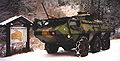 Sisu XA-186
 -
 Sisu SA-150 "Masi" military vehicle
 -
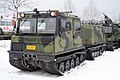 Sisu Nasu tracked military vehicle
 -
 Sisu XA-180 series military vehicle
 -
 Sisu Polar Works DK16M
 -
 Sisu racing truck
 -
 Sisu truck power pulling


See also
[edit]Sources
[edit]- Blomberg, Olli (2006). Suomalaista Sisua vuodesta 1931 – Monialaosaajasta kuorma-autotehtaaksi [Finnish Sisu since 1931 – From multi-industrial expert to lorry factory] (in Finnish). Karis: Oy Sisu Auto Ab. ISBN 952-91-4918-2.
- Mäkipirtti, Markku (2011). Sisu. Ajoneuvot Suomessa (in Finnish). Vol. 4 (2. ed.). Tampere: Apali Oy. ISBN 978-952-5877-05-2.
References
[edit]- ^ https://sisuauto.com/en/sisu-autos-strategy-is-export-oriented/#:~:text=Sisu%20Auto's%20strategy%20is%20export,in%20the%20evolving%20new%20markets.
- ^ "Yrityshaku – Sisu Auto Oy". Kauppalehti (in Finnish). Alma Media Oyj. Retrieved 27 February 2025.
- ^ a b Blomberg: Fleminginkadun koritehtaista syntyi suomalainen autotehdas. pp. 17–28.
- ^ Blomberg: Mikä autolle nimeksi? p. 32.
- ^ Blomberg: Lyseolaisesta kummisedäksi. pp. 32–33.
- ^ a b Blomberg: Salaperäinen esisarja. pp. 56–61.
- ^ Blomberg: O/Y Suomen Autoteollisuus A/B:stä Suomen Autoteollisuus Oy:ksi. p. 62.
- ^ a b c Blomberg: Tuotanto täysille. pp. 62–64.
- ^ Herranen, Timo (15 June 2014). "Biografiakeskus – Vuorineuvos Tor Nessling (1901–1971)" (in Finnish). Helsinki, Finland: Suomalaisen Kirjallisuuden Seura.
- ^ a b Blomberg: Kohti kotimaisuutta. pp. 92–94.
- ^ a b c Blomberg: Dieselaika alkaa. pp. 94–98.
- ^ Blomberg: Tehtiin muutakin kuin autoja. pp. 143–145.
- ^ a b Blomberg: Tarvittiin voimaa voimanlähteille. pp. 145–148.
- ^ a b c d e Blomberg: Omin konein eteenpäin. pp. 99–104.
- ^ a b c Blomberg: Tuotannollista hajaannusta. pp. 69–71.
- ^ a b c d Blomberg: Mukaan materiaalinkäsittelyyn. pp. 148–153.
- ^ a b Blomberg: Katseet kääntyivät Sisuun. pp. 274–275.
- ^ a b Blomberg: Radoille ja teille rautaa – konein tai ilman. pp. 153–159; 167.
- ^ Blomberg: Yhteissisun piti hoitaa kuorma-autonvalmistus. p. 274.
- ^ a b Blomberg: Valtiovalta otti komennon. pp. 275–277.
- ^ a b Blomberg: Valittiin siis Vanaja. pp. 280–281.
- ^ Blomberg: Synkkiä pilviä taivaalla. pp. 281–282.
- ^ Blomberg: Ollako vai eikö olla? p. 283; 291.
- ^ Mäkipirtti: S-sarja – Kotimaisuusaste korkeimmillaan. pp. 21–26.
- ^ Mäkipirtti: Sisu B-56SH kuorma-auto. p. 75.
- ^ Mäkipirtti: KB-sarja. p. 76.
- ^ Mäkipirtti: Sisu K-36SS maansiirtoauto. pp. 83–84.
- ^ Mäkipirtti: Sisu K-32SH, ensimmäinen 6×4. p. 70.
- ^ Mäkipirtti: Sisu Jyry 4×4+2. pp. 64–69.
- ^ a b c Blomberg: Kumppanuuksista hyötyä ja voimaa. pp. 198–199.
- ^ a b Blomberg: Ei pelkästään Sisuja. pp. 167–171.
- ^ a b Mäkipirtti: Suurin vientimaa. p. 74.
- ^ a b Blomberg: Heikki Luostarinen: Sisun tekninen osaaminen varmisti yrityksen jatkuvuuden. pp. 229–234.
- ^ a b c Blomberg: Karjaa johti uuteen aikaan. pp. 71–74.
- ^ a b Blomberg: Rolls-Royce ja piikarbidiputket. pp. 109–114.
- ^ Mäkipirtti: Kippiohjaamo. p. 96.
- ^ a b c "Sisu tuotteiden syntymävuodet (1959–1981)". Sisuviesti (2./1981). Oy Suomen Autoteollisuus Ab: 23. 1981. Retrieved 21 June 2014.
- ^ Mäkipirtti: "Kolonokka". p. 111.
- ^ Mäkipirtti: Sisu K-141 4×2. p. 112.
- ^ Blomberg: Vuosisadan keksintö... pp. 319–324.
- ^ Blomberg: ...ja innovaatioita joka lähtöön. pp. 325–328.
- ^ a b Blomberg: Vesa Palmu: Sisulla ja sydämellä! pp. 256–262.
- ^ a b c d Blomberg: Nesslingin aika päättyy. pp. 76–80.
- ^ Blomberg: Murroksen vuodet. pp. 75–76.
- ^ Mäkipirtti: S-sarja. p. 188.
- ^ a b Blomberg: Sampo Siiskonen: Sisu on aina pärjännyt – vaikeista ajoista huolimatta. pp. 245–249.
- ^ Blomberg: Uudet tuulet puhaltavat. pp. 80–81.
- ^ a b c Blomberg: Syntyi Oy Sisu Ab. pp. 81–82.
- ^ a b c Blomberg: Ratkaisevia uudelleenjärjestelyjä. pp. 82–83.
- ^ Mäkipirtti: 1980-luku. p. 185.
- ^ a b Blomberg: Moduulirakenteinen S-mallisto. pp. 189–195.
- ^ Blomberg: Tyttäriä ja tuontia. pp. 84–86.
- ^ Blomberg: Kone ostaa Partekin. pp. 83–84.
- ^ Blomberg: Sisu sijoittajaryhmän haltuun. pp. 86–88.
- ^ Blomberg: Paluu juurilleen. pp. 88–89.
- ^ "Olof Elenius aloittaa Sisu Auton johdossa" [Olof Elenius to start working in leadership of Sisu Auto]. Turun Sanomat (in Finnish). Turku, Finland: TS-Yhtymä Oy. 9 October 2007. Retrieved 21 June 2014.
- ^ "Sisu kuorma-autojen markkinointi ja myynti Veho Hyötyajoneuvoille". Metsäalan Ammattilehti. Helsinki. 2 July 2010. Retrieved 21 June 2014.
- ^ a b Kekko, Iikka (2011). "Jotain uutta, jotain vanhaa". Raskas Kalusto (in Finnish) (1). Viipalemediat Oy: 14–18.
- ^ "Sisu 8×8 Military Truck, Finland". army-technology.com. Kable Intelligence Limited. Retrieved 21 June 2014.
- ^ "Komas ja Sisu soutavat ja huopaavat" [Komas and Sisu chop and change]. Taloussanomat (in Finnish). Sanoma News Oy. 15 March 2012. Retrieved 21 June 2014.
- ^ "Omat johtajat ostavat Sisu Auton" [Own managers to buy Sisu Auto]. Länsi-Uusimaa (in Finnish). Lohja, Finland: Suomen Lehtiyhtymä. 23 February 2011. Retrieved 21 June 2014.
- ^ "Olof Elenius myi Sisun" [Olof Elenius sold Sisu]. Kauppalehti (in Finnish). Alma Media Oyj. 19 August 2013. Retrieved 21 June 2014.
- ^ a b c Blomberg: Joukkoliikennettäkin aikanaan. pp. 313–318.
- ^ a b c Blomberg: Olli Viitanen: Vanajasta tuli Sisu-Hämeenlinna. pp. 284–285.
- ^ Blomberg: Mennään bussilla tai ostoksille. pp. 407–410.
- ^ a b c Blomberg: Kari Lindholm: Sisulta ajoneuvoja siviili- ja sotilaskäyttöön. pp. 250–253.
- ^ IEC
- ^ a b Blomberg: Kaduilta ja teiltä kiskoillekin. pp. 64–69.
- ^ a b Blomberg: Vielä kolme Volvo-sarjaa. pp. 50–54.
- ^ Mäkipirtti: Puolustuslaitoksen suuri talvikokeilu. pp. 40–44.
- ^ Mäkipirtti: Sisu K-35SC (SI) "Kärppä-Sisu". pp. 87–89.
- ^ a b c d Blomberg: Puolustuksellistakin painoarvoa. pp. 304–312.
- ^ "Sisu A2045 - General utility truck". ARG. Archived from the original on 2 July 2014. Retrieved 21 June 2014.
- ^ Blomberg: Nostovoimaa ja tuhatjalkaisia. pp. 296–298.
- ^ a b c Blomberg: Oy Suomen Autoteollisuus Ab:n sekä sen edeltäjien, seuraajien ja sisaryhtiöiden edustuksia. pp. 200–201.
- ^ a b Blomberg: Sisun edustuksia vuosien varrelta. pp. 202–208.
- ^ Blomberg: Renault ratkaisijan rooliin. p. 211.
- ^ Blomberg: Ratkaisevana tekijänä käyttö. p. 92.
- ^ Blomberg: Välivaiheen moottorit. pp. 104–106.
- ^ a b Blomberg: Leylandista lähes vakiomoottori. pp. 106–109.
- ^ a b c d Blomberg: Sisuun tuli kumminskin moottori. pp. 116–123; 126–127.
- ^ Blomberg: Konsernimoottorit. pp. 127–128; 130.
- ^ a b Blomberg: Caterpillar puskee Sisuun. pp. 130–132.
- ^ a b c d Blomberg: Kotimaista Valmettia... pp. 132–137.
- ^ Blomberg: ...ja muita kummallisuuksia. pp. 138–142.
- ^ Mäkipirtti: S-sarja. pp. 10–12.
- ^ Hievanen, Jouni (2010). "Polar juhlamalli". Ajolinja (in Finnish) (8). B Yhtiöt Oy: 4–8.
- ^ Blomberg: Sisun tupla-ässät — Aikojensa suurimmat Pohjoismaissa valmistetut autot. pp. 160–161.
- ^ Blomberg: Akseleita aina tarvitaan. pp. 298–300.
- ^ Blomberg: Teppo Raitis: Ympyrä on sulkeutunut Sisun 75-vuotisessa historiassa. pp. 11–12.
- ^ a b c Blomberg: Hyttituotantoa tyyppi kerrallaan. pp. 174–185.
- ^ "Sisu tuotteiden syntymävuodet (1932–1958)". Sisuviesti (2./1981). Oy Suomen Autoteollisuus Ab: 22. 1981. Retrieved 21 June 2014.
- ^ Mäkipirtti: 1950-luku. pp. 27–28.
- ^ "Sisut nostivat Suomen pyörille" [Sisus lifted Finland onto wheels]. Iltalehti (in Finnish). Alma Media Oyj. 29 December 2006. Retrieved 21 June 2014.
- ^ Mäkipirtti: Sisu K-138BM. pp. 124–127.
- ^ Mäkipirtti: Sisu SK. pp. 189–193.
- ^ Mäkipirtti: Sisu SM. pp. 218–230.
- ^ Mäkipirtti: Sisu SC "Mäyräkoira". p. 198.
- ^ Mäkipirtti: Sisu SL. pp. 199–204.
- ^ Mäkipirtti: Sisu SN. p. 205–207.
- ^ Mäkipirtti: Sisu SR. p. 208–214.
- ^ "МИМС-93: от сенсации к традиции" [MIMS-93: from sensation to tradition]. Za Rulem (in Russian). December 1993. p. 5.
- ^ Mäkipirtti: C/R-sarja. p. 249.
- ^ Mäkipirtti: Sisu Timber. p. 250.
- ^ Mäkipirtti: Sisu Rock. pp. 251–252.
- ^ Mäkipirtti: Sisu Roll. p. 255.
- ^ Mäkipirtti: Sisu Works. p. 253.
- ^ Mäkipirtti: Sisu Crane. p. 254.
- ^ Mäkipirtti: Sisu Carrier. p. 255.
- ^ Blomberg, Olli (2011). "Uusi Sisu Polar tulee – Ja se ON Sisu!". Kuljetusyrittäjä (in Finnish) (1). SKAL: 38–39.
- ^ Laurell, Heikki (2012). "Tässä on Vuoden Kuorma-auto Suomessa 2012 — Sisu Polar". Auto, Tekniikka Ja Kuljetus (in Finnish) (7). B Yhtiöt Oy: 42.
- ^ "SH-1". Sisu p.5 (1935). 1 January 1935. Retrieved 21 May 2025.
- ^ "SH-2 truck 3,5 t". Sisu kuorma-auto (1935). 1 January 1935. Retrieved 7 May 2025.
- ^ "SH-3 truck". Sisu (1935). 1 January 1935. Retrieved 20 May 2025.
External links
[edit]
- Official website (in English and Finnish)
- Sisu Auto on Facebook
| Vehicles |
| ||||||||||||||||
|---|---|---|---|---|---|---|---|---|---|---|---|---|---|---|---|---|---|
| Related people | |||||||||||||||||
| Related companies | |||||||||||||||||
| Media related to Sisu Auto at Wikimedia Commons | |||||||||||||||||
| Active | |
|---|---|
| Defunct | |
| Components | |
| Related topics | |
| |

Raseborg Cityscape | ||
|---|---|---|
| Sub-divisions and villages |  | |
| Former municipalities | ||
| Archipelago | ||
| Transport | ||
| Buildings | ||
| Places of worship | ||
| Tourist attractions | ||
| Museums | ||
| Organisations | ||
| History | ||


Sisu Auto
View on GrokipediaHistory
Early years (1931–1939)
Sisu Auto was established on April 1, 1931, as Oy Suomen Autoteollisuus Ab in Helsinki, Finland, organized by Karl Arthur Nordgrén, Emil Anton Winckelmann, and Lars Wilhelm Åberg, with Tor Nessling as general manager.[9] The company quickly focused on truck manufacturing amid Finland's economic challenges during the Great Depression, prioritizing robust designs for local roads and forestry operations. In 1932, following a public contest to select a brand name, "Sisu"—a Finnish term denoting perseverance and inner strength—was chosen, and the first twelve Sisu trucks rolled off the production line.[9][4] Early models, such as the S-321 series, included both lorries and bus chassis, with production emphasizing civilian applications like transport and public services. These vehicles incorporated imported components, including engines from foreign suppliers, to enable assembly in Finland while adapting to harsh environmental conditions.[10][3] By the late 1930s, operations had expanded to include specialized chassis variants, solidifying Sisu's role in the nascent Finnish automotive sector and serving primarily the home market.[3]World War II era (1939–1945)
The outbreak of the Winter War in November 1939 prompted Suomen Autoteollisuus, operating as Sisu, to redirect its limited production capacity toward military logistics support for the Finnish Army, building on pre-war truck designs to aid transport in harsh winter conditions. However, the short duration of the conflict and Finland's constrained industrial base meant output remained modest, with existing models adapted rather than new ones introduced at scale. As the Continuation War commenced in 1941, the need for reliable heavy vehicles intensified, leading to the formation of the Yhteissisu consortium in 1943 by the Finnish government and major companies including Suomen Autoteollisuus. This joint venture centralized truck and bus production in Hämeenlinna to streamline wartime manufacturing away from vulnerable urban areas like Helsinki, focusing on models suited for frontline logistics in rugged terrain. Yhteissisu delivered approximately 7,000 vehicles to the Finnish Defence Forces during the war, including variants of the Sisu S-21 lorry equipped with ZF gearboxes for enhanced durability.[11] Production innovations included the development of all-wheel-drive configurations and limited armored chassis adaptations for reconnaissance and transport roles, often incorporating components from captured Soviet equipment to address shortages of imported parts. Engineer-led design efforts emphasized off-road capability, with reinforced frames and higher ground clearance to navigate Finland's forested and snowy landscapes. Key contributors, such as the founding team of Karl Arthur Nordgrén, Emil Anton Winckelmann, and Lars Wilhelm Åberg, oversaw these adaptations, drawing from pre-war expertise to ensure vehicle reliability under combat stress. The Moscow Armistice of September 1944 ended Finland's involvement in the war, imposing immediate demobilization and restrictions on military production through the Allied Control Commission. The subsequent Paris Peace Treaty of 1947 further limited Finland's armed forces to 34,400 personnel and prohibited heavy armament manufacturing, compelling Yhteissisu and Sisu to reconvert facilities for civilian truck output by 1945 amid war reparations demands. This shift marked the end of wartime collaboration, with the consortium dissolving as focus returned to domestic reconstruction.[12][13]Post-war expansion (1945–1969)
Following World War II, Sisu Auto, operating as Suomen Autoteollisuus (SAT), rapidly reconverted its facilities from military production to civilian truck manufacturing, leveraging wartime expertise in durable off-road vehicles. Production resumed in 1946 with models like the S-22, focusing on robust chassis suitable for Finland's demanding terrain and reconstruction needs; initial output emphasized petrol and early diesel variants, transitioning from wartime wood-gas systems. Exports began to neighboring markets, including Sweden for logging operations and the Soviet Union as part of bilateral trade agreements supporting post-war recovery. This shift aligned with Finland's broader economic rebuilding efforts, where heavy vehicles played a key role in infrastructure repair and resource extraction, though the country notably declined U.S. Marshall Plan aid due to geopolitical pressures from the Soviet Union.[14] The 1950s marked a period of significant growth for Sisu Auto, driven by technological advancements and market demand. Diesel engines, initially sourced from partners like Leyland Motors following a mid-decade agreement, became standard, improving fuel efficiency and payload capacity for models such as the KB series. Cab-over-engine designs gained prominence, enhancing maneuverability for urban and export applications; by 1962, the KB-112 introduced Europe's first series-produced tilt cab, allowing easier maintenance in harsh conditions. Annual production surged amid Finland's industrial boom, with the company expanding its workforce to meet rising domestic and international orders. Sisu captured approximately 20% of Finland's heavy truck market, benefiting from national reconstruction projects in forestry, construction, and transport.[14][15][9] Diversification accelerated in the late 1950s, as Sisu expanded beyond standard trucks into specialized chassis. The company entered bus production with forward-control models like the B-52 in 1948, evolving to the B-61 chassis by the late 1950s, which supported urban and intercity coaches built by Finnish bodybuilders. Simultaneously, Sisu developed heavy-duty bases for mobile cranes, utilizing reinforced frames and lifting tandems to serve construction and utilities sectors. Key strategic moves included the 1961 acquisition of Vanaja Autotehdas operations, which broadened engine options to include Rolls-Royce and Cummins diesels, enhancing product versatility. By 1969, amid industry-wide consolidation pressures from rising competition and economic shifts, Sisu engaged in merger discussions with Vanaja, culminating in their full integration at the start of the year to streamline production and bolster competitiveness. This era solidified Sisu's reputation for rugged, adaptable vehicles tailored to Nordic challenges.[14][15]Modernization and challenges (1970–1993)
During the 1970s, Sisu Auto undertook significant investments in production facilities and technology to enhance competitiveness amid Finland's industrial evolution. The company introduced modular cab designs and began incorporating automatic transmissions in its truck lineup, improving versatility and operator comfort for heavy-duty applications. These upgrades were part of broader efforts to streamline manufacturing following the expansion of the Karjaa factory in the prior decade.[14] The launch of the S-180 series in the 1970s represented a milestone for heavy haulage, featuring a robust 6x6 configuration capable of handling up to 180-tonne loads, often equipped with Leyland or Rolls-Royce engines. This series addressed growing demand for specialized transport in forestry and construction, building on post-war export foundations that facilitated international component sourcing. However, the 1975 oil shock severely impacted the Finnish automotive sector, raising fuel costs and reducing demand for heavy vehicles, which strained Sisu's operations and contributed to financial pressures leading to partial state ownership by 1976.[16][14][17] Entering the 1980s, Sisu faced intensified challenges from the global recession and rising competition from imported trucks, prompting diversification into terminal tractors through its Sisu Terminal Systems division, established in 1969 but expanded during this period for port and logistics applications. Collaboration with Scania provided access to advanced components, including cab elements for the T-series trucks starting in 1980, while a 10% stake held by Saab-Scania since 1976 supported joint technological development. In response to economic downturns, the company experienced layoffs and began rationalizing operations amid Finland's severe early-1990s depression.[18][15][19] Technological progress continued with the 1983 introduction of the S-320 model within the S-series, which integrated electronic systems for engine management and diagnostics, signaling a shift toward computerized manufacturing processes that boosted efficiency and reliability. The S-series overall, launched in 1980 with modular cabs and Cummins engines paired with Eaton Fuller transmissions, achieved strong domestic sales through the decade, though bus production ceased in 1989 due to market shifts. These innovations helped Sisu navigate import pressures, but persistent economic volatility underscored the challenges of maintaining a niche player in a consolidating European truck market.[14][20]Merger and restructuring (1994–2003)
In 1994, Sisu Auto merged with Valmet Oy's transportation and tractor business units to form the larger Sisu Corporation, aiming to achieve operational synergies and expand into broader transportation manufacturing.[15][21] This integration positioned truck production as a smaller component of the group's activities, accounting for just over 10% of net sales initially.[21] The following year, industrial conglomerate Partek acquired Sisu Corporation, further diversifying the company's portfolio while maintaining Sisu Auto as a subsidiary focused on heavy vehicles.[15] Under Partek's ownership, Sisu Auto emphasized quality certifications, obtaining ISO 9001 for quality management and AQAP 110 for defense-related processes in 1996.[21] In 1997, Sisu signed a cooperation agreement with Renault Trucks for component sourcing and distribution, enabling enhanced engineering capabilities and market access.[21] Concurrently, Sisu's defense division, Sisu Defence Oy, merged with other state-owned entities including Vammas Oy and Vihtavuori Oy to form Patria Industries Oy, separating military vehicle production from civilian operations.[11] Mid-decade challenges arose from broader economic pressures, including the 1998 Russian financial crisis, which severely disrupted Finnish exports to Russia—a key market for heavy-duty trucks—and contributed to financial strains across the sector.[22] In response, Sisu Auto shifted toward niche heavy-duty applications, exemplified by the 1998 homologation of its models in France and a landmark order for 110 SISU E12 6x4 heavy tractors for the French military, marking its largest international export to date.[21] By 2000, ongoing restructuring efforts led to a de-merger of operations, with Sisu Auto refocusing on truck chassis and special vehicles under evolving ownership structures, while Patria Vehicles handled defense-related production.[15] In 2002, Partek divested its stake in Sisu Auto to KONE Corporation, allowing the company to prioritize custom-built heavy-duty trucks for demanding environments rather than mass production.[21] This period culminated in the introduction of the SISU E18 series, featuring an 18-liter 630 hp Caterpillar engine, underscoring Sisu Auto's emphasis on high-performance, specialized engineering.[21]Contemporary developments (2004–present)
In 2004, KONE Corporation sold its majority shares in Oy Sisu Auto Ab to Suomen Autoteollisuus Oy, a holding company formed by a group of Finnish investors, marking a significant shift in ownership and strategic direction.[23] This transition enabled the company to refocus on niche markets, particularly military and heavy-duty vehicles, building on prior restructuring to emphasize customized, high-mobility solutions for defense applications.[5] During the 2010s, Sisu Auto expanded its portfolio with NATO-compatible vehicles, including the development of high-mobility tactical trucks like the Sisu E13TP 8x8, which supported international defense needs through modular designs adaptable to various mission requirements.[24] A key milestone came in November 2019 with the unveiling of the GTP 4x4 armored platform, a versatile, mine-resistant vehicle family engineered for troop transport, command, and specialized roles, aligning with evolving NATO standards for protected mobility.[25] Recent years have seen accelerated growth in defense exports, highlighted by deliveries of GTP 4x4 vehicles to the Swedish Armed Forces starting in 2024, with the first batch of an order for over 260 units for multi-purpose operations.[26] In January 2025, Sisu Auto launched the GTT all-terrain vehicle, a tracked, articulated platform optimized for Arctic and extreme environments, enhancing capabilities for logistics and personnel transport in harsh Nordic terrains.[6] These developments reflect the company's integration into joint programs, such as the Finland-Sweden Common Tactical Vehicle initiative.[27] As of 2025, Sisu Auto operates from its headquarters in Karjaa, Raseborg municipality, Finland, employing over 100 professionals in production, design, and project management, with a strong emphasis on modular vehicle architectures that facilitate exports to Nordic and Baltic defense markets.[1] The company discontinued civilian bus production in 1989 to concentrate resources on trucks and specialized heavy-duty segments.[5] Looking ahead, Sisu Auto is participating in EU-aligned defense initiatives, supported by investments from Finnish Industry Investment Ltd (Tesi), which acquired a 19.9% stake in 2023 and increased it to 24.4% in 2024 to fuel international expansion and aims for turnover growth to €500 million by the early 2030s.[28][29][8]Products and production
Civil trucks
Sisu Auto's civil trucks, primarily from the Polar product family, are engineered for demanding civilian applications including logging, construction, and heavy transport in Nordic environments. These vehicles emphasize durability, reliability, and performance in extreme weather, drawing on the company's long-standing expertise in heavy-duty transport solutions.[30] The core lineup encompasses specialized variants such as Polar Timber for timber handling, Polar Rock for aggregate and rock transport, Polar Works for construction tasks, and Polar Carrier for versatile hauling, all configured on modular chassis platforms to suit specific operational needs. Key design features include a high frame construction that provides elevated ground clearance for off-road stability and reduced weight without compromising rigidity, along with liftable axles that enhance fuel efficiency and maneuverability when unloaded. Additionally, the trucks incorporate components optimized for Arctic conditions, such as robust electronics and Mercedes-Benz engines compliant with Euro VI standards, ensuring reliable cold-start performance in sub-zero temperatures.[31][30] Production of these civil trucks occurs at Sisu Auto's facility in Raseborg, Finland, where custom chassis assembly allows for tailored integrations of hydraulics, electronics, and bodywork to meet client specifications. Following the company's restructuring in the 1990s and early 2000s, production has shifted from mass-manufactured volumes to bespoke builds, prioritizing flexibility and customer-specific adaptations over high-volume output. As of recent years, annual production stands in the hundreds of units, supported by ongoing investments to expand capacity for specialized vehicles.[1][32][33] In the Finnish market, Sisu civil trucks are the leading heavy truck producer, particularly in extreme-duty segments requiring capabilities for harsh conditions. The vehicles are integrated into importer networks across Scandinavia, facilitating distribution and service, while exports target the Baltic states and northern Central European markets to capitalize on demand for rugged transport solutions in similar climates. This market role builds briefly on the company's historical truck production foundations established in the 1930s.[1][5]Military vehicles
Sisu Auto has established itself as a key producer of military vehicles, leveraging its expertise in rugged, all-terrain designs for defense applications. The company's primary platforms include the GTP series, available in 4x4 and 6x6 configurations, which serve as versatile bases for troop transport and mortar carriers. These vehicles feature a modular chassis that supports various mission-specific adaptations, such as armored personnel carrier roles or integrated weapon systems. Complementing the wheeled GTP lineup is the GTT, a tracked vehicle optimized for extreme terrains like Arctic conditions, providing enhanced mobility in snow, mud, and uneven landscapes.[34][35][36] Manufacturing of these platforms emphasizes modular assembly, allowing for customizable ballistic protection options that meet protection levels such as STANAG 4569 Level 1 for the crew compartment. Since the 2010s, Sisu Auto's military vehicles have been designed to comply with NATO standards, facilitating interoperability with allied forces through standardized components and interfaces. This approach stems from the company's wartime origins in producing durable military trucks during World War II, which laid the foundation for modern tactical vehicle development.[35][5][35] Key contracts underscore Sisu Auto's role in international defense procurement. In 2024, the Swedish Defence Materiel Administration (FMV) received the initial deliveries from a major order exceeding 260 GTP units, intended to bolster Sweden's armored troop transport capabilities. For the Finnish Defence Forces, ongoing upgrades include acquisitions such as 13 additional GTP 4x4 vehicles in 2024 and a self-propelled mortar variant (GTP TREMOS) developed in collaboration with Patria and unveiled in August 2025, enhancing national readiness. These contracts highlight Sisu Auto's export focus, with military vehicle production increasingly oriented toward international markets to meet rising global demand.[37][38][39][40] Innovations in Sisu Auto's military lineup include the integration of remote weapon stations on GTP variants, enabling safe operation of armaments from within protected cabins. Prototypes have also explored hybrid powertrains, combining diesel engines with electric systems to improve fuel efficiency and low-speed torque in demanding operations, though full deployment remains in testing phases. Annual production of these defense vehicles supports a growing output, with exports forming a significant share driven by contracts like the Swedish program.[35][41][42][33]Buses and special chassis
Sisu Auto initiated bus chassis production in the mid-20th century as part of its expansion into passenger transport solutions, primarily serving the Finnish market through municipal contracts and local coach builders. The company's chassis were designed for urban and intercity coaches, with models like the BK series supporting various body types from Finnish manufacturers.[43] By the 1970s, annual output reached approximately 100 units, reflecting steady demand for durable frames suited to Nordic conditions, including reinforced structures for challenging snowy terrains.[14] Production emphasized compatibility with established body builders, allowing integration with components from partners like Volvo and Scania for hybrid and conventional setups.[3] These chassis were tailored for Finnish municipal operators pre-2000, prioritizing reliability in harsh winter environments. Bus production was discontinued in the late 1980s, with full cessation by 1989 amid industry consolidation and a shift toward truck specialization.[14] Today, Sisu Auto no longer manufactures complete buses or standard chassis, though occasional custom adaptations for arctic shuttle services persist, often using imported hybrid components.[1] Niche repair and maintenance services for legacy bus chassis continue in 2025, supporting ongoing use in specialized Finnish transport applications.[5] These chassis contributed to the company's legacy of over 50,000 total vehicles produced since 1931.[3]Other specialized vehicles
Sisu Auto has produced specialized chassis for mobile cranes since the 1960s, with the first vehicles under the SISU brand manufactured in 1971.[44] These chassis feature a robust 300 mm-high U-profile frame designed to support cranes with capacities ranging from 60 to 150 ton-meters, available in four- or five-axle configurations for optimal stability and load handling in demanding environments.[44][31] The designs include factory-fitted attachment points, support leg mounting plates, and hydraulic systems tailored for heavy lifting tasks, emphasizing agility in confined spaces and high payload capacity.[31] In recent years, Sisu Auto's Polar series has been adapted for crane applications, particularly in forestry and heavy transport sectors. The Sisu Polar Crane combines Mercedes-Benz engines (up to 600 hp) with advanced frame reinforcements to ensure performance in extreme Nordic conditions, such as deep snow and rough terrain.[31] These models prioritize durability, with corrosion-resistant materials and off-road capabilities that allow operation beyond standard weight limits without additional structural modifications.[31] Chassis from the Polar lineup have been integrated with loader cranes from manufacturers like Hiab and Palfinger in various configurations for timber handling and material transport.[45][46] Sisu Auto also supplies chassis for terminal tractors, historically through its Sisu Terminal Systems division, which produced compact models suited for port and industrial operations from 1969 until the factory closure in 2005.[47] Current adaptations draw from the S-series, offering modular designs with high maneuverability for yard spotting and container handling, though production remains limited to custom orders.[31] These vehicles emphasize low center of gravity and robust axles for frequent short-haul tasks in harsh weather.[15] For utility applications, Sisu Auto provides bases for fire trucks, recommending low-cab chassis like the Polar series for their compact footprint and hydraulic readiness. These setups include crew cab extensions and integrated systems for mounting firefighting equipment, ensuring reliability in emergency responses across Finland's varied climates. The Polar Works variant serves as a foundation for snow plows and road maintenance vehicles, featuring an integrated plow bumper, underbody blade mounts, and hydraulic solutions for maximum stability during operations.[48] Designed for Arctic winters, these chassis support heavy attachments while maintaining traction on icy surfaces, with reinforced frames to handle extreme loads in sub-zero temperatures.[48][31] Custom mining vehicles, such as the Polar Super 10x6, are built for operations in Lapland's rugged terrain, incorporating multi-axle bogies for superior off-road mobility and payload delivery in 24/7 harsh conditions.[49] Earlier models like the SRH 450 were supplied to northern mines, highlighting Sisu Auto's focus on durable, high-torque solutions for ore transport.[50] Overall, production of these specialized vehicles occurs at low volumes in Karjaa, Finland, with an emphasis on bespoke engineering for durability in extreme weather, contributing to the company's 2024 turnover of €50.2 million amid growing demand for tailored heavy-duty solutions.[31][8]Models
Truck models
Sisu Auto's truck models began with the S-21 in the 1940s, a two-axle 4×2 lorry designed for general cargo transport with a 6-ton payload capacity and featuring chain drive for rear axle propulsion. The model had a kerb weight of approximately 3 tons and a gross vehicle weight of 7 to 8 tons, reflecting the company's early emphasis on robust, wartime-adapted designs.[51] In the post-war era, models like the KB-112 entered production in 1962 as one of the first tilt-cab trucks with diesel power, offering improved reliability for logging and construction tasks.[14] The M-162 followed in the 1970s, a heavy model with capacities up to 16 tons and versatile configurations for industrial applications.[14] The S-series modular cab trucks launched in 1980, providing customizable options for heavy-duty use. Modern developments include the Polar series from 2011, such as the Polar Rock 6×4 configuration capable of handling 32-ton gross weights, suited for heavy haulage with advanced suspension for rough terrain. More recently, Polar models feature engines up to 625 hp for off-road operations in mining and forestry.[52] Sisu trucks commonly featured variants such as tipper bodies for aggregate transport and tractor units for semi-trailer towing, adapting to diverse civilian needs. Lighter models under 10 tons were largely discontinued after 1990, shifting production toward heavy-duty segments.[53] Overall, Sisu Auto has manufactured over 20,000 trucks since its inception, with current offerings centered on more than 10 active configurations within the Polar series for specialized heavy transport.[5]Bus and chassis models
Sisu Auto's bus and chassis development began in the post-war era, building on truck expertise to provide reliable bases for body builders, with early examples including adaptations of L-series chassis in the 1950s for intercity and touring applications. By the 1970s, Sisu produced around 100 bus chassis annually, often bodied by partners like Carrus for Finland's varied road conditions and passenger loads.[14] Bus chassis production emphasized durability, with reinforced framing for snowy terrains. Full-scale bus chassis production at Sisu ended in 1989, leaving a legacy of over 1,000 units still in use or preserved for historical purposes.[14] Today, the company provides repair kits and parts for these legacy models.[9]Military and special models
Sisu Auto has developed several military vehicles tailored for demanding operational environments, emphasizing high mobility and protection. The Sisu A2045, a 4x4 high-mobility terrain vehicle, serves as a medium tactical truck for the Finnish Defence Forces, equipped with a tarpaulin-covered cargo area and seating for crew transport in rough terrain.[54] It features all-wheel drive and is designed for logistics and patrol duties, with a payload capacity supporting up to 6 tons.[55] The Sisu GTP 4x4, introduced in 2019, is a modular armored personnel carrier built for versatile defense applications, including troop transport, patrol, and as a system platform.[35] Powered by a Mercedes-Benz OM926 six-cylinder diesel engine delivering 308 horsepower, it offers all-terrain mobility with a top speed exceeding 100 km/h and a range of 700 km.[35] The vehicle provides STANAG 4569 Level 1 ballistic and mine blast protection, with options for enhanced add-on armor, and can ford water up to 0.85 meters deep.[35] A notable variant is the mortar carrier configuration integrated with the Patria NEMO or TREMOS system, enhancing its firepower for indirect fire support missions.[25] In the heavy tactical category, the Sisu E13TP series, launched in 2005, includes 6x6 and 8x8 configurations for military logistics, such as hook loaders, radar carriers, missile transporters, recovery vehicles, and bridging units.[24] These trucks incorporate mine and ballistic shielding compliant with STANAG 4569 standards, powered by a Caterpillar C13 turbo-diesel engine for operations in extreme conditions.[24] Ambulance variants provide medical evacuation capabilities, while recovery models support battlefield repairs with integrated winches and cranes. Civil adaptations of the E13TP, including tractor configurations, have been used in port and heavy haulage environments for their robust off-road performance and high payload of up to 22 tons.[24] The XA-180 EST, developed in the 1980s, is a 6x6 armored personnel carrier used by the Finnish Defence Forces and exported, with capacities for troop transport and variants like command vehicles. Sisu Auto's special models extend to utility and niche applications, such as the Sisu Crane series, designed for heavy-lift operations with crane capacities reaching up to 150 ton-meters.[56] These vehicles feature reinforced frames and attachment points optimized for rapid deployment in construction and recovery tasks. More recently, the Sisu GTT, unveiled in January 2025, represents an advanced tracked platform equivalent in capability to 8x8 wheeled vehicles but suited for arctic and extreme terrains.[6] This double-link articulated carrier offers modular payload options up to 5 tons, with high-performance tracks for superior traction in snow, mud, and uneven ground.[57] By 2025, Sisu Auto's military vehicles have seen exports to several nations, including Lithuania for tactical truck fleets and integration into multinational operations like UNIFIL.[58][59] The Finnish Defence Forces operate over 40 GTP 4x4 units as of 2024, with procurements continuing to bolster armored mobility.[39]Technical aspects
Key components
Sisu Auto employs a component strategy that balances in-house manufacturing with strategic partnerships to ensure vehicle reliability and customization. A significant portion of components in its trucks are made in Finland, with production centered at the company's facility in Raseborg, Finland. This approach allows for tailored integration of special vehicle manufacturing with mass-produced parts, a core strategic choice since the company's early years. Partnerships with global suppliers like Daimler Truck AG provide access to advanced technologies, such as engines and cabs, complementing in-house capabilities to support both civilian and military applications.[1][9] Historically, Sisu Auto shifted from reliance on imported engines in the 1930s—sourcing from North American and European providers—to greater localization, including the establishment of in-house axle production in the 1940s at its Helsinki facility, which later moved to support expanded operations. By the 1980s, this evolution enabled fuller integration of domestically produced axles alongside sourced powertrains, reflecting a progression toward self-sufficiency in critical drivetrain elements. Axles are now produced by the separate company Sisu Axles Oy in Hämeenlinna. These developments underscore the company's adaptation to Finland's demanding industrial needs.[60] The integration of components emphasizes a modular design philosophy, facilitating interchangeable parts across vehicle models for enhanced flexibility and maintenance efficiency. Sisu Auto maintains rigorous quality standards, with its management system certified to ISO 9001 since 1996, ensuring consistent performance and compliance. Current efforts prioritize durable components engineered for extreme conditions, including operations in temperatures as low as -40°C, vital for Nordic and Arctic environments. Components are sourced internationally, primarily from partners in Germany such as Daimler, balancing local production with global expertise. Component choices also inform the company's model nomenclature, linking design codes to integrated features, including in the SISU Polar hybrid truck series and military vehicles.[61][62][60][30]Model nomenclature
Sisu Auto's model nomenclature serves to encode essential vehicle attributes, including payload capacity, drive configuration, and generational series, adapting over time to accommodate technological progress and shifts in manufacturing partnerships. These designations facilitate quick identification of a model's intended use and specifications, evolving from simple alphanumeric formats to more complex systems reflecting modular designs and international collaborations.[14] Since its inception in the 1930s, the company has employed alphanumeric naming patterns, with the prefix "S" signifying the Sisu brand, followed by numerals that often denoted production year or load-bearing features in early iterations. Post-World War II, from the late 1940s onward, the system increasingly incorporated numeric elements to specify tonnage or payload, such as in the M-series where the trailing figures indicated capacity in metric tons, aligning with the era's focus on standardized heavy-duty chassis for civilian and military applications. This numeric emphasis persisted into the 1960s and 1970s, as seen in models like the KB 112 and M 162, where letters prefixed series identifiers and numbers captured performance metrics.[14] The 1970s through 1990s marked a period of transitional overlaps in nomenclature, driven by mergers such as the 1971 integration of Vanaja and later ties with Partek and Renault VI, resulting in hybrid coding schemes that blended legacy Sisu patterns with partner influences. For instance, the introduction of the E-series in 1996 incorporated Renault-derived cabs while retaining Sisu's payload and drive indicators, bridging older numeric tonnage codes with emerging modular frameworks. These shifts accommodated advancements in cab tilting mechanisms, engine integrations, and axle configurations, ensuring nomenclature reflected enhanced durability for Nordic terrains.[14] In contemporary usage since 2010, Sisu Auto has adopted the "Polar" prefix for its premium heavy-duty truck lineup, denoting robust, multi-axle vehicles optimized for extreme conditions like forestry and construction, often paired with three-digit codes for precise variant specification. Internal documentation employs additional markers, such as "R" for rigid axle setups, to differentiate chassis types without altering public model names. This system underscores the company's emphasis on customization, with codes influenced by key components like engines and gearboxes to denote compatibility and power output.[14][3]Key components
Engines
Sisu Auto's engines have historically been sourced from reputable suppliers and customized for reliability in extreme Nordic environments, emphasizing durability over in-house development. In the 1950s, Sisu trucks primarily used Leyland diesel engines, delivering around 120 hp to support post-war heavy transport needs.[14] The 1960s marked the introduction of Rolls-Royce and Cummins powerplants, with the latter becoming prominent in models like the E11 series during the 1970s for their robust performance in logging and construction.[14] Turbocharged variants emerged in the 1980s, including the 14-liter Cummins NTE-370 series (370 hp) fitted to R-model trucks, featuring custom tuning for cold starts to ensure operation in sub-zero temperatures down to -40°C.[14] By the 1990s and 2000s, engine options expanded to include 12-liter Mack E Tech units and Caterpillar diesels in 13- and 15-liter displacements, culminating in the E18 series' 18-liter Caterpillar engine rated at 630 hp for maximum haulage capacity.[14] Contemporary Sisu vehicles, particularly the Polar series, incorporate Mercedes-Benz OM 47-series inline-six diesels, such as the OM 501LA (11.97-liter, 480 hp) and OM 502LA (15.94-liter, 550–600 hp), both meeting Euro 6 emissions via BlueTec technology for reduced NOx output.[14] For export-oriented applications, Cummins ISBe 6.7-liter engines (up to 360 hp) have been integrated, offering flexibility for international standards.[63] Displacements across Sisu's lineup generally span 7–13 liters for mid-range duties, with heavy configurations extending to 16 liters; typical fuel efficiency in loaded heavy-duty operations averages 25 L/100 km, optimized through aerodynamic cabs and efficient injection systems.[64] Engines are configured for direct drive to maximize torque delivery or paired with hydrodynamic retarders for controlled descent in forested or mining terrains, enhancing safety without excessive brake wear.[14] Hybrid development began in 2018 with the Polar Hybrid prototype, pairing a 15.6-liter Mercedes-Benz OM 473 (625 hp) with a 250 kW Danfoss Editron electric motor and supercapacitors for peak power boosts, yielding 10% improved fuel efficiency over diesel equivalents.[52][64]Gearboxes
Sisu Auto employs a range of transmission systems designed for heavy-duty and specialized applications, emphasizing durability in extreme conditions like Arctic environments. Manual transmissions, primarily from Eaton Fuller, include 16-speed and 18-speed models for Sisu Polar trucks, providing versatile gearing for off-road and hauling tasks. For example, the Eaton Fuller RTLO 20918B is used in Polar series vehicles, offering reliable performance with overdrive for fuel efficiency on highways.[31][65][66] Automated and automatic transmissions are sourced from Daimler AG and Allison Transmission, with options like the Mercedes-Benz PowerShift 3 16-speed automated manual for Euro 6 Polar models, enabling electronic shifting for reduced driver fatigue and precise control. In military and special vehicles, such as the Sisu GTP 4x4, the Allison 3500 6-speed automatic is standard, delivering smooth power delivery up to 300 hp engines while supporting high torque loads in tactical operations.[67][68][35] Key features include integrated retarders for enhanced downhill control and braking, as seen in the turbo retarder clutch option for Polar Hauler configurations, which helps manage heavy loads without excessive wear on service brakes. Off-road capabilities are bolstered by low-range gears via transfer cases, such as the ZF VG750 paired with the Allison 3500 in the GTP, allowing operation in challenging terrain with lockable differentials. ZF also supplies direct transmissions like the 16S221 IT for various Sisu truck models.[65][68][69] Recent adaptations include electric shift mechanisms in prototypes, such as the Sisu Polar Hybrid, where an electric motor is integrated between the diesel engine and Eaton Fuller 18-speed transmission for improved efficiency and reduced emissions. Maintenance intervals for these systems are extended, reaching up to 500,000 km for Allison automatics in vocational use, supported by Sisu's global service network and compatibility with Mercedes-Benz engines for seamless power transfer.[52][70][31]| Transmission Type | Supplier | Example Model | Key Applications | Torque Capacity Example |
|---|---|---|---|---|
| Manual (16/18-speed) | Eaton Fuller | RTLO 20918B | Sisu Polar Hauler, Timber | Up to 2,300 Nm input |
| Automated (16-speed) | Daimler AG | PowerShift 3 G280 | Sisu Polar Euro 6 | Up to 2,800 Nm |
| Automatic (6-speed) | Allison | 3500 RDS | Sisu GTP 4x4 | Up to 1,129 Nm (with retarder option) |
| Transfer Case | ZF | VG750 | Sisu GTP off-road | Supports low-range reduction |