



Community hub
Recent from talks
Contribute something
Nothing was collected or created yet.
Solar zenith angle
View on WikipediaThe solar zenith angle is the zenith angle of the Sun, i.e., the angle between the sun’s rays and the vertical direction. It is the complement to the solar altitude or solar elevation, which is the altitude angle or elevation angle between the Sun’s rays and a horizontal plane.[1][2] At solar noon, the zenith angle is at a minimum and is equal to latitude minus solar declination angle. This is the basis by which ancient mariners navigated the oceans.[3]
Solar zenith angle is normally used in combination with the solar azimuth angle to determine the position of the Sun as observed from a given location on the surface of the Earth.
Formula
[edit]

where
- is the solar zenith angle
- is the solar altitude angle,
- is the hour angle, in the local solar time.
- is the current declination of the Sun
- is the local latitude.





Derivation of the formula using the subsolar point and vector analysis
[edit]While the formula can be derived by applying the cosine law to the zenith-pole-Sun spherical triangle, the spherical trigonometry is a relatively esoteric subject.
By introducing the coordinates of the subsolar point and using vector analysis, the formula can be obtained straightforward without incurring the use of spherical trigonometry.[4]
In the Earth-Centered Earth-Fixed (ECEF) geocentric Cartesian coordinate system, let and be the latitudes and longitudes, or coordinates, of the subsolar point and the observer's point, then the upward-pointing unit vectors at the two points, and , are




where , and are the basis vectors in the ECEF coordinate system.


Now the cosine of the solar zenith angle, , is simply the dot product of the above two vectors

Note that is the same as , the declination of the Sun, and is equivalent to , where is the hour angle defined earlier. So the above format is mathematically identical to the one given earlier.


Additionally, Ref. [4] also derived the formula for solar azimuth angle in a similar fashion without using spherical trigonometry.
Minimum and Maximum
[edit]

At any given location on any given day, the solar zenith angle, , reaches its minimum, , at local solar noon when the hour angle , or , namely, , or . If , it is polar night.





And at any given location on any given day, the solar zenith angle, , reaches its maximum, , at local midnight when the hour angle , or , namely, , or . If , it is polar day.






Caveats
[edit]The calculated values are approximations due to the distinction between common/geodetic latitude and geocentric latitude. However, the two values differ by less than 12 minutes of arc, which is less than the apparent angular radius of the Sun.
The formula also neglects the effect of atmospheric refraction.[5]
Applications
[edit]Sunrise/Sunset
[edit]Sunset and sunrise occur (approximately) when the zenith angle is 90°, where the hour angle h0 satisfies[2]

Precise times of sunset and sunrise occur when the upper limb of the Sun appears, as refracted by the atmosphere, to be on the horizon.
Albedo
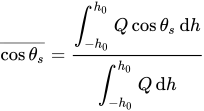
[edit]A weighted daily average zenith angle, used in computing the local albedo of the Earth, is given by where Q is the instantaneous irradiance.[2]
Summary of special angles
[edit]
For example, the solar elevation angle is:
- 90° at the subsolar point, which occurs, for example, at the equator on a day of equinox at solar noon
- near 0° at the sunset or at the sunrise
- between −90° and 0° during the night (midnight)
An exact calculation is given in position of the Sun. Other approximations exist elsewhere.[6]
See also
[edit]References
[edit]- ^ Jacobson, Mark Z. (2005). Fundamentals of Atmospheric Modeling (2nd ed.). Cambridge University Press. p. 317. ISBN 0521548659.
- ^ a b c Hartmann, Dennis L. (1994). Global Physical Climatology. Academic Press. p. 30. ISBN 0080571638.
- ^ Bonan, Gordon (2005). Ecological climatology: concepts and applications. Cambridge University Press. p. 62. ISBN 9781316425190. Retrieved 13 November 2019.
- ^ a b Zhang, T., Stackhouse, P.W., Macpherson, B., and Mikovitz, J.C., 2021. A solar azimuth formula that renders circumstantial treatment unnecessary without compromising mathematical rigor: Mathematical setup, application and extension of a formula based on the subsolar point and atan2 function. Renewable Energy, 172, 1333-1340. DOI: https://doi.org/10.1016/j.renene.2021.03.047
- ^ Woolf, Harold M. (1968). "On the computation of solar elevation angles and the determination of sunrise and sunset times". NASA Technical Memorandu, X-1646. Washington, D.C.: 3.
- ^ livioflores-ga. "Equation to know where the Sun is at a given place at a given date-time". Retrieved 9 March 2013.


Solar zenith angle
View on Grokipediacos(θ) = sin(φ) sin(δ) + cos(φ) cos(δ) cos(h),
where θ is the SZA.[5] This computation is implemented in various algorithms, such as the National Renewable Energy Laboratory's (NREL) Solar Position Algorithm (SPA), which provides high-precision values with uncertainties of ±0.0003° over a wide historical range from -2000 to 6000 CE.[6] Accurate SZA determination is essential for modeling diurnal and seasonal variations in solar position.[7] In atmospheric and environmental sciences, the solar zenith angle plays a critical role in quantifying incoming solar radiation (insolation) at Earth's surface, as the flux is proportional to cos(θ), accounting for the projection of sunlight onto a horizontal plane.[1][8] It influences atmospheric optics, including air mass (AM = 1 / cos(θ)), which affects scattering, absorption, and the path length of solar rays through the atmosphere.[9] Variations in SZA also impact remote sensing applications, such as vegetation indices (e.g., NDVI and EVI), where changes in θ alter reflectance measurements and phenological assessments.[10][11] Additionally, SZA is vital for solar energy systems, climate modeling (e.g., explaining latitudinal albedo differences), and biological processes like photosynthesis and UV exposure.[12][13]