Hubbry Logo
Sudan IVSudan IVMain
Open search
Sudan IV
Community hub
Sudan IV
logo
8 pages, 0 posts
0 subscribers
Be the first to start a discussion here.
Sudan IV
Sudan IV
from Wikipedia
Sudan IV
Names
Preferred IUPAC name
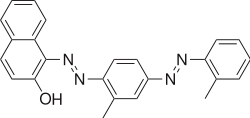
1-[{2-Methyl-4-[(2-methylphenyl)diazenyl]phenyl}diazenyl]naphthalen-2-ol
Other names
1-{2-Methyl-4-[(2-methylphenyl)diazenyl]phenyl}azonaphthalen-2-ol
Sudan R, C.I. Solvent Red 24, C.I. 26105, Lipid Crimson, Oil Red, Oil Red BB, Fat Red B, Oil Red IV, Scarlet Red, Scarlet Red N.F, Scarlet Red Scharlach, Scarlet R
Identifiers
3D model (JSmol)
ChEBI
ChEMBL
ChemSpider
ECHA InfoCard 100.001.487 Edit this at Wikidata
EC Number
  • 201-635-8
KEGG
UNII
  • InChI=1S/C24H20N4O/c1-16-7-3-6-10-21(16)26-25-19-12-13-22(17(2)15-19)27-28-24-20-9-5-4-8-18(20)11-14-23(24)29/h3-15,29H,1-2H3/b26-25+,28-27+ checkY
    Key: RCTGMCJBQGBLKT-PAMTUDGESA-N checkY
  • InChI=1S/C24H20N4O/c1-16-7-3-6-10-21(16)26-25-19-12-13-22(17(2)15-19)27-28-24-20-9-5-4-8-18(20)11-14-23(24)29/h3-15,29H,1-2H3/b26-25+,28-27+
    Key: RCTGMCJBQGBLKT-PAMTUDGEBE
  • Key: RCTGMCJBQGBLKT-PAMTUDGESA-N
  • Cc4ccccc4/N=N/c3ccc(/N=N/c1c2ccccc2ccc1O)c(C)c3
Properties
C24H20N4O
Hazards
GHS labelling:
GHS07: Exclamation mark
Warning
H315, H319
P264, P280, P302+P352, P305+P351+P338, P321, P332+P313, P337+P313, P362
Except where otherwise noted, data are given for materials in their standard state (at 25 °C [77 °F], 100 kPa).
☒N verify (what is checkY☒N ?)

Sudan IV (C24H20N4O) is a lysochrome (fat-soluble dye) diazo dye used for the staining of lipids, triglycerides and lipoproteins on frozen paraffin sections. It has the appearance of reddish brown crystals with melting point 199 °C and maximum absorption at 520(357) nm.

Sudan IV is one of the dyes used for Sudan staining. Similar dyes include Oil Red O, Sudan III, and Sudan Black B. Staining is an important biochemical technique, offering the ability to visually qualify the presence of the fatty compound of interest without isolating it. For staining purposes, Sudan IV can be made up in propylene glycol.[1] Alternatively, authors have reported using the dye saturated in isopropyl alcohol, 95% ethanol, or 0.05% by weight in acetone:ethanol:water (50:35:15).[citation needed] The idea is to use a moderately apolar solvent to solubilize the dye allowing it to partition into the highly apolar fat without the solvent solubilizing the fat to be stained.

Sudan I, Sudan III, and Sudan IV have been classified as category 3 carcinogen by the International Agency for Research on Cancer.[2]

In its purified form it is called Biebrich scarlet R, which should not be confused with the water-soluble Biebrich scarlet.

In industry, it is used to color nonpolar substances like oils, fats, waxes, greases, various hydrocarbon products, and acrylic emulsions. Sudan IV is also used in United Kingdom as a fuel dye to dye lower-taxed heating oil; because of that it is also known as Oil Tax Red. As a food dye, Sudan IV is considered an illegal dye, mainly because of its harmful effect over a long period of time, as it is a carcinogen. It was ruled unsafe in the 1995 food safety regulations report.

While the dye does stain triglycerides with an intense red color, it does not stain lipid droplets or phospholipids. Sudan IV can be used to stain the aorta by staining lipid-rich plaques. The dye can also be used to stain lipids in atherosclerotic lesions in mice.[3]

References

[edit]
[edit]
Revisions and contributorsEdit on WikipediaRead on Wikipedia
from Grokipedia
Sudan IV is a synthetic fat-soluble , chemically described as 1-[(E)-{2-methyl-4-[(E)-(2-methylphenyl)diazenyl]phenyl}diazenyl]naphthalen-2-ol, with the molecular formula C24H20N4O and a molecular weight of 380.44 g/mol. Also known by synonyms such as Solvent Red 24, Scarlet Red, and C.I. 26105, it exists as a reddish-brown crystalline powder that is insoluble in water but readily dissolves in organic solvents like , , and acetone. Primarily utilized in biological and histological applications, Sudan IV serves as a lysochrome to selectively neutral , triglycerides, and lipoproteins in frozen tissue sections, enabling visualization under a for studies of distribution in cells and organs. Beyond microscopy, Sudan IV finds industrial applications as a coloring agent for non-food materials, including oils, waxes, greases, shoe polishes, petrol, printing inks, and , owing to its hydrophobic nature and stability in lipophilic environments. It is certified by the Biological Stain Commission for use in laboratory settings, with a typical content of 80-85%, ensuring reliability in scientific procedures. However, its metabolites exhibit genotoxic, teratogenic, and carcinogenic properties, leading to strict regulatory prohibitions: Sudan IV is not approved as a by the Food and Drug Administration or the , and its illegal addition to foodstuffs like spices and oils has prompted numerous recalls and alerts due to risks.

Chemistry

Chemical structure

Sudan IV, also known as Solvent Red 24, has the molecular formula C24_{24}H20_{20}N4_{4}O. Its systematic IUPAC name is 1-[(E)-{2-methyl-4-[(E)-(2-methylphenyl)diazenyl]phenyl}diazenyl]naphthalen-2-ol. As a , Sudan IV features a central diazenyl linkage (-N=N-) connecting a 2-hydroxynaphthalen-1-yl group to a 4-(2-methylphenyl)diazenyl-2-methylphenyl moiety, forming an extended aromatic system with two azo bridges. This structure is typically depicted in chemical literature with the naphthalene ring on one end, bearing the phenolic hydroxy group ortho to the first azo linkage, which attaches to the para position of a toluene-derived phenyl ring (methyl ortho to the azo), and the second azo group extending from the para position of that phenyl to an ortho-tolyl group. The characteristic red color of Sudan IV arises from the chromophoric azo (-N=N-) groups integrated into a conjugated π-electron system across the aromatic rings, which facilitates absorption of light in the blue-green region of the (approximately 500-550 nm).

Physical properties

Sudan IV appears as a reddish-brown crystalline or . Its molecular is C24H20N4O, with a molecular weight of 380.44 g/mol. The compound has a of 199 °C, at which it decomposes. Its is approximately 1.192 g/cm³. Sudan IV is insoluble in water but exhibits good solubility in various organic solvents, including , acetone, , , , and oils. Spectroscopically, Sudan IV shows maximum absorption at 520 nm (with a secondary peak at 357 nm in ), which accounts for its characteristic red coloration in solution. Similar absorption maxima are observed in at 520 nm, 355 nm, and 242 nm. Under normal conditions, Sudan IV is stable, but it is light-sensitive and decomposes at high temperatures.

Synthesis

Sudan IV is synthesized via a multi-step process involving diazotization and reactions, typically starting from o-toluidine derivatives to form the bis-azo structure. The process begins with the diazotization of o-toluidine (2-methylaniline) in using at low temperature (0–5°C) to generate the corresponding diazonium salt, which is then coupled with o-toluidine under mildly alkaline conditions to produce the key intermediate o-aminoazotoluene (4-amino-3-methylazobenzene). In the subsequent step, the amino group of o-aminoazotoluene is diazotized in acidic medium with at controlled low temperature to form the diazonium salt, followed by with β-naphthol in alkaline solution ( 8–10) to yield Sudan IV. This standard laboratory procedure maintains acidic conditions for diazotization to ensure stability of the reactive intermediate and shifts to alkaline conditions for to facilitate nucleophilic attack by the naphthol's phenolic ring. The reaction mixture is stirred for several hours, with critical to prevent side reactions or decomposition. Purification of the crude product involves , washing with dilute acid and alkali to remove impurities, and recrystallization from hot , resulting in a bright red crystalline powder. Laboratory-scale syntheses typically achieve yields of 70–80%, depending on reaction conditions and purity of starting materials. In contrast to Sudan II, which is prepared by direct of diazotized o-toluidine with β-naphthol without an intermediate azo linkage, Sudan IV's synthesis incorporates an additional coupling step using the o-toluidine-derived diazonium on the aminoazotoluene , leading to its distinctive bis-azo configuration.

Applications

Histological staining

Sudan IV is a fat-soluble lysochrome primarily employed in histological techniques to visualize , triglycerides, and lipoproteins within tissue sections. It selectively binds to , imparting a red or orange coloration that contrasts against the background tissue, facilitating the identification of lipid deposits under . This method is particularly valuable in for assessing lipid accumulation in various organs without requiring complex equipment. The procedure typically involves preparing frozen or paraffin-embedded sections to preserve , as standard alcohol-based can extract fats. For frozen sections, tissues fixed in 10% formal-saline are cut at 5-10 μm thickness, rinsed in 50% alcohol, and immersed in a saturated solution (dissolved in equal parts acetone and 50% or 70% alone) for 5-15 minutes. Sections are then differentiated in 50% alcohol to remove excess , rinsed in , and optionally counterstained with alum hematoxylin for nuclear detail before mounting in a water-soluble medium like glycerin jelly. Paraffin sections require deparaffinization and hydration prior to , though frozen sections yield superior results due to minimal loss. In specific applications, Sudan IV excels at staining atherosclerotic plaques in the , where it highlights lipid-rich regions in red, aiding quantification of plaque burden in experimental models. It is also used to detect lipid droplets in liver tissue, revealing in conditions like nonalcoholic fatty liver disease, and in to visualize fat storage patterns. Additionally, in , Sudan IV facilitates the detection of fat emboli in or sections, supporting diagnoses of trauma-related lipid embolization. Key advantages of Sudan IV include its simplicity and rapidity, often completing in under 30 minutes without prior fixation in some protocols, and its specificity for , producing a vivid that distinguishes from other cellular components. These attributes make it accessible for routine labs. However, limitations include incompatibility with water-based fixatives, which fail to preserve adequately, and a preference for frozen sections to avoid extraction during . The stain is also prone to fading upon prolonged light exposure, necessitating prompt mounting and storage in dark conditions. Compared to alternatives like Oil Red O, Sudan IV is less sensitive for subtle lipid detection and has been largely supplanted in modern practice, though it remains historically significant for its role in early lipid histochemistry studies.

Industrial uses

Sudan IV serves as a fat-soluble azo dye in industrial coloring applications, particularly for non-polar substances such as oils, fats, waxes, greases, hydrocarbons, and acrylic emulsions. It is incorporated into products like shoe polishes, floor polishes, and varnishes to impart a characteristic red hue derived from its azo structure. In the fuel sector, Sudan IV, marketed as Solvent Red 24 or "Oil Tax Red," is employed in the to lower-taxed heating oils red, distinguishing them from road diesel and aiding in the prevention of fuel adulteration or misuse in taxable applications. This marker ensures compliance with duties by providing a visible identifier for non-road or rebated fuels. Beyond these, Sudan IV finds use in staining petroleum products, dyeing leather, and historically in the formulation of printing inks for oil-based systems. In such applications, it is typically added at low concentrations of 0.001–0.01% to achieve sufficient tinting without compromising the material's performance or functionality. The dye's lipophilic properties contribute to its persistence in non-polar environments, complicating in dye-manufacturing and related industries where effluents may release stable azo compounds into aquatic systems. This durability necessitates advanced remediation techniques, such as microbial degradation, to mitigate environmental accumulation.

Safety and regulation

Toxicity

Sudan IV is classified by the International Agency for Research on Cancer (IARC) as Group 3, not classifiable as to its carcinogenicity to humans, due to inadequate evidence in humans and limited evidence in experimental animals. However, animal studies have demonstrated its potential as a tumor promoter, with evidence of liver and urinary bladder tumors in rats exposed to Sudan IV or related azo dyes, attributed to metabolic activation and genotoxic effects. Recent studies (2024) suggest Sudan IV may promote liver carcinogenesis by inhibiting the AKR1D1 enzyme, impairing bile acid metabolism, and supporting cancer cell proliferation. These findings highlight concerns over long-term exposure, particularly through bioactivation by hepatic enzymes leading to reactive metabolites. Acute exposure to Sudan IV primarily causes , classified under GHS as a irritant (Category 2, H315) and causing serious eye damage or (Category 2, H319). of or vapors may lead to , though specific data on respiratory toxicity are limited. Oral acute is low, with an LD50 greater than 3,600 mg/kg in rats, indicating no immediate lethality at typical exposure levels but potential for gastrointestinal discomfort. Chronic exposure raises concerns for mutagenicity, as Sudan IV exhibits genotoxic potential following metabolic activation, with positive results in bacterial mutagenicity assays and DNA damage in human liver cells via oxidative stress mechanisms. It has also been associated with allergic skin reactions (GHS H317). Long-term animal studies show organ damage, including hepato-renal impairment in rats fed Sudan IV-adulterated diets, with elevated inflammatory markers and oxidative stress. Handling Sudan IV requires precautions due to its irritant and potential carcinogenic properties; it is recommended to use in fume hoods, wear (PPE) such as gloves, , and respirators, and avoid skin contact or . GHS labeling includes warnings for irritancy and suspected carcinogenicity, with storage in well-ventilated areas away from incompatibles like strong oxidizers. Environmentally, Sudan IV poses risks due to its very low water solubility (0.023 mg/L at 25°C) and fat-solubility, which facilitates in fatty tissues of organisms. It is classified as toxic to aquatic life (GHS H401), with potential harm to and fish through inhibitory effects on and respiration, though chronic ecotoxicity data remain limited. Its persistence in lipid-rich environments underscores the need for controlled disposal to prevent environmental release. Sudan IV is prohibited as a food coloring agent in the European Union under Directive 94/36/EC, which authorizes only specific colors for foodstuffs and excludes Sudan dyes due to safety concerns. This ban was implemented through national regulations, such as the UK's Colors in Food Regulations 1995, rendering Sudan IV illegal for food use across the EU. In the United States, the Food and Drug Administration (FDA) classifies Sudan IV as a non-permitted color additive, prohibiting its use in food products and listing it in import alerts for adulterated goods. Similarly, Health Canada bans Sudan IV in food under the Food and Drug Regulations, as it is considered an unauthorized synthetic dye for consumption. These restrictions extend to most countries worldwide, where Sudan IV is deemed unsuitable for edible applications due to its potential health risks. For non-food applications, Sudan IV remains permissible in select industrial contexts, such as dyes for solvents, waxes, polishes, and petrol, provided there is no risk of food contamination. In the , it is authorized as a fuel marker dye for lower-taxed under (HMRC) excise regulations to prevent fraud. Use in is limited and jurisdiction-specific; for instance, certain Sudan dyes are allowed externally in some regions, but Sudan IV is generally restricted in products intended for skin contact due to regulatory scrutiny on color additives. International bodies reinforce these prohibitions: the FDA explicitly deems Sudan IV unsafe for ingestion, delisting it as a color additive prior to the 1938 Federal Food, Drug, and Cosmetic Act. The Joint FAO/WHO Expert Committee on Food Additives (JECFA) evaluated related Sudan dyes, such as Sudan I, as unsafe for food use in 1973 based on toxicological data, with similar conclusions applying to Sudan IV as an azo dye in consumables. The World Health Organization (WHO) and Food and Agriculture Organization (FAO) advocate restrictions on azo dyes like Sudan IV in food through Codex Alimentarius guidelines, emphasizing zero tolerance for unauthorized additives. Post-2020 developments include enhanced monitoring for illegal adulteration of spices and oils with Sudan IV, driven by ongoing surveys in regions like the and to detect trace levels in imported goods. In 2024, incidents included a contamination in involving Sudan dyes in seasonings from Chi-Sheng Co., leading to recalls, and alerts in and regarding Sudan IV in adulterated , underscoring persistent risks in imported and local products. Under the EU's REACH Regulation (EC) No 1907/2006, stricter controls on azo dyes address environmental releases, including wastewater discharge limits for industrial effluents containing persistent substances like Sudan IV to prevent ecological . These updates align with the Urban Wastewater Treatment Directive revisions, mandating advanced treatment for priority pollutants in member states. Enforcement actions highlight the risks of non-compliance, notably the 2003-2005 Sudan dyes scandals in , where contaminated chili products led to widespread seizures and recalls across the and , affecting over 570 items due to adulteration with Sudan I-IV. The European Commission's Rapid Alert System for Food and Feed (RASFF) facilitated these interventions, resulting in import bans on suspect batches from . Regulatory variations persist by country, with Sudan IV permitted for non-edible industrial uses in some developing markets lacking stringent azo dye controls, such as in certain African and Asian nations for textiles and oils, though phase-outs are underway in others aligning with international standards. In contrast, developed economies enforce comprehensive bans beyond , limiting it to controlled non-consumable applications.

History

Discovery

Sudan IV was developed in the late as part of the Sudan series of fat-soluble azo dyes amid the rapid expansion of synthetic dye production in following William Henry Perkin's discovery of in 1856. This era saw the emergence of azo dyes through diazotization and coupling reactions, first industrialized in 1875 by Heinrich Caro and Otto Witt at . The Sudan dyes were synthesized by German chemists as oil-soluble alternatives to natural red pigments like madder, enabling better coloring of non-polar materials such as fats, oils, and waxes for industrial applications. The series began with around 1884, followed by Sudan II, , and Sudan IV as sequential improvements in and properties for . Sudan IV, also known as Scarlet Red or Fat Ponceau, was synthesized in 1901 by and first described in chemical for its in histological fat rather than use. Its name derives from commercial branding practices of the time, unrelated to the African nation of despite later controversies. Early work on the Sudan dyes was linked to German firms like Georg Grübler's company, founded in 1880 to produce high-purity dyes for biological research, including and IV as specialized lysochromes. These dyes represented a key advancement in synthetic colorants, prioritizing fat affinity over water solubility to outperform natural dyes in industrial and scientific contexts.

Commercial development

Sudan IV, an , was first commercialized in the early 1900s by German firms specializing in biological and industrial stains, including Grübler, which began producing high-quality dyes for scientific applications starting in 1880 to meet the needs of biologists and microscopists. These companies targeted both histological staining for in biological tissues and industrial uses, such as coloring nonpolar materials like oils, waxes, greases, textiles, and hydrocarbons, capitalizing on the dye's fat-soluble properties amid the rapid expansion of the German chemical industry. By the 1920s, production scaled with the formation of conglomerates like in 1925, which dominated manufacturing for global markets, though Sudan IV itself fell under broader solvent dye categories without dedicated patents, building on foundational innovations patented in the following diazotization discoveries. The dye's naming evolved with its commercialization, initially marketed under variants like Scarlet Red, Sudan R, and Oil Red to reflect its applications in and oil-based products, before as C.I. 26105 (Solvent Red 24) in the inaugural 1924 edition of the Colour Index by the Society of Dyers and Colourists, which systematized nomenclature for industrial dyes. This period marked peak adoption from the 1920s through the 1970s, when Sudan IV saw extensive use in histological labs for visualization—first recommended for fat staining in 1901—and in industries for enhancing colors in polishes, resins, and emulsions, driven by its intense red hue and solubility. Post-1970s, awareness of 's , including carcinogenic risks from azo reduction metabolites, prompted a decline in broader applications, leading to a shift toward safer alternatives like Sudan Black B for histological by the 1980s. Today, production persists for specialized lab-grade needs, with suppliers such as providing certified Biological Stain Commission-approved material, while industrial-scale manufacturing occurs primarily through dye companies in (e.g., CDH Fine Chemicals and Sihauli Chemicals) and , focusing on non-food sectors amid ongoing regulatory scrutiny.

References

Add your contribution
Related Hubs
User Avatar
No comments yet.