


Community hub
Recent from talks
Contribute something
Nothing was collected or created yet.
South Florida
View on WikipediaSouth Florida, sometimes colloquially shortened to SoFlo,[2][3] is the southernmost region of the U.S. state of Florida. It is one of Florida's three most commonly referred to directional regions; the two others are Central Florida and North Florida. South Florida is the southernmost part of the continental United States and the only region of the continental U.S. that includes some areas with a tropical climate.
Key Information


South Florida is dominated by the Miami metropolitan area and the Everglades. It also contains the Florida Keys; three U.S. national parks: Biscayne, Dry Tortugas, and Everglades; and multiple cities.
Composition
[edit]As with all vernacular regions, South Florida has no official boundaries or status and is defined differently by different sources. A 2007 study of Florida's regions by Ary Lamme and Raymond K. Oldakowski found that Floridians surveyed identified "South Florida" as comprising the southernmost sections of peninsular Florida, meaning from Jupiter, Florida south. That area includes the Miami metropolitan area, defined as Miami-Dade, Broward, and Palm Beach counties, the Florida Keys, and the interior region known as the Glades.
The term South Florida most commonly refers to the Miami metro’s tri-county area, interpretations vary on the inclusion of some other parts of Florida within the South Florida region, such as the inclusion of Southwest Florida and the Treasure Coast. Southwest Florida, representing the state's Gulf Coast, has emerged as a directional vernacular region. Respondents from as far northwest as the Tampa Bay area identified their region as being in Central Florida.[4] Confusing the matter further, the University of South Florida, named in part because of its status as the state's southernmost public university at the time of its 1957 founding, is located in Tampa. Florida State Road 70 bisects approximately in the Central Florida region from west to east. However, Tampa is not considered South Florida region.[5]
Enterprise Florida, the state's economic development agency, identifies "Southeast Florida" as one of eight economic regions used by the agency and other state and outside entities, including the Florida Department of Transportation. Some entities alternately designate this region "South Florida".[6] Its definition includes much of the same territory as Lamme and Oldakowski's report, except the Gulf Coast and much of the interior Glades region. It includes Monroe County and the three metropolitan counties of Miami-Dade, Broward, and Palm Beach, as well as the three "Treasure Coast" counties of Indian River, St. Lucie, and Martin to the north.[7]
Demographics
[edit]The demographics of South Florida residents can be segmented as following:
| Population % | Place of birth |
|---|---|
| 32.2% | State of Florida |
| 33.0% | Elsewhere in the U.S. |
| 34.8% | Outside of the U.S. |
Over 87.2% of all foreigners residing in South Florida come from Latin America.
Political affiliations
[edit]South Florida is politically diverse, with multiple congressional districts in the region supporting both the Democratic and Republican parties. As evidenced by the 2020 United States presidential election, supporters of the Democratic Party are mostly concentrated in urban areas, as well as areas to the west of and including downtown Key West, rural communities surrounding Immokalee, and the areas surrounding Belle Glade, while supporters of the Republican Party reside in the most costal regions of the Miami area north of Pompano Beach, most of the Everglades, most of the regions between Port St. Lucie and Riviera Beach, Southwest Florida, and a supermajority of the region's inland and rural areas.[8]
Cities
[edit]
Largest cities in South Florida by population:
| City | 2020 population[9] | 2010 population[10] | 2000 population | County |
|---|---|---|---|---|
| Miami | 442,241 | 399,457 | 362,470 | Miami-Dade |
| Hialeah | 223,109 | 224,669 | 226,419 | Miami-Dade |
| Port St. Lucie | 204,851 | 164,603 | 88,769 | St. Lucie |
| Fort Lauderdale | 182,760 | 165,521 | 152,397 | Broward |
| Pembroke Pines | 171,178 | 154,750 | 137,427 | Broward |
| Hollywood | 153,067 | 140,768 | 139,368 | Broward |
| Miramar | 134,721 | 122,041 | 72,739 | Broward |
| Coral Springs | 134,394 | 121,096 | 117,549 | Broward |
| Miami Gardens | 111,640 | 107,167 | 124,656 | Miami-Dade |
| West Palm Beach | 117,415 | 99,919 | 82,103 | Palm Beach |
| Pompano Beach | 112,046 | 99,845 | 78,191 | Broward |
| Davie | 105,691 | 91,992 | 75,720 | Broward |
| Miami Beach | 82,890 | 87,779 | 87,933 | Miami-Dade |
| Plantation | 91,750 | 84,955 | 82,934 | Broward |
| Sunrise | 97,335 | 84,439 | 85,787 | Broward |
| Boca Raton | 97,422 | 84,392 | 74,764 | Palm Beach |
| Deerfield Beach | 86,859 | 75,018 | 64,585 | Broward |
| Boynton Beach | 80,380 | 68,217 | 60,389 | Palm Beach |
| Lauderhill | 74,482 | 66,887 | 57,585 | Broward |
| Weston | 68,107 | 65,333 | 49,286 | Broward |
| Delray Beach | 66,846 | 60,522 | 60,020 | Palm Beach |
| Homestead | 80,737 | 60,512 | 31,909 | Miami-Dade |
| Tamarac | 71,897 | 60,427 | 55,588 | Broward |
| North Miami | 60,191 | 58,786 | 59,880 | Miami-Dade |
| Wellington | 61,637 | 56,508 | 38,216 | Palm Beach |
| Jupiter | 61,047 | 55,156 | 39,328 | Palm Beach |
| Margate | 58,712 | 53,284 | 53,909 | Broward |
| Coconut Creek | 57,833 | 52,909 | 43,566 | Broward |
Culture
[edit]Miami accent
[edit]The Miami accent is a regional accent of the American English dialect spoken in South Florida, particularly in Miami-Dade, Broward, Palm Beach, and Monroe counties. The accent was born in central Miami, but has expanded to the rest of South Florida in the decades since the 1960s. The Miami accent is most prevalent in American-born South Floridian youth.[11][12][13]
The Miami accent is based on a fairly standard American accent but with some changes very similar to dialects in the Mid-Atlantic (especially the New York area dialect, Northern New Jersey English, and New York Latino English.) Unlike Virginia Piedmont, Coastal Southern American, and Northeast American dialects, the "Miami accent" is rhotic; it also incorporates a rhythm and pronunciation heavily influenced by Spanish (wherein rhythm is syllable-timed).[14]
Politics
[edit]
Lamme and Oldakowski identify several demographic, political, and cultural elements that characterize South Florida and distinguish it from other areas of the state. Many of its differences appear to be driven by its proportionately higher level of migration from the northern U.S. states and from the Caribbean and Latin America, particularly in the densely populated Miami area.[15] Politically, South Florida is more liberal than the rest of the state. While less than 10% of people in either North or Central Florida felt their area was liberal, over a third of South Floridians described their region as such.[16] 38% characterized the area as conservative; 26% as moderate.[16] This tracks with South Florida's demographics, and Lamme and Oldakowski's findings parallel Barney Warf and Cynthia Waddell's research on Florida's political geography during the 2000 Presidential election.[16][17] The economy in South Florida is very similar to that in Central Florida. Compared to the more diversified economy in North Florida, tourism is by far the most significant industry in South and Central Florida, with a much smaller but vibrant agricultural industry.[18]
Cuisine
[edit]Lamme and Oldakowski's survey also found some cultural indicators distinguishing South Florida. South Florida is the only region of the state where ethnic foods are as popular as general American cuisine.[19] Floribbean cuisine is a fusion cuisine which developed in South Florida, drawing influence from Floridian, Caribbean, Asian and Latin American cuisines. Additionally, while there was little geographical variation for most styles of music, there was regional variation for both country and Latin music. Country was significantly less popular in South Florida than in North or Central Florida, while Latin was more popular than in the other regions.[19]
Urban planning
[edit]The Anthony J. Catanese Center for Urban and Environmental Solutions at Florida Atlantic University notes the unusual growth pattern of South Florida. Unlike many areas with centralized cities surrounded by development, most of South Florida is preserved natural area and designated agricultural reserves, with development restricted to a dense, narrow strip along the coast. The developed area is highly urbanized and increasingly continuous and decentralized, with no particular dominant core cities. The center projects this pattern to continue in the future.[20]
Partition proposals
[edit]
There have been several proposals for partitioning the state of Florida to form a separate state of South Florida. Such proposals have usually been made as political statement rather than serious attempts at secession. Reasons often stated are cultural, ethnic, economic, and financial frustrations with the state government in Tallahassee, which is in North Florida.[21]
In 2008, the North Lauderdale City Commission passed a resolution calling for a new state of South Florida to be formed from Palm Beach, Broward, Miami-Dade and Monroe Counties.[22][21]
In 2014, South Miami's city commission passed a resolution in favor of splitting the state in half, with a northern boundary drawn to include the counties of Brevard, Orange, Polk, Hillsborough, and Pinellas, which roughly includes parts of Tampa Bay and Orlando areas. In total, the proposed State of South Florida would have included 24 counties.[23][24][25]
See also
[edit]Notes
[edit]- ^ "County Population". www.census.gov.
- ^ Vyas, Mithil (November 5, 2024). "USF's SoFlo Rodeo remembers Abdur-Rahim: "Made us proud to be a Bull"". The Oracle. Retrieved December 14, 2024.
- ^ Bernstein, Michelle (December 14, 2024). "Michelle's Favorite Brussels Sprouts". WPLG. Retrieved December 14, 2024.
- ^ Lamme & Oldakowsi, p. 329.
- ^ "USF History". usf.edu. University of South Florida. Retrieved April 23, 2020.
- ^ "Charting the Course" uses "the term 'Southeast' Florida interchangeably with 'South' Florida" for this region; p. 3.
- ^ "Charting the Course", p. 2–3.
- ^ Park, Alice; Smart, Charlie; Taylor, Rumsey; Watkins, Miles (2021-02-02). "An Extremely Detailed Map of the 2020 Election". The New York Times. ISSN 0362-4331. Retrieved 2022-10-25.
- ^ Bureau of Economic and Business Research (2011). "Florida Population: Census Summary 2010". University of Florida.
{{cite web}}:|author=has generic name (help) - ^ Bureau of Economic and Business Research (2021). "Florida Population: Census Summary 2020". University of Florida. Archived from the original on 2020-09-27. Retrieved 2017-04-18.
{{cite web}}:|author=has generic name (help) - ^ Haggin, Patience (27 August 2013). "Miami Accents: Why Locals Embrace That Heavy "L" Or Not". Wlrn.org. Retrieved 10 July 2018.
- ^ Watts, Gabriella (26 August 2013). "Miami Accents: How 'Miamah' Turned Into A Different Sort Of Twang". Wlrn.org. Retrieved 10 July 2018.
- ^ "English in the 305 has its own distinct Miami sound - Lifestyle - MiamiHerald.com". Miamiherald.com. Retrieved 10 July 2018.
- ^ "'Miami Accent' Takes Speakers By Surprise". Articles – Sun-Sentinel.com. June 13, 2004. Archived from the original on 2012-08-20. Retrieved 2012-10-08.
- ^ Lamme & Oldakowsi, p. 330.
- ^ a b c Lamme & Oldakowsi, p. 336.
- ^ Warf & Waddell, pp. 88.
- ^ Lamme & Oldakowsi, pp. 336–337.
- ^ a b Lamme & Oldakowsi, p. 337.
- ^ "Charting the Course", p. 3.
- ^ a b Morelli, Keith (May 8, 2008). "2 Broward Cities Plant Seeds of Secession". The Tampa Tribune. Archived from the original on September 8, 2017. Retrieved November 23, 2016.
- ^ Huriash, Lisa J. (May 6, 2008). "North Lauderdale wants to split Florida into two states". Sun-Sentinel. Archived from the original on February 2, 2014. Retrieved November 23, 2016.
- ^ Cutway, Adrienne. "Officials want South Florida to break off into its own state". Sun-sentinel.com. Retrieved 10 July 2018.[permanent dead link]
- ^ Cutway, Adrienne (21 October 2014). "Officials want South Florida to break off into its own state". Orlandosentinel.com. Retrieved 10 July 2018.
- ^ "Officials want to create 51st state in South Florida". Archived from the original on 2014-10-22. Retrieved 2014-10-22.
References
[edit]- Lamme, Ary J.; Oldakowski, Raymond K. (November 2007). "Spinning a New Geography of Vernacular Regional Identity: Florida in the Twenty-First Century". Southeastern Geographer. 47 (2): 320–340. doi:10.1353/sgo.2007.0029. S2CID 129577530.
- Warf, Barney; Waddell, Cynthia (January 2002). "Florida in the 2000 Presidential Election: Historical Precedents and Contemporary Landscapes". Political Geography. 21 (1): 85–90. doi:10.1016/S0962-6298(01)00063-4.
- Anthony J. Catanese Center for Urban and Environmental Solutions at Florida Atlantic University (2006). "Charting the Course: Where is South Florida Heading?" (PDF). Florida Atlantic University. Archived from the original (PDF) on December 16, 2011. Retrieved March 23, 2012.
{{cite journal}}: Cite journal requires|journal=(help)
External links
[edit]
Municipalities and communities of Miami-Dade County, Florida, United States | ||
|---|---|---|
| Cities | 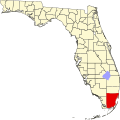 | |
| Towns | ||
| Villages | ||
| CDPs |
| |
| Unincorporated communities | ||
| Indian reservation | ||
| Footnotes | ‡This populated place also has portions in an adjacent county or counties | |

South Florida
View on GrokipediaGeography and Environment
Boundaries and Composition
South Florida constitutes the southeastern portion of Florida, lacking formally defined boundaries but conventionally encompassing Miami-Dade, Broward, and Palm Beach counties, which form the core of the Miami–Fort Lauderdale–West Palm Beach metropolitan statistical area as designated by the U.S. Office of Management and Budget.[9][10] This tri-county region extends northward from the southern tip of the Florida peninsula near Florida Bay, approximately along the 25th parallel north, to the northern limits of Palm Beach County around the 26th parallel north and 27th parallel north, bordering Martin County to the north and the Atlantic Ocean and Everglades to the east and west, respectively.[9] The composition includes densely urbanized coastal zones along the Gold Coast, featuring major cities such as Miami (Miami-Dade County seat), Fort Lauderdale (Broward County seat), and West Palm Beach (Palm Beach County seat), alongside extensive suburban and exurban developments inland.[10] These counties collectively span about 5,000 square miles of land area, dominated by low-lying coastal plains, barrier islands, and wetlands transitioning into the Everglades.[11] As of 2025 estimates, the population exceeds 6.4 million residents across these counties, with Miami-Dade holding 2.84 million, Broward 2.04 million, and Palm Beach 1.58 million, reflecting rapid urbanization and migration patterns.[12][11] Broader definitions occasionally incorporate Monroe County to the south, including the Florida Keys archipelago extending to Key West at approximately 24.5° north latitude, adding remote island communities and marine environments, though this extension is less standard for metropolitan analyses.[9]Physical Landscape
South Florida's physical landscape is characterized by low topographic relief and flat terrain, forming part of the Atlantic Coastal Plain physiographic province.[13] Elevations range from near sea level along the coast to a maximum of about 12-14 feet (3.7-4.3 meters) near Lake Okeechobee, with much of the region, including the Everglades, averaging around 2 meters (6.6 feet) above sea level.[13][14] The underlying geology consists primarily of permeable karst limestone formations of Pleistocene age, which contribute to a high water table and extensive subterranean drainage features such as sinkholes, caves, and solution channels.[15][16] The Biscayne Aquifer, a highly transmissive karst limestone system, underlies much of the coastal plain and serves as the primary source of groundwater, with rapid flow facilitated by fractures and dissolution-enlarged porosity in the bedrock.[16][17] Inland, the landscape features vast freshwater wetlands like the Everglades National Park, which preserves a unique subtropical wetland ecosystem known as a shallow, slow-moving river of grass covering approximately 1,500 square miles, interspersed with sawgrass marshes, tree islands, and sloughs; the park draws visitors for airboat tours offering views of alligators and other wildlife.[13][18] The Atlantic Coastal Ridge, a prominent topographic feature in southeastern areas such as Miami-Dade County, rises modestly to 7 meters (23 feet) in places, supporting pine rocklands and hammocks amid the otherwise subdued terrain.[19][20] Coastal landforms include barrier islands, sandy beaches, and mangrove-fringed shorelines, with the Florida Keys extending as a chain of low-lying coral and limestone islands southwest from the mainland, where elevations typically do not exceed 8 feet (2.4 meters).[21] Karst processes have shaped the region's hydrology, promoting direct recharge and discharge between surface water and aquifers, while limiting surface relief and fostering a landscape vulnerable to sea-level changes and subsidence.[15][22]Climate Patterns
South Florida possesses a tropical monsoon climate under the Köppen classification (Am), marked by consistently high temperatures, elevated humidity, and distinct wet and dry seasons driven by seasonal shifts in the Intertropical Convergence Zone and Atlantic sea surface temperatures.[23] This regime contrasts with the humid subtropical conditions prevalent in northern Florida, reflecting the region's latitude below 26°N and exposure to maritime tropical air masses.[24] Annual mean temperatures hover around 76°F (24.4°C) in key areas like Miami, with minimal seasonal variation compared to temperate zones; daily highs rarely drop below 70°F (21°C) in winter, while summer peaks often exceed 90°F (32°C) amid frequent heat indices above 100°F due to humidity.[25] The wet season spans May through October, coinciding with the North American monsoon influence and peak convective activity, delivering approximately 70-80% of the region's annual rainfall—totaling 60-62 inches (152-157 cm) on average—primarily via afternoon thunderstorms fueled by sea breezes and instability.[25] [26] These patterns result from diurnal heating over the peninsula, leading to localized heavy downpours exceeding 2-3 inches in hours, though prolonged droughts can occur between events. In contrast, the dry season from November to April features reduced precipitation (averaging 1-2 inches monthly), clear skies, and northeasterly trade winds, with occasional frontal passages introducing cooler air masses and rare freezes north of the Everglades.[25] El Niño-Southern Oscillation modulates winter variability: La Niña phases correlate with warmer, drier conditions, while El Niño enhances storm track incursions, yielding cooler temperatures and increased rainfall.[27] Tropical cyclone activity defines a core risk in climate patterns, as South Florida's coastal position places it in the Atlantic basin's primary track during the June-November season. Historical data indicate Florida experiences more hurricane landfalls than any other U.S. state, with South Florida bearing strikes from major hurricanes (Category 3+) roughly every 3-5 years on average since 1900, including the 1926 Great Miami Hurricane (Category 4) and 1992 Hurricane Andrew (Category 5).[28] [3] These events amplify seasonal rainfall, with associated storm surges and winds exceeding 100 mph, though long-term frequency shows decadal clustering tied to multidecadal Atlantic oscillations rather than monotonic trends.[29]| Month | Avg. High (°F) | Avg. Low (°F) | Avg. Precipitation (in) |
|---|---|---|---|
| Jan | 76 | 60 | 2.0 |
| Apr | 82 | 67 | 2.6 |
| Jul | 90 | 77 | 9.0 |
| Oct | 86 | 72 | 6.7 |
| Annual | 83 | 70 | 61.9 |
History
Pre-20th Century Foundations
The Tequesta inhabited the southeastern coast of Florida, including the Biscayne Bay region of present-day South Florida, from approximately 500 BCE until European contact.[30] This small tribe, numbering around 800 people at contact, relied on fishing, hunting, and gathering in a mangrove-dominated environment, constructing thatched huts and burying their dead in mounds.[31] Their territory extended from southern Palm Beach County southward to the Florida Keys and Cape Sable.[32] Archaeological evidence, such as the Miami Circle site, confirms their presence through shell tools and ceremonial structures.[30] Spanish explorer Juan Ponce de León sighted and landed on Florida's east coast in 1513, claiming the region for Spain and naming it La Florida, though South Florida saw minimal direct exploration or settlement initially.[33] Subsequent expeditions, including those mapping the Florida Keys, encountered Calusa and Tequesta groups but established no permanent outposts in the south due to hostile relations and logistical challenges.[33] Spanish influence remained peripheral, focused northward at St. Augustine (founded 1565), with South Florida serving as a frontier buffer against indigenous resistance.[34] Under the Adams-Onís Treaty of 1819, Spain ceded Florida to the United States, effective 1821, transferring control of sparsely populated South Florida and enabling American expansion amid ongoing border disputes.[35] This acquisition intensified conflicts with Seminoles, who had migrated into Florida from the north in the 18th century, blending with remnant Tequesta and other locals to form a distinct group resisting removal.[36] The First Seminole War (1816–1818) and subsequent wars (1835–1842, 1855–1858) displaced many Seminoles into the Everglades, establishing their enduring presence in South Florida's interior wetlands.[37] American military installations marked early footholds: the Cape Florida Light was constructed in 1825 on Key Biscayne to aid navigation, while Fort Dallas (1836) and other outposts near Biscayne Bay supported operations against Seminoles.[38] Key West, surveyed and claimed for the U.S. in 1821, saw its first permanent settlers arrive by 1823, with John W. Simonton purchasing the island in 1822 for $2,000, fostering wrecking and fishing economies amid piracy suppression efforts.[39] Civilian settlement in the Miami area remained negligible until the 1870s, when pioneers like Julia Tuttle acquired land, though incorporation occurred in 1896 just before the 20th century.[40] These foundations—indigenous adaptation, tenuous colonial claims, territorial transfer, and conflict-driven outposts—shaped South Florida's sparse pre-1900 human landscape amid its subtropical isolation.[41]Mid-20th Century Expansion
The end of World War II marked the onset of accelerated growth in South Florida, as military personnel who had trained at regional bases returned as residents, drawn by the area's subtropical climate and economic opportunities in tourism and construction. Dade County's population rose from 267,739 in 1940 to 495,084 in 1950, reflecting a surge in domestic migration.[42] Similarly, Broward County's population increased from 83,933 in 1950 to 333,946 by 1960, driven by suburban development north of Miami.[43] This expansion was supported by post-war infrastructure investments, including expanded highways and airports that integrated South Florida into national transportation networks, facilitating further influxes of residents and visitors.[44] The invention and affordability of residential air conditioning in the 1950s played a pivotal role in making year-round habitation viable amid the region's high humidity and heat, contributing to Florida's overall population growth of over 78% between 1950 and 1960.[45][46] Urban and suburban sprawl followed, with real estate development converting agricultural and wetland areas into housing tracts, though this strained water resources and prompted canal expansions for flood control after 1947 inundations.[47] By the late 1950s, South Florida's metropolitan areas had evolved from seasonal resorts into permanent economic hubs, bolstered by federal investments in aviation and roadways. The 1959 Cuban Revolution catalyzed a distinct phase of expansion through the arrival of skilled exiles, whose exodus reversed Cuba's brain drain while injecting capital and labor into Miami's economy. The U.S. Cuban population grew from 79,000 in 1960 to 439,000 by 1970, with the majority concentrating in South Florida and founding enterprises in trade, finance, and manufacturing that revitalized dormant districts.[48] This influx, aided by the 1966 Cuban Adjustment Act granting residency pathways, diversified the workforce and elevated Miami as a gateway for Latin American commerce, though it initially overwhelmed social services and housing stocks.[49] By the 1970s, these demographic shifts had solidified South Florida's transformation into a multicultural urban corridor, setting the stage for further globalization.[50]Late 20th and 21st Century Transformations
The Mariel boatlift of 1980 resulted in the arrival of approximately 125,000 Cuban refugees in South Florida over several months, swelling Miami's population and labor force by about 7%.[51] This sudden influx strained public resources, housing, and social services while introducing a mix of skilled workers, families, and a small but notable contingent released from Cuban prisons or mental institutions, which correlated with a temporary uptick in certain crime categories in Miami during the early 1980s.[52] Economically, the refugees integrated into low-skill sectors like construction and garment manufacturing, though studies indicate no long-term depression of native wages despite the supply shock.[53] Coinciding with this migration wave, the 1980s saw South Florida emerge as a primary entry point for cocaine smuggling from Latin America, fueling the "Cocaine Cowboys" era of unchecked violence and corruption.[54] Cartels exploited Miami's ports and proximity to the Bahamas for trafficking, leading to hundreds of homicides annually—peaking at over 600 in Miami-Dade County in 1981—and scandals like the 1985 Miami River Cops case, where officers were convicted of stealing from drug shipments.[55] Proceeds from the trade inadvertently boosted local real estate and luxury development, as laundered money funded construction amid lax oversight, though federal crackdowns via operations like the 1987 seizure of 75 tons of cocaine by figures like Willy Falcon and Sal Magluta began curtailing the chaos by decade's end.[56] Hurricane Andrew, a Category 5 storm, made landfall near Homestead in southern Miami-Dade County on August 24, 1992, generating winds up to 165 mph and inflicting $27 billion in damages (1992 dollars), the costliest U.S. hurricane until then.[57] The cyclone demolished over 125,000 homes, particularly mobile and single-family structures in South Dade, displaced 230,000 residents, and caused 44 fatalities in Florida, exposing vulnerabilities in building standards and urban planning.[58] Recovery efforts, bolstered by federal aid exceeding $11 billion, spurred stricter wind-resistant codes statewide and accelerated suburban expansion northward into Broward and Palm Beach counties, transforming previously rural areas into dense residential zones. Entering the 21st century, South Florida underwent a real estate boom from 2000 to 2006, driven by low interest rates, speculative investment, and influxes of domestic and international buyers, with Miami home prices surging 138% from January 2000 to their peak. This expansion added thousands of condominium units and fueled job growth in construction and finance, but overleveraged subprime lending precipitated a sharp bust after 2007, triggering widespread foreclosures—over 300,000 in Florida by 2010—and a 50%+ drop in median home values by 2011.[59] The crisis exposed reliance on housing as an economic driver, prompting diversification into logistics and tech, while post-2010 recovery saw renewed population inflows, with South Florida counties gaining over 500,000 residents between 2010 and 2020 amid broader state migration trends.[60] By the 2020s, net domestic migration accelerated growth to 1.6% annually statewide, sustaining urban intensification despite challenges like insurance costs and infrastructure strain.[61]Demographics
Population Growth and Trends
The Miami-Fort Lauderdale-West Palm Beach metropolitan statistical area, comprising Miami-Dade, Broward, and Palm Beach counties and serving as the primary demographic measure for South Florida, had a population of 6,457,988 as of July 1, 2024, up 123,471 residents or 1.9% from the 2023 estimate.[62] This marked the fourth-largest numeric gain among U.S. metro areas for the 2023-2024 period, driven by net international migration exceeding 100,000 across the region, which offset domestic out-migration in urban cores like Miami-Dade.[63] From April 1, 2020, to July 1, 2024, the MSA expanded by about 348,000 people, a cumulative growth rate of roughly 5.7%, surpassing the U.S. average of 2.5% over the same span, with annual increases accelerating post-2020 amid interstate relocations from higher-tax states.[64] [65] County-level trends reveal divergence: Miami-Dade grew 2.3% to approximately 2.77 million in 2023-2024, fueled by daily net inflows averaging 155 international migrants, while Broward and Palm Beach added 1.7% and 1.6%, respectively, reaching about 1.99 million and 1.56 million.[63] Between 2020 and 2023, however, Miami-Dade and Broward experienced net domestic losses of 134,382 and smaller outflows, respectively, as residents moved to Palm Beach County (net domestic gain) or other Florida regions amid rising housing costs and insurance premiums.[66] International migration, particularly from Latin America and the Caribbean, accounted for over 70% of recent net gains statewide, with South Florida capturing a disproportionate share due to established immigrant networks and port access. [63] Longer-term patterns show sustained expansion from a 2010 base of about 5.57 million, doubling roughly every 40 years since 1950, though growth moderated in the 2010s before rebounding sharply after 2020, coinciding with Florida's lack of state income tax and relatively permissive pandemic policies attracting remote workers and retirees from Northeast and California metros.[63] Natural increase (births minus deaths) contributed modestly, at under 20% of 2023-2024 gains, amid an aging demographic where deaths outpaced births in some years.[67] Emerging signs of stabilization include a 2023-2024 domestic net loss exceeding 101,000 in Miami proper, linked to affordability pressures post-hurricane vulnerabilities and inflation, potentially signaling a shift toward suburban or intrastate redistribution rather than outright decline.[68]Ethnic and Racial Breakdown
South Florida's population is marked by substantial diversity, with Hispanics or Latinos of any race forming the largest segment, followed by non-Hispanic Whites and non-Hispanic Blacks or African Americans. In the Miami-Fort Lauderdale-West Palm Beach metropolitan statistical area, which encompasses the core counties of Miami-Dade, Broward, and Palm Beach, the 2020 Census recorded approximately 42% of residents as Hispanic or Latino, 28% as non-Hispanic White alone, 18% as non-Hispanic Black or African American alone, 3% as Asian alone, and smaller shares for other races, multiracial individuals, and Native Americans.[69] These figures reflect heavy immigration from Latin America and the Caribbean since the mid-20th century, particularly Cubans fleeing post-1959 communist rule, alongside native-born and migrant Black populations from Haiti, Jamaica, and African American communities.[70]| County | Hispanic or Latino (%) | White alone, non-Hispanic (%) | Black or African American alone, non-Hispanic (%) | Asian alone, non-Hispanic (%) |
|---|---|---|---|---|
| Miami-Dade | 68.7 | 13.4 | 14.0 | 1.5 |
| Broward | 31.3 | 33.1 | 26.6 | 3.8 |
| Palm Beach | 21.5 | 53.8 | 17.2 | 3.2 |
Socioeconomic Indicators
The Miami–Fort Lauderdale–West Palm Beach metropolitan statistical area, encompassing South Florida's core counties, had a median household income of $76,271 in 2023, up 3.5% from $73,688 in 2022 but below the U.S. median of $77,719.[75] This figure reflects variability across counties, with Palm Beach County at $81,100 and Miami-Dade at $68,694, influenced by concentrations of high-net-worth individuals alongside lower-wage service and immigrant labor sectors.[76][77] The area's poverty rate was 12.8% in 2023, lower than Florida's statewide rate but elevated relative to national trends due to factors including household size and reliance on tourism-related employment.[78] Educational attainment among adults aged 25 and older reached 37.6% with a bachelor's degree or higher, compared to a high school completion rate of 87.7%, trailing national averages amid challenges like language barriers in Hispanic-majority populations and variable K-12 performance in urban districts.[78] Income inequality remains pronounced, aligning with Florida's Gini coefficient of 0.473 in 2023—higher than the U.S. value of 0.418—and exacerbated by stark wealth gaps between affluent enclaves and underemployed communities.[79][80]| Socioeconomic Indicator | South Florida MSA (2023) | U.S. Comparison |
|---|---|---|
| Median Household Income | $76,271 | Below national median ($77,719)[75] |
| Poverty Rate | 12.8% | Above national average[78] |
| Bachelor's Degree or Higher (Ages 25+) | 37.6% | Below national average[78] |
| Gini Coefficient (State Level Proxy) | 0.473 (Florida) | Higher than U.S. (0.418)[79][80] |
Economy
Primary Industries and Employment
The economy of South Florida, encompassing Miami-Dade, Broward, and Palm Beach counties, is predominantly service-based, with primary industries including tourism and hospitality, international trade and logistics, professional and business services, healthcare, and finance. The Miami-Fort Lauderdale-West Palm Beach metropolitan statistical area, which covers these counties, experienced nonfarm employment growth of 42,600 jobs over the 12 months ending June 2025, reflecting robust demand in leisure, trade, and professional sectors.[82] Overall, the tri-county region supports more than 2.5 million jobs, with concentrations in healthcare, retail trade, professional services, and hospitality.[6] Tourism drives significant employment through cruise operations, hotels, and attractions, capitalizing on the area's subtropical climate and coastal access. PortMiami, handling over 7 million cruise passengers annually as of recent years, generated a $61.4 billion economic impact in 2023 and supported 340,078 jobs across Florida, many in direct hospitality and support roles within South Florida.[83] Statewide tourism visitation reached a record 143 million in 2024, with South Florida capturing a substantial share via Miami's beaches and events, sustaining roles in accommodations, food services, and transportation.[84] International trade and logistics form another pillar, anchored by PortMiami and Miami International Airport, which together underpin warehousing, shipping, and aviation jobs. These facilities contributed to a combined $242.8 billion economic impact and nearly 1.2 million jobs statewide in recent assessments, with localized effects in cargo handling and supply chain management concentrated in the ports' vicinities.[85] Professional services, including finance and real estate, employ tens of thousands in office-based roles, while healthcare systems like Baptist Health South Florida rank among the largest employers, providing stable jobs in medical care and administration.[86] Manufacturing, though comprising a smaller share, sustains 100,000 jobs across over 6,000 firms in the tri-county area, generating a $9.4 billion impact through sectors like aerospace, medical devices, and food processing.[87] In Palm Beach County specifically, agriculture remains relevant, supporting roles in sugarcane and vegetable production alongside tourism and construction.[88] Recent job gains have favored education and health services, adding thousands of positions amid overall regional outperformance relative to national averages.[7]International Trade and Logistics
South Florida serves as a primary gateway for U.S. trade with Latin America and the Caribbean, handling significant volumes of containerized cargo, perishables, and high-value goods through its seaports and airports. The region's strategic location facilitates over half of PortMiami's imports from these areas, positioning it as a key node in hemispheric supply chains.[89] Florida's exports to Latin America and the Caribbean exceed those to other regions, with South Florida ports and Miami International Airport (MIA) enabling rapid distribution of electronics, pharmaceuticals, and agricultural products.[90] PortMiami, the largest container port in Florida, processed 1,089,443 twenty-foot equivalent units (TEUs) in fiscal year 2024, ranking 11th among U.S. container ports and first in the state.[91] Port Everglades in Fort Lauderdale handled 1,087,112 TEUs in the same period, securing 12th place nationally and supporting diverse cargoes including bulk liquids and vehicles.[92] These facilities emphasize refrigerated containers for time-sensitive exports like fruits and seafood, with Port Everglades ranking in the top 20% globally for container port performance per the World Bank's 2023 Container Port Performance Index.[93] The Port of Palm Beach contributes smaller volumes, focusing on regional breakbulk and roll-on/roll-off traffic. MIA, the leading U.S. airport for international air freight, managed a record 3 million tons of cargo in 2024, driven by e-commerce, pharmaceuticals, and perishables from Latin American partners.[94] This volume, up from prior years, underscores MIA's role as the top U.S. hub for inbound international freight, with over 70% of Florida's air exports destined for the Americas.[95] Logistics infrastructure, including foreign trade zones and intermodal connections via highways like I-95 and rail, enhances efficiency, though congestion and labor dependencies pose ongoing challenges. The combined economic footprint of these assets is substantial: PortMiami generated $61.4 billion in impact in 2023, supporting 340,078 jobs, while Port Everglades contributes $28.1 billion annually and 204,385 statewide jobs.[96][97] MIA and PortMiami together drive over $242.8 billion in Miami-Dade County activity, amplifying South Florida's status as a trade multiplier amid global shifts toward nearshoring in the Americas.[98]Real Estate and Development Dynamics
South Florida's real estate market has been shaped by rapid population inflows and international investment, driving development in high-rise condos and luxury residences, though recent trends indicate a shift toward a buyer's market amid rising inventory and affordability challenges. Median home sale prices in Miami reached $605,000 in September 2025, reflecting a 6.9% decline from the prior year, while statewide Florida prices hovered around $410,000 with flat growth.[99][100] Inventory levels expanded to 9.7 months' supply in 2025, contributing to a 5.7% drop in median home values and signaling reduced seller leverage.[101] Condo sales have faced sharper declines, with a 25% drop in South Florida transactions amid a post-pandemic correction from earlier booms fueled by remote work migration.[102] Older condos over 30 years old are now selling faster—averaging 62 days on market—than new builds at 79 days, as buyers prioritize affordability over premium features.[103] International buyers accounted for 49% of new construction and pre-construction sales over an 18-month period ending in mid-2025, predominantly from Latin America, sustaining luxury segment demand despite broader softening.[104] Branded condo projects proliferated in 2024, including Mercedes-Benz Places and Pagani Residences, targeting high-net-worth investors.[105] Development dynamics are constrained by Florida's property insurance crisis, where premiums have surged due to hurricane risks and litigation, deterring new projects and limiting buyer demand.[106] State reforms aimed at stabilizing insurers have coincided with a 17% rise in unpaid claims from 2022 to 2024, exacerbating coverage gaps particularly in coastal areas.[107] Post-COVID migration, which initially boosted prices through inflows from northern states, has slowed by 2025, easing pressure on single-family homes but highlighting vulnerabilities in multifamily and condo sectors reliant on continuous population growth.[108][109] In Palm Beach County, affluent migration from New York has sustained premium price appreciation, contrasting with broader regional trends.[110]Government and Politics
Local Governance Structures
Local governance in South Florida operates through a combination of county, municipal, and special district entities, with Miami-Dade, Broward, and Palm Beach counties serving as the primary administrative units under Florida's home rule provisions for charter counties, which grant broad powers not inconsistent with state law. These counties handle regional services such as public safety, infrastructure, and land use planning, while deferring to municipalities for localized matters. Miami-Dade County employs a distinctive two-tier federated system, where the county government coordinates services across unincorporated areas and 34 independent municipalities, each retaining autonomy over local ordinances and policing.[111] The county's executive branch is led by a strong mayor elected at-large, who manages daily operations, proposes budgets, and holds veto authority over legislation, supported by a 13-member Board of County Commissioners elected from single-member districts to staggered four-year terms for legislative oversight.[111] This structure, established via charter amendments, emphasizes centralized executive control amid the county's 2.7 million residents and dense urban fabric.[111] Broward County utilizes a commission-administrator form, with a nine-member Board of County Commissioners elected from single-member districts to four-year terms, collectively handling policy-making, budgeting, and ordinances.[112] The board selects a mayor and vice mayor annually from its ranks for ceremonial and presiding roles, while a professional county administrator executes administrative duties, reflecting a collective rather than strong-mayor executive model suited to its 1.9 million population and emphasis on inter-municipal coordination.[112] Palm Beach County follows a similar commission-administrator framework, governed by a seven-member Board of County Commissioners elected from districts to four-year staggered terms, which adopts laws and oversees a $8.5 billion annual budget as of fiscal year 2023-2024. A county administrator implements board directives, managing departments for services like environmental protection and transportation across 39 municipalities and unincorporated zones serving 1.5 million residents. Complementing county and municipal authority—encompassing over 100 cities and towns with mayor-council or commission-manager governments for hyper-local functions like zoning and utilities—special districts address targeted needs such as flood control and fire services.[113] [114] These entities, numbering over 1,900 statewide including regional bodies like the South Florida Water Management District, operate under elected or appointed boards with jurisdiction limited to specific purposes and funded via ad valorem assessments or user fees.[115] [114]Electoral Shifts and Voter Behavior
South Florida, encompassing Miami-Dade, Broward, and Palm Beach counties, has historically leaned Democratic since the mid-20th century, driven by large retiree populations, union influences, and immigrant communities favoring social welfare policies. However, from 2016 onward, electoral patterns shifted markedly toward Republicans, particularly among Hispanic voters, reflecting dissatisfaction with Democratic economic management, school closures during the COVID-19 pandemic, and perceived leniency on socialism—echoing experiences of Cuban, Venezuelan, and Nicaraguan exiles. This realignment accelerated Florida's transition from swing state to Republican stronghold, with voter registration flipping in key areas.[116][117] Voter registration data illustrates the trend: In Miami-Dade County, Democrats held a plurality for decades, but Republicans surpassed them in active registrations by May 2025, with 904,000 Republicans compared to 892,000 Democrats, marking the first such flip since at least the 1980s. Broward and Palm Beach remained Democratic-leaning as of 2024, though statewide purges reduced totals by over 250,000 in each due to inactive voter removals, narrowing gaps without reversing the upward Republican trajectory. Republicans gained steadily from 2016 to 2024 through conversions and new registrations, fueled by Hispanic influxes prioritizing entrepreneurship and anti-regulatory stances over expansive government programs.[118][119][120] Presidential election outcomes underscore behavioral changes. In 2016, Hillary Clinton won Miami-Dade by 29 points, Broward by 35, and Palm Beach by 22. By 2020, Joe Biden's margins shrank to 7, 15, and 7 points, respectively, as Donald Trump captured 46% in Miami-Dade amid Hispanic gains. The 2024 results cemented the shift: Trump won Miami-Dade outright (51% to 48%), the first Republican presidential victory there since 1988, while improving in Broward (45%) and Palm Beach (48%), securing Florida's 30 electoral votes decisively. Turnout dipped slightly from 2020 levels, but Republican enthusiasm—evident in higher early voting among conservatives—amplified the edge.[121][122][123] Hispanic voters, comprising over 40% of South Florida's electorate, drove the pivot, with Trump garnering 55-60% support among Latinos statewide in 2024, up from 35% in 2016, per exit polls. Cuban-Americans, long Republican on foreign policy, were joined by non-Cubans citing inflation, border security, and Governor Ron DeSantis's parental rights laws as motivators; polls showed 48% of Florida Latinos prioritizing economy over social issues. This defied mainstream predictions of immutable Democratic loyalty, as empirical voting data revealed causal links to policy outcomes like post-pandemic recovery and opposition to progressive curricula, rather than identity-based allegiance.[124][125][126]| County | 2016 (D-R Margin) | 2020 (D-R Margin) | 2024 (Trump %) |
|---|---|---|---|
| Miami-Dade | +29 | +7 | 51 |
| Broward | +35 | +15 | 45 |
| Palm Beach | +22 | +7 | 48 |