Hubbry Logo
search
logo
1763918

Squircle

logo
Community Hub0 Subscribers
Read side by side
from Wikipedia

Squircle centred on the origin (a = b = 0) with minor radius r = 1: x4 + y4 = 1

A squircle is a shape intermediate between a square and a circle. There are at least two definitions of "squircle" in use, one based on the superellipse, the other arising from work in optics. The word "squircle" is a portmanteau of the words "square" and "circle". Squircles have been applied in design and optics.

Superellipse-based squircle

[edit]

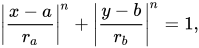
In a Cartesian coordinate system, the superellipse is defined by the equation where ra and rb are the semi-major and semi-minor axes, a and b are the x and y coordinates of the centre of the ellipse, and n is a positive number. The prototypical squircle is then defined as the superellipse where ra = rb and n = 4. Its equation is:[1]where r is the radius of the squircle. Compare this to the equation of a circle. When the squircle is centred at the origin, then a = b = 0, and it is called Lamé's special quartic.
The area inside this squircle can be expressed in terms of the beta function B or the gamma function Γ as[1]where r is the radius of the squircle, and is the lemniscate constant.

p-norm notation

[edit]

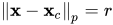
In terms of the p-norm ‖ · ‖p on R2, the squircle can be expressed as:where p = 4, xc = (a, b) is the vector denoting the centre of the squircle, and x = (x, y). Effectively, this is still a "circle" of points at a distance r from the centre, but distance is defined differently. For comparison, the usual circle is the case p = 2, whereas the square is given by the p → ∞ case (the supremum norm), and a rotated square is given by p = 1 (the taxicab norm). This allows a straightforward generalization to a spherical cube, or sphube, in R3, or hypersphube in higher dimensions.[2] Different values of p may be used for a more general squircle, from which an analog to trigonometry ("squigonometry") has been developed.
Fernández-Guasti squircle

[edit]

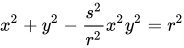
Another squircle comes from work in optics.[3][4] It may be called the Fernández-Guasti squircle or FG squircle, after one of its authors, to distinguish it from the superellipse-related squircle above.[2] This kind of squircle, centered at the origin, is defined by the equation:where r is the radius of the squircle, s is the squareness parameter, and x and y are in the interval [−r, r]. If s = 0, the equation is a circle; if s = 1, it is a square. This equation allows a smooth parametrization of the transition to a square from a circle, without invoking infinity.
Polar form

[edit]

The FG squircle's radial distance from center to edge can be described parametrically in terms of the circle radius and rotation angle:[5]

In practice, when plotting on a computer, a small value like 0.001 can be added to the angle argument to avoid the indeterminate form when for any integer , or one can set for these cases.

Linearizing squareness

[edit]

The squareness parameter in the FG squircle, while bounded between 0 and 1, results in a nonlinear interpolation of the squircle "corner" between the inner circle and the square corner. If is the intended liniearly-interpolated position of the corner, the following relationship converts to for use in the squircle formula to obtain correctly interpolated squircles:[5]

Periodic squircle

[edit]

Another type of squircle arises from trigonometry.[6] This type of squircle is periodic in R2 and has the equation

where r is the minor radius of the squircle, s is the squareness parameter, and x and y are in the interval (−r, r). As s approaches 0 in the limit, the equation becomes a circle. When s = 1, the equation is a square.

Similar shapes

[edit]
A squircle (blue) compared with a rounded square (red).

Rounded square

[edit]

A shape similar to a squircle, called a rounded square, may be generated by separating four quarters of a circle and connecting their loose ends with straight lines, or by separating the four sides of a square and connecting them with quarter-circles. Such a shape is very similar but not identical to the squircle. Although constructing a rounded square may be conceptually and physically simpler, the squircle has a simpler equation and can be generalised much more easily. One consequence of this is that the squircle and other superellipses can be scaled up or down quite easily. This is useful where, for example, one wishes to create nested squircles.

Truncated circle

[edit]
Various forms of a truncated circle

Another similar shape is a truncated circle, the boundary of the intersection of the regions enclosed by a square and by a concentric circle whose diameter is both greater than the length of the side of the square and less than the length of the diagonal of the square (so that each figure has interior points that are not in the interior of the other). Such shapes lack the tangent continuity possessed by both superellipses and rounded squares.

Rounded cube

[edit]

A rounded cube can be defined in terms of superellipsoids.

Sphube

[edit]

Similar to the name squircle, a sphube is a portmanteau of 'sphere' and 'cube'. It is the three-dimensional counterpart to the squircle. The equation for the FG-squircle in three dimensions is:[5]

In polar coordinates, the sphube is expressed parametrically as

While the squareness parameter s in this case does not behave identically to its squircle counterpart, nevertheless the surface is a sphere when s equals 0, and approaches a cube with sharp corners as s approaches 1.[5]

Uses

[edit]
Squircle-shaped porcelain dishes

Squircles are useful in optics. If light is passed through a two-dimensional square aperture, the central spot in the diffraction pattern can be closely modelled by a squircle or supercircle. If a rectangular aperture is used, the spot can be approximated by a superellipse.[4]

Squircles have also been used to construct dinner plates. A squircular plate has a larger area (and can thus hold more food) than a circular one with the same radius, but still occupies the same amount of space in a rectangular or square cupboard.[7]

Many Nokia phone models have been designed with a squircle-shaped touchpad button,[8][9] as was the second generation Microsoft Zune.[10] Apple uses an approximation of a squircle (actually a quintic superellipse) for icons in iOS, iPadOS, macOS, and the home buttons of some Apple hardware.[11] One of the shapes for adaptive icons introduced in the Android "Oreo" operating system is a squircle.[12] Samsung uses squircle-shaped icons in their Android software overlay One UI, and in Samsung Experience and TouchWiz.[13]

Italian car manufacturer Fiat used numerous squircles in the interior and exterior design of the third generation Panda.[14]

See also

[edit]

References

[edit]
[edit]
Revisions and contributorsEdit on WikipediaRead on Wikipedia
from Grokipedia
A squircle is a two-dimensional geometric shape intermediate between a square and a circle. The term "squircle" can refer to different curves, but most commonly denotes a special case of the superellipse with exponent $ n = 4 $, given by the equation $ \left| \frac{x}{a} \right|^4 + \left| \frac{y}{b} \right|^4 = 1 $, where $ a $ and $ b $ determine the semi-axes lengths.[1] This curve, also known as Lamé's special quartic, features smoothly rounded sides and corners, distinguishing it from simple rounded rectangles.[1] The underlying superellipse family was introduced by French mathematician Gabriel Lamé in 1818 as a generalization of ellipses to higher powers, encompassing both circles ($ n=2 $) and squares (as $ n \to \infty $).[2] Danish artist and mathematician Piet Hein popularized superellipses, including the squircle form, in the mid-20th century through applications in furniture, sculpture, and his "superegg" design—a three-dimensional analog.[3] The term "squircle," a portmanteau of "square" and "circle," emerged in 1966 when architect Peter Panholzer used it to describe the shape for custom bathroom fixtures.[3] In contemporary design, squircles are valued for their aesthetic balance of angularity and smoothness, appearing in user interfaces such as Apple's iOS app icons since 2013, where they approximate the curve using cubic Bézier paths for consistent visual appeal across devices.[4] Beyond digital media, squircles find use in industrial design for products such as hardware and tableware.[5]

Overview and History

General Definition

A squircle is a geometric shape that serves as an intermediate form between a square and a circle, blending the straight-edged, angular profile of the former with the smooth, curved boundary of the latter.[1] The term "squircle" is a portmanteau of "square" and "circle," first coined in the summer of 1966 by Peter Panholzer, an Austrian-born aspiring architect who studied in Vienna and was working in Toronto, Canada.[6] Conceptually, a squircle is defined as a continuous closed curve where the sides exhibit relatively flat regions that transition smoothly into rounded corners, avoiding the discontinuous curvature jumps found in simpler rounded squares. This results in a profile that maintains a squarish overall appearance while ensuring a seamless flow without abrupt changes in radius. Visually, the shape's curvature varies along its perimeter: it approaches zero along the midpoints of the sides, creating near-straight segments, and reaches its maximum values at the corners, producing gentle rounding that enhances its organic feel compared to a pure square's sharp 90-degree angles.[4][7] At its core, the squircle is mathematically modeled as a specific case of the superellipse, a generalized curve that interpolates between ellipses and rectangles based on an exponent parameter, allowing for tunable roundness without introducing piecewise constructions.[1] The conceptual foundations of such shapes trace back to the 1950s, when Danish polymath Piet Hein developed the superellipse to address practical design challenges, including the layout of Sergels torg—a major public square in Stockholm redesigned in the early 1960s to improve pedestrian flow and traffic separation through smoother, more efficient boundaries. Hein's innovations also extended to furniture, where the superellipse informed the iconic Superellipse table series, produced in collaboration with designer Bruno Mathsson and manufacturer Fritz Hansen starting in 1968, demonstrating the shape's utility in everyday objects.[8][9]

Etymology and Development

The concept of the squircle traces its mathematical roots to the superellipse, first described by French mathematician Gabriel Lamé in 1818 as a generalization of the ellipse using the equation $ |x/a|^n + |y/b|^n = 1 $, where $ n > 2 $ produces shapes intermediate between a square and a circle.[10] This remained a theoretical curiosity until the mid-20th century, when Danish polymath Piet Hein popularized superellipses (which he termed "super-ellipses") for practical design applications starting in the 1950s. Hein's work drew inspiration from Lamé's equation and applied it to urban planning, such as the superelliptical roundabout at Sergels Torg in Stockholm, Sweden, implemented in the 1960s to optimize traffic flow with smoother curves than traditional ellipses.[11] Hein also collaborated with designer Bruno Mathsson on superelliptical furniture, like tables produced by Fritz Hansen from 1968 onward, which featured the shape for its ergonomic and aesthetic balance between rectangular and circular forms.[8] The term "squircle" itself emerged as a portmanteau of "square" and "circle," with early recordings of the blend dating to 1945–1950 in general linguistic usage.[12] Peter Panholzer is credited with first applying the term to the superellipse-based geometric shape in the summer of 1966.[6] Panholzer, an Austrian-born student studying architecture in Vienna and working in Toronto, Canada, for Gerald Robinson, introduced the term while developing a master plan for Peterborough, Ontario's city center. Inspired by a 1965 Scientific American article on Hein's superellipses, Panholzer adapted the concept to emphasize a circle-based variant with squared edges, naming it "squircle" to describe its hybrid form during architectural sketches.[6] By the 1970s, the term appeared in design publications, reflecting growing interest in such shapes for furniture and urban layouts. The squircle evolved from these mathematical and design origins into broader adoption by the 1980s, particularly in optics where superellipse-like curves model diffraction patterns from square apertures more accurately than simple circles or squares.[13] It gained formal recognition in mathematical literature during the 2000s, such as through entries on Wolfram MathWorld, solidifying its place as a distinct geometric entity.[1] The squircle has persisted in digital design, notably since Apple's iOS 7 update in 2013, which incorporated squircle-inspired icons for a softer, more modern interface aesthetic.

Mathematical Definitions

Superellipse-based Squircle

The superellipse-based squircle is defined by the implicit equation
xr4+yr4=1, \left| \frac{x}{r} \right|^4 + \left| \frac{y}{r} \right|^4 = 1,
where r>0r > 0 is a scaling parameter analogous to the radius of a circle. This equation generalizes the standard ellipse equation (xa)2+(yb)2=1\left( \frac{x}{a} \right)^2 + \left( \frac{y}{b} \right)^2 = 1 (where n=2n=2 and a=b=ra=b=r), with the exponent n=4n=4 producing a shape that interpolates between a circle and a square.[10] As nn \to \infty, the superellipse approaches a square with side length 2r2r; the choice of n=4n=4 yields a visually balanced form with moderately rounded corners and straight mid-sides.[10] The curve originates from the work of French mathematician Gabriel Lamé, who introduced superellipses (also known as Lamé curves) in 1818 as a broader class of algebraic curves for solving geometric problems.[14] The specific case with n=4n=4 and a=ba=b gained prominence in the 1960s through applications in industrial design, where its smooth yet angular profile suited furniture and product aesthetics.[3] A parametric representation of the squircle, suitable for plotting and computation, is given by
x(θ)=rcosθ1/2\sgn(cosθ),y(θ)=rsinθ1/2\sgn(sinθ), x(\theta) = r \cdot |\cos \theta|^{1/2} \cdot \sgn(\cos \theta), \quad y(\theta) = r \cdot |\sin \theta|^{1/2} \cdot \sgn(\sin \theta),
for θ[0,2π)\theta \in [0, 2\pi). This form ensures the curve traces the full boundary, with the exponent 2/n=1/22/n = 1/2 for n=4n=4, and the sign function \sgn\sgn preserving quadrant orientation.[10] Geometrically, the squircle boundary corresponds to the unit sphere (in 2D) under the L4L_4 norm (also called the pp-norm with p=4p=4), defined as
(x,y)4=(x4+y4)1/4=r. \| (x, y) \|_4 = \left( |x|^4 + |y|^4 \right)^{1/4} = r.
This connection arises because the superellipse equation describes the level set of the LnL_n norm, linking the shape to functional analysis and convex geometry.[15] The enclosed area AA of a squircle with parameter rr is A=r2B(14,54)A = r^2 B\left( \frac{1}{4}, \frac{5}{4} \right), where BB is the beta function B(m,k)=Γ(m)Γ(k)Γ(m+k)B(m,k) = \frac{\Gamma(m) \Gamma(k)}{\Gamma(m+k)} and Γ\Gamma is the gamma function; for the unit squircle (r=1r=1), this evaluates to approximately 3.708.[10]

Fernández-Guasti Squircle

The Fernández-Guasti squircle represents an alternative formulation of the squircle, originating from optics research and emphasizing smooth geometric transitions suitable for simulations involving aperture shapes. Proposed by Manuel Fernández-Guasti in 1992, this curve is defined as a quartic algebraic shape that interpolates between a circle and a square, with the goal of reducing curvature discontinuities inherent in other definitions like the superellipse.[16] Unlike the superellipse-based squircle, which uses higher-order norms that can lead to sharp changes in curvature near the axes, the Fernández-Guasti version employs a simpler polynomial structure for enhanced continuity in applications requiring precise boundary modeling. The implicit Cartesian equation is
x4+y4+s2x2y22s2r2(x2+y2)+s4r4=0, x^4 + y^4 + s^2 x^2 y^2 - 2 s^2 r^2 (x^2 + y^2) + s^4 r^4 = 0,
where s[0,1]s \in [0,1] is the squareness parameter (s=0s=0 yields a circle of radius rr, s=1s=1 a square of side 2r2r), and rr scales the shape.[17] An equivalent normalized form is s2(x/r)2(y/r)2((x/r)2+(y/r)2)+1=0s^2 (x/r)^2 (y/r)^2 - ((x/r)^2 + (y/r)^2) + 1 = 0. In polar coordinates, the radius is
ρ(θ)=2r2(1s2)1+s2+cos2θ(1s2). \rho(\theta) = \sqrt{ \frac{2 r^2 (1 - s^2)}{1 + s^2 + \cos 2\theta \, (1 - s^2)} }.
This parametric representation is derived by solving the underlying quartic equation in polar terms, providing an explicit expression for radius as a function of angle that avoids solving higher-degree polynomials at each point. It proves particularly advantageous for computational plotting and numerical integration in polar-based algorithms.[17] A distinctive aspect is the linearizing squareness technique, which modifies the equation to maintain a constant squareness factor throughout the curve. By incorporating the s2x2y2s^2 x^2 y^2 term, the formulation normalizes angular variations, ensuring uniform rounding and minimizing discontinuities in the second derivative of the curvature—a common issue in superellipse variants at transition points. This adjustment allows for controlled "squareness" without disproportionate flattening at the diagonals or axes, promoting more isotropic behavior in design contexts. The technique stems from Fernández-Guasti's efforts to refine the curve for optical precision, as detailed in his publications.[17] For practical implementation, the Fernández-Guasti squircle excels in parametric plotting due to its explicit polar expression, enabling efficient generation of boundary points for simulations. In a unit-scaled configuration (with maximum radius normalized to 1), the radius exhibits minimal variation, dipping to approximately 0.92 at 45-degree angles for typical squareness parameters near the square limit, which underscores its stability for bounded shapes. These properties found early application in 2000s optics simulations, particularly for modeling diffraction patterns from squircle-like apertures in LCD pixels, where the smooth curvature aids in accurate far-field predictions without artifacts from discontinuous derivatives.[17]

Periodic Squircle

The periodic squircle represents a trigonometric extension of the squircle, designed to repeat indefinitely across the plane, facilitating applications in seamless tiling and periodic waveform generation. Unlike the bounded superellipse-based squircle, this variant achieves periodicity through an implicit equation of the form cos(πxr)cos(πyr)=ssin(πxr)sin(πyr)\cos\left(\frac{\pi x}{r}\right) \cos\left(\frac{\pi y}{r}\right) = s \sin\left(\frac{\pi x}{r}\right) \sin\left(\frac{\pi y}{r}\right), where s[0,1]s \in [0,1] controls the squareness (with s=0s=0 yielding a circle and s=1s=1 approaching a square grid), and rr sets the scale for repetition every 2r2r units in both directions.[18] This formulation enables the curve to tile the Euclidean plane without gaps or overlaps, forming an infinite lattice of squircle-like cells that blend circular smoothness with square-like flatness depending on ss. Such properties make it suitable for modular designs in computational geometry and generating non-sinusoidal waveforms that mimic squircle geometry over each period.[18] The derivation modifies Lamé curve concepts by incorporating periodic trigonometric functions into the implicit form, effectively wrapping the angular parameter to produce spatial repetition rather than a single closed loop. Introduced in 2022 as part of explorations into squircular implicit surfaces, this periodic variant allows for infinite extensions via the periodicity parameter, with the area enclosed per fundamental tile equivalent to that of a bounded squircle of comparable scale.[18] Despite its utility, adoption of the periodic squircle remains limited in computational geometry and related fields since its formal introduction.[18]

Geometric Properties

Curvature and Perimeter

The curvature of the superellipse-based squircle, defined by the equation $ |x/a|^n + |y/b|^n = 1 $ with $ n = 4 $ and $ a = b = r $, varies continuously around the curve, reaching maximum values near the corners (at approximately 45° angles in polar coordinates) and dropping to zero at the midpoints of the sides (along the axes). This profile arises from the parametric representation $ x(\theta) = r \cdot |\cos \theta|^{1/2} \cdot \operatorname{sign}(\cos \theta) $, $ y(\theta) = r \cdot |\sin \theta|^{1/2} \cdot \operatorname{sign}(\sin \theta) $ for $ \theta \in [0, 2\pi) $, where the curvature $ \kappa(\theta) $ is computed using the standard formula for parametric plane curves: $ \kappa = \frac{|x' y'' - y' x''|}{(x'^2 + y'^2)^{3/2}} $, with derivatives taken with respect to $ \theta $. The resulting expression for $ n = 4 $ highlights peaks at the corners, providing a smooth transition that eliminates the discontinuous curvature jumps present in approximations like rounded squares with circular arcs. This varying curvature is particularly advantageous in manufacturing and engineering, as it minimizes stress concentrations at transition points compared to shapes with abrupt changes.[19] The perimeter of the superellipse-based squircle lacks a closed-form expression and must be evaluated numerically via the arc length integral $ P = 4 \int_0^{\pi/2} \sqrt{ \left( \frac{dx}{d\theta} \right)^2 + \left( \frac{dy}{d\theta} \right)^2 } , d\theta $, derived from the parametric equations above. For $ r = 1 $, numerical integration yields $ P \approx 7.018 $, which lies between the circle's $ 2\pi \approx 6.283 $ and the limiting square's 8, reflecting the intermediate geometry.[1] In the Fernández-Guasti squircle, defined by $ x^2 + y^2 = s^2 x^2 y^2 + r^2 (1 - s^2) $ where $ s $ controls squareness (0 for circle, 1 for square), the curvature profile similarly varies smoothly without kinks, but the algebraic simplicity of this quartic form allows for potentially lower maximum curvature values compared to the superellipse variant for equivalent bounding boxes. Derivations for both variants emphasize parametric differentiation to obtain the necessary first and second derivatives, underscoring the squircle's role in designs where continuous curvature reduces mechanical stress points.[17]

Area and Comparisons

The area of a superellipse-based squircle, defined by the equation xan+ybn=1\left| \frac{x}{a} \right|^n + \left| \frac{y}{b} \right|^n = 1 with n=4n=4 and a=b=1a = b = 1, is given by the formula
A=4ab[Γ(1+1n)]2Γ(1+2n), A = 4ab \frac{\left[ \Gamma\left(1 + \frac{1}{n}\right) \right]^2}{\Gamma\left(1 + \frac{2}{n}\right)},
where Γ\Gamma denotes the gamma function.[10] This expression arises from evaluating the double integral over the region using the beta function, B(m,n)=01tm1(1t)n1dt=Γ(m)Γ(n)Γ(m+n)B(m, n) = \int_0^1 t^{m-1} (1-t)^{n-1} \, dt = \frac{\Gamma(m) \Gamma(n)}{\Gamma(m+n)}, which provides an exact closed-form solution via substitution in the quarter-area integral 0ab(1(xa)n)1/ndx\int_0^a b \left(1 - \left(\frac{x}{a}\right)^n \right)^{1/n} \, dx.[20] For n=4n=4 and unit semi-axes a=b=1a = b = 1, the numerical value is A3.708A \approx 3.708, computed as 4[Γ(54)]2Γ(32)4 \frac{\left[ \Gamma\left(\frac{5}{4}\right) \right]^2}{\Gamma\left(\frac{3}{2}\right)} with Γ(54)0.906402\Gamma\left(\frac{5}{4}\right) \approx 0.906402 and Γ(32)=π20.886227\Gamma\left(\frac{3}{2}\right) = \frac{\sqrt{\pi}}{2} \approx 0.886227.[10] This area positions the squircle intermediately between a circle and a square sharing the same bounding box of side length 2 (from 1-1 to 1 in both directions). The circumscribed square has area 4, so the squircle encloses approximately 92.7% of the square's area (3.708/40.9273.708 / 4 \approx 0.927).[10] The inscribed circle, touching the squircle at the axial midpoints with radius 1, has area π3.142\pi \approx 3.142, making the squircle's area about 118% of the circle's (3.708/π1.183.708 / \pi \approx 1.18).[10] As nn varies from 2 to \infty in the superellipse family, the area monotonically increases from πab\pi ab (circle) to 4ab4ab (square), highlighting the squircle's transitional role at n=4n=4.[20] Eccentricity-like metrics, such as the ratio of axial to diagonal extents (241.189\sqrt[4]{2} \approx 1.189 for the diagonal radius versus 1 for axial), further quantify this intermediate geometry, though area ratios provide a direct measure of enclosed space.[1] For the Fernández-Guasti squircle, defined by $ x^2 + y^2 = s^2 x^2 y^2 + r^2 (1 - s^2) $ with 0s10 \leq s \leq 1, the area is given by
A=4r2[E(k)(111+s2)K(k)], A = 4 r^2 \left[ E(k) - \left(1 - \frac{1}{1+s^2}\right) K(k) \right],
where $ k = \frac{1}{\sqrt{1+s^2}} $ is the modulus, $ K(k) $ is the complete elliptic integral of the first kind, and $ E(k) $ is the second kind.[17] This integral form, derived from quadrant symmetry and substitution $ t = x/r ,yieldsvaluesbetweenthecircle(, yields values between the circle ( s=0 $, $ A = \pi r^2 )andthesquare() and the square ( s=1 $, $ A \approx 1.476 r^2 $, corresponding to a rotated square with vertices near (\pm r, \pm r) in a bounding box of side $ 2r $). For equivalent bounding boxes, areas are comparable to the superellipse case but differ slightly due to the parametric form. At extremes, it reduces consistently to the circle and square areas under the equation's normalization.[17][1] The periodic squircle, given by cos(sπx2r)4+cos(sπy2r)4=1\cos\left( s \pi \frac{x}{2r} \right)^4 + \cos\left( s \pi \frac{y}{2r} \right)^4 = 1 for 0s10 \leq s \leq 1, tiles the plane periodically with period 4r4r in both directions.[21] The area of each fundamental tile equals that of the base squircle, as the periodicity preserves the enclosed region per unit cell without overlap or gap.[21] Numerical evaluation again relies on beta function integration for the base shape, ensuring exactness beyond approximate quadrature methods.[21]

Rounded Square

A rounded square is constructed by replacing the four corners of a square with side length $ s $ using quarter-circle arcs of constant radius $ r $, where $ r < s/2 $. The resulting shape features four straight segments along the mid-portions of the sides, each of length $ s - 2r $, connected smoothly at the endpoints to the arcs, forming a closed boundary that approximates a circle more closely than a sharp-cornered square while retaining linear sections. This geometric construction provides a simple method for creating softened edges without requiring a unified continuous curve.[22] The boundary of a rounded square is defined piecewise, combining linear equations for the straight segments and parametric equations for the circular arcs. Assuming the shape is centered at the origin, the horizontal straight segments are given by $ y = \pm s/2 $ for $ x $ ranging from $ -(s/2 - r) $ to $ s/2 - r $, and the vertical straight segments by $ x = \pm s/2 $ for $ y $ ranging from $ -(s/2 - r) $ to $ s/2 - r $. The corner arcs are quarter-circles; for instance, the top-right arc, centered at $ (s/2 - r, s/2 - r) $, is parameterized as $ x = (s/2 - r) + r \cos \theta $, $ y = (s/2 - r) + r \sin \theta $ for $ \theta \in [0, \pi/2] $, with similar parameterizations rotated for the other corners using appropriate sine and cosine shifts.[23] Unlike a true squircle, which exhibits continuously varying curvature along its entire perimeter, the rounded square has constant curvature $ 1/r $ on each arc and zero curvature on the straight segments, resulting in abrupt transitions—or "kinks"—at the junctions where the arcs meet the straights; these discontinuities in curvature and its derivative distinguish it as a piecewise approximation rather than a smooth intermediate form between square and circle. The area of a rounded square is $ s^2 + r^2 (\pi - 4) $, derived by starting from the area of the bounding square and adjusting for the replacement of each corner square of side $ r $ with a quarter-disk of area $ \pi r^2 / 4 $. This shape gained prominence in early user interface design, particularly from the 1980s onward in systems like the original Macintosh, where rounded rectangles were adopted for buttons and windows to convey a friendlier aesthetic, remaining common in pre-2010s digital interfaces before smoother alternatives like squircles became feasible.[22][24][25]

Truncated Circle

A truncated circle is formed by applying four symmetric truncations to a circle via straight chords positioned parallel to the coordinate axes, creating four flat sides while preserving curved arcs between the truncation points; this is equivalent to subtracting four corner segments from the original circle. This construction produces flat sides and arcs only when $ d \geq R / \sqrt{2} $; for $ d < R / \sqrt{2} $, the shape is a square of side length $ 2d $.[26] The parametric representation alternates between straight-line chord segments and circular arcs connecting their endpoints, defined for a circle of radius $ R $ and truncation parameter $ d $ (the perpendicular distance from the center to each chord). The flat sides correspond to these chords, each of length $ 2 \sqrt{R^2 - d^2} $. The connecting arcs are portions of the original circle with constant curvature $ 1/R $, in contrast to the zero curvature along the flat sides.[27][26] Key properties include the enclosed area, given by $ \pi R^2 - 4 \times $ (area of one circular segment), where the segment area is $ \frac{R^2}{2} (\theta - \sin \theta) $ and $ \theta = 2 \arccos(d/R) $; the chord length $ 2 \sqrt{R^2 - d^2} $ determines the segment's base. The perimeter is $ 4 \left( 2 \sqrt{R^2 - d^2} + R \left( \frac{\pi}{2} - 2 \arccos\frac{d}{R} \right) \right) $, where the central angle subtended by each arc is $ \frac{\pi}{2} - 2 \arccos\frac{d}{R} $.[26] This shape finds application in optics and engineering, such as apertures in therapeutic ultrasound systems, where a truncated circle of dimensions like 165 mm by 234 mm accommodates anatomical geometries while optimizing beam focusing.[28] It differs from the squircle in its piecewise construction of uniform arcs and discrete flats, rather than a continuously varying smoothness from a unified equation.

3D Extensions

The three-dimensional analog of the squircle is known as a sphube, a portmanteau of "sphere" and "cube," representing a rounded cube with variable curvature that interpolates smoothly between these shapes. It is defined mathematically as a special case of the superellipsoid given by the equation xan+ybn+zcn=1\left| \frac{x}{a} \right|^n + \left| \frac{y}{b} \right|^n + \left| \frac{z}{c} \right|^n = 1, where n=4n = 4 and aa, bb, c>0c > 0 are semi-axes lengths; for the symmetric sphube, a=b=ca = b = c.[29] This form extends the 2D superellipse-based squircle to volume by applying the same exponent to all three dimensions, producing smooth transitions without discontinuities in curvature, unlike a rounded cube that features constant-radius spherical caps at edges and corners. A parametric representation of the sphube in 3D extends the 2D squircle parameters using spherical coordinates (θ,ϕ)(\theta, \phi), where θ[π/2,π/2]\theta \in [-\pi/2, \pi/2] and ϕ[π,π]\phi \in [-\pi, \pi], as follows:
x=acosθ2/nsgn(cosθ)cosϕ2/nsgn(cosϕ),y=bcosθ2/nsgn(cosθ)sinϕ2/nsgn(sinϕ),z=csinθ2/nsgn(sinθ). \begin{align*} x &= a \cdot |\cos \theta|^{2/n} \cdot \operatorname{sgn}(\cos \theta) \cdot |\cos \phi|^{2/n} \cdot \operatorname{sgn}(\cos \phi), \\ y &= b \cdot |\cos \theta|^{2/n} \cdot \operatorname{sgn}(\cos \theta) \cdot |\sin \phi|^{2/n} \cdot \operatorname{sgn}(\sin \phi), \\ z &= c \cdot |\sin \theta|^{2/n} \cdot \operatorname{sgn}(\sin \theta). \end{align*}
For n=4n=4, this yields a surface that blends cubic facets with spherical rounding.[30] The volume VV of a superellipsoid, including the sphube, is given by V=8abcΓ(1+1n)3Γ(1+3n)V = 8abc \frac{\Gamma\left(1 + \frac{1}{n}\right)^3}{\Gamma\left(1 + \frac{3}{n}\right)}, where Γ\Gamma denotes the gamma function; for the symmetric unit case (a=b=c=1a = b = c = 1, n=4n=4), this evaluates to approximately 6.48, establishing its intermediate scale between the unit cube's volume of 8 and the inscribed sphere's 43π4.19\frac{4}{3}\pi \approx 4.19.[31] Sphubes and related superellipsoids find applications in computer-aided design (CAD) and 3D printing for modeling organic or ergonomic forms due to their compact parametric description and smooth geometry.[32] The term "sphube" emerged in computer graphics literature during the 2010s to describe these n=4 superellipsoids.

Applications

Design and User Interfaces

In user interface design, squircles gained prominence with Apple's adoption in iOS 7 in 2013, where app icons were masked with a squircle shape to minimize visual tension at the corners compared to traditional rounded rectangles, while ensuring uniform alignment on the home screen grid.[33] This design choice provided a smoother transition between straight edges and curves, enhancing overall aesthetic harmony in the flat design paradigm introduced at the time.[4] The squircle mask has persisted through subsequent iOS versions, including iOS 16 and later releases in 2022 onward, where it continues to define app icons and extends to home screen elements for consistent visual scaling across devices. In graphic design software, support for squircle approximations via Bézier curves emerged around 2018, enabling designers to replicate iOS-style shapes precisely. Figma, for instance, reverse-engineered the iOS squircle to create vector-based approximations using cubic Bézier paths, addressing the limitations of standard rounded rectangle tools by achieving more fluid curvature.[4] Adobe Illustrator and similar tools have long facilitated such custom Bézier constructions, allowing designers to craft squircles for logos, buttons, and illustrations since the rise of mobile-first workflows. A related development, the squirclemorphism trend in 2021, integrated squircles into neumorphic interfaces—elements with subtle shadows mimicking depth—popularizing their use for softer, more organic button and card designs in apps and websites.[34] Beyond digital interfaces, squircles appear in consumer products for their practical advantages in form and function. Squircular plates, for example, offer greater surface area for holding food compared to circular plates of equivalent width, while avoiding the sharp edges of square plates that complicate stacking and handling.[5] This shape's continuous curvature also supports scalability in responsive web design, where elements resize smoothly across screen sizes without abrupt corner distortions. Following 2020, web developers increasingly employed CSS border-radius hacks—such as varying values for adjacent sides (e.g., 40% on straight edges tapering to 20% at corners)—to approximate squircles in layouts, driven by the demand for iOS-like aesthetics in cross-platform apps. As of late 2025, native CSS support via the corner-shape: squircle property has begun rolling out in major browsers like Chrome, simplifying these implementations without approximations.[35]

Optics and Engineering

In optics, the squircle serves as an effective mathematical model for apertures that approximate squares with rounded corners, such as those in LCD pixels or photomasks, producing diffraction patterns that transition between sinc-like distributions for squarer forms and Airy-like rings for more circular ones.[36] The far-field intensity distribution arises from the Fourier transform of the squircle's indicator function, often computed using Fourier-Bessel integrals for scalar diffraction theory.[36] For instance, in photomask fabrication for optical lithography, squircles model corner rounding influenced by beam width and photoresist sensitivity, with diffraction patterns analyzed via Fraunhofer approximation to optimize shape fidelity.[37] The squircle's polar equation, given by $ s^2 r^4 \sin^2(2\theta) - k^2 r^2 + k^4 = 0 $, where $ s $ controls roundness (0 for circle, 1 for square) and $ k $ scales the size, enables precise simulation of these patterns, revealing angular variations in higher-order rings due to aperture irregularities.[36] This approach improves light efficiency over purely square apertures by reducing spillover into unwanted diffraction orders, while being simpler to machine than circular forms in optical hardware.[36] In engineering, superellipses, including squircles as the case with exponent $ n=4 $, have been applied since the 1960s in urban design, notably by Piet Hein for the concentric layouts of streets and underground pathways at Sergels Torg in Stockholm, using exponent $ m=2.5 $ to balance traffic flow and aesthetics.[31] More recently, generalized superellipsoids model complex mechanical components like crankshaft counterweights, optimizing stress distribution through parametric adjustments to the shape's curvature for enhanced durability in high-load applications.[38] These forms provide smoother load paths compared to traditional ellipses or rectangles, facilitating better material efficiency in fabrication processes such as additive manufacturing.[38]

References

User Avatar
No comments yet.