Hubbry Logo
Saint LawrenceSaint LawrenceMain
Open search
Saint Lawrence
Community hub
Saint Lawrence
logo
8 pages, 0 posts
0 subscribers
Be the first to start a discussion here.
Saint Lawrence
Saint Lawrence
from Wikipedia

Saint Lawrence or Laurence (Latin: Laurentius, lit.'laurelled'; 31 December 225[1] – 10 August 258) was one of the seven deacons of the city of Rome under Pope Sixtus II who were martyred in the persecution of the Christians ordered by the Roman emperor Valerian in 258.

Key Information

Life

[edit]

Lawrence is thought to have been born on 31 December AD 225,[1] in Huesca (or, less probably, in Valencia), the town from which his parents came in the later region of Aragon, which was then part of the Roman province of Hispania Tarraconensis.[2] The martyrs Orentius (Modern Spanish: San Orencio) and Patientia (Modern Spanish: Santa Paciencia) are traditionally held to have been his parents.[3][4]

Lawrence encountered the future Pope Sixtus II, a famous teacher born in Greece, in Caesaraugusta (Zaragoza), and they travelled together from Hispania to Rome. When Sixtus became the pope in 257, he ordained the young Lawrence, who was only 32, as a deacon, and later appointed him as Archdeacon of Rome, the first among the seven deacons who served in the cathedral church. This was a position of great trust which included the care of the treasury and riches of the Church and the distribution of alms to the poor.[5]

St. Lawrence Distributing the Treasures of the Church by Bernardo Strozzi

St. Cyprian, Bishop of Carthage, noted that at the time the norm was that Christians who were denounced were executed and all their goods confiscated by the Imperial treasury. At the beginning of August 258, the Emperor Valerian issued an edict that all bishops, priests, and deacons should immediately be put to death. Pope Sixtus II was captured on 6 August 258, at the cemetery of St. Callixtus, while celebrating the liturgy, and was executed immediately.[6]

After the death of Sixtus, the prefect of Rome demanded that Lawrence turn over the riches of the Church, and St. Ambrose wrote that Lawrence asked for three days to gather the wealth.[7] He worked swiftly to distribute as much Church property to the indigent as possible to prevent it from being seized by the prefect. On the third day, at the head of a small delegation, he presented himself to the prefect. When ordered to deliver the treasures of the Church, he presented the city's indigent, crippled, blind, and suffering, and declared that these were the true treasures of the Church: "Here are the treasures of the church. You see, the church is truly rich, far richer than your emperor!"[8][9]

Martyrdom

[edit]
The Martyrdom of Saint Lawrence by Rubens (1614)

As a deacon in Rome, Lawrence was responsible for the material goods of the Church and the distribution of alms to the poor.[8] Ambrose of Milan related that when the treasures of the Church were demanded of Lawrence by the prefect of Rome, he brought forward the poor, to whom he had distributed the treasure as alms.[10] "Behold in these poor persons the treasures which I promised to show you; to which I will add pearls and precious stones, those widows and consecrated virgins, which are the Church's crown."[5] The prefect was so angry that he had a great gridiron prepared with hot coals beneath it and had Lawrence placed on it, hence Lawrence's association with the gridiron.

Lawrence was sentenced at San Lorenzo in Miranda and imprisoned in San Lorenzo in Fonte, where he baptized fellow prisoners. He was martyred in San Lorenzo in Panisperna and was buried in San Lorenzo fuori le Mura. The Almanac of Filocalus for 354 states that he was buried in the Catacomb of Cyriaca on the Via Tiburtina[10] by Hippolytus and Justin the Confessor, a presbyter. One of the early sources for his martyrdom was the description of Aurelius Prudentius Clemens in his Peristephanon, Hymn 2.

Martyrdom of San Lorenzo, by Palma il Giovane, in San Giacomo dall'Orio (Venice)

Despite the Church being in possession of the actual gridiron, historian Patrick J. Healy argues that the traditional account of how Lawrence was martyred is "not worthy of credence",[11] as the slow, lingering death cannot be reconciled "with the express command contained in the edict regarding bishops, priests, and deacons (animadvertantur) which ordinarily meant decapitation".[11] A theory of how the tradition arose is proposed that as the result of a mistake in transcription, the omission of the letter "p" – "by which the customary and solemn formula for announcing the death of a martyr – passus est ["he suffered," that is, was martyred] – was made to read assus est [he was roasted]."[11] The Liber Pontificalis, which is held to draw from sources independent of the existing traditions and Acta regarding Lawrence, uses passus est concerning him, the same term it uses for Pope Sixtus II, who was martyred by decapitation during the same persecution 4 days earlier.[11]

Emperor Constantine I is said to have erected a small oratory in honour of Lawrence, which was a station on the itineraries of the graves of the Roman martyrs by the seventh century. Pope Damasus I rebuilt or repaired the church, now the Basilica di San Lorenzo fuori le Mura, while the Minor Basilica of San Lorenzo in Panisperna was erected over the site of his martyrdom. The gridiron of the martyrdom was placed by Pope Paschal II in the Minor Basilica of San Lorenzo in Lucina.[citation needed]

Associated Roman churches

[edit]
St. Lawrence in stained glass window by Franz Mayer & Co. He is holding a palm branch, a symbol of martyrdom, and a griddle, the instrument of his death.

The Roman Catholic Church erected six churches on the sites in Rome traditionally associated with his martyrdom:

There are also three other significant churches in Rome which are dedicated to Saint Lawrence but not associated with his life:

Miracles

[edit]

The life and miracles of Lawrence were collected in The Acts of St Lawrence but those writings have been lost. The earliest existing documentation of miracles associated with him is in the writings of Gregory of Tours (538–594), who mentions the following:

A priest named Fr. Sanctulus was rebuilding a church of St. Lawrence, which had been attacked and burnt, and hired many workmen to accomplish the job. At one point during the construction, he found himself with nothing to feed them. He prayed to St. Lawrence for help, and looking in his basket he found a fresh, white loaf of bread. It seemed to him too small to feed the workmen, but in faith he began to serve it to the men. While he broke the bread, it so multiplied that his workmen fed from it for ten days.[5][better source needed]

The mediaeval Church of St Mary Assumed (Chiesa di Santa Maria Assunta) in the small commune of Amaseno, Lazio, Italy, houses the famous reliquary of the ampulla containing relics of Lawrence, namely a quantum of his blood, a fragment of his flesh, some fat and ashes. Tradition holds that annually, on the Feast of St. Lawrence, and sometimes on other occasions, the blood in the ampulla miraculously liquefies during the Feast and re-coagulates by the following day.[13][better source needed]

Veneration

[edit]
The stone on which St Lawrence's body was laid after death, in San Lorenzo fuori le mura

Due to his conspiring to hide and protect the written documents of the Church, Lawrence is known as the patron saint of archivists and librarians.[14]

Roman Catholic Church

[edit]

Lawrence is one of the most widely venerated saints of the Roman Catholic Church. Legendary details of his death were known to Damasus, Prudentius, Ambrose, and Augustine. Devotion to him was widespread by the fourth century. His liturgical celebration on 10 August has the rank of feast in the General Roman Calendar, consistent with the oldest Christian calendars, e.g. the Almanac of Philocalus for the year 354, the inventory of which contains the principal feasts of the Roman martyrs of the middle of the fourth century. He remains one of the saints enumerated in the "Roman Canon" of the Holy Mass as celebrated in the Latin Church.[15][16]

Lawrence is especially honoured in the city of Rome, of which he is considered the third patron after St. Peter and St. Paul.[17] The church built over his tomb, the Papal Minor Basilica di San Lorenzo fuori le Mura, became one of the seven principal churches of Rome and a favourite place of Roman pilgrimages.[18] The area proximate to the Basilica di San Lorenzo fuori le Mura is named the "Quartiere San Lorenzo".[citation needed]

Because the Perseid Meteor Shower typically occurs annually in mid-August on or around his feast day, some refer to the shower as the "Tears of St Lawrence".[5]

The shrine containing the gridiron that was used to roast St Lawrence to death according to tradition is in the Church of San Lorenzo in Lucina, Rome.

His intercession to God is invoked by librarians, archivists, comedians, cooks and tanners as their patron. He is the patron saint of Ampleforth Abbey, whose Benedictine monks founded one of the world's leading public schools for British (and other) Roman Catholics, located in North Yorkshire.

The Festival of San Lorenzo is a religious celebration occurring every year in Tarapacá, Chile.[19]

Anglican Communion

[edit]

Within Anglicanism Lawrence's name is traditionally spelled Laurence or Lawrence. His feast is on 10 August which is in the calendar of the Book of Common Prayer, the volume of prayers which, in its 1662 format, was the founding liturgical document of a majority of Anglican provinces. In the Book of Common Prayer the feast is titled "S Laurence, Archdeacon of Rome and Martyr". His feast on 10 August has been carried into the contemporary calendars of most Anglican provinces,[20] Laurence is remembered in the Church of England[21] with a Lesser Festival under the title "Laurence, deacon, martyr, 258" on 10 August.[22]

Anglo-Catholics venerate Lawrence, who is the patron of many Anglican parish churches, including 228 in England.[23][24] A major church in Sydney, Australia, in the former civil parish of St Laurence, is known as "Christ Church St Laurence". The Anglican charitable society, Brotherhood of St Laurence also bears his name.[citation needed]

Legacy

[edit]
El Escorial, near Madrid, laid out in a pattern resembling a gridiron

According to Francesco Moraglia, the role of deacon is distinguished by service of the poor. He is destined both to the service of the table (corporal works of mercy) and to the service of the word (spiritual works of mercy). "The beauty, power and the heroism of [d]eacons such as Lawrence help to discover and come to a deeper meaning of the special nature of the diaconal ministry."[6] Pope Leo XIV links Laurence with Saint Stephen, the first Christian martyr, as two deacons concerned with Christian service to the poor who died for their faith.[25]

Many churches, schools, parishes, towns, and geographic features throughout the world are named for Lawrence of Rome. Depending on locality they are named St. Lawrence, St. Laurence, San Lorenzo, St. Laurent, St. Lorenz or similarly in other languages.

Europe

[edit]

San Lorenzo del Escorial, the monastery built by King Philip II of Spain, commemorates his victory at the Battle of St. Quentin (1557) on the Feast of St. Lawrence.[26] The monastery and the attached palace, college, and library are laid out in a pattern that resembles the gridiron of Lawrence's martyrdom.

The gridiron of Lawrence is also thought to be the basis of the design of the Certosa di San Lorenzo di Padula, which is a monastery in Padula, Salerno, Italy, and in Switzerland, Saint Lawrence is represented on the coat of arms of the city of Bülach with a gridiron.

Americas

[edit]

Saint Lawrence is one of Canada's patron saints. On his second voyage, French explorer Jacques Cartier, arriving in the river estuary of the North American Great Lakes on the Feast of St. Lawrence in 1535, named it the Gulf of St. Lawrence.[27] The river emptying into the gulf was named the St. Lawrence River. Many names in what are now Québec and the Maritime Provinces of Canada are references to this important seaway, e. g., the Laurentian Mountains north of the city of Montreal, Saint-Laurent (borough), Saint Lawrence Boulevard which spans the width of the Island of Montreal, and St. Lawrence County, New York, United States, near Lake Ontario. In the province of Ontario, St. Lawrence is a prominent, historic neighbourhood in the old centre of Toronto (formerly named York), now most known for the expansive St. Lawrence Market. The Laurentian Mountains gave rise to the name for the Laurential Plateau, or the Canadian Shield.

In Chile, the Day of the Miner (Spanish: Día del Minero) is commemorated on the feast of Saint Lawrence.[28] On that day the National Mining Society awards the San Lorenzo Prize to individual miners and entities of the mineral industry.[28] The rescue operation for the miners trapped in the 2010 Copiapó mining accident in Chile was named Operacíon San Lorenzo after Lawrence, patron saint of miners.[29]

Bernalillo, New Mexico, celebrates three days of devotions to the Saint, to honor a devotional promise made by Spanish settlers during the 1692 Pueblo Revolt. Among the festivities are a set of dances performed by matachines. An image of the saint is kept in the house of a local family throughout the year, and a vigil and feast are held from 9–11 August. It is one of the oldest dancing processions in the New World.[30]

Patronage

[edit]

[31][32]

[edit]
[edit]

In Fargo, season 1, episode 3, Lorne Malvo notes the stained glass window of St Lawrence in Stavros's office, in response to which Stavros narrates his martyrdom, in "A Muddy Road".

In a scene in the 1992 film Lorenzo's Oil, Augusto, Michaela, and Lorenzo tell a story about St Lawrence and refer to his Feast Day as "The Night of The Shooting Stars".[33]

In music

[edit]

Marc-Antoine Charpentier, Motet de Saint Laurent, H.321, for one voice, two treble instruments and contino, 1677-78

See also

[edit]

Several other saints were also named "Lawrence" (or the corresponding local variant), so one might also occasionally encounter something named after one of them. More information on these topics can currently be accessed through disambiguation articles like:

References

[edit]
[edit]
Revisions and contributorsEdit on WikipediaRead on Wikipedia
from Grokipedia
Saint Lawrence (Latin: Laurentius; c. 225 – 10 August 258) was a third-century Christian deacon and martyr in Rome, renowned for his role as one of the seven deacons serving under Pope Sixtus II and for his steadfast charity toward the poor during the Valerian persecution. Born in Hispania (modern-day Spain) at Osca in Aragon near the Pyrenees, he studied in Saragossa before migrating to Rome, where he was ordained as archdeacon and entrusted with distributing the Church's material goods to the needy, embodying the belief that the poor constituted the true treasures of the faith. His feast day is celebrated on August 10, and he is venerated as a patron saint of deacons, the poor, Rome (as its third co-patron after Peter and Paul), and various professions including cooks, chefs, firefighters, miners, students, and tanners, due to legends surrounding his life and death. As proto-deacon, Lawrence closely assisted Pope Sixtus II, who had been elected in 257 amid intensifying Roman persecutions of Christians. When Sixtus was arrested and executed by decapitation on August 6, 258, Lawrence reportedly followed him to the site of martyrdom, pleading, "Where are you going, Father, without your son?"—a testament to his filial devotion and willingness to share in suffering. Seized shortly after, Lawrence was ordered by the prefect to surrender the Church's riches; in defiance, he assembled the city's impoverished and disabled, declaring them the authentic wealth of the Christian community, an act that sealed his fate under Emperor Valerian's edict targeting clergy and confiscating sacred properties. Lawrence's martyrdom occurred on August 10, 258, four days after his pope's execution, and is recorded in early sources like the Depositio Martyrum of 354 AD, which notes his burial at the Verano cemetery on the Via Tiburtina. According to tradition preserved in the Roman Canon of the Mass and later hagiographies, he was roasted alive on a gridiron over hot coals, enduring the torture with humor by quipping to his executioners, "This side is done—turn me over and eat," before succumbing after brief additional suffering. His relics were later translated to various sites, including the Basilica of San Lorenzo fuori le Mura in Rome, and his example of sacrificial love has inspired Christian diakonia, emphasizing service to the marginalized as a core aspect of faith.

Biography

Early Life and Background

Saint Lawrence, also known as Laurence of Rome, was born circa 225 AD in Osca (modern-day Huesca), a city in the Roman province of Hispania Tarraconensis (present-day Aragon, Spain), into a Christian family that held Roman citizenship. According to tradition, he was born to Christian parents. This birthplace positioned him within a region of early Christian communities, where Hispanic converts navigated Roman cultural and legal structures. As a young man, Lawrence pursued education in Zaragoza (ancient Caesaraugusta), a hub for theological and humanistic studies, under the guidance of the scholar Sixtus, later Pope Sixtus II, who originated from Greece. Sixtus recognized Lawrence's exceptional piety, intellectual acuity, and organizational abilities, fostering his rapid advancement within ecclesiastical circles despite the era's risks for Christian adherents. These formative years equipped Lawrence with the scriptural knowledge and administrative expertise that would define his later service. According to tradition, circa 250 AD, amid the persecutions initiated by Emperor Decius, Lawrence accompanied Sixtus II to Rome, the epicenter of the Christian world, where he integrated into the local community and assumed roles reflecting his talents. This migration occurred during a turbulent period, as Decius's edicts demanded sacrifices to Roman gods, intensifying scrutiny on church leaders and their supporters. Details of Lawrence's early life derive from sparse historical records and later tradition, chiefly hagiographic texts such as the 5th-century Passio Sancti Laurentii (Acts of St. Lawrence), a narrative blending fact and legend, and allusions in Eusebius of Caesarea's Ecclesiastical History (circa 312–324 AD), which records the martyrdoms of Sixtus II and his deacons but offers minimal biographical insight into Lawrence himself. Additional corroboration appears in St. Ambrose's De Officiis Ministrorum (circa 391 AD), emphasizing Lawrence's virtues without extensive pre-Rome details. These sources, while not exhaustive, underscore his origins as foundational to his enduring legacy in early Christianity.

Ministry in Rome

Saint Lawrence was ordained as one of the seven deacons of the Roman Church by Pope Sixtus II shortly after the latter's election in 257 AD, and he quickly rose to the position of archdeacon, the chief among them, entrusted with oversight of the Church's material and spiritual treasures. In this role, Lawrence served as the treasurer, managing the disposition of Church properties and ensuring the equitable distribution of alms to the needy, while also assisting the pope in liturgical functions and the administration of sacraments. His dedication to charity was profound, as early accounts describe him prioritizing the alleviation of poverty over hoarding resources, a practice that exemplified the Church's commitment to serving the marginalized in a time of growing imperial scrutiny. Lawrence's close bond with Pope Sixtus II was marked by deep mutual affection and trust, forged through their shared ministry in Rome. According to Saint Ambrose of Milan, when Sixtus was arrested and led to execution, Lawrence followed weeping, pleading, "Whither goest thou, father, without thy son? Whither goest thou, holy priest, without thy deacon?" The pope reassured him, stating that Lawrence would join him in martyrdom after three days, a prophecy that underscored their spiritual unity. This period of service unfolded against the backdrop of escalating tensions under Emperor Valerian's persecution in 258 AD, when an edict specifically commanded the execution of all Christian bishops, priests, and deacons, alongside the seizure of Church properties and sacred sites. As archdeacon, Lawrence became a pivotal figure in protecting and distributing the Church's assets amid these threats, embodying stewardship that balanced administrative prudence with unwavering fidelity to the faith.

Martyrdom and Death

The persecution of Christians under Emperor Valerian intensified in 258 AD with an edict targeting clergy, requiring bishops, presbyters, and deacons to sacrifice to Roman gods or face execution, while also demanding the surrender of church property. Following the martyrdom of Pope Sixtus II and four deacons on August 6, 258 AD, during a liturgy in the Catacombs of Saint Callistus, Lawrence, as archdeacon and treasurer of the Roman Church, was arrested shortly thereafter. The Roman prefect, enforcing the edict, demanded that Lawrence deliver the Church's treasures to the imperial treasury within three days. Lawrence used the delay to distribute the Church's material wealth to the poor, widows, and orphans, viewing them as its true riches. On August 9, he assembled these marginalized Christians before the prefect, declaring them the "true treasures of the Church" and proclaiming that those who served the needy served Christ himself. This bold defiance enraged the prefect, who had expected gold and silver, and underscored Lawrence's commitment to the Church's charitable mission amid persecution. Brought before authorities, Lawrence was offered clemency if he would sacrifice to the Roman gods, but he refused, affirming his faith in Christ. Condemned to death for his intransigence, he was sentenced to be roasted alive on a gridiron, a method intended to prolong his suffering as punishment for mocking imperial authority. The execution took place on August 10, 258 AD, in Rome, where Lawrence endured the flames with remarkable endurance. According to tradition, after being partially roasted, he quipped to his executioners, "This side is well done; turn me over," symbolizing his unyielding spirit and trust in divine reward. He was then buried in the Catacomb of Cyriaca along the Via Tiburtina, where his tomb became an early site of Christian veneration. The core events of Lawrence's martyrdom are historically attested by contemporary and near-contemporary sources, including Cyprian of Carthage's Epistle 80, which details Sixtus II's execution with deacons on August 6, and the Depositio Martyrum of 354 AD, which records Lawrence's commemoration on August 10 at the Via Tiburtina. Detailed narratives, such as the confrontation over treasures, the trial, and the gridiron execution, appear in Ambrose of Milan's De Officiis (c. 391 AD) and Prudentius's Peristephanon 2 (c. 400 AD), though elements like the gridiron and quip are likely hagiographical embellishments added in the late fourth century to emphasize his heroic defiance.

Veneration

In the Roman Catholic Church

The veneration of Saint Lawrence within the Roman Catholic Church began almost immediately after his martyrdom in 258 AD, with evidence of an early cult centered on his tomb outside Rome's walls. By the fourth century, his feast day was firmly established on August 10, marking one of the earliest fixed commemorations for a non-apostolic martyr in the Western liturgical tradition. This rapid development reflected his role as a deacon who distributed the Church's treasures to the poor, symbolizing charitable stewardship amid persecution. Saint Lawrence holds a prominent place in the Roman Canon of the Mass, enumerated among the few non-apostolic saints invoked by name alongside figures like the apostles and early martyrs. His inclusion, dating back to the fourth century in the Eucharistic Prayer, underscores his enduring significance as a model of service and sacrifice. Until the liturgical reforms following the Second Vatican Council in 1969, his feast was obligatory with a rank of Double of the Second Class, emphasizing its centrality in the Roman calendar; it is now observed as a feast on August 10. Papal recognition has reinforced Saint Lawrence's status throughout Church history. Pope Damasus I (r. 366–384) honored him by composing and inscribing epigrams at his burial site, promoting the veneration of Roman martyrs to strengthen Christian identity in the post-persecution era. In modern times, popes have linked his legacy to the Church's social doctrine on charity. Devotional practices dedicated to Saint Lawrence remain vibrant in Roman Catholic communities, particularly in Europe. Novenas invoking his intercession for the poor and against greed are common, often culminating on his feast day with prayers for material and spiritual generosity. In Italy, processions honor him as a patron of Rome, featuring relics and reenactments of his martyrdom, while in Spain—especially in Huesca and other regions—fiestas include public celebrations with fireworks and communal meals, blending faith with cultural heritage. Post-2000, his patronage has appeared in global events. Additionally, the 1987 canonization of Saint Lawrence Ruiz and companions by Pope John Paul II, sharing the name and emphasizing martyrdom for the faith, has inspired renewed devotions linking the two figures in missionary contexts. In the post-Vatican II era, Saint Lawrence's veneration has intersected with ecumenical dialogues, particularly through his patronage of the poor and deacons, fostering shared reflections on social justice with other Christian traditions. Recent archaeological work at his tomb in the Basilica of Saint Lawrence Outside the Walls, including 21st-century excavations and restorations, has enhanced scholarly and devotional access, revealing fourth-century graffiti and basilica foundations that affirm the site's continuous cultic importance.

In Eastern Christianity

In Eastern Orthodox tradition, Saint Lawrence is venerated as a Great Martyr and Archdeacon of Rome, commemorated on August 10 in the church calendar. This date follows the Julian reckoning used by some Orthodox jurisdictions, corresponding to August 23 in the Gregorian calendar for old-calendarist communities, while many others align with the Revised Julian calendar on August 10. His recognition emphasizes his role as a deacon who endured persecution under Emperor Valerian in 258 AD, distributing the Church's treasures to the poor before his martyrdom. The liturgical commemoration of Saint Lawrence is detailed in the Menaion, the monthly service book of the Byzantine rite, featuring troparia and kontakia that highlight his charity and steadfast endurance. One troparion praises him as the "victorious martyr of Christ our God" who "distributed the riches of the Church to the poor" and proclaimed them as the true treasure amid torment, underscoring his almsgiving as an act of faithful stewardship. Stichera in the service further extol his "courageous endurance" against impious laws, portraying his suffering as a triumphant witness to Christ's law. These hymns integrate his story into the broader paschal narrative of martyrdom as victory over death. Iconographic depictions in the Byzantine style typically show Saint Lawrence in deaconal vestments, such as a sticharion and orarion, often with long hair and holding a gridiron symbolizing his fiery martyrdom or a book representing the Gospels entrusted to him as archdeacon. These attributes emphasize his dual role as caretaker of sacred texts and defender of the faith. In Oriental Orthodox traditions, his prominence extends to Coptic iconography, where he appears in similar martyrial poses, and Syriac hagiographical narratives that preserve early accounts of his endurance, though these aspects remain underexplored in broader scholarship compared to Western sources. Veneration of Saint Lawrence holds particular strength in regions like Greece and Russia, where he is honored through dedicated monasteries and local saints bearing his name. In Greece, the Skete of Saint Lawrence on Mount Athos, founded in the 14th century, exemplifies enduring devotion tied to his legacy of monastic discipline. In Russia, figures such as Blessed Laurence the Fool-for-Christ of Kaluga (16th century) invoke his intercession, with churches like those in the Orthodox Church in America tracing roots to Russian and Greek immigrants. Among Oriental Orthodox communities, including Ethiopia, his martyr's example resonates in liturgical calendars, supported by Ge'ez texts that adapt early Christian hagiographies, though specific Ethiopian manuscripts on Lawrence are less documented. Modern expressions include 20th- and 21st-century efforts in interfaith dialogues within Eastern Christianity, such as those facilitated by the World Council of Churches post-2010, which highlight shared martyr traditions across Orthodox divides to foster ecumenical understanding.

In Western Non-Catholic Traditions

In the wake of the English Reformation, the veneration of saints like Lawrence experienced significant suppression under Henry VIII, who dissolved monasteries and curtailed relic cults as part of asserting royal supremacy over the Church, viewing such practices as superstitious and contrary to reformed theology. This extended to the removal of many saintly commemorations from liturgical calendars, though Lawrence's feast on August 10 was among a few retained in the 1549 Book of Common Prayer, reflecting a transitional phase before fuller Protestant iconoclasm. Within the Anglican Communion, Lawrence's commemoration persists in the Church of England's Common Worship calendar as a lesser festival on August 10, emphasizing his role as deacon and martyr, with collects in high-church parishes often highlighting themes of stewardship and care for the poor, as seen in the 1662 Book of Common Prayer tradition. This observance is particularly noted in Anglo-Catholic contexts, where his patronage inspires dedications of over 200 parishes in England alone, and extends to Commonwealth nations like Australia and Canada, where 21st-century churches such as Christ Church St Laurence in Sydney and St Laurence in Coquitlam, British Columbia, actively mark the feast with services focused on his example of faithful service. In Lutheran traditions, Lawrence is honored in select calendars as a model of steadfast faith amid persecution, appearing on August 10 in the Lutheran Church–Missouri Synod's commemorations without provisions for intercessory prayers, underscoring his historical witness rather than devotional cultus. The Evangelical Lutheran Church in America similarly includes him in its lectionary resources, presenting his martyrdom as an exemplar of diaconal charity and endurance under Roman oppression. The 19th-century Oxford Movement revived interest in pre-Reformation saints like Lawrence among Anglicans, promoting liturgical renewal and the recovery of patristic devotions through tracts and parish practices that reframed his story as emblematic of apostolic continuity and resistance to secular authority. This resurgence contrasted with broader Protestant declines, fostering ecumenical dialogues in the 20th and 21st centuries where Lawrence appears in joint statements on martyrdom and social justice, such as Anglican-Lutheran agreements affirming shared early Christian heritage. Reformed traditions, including Methodist and Baptist communities, show minimal formal commemoration of Lawrence, with his narrative occasionally referenced in sermons on persecution but absent from standard calendars, reflecting a post-Reformation emphasis on scriptural sufficiency over hagiographical veneration.

Relics and Sacred Sites

Churches in Rome

The Basilica of San Lorenzo fuori le Mura stands as the primary Roman site associated with Saint Lawrence, constructed over the catacomb where he was initially buried following his martyrdom in 258 AD. Tradition holds that Emperor Constantine I erected a small oratory there in the early 4th century to honor the deacon-martyr, marking one of the earliest Christian shrines outside Rome's walls along the Via Tiburtina. The structure was significantly expanded during the 6th century under Pope Pelagius II, incorporating the saint's tomb into a larger basilica, though Constantine's foundational role underscores its 4th-century origins. The basilica suffered severe damage from an Allied bombing on July 19, 1943, during World War II, which destroyed much of the 13th-century facade and nave while targeting nearby railway infrastructure; it was the only major Roman church hit in the conflict. Post-war reconstruction utilized original rubble to restore the structure, blending its layered history of paleochristian, medieval, and modern elements, including a portico with 13th-century frescoes depicting scenes from the lives of Saints Lawrence and Stephen. As part of Rome's Historic Centre, it has been a UNESCO World Heritage Site since 1980, recognized for its architectural testimony to early Christian pilgrimage and martyrdom veneration. Other sites linked to Saint Lawrence include the Catacomb of Cyriaca, the original burial place on the Via Tiburtina where his body was interred in 258 AD, as recorded in the 4th-century Depositio Martyrum. The Basilica of San Lorenzo in Damaso, founded in the 4th century by Pope Damasus I and dedicated to the saint. Minor oratories, such as the 17th-century San Lorenzo in Fonte in the rione Monti district, further reflect localized devotion, serving as smaller devotional chapels tied to the saint's legacy. Historical developments trace to papal dedications under Sylvester I (314–335 AD), during whose pontificate Constantine's oratory was established, elevating the site as a key martyrial center amid Christianity's legalization. Medieval reconstructions, particularly under Pope Honorius III in the early 13th century, unified earlier structures and added fresco cycles illustrating Lawrence's life, reinforcing the basilica's role in hagiographical narrative. Today, these Roman churches function as active pilgrimage hubs, drawing devotees especially for annual masses on August 10, the saint's feast day, as part of the traditional Seven Churches itinerary established in the 16th century. Post-2000 initiatives, including the "Shape of Monuments" project by Sapienza University of Rome in collaboration with Leica Geosystems, have employed laser scanning and digital modeling for conservation, documenting the basilica's architectural evolution without invasive alterations.

Global Relic Locations and Pilgrimages

The primary relics of Saint Lawrence, including his body, are preserved in the Basilica Papale di San Lorenzo fuori le Mura in Rome, where tradition holds that his head and major skeletal remains were interred following his martyrdom in 258 AD. The gridiron, the iron instrument associated with his martyrdom, is housed at the Basilica of San Lorenzo fuori le Mura in Rome. Significant portions of relics were transferred to Spain in the 16th century, notably to the Real Monasterio de San Lorenzo de El Escorial, built by King Philip II as a tribute to the saint and incorporating his venerated remains into the monastery's extensive collection of over 7,500 relics. In Spain, relics are also venerated in Huesca, the saint's birthplace, including at the Cathedral of San Pedro el Viejo. Pilgrimage traditions extend beyond Rome, with annual festivals marking his feast day on August 10 in Italy, such as the vibrant celebrations in Viterbo featuring processions and fireworks, and in Latin America, including the Festival of San Lorenzo in Tarapacá, Chile, where communities gather for masses, music, and cultural reenactments. Post-COVID adaptations have included 21st-century virtual pilgrimages, allowing global devotees to engage with relic sites through online tours and digital devotionals hosted by basilicas. Debates on relic authentication often center on medieval translations, such as those in the 1100s that dispersed fragments across Europe to protect them from invasions, documented in hagiographical accounts from monastic records. Recent expositions in the 2020s, tied to Jubilee preparations, have displayed these relics publicly in Rome, drawing pilgrims while prompting renewed scholarly scrutiny on their provenance and recoveries from historical dispersals.

Miracles and Legends

Attributed Miracles

According to the early account attributed to Ambrose of Milan, Saint Lawrence experienced a prophetic assurance from Pope Sixtus II shortly before his own martyrdom. As Sixtus was led to execution, Lawrence lamented being left behind, to which the pope replied that he would follow in three days, a prophecy that, according to tradition, was fulfilled—though historical dates indicate four days later. According to later hagiographical tradition, Lawrence, as archdeacon responsible for the Church's material goods, miraculously preserved its spiritual treasures from imperial confiscation. Granted three days by the prefect to assemble the riches, Lawrence distributed the funds and sold sacred vessels to aid the poor, then presented a multitude of impoverished, lame, and blind individuals as the true wealth of the Church, defying the authorities and emphasizing charity over material gain. Post-mortem miracles attributed to Lawrence appear in fourth-century sources like Prudentius's Peristephanon II, which praises the healing power of his relics in Rome, including restorations of sight to the blind through intercession at his tomb during the late fourth century. A specific pre-martyrdom healing is recounted in the Passio Laurentii, an early hagiographical text drawing from Ambrosian traditions: while imprisoned, Lawrence cured the blind Lucillus and several others by the sign of the cross and baptism, converting them to Christianity. Sixth-century accounts by in his Gloria Martyrum record further intercessions via Lawrence's relics in and . A named Sanctulus, tasked with repairing a church dedicated to Lawrence, received of the urging completion of the work; miraculously, a short wooden beam extended to fit the structure. In Milan, a broken chalice—used in the Eucharist and shattered during Mass—was repaired overnight through Lawrence's invocation, after which it was suspended above the altar as a sign of his eucharistic patronage. These events, dated to the mid-sixth century, highlight Lawrence's role in aiding construction and liturgical integrity. Most attributed miracles stem from fourth- to eighth-century passiones and vitae, such as those by , , and Gregory, which blend historical martyrdom with legendary elements to inspire devotion; no verified modern miracles are documented in these traditions. Lesser-known accounts in Oriental Christian sources, including Syriac and Coptic texts from the fifth century onward, similar healings and protections but lack unique narratives beyond veneration of his relics for eyesight restoration.

Hagiographical Developments

The earliest hagiographical accounts of Saint Lawrence emerged in the fourth century, primarily through the Passio Sancti Laurentii, an early Latin narrative from the fourth century, with later translations and adaptations in Greek, reflecting the bilingual transmission of martyr stories in early Christianity. These texts, racing shortly after his purported martyrdom in 258 AD, emphasize Lawrence's role as archdeacon under Pope Sixtus II, his stewardship of church property, and his defiant distribution of treasures to the poor rather than surrendering them to Roman authorities. The Latin versions, such as those circulating in Rome, gained prominence and influenced subsequent Western traditions, portraying Lawrence's execution not merely as suffering but as a model of faithful resistance. By the late fourth century, poetic elaborations enriched the narrative, notably in Aurelius Prudentius Clemens's Peristephanon II (c. 400 AD), which expands the martyrdom with rhetorical flair and theological depth. Prudentius depicts Lawrence's roasting on the gridiron as a sacrificial triumph, transforming physical torment into spiritual victory and integrating classical literary motifs to appeal to an educated audience in Hispania and Rome. This hymn shifts emphasis from historical detail to symbolic exaltation, influencing liturgical readings and artistic representations by framing the saint's death as a cosmic battle against paganism. Medieval compilations further adapted the legend, with Jacobus de Voragine's Legenda Aurea (Golden Legend, c. 1260) introducing vivid, didactic embellishments that popularized the story across Europe. Voragine amplifies the martyrdom's dramatic irony, incorporating comedic elements such as Lawrence's quip to his executioners—"This side is done; turn me over"—to underscore his unyielding wit and faith amid suffering. This version not only humanizes the saint but also integrates him into broader moral teachings on charity and endurance. Additionally, speculative medieval traditions linked Lawrence to Arthurian Grail romances, positing that the Holy Grail was among the church treasures he safeguarded and dispatched to Spain before his death, blending hagiography with chivalric mythology to symbolize divine protection of sacred relics. Renaissance humanists initiated critical scrutiny of these legends, with figures like Desiderius Erasmus questioning exaggerated details such as the gridiron torment in favor of more historically grounded interpretations of early Christian persecution. This era marked a shift toward philological analysis, prioritizing authentic sources over pious accretions. In the nineteenth century, Romantic literature revived interest in medieval martyrs like Lawrence, portraying him in works emphasizing heroic individualism and social rebellion, as seen in poetic and novelistic treatments that romanticized his charitable defiance against imperial greed. Modern scholarship continues to evolve the narrative, debating elements like the historicity of Lawrence's Spanish birthplace in Huesca, a tradition supported by later accounts but lacking definitive fourth-century epigraphic evidence, leading some to view it as a regional claim bolstered by Visigothic-era veneration. The influence of other martyr passions, such as those of Saint Dionysius, is evident in structural parallels, where themes of decapitation and posthumous miracles echo in Lawrence's story, suggesting cross-pollination in early hagiographical traditions. In the twentieth and twenty-first centuries, postcolonial analyses highlight Lawrence's cult in Hispanic contexts, interpreting his distribution of treasures to the poor as a proto-testimonio narrative that resonates with Latin American indigenous and mestizo resistance against colonial extraction, fostering hybrid devotional practices that subvert European impositions. Feminist readings, meanwhile, reframe his charity as an empowering ethic of communal solidarity, challenging patriarchal hierarchies by centering the marginalized in sacred history.

Legacy

Patronage and Symbolism

Saint Lawrence serves as patron saint to various professions, particularly those linked to his life and martyrdom. He is invoked by cooks, chefs, and restaurateurs, a patronage derived from his execution on a gridiron—a metal frame resembling a grill—where he reportedly endured roasting over flames. This association underscores his endurance in suffering, transforming a tool of torture into a symbol of culinary vocation. Similarly, comedians and comedy writers regard him as their patron due to his legendary wit during martyrdom, when he quipped to his executioners that he was sufficiently cooked and ready to be turned over. Librarians, archivists, and students also claim him as protector, rooted in his role as archdeacon and treasurer of the Roman Church, where he managed sacred texts, records, and intellectual treasures alongside material goods. Geographically, Saint Lawrence holds special patronage over Rome, where he served as deacon and met his martyrdom, ranking as the city's third patron after Saints Peter and Paul; his veneration there dates to the early Church, with his basilica becoming a major pilgrimage site by the fourth century. Born in Huesca, Spain, around 225 AD, he is particularly revered in his homeland, though not the national patron, with numerous churches and festivals honoring his legacy of charity and defiance. In Canada, he is recognized as a national patron saint, a tradition stemming from the 16th century when explorer Jacques Cartier named the St. Lawrence River after encountering its estuary on the saint's feast day, August 10, 1535, linking his intercession to the nation's foundational geography. Additionally, his fiery ordeal positions him as patron against fire-related disasters, including for firefighters, a role solidified in modern devotions following increased urban fire risks in the 19th and 20th centuries. Symbolically, the gridiron stands as Saint Lawrence's primary emblem, representing not only physical torment but also spiritual triumph, as his humor amid agony illustrates faith's power to convert suffering into joy and witness. This icon appears in religious art and devotions to evoke resilience under persecution. Central to his symbolism is the concept of "the treasures of the poor," drawn from his act of distributing the Church's wealth to the needy when ordered to surrender its riches; presenting beggars, orphans, and the infirm as the true patrimony, he embodied Christian theology's emphasis on spiritual wealth over material, influencing teachings on poverty, almsgiving, and social equity. He is also invoked against lumbago—lower back pain—likely alluding to the physical strain of his gridiron ordeal, and more broadly against fire and its harms. In contemporary contexts, his roles as archivist and advocate for the marginalized extend to emerging patronages in digital preservation, reflecting modern stewardship of knowledge, and in social justice initiatives that prioritize aid to the vulnerable.

Historical and Scholarly Assessment

The historicity of Saint Lawrence's martyrdom relies on a limited set of early Christian texts, with no surviving documents directly from the 3rd century. Eusebius of Caesarea, writing in the early 4th century, provides one of the earliest references in his Ecclesiastical History, noting Lawrence's execution alongside Pope Sixtus II during the Valerian persecution of 258, based on contemporary Roman church records. Ambrose of Milan, in a late 4th-century funeral oration for Satyrus, offers a more detailed account of Lawrence's role as archdeacon and his distribution of church assets, emphasizing his fidelity to the poor; Augustine of Hippo later echoed these themes in sermons, portraying Lawrence as a model of Christian stewardship. However, these patristic sources blend factual reporting with rhetorical embellishment, and by the 5th century, passiones such as the Passio Laurentii introduced legendary elements, including the iconic gridiron torture, which scholars view as symbolic rather than historical, possibly invented to underscore themes of sacrificial endurance. Archaeological evidence supports the general context of Lawrence's burial and veneration but offers no direct artifacts confirming specific details of his life or death. Excavations in the Catacomb of San Lorenzo, conducted primarily in the 19th century by Giovanni Battista de Rossi and supplemented by 20th-century restorations, have confirmed the site's use as a major Christian burial ground from the late 2nd century onward, with inscriptions and loculi indicating communal veneration by the 4th century. More recent work in the 1990s and 2000s, including geophysical surveys and limited digs around the Basilica of San Lorenzo fuori le Mura, has reinforced evidence of continuous catacomb activity but yielded no gridiron-related artifacts, aligning with scholarly consensus that the roasting motif is a later hagiographical invention rather than a literal event. Key debates center on chronological and biographical details. The date of Lawrence's death, August 10, 258, is firmly established by early martyrologies, including the Martyrologium Hieronymianum (compiled around 354) and the Depositio Martyrum in the Depositio of the Roman Church calendar, which list his feast consistently without contradiction. His purported Spanish origin, traced to Ambrose's account naming Huesca or Valencia as his birthplace, finds support in 7th-century Iberian liturgies like the Missale Gothicum, yet faces linguistic scrutiny: the name "Laurentius" is quintessentially Roman-Latin, suggesting possible adaptation of a local Hispano-Roman figure rather than definitive proof of birth in Spain. Lawrence's narrative also shaped early Church discourse on property rights, as Ambrose and Prudentius used his distribution of ecclesiastical wealth to the needy as a paradigm for viewing church assets as communal trusts for the marginalized, influencing patristic typology of martyrdom as both personal sacrifice and institutional defiance.

Cultural Impact

In Visual Arts and Iconography

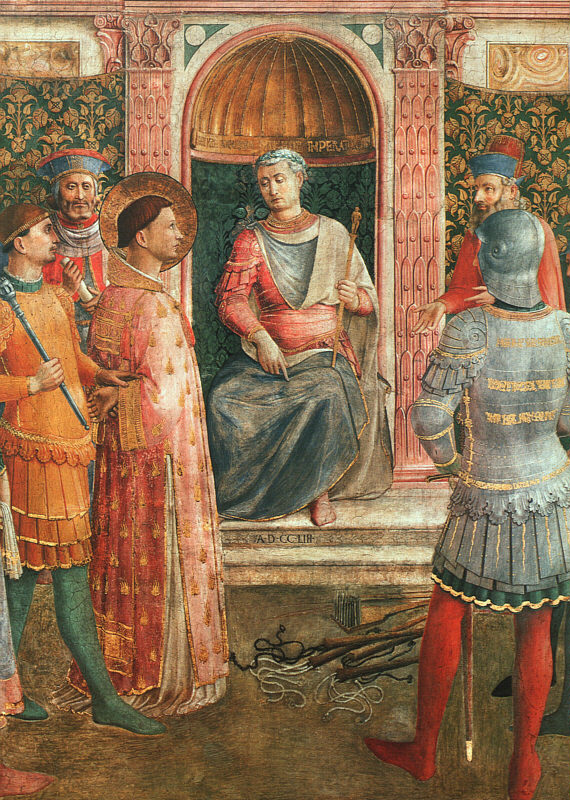
Depictions of Saint Lawrence in visual arts trace back to early Christian periods, where representations emphasized his role as a deacon distributing church treasures to the poor rather than his martyrdom. In the medieval era, artistic focus shifted toward narrative cycles of Lawrence's life, blending hagiographical elements with emerging Gothic naturalism. Giotto di Bondone's panel painting Saint Lawrence (c. 1320–1325), a tempera on wood now in the Musée Jacquemart-André at the Château de Chaalis, portrays the saint in deacon's attire holding a book and gridiron, exemplifying proto-Renaissance humanism in facial expression and pose. This work, part of a possible altarpiece predella, highlights Lawrence's ecclesiastical authority through dignified, volumetric figures. The Renaissance brought refined altarpieces and frescoes that integrated classical proportions with devotional themes. Fra Angelico's fresco cycle in the Cappella Niccolina of the Vatican Palace (1447–1449) narrates Lawrence's life, including Saint Lawrence Receives the Treasures of the Church and Saint Lawrence Distributing Alms, where the saint is shown in radiant dalmatic robes amid architectural settings inspired by antiquity, emphasizing moral triumph over persecution. Michelangelo's broader influence in Vatican commissions, such as his dynamic figural style in the Sistine Chapel, indirectly shaped later Renaissance depictions of Lawrence by promoting muscular, expressive forms that conveyed spiritual intensity, as seen in subsequent Vatican-adjacent works. Baroque artists amplified the drama of Lawrence's martyrdom, using chiaroscuro and theatrical composition to evoke emotional fervor. Peter Paul Rubens's The Martyrdom of Saint Lawrence (1614), an oil on canvas in the Alte Pinakothek, Munich, captures the saint on the gridiron surrounded by executioners and onlookers, with swirling clouds and golden light heightening the scene's pathos and divine intervention. Francisco de Zurbarán's Saint Lawrence (1636–1639), an oil on canvas in the Hermitage Museum, presents the saint in contemplative solitude, clad in embroidered vestments and holding the gridiron, his austere realism and tenebrist shadows underscoring quiet heroism amid suffering. Nineteenth-century Romanticism in Spain infused sculptures with emotional depth and nationalistic fervor, often portraying Lawrence's endurance as a metaphor for cultural resilience. Eduardo Rosales's Burial of Saint Lawrence in the Catacombs of Rome (1862), an oil painting in the Prado Museum, depicts the saint's interment with dramatic lighting and expressive mourners, evoking Romantic pathos in its historical reconstruction. Sculptures like the colossal statue of Saint Lawrence by Juan Bautista Monegro in the San Lorenzo de El Escorial complex, influenced by Romantic revivalism, features the saint in a heroic pose holding a gridiron, carved in granite to symbolize Spain's Catholic heritage. Iconographic motifs consistently identify Lawrence across periods: the gridiron as his primary attribute symbolizing martyrdom, the martyr's palm for victory over death, the dalmatic denoting his deacon status, and a purse or book representing alms distribution. These elements often appear in gender-neutral, youthful portrayals that prioritize themes of charity and faith, evolving from symbolic restraint in early art to emotive realism in later eras. In the 20th and 21st centuries, depictions extend to contemporary media, including digital icons and street art that reinterpret Lawrence's legacy for modern audiences. Digital artworks, such as vector illustrations on platforms like Fine Art America, reimagine him in minimalist styles blending gridiron motifs with abstract charity symbols, appealing to global devotional practices. Street art in urban centers like Rome occasionally features Lawrence in murals emphasizing social justice, drawing on his alms distribution to critique inequality, though such works remain niche compared to traditional forms.

In Literature, Media, and Music

Saint Lawrence has been a prominent figure in hagiographic literature since antiquity, with one of the earliest detailed accounts appearing in the fifth-century poem Peristephanon II by the Spanish Christian poet Aurelius Prudentius, which vividly describes his martyrdom as a triumphant act of faith amid Roman persecution. This work, part of Prudentius's collection celebrating martyrs, emphasizes Lawrence's wit and generosity, portraying him as distributing the Church's treasures to the poor before his execution, a theme that recurs in later texts. By the late Middle Ages, Jacobus de Voragine's Golden Legend (c. 1260) compiled these legends into a widely influential narrative, presenting Lawrence's story as a model of Christian charity and endurance, which was disseminated across Europe through vernacular translations and sermons. In medieval dramatic literature, Saint Lawrence featured in saint plays performed in religious cycles and local festivals, serving as vehicles for community devotion and moral instruction. These works, often staged on his feast day (August 10), dramatized his confrontation with Roman authorities and his iconic roasting on a gridiron, blending liturgical elements with theatrical spectacle to inspire audiences. A notable example is the Croatian Play of the Life and Death of Saint Lawrence, the Martyr, performed annually since the 16th century by amateur groups in Hvar, where it reinforces local identity and Catholic heritage through reenactments of his trial and defiance. In England, similar saint plays from the 14th to 16th centuries, such as those in York or Beverley cycles, occasionally incorporated Lawrence's martyrdom to highlight themes of communal solidarity against tyranny, though many scripts survive only in fragments. Nineteenth-century literature occasionally invoked Saint Lawrence in historical fiction and devotional works, adapting his legend to explore themes of spiritual resilience amid secular challenges. For instance, in Henryk Sienkiewicz's novel Quo Vadis (1896), the broader context of early Christian martyrdoms echoes Lawrence's story, underscoring endurance under imperial oppression as a metaphor for personal faith. In modern poetry, Lawrence appears as a symbol of unyielding integrity; Saiom Shriver's 2012 poem "St Lawrence" reflects on his grilled martyrdom to critique modern injustices, transforming the saint into an emblem of sacrificial resistance. Contemporary works, such as those anthologized on platforms like PoetrySoup, often draw on his legacy for verses about poverty and defiance, with poets like Galren Reigns weaving his narrative into explorations of historical mysteries. In media, Saint Lawrence's story has been adapted into documentaries and podcasts, particularly in post-2020 productions focusing on early Christianity's human elements. The 2023 podcast series The Saints: Adventures of Faith and Courage devotes episodes to his life, portraying him as a deacon safeguarding the Church's wealth for the needy, with narrative storytelling that highlights his humor during torture. Similarly, the Saint Podcast's 2022 Martyrs episode frames Lawrence as the "Saviour of the Holy Grail," linking him to Grail legends in a serialized audio format that appeals to modern audiences interested in historical spirituality. While feature films remain sparse, television appearances in historical series, such as BBC's Ancient Rome: The Rise and Fall of an Empire (2006, with reruns post-2010), briefly depict his execution as emblematic of Valerian's persecutions, emphasizing thematic endurance over graphic detail. Musical compositions dedicated to Saint Lawrence span sacred and secular genres, often evoking his fiery martyrdom through evocative melodies. The fourth-century hymn attributed to Saint Ambrose, "Hymnus Sancti Laurenti," celebrates his patronage with rhythmic praise, influencing later liturgical chants in the Roman rite. In the 20th century, Elliot del Borgo's St. Lawrence Overture (1983) for orchestra captures the saint's bold spirit with bold brass fanfares and dynamic contrasts, premiered by school ensembles to symbolize triumphant faith. Morton Gould's Saint Lawrence Suite (1962), commissioned for the Saint Lawrence Seaway's opening, blends folk-inspired motifs with symphonic energy, indirectly honoring the river named after the saint while nodding to his legacy of stewardship. Antonio Vivaldi's Summer from The Four Seasons (c. 1725) has been interpretively linked to Lawrence's ordeal, its depiction of scorching heat mirroring the gridiron in program notes and performances. In Spanish-speaking regions, folk hymns and processional marches, such as those in Zaragoza's festivals where Lawrence is co-patron, integrate his story into communal songs emphasizing charity and resistance. Over time, literary and media portrayals of Saint Lawrence have shifted from purely heroic to symbols of and anti-authoritarian defiance, particularly in 20th-century works amid global conflicts. In anti-fascist contexts, his distribution of Church to the poor resonated as a of oppressive regimes, as seen in devotional during that recast his martyrdom as a stand against tyranny. This continues in contemporary media, where podcasts post-2020 emphasize his role in equitable resource sharing, adapting the legend for discussions on modern inequality and faithful witness.

References

Add your contribution
Related Hubs
User Avatar
No comments yet.