Hubbry Logo
StanegateStanegateMain
Open search
Stanegate
Community hub
Stanegate
logo
8 pages, 0 posts
0 subscribers
Be the first to start a discussion here.
Stanegate
Stanegate
from Wikipedia

Stanegate
Roman Road
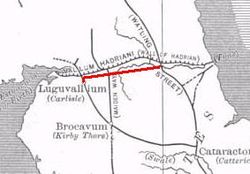
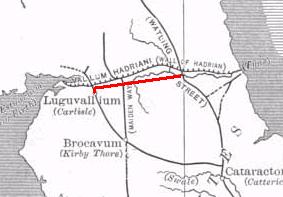
Map showing Stanegate
Route of the Stanegate
Route information
Length38 mi (61 km)
Time periodRoman Britain
Margary number85
Major junctions
FromCorstopitum
Major intersectionsVindolanda, Magnis
ToLuguvalium
Location
CountryUnited Kingdom
Road network
Forts on Stanegate and Hadrian's wall

The Stanegate (meaning "stone road" in Northumbrian dialect[1]) was an important Roman road and early frontier built in what is now northern England. It linked many forts including two that guarded important river crossings: Corstopitum (Corbridge) on the River Tyne in the east (situated on Dere Street) and Luguvalium (Carlisle) on the River Eden in the west. The Stanegate ran through the natural gap formed by the valleys of the River Tyne in Northumberland and the River Irthing in Cumbria. It predated the Hadrian's Wall frontier by several decades; the Wall would later follow a similar route, albeit slightly to the north.

The Stanegate should not be confused with the two Roman roads called Stane Street in the south of England, namely Stane Street (Chichester) and Stane Street (Colchester). In both these cases the meaning is the same as for the northern version, indicating a stone or paved road.

The Stanegate differed from most other Roman roads in that it often followed the easiest gradients, and so tended to weave around, whereas typical Roman roads follow a straight path, even if this sometimes involves having punishing gradients to climb.[2]

A large section of the Stanegate is still in use today as a modern minor road between Fourstones and Vindolanda in Northumberland.

History

[edit]

The Stanegate is believed to have been built under the governorship of Agricola, from 77 to 85 AD, during the reigns of the emperors Vespasian, Titus, and Domitian. It is also thought that it was built as a strategic road when the northern frontier was on the line of the Forth and Clyde. An indication of this is that it was provided with forts at one-day marching intervals (14 Roman miles or modern 13 miles (21 km)), sufficient for a strategic non-frontier road.[3] The forts at Vindolanda (Chesterholm) and Nether Denton have been shown to date from about the same time as Corstopitum and Luguvalium, in the 70s and 80s AD.

When the Romans decided to withdraw from Scotland starting from around 87 AD,[4] the line of the Stanegate gradually became the new frontier and it became necessary to provide forts at half-day marching intervals. These additional forts were Newbrough, Magnis (Carvoran), and Brampton Old Church. It has been suggested that a series of smaller forts were built in between the 'half-day-march' forts. Haltwhistle Burn and Throp might be such forts, but there is insufficient evidence to confirm a series of such fortlets.[5]

Structure

[edit]
The line of the Stanegate looking east, within the Corbridge Roman Site
An in situ Roman milestone on the Stanegate adjoining Vindolanda fort

Where it left the base of Corstopitum, the Stanegate was 22 feet (6.7 m) wide with covered stone gutters and a foundation of 6-inch (150 mm; 15 cm) cobbles with 10 inches (250 mm; 25 cm) of gravel on top.[6]

Route

[edit]

The Stanegate began in the east at Corstopitum, where the important road, Dere Street headed towards Scotland. West of Corstopitum, the Stanegate crossed the Cor Burn, and then followed the north bank of the Tyne until it reached the North Tyne near the village of Wall. A Roman bridge must have taken the road across the North Tyne, from where it headed west past the present village of Fourstones to Newbrough, where the first fort is situated, 7+12 miles (12.1 km) from Corbridge, and 6 miles (9.7 km) from Vindolanda. It is a small fort occupying less than 1 acre (0.40 ha) and is in the graveyard of Newbrough church, which stands alone to the west of the village.[6]

From Newbrough, the Stanegate proceeds west, parallel to the South Tyne until it meets the next major fort, at Vindolanda (Chesterholm). From Vindolanda the Stanegate crosses the route of the present-day Military Road and passes just south of the minor fort of Haltwhistle Burn. From Haltwhistle Burn, the Stanegate continues west away from the course of the South Tyne and passes the major fort of Magnis (Carvoran), 6+12 miles (10.5 km) from Vindolanda and 20 miles (32 km) from Corstopitum. At this point, the road is joined by the Maiden Way coming from the fort of Epiacum (also known as Whitley Castle) near Alston to the south.[6]

From Magnis, the road turns towards the southwest to follow the course of the River Irthing, passing the minor fort of Throp, and arriving at the major fort of Nether Denton, 4+12 miles (7.2 km) from Magnis and 24+12 miles (39.4 km) from Corstopitum. The fort occupies an area of about 3 acres (1.2 ha).[6]

From Nether Denton, the road continues to follow the River Irthing and heads towards present-day Brampton. It passes the minor fort of Castle Hill Boothby and then, 1 mile (1.6 km) west of Brampton, reaches the next major fort, that of Brampton Old Church, 6 miles (9.7 km) from Nether Denton and 30+12 miles (49.1 km) from Corstopitum. The fort is so called because half of it is buried under Old St Martin's church and its graveyard.[6]

From Brampton Old Church, the road crosses the River Irthing and continues southwest through Irthington and passes through what is now the site of Carlisle Airport, just to the north of the main runway.[7] The curving corner of an associated marching camp can be made out from the air on the south edge of the runway near its western end,[8] and can be seen on Google Earth. The Stanegate then continued through a large cutting in the village of Crosby-on-Eden, where a small fort has been postulated, based on marching distances, but has not yet been found.[9] The Stanegate then crossed the River Eden near the cricket ground[10] in modern Carlisle and eventually reached the fort of Luguvalium (Carlisle) on the site of Carlisle Castle, 7+12 miles (12.1 km) from Brampton Old Church and 38 miles (61 km) from Corstopitum. LIDAR images show that the road carried on westwards for a further 4+12 miles (7.2 km) to the Roman fort at Kirkbride overlooking Moricambe Bay, an inlet of the Solway Firth, where a large camp of 5 acres (2.0 ha) was found.

The Stanegate might have run eastwards from Corstopitum towards the fort and bridge at Pons Aelius, present-day Newcastle upon Tyne, possibly linking to Washing Wells Roman Fort in Whickham, but no evidence of a road here has yet been found to support this.[5]

List of forts on the Stanegate

[edit]

From east to west:

Subsequent history

[edit]

Much of the Stanegate provided the foundation for the Carelgate (or Carlisle Road), a medieval road running from Corbridge market place and joining the Stanegate west of Corstopitum. The Carelgate eventually deteriorated to such an extent that it was unusable by coaches and wagons. In 1751–1752, a new Military Road was built by General George Wade in the wake of the Jacobite rising of 1745.[6]

See also

[edit]

References

[edit]
[edit]
Revisions and contributorsEdit on WikipediaRead on Wikipedia
from Grokipedia
The Stanegate was a Roman road in , constructed around AD 85, that ran east-west for approximately 38 miles (61 km) from on the River Tyne to Carlisle on the , serving as the primary frontier line across the Tyne-Solway before the building of to its north. Established in the AD 80s following the Roman army's retreat from after the campaigns of , the Stanegate formed the backbone of an early frontier defense system under Emperor (r. AD 98–117), linking a chain of auxiliary forts, fortlets, and signal towers to monitor and control the northern border of . Key fortifications along the route included the substantial fort at —occupied continuously from around AD 85 and renowned for the discovery of wooden writing tablets providing insights into daily Roman military life—and endpoints at Corstopitum (modern ) in the east and Luguvalium (Carlisle) in the west, with intermediate sites such as Haltwhistle Burn and smaller outposts like Pike Hill Signal Tower for communication and surveillance. When Emperor (r. AD 117–138) ordered the construction of starting in AD 122, the Stanegate was not abandoned but repurposed as a vital supply and communication route running parallel to and south of the new stone wall, supporting the of around 9,000 auxiliary soldiers stationed along the . This road exemplified typical Roman engineering, likely featuring a raised agger (embankment) with gravel or stone surfacing to facilitate rapid troop movements and logistics across the rugged terrain of what is now and . Archaeological evidence from sites like highlights its enduring role in Roman Britain's northern defenses, remaining in use until the empire's withdrawal around AD 410.

Historical Context

Roman Campaigns in Northern Britain

The Roman invasion of Britain began in AD 43 under Emperor , with four legions and auxiliaries landing in and rapidly advancing northward to subdue southern tribes such as the , led by generals and Ostorius Scapula. By AD 47, the Romans had established control over much of southern and midland England, incorporating tribes like the and Dobunni into the province of , while facing resistance from the in . This initial phase focused on consolidating the southeast, with the construction of early forts and roads to facilitate administration and supply lines. By the 60s AD, under governor Suetonius Paulinus, Roman forces suppressed major revolts, including Boudica's uprising in AD 60-61 led by the queen, which temporarily halted expansion but ultimately strengthened provincial control. His successor, Turpilianus, then pursued a policy of pacification to restore order. In AD 71, Petilius Cerialis established (modern ) as a major legionary fortress for the IX Hispana Legion, serving as a strategic base for operations against the , the dominant tribe in whose territory spanned from the to the . Cerialis's campaigns in AD 71-74 pacified much of Brigantian lands, subduing internal divisions exacerbated by the pro-Roman queen Cartimandua's earlier alliance and subsequent civil strife. His successor, Sextus Julius Frontinus (AD 74-78), further consolidated the north by defeating remaining Brigantian holdouts and securing routes toward modern , while also initiating efforts against the in northwest . Gnaeus Julius Agricola assumed governorship in AD 77 or 78, launching aggressive campaigns to extend Roman influence into northern Britain and beyond. In his first year, he crushed the in , nearly exterminating the tribe, and then turned to the ' fringes, incorporating the —a coastal tribe from to the Forth—who became Roman client allies without major conflict, aiding pacification through and shared interests. Over the next seasons (AD 79-83), Agricola advanced into Caledonia (modern ), building forts along the Tay and subduing tribes like the and , driven by imperial goals of prestige, territorial security, and resource exploitation including metals, agriculture, and potential silver deposits in upland areas. The culmination was the in AD 83 or 84, where Agricola's forces—comprising 8,000 auxiliary infantry and 3,000 cavalry in the front line, with legions held in reserve—decisively defeated a Caledonian confederation of over 30,000 warriors led by , reportedly killing 10,000 while suffering 360 losses, as described by . These efforts secured the north temporarily but were recalled by , leading to the establishment of supply lines like the Stanegate as a response.

Pre-Roman Landscape and Infrastructure

The pre-Roman landscape of , particularly along what would become the Stanegate corridor, was dominated by the Tyne Valley's lowland expanse, a narrow corridor of gently undulating incised by the River Tyne and its tributaries, separating the rugged from the Border uplands to the north. The Pennine uplands, characterized by high moorlands interspersed with fertile river valleys, created natural barriers and passageways that funneled movement eastward toward the . River crossings, primarily natural fords at confluences such as that of the North and South Tyne near modern , served as focal points for settlement and transit, with larger villages developing at these strategic low-water points along the valley floors. Indigenous tracks and trade routes in this region followed the Tyne Valley's contours, leveraging the river as a key artery for exchange, evidenced by Late votive metalwork deposits—totaling 19 objects—and dug-out canoes recovered from the waterway, indicating fluvial transport predating the . The Great North Road, a prehistoric alignment, crossed the Tyne at a significant trading nexus near modern Newcastle, reflecting established east-west connectivity through open landscapes of shifting ploughlands and stock runs divided by shrub and forest belts. Archaeological evidence from hillforts underscores these networks; in Northumberland's Tyne Valley, sites such as Horsley Wood , a defended enclosure overlooking the river, and Warden Hill near the Tyne confluence, highlight protected nodes along tribal paths, with over 40 documented across the broader , many dating from 440–250 BC to AD 100. The , a loose of tribes controlling the largest swath of pre-Roman —including the Tyne Valley and Pennine fringes—shaped the region's socio-political dynamics through their decentralized kinship-based groups, centered on major strongholds like Stanwick with its 7.28 km perimeter of fortifications. Initial alliances, such as Queen Cartimandua's pro-Roman stance around AD 43, gave way to internal divisions and resistance, exemplified by the revolt following her handover of the fugitive in AD 51, which fragmented Brigantian unity and heightened frontier vulnerabilities along natural corridors like the Tyne Gap. This tribal instability, marked by weak centralization possibly divided by rivers like the , underscored the need for controlled access routes in the area.

Construction and Development

Origins under Agricola

The Stanegate, a key Roman military road in northern Britain, was likely initiated in the late AD around AD 85 as a vital supply route linking Corstopitum (modern ) to Luguvalium (modern Carlisle), following the Roman army's retreat from after the campaigns of . This timeline aligns with the early phases of Roman consolidation in the region, where an initial fort at Red House Farm near —built between AD 77 and 83 to support advancing forces under Agricola—was abandoned around AD 86, possibly paving the way for later frontier infrastructure. Gnaeus Julius Agricola, governor of from AD 77 or 78 to 83 or 84, oversaw campaigns against northern tribes that included fort-building and road networks to secure Roman gains, as described generally by his son-in-law in the Agricola. The , Agricola's favored legion stationed in the north, contributed to such infrastructure projects, marching across the to facilitate military movement. The primary purpose of the Stanegate was logistical support for Roman offensives in the north, serving as a supply line rather than an initial defensive barrier, enabling efficient provisioning amid conflicts with Caledonian tribes. Initial route development may have occurred under Emperor (r. AD 81–96) during the withdrawal from around AD 87.

Expansion and Fortifications

During the reign of Emperor Trajan (AD 98–117), the Stanegate underwent substantial enhancements around AD 105 that transformed it from an emerging logistical supply route—initiated in the late AD—into a robust system designed to maintain Roman control over northern Britain. This evolution occurred amid strategic pressures, including the redeployment of troops from to support Trajan's major campaigns in (AD 101–106) and (AD 113–117), necessitating a consolidated defensive posture along the existing road. Key developments in the Trajanic period centered on the addition and upgrading of military installations to establish a permanent presence, with forts rebuilt or newly constructed at strategic intervals and fortified to sustain garrisons. Notable examples include the expansion of the fort at , which grew to approximately 7 acres (2.8 ha) and housed auxiliary cohorts such as the Cohors I Tungrorum, and the major at (Corstopitum), covering 9 acres (3.6 ha) and serving as a critical hub for grain storage and equipment distribution. A smaller fort at Old Church Brampton (about 3.75 acres or 1.5 ha) was also added between Carlisle and to bridge gaps in coverage, while the fort at Carlisle () was enlarged to around 8 acres (3.2 ha). These changes marked a shift toward a defensive , with forts spaced roughly every 12 Roman miles (17.7 km) to monitor and respond to threats from the north. Archaeological evidence firmly dates these upgrades to circa AD 105, primarily through numismatic, ceramic, and epigraphic finds that align with Trajan's emphasis on management. A significant unearthed at includes issues up to AD 103, indicating reconstruction activity shortly thereafter to accommodate returning troops from . Pottery assemblages at , featuring Trajanic South Gaulish samian ware and East Gaulish imports, corroborate continuous occupation and infrastructural improvements during this phase, reflecting increased military logistics. Inscriptions on surviving milestones along the Stanegate near , including those potentially referencing involved in road maintenance, further attest to organized engineering efforts under Trajanic oversight, underscoring the road's role in his broader policy of stabilizing provincial borders before eastern expansions.

Physical Structure and Design

Road Engineering Features

The Stanegate exemplified standard Roman road construction techniques adapted to the northern British landscape, featuring a multi-layered agger foundation designed for durability and efficient military transport. The base consisted of large stones and earth, forming a raised embankment typically 4 to 6 meters wide to accommodate wagons and troop movements, with a cambered surface to facilitate drainage. At its eastern terminus near Corstopitum (modern ), archaeological evidence reveals a width of approximately 6.7 meters, supported by a foundation of 15 cm-deep rounded cobbles bedded in clay, overlaid with 25 cm of for a smooth, all-weather surface. Local materials were integral to the road's resilience in Northumberland's variable , incorporating abundant and whinstone for surfacing and repairs, which provided hard-wearing qualities against heavy use by legions. These stones, quarried nearby, replaced imported materials common in southern roads, ensuring logistical efficiency during construction under Agricola's campaigns. Drainage features were meticulously engineered, with parallel ditches flanking the agger to channel rainwater away, preventing and bogging; covered stone gutters along the edges further directed runoff, while stone-lined culverts bridged small streams, maintaining connectivity without flooding disruptions. Milestones enhanced the road's utility for , marking distances in Roman miles from to guide supply convoys and reinforcements. Surviving examples, such as the two inscribed stones near fort, indicate distances marking 15 and 16 Roman miles from , inscribed with imperial dedications and numerals for precise ; these cylindrical markers, often 1-2 meters tall, underscore the road's role in coordinating operations. Such , integrated seamlessly into the , supported rapid without impeding the flow of traffic.

Defensive Elements

The Stanegate frontier system featured a network of fortlets positioned at irregular intervals along the route, functioning as compact outposts to support patrols and maintain . These structures were primarily constructed in timber during the initial phase under the Flavian emperors, with some later rebuilt or supplemented in stone to enhance durability against environmental wear and potential attacks. Archaeological evidence from sites like Haltwhistle Burn and Newbrough reveals these fortlets as small enclosures, often around 0.8 to 0.85 acres in area, designed for housing detached auxiliary detachments without extensive administrative facilities. Complementing the fortlets were watchtowers and signal stations, erected in timber and occasionally stone, to enable visual signaling via beacons or flags for coordinating defenses across the rugged terrain. Notable examples include the timber watchtowers on Fingland Rigg and the stone signal station on Mains Rigg, which overlooked the Stanegate and offered clear lines of sight to nearby forts such as Nether Denton and Throp, facilitating rapid alerts to threats from the north. These towers, typically square or rectangular with surrounding ditches for added protection, emphasized and communication rather than heavy , allowing small crews to monitor movements and dispatch patrols efficiently. In select sections of the frontier, particularly near the western extensions toward the , vallum-like ditches and timber served as linear barriers for boundary demarcation and control, predating the more elaborate Vallum associated with by several decades. Excavations at sites like Burgh-by-Sands have uncovered evidence of these early earthworks, including ditches and palisade slots, which funneled traffic through controlled points and deterred unauthorized crossings. These features, integrated with the road's agger (raised base) for mutual support, formed a cohesive defensive envelope without the density of later wall systems. Garrisons manning these elements typically comprised 500 to 1,000 auxiliary troops per major fort segment, drawn from non-citizen units specialized in and mobile operations to counter tribal incursions. This force distribution, evident from fort sizes like (around 7 acres) and Carlisle (8 acres), prioritized over static defense, enabling quick reinforcements along the Stanegate to respond to intelligence from fortlets and watchtowers.

Route and Geography

Overall Path from Corbridge to Carlisle

The Stanegate Roman road extended approximately 61 km (38 miles) in an east-west direction across northern England, serving as a vital supply and military corridor parallel to the later Hadrian's Wall. It connected the key legionary supply base at Corstopitum (modern Corbridge) on the River Tyne to the frontier outpost of Luguvalium (modern Carlisle) on the Solway Firth, facilitating rapid troop movements and logistics in the region south of the eventual wall line. Classified under the Margary system as road number 85 (with variants 85a and 85b), this route was engineered for strategic efficiency rather than direct linearity, weaving through valleys to link defensive positions while avoiding excessive elevation changes. The path began at Corstopitum, where it intersected the major north-south artery of , then proceeded westward along the north bank of the River Tyne, crossing the Cor shortly after departure and later the North Tyne near the modern village of . Key segments included the stretch from through the vicinity of —passing south of the town via areas like Fourstones—to the fort at , covering about 22 km (14 miles) of undulating terrain. Further west, the road continued past Carvoran (Magnis) and Nether Denton, crossing the River Irthing near Brampton Old Church, before traversing the final 12 km (7.5 miles) to , where it bridged the River Eden to reach the western terminus. These segments were spaced to support a chain of forts at intervals of about 10 km (6 miles), allowing for efficient communication, resupply, and control along the frontier. In modern times, significant portions of the Stanegate align with the A69 trunk road, which parallels its historical course from Carlisle through , , and to , preserving the east-west connectivity while integrating with contemporary infrastructure. Shorter sections, such as between Fourstones and , remain as minor rural roads, allowing traces of the original alignment to be visible amid agricultural landscapes. This overlay underscores the enduring practicality of the Roman design in navigating the Tyne-Irthing-Eden river systems.

Terrain Challenges and Adaptations

The Stanegate Roman road encountered significant challenges from river crossings along its route through northern England's river valleys, particularly the Tyne and Eden systems. Near the village of , east of , the road crossed the River North Tyne via a ford or, more likely, a , facilitating access to upstream forts while contending with the river's variable flow. Similarly, near Carlisle, it traversed the River Eden close to the modern cricket ground, employing a ford or bridge to enter the fort of , with the route skirting the edges of the Eden's flood plain to minimize water-related disruptions. In the Tyne Valley, the road navigated flood-prone lowlands by aligning with slightly elevated paths where possible, reducing vulnerability to seasonal inundations that could impede military movements. Fords were used at other minor watercourses along the way, reflecting practical adaptations to the landscape's hydrological features. Hilly terrain presented another key obstacle, as the Stanegate traversed the undulating landscape south of the Whin Sill, a prominent dolerite ridge formation. Engineers opted for gradual ascents by weaving the road along the most accessible gradients, avoiding the steeper Pennine passes to the south and ensuring efficient passage for troops and supply wagons. This sinuous alignment over Whin Sill-associated ridges allowed the road to climb steadily without excessive gradients, prioritizing practicality over the straight-line efficiency seen in flatter terrains. Such adaptations maintained the road's utility as a supply line amid the region's rugged . The wet climate of northern Britain further complicated maintenance, with frequent rains risking bogging and . To counter this, the Stanegate incorporated cambered surfaces, elevating the center slightly above the sides to promote rapid drainage and prevent water accumulation. This feature, standard in Roman road construction, ensured year-round usability in the damp environment, with flanking ditches enhancing runoff. By integrating these elements, the road remained resilient against the persistent moisture that characterized the area's weather patterns.

Military Installations

Primary Forts Along the Route

The primary forts along the Stanegate served as key garrisons, supply depots, and defensive outposts, typically measuring 2-3 hectares to accommodate auxiliary cohorts such as the Batavian and Tungrian units. These installations were strategically placed to control river crossings, road junctions, and the surrounding terrain, forming the backbone of the pre-Hadrianic system established around AD 105. At the eastern end, Corstopitum (modern ) functioned as a major supply base and administrative center, guarding the vital crossing of the River Tyne and linking to the northern route of . Established around AD 86 with a succession of timber and stone fortifications, it supported logistics for the frontier, including granaries constructed between AD 139 and 140 to store provisions for garrisons. Archaeological excavations have revealed the Corbridge Hoard, a cache of military equipment including two suits of armor dating to AD 105-120, highlighting its role in equipping Roman forces. Further west, (Chesterholm) stands out for its multiple phases of occupation, with nine successive forts built from around AD 85 onward, initially in timber before transitioning to stone. This site housed units like the Cohors I Tungrorum (First Cohort of Tungrians) and Cohors IX Batavorum (Ninth Cohort of Batavians), both recruited from regions in modern-day and the , providing infantry and specialized skills for frontier defense. The fort's anaerobic soil conditions have preserved extraordinary organic artifacts, including over 1,000 wooden writing tablets—the oldest surviving handwritten documents in Britain—offering insights into daily military life, such as invitations, reports, and requests for supplies like beer. Additional finds include leather shoes, textiles, and wooden barrack structures, underscoring the site's exceptional preservation. In the central stretch, Magnis (Carvoran) acted as a crucial junction fort, protecting the intersection of the Stanegate with the Maiden Way road leading north into the . Constructed before AD 80, it was occupied continuously into the and garrisoned by auxiliary cohorts, including possible detachments from Tungrian units. Excavations have uncovered stone walls, gatehouses, and recent discoveries like squamae armor scales, a Roman , ceramics, and Roman —including exceptionally large examples up to 32 cm long from 2024 excavations—illustrating its defensive and ritual functions. The fort's location near the Vallum and 50 integrated it into the evolving frontier network. At the western terminus, (modern Carlisle) anchored the Stanegate as a large-scale fort and regional hub, established in AD 72 to secure the River Eden crossing and support campaigns into . Measuring approximately 168 by 201 meters (about 3.2 hectares), it was larger than standard auxiliary forts and initially built in turf and timber before stone reconstruction around AD 105, housing quingenary cohorts of up to 500 men. It served as a supply and command post for the western frontier, with archaeological evidence from excavations at revealing timber gatehouses and barrack foundations. The site's strategic position facilitated control over access and integration with later Wall defenses.

Supporting Structures and Supply Posts

The Stanegate frontier incorporated smaller military outposts known as fortlets, which supplemented the primary forts by providing localized control and signaling capabilities. One such fortlet at Burn, dating to around AD 105, measured approximately 55m by 65m and featured visible earthworks of a barrack block and officers' quarters, positioned to guard a key crossing of the road over the Haltwhistle Burn. These structures facilitated rapid communication and surveillance along the route, acting as hubs for visual signaling between larger installations. Watchtowers and signal stations further enhanced the network's defensive and logistical oversight. A timber at Fingland, near Burgh-by-Sands, was associated with a defensive and served to monitor the western sector toward Carlisle. Additional signal posts, such as those at Barcombe Hill between Chesterholm and Newbrough, and Mains Rigg between Nether Denton and Throp, enabled line-of-sight coordination for troop movements and alerts across the frontier. While not uniformly spaced at precise intervals, these elements created a layered system of observation that predated the more regimented turret arrangements on . Logistical support was provided through dedicated supply posts, including granaries and facilities for units. At (Corstopitum), a major supply depot on the Stanegate, extensive granaries north of the road stored grain and provisions, sustaining operations for thousands of troops, including elements of the Second and Sixth Legions. These structures, part of a broader town complex with compounds to the south, ensured efficient distribution via water channels and road access, supporting over 8,000 personnel across the frontier. Horse depots were integrated into forts like Chesters (Cilurnum), where stable-barracks accommodated up to 30 men and their mounts per block, with front rooms featuring pits for to maintain readiness for rapid deployment along the Stanegate and adjacent routes. Temporary marching camps addressed short-term needs during expansions and maneuvers, often identified through revealing evidence. The Fell End camp, straddling the Stanegate about 1.7 km east of Carvoran fort, enclosed roughly 8.7 s with an irregular plan adapted to the terrain, featuring ramparts and gated ditches for defensive occupation. Similarly, the Burn temporary camp, covering 1 on a ridge summit, included turf-revetted ramparts and ditches, likely used for staging troops during the frontier's consolidation around AD 105. These transient sites, bisected or aligned with the road, underscore the Stanegate's role as a dynamic supply artery linking primary forts.

Integration with Later Frontiers

Relationship to Hadrian's Wall

The Stanegate served as the primary Roman frontier line in northern Britain following the withdrawal from southern Scotland around AD 105 under Emperor Trajan, establishing a system of forts and patrols along the road from Corbridge to Carlisle. In AD 122, Emperor Hadrian, upon visiting the province, decided to reinforce this line by constructing Hadrian's Wall as a more robust northern boundary, positioning it parallel to and approximately 10-20 km north of the Stanegate to provide superior defense against incursions from the Caledonians in what is now Scotland. This decision reflected Hadrian's broader policy of imperial consolidation, abandoning further expansion in favor of securing existing territories. Several Stanegate forts, such as , were strategically reused and integrated into the new Wall system, allowing for continuity in military occupation while the Wall's milecastles and turrets formed a denser network of surveillance. The Wall's alignment took advantage of the Stanegate's established infrastructure for supply and communication, with the road continuing to function as a vital rearward artery supporting the frontier garrisons. This transition marked a strategic from the Stanegate's reliance on mobile road-based patrols—spaced at roughly half-day marching intervals—to a fixed, continuous barrier that enhanced and resource efficiency. By shifting the primary defensive line northward, Hadrian's initiative not only addressed vulnerabilities exposed by earlier raids but also optimized deployments, increasing overall troop presence in the region from an estimated 3,500-4,000 to around 15,000 soldiers.

Post-Construction Modifications

Following the advance to the around AD 142 and the subsequent withdrawal to by approximately AD 158–160, the Stanegate was repaired and refurbished to resume its function as a key supply route supporting the . Forts along the route, including Birdoswald (Banna), underwent adaptations such as the refurbishment of and defensive structures, with the turf wall west of the River Irthing rebuilt in stone by the end of the second century to enhance durability against local terrain challenges. These modifications reflected a strategic emphasis on strengthening the rearward behind , where the Stanegate served as the primary military highway. In the Severan era (AD 193–211), further repairs and extensions maintained the Stanegate's operational integrity amid ongoing campaigns in northern Britain. At Birdoswald, archaeological evidence indicates continued adaptations to fort layouts, accommodating part-mounted units like the First Cohort of by the early third century, which required adjustments to stabling and granaries. These efforts ensured the road's role in , with inscriptions and building phases attesting to investment in supporting structures along the route. By the third century, empire-wide pressures including economic instability and barbarian incursions led to the decline and partial abandonment of some Stanegate sections, though Carlisle () remained a vital hub with stone reconstruction of its principia around the early 200s AD. Coin hoards, such as small deposits at Birdoswald and along the , alongside phases of intermittent rebuilding, indicate sporadic military use and local economic activity persisting into the mid-third century despite broader neglect. This evidence underscores the road's fluctuating importance as pressures mounted, with Carlisle's maintenance highlighting its enduring strategic value.

Post-Roman Legacy

Medieval Reuse and Decline

Following the Roman withdrawal from Britain in the early AD, the Stanegate fell into disuse as a structured military supply line but continued to serve as a local trackway, with early medieval communities adapting its durable paved surface for everyday travel. The road's enduring name, "Stanegate," derives from the terms stān (stone) and geat (road or gate), reflecting Anglo-Saxon awareness and linguistic labeling of the ancient stone-paved route during the post-Roman period. During the medieval era, significant portions of the Stanegate were integrated into broader regional networks, particularly as the Carelgate, an early medieval east-west road extending from toward Carlisle and , which overlaid the Roman alignment to facilitate trade and livestock movement near sites. This reuse supported practical functions such as cattle droving, leveraging the road's established path through the Tyne Valley for herding animals to markets, with sections functioning as stock-proof boundaries adjacent to Wall-related castles and settlements. The Carelgate remained a primary until the , when shifting trade routes diminished its prominence. By the 18th and 19th centuries, much of the Stanegate succumbed to agricultural expansion, with large segments plowed over and incorporated into farmland, erasing visible traces of its original construction. Early recognition of its Roman origins came through antiquarian surveys, notably by John Horsley, whose 1732 publication Britannia Romana documented surviving forts and road segments along the route, marking the first systematic notices amid widespread neglect.

Modern Rediscovery and Archaeology

The modern rediscovery of the Stanegate began in earnest during the , with systematic excavations at key sites along the route providing unprecedented insights into its structure and function. At , a major fort on the Stanegate, archaeological work initiated in the 1970s by the Vindolanda Trust uncovered over 1,700 wooden writing tablets, the earliest surviving examples of handwritten documents in Britain, dating primarily to the late 1st and early 2nd centuries AD. These artifacts, preserved in the anaerobic conditions of the site's ditches, were first discovered in 1973 and continue to be unearthed annually, offering details on daily Roman life. Concurrently, the conducted comprehensive mapping of , including the Stanegate, incorporating field surveys and historical data to delineate its course from to Carlisle on modern topographic sheets, facilitating further targeted investigations. Post-2020 discoveries have further illuminated the road's physical remains through infrastructure-related . In late 2020, during Northumbrian Water's network improvement works near Settlingstones—close to —archaeologists from Archaeological Research Services Ltd identified a well-preserved section of the Stanegate, consisting of a 15 cm layer of rounded cobbles topped with 25 cm of gravel surfacing, confirming its construction around 80. This find, part of a £55,000 project, represents one of the best-preserved segments exposed in recent decades and underscores the road's role in the pre-Hadrianic . In 2024, excavations at Carvoran Roman Fort (Magna), another Stanegate installation, yielded significant artifacts including a Roman altar, ceramics, and squamae scales from military armor, enhancing understanding of the route's associated structures. In 2025, further work at Magna uncovered 32 leather shoe soles from a defensive , including exceptionally large examples measuring up to 32.6 cm—far exceeding the typical Roman size—suggesting unique preservation conditions and providing new evidence of the soldiers' daily equipment. Preservation of the Stanegate is integrated into the broader Frontiers of the Roman Empire , inscribed by in 1987 with extensions in 2005 that encompass the corridor, including the Stanegate as a key component of the Roman military network. Managed by the Hadrian's Wall Heritage Partnership and protected under the UK's Ancient Monuments and Archaeological Areas Act 1979, efforts emphasize non-invasive techniques like geophysical surveys to minimize site disturbance. However, ongoing threats from agricultural intensification, urban development, and climate-induced erosion—such as increased flooding along the Solway Plain—pose risks to unexcavated sections, prompting calls for enhanced monitoring and land-use restrictions. Medieval traces, such as reused stone in local structures, have occasionally aided in locating buried segments during these modern efforts.

References

Add your contribution
Related Hubs
User Avatar
No comments yet.