Hubbry Logo
StereopticonStereopticonMain
Open search
Stereopticon
Community hub
Stereopticon
logo
8 pages, 0 posts
0 subscribers
Be the first to start a discussion here.
Stereopticon
Stereopticon
from Wikipedia
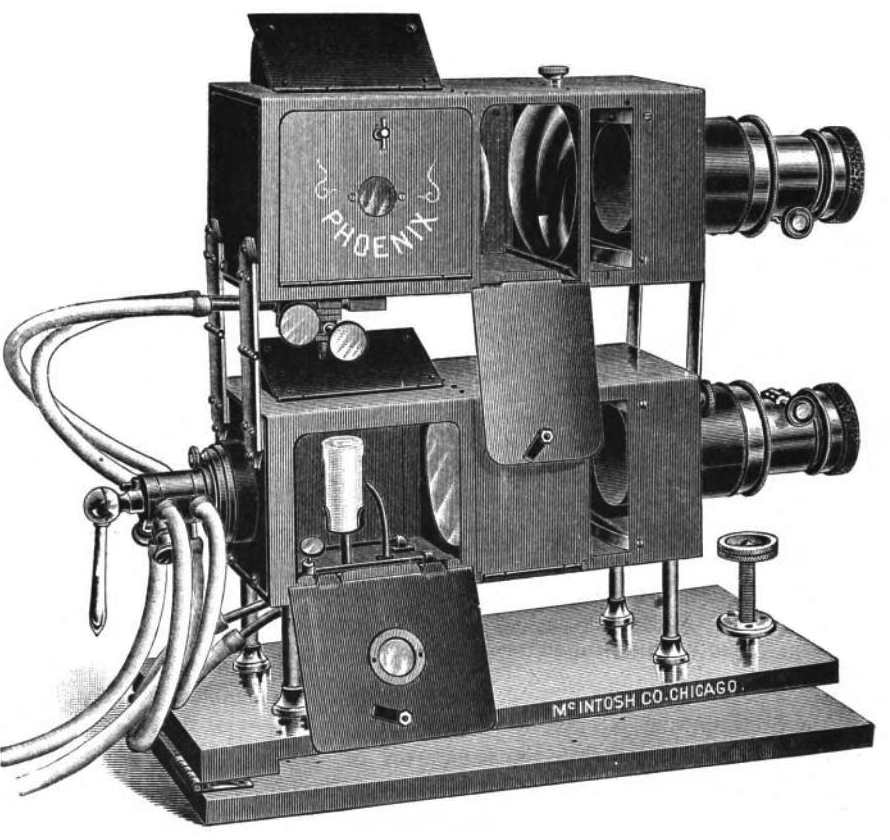
Illustration of a stereopticon

A stereopticon is a slide projector or relatively powerful "magic lantern", which has two lenses, usually one above the other, and has mainly been used to project photographic images. These devices date back to the mid 19th century,[1] and were a popular form of entertainment and education before the advent of moving pictures.

Magic lanterns originally used rather weak light sources, like candles or oil lamps, that produced projections that were just large and strong enough to entertain small groups of people. During the 19th century stronger light sources, like limelight, became available.

For the "dissolving views" lantern shows that were popularized by Henry Langdon Childe since the late 1830s, lanternists needed to be able to project two aligned pictures in the same spot on a screen, gradually dimming a first picture while revealing a second one. This could be done with two lanterns, but soon biunial lanterns (with two objectives placed one above the other) became common.

William and Frederick Langenheim from Philadelphia introduced a photographic glass slide technology at the Crystal Palace Exhibition in London in 1851. For circa two centuries magic lanterns had been used to project painted images from glass slides, but the Langenheim brothers seem to have been the first to incorporate the relatively new medium of photography (introduced in 1839).[2] To enjoy the details of photographic slides optimally, the stronger lanterns were needed.

By 1860 Massachusetts chemist and businessman John Fallon improved a large biunial lantern, imported from the United Kingdom, and named it 'stereopticon'.[2]

For a usual fee of ten cents, people could view realistic images of nature, history, and science themes.[3] The two lenses are used to dissolve between images when projected. This "visual storytelling" with technology directly preceded the development of the first moving pictures.[4]

The term stereopticon has been widely misused to name a stereoscope. The stereopticon has not commonly been used for three-dimensional images.

References

[edit]

Further reading

[edit]
Revisions and contributorsEdit on WikipediaRead on Wikipedia
from Grokipedia
A stereopticon is a , typically comprising two or more magic lanterns synchronized to produce dissolving views, in which one projected image fades seamlessly into the next for dramatic transitions between scenes. It utilized transparent glass slides, often photographic positives, illuminated by intense light sources such as oxy-hydrogen or oxy-calcium flames to cast enlarged images—up to 30 feet in diameter—onto screens for public viewing. Pioneered in the United States around 1860 by Massachusetts chemist and businessman John Fallon, the stereopticon represented an advancement over earlier single-lantern magic lanterns, incorporating biunial designs imported from with enhanced optics and illumination for brighter, more vivid projections. Fallon's device debuted in on December 22, 1860, and quickly toured northeastern cities including , and Portland, where it was operated by a team of lecturers and technicians who presented illustrated talks on , travel, statuary, and current events to audiences of up to 2,000 people. These exhibitions, which raised funds for charities and competed with imitators using variant names like "stereoscopticon," significantly influenced 19th-century by making distant scenes and educational content accessible to the public, paving the way for lantern slide lectures and early motion picture technologies. By the late 1800s, commercial versions from firms like McAllister & Brother became staples in schools, churches, and theaters, adapting to themes from biblical stories to scientific illustrations until supplanted by electric projectors in the early .

History

Origins in Magic Lantern Technology

The served as the foundational precursor to the stereopticon, representing the earliest known slide projection technology. Invented in the 1600s, likely by Dutch , it images onto surfaces using painted slides illuminated from behind by simple sources such as candles or oil lamps. These early devices produced modest, often indistinct projections suitable primarily for small audiences in darkened rooms, relying on hand-crafted slides to depict scenes, figures, or educational content. A key limitation of the magic lantern was the dimness of its projections, constrained by the feeble output of candles and oil lamps, which restricted image size and clarity even in controlled environments. This challenge was mitigated in the 1820s through the invention of by Scottish engineer Thomas Drummond, who created an intense white light by directing an flame onto a block of quicklime, generating illumination far brighter than previous methods and enabling larger, more vibrant displays for both scientific and purposes. Limelight's adoption in projection setups marked a critical step toward overcoming the optical constraints of earlier lanterns, paving the way for more dynamic visual presentations. The integration of into lantern slides further revolutionized projection technology. In 1851, Philadelphia-based brothers and Frederick Langenheim showcased their innovative photographic glass slides—produced via the they developed in 1849—at London's Crystal Palace Exhibition, introducing realistic, detailed images derived from actual photographs rather than paintings. This advancement shifted projected visuals from artistic interpretations to lifelike representations, enhancing fidelity and appeal in educational and public demonstrations. Building on these improvements, the late 1830s saw the popularization of "dissolving views" by English lanternist Henry Langdon , who employed two magic lanterns to superimpose images for fluid scene transitions. By gradually dimming the light of one projector while intensifying the other, Childe created seamless fades—such as a morphing into a —captivating audiences and foreshadowing multi-image projection techniques. This method, often paired with brighter , expanded the dramatic potential of lantern shows and influenced early dual-lens configurations like the biunial lantern.

Invention and Naming

In 1860, Massachusetts chemist John Fallon developed the stereopticon by improving a large biunial lantern that he had imported from . Fallon, serving as superintendent at Pacific Mills in , enhanced the device's optical system to project enlarged photographic slides, making it suitable for large audiences and marking a significant advancement in projection technology. He first publicly demonstrated the invention on December 22, 1860, at Concert Hall in , showcasing images from and illuminated by a powerful Drummond light. The biunial lantern served as the direct predecessor to Fallon's stereopticon, featuring two independent lenses that allowed for the simultaneous projection of images to create smooth transitions or dissolving views. This dual-lens design, common in 19th-century magic lanterns, enabled operators to fade one slide into another without interruption, a capability Fallon refined to handle larger formats and brighter illumination for more vivid displays. Fallon coined the name "stereopticon" by combining the Greek root "stereo-," meaning or three-dimensional, with "opticon," derived from "optikos," relating to visual projection or display. As a businessman alongside his chemical work, he organized paid exhibitions of the device, typically charging admission fees to cover costs and demonstrate its capabilities to the public. Initially marketed as a means to project "stereoptic" images that conveyed a realistic, appearance—evoking depth without actual three-dimensional viewing—the stereopticon appealed to audiences seeking immersive visual experiences of distant scenes and artworks.

Evolution and Popularization

Following its initial invention in the early , the stereopticon evolved significantly through the of more powerful illumination sources, transitioning from traditional oil lamps to () and lamps during the 1870s and 1880s. These advancements, which produced brighter and more stable light, allowed for sharper projections of photographic slides onto larger screens, accommodating audiences in expansive venues such as auditoriums and lecture halls that previously exceeded the capabilities of dimmer magic lanterns. For instance, by the mid-1870s, setups enabled projections visible to hundreds, while lamps, introduced commercially around 1878, further intensified output for even grander scales. Manufacturing of stereopticons expanded rapidly in the United States and during this period, with American firms like James W. Queen & Company in producing early models as noted in their 1869 catalog, and European makers such as those in contributing to widespread availability. By the , portable variants emerged, featuring compact designs with integrated carrying cases and lighter components, which facilitated travel for lecturers and exhibitors across rural and urban areas. Companies like the McIntosh Stereopticon Company in exemplified this growth, offering models adaptable for both stationary and mobile use in their catalogs from the era. The stereopticon reached peak popularity during the , particularly in the 1880s, when it became a staple for illustrated lectures in theaters, churches, and county fairs, with public performances accounting for nearly half of documented uses and religious settings about a quarter. Reformers like incorporated it into urban poverty lectures starting in 1888, drawing crowds to venues across and beyond, while an estimated 150,000 annual shows highlighted its role in mass education and entertainment by the late nineteenth century. John Fallon's original 1860s design laid the groundwork for this spread, but enhanced lighting and portability drove its cultural entrenchment. A pivotal moment in its popularization occurred at the , where stereopticons projected educational slides of exhibits, including machinery halls and art galleries, to illustrate industrial and cultural advancements for fairgoers. This event, attended by millions, showcased the device's potential for large-scale instructional displays, influencing its subsequent adoption in similar international expositions.

Design and Operation

Key Components

The stereopticon, as a dual-lens slide projector, comprised several essential physical components that enabled its function in projecting images from glass lantern slides onto screens. These included a dual-lens system for simultaneous or overlapping projections, a powerful light source with associated , mechanical slide holders for handling transparencies, and a robust base structure for stability and adjustability. The core of the stereopticon was its dual-lens system, featuring two objective lenses—typically achromatic projection lenses arranged one above the other—mounted within a wooden or metal housing to project images from separate slides. These lenses, often double achromatic designs with crown-glass and flint-glass elements for reduced distortion, allowed for the superposition of images, facilitating effects such as the dissolving transition between scenes. The housing ensured precise optical alignment, with rack-and-pinion mechanisms for focusing each lens independently. Illumination was provided by a high-intensity source, initially generated via combustion on a lime cylinder or later by lamps, both delivering brilliance comparable to for clear projection over distances. A condenser lens system—usually two plano-convex lenses of glass, approximately 4.5 inches in diameter with convex surfaces facing each other—focused the light evenly through the slide to maximize image brightness and uniformity. Slide holders consisted of mechanical trays designed for standard 3.25 × 4-inch lantern slides, which could be hand-painted or photographic transparencies bound between plates. These carriers, such as self-centering or panorama-style trays made of or , allowed for quick insertion and removal, often with spring-loaded or mechanisms to secure and advance slides without interrupting projection. Some dissolving view configurations used 3-inch diameter circular transparencies mounted in larger 4x7-inch holders for . The base structure formed a sturdy frame, typically constructed from Russia iron, planished , or nickel-plated tubing for durability and rigidity, measuring about 2 to 3 feet in height to accommodate or freestanding use. It incorporated adjustable height legs and focus knobs connected to the lens mounts, ensuring stable positioning and fine-tuned alignment during operation.

Projection Mechanism

The stereopticon employed a dual-lantern to project two slides simultaneously, enabling the superimposition of images on a screen. from a source, such as oxy-hydrogen or oxy-calcium lamps, passed through standard 3.25 × 4-inch glass photographic slides—or variants like 3-inch diameter transparencies in 4x7-inch holders for —and was condensed by plano-convex or double-convex lenses of 4½ to 4⅝ inches in diameter before reaching achromatic object glasses. These lenses focused and enlarged the images, projecting them up to 30 feet away for clear visibility in lecture halls or theaters. Central to the device's operation was the dissolving views technique, which produced seamless transitions between images. Using two aligned lanterns connected by a dissolving key or metal dissolver, the operator gradually shifted light intensity from one to the other—often by adjusting gas flow to the lamps or sliding a dissolver mechanism in a groove—creating a fade-out of the first image while fading in the second. This effect, described as imperceptible and beautiful when performed slowly and regularly, typically lasted several seconds and relied on precise shutter-like control to avoid abrupt changes. Image alignment was achieved through pivoting mounts and set screws on the lanterns, allowing operators to register projections accurately for . In some configurations, a slight offset in lens positioning facilitated the blending of images, enhancing perceived three-dimensionality through layered effects that evoked binocular depth cues, though without true stereoscopic separation. The term "stereopticon" itself derived from "" () and "opticon" (), reflecting this of solidity. Operators managed the system via manual controls, including levers for inserting and swapping slides quietly during shows, brass rack-work or slip-tube mechanisms for focus adjustments, and the dissolving key for timing transitions. Additional tasks, such as rotating lime cylinders in limelight models, ensured consistent illumination throughout the performance.

Technical Improvements

One significant advancement in stereopticon technology during the late was the adoption of lamps, introduced in the , which replaced the earlier system. Limelight, reliant on a flame from burning lime with hydrogen and oxygen gases, required constant refueling and produced inconsistent illumination prone to fluctuations. In contrast, carbon arc lamps provided brighter, more stable light—often exceeding 10,000 lumens—without the need for gaseous fuels, enabling longer projection sessions and higher-quality images in larger venues. Biunial designs, featuring dual lenses for seamless image transitions, saw key enhancements in the mechanism for dissolves, including synchronized shutters that allowed precise timing between the two projection paths. These shutters minimized flicker by coordinating the dimming and brightening of each lens, facilitating faster and smoother crossfades between slides—typically reducing transition times to under two seconds—compared to manual methods in earlier single-lens setups. This improvement was particularly valuable for narrative presentations, where visual continuity enhanced audience engagement without visible interruptions. By the early , portability became a focus, exemplified by the Victor Animatograph Company's Viopticon introduced in 1912. This compact, all-aluminum device accommodated 2⅛ × 2⅛-inch "" glass slides, making it suitable for traveling lecturers and small auditoriums. Its cylindrical design integrated a self-contained and tilting base for easy setup, projecting images up to 20 feet high while maintaining the stereopticon's dissolving capabilities in a fraction of the space and weight of prior models. Safety considerations also drove innovations, particularly in managing the heat from arc lamps, with built-in ventilation systems in lamp houses to exhaust hot air and prevent overheating. Models from manufacturers like incorporated louvered vents and forced-air mechanisms to dissipate heat, reducing fire risks in enclosed spaces. Additionally, shatter-resistant glass components, such as tempered lenses and reinforced slide holders, were developed to withstand and accidental impacts, enhancing operational reliability during extended use.

Applications

Entertainment Uses

The stereopticon found widespread application in and theater performances starting in the 1870s, where it projected scenic backdrops, travelogues, and dramatic reenactments accompanied by live narration to enhance stage productions. These devices, featuring dual lenses for smooth image transitions, allowed performers to create immersive visual narratives that complemented actors' dialogues and movements, serving as a precursor to motion pictures in variety shows. By the late , stereopticons were integral to acts, displaying sequences of photographic slides to depict exotic locales or historical events, often for audiences paying a modest 10-cent admission. A notable development was the emergence of "stereopticon dramas" in the 1880s and 1890s, which transformed illustrated lectures into theatrical spectacles blending slides with live narration, music, and rudimentary sound effects to recount adventure stories or biblical tales. Productions like those based on Lew Wallace's Ben-Hur: A Tale of the Christ used stereopticon slides to illustrate epic narratives of races and spiritual redemption, incorporating orchestral accompaniment and dramatic readings to heighten emotional impact. These shows emphasized narrative drive, with dissolves facilitating seamless scene changes that evoked tension and wonder in tales of exploration or divine intervention. In fairs and circuses during the same era, stereopticons popularized dissolving views that simulated motion, such as crashing waves or approaching trains, to captivate crowds with optical illusions akin to early . These effects, achieved through sequential slides and the device's fading mechanism, delighted audiences by mimicking dynamic scenes like railway journeys or stormy seas, often integrated into attractions. A prominent example is E. Burton Holmes' travel lectures from the to the 1920s, which employed stereopticons to project hand-colored photographic slides of global destinations—from Japanese landscapes to European coronations—creating immersive experiences that transported viewers vicariously around the world. Holmes delivered over 8,000 such performances, evolving the format with added film clips while retaining the stereopticon's core for vivid, narrative-driven spectacle.

Educational and Instructional Roles

The stereopticon found widespread deployment in schools and universities starting from the , where it was employed to illustrate subjects such as , , and through the projection of detailed photographic slides that brought abstract concepts to life for students. These slides allowed educators to present vivid, large-scale images of distant landscapes, historical events, and biological specimens, enhancing comprehension in an era before widespread access to printed visuals or motion pictures. In public lectures organized by groups like the Chautauqua movement, which began in , the stereopticon was instrumental in projecting scientific concepts, including anatomical diagrams and astronomical views, to large audiences seeking self-improvement and knowledge dissemination. These sessions, often held in assembly tents or halls, used the device's dissolving views to transition smoothly between images, making complex topics like human physiology or celestial phenomena more engaging and accessible to lay participants. Missionary and reform societies also harnessed the stereopticon for moral education, projecting imagery related to temperance and anti-slavery efforts to evoke emotional responses and inspire behavioral change among viewers. Such presentations featured slides depicting the ravages of alcohol addiction or the human suffering of enslavement, serving as powerful tools in campaigns to promote ethical reforms and social upliftment.

Commercial Aspects

The manufacturing of stereopticons saw significant growth during the 1880s, driven by advancements in optical technology and increasing demand for public and educational displays. In the United Kingdom, Carpenter & Westley, based in London, emerged as a leading producer of high-quality magic lanterns and stereopticon components, including detailed astronomical slide sets that were widely exported. Similarly, in France, Radiguet & Massiot specialized in professional projection lanterns and accessories, contributing to the European market's expansion with durable, innovative designs suitable for both commercial and scientific use. American firms like T.H. McAllister and Geo. H. Pierce further fueled this boom by offering a range of models priced from $50 for basic dissolving view apparatus to $200 for advanced oxy-calcium stereopticons, making the technology accessible to lecturers, theaters, and traveling showmen. Parallel to hardware production, a robust industry developed around slide creation, with specialized companies producing custom glass slides for thematic presentations. Firms such as Levy & Co. and G.W. Wilson & Co. supplied uncolored photographic views at $0.50 each and finely colored sceneries at $1.80 to $2.50 per slide, often bundled into sets of 12 to 73 slides for $3 to $36 depending on complexity and theme. These bundles, tailored for lectures on travel, history, or , were priced affordably at $1 to $5 per slide for custom orders, enabling operators to assemble cohesive programs that enhanced the stereopticon's appeal in commercial exhibitions. Mechanical and dissolving slides, which added motion effects, commanded higher prices up to $6.25 each, reflecting the labor-intensive hand-painting and assembly processes. Exhibition economics underscored the stereopticon's viability as a business venture, particularly in urban settings where operators could host nightly shows for large audiences. Complete outfits, including lanterns, slides, and screens, were marketed for $25 to $50, allowing entrepreneurs to recoup investments quickly through ticketed performances that generated $10 to $50 in nightly profits. Halls accommodating over 200 viewers were common in cities, where shows leveraging biunial designs for seamless transitions drew repeat crowds and supported touring circuits with portable models. Patent protections, such as T.H. McAllister's bi-unial lamp (patent applied for in the 1880s) and earlier 1870s designs for double-lens mechanisms, shaped market dynamics by enabling exclusive innovations while fostering competition among manufacturers.

Legacy and Influence

Transition to Motion Pictures

The stereopticon's dissolving views technique, which enabled smooth transitions between static slides using biunial lanterns and varying light intensities, profoundly influenced early by inspiring fade and dissolve effects in motion pictures. This visual transition method, refined in the mid-19th century, provided a foundational for that emphasized continuity and flow. In the 1890s, stereopticons were integrated with emerging devices like the and to project illusions of motion through rapid sequential changes of photographic slides, serving as a transitional technology in and lecture halls. These hybrid systems mounted slide sequences in the stereopticon's dual-lens apparatus, flipping them at speeds up to 16 frames per second to simulate movement, thus extending the lantern's capabilities toward true cinematic projection before perforated film became standard. For example, early demonstrations projected footage in a "stereopticon fashion," combining still-image projection with nascent motion elements to captivate audiences. Woodville Latham's 1895 , later renamed the Eidoloscope, represented a pivotal successor by adapting the stereopticon's mechanical and optical components—such as its dual-lens —for continuous strip projection, allowing multiple viewers to experience moving images on a large screen. Developed through the Company in New York, the device debuted publicly in May 1895 with films like boxing matches, employing a loop mechanism to feed unperforated without pauses, directly evolving slide-based dissolving from the stereopticon into sustained motion. This innovation addressed the kinetoscope's single-viewer limitation and accelerated the shift to cinema. By the 1910s, the stereopticon had largely declined as affordable, dedicated motion picture projectors like —introduced in 1896 and refined in subsequent models—superseded it for delivering superior dynamic visuals to larger audiences. The 's intermittent film advance and brighter illumination enabled more fluid, realistic motion than slide-based illusions, while the proliferation of nickelodeons and theaters prioritized film over static projections. Usage of the term "stereopticon" in entertainment contexts dropped sharply after 1910, reflecting its obsolescence amid cinema's dominance.

Cultural Impact

The stereopticon significantly democratized visual storytelling in the by providing mass access to photographic slides depicting global imagery, which profoundly shaped public perceptions of travel and exotic cultures. As an advanced form of the projector, it allowed middle-class families and communities to rent or purchase slides portraying distant landscapes, foreign customs, and architectural wonders, transforming private homes and public venues into virtual windows on the world. This accessibility, facilitated by affordable rental systems from local businesses and national libraries, exposed audiences to narratives of exploration and that were previously reserved for elite travelers or printed books, thereby cultivating a shared visual imagination of and global interconnectedness. In the realm of and during the , the stereopticon emerged as a powerful tool for influencing , most notably through illustrated lectures on the Spanish-American War. Photographers and journalists produced slides capturing battle scenes, naval engagements, and depictions of Spanish atrocities, which were projected in theaters and town halls to evoke patriotic fervor and justify U.S. intervention. These presentations, often narrated by war correspondents, amplified sensationalist reporting akin to , swaying audiences toward support for expansionist policies and embedding vivid, emotive imagery of conflict into . The device's artistic legacy is exemplified by its influence on pioneers like , who employed the stereopticon in the late to lecture on his groundbreaking motion studies. By projecting sequential photographic slides of galloping horses and other subjects, Muybridge demonstrated the phases of movement that challenged longstanding artistic conventions, inspiring a shift toward more scientifically accurate representations in , , and emerging film technologies. This use of the stereopticon not only popularized Muybridge's findings but also bridged with performative , encouraging experimentation in sequential imagery as a form. Furthermore, the stereopticon extended its social reach by bridging urban-rural divides, delivering projections of exotic locales to small towns and fostering early experiences. Traveling lecturers and assemblies utilized the device to present slides of far-flung adventures, natural wonders, and cultural rituals in rural American communities, where access to such spectacles was limited. These events, combining , , and projected visuals, created immersive communal gatherings that educated and entertained, promoting cultural exchange and a sense of worldly awareness among isolated populations.

Preservation and Modern Interest

Efforts to preserve stereopticon artifacts have been led by organizations such as the Magic Lantern Society of the United States and Canada, which supports the collecting, restoration, and exhibition of , including stereopticon projectors and related slides. Founded in the late , the society facilitates research and public displays to highlight these early projection devices as precursors to modern cinema. Similarly, the UK-based Magic Lantern Society, established in , promotes conservation of lantern material through journals, conventions, and restorations for educational exhibitions. Digital recreations of stereopticon effects, particularly dissolving views, have emerged in presentations since the early 2000s, enabling virtual simulations of 19th-century projection techniques. These software-based emulations allow interactive experiences that replicate the fade transitions between slides, often integrated into exhibits on media history. In contemporary settings, replicas of stereopticon projectors are produced by specialty makers for use in historical reenactments and steampunk-themed events, where they enhance immersive storytelling with projected imagery. Such replicas typically range in price from $500 to $2,000, depending on craftsmanship and materials. Scholarly interest in the stereopticon focuses on its pivotal role in media history as a bridge between static images and motion pictures, with key studies examining its technical and . Major collections, including 19th-century stereopticon slides and projectors, are held at institutions like the Smithsonian Institution's Division of , which preserves thousands of lantern slides and stereographs for research. The also maintains extensive holdings of glass stereographs and related lantern slide materials from the period.

References

Add your contribution
Related Hubs
User Avatar
No comments yet.