Hubbry Logo
Stifle jointStifle jointMain
Open search
Stifle joint
Community hub
Stifle joint
logo
8 pages, 0 posts
0 subscribers
Be the first to start a discussion here.
Stifle joint
Stifle joint
from Wikipedia
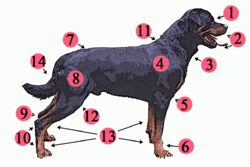
This dog's stifle joint is labeled 12

The stifle joint (often simply stifle) is a complex joint in the hind limbs of quadruped mammals such as the sheep, horse or dog. It is the equivalent of the human knee and is often the largest synovial joint in the animal's body. The stifle joint joins three bones: the femur, patella, and tibia. The joint consists of three smaller ones: the femoropatellar joint, medial femorotibial joint, and lateral femorotibial joint.[1]

The stifle joint consists of the femorotibial articulation (femoral and tibial condyles), femoropatellar articulation (femoral trochlea and the patella), and the proximal tibiofibular articulation.

The joint is stabilized by paired collateral ligaments which act to prevent abduction/adduction at the joint, as well as paired cruciate ligaments. The cranial cruciate ligament and the caudal cruciate ligament restrict cranial and caudal translation (respectively) of the tibia on the femur. The cranial cruciate also resists over-extension and inward rotation, and is the most commonly damaged stifle ligament in dogs.

"Cushioning" of the joint is provided by two C-shaped pieces of cartilage called menisci which sit between the medial and lateral condyles of the distal femur and the tibial plateau. The main biomechanical function of the menisci is probably to divide the joint into two functional units—the "femoromeniscal joint" for flexion/extension movements and the "meniscotibial joint" for rotation—a function analogous to that of the disc dividing the temporomandibular (jaw) joint. The menisci also contain nerve endings which are used to assist in proprioception.

The menisci are attached via a variety of ligaments: two meniscotibial ligaments for each meniscus, the meniscofemoral from the lateral meniscus to the femur, the meniscocollateral from the medial meniscus to the medial collateral ligament, and the transverse ligament (or intermeniscal) which runs between the two menisci.

There are between one and four sesamoid bones associated with the stifle joint in different species. These sesamoids assist with the smooth movement of tendon/muscle over the joint. The most well-known sesamoid bone is the patella, more commonly known as the "knee cap". It is located cranially to the joint and sits in the trochlear groove of the femur. It guides the patellar ligament of the quadriceps over the knee joint to its point of insertion on the tibia. Caudal to the joint, in the dog for example, are the two fabellae, which lie in the two tendons of origin of gastrocnemius. Fourth, there is often a small sesamoid bone in the tendon of origin of popliteus in many species. Humans possess only the patella.

In horses and oxen, the distal part of the tendon of insertion of quadriceps ("below" the patella) is divided into three parts. An elaborate twisting movement of the patella allows the stifle to "lock" in extension when the medial portion of the tendon is "hooked" over the bulbous medial trochlear ridge of the distal femur. This locking mechanism enables these animals to sleep while standing up.

References

[edit]
[edit]
Revisions and contributorsEdit on WikipediaRead on Wikipedia
from Grokipedia
The stifle joint is a complex, diarthrodial in the of quadrupedal animals, analogous to the human knee, consisting of the femoropatellar, medial femorotibial, and lateral femorotibial articulations between the distal , proximal , and . It is the largest joint in the body of many , such as dogs, , and ruminants, and serves as a primary structure that facilitates locomotion through flexion, extension, and limited rotation. Key anatomical components include the femoral condyles, which articulate with the tibial plateau and menisci; the , a large embedded in the that glides within the femoral trochlea; and sesamoid fabellae in the gastrocnemius muscle heads. The joint is stabilized by crucial ligaments, notably the intra-articular cranial and caudal cruciate ligaments that prevent excessive tibial translation, as well as medial and lateral collateral ligaments that resist varus and valgus forces. C-shaped medial and lateral menisci, attached via meniscotibial ligaments, enhance joint congruity, distribute compressive loads (absorbing 40–70% of forces), and act as shock absorbers during weight-bearing activities. Functionally, the stifle enables powerful extension for propulsion—driven by the , tensor fasciae latae, and —while flexion is mediated by the semitendinosus, semimembranosus, and gastrocnemius muscles, allowing for posture maintenance, , and maneuvers like or turning. In like , unique adaptations such as a locking mechanism via the reciprocal apparatus permit standing without constant muscular effort, conserving . The synovial compartments often communicate, with the frequency varying by (for example, freely in dogs and in approximately 60-80% of cases in ), facilitating fluid distribution for and nutrition of articular . Due to its complexity and load-bearing role, the stifle is prone to injuries like cruciate ruptures and meniscal tears, making it a focal point in veterinary orthopedics.

Anatomy

Bones and articulations

The stifle joint is formed by three primary bones: the distal , the , and the proximal . The distal end of the is quadrangular and protrudes caudally, featuring medial and lateral condyles that are convex and roller-like, separated by the intercondyloid fossa. The serves as an ovate embedded within the , enhancing the mechanical efficiency of the extensor mechanism. The proximal presents a convex, triangular surface with medial (oval-shaped) and lateral (circular) condyles, divided by the intercondylar eminence. Key anatomical features include the femoral trochlea, a smooth, grooved surface on the cranial aspect of the distal femur that guides patellar movement; the tibial intercondylar area, a cranial region within the intercondylar eminence for structural support; and the medial and lateral patellar ligaments, which connect the patella to the tibial tuberosity, varying in number across mammals (e.g., three in equids). These bony elements provide the foundational scaffold for joint congruence and load transmission in the hindlimb. The articulations comprise the femoropatellar joint, where the patella glides along the femoral trochlea, and the medial and lateral femorotibial joints, where the femoral condyles interface with the tibial plateau. The stifle is classified as a modified (ginglymus) joint, specifically a complex condylar with three interconnected compartments: the femoropatellar and medial and lateral femorotibial sacs.

Ligaments and soft tissues

The stifle joint is reinforced by a network of ligaments that provide static stability, preventing excessive translation and rotation, while surrounding soft tissues facilitate smooth articulation and force transmission. The primary intra-articular ligaments are the cranial and caudal cruciate ligaments, which cross each other within the joint cavity to maintain anteroposterior integrity. The cranial cruciate ligament originates from the caudomedial aspect of the lateral femoral condyle and inserts on the cranial intercondyloid area of the tibia, serving as the main restraint against cranial displacement of the tibia relative to the femur, thereby preventing the positive drawer sign observed in instability. Its caudolateral band is taut during extension, while the craniomedial band tightens in flexion. The caudal cruciate ligament attaches from the lateral aspect of the medial femoral condyle to the caudal intercondyloid area of the tibia, acting as the primary restraint against caudal tibial translation and limiting internal rotation, with its larger cranial portion taut in flexion and caudal band in extension. Extracapsular support is provided by the medial and lateral collateral ligaments, which resist varus and valgus forces to prevent lateral deviation. The (tibial collateral) originates proximally on the medial femoral and inserts on the medial tibial , often fusing with the to enhance medial stability. The lateral collateral ligament (fibular collateral) extends from the lateral femoral to the head of the , countering lateral without direct meniscal attachment. These ligaments attach to the femoral condyles and tibial plateau, integrating with the bony framework for comprehensive lateral restraint. The patellar complex transmits extensor forces from the mechanism. The straight patellar connects the apex of the to the tibial tuberosity, efficiently conveying tension to extend the while the protects the from compression against the femoral trochlea. Supporting medial and lateral patellar retinacula blend with the , reinforcing patellar alignment and preventing luxation. In carnivores, this consists of a single primary augmented by retinacular expansions. Enveloping the joint, the fibrous capsule comprises a tough outer layer and an inner that secretes lubricating fluid, forming three interconnected compartments: medial and lateral femorotibial sacs and a femoropatellar sac. This structure is separated cranially by the and provides passive containment while allowing flexion-extension. The femoris muscle group, including the vastus lateralis, , and rectus femoris, inserts via the patellar to drive stifle extension, with the increasing the moment arm for efficient force application. The originates on the caudolateral femoral condyle and inserts on the proximal , aiding in joint unlocking through internal tibial rotation relative to the and stabilizing the lateral aspect during flexion.

Menisci and synovial capsule

The menisci of the stifle joint are paired, C-shaped structures composed of that lie between the femoral and tibial condyles, enhancing joint congruity and distributing compressive forces. The is larger, semicircular, and more firmly attached to surrounding tissues, while the lateral meniscus is smaller, more uniformly C-shaped, and exhibits greater mobility due to looser peripheral attachments. These menisci consist primarily of fibers arranged in layered orientations—random on the surfaces, radial in the inner third, and circumferential in the outer two-thirds—along with proteoglycans that bind water to resist compression. The cranial and caudal horns of each meniscus attach to the tibial plateau via meniscotibial ligaments, with the medial meniscus additionally secured by the and the lateral by the meniscofemoral ligament. Vascular supply to the menisci is limited to the peripheral 15% to 25%, known as the red-red zone, derived from branches of the genicular arteries via the synovial fringe; the inner white-white zone remains largely avascular, making it susceptible to poor . In terms of function, the menisci absorb shock by deforming under load and improve articular , thereby stabilizing the and protecting the surfaces. The synovial capsule envelops the stifle joint, comprising an outer fibrous layer that provides tensile strength and an inner that lines non-articular surfaces. The secretes , a viscous rich in hyaluronan and lubricin, which reduces and nourishes avascular structures like the menisci and . Within the capsule, synovial folds such as the plica synovialis—a transverse or horizontal band in the femoropatellar compartment—extend from the , potentially aiding in fluid distribution during joint motion. The capsule forms distinct compartments, including the medial and lateral femorotibial sacs and the communicating femoropatellar sac, all interconnected to facilitate across the .

Function and biomechanics

Joint movements

The stifle joint primarily facilitates flexion and extension in the , functioning as a modified to support locomotion in quadrupeds. The femorotibial angle in full extension is typically 150-165 degrees during stance, enabling efficient , while maximum flexion reduces it to 40-60 degrees, allowing limb retraction for and providing a total of approximately 100-125 degrees. These values vary slightly across but are essential for absorbing impact and generating forward thrust. In extension-prone such as , full extension achieves 155–160 degrees, enhancing stability during prolonged standing. Accessory motions accompany the primary actions, including slight tibial rotation and craniocaudal . During flexion, the tibia exhibits internal rotation of up to 6 degrees relative to the , while external rotation occurs in extension; this coupling, termed the screw-home mechanism, enhances joint congruence and stability. Additionally, the cam-shaped femoral condyles induce a cranial glide of the tibia on the , preventing excessive shear forces during motion. These movements are constrained at extremes by the cruciate ligaments, which prevent over-rotation and . In the gait cycle, stifle extension aligns with the weight-bearing phase to propel the body forward, while flexion coordinates with hock extension to elevate the limb during swing. This reciprocal coupling between the stifle and hock ensures efficient stride progression and minimizes energy expenditure. The contributes by locking into the femoral trochlear groove in full extension, via engagement of its ligaments over the medial trochlear ridge, permitting passive stance without muscular effort.

Stability and load distribution

The stability of the stifle joint relies on both static and dynamic mechanisms to maintain equilibrium under load. Static stabilizers include the cranial and caudal cruciate ligaments, which primarily resist anterior-posterior shear forces and internal-external ; the medial and lateral collateral ligaments, which provide tensile resistance against varus and valgus angulation; and the menisci, which enhance joint congruity by deepening the tibial plateau articulation with the femoral condyles. These passive structures collectively prevent excessive translation and , ensuring the joint remains aligned during weight-bearing activities. Dynamic stability is achieved through muscular contributions, with the quadriceps femoris group actively supporting extension to counter compressive loads and the muscles ( femoris, semitendinosus, and semimembranosus) facilitating controlled flexion while providing co-contraction to fine-tune joint position and resist instability. Load distribution in the stifle joint is optimized to minimize stress on articular cartilage, primarily through the menisci, which transmit approximately 65% of the joint reaction force and increase the femorotibial contact area, thereby distributing compressive loads more evenly and reducing peak pressures that could lead to degeneration. In the absence of intact menisci, contact areas decrease significantly (e.g., by up to 17% following medial meniscectomy), leading to elevated localized stresses. The cruciate ligaments further aid load management by constraining shear forces that arise from tibial plateau slope during weight-bearing, preventing excessive cranial tibial subluxation under axial compression. Collateral ligaments experience tensile loads to maintain mediolateral balance, particularly during asymmetrical weight distribution. Biomechanically, the stifle endures substantial compressive forces during the stance phase of , estimated at 2-4 times body weight in trotting dogs based on biomechanical models, with higher magnitudes during more dynamic gaits like galloping. These forces are primarily axial along the femorotibial axis, with menisci and distributing them to avoid focal overload. The mechanism exemplifies load-handling via generation for extension; the produced (τ\tau) is calculated as the muscle (FF) multiplied by the perpendicular distance (dd) from the to the joint's center of rotation (moment arm), enabling efficient counteraction of flexion moments under load. This relationship underscores how muscular translates to stability without requiring complex derivations.

Comparative anatomy

In dogs and cats

In dogs and cats, the stifle joint exhibits adaptations suited to locomotion, with notable differences in bony structure compared to other species. In dogs, the femoral condyles are steeper, particularly the lateral condyle which is more convex and inclined than the medial, contributing to the joint's biomechanical profile during activities. The patellar ligament in dogs tends to be more vertical in orientation relative to the tibial plateau, becoming at approximately 90° of stifle flexion, enhancing patellofemoral stability during dynamic movements. In cats, the lateral meniscus is proportionally larger, with its superior articulating length measuring approximately 3.91 mm compared to 3.65 mm for the , aiding in load distribution across the joint. Ligamentous features also vary between the species, reflecting their conformational differences. Dogs are particularly prone to cranial rupture due to inherent conformational factors, such as tibial plateau slope and overall stifle alignment, which predispose certain breeds to degenerative failure under load. In contrast, cats demonstrate greater rotational laxity in the stifle joint, with clinically normal individuals showing inherent medial-lateral and rotational play that must be considered during assessments to avoid of . Functionally, these anatomical traits support species-specific behaviors in carnivores. In dogs, the facilitates agile turns and rapid directional changes, with its steeper condyles and vertical providing the necessary torque and stability during high-speed pursuits or activities. In cats, the joint enables powerful jumping and pouncing, with enhanced flexion allowing a from approximately 24° in flexion to 164° in extension, accommodating explosive extensions from crouched positions. Specific metrics highlight these adaptations further. The canine stifle maintains an of approximately 140° in the standing position, balancing load transmission while preventing collapse during the gait cycle. In cats, the menisci are distinctly wedge-shaped, thicker peripherally and tapering axially, which optimizes shock absorption during impacts from leaps or falls by distributing compressive forces across the tibiofemoral interface. These general ligament roles, such as restraining tibial translation, underpin the joint's overall stability in both species.

In horses and ruminants

In , the stifle joint exhibits bony adaptations that facilitate a passive locking mechanism in extension as part of the stay apparatus, allowing the animal to stand with minimal muscular effort by hooking the medial and middle patellar ligaments over the prominent medial trochlear ridge of the . This locking is enabled by the femoral trochlea's large medial ridge and smaller lateral ridge, which provide structural support during rest or . In contrast, ruminants such as possess a straighter femoral alignment relative to the , contributing to a more upright posture that supports prolonged stationary positions typical of behaviors. Ligamentous structures in the equine stifle emphasize the prominent medial patellar ligament, which plays a critical role in the locking mechanism by engaging the femoral trochlea to prevent flexion during extension. In ruminants, the cranial and caudal cruciate ligaments enhance resistance to shear forces across the joint during weight-bearing activities. These cruciates, along with the collateral ligaments, anchor the femur to the tibia, providing intra-articular stability in both species, though the ruminant configuration prioritizes durability under static loads. Functionally, the equine stifle supports efficient trotting and galloping through its hinge-like flexion-extension motion, integrated with the reciprocal apparatus linking the stifle to the tarsus via tendons like the superficial digital flexor, which synchronizes limb movement for propulsion. The joint's range of flexion reaches approximately 110 degrees, allowing substantial angular displacement during high-speed locomotion while maintaining stability via the stay apparatus in extension. In ruminants, the stifle is adapted for energy-efficient prolonged standing, with a less pronounced patellar locking mechanism and a tibial plateau that enhances joint congruity and load distribution, reducing muscular fatigue during extended postures.

Clinical significance

Common injuries and disorders

The stifle joint is susceptible to several common injuries and disorders, particularly in dogs and , where biomechanical stresses and conformational variations contribute to . Cranial cruciate ligament (CCL) rupture represents one of the most prevalent injuries, especially in dogs, where it accounts for 3% to 5% of all cases and has a lifetime prevalence of approximately 5-10% in predisposed breeds such as Labrador Retrievers. In dogs, CCL rupture is primarily degenerative, linked to progressive weakening rather than acute trauma, though traumatic ruptures can occur during high-impact activities; risk factors include , breed predispositions (e.g., Labrador Retrievers), status, and conformational issues like steep tibial plateau angles. Symptoms typically include acute or chronic lameness, stifle joint , on manipulation, and cranial drawer , often leading to secondary degenerative changes. In , CCL rupture is less common and usually traumatic, resulting from falls or sudden hyperextension, presenting with severe, acute lameness, femoropatellar joint distension, and instability. Meniscal tears frequently accompany CCL ruptures in dogs, occurring in up to 50% of cases involving the , with bucket-handle tears comprising about 20% of these lesions. These tears arise from joint instability post-CCL damage, causing abnormal meniscal loading; symptoms manifest as exacerbated lameness, , and pain, particularly during flexion or weight-bearing. Patellar luxation is another frequent disorder, predominantly medial in small-breed dogs (e.g., Yorkshire Terriers, Pomeranians), where it is diagnosed in approximately 7% of puppies, particularly in small breeds, and is often congenital due to shallow trochlear grooves or malalignment. Patellar luxation is also common in cats, often presenting as bilateral medial displacement. factors include female sex, , and skeletal deformities, with symptoms ranging from intermittent "skipping" lameness to persistent crouching postures in advanced grades. In horses, lateral patellar luxation is more typical and often developmental or traumatic, linked to hypoplasia of the lateral femoral trochlear ridge; it causes stifle stiffness, reluctance to flex the limb, and intermittent locking, particularly in young or miniature breeds. Osteochondrosis dissecans (OCD) primarily impacts young horses, where stifle involvement is a leading cause of lameness, with lesions on the lateral femoral trochlear ridge in 5-25% of clinical cases. This developmental disorder stems from failed in the first 6 months of life, influenced by rapid growth, genetics, and nutrition; symptoms include , acute lameness, and fragment displacement during exercise. Degenerative joint disease (DJD), or , commonly develops secondary to the above injuries in both , driven by chronic instability, age-related cartilage wear, in dogs, and conformational faults in . It presents with progressive stiffness, , and reduced , exacerbating lameness over time.

Diagnosis and treatment

Diagnosis of stifle joint disorders in typically begins with a thorough to assess lameness and stability. In dogs, the cranial is a key orthopedic maneuver used to evaluate the integrity of the cranial (CrCL), where excessive craniocaudal movement of the relative to the indicates ligament deficiency. The tibial compression test complements this by simulating joint loading to detect instability, while meniscal compression tests apply targeted pressure to provoke pain or clicking indicative of meniscal tears. In horses, similar techniques, including flexion tests and direct compression, help identify stifle involvement, often presenting as lameness. Imaging modalities play a crucial role in confirming diagnoses and characterizing lesions. Radiography is routinely employed to detect osteochondrosis dissecans (OCD) fragments or degenerative joint disease (DJD) in both dogs and horses, revealing space narrowing, osteophytes, or mineralized bodies. Advanced imaging such as computed tomography (CT) or (MRI) provides detailed visualization of ligament tears, meniscal damage, or subtle cartilage defects, particularly useful for CrCL assessment in dogs and complex stifle pathologies in horses. offers a non-invasive option for evaluating soft tissues like menisci and ligaments in dogs, with high sensitivity for detecting effusions or tears when performed dynamically. Arthroscopy serves as the gold standard for direct intra-articular inspection and diagnosis, allowing visualization of ligaments, menisci, and cartilage surfaces in both species. In dogs, it facilitates identification of partial CrCL tears or meniscal injuries not evident on other tests, while in horses, it is essential for confirming OCD lesions in the femoropatellar joint. Treatment strategies for stifle joint disorders vary by severity and species, prioritizing conservative management for mild cases. Rest, controlled exercise, and nonsteroidal anti-inflammatory drugs (NSAIDs) form the cornerstone for early DJD or minor injuries in dogs and horses, reducing inflammation and supporting joint function without invasive intervention. For progressive or severe conditions, surgical options are indicated; in dogs, tibial plateau leveling osteotomy (TPLO) stabilizes the stifle in CrCL ruptures by altering biomechanics, achieving approximately 90% success in restoring function. In horses, arthroscopic removal of OCD fragments addresses cartilage defects, with recovery typically spanning 4 to 6 weeks of stall rest followed by gradual exercise. Postoperative rehabilitation is integral to optimizing outcomes, incorporating physiotherapy such as passive range-of-motion exercises, controlled walks, and balance in dogs to enhance muscle strength and mobility. In , similar protocols emphasize controlled turnout and gradual return to work post-arthroscopy to prevent re-injury. Emerging regenerative therapies, including injections, show promise for cartilage repair in stifle disorders, reducing arthritic changes in experimental equine models and supporting tissue regeneration in canine .

References

Add your contribution
Related Hubs
User Avatar
No comments yet.