Recent from talks
Nothing was collected or created yet.
Stoke Row
View on Wikipedia
Stoke Row is a village and civil parish in the Chiltern Hills, about 5 miles (8 km) west of Henley-on-Thames in South Oxfordshire and about 9 miles (14 km) north of Reading. The 2011 Census recorded the parish population as 651.[1]
Key Information
History
[edit]The earliest known surviving record of the name is from 1435. Stoke is a common place-name derived from Old English, typically meaning a secondary settlement or outlying farmstead. With the affix "row" it means a "row of houses at Stoke".[2] Stoke Row was a hamlet divided between the ancient parishes, and later civil parishes, of Ipsden, Newnham Murren and Mongewell. It was made a chapelry in 1849.[3] From 1932 it was divided between Ipsden and Crowmarsh, into which Newnham Murren and Mongewell were merged.[4] In 1952 Stoke Row was made a new civil parish.[5]
Parish church
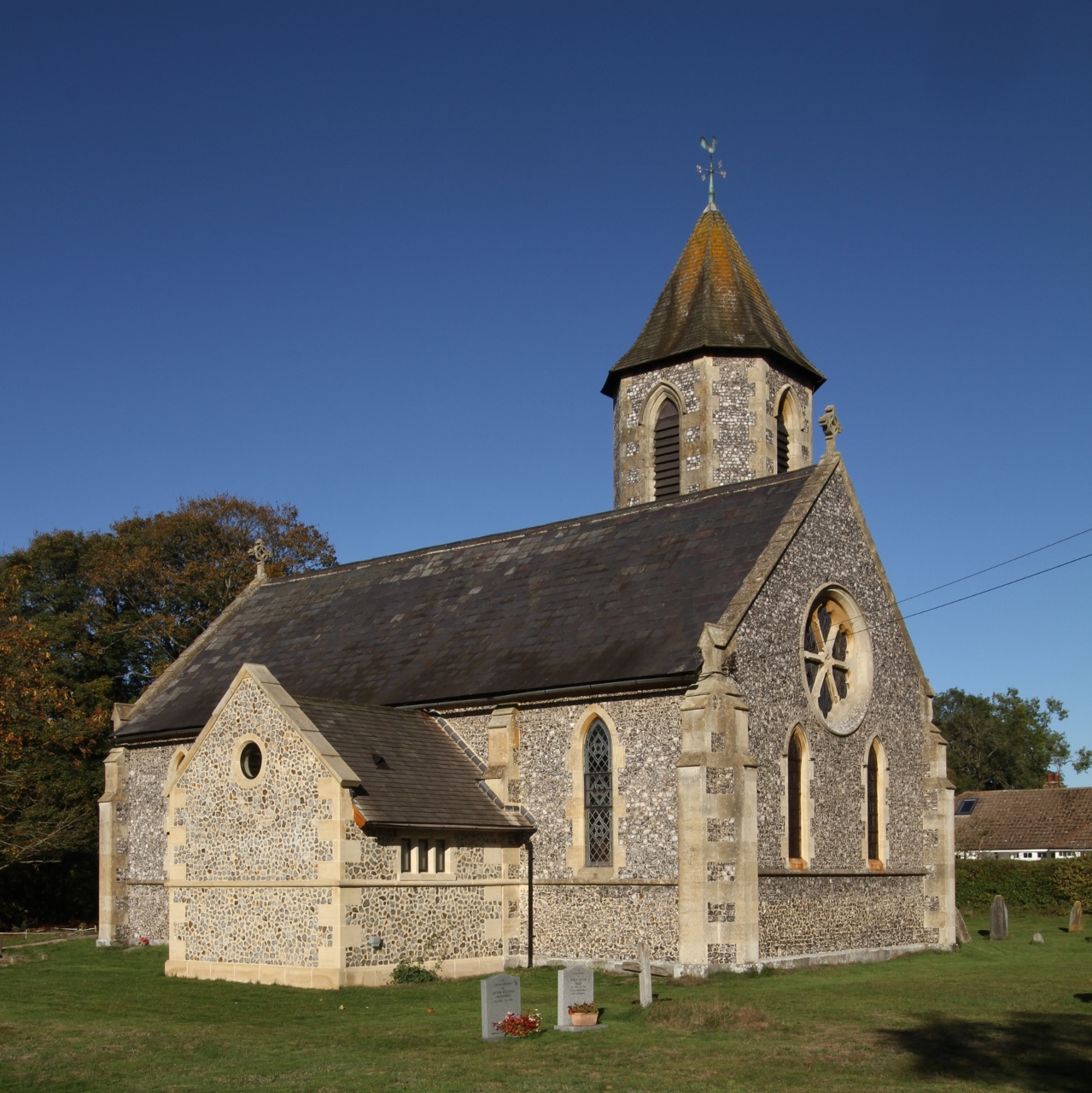
[edit]The Church of England parish church of St John the Evangelist was consecrated in 1846.[6] It was designed in 13th-century style by the architect RC Hussey[7] and is built of knapped flint with stone dressings. The church has a north tower with an octagonal belfry and short spire with a wood shingle roof.[8] The ecclesiastical parish is now a member of The Langtree Team Ministry: a Church of England benefice that also includes the parishes of Checkendon, Ipsden, North Stoke, Whitchurch-on-Thames and Woodcote.[9]
Independent chapel
[edit]The history of Dissenters meeting in the village dates from 1691.[10] Stoke Row Independent Chapel was built in 1815. It is a Georgian building with flint footings and a hipped roof of slate.[11] In 1884 a Sunday school room was built at the back of the chapel.[12] An extension was built in 1956.[12] In 2015 an outdoor service was held to celebrate the chapel's bicentenary.[13]
Ministers
[edit]- 1959–65: Pastor Ernest Dickerson
- 1967–72: Rev John Potts
- 1973–75: Rev Arthur Tilling
- 1977–90: Rev Padre Bernard Railton Bax
- 1990–2004: Rev John Harrington
- 2004–10: Rev David Holmwood
- 2010–16: Revs David and Sonia Jackson
- 2016– present: Rev Mark Taylor
Maharajah's Well
[edit]Edward Anderton Reade, the local squire at Ipsden, had worked with the Maharajah of Benares in India in the mid-nineteenth century. Under Reade's leadership, a well was sunk in 1831 to aid the community in Azamgarh. Reade left the area in 1860, and after his departure, the Maharajah decided to make a contribution to Reade's home area in England. Recalling Reade's help in creating the Azimgurgh well in 1831 and his stories of water deprivation in his home area of Ipsden[citation needed] the Maharajah commissioned the well at Stoke Row and it was sunk in 1863.[7] The Wallingford firm of RJ and H Wilder made the well mechanism in 1863[14] and completed the pavilion over the well in 1864.[15] The pavilion is open-sided with a cupola on top and a golden-coloured elephant above the well mechanism. The well and pavilion can be seen in a small park on the north side of the main road through Stoke Row village.
Another Indian aristocrat, Maharaja Sir Deonarayun Singh, probably motivated the Stoke Row project, donated a well to the nearby village of Ipsden.
Amenities
[edit]The village has two 17th-century pubs: the Cherry Tree Inn, a Brakspear tied house[16][17] and the Crooked Billet[18] a free house.[19] Built in 1642 the pub is reputed to have once been the hideout of highwayman Dick Turpin, who was said to have been in love with the landlord's daughter, Bess.[20] It was England's first gastropub and was the venue for Titanic star Kate Winslet's wedding reception. In June 1989 the British progressive rock band Marillion played its first performance with Steve Hogarth as frontman at the pub; a documentary DVD called From Stoke Row To Ipanema – A Year In The Life was subsequently produced.[21] In the 1851 Census the head of the household at No 1 Stoke Row was George Hope, who built "The Hope" public house.[22] This was later called "The Farmer" and today is Hope House, at the junction of Main Street with Nottwood Lane. The parish has a Church of England primary school.[23]
Notable residents
[edit]- George Cole (1925–2015), actor, lived in Stoke Row for more than 70 years.[24]
- Carol Decker (born 1957), former singer of T'Pau, in 2006 became a joint tenant of the Cherry Tree Inn which her husband Richard Coates had established.[25] It closed in 2012,[26] but later reopened under new ownership.[citation needed]
- Nick Heyward (born 1961), singer-songwriter and guitarist, has lived in the village since 2014.[27]
Gallery
[edit]-
The Crooked Billet pub
-
The Cherry Tree Inn
-
Stoke Row Independent Chapel
-
Grave of a Free Czechoslovak airman in St John's parish churchyard
-
The Maharajah's Well, with Well Cottage behind the hedge on the right
-
Maharajah's well cupola with wording "His Highness the Maharajah of Benares"
-
Maharajah's Well - golden elephant inside
References
[edit]- ^ UK Census (2011). "Local Area Report – Stoke Row Parish (1170217830)". Nomis. Office for National Statistics. Retrieved 25 July 2018.
- ^ Watts 2010, Stoke Row
- ^ Wilson 1870–72, [1]
- ^ "Crowmarsh CP". Vision of Britain. University of Portsmouth.
- ^ "Stoke Row CP". Vision of Britain. University of Portsmouth.
- ^ Lewis 1931, pp. 220–224.
- ^ a b Sherwood & Pevsner 1974, p. 789
- ^ Historic England. "Church of St John the Evangelist (Grade II) (1369052)". National Heritage List for England. Retrieved 25 July 2018.
- ^ "Locations". The Langtree Team Ministry. Retrieved 25 July 2018.
- ^ "Journals of the House of Lords". 1833. p. 306.
- ^ "Independent Chapel". Oxfordshire Historic Churches Trust. 12 September 2015. Retrieved 11 November 2015.
- ^ a b Historic England. "Stoke Row Independent Chapel (Grade II) (1271461)". National Heritage List for England. Retrieved 25 July 2018.
- ^ "Celebrating 200 years of worship". Henley Standard. Higgs Group. 27 June 2015. Retrieved 11 November 2015.
- ^ Williamson 1983[page needed]
- ^ Historic England. "Maharajah's Well (Grade II) (1180547)". National Heritage List for England. Retrieved 24 October 2018.
- ^ Cherry Tree Inn
- ^ Historic England. "Cherry Tree public house (Grade II) (1059327)". National Heritage List for England. Retrieved 25 July 2018.
- ^ Historic England. "The Crooked Billet public house (Grade II) (1180667)". National Heritage List for England. Retrieved 25 July 2018.
- ^ The Crooked Billet
- ^ "History". The Crooked Billet. Retrieved 22 February 2024.
- ^ "Steve Hogarth's first Marillion Gig at The Crooked Billet". Archived from the original on 5 June 2012.
- ^ "Stoke Row Census Return 1851". Angela Spencer-Harper. February 2002.
- ^ Stoke Row Church of England Primary School
- ^ Ward, Victoria (31 August 2013). "Actor George Cole in dispute over local sawmill". Daily Telegraph.
- ^ "The Sugar Loaf gets a makeover and a new style of cuisine (From Bucks Free Press)". Bucksfreepress.co.uk. 15 February 2006. Retrieved 31 December 2011.
- ^ "Last orders for The Cherry Tree". getreading. 19 January 2012. Retrieved 7 July 2014.
- ^ "Nick Heyward". Henley Life: 7. August 2014. Archived from the original on 9 July 2015. Retrieved 8 July 2015.
Sources
[edit]- Lewis, Samuel, ed. (1931) [1848]. A Topographical Dictionary of England (Seventh ed.). London: Samuel Lewis. pp. 220–224.
- Sherwood, Jennifer; Pevsner, Nikolaus (1974). Oxfordshire. The Buildings of England. Harmondsworth: Penguin Books. p. 789. ISBN 0-14-071045-0.
- Spencer-Harper, Angela (1999). Dipping into the Wells: The Story of the Two Chiltern Villages of Stoke Row and Highmoor Seen Through the Lives of Their Inhabitants. Witney: Robert Boyd Publications. ISBN 1-899536-35-3.
- Watts, Victor, ed. (2010). "Stoke Row". The Cambridge Dictionary of English Place-Names. Cambridge: Cambridge University Press. pp. 510, 577.
- Williamson, LD (1983). An Illustrated History of The Maharajah's Well. Stoke Row: The Maharajah's Well Trust.
- Wilson, John Marius (1870–72). Imperial Gazetteer of England and Wales. London and Edinburgh: A Fullarton and Co.
External links
[edit]Stoke Row
View on GrokipediaGeography and Demographics
Location and Topography
Stoke Row is a village and civil parish located in the Chiltern Hills of South Oxfordshire, England, at coordinates 51°33′07″N 01°00′58″W.[6] It lies within the Chilterns Area of Outstanding Natural Beauty, approximately 5 miles (8 km) west of Henley-on-Thames and 9 miles (14 km) north of Reading.[1] The village occupies an elevated position on the Chiltern escarpment, with elevations ranging from about 107 metres (351 ft) to a maximum of 204 metres (669 ft) above sea level, averaging 164 metres (538 ft).[7] The topography of Stoke Row is characterized by the rolling chalk hills typical of the southern Chilterns, featuring undulating terrain formed by an outcrop of chalk overlain by clay-with-flints deposits.[8] These geological conditions result in thin, nutrient-poor soils that are generally unsuitable for intensive arable farming, leading historically to a landscape dominated by beech woodlands and limited agricultural productivity on the higher ground.[9] The scarcity of natural surface water sources, due to the permeable chalk underlying the area, has necessitated reliance on wells and ponds for water supply, a factor that shaped local development patterns.[10] Settlement in Stoke Row follows a dispersed pattern, with buildings clustered loosely around a central common that historically covered around 60 acres.[10] Administratively, the area was originally divided among the ancient parishes of Ipsden, Newnham Murren, and Mongewell, functioning as a chapelry until it was unified as a distinct civil parish in 1952, now part of the South Oxfordshire District.[1][11] This topography, including the dry conditions and poor soils, contributed to the construction of notable water features in the village, such as the Maharajah's Well, though details of its history are covered elsewhere.[12]Population and Housing
According to the 2021 Census, the civil parish of Stoke Row had a population of 704, marking an increase of 53 residents from the 651 recorded in the 2011 Census.[2] This growth equates to an annual change of 0.79% over the decade.[2] The parish spans 6.079 square kilometres, resulting in a population density of 115.8 residents per square kilometre, characteristic of its rural setting in the Chiltern Hills.[2] Housing in Stoke Row consists predominantly of detached homes and traditional cottages, reflecting the area's historic rural character and scattered settlement pattern.[4] Modern developments remain limited due to stringent conservation policies within the Chilterns Area of Outstanding Natural Beauty, which prioritize preserving the landscape and architectural heritage.[13] Socioeconomically, Stoke Row is an affluent locality, with average property values exceeding £1.15 million in recent sales, far above national averages and indicative of high demand in this desirable countryside location.[14] Historically, the parish experienced poverty linked to agricultural limitations, such as poor soil quality and reliance on labor-intensive farming during periods of economic depression in the 19th century.[15]History
Origins and Early Settlement
The earliest recorded mention of Stoke Row dates to 1435, in a document describing a land transaction within the area then part of North Stoke parish.[4] The name derives from Old English, with "Stoke" referring to a secondary settlement or outlying farmstead, and "Row" indicating a row of houses at that site.[4] Notably absent from the Domesday Book of 1086, the settlement likely emerged as a modest woodland clearance in the southern Chiltern Hills, an area unsuited to large-scale development due to its isolated, elevated position.[4] In the medieval period, Stoke Row existed as a divided hamlet spanning the ancient parishes of Ipsden, Newnham Murren, and Mongewell, with residents traveling to distant churches in those locales for worship.[1] Growth remained limited, confined largely to a handful of cottages clustered around a small green, as the thin, chalky soils of the Chilterns offered low agricultural yields, supporting only basic farming on marginal land.[16] Water scarcity compounded these challenges, with no natural springs or reliable sources available, forcing reliance on seasonal ponds that often dried up and compelling inhabitants to fetch water from valleys below.[4] By the 17th and 18th centuries, Stoke Row saw the stirrings of nonconformist activity, with dissenters beginning to hold meetings as early as 1691 in the drawing room of a local farmhouse, reflecting broader regional currents of religious dissent amid Anglican dominance.[17] These gatherings laid the groundwork for later independent worship in the village, though the settlement's overall expansion stayed constrained by its environmental limitations until external interventions in the following century. Archaeological evidence underscores the area's long human presence, including Neolithic flint axes and isolated Roman coins discovered near the village center, hinting at prehistoric and Roman-era activity without indicating permanent settlements.[4] More recently, in 2024, an inquest at Oxford's County Hall declared a hoard of 21 coins—dating to over 300 years old and containing more than 10% precious metal—treasure after their discovery by a metal detectorist in a local field between 2018 and 2020, offering insights into post-medieval economic life.[18]19th-Century Developments and Administrative Changes
In the mid-19th century, Stoke Row underwent significant administrative changes that reflected its growing distinct identity separate from surrounding parishes. Originally a hamlet divided among the ancient parishes of Ipsden, Newnham Murren, and Mongewell, it was constituted as an ecclesiastical chapelry in 1849, allowing for independent church governance and the establishment of its own parish church.[19] This status change facilitated local religious administration but did not immediately alter civil boundaries; full recognition as a separate civil parish occurred later in 1952, consolidating land from Ipsden and the former areas of Newnham Murren and Mongewell into a unified entity of approximately 1,730 acres.[10] A pressing challenge during this period was the severe water crisis exacerbated by droughts in the 1860s, which highlighted the village's inadequate and unsanitary water supply. Residents relied on contaminated ponds and abandoned clay pits for water, often leading to health issues and poverty, as clean sources were scarce and distant—sometimes requiring long hauls from external locations.[3] These conditions were particularly dire during dry spells, with villagers postponing basic hygiene and children facing punishment for accessing limited supplies, underscoring the social and economic strain on the rural community.[20] This crisis inspired philanthropic intervention through the efforts of local squire and East India Company official Edward Anderton Reade, who drew on his international connections to address local needs. Reade, having served in India, shared accounts of the villagers' hardships with Maharajah Ishree Pershad Narayan Singh of Benares during visits in the early 1860s, prompting the Maharajah to fund the construction of a deep well in Stoke Row, completed in 1864, as a gesture of gratitude and cross-cultural solidarity.[3] Reade's involvement not only alleviated the immediate water scarcity but also symbolized broader 19th-century trends linking colonial experiences to domestic philanthropy. Amid these developments, Stoke Row experienced modest population growth, rising from 351 residents in 1871 to 438 by 1891, driven by agricultural employment in the Chiltern Hills and influxes supported by local initiatives like the well and emerging infrastructure.[21][22] This expansion reflected shifts in rural economy, including sustained farming practices and the stabilizing influence of figures like Reade, whose philanthropy fostered community resilience without large-scale industrialization.[10]Religious Sites
Parish Church of St John the Evangelist
The Parish Church of St John the Evangelist in Stoke Row was constructed around 1846 to designs by the architect R. C. Hussey in the Early English lancet style of Gothic Revival, using knapped flint with stone dressings and a Welsh slate roof.[23] The church was built to address the needs of local worshippers who previously attended services in the distant parishes of Ipsden and North Stoke, with funding raised through contributions from Revd Richard Twopenny, Bishop Samuel Wilberforce, and benefactors including John Reade; the site was donated by St John's College, Oxford.[24] It was consecrated on 19 October 1848, at which time the north tower was added.[25] The building features a four-bay nave seating approximately 90 people, a spacious chancel, and a three-stage north tower incorporating a vestry, clock, and single bell in a bell-cote with louvred lancets and an octagonal pyramidal roof covered in cedar shingles.[24][23] External elements include stepped buttresses, a central double plank door on the south side, and an east window comprising two lancets below a rose window. The church is designated as a Grade II listed building for its architectural interest as a simple Victorian example.[23] Inside, the church retains mid-19th-century furnishings such as a stone font, pulpit, and coupled rafter roof with arch bracing, alongside an early 20th-century reredos featuring hood-moulds and slate text panels, and a mid-19th-century altar rail.[23] Stained glass includes 19th- and early 20th-century examples, notably the 1954 east rose window designed by Barbara Batt with 1,226 pieces of glass.[25] Memorials are present, though specific details are not extensively documented. Between 2011 and 2015, the interior was reordered by Jessop & Cook Architects, removing some pews, adding a wooden floor, underfloor heating, and facilities including a disabled toilet and kitchen to enhance community use.[25][24] Following its consecration, the church served as the primary place of worship for Stoke Row after it attained chapelry status in 1849, independent from the mother parishes of Ipsden and North Stoke.[24] Today, it forms part of the Langtree Team Ministry, established in 1984, which includes neighbouring parishes such as Checkendon; the rectory is now located in Checkendon.[24] Regular Sunday services are held at 9:30 a.m., and the church accommodates baptisms, weddings, funerals, and community events, including use by the local Church of England primary school during the week.[24]Stoke Row Independent Chapel
The Stoke Row Independent Chapel was established in 1815 to serve the village's non-conformist community, with records indicating that dissenters had been holding meetings in the area since 1691.[17] The chapel's construction marked a formalization of these gatherings, reflecting the broader tradition of independent worship in rural Oxfordshire during the early 19th century. In 2015, the chapel celebrated its bicentenary with special events, underscoring its enduring role in local religious life.[17] Architecturally, the chapel is a simple rectangular single-storey building constructed in Flemish bond red brick on flint footings, topped by a slate hipped roof with overhanging eaves.[26] It features round-arched sash windows with glazing bars and a central doorway sheltered by a late-19th-century porch; extensions include a Sunday school added in 1884 and a kitchen and lavatory block from 1956.[26] The interior retains late-19th-century pews and a monument to John Olding Alanson (d. 1831), with modernizations in 1955 adding heating, a kitchen, toilets, and a manse.[17][26] Designated as a Grade II listed building in 2000, it exemplifies modest Georgian-era non-conformist design adapted for continued use.[26] Leadership of the chapel has been documented from 1959 onward, with a succession of ministers guiding its evangelical focus:| Period | Minister | Notes |
|---|---|---|
| 1959–1965 | Pastor Ernest Dickerson | |
| 1967–1972 | Revd John Potts | |
| 1973–1975 | Revd Arthur Tilling | |
| 1977–1990 | Revd Padre Bernard Railton Bax | |
| 1990–2004 | Revd John Harrington | |
| 2004–2010 | Revd David Holmwood | |
| 2010–2016 | Revd David and Sonia Jackson | Joint ministers |
| 2016–present | Revd Mark Taylor | Current minister |
