


Community hub
Recent from talks
Contribute something
Nothing was collected or created yet.
Cooktop
View on Wikipedia
A cooktop (American and Canadian English; British English: stovetop or hob) is a device commonly used for cooking that is commonly found in kitchens and used to apply heat to the base of pans or pots. Cooktops are often found integrated with an oven into a kitchen stove but may also be standalone devices. Cooktops are commonly powered by gas or electricity, although oil or other fuels are sometimes used.
Gas
[edit]
Gas cooktops consist of one or more gas burners with arrangements to control the rate of flow. They often have integral lighters or (in older models) pilot lights,[1] and may have safety interlocks designed to reduce the risk of hazardous gas leaks.[2]
Gas cooking has been associated with negative health effects, such as reduced pulmonary function[3] and a higher rate of respiratory symptoms in children.[4]
Electric
[edit]
Coil
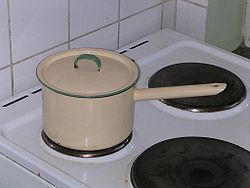
[edit]An electric coil cooktop uses electric elements that directly heat pots placed on them. They are inexpensive to buy and maintain, but are considered more difficult to clean than smooth-top models.[5][6][7]
Plate
[edit]An electric plate cooktop is similar to a coil cooktop but uses plate-like base supports as opposed to coil supports.
Ceramic radiation heating
[edit]
A ceramic radiation heating cooktop has a surface made of low-expansion thermal glass-ceramic that is transparent to infrared.[5] This surface houses radiant or halogen heaters below it. The advantage of this arrangement is that the heat can be quickly controlled. These cooktops are often simply called ceramic cooktop or ceramic-glass cooktop, because they were the first type of cooktop to use glass-ceramic—however, other types of cooktops also use glass-ceramic surfaces, notably induction cooktops.
Induction
[edit]
An induction cooktop involves the electrical heating of a cooking vessel by magnetic induction instead of by radiation or thermal conduction from an electrical heating element or from a flame. Because inductive heating directly heats the vessel, very rapid increases in temperature can be achieved and changes in heat settings are fast, similar to gas.[8]
In an induction cooktop ("induction hob" or "induction stove"), a coil of copper wire is placed under the cooking pot, and an alternating electric current is passed through it. The resulting oscillating magnetic field induces a magnetic flux that repeatedly magnetises the pot, treating it like the lossy magnetic core of a transformer. This produces large eddy currents in the pot, which, because of the resistance of the pot, heat it.
For nearly all models of induction cooktops, a cooking vessel must be made of, or contain, a ferromagnetic metal such as cast iron or some stainless steels. However, copper, glass, non-magnetic stainless steels, and aluminum vessels can be used if placed on a ferromagnetic disk that functions as a conventional hotplate.
Induction cooking is quite efficient, which means it puts less waste heat into the kitchen, can be quickly turned off, and has safety advantages compared to gas stoves. Cooktops are also usually easy to clean, because the cooktop itself does not get very hot.
If the induction coil is of lesser diameter than the cooking pot, and the pot has low thermal conductivity, use of high power can potentially warp the pot due to non-uniform heating. 6" coils are common in low-end portable units, which is smaller than most pots and pans.
Ventilation and exhaust
[edit]Cooktops often have a kitchen hood installed overhead to expel or filter smoke, fumes and undesirable odors that result from cooking. However, when installation of an updraft ventilation system is undesirable or impossible (for example in an open kitchen design), a cooktop with an integrated downdraft ventilation system can be used instead. Such systems draw cooking fumes downwards rather than upwards, eliminating the need of an overhead installation. They are, however, less effective than overhead systems, and may not be able to extract fumes emanating from taller pots.[9]
Placement
[edit] |
Installed
[edit]Cooktops are virtually ubiquitous in kitchens. They may be built into a stove along with an oven. Alternatively, cooktops are often installed independently in work surfaces.
Hot plate
[edit]
A hot plate or hotplate is a portable self-contained tabletop small appliance cooktop with one, two or more electric heating elements, or gas burners. A hot plate can be used as a standalone appliance, but is often used as a substitute for one of the burners from an oven range or a kitchen stove.
Hot plates are often used for food preparation, generally in locations where a full kitchen stove would not be convenient or practical. A hot plate can have a flat or round surface. Hot plates can be used for traveling or in areas without electricity.
References
[edit]- ^ Klahre, Ayn-Monique (2018-02-04). "How To Light a Stovetop and Oven Pilot Light". Kitchn. AT Media. Retrieved 2020-09-10.
- ^ Prelusky, Alison (2018-02-01). "Can Gas Ranges Run Without Electricity?". P. C. Richard & Son. Retrieved 2020-09-10.
- ^ Ware, J. H.; Dockery, D. W.; Spiro III, A.; Speizer, F. E.; Ferris Jr., B. G. (1984). "Passive Smoking, Gas Cooking, and Respiratory Health of Children Living in Six Cities". American Review of Respiratory Disease. 129 (3): 366–374. doi:10.1164/arrd.1984.129.3.366 (inactive 11 July 2025). Retrieved 2020-09-10.
{{cite journal}}: CS1 maint: DOI inactive as of July 2025 (link) - ^ Garrett, Maria H.; Hooper, Martin A.; Hooper, Beverley M.; Abramson, Michael J. (1998-09-01). "Respiratory Symptoms in Children and Indoor Exposure to Nitrogen Dioxide and Gas Stoves". American Journal of Respiratory and Critical Care Medicine. 158 (3): 891–895. doi:10.1164/ajrccm.158.3.9701084.
- ^ a b Byer, Beverley. "Cooktops". Smith & Smith Kitchens. Retrieved 2023-11-12.
- ^ Allaire, Jeff (2020-03-09). "Smooth Top Ranges - Pros & Cons vs Coil Top". Belingham Electric. Retrieved 2023-11-12.
- ^ Frost, Shelley (2019-10-03). "Electric Coil Range vs. Smooth-Top". Hunker. Leaf Group Ltd. Retrieved 2020-09-10.
- ^ "Induction Cooking Technology Design and Assessment; M. Sweeney, J. Dols, B. Fortenbery, F. Sharp; Electric Power Research Institute (EPRI)" (PDF). Archived from the original (PDF) on 2015-09-10. Retrieved 2016-09-19. Paper presented at the 2014 ACEEE Summer Study on Energy Efficiency in Buildings
- ^ Miller, Renee. "How Good Is a Cooktop Downdraft Ventilation System?". SFGate. Hearst. Retrieved 2020-09-10.
Cooktop
View on GrokipediaHistory
Origins and Early Developments
Early cooking methods relied on open fire pits dug into the ground or simple hearths, where pots were suspended over flames or placed on hot stones, without a defined cooktop surface for direct heat application.[14] These primitive setups, common in ancient civilizations, allowed for basic boiling and roasting but offered limited control and efficiency due to direct exposure to open flames.[15] Significant advancements emerged in the 16th century with the first patented woodburning cookstove in 1557 Strasbourg, featuring an enclosed firebox and a top surface with openings for multiple pots, marking an initial shift toward structured cooking platforms.[16] By the 18th century, metal construction enabled more durable designs; Benjamin Franklin's 1742 stove improved heat circulation within an enclosed chamber, while U.S. iron manufacturers introduced practical cast-iron models in the 1760s, incorporating flat tops with grates for better pot placement and fuel economy.[17][18] The 1735 Castrol stove by François de Cuvilliés represented a key milestone by fully enclosing the fire beneath a solid top surface, reducing smoke and enhancing safety for household use.[19] In the early 19th century, gas technology began influencing cooktop evolution, with James Sharp patenting the first gas stove in 1826, which used piped gas for burners on a dedicated cooking surface, though widespread adoption lagged until infrastructure improvements.[17] These developments prioritized containment and heat direction, laying the foundation for modern cooktops by transitioning from open flames to controlled, surface-based heating.[15]Industrial Era Advancements
The advent of the Industrial Revolution in the late 18th century spurred the shift from open hearth cooking to enclosed cast-iron stoves, enabling more efficient fuel use and heat distribution for cooktops. These stoves featured a flat or grated top surface with multiple holes or rings for suspending pots over a contained firebox, reducing smoke dispersion and allowing better temperature regulation via dampers and flues.[20] Cast iron's high thermal mass retained heat effectively, minimizing wood or coal consumption compared to open fires, which often wasted up to 90% of fuel energy.[21] Key early innovations included the Rumford stove, patented around 1800 by Benjamin Thompson (Count Rumford), which used a single fire to simultaneously heat multiple pots through strategic airflow and radiant heat conduction across the cooktop surface.[22] This design prioritized economy and uniformity, influencing subsequent models by demonstrating how enclosed combustion could support precise cooking control without constant fire tending. By the 1830s, advancements like Philo Stewart's Oberlin stove introduced compact, portable cast-iron units optimized for wood fuel, further standardizing cooktop layouts with integrated oven compartments below the heating surface.[17] Mass production techniques, enabled by iron foundry expansions during industrialization, proliferated these stoves; U.S. patents for cookstove designs surged in the early 1800s, with over 100 granted by 1820 for variations improving draft efficiency and cooktop modularity.[18] Coal-fired iterations gained prominence by the mid-19th century, as railways lowered transport costs for heavy castings, making durable, multi-burner cooktops accessible beyond elite households.[23] These developments marked a causal leap in kitchen technology, prioritizing empirical heat management over traditional open-flame variability, though early models still required manual ash removal and fuel reloading.[24]20th Century Innovations
The development of electric cooktops marked a significant advancement in the early 20th century, transitioning from fuel-based heating to electrically powered resistance elements. On June 30, 1896, William S. Hadaway Jr. received the first U.S. patent for an electric oven and heater, enabling direct electrical heating without wood, coal, or gas.[25] Prototypes appeared at the 1893 Chicago World's Fair, demonstrating electrified model kitchens, though commercial viability was limited by unreliable electricity supply.[26] By 1910, Hotpoint introduced the first fully integrated electric range with exposed coil elements on the cooktop surface, offering precise temperature control via simple on-off switches and improving safety over open flames.[7] Mid-century innovations focused on surface materials and heat distribution. In 1952, S. Donald Stookey at Corning Inc. discovered glass-ceramics through accidental high-temperature exposure of photosensitive glass, yielding a material with exceptional thermal shock resistance and low expansion, ideal for cooktop surfaces.[27] This led to radiant electric cooktops where halogen or metal heating elements embedded beneath a smooth glass-ceramic panel transferred heat via infrared radiation, combining aesthetics with easier cleaning compared to traditional exposed coils.[28] SCHOTT's CERAN® glass-ceramic cooktop, launched in 1971, became the first commercial product of this type, featuring a flat black surface that concealed elements while allowing visual confirmation of heat zones through red-glowing rings.[29] Induction cooktops emerged late in the century, leveraging electromagnetic fields for direct cookware heating. Patented concepts dated to 1909, with demonstrations at the 1933 Chicago World's Fair showcasing single-burner units.[30] However, practical household models awaited power electronics advances; Westinghouse Electric Corporation released the first modern induction stove in 1973, using high-frequency currents to induce eddy currents in ferromagnetic pots, achieving faster response times and higher efficiency than resistive methods.[30] These innovations collectively shifted cooktops toward safer, more controllable, and energy-efficient designs, driven by electrification and materials science progress.[15]Types of Cooktops
Gas Cooktops
Gas cooktops burn natural gas or propane to generate heat via open flames that directly warm cookware through convection and radiation.[31] Fuel flows from a supply line to burner ports, where an electric spark igniter or, in older models, a pilot light initiates combustion, producing flames adjustable in intensity for cooking control.[31] This direct flame visibility allows chefs to gauge heat levels intuitively, enabling rapid adjustments from high searing to low simmering.[32] Two primary burner configurations exist: sealed and open. Sealed burners integrate ports flush with the cooktop surface, containing spills within a moat-like area for easier cleaning and reducing debris entry into gas lines, though they may limit maximum airflow and heat output compared to open designs.[33] Open burners expose ports beneath raised grates designed with individual segments featuring more contact points (e.g., 6 instead of 4) or special fits to reduce wobbling and enhance pot stability, especially for heavy loads.[34] These configurations permit greater oxygen intake for higher British Thermal Unit (BTU) ratings—often up to 21,000 BTU per burner—and faster boiling, favored in professional kitchens for wok cooking or rapid heating, but requiring more thorough cleaning to prevent grease buildup.[35] Sealed models dominate residential use for their spill resistance and safety, with open burners more common in commercial settings.[33] Energy efficiency for gas cooktops stands at approximately 40%, as much of the combustion heat dissipates into the air rather than transferring to pots, leading to higher operational losses at the appliance level.[36] Lifecycle analyses, accounting for electricity production inefficiencies (which consume about three times more primary energy than direct gas use), suggest gas may edge out grid-dependent electric options in overall energy use from source to stove.[37] Performance excels in responsiveness, with flames igniting instantly and extinguishing without residual heat, outperforming electric coils in boil times for large volumes.[38] Safety concerns include open flame hazards like burns and accidental ignition of nearby combustibles, alongside risks from unlit gas leaks if valves fail.[32] Combustion emits nitrogen dioxide (NO₂), carbon monoxide (CO), particulate matter, and volatile organic compounds such as benzene, with studies linking chronic exposure to increased childhood asthma risk and respiratory inflammation.[39] [40] These pollutants concentrate indoors without ventilation, exacerbating effects in poorly aired homes; government health agencies recommend range hoods exhausting outdoors to dilute concentrations.[41] Modern units incorporate thermocouple-based flame failure safety devices that interrupt gas flow if flames extinguish, and automatic shutoff valves, reducing leak risks.[42]Resistance Electric Cooktops
Resistance electric cooktops utilize heating elements composed of high-resistivity alloys, primarily nichrome (an alloy of approximately 80% nickel and 20% chromium), which generate heat through Joule heating when electric current passes through them, converting electrical energy into thermal energy via the formula , where is power, is current, and is resistance.[43][44] These elements typically operate at temperatures up to 1,200°C, transferring heat to cookware primarily through conduction upon direct contact, supplemented by radiation and convection.[45] Two primary configurations exist: exposed coil elements, consisting of spiraled nichrome wire mounted on a metal frame, and radiant elements, often in ribbon or tubular form embedded under a glass-ceramic surface. Exposed coils, common in traditional designs since the early 20th century, allow direct visual confirmation of heat levels but accumulate spills and residue, complicating cleaning.[46] Radiant systems, introduced more widely in the late 20th century with glass-ceramic tops like Schott Ceran (developed in the 1970s), provide a smooth, sealed surface for easier maintenance while concealing the heating ribbons, which are insulated and shaped for uniform heat distribution.[7] Performance characteristics include relatively slow heat-up times, often 2-4 minutes to reach boiling for water compared to faster alternatives, due to the thermal mass of the elements requiring time to expand and glow.[47] Temperature control relies on bi-metallic thermostats or infinite switches that cycle power on and off, offering discrete settings rather than continuous modulation, which can lead to less precise simmering. Energy efficiency for resistance electric cooktops ranges from 70-80%, with heat losses occurring through the cooktop surface and surrounding air, lower than induction's 84-90% but higher than gas's 30-40%.[48][36] These cooktops demonstrate durability, with elements lasting 5-10 years under normal use, and compatibility with any cookware material, unlike induction requiring ferromagnetic bases. However, residual surface heat post-use poses burn risks, and exposed coils may warp over time from uneven heating cycles.[49]Induction Cooktops
Induction cooktops heat cookware through electromagnetic induction, where an alternating current passes through a copper coil beneath a glass-ceramic surface, generating an oscillating magnetic field that induces eddy currents in the base of ferromagnetic pots and pans. These currents create heat via electrical resistance within the cookware itself, rather than heating the cooktop surface or surrounding air. This process, rooted in principles discovered by Michael Faraday in the 1830s, requires cookware with a magnetic base, such as cast iron or ferritic stainless steel, which can be tested by checking if a magnet adheres to the bottom; non-ferrous materials like pure aluminum or copper fail to interact effectively unless layered with a ferromagnetic cladding.[50][51][52] The technology emerged commercially in the 1970s, with early models developed by companies like Frigidaire, building on concepts patented in the early 1900s and demonstrated at the 1933 World's Fair, though high costs delayed widespread use until the 2000s. Induction systems typically operate at frequencies of 20-50 kHz, enabling rapid boil times—often 50% faster than gas—and precise power modulation for simmering without hotspots, as heat is generated uniformly in the cookware base.[53][54][55] Efficiency reaches 80-90%, transferring up to 90% of energy directly to food compared to 32-40% for gas (due to flame losses) and 65-75% for resistance electric cooktops (which heat elements first), resulting in lower energy bills and reduced kitchen heat buildup. Safety features include automatic shutoff without compatible cookware, minimizing burn risks since the surface stays below 140°F (60°C) absent a pot, and elimination of open flames or glowing elements. No combustion byproducts are emitted, improving indoor air quality over gas.[56][57][58] Limitations include higher purchase prices (often 20-50% more than gas or electric models), dependency on 240V circuits for full-power units, potential scratching of the fragile glass surface, and operational noises like coil hum or cooling fan whir at high settings. Electromagnetic fields are confined but may interfere with nearby pacemakers, though levels drop sharply with distance.[59][60][55]
Operating Principles and Performance
Heat Generation Mechanisms
In gas cooktops, heat is generated via the combustion of hydrocarbon fuels such as natural gas (primarily methane) or propane with atmospheric oxygen, an exothermic oxidation reaction that releases thermal energy as hot combustion products forming a visible flame. This process follows the basic stoichiometry, for example, CH₄ + 2O₂ → CO₂ + 2H₂O + heat, with the flame's luminous zone resulting from incomplete combustion and excited radicals.[61] The generated heat transfers to cookware mainly through convection from the rising hot gases and infrared radiation from the flame, though a portion is lost to the surrounding air and burner components.[62] Resistance electric cooktops produce heat through Joule heating (also known as ohmic or resistive heating), where an alternating current flows through a high-resistance conductor, typically a nichrome alloy wire formed into exposed coils or embedded under a ceramic-glass surface, converting electrical energy into thermal energy via collisions between electrons and the lattice atoms of the material. The power output follows P = I²R, where I is current and R is resistance, allowing elements to reach operational temperatures sufficient for boiling water in minutes, though the cooktop surface itself becomes hot primarily through conduction from the element.[61][63] Induction cooktops generate heat directly within compatible ferromagnetic cookware using electromagnetic induction: a high-frequency alternating current (typically 20-50 kHz) in a planar copper coil beneath the cooktop surface creates an oscillating magnetic field that penetrates the pot's base, inducing eddy currents via Faraday's law and additional hysteresis losses in the material's magnetic domains, both dissipating as heat through resistive effects in the cookware itself rather than the cooktop.[64][50] This mechanism requires the cookware to have sufficient magnetic permeability and conductivity, such as cast iron or certain stainless steels, and results in negligible heating of non-compatible vessels or the cooktop surface absent cookware.[65]Efficiency and Energy Transfer
Induction cooktops exhibit the highest energy efficiency among common types, with heat-up efficiencies reaching 83–86% in standardized water boil tests, as the alternating magnetic field induces eddy currents directly within compatible ferromagnetic cookware, generating heat at the pot's base without preheating the cooktop surface.[66] This direct energy transfer minimizes radiative and convective losses to the surrounding environment, achieving overall cooking efficiencies up to 70–90% depending on the task and cookware.[67][56] In contrast, electric resistance cooktops, such as coil or radiant elements, attain 65–79% efficiency for similar boil tests, as electrical resistance produces heat in the exposed element, which then transfers to the cookware via conduction and radiation, incurring losses from element glow and ambient dissipation.[58][66] Gas cooktops demonstrate the lowest efficiency, typically 25–40% for boiling and around 28% for general cooking tasks, due to the open flame's reliance on convective heat transfer across an air gap to the cookware bottom, with substantial energy escaping upward through flue gases or radiating sideways.[58][67] Empirical tests confirm induction's superiority in energy delivery speed and precision, boiling 12 pounds of water in under half the time of gas equivalents at comparable input rates, while maintaining cooler cooktop surfaces that reduce standby losses.[66]| Cooktop Type | Boil Efficiency (%) | Sauté Efficiency (%) | Key Source (Test Date) |
|---|---|---|---|
| Gas | 25–40 | 22.8 | 2019 Study[66] |
| Electric Resistance | 65–79 | 38–55 | 2019 & Undated Studies[66][58] |
| Induction | 80–86 | 48–54 | 2019 & Undated Studies[66][58] |
Cooking Control and Precision
Induction cooktops demonstrate superior temperature precision compared to gas and resistance electric models, primarily due to electromagnetic heating that directly targets the cookware, enabling rapid power adjustments with negligible surface residual heat. In controlled tests heating 12 pounds of water from 70°F to 200°F, induction units showed minimal overshoot of 0.0–1.4°F, allowing for stable target temperatures without significant fluctuation.[66] This contrasts with resistance electric cooktops, where thermal mass in coils or ceramic elements causes pronounced overshoot of 4.9–8.5°F, delaying precise stabilization.[66] Cooldown response further highlights induction's advantages, with times to drop from 200°F to 190°F averaging 18.8–20.6 minutes, versus 23.9 minutes for gas and up to 38.1 minutes for ceramic electric.[66] Gas cooktops offer quick flame modulation via manual valves, providing intuitive visual feedback for adjustments, though empirical data reveal slightly higher overshoot (1.3–1.7°F) and slower heat-up (18.6 minutes to 200°F).[66] Resistance electric types lag in responsiveness, as heat must conduct through the element to the pan, complicating fine control for simmering or deglazing.[66] The following table summarizes key precision metrics from a 2019 residential cooktop study using standardized water heating protocols:| Cooktop Type | Overshoot to 200°F (°F) | Heat-Up Time to 200°F (min) | Cooldown to 190°F (min) |
|---|---|---|---|
| Induction | 0.0–1.4 | 9.3–11.6 | 18.8–20.6 |
| Gas | 1.3–1.7 | 18.6 | 23.9 |
| Electric (Ceramic) | 4.9–7.4 | 17.8 | 38.1 |
| Electric (Coil) | 7.1–8.5 | 15.5 | 26.5 |
Safety Features and Risks
Burn and Ignition Hazards
Burn hazards on cooktops primarily stem from direct contact with heated surfaces, open flames, or spilled hot substances, with ranges and cooktops implicated in 74% of reported home cooking fire injuries between 2014 and 2018.[69] Thermal burns occur when skin touches elements exceeding 140°F (60°C), such as glowing coils on resistance electric cooktops or radiant glass-ceramic surfaces that retain heat post-shutdown, increasing residual burn risk compared to gas models where flames extinguish more rapidly.[70] Gas cooktops present additional flame-contact burns, with data from the National Electronic Injury Surveillance System (NEISS) indicating gas stoves caused 102 facial injuries from 2010 to 2020, comprising 46.2% of gas-related stove injuries, often from proximity to burners.[71] Ignition hazards involve sparks, flames, or hot surfaces igniting nearby combustibles like oils, fabrics, or packaging, contributing to cooktops' role in 53% of home cooking fires during the same period.[69] On gas cooktops, unignited leaks or stray flames can ignite volatile vapors or materials, though electric cooktops account for a disproportionate share of cooking fires—79% of incidents despite comprising 60% of households—due to unattended heating elements sparking grease fires.[72] Induction cooktops mitigate surface ignition risks as the cook surface remains below 140°F (60°C) without ferromagnetic cookware, reducing accidental ignitions of spills or cloths, though pot contents can still ignite oils with shorter times (average 325 seconds) under rapid heating.[73][56] Children and unattended operations amplify these risks, with U.S. fire departments responding to 170,000 home cooking fires in 2021 alone, yielding 3,000 injuries largely from burns and ignitions near cooktops.[74] Mitigation relies on auto-shutoff features tested to prevent ignition from dry pans, as validated in CPSC evaluations where no fires occurred under controlled overheating scenarios.[75]Gas-Specific Dangers
Gas cooktops, which burn natural gas or propane, present hazards stemming from fuel leakage and combustion byproducts not shared with electric models. Unburned methane leakage occurs even when burners are off, with studies estimating that natural gas stoves emit 0.8–1.3% of supplied gas as unburned methane, contributing to indoor concentrations that pose explosion risks if ignited in air-fuel mixtures of 5–15%.[76] Faulty valves, connections, or seals can exacerbate leaks, potentially displacing oxygen and causing asphyxiation or, upon ignition, explosions; U.S. Pipeline and Hazardous Materials Safety Administration data recorded 23 fatalities from gas-related home explosions in 2023, the highest in nearly two decades, though not all attributable solely to cooktops.[77] Incomplete combustion during operation generates carbon monoxide (CO), a toxic gas that binds to hemoglobin, impairing oxygen transport and leading to poisoning symptoms including headaches, dizziness, and death at concentrations above 100 ppm over hours.[78] Malfunctioning igniters, blocked vents, or inadequate air supply elevate CO output, prompting recalls such as those in 2023 for models emitting unsafe levels during use.[79] Consumer Product Safety Commission estimates indicate approximately 250 unintentional non-fire CO deaths annually from consumer products, with cooking appliances implicated in a subset of incidents alongside detectors' role in prevention.[80] Mitigation relies on features like flame failure devices, which automatically cut gas supply if the flame extinguishes, and mandatory installation standards addressing electronic controls prone to leaks or fires, as pursued by the CPSC.[81] Nonetheless, improper installation or maintenance—such as unvented use or ignored odorant alerts—amplifies these risks, underscoring the need for CO alarms and professional servicing.[82]Electrical and Induction Safety
Electrical resistance cooktops pose elevated fire risks compared to gas alternatives, primarily due to heating elements that retain heat after deactivation, increasing ignition potential from unattended cookware or spills. According to National Fire Protection Association (NFPA) analysis of U.S. data from 2014–2018, households with electric ranges reported cooking fires at a rate 2.4 times higher per million households than those with gas ranges.[69] Electric cooktops, used in approximately 60% of U.S. households, account for 79% of cooktop-involved fires, reflecting inherent vulnerabilities in sustained surface temperatures.[83] Electrical shock hazards from cooktops arise mainly from faulty wiring, damaged cords, or improper installation, though hardwired 240-volt systems limit everyday exposure compared to plug-in appliances. Preventive measures include regular inspection for frayed insulation and use of ground-fault circuit interrupters (GFCIs) in outlet-connected models, which detect imbalances and cut power within milliseconds to avert shocks.[84] Wet hands or water proximity during operation heightens risk, necessitating dry conditions and avoidance of overloaded circuits.[85] Induction cooktops mitigate burn risks through direct magnetic heating of compatible cookware, keeping the glass-ceramic surface relatively cool—typically below 140°F (60°C) away from the pot—unlike resistance elements that exceed 500°F (260°C).[55] This reduces accidental scalds, particularly for children or elderly users, and eliminates open-flame ignition sources. However, rapid power delivery can cause oil to overheat undetected, potentially leading to auto-ignition if monitoring lapses, as boil-overs or spills fail to trigger automatic shut-off without pot detection.[86] Modern units incorporate sensors for pan presence and overflow shut-off to address this.[87] Electromagnetic fields (EMFs) from induction coils raise concerns for users with implanted cardiac devices, as fields up to 50 kHz can induce currents interfering with pacemaker function. A 2006 study demonstrated voltage induction in unipolar, left-sided pacemakers during close-range operation (within 1 foot), recommending a minimum 2-foot (60 cm) distance or device reprogramming.[88] Individuals with pacemakers or defibrillators should consult physicians before use, though fields dissipate rapidly beyond the surface and pose no verified long-term risks to the general population per safety standards.[89][87]Environmental and Health Impacts
Emissions and Indoor Air Quality
Induction cooktops generate heat through electromagnetic induction directly in compatible cookware, eliminating open-flame combustion and thereby producing no direct emissions of nitrogen oxides (NOx), carbon monoxide (CO), particulate matter (PM2.5), or unburned methane from the appliance itself.[90] In contrast, gas cooktops release these pollutants during operation, with natural gas stoves emitting 0.8–1.3% of consumed gas as unburned methane and contributing to elevated indoor concentrations of NOx, which exceed health guidelines in many homes.[76] Empirical measurements indicate that switching from gas to induction reduces indoor NO2 levels by more than 50%, PM2.5 by 26.8%, methane by 63.3%, direct CO2 by 100%, and CO by 94.4%.[91] [90] These combustion byproducts from gas appliances are causally linked to respiratory health risks, including an estimated 12.7% of current childhood asthma cases in the U.S. attributable to NO2 exposure from gas stove use, based on meta-analyses of observational data.[40] Benzene emissions from gas combustion, a known carcinogen associated with leukemia, can elevate indoor levels above those in secondhand tobacco smoke during cooking.[92] Induction cooktops mitigate such risks by avoiding these emissions, resulting in near-zero appliance-related indoor air pollution in controlled tests, though volatile organic compounds (VOCs) and aerosols from food frying or boiling persist across all cooktop types and require ventilation to manage.[39] Peer-reviewed assessments emphasize that induction's lack of on-site combustion directly improves indoor air quality compared to gas, independent of upstream electricity generation impacts, which affect outdoor rather than indoor environments.[91] However, effective range hood use remains essential for all electric cooktops to capture cooking-generated particulates, as inadequate ventilation can still lead to pollutant buildup from the cooking process.[39] Regulatory bodies like the EPA identify combustion appliances as key indoor pollution sources, underscoring induction's advantage in reducing direct exposure without relying on exhaust systems for appliance emissions alone.[93]Energy Efficiency Comparisons
Energy efficiency in cooktops is typically quantified by the percentage of input energy successfully transferred to the cooking vessel, accounting for losses through radiation, convection, and conduction to the surrounding environment. Gas cooktops achieve approximately 40% efficiency, as a significant portion of the flame's heat dissipates into the air rather than reaching the pot.[56][94] Electric resistance cooktops, including coil and radiant types, perform better at 70-80% efficiency, with heat generated in the heating element and transferred via radiation and conduction, though losses occur from the element to the cookware.[94][57] Induction cooktops demonstrate superior efficiency, ranging from 84-90%, by generating heat directly within the ferromagnetic cookware through electromagnetic induction, minimizing losses outside the pot.[56][57] This represents a 5-10% improvement over resistance electric models and up to three times the efficiency of gas.[56] Empirical testing by the U.S. Department of Energy supports these figures, derived from standardized protocols measuring energy use to boil water or simulate cooking loads.[56]| Cooktop Type | Efficiency Range (%) | Primary Loss Mechanism |
|---|---|---|
| Gas | 30-50 | Flame heat escaping to ambient air [95][94] |
| Electric Resistance | 70-80 | Heat dissipation from element surface [94] |
| Induction | 84-90 | Minimal; direct pan heating [56][57] |