



Community hub
Recent from talks
Contribute something
Nothing was collected or created yet.
Streetcleaner
View on Wikipedia
| Streetcleaner | ||||
|---|---|---|---|---|
 | ||||
| Studio album by | ||||
| Released | 13 November 1989 (Europe) 7 December 1990 (US) | |||
| Recorded | 1988 (Tiny Tears bonus tracks) May–August 1989 (main album) | |||
| Studio | Soundcheck in Birmingham, England and Square Dance in Derby, England | |||
| Genre | Industrial metal | |||
| Length |
| |||
| Label | Earache, Combat (US) | |||
| Producer | ||||
| Godflesh chronology | ||||
| ||||
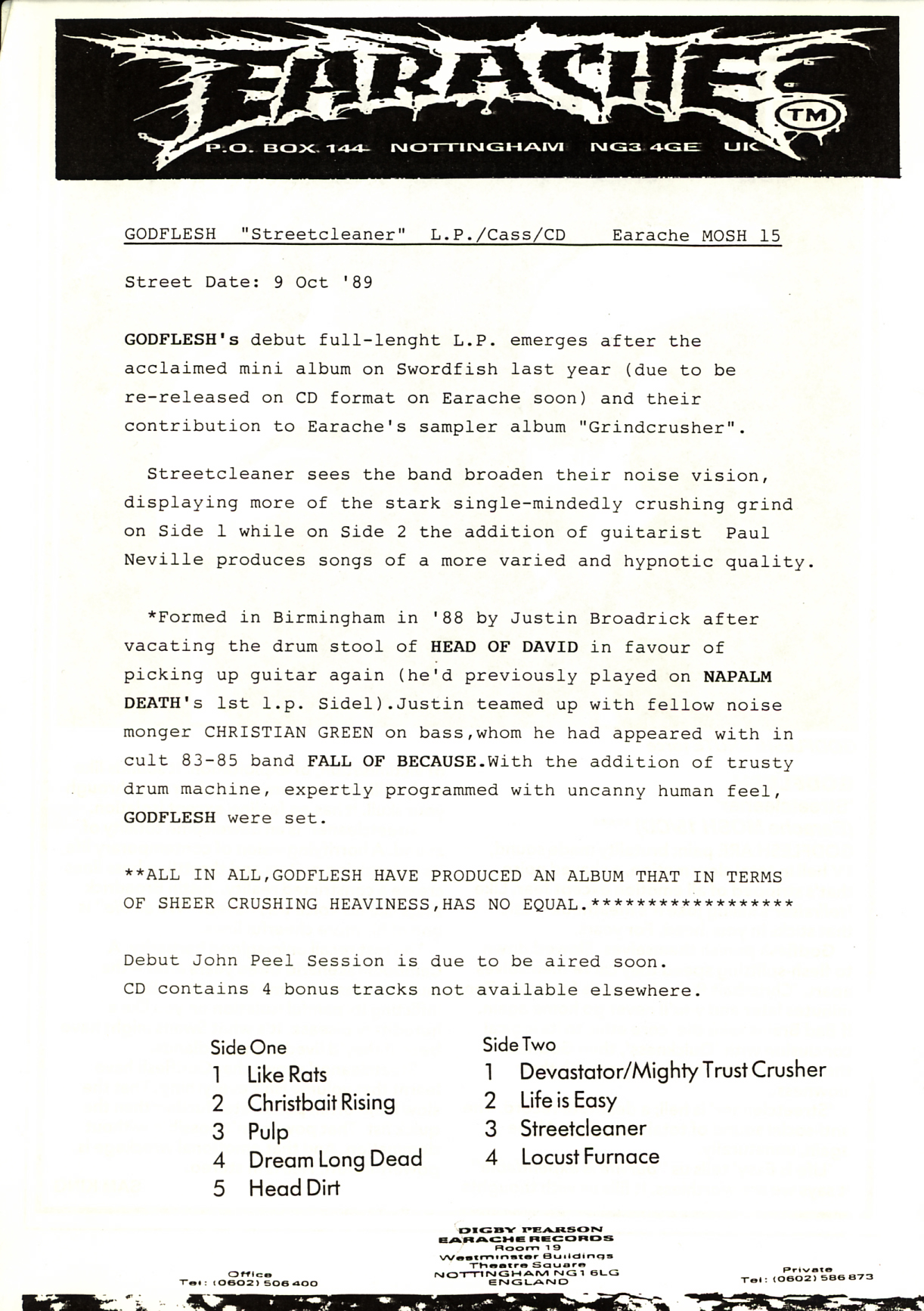
Streetcleaner is the debut studio album by English industrial metal band Godflesh. It was released in the UK by Earache Records on 13 November 1989 and in the United States by Combat Records on 7 December 1990. The album was then reissued with a second disc of previously unreleased material on 21 June 2010. The album is widely acclaimed by critics and is often cited as a landmark release in industrial metal; though not the genre's first release, Streetcleaner helped define what industrial metal would become.
Recorded in three distinct sessions and partially refined from pre-Godflesh demos, Streetcleaner is a weighty, bleak album that blends heavy metal with industrial music by means of production-emphasised bass, distorted guitar and, most importantly, machine percussion. Unlike many metal albums, guitar is employed to create screeching noise rather than discrete riffs, and the drums and bass are louder than is typical. Streetcleaner was supported by a series of concerts where Godflesh played alongside Napalm Death, and it was on the North American leg of the tour that the band began to gain significant international traction.
Since its release, Streetcleaner has received a number of accolades and has been performed in its entirety by Godflesh twice (once at Roadburn Festival, a recording of which was released as a live album in 2013). Many other metal bands have cited the album as particularly influential, including Neurosis, Fear Factory and Isis, and Godflesh frontman Justin Broadrick considers it one of his landmark releases. In 2017, Rolling Stone named Streetcleaner the 64th greatest metal album of all time.
Background and recording
[edit]Before performing as Godflesh, G. C. Green (bass) and Paul Neville (guitar) played together in a band known as Fall of Because.[1] That group, formed in 1982, were less overtly heavy than what they would become as Godflesh, drawing musical and aesthetic influence from bands like the Cure.[2] Future frontman Justin Broadrick (guitar, vocals and programming) joined Fall of Because in 1984 and introduced Green and Neville to Swans, Sonic Youth and Discharge.[2] Inspired by the dissonance of this music, the group recorded a demo called Extirpate (1986).[1] The songs "Devastator", "Mighty Trust Krusher", "Life Is Easy" and "Merciless" were included on this demo, the first three of which would be rerecorded for Streetcleaner.[3] These early versions were eventually released on a wide scale in 1999 via the compilation album Life Is Easy.[4]

Shortly after Fall of Because dissolved in 1987, Broadrick and Green reconvened without Neville and, in April 1988, renamed the project Godflesh.[5] They released their debut self-titled EP on the independent label Swordfish later that year.[5] That EP, though described by critics as raw and unrefined, is considered one of the originating industrial metal releases and proved to be the foundation upon which Streetcleaner would fine-tune Godflesh's approach to the genre.[6][7][8] After the underground success of Godflesh,[9] the band played several shows across Europe and recorded a four-track EP titled Tiny Tears.[10] Before they could release the EP on Swordfish, Godflesh were acquired by Earache Records, and Digby Pearson, the label's head, urged the band to shelve the tracks and instead focus on putting out a complete studio album next.[10] Broadrick and Green agreed and began recording Streetcleaner in May 1989 at Soundcheck in Birmingham and Square Dance in Derby.[11]
The Birmingham sessions saw Broadrick and Green recording and mixing the first half of the album, while the Derby sessions (which yielded tracks six through ten) saw the temporary reincorporation of Neville into the band, this time as a second guitarist.[11] Tiny Tears was appended to the end of CD versions of Streetcleaner, resulting in the album including material from three separate sessions.[12] The entirety of the creative period was reinforced by an Alesis HR-16 drum machine.[13] This choice was at first made out of necessity since Broadrick could not play the beats he wanted acoustically (he described himself as "[not] a great drummer"),[13] but he came to embrace machine percussion and consider it a defining feature of Godflesh.[14]: 2 Loudwire called the HR-16, specifically in regard to its use on Streetcleaner, "the most devastating drum machine ever employed".[15] In a retrospective interview, Broadrick described the release as "one of the most alienating albums" he had ever made and referred to it as the band's landmark record.[16]
Composition and style
[edit]"The bass sound and texture, this is an integral part of the Godflesh sound. People often say that the bass is so loud in Godflesh they'll barely find another band [like it]. And that's entirely intentional, obviously."
Musically, Streetcleaner was one of the earliest albums to merge industrial and heavy metal music.[6][17][18][19] It accomplishes such a fusion through combining programmed, repetitive drum machine loops with Green's overdriven bass and Broadrick's distorted guitar.[8][20] The vocals are sparse, guttural and bleak,[21] and, according to Peter Buckley's Rough Guide to Rock, "misanthropic".[22] Inspired by the harshness of early Swans material,[8][19] Streetcleaner has been noted for its extreme weight and crushing aggression.[23][24] Unlike the music of Napalm Death's 1987 album Scum, a release for which Broadrick provided guitar shortly before starting Godflesh,[25] Streetcleaner is exceptionally slow,[22] and the focus is placed on percussion and bass rather than vocals or traditional riffs.[26][27] The style of guitar playing has been described as abrasive and deliberately grating,[21][28] and the album is laden with factory sounds, stiff mechanical beats and overwhelming washes of noise.[29] Thematically, Streetcleaner's dismal tone was born from Broadrick's troubled upbringing and from the oppressive Birmingham environment.[30][31] About the album's desolate fury, he said, "there is a pure nihilism in there. Totally anti-everything. I couldn't come to terms with anything. It was all a struggle, and I just wanted to lash out at every target I possibly could".[32]
Streetcleaner begins with one of Godflesh's most well-known tracks, "Like Rats".[33] The introduction of the song, and of the album at large, is a wall of feedback.[34] After the brief noise introduction, "Like Rats" descends into an intense, scathing song with prominent percussion, driving bass and piercing guitar.[12] The screamed vocals, which Consequence of Sound's Andy O'Connor called "spine-chilling" and "some of the angriest verses laid to tape",[35] are harsh and regularly noted for their punchy efficacy.[36][37] Eduardo Rivadavia of Loudwire called the song "the genre standard",[38] Decibel's Jonathan Horsley referred to it as "anthemic" and Revolver described it as "far-beyond-heavy".[39][40]

Streetcleaner's second track, "Christbait Rising", has been cited by several critics as another high point of the album,[8][33] and Decibel named it one of Godflesh's five best songs.[41] While this track does feature a riff-heavy guitar breakdown in its latter segments, it is still dominated by machine drumming.[12] According to Broadrick, the song's beat was his attempt to copy a rhythmic break in "Microphone Fiend" (1988) by Eric B. & Rakim.[42] Luca Cimarusti of the Chicago Reader described "Christbait Rising" by writing, "Drum machines clank and scrape by, creating an eerie cyber-racket, while Broadrick and bassist G. Christian Green lay down impossibly heavy riffs on top. Broadrick's vocals—guttural and processed to sound like some sort of gigantic monster—make the whole thing sound like something out of a nightmare."[43] "Pulp", the album's third track, is entirely built around a locked, repeating, uncomplicated drum loop;[12] Green and Broadrick play over the beats, which completely drive the track.[44] Because the percussion on "Pulp" features little to no changes over its running time, Godflesh occasionally performed extended versions of it where they simply allowed the machine to continue.[45] "Pulp" and "Christbait Rising" were issued together as a promotional single in 1989.[46]
"Dream Long Dead" is Streetcleaner's fourth song. Much of the track puts the squealing guitar of Broadrick at the forefront, but significant portions of the second half descend into heavy, repeating percussive movements where all instruments double the drums. The fifth track and the first recorded for the album,[47] "Head Dirt", displays an unusual compositional structure, with the first half comprising a disjointed, jagged rhythmic loop and the latter half being almost entirely high-pitched guitar feedback.[48] Those swelling waves of noise transition into "Devastator" and "Mighty Trust Krusher" (sometimes listed as two separate songs, sometimes listed as one combined track[11][45]), the first composition on Streetcleaner from the recording sessions with Neville as a second guitarist and the first rerecorded remnants of the Fall of Because project.[3][45] This nine-minute stretch is dark, dismal and oppressive, with enigmatic, growled lyrics and sounds underlaid with samples of voices.[12][45] Ned Raggett of AllMusic considered it, along with "Like Rats" and "Christbait Rising", one of his favorite pieces on the album.[8]
The seventh track on Streetcleaner, "Life Is Easy", is another holdover from the mid-eighties Fall of Because demos.[3] Broadrick's and Neville's guitars clash and scrape against each other, creating eerie cacophony before the bass and drums kick in. The album's eighth song, its title track, begins with a sample of convicted serial killer Henry Lee Lucas speaking during an interrogation.[44][49] "Streetcleaner" proper is one of the album's faster, more aggressive songs; as AllMusic's Stephen Cook describes, it "pummel[s] the listener with jackhammer percussion and ultra-demonic vocals",[50] and Charlie Wood of Clash agreed, also calling the drumming similar to a jackhammer.[51] "Locust Furnace" was originally designed as the album's closing track.[11] The song itself is characterised by the drums and bass trading off with the vocals and guitar, and it concludes with Broadrick repeatedly shouting "furnace" as he grows gradually hoarser.[12]
Tiny Tears and the Godflesh reissue
[edit]The four Tiny Tears bonus songs (the title track, "Wound", "Dead Head" and "Suction") are Streetcleaner's shortest pieces.[45] Because they were recorded apart from the album, they are compositionally different, more focused on propulsive hard rock riffs and beats than the stark, industrial sterility of Streetcleaner proper.[52] Broadrick employs clean singing rather than growls, and multiple critics have described the tone of the songs as "ethereal".[12][53] Noel Gardner of The Quietus called the EP a "muscular, enveloping follow-up, and utterly worth hearing".[12] "Dead Head", a frantic song with stretched vocals, even has a tone that Sputnikmusic characterised as almost optimistic.[36] Digby Pearson considered "Tiny Tears" one of his favorite Godflesh songs,[10] and "Wound" would be revisited by Godflesh multiple times on future releases.[54] One such future release, Earache's 1990 reissue of the band's debut EP Godflesh, featured two songs entitled "Wounds" and "Streetcleaner 2".[55] Both are extended songs that have been manipulated and altered, something common for Godflesh. While "Streetcleaner 2" primarily builds upon and distorts "Streetcleaner", it also features deconstructed segments of "Pulp". It is one of Godflesh's earliest tracks to experiment with ambient elements.[56] Another track, "My Own Light", was recorded during the Streetcleaner sessions but only saw release on label compilations.[47][57]
Release
[edit]Streetcleaner was released on 13 November 1989 through Earache Records. In the United States, it was released the following year on 7 December 1990 and was part of Earache's first push into the American market through a licensing deal with Combat Records; it was deemed a success.[58] While the vinyl and cassette versions contained ten songs, the CD release included the Tiny Tears EP as a set of bonus tracks.[11] In April 2010, Broadrick remastered the album and compiled seventy minutes of extra material for a double-disc reissue that was released later that year on 21 June.[45] The bonus disc contained original unreleased mixes of songs from the Soundcheck sessions, live recordings from 1990, rehearsals and demos of some Tiny Tears songs that Broadrick believed revealed melodies that had been lost in the original mixing process.[45][48] On all releases, the album's cover is a still frame of a hallucination scene from the 1980 Ken Russell film Altered States.[13]
Live performances
[edit]
Godflesh toured Europe and North America in support of Streetcleaner from 1989 to 1991.[4] Many of these shows were under the Grindcrusher Tour umbrella, which included fellow Earache acts Napalm Death and Nocturnus.[5] By 1991 when Godflesh played in North America for the first time, the band was gaining "unexpected success" and "a loyal following".[4] Neville performed with Godflesh during many of these shows, playing only on the songs which were recorded at the Derby Streetcleaner sessions.[59] On 27 August 1989, Godflesh performed a four-song Peel session for BBC Radio 1. On the tracks played, "Tiny Tears", "Wound", "Pulp" and "Like Rats", the band experimented live, with Kevin Martin playing saxophone over "Pulp".[60][61] Half of this session was released on the 2001 Godflesh compilation In All Languages, while the other two songs were only released through label compilations.[62]
Apart from these initial tours, Streetcleaner tracks have remained a staple of Godflesh's set lists, and the album has been performed by the band in its entirety twice: once at Roadburn 2011 and once at the Hospital Productions 20th anniversary show in 2017.[63][64] The Roadburn performance was recorded and released first through vinyl in 2013 as Godflesh's debut live album, then again in 2017 digitally and on CD.[65][66]
Critical reception and legacy
[edit]| Review scores | |
|---|---|
| Source | Rating |
| AllMusic |   [8] [8] |
| Chicago Tribune |  [21] [21] |
| Entertainment Weekly | B+[67] |
| Metal Forces | 95/100[68] |
| Sputnikmusic | 5/5[36] |
| Tiny Mix Tapes |   [69] [69] |
Streetcleaner was met with positive reviews upon release, and its acclaim grew with time; several publications now list it as one of the best metal albums.[26][70][71] Ned Raggett of AllMusic praised Godflesh's ability to deliver the apocalyptic impact of metal without resorting to invocations of Satan and death, and he highlighted the precision of the execution as particularly impressive.[8] Chicago Tribune's Greg Kot called the album one of the most menacing ever released,[72] and Entertainment Weekly's David Browne emphasised how intense and frightening it was.[67] In 1992, Luca Collepiccolo of Blast! labeled the album as legendary.[73] In a retrospective review of the album, The Quietus' Noel Gardner called Streetcleaner Godflesh's best material,[12] a common stance; Joe DiVita of Loudwire wrote that Streetcleaner "borders on perfection",[15] and Alternative Press' Jason Pettigrew regarded the album as a masterpiece.[74] In 2010, Blabbermouth.net also agreed with Gardner, writing, "Streetcleaner was Godflesh's second release, proving to be one of the band's finest and most recognized albums and helping them to become one of the most influential industrial bands ever",[75] and in 2013, Fact magazine lauded Streetcleaner as "arguably the 1980s' most important piece of extreme music".[71] AllMusic's Jason Birchmeier called it "a landmark album whose status has steadily grown in stature over time".[25]
As well as impressing critics, Streetcleaner has cultivated a major following among other musicians. Neurosis said that the album "was a game changer for everybody" that "forever changed heavy music",[76] and Burton C. Bell of Fear Factory said, "[it] is a fantastically produced and written record; every song is an opus".[77] Roy Christopher of Slap Magazine wrote, "1989's Streetcleaner is the seminal industrial-metal hybrid sound that bands all over the world are still trying to recreate".[78] Devin Townsend also called the album "seminal" and claimed it as a major influence on his music,[79][80] and in 2014, Revolver's Jon Wiederhorn wrote that Streetcleaner and Godflesh's second album, 1992's Pure, influenced bands like Korn, Isis and Converge.[81] Dominick Fernow (better known as Prurient) credited the song "Like Rats", especially its noisy introduction, as a major influence on his musical experimentation.[34] Aaron Turner of Isis described hearing Streetcleaner the first time by saying, "It honestly scared me. I was like, 'What the fuck is this?' It didn't even sound like music to me. Like, the first time I saw the Melvins, I didn't like it, but it made an impression on me that I can still recall today".[82] In 1999, Isis covered the title track, beginning a long partnership between Turner and Broadrick.[83] Broadrick reflected on the album as a highlight of his career by saying, "I'm really proud—even though it's been like an albatross around my neck—of the Streetcleaner album by Godflesh, because it was made without any ambition, and it seemed to change a lot of things in music and have a really wide effect".[84]
Accolades
[edit]| Year | Publication | Country | Accolade | Rank | Ref. |
|---|---|---|---|---|---|
| 1995 | Alternative Press | United States | "Top 99 of '85 to '95" | 34 | [85] |
| 1998 | "The 90 Greatest Albums of the '90s" | 79 | [86] | ||
| 2000 | Kerrang! | United Kingdom | "200 Albums for the Year 2000: Essential Industrial" | * | [87] |
| Terrorizer | "100 Most Important Albums of the Eighties" | * | [88] | ||
| 2002 | Revolver | United States | "The 69 Greatest Metal Albums of All Time" | 66 | [70] |
| 2005 | Kerrang! | United Kingdom | "The 100 Best British Rock Albums Ever" | 78 | [89] |
| 2011 | NME | United Kingdom | "The Twenty Heaviest (Metal) Records of All Time" | 7 | [24] |
| Terrorizer | "The Heaviest Albums Ever" | 1 | [23] | ||
| 2013 | Fact | "The 100 Best Albums of the 1980s" | 3 | [71] | |
| 2017 | Rolling Stone | United States | "The 100 Greatest Metal Albums of All Time" | 64 | [26] |
| 2018 | Consequence of Sound | "The 25 Greatest Debut Metal Albums of All Time" | 8 | [35] | |
| Loudwire | "The Best Metal Album from 40 Subgenres: Industrial Metal" | * | [38] | ||
| 2019 | Pitchfork | "The 33 Best Industrial Albums of All Time" | 19 | [90] | |
| 2021 | Revolver | "10 Essential Industrial Albums" | * | [91] | |
| "*" denotes an unordered list. | |||||
Track listing
[edit]All tracks are written by Justin Broadrick and G. C. Green. Tracks 6 to 10 also written by Paul Neville.
| No. | Title | Length |
|---|---|---|
| 1. | "Like Rats" | 4:29 |
| 2. | "Christbait Rising" | 7:00 |
| 3. | "Pulp" | 4:16 |
| 4. | "Dream Long Dead" | 5:19 |
| 5. | "Head Dirt" | 6:09 |
| 6. | "Devastator" | 3:20 |
| 7. | "Mighty Trust Krusher" | 5:26 |
| 8. | "Life Is Easy" | 4:51 |
| 9. | "Streetcleaner" | 6:42 |
| 10. | "Locust Furnace" | 4:45 |
| Total length: | 52:21 | |
| No. | Title | Length |
|---|---|---|
| 11. | "Tiny Tears" | 3:25 |
| 12. | "Wound" | 3:05 |
| 13. | "Dead Head" | 4:09 |
| 14. | "Suction" | 3:22 |
| Total length: | 66:22 | |
| No. | Title | Length |
|---|---|---|
| 1. | "Like Rats" (Original Unreleased Mix) | 4:22 |
| 2. | "Christbait Rising" (Original Unreleased Mix) | 6:50 |
| 3. | "Pulp" (Original Unreleased Mix) | 4:07 |
| 4. | "Dream Long Dead" (Original Unreleased Mix) | 5:08 |
| 5. | "Head Dirt" (Original Unreleased Mix) | 6:01 |
| 6. | "Streetcleaner" (Live Geneva Early 1990) | 5:47 |
| 7. | "Head Dirt" (Live Geneva Early 1990) | 6:00 |
| 8. | "Pulp" (Rehearsal May 1989) | 12:20 |
| 9. | "Dream Long Dead" (Rehearsal April 1989) | 5:29 |
| 10. | "Christbait Rising" (Rehearsal April 1989) | 6:34 |
| 11. | "Deadhead" (Original Demo Guitar & Machine 1988) | 4:01 |
| 12. | "Suction" (Original Demo Guitar & Machine 1988) | 3:11 |
| Total length: | 69:50 | |
Notes
- On some releases, tracks 6 and 7 on the first disc are combined into one song titled "Devastator/Mighty Trust Krusher".[45]
Personnel
[edit]Credits adapted from Streetcleaner liner notes unless otherwise noted[11]
Godflesh
- Justin Broadrick – guitar, vocals, production, Alesis HR-16 rhythm programming[13] (credited to "Machine" on liner notes)
- G. C. Green – bass, production
- Paul Neville – guitar (tracks 6–10)
Technical personnel
- Pete Gault – engineering (tracks 1–5)
- Ric Peet – engineering (tracks 6–14)
- Noel Summerville – mastering
Charts
[edit]| Chart (1989) | Peak position |
|---|---|
| UK Indie Chart[9] | 19 |
References
[edit]- ^ a b Ankeny, Jason. "Fall of Because – Biography & History". AllMusic. Archived from the original on 12 June 2018. Retrieved 25 July 2018.
- ^ a b Bennett, J (8 July 2014). "Justin Broadrick on the Secret History of Godflesh". Vice. Archived from the original on 12 June 2018. Retrieved 25 July 2018.
- ^ a b c Life Is Easy (CD liner notes). Fall of Because. Invisible Records. 1999. INV 9042.
{{cite AV media notes}}: CS1 maint: others in cite AV media (notes) (link) - ^ a b c Nasrallah, Dimitri. "Justin Broadrick: Napalm Death – Godflesh – Techno Animal – Jesu – Pale Sketcher". Exclaim!. Archived from the original on 10 February 2018. Retrieved 19 February 2018.
- ^ a b c "Godflesh 1991" (Press release). Nottingham: Earache Records. 1991. Archived from the original on 11 July 2018. Retrieved 11 July 2018.
- ^ a b Prato, Greg. "Godflesh – Biography & History". AllMusic. Archived from the original on 12 June 2018. Retrieved 25 July 2018.
- ^ Walters, Martin. "Godflesh – Godflesh". AllMusic. Archived from the original on 12 June 2018. Retrieved 25 July 2018.
- ^ a b c d e f g Raggett, Ned. "Streetcleaner – Godflesh". AllMusic. Archived from the original on 12 June 2018. Retrieved 25 July 2018.
- ^ a b "Indie Hits 1980–1989". Cherry Red Records. Archived from the original on 8 June 2011. Retrieved 25 July 2018.
- ^ a b c Pearson, Digby (22 August 2006). "Godflesh – 'Tiny Tears' 12-inch?". Earache Records. Archived from the original on 5 July 2018. Retrieved 25 July 2018.
- ^ a b c d e f Streetcleaner (CD liner notes). Godflesh. Earache Records. 1989. MOSH 15CD.
{{cite AV media notes}}: CS1 maint: others in cite AV media (notes) (link) - ^ a b c d e f g h i Gardner, Noel (9 August 2010). "Godflesh – Streetcleaner (Reissue)". The Quietus. Retrieved 25 July 2018.
- ^ a b c d Cimarusti, Luca. "Artist on Artist: Justin Broadrick of Godflesh Talks to Producer Sanford Parker". Chicago Reader. Archived from the original on 14 December 2017. Retrieved 25 July 2018.
- ^ a b Teitelman, Bram (23 September 2014). "Justin Broadrick Talks the Rebirth of Godflesh". Metal Insider. Archived from the original on 12 June 2018. Retrieved 26 February 2018.
- ^ a b DiVita, Joe (29 September 2016). "Top 25 Industrial Rock + Metal Bands of All Time". Loudwire. Archived from the original on 26 July 2018. Retrieved 25 July 2018.
- ^ "Justin Broadrick on... Justin Broadrick". Self-Titled. 27 September 2013. Archived from the original on 23 April 2018. Retrieved 24 February 2018.
- ^ Newquist, H. P.; Maloof, Rich (1 April 2004). The New Metal Masters. Blackbeat Books. p. 38. ISBN 0879308044. Retrieved 25 July 2018.
- ^ The Greenwood Encyclopedia of Rock History: The Grunge and Post-Grunge Years, 1991–2005. Greenwood. 2006. ISBN 0313329818.
- ^ a b Carden, Andre (October 2010). "Godflesh: Streetcleaner (Earache)". Mojo (203).
- ^ O'Connor, Andy (10 October 2018). "Heavy Metal Techno: JK Flesh on Futurism, DIY Culture, and the Beauty of Non-Music". Electronic Beats. Retrieved 10 October 2018.
- ^ a b c Kot, Greg (21 February 1991). "Godflesh Streetcleaner (Combat/Earache..." Chicago Tribune. Archived from the original on 20 March 2014. Retrieved 25 July 2018.
- ^ a b Buckley, Peter (2003). The Rough Guide to Rock. Rough Guides. pp. 432. ISBN 1858284570. Retrieved 25 July 2018.
godflesh streetcleaner.
- ^ a b Yardley, Miranda (11 November 2011). "The Heaviest Albums Ever: The Albums Kerrang! Forgot". Terrorizer. Archived from the original on 27 January 2018. Retrieved 25 July 2018.
- ^ a b "The Twenty Heaviest (Metal) Records of All Time". NME. 4 May 2011. Archived from the original on 15 January 2018. Retrieved 25 July 2018.
- ^ a b Birchmeier, Jason. "Justin Broadrick – Biography & History". AllMusic. Archived from the original on 15 December 2017. Retrieved 9 February 2018.
- ^ a b c Christe, Ian. "The 100 Greatest Metal Albums of All Time". Rolling Stone. Archived from the original on 12 June 2018. Retrieved 25 July 2018.
- ^ Reynolds, Simon (October 1989). "Godflesh – Streetcleaner (Earache)". Melody Maker. 65: 37.
- ^ DiVita, Joe; Hartmann, Graham; Ives, Brian. "The 30 Most Underrated Hard Rock + Metal Guitarists". Loudwire. Archived from the original on 1 July 2018. Retrieved 25 July 2018.
- ^ Christopher, Roy. "Godflesh Streetcleaner: My 33 1/3 Book Proposal". roychristopher.com. Archived from the original on 15 June 2018. Retrieved 25 July 2018.
- ^ Horsley, Jonathan (7 October 2011). "Justin Broadrick Interview: Godflesh, Growing Up and Anarcho-Punk". Decibel. Archived from the original on 15 August 2018. Retrieved 9 February 2018.
- ^ Jones, Cat (18 September 2013). "Exclusive Interview with Justin Broadrick on All Things Jesu and Godflesh". MetalSucks. Archived from the original on 20 February 2018. Retrieved 19 February 2018.
- ^ Teppo, Mark. "Features: Godflesh". EarPollution. Archived from the original on 12 June 2002. Retrieved 28 July 2018.
- ^ a b Parks, Andrew (11 April 2014). "Photos/Review: Godflesh + Cut Hands + Pharmakon @ Irving Plaza, 4.10.14". Self-Titled. Archived from the original on 26 July 2018. Retrieved 25 July 2018.
- ^ a b Fernow, Dominick (16 April 2018). "Godflesh's 'Streetcleaner': Justin Broadrick, Nothing, Prurient on Revolutionary LP". Jesu X Nothing X Prurient. 4:08 minutes in. Revolver. Archived from the original on 17 April 2018. Retrieved 25 July 2018.
Even the introduction of 'Like Rats', that little bit of feedback was, like, clearly an influence for me. I spent ten years just working on feedback alone, and I give the credit to Streetcleaner.
- ^ a b O'Connor, Andy (9 April 2018). "The 25 Greatest Debut Metal Albums of All Time". Consequence of Sound. Archived from the original on 23 July 2018. Retrieved 25 July 2018.
- ^ a b c K., Simon. "Godflesh – Streetcleaner". Sputnikmusic. Retrieved 25 July 2018.
- ^ Kailas (16 July 2011). "Architects of Rage: Godflesh on Streetcleaner – Interview". Trebuchet. Archived from the original on 22 February 2018. Retrieved 25 July 2018.
- ^ a b Rivadavia, Eduardo. "The Best Metal Album from 40 Subgenres". Loudwire. Archived from the original on 12 June 2018. Retrieved 25 July 2018.
- ^ Horsley, Jonathan (4 December 2012). "Live Review: Neurosis + Godflesh, HMV Forum, London". Decibel. Retrieved 24 February 2018.
- ^ "Watch Godflesh Deliver Crushing 'Like Rats' Performance in Brooklyn". Revolver. Archived from the original on 12 June 2018. Retrieved 25 July 2018.
- ^ Macomber, Shawn (15 April 2014). "Czar Issues Decree: Top Five Godflesh Songs". Decibel. Retrieved 17 November 2018.
- ^ Vuk, Valcic. "Godflesh Revisits Streetcleaner". Rock-A-Rolla: 28–29.
- ^ Cimarusti, Luca (21 June 2013). "12 O'Clock Track: 'Christbait Rising' Is an Industrial Metal Landmark". Chicago Reader. Archived from the original on 26 July 2018. Retrieved 25 July 2018.
- ^ a b Necci, Marilyn Drew. "Godflesh 'Streetcleaner' Receives Deluxe Double-Disc Reissue". RVA Magazine. Retrieved 25 July 2018.
- ^ a b c d e f g h Broadick, Justin; Selzer, Jonathan (2010). Streetcleaner (2010 remaster) (CD liner notes). Godflesh. Earache Records. MOSH1501.
- ^ "Pulp" / "Christbait Rising" (Vinyl liner notes). Godflesh. Combat Records. 1989. ICPROLP-0908.
{{cite AV media notes}}: CS1 maint: others in cite AV media (notes) (link) - ^ a b Green, Ben. "My handwritten list of songs that were programmed on our Alesis HR16..." Instagram. Archived from the original on 24 December 2021. Retrieved 6 June 2020.
- ^ a b Fisher, Mark (August 2010). "Godflesh – Streetcleaner". The Wire (318): 70–71.
- ^ Walczak, René (Autumn 1992). "Godflesh: Strength Through Purity". Propaganda. 19: 40–41.
- ^ Cook, Stephen. "Grindcrusher – Various Artists". AllMusic. Archived from the original on 26 July 2018. Retrieved 26 July 2018.
- ^ Wood, Charlie (11 December 2014). "Live Report: Godflesh at The Garage, London". Clash. Retrieved 17 December 2018.
- ^ Dunton, Creaig. "Godflesh, 'Streetcleaner'". Brainwashed. Archived from the original on 27 June 2010. Retrieved 14 January 2019.
- ^ Nanos, Darren. "Godflesh – Tiny Tears EP (Bonus Tracks; Earache 1989)". Just a Visual. Archived from the original on 26 July 2018. Retrieved 19 February 2018.
- ^ Raggett, Ned. "Slavestate – Godflesh". AllMusic. Archived from the original on 4 July 2018. Retrieved 26 July 2018.
- ^ Godflesh (1990 reissue) (CD liner notes). Godflesh. Earache Records. 1990. MOSH 20CD.
{{cite AV media notes}}: CS1 maint: others in cite AV media (notes) (link) - ^ Reynolds, Simon (March 1990). "Godflesh – Godflesh (Earache)". Melody Maker. 66: 38.
- ^ Pathological Compilation (CD liner notes). Various artists. Pathological Records. 1989. PATH CD 1.
{{cite AV media notes}}: CS1 maint: others in cite AV media (notes) (link) - ^ Mudrian, Albert (2004). Choosing Death: The Improbable History of Death Metal & Grindcore. Bazillion Points. p. 266. ISBN 1935950169.
- ^ Thompson, David (1 December 1992). Industrial Revolution. Cleopatra Records. p. 44. ISBN 978-0963619303.
- ^ Freeman, Phil. "Grind Madness at the BBC: The Earache Peel Sessions – Various Artists". AllMusic. Archived from the original on 26 July 2018. Retrieved 26 July 2018.
- ^ Freeman, Phil (November 2019). "The Game of the Name". The Wire (429): 42.
- ^ In All Languages (CD liner notes). Godflesh. Earache Records. 2001. MOSH246CD.
{{cite AV media notes}}: CS1 maint: others in cite AV media (notes) (link) - ^ Yardley, Miranda (27 October 2010). "Godflesh to Perform 'Streetcleaner' in its Entirety at Roadburn Festival 2011". Terrorizer. Archived from the original on 19 February 2018. Retrieved 18 February 2018.
- ^ Bowe, Miles (25 July 2017). "Hospital Productions Announce 20th Anniversary Show Featuring Godflesh, Prurient, Regis". Fact. Archived from the original on 25 July 2018. Retrieved 24 July 2018.
- ^ Streetcleaner: Live at Roadburn 2011 (Digital liner notes). Godflesh. Avalanche Recordings. 2017. AREC028. Archived from the original on 4 July 2018. Retrieved 25 July 2018.
{{cite AV media notes}}: CS1 maint: others in cite AV media (notes) (link) - ^ Bellino, Vince (30 June 2017). "5 Great Live Roadburn Albums". Decibel. Retrieved 8 June 2018.
- ^ a b Browne, David (January 1991). "Death Metal New Releases". Entertainment Weekly. Archived from the original on 4 July 2018. Retrieved 25 July 2018.
- ^ Williams, Carl (November 1989). "Albums". Metal Forces. No. 44. Force10 Publications. p. 32. OCLC 859210254.
- ^ Roesgen, Jeff (13 April 2007). "Godflesh - Streetcleaner". Tiny Mix Tapes. Archived from the original on 4 May 2007. Retrieved 11 February 2024.
- ^ a b "Revolver – The 69 Greatest Metal Albums of All Time". Revolver. Archived from the original on 2 June 2017. Retrieved 25 July 2018.
- ^ a b c "The 100 Best Albums of the 1980s". Fact. 24 June 2013. Archived from the original on 17 November 2017. Retrieved 25 July 2018.
- ^ Kot, Greg (21 May 1992). "Technology Expands Skinny Puppy's Apocalyptic Sound". Chicago Tribune: 84.
- ^ Collepiccolo, Luca (April 1992). "Godflesh – Into the Void". Blast! (in Italian): 12–15.
- ^ Pettigrew, Jason (30 September 2014). "'It's a Relationship Like One Would Have with a Sledgehammer: Very Singular' – The Return of Godflesh". Alternative Press. Archived from the original on 26 July 2018. Retrieved 25 July 2018.
- ^ "Godflesh's 'Streetcleaner' to Be Reissued with Bonus Disc". Blabbermouth.net. 7 May 2010. Archived from the original on 4 July 2018. Retrieved 25 July 2018.
- ^ Jahdi, Robin (15 September 2012). "Neurosis on Working with Steve Albini, Locking Horns with Godflesh and Making Time Stand Still". Fact. Archived from the original on 22 February 2018. Retrieved 25 July 2018.
- ^ Bartkewitcz, Anthony (March 2007). "Vision: Escape: Justin Broadrick". Decibel: 68–74.
- ^ Christopher, Roy (1 December 1997). "Godflesh: Heads Ain't Ready". Slap Magazine. Archived from the original on 15 June 2018. Retrieved 25 July 2018.
- ^ Lake, Daniel (16 January 2015). "Devin Townsend Interview: Part 2". Decibel. Retrieved 1 August 2018.
- ^ Yardley, Miranda (19 October 2011). "Devin Townsend: 'I Found Out About Playing Damnation Festival on Twitter'". Terrorizer. Archived from the original on 1 August 2018. Retrieved 1 August 2018.
- ^ Wiederhorn, Jon (October 2014). "Godflesh: Long Live the New Flesh". Revolver. Archived from the original on 19 February 2018. Retrieved 18 February 2018.
- ^ Parks, Andrew (10 October 2014). "Godflesh and the Horror of Everyday Life". Wondering Sound. Archived from the original on 18 November 2014. Retrieved 17 March 2018.
- ^ Nelson, Michael (6 November 2012). "Isis – 'Streetcleaner' (Godflesh Cover) (Stereogum Premiere)". Stereogum. Archived from the original on 22 February 2018. Retrieved 26 July 2018.
- ^ "Interview: Justin Broadrick (Godflesh/Jesu), 2003". That Was Then/This Is Yesterday. 23 February 2015. Archived from the original on 19 June 2018. Retrieved 2 August 2018.
- ^ "Alternative Press – Top 99 of '85 to '95". Alternative Press. Archived from the original on 31 March 2018. Retrieved 25 July 2018.
- ^ "Alternative Press – The 90 Greatest Albums of the '90s". Alternative Press (125). December 1998. Archived from the original on 31 March 2018. Retrieved 25 July 2018.
- ^ "Kerrang! – 200 Albums for the Year 2000". Kerrang!. Archived from the original on 23 October 2014. Retrieved 25 July 2018.
- ^ "Terrorizer – 100 Most Important Albums of the Eighties". Terrorizer. Archived from the original on 15 May 2013. Retrieved 25 July 2018.
- ^ Bird, Ashley, ed. (19 February 2005). "The 100 Best British Rock Albums Ever!". Kerrang!. No. 1044. EMAP. p. 22.
- ^ Sodomsky, Sam (17 June 2019). "Music for the Dark: The 33 Best Industrial Albums of All Time". Pitchfork. Retrieved 19 June 2019.
- ^ "10 Essential Industrial Albums". Revolver. 18 October 2021. Retrieved 18 October 2021.
External links
[edit]- Streetcleaner press release from Earache Records
- Streetcleaner on Bandcamp through Earache Records (original release)
- Streetcleaner on Bandcamp through Earache Records (remastered release)

Streetcleaner
View on GrokipediaBackground and development
Godflesh's formation and early years
Godflesh was formed in Birmingham, England, in March 1988 by guitarist and vocalist Justin Broadrick and bassist G. C. Green, both of whom had previously collaborated in the short-lived post-punk band Fall of Because.[7][8] Broadrick, who had joined grindcore pioneers Napalm Death in 1985 at the age of 15, contributed guitar to several of their early demos and the first half of their debut album Scum (1987), but grew dissatisfied with the band's relentless speed and chaotic direction, describing it as an environment that stifled his desire for slower, more atmospheric sounds.[8][9] After being ousted from Napalm Death—he later recalled being fired as a "noisy bastard"—Broadrick briefly drummed for Head of David in 1986 before leaving amid internal conflicts, prompting him to co-found Godflesh with Green, a childhood friend who had loaned money from his mother to purchase an inexpensive drum machine that became central to their sound.[8][10] The duo's lineup expanded shortly after formation with the addition of guitarist Paul Neville, a fellow Birmingham native and former member of Fall of Because alongside Green, marking a shift away from Broadrick's solo ambient experiments in projects like Final—started in 1984 as a noise-oriented outlet using shortwave radio and guitar pedals—and the more electronic Ice.[11][9] Neville's recruitment brought a heavier, riff-driven edge to the group, building on the industrial and post-punk foundations of their prior collaborations while allowing Broadrick to focus on vocals and programming.[8] In the late 1980s, Godflesh quickly developed their industrial metal ethos amid Birmingham's gritty underground scenes, drawing from the city's post-punk energy (influenced by acts like Killing Joke), anarcho-punk roots at venues such as The Mermaid Pub, and the emerging grindcore intensity exemplified by Napalm Death.[9][10] Their early work, including a self-titled mini-LP recorded in June or July 1988 and released that autumn via Swordfish Records, featured harsh machine beats, distorted guitars, and sparse vocals that reflected the urban decay and power electronics experimentation of the local environment, setting the stage for their debut full-length Streetcleaner.[7][8]Conceptualization and pre-production
Justin Broadrick envisioned Streetcleaner as a fusion of industrial noise, heavy metal aggression, and dub-inspired rhythms to craft a raw, "street-level" dystopian sound that captured mechanical alienation and sonic filth. Drawing from his exposure to power electronics pioneers like Throbbing Gristle and Whitehouse, as well as the pounding grooves of early hip-hop and dub production techniques, Broadrick aimed to create music that felt like an oppressive urban machine, emphasizing slow, crushing tempos and echoing spaces. This approach marked a departure from his grindcore roots in Napalm Death, prioritizing atmospheric depth over speed.[9][8] Central to the album's conceptualization were themes of urban decay and unrelenting aggression, directly inspired by the grim industrial landscape of 1980s Birmingham, where Broadrick grew up in dilapidated council estates amid factory pollution and economic hardship. He sought to infuse the music with the "filth and factory smells" of his environment, portraying a smog-choked harbor and societal nihilism through tracks that evoked entrapment and frustration under Thatcherite Britain. These ideas stemmed from personal experiences of resentment and endurance, transforming the city's post-industrial bleakness into a sonic critique of deformity and disaffection.[8][12][13] Pre-production in 1988 involved Broadrick and bassist G.C. Green writing core guitar riffs and programming drum patterns on an early drum machine, which they purchased together to establish the album's mechanical backbone. Working in a shared council flat, they experimented with downtuned guitars and sparse, pounding beats to build the foundational structures, refining ideas from their prior project Fall of Because into a more realized industrial-metal template. This phase focused on capturing raw energy through limited tools, laying the groundwork for the album's claustrophobic intensity.[8][14][13] Following submissions of mid-1988 demos, including early versions of tracks like "Suction" and "Deadhead," Godflesh signed with Earache Records, enabling them to self-produce Streetcleaner with full creative control. Broadrick handled production duties himself, leveraging the label's support for extreme music to realize their vision without external interference. This deal came shortly after their self-released debut EP on Swordfish Records, solidifying Earache as the platform for the album's release.[15][8][16]Recording and production
Studio sessions and locations
The recording of Streetcleaner took place across multiple sessions in 1989, primarily between May and August, at two studios in the English Midlands: Soundcheck in Birmingham and Square Dance in Derby.[17] The album's structure reflects this division, with tracks 1–5 ("Like Rats," "Christbait Rising," "Pulp," "Dream Long Dead," and "Head Dirt") captured at Soundcheck, engineered by Pete Gault, while tracks 6–10 ("Devastator," "Streetcleaner," "Locust," "Dead Head," and "Freight Train") were recorded at Square Dance, engineered by Ric Peet.[17] These sessions built upon earlier pre-production ideas developed during the duo's time in the project Fall of Because, refining demo material into the album's core sound.[7] The timeline began with initial drum programming and bass tracking in early 1989, coinciding with the recording of the Tiny Tears EP, before shifting to full band sessions in May for the second side of the album, which included guitarist Paul Neville.[7] Guitar overdubs and additional layers followed through July and August, focusing on the first side without Neville's involvement, allowing Justin Broadrick and G.C. Green to emphasize their core duo dynamic.[7] This phased approach enabled iterative refinements amid a tight schedule, culminating in the album's completion just months before its November 1989 release.[17] Godflesh faced significant logistical hurdles due to their limited budget as an emerging act on Earache Records, a small independent label at the time.[8] To fund essential equipment like a drum machine, Green borrowed money from his mother, underscoring the DIY ethos that permeated the project.[8] Broadrick took a hands-on role in directing the sessions, overseeing programming and arrangements to maximize resources, which contributed to the album's raw, unpolished intensity despite the constraints.[8]Technical production techniques
The production of Streetcleaner relied heavily on the Alesis HR-16 drum machine to generate its rigid, machine-like percussion patterns, which provided the album's unrelenting, hip-hop-influenced beats layered over live bass performances by G.C. Green.[18][4] This setup created a stark, mechanical foundation that contrasted with the organic elements of the instrumentation, emphasizing repetition and low-end drive. Justin Broadrick's guitar tones were achieved through a custom Japanese Fender Stratocaster routed into a Marshall JCM800 amplifier head and 4x12 cabinet, with distortion primarily supplied by a Boss HM-2 Heavy Metal pedal set to high gain and a scooped midrange EQ (bass at 3/4, treble at 3/4 off).[19] Effects processing included a Boss DD-3 Digital Delay for echo and reverb-like washes, often programmed with short delays to simulate space without softening the attack, alongside occasional use of a Cry Baby wah-wah pedal on tracks like "Like Rats." Green's bass was recorded live using a Fender Jazz Bass with active pickups, processed through a Boss HM-2 pedal (distortion partially rolled off) into a Laney head and cabinet, focusing EQ on boosted bass and high mids to lock tightly with the drum machine's kick.[19][4] The album was self-produced by Godflesh, with engineering by Pete Gault for tracks 1-5 at Soundcheck Studios in Birmingham and by Ric Peet for tracks 6-10 at Square Dance in Derby.[17] Mixing occurred at the respective studios, with an approach that prioritized aggressive compression on the bass and percussion to achieve a dense, monolithic low end while keeping vocals sparse and buried in the mix for a sense of alienation.[4] Mastering was handled by Noel Summerville at The Town House, ensuring the final cut retained its punishing dynamics and clarity across formats.[20] Innovations in Streetcleaner's production included the HR-16's sampled drum sounds, which incorporated raw, industrial-style percussion hits to evoke urban decay, marking an early fusion of sampling techniques with metal riffing.[18] Additionally, the use of dub-inspired delay effects on guitars and occasional noise elements set precedents for layering electronic processing over heavy instrumentation in industrial metal.[19]Composition and musical style
Song structures and themes
The songs on Streetcleaner employ a minimalist verse-chorus structure, often augmented by extended drones and repetitive riffs that create a hypnotic, oppressive atmosphere, with tracks typically lasting between four and seven minutes.[1] This architecture relies on mechanized drum machine patterns layered with distorted guitars and deep basslines, emphasizing rhythmic grooves over melodic progression to evoke a sense of unrelenting tension.[5] Vocally, Justin Broadrick's growled delivery is sparse and abstract, prioritizing suggestion over literal narrative to amplify the music's emotional weight.[21] Lyrically, the album explores themes of urban alienation and societal collapse, rooted in Broadrick's experiences of growing up in Birmingham's council estates amid Thatcher-era economic despair.[13] These motifs manifest as screams of frustration against dehumanizing environments, portraying humanity as trapped in cycles of self-destruction and conformity.[13] The abstract phrasing allows for broad interpretation, reflecting inner struggles like defense mechanisms and revenge against oppressive systems.[21] "Like Rats," the album's opener, exemplifies the repetitive riff-driven structure with a percussive intro that shifts into a bouncing hip-hop-influenced beat and crunching metallic guitars, building to a chorus chant of misanthropic disdain for societal breeding and conformity: "You breed, like rats!"[5] This anti-establishment lyric critiques the underprivileged's entrapment in cycles of poverty and reproduction, serving as a bitter diagnosis of urban decay.[13] "Christbait Rising" adopts a hypnotic groove with slow-building tension through deep-tuned bass and droning guitars, incorporating tribal vocal patterns and a sampled hip-hop beat inspired by Eric B. & Rakim's "Microphone Fiend," culminating in manipulated vocals from the 3:37 mark.[5] Its lyrics deliver a religious critique, with lines like "Don't hold me back, this is my own hell" expressing personal torment and rejection of institutional faith amid societal collapse.[13] "Mighty Trust Krusher" uses simple looped guitar samples that evolve into ambient builds, maintaining a minimalistic riff cycle over five minutes to underscore themes of betrayal and despair, with repetitive chants like "Effortless" highlighting futile human efforts.[5] "Pulp" features staccato electronic beats and a crunching guitar loop with sparse, howling vocals that explore isolation—"When on my own I feel free"—evoking alienation in a tense, four-minute arc.[5] The album's unique elements include the integration of earlier EP material, such as "Tiny Tears" from the Slavestate EP (added in reissues), which provides emotional contrast through its more introspective tone against the prevailing aggression, emphasizing vulnerability amid collapse.[1]Influences and genre innovations
Streetcleaner drew from a range of post-punk and noise rock sources that shaped its abrasive sonic palette. The album's intensity was heavily influenced by Swans' early noise rock, particularly their relentless, pounding rhythms and emotional rawness, which Broadrick has cited as a foundational element in Godflesh's development.[22] Similarly, Sonic Youth's dissonant guitar textures and experimental structures informed the record's atonal edges and layered noise, allowing Godflesh to blend chaos with precision. Killing Joke's industrial rhythms and post-punk drive provided a rhythmic backbone, evident in the mechanical pulse that permeates tracks like "Like Rats," marking a direct nod to their fusion of aggression and repetition.[2][23] While dub elements from the On U Sound label, led by Adrian Sherwood, were part of the broader industrial scene's experimental ethos, Godflesh's incorporation leaned more toward hip-hop-inspired beats and sparse electronics, creating echoing spaces that evoked urban decay without direct emulation.[22] This selective borrowing helped distinguish Streetcleaner from pure metal, emphasizing groove over speed. The album pioneered a fusion of grindcore's aggression—stemming from Broadrick's Napalm Death roots—with electronic percussion and drum machines, establishing a template for industrial metal's machine-like relentlessness.[2] This innovation shifted the genre from punk-derived heaviness toward machine-driven soundscapes, influencing 1990s acts like Ministry and Nine Inch Nails by prioritizing low-end bass, programmed beats, and vocal distortion as core components.[24] Streetcleaner's harsh minimalism also laid groundwork for post-metal's atmospheric nihilism and nu-metal's rhythmic hybridity, with bands like Neurosis and Korn later echoing its blend of fury and electronics.[25] Broadrick conceived Streetcleaner as a sonic representation of "street cleaning," using its stark, purging minimalism to confront and cleanse societal filth—reflecting the frustrations of Thatcher-era Britain and personal turmoil through unrelenting noise.[13] He described the process as lashing out at every target, channeling inner chaos into a defensive scream against oppression.[2]Release and editions
Initial release and formats
Streetcleaner was released on November 13, 1989, through Earache Records as Godflesh's debut full-length album.[3] The initial rollout focused on physical formats suited to the underground metal market, including 12-inch vinyl LP (catalog MOSH 15), cassette, and compact disc (MOSH 15CD).[4] The CD edition uniquely incorporated four bonus tracks from the band's unreleased 1988 "Tiny Tears" EP—"Tiny Tears," "Wound," "Dead Head," and "Suction"—which were not available on the vinyl or cassette versions.[17] The album's packaging featured stark, surreal imagery derived from a still in the 1980 film Altered States, directed by Ken Russell, evoking themes of distortion and intensity that aligned with Godflesh's industrial aesthetic.[26] This visual choice contributed to the album's raw, confrontational presentation. The standard edition across formats clocked in at a total runtime of 52:21, while the CD's bonus content extended it to approximately 66:22, providing additional material from early sessions completed just prior to release.[27] Distribution emphasized the UK and European markets through Earache Records, Godflesh's primary label at the time, with more limited exposure in the United States via a licensing deal with Combat Records, which handled a 1991 pressing but offered initial access to North American audiences.[28] This regional focus underscored the album's roots in the British industrial and extreme metal underground.Reissues and bonus content
The 1991 CD edition released in the United States by Combat Records incorporated bonus tracks from the unreleased 1988 "Tiny Tears" EP recorded that year, including "Tiny Tears" (3:24), "Wound" (3:07), "Dead Head" (4:08), and "Suction" (3:23).[17] These additions extended the album's runtime and provided early insight into the band's experimental sound during the original sessions.[29] In 2010, Earache Records issued a remastered two-disc "Redux" edition, supervised by founding member Justin Broadrick, which restored the original nine tracks alongside the "Tiny Tears" bonuses on the first disc.[30] The second disc featured approximately 70 minutes of previously unreleased material, including original mixes such as "Like Rats" (4:22), alternate versions like "Streetcleaner" (5:19), early 1988 demos, rehearsal recordings, and live tracks from 1989 performances.[31][32] A vinyl reissue of the remastered edition followed in 2019 for the 30th anniversary as a limited edition LP set.[33] In 2025, Earache released a KiT edition, a new format collaboration with Muzlive. Digital versions of the remastered album, including select bonus content, became available on Bandcamp starting in the post-2010 era, broadening accessibility for streaming and downloads.[34][35]Promotion and performances
Marketing and initial tours
Earache Records promoted Streetcleaner through inclusion on the label's Grindcrusher compilation, released in September 1989, which featured a Godflesh track alongside debuts from acts like Morbid Angel and Repulsion to showcase emerging extreme metal talent.[36] This sampler, with its bold cover art and focus on grindcore pioneers, served as a key marketing tool ahead of the album's November 13 release and tied into Earache's broader push via metal compilations.[36] Early buzz was further built via a BBC Radio 1 John Peel Session recorded on August 27, 1989, and broadcast on September 27, highlighting lead track "Like Rats" as a promotional showcase in October leading into the album launch.[37] In support of Streetcleaner, Godflesh conducted headline tours across the UK and Europe from late 1989 to 1990, performing in small venues such as Leeds Poly (January 24, 1990) and Amsterdam's Paradiso (February 23, 1990).[38] Setlists during these shows heavily featured material from the album, including staples like "Like Rats," "Pulp," and "Streetcleaner," with guitarist Paul Neville joining for select tracks such as "Mighty Trust Krusher" and encores.[38] The band also filled support slots on bills with Napalm Death during this period, navigating intimate crowds in spaces like Birmingham's Jug of Ale (June 8, 1989) where audience sizes remained modest amid the niche appeal of their industrial sound in metal scenes.[38] These early outings faced logistical hurdles typical of underground acts, including performances in cramped, low-capacity spots that sometimes drew limited attendance, as noted in contemporaneous live logs describing shows as "nothing special" with small turnouts.[39] Media coverage in outlets like Kerrang! and Metal Hammer captured frontman Justin Broadrick's outspoken rejection of commercial pressures, framing Godflesh's ethos as defiantly anti-mainstream in the industrial metal landscape.[40]Later live renditions and recordings
In the years following Godflesh's 2010 reunion, the band frequently included tracks from Streetcleaner in their live sets, such as "Like Rats," "Christbait Rising," and the title track, during tours supporting albums like A World on God (2017) and Purge (2023). These renditions maintained the duo's core sound of Justin Broadrick on guitar and vocals alongside G. C. Green on bass, augmented by programmed drums and occasional live percussion. Broadrick has described the evolved staging in these shows as integrating modern visuals on large screens to enhance the industrial atmosphere, drawing from the band's early use of projected imagery but updated with contemporary technology.[41] A landmark event was the full-album performance of Streetcleaner at the Roadburn Festival on April 14, 2011, in Tilburg, Netherlands, featuring the original lineup delivering the 1989 record in sequence, including bonus EP tracks like "Tiny Tears." This set was captured live and released as the album Streetcleaner: Live at Roadburn 2011 on November 2, 2013, via Roadburn Festival Records and Burning World Recordings, with a subsequent reissue on Avalanche Recordings in 2017. Mixed by Broadrick and mastered by James Plotkin, the recording preserves the raw energy of the duo's interplay while providing added sonic clarity through digital processing, distinguishing it from the lo-fi aggression of the studio original.[15] Another notable complete playthrough occurred on November 5, 2017, at the Hospital Productions 20th anniversary show in Brooklyn, New York, where Godflesh performed Streetcleaner in its entirety at the Warsaw venue, highlighting the tracks' timeless intensity amid a bill that included Broadrick's Jesu project collaborating with Prurient. This rare event emphasized the album's ongoing relevance, with the performance's heavy, unrelenting delivery reaffirming its influence on industrial and extreme music scenes.[42]Reception
Contemporary critical reviews
Upon its release in 1989, Streetcleaner received widespread praise in the UK underground music press for its fusion of industrial noise and heavy metal aggression. By the mid-1990s, Alternative Press included Streetcleaner in its retrospective ranking at #34 among the top 99 albums from 1985 to 1995, praising the "lugubriously slow" drum-machine tempos that defined its brooding atmosphere.[43] Overall, Streetcleaner garnered acclaim in the underground press for pushing grindcore boundaries through its nihilistic themes and mechanical precision, though initial sales remained modest, reflecting its cult status rather than mainstream breakthrough.Retrospective evaluations and modern reception
In the 2010s, retrospective assessments of Streetcleaner emphasized its lasting impact on industrial metal, particularly through reissues that highlighted its raw power. The 2010 double-CD reissue, featuring remastered tracks, demos, and live recordings, was praised by The Quietus as a seminal work that bridged grindcore and heavy metal, delivering "juddering" sonics and visceral unease through its drum machine-driven intensity.[30] Similarly, a 2011 live rendition of the full album at Roadburn Festival was described by The Quietus as thrilling and overwhelming, with the duo's stark, tormented sound evoking a physical "Ouch" response from audiences in the venue's grand scale.[44] By the late 2010s, Pitchfork's 2019 ranking of the 33 best industrial albums placed Streetcleaner at No. 19, lauding it as one of the genre's most uncompromising and influential statements—a "masterpiece of precision" defined by programmed drums, lurching guitars, and Justin Broadrick's anguished vocals, reflecting his personal turmoil.[2] This acclaim underscored the album's foundational role in shaping industrial metal's bleak aesthetic. Reception in the 2020s has been positive yet more sporadic, with no major remasters but increased accessibility via streaming platforms contributing to renewed appreciation. A 2021 review on Sputnikmusic hailed it as a "masterful manifestation of no-nonsense misanthropy," praising its ability to evoke physical revulsion and explore humanity's darker impulses in a timeless, Giger-esque manner.[45] Godflesh's 2022 tour performances, including tracks like "Like Rats" and "Streetcleaner" at events such as Rock Herk, further sparked interest among live audiences.[46] As of 2025, the album continues to be celebrated, with anniversary posts marking its 35th and 36th years and ongoing tours featuring its tracks.[47][48] In modern contexts, Streetcleaner is frequently praised for prefiguring elements of nu-metal through its hip-hop-inflected rhythms and industrial aggression, influencing producers like Ross Robinson, while its atmospheric weight anticipates post-rock and post-metal textures.[49] Critiques, however, note that its lo-fi production can feel dated in the digital era, though this rawness enhances its punishing authenticity rather than detracting from it.[50]Legacy and impact
Accolades and rankings
Streetcleaner has received numerous accolades and high rankings in music publications, particularly within metal and industrial genres, though it has not won major industry awards such as the Grammy.[51] In 1995, Alternative Press ranked Streetcleaner at number 34 on its list of the Top 99 Albums of 1985–1995.[52] Terrorizer magazine placed the album at number 1 on its 2011 list of the 20 Heaviest Albums Ever.[53] Kerrang! included Streetcleaner at number 5 on its 2000 list of the 20 essential industrial albums.[54] In 2017, Rolling Stone ranked it number 64 on its list of the 100 Greatest Metal Albums of All Time.[51] The album has maintained consistent placements in top-100 metal album rankings into the 2020s, including Treble's 2014 Top 100 Metal Albums and ongoing recognition in genre retrospectives through 2025.[55][56]Cultural and musical influence
Streetcleaner played a pivotal role in shaping industrial metal, particularly influencing Fear Factory's 1995 album Demanufacture by establishing a template for blending mechanical rhythms with heavy riffs. Prior to Demanufacture, industrial metal was primarily defined by Godflesh's sound, which emphasized sparse, distorted guitars and drum machine programming over traditional percussion, setting the stage for Fear Factory's machine-like intensity and thematic focus on dystopian machinery.[57] The album's innovative use of drum machines and droning textures also contributed to the emergence of post-metal, bridging Godflesh's industrial roots with the atmospheric, experimental approaches of subsequent bands like Neurosis and Isis. Streetcleaner demonstrated how industrial metal could adopt a sluggish, tortured pace rather than aggressive speed, inspiring Neurosis to incorporate dynamic textural shifts in works like Through Silver in Blood (1996) and influencing Isis's early minimalist doom, with the band covering the title track "Streetcleaner" on their 2012 compilation Temporal. Isis further echoed these elements through collaborations with Godflesh's Justin Broadrick, such as a remix on their SGNL>05 EP, highlighting the album's lasting impact on post-metal's tension-and-release structures.[58][59][60] By fusing 1980s grindcore aggression—stemming from Broadrick's Napalm Death background—with electronic elements, Streetcleaner helped evolve the genre toward 1990s nu-metal and electronic-metal hybrids, evident in acts like Ministry and Nine Inch Nails that adopted similar mechanical beats and industrial dissonance. This evolution is seen in Godflesh's sparse, oppositional soundscapes, which prioritized alienation and opposition, influencing broader heavy music's integration of noise and rhythm programming.[30][25] In the post-2020 era, Streetcleaner's techniques have been echoed in Broadrick's JK Flesh projects, which revisit industrial drum programming and sonic abrasion, while renewed streaming accessibility has amplified its reach, with millions of plays across platforms underscoring its enduring resonance in discussions of noise and drone-infused genres.[61]Album details
Standard edition
All tracks are written by Justin Broadrick, G. C. Green and Paul Neville.[62]- "Like Rats" – 4:28[17]
- "Christbait Rising" – 7:00[17]
- "Pulp" – 4:16[17]
- "Dream Long Dead" – 5:18[17]
- "Head Dirt" – 6:08[17]
- "Devastator" – 3:21[17]
- "Streetcleaner" – 7:14[17]
- "Locust" – 4:12[17]
- "This Mortal Coil" – 3:51[17]
- "Colony" – 5:51[17]
CD bonus tracks (Tiny Tears EP)
The CD edition includes four bonus tracks from the unreleased 1989 Tiny Tears EP, recorded during a separate session in 1989.[29]- "Tiny Tears" – 3:24[29]
- "Wound" – 3:07[29]
- "Dead Head" – 4:07[29]
- "Suction" – 3:23[29]
2010 reissue bonus disc
The 2010 remastered reissue includes a bonus disc with 12 tracks of previously unreleased studio mixes, rehearsals, demos, and live recordings.[31]- "Like Rats (Original Unreleased Mix)" – 4:22[31]
- "Christbait Rising (Original Unreleased Mix)" – 6:50[31]
- "Pulp (Original Unreleased Mix)" – 4:07[31]
- "Dream Long Dead (Original Unreleased Mix)" – 5:09[31]
- "Head Dirt (Original Unreleased Mix)" – 6:02[31]
- "Streetcleaner (Live Geneva Early 1990)" – 5:47[31]
- "Head Dirt (Live Geneva Early 1990)" – 6:00[31]
- "Pulp (Rehearsal May 1989)" – 12:21[31]
- "Dream Long Dead (Rehearsal April 1989)" – 5:30[31]
- "Christbait Rising (Rehearsal April 1989)" – 6:35[31]
- "Deadhead (Original Demo Guitar & Machine 1988)" – 4:01[31]
- "Suction (Original Demo Guitar & Machine 1988)" – 3:11[31]