



Community hub
Recent from talks
Contribute something
Nothing was collected or created yet.
Ordinary (heraldry)
View on Wikipedia
| Part of a series on |
| Heraldic achievement |
|---|
| External devices in addition to the central coat of arms |
 Heraldry portal Heraldry portal |

In heraldry, an ordinary is one of the two main types of charges, beside the mobile charges. An ordinary is a simple geometrical figure, bounded by straight lines and running from side to side or top to bottom of the shield. There are also some geometric charges known as subordinaries, which have been given lesser status by some heraldic writers, though most have been in use as long as the traditional ordinaries. Diminutives of ordinaries and some subordinaries are charges of the same shape, though thinner. Most of the ordinaries are theoretically said to occupy one-third of the shield; but this is rarely observed in practice, except when the ordinary is the only charge (as in the coat of arms of Austria).
The terms ordinary and subordinary are somewhat controversial, as they have been applied arbitrarily and inconsistently among authors, and the use of these terms has been disparaged by some leading heraldic authorities.[1] In his Complete Guide to Heraldry (1909), Arthur Charles Fox-Davies asserted that the terms are likely inventions of heraldic writers and not of heralds,[2] arguing the "utter absurdity of the necessity for any [such] classification at all," and stating that the ordinaries and sub-ordinaries are, in his mind, "no more than first charges."[3]
Types
[edit]Ordinaries
[edit]
Ordinaries (sometimes called "honourable ordinaries") resemble partitions of the field, but are formally considered objects on the field. Though there is some debate as to exactly which geometrical charges—with straight edges and running from edge to edge of the shield—constitute ordinaries, certain ones are agreed on by everyone. Except for the chief they are central to the shield. Ordinaries should not be mixed with Division of the field.
- Cross: a pale and a fess of equal widths conjoined (though the cross is typically thinner than this would suggest), as in the arms of the City of London.
- Pale: a vertical stripe right down the middle of the shield. Typically 1⁄5 to 1⁄3 the width of the field.
- A variant is the Canadian pale, invented in 1964 for the new Canadian national flag: it takes up half the width of the field.
- Fess: a horizontal stripe, as in the coat of arms of Austria. Typically 1⁄5 to 1⁄3 the height of the field.
- Bar: a narrower fess (said in theory to occupy one-fifth of the field), sometimes reckoned as an ordinary in its own right. It is rarely borne singly.
- Bend: an oblique band from the dexter chief (the bearer's upper right, viewer's upper left) to the opposite corner, as in the arms of the former grand duchy of Baden.
- Bend sinister: a bend in the opposite direction (sinister chief to dexter base).
- Chevron: two diagonal bands meeting in the centre in the form of an inverted V, or like the beams of a gable; as in the arms of Udine, Italy, or Trans, Switzerland.
- Saltire: a bend and a bend sinister both of equal widths conjoined to form a diagonal cross (×), as in the Scots national banner (often referred to simply as "the Saltire"), and also known colloquially as a St Andrew's cross.
- Chief: a horizontal band right across the top of the shield, as in the arms of the district of Lausanne (Vaud, Switzerland).
- Chief triangular begins in the corners and extends to a point that is one quarter to one third the way down the shield. It is a complex line division variant of a chief.
- Chief enarched is drawn with a concave arch
- Chief double-arched has two concavities
- Terrace in base (French: champagne, terrace; Italian campagna; German Schildfuß)
Ordinaries or subordinaries
[edit]The following are sometimes classed as ordinaries, sometimes as subordinaries (see below):[5]
- Bordure: the boundary of the shield; often used for cadency
- Pile: downward pointing triangle, issuing from the top of the shield
- Pall or Pairle: a Y-shape
- A variant is the shakefork: a pall cut short of the margins, with pointed ends. It is frequent in Scotland, owing to its prominence in the armoury of Clan Cunningham.
-
 a bordure—Argent; an oak tree eradicated, fessways, proper, between three pheons, points upward, azure; within a bordure azure—Dalgleish of Keavil, Scotland
 -
 a pile—Argent, on a pile azure three towers, two and one, of the first, in the middle chief point two keys in saltire, wards upwards and inwards, or—Otley Urban District Council, England
 -
 a pairle or pall—Ermine; a pairle azure charged with the crosier of St Fillan proper—Dewar, Canada* (Scots coat)
 -
 a shakefork—Azure, a shakefork argent supporting in the middle chief a bezant, within an annulet enwreathed, ensigned of a naval crown or, the sails argent, beneath which on a panel argent edged or is the name "Discovery" in letters sable—HM Canadian Ship Discovery


Subordinaries
[edit]Some geometric figures are not considered to be "honourable ordinaries" and are called "subordinaries". Very loosely, they are geometric or conventional charges that, unlike ordinaries, do not stretch from edge to edge of the shield. There is no definitive list or definition, but they generally include:
Fixed subordinaries
[edit]Fixed subordinaries are those that have a particular place to go on a shield—or at least a very limited range of places.

- Quarter: the dexter chief quadrant of the shield
- Canton: smaller than the quarter, formally said to occupy one-ninth of the shield, though sometimes drawn smaller, but generally accepted as a square 1/3 the width of the shield. The canton is often said to be the quarter's diminutive, but perhaps it should be treated as a subordinary in its own right as it fulfils heraldic functions not fulfilled by the quarter, and behaves according to its own special rules—as for example in the case of the canton on which baronets in the UK may display the badges of their 'rank', which is very rarely shown occupying such a large area as the upper left third of the field, and is usually much less and very often shown not as square but as a rectangle with its longer side vertical. Very occasionally a 'sinister canton' is found, on the shield's other side.
- Flaunches, always borne in pairs: a circular arc emerging out of each flank of the shield.
- Fret: interlacing bendlet, bendlet sinister and mascle.
- Gore: two arcs meeting in the fess point to form a triangular segment.
- Gyron: the lower half of a quarter cut diagonally, said to be an old charge but rare although there are modern examples (e. g. de Cluseau)
- Orle: A bordure separated from the outside of the shield. Like the bordure the orle takes on the shape of the shield or flag it is on. Although the orle's diminutive is the tressure, there are examples of "fillet orles" (orles narrower than usual). When a number of charges are arranged as if on a bordure, they are said to be in orle or to form an orle of such charges. It is often said that an orle may not have other charges charged on it, but the Scots Public Register has the coat of Norie of Noristone: 'Parted per pale argent and sable ane orle engrailed on both sydes charged with four quaterfoiules within a bordur all counterchanged'.
- Tressure: a thinner version and hence diminutive of the orle. The most famous tressure is probably the double tressure flory counter flory in the royal coat of arms of Scotland. Tressures with other ornamentation exist, such as with maple leaves, crescents, thistles and roses.
-
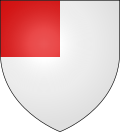 a quarter—Argent, a quarter gules
 -
 a canton—Argent, a canton gules
 -
 flaunches—Argent, flaunches gules
 -
 a fret—Argent, a fret gules. Arms of the Blake family.
 -
 an orle—Argent, an orle azure (D'argent à l'orle d'azur—Lacroisille, Tarn, France)
 -
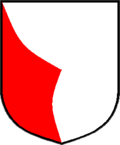 a gore—Argent, a gore gules
 -
 a gyron—Vert five barrulets dovetailed on the lower sides Argent, in dexter base a gyron voided of the field in sinister chief a crescent over all at centre point the sun in his splendour all Or.—Green, Scotland
 -
 an orle charged—Parted per pale argent and sable; an orle engrailed on both sides charged with four quatrefoils within a bordure, all counter changed—Norie, Scotland
 -
 an orle of crescents and mullets—Sable; a cross moline within an orle of crescents and mullets alternately, argent—Sibbald, Scotland
 -
 a tressure—Azure, an annulet, therewithin three barrulets wavy, conjoined, all within a tressure, argent—Umgeni Water Board, RSA
 -
![a double tressure—Azure; a facetted six pointed star [mullet] argent ensigned with a gable crown or, the whole within a double tressure argent—Langenhoven, RSA](//upload.wikimedia.org/wikipedia/commons/thumb/3/36/Mullet_facetted_wiki.jpg/120px-Mullet_facetted_wiki.jpg) a double tressure—Azure; a facetted six pointed star [mullet] argent ensigned with a gable crown or, the whole within a double tressure argent—Langenhoven, RSA
a double tressure—Azure; a facetted six pointed star [mullet] argent ensigned with a gable crown or, the whole within a double tressure argent—Langenhoven, RSA


.svg)


![a double tressure—Azure; a facetted six pointed star [mullet] argent ensigned with a gable crown or, the whole within a double tressure argent—Langenhoven, RSA](https://en.wikipedia.org/wiki/File:Mullet_facetted_wiki.jpg)
Mobile subordinaries
[edit] | This article may require cleanup to meet Wikipedia's quality standards. The specific problem is: These are mobile charges, not ordinaries![6]. (January 2023) |
Other subordinaries can be placed anywhere on the field.
- Escutcheon: a shield used as a charge.
-
 an escutcheon—Or, an escutcheon sable—Bourigeole, Aude, France
 -
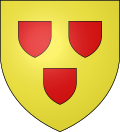 3 escutcheons—Or, three escutcheons gules—d'Abbeville, France
 -
 3 escutcheons —Argent; three escutcheons gules; within a bordure chequy gules and argent—Hay of Pitfour, Scotland
 -
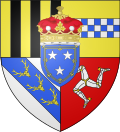 escutcheon en surtout—Arms of Murray, Duke of Atholl, Scotland includes an escutcheon en surtout for the Chiefship of the Name of Murray and with the crown of a marquess for the Marquessate of Tullibardine
.svg)


- escutcheon of pretence or en surtout—When one escutcheon is borne in the centre of the coat, it is sometimes called an inescutcheon or an escutcheon of pretence or an escutcheon en surtout. Such centrally placed escutcheons usually have some particular significance. For example, in arms of dominion an inescutcheon typically shows the dynastic arms of the prince, whose possessions are shown in the quarters of the main shield; current examples include the arms of the Danish royal family, with an inescutcheon of the house of Oldenburg, and the coat of arms of Spain, with an inescutcheon of the house of Bourbon-Anjou. In Scots heraldry the escutcheon en surtout serves several different purposes. This all comes under the heading of marshalling.
- Fusil: a thin lozenge; very much taller than it is wide.
- Mascle: a voided lozenge (i.e. with a largish lozenge shaped hole)
- Rustre (very rare): a lozenge pierced (i.e. with a smallish round hole)
-
 3 lozenges—Gules, three lozenges argent— Guillaume de Haer (according to Gelre)
 -
 3 fusils—Per fess azure and vair ancient; three fusils in chief and a crescent in base, or; a bordure engrailed argent—Freeman of Murtle, Scotland
 -
 9 mascles—Gules, nine mascles or—Rohan family of France
 -
 5 rustres—Argent; on a saltire gules five rustres argent, in chief a lion rampant of the second (gules)—Dalrymple of Woodhead, Scotland
.svg)


- Roundel: a disc or ball, as in the arms of the Duchy of Cornwall or of the Medici. In the Anglophone heraldries differently coloured roundels have different names, e.g. a roundel or is called a bezant and a roundel azure is called a hurt. French heraldry solely distinguishes besants (roundels of a metal tincture) and tourteaux (roundels of a colour tincture): hence, the Canadian Francophone versions of blazons follow suit — Anglophone hurt is Francophone tourteau d'azur, and Anglophone bezant is a besant d'or
- Annulet: a voided roundel (i.e. with a largish round hole, resembling a ring)
-
 a hurt (roundel azure)—Or, a hurt; D'or au tourteau d'azur—Launaguet, Haute-Garonne, France
 -
 10 bezants (roundels or)—Azure, ten bezants in pile; D'azur à dix besants d'or— Jean IV de Rieux, France
 -
 3 annulets—Gules, three annulets in pile argent; De gueules à trois annelets d'argent— Mâcon, France
.svg)


- Billet: a small rectangle, resembling a brick or a letter. Billets are normally vertical (as in the arms of the Kingdom of the Netherlands), but can be horizontal (as in the arms of Friesland).
-
 10 billets—Azure, ten billets or; D'azur à dix billettes d'or— Baud, Morbihan, France

Variations
[edit]Lines
[edit]Ordinaries need not be bounded by straight lines.
-
 engrailed—Sable, a cross engrailed argent
 -
 dancetty—Azure, a bend dancetty or
 -
 wavy—Vert, three bars wavy argent
 -
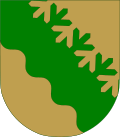 fir-twigged (sapiny) and wavy—Or, a bend upper edge fir twigged (sapiny), lower edge wavy, vert


Diminutives
[edit]When a coat of arms contains two or more of an ordinary, they are nearly always blazoned (in English) as diminutives of the ordinary, as follows.
Diminutives of the pale
[edit]- pallet: theoretically half the width of a pale.
- endorse: half the width of a pallet; also found in pairs on either side of a pale when the term "endorsed" is used
-
 3 pallets—Per fess or and azure; in chief a dexter arm vambraced and a sinister arm contourny vambraced, proper and in base three pallets argent—Armstrong, USA (Scots arms)
 -
 an endorse—Per fess gules and azure; in chief three lions rampant, argent, in base an endorse argent between, dexter, a stag's head cabossed, and, sinister, a sun in its splendour, between five mullets, or—Ross and Cromarty District Council, `Scotland
 -
 pale endorsed—Sable; a pale chequy argent and azure of 24 pieces, endorsed argent; on a chief or five flames gules—Secunda Health Committee, RSA


Diminutives of the fess
[edit]- bar, see above.
- closet, half the width of the bar
- barrulet, narrower than both.
- hamade (also called hamaide or hummet): a bar couped which doesn't reach the edges of the shield, usually in threes
-
 3 bars—Per bend sable and azure; three bars or—Kenan, Scotland
 -
 5 barrulets—Argent; five barrulets sable, engrailed on their under edges, the figure of St Peter enhaloed, proper, vested azure and or, in his dexter hand two keys in saltire or and argent—Burgh of Thurso, Scotland
 -
 3 hamades—Argent, three hamades gules


Diminutives of the bend
[edit]- bendlet, half the width of a bend.
- ribbon or riband, half the width of a bendlet, occasionally called a cost
- baton: a bendlet couped which doesn't reach the edges of the shield, often said to be only a bendlet sinister couped, but has certainly been used as a couped bendlet 'dexter' since the 17th century at the latest
-
 a bendlet—Vert; a bendlet wavy argent between six billets gules, each fimbriated or—Stroud Urban District Council, England
 -
 a ribbon (or riband)—Or, lion rampant gules, surmounted of a ribbon sable; within a bordure azure charged with three boars' heads erased, or—Drummond of Hawthornden, Scotland
 -
 a baton—Gules; on a bend engrailed or a baton azure; within a bordure vair—Elliot, Scotland (matriculated 1693)


Diminutive of the bend sinister
[edit]- bendlet sinister, half the width of a bend sinister, also very occasionally called a scarpe;
- baton sinister, a bendlet sinister couped
-
 a bendlet sinister—Argent, a bendlet wavy azure and a bendlet sinister wavy vert, over all on a cross gules five roses argent barbed and seeded proper—North Yorkshire County Council, England
 -
 a scarpe—Argent, three bends engrailed sable, over all a scarpe gules—Blage, England
 -
 a baton sinister—Argent, a galley (or lymphad) sable, sails furled, flags and pinnets flying and oars in action, debruised with a baton sinister couped gules—Campbell (second and third quarters, all quarters within a bordure compony argent and azure; matriculated 1763)


Diminutives of the chevron
[edit]- chevronel: half the width of a chevron.
- couple close: half the width of a chevronnel, but only to be found in pairs with a chevron between them; the phrase 'a chevron between two couple closes' has the alternative 'a chevron couple closed'; in essence the same as cottising a chevron; couple close is not found much in modern blazons
-
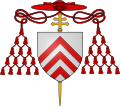 3 chevronels—Argent, three chevronels gules—Cardinal Richelieu, France
 -
![couple closes (or couple closed)—Gules; a chevron ermine, couple closed [between two couple closes] or, between three escallops of the second [ermine]—Browne, England](//upload.wikimedia.org/wikipedia/commons/thumb/1/13/Browne_arms.jpg/120px-Browne_arms.jpg) couple closes (or couple closed)—Gules; a chevron ermine, couple closed [between two couple closes] or, between three escallops of the second [ermine]—Browne, England
couple closes (or couple closed)—Gules; a chevron ermine, couple closed [between two couple closes] or, between three escallops of the second [ermine]—Browne, England

![couple closes (or couple closed)—Gules; a chevron ermine, couple closed [between two couple closes] or, between three escallops of the second [ermine]—Browne, England](https://en.wikipedia.org/wiki/File:Browne_arms.jpg)
Diminutives of the chief
[edit]- comble, "half" a chief; rare in the Anglophone heraldries, but does appear in the civic heraldry of France—there even being at least one chief charged with a comble
- chief enhanced, again "half" a chief, sometimes said not to be a diminutive, but is indistinguishable from the comble which is.
- fillet: said, by those who do not believe in the comble or chief enhanced, to be the nearest that the chief comes to having a diminutive, which is effectively a barrulet conjoined to a chief at its bottom edge—blazoned either as 'a chief supported by a fillet' or as 'a chief filleted' (or things similar); occasionally appears in its own right—though it is then very little other than a barrulet enhanced.
-
![a comble—Argent; three martlets sable; on a comble azure a cross or; a franc quartier [quarter] azure charged with a sword argent, hilted and pomelled or—Nairne of Meikleour (fourth grand quarter for Flahault)](//upload.wikimedia.org/wikipedia/commons/thumb/e/e5/Blason_Comte_Charles_de_Flahaut_%281785-1870%29.svg/120px-Blason_Comte_Charles_de_Flahaut_%281785-1870%29.svg.png) a comble—Argent; three martlets sable; on a comble azure a cross or; a franc quartier [quarter] azure charged with a sword argent, hilted and pomelled or—Nairne of Meikleour (fourth grand quarter for Flahault)
a comble—Argent; three martlets sable; on a comble azure a cross or; a franc quartier [quarter] azure charged with a sword argent, hilted and pomelled or—Nairne of Meikleour (fourth grand quarter for Flahault) -
 a comble on a chief—Gules, a ship or, sails set ermine, on a sea in base vert, a chief also ermine charged with a comble gules charged with three bees or—Nantes, Loire-Atlantique, France
 -
 a chief enhanced—Per chevron Azure and Gules on a chevron between in chief two acorns and in base a unicorn's head erased all Argent three mullets Gules pierced a chief enhanced and embattled Vert fimbriated Or. — Matthews, Scotland
 -
![a fillet and a chief—Sable; an eagle displayed or, charged on the breast with an escutcheon gules, thereupon two chevrons couped interlaced inverted or; a chief gules filleted [supported by a fillet] or—Wing Riders of South Africa](//upload.wikimedia.org/wikipedia/commons/thumb/6/6d/Fillet_%26_chief_wing_riders_wiki.jpg/120px-Fillet_%26_chief_wing_riders_wiki.jpg) a fillet and a chief—Sable; an eagle displayed or, charged on the breast with an escutcheon gules, thereupon two chevrons couped interlaced inverted or; a chief gules filleted [supported by a fillet] or—Wing Riders of South Africa
a fillet and a chief—Sable; an eagle displayed or, charged on the breast with an escutcheon gules, thereupon two chevrons couped interlaced inverted or; a chief gules filleted [supported by a fillet] or—Wing Riders of South Africa
![a comble—Argent; three martlets sable; on a comble azure a cross or; a franc quartier [quarter] azure charged with a sword argent, hilted and pomelled or—Nairne of Meikleour (fourth grand quarter for Flahault)](https://en.wikipedia.org/wiki/File:Blason_Comte_Charles_de_Flahaut_(1785-1870).svg)
_(1808).svg)

![a fillet and a chief—Sable; an eagle displayed or, charged on the breast with an escutcheon gules, thereupon two chevrons couped interlaced inverted or; a chief gules filleted [supported by a fillet] or—Wing Riders of South Africa](https://en.wikipedia.org/wiki/File:Fillet_%26_chief_wing_riders_wiki.jpg)
Diminutive of the cross
[edit]- cross fillet (or fillet cross), somewhat less than half the width of a cross.
-
 a fillet cross (or cross fillet)—Quarterly, azure and gules; 1. a fish naiant or; 2. a cock argent; 3. a fleur de lis argent; 4, an anchor fouled or; over all a fillet cross or—Port Alfred Municipality, RSA

Diminutive of the saltire
[edit]- fillet saltire, something less than half the width of a saltire
- saltorel, is sometimes said to be a diminutive saltire, but is best thought of simply as a saltire couped, the word being sometimes used when there are three or more (rather like lioncel and eaglet were used at times when there were three or more lions or eagles in a coat)—a 19th-century armorial uses 'saltorels' only once for every ten or eleven 'saltires'. A common charge in Dutch heraldry.
-
 a fillet saltire (or a saltire fillet)—Azure, a bezant; a chief per saltire, murrey and azure, filleted argent, over the partition a fillet saltire nowy, also argent—de Jong, RSA
 -
![3 saltorels—Tierced per pale, gules, argent and azure, the argent charged with three saltorels in pale, sable; on a chief invected of three pieces vert, three powder horns [stringed] or—Oosthuysen, RSA](//upload.wikimedia.org/wikipedia/commons/thumb/e/e8/Saltorel_oosthuysen_wiki.jpg/120px-Saltorel_oosthuysen_wiki.jpg) 3 saltorels—Tierced per pale, gules, argent and azure, the argent charged with three saltorels in pale, sable; on a chief invected of three pieces vert, three powder horns [stringed] or—Oosthuysen, RSA
3 saltorels—Tierced per pale, gules, argent and azure, the argent charged with three saltorels in pale, sable; on a chief invected of three pieces vert, three powder horns [stringed] or—Oosthuysen, RSA

![3 saltorels—Tierced per pale, gules, argent and azure, the argent charged with three saltorels in pale, sable; on a chief invected of three pieces vert, three powder horns [stringed] or—Oosthuysen, RSA](https://en.wikipedia.org/wiki/File:Saltorel_oosthuysen_wiki.jpg)
Cottise and cottising
[edit]

The cottise (the spelling varies—sometimes only one t and sometimes c instead of the s) originated as an alternative name to cost (see above) and so as a diminutive of the bend, most commonly found in pairs on either side of a bend, with the bend being blazoned either as between two cottises or as cottised.
Nowadays cottising is used not just for bends but for practically all the ordinaries (and occasionally collections of charges), and consists in placing the ordinary between two diminutive versions of itself (and occasionally other things). A pale so treated is usually blazoned endorsed and a chevron very occasionally couple closed or between two couple closes. A chief, however, cannot be cottised.[7]
The ordinary and its cottices need not have the same tincture or the same line ornamentation.
Ordinaries very occasionally get cottised by things shaped quite differently from their diminutives—like demi maple leaves.
Occasionally a collection of charges aligned as if on an ordinary—in bend, etc.—is accompanied by cotticing.
Voiding, surmounting with another, and fimbriation
[edit]Any type of charge, but probably most often the ordinaries and subordinaries, can be "voided"; without further description, this means that a hole in the shape of the charge reveals the field behind it. Occasionally the hole is of different tincture or shape (which must then be specified), so that the charge appears to be surcharged with a smaller charge.
Notes
[edit]- ^ See "Chapter IX: the so-called ordinaries and sub-ordinaries" in Fox-Davies (1909) A Complete Guide to Heraldry.
- ^ Fox-Davies (1909), pp. 106–107.
- ^ Fox-Davies (1909), p. 107.
- ^ "Mount" in: William Berry, Encyclopaedia Heraldica, Or Complete Dictionary of Heraldry (1828).
- ^ "American Heraldic Society: An American Heraldic Primer". Americanheraldry.org. 26 August 2007. Archived from the original on 22 March 2012. Retrieved 28 June 2013.
- ^ Geometric Charges Archived 16 January 2023 at the Wayback Machine, heraldicart.org, PDF
- ^ Mackinnon of Dunakin (1966), p. 56.
References
[edit]- Boutell, Charles (1983). Boutell's Heraldry. Revised J P Brook-Little, Norroy and Ulster King of Arms. London and New York: Frederick Warne.
- Fox-Davies, Arthur Charles (1986, first published 1904). The Art of Heraldry: An Encyclopædia of Armory London: Bloomsbury Books.
- Fox-Davies, Arthur Charles (1909). A Complete Guide to Heraldry. New York: Dodge Pub. Co. ISBN 0-517-26643-1. LCCN 09-23803
- Greaves, Kevin (2000). A Canadian Heraldic Primer. Ottawa: The Heraldry Society of Canada. ISBN 0-9693063-4-2. LCCN 2001-326695
- Sir Thomas Innes of Learney, Lord Lyon King of Arms (1978). Scots Heraldry. Revised Malcolm R Innes of Edingight, Marchmont Herald. London and Edinburgh: Johnston and Bacon. LCCN 79-306835
- Mackinnon of Dunakin, Charles (1966). The Observer's Book of Heraldry. London: Frederick Warne.
- Nisbet, Alexander (1984, first published 1722). A system of heraldry. Edinburgh: T & A Constable.
- Sir James Balfour Paul, Lord Lyon King of Arms (1969, first published 1903). An Ordinary of Arms Contained in the Public Register of All Arms and Bearings in Scotland (2nd edition, paperback reprint). Baltimore: Genealogical Publishing Co.
- David Reid of Robertland and Vivien Wilson (1977). An Ordinary of Arms, volume 2 [1902-1973]. Edinburgh: Lyon Office.
- Urquhart, R M (1979). Scottish Civic Heraldry: Regional - Islands - District. London: Heraldry Today. ISBN 0-900455-26-8. LCCN 80-467758
External links
[edit]
Canadian Heraldic Authority
[edit]- pall—College of New Caledonia (Prince George, British Columbia): Azure on a pall Or five cross crosslets fitchée Gules in chief an open book Argent binding and fore-edges Or.
- Blair Keith Churchill: Purpure a lion rampant within a double tressure erablé-counter-erablé Or.
- tressure—Odile Gravereaux Calder: Azure a rose Argent seeded Or barbed Vert within a tressure flory inward Argent.
- pallets—Niagara Herald Extraordinary, badge: On a compass rose of sixteen points Gules, a plate fimbriated Gules charged with three pallets wavy Azure.
- Municipality of Sainte-Apolline-de-Patton, Quebec: Azure on a bend between in chief a sun in splendour and in base a circular saw blade Or, a bendlet wavy Azure.
- voided—Town of Lacombe: Or a cross Gules voided throughout of the field between in the first quarter a Mountain Bluebird (Sialia currucoides) volant bendwise Azure, in the second an open book Argent bound Azure, in the third a cross flory Azure voided of the field and charged with a cross couped Gules, and in the fourth two bendlets and two bendlets sinister interlaced Azure.
- City of Abbotsford: Vert a cross and saltire merged Or voided Azure and over all in centre point a bezant charged with a strawberry flower proper.
- cottised—Fr. Marc Edward Smith: Azure on a fess cottised Or an open book Argent edged Or bound Azure clasped Argent in chief a Loyalist civil coronet and in base a cross formy Or.
- cotised—Regional Municipality of Niagara: Vert on a fess Argent coticed Or fracted per pale lowered dexter raised sinister twelve chevrons couched dexter Azure in dexter chief a representation of the Royal Crown Or.
- cotised—St George's Society of Toronto: Argent a cross cotised by eight demi maple leaves Gules.
- cotised—Commemorative Distinction Gulf of St Lawrence (flag): Gules on a Canadian Pale wavy Argent cotised to the interior Azure, a maple leaf composed of flames proper charged with a gridiron Azure.
- cotised—John Stewart Archibald LeForte: Argent on a bend bretessed Azure cotised Sable between in chief and in base a Latin cross fleury Gules a key ward upwards between two fleurs-de-lys all bendwise Or — illustrating that both the tinctures and the lines of an ordinary and its cotises are independent of each other.
U. S. Army Institute of Heraldry
[edit]- sinister canton—11th Field Artillery Regiment, USA: an example of a sinister canton, bearing the badge of the 'parent' regiment.
- fusils—US Army 72nd Signal Battalion: Per pale Sable and Gules, a fleur-de-lis throughout Or between in chief two fusils pilewise and in fess two mullets Argent.
- bendlets sinister—7th Infantry Regiment, USA: Per fess Argent and Azure, a fess embattled to chief Or masoned Sable between in chief a field gun Gules on a mount Vert and in base three bendlets sinister of the first.
- chief enhanced—244th Quartermaster Battalion: Buff, a wheel Argent between dexter and sinister flanks Vert and Gules, on a chief enhanced Azure a chain of three links fesswise of the second. Here the flanks are straight rather than being their cousins the curved flaunches.
- chief with a fillet—U.S.Army 121st Support Battalion: Per bend Buff and Gules a bend Or, a cross and ball peen hammer saltirewise superimposed in base by a stylized mechanized track Sable; on a chief per fess dancetty of three Azure (light Blue) and of the third with the dexter and sinister peaks diminutive, a mullet on the dexter peak Argent, on the lower part of chief a fillet of the fourth.
Heraldry Society of Scotland
[edit]- Royal Burgh of Annan Community Council: Or; a saltire and chief gules, on the latter five barrulets wavy conjoined, alternately argent and azure.
- Kilsyth Community Council, Scotland: Quarterly, azure and gules: first, an open bible proper; second, two swords in saltire argent, hilts uppermost, or; third, two shuttles in saltire or, garnished with thread argent; fourth, a miner's lamp argent, enflamed proper; over all a fillet cross, nowy lozengy, argent.
Royal Heraldry Society of Canada
[edit]- Suan-Seh Foo MD: Argent semé bottony Sable a pall reversed Gules cotised Azure, over all a rod of Aesculapius surmounting a mahlstick and a paint brush in saltire Or.
- William Neil Fraser: Azure between three cinquefoils a chevron Argent masoned Sable voided of the field and charged thereon with a trillium flower between two dogwood flowers proper.
- Michael Greenwood: Sable, a chevron Erminois cotised between three saltires couped and within a bordure Or.
- Comm. Daniel Leonard Norris: Azure a pall and pale merged wavy Or voided wavy of the field cotised wavy Or.
Civic Heraldry of England and Wales
[edit]- Newquay Town Council: Or on a Saltire Azure four Herrings respectant Argent.
- Blaenavon Town Council: Quarterly wavy Sable and Or in the first and fourth quarters a Key wards upwards and to the dexter and in the second and third quarters a Lozenge all counterchanged.
- Harlow District Council: Vert between three Lozenges Argent a Pair of Dividers Or enfiled by a Mural Crown also Argent two Flaunches of the last each charged with a Mascle Gules.
- Barnard Castle Town Council: Gules in chief a Castle and in base a Cross formy the uppermost limb between a Crescent and an Estoile of seven rays all within an Orle Argent.
- Hinckley and Bosworth Borough Council: Per pale indented Argent and Gules on a Chief Or three Torteaux that in the centre charged with a Pierced Cinquefoil Ermine the others each charged with a Mascle Or.
- Darlington Borough Council: Per pale Azure and Gules on a Chevron Argent between in chief a representation of St. Cuthbert's Cross proper and a Shorthorn Bull's Head caboshed and in base a Garb Or enfiled by a Circlet of Steel proper a Chevronel wavy Azure on a Chief Argent a representation of the Steam Engine "Locomotion" and a Tender proper.
- Former Hawarden Rural District Council, a rare example of a single bar.
- Former Gower Rural District Council: Barry wavy of eight Argent and Azure on a Pile Azure a Lion rampant between three Cross Crosslets Or.
- Former Ashby de la Zouch Rural District Council: the crest includes a Banner paly of six Gold and Azure a Quarter Ermine.
- Former Billingham Urban District Council, showing a canton filling one-ninth of the shield.
- Former Merton and Morden Urban District Council: Sable a Fret Or on a Chief of the last two Lions passant respectant of the field.
- Former Ampthill Rural District Council: Or a Stag's Head Gules between the attires an Escutcheon Azure charged with three Bars wavy of the first encircled by a Chaplet of Oak fructed proper on a Chief Sable a Lion passant guardant Gold.
- Former Blackwell Rural District Council: Argent a Pickaxe surmounted by a Spade the hafts upwards in saltire proper within an Orle of Pellets on a Chief Sable three Stag's Heads caboshed of the Field.
- Former Beddington and Wallington Borough Council: Argent a Fess embattled between three roses Gules each surmounted by a Rose Argent barbed and seeded proper the Fess surmounted by an Escutcheon Azure charged with a representation of an Hannibal Aircraft volant Argent and in base a rising Sun Or all within a Bordure compony Or and Azure.
- Former Chelsea Metropolitan Borough Council: Gules within a Cross voided Or a Crozier in pale of the last in the first quarter a winged Bull statant in the second a Lion rampant reguardant both Argent in the third a Sword point downwards proper pomel and hilt Gold between two Boars' Heads couped at the neck of the third and in the fourth a Stag's Head caboshed of the second..
Other sites
[edit]- Braemar Royal Highland Society, Scotland: Per fess enhanced wavy or and argent; in chief issuant out of a fillet wavy azure four demi lions combatant, two and two gules, and in base a Scots fir tree in pale, seeded, proper, growing out of a mound purpure, between on the dexter an eagle displayed azure, armed beaked and membered gules, on its breast an antique covered cup or and charged with a three point label also gules, and on the sinister an eagle displayed sable armed beaked and membered gules.
- Newton Technical High School, South Africa: Quarterly gules and sable; a lozenge or voided of a quatrefoil; at its centre a cog wheel argent; the whole within a bordure or.
| Types | |||||||||||||||
|---|---|---|---|---|---|---|---|---|---|---|---|---|---|---|---|
| Topics | |||||||||||||||
| Achievement | |||||||||||||||
| Charges | |||||||||||||||
| Tinctures |
| ||||||||||||||
| Applications | |||||||||||||||
| Related | |||||||||||||||
| |||||||||||||||


Ordinary (heraldry)
View on GrokipediaOverview
Definition
In heraldry, an ordinary is a simple geometric figure bounded by straight or curved lines, occupying a defined position on the shield and serving as one of the two primary types of charges, the other being mobile charges.[4][5] These figures are characterized by their simplicity, standardization across heraldic traditions, and adherence to specific positional rules, such as the pale extending vertically from the chief to the base of the shield or the fess running horizontally across the middle third of the shield's height.[6][2] The nine traditional principal ordinaries are as follows, each with a conventional placement:- Chief: A horizontal band occupying the upper third of the shield.[6]
- Pale: A vertical band centered and extending the full height of the shield.[6]
- Fess: A horizontal band across the center of the shield.[6]
- Bend: A diagonal band from the upper left to the lower right of the shield.[6]
- Bend sinister: A diagonal band from the upper right to the lower left of the shield.[6]
- Chevron: An inverted V-shape issuing from the base toward the chief.[6]
- Cross: A figure formed by a vertical pale intersected by a horizontal fess, extending to the edges.[2]
- Saltire: A diagonal cross formed by a bend and bend sinister intersecting at the center.[6]
- Pile: A wedge-shaped figure issuing from the chief and tapering to a point at or near the base.[5]
Role in Heraldic Composition
Ordinaries serve as foundational elements in the composition of a coat of arms, functioning either as the primary background structure or as prominent charges that occupy significant portions of the shield. They are typically integrated with tinctures—such as metals (or and argent) or colors (gules, azure, vert, purpure, and sable)—and furs (like ermine or vair) to ensure visibility and contrast. The rule of tincture mandates that colors must be placed on metals and metals on colors to maintain clear distinction, prohibiting color on color or metal on metal, though exceptions apply for furs and certain "proper" charges that depict natural colors.[7][8] For instance, an ordinary like a fess might be blazoned as "a fess gules" on a field of argent, creating a red horizontal band across a silver background.[7] In blazoning, the formal description of heraldic designs, ordinaries are articulated with precise terminology that begins with the field and proceeds to the charges in order of precedence. The ordinary's name is stated first, followed by its tincture and any modifications, ensuring the blazon allows accurate reconstruction of the arms. For example, "Or, a fess between three crescents sable" describes a gold field with a horizontal band, flanked by black crescents above and below.[7] This convention prioritizes simplicity and logical sequence, with ordinaries mentioned before mobile charges unless the ordinary is subordinate.[7] Positional hierarchy governs the default placement of ordinaries to avoid ambiguity in composition. The chief occupies the upper third of the shield, the fess the central horizontal band, the pale the vertical center, the bend a diagonal from dexter chief to sinister base, and the base the lower portion, with these positions assumed unless otherwise specified. Multiple ordinaries interact by layering in precedence order—such as a chief surmounting a bordure—without overlapping except when explicitly stated, like in quartered arms.[7] Unlike mobile charges such as lions or eagles, which often carry symbolic connotations of strength or nobility, ordinaries generally exhibit symbolic neutrality, deriving meaning primarily from their structural role or contextual associations rather than inherent significance. They facilitate differentiation in arms, such as in cadency marks for heirs, emphasizing clarity and identification over allegory.[7]Historical Development
Origins in Medieval Heraldry
The emergence of ordinaries in heraldry traces back to the mid-12th century in Western Europe, where they developed as simple geometric designs on shields to aid rapid identification amid the chaos of tournaments and battles during the Crusades. These shapes, such as the chief, pale, bend, fess, chevron, saltire, and cross, initially derived from practical reinforcements on shields, including extra planks or iron strips that strengthened vulnerable areas and were later painted for visibility. This evolution occurred primarily among the feudal military elite in regions like England, France, and Flanders, with the first heraldic shields appearing on seals between 1140 and 1159 across eight West European countries.[9][10] Influences from earlier traditions contributed to the adoption of these forms, with roots in Roman military insignia—such as legionary shields bearing symbols like eagles—and Byzantine art encountered by Crusaders, which introduced motifs like lions and double-headed eagles that complemented geometric ordinaries. During the Second Crusade (1147–1149), orders like the Templars adopted a red cross on a white field as a prominent ordinary, facilitating group recognition in combat and processions. The purpose was pragmatic: enclosed helmets obscured faces, so bold, contrasting ordinaries ensured knights could be swiftly identified by allies and foes alike, emphasizing simplicity over intricate decoration.[9][10] Early documented examples appear in seals from England and France from the mid-12th century (c. 1140–1159), predating formal rolls of arms. The earliest known colored example is the enamel plaque of Geoffrey of Anjou (1151), depicting lions, alongside emerging ordinaries on seals. In France, the seal of Raoul I of Vermandois (c. 1146) features a chequy pattern, an early subordinary. English examples include William de Mandeville's quarterly arms (post-1166, evolving to full ordinaries by c. 1180) and William Longespée's shield with vertical pale-like divisions (c. 1210s). By the 1250s, the Bigot Roll in France records ordinaries in 46% of entries, such as bends and crosses, underscoring their foundational role in armorial bearings for knights. These principal ordinaries, like the cross and pale, were among the earliest adopted for their high visibility in medieval warfare.[9][10]Standardization and Evolution
The codification of ordinaries in heraldry gained momentum in the 14th century through influential treatises that formalized their geometric forms and placement on shields. Johannes de Bado Aureo's Tractatus de Armis, composed around 1394 at the request of Queen Anne of Bohemia, provided one of the earliest systematic discussions of armorial principles, including the use of simple ordinaries like the chief, pale, and fess to ensure identifiability in battle and tournaments.[11] This work, translated into Welsh and English in the early 15th century, emphasized Roman legal precedents to regulate the assumption of arms, thereby establishing ordinaries as foundational elements in heraldic composition.[7] By the 15th century, the College of Arms integrated these concepts into its practices, formalizing under a royal charter from Richard III in 1484 to oversee the recording and standardization of armorial bearings across England and Wales.[12] Heralds within the College conducted surveys to verify pedigrees and arms, promoting consistent depiction of ordinaries such as the bend and chevron, which were adapted from early decorative shield patterns to more precise proportions for clarity.[11] Regional variations emerged between British and Continental heraldry, with English traditions adopting more rigid positioning for ordinaries—such as the pale occupying exactly one-third of the shield's width—compared to the flexible artistic interpretations common in French and German practices.[7] For instance, the saltire appeared more frequently in Scottish arms due to its association with St. Andrew, while Continental heraldry often incorporated unique furs and terms absent in British usage.[7] The evolution of ordinary types continued into the 16th century with the introduction of subordinaries, such as the bordure and orle, which added layers of complexity to distinguish cadet lines and augmentations without altering principal forms.[7] However, the Renaissance period saw a decline in the exclusive reliance on ordinaries, as mobile charges like lions and eagles proliferated, integrating with ordinaries to create more narrative designs reflective of personal or familial symbolism.[7] Standardization was further advanced through legal and technological means, including heraldic visitations ordered from Henry V's reign (1413–1422) and intensified in the 16th–17th centuries under the Tudors, where officials inspected and recorded arms to prevent unauthorized use.[11] The advent of printing in the 15th century facilitated this process via armorials and treatises, such as the 1486 Boke of Saint Albans, which disseminated uniform depictions of ordinaries and ensured consistency across regions.[7] These efforts culminated in the last major visitations by 1686, solidifying ordinaries as enduring, regulated components of heraldic tradition.[11]Classification of Ordinaries
Principal Ordinaries
The principal ordinaries form the foundational geometric charges in heraldry, consisting of nine core shapes that occupy defined positions on the shield and convey structural significance in armorial compositions. The classification varies among authorities, but commonly recognized principal ordinaries include the chief, pale, fess, bend, bar, chevron, cross, saltire, and pile, each with standardized proportions typically occupying one-third of the shield's relevant dimension, though artistic variations exist.[1] They are distinguished from subordinaries, which derive from or diminish these forms.[1] The following table summarizes the shapes, positions, and standard proportions of the principal ordinaries:| Ordinary | Shape | Position | Standard Proportions |
|---|---|---|---|
| Chief | Horizontal band | Uppermost section of the shield | One-third of shield height |
| Pale | Vertical band | Center, from top to bottom | One-third of shield width |
| Fess | Horizontal band | Across the center | One-third of shield height |
| Bend | Diagonal band | From dexter chief to sinister base | One-third of shield width |
| Bar | Horizontal band | Across the center, narrower than fess | Less than one-third of shield height |
| Chevron | Inverted V (upward-pointing) | Centered, base at shield base | Base width one-third of shield width |
| Cross | Vertical and horizontal arms intersecting at center | Spanning the entire shield | Arms each one-third of width/height |
| Saltire | Diagonal X (St. Andrew's Cross) | Diagonally across the shield | Arms each one-third of relevant dimension |
| Pile | Downward-pointing wedge or triangle | From chief to a point in base | Upper edge often full width, tapering |
Subordinaries
Subordinaries are geometric charges in heraldry that are considered secondary or supplementary to the principal ordinaries, often derived from them but occupying less prominent positions or serving auxiliary roles on the shield.[1] They include shapes such as the bordure, orle, quarter, canton, flanch or flaunches, gyron, lozenge, fusil, and mascle, which provide variety in heraldic design while maintaining geometric simplicity.[13] Unlike principal ordinaries, which form the core structural elements, subordinaries are typically narrower, smaller, or positioned peripherally, allowing for intricate compositions without overwhelming the overall arms.[1] Key examples of subordinaries illustrate their diversity. The bordure is a border that encircles the entire edge of the shield, often used as a frame for other charges, as seen in the arms of William de Ferrers: "Vaire, or, and gules, a bordure argent semy of horseshoes sable."[1] The orle functions as an inner bordure, parallel to the shield's outline but not touching the edges, typically half the width of a bordure and capable of bearing additional charges.[1] The quarter is a charge occupying one-fourth of the shield in the dexter chief, with the remaining field available for other elements.[1] The canton is a small rectangular charge in the dexter chief corner, theoretically one-ninth of the field, often added for honors like the "canton of England" featuring three lions passant guardant or on gules.[1] Flanches, or flaunches, are paired curved segments arcing from the shield's sides toward the center, always appearing in duplicate.[13] The gyron is a triangular charge extending from the center to one corner, representing one-eighth of the shield when used singly, though more commonly seen in multiples as in the Campbell arms: "Gyronny or and sable."[1] Lozenge-shaped charges include the lozenge itself, a diamond form; the narrower fusil; and the mascle, a voided lozenge, as in the Ferrers arms: "Gules, seven mascles conjoined or."[1] Subordinaries are distinguished by their positional behavior: fixed subordinaries, such as the quarter, canton, and bordure, maintain static locations relative to the shield's geometry and cannot be repositioned without altering their identity.[1] In contrast, mobile subordinaries like the orle, gyron, lozenge, fusil, and mascle can be placed variably across the field unless the blazon specifies otherwise, offering flexibility in arrangement.[1] Flanches, while paired, are also mobile within their lateral constraints.[13] Proportions and positions of subordinaries are governed by heraldic convention to ensure balance. The bordure follows the full perimeter of the shield, varying in width but never encroaching inward significantly.[1] The orle mirrors this outline internally at a reduced scale, while the gyron radiates precisely from the escutcheon's center to a corner point.[1] The quarter claims one-fourth of the total area, the canton one-ninth, and flanches each cover a modest curved portion near the flanks, all aligned to the shield's cardinal points for visual harmony.[1] Lozenges and their variants adapt to the space, with fusils elongated for distinction.[13] Due to their secondary status, subordinaries are rarer in central compositions than principal ordinaries and are primarily employed for differencing—to distinguish branches of a family—or augmentation, to commemorate honors granted by a sovereign.[1] For instance, a bordure often serves as a cadency mark for illegitimate or cadet lines, while a canton might augment arms for notable service, as in the 1660 grant to Jane Lane's family of a canton bearing the Lions of England.[13] This usage underscores their role in enhancing rather than dominating heraldic identity.[1]Variations
Line Styles
In heraldry, line styles, also known as lines of partition, define the edges of ordinaries, allowing for stylistic variation while maintaining the ordinary's fundamental geometric form. These lines modify only the boundary of the charge and do not affect its internal filling or tincture; they are specified in the blazon immediately after the ordinary's name, such as "a fess engrailed" or "a bend wavy."[7] The default line style is straight, characterized by unadorned, linear edges that extend from side to side or top to bottom of the shield, historically representing simplicity and comprising a traditional proportion like one-third of the field for a fess.[7] Engrailed lines feature semicircular notches curving outward along the edge, evoking a series of convex arcs, while invected (sometimes termed imbated) lines reverse this with inward-curving semicircles.[7] Wavy or undy lines produce an undulating pattern resembling gentle waves, often symbolizing water or fluidity, as in "party per fess wavy or and gules" for the Drummond of Megginch arms.[7] Embattled lines mimic the crenellations of a castle battlement, typically applied to the upper edge of horizontals like the fess unless specified as counter-embattled, seen in examples such as "gules, a fess embattled argent."[7] Further variations include indented lines, which form a zigzag of straight segments at right angles, creating a sharp, toothed appearance as in "argent, a chevron indented gules"; nebuly lines, with broad, cloud-like curves suggesting mist or nebulosity, exemplified by "or, a bend nebuly azure"; raguly lines, featuring slanted, branch-like projections that give a rough, woody texture, a line style known since at least the 15th century, as in the arms of Lord Leighton; and dovetailed lines, rare interlocking shapes akin to carpentry joints, such as "gules, a chevron dovetailed ermine" in the Kirk arms.[7] Historically, straight lines dominated early medieval heraldry from the 12th and 13th centuries, prioritizing clarity for battlefield identification during events like the Crusades, with ornate styles like engrailed and indented emerging in the 14th century for differentiation among similar arms, as evidenced in monumental brasses such as those of the Scarisbrick and Aldeburgh families.[7] By the 16th century onward, more elaborate lines like nebuly and raguly gained popularity in continental and Scottish heraldry, reflecting artistic evolution and the influence of Renaissance ornamentation, though their use remained governed by rules of tincture contrast to ensure visibility.[7] These line styles enhance the identifiability of ordinaries by adding visual texture and can convey symbolism—wavy lines for aquatic themes, embattled for martial strength, or nebuly for ethereal qualities—while allowing heraldic artists considerable latitude in execution, provided the overall form remains recognizable.[7] For principal ordinaries like the bend or chief, such modifications are blazoned to specify the style, as in "azure, a fess wavy or," ensuring precise replication across depictions.[7]| Line Style | Description | Example Blazoning | Symbolic Association (if applicable) |
|---|---|---|---|
| Straight | Unadorned linear edge | Azure, a bend or | Simplicity and stability |
| Engrailed | Outward semicircular notches | Gules, three mullets in bend between two bendlets engrailed argent | Ornamental distinction |
| Invected | Inward semicircular curves | Pile invecked | Reversed engrailing effect |
| Wavy/Undy | Undulating wave pattern | Azure, a fess wavy or | Water or flow |
| Embattled | Battlement-like crenellations | Gules, a fess embattled argent | Fortification or defense |
| Indented | Zigzag of straight segments | Argent, a chevron indented gules | Sharp division |
| Nebuly | Broad, cloud-like curves | Or, a bend nebuly azure | Clouds or mist |
| Raguly | Slanted, branch-like projections | Quarterly per fess raguly or and gules | Roughness or nature |
| Dovetailed | Interlocking joint shapes | Gules, a chevron dovetailed ermine | Precision or unity |
Diminutives
Diminutives in heraldry are reduced versions of ordinaries, typically half the width or narrower than their parent form, and are frequently depicted in multiples to create visual distinction or to occupy space on the shield without dominating the field.[7] These narrower charges allow for greater complexity in armorial designs while maintaining the geometric simplicity characteristic of ordinaries.[7] The diminutives are classified according to their parent ordinary. For the pale, the primary diminutive is the pallet, which occupies half the width of a full pale; a further diminutive is the endorse, measuring half the width of a pallet or one-quarter of the pale, often appearing in pairs flanking a pale.[14] For the fess, the bar serves as the main diminutive at half the fess's width, with the barrulet (half a bar) and closet as even narrower variants, the latter sometimes used in multiples.[7] The bend's diminutives include the bendlet (half the bend's width) and the cotise (half the bendlet's width), with cotises typically appearing in pairs accompanying a bend.[7] For the bend sinister, the scarpe functions as the equivalent diminutive, mirroring the bendlet in proportion and placement.[7] The chevron's diminutive is the chevronel, half its width, which may be braced or interlaced when multiple are present.[7] The chief has no standard diminutive in traditional British heraldry.[15] For the cross, there is no direct diminutive ordinary, but crosslets—small, independent cross charges—serve a similar role in multiples or as mobiles on larger ordinaries.[7] The saltire lacks a standard diminutive, with occasional use of saltorels in specialized continental arms but not in standard English practice.[7] When multiples of diminutives are blazoned, even numbers are generally arranged symmetrically in pairs (gemels), while odd numbers are centered on the field for balance; for instance, a blazon might specify "three pallets" for odd placement or "two bars gemels" to denote a paired set treated as a single unit.[7] This convention ensures harmonious composition, with artistic latitude allowed in spacing to avoid overcrowding.[7] Diminutives are primarily used for differencing arms within a family, such as adding pallets or bars to indicate cadency for heirs or branches, or to fill available space on the shield while accommodating additional charges.[7] Examples include the Bohun arms, blazoned as "Azure, a bend argent cottised between six lioncels rampant or," where cotises differentiate the design, or the Sawbridge arms with "Or, on two bars azure, as many barrulets dancetté argent" to enhance visual layering.[7] Diminutives may also incorporate line styles like engrailed or wavy for further variation.[7]Embellishments and Modifications
Embellishments and modifications of ordinaries in heraldry involve decorative techniques that add complexity and visual distinction to these fundamental charges, often employed to differentiate arms or enhance aesthetic appeal while adhering to traditional rules. These alterations, such as bordering or internal adjustments, allow heraldic designers to create layered compositions without introducing entirely new elements.[7] Cottising refers to the addition of narrow parallel lines, known as cottises, placed on either side of a principal ordinary to flank it symmetrically. Typically half the width of a bendlet, a cottise cannot stand alone and serves to frame the ordinary, often using diminutives like bendlets or barules. For instance, a bend cottised appears in the arms of the Harley family, where the central bend is accompanied by two narrower lines of the same tincture. Similarly, the Bohun arms feature "Azure, a bend argent, cottised between six lioncels rampant or," illustrating how cottising integrates with other charges. This modification emerged in later heraldry to add subtlety and avoid overcrowding the shield.[7] Voiding involves hollowing out the interior of an ordinary, leaving only its outline visible and exposing the underlying field tincture through the center. This creates a transparent or framed effect, distinguishing it from solid charges. A classic example is the voided cross, where the arms form a border around the field, or the mascle, defined as a lozenge voided, as seen in the arms of De Quincy. In the Dukinfield arms (quartered by Tatton), a cross is both pointed and voided, emphasizing the technique's use in crosses and other geometric forms. Voiding is particularly effective for ordinaries like chevrons or fesses, though it requires careful blazoning to specify the extent of the hollowing.[7] Fimbriation is the application of a narrow border or edging of a contrasting tincture around an ordinary, effectively outlining it to improve visibility or contrast against the field. This border lies in the same plane as the charge and must follow its contours precisely. An example is a fimbriated cross gules edged in argent on an azure field, which prevents tincture violation by separating color from color. In Scottish heraldry, the royal tressure—often flory and counter-flory—is a specialized fimbriated form encircling the field, but its use requires special license from the Sovereign. Fimbriation adds elegance without altering the ordinary's core shape, commonly applied to bends, chevrons, or crosses.[7] Surmounting occurs when one ordinary or charge overlays another, with the upper element interrupting the line of the lower one. In blazoning, the undermost charge is named first to clarify the composition. For example, in the Beaumont arms, a bend surmounts a lion rampant, or a canton may overlay a bordure as in the Clerke baronetcy. A chief can surmount both a tressure and bordure, creating hierarchical depth. This technique allows intersection without merging, as in a cross surmounting a saltire, and is distinct from debruising, which implies partial covering. Surmounting enhances compositional balance in complex shields.[7] These embellishments must comply with the fundamental rule of tincture, prohibiting metal upon metal or color upon color to ensure legibility from a distance, with rare exceptions like the arms of Jerusalem. Fimbriation and voiding specifically help circumvent such conflicts by introducing intermediate tinctures or exposing the field. In later heraldry, these modifications increased complexity, reflecting evolving artistic preferences while maintaining clarity.[7]Usage and Examples
Traditional Applications
In traditional heraldry, ordinaries featured prominently in armorial bearings of medieval Europe, providing simple yet distinctive elements for identification. The Scottish national flag, known as the Saltire, exemplifies this with its design of a white diagonal cross (saltire, a principal ordinary) on a blue field, blazoned as azure, a saltire argent, which traces its origins to the 14th century as a symbol of St. Andrew, patron saint of Scotland.[16] Similarly, in French heraldry, the cross fleury—a cross ordinary with fleur-de-lis terminations—appeared in noble and royal arms during the Crusades, symbolizing faith and monarchical authority.[17] In English contexts, ordinaries such as the cross were integrated into royal and noble designs; for instance, the cross of St. George (argent, a cross gules), another principal ordinary, was adopted in the 14th century for the Order of the Garter and appeared in variations of royal arms to denote sovereignty.[18] Ordinaries also served critical functions in differencing, allowing families to distinguish branches while maintaining core designs. A bordure, an ordinary forming a border around the shield, was commonly added to the arms of cadet or illegitimate lines; in Scottish practice, this was the primary method of cadency, as mandated in heraldic traditions to prevent confusion among kin.[19] English heraldry employed similar techniques, where a bordure of contrasting tincture or pattern labeled heirs or relatives without altering the paternal inheritance.[19] From the 13th to 15th centuries, ordinaries on shields were indispensable for recognition in tournaments, where armored combatants relied on visual cues for safe engagement, and on seals, which authenticated documents and personal identity in an illiterate era. Tournament rolls and chroniclers from this period document knights bearing simple ordinaries like pales or fesses for swift identification amid melee.[11] Seals appended to charters often displayed shields quartered with ordinaries, evolving from equestrian motifs in the 12th century to formalized armorial compositions by the 14th, as evidenced in English and French archives.[9] Partitioning the shield using lines derived from ordinaries further enhanced compositional variety in traditional applications. Per fess divided the field horizontally, akin to a fess ordinary, while per pale split it vertically like a pale, enabling the placement of distinct ordinaries or charges in each compartment to represent alliances or inheritances.[20] These divisions, common in 13th-century armorials, allowed for balanced yet informative designs, such as a shield per pale with a cross in one half and a saltire in the other.[21]Modern and Contemporary Uses
In the 20th and 21st centuries, ordinaries have found renewed application in institutional heraldry, particularly in official seals and emblems of governments and organizations. A prominent example is the Great Seal of the United States, adopted in 1782 but emblematic of enduring modern use, where the escutcheon is composed of a chief and a pale—the two most honorable ordinaries—dividing the field into blue and red sections to symbolize Congress.[22] Similarly, numerous U.S. state seals incorporate ordinaries for structural simplicity and symbolic clarity; for instance, the seal of Maryland features quartered ordinaries including a cross bottony, reflecting heraldic traditions adapted to civic identity. These designs prioritize bold geometric forms to ensure recognizability on documents and flags, maintaining heraldic principles in contemporary administrative contexts.[23] Corporate and commercial branding has also adapted ordinaries, drawing on their timeless geometric appeal for logos and trademarks. The Chevron Corporation's emblem, introduced in the mid-20th century, employs a stylized chevron—a principal ordinary representing protection and aspiration—dividing the field and evoking stability in the energy sector. This adaptation highlights how ordinaries provide a versatile framework for modern visual identity, balancing simplicity with symbolic depth in global commerce. While not formally granted as arms, such uses echo heraldic composition to convey authority and heritage. Civic heraldry continues through institutions like the College of Arms in England, which issues modern grants incorporating ordinaries to achieve clear, distinctive designs suitable for individuals, families, and organizations. Since the early 20th century, these grants have emphasized ordinaries such as fesses and bends for their adaptability in differencing arms, ensuring compliance with tincture rules while accommodating contemporary needs like digital reproduction. For example, grants to professionals and institutions often feature a central ordinary as the primary charge, simplifying composition without sacrificing tradition.[24] In digital and revivalist contexts, ordinaries underpin fantasy heraldry in role-playing games and online communities. Dungeons & Dragons, since its 1974 inception, employs ordinaries like saltires and chevrons in player-created coats of arms to denote noble houses and alliances, fostering immersive world-building. Online armorial databases, such as the Society for Creative Anachronism's Ordinary & Armorial, catalog thousands of modern registrations featuring ordinaries, enabling global enthusiasts to search and register designs that adhere to heraldic standards. These platforms democratize heraldry, extending its use into virtual and creative domains.[25][26] Globally, non-European traditions have integrated ordinaries into hybrid systems, notably in South Africa following the 1994 democratic transition. The Bureau of Heraldry, established in 1963 but revitalized post-apartheid, registers coats of arms that combine principal ordinaries—such as pales and crosses—with indigenous motifs like protea flowers or Zulu patterns, symbolizing national reconciliation and cultural diversity. This approach, governed by the Heraldry Act of 1962 as amended, ensures ordinaries serve as neutral structural elements in inclusive designs for families, municipalities, and corporations. Subordinaries occasionally appear in these grants for subtle differencing among related bearers.[27][28]References
- https://en.wikisource.org/wiki/A_Complete_Guide_to_Heraldry/Chapter_9
- https://en.wikisource.org/wiki/The_Grammar_of_Heraldry/Chapter_4