


Community hub
Recent from talks
Contribute something
Nothing was collected or created yet.
High-pass filter
View on Wikipedia
A high-pass filter (HPF) is an electronic filter that passes signals with a frequency higher than a certain cutoff frequency and attenuates signals with frequencies lower than the cutoff frequency. The amount of attenuation for each frequency depends on the filter design. A high-pass filter is usually modeled as a linear time-invariant system. It is sometimes called a low-cut filter or bass-cut filter in the context of audio engineering.[1] High-pass filters have many uses, such as blocking DC from circuitry sensitive to non-zero average voltages or radio frequency devices. They can also be used in conjunction with a low-pass filter to produce a band-pass filter.
In the optical domain filters are often characterised by wavelength rather than frequency. High-pass and low-pass have the opposite meanings, with a "high-pass" filter (more commonly "short-pass") passing only shorter wavelengths (higher frequencies), and vice versa for "low-pass" (more commonly "long-pass").
Description
[edit]In electronics, a filter is a two-port electronic circuit which removes frequency components from a signal (time-varying voltage or current) applied to its input port. A high-pass filter attenuates frequency components below a certain frequency, called its cutoff frequency, allowing higher frequency components to pass through. This contrasts with a low-pass filter, which attenuates frequencies higher than a certain frequency, and a bandpass filter, which allows a certain band of frequencies through and attenuates frequencies both higher and lower than the band.
In optics a high pass filter is a transparent or translucent window of colored material that allows light longer than a certain wavelength to pass through and attenuates light of shorter wavelengths. Since light is often measured not by frequency but by wavelength, which is inversely related to frequency, a high pass optical filter, which attenuates light frequencies below a cutoff frequency, is often called a short-pass filter; it attenuates longer wavelengths.
Continuous-time circuits
[edit]First-order passive
[edit]
A resistor and either a capacitor or an inductor can be configured as a first-order high-pass filter. The simple first-order capacitive high-pass filter shown in Figure 1 is implemented by placing an input voltage across the series combination of a capacitor and a resistor and using the voltage across the resistor as an output. The transfer function of this linear time-invariant system is:
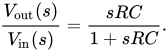
The product of the resistance and capacitance (R×C) is the time constant (τ); it is inversely proportional to the cutoff frequency fc, that is,
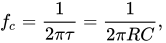
where fc is in hertz, τ is in seconds, R is in ohms, and C is in farads. At the cutoff frequency, the filter's frequency response reaches -3dB referenced to the gain at an infinite frequency.
First-order active
[edit].svg)
Figure 2 shows an active electronic implementation of a first-order high-pass filter using an operational amplifier. The transfer function of this linear time-invariant system is:
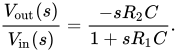
In this case, the filter has a passband gain of −R2/R1 and has a cutoff frequency of
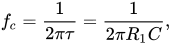
Because this filter is active, it may have non-unity passband gain. That is, high-frequency signals are inverted and amplified by R2/R1.
All of these first-order high-pass filters are called differentiators, because they perform differentiation for signals whose frequency band is well below the filter's cutoff frequency.
| Linear analog electronic filters |
|---|
Higher orders
[edit]Filters of higher order have steeper slope in the stopband, such that the slope of nth-order filters equals 20n dB per decade. Higher order filters can be achieved simply by cascading these first order filters. While impedance matching and loading must be taken into account when chaining passive filters, active filters can be easily chained because the signal is restored by the output of the op amp at each stage. Various filter topologies and network synthesis filters for higher orders exist, which ease design.
Discrete-time realization
[edit]Discrete-time high-pass filters can also be designed. Discrete-time filter design is beyond the scope of this article; however, a simple example comes from the conversion of the continuous-time high-pass filter above to a discrete-time realization. That is, the continuous-time behavior can be discretized.
From the circuit in Figure 1 above, according to Kirchhoff's Laws and the definition of capacitance:
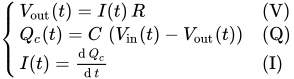
where is the charge stored in the capacitor at time . Substituting Equation (Q) into Equation (I) and then Equation (I) into Equation (V) gives:


This equation can be discretized. For simplicity, assume that samples of the input and output are taken at evenly spaced points in time separated by time. Let the samples of be represented by the sequence , and let be represented by the sequence which correspond to the same points in time. Making these substitutions:






And rearranging terms gives the recurrence relation

That is, this discrete-time implementation of a simple continuous-time RC high-pass filter is

By definition, . The expression for parameter yields the equivalent time constant in terms of the sampling period and :


- .
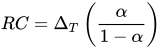
Recalling that
- so


then and are related by:


and
- .
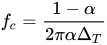
If , then the time constant equal to the sampling period. If , then is significantly smaller than the sampling interval, and .


Algorithmic implementation
[edit]The filter recurrence relation provides a way to determine the output samples in terms of the input samples and the preceding output. The following pseudocode algorithm will simulate the effect of a high-pass filter on a series of digital samples, assuming equally spaced samples:
// Return RC high-pass filter output samples, given input samples,
// time interval dt, and time constant RC
function highpass(real[1..n] x, real dt, real RC)
    var real[1..n] y
    var real α := RC / (RC + dt)
    y[1] := x[1]
    for i from 2 to n
        y[i] := α × y[i−1] + α × (x[i] − x[i−1])
    return y
The loop which calculates each of the outputs can be refactored into the equivalent:

    for i from 2 to n
        y[i] := α × (y[i−1] + x[i] − x[i−1])
However, the earlier form shows how the parameter α changes the impact of the prior output y[i-1] and current change in input (x[i] - x[i-1]). In particular,
- A large α implies that the output will decay very slowly but will also be strongly influenced by even small changes in input. By the relationship between parameter α and time constant above, a large α corresponds to a large and therefore a low corner frequency of the filter. Hence, this case corresponds to a high-pass filter with a very narrow stopband. Because it is excited by small changes and tends to hold its prior output values for a long time, it can pass relatively low frequencies. However, a constant input (i.e., an input with {{{1}}}) will always decay to zero, as would be expected with a high-pass filter with a large .
- A small α implies that the output will decay quickly and will require large changes in the input (i.e., (x[i] - x[i-1]) is large) to cause the output to change much. By the relationship between parameter α and time constant above, a small α corresponds to a small and therefore a high corner frequency of the filter. Hence, this case corresponds to a high-pass filter with a very wide stopband. Because it requires large (i.e., fast) changes and tends to quickly forget its prior output values, it can only pass relatively high frequencies, as would be expected with a high-pass filter with a small .
Applications
[edit]Audio
[edit]High-pass filters have many applications. They are used as part of an audio crossover to direct high frequencies to a tweeter while attenuating bass signals which could interfere with, or damage, the speaker. When such a filter is built into a loudspeaker cabinet it is normally a passive filter that also includes a low-pass filter for the woofer and so often employs both a capacitor and inductor (although very simple high-pass filters for tweeters can consist of a series capacitor and nothing else). As an example, the formula above, applied to a tweeter with a resistance of 10 Ω, will determine the capacitor value for a cut-off frequency of 5 kHz. , or approx 3.2 μF.

An alternative, which provides good quality sound without inductors (which are prone to parasitic coupling, are expensive, and may have significant internal resistance) is to employ bi-amplification with active RC filters or active digital filters with separate power amplifiers for each loudspeaker. Such low-current and low-voltage line level crossovers are called active crossovers.[1]
Rumble filters are high-pass filters applied to the removal of unwanted sounds near to the lower end of the audible range or below. For example, noises (e.g., footsteps, or motor noises from record players and tape decks) may be removed because they are undesired or may overload the RIAA equalization circuit of the preamp.[1]
High-pass filters are also used for AC coupling at the inputs of many audio power amplifiers, for preventing the amplification of DC currents which may harm the amplifier, rob the amplifier of headroom, and generate waste heat at the loudspeakers voice coil. One amplifier, the professional audio model DC300 made by Crown International beginning in the 1960s, did not have high-pass filtering at all, and could be used to amplify the DC signal of a common 9-volt battery at the input to supply 18 volts DC in an emergency for mixing console power.[2] However, that model's basic design has been superseded by newer designs such as the Crown Macro-Tech series developed in the late 1980s which included 10 Hz high-pass filtering on the inputs and switchable 35 Hz high-pass filtering on the outputs.[3] Another example is the QSC Audio PLX amplifier series which includes an internal 5 Hz high-pass filter which is applied to the inputs whenever the optional 50 and 30 Hz high-pass filters are turned off.[4]

Mixing consoles often include high-pass filtering at each channel strip. Some models have fixed-slope, fixed-frequency high-pass filters at 80 or 100 Hz that can be engaged; other models have sweepable high-pass filters, filters of fixed slope that can be set within a specified frequency range, such as from 20 to 400 Hz on the Midas Heritage 3000, or 20 to 20,000 Hz on the Yamaha M7CL digital mixing console. Veteran systems engineer and live sound mixer Bruce Main recommends that high-pass filters be engaged for most mixer input sources, except for those such as kick drum, bass guitar and piano, sources which will have useful low-frequency sounds. Main writes that DI unit inputs (as opposed to microphone inputs) do not need high-pass filtering as they are not subject to modulation by low-frequency stage wash—low frequency sounds coming from the subwoofers or the public address system and wrapping around to the stage. Main indicates that high-pass filters are commonly used for directional microphones which have a proximity effect—a low-frequency boost for very close sources. This low-frequency boost commonly causes problems up to 200 or 300 Hz, but Main notes that he has seen microphones that benefit from a 500 Hz high-pass filter setting on the console.[5]
Image
[edit]
High-pass and low-pass filters are also used in digital image processing to perform image modifications, enhancements, noise reduction, etc., using designs done in either the spatial domain or the frequency domain.[6] The unsharp masking, or sharpening, operation used in image editing software is a high-boost filter, a generalization of high-pass.
See also
[edit]References
[edit]- ^ a b c Watkinson, John (1998). The Art of Sound Reproduction. Focal Press. pp. 268, 479. ISBN 0-240-51512-9. Retrieved March 9, 2010.
- ^ Andrews, Keith; posting as ssltech (January 11, 2010). "Re: Running the board for a show this big?". Recording, Engineering & Production. ProSoundWeb. Archived from the original on 15 July 2011. Retrieved 9 March 2010.
- ^ "Operation Manual: MA-5002VZ" (PDF). Macro-Tech Series. Crown Audio. 2007. Archived from the original (PDF) on January 3, 2010. Retrieved March 9, 2010.
- ^ "User Manual: PLX Series Amplifiers" (PDF). QSC Audio. 1999. Archived from the original (PDF) on February 9, 2010. Retrieved March 9, 2010.
- ^ Main, Bruce (February 16, 2010). "Cut 'Em Off At The Pass: Effective Uses Of High-Pass Filtering". Live Sound International. Framingham, Massachusetts: ProSoundWeb, EH Publishing.
- ^ Paul M. Mather (2004). Computer processing of remotely sensed images: an introduction (3rd ed.). John Wiley and Sons. p. 181. ISBN 978-0-470-84919-4.
External links
[edit]
- Common Impulse Responses
- ECE 209: Review of Circuits as LTI Systems, a short primer on the mathematical analysis of (electrical) LTI systems.
- ECE 209: Sources of Phase Shift, an intuitive explanation of the source of phase shift in a high-pass filter. Also verifies simple passive LPF transfer function by means of trigonometric identity.
High-pass filter
View on GrokipediaFundamentals
Definition and Purpose
A high-pass filter is a signal processing device or circuit that permits signals with frequencies higher than a designated cutoff frequency to pass through with minimal attenuation, while significantly reducing the amplitude of lower-frequency signals.[6] This selective frequency response makes it essential in various engineering domains, including electronics, audio processing, and communications.[7] The primary purpose of a high-pass filter is to eliminate undesirable low-frequency components from a signal, such as direct current (DC) offsets, low-frequency noise, or mechanical rumble, thereby enhancing the clarity and integrity of higher-frequency content. For instance, in audio applications, it removes bass rumble from recordings without affecting treble details, and in instrumentation, it isolates transient events from baseline drifts.[8] In an ideal high-pass filter, the frequency response forms a sharp step function, offering complete attenuation below the cutoff frequency and full transmission (unity gain) above it; practical implementations, however, feature a transitional roll-off region where attenuation decreases gradually over a finite bandwidth.[9] Intuitively, a high-pass filter operates like a sieve that blocks fine particles representing low frequencies but allows coarser ones symbolizing high frequencies to flow through unimpeded. The foundational concepts underlying high-pass filters emerged in early 20th-century electrical engineering, with practical deployments in telephony by the 1920s, driven by innovations in electric wave filters for frequency separation in communication lines.[10]Transfer Function and Frequency Response
The transfer function of a first-order continuous-time high-pass filter in the s-domain is given by where is the complex frequency variable and is the cutoff angular frequency.[11] This form indicates a zero at , which emphasizes high-frequency components, and a pole at , which determines the filter's time constant. To obtain the frequency response, substitute , yielding The magnitude response is which approaches 0 as (attenuating low frequencies) and 1 as (passing high frequencies unattenuated).[12] The phase response is starting at radians (90°) for low frequencies and approaching 0 radians for high frequencies.[13] The cutoff frequency (or in hertz) is defined as the angular frequency where the magnitude response equals , corresponding to the -3 dB point where the power transfer is half of the maximum.[14] Substituting into the magnitude equation gives , confirming this definition. In the Bode plot, the magnitude response exhibits asymptotic behavior: for , (a straight line with slope +20 dB/decade on a logarithmic scale), and for , it is approximately flat at 0 dB. The phase plot transitions smoothly from +90° to 0° around . This +20 dB/decade roll-off rate in the stopband (low frequencies) is characteristic of first-order filters.[15] The time-domain impulse response for the first-order high-pass filter, obtained via the inverse Laplace transform of , is , where is the Dirac delta function and is the unit step function.[16] This reflects an initial impulse followed by an exponential decay, effectively differentiating low-frequency components while preserving high ones. For higher-order high-pass filters, the impulse response exhibits an oscillatory nature due to complex conjugate poles, leading to ringing artifacts near the cutoff.[17]Analog Implementations
First-Order Passive Circuits
A first-order passive high-pass filter can be implemented using either an RC or RL configuration, both of which rely on the frequency-dependent impedance of passive components to attenuate low-frequency signals while passing higher frequencies. These circuits are lossy, drawing no external power, and provide unity gain in the passband without amplification. In the RC high-pass filter, the capacitor is placed in series with the input voltage , and the resistor is connected in parallel (shunt) to ground at the output node, where is measured across .[18] The circuit acts as a voltage divider, with the capacitor's impedance dominating at low frequencies (high impedance, blocking the signal) and the resistor's fixed impedance dominating at high frequencies (low capacitor impedance, allowing ).[18] The transfer function is derived as: where the cutoff angular frequency is , marking the -3 dB point where the magnitude response drops to of the passband value.[18] The magnitude response qualitatively shows high attenuation near DC (approaching 0 magnitude or -∞ dB gain as ) and flat unity gain for , with a roll-off of +20 dB/decade in the stopband.[18] For practical design, component values are selected based on the desired cutoff frequency . For example, to achieve kHz with k, the required capacitance is F, ensuring the filter blocks frequencies below 1 kHz while passing higher ones. The RL high-pass filter consists of a resistor in series with and an inductor shunted to ground, with across .[18] Here, the inductor's impedance is low at low frequencies (shorting the output to ground) and high at high frequencies (allowing the signal to pass through ).[18] The transfer function is similarly derived via voltage division: with cutoff .[18] The frequency response mirrors the RC case, featuring low-frequency attenuation and high-frequency passband unity gain, though RL circuits are less common in low-frequency applications due to bulky inductors.[18] Passive first-order high-pass filters have inherent limitations, including no voltage gain (potentially attenuating signals in the passband due to resistive losses) and high sensitivity to source and load impedances, which can alter the cutoff frequency if the load is not much larger than .[3] Additionally, without buffering, these circuits require careful impedance matching to maintain performance.[3]First-Order Active Circuits
Active first-order high-pass filters incorporate operational amplifiers (op-amps) to overcome limitations of passive designs, such as signal attenuation and loading effects, by providing amplification and buffering capabilities.[14] In the non-inverting configuration, a passive high-pass network—consisting of a series capacitor connected to the non-inverting input of the op-amp, with a shunt resistor from the non-inverting input to ground—precedes a non-inverting amplifier stage. The op-amp's output is fed back to the inverting input through a resistor divider for adjustable gain. This setup yields a transfer function of where is the time constant, is the DC gain set by feedback resistors and , and the cutoff frequency is .[14] The magnitude response matches that of the passive counterpart but scaled by , allowing gains greater than unity while maintaining a -3 dB roll-off at . The inverting configuration routes the input signal through a series capacitor to the inverting input, with a resistor connected from the inverting input to ground and a feedback resistor from the output to the inverting input; the non-inverting input is grounded. This produces a transfer function with , cutoff frequency , and high-frequency gain .[14] For unity gain buffering in the non-inverting case, direct connection from output to inverting input simplifies the circuit, eliminating the need for feedback resistors while preserving high input impedance.[14] These active realizations offer key advantages over passive first-order circuits, including high input impedance (preventing signal loading from preceding stages), low output impedance (enabling direct drive of subsequent loads), and the ability to achieve gains exceeding 1 without additional components.[14] Unlike passive filters, which inherently attenuate signals by -3 dB at the cutoff and provide no amplification, active designs maintain signal integrity and versatility in gain adjustment.[14] Practical implementation assumes an ideal op-amp with infinite open-loop gain, infinite bandwidth, infinite input impedance, zero output impedance, and zero offset voltage; real op-amps deviate from these, introducing limitations such as finite bandwidth that can distort the filter response at frequencies approaching the op-amp's gain-bandwidth product (typically 1-10 MHz for general-purpose devices).[19] Component tolerances in and (1-5% for standard values) also affect accuracy, necessitating precision parts for critical applications.[20]| Aspect | Passive First-Order | Active First-Order (Non-Inverting) |
|---|---|---|
| Gain Capability | ≤ 1 (attenuating) | > 1 (adjustable via ) |
| Input Impedance | Low (≈ ) | High (≈ infinite due to op-amp) |
| Output Impedance | High (≈ ) | Low (≈ zero due to op-amp) |
| Component Count | 2 (R, C) | 3+ (R, C, op-amp, optional resistors) |
| Loading Effects | Significant | Minimal |
Higher-Order Circuits
Higher-order high-pass filters achieve sharper frequency selectivity by cascading multiple first-order or second-order stages, extending the basic principles of single-stage designs to multi-stage analog configurations. A second-order high-pass filter, for instance, can be constructed by cascading two first-order stages, resulting in the transfer function , where is the cutoff angular frequency. For an n-th order filter, the transfer function becomes the product of n such first-order terms, though practical realizations often group them into second-order sections for stability and ease of implementation. This cascading approach multiplies the attenuation in the stopband, providing greater rejection of low frequencies compared to lower-order filters.[21][22] Among common approximations, the Butterworth response is favored for its maximally flat magnitude in the passband, with poles equally spaced on a circle in the left half of the s-plane. The magnitude response for an n-th order Butterworth high-pass filter is given by for , ensuring a smooth transition without ripples in the passband. In contrast, Chebyshev filters provide a steeper roll-off by introducing controlled ripples, making them suitable for applications requiring rapid attenuation. Chebyshev Type I filters exhibit equiripple behavior in the passband with a monotonic stopband, while Type II (inverse Chebyshev) filters have a monotonic passband and equiripple minima in the stopband, both offering improved selectivity over Butterworth designs at the cost of passband or stopband variations.[21][23][24] The design process for higher-order high-pass filters involves determining pole-zero placements from low-pass prototypes via frequency transformations, such as replacing with to convert low-pass to high-pass responses. These poles are then realized using cascaded active stages, commonly the Sallen-Key topology for second-order sections, where component values (resistors and capacitors) are scaled to match the desired quality factor (Q) and natural frequency for each stage. For example, a fourth-order Butterworth high-pass filter might consist of two cascaded Sallen-Key second-order stages, each tuned to contribute to the overall pole configuration, yielding an asymptotic roll-off of 80 dB/decade (20n dB/decade generally). This topology uses unity-gain op-amps for simplicity, with capacitor and resistor ratios set to achieve the required damping.[25][26][21] Despite their advantages, higher-order filters introduce trade-offs, including increased phase distortion due to the cumulative phase shifts across stages, which can result in nonlinear phase responses and waveform distortion for broadband signals. Phase shift in each second-order stage approaches 180° in the stopband, leading to greater group delay variations in higher orders. Additionally, sensitivity to component tolerances rises with filter order and Q-factor, as small variations in resistors or capacitors can significantly alter pole positions, necessitating precision components (e.g., 1% tolerance) to maintain performance. These sensitivities are particularly pronounced in Sallen-Key realizations for high-Q sections, often requiring simulation or trimming for accuracy.[27][28][22]Digital Implementations
Infinite Impulse Response (IIR) Filters
Infinite impulse response (IIR) filters are a class of digital filters where the output signal at any given time depends not only on current and past input samples but also on past output samples, resulting in a recursive structure. The general transfer function for an IIR filter in the z-domain is expressed as where the numerator coefficients define the zeros and the denominator coefficients define the poles, allowing the filter to approximate analog filter characteristics with finite-order rational functions.[29] A primary method for designing digital high-pass IIR filters involves the bilinear transform, which converts an analog filter transfer function to the digital domain by substituting , where is the sampling interval. This mapping conformally transforms the left half of the s-plane to the interior of the unit circle in the z-plane, preserving stability. To compensate for frequency warping, pre-warping adjusts the analog cutoff frequency to , ensuring the digital filter's cutoff aligns accurately with the desired response without aliasing.[30] For a first-order high-pass IIR filter derived via the bilinear transform from a first-order analog prototype, the transfer function simplifies to with the pole parameter related to the digital cutoff frequency by , ensuring a |3 dB| attenuation at and a zero at DC (z=1) to block low frequencies.[31] Higher-order high-pass IIR filters are typically realized using structures like Direct Form I, which separates the non-recursive (FIR) and recursive (all-pole) sections, or Direct Form II, which minimizes delay elements by cascading the sections. Stability requires all poles to lie strictly inside the unit circle (|z| < 1), verified through pole-zero analysis or Jury stability criteria. Common design approaches include impulse invariance, which discretizes the analog impulse response via to preserve time-domain characteristics, though it may introduce aliasing for high-pass filters; and digitization of classical prototypes such as Butterworth (maximally flat passband) or Chebyshev (equiripple passband) filters using the bilinear transform after applying an analog low-pass to high-pass transformation . For a second-order Butterworth high-pass filter with a normalized digital cutoff of , the bilinear transform yields example coefficients , , providing a sharp roll-off with -3 dB at the cutoff.[32] IIR high-pass filters excel in computational efficiency, requiring only N+1 multiplications per output sample for an Nth-order filter due to recursion, enabling real-time processing on resource-constrained hardware. However, they are prone to instability from finite-precision arithmetic pushing poles outside the unit circle and exhibit nonlinear phase distortion, which can alter signal timing compared to linear-phase alternatives.[29]Finite Impulse Response (FIR) Filters
Finite impulse response (FIR) filters produce an output that is a finite weighted sum of current and past input samples, without feedback from previous outputs, making them non-recursive structures. The transfer function of an FIR filter is a polynomial in z^{-1}, expressed as where M is the filter order and the b_k are the filter coefficients that determine the frequency response. This feedforward nature distinguishes FIR filters from recursive infinite impulse response (IIR) filters, providing inherent advantages in digital high-pass filter implementations.[33] A primary method for designing high-pass FIR filters is the windowing technique, which approximates the ideal brick-wall frequency response by truncating its inverse Fourier transform—the sinc function shifted by the cutoff frequency—and applying a tapering window to mitigate truncation effects like ringing. For a high-pass filter with cutoff frequency ω_c, the ideal impulse response h_d is given by δ[n - M/2] - (sin(ω_c (n - M/2))/π (n - M/2)) for n = 0 to M; this is then windowed using functions like the Hamming window w = 0.54 - 0.46 cos(2π n / M) or Blackman window for better sidelobe suppression. The resulting coefficients b_k = h_d w yield a linear-phase high-pass response with controlled passband ripple and stopband attenuation.[34][35] The frequency sampling method offers an alternative for high-pass FIR design by directly specifying the desired frequency response H(e^{jω}) at uniformly spaced discrete frequencies corresponding to the DFT bins, typically setting H = 0 for ω < ω_c and H = e^{-j ω (M/2)} for ω ≥ ω_c to ensure linear phase. The coefficients are then computed via the inverse discrete Fourier transform (IDFT): b_l = (1/N) ∑_k H_k e^{j 2π k l / N} for l = 0 to M, where N = M+1. This approach is particularly useful for filters with irregular frequency responses and allows interpolation for finer grid resolution to improve accuracy.[36][37] High-pass FIR filters are categorized into four linear-phase types based on coefficient symmetry and filter length, influencing their suitability for specific responses. Type I filters (odd length, symmetric coefficients) support general high-pass characteristics with non-zero response at both DC and Nyquist frequencies. Type II (even length, symmetric) have zero response at Nyquist, limiting their use for high-pass filters unless the passband avoids Nyquist. Type III (odd length, antisymmetric) and Type IV (even length, antisymmetric) exhibit zero response at DC, making Type IV viable for high-pass differentiators but less common for standard high-pass due to phase constraints. For a typical high-pass with cutoff f_c = 0.2 f_s, a Type I 11-tap filter (M=10, odd length) designed via windowing provides symmetric coefficients ensuring exact linear phase and stability. An example set of such coefficients, computed using the Hamming window, yields symmetric values ensuring linear phase and DC rejection, providing a passband from 0.2 f_s to f_s with about 40 dB stopband attenuation.[38][35] FIR filters possess key properties that make them preferable for high-pass applications: they are always stable since all poles are at the origin (no feedback), and exact linear phase is achievable with symmetric (Type I/II) or antisymmetric (Type III/IV) coefficients, preserving waveform shape in the passband. However, they impose a higher computational burden than IIR filters, requiring M+1 multiplications and additions per output sample. In contrast to IIR filters, which may suffer instability from pole placement, FIR designs guarantee BIBO stability.[33] The trade-offs in FIR high-pass filters include the need for longer lengths (higher M) to achieve sharp transition bands and low ripple, leading to increased delay (group delay = M/2 samples) and resource usage in hardware. Unlike IIR filters that often rely on analog prototype transformations like bilinear mapping, FIR designs enable direct specification in the digital domain without such approximations, offering flexibility for custom responses but at the cost of efficiency.[39]Applications
Audio Signal Processing
In audio signal processing, high-pass filters are essential for removing unwanted low-frequency components from signals, thereby enhancing clarity and preventing issues like distortion or equipment damage. These filters allow frequencies above a specified cutoff to pass through while attenuating those below, making them invaluable in recording, mixing, and live sound applications. DC blocking is a primary use of first-order high-pass filters in audio systems, where they eliminate direct current offsets introduced by microphones or preamplifiers, which could otherwise cause baseline shifts and intermodulation distortion. Typically, these filters employ a cutoff frequency (f_c) between 5 and 20 Hz to block DC and very low frequencies without significantly affecting audible bass content. For instance, in professional audio interfaces, a simple RC high-pass circuit with a 10 Hz cutoff is commonly implemented to maintain signal integrity during analog-to-digital conversion. Rumble and hum removal often involves combining a high-pass filter with a 60 Hz notch filter (or 50 Hz in regions with 50 Hz mains power) to suppress mechanical vibrations and electrical interference in audio recordings. In vinyl playback systems, a high-pass filter with a cutoff around 20-30 Hz effectively eliminates turntable rumble, preserving the integrity of the musical signal while a notch targets power-line hum. This combination is standard in phono preamplifiers to ensure clean reproduction of analog sources. In equalization (EQ), high-pass filters form the basis of parametric high-pass shelves used in mixing to cut excessive bass and reduce low-end buildup, allowing engineers to sculpt the frequency balance of tracks. Digital audio workstations (DAWs) like Pro Tools implement these as infinite impulse response (IIR) or finite impulse response (FIR) high-pass filters, enabling precise control over slope and frequency for applications such as cleaning up vocal or instrument recordings. A typical setup might apply a 12 dB/octave high-pass shelf at 80 Hz to attenuate sub-bass mud without dulling the overall tone. For live sound reinforcement, subsonic filtering via high-pass filters protects loudspeakers from inaudible low frequencies that could cause over-excursion and damage, particularly in woofer drivers. High-passing in audio systems involves cutting low frequencies, for example around 80-120 Hz, using digital signal processing (DSP) in speakers to protect drivers and direct bass to subwoofers.[40][41] Crossover networks in PA systems use high-pass filters to separate high frequencies (e.g., above 80-100 Hz) for full-range or tweeter drivers, directing low frequencies to subwoofers and improving overall efficiency and sound quality. Butterworth or Linkwitz-Riley alignments are favored for their flat response in these multi-way systems. Psychoacoustically, high-pass filters help preserve sharp transients and attack in audio signals by attenuating low-end mud that masks midrange details, leading to a more defined and spacious soundstage. In mixing workflows, A/B testing—comparing filtered versus unfiltered versions—demonstrates how a gentle high-pass roll-off can enhance perceived clarity; for example, applying a 6 dB/octave filter at 40 Hz on a drum bus reduces boominess while retaining punch, as validated in listener preference studies. Phono preamplifiers implementing RIAA equalization, which boosts low frequencies during playback to compensate for attenuation during the recording process, often include a separate high-pass filter to counter residual rumble and subsonic noise. This rumble filter is typically placed after the RIAA stage to prevent amplification of low-frequency noise, ensuring accurate reproduction across the audio spectrum.[42]Image Processing
In image processing, high-pass filters operate in the two-dimensional spatial domain to emphasize high-frequency components, such as edges and fine details, while attenuating low-frequency regions like smooth backgrounds. This is achieved by extending one-dimensional filter concepts to 2D convolution operations on image pixels. Unlike temporal filtering in audio, spatial high-pass filtering enhances visual discontinuities, making it essential for tasks requiring contrast amplification in static images. A common implementation in the spatial domain uses finite impulse response (FIR) kernels, which are small matrices convolved with the image to produce the filtered output. The discrete Laplacian operator serves as a foundational high-pass kernel for edge detection, approximating the second spatial derivative to highlight intensity transitions. A standard 3x3 Laplacian kernel is: 0 -1 0
-1 4 -1
0 -1 0
  0  -1   0
 -1   4  -1
  0  -1   0