Hubbry Logo
SugerSugerMain
Open search
Suger
Community hub
Suger
logo
8 pages, 0 posts
0 subscribers
Be the first to start a discussion here.
Suger
Suger
from Wikipedia

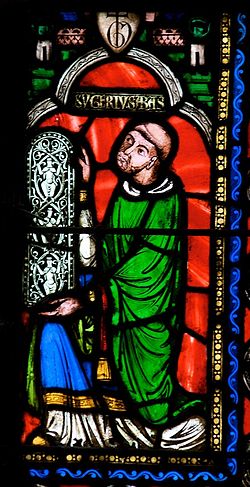
Suger (/sˈʒɛər/;[2] French: [syʒɛʁ]; Latin: Sugerius; c. 1081 – 13 January 1151) was a French abbot and statesman. He was a key advisor to King Louis VI and his son Louis VII, acting as the latter's regent during the Second Crusade. His writings remain seminal texts for early twelfth-century Capetian history, and his reconstruction of the Basilica of Saint-Denis, where he was abbot, was instrumental in creating the Gothic architecture style.

Key Information

Early life

[edit]

Suger was born into a family of minor knights c. 1081 (or 1080), landholders at Chennevières-lès-Louvres, a small village surrounding Saint-Denis in northern Parisis.[3] Suger was one of the younger sons in a family of some substance and upwardly connections where many went into the church, and so he was given as an oblate to the abbey of St. Denis at age ten in 1091. He first trained at the priory of Saint-Denis de L'Estrée for about a decade, where he would have first met the future king Louis VI of France.[note 1] Suger took up the oblate life relatively easily, and showed strong ability including in Latin and a firm grasp of legal matters. This ability led to him being chosen to work in the abbey archives to find documents that could protect the abbey from usurpation by Bouchard II of Montmorency, where historians speculate of his involvement in the appearance of a forged charter—if this was Suger's work, then it is certainly a fitting reflection and early example of his close admiration of the abbey.[note 2]

Suger began a successful career in monastic administration as he went on several missions for his abbey, which held land at several vantage points across the country. Finding favour with the abbot of Saint-Denis, Abbot Adam, Suger's political career would develop under him as in 1106 he became his secretary.[note 3] Suger found himself involved in significant events: in the same year, he was at the synod at Poitiers; in the Spring of 1107 to attend Pope Paschal II; in 1109, where he met Louis VI again as he sat a dispute between the king and Henry I of England, and; in 1112 at Rome for the second Lateran council. During this time, he held administrative roles that required him to be first at Berneval in Normandy in 1108 as provost, then from mid-1109 to 1111 provost to the more important priory of Toury. The area was suffering as a result of Hugh III of Le Puiset's exploitation of revenues, with a series of disputes and failing alliances eventually led to Suger gaining experience on the battlefield.[4] He appeared to take up this new challenge well and was successful, though would go on to heavily regret his involvement in warfare by his sixties.[5] There is a complete gap in sources on Suger's whereabouts after he left Toury in 1112,[6] though he was likely advancing his monastic position alongside working on further negotiations.

It is from 1118 when the sources start again, where Suger is deeply entrenched in royal affairs. He is chosen as the royal envoy to welcome the fleeing Pope Gelasius II (John of Gaetani) to France and arrange a meeting with Louis VI.[note 4] Suger was sent to live at the court of Gelasius at Maguelonne, and later at his successor Pope Calixtus II's court in Italy in 1121. It was on his return from in March 1122 that Suger, now 41, learned of Abbot Adam's death and that the others at the abbey had elected him to be the new abbot. Suger took pride in the fact that this happened in his absence and without his knowledge—whilst Louis was initially enraged at the fact that the decision was made without him being consulted first, he was clearly content with Suger assuming the role, as the two enjoyed a strong working relationship.

Court life and influence

[edit]

Suger served as the friend and counsellor to both Louis VI and Louis VII. Until 1127, he occupied himself at court mainly with the temporal affairs of the kingdom, while during the following decade he devoted himself to the reorganization and reform of St-Denis.

Suger and Louis VI (1122–37)

[edit]

Suger and Louis VII (1137–49)

[edit]

In 1137, he accompanied the future king, Louis VII, into Aquitaine on the occasion of that prince's marriage to Eleanor of Aquitaine, and during the Second Crusade served as one of the regents of the kingdom (1147–1149). He bitterly opposed the king's divorce, having himself advised the marriage. Although he disapproved of the Second Crusade, he himself, at the time of his death, had started preaching a new crusade.

Suger, the Regent (1147–9)

[edit]

Though Suger was openly against[7] Louis VII's intention announced in 1145 to lead a crusade to rescue the Kingdom of Jerusalem, a council in February 1147 elected Suger to be a regent.[note 5] One of the reasons Suger was opposed to the crusade were the issues present in France at the time: Louis VII wrote shortly after setting out to ensure protection of Gisors, and only six weeks after his expedition, asking for money, asking Suger to use some from his own resources if necessary.[note 6]

He urged the king to destroy the feudal bandits, was responsible for the royal tactics in dealing with the communal movements, and endeavoured to regularize the administration of justice. He left his abbey, which possessed considerable property, enriched and embellished by the construction of a new church built in the nascent Gothic style. Suger wrote extensively on the construction of the abbey in Liber de Rebus in Administratione sua Gestis, Libellus Alter de Consecratione Ecclesiae Sancti Dionysii, and Ordinatio.

Suger's final years (1149–51) and legacy

[edit]

After the regency, Louis VII and his contemporaries still consulted Suger on matters ecclesiastical and political, and he was asked to defend in a number of cases at court. At this point, Suger was also being assigned cases to work on lone which would otherwise be given to an episcopal commission to deal with lone; Louis VII also gave to Suger the task of resolving two episcopal elections, at which point Suger practically continued to hold the same level of control over the church of France as he would have had as regent.[8] Following the failure of the Second Crusade and letters from the Jerusalem and Pope Eugenius, Suger proposed a new crusade at a convention in Laon in 1150, with the support of Louis and St Bernard. The aim was to have a crusade run by the French church to do what the secular powers failed to do, led by Suger.[9] Support for this fell apart from many churchmen, including the Pope losing belief in the pursuit and advising the king to remain in France to settle local issues. The matter troubled Suger to his final year of his life, at which point he nominated an (unnamed) nobleman to take his stead in battle, though it ultimately did not materialise as the idea was likely shelved by that point.[10]

Suger's final year continued to be busy for him, as he was instructed by the pope to reform Saint Corneille at Compiègne. Odo of Deuil's appointment as abbot had the backing of Louis VII and Suger, though after the two left, it was met with violent resistance by the canons (as was the case at Sainte-Geneviève).

Today, a French street is named after Suger, and two schools bear his name (Lycée Suger [fr] in Saint-Denis, and École secondaire Suger in Vaucresson).

Contribution to the arts

[edit]
Gothic ambulatory at Saint-Denis

Abbey of Saint-Denis

[edit]

The Abbey of Saint-Denis was, even prior to Suger's abbacy, a significant site, with a long tradition of royal burials dating back to the sixth century. Thus, when Suger was appointed to be its abbot, the tie between monarchy and church became even closer. Ideas to renovate the small and aging abbey arose as early as 1124, when he began to take in funds for the project—but work on the full rebuild as did not begin until 1137. The idea of a full rebuild, and what it should look like, was less a single moment and more a gradual development over time, as his ideas developed further. Early ideas were sporadic and undeveloped, with Suger mostly preoccupied with state affairs. Ground was first broken in 1130 to rebuild the old nave, with ideas of importing in classical columns from Rome, though this was an act rendered moot by the eventual decision for a full rebuild. The rebuild was not something Suger could have given much of his time to until the death of Louis VI and ascension of his son Louis VII, who wished to have his own set of advisors alongside his father's.

Suger began with the West front, reconstructing the original Carolingian façade with its single door. He designed the façade of Saint-Denis to be an echo of the Roman Arch of Constantine with its three-part division and three large portals to ease the problem of congestion. The rose window above the West portal is the earliest-known such example, although Romanesque circular windows preceded it in general form.[citation needed]

At the completion of the west front in 1140, Abbot Suger moved on to the reconstruction of the eastern end, leaving the Carolingian nave in use. He designed a choir (chancel) that would be suffused with light.[note 7][note 8] To achieve his aims, his masons drew on the several new features which evolved or had been introduced to Romanesque architecture, the pointed arch, the ribbed vault, the ambulatory with radiating chapels, the clustered columns supporting ribs springing in different directions and the flying buttresses which enabled the insertion of large clerestory windows.[citation needed]

The new structure was finished and dedicated on 11 June 1144,[12] in the presence of the King. The Abbey of Saint-Denis thus became the prototype for further building in the royal domain of northern France. It is often cited as the first building in the Gothic style. A hundred years later, the old nave of Saint-Denis was rebuilt in the Gothic style, gaining, in its transepts, two spectacular rose windows.[13]

Suger's collections

[edit]

Suger was also a patron of art. Among the liturgical vessels he commissioned are a gilt eagle, the King Roger decanter, a gold chalice and a sardonyx ewer.[citation needed] A chalice once owned by Suger is now in the collections of the National Gallery of Art in Washington, D.C., and the Eleanor of Aquitaine vase which he received that was subsequently offered to the saints at his abbey is now held in the Louvre in Paris, believed to be the only existing artefact of Eleanor's to exist today.

The vases de Suger series of commissioned vases
A gold cup
Chalice of Suger, with on onyx cup of the 2nd or 1st century BC.
A gold eagle metalwork surrounding a vase
Suger's Eagle, with a 2nd-century porphyry vase.
A vase, with a translucent crystal middle
Eleanor of Aquitaine vase, a rock crystal vase from 6th- or 7th-century Persian vessel.
A vase, with translucent body with bird patterning
Aiguière aux oiseaux ("Ewer with birds") with a 10th- or 11th-century Egyptian rock-crystal vessel.
A vase made of gem and hard stone; an ewer
Sardonyx ewer (Aiguière en Sardoine), with a vase possibly from 7th-century Byzantium.

Historiography

[edit]

Suger's writings

[edit]

Suger wrote several works, which are regarded for their accuracy and detail. Of these, two record his activities as abbot of St-Denis. The Libellus Alter de Consecratione Ecclesiae Sancti Dionysii (Other Little Book on the Consecration of Saint-Denis) is a short treatise on the building and consecration of the abbey church.[14] The Liber De Rebus in Administratione sua Gestis (Book on Events under his Administration) is an unfinished account of his administration of the abbey, which he started on request of his monks in 1145.[15] In these texts, he treats of the improvements he had made to St Denis, describes the treasure of the church, and gives an account of the rebuilding. Unlike other medieval texts recording the deeds of religious figures, Suger’s are written by himself.[16]

Of his histories, Vie de Louis le Gros (Life of Louis the Fat) is his most substantial and widely circulated. It is a panegyric chronological narrative of king Louis VI, primarily concerned with warfare, but also his dependence on the Saint-Denis abbey.[17] Historia gloriosi regis Ludovici (The Illustrious King Louis) is the other demonstrably unfinished work of Suger, accounting for the first year of Louis VII’s reign.[18] Written in Suger’s final years, it (like his other history) covers in great detail events where Suger was himself present or involved in.

Suger’s secretary, William, himself produced two works on Suger: the first, a letter shortly after his death announcing the death; the other a short biography (Sugerii Vita; The Life of Suger) authored between summer 1152 and autumn 1154.[19][note 9] A collection of Suger’s letters exist in Saint Denis, mostly from near the end of his life, though its provenance is unknown.[20] Suger's works served to imbue the monks of St Denis with a taste for history and called forth a long series of quasi-official chronicles.[21]

Suger in the Gothic tradition

[edit]

Suger is considered the forerunner of (French) Gothic architecture, where in its history he falls in the Early Gothic (Gothique primitif) period concentrated in the Île-de-France region of France. This new genre is seen as the progression of Romanesque architecture, though few of the key elements that define the Gothic tradition were particularly new as they were inspired by these very Romanesque elements, especially those of Normandy and Burgundy.[22] The key element that sets aside Gothic architecture from its predecessor is "the novelty of the spiritual message that was to be conveyed" using its "novel and anti-Romanesque" elements.[23]

Scholars tend to attribute Suger's influences on his ideas of symbolism and manner of symbolic thought to interpretations of Pseudo-Dionysius the Areopagite and the derivates of John Scotus Eriugena, as well as; those from the school of Chartres.[note 10] Where Erwin Panofsky made the claim that this theology of Pseudo-Dionysius influenced the architectural style of the abbey of St. Denis, it was questioned by later scholars who have argued against such a simplistic link between philosophy and architectural form.[note 11] Though Suger did not leave any explicitly theological writings, his work on Saint Denis was inspired by his own set of religious ideas influenced by a range of new or renewed theological themes in the wider context of twelfth-century France. The influence of the cosmology of the Chartres school, which resulted from interpretations of Plato and the Bible, created a speculative system which emphasised mathematics, particularly geometry, and the aesthetic outcomes that arise from the convergence of the two.[24][note 12]

Art historians paint Gothic architecture as Suger's own creation, though some question this: Similarly the assumption by 19th century French authors that Suger was the "designer" of St Denis (and hence the "inventor" of Gothic architecture) has been almost entirely discounted by more recent scholars. Instead he is generally seen as having been a bold and imaginative patron who encouraged the work of an innovative (but now unknown) master mason.[25][26] It is difficult to contextualise St-Denis to other buildings of the time and place, due to the fact that many churches in Capetian France between 1080 and 1160 were destroyed and/or rebuilt later,[27] combined with the fact that no other building of this period enjoyed the level of precision and detail of Suger's accounts of St-Denis. Thus, the Gothic style can be seen as a multiplicity of trends in the architecture of this period, some occasionally intersecting with others: Jean Bony describes it as "a happy accident of history; it would have been infinitely more normal if the Gothic had never appeared."[28][29]

Citations

[edit]

Notes

[edit]
  1. ^ Their friendship may have been shortlived for Louis had left the abbey's schooling in 1092: whilst it is not certain that the two were friends yet, it is not unlikely given the cozy number of students present. In 1124, Louis refers to Suger as a "faithful and familiar" companion (Jules Tardif, Monuments historiques, no. 391).
  2. ^ Lindy Grant, Abbot Suger of St-Denis: Church and State in Early Twelfth-Century France (Essex: Addison Wesley Longman, 1998) p. 80, fn. 30.
  3. ^ Suger has a tendency to downplay Abbot Adam's achievements: these are explored in Rolf Große, "L'abbé Adam, Prédécesseur De Suger," in Rolf Große, ed. Suger en question (Munich: Oldenbourg Wissenschaftsverlag, 2004) pp. 31–43. [in French] Free access icon
  4. ^ Pope Paschal II dies January 1118; John of Gaetani is made the new pope, becoming Gelasius II; Henry V marched on Rome and appointed Gregory (VIII) as an antipope; Gelasius fled to France to the protection of Louis VI.
  5. ^ Initially, Suger and William, count of Nevers were chosen in an election dominated by St Bernard, with the rationale as "twin swords—the ecclesiastical and securar—[to] protect the realm." William's imminent retirement as a monk meant that Ralph of Vermandois and, to a lesser degree, Archbishop Samson of Reims, to be co-regents with Suger. Grant, Church and State, 157.
  6. ^ "sive de nostro seu de vestro pecuniam sumptam nobis mittatis," [whether you send us money taken from us or from you,] in Recueil des Historiensdes Des Gaules et de la France, ed. Martin Bouquet et al. (Paris, 1869–1904) vol 15, p. 487.
  7. ^ When the new rear part is joined to that in front,
    The church shines, brightened in its middle.
    For bright is that which is brightly coupled with the bright
    And which the new light pervades,
    Bright is the noble work Enlarged in our time
    I, who was Suger, having been leader
    While it was accomplished.
    Abbot Suger: On What Was Done in His Administration c.1144–8, Chap XXVIII
  8. ^ Erwin Panofsky argued that Suger was inspired to create a physical representation of the Heavenly Jerusalem, however the extent to which Suger had any aims higher than aesthetic pleasure has been called into doubt by more recent art historians on the basis of Suger's own writings.
  9. ^ After Suger’s death, William’s leading of a faction against the new abbot at Saint Denis, Odo of Deuil, meant he was exiled. It was during exile that he authored the life of Suger; it was thus intended to portray Suger in good light, implicitly criticising Odo. Grant, Church and State, 44.
  10. ^ There are three Dionysiuses who have been confused and interchanged throughout history: Dionysius the Areopagite, an Athenian first century judge and saint; Pseudo-Dionysius the Areopagite, a Greek author of the fifth/sixth century who pseudepigraphically (falsely) identified as the former and wrote Christian theological and mystical works; and saint Dionysius of Paris, or Denis of Paris, after whom the abbey is named after.
  11. ^ For a summary of the 'arguments against' Panofsky's view, see Panofsky, Suger and St Denis, Peter Kidson, Journal of the Warburg and Courtauld Institutes, Vol. 50, (1987), pp. 1–17.
  12. ^ Further reading: Neoplatonism and Christianity#Middle_Ages, and von Simson, The Gothic Cathedral, pp. 25–39.

References

[edit]
  1. ^ Charles Higounet, La Grange de Vaulerent (Paris: S. E. V. P. E. N., 1965) p. 11. This is a history of the Vaulerent barn and its development, from which we learn that the land had previously belonged to the Suger de Chennevières family.
  2. ^ "Suger". Dictionary.com Unabridged (Online). n.d.
  3. ^ John F. Benton, "Suger's Life and Personality," in Paula Lieber Gerson, ed. Symposium (New York: The Metropolitan Museum of Art, 1986) p. 3. Free access icon
  4. ^ John France, Medieval France at War (Leeds: Arc Humanities Press, 2022) p. 79. OCLC WorldCat 1381142379.
  5. ^ In Ordinatio, he asks God to forgive "what I have done," and refers to himself as "clearly being an irreligious man." (trans. Panofsky, p. 123)
  6. ^ Grant, Suger: Church and State, p. 96.
  7. ^ Willelmus, Vita., 394.
  8. ^ Grant, Church and State, 278.
  9. ^ Grant, Church and State, 279.
  10. ^ Grant, Church and State, 280.
  11. ^ When it was decided in 1931 that the statues be moved to the birth places of their representatives, Suger's was moved to Saint-Omer from a local legend that he was born there. "Statue de l'abbé Suger". Saint Omer tourism office. Archived from the original on 12 June 2024.
  12. ^ Honour, H. and J. Fleming, (2009) A World History of Art. 7th edn. London: Laurence King Publishing, p. 376. ISBN 9781856695848
  13. ^ Wim Swaan, The Gothic Cathedral
  14. ^ Suger, Consc.
  15. ^ Suger, Admin., 155.
  16. ^ H. E. J. Cowdrey, The Age of Abbot Desiderius (Oxford: Oxford University Press, 1983) 13–6.
  17. ^ Suger, VLG.
  18. ^ Suger, Hist. VII.
  19. ^ Willelmus, Vita.
  20. ^ Grant, Church and State, 43–5.
  21. ^ Anne D. Hedeman, The Royal Image: Illustrations of the Grandes Chroniques de France, 1274-1422 (Berkeley: University of California Press, 1991) 3–6, 10. Free access icon
  22. ^ Otto von Simson, The Gothic Cathedral: Origins of Gothic Architecture and the Medieval Concept of Order, 3rd ed. (Princeton: Princeton University Press, 1988) 62.
  23. ^ von Simson, The Gothic Cathedral, 62.
  24. ^ von Simson, The Gothic Cathedral, pp. 26–7.
  25. ^ Conrad Rudolph, Artistic Change at St Denis: Abbot Suger's Program and the Early Twelfth Century Controversy Over Art, Princeton University Press, 1990
  26. ^ Kibler et al (eds) Medieval France: An Encyclopedia, Routledge, 1995
  27. ^ Take St-Meglorie, Ste-Genevie, and St-Victor in local Paris.
  28. ^ "[U]n hasard heureux de l'histoire. Il aurait été infiniment plus normal que le Gothique n'eût jamais paru," p. 11. Jean Bony, "Architecture gothique. Accident ou nécessité?" in Revuew de l'Art, LVIII-LVIX (1983) pp. 9–20.
  29. ^ Stephen Gardner, "L'église Saint-Julien de Marolles-en-Brie et ses rapports avec l'architecture Parisienne de la génération de Saint-Denis," in Bull Mon 153 (1995) pp. 23–46.

Bibliography

[edit]

Contemporary works

[edit]

Books

[edit]

Journal articles

[edit]
  • Hugenholtz, Frits, and Henk Teunis. "Suger's advice." Journal of Medieval History 12, no. 3 (1986), pp. 191–206. DOI: 10.1016/0304-4181(86)90031-X.
  • Inglis, Erik. "Remembering and Forgetting Suger at Saint-Denis, 1151–1534: An Abbot’s Reputation between Memory and History." Gesta 54, no. 2 (September 2015), pp. 219–43. JSTOR.
  • Kidson, Peter. "Panofsky, Suger and St Denis." Journal of the Warburg and Courtauld Institutes 50 (1987), pp. 1–17. JSTOR.
  • Rudolph, Conrad. "Inventing the Exegetical Stained-Glass Window: Suger, Hugh, and a New Elite Art." The Art Bulletin 93, no. 4 (December 2011), pp. 399–422. JSTOR.

Websites

[edit]

See also

[edit]
Revisions and contributorsEdit on WikipediaRead on Wikipedia
from Grokipedia
Suger (c. 1081–1151) was a French abbot, statesman, and architectural patron who led the Abbey of Saint-Denis from 1122, serving as principal advisor to Kings Louis VI and Louis VII of France and acting as regent during the latter's absence on the Second Crusade from 1147 to 1149. Born into a minor knightly family, he was dedicated to the monastery at around age nine, rising through education and administrative skill to reform the abbey's finances and discipline while expanding its influence as the royal necropolis. Suger's most enduring legacy stems from his reconstruction of the Abbey Church of Saint-Denis starting in the 1130s, incorporating structural innovations such as pointed arches, ribbed vaults, and flying buttresses that enabled taller walls and larger windows filled with to flood the interior with light, which he viewed as a for drawing the soul upward. In his own accounts, like De Administratione, Suger detailed procuring materials and treasures to enhance worship, arguing that beauty in art and elevated the mind toward rather than mere ostentation. Politically, he mediated royal disputes, strengthened Capetian authority against feudal lords, and authored historical works including biographies of Louis VI, providing primary insights into early twelfth-century French governance. His efforts balanced ecclesiastical reform with secular power, amassing wealth for sacred purposes amid critiques of clerical worldliness that he countered by emphasizing utility for piety and kingship.

Early Life

Origins and Monastic Education

Suger was born circa 1081 near to parents of modest origins. Historical accounts describe his family as belonging to the minor knightly class, though some traditions suggest ties to local figures associated with the abbey. In 1091, at approximately ten years of age, Suger was offered as an to the Abbey of Saint-Denis, entering the monastic life under Abbot Yves I. He was initially placed at the dependent priory of Saint-Denis-de-l'Estrée for foundational schooling. Suger spent about a decade in monastic education, studying , scripture, and the liberal arts alongside future King Louis VI, with whom he formed a enduring that influenced his later political career. This period instilled in him a deep devotion to Saint-Denis, which he later regarded as his spiritual home and adopted family.

Abbacy and Reforms at Saint-Denis

Election as Abbot and Estate Management

Suger was elected abbot of the Royal Abbey of Saint-Denis in 1122, following the death of his predecessor, . The election occurred in a full assembly of the monastic community, reflecting standard procedures for selecting in Cluniac-influenced houses, though Suger's close ties to King Louis VI likely played a role given the abbey's status as a royal and Suger's prior on the king's behalf. Having entered the as an around age ten, Suger viewed himself as an adopted son of Saint-Denis, which informed his commitment to its governance. Upon assuming the abbacy, Suger prioritized the reform of the abbey's extensive estates, which spanned lands across the and beyond, to address prior mismanagement and alienation of properties. In his De Administratione, he documented efforts to recover lands that had been improperly granted away or leased under unfavorable terms, emphasizing the preservation of assets against lay encroachments. He reformed leasing practices by standardizing contracts, enforcing fixed rents over arrangements that diluted yields, and centralizing oversight to curb fraud by local stewards. These measures contributed to a documented increase in revenues, enabling subsequent investments in monastic infrastructure and treasures, as Suger detailed to safeguard the abbey's prosperity for future generations. By consolidating control over lands and optimizing agricultural output, Suger transformed the abbey's economic base from vulnerability to stability, aligning fiscal prudence with the institution's spiritual and royal prestige.

Monastic Discipline and Economic Reforms

Upon his election as abbot in 1122, Suger confronted a monastic community marked by laxity under the prior administration of , promptly re-establishing discipline through stricter adherence to the Benedictine rule. Influenced by correspondence from , Suger exemplified personal austerity—eschewing luxuries and emphasizing spiritual rigor—to inspire the monks toward greater observance and communal harmony, though his approach avoided the ascetic extremes of Cistercian reform. By 1127, he had reaffirmed core Benedictine practices, including enhanced liturgical solemnity, perpetual lamps before key altars, and regulated repasts tied to feast days and anniversaries, fostering a renewed focus on prayer and order without radical overhaul. Suger extended these restorative efforts to economic administration, systematically reorganizing the abbey's scattered to boost and amid fiscal strains from prior mismanagement. He personally inspected domains, renegotiated leases, and cultivated underutilized lands, such as elevating the Villaine estate's output to 80–100 pounds annually by the 1140s, with 50 pounds earmarked for church reconstruction. In Le Vexin, weekly revenues doubled from 5 to 10 shillings through improved oversight, while allocations from rents, tithes, and fairs—yielding some 200 pounds yearly (150 from treasury and markets, 50 from )—underwrote major initiatives. These measures tripled overall monastic revenues by streamlining , , and property acquisitions, including the purchase of royal domain parcels for 80 pounds to secure chapel endowments. Suger also emancipated serfs bound to abbey lands, granting freedoms that enhanced labor productivity and aligned with his vision of just stewardship, as detailed in his De Administratione.

Political Career

Advisorship to Louis VI

Suger, born circa 1081, established a formative friendship with the future Louis VI as schoolmates at the Abbey of Saint-Denis during their youth. This early bond evolved into a pivotal advisory relationship after Louis's accession to the throne on July 3, 1108, with Suger providing counsel on state affairs while serving as to Abbot Adam. Suger undertook key diplomatic missions on behalf of the king, including embassies to in the early 1110s and to in 1118, as well as to in 1120–1122, the latter coinciding with his election as on his return journey. These roles underscored his growing influence in bridging ecclesiastical and royal interests. As abbot from 1122, Suger accompanied Louis VI on military expeditions against disruptive vassals, offering strategic guidance during campaigns such as the assault on Crépy castle held by of Marle around 1117 and the prolonged at . In 1124, he bolstered royal mobilization against Henry V's invasion by emphasizing the sacral authority of Saint-Denis and deploying the banner, which helped deter the enemy without direct engagement. Suger's Deeds of Louis the Fat, composed circa 1130s, chronicles these endeavors from firsthand observation, depicting the king as a divinely sanctioned protector of justice and the Church against feudal anarchy, thereby articulating an ideological foundation for Capetian royal power. His counsel thus aided Louis in consolidating authority over the amid persistent baronial resistance.

Regency during the Second Crusade

Suger opposed King Louis VII's decision to join the Second Crusade, citing the risks posed by restless vassals and internal instability within the realm. Despite his reluctance, Louis VII appointed him upon departing on 8 June 1147, alongside associates such as Count of , entrusting Suger with primary administrative authority due to his proven loyalty and experience under Louis VI. Suger accepted the role only after persistent appeals from the king and barons, prioritizing the kingdom's continuity over his monastic duties at Saint-Denis. From 1147 to 1149, Suger governed with firm resolve, suppressing and reestablishing order among turbulent nobles who challenged royal prerogatives. He defended the frontiers against external threats, mediated disputes to prevent widespread rebellion— including tensions involving figures like the —and maintained fiscal stability by enhancing agriculture, commerce, and trade routes. His correspondence with Louis VII emphasized practical counsel, urging the king's early return to avert domestic collapse, while Suger himself equipped forces intended for a later crusade contingent that he never led. Louis VII's return on 14 November 1149 affirmed 's efficacy, as the king bestowed upon him the title ("Father of the Country") for safeguarding Capetian authority amid the crusade's distant failures. 's regency exemplified continuity with Louis VI's policies, reinforcing centralized governance without major territorial losses or fiscal ruin, though it strained his health and deepened his disillusionment with the crusade's outcomes.

Relations with Louis VII and Final Political Role

Upon Louis VII's return from the Second Crusade in late 1149, Suger resumed his position as the king's principal advisor, focusing on stabilizing the realm after outbreaks of during the regency. He urged the king to prioritize domestic over prolonged stays abroad, counseling a swift return to address vassal unrest and administrative challenges. Suger also demonstrated mercy in royal policy, advising Louis to release prisoners captured amid the disorders, which the king followed. In marital matters, Suger opposed Louis VII's inclinations toward annulling his marriage to , instead promoting reconciliation to preserve political alliances and dynastic stability; despite these efforts, the proceeded in March 1152, after Suger's death. Suger continued mediating royal-vassal conflicts to strengthen Capetian authority, building on prior interventions like the 1143 pact resolving tensions with , amid ongoing feudal pressures. Throughout 1150, Suger advanced theories of sacral kingship, portraying the as a divinely ordained protector of the realm and church, which influenced Louis VII's governance and contributed to the centralization of French royal power. His final political contributions emphasized pragmatic and alignment, until his death on 13 January 1151 at Saint-Denis.

Architectural Innovations

Rebuilding of the Abbey Church

Suger initiated the reconstruction of the Abbey Church of in the mid-1130s to address the inadequacies of the existing Carolingian-era structure, which suffered from dilapidation, insufficient height, and limited capacity for pilgrims venerating royal tombs and relics. He began with the western end, demolishing the old facade and constructing a new with two towers featuring innovative sculptural portals depicting biblical scenes and royal donors. This phase, started around 1135–1136, was completed and consecrated on June 9, 1140. Shifting focus eastward in 1140, Suger oversaw the rebuilding of the and to enhance spatial flow and illumination, raising the floor level by about 2 meters to align with the new western elevation. The design incorporated pointed arches, ribbed vaults, and flying buttresses—early instances of these features—allowing for thinner walls and expansive windows that flooded the interior with light. A double encircled the , connected to seven radiating chapels for improved relic processions, effectively doubling the eastern end's area. This phase concluded with the dedication on June 11, 1144, attended by King Louis VII and numerous bishops. Suger documented the project's rationale in his Libellus de consecratione ecclesiae Sancti Dionisii, portraying the architectural splendor as a material ascent toward divine radiance, inspired by Pseudo-Dionysius the Areopagite's emphasis on light as a metaphor for God. Funded through abbey revenues, royal grants, and relic-induced donations, the work symbolized Saint-Denis's prestige as France's royal necropolis. Following the choir's completion, Suger commenced nave reconstruction around 1146 to unify the church under a consistent Gothic vocabulary, though he died in 1151 before its finish; the nave was later executed in the 1230s–1280s. These innovations at Saint-Denis established precedents for Gothic architecture across Europe, prioritizing verticality, skeletal structure, and stained-glass illumination.

Integration of Light and Symbolism

Abbot Suger regarded as a profound theological symbol, equating its material manifestation with divine lux aeterna (eternal light), capable of drawing the worshipper's mind from earthly distractions toward celestial contemplation. Influenced by Pseudo-Dionysius the Areopagite's hierarchical cosmology, where cascades from the divine source to illuminate creation, Suger sought to embody this in architecture, arguing that radiant splendor in sacred spaces could induce moral and spiritual elevation. In his Libellus de Consecratione Ecclesiae Sancti Dionysii, he explicitly linked architectural beauty to theological ascent, stating that "bright is the noble edifice which is pervaded by the new ." This symbolism manifested structurally through innovations that maximized interior illumination while preserving stability. Suger commissioned pointed arches and ribbed vaults in the choir's reconstruction (begun circa 1135–1140), which distributed weight efficiently and permitted expansive window openings—up to twice the size of Romanesque precedents—filled with depicting typological narratives from Scripture. The resulting polychromatic glow, as Suger described in De Administratione, mimicked the "true lights" leading to Christ, the ultimate source, transforming the into a luminous where refracted rays highlighted altars and holy artifacts, reinforcing their sanctity. The integration extended to the radiating chapels, consecrated on June 11, 1144, which encircled the and amplified light diffusion, creating a dynamic interplay of shadow and radiance that symbolized the emanation of grace from the divine to the faithful. Suger justified these departures from austere monastic norms by positing that such sensory splendor, when subordinated to , served didactic and devotional ends, countering Cistercian critiques of ornament as superfluous. This approach not only enhanced liturgical experience but established a for Gothic , where light's potency derived from empirical optical effects harnessed to metaphysical ends.

Artistic Patronage and Collections

Acquisition of Relics and Treasures

Abbot Suger significantly expanded the collection of relics at the Abbey of Saint-Denis, enhancing its status as a pilgrimage site. In 1124, King Louis VI returned key relics of the Passion, including a nail from the and a portion of of Thorns, which had been transferred to Notre-Dame Cathedral in 1109. Louis VI also donated precious jewels to the abbey during this period, bolstering its treasury and attracting more pilgrims whose offerings supported further developments. Suger referenced historical endowments, such as the relics of Saints James, , and placed in a porphyry altar funded by Charles III, which included properties like Reuil and seven silver lamps for illumination. For treasures, Suger commissioned and acquired ornate liturgical objects, often remounting ancient vessels in gold and gems to symbolize divine splendor. He obtained a beryl vase, faceted and acquired from , who had received it from Roger II, King of . Surviving examples associated with Suger include the Eagle of Suger, a porphyry vase enclosed in gilded with an eagle form and inscription, and the of Suger, where around 1137–1140, goldsmiths added gem-studded metalwork to an ancient cup. Other items encompass a ewer, sardonyx basin, and Vase, typically artifacts enhanced with medieval mounts. Suger detailed these efforts in De Administratione, describing sourcing materials through donations and purchases. The golden altar frontal incorporated 42 marks of gold and gems like hyacinths, rubies, and emeralds donated by kings, princes, and bishops. A golden cross required 80 marks of gold and pearls, with gems purchased for 400 pounds from Cistercian monasteries via Count Theobald and Stephen of , crafted by Lotharingian goldsmiths over two years. Main altar decorations drew from Louis's candlesticks and prior Carolingian elements, with Suger actively seeking additional stones to elevate the Eucharistic rites. These acquisitions, funded partly by abbey reforms and pilgrim donations, aimed to honor Saint Denis and foster spiritual elevation through material beauty.

Defense of Ornate Art against Austerity

Abbot Suger articulated a defense of ornate art in his writings, particularly in De Administratione and De Consecratione, arguing that material splendor in sacred spaces elevates the worshipper's mind toward divine contemplation through an anagogical ascent from the sensible to the intelligible. He contended that the beauty of gems, , and colored glass mirrors the divine order and the heavenly described in :18–21, where the city is adorned with precious stones, thereby justifying lavish decoration as a reflection of God's own adornment of creation. Suger emphasized that such artistry was not mere ostentation but a pedagogical tool: "Thus, when—out of my delight in the beauty of the house of God—the loveliness of the many-colored gems has called me away from external cares, and worthy meditation has induced me to reflect, transferring that which is material to that which is immaterial, on the diversity of the sacred virtues: then it seems to me that I see myself dwelling... in some strange region of the universe." This position stood in opposition to the Cistercian emphasis on austerity, championed by figures like , who in his Apologia ad Guillelmum Abbatem (c. ) condemned excessive ornamentation in churches as distracting from spiritual poverty and resembling theatrical pomp unfit for monastic humility. Suger, while upholding Benedictine discipline in personal conduct, differentiated between private asceticism and the public role of the abbey church as a site for lay devotion and royal , asserting that magnificence befitted St. Denis as the of French kings and a symbol of sacred kingship. He drew on Pseudo-Dionysius the Areopagite's celestial hierarchy, interpreting ecclesiastical hierarchy as requiring outward splendor to signify inner spiritual hierarchy, thus countering austerity's risk of undervaluing the incarnational where the divine embraces material form. Suger's patronage exemplified this defense; he commissioned and acquired artifacts like the (c. 1140), a gilt-bronze eagle holding a , symbolizing divine provision and integrated into the altar for liturgical use, arguing that such treasures enhanced reverence without personal enrichment. Financially, he justified expenditures from revenues by linking them to increased pilgrim donations and royal favor, which sustained the institution more effectively than minimalist might. Critics like viewed this as worldliness, but Suger's writings framed it as pragmatic , where art served evangelization and communal edification rather than individual vanity.

Writings and Intellectual Legacy

Administrative and Historical Works

Suger composed the Gesta Ludovici Grossi (Deeds of Louis the Fat), a of King Louis VI completed around 1140, which chronicles the monarch's campaigns against rebellious barons and efforts to centralize authority in the region. The text emphasizes Louis's role in restoring order amid feudal disorder, portraying him as a divinely supported who subdued figures like Thomas de Marle and defended against external threats, including the Emperor Henry V in 1124. As a firsthand and advisor, Suger structured the narrative to legitimize Capetian kingship, drawing on biblical and classical models while focusing on verifiable military and judicial actions rather than personal . In administrative writings, Suger produced De Administratione (On What Was Done During His Administration), a fragmentary account spanning his abbacy from 1122 to 1151, which documents fiscal reforms, land acquisitions, and the rebuilding of . This work details specific measures, such as resolving disputes over elections and privileges, increasing revenues through prudent leasing of monastic properties, and funding expansions amid debt from prior mismanagement. Suger's charters, preserved in abbey records, further illustrate these practices, evidencing a commitment to enhancing the institution's and wealth without compromising its spiritual mission. These texts reflect his pragmatic governance, prioritizing empirical efficiency over ascetic ideals prevalent among contemporaries like the .

Theological and Philosophical Contributions

Suger drew upon the mystical theology of , interpreting divine light as a symbol of spiritual ascent from the material to the immaterial realm, which informed his vision for sacred spaces. In his writings, particularly the Libellus de consecratione ecclesiae Sancti Dionysii (c. 1144), he argued that the radiant interplay of and architectural openings in the Abbey of Saint-Denis facilitated an anagogical elevation of the soul, where physical light evoked the ineffable divine essence. This reflected a Neoplatonic wherein sensory beauty served as a ladder to transcendent contemplation, blending Dionysian —emphasizing God's unknowability—with affirmative . Philosophically, Suger advanced a defense of ornate ecclesiastical art against Cistercian , positing that precious metals and gems, when used liturgically, mirrored celestial harmony and purified the viewer's spirit rather than distracting it. He contended in administrative texts like De administratione (c. 1140–1144) that such material splendor, far from worldliness, enacted a theological realism by embodying the Incarnation's union of divine and earthly forms, thereby fostering through delight. This position implicitly critiqued minimalist reforms by prioritizing causal efficacy of beauty in moral and , grounded in empirical observation of worshippers' responses. Suger's ideas extended to , where he linked the abbey's relics and luminosity to the (equated with Pseudo-Dionysius), reinforcing hierarchical symbolism in Capetian kingship as divinely ordained. His synthesis of Augustinian interiority with Dionysian light metaphysics prefigured scholastic integrations of faith and reason, influencing later without formal systematic treatises.

Controversies

Clashes with Cistercian Reformers

The Cistercian movement, emerging in 1098 at Cîteaux, sought to restore primitive Benedictine observance through rigorous austerity, rejection of feudal entanglements, manual labor, and unadorned architecture and liturgy, critiquing the opulence of houses like as deviations fostering spiritual laxity. (1090–1153), the order's most influential advocate, amplified these principles in his Apologia ad Guillelmum Abbatem (c. 1124–1125), a tract ostensibly defending against Cluniac accusations but effectively lambasting ornate Benedictine churches for promoting vanity over devotion: "What fruit do we gather [...] from [...] these costly but useless ornaments? [...] Painted windows [...] attract the eyes of the curious but not the devotion of the worshiper." Though not naming Saint-Denis explicitly, Bernard's barbs targeted the lavish decoration, sculptures, and paintings prevalent in such abbeys, associating them with carnal distraction and excessive wealth amid monastic vows of poverty. Suger, elected of Saint-Denis in 1122, responded to the era's reformist pressures by enacting disciplinary measures in 1127, including stricter , reduced almsgiving excesses, and reaffirmation of Benedictine communal life, yet deliberately halted short of Cistercian extremes like whitewashed walls or prohibition of representational art. His reconstruction of the abbey church ( begun 1140, dedicated June 11, 1144) introduced ribbed vaults, pointed arches, and expansive stained-glass windows to symbolize , alongside gilded altars and jeweled reliquaries, amassing materials worth over 42 marks of gold by 1144. This approach clashed with Cistercian , as Suger's emphasis on material splendor—sourcing gems from royal gifts and Byzantine imports—prioritized aesthetic elevation over ascetic renunciation, positioning Saint-Denis as a royal and site rather than a site of eremitic simplicity. In Libellus de rebus gestis in administratione sua (c. 1144–1148), Suger mounted an implicit rebuttal to austerity critiques, invoking Pseudo-Dionysius the Areopagite's hierarchical theology to argue that sensory beauty induced an "anagogical" ascent to the immaterial: "Bright is the noble edifice which is pervaded by the new light," enabling worshipers "to pass [...] through the light to the true Light." He justified lavish vessels—"gold [...] to receive the blood of Jesus Christ"—by analogy to Mosaic gold for "goat's blood," deeming austerity in sacred contexts not only inadequate but theologically retrograde, as it failed to mirror divine superabundance. Suger's rationale, rooted in patristic precedent over reformist novelty, underscored a causal view that ornate stimuli directed the "dull folk" toward contemplation, countering Bernard's fear of perceptual overload. Personal ties tempered overt conflict; Suger and , despite aesthetic divergence, allied against Peter Abelard's rationalism (condemned at , 1141) and collaborated on Crusader support, with Bernard praising Suger's in letters (c. 1127). The tension reflected wider twelfth-century monastic polarities—Cluniac/Black Monk splendor versus Cistercian poverty—wherein Suger's preserved artistic amid reformist zeal, influencing Gothic proliferation without yielding to iconophobic .

Accusations of Worldliness and Ambition

Opponents within the community accused Suger of worldliness due to the lavish expenditures on rebuilding and decorating the Church of Saint-Denis, viewing these as a blatant display of opulent wealth incompatible with monastic ideals of simplicity. Critics, including senior , contended that abbey revenues—intended for pious maintenance and almsgiving—were misdirected toward costly adornments and artworks, even as Suger cited the structure's as justification. St. Bernard of Clairvaux amplified such concerns in his Apologia ad Guillelmum Abbatem (c. 1125), denouncing the incorporation of , precious stones, and elaborate sculptures in monastic churches as distractions from prayer, declaring, "What is doing in the ?" and arguing that such splendor bred greed by luring donations through sensory appeal rather than spiritual merit. While targeting Cluniac extravagance, Bernard's critique implicitly encompassed Suger's projects at Saint-Denis, where ornate features like and metalwork were perceived as fostering and over ascetic focus. Suger also faced charges of ambition for subordinating abbatial responsibilities to secular political pursuits, entangling the sacred office with royal power. From his election in 1122, he served as chief counselor to Louis VI (r. 1108–1137), joining military campaigns against barons and negotiating alliances, then acting as regent for the underage Louis VII after 1137 and fully during the king's absence (1147–1149), during which he defended the royal domain amid feudal revolts. Church critics, wary of clerical involvement in statecraft, saw these roles—detailed in Suger's own Vita Ludovici Grossi Regis—as evidence of overreach, prioritizing Capetian expansion over detachment from worldly strife. Within Saint-Denis, monastic resistance underscored ambitions tied to prestige-seeking reforms, including opposition to altering the Carolingian-era church—reputedly consecrated by Christ himself—and demands for relic verifications amid relic-hunting expeditions that bolstered the abbey's pilgrim draw and influence. These efforts, while expanding economic control through rent commutations and treasure commissions, were decried by some monks as driven by institutional aggrandizement rather than , exacerbating perceptions of Suger as a figure whose reforms blurred with temporal dominance.

Historiography and Modern Assessment

Medieval Perceptions

In the twelfth century, Suger was perceived by Capetian royal circles as an indispensable statesman and loyal counselor, leveraging his position at Saint-Denis to bolster monarchical authority. King Louis VI (r. 1108–1137) entrusted him with diplomatic missions and administrative reforms, viewing him as a stabilizing force amid feudal conflicts, while Louis VII (r. 1137–1180) appointed him of the realm from 1147 to 1149 during the Second Crusade, reflecting confidence in his governance capabilities. Within the abbey, Suger cultivated an image of himself as a divinely inspired reformer, as evidenced in his administrative records emphasizing fiscal prudence and relic acquisitions to enhance Saint-Denis's prestige. Monastic reformers, however, regarded Suger's worldly engagements and advocacy for ornate artistry with suspicion, associating them with Cluniac excess rather than Cistercian austerity. , in his (c. 1124–1125), lambasted gilded altars and jeweled adornments as snares for the senses that impeded contemplation, implicitly targeting practices like Suger's refurbishments at Saint-Denis; Suger responded by justifying such beauty as a ladder to , drawing on pseudo-Dionysian to defend material splendor. This tension highlighted a broader contemporary divide, with Suger seen by critics as ambitious and overly entangled in secular power, yet by supporters as a pragmatic innovator harmonizing ecclesiastical and royal interests. Posthumously through the thirteenth century, Suger's reputation at Saint-Denis remained largely affirmative in abbey chronicles, which lauded his architectural patronage and regency as exemplars of pious statesmanship, preserving his self-authored vitae and building accounts as authoritative records. By the early fourteenth century, however, his legacy faced amid evolving monastic priorities and architectural shifts, with inventories and narratives at Saint-Denis downplaying his facade innovations in favor of relic-focused traditions, marking a gradual erosion of his prominence until rediscovery in later .

Interpretations in Gothic Origins and Statecraft

Historians interpret Suger's of the Saint-Denis reconstruction, begun in 1137 after structural assessments revealed decay, as the genesis of , marked by innovations such as pointed arches, ribbed vaults, and flying buttresses that enabled expansive windows to flood the interior with light, symbolizing divine radiance per Pseudo-Dionysius the Areopagite's theology. Suger justified these changes in his treatise De Administratione (c. 1144), arguing that ornate materials and luminous spaces elevate worshippers toward God, countering austerity critiques by linking material splendor to spiritual ascent. Erwin Panofsky's 1951 analysis in Gothic Architecture and framed Suger's approach as paralleling scholastic dialectics, with architectural clarity mirroring rational theological order, though this analogy has faced scrutiny for overstating Suger's rationalism in favor of his mystical light symbolism. Empirical evidence from the ambulatory's completion by 1140 underscores masons' technical adaptations under Suger's directive, prioritizing functionality for relic over purely aesthetic theory. In statecraft, Suger emerges as a theorist of Capetian kingship, intertwining abbey authority with monarchical legitimacy through Saint-Denis as the dynasty's since Hugh Capet's 987 burial there, which he leveraged to portray kings as divine stewards of justice and order. His Vita Ludovici Grossi (c. 1130s–1140s), chronicling Louis VI's reign (1108–1137), depicts the king as a pious warrior restoring central authority amid feudal anarchy, emphasizing royal oaths to protect the church as causal to dynastic stability. As during Louis VII's absence (1147–1149), Suger suppressed baronial revolts, convened assemblies, and safeguarded royal domains, actions that empirically bolstered Capetian prestige without territorial expansion, aligning with his writings' advocacy for harmonious governance over conquest. Scholars note Suger's model influenced later medieval , viewing the as a sacred bulwark against disorder, though his ambitions intertwined personal ecclesiastical power with royal patronage, as evidenced by abbey exemptions secured under Louis VI. This dual role—ecclesiastical innovator and monarchical counselor—positions Suger as a causal agent in France's transition from fragmented to consolidated royal statecraft by mid-12th century.

References

Add your contribution
Related Hubs
User Avatar
No comments yet.