


Community hub
Recent from talks
Contribute something
Nothing was collected or created yet.
Foxboro Stadium
View on Wikipedia
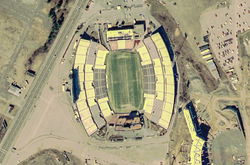
Foxboro Stadium, originally Schaefer Stadium and later Sullivan Stadium, was an outdoor stadium in the New England region of the United States, located in Foxborough, Massachusetts. It opened in 1971 and served as the home of the New England Patriots of the National Football League (NFL) for 31 seasons (through January 2002) and also as the first home venue for the New England Revolution of Major League Soccer (MLS) from 1996 to 2002. The stadium was the site of several games in both the 1994 FIFA World Cup and the 1999 FIFA Women's World Cup, and hosted a wide variety of other events, particularly concerts. Foxboro Stadium was demolished in 2002 and replaced by Gillette Stadium and the Patriot Place shopping center.
Key Information


History
[edit]The stadium opened in August 1971 as Schaefer Stadium,[2] primarily as the home venue for the renamed New England Patriots of the National Football League.[1] The team was known as the Boston Patriots for its first eleven seasons 1960–70,[5] and had played in various stadiums in the Boston area. For six seasons, 1963–68, the Patriots played in Fenway Park, home of baseball's Boston Red Sox.[6] Like most baseball stadiums, Fenway was poorly suited as a football venue. Its seating capacity was inadequate—only about 40,000 for football—and many seats had obstructed views. With the completion of the AFL–NFL merger in 1970, the league required its teams to play in stadiums which seated more than 50,000, and no venue in Boston proper could accommodate a crowd this size with the NFL's then-new requirements. Indeed, before the Patriots arrived, numerous previous attempts at pro football in Boston had been stymied by the lack of a pro-caliber stadium. (The Redskins left for Washington, D.C. after the 1936 season, in which they hosted the NFL Championship Game, not in Boston but at the Polo Grounds in New York City.)
The then-Boston Patriots played the 1969 season at Alumni Stadium at Boston College in Chestnut Hill, Massachusetts, and the 1970 season, their first in the NFL, at Harvard Stadium in Boston's Allston neighborhood.[6]
The site was selected when the owners of Bay State Raceway donated the land, midway between Boston and Providence, Rhode Island. The general contractor who built the stadium was a Massachusetts-based company named J. F. White Contracting Co.[citation needed]
Ground was broken in September 1970,[7] and it cost $7.1 million,[7] only $200,000 over budget.[8] Even allowing for this modest cost overrun, it was still a bargain price for a major sports stadium even by 1970s standards. This was because the Patriots received no funding from the governments of either the Commonwealth of Massachusetts or the town of Foxborough; indeed, it was one of the few major league stadiums of that era that was entirely privately funded.[7]
Seating capacity
[edit]| Years | Capacity |
|---|---|
| 1971 | 61,114[9] |
| 1972 | 60,999[10] |
| 1973–1977 | 61,279[11] |
| 1978–1983 | 61,297[12] |
| 1984–1987 | 60,890[13] |
| 1988–1994 | 60,794[14] |
| 1995–2002 | 60,292[15] |
Playing surface
[edit]Like the majority of outdoor sports venues built in North America in the 1970s, Foxboro Stadium was designed for the use of an artificial turf playing surface. The original field was Poly-Turf,[16] succeeded by AstroTurf.[citation needed] A natural grass field was installed before the start of the 1991 season.[citation needed]
Naming rights
[edit]The original name in 1971 was Schaefer Stadium for the brewery of that name in an early example of the sale of naming rights to a company that did not own the stadium. When this agreement expired after the 1982 season, Anheuser-Busch took over the rights. Instead of putting the name of one of its brands of beer on the stadium, Anheuser-Busch agreed to name it in honor of the Sullivan family, then the majority owners of the Patriots. The name Sullivan Stadium took effect on May 23, 1983.[17] After Sullivan went bankrupt and Robert Kraft purchased the stadium, Kraft stripped Sullivan's name and renamed the venue "Foxboro Stadium".[18] Although the official spelling of the town's name is "Foxborough", the shorter spelling was used for the stadium.[19]
During the ownership of Victor Kiam, ESPN anchor Chris Berman humorously referred to the facility as "Shaver Stadium", a pun on Kiam's fame from Remington razor commercials and the stadium's original name.
Notable events
[edit] | This section possibly contains original research. (August 2016) |
Soccer
[edit]The venue hosted numerous significant soccer matches, including six games in the 1994 FIFA World Cup.[8] Foxboro Stadium was the last stadium where Diego Maradona scored a World Cup goal in a game against Greece, and where he last played in an official FIFA World Cup match against Nigeria on June 25, 1994.
The stadium hosted five games in the 1999 FIFA Women's World Cup, the 1996 and 1999 MLS Cups, and the inaugural Women's United Soccer Association Founders Cup.
The stadium's final soccer match was the qualifying match between the United States and Jamaica, which the United States won 2-1.
- 1994 FIFA World Cup
| Date | Time (EDT) | Team #1 | Res. | Team #2 | Round | Attendance |
|---|---|---|---|---|---|---|
| 21 June 1994 | 12:30 |  Argentina Argentina |
4–0 |  Greece Greece |
Group D | 54,456 |
| 23 June 1994 | 19:30 |  South Korea South Korea |
0–0 |  Bolivia Bolivia |
Group C | 54,453 |
| 25 June 1994 | 16:00 | Argentina |
2–1 |  Nigeria Nigeria |
Group D | |
| 30 June 1994 | 19:30 | Greece |
0–2 | 53,001 | ||
| 5 July 1994 | 13:00 | Nigeria |
1–2 (a.e.t.) |  Italy Italy |
Round of 16 | 54,367 |
| 9 July 1994 | 12:00 | Italy |
2–1 |  Spain Spain |
Quarter-finals | 53,400 |
- 1999 FIFA Women's World Cup
| Date | Time (EDT) | Team #1 | Res. | Team #2 | Round | Attendance |
|---|---|---|---|---|---|---|
| 20 June 1999 | 16:00 |  Norway Norway |
2–1 |  Russia Russia |
Group C | 14,873 |
| 20 June 1999 | 19:30 |  Australia Australia |
1–1 |  Ghana Ghana |
Group D | 14,873 |
| 27 June 1999 | 16:30 |  Mexico Mexico |
0–2 | Italy |
Group B | 50,484 |
| 27 June 1999 | 19:00 |  United States United States |
3–0 |  North Korea North Korea |
Group A | 50,484 |
| 4 July 1999 | 19:30 | Norway |
0–5 |  China China |
Semi-finals | 28,986 |
- Major League Soccer finals
| Event | Date | Champions | Res. | Runners-Up | Attendance |
|---|---|---|---|---|---|
| MLS Cup '96 | 20 October 1996 | D.C. United | 3–2 (a.e.t.) | Los Angeles Galaxy | 34,643 |
| MLS Cup '99 | 21 November 1999 | 2–0 | 44,910 |
- Women's United Soccer Association finals
| Event | Date | Time (EDT) | Champions | Res. | Runners-Up | Attendance |
|---|---|---|---|---|---|---|
| 2001 WUSA Founders Cup | 25 August 2001 | 14:00 | Bay Area CyberRays | 3–3 (a.e.t.) (4–2 p) | Atlanta Beat | 21,078 |
College football
[edit]Holy Cross Crusaders
[edit]During the final week of the 1971 season, Holy Cross moved its home game against rival Boston College to the newly-constructed Schaefer Stadium, due to a heavy snowstorm that rendered Fitton Field in Worcester unplayable.[20]
Boston College Eagles
[edit]In the opening week of the 1975 season, Boston College hosted Notre Dame at Schaefer Stadium in their first ever meeting.[21] From 1983 through 1987, BC used Schaefer/Sullivan Stadium as an alternate home venue to host crowds larger than could be accommodated on campus at Alumni Stadium.
| Date | Visiting Team | Result | Home Team | Attendance | Source |
|---|---|---|---|---|---|
| November 27, 1971 | Boston College (rivalry) | 21-7 | Holy Cross | 22,205 | [22][23][24] |
| September 15, 1975 | #9 Notre Dame (Holy War) | 17-3 | Boston College | 61,501 | [21][25][26] |
| October 29, 1983 | Penn State | 17-27 | #19 Boston College | 56,605 | [27][28] |
| November 19, 1983 | Holy Cross (rivalry) | 7-47 | #18 Boston College | 38,512 | [29][28] |
| November 26, 1983 | #13 Alabama | 13-20 | #15 Boston College | 58,047 | [30][31][28] |
| September 22, 1984 | North Carolina | 20-52 | #10 Boston College | 44,672 | [32][33] |
| November 17, 1984 | Syracuse (rivalry) | 16-24 | #13 Boston College | 60,890 | [34][33] |
| September 14, 1985 | #17 Maryland | 31-13 | Boston College | 30,210 | [35][36] |
| September 28, 1985 | Miami (FL) | 45-10 | Boston College | 31,864 | [37][36] |
| September 20, 1986 | #5 Penn State | 26-14 | Boston College | 42,329 | [38][39] |
| September 26, 1987 | #15 Penn State | 27-17 | Boston College | 50,267 | [40][41] |
| Rankings from AP Poll released prior to the game | |||||
Other events
[edit]The stadium hosted numerous other outdoor events, primarily concerts, along with music festivals, including The Monsters of Rock Festival Tour and The Vans Warped Tour, as well as the WWF King of the Ring tournament on July 8, 1985 and July 14, 1986. U2 played on The Joshua Tree Tour on September 22, 1987, and later performed three nights of their Zoo TV Tour on August 20, 22, and 23, 1992. Schaefer Stadium hosted Elton John on July 4, 1976, as well as Boz Scaggs, The Eagles, and Fleetwood Mac on July 25, 1976.
Sullivan Stadium hosted The Who's 25th anniversary tour on July 12 and 14, 1989.
Paul McCartney brought the Flowers In the Dirt Tour to the stadium on July 24 and 26, 1990.
New Kids on The Block brought The Magic Summer Tour to the stadium on July 29 and July 31, 1990. An audience of 53,000 people attended one of two concert dates.
Genesis brought the We Can't Dance Tour to the stadium on May 28, 1992.
Metallica and Guns N' Roses brought the Guns N' Roses/Metallica Stadium Tour to the stadium on September 11, 1992, with Faith No More as their opening act.
Elton John performed at the venue in front of 62,000 on US Bicentennial on July 4, 1976. John again appeared in a Face to Face concert with Billy Joel on July 18, 1994.
Madonna performed her "Who's That Girl" tour there on July 9, 1987, to a sell-out crowd. Bob Dylan and the Grateful Dead recorded a portion of their collaborative live album, entitled Dylan & the Dead, there on July 4, 1987. Pink Floyd played a two-night stand in May 1988 (on one of the nights their inflatable pig was torn to shreds). They also played a three-night sold-out stand in May 1994 on their The Division Bell Tour which was recorded and readily available on bootleg. (The second night was filmed by MTV for promotional purposes.) The Dave Matthews Band played seven shows at the stadium from 1998 to 2001.
The Rolling Stones played three nights on September 27 and 29 and October 1, 1989, then two more nights on September 4 and 5, 1994 and lastly October 20 and 21, 1997.
Additionally, in 1994, the Drum Corps International World Championships were held in the stadium.
Closing
[edit]By the late 1990s, Foxboro Stadium had become functionally obsolete by modern NFL standards. Despite excellent sight lines to view game action or concerts and having fewer of the issues that multi-sport multi-purpose stadiums in other cities had, the stadium was otherwise outmoded. The facility was built in a low-cost "bare bones" manner with unexceptional architectural elements, and had very few modern amenities. The stadium's plumbing was not designed with NFL-sized crowds in mind, which became evident when a sewage issue overflowed the restroom facilities during its first game.[42] Stadium officials were forced to augment the permanent toilets with rented portable toilets for the rest of the stadium's existence. It also lacked luxury boxes, an increasingly important source of revenue for other teams in the league. Only a small fraction of the seats had permanent chairbacks (painted blue, red and white near the 50-yard line). Most patrons had to sit on backless aluminum benches (or like still done in the lower Lambeau Field bowl today, rent or bring in their own stadium cushions and portable chairbacks) that often froze late in the season. During heavy rains, the numerous unpaved spots in the parking lot turned to mud. It frequently took an hour or more to leave after games, due to its location on a then-undivided four-lane portion of U.S. Route 1.[8] In order to host the FIFA World Cup (and later, the New England Revolution), several rows of seats were removed to accommodate a soccer pitch with acceptable dimensions to FIFA.[43]
With a capacity of just over 60,000 (only 10,000 above the NFL's minimum seating capacity), it was one of the smallest stadiums in the NFL. It was also almost completely exposed to the elements, meaning that there was almost no protection for the fans in storms (outside of beneath the stands) or in extreme cold. Additionally, the Sullivan family had lost millions promoting the Jackson Victory Tour in 1984. Due to their relatively modest wealth compared to other NFL owners, they pledged the stadium as collateral for the tour. Knowing that the revenue from the Patriots would not be nearly enough to service the debt, the Sullivans quietly put the team and the stadium on the market.[44]
The Sullivans' financial picture was so dire that even when the Patriots made Super Bowl XX, the team failed to bring in nearly enough money to service the debt from the Victory Tour. With most of their money tied up in the team, they sold controlling interest in the Patriots to Victor Kiam in 1989. The stadium, however, lapsed into bankruptcy and was bought by Boston paper magnate Robert Kraft in 1988.[citation needed]
When Kiam and Sullivan tried to sell the team to interests in Jacksonville, Kraft effectively stymied the deal by refusing to let the team out of their lease, which contained an ironclad commitment to play in the stadium until 2001. As a result, when Kiam himself was crippled by financial troubles, he sold the Patriots to James Orthwein in 1992. After only two years, Orthwein tried to move the Patriots to his hometown of St. Louis. However, as in 1992, Kraft refused to let the Patriots out of their lease. Orthwein then put the team on the market, but the wording of the operating covenant required any potential buyer to negotiate lease terms with Kraft. With this in mind, Kraft swooped in and bought the team himself.[45] Two years later, Kraft bought the parcel of land containing neighboring Bay State Raceway, allowing him to build a new and privately-financed stadium on the raceway property after proposals to build a new stadium in Hartford, Connecticut and South Boston failed.[citation needed]
After 31 NFL seasons, Foxboro Stadium was scheduled to be demolished on December 23, 2001, the day after the Patriots' final home game. However, the stadium would instead play host to the first season of the Tom Brady and Bill Belichick era, with the team making a run to get into the playoffs and going on to win their first Super Bowl. As a result, the stadium was not demolished until late January 2002, after the conclusion of the 2001 postseason. The last game played in the stadium, the "Tuck Rule Game", was played in a snow storm; it resulted in a Patriots win against the Oakland Raiders, which famously featured an overturned fumble call based on the then-applicable tuck rule in the final minutes. The stadium's former site became parking lots for its successor, Gillette Stadium, before being developed into the open-air shopping center Patriot Place.[citation needed]
References
[edit]- ^ a b "New England opens park with victory". Eugene Register-Guard. Associated Press. August 16, 1971. p. 6B.
- ^ a b "Traffic situation 'hard to forget'". The Telegraph. (Nashua, New Hampshire). Associated Press. August 16, 1971. p. 18.
- ^ 1634–1699: McCusker, J. J. (1997). How Much Is That in Real Money? A Historical Price Index for Use as a Deflator of Money Values in the Economy of the United States: Addenda et Corrigenda (PDF). American Antiquarian Society. 1700–1799: McCusker, J. J. (1992). How Much Is That in Real Money? A Historical Price Index for Use as a Deflator of Money Values in the Economy of the United States (PDF). American Antiquarian Society. 1800–present: Federal Reserve Bank of Minneapolis. "Consumer Price Index (estimate) 1800–". Retrieved February 29, 2024.
- ^ a b Foxboro Stadium
- ^ New England Is Their Third Name
- ^ a b They Played at Four Different Stadiums In Their First 11 Years
- ^ a b c FOXBORO STADIUM
- ^ a b c Foulds, Alan (2005). Boston's Ballparks and Arenas. University Press of New England. ISBN 9781584654094.
- ^ Will McDonough (September 3, 1972). "Bell Hopes Patriots Knock 'Em Around". Boston Globe. Archived from the original on February 1, 2013.
- ^ Al Harvin (October 16, 1972). "Riggins, Boozer Combine for 318 Yards; Jet Ground Game Crushes Patriots". New York Times. Retrieved November 27, 2011.
- ^ "Patriot Goal: Field Winner". Rome News-Tribune. April 11, 1976.
- ^ "Shoulder May Keep Griese From Returning This Year". Palm Beach Post. April 1, 1981.[permanent dead link]
- ^ "Hannah May Miss Jets". The Lewiston Journal. October 26, 1984.
- ^ "AFC East". USA Today. September 2, 1988. Archived from the original on November 7, 2012. Retrieved July 6, 2017.
- ^ Bill Plaschke (September 11, 1995). "Dolphins Have Few Problems in 20-3 Victory". Los Angeles Times.
- ^ Sports Illustrated – "Rug" – Scorecard – October 18, 1971
- ^ "History: 1980-1989". Official web site of the New England Patriots. New England Patriots. Retrieved January 13, 2020.
- ^ The League by David Harris
- ^ Ask PFW: Winning vs. whining Patriots.com
- ^ Concannon, Joe (November 27, 1971). "Phone call switches BC-HC site to Schaefer". Boston Globe. p. 17.
- ^ a b "17-3 for Devine, Assistants". Press and Sun-Bulletin. September 16, 1975. pp. 13–A. Retrieved November 6, 2022.
- ^ Nason, Jerry (November 28, 1971). "BC's Bombs Trip Up 'Soft Touch' HC, 21-7". Boston Sunday Globe. p. 85. Retrieved November 6, 2022.
- ^ "1971 Boston College Eagles Schedule and Results". Sports Reference. November 6, 2022. Retrieved November 6, 2022.
- ^ "1971 Holy Cross Crusaders Schedule and Results". Sports Reference. November 6, 2022. Retrieved November 6, 2022.
- ^ "1975 Notre Dame Fighting Irish Schedule and Results". Sports Reference. November 6, 2022. Retrieved November 6, 2022.
- ^ "1975 Boston College Eagles Schedule and Results". Sports Reference. November 6, 2022. Retrieved November 6, 2022.
- ^ "1983 Penn State Nittany Lions Schedule and Results". Sports Reference. November 6, 2022. Retrieved November 6, 2022.
- ^ a b c "1983 Boston College Eagles Schedule and Results". Sports Reference. November 6, 2022. Retrieved November 6, 2022.
- ^ May, Peter (November 20, 1983). "BC Pounds Holy Cross, Expects New Bowl Foe". Hartford Courant. p. 102. Retrieved November 6, 2022.
- ^ "Turnovers turn back Tide; BC finishes with 9–2 record". The Boston Globe. November 26, 1983. p. 28. Retrieved November 6, 2022.
- ^ "1983 Alabama Crimson Tide Schedule and Results". Sports Reference. November 6, 2022. Retrieved November 6, 2022.
- ^ "1984 North Carolina Tar Heels Schedule and Results". Sports Reference. November 6, 2022. Retrieved November 6, 2022.
- ^ a b "1984 Boston College Eagles Schedule and Results". Sports Reference. November 6, 2022. Retrieved November 6, 2022.
- ^ "1984 Syracuse Orange Schedule and Results". Sports Reference. November 6, 2022. Retrieved November 6, 2022.
- ^ "1985 Maryland Terrapins Schedule and Results". Sports Reference. November 6, 2022. Retrieved November 6, 2022.
- ^ a b "1985 Boston College Eagles Schedule and Results". Sports Reference. November 6, 2022. Retrieved November 6, 2022.
- ^ "1985 Miami (FL) Hurricanes Schedule and Results". Sports Reference. November 6, 2022. Retrieved November 6, 2022.
- ^ "1986 Penn State Nittany Lions Schedule and Results". Sports Reference. Retrieved November 6, 2022.
- ^ "1986 Boston College Eagles Schedule and Results". Sports Reference. November 6, 2022. Retrieved November 6, 2022.
- ^ "1987 Penn State Nittany Lions Schedule and Results". Sports Reference. November 6, 2022. Retrieved November 6, 2022.
- ^ "1987 Boston College Eagles Schedule and Results". Sports Reference. November 6, 2022. Retrieved November 6, 2022.
- ^ Joseph, Dave (December 21, 2001). "FROZEN IN TIME". sun-sentinel.com. Retrieved February 19, 2020.
- ^ Mallison, Lloyd (August 25, 2015). "Before the Patriots played at Gillette Stadium". The Boston Globe. pp. slideshow image number 27. Retrieved December 27, 2017.
- ^ Harris, David (1986). The League: The Rise and Decline of the NFL. New York City: Bantam Books. pp. 629–32. ISBN 0-553-05167-9.
- ^ Burke, Monte (September 19, 2015). "Unlikely Dynasty". Forbes.
Former stadiums of the National Football League | |
|---|---|
| Early era: 1920–1940 |
|
| Post-war and pre-merger era: 1941–1969 |
|
| Current era: 1970–present |
|
| Stadiums used by NFL teams temporarily |
|
†= Team's stadium under construction or refurbishment at time | |


Foxboro Stadium
View on GrokipediaConstruction and Early History
Planning and Construction
The decision to relocate the Boston Patriots stemmed from the inadequacy of Fenway Park's facilities, which lacked sufficient seating capacity, proper parking, and infrastructure suited for professional football, compounded by the 1970 AFL-NFL merger's mandate requiring all teams to play in stadiums with at least 50,000 seats by that year.[7][8] Fenway's obsolete design, with only about 33,500 seats and limited amenities, failed to meet these standards, prompting team owner William H. "Billy" Sullivan to seek a new venue after unsuccessful negotiations with Boston officials.[9] Sullivan, who founded the Patriots in 1959, spearheaded the project as a private venture funded entirely by the team's ownership group, avoiding public financing to expedite development.[10][4] Site selection focused on Foxborough, Massachusetts, approximately midway between Boston and Providence, Rhode Island, to maintain regional accessibility for fans while resolving the urban constraints of Boston. The land, formerly occupied by the Bay State Raceway—a harness racing track that closed in 1970—was donated to Sullivan by its owner, E.M. Loew, to help secure the team's future in New England.[4] A town referendum on April 30, 1970, overwhelmingly approved the stadium's construction (1,852 to 84 votes), reflecting strong local support for the economic benefits.[10][11] Construction commenced with groundbreaking on September 23, 1970, and progressed rapidly under general contractor J.F. White Contracting Co., a Massachusetts-based firm, completing the project in 327 days at a cost of $7.1 million—slightly over the initial $6.9 million budget.[12][13] The initial design emphasized a multi-purpose, open-air venue capable of hosting football and potentially other sports, featuring basic steel-and-concrete construction with minimal luxury amenities, such as limited skyboxes and concession stands, characteristic of cost-conscious 1970s stadiums.[14] This straightforward approach allowed for quick assembly while providing a dedicated 60,000-seat facility tailored to NFL specifications.[13]Opening and Initial Operations
Foxboro Stadium, originally named Schaefer Stadium, opened on August 15, 1971, with a preseason National Football League (NFL) game between the New England Patriots and the New York Giants. The Patriots secured a 20-14 victory in the inaugural contest, marked by kicker Gino Cappelletti's 36-yard field goal as the first points scored in the venue's history. Despite an advertised capacity of 60,000 seats, an announced crowd of 60,423 attended, setting a franchise record for the largest turnout at the time.[15][16] The stadium's suburban location in Foxborough, Massachusetts—approximately 25 miles southwest of Boston—presented immediate logistical challenges, exacerbated by the absence of public transit options and reliance on U.S. Route 1 for access. On opening night, severe traffic congestion backed up for miles, delaying thousands of fans for hours and preventing some from reaching the parking lots before kickoff; post-game exodus extended until the early morning hours for many. Additional operational hurdles included plumbing failures, with numerous toilets overflowing or failing to flush due to the stadium's rushed, budget-conscious construction, prompting a pre-opening "Super Flush" test involving simultaneous activation of all facilities to meet health standards. These issues led to a ban on future night games, shifting subsequent contests to 1 p.m. starts. Basic amenities, such as concessions offering beer for $1, were operational but strained under the high demand.[16][17][11] The first regular-season game occurred on September 19, 1971, against the Oakland Raiders, resulting in a 20-6 Patriots win highlighted by rookie quarterback Jim Plunkett's two touchdown passes in his NFL debut. This matchup drew 55,405 spectators and underscored the venue's role in the franchise's rebranding from the Boston Patriots to the New England Patriots, finalized on March 22, 1971, to reflect its broader regional appeal beyond Boston. The 1971 season saw the team finish with a 6-8 record under coach John Mazur, a modest improvement from the prior year's struggles, though the stadium's debut year highlighted persistent operational teething problems amid growing fan interest. Home attendance averaged over 55,000 across seven games, demonstrating early popularity despite the team's middling performance and logistical hurdles.[15][18][19]Design and Facilities
Seating Capacity and Expansions
Foxboro Stadium opened in 1971 with a seating capacity of 61,043. The majority of these seats—approximately 90%—were aluminum benches without backs, while about 54,320 were positioned along the sidelines for optimal sightlines.[11] The venue's design emphasized a single-tier grandstand on each sideline, extending beyond the end zones, with only limited bleacher seating at either end. This configuration provided close proximity to the field for most patrons but limited overall expansion potential without major structural changes.[20] Throughout its operational history, the stadium's capacity saw minor adjustments and was consistently listed as 60,292 from the 1980s onward, positioning it among the NFL's smaller venues relative to contemporaries like those exceeding 70,000 seats. The bench-heavy seating arrangement drew early criticism for discomfort during long games, particularly in inclement New England weather, as the open-air structure offered no overhead cover.[21][4] A notable renovation occurred in 1993 following Robert Kraft's acquisition of the team, involving a $10 million investment to upgrade premium areas, including the addition of luxury suites and enhanced club seating. These changes introduced more chair-back options in select sections but did not substantially increase the total capacity, maintaining the focus on improving revenue-generating spaces rather than broad expansion.[4] The evolutions in seating reflected efforts to address growing fan demand amid the Patriots' rising popularity, yet persistent challenges shaped the overall experience. While sideline seats generally offered clear views, end zone positions suffered from obstructions due to the single-tier layout, and the lack of weather protection remained a frequent complaint, especially for bench-seated fans exposed to rain, wind, and cold. These factors contributed to Foxboro Stadium's reputation as a no-frills venue, prioritizing functionality over modern comforts.[20]Playing Surface Changes
Upon its opening in 1971, Foxboro Stadium featured a Poly-Turf artificial surface, selected for its durability amid New England's harsh winters and frequent precipitation, which often rendered natural grass fields unplayable.[22] However, the surface drew widespread criticism for its excessive hardness, contributing to a higher incidence of player injuries compared to natural grass, including strains and abrasions during tackles and falls.[23] In 1977, the stadium underwent an upgrade to Super Turf, a more resilient synthetic variant designed to address some of the original Poly-Turf's shortcomings in cushioning and longevity.[24] This improved surface remained in place through the 1990 season, providing consistent playability for football and other events while better withstanding the region's variable climate.[5] The stadium transitioned to a natural grass playing surface in 1991, installing a sand-based GraviTURF system to enhance versatility for international soccer competitions, including preparations for the 1994 FIFA World Cup.[25] This gravity-drained setup, developed by RBI Resources for a Better Tomorrow, offered superior ball roll and footing for soccer, significantly improving athlete safety and performance over the prior artificial turf.[26] Despite these benefits, the natural grass field presented substantial maintenance demands, exacerbated by the site's underlying rock ledge and high groundwater table, which complicated installation and ongoing care.[25] Drainage issues persisted during heavy rains, leading to waterlogged conditions that affected game conditions, though the surface achieved FIFA certification suitable for World Cup-level play.[27] The grass field endured with routine upkeep through the stadium's final years, reverting fully to natural turf without additional major alterations before its closure in 2001.[27]Architectural Features
Foxboro Stadium was designed by architect David Berg and built by J.F. White Construction using a low-cost steel framework typical of 1970s-era venues, resulting in a simple, open-air structure with no roof that left patrons fully exposed to New England's variable weather conditions.[14] The stadium featured a single-tier grandstand layout on both sidelines, extending partially into the end zones, with the majority of seating consisting of backless metal bleachers for a utilitarian aesthetic that prioritized functionality over comfort.[4][20] Midfield sections included individual plastic seats angled toward the center of the field to enhance sightlines, while a narrow concourse beneath the stands provided basic access to amenities.[20] In the 1980s, the stadium received structural enhancements, including the addition of 41 luxury suites atop the upper level, offering enclosed viewing options amid the otherwise spartan design.[28] A main scoreboard was installed above the south end zone seating, supplemented later in the decade by improved lighting systems that initially supported night games starting in 1971, though such events were restricted from 1981 to 1995 due to crowd control concerns.[20] The overall layout emphasized efficiency, with an east-west field alignment integrating the playing surface directly into the open enclosure without enclosed end zones.[14] Amenities were minimal, reflecting the venue's bare-bones construction, including around two fixed concession stands and portable carts serving basic fare like hot dogs and burgers, often resulting in long lines during events.[20] Surrounding unpaved parking lots provided initial access for approximately 10,000 vehicles, contributing to traffic challenges on nearby Route 1.[20] Accessibility features were limited in the original design, lacking modern ADA-compliant elements such as ramps and elevators until later modifications in the 1990s.[14] These aspects underscored the stadium's budget-driven, no-frills character, distinguishing it from more elaborate contemporary facilities.[29]Ownership and Naming
Ownership History
Foxboro Stadium was initially owned by the Sullivan family through their control of the New England Patriots organization, establishing it as a team-controlled asset upon its opening in 1971.[30] The Sullivans, led by founder Billy Sullivan, maintained ownership amid the franchise's early challenges, with the stadium serving as a key component of their sports holdings.[31] The Sullivan family's financial difficulties intensified in the 1980s, exacerbated by the failed promotion of the Jackson Victory Tour in 1984, which led to significant debts and bankruptcy proceedings.[32] These struggles prompted multiple unsuccessful attempts to sell the Patriots franchise, including a quiet 1985 effort seeking $100 million that yielded no buyers, and the stadium was used as collateral in the ensuing financial entanglements.[33] In 1988, amid the bankruptcy, businessman Robert Kraft, along with a partner, acquired the stadium from a U.S. Bankruptcy Court for approximately $25 million, gaining control of the lease and separating it from the team's ownership, which was sold to Victor Kiam that same year.[34][35] In 1994, Kraft purchased the Patriots franchise from James Orthwein (who had acquired it from Kiam in 1992) for a then-record $172 million, reuniting team and stadium ownership under his control and preventing a potential relocation to Jacksonville, Florida.[36][37] Following the acquisition, Kraft invested in minor upgrades to Foxboro Stadium, including a $10 million renovation completed after 1993 that improved facilities and maintenance, though the venue's aging infrastructure ultimately prompted plans for a replacement due to its obsolescence.[4] Kraft's development ambitions faced legal challenges from the town of Foxborough over lease terms and land use for a new stadium, including disputes involving evictions from a nearby mobile home park to clear the site.[38] These battles, which included lawsuits questioning the constitutionality of eminent domain provisions in state legislation, were resolved in Kraft's favor by 2000, enabling construction of Gillette Stadium to begin that year.[39] Naming changes, such as the shift to Sullivan Stadium in 1983 under family ownership and back to Foxboro Stadium in 1989, reflected these ownership transitions.[4]Naming Rights Evolution
Foxboro Stadium opened in 1971 as Schaefer Stadium, following a pioneering naming rights agreement with F&M Schaefer Brewing Company, which contributed $1 million toward the venue's $6.7 million construction cost.[10][40] This deal represented one of the earliest instances of corporate sponsorship for an NFL stadium, setting a precedent for future venue branding in professional sports.[40] The Schaefer agreement expired after the 1982 season, prompting a new sponsorship from Anheuser-Busch, which secured naming rights for over $1 million, covering permanent signage and scoreboard advertising.[41] At the request of the Sullivan family, majority owners of the New England Patriots at the time, Anheuser-Busch opted not to apply its own branding and instead renamed the stadium Sullivan Stadium on May 23, 1983, to honor founder William H. "Billy" Sullivan.[41][4] This gesture acknowledged Sullivan's role in relocating the team from Boston and building the facility, though it lasted only until 1988.[31] Following the Sullivans' sale of their majority stake in the Patriots to Victor Kiam in 1988, the venue reverted to the generic name Foxboro Stadium in 1989, as no new corporate sponsor emerged to replace the expired Anheuser-Busch deal.[4][2] Robert Kraft's acquisition of the team in 1994 and the stadium in 1988 did not lead to additional naming changes, with Kraft prioritizing plans for a modern replacement over further sponsorship pursuits.[4][5] The Sullivan Stadium name evoked strong nostalgia among fans, symbolizing an era of team loyalty and gritty play despite the Patriots' on-field struggles and financial challenges under Sullivan ownership.[20] This attachment persisted in fan recollections, contrasting the venue's later generic identity amid preparations for its successor.[20]Hosted Teams and Events
Professional Football
Foxboro Stadium served as the home venue for the New England Patriots of the National Football League from 1971 through 2001, marking 31 seasons of professional football at the facility. The stadium hosted 237 regular-season games during this span, along with five playoff contests, providing the backdrop for the franchise's evolution from perennial underachievers to playoff contenders.[2] The Patriots' early years at Foxboro were marked by inconsistency, particularly in the 1970s, when the team endured some of its worst seasons, including a 3-13 finish in 1979 amid ongoing front-office instability. A notable turnaround occurred in the 1980s under head coach Raymond Berry, who took over in 1984 and guided the team to an 11-5 record in 1985, culminating in an AFC Championship victory—though the playoffs that year were played on the road, highlighting the team's resilience despite the stadium's rudimentary conditions. Overall, the Patriots compiled a regular-season home record of 133-104 at Foxboro, with a 4-1 mark in playoffs, reflecting a .566 winning percentage across 242 total games.[2][42] Key milestones underscored the stadium's role in Patriots lore, including the 1996 AFC East division clincher on December 15, when a 10-7 victory over the Indianapolis Colts secured the team's first division title since 1963 and propelled them to the AFC Championship game. The venue also witnessed dramatic playoff moments, such as the aftermath of the 1985 "Epic in Miami" divisional win over the Miami Dolphins, which fueled the team's momentum into the AFC Championship despite a subsequent loss to the Los Angeles Raiders. The stadium's final professional football event was the January 19, 2002, AFC Divisional playoff against the Oakland Raiders—known as the "Tuck Rule Game"—played amid a blizzard, where a controversial incomplete pass ruling on quarterback [Tom Brady](/page/Tom Brady) preserved a 16-13 overtime victory and ignited the Patriots' dynasty.[43][44] The stadium's limitations, including outdated amenities and frequent surface issues like AstroTurf wear, increasingly pressured the franchise toward relocation, contributing to owner Robert Kraft's decision to build Gillette Stadium nearby. Yet, Foxboro fostered a dedicated fanbase, achieving consistent sellouts starting with the 1994 season opener and maintaining that streak through the end of its tenure, which helped stabilize attendance and franchise value.[45][46] Beyond the Patriots, the stadium briefly hosted professional football from the United States Football League's New England Steamroller in 1988, though the team played only a handful of games there amid the league's collapse.[4]Soccer Matches
Foxboro Stadium hosted six matches during the 1994 FIFA World Cup, serving as a key venue for the tournament's group stage and knockout rounds.[47] The stadium's natural grass surface, installed in 1991 to replace the previous artificial turf, accommodated the event without major conversion, though temporary adjustments such as soccer-specific markings and portable goalposts were implemented to suit the pitch dimensions and lines required for international play.[26] Among the highlights was the quarterfinal between Italy and Spain on July 9, 1994, where Italy advanced with a 2-1 victory in extra time, drawing an attendance of 53,400 spectators. Other notable games included Argentina's 4-0 group stage win over Greece on June 21 and the round-of-16 clash where Italy defeated Nigeria 2-1 after extra time on July 5.[48] The venue further demonstrated its versatility for soccer in 1999 by hosting five matches of the FIFA Women's World Cup, including group stage, and semifinal contests.[49] These events capitalized on the established grass field from 1991, with similar adaptations like field markings and goal setups to facilitate women's international standards. Standout matches included the U.S. 3-0 group stage victory over the Democratic People's Republic of Korea on June 27 before 50,484 fans[50] and the semifinal where China PR defeated Norway 5-0 on July 4 before 28,986 spectators.[51] Additional games included Mexico's 0-2 loss to Italy on June 27 (attendance 50,484). From 1996 to 2001, Foxboro Stadium served as the home field for Major League Soccer's New England Revolution, hosting their regular-season and playoff games on the shared grass surface with the NFL's New England Patriots. The team averaged approximately 20,000 attendees per home match during this period, reflecting growing interest in professional soccer in New England.[52] A key moment came in the 1997 MLS playoffs, where the Revolution hosted conference semifinal matches against D.C. United, including a 1-1 draw in the second game on October 8 before 16,233 fans, though they ultimately fell in the series. Beyond major tournaments and MLS play, the stadium supported soccer's development in the region through other events, such as international friendlies like the United States' 3-2 win over Nigeria on June 11, 1995.[48] These matches, along with adaptations for soccer on a multi-use venue, underscored Foxboro Stadium's role in promoting the sport locally.College Football Games
Foxboro Stadium frequently served as a neutral-site venue for college football games in New England during the 1980s and 1990s, allowing local programs like the Boston College Eagles to host larger crowds than their on-campus facilities could accommodate. The stadium's capacity and professional-grade amenities provided an elevated atmosphere for NCAA Division I contests, drawing fans from across the region for matchups involving prominent opponents. This usage highlighted the venue's versatility beyond professional sports, supporting amateur football by offering a centralized location near major population centers.[53] The Boston College Eagles utilized Foxboro Stadium—known as Sullivan Stadium during much of this period—for several high-profile games, compiling a 7-5 record across 12 contests there from 1975 to 2000. Notable examples include the 1983 matchup against Penn State, where BC secured a 27-17 upset victory before a crowd of over 58,000, one of the largest attendances for an Eagles home game at the time. That same season, BC defeated Alabama 20-13 at Sullivan Stadium, marking a significant win against a national powerhouse and further establishing the venue's role in hosting competitive Division I action. In 1984, the Eagles faced North Carolina in a 24-23 loss and Syracuse in a 24-16 win, both drawing substantial regional interest.[54][55] Additional games underscored the stadium's appeal for local rivalries and out-of-conference clashes. The 1983 Boston College–Holy Cross rivalry game took place at Sullivan Stadium, with BC prevailing 47-7, providing Holy Cross—a Division I-AA program—with exposure in a larger setting despite the lopsided result. Later, in 1986, Penn State returned to defeat BC 27-7, while the 1990 Eagles edged Temple 13-10. The Eagles also hosted Army in 1991 (21-17 win) and 1995 (42-27 win), using the site occasionally for capacity needs during their independent and early Big East eras. These events emphasized Foxboro's function as an off-campus option for New England teams, fostering rivalries and boosting visibility in NCAA play without the constraints of smaller college venues.[53] By the early 2000s, college football utilization of Foxboro Stadium declined as programs invested in on-campus renovations or shifted to the newly opened Gillette Stadium in 2002. The original venue's demolition that year marked the end of its role in amateur games, with teams like Boston College returning primarily to Alumni Stadium for a more integrated home experience.[56]Concerts and Other Events
Foxboro Stadium served as a prominent venue for major rock concerts throughout its history, particularly during the 1980s and 1990s, when it hosted performances by leading acts that drew tens of thousands of attendees. The Rolling Stones kicked off this era of large-scale music events with a show on September 25, 1981, as part of their American Tour, attracting over 50,000 fans to the then-newly renamed Sullivan Stadium.[57] The band returned for multiple performances during the 1994 Voodoo Lounge Tour, including dates on September 4 and 5, each drawing approximately 50,000 spectators and showcasing the venue's capacity for high-energy stadium rock productions.[58] U2's September 22, 1987, concert on The Joshua Tree Tour further solidified the stadium's status, with 55,378 in attendance for a set that emphasized the venue's acoustics for expansive arena anthems.[59] The Grateful Dead frequently utilized Foxboro Stadium for their improvisational live shows across the late 1980s and 1990s, contributing to the venue's reputation among jam band enthusiasts. Notable appearances included a July 4, 1987, performance alongside Bob Dylan, as well as standalone concerts on July 2, 1989, and July 14, 1990, each attracting dedicated crowds in the range of 40,000 to 50,000. These events exemplified the stadium's versatility for extended sets, with stages typically erected at one end of the field to preserve sightlines while allowing temporary seating expansions for music configurations. The 1990s marked a peak period, with over 10 major concerts annually by the mid-decade, including acts like Pink Floyd in 1994, diversifying the facility's usage beyond its primary sports function.[57] Beyond music, Foxboro Stadium accommodated a variety of non-sports entertainment, including professional wrestling and motorsport spectacles during off-seasons. The World Wrestling Federation (WWF) staged events there, such as the 1986 King of the Ring tournament, which drew significant crowds for its bracket-style matches and celebrity crossovers with local football figures.[61] Monster truck rallies, like the 1989 Renegades TNT Monster Truck Challenge, transformed the field into a dirt track arena, featuring high-flying stunts and vehicle competitions that appealed to families and auto enthusiasts.[62] Auto shows and similar exhibitions also occurred, showcasing vehicles and related displays to capitalize on the venue's expansive parking and indoor-outdoor capabilities. Logistically, non-sports events required adaptations to the stadium's architecture, such as field-end stage placements for concerts and modular barriers for rallies to protect the turf, often involving temporary seating rearrangements to accommodate up to 60,000 patrons. Weather played a role in operations, with occasional delays or cancellations due to storms, as seen in rain-affected shows that prompted shelter-in-place protocols or rescheduling to ensure safety. These gatherings provided crucial revenue diversification for the stadium operators, drawing audiences outside the football fanbase and stimulating the local Foxborough economy through hotel bookings, dining, and merchandise sales estimated to generate millions annually during peak seasons.[63]Demolition and Legacy
Final Events and Closure
In 1999, the town of Foxborough approved plans for a new stadium to replace the aging Foxboro Stadium, with construction beginning on March 24, 2000, signaling the end of operations at the original venue following the 2001 NFL season.[64] This development marked the operational wind-down of Foxboro Stadium, which had served as the home of the New England Patriots for over three decades. The final regular-season game at Foxboro Stadium occurred on December 22, 2001, when the Patriots defeated the Miami Dolphins 20-13 in front of 60,029 fans, clinching first place in the AFC East.[65] Post-game celebrations were emotional, with players including Troy Brown and Ty Law taking bows to the crowd, and head coach Bill Belichick leading a victory lap around the field carrying the game ball, as fans lingered in the cold weather to bid farewell to the venue.[65] These tributes evoked the stadium's history, including its Sullivan Stadium naming era from 1983 to 1988 under the Sullivan family's ownership. The last non-football event was a World Cup qualifier on October 7, 2001, where the United States men's national soccer team defeated Jamaica 2-1 before 40,483 spectators, securing qualification for the 2002 FIFA World Cup.[66] Foxboro Stadium's ultimate event was the AFC Divisional playoff game on January 19, 2002, a 16-13 overtime victory for the Patriots over the [Oakland Raiders](/page/Oakland Raiders) amid heavy snowfall, drawing 60,292 attendees and famously featuring the controversial "Tuck Rule" call that preserved New England's season.[67] Following this win, which advanced the Patriots toward their first Super Bowl title, the stadium entered operational shutdown, with demolition commencing on February 18, 2002.[68]Demolition Process
The demolition of Foxboro Stadium commenced on February 18, 2002, approximately one month after the New England Patriots' final game there, an AFC Divisional playoff victory over the Oakland Raiders on January 19, 2002.[68][5] The dismantling process utilized heavy machinery to systematically remove sections of the structure, beginning with the upper decks and progressing downward to facilitate efficient teardown. The entire operation was completed by June 1, 2002, achieving full removal in under four months.[69][5] This rapid timeline was closely coordinated with the simultaneous construction of Gillette Stadium on an adjacent site, allowing the new venue to open later that year without significant delays to the overall development project overseen by the Kraft Group.[56]Post-Demolition Site and Impact
Following the demolition of Foxboro Stadium in 2002, the cleared site was fully integrated into the adjacent Gillette Stadium complex, which opened that same year as the new home for the New England Patriots. The original parking lots surrounding the old stadium were expanded and repurposed to support the larger venue, contributing to extensive parking facilities across the property to accommodate fans, events, and the neighboring Patriot Place retail and entertainment district. This transformation turned the former stadium footprint into functional open space, enhancing accessibility and infrastructure without significant alterations to the site's core layout since its incorporation.[70] The legacy of Foxboro Stadium endures in New England sports culture, having paved the way for the development of modern, state-of-the-art facilities like Gillette Stadium that elevated the Patriots' performance and regional prominence. Post-relocation, the team achieved six Super Bowl victories between 2002 and 2019, establishing a dynasty that transformed Foxborough into a premier sports destination and drew millions in tourism-related economic activity. The broader complex, including Gillette and Patriot Place, generates an estimated $124 million in annual revenue (as of 2023), with tax contributions of approximately $8 to $10 million yearly to the town of Foxborough (as of the early 2020s), underscoring the stadium's role in bolstering local economies through events, retail, and hospitality. Reflections in the 2020s on the original 1970s-era design—characterized by outdated artificial turf, limited amenities, and structural inadequacies—highlight how its replacement addressed these flaws, enabling sustained fan engagement and competitive success.[71][72][73][20] Culturally, Foxboro Stadium is remembered through annual fan nostalgia events, such as alumni gatherings and historical retrospectives hosted by the New England Patriots organization, alongside preserved memorabilia displayed at the Patriots Hall of Fame. The hall features interactive exhibits chronicling the venue's history, including artifacts from its 30-year tenure as the team's home. A 2017 ESPN retrospective marked the 15th anniversary of the demolition, evoking widespread fan sentiment about its gritty charm and pivotal role in the franchise's evolution. The site remains under the ownership of Kraft Sports Group as of 2025, with no major redevelopment planned, preserving its integration within the ongoing sports and entertainment hub.[74][5][75]References
- https://herbibot.com/?place=[Earth](/page/Earth)/US/MA/Foxborough