


Community hub
Recent from talks
Contribute something
Nothing was collected or created yet.
Ohio Stadium
View on Wikipedia
 | This article needs additional citations for verification. (August 2024) |
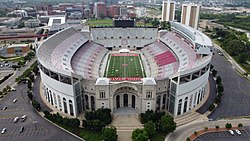
Ohio Stadium is an American football stadium in Columbus, Ohio, on the campus of Ohio State University. It primarily serves as the home venue of the Ohio State Buckeyes football team and is also the site for the university's Spring Commencement ceremonies each May. Common nicknames for the stadium include "The Horseshoe", "The Shoe", and "The House That Harley Built".
Key Information


From 1996 to 1998, Ohio Stadium was the home venue for the Columbus Crew of Major League Soccer prior to the opening of Columbus Crew Stadium in 1999. The stadium also was the home venue for the OSU track and field teams from 1923 to 2001. In addition to athletics, Ohio Stadium is also a concert venue, with U2, Taylor Swift, The Rolling Stones, Genesis, Pink Floyd, and Metallica among the many acts to have played at the venue.
The stadium opened in 1922 as a replacement for Ohio Field and had a seating capacity of 66,210. In 1923, a cinder running track was added that was later upgraded to an all-weather track. Seating capacity gradually increased over the years and reached a total of 91,470 possible spectators in 1991. Beginning in 2000, the stadium was renovated and expanded in several phases, removing the track and adding additional seating, which raised the capacity to 101,568 by 2001 and to 102,329 in 2007. In 2014, additional seating was added in the end zone, raising the official capacity to 104,944. Another renovation to add more luxury suites began in 2017 and will eventually lead to a decrease of 2,600 seats. It is the largest stadium by capacity in the state of Ohio, and the third largest on-campus football stadium in the United States. Ohio Stadium was added to the National Register of Historic Places in 1974.[3]
Construction
[edit]_(cropped).jpg)
As early as 1913, Ohio Field at High Street and Woodruff Avenue was unable to contain the crowds attracted to many Buckeye home football games. This led to faculty discussion of moving the site elsewhere and building a new facility. The growing popularity of football in Ohio led to the design of a horseshoe-shaped stadium, conceptualized and designed by architect Howard Dwight Smith in 1918. A public-subscription Stadium Campaign to fund the project began in October 1920 and raised over $1.1 million in pledges by January 1921, of which $975,001 were actually honored. [4]
The stadium was built in 1922 by E. H. Latham Company of Columbus, with materials and labor from the Marble Cliff Quarry Co. at a construction cost of $1.34 million and a total cost of $1.49 million. The stadium's original capacity was 66,210. Upon completion, it was the largest poured concrete structure in the world. Many university officials feared that the stadium would never be filled to capacity.[4]
Smith employed numerous revolutionary architectural techniques while building the stadium. At the base is a slurry wall to keep out the waters from the Olentangy River; the stadium rests on the flood plain. Instead of building a large bowl like the previously constructed Yale Bowl, Ohio Stadium was designed to have an upper deck that would hang over part of the lower deck, giving Ohio Stadium its "A", "B", and "C" decks. Instead of employing numerous columns like those at Harvard Stadium, Smith designed double columns that allow for more space between columns. The rotunda at the north end of the stadium, which is now adorned with stained glass murals of the offensive and defensive squads that comprise the Buckeye football team,[5] was designed to look like the dome at the Pantheon in Rome.
History
[edit].jpg)
The first game in the stadium was against Ohio Wesleyan University on October 7, 1922, and brought a crowd of around 25,000, which left people concerned because the stadium was half empty. This concern was put to rest at the stadium's formal dedication against Michigan on October 21, which the Wolverines won, 19–0. The crowd was announced at the game to be 72,000, but no one is really sure how many people made it into the stadium. This attendance mark was broken in a game against Michigan in 1926 when 90,411 came out to support the Buckeyes; this is also the last time standing-room-only tickets were sold for a game.[4]
The stadium did not regularly sell out until after World War II, and in the 1920s and 1930s most games only drew in 20,000 or 30,000 fans with many more attending the annual game against Michigan. The 1935 contest with Notre Dame was a sellout, with over 81,000 in attendance.
In 1923, a cinder track was built around the football field, which would later be named after Olympian and Ohio State athlete Jesse Owens. The stadium was home to the OSU track and field teams until the opening of Jesse Owens Memorial Stadium in 2001.[4]
Renovations
[edit]As time passed, minor adjustments raised the seating capacity to more than 90,000. In 1984, a new $2.1 million scoreboard was installed. The stadium was heavily renovated from 1998 to 2001. The press box was replaced, additional seating was installed, and 81 luxury suites and 2,500 club seats were added. The south end zone scoreboard was also replaced by a 90-by-30-foot (27.4 m × 9.1 m) video board that is able to show replays, highlights, animations, graphics and statistical information. Additionally, a smaller version of the south end scoreboard was added to the north end and a new LED ribbon board that runs end-zone to end-zone was added to the balcony prior to the 2009 season. In 1998, the track was removed and a 45-foot (14 m) slurry wall was built underneath the field to allow it to be lowered 14.5 feet (4.4 m), which places it below the water table. After the 1999 season, the field of play was lowered to add seating closer to the field.[6] The temporary bleachers in the south end zone were replaced with permanent seating. However, the south end of the stadium remains partially open, thus allowing the stadium to maintain its notable horseshoe configuration.[4][7] General improvements were made in the seating and concourse areas. The result of the $194 million renovation was a capacity that rose to 101,568. 80% of the cost of the renovation was funded by the sale of leases on the suites and club seats, with the remaining 20% funded by donations and the sale of naming rights for portions of the stadium. No public or university money was spent in the renovation process.[4]


In 1971, the natural grass field was removed, and AstroTurf was installed, compliments of a donation by Lou Fisher in dedication to fellow football player Joseph Campanella. A plaque was placed on the southeast corner in memory of Campanella. In 1979, the surface was replaced with SuperTurf. In 1990, natural grass made its return to the Horseshoe, in the form of a special grass called "Prescription Athletic Turf." New field designs were put in place for the 1992 season and existed through the 2006 season. During the 2006 season, problems with the natural grass began to arise. After serious damage to the field during use in the spring of 2006, the field never recovered and had to be re-sodded. That grass never took root because of bad weather, and the university was forced to re-sod the field again only three weeks after the old sod was laid. The university spent approximately $150,000 to perform both soddings. In response to this, OSU replaced the natural grass with FieldTurf for the 2007 season. This new artificial turf looks and feels like real grass but requires minimal upkeep.

In March 2012 the university announced a $7 million renovation to the scoreboard installed during the 2000–01 renovation. The project began April 23 and was completed in time for the 2012 season opener on September 1. The current scoreboard includes a Panasonic HD screen, stretching 124 by 42 feet (38 by 13 m), and incorporates upgrades to the audio system and the LED running boards (which are the smaller screens underneath the larger screen that usually display score updates and advertisements). A Pro Sound audio system with 25 different speakers flank the scoreboard. Older speakers throughout the Horseshoe received improvements and will eventually be replaced by new speakers fitted into the existing framework.
Prior to the 2014 season, 2,500 seats were added to the south stands. These seats were built over the entrance tunnels and raised the official capacity of the stadium to 104,851, making it the third largest stadium in the country and the fourth largest stadium in the world. The renovations also included permanent lights added to the northeast and southeast corners of the stadium, as well as atop the press box, and the playing surface was replaced.[4][8]
Field name
[edit]The playing surface at Ohio Stadium is known as Safelite Field, named for Columbus-based Safelite, a glass repair company. The naming rights deal was announced August 26, 2022, and allows the company’s logos to be displayed on the field. The name of the facility, however, did not change.[9]
Timeline of seating capacity
[edit]
.jpg)
| Capacity | Years |
|---|---|
| 66,210 | 1922–1943 |
| 72,754 | 1944–1947 |
| 78,677 | 1948–1957 |
| 79,658 | 1958–1960 |
| 79,727 | 1961 |
| 81,109 | 1962–1968 |
| 81,455 | 1969–1970 |
| 81,475 | 1971 |
| 81,667 | 1972 |
| 82,567 | 1973 |
| 83,080 | 1974 |
| 83,112 | 1975–1981 |
| 85,290 | 1982–1984 |
| 85,399 | 1985–1988 |
| 86,071 | 1989–1990 |
| 91,470 | 1991–1994 |
| 89,841 | 1995–1999 |
| 95,346 | 2000 |
| 101,568 | 2001–2006 |
| 102,329 | 2007–2014 |
| 104,944 | 2014–2017 |
| 102,082 | 2018 |
| 102,780 | 2019–present |
Night football games
[edit] |
Before the 2014 renovations, Ohio Stadium did not have permanent lights at the stadium, thus night games were rare. Ohio State's first night game in the stadium was played on September 14, 1985, when the #9 Buckeyes defeated the Pittsburgh Panthers, 10–7. Ohio State did not play another night game at Ohio Stadium until September 11, 1993, when the 16th-ranked Buckeyes defeated #12 Washington 21–12. Ohio State played a total of 12 more night games before permanent lighting was installed, nine of which were against ranked opponents.
Below is a table of teams the Buckeyes have faced in multiple night games at Ohio Stadium.[needs update]
| Matchups | Opponent | OSU Record |
|---|---|---|
| 3 | Penn State | 2–1 |
| 2 | Nebraska | 2–0 |
| 2 | Washington | 2–0 |
| 2 | Wisconsin | 2–0 |
Largest attendance
[edit]| Rank | Date | Attendance | Result |
|---|---|---|---|
| 1 | November 26, 2016 | 110,045 | #2 Ohio State 30 – #3 Michigan 27 (2 OT) |
| 2 | October 28, 2017 | 109,302 | #6 Ohio State 39 - #2 Penn State 38 |
| 3 | September 9, 2017 | 109,088 | #5 Oklahoma 31 – #2 Ohio State 16 |
| 4 | November 21, 2015 | 108,975 | #9 Michigan State 17 – #3 Ohio State 14 |
| 5 | November 5, 2016 | 108,750 | #6 Ohio State 62 – #10 Nebraska 3 |
| 6 | November 29, 2014 | 108,610 | #6 Ohio State 42 – Michigan 28 |
| 7 | October 17, 2015 | 108,423 | #1 Ohio State 38 – Penn State 10 |
| 8 | September 16, 2017 | 108,414 | #8 Ohio State 38 – Army 7 |
| 9 | September 27, 2014 | 108,362[11] | #22 Ohio State 50 – Cincinnati 28 |
| 10 | November 7, 2015 | 108,075[12] | #3 Ohio State 28 – Minnesota 14 |
2024 commencement death
[edit]On May 5, 2024, a woman fell to her death from the stands atop the stadium during Ohio State's commencement ceremony. The ceremony was not stopped, and no speakers acknowledged the death.[13]
2025 sucicide incident
[edit]On September 26, 2025, first responders were notified after the discovering of a deceased body at the northeast side of the Stadium.[14][15] Several Columbus fire and Campus Police officers arrived shortly after and had blocked off the scene on the same day.[15] The person was identified later as William Meyers, a third-year student attending the university for an accounting degree.[15] A spokesperson of the university, Ben Johnson, gave his condolences to the family of Meyers and to the students of Ohio State.[15] This event did not interfere with any of the stadium's scheduled events of that week, as The Ohio State Buckeyes' football team were at an away game at Washington.
Buckeye football
[edit]The largest crowd in stadium history is 110,045, set November 26, 2016, in a game against Michigan. The attendance broke the previous record of 108,975 set the previous year for the game against Michigan State. Ohio State has ranked in the top five for attendance for many years, and was the national leader in attendance for the 2014 season, averaging 106,296 people per game.[16] The school set the national spring game record on April 16, 2016, when they drew 100,189 fans for their 2016 spring game. This broke the previous record of 99,391 set by the Buckeyes in their 2015 spring game.[17]
Mel Kiper, Jr. ranked Ohio Stadium second in atmosphere in 2002, behind the Army–Navy Game, and quoted Beano Cook in saying "There is nothing that beats when the Ohio State Marching Band and the sousaphone player dots the 'i' for Script Ohio."[18] The crowd attending these home games is known for creating harsh and difficult environments for opponents. University of Iowa coach Hayden Fry complained after a 1985 loss that the fans were too loud for his quarterback, Chuck Long, to call plays and suggested sound meters be used to gauge the noise level, penalizing home teams if there was too much noise. He said, "It's a realistic fact that happened. He became mentally disturbed for the first time since he's been a starter for us because of his inability to communicate."[19]
O-H-I-O
[edit]
One famous chant by the Buckeye fans, usually starting with the students in the South Stands, is O-H-I-O. The entire South end yells O then the East stands follow with H, the North with I and the West with O. The chant loops around the stadium loudly sometimes for 5 to 10 minutes. Before kickoff the entire stadium screams O continuously until the ball is kicked; immediately following the kick the stadium shouts in unison O-H-I-O.
Events
[edit]Columbus Crew
[edit]Major League Soccer games were held at Ohio Stadium between 1996 and 1998. The home opener was held on April 13, 1996, against D.C. United before 25,266 fans. Brian McBride scored 2 goals and had an assist in a 4–0 rout. The field at Ohio Stadium was the smallest in the MLS, measuring only 62 yards wide by 106 yards long, limited by the track surrounding it.[20] Because of the smaller market for soccer than Ohio State football, B Deck, C Deck, and the South end zone seats were closed, leading to a capacity of 25,243.[21]
Attendance stayed strong through the first season, seeing a record audience of 31,550 September 15, 1996 win over the MetroStars, 2–0.[22] Despite the facility's size, problems like field dimensions and the lack of lighting pushed the Crew to find a new home. Jamey Rootes, Crew president and general manager stated, "We prefer a smaller, more intimate environment (than Ohio Stadium) … We've got to create a major league environment. Ohio Stadium is a great stadium, but we cannot create a major league environment in a facility that is way too big for us."[23] The Crew finished their tenure at Ohio Stadium 30–18.
Concerts
[edit] | This section needs additional citations for verification. (September 2018) |
| Date | Artist(s) | Opening act(s) | Tour / Concert name | Attendance | Revenue | Notes |
|---|---|---|---|---|---|---|
| May 28, 1988 | Pink Floyd | — | A Momentary Lapse of Reason Tour | 63,016 / 63,016 | $1,260,320 | |
| May 22, 1992 | Genesis | — | We Can't Dance Tour | 71,550 / 71,550 | — | |
| May 29, 1994 | Pink Floyd | — | The Division Bell Tour | 75,250 / 75,250 | $2,406,920 | |
| August 6, 1994 | Billy Joel Elton John |
— | Face to Face 1994 | 67,606 / 67,606 | $2,710,335 | |
| May 24, 1997 | U2 | Fun Lovin' Criminals | PopMart Tour | 43,813 | $2,246,977 | |
| September 27, 1997 | The Rolling Stones | Blues Traveler | Bridges to Babylon Tour | 60,621 / 60,621 | $3,553,069 | |
| May 9, 1998 | George Strait | Tim McGraw Faith Hill John Michael Montgomery Lee Ann Womack Asleep at the Wheel Lila McCann |
George Strait Country Music Festival | 69,954 / 69,954 | $2,773,080 | |
| July 19, 2003 | Metallica | Mudvayne Deftones Linkin Park Limp Bizkit |
Summer Sanitarium Tour 2003 | 41,458 | — | |
| May 30, 2015 | The Rolling Stones | Kid Rock | Zip Code Tour | 59,038 / 59,038 | $7,911,843 | |
| August 18, 2015 | One Direction | Icona Pop | On the Road Again Tour | 31,626 / 31,626 | $2,492,794 | |
| July 7, 2018 | Taylor Swift | Camila Cabello Charli XCX |
Taylor Swift's Reputation Stadium Tour | 62,897 / 62,897 | $6,606,529 | First woman to headline a concert at the stadium. |
| August 16, 2018 | Beyoncé Jay-Z |
Chloe X Halle DJ Khaled |
On the Run II Tour | 35,083 / 35,083 | $3,142,160 | |
| August 12, 2023 | Morgan Wallen | HARDY ERNEST Bailey Zimmerman |
One Night At A Time World Tour | — | — | |
| May 20, 2026 | Bruno Mars | Anderson .Paak Leon Thomas |
The Romantic Tour[24] | TBD | TBD |
Buckeye Country Superfest
[edit]Classic For Columbus
[edit]On August 28, 2021, Ohio Stadium played host to the Classic For Columbus, which matched up two HBCUs, in Central State Marauders and Kentucky State Thorobreds. Kentucky State won 20–6 in front of approximately 20,000 fans.[28]
High school
[edit]The stadium hosted the Ohio High School Athletic Association football championship games for all seven divisions from 2014 to 2016.[29] The stadium had previously hosted the championships for Divisions I and III in 1982 and all divisions (five at the time) from 1983 to 1989.
| OHSAA Football State Championship Games Played at Ohio Stadium[30] | |||||||
|---|---|---|---|---|---|---|---|
| Year | Division I | Division II | Division III | Division IV | Division V | Division VI | Division VII |
| 1982 | Cincinnati Archbishop Moeller 35, Massillon Washington 14 | did not host | Akron St. Vincent–St. Mary 21, Ironton 14 | did not host | did not host | Division VI created in 1994 | Division VII created in 2013 |
| 1983 | Cincinnati Princeton 24, Akron Garfield 6 | Brecksville-Broadview Heights 12, Celina 6 | Elyria Catholic 14, Urbana 9 | Columbus Bishop Ready 43, Orrville 15 | McComb 6, Newark Catholic 0 | ||
| 1984 | Toledo St. Francis de Sales 17, North Canton Hoover 14 | Steubenville 12, Whitehall-Yearling 9 (OT) | Elyria Catholic 45, Cincinnati Archbishop McNicholas 20 | Louisville St. Thomas Aquinas 23, Columbus Bishop Hartley 0 | Newark Catholic 14, Middletown Bishop Fenwick 6 | ||
| 1985 | Cincinnati Archbishop Moeller 35, Canton McKinley 11 | Galion 6, Youngstown Cardinal Mooney 0 | Columbus St. Francis DeSales 21, Orrville 13 | Cincinnati Academy of Physical Education 27, Louisville St. Thomas Aquinas 0 | Newark Catholic 19, Delphos Jefferson 0 | ||
| 1986 | Fairfield 21, Lakewood St. Edward 20 | Cincinnati Purcell Marian 26, Willoughby South 7 | Cincinnati Academy of Physical Education 7, Chagrin Falls Kenston 6 | Columbus Bishop Hartley 47, Castalia Margaretta 0 | Newark Catholic 28, Defiance Ayersville 27 | ||
| 1987 | Cincinnati Princeton 14, Youngstown Boardman 7 | Akron Buchtel 26, Steubenville 14 | Youngstown Cardinal Mooney 30, Thornville Sheridan 7 | Gahanna Columbus Academy 21, Gates Mills Hawken 0 | Newark Catholic 16, Mogadore 13 | ||
| 1988 | Cleveland St. Ignatius 10, Cincinnati Princeton 7 | Akron Buchtel 28, Steubenville 21 (2OT) | Akron St. Vincent–St. Mary 14, Ironton 12 | Canton Central Catholic 21, Versailles 6 | Archbold 42, Mogadore 14 | ||
| 1989 | Cleveland St. Ignatius 34, Cincinnati Archbishop Moeller 28 | Cleveland St. Joseph 21, Fostoria 14 | Ironton 12, Campbell Memorial 7 | Wheelersburg 14, Warren John F. Kennedy 7 | Minster 16, McDonald 7 | ||
| 2014 | Lakewood St. Edward 31, Huber Heights Wayne 21 | Cincinnati La Salle 55, Macedonia Nordonia 20 | Toledo Central Catholic 56, The Plains Athens 52 | Cleveland Benedictine 21, Kettering Archbishop Alter 14 | Coldwater 62, Canton Central Catholic 21 | Minster 46, Kirtland 42 | Maria Stein Marian Local 41, Norwalk St. Paul 0 |
| 2015 | Lakewood St. Edward 45, Huber Heights Wayne 35 | Cincinnati La Salle 42, Massillon Perry 0 | Akron Archbishop Hoban 33, Toledo Central Catholic 20 | Columbus Bishop Hartley 31, Steubenville 28 | Coldwater 35, Canton Central Catholic 18 | Kirtland 22, Maria Stein Marion Local 20 | Fort Recovery 33, Mogadore 14 |
| 2016 | Cincinnati St. Xavier 27, Cleveland St. Ignatius 20 (2OT) | Cincinnati La Salle 14, Massillon Perry 7 | Akron Archbishop Hoban 30, Trotwood-Madison 0 | Columbus Bishop Hartley 24, Steubenville 21 | Canton Central Catholic 16, Coldwater 13 | Maria Stein Marion Local 21, Cuyahoga Heights 17 | Warren John F. Kennedy 24, Minster 6 |
International soccer
[edit]The 2016 International Champions Cup match between Real Madrid and Paris Saint-Germain was held at Ohio Stadium on July 27, 2016. The match, won by Paris Saint-Germain 3–1, drew 86,641 fans, the largest crowd to ever see a soccer game in the state of Ohio.[31]
Chelsea F.C. and Manchester City F.C. played in a friendly match at the stadium on August 3, 2024, with 71,280 in attendance. Manchester City won 4–2 with a hat-trick scored by Erling Haaland. The stadium had a temporary grass pitch installed over the normal turf surface for the match, which was criticized by Manchester City manager Pep Guardiola.[32]
| Date | Team #1 | Result | Team #2 | Tournament | Spectators |
|---|---|---|---|---|---|
| July 27, 2016 |  Real Madrid Real Madrid |
1–3 |  Paris Saint-Germain Paris Saint-Germain |
Friendly 2016 International Champions Cup |
86,641 |
| August 3, 2024 |  Manchester City Manchester City |
4–2 | Chelsea |
Friendly 2024 Florida Cup |
71,280 |
Ice hockey
[edit]The National Hockey League (NHL) announced on February 15, 2024, that the Columbus Blue Jackets would host the Detroit Red Wings in the 2025 NHL Stadium Series at Ohio Stadium on March 1, 2025.[33] The Blue Jackets would win 5–3.
| Date | Away | Result | Home | Spectators |
|---|---|---|---|---|
| March 1, 2025 | Detroit Red Wings | 3–5 | Columbus Blue Jackets | 94,751 |
See also
[edit]References
[edit]- ^ "Ohio State University Safelite Field". Retrieved October 6, 2024.
- ^ 1634–1699: McCusker, J. J. (1997). How Much Is That in Real Money? A Historical Price Index for Use as a Deflator of Money Values in the Economy of the United States: Addenda et Corrigenda (PDF). American Antiquarian Society. 1700–1799: McCusker, J. J. (1992). How Much Is That in Real Money? A Historical Price Index for Use as a Deflator of Money Values in the Economy of the United States (PDF). American Antiquarian Society. 1800–present: Federal Reserve Bank of Minneapolis. "Consumer Price Index (estimate) 1800–". Retrieved February 29, 2024.
- ^ a b "National Register Information System". National Register of Historic Places. National Park Service. July 9, 2010.
- ^ a b c d e f g "Ballparks.com - Ohio Stadium". Archived from the original on October 22, 2006. Retrieved August 9, 2006.
- ^ "Motorists Insurance Gife Supports Ohio Stadium Enhancement and Renovation" (Press release). Ohio State University. June 5, 2001. Archived from the original on September 2, 2006. Retrieved August 20, 2006.
- ^ Sherratt, Pam. "Part 2: Stadium Renovation 1998-2000". Buckeye Turf. Ohio State University. Archived from the original on January 10, 2015. Retrieved January 10, 2015.
- ^ "Renovations of Ohio Stadium". The Ohio State University Archives. Archived from the original on January 9, 2013. Retrieved October 7, 2012.
- ^ "2014 Ohio Stadium Renovations". Scribd. Archived from the original on June 11, 2013. Retrieved June 11, 2013.
- ^ Russell, Mark (August 27, 2022). "Safelite Autoglass buys naming rights to playing field at Ohio Stadium". Retrieved September 8, 2022.
- ^ Ohio Stadium - The Ohio State Buckeyes Official Athletics Site - OhioStateBuckeyes.com Archived 2011-07-25 at the Wayback Machine
- ^ "Barrett, Elliott lead Buckeyes by Bearcats, 50-28". ESPN.com. Associated Press. September 27, 2014. Archived from the original on September 29, 2014. Retrieved September 27, 2014.
- ^ "Ohio State Postgame Notes". www.ohiostatebuckeyes.com. November 8, 2015. Archived from the original on March 4, 2016. Retrieved November 8, 2015.
- ^ Thornton, Claire; Gill, Peter; Powel, James. "Victim identity remains unknown after Ohio State University graduation death". USA Today. Gannett Satellite Information Network. Retrieved May 7, 2024.
- ^ "Police Investigating Discovery of Dead Ohio State Student Inside Ohio Stadium". Athletic Business. September 29, 2025. Retrieved November 13, 2025.
- ^ a b c d Beatty, Davis (September 26, 2025). "Ohio State confirms death at Ohio Stadium". Retrieved November 13, 2025.
- ^ "Ohio State Beats Michigan In Average Attendance". WBNS-TV. December 17, 2014. Archived from the original on April 27, 2015. Retrieved April 20, 2015.
- ^ Forde, Pat (April 18, 2015). "Buckeyes set spring game record as staggering number of fans pack Ohio Stadium". Yahoo! Sports. Archived from the original on April 22, 2015. Retrieved April 20, 2015.
- ^ Kiper, Mel Jr. (March 8, 2002). "For scenery, check out Michie Stadium". Archived from the original on January 7, 2010. Retrieved November 7, 2009.
- ^ "Too Much Noise". The New York Times. November 7, 1985. p. B27.
- ^ Merz, Craig (April 14, 1996). "Crew Routs United 4–0 in Opener". The Columbus Dispatch. p. 1E.
- ^ Merz, Craig (April 17, 1996). "Crew Won't Increase 'Shoe Size; for Now, Capacity Will Remain as Is". The Columbus Dispatch. p. 3H.
- ^ "SOCCER: Crew Wins 8th Straight; More than 31,000 Fans See Columbus' 2–0 Win Over the MetroStars". The Columbus Dispatch. April 14, 1996. p. 1E.
- ^ Merz, Craig (June 6, 1997). "Crew Has Home for '98 Season". The Columbus Dispatch. p. 1B.
- ^ "Bruno Mars announces 'The Romantic Tour' with May performance at Ohio Stadium". 10tv.com. January 8, 2026. Retrieved January 8, 2026.
- ^ Caperton, Alex (May 28, 2023). "Record Attendance at 2023 Buckeye Country Superfest". WSYX. Retrieved September 4, 2025.
- ^ "Buckeye Country Superfest 2024 brings in record crowd". 10tv.com. June 24, 2024. Retrieved September 4, 2025.
- ^ link, Get; Facebook; X; Pinterest; Apps, Other (June 27, 2025). "Review & Photos: Buckeye Country Superfest 2025, A Memorable Day At Ohio Stadium". Retrieved September 4, 2025.
{{cite web}}:|last2=has generic name (help) - ^ Jardy, Adam. "Rushing attack powers Kentucky State past Central State in Classic for Columbus". The Columbus Dispatch. Retrieved September 2, 2021.
- ^ Znidar, Mark (July 22, 2010). "Football finals are coming back to the 'Shoe". Columbus Dispatch. Archived from the original on April 27, 2015. Retrieved September 21, 2014.
- ^ "All-Time State Tournament Results". OHSAA.org. Archived from the original on January 13, 2015. Retrieved September 21, 2014.
- ^ Cermak, Daniel (July 27, 2016). "Paris Saint-Germain Defeat Real Madrid 3-1 in Front of Record Crowd". ISNSoccer.com. International Soccer Network. Archived from the original on October 4, 2017. Retrieved July 25, 2017.
- ^ Bielik, Tim (August 3, 2024). "Manchester City manager Pep Guardiola enjoyed his first trip to Ohio Stadium except for one thing". Cleveland.com. Retrieved August 4, 2024.
- ^ "Blue Jackets, Red Wings to play 2025 Stadium Series at Ohio Stadium". NHL. NHL. February 17, 2024. Retrieved July 1, 2024.
- Bennet, Brian (May 31, 2013). "Ohio State Plans to Expand the 'Shoe". ESPN. Retrieved June 11, 2013.
- Evans, Andy (April 11, 2012). "Ohio Stadium to Receive New $7M HD Scoreboard". The Lantern. Archived from the original on February 4, 2013. Retrieved April 11, 2012.
External links
[edit]
- Official website

- Stadium history on display at main library in The Lantern
- WOSU history of stadium
- The Ohio Stadium Story Highly detailed account of genesis, funding, and construction of Ohio Stadium
- Stadium Journey Review of Ohio Stadium
- Ohio Stadium under construction in 1922
- Ohio Stadium under construction in 1921

Main campus located in: Columbus, Ohio | |||||
| Academics |  | ||||
| Campuses |
| ||||
| Athletics |
| ||||
| Media | |||||
| Traditions | |||||
| People | |||||
| Student life | |||||
| Related | |||||
| |||||


| Topics |  | ||||||
|---|---|---|---|---|---|---|---|
| Neighborhoods | |||||||
| Enclaves | |||||||
| History |
| ||||||
| Attractions | |||||||
| Government |
| ||||||
| Education |
| ||||||
| Transportation |
| ||||||
| Sports |
| ||||||
| Museums |
| ||||||
| |||||||


Ohio Stadium
View on GrokipediaConstruction and Design
Planning and Original Construction
The planning for Ohio Stadium began in the late 1910s amid growing demand for a larger venue to accommodate the rising popularity of Ohio State University football, which had outgrown the existing Ohio Field. In 1919, the university dedicated 92 acres of land along the banks of the Olentangy River in Columbus, Ohio, selected for its close proximity to campus and scenic riverfront location that enhanced accessibility and aesthetic appeal.[5] A public fundraising campaign launched in October 1920 successfully raised over $1.1 million—nearly all through private donations from alumni, fans, and supporters—explicitly avoiding any state taxpayer funds to ensure community-driven support.[1] This effort, led by university president William Oxley Thompson and a dedicated building committee, enabled the project to proceed without public debt.[6] Architect Howard Dwight Smith, an Ohio State alumnus from the class of 1907, was commissioned to design the stadium in 1918, drawing inspiration from ancient Roman coliseums and aqueducts to create a distinctive horseshoe-shaped structure that maximized seating efficiency around the playing field while evoking classical grandeur.[7] Smith's innovative U-form design featured reinforced concrete arches for durability and open sightlines, earning him a gold medal from the American Institute of Architects in 1921 for public building excellence.[8] The total cost reached approximately $1.3 million, reflecting the ambitious scale of a facility intended to seat over 60,000 spectators.[1] Construction commenced with a ceremonial groundbreaking on August 3, 1921, overseen by Governor Harry L. Davis and university officials, and progressed rapidly under the general contracting of the E.H. Latham Company of Columbus, utilizing local labor and materials from nearby quarries.[9] The project required about 40,000 cubic yards of poured concrete, 4,000 tons of steel reinforcement, and 1.8 million feet of lumber, with workers completing the build in just 10 months despite the complexity of the reinforced concrete framework.[10] To facilitate material transport, a temporary short-line railroad was constructed on-site, underscoring the engineering ingenuity employed.[11] The stadium was finished in time for its official debut on October 7, 1922, when Ohio State defeated Ohio Wesleyan University 5-0 in the inaugural game before a crowd of around 25,000.[12]Architectural Features and Nickname
Ohio Stadium is distinguished by its iconic horseshoe shape, a double-decked U-form design that wraps around the playing field on three sides while leaving the ends open. This configuration, envisioned by architect Howard Dwight Smith, draws inspiration from classical Roman architecture, including arches reminiscent of the Colosseum and aqueducts, as well as a rotunda modeled after the Pantheon. The open ends promote natural ventilation and provide unobstructed views toward the adjacent Olentangy River, enhancing the stadium's integration with its riverside location on The Ohio State University campus.[13][14][1] The stadium's construction utilized reinforced concrete as its primary material, with brick facing and terra-cotta trim adding aesthetic depth to the exterior walls, towers, and colonnades. Notably, upon completion in 1922, it stood as the world's largest poured-concrete structure, requiring approximately 40,000 cubic yards of concrete and incorporating steel reinforcement for structural integrity without relying on a full steel skeleton. Key architectural elements include the original brick arches supporting the grandstands and colonnades that frame entryways, contributing to both the visual grandeur and functional stability of the double-deck seating arrangement. The field itself sits slightly below surrounding grade level, optimizing sightlines from all seats and amplifying acoustics through the enclosed bowl design.[15][16][13] The nickname "The Horseshoe," often shortened to "The Shoe," originated from the stadium's distinctive U-shaped grandstands and has been used since its opening in 1922. It reflects the enduring architectural identity that sets Ohio Stadium apart from rectangular or fully enclosed venues. The playing field measures the standard 120 yards in length by 53⅓ yards in width for American football, while the overall stadium footprint spans 14.5 acres, encompassing a length of 919 feet and a width of 679 feet.[1][17][13]Historical Development
Early Years and Opening
Ohio Stadium opened on October 7, 1922, with Ohio State defeating Ohio Wesleyan 5-0 in the inaugural game before a crowd of approximately 25,000 spectators.[1] The stadium quickly became the central venue for Buckeyes football, replacing the smaller Ohio Field amid surging popularity during the "Chic Harley era" of the late 1910s, when attendance had outgrown the prior facility's capacity.[1] Designed to seat 66,210, the structure accommodated additional standing room, allowing for larger gatherings that reflected the 1920s boom in college football enthusiasm across the nation.[1] The official dedication occurred on October 21, 1922, during a matchup against Michigan, drawing an overflow crowd of 71,138 and marking one of the largest sporting events in Ohio history at the time.[1] Although Ohio State lost 19-0, the event highlighted the stadium's role as a unifying hub for university athletics and community spirit, with private fundraising efforts that raised $1.3 million—predominantly from alumni and fans—fueling its construction during a period of economic prosperity and expanded athletic investment.[18] The Ohio State Marching Band performed its first "O-H-I-O" formation on the field that day, establishing an early tradition that symbolized school pride.[19] Attendance continued to grow throughout the decade, with the stadium hosting capacity crowds for key rivalry games and solidifying its status as the heart of Buckeyes football. Beyond football, the stadium served diverse early purposes, including the addition of a cinder running track in 1923 that hosted track meets and positioned it as a multi-sport facility.[20] Commencement ceremonies began there in spring 1928, accommodating large graduating classes in an open-air setting that enhanced the university's ceremonial traditions.[18] Military events, such as parades and reunions, also utilized the space from the outset, aligning with post-World War I patriotic activities and the venue's planned versatility for community gatherings.[21] One notable challenge in the stadium's initial decade was the absence of lighting, which prevented night games until temporary installations were used in the early 1930s, limiting events to daylight hours and underscoring the era's technological constraints on large-scale athletics.[22]Renovations and Expansions
Ohio Stadium has seen numerous expansions and renovations since its 1922 opening to accommodate growing crowds, improve safety, and modernize facilities. Early modifications in the 1940s and 1950s included the addition of temporary and permanent stands, increasing seating from an initial 66,210 to 78,677 by 1948 and further to approximately 79,000 by the late 1950s through upper deck extensions and end zone additions. These changes allowed the stadium to host larger events while maintaining its iconic horseshoe shape.[23] A landmark renovation project began in 1999 and concluded in 2001, costing $194 million and transforming the venue's infrastructure. Key upgrades included the installation of club seating and 68 luxury suites for premium experiences, enhancements for Americans with Disabilities Act (ADA) compliance such as additional accessible seating and ramps, and the addition of large video boards for improved fan viewing. The project also removed the surrounding running track, lowered the field by 14.5 feet to bring spectators closer to the action, renovated concourses for better flow, and converted the previously portable south stands into a permanent structure. These modifications enhanced safety, accessibility, and overall amenities without altering the stadium's historic architecture.[18][1] In 2009, upgrades to the north end zone focused on technology and signage, including new scoreboards on the east and west fascias of the C-Deck and end zone displays to commemorate national championships, improving visibility and fan engagement.[24] The 2014 renovation, valued at $13.7 million, targeted the south stands with the addition of 2,522 seats built over entrance tunnels, along with a new FieldTurf playing surface, concrete waterproofing to prevent deterioration, and the installation of permanent LED lights in the northeast and southeast corners as well as atop the press box. This project raised the official capacity to 104,581 and enabled more frequent night games, contributing to record attendances.[18] From 2017 to 2020, a $42 million initiative modernized premium areas, consolidating university suites into a single space, adding 35 loge boxes and 12 luxury suites, and upgrading lighting, sound systems, and larger televisions in the B-Deck for enhanced audio-visual quality. Capacity was adjusted to 102,780 to prioritize comfort and safety in these zones.[18][25] Recent upgrades include a 2020-2021 concourse LED lighting retrofit that reduced energy use by 20% and improved illumination efficiency across 25,000 square feet of space. In 2022, the artificial turf was replaced with a new FieldTurf surface featuring updated designs like Buckeye leaf decals at the 35-yard lines and official athletics word marks, addressing wear from heavy usage and enhancing playability.[26][27][28]Seating Capacity Evolution
Ohio Stadium opened in 1922 with an initial permanent seating capacity of 66,210, consisting entirely of bench seating. Temporary wooden bleachers allowed for an effective capacity of up to 72,000 during early games.[1][29] Subsequent expansions gradually increased the stadium's capacity. By 1928, additions brought it to approximately 78,000 seats. In the mid-20th century, temporary stands on the south end enabled peak attendances exceeding official capacity, such as rivalry games drawing over 85,000 fans, though official permanent capacity remained lower at around 88,000 by the late 1970s. A notable reduction to 88,200 occurred in 1979, driven by stricter NCAA and local fire safety regulations that eliminated much of the standing room and temporary structures to enhance egress and fire code compliance.[30][31] Further renovations in the late 1990s and early 2000s reversed some declines while modernizing the venue. The 1999-2001 project added club seats and suites, boosting capacity to 101,568 by 2001. Additional end-zone seating in 2009 raised it to 104,944. However, ongoing shifts toward individual chairback seats—replacing aluminum benches during these upgrades, with over 80% of seating converted by the 2000s for improved comfort and safety—along with premium amenities, led to a slight reduction to the current official capacity of 102,780 as of 2019.[18][32]| Year | Capacity | Key Changes |
|---|---|---|
| 1922 | 72,000 | Original with temporary bleachers; all benches. |
| 1928 | 78,000 | Early expansions. |
| Mid-1950s | ~85,000 (peak) | Temporary stands for high-attendance rivalry games. |
| 1979 | 88,200 | Reduction for fire safety codes, eliminating standing areas. |
| 1999 | 101,568 | Addition of club seats and suites. |
| 2009 | 104,944 | End-zone seating additions. |
| 2019 | 102,780 | Current official; individual seats >80%, premium focus. |