Hubbry Logo
Susan McSweenSusan McSweenMain
Open search
Susan McSween
Community hub
Susan McSween
logo
8 pages, 0 posts
0 subscribers
Be the first to start a discussion here.
Susan McSween
Susan McSween
from Wikipedia

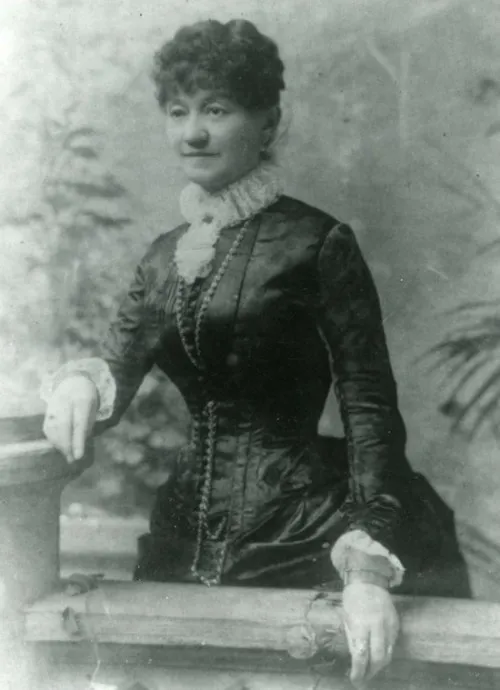
Susan McSween (née Hummer; December 30, 1845 – January 3, 1931) was a prominent cattlewoman of the 19th century, once called the "Cattle Queen of New Mexico", and the widow of Alexander McSween, a leading factor in the Lincoln County War, who was shot and killed by members of the Murphy-Dolan faction.

Susan McSween

Early life, Lincoln County War

[edit]

Born in Adams County, Pennsylvania, from a German Baptist (Dunkard) background, she left home at an early age after her mother had died and her father remarried. She married Alexander McSween on August 23, 1873 in Atchison, Kansas and they settled in Eureka, Kansas. In 1875, the couple moved to Lincoln, New Mexico, where her husband had accepted a job with the company of Lawrence Murphy. Working alongside James Dolan, McSween soon lost his desire to work for the company, and had by that time become friends with John Tunstall, a wealthy English rancher. Through Tunstall, the couple met John Chisum, and by 1877 the three men had established a rival business to the Murphy-Dolan businesses who had completely monopolized every business transaction in Lincoln. The Murphy-Dolan faction was backed by the infamous Santa Fe Ring.

Problems between the two factions began there, and on February 18, 1878, outlaw Jesse Evans and members of his gang working with "the boys" from the rival faction of James Dolan also known as The Santa Fe Ring, shot and killed Tunstall, which sparked the Lincoln County War. By that time, Tunstall and McSween had hired gunmen to counter those hired by Murphy-Dolan. While the latter had hired outlaw gangs like the Seven Rivers Warriors, John Kinney Gang, and the Jesse Evans Gang, Tunstall hired individuals, to include Billy the Kid, Chavez y Chavez, Dick Brewer, Charlie Bowdre, Doc Scurlock and others. The two factions clashed over Tunstall's death, with numerous people being killed by both sides culminating in the Battle of Lincoln, in which Susan McSween was present. Her husband was killed at the end of that battle, despite his being unarmed and attempting to surrender.[1]

Susan McSween hired attorney Huston Chapman to pursue charges against those responsible for her husband's death and had him assist in negotiating with Governor Lew Wallace on amnesty for the Lincoln County Regulators who had defended her husband and sought vengeance for Tunstall's death. Colonel Nathan Dudley was one of her main targets, and he did stand trial, but was acquitted. Lawrence Murphy had died before the end of 1878, and James Dolan was charged in Tunstall's murder, but acquitted, and could never be linked directly to Alex McSween's murder. Jesse Evans killed Chapman, then fled the territory, after which eventually the whole matter simply went away.[1]

After the range war

[edit]

Susan struggled in the aftermath of the Lincoln County War to make ends meet in New Mexico Territory. She sought and received help from John Tunstall's family in England. She served as executor of John's estate and that of her husband, managing to free herself of their accrued debts by liquidating the estate assets. In 1880 she married George Barber, a young law clerk and later attorney, who aided in her recovery. Barber's work as a surveyor for John Chisum resulted in Chisum gifting 40 head of cattle to Susan worth about $400 to start her into the cattle business. Later the couple divorced.

Susan took over 1,158 acres of land on the West side of the Mescalero Apache Indian Reservation in the years after the Lincoln County War ended. By 1890 she had expanded the acreage of the ranch and ran at least 5,000 head of cattle under the Three Rivers Cattle Company brand in Three Rivers. By some estimates she owned upward of 8,000[2] By the mid-1890s her ranch holdings were some of the largest in the territory. She became extremely wealthy through cattle sales and mining a small silver vein on the property.[1] She was also known for the fruit orchards she planted with trees she obtained from John Chisum.

On April 21, 1892, the Old Abe Eagle of Lincoln reported that she had driven 700 to 800 cattle from her ranch to Engle, the most accessible railroad point, from which place they were shipped "in 38 foot New England Cars" to the Jones and Nolan feed lots in Grand Summit and Strong City, Kansas.

The New York Commercial Advertiser said:

"Near the town of White Oaks, New Mexico, lives one of the most remarkable women of this remarkable age, at the present time a visitor in this city (New York). The house in which she lives ; a low, whitewashed adobe building, is covered with green vines and fitted out with rich carpets, artistic hangings, books and pictures, exquisite china and silver, and all the dainty belongings with which a refined woman wishes to surround herself. The house was built with her own hands. The huge ranch on which it is located with its 8,000 cattle, is managed entirely by her. It is she who buys or takes up the land, selects and controls the men, buys, sells and transfers the cattle. She is also a skillful and intelligent prospector, and found the valuable silver mine on her territory in which she now holds a half interest."[3]

Last years/death

[edit]

In 1902 she sold her ranch holdings (with the exception of the ranch house) to Monroe Harper,[4] moving to a house and later a cottage in White Oaks, New Mexico, by that time a declining boomtown. Over time, she went through the money she had accrued making frequent trips to El Paso to divest herself of the jewelry she had acquired in order to support herself, although she was supported in later life by her nephew Edgar Shields. [5]

She died from pneumonia, an impoverished woman in White Oaks, on January 3, 1931, aged 85,[6] and is buried there in the Cedarvale Cemetery.[7]

[edit]
  • She is portrayed by Sharon Thomas in the 1988 movie Young Guns. The epilogue states that following the death of her husband she became a prominent cattlewoman; however she was not depicted in the film's sequel.
  • She is portrayed by Lynda Day George in the 1970 John Wayne film, Chisum.
  • In the Shadow of Billy the Kid: Susan McSween and the Lincoln County War (2013) by Kathleen P. Chamberlain, a professor of history at Eastern Michigan University.
  • Violence in Lincoln County 1869-1881, William A. Kelleher, University of New Mexico Press 1957
  • McSween is mentioned in the 2019 semi-biographical novel of John Chisum's life, by Russ Brown, titled Miss Chisum.[8]
  • She is portrayed by Lisa Chandler in the 2022 series Billy the Kid.

References

[edit]

Bibliography

[edit]
[edit]
Revisions and contributorsEdit on WikipediaRead on Wikipedia
from Grokipedia

Susan Ellen McSween (née Hummer; December 30, 1845 – January 3, 1931) was an American rancher and entrepreneur who became entangled in the violent commercial rivalries of 1870s , particularly as the wife of lawyer during the , and later built a substantial that established her as the "Cattle Queen of ." Born in , to a family of strict religious background, she married on August 23, 1873, in , and relocated with him to the frontier settlement of Lincoln in 1875, where they challenged the dominant economic interests controlled by the Murphy-Dolan faction through mercantile and banking ventures.
The erupted from these tensions, culminating in the July 19, 1878, siege of the McSweens' home, during which was killed by forces aligned with Dolan, but escaped amid the gunfire and burning of the building, marking her transition from dependent spouse to independent litigant seeking restitution for losses estimated in the tens of thousands of dollars. Refusing to yield, she retained attorneys, including Huston Chapman—whose subsequent in 1879 underscored the ongoing perils—and pursued federal investigations that exposed among local officials tied to her adversaries, ultimately recovering assets through persistent court actions over several years. In the war's aftermath, McSween remarried cattleman George Barber in 1885, expanding her operations into one of the territory's largest ranches with thousands of head of cattle, meticulous management of ranch infrastructure, and strategic land acquisitions along the , though her second marriage ended in by 1891 amid financial strains. Her sustained wealth into the early until sales of holdings, including to Albert Fall in 1917, but her legacy endures as a rare exemplar of frontier self-reliance, transforming personal tragedy into economic dominance without reliance on mythologized outlaws like , whose association with her cause was peripheral to her own agency.

Early Life

Childhood and Family Origins

Susan Ellen Hummer was born on December 30, 1845, in Gettysburg, , to Peter Hummer (1808–1886) and his first wife, Elizabeth Stauffer Hummer (1812–1851). Her family belonged to the German Baptist Brethren, commonly known as Dunkards, a conservative Anabaptist sect emphasizing , , and communal living. As the sixth of ten children—nine daughters and one son—Susan grew up in a large typical of rural Pennsylvania farming communities during the mid-19th century. Elizabeth died in 1851, likely in , leaving Susan, then aged five or six, motherless; Peter Hummer subsequently remarried. Following her mother's death, Susan departed from the family home at a young age, though details of her circumstances and motivations remain sparse in historical records. By the early 1870s, she had relocated westward, appearing in , where she attended a school before her marriage. The Hummer family as a whole migrated to Eureka, , reflecting broader patterns of midwestern settlement among Pennsylvania German families seeking economic opportunities in expanding territories.

Education and Pre-Marital Moves

Susan Ellen Hummer was born on December 30, 1845, near Gettysburg in , to Peter Hummer and Barbara Longnecker, members of the German Baptist Brethren (commonly known as Dunkards), a conservative Anabaptist sect emphasizing plain living and scriptural literacy. Her early , consistent with the limited opportunities for girls in rural 19th-century and her religious upbringing, likely involved basic instruction in , primarily to facilitate study, though no specific institutions or advanced schooling are documented in primary records. Following her mother's death around —when Hummer was about six years old—and her father's remarriage, she departed from home as a young adolescent, reportedly dissatisfied with the strict household and dynamics. Historical accounts indicate she initially stayed with relatives, possibly a married sister in , before independently migrating westward amid the post-Civil War expansion of settlement in the Midwest. By the early , Hummer had reached , residing in Atchison, where she supported herself through unspecified work or kin networks common to itinerant young women of the period. In Atchison, supplemented her rudimentary education by attending a local covenant school affiliated with Presbyterian or Reformed traditions, acquiring skills in music, including proficiency on the piano and organ, which reflected emerging cultural influences diverging from her Dunkard . This period marked her transition from Pennsylvania's insular communities to the more fluid social environment of frontier , where she corresponded with and eventually married Alexander A. McSween, a Scottish-born , on August 23, 1873, in Atchison County. The union, performed under a judge's authorization noting McSween's residence in nearby Eureka, , preceded their brief settlement there prior to relocating to in 1875.

Marriage and Arrival in New Mexico

Union with Alexander McSween

Susan Ellen Hummer, born in 1845 in Gettysburg, Pennsylvania, corresponded with Alexander Angus McSween, a Canadian-born aspiring lawyer who had dropped out of law school, prior to their engagement as pen-pals. The two married on August 23, 1873, in Atchison, Kansas, when Hummer was 28 years old and McSween approximately 30. Their union produced no children, and the couple initially resided in Eureka, Kansas, where McSween established a legal practice amid the post-Civil War economic opportunities in the region. McSween, who had immigrated from Prince Edward Island and briefly pursued Presbyterian ministry before turning to law, brought financial ambitions to the marriage, though early years were marked by modest circumstances.

Settlement in Lincoln County and Initial Business Ties

In early March 1875, Susan and arrived in Territory, by wagon after departing Eureka, , with limited financial resources but aspirations for opportunity in the region's growing economy. , a Presbyterian minister-turned-lawyer, quickly established the county's inaugural legal practice, initially operating from the home of Squire Wilson to build a clientele amid the sparse settlement. McSween's early professional ties centered on and legal services for Lincoln County's dominant mercantile enterprise, L.G. Murphy & Co.—known locally as "the House"—which held monopolistic control over trade, supplies, and government contracts serving nearby forts and agencies. Introduced via a letter from Miguel Otero, McSween was hired to recover outstanding debts from settlers, receiving a 10% commission on collections, and provided counsel to James Dolan, a key partner in the firm following L.G. Murphy's death in 1874. He also represented in transactions, including the 1875 sale of Chisum's Grande ranch, valued between $219,000 and $350,000, which expanded McSween's connections to the area's ranching interests. Susan McSween focused on household management during this establishment phase, with no documented direct participation in these initial ventures, though the couple's shared circumstances tied her fortunes to legal and commercial engagements in the faction-dominated economy. These affiliations provided the McSweens entry into Lincoln's networks but sowed seeds of conflict through fee disputes and perceived encroachments on the House's influence.

Prelude to the Lincoln County War

Economic Rivalries and Factional Tensions

In the mid-1870s, Lincoln County's economy revolved around the mercantile monopoly of L.G. Murphy & Co., operated through their dubbed "The House," which dominated trade, banking, and government supply contracts. and his partner James J. Dolan secured lucrative beef provisions for Fort Stanton and dealings with reservations, enabling them to charge inflated prices—often double those in larger markets—while extending credit that ensnared small ranchers, farmers, and settlers in perpetual indebtedness through peonage-like practices. This control extended to political leverage via ties to the , allowing the firm to influence local appointments, including the sheriff's office under , and forestall competition. Alexander McSween, arriving in Lincoln as a Presbyterian lawyer in 1873, positioned himself against this system by advising debtors and partnering with English rancher John Tunstall, who in late 1876 or early 1877 established H.H. Tunstall & Co. as a direct rival store and banking operation. Backed by cattle magnate John Chisum's vast herds—estimated at over 100,000 head—the new venture offered lower prices on goods imported via independent routes, undercutting The House's 30-50% markups and vying for military contracts. Susan McSween, who had relocated from Pennsylvania to join her husband by 1875, contributed to the family's commercial interests through household management and logistical support amid the burgeoning rivalry, though primary decisions rested with Alexander. These economic incursions fractured the county into factions: the entrenched Murphy-Dolan adherents, reliant on enforcers and judicial favoritism to protect their empire, versus the McSween-Tunstall of reformers, including Chisum's cowhands, who advocated open competition to alleviate local exploitation. Tensions manifested in aggressive debt collections, rustling accusations, and threats during 1877 supply runs, as The House viewed the newcomers' expansion—spanning ranching, merchandising, and freighting—as an existential threat to their annual profits exceeding $100,000 from territorial contracts. By early 1878, mutual suspicions had polarized alliances, with Hispanic peons and independent Anglo settlers quietly favoring the challengers, setting the stage for violent escalation. Upon arriving in Lincoln County in March 1875, and Susan McSween faced immediate financial hardship, having traveled by wagon with limited funds after selling their property. established a law practice to support the family, initially handling cases that brought him into contact with the dominant commercial entity, L.G. Murphy & Co., known locally as "The House." A pivotal legal dispute arose from Alexander McSween's role in administering the estate of Emil Fritz, a deceased partner in The , who died on , 1874. Fritz's estate retained McSween to collect a $10,000 life insurance policy from a New York company; McSween successfully obtained the funds in 1876 but withheld disbursement to the estate's , Maria Fritz Scholland, amid claims that The House, led by and James Dolan, sought to claim the money to offset Fritz's debts to their firm exceeding $8,000. McSween argued the policy benefited Fritz's heirs exclusively and suspected misuse by the executor, who was aligned with The House; this refusal prompted accusations of against McSween, escalating tensions as Murphy and Dolan leveraged local judicial influence to pursue attachment orders on McSween's assets. Commercially, the McSweens challenged The House's near-monopoly on mercantile trade, supplies, and banking in Lincoln County, which supplied army posts and controlled credit to ranchers. In late 1876, partnered with English immigrant to establish a competing store and banking operation in Lincoln, aiming to undercut The House's high prices and extend fairer credit terms; this venture drew ranchers and farmers away from Dolan and , who responded with economic pressure, including foreclosure threats on indebted clients. Susan McSween assisted in managing household and early business affairs amid these pressures, as the family's income depended heavily on Alexander's contested legal fees. Judicial bias compounded their challenges, with Lincoln County Sheriff William Brady and John Riley—both indebted to The House—ruling consistently against McSween in civil suits over debts and attachments. By mid-1877, multiple writs targeted McSween's property, including his home and effects, forcing defensive legal maneuvers and deepening the family's financial strain; McSween secured a temporary against some seizures but faced ongoing , including an 1877 for related to the Fritz estate. These entanglements highlighted systemic favoritism toward established commercial interests, as territorial courts often deferred to influential merchants like Dolan, who by 1877 had assumed control of The House following Murphy's decline.

Involvement in the Lincoln County War

Outbreak of Violence and Strategic Role

The outbreak of violence in the occurred on February 18, 1878, when , a business partner and client of , was murdered by a posse led by of the Seven Rivers Warriors, acting under the direction of Lawrence Murphy's former deputies William Brady and George Hindman. This killing stemmed directly from an ongoing legal dispute, in which Brady and Hindman sought to enforce an attachment order on Tunstall's horses to satisfy alleged debts owed by to the Murphy-Dolan mercantile interests; Tunstall had ridden out from Lincoln to intercept the seizure, but was shot in the head and left to die on the road to his ranch. The murder shattered fragile truces and catalyzed the formation of the Regulators, a vigilante group of Tunstall's employees and McSween supporters—including Dick Brewer, , and William Bonney (later known as )—tasked with arresting Tunstall's killers and protecting McSween family assets. Susan McSween played a pivotal strategic role in the early phases of the conflict by assuming control of the McSween-Tunstall commercial operations following Tunstall's , including management of the Lincoln store and ranch properties, which provided logistical and financial backbone to the Regulators' efforts. As executrix of Tunstall's estate, she pursued legal claims against the Murphy-Dolan faction while counseling the Regulators on targets and operations, effectively directing their campaign of retribution and asset defense amid escalating skirmishes, such as the March 1878 killing of Brady by the Regulators. Her oversight extended to forging alliances with influential figures like cattle baron , whose resources bolstered the faction's endurance against the opposing group's control of territorial and military support; historical accounts have dubbed her the "secretary of war" for this behind-the-scenes coordination, which sustained resistance despite Alexander McSween's focus on litigation. This role proved critical in transforming economic rivalries into armed conflict, as her directives prioritized reclaiming seized goods and countering Dolan-backed posses, setting the stage for the war's intensification through spring and summer 1878.

Key Events and Alliances, Including with Regulators

The Tunstall-McSween faction, including Susan and Alexander McSween, allied with the Lincoln County Regulators—a vigilante posse formed in late February 1878 by former Tunstall employees to enforce arrest warrants against Murphy-Dolan affiliates following John Tunstall's murder on February 18, 1878. The Regulators, comprising around 70 men at their peak including Billy Bonney (later known as Billy the Kid), Doc Scurlock, and Charlie Bowdre, acted in support of McSween's legal and commercial interests against the rival House monopoly controlled by Lawrence Murphy and James Dolan. Susan McSween, while not participating in combat, backed the faction by endorsing the hiring of armed supporters aligned with the Regulators to protect their enterprises. A pivotal early event occurred on April 1, 1878, when Regulators ambushed and killed Lincoln County Sheriff Brady and Deputy George Hindman in Lincoln, citing Brady's alleged complicity in Tunstall's death and prior confiscations of McSween property. Three days later, on April 4, 1878, at Blazer's Mill, Regulator leader Dick Brewer and two others died in a with , a Dolan hired gun, highlighting the escalating violence that drew in broader alliances, including indirect ties to cattleman who favored the McSween side for economic reasons. These actions positioned the Regulators as enforcers for the McSweens amid factional tensions over store ownership, banking, and territorial influence. The conflict culminated in the five-day Battle of Lincoln from July 15 to 19, 1878, where approximately 60 Regulators under Billy the Kid's leadership occupied key buildings to counter George Peppin's Dolan-backed posse. Susan and were barricaded in their home with a small group of defenders, including Regulators, as Peppin's forces—numbering over 50 and supported by U.S. Army troops under Colonel Nathan Dudley—surrounded the town. On July 19, after artillery and gunfire exchanges, the McSween residence was set ablaze; was shot and killed while attempting to flee, but Susan escaped unharmed by surrendering under a to federal officer Lewis Wallace, marking the effective end of organized Regulator resistance in the war. This alliance with the Regulators underscored the McSweens' reliance on armed proxies rather than formal regulatory authorities, as territorial governance favored the Dolan faction through sheriff appointments and military neutrality.

Alexander McSween's Death and Susan's Survival

The five-day siege of the McSween home in , from July 15 to 19, 1878, represented the violent culmination of the , with and roughly 15 supporters barricaded inside against a larger force under , comprising deputies aligned with the Murphy-Dolan faction. On the afternoon of July 19, Peppin's men ignited the house to dislodge the defenders, starting fires in adjacent structures that spread to the main building despite attempts by those inside to extinguish them. As smoke and flames filled the rooms, Susan McSween, along with other women and children present, was allowed to exit the burning structure under a temporary truce, recognized as non-combatants amid the chaos. Earlier in the siege, Susan had ventured out under risk to appeal directly to U.S. Army Colonel Nathan A.M. Dudley at nearby Fort Stanton for protection or mediation, but Dudley, observing from a distance with troops who did not intervene, declined to act decisively. Her survival hinged on this civilian exemption during the escape, though she remained in the vicinity long enough to witness the ensuing tragedy. That evening, McSween and a group of armed Regulators, including , dashed from the inferno toward a nearby orchard for cover, but McSween—unarmed according to eyewitness accounts and possibly attempting to surrender—was cut down by gunfire from the deputies, sustaining fatal multiple gunshot wounds to the head and body. His corpse was left in the yard as the house collapsed into embers, with four other Regulators also killed in the breakout attempt. McSween's death on July 19, 1878, effectively concluded the war's open hostilities, leaving Susan widowed at age 32 with substantial unresolved claims against the opposing faction. She later described the event as a deliberate , attributing it to the unchecked aggression of Peppin's posse, though no immediate prosecutions followed due to the faction's local influence.

Pursuit of Justice and Attorney Murders

Following the death of her husband on July 19, 1878, during the final siege of their home in , Susan McSween initiated legal proceedings to hold members of the opposing Murphy-Dolan faction accountable for his killing and related grievances, including disputed business claims and prior violence. She retained Huston A. Chapman, a young attorney from , to represent her interests, tasking him with filing charges against key figures such as James Dolan for , , and tied to the estate. Chapman's aggressive approach included gathering evidence against the faction's enforcers and pushing for indictments, which intensified threats from former antagonists still influential in local law enforcement and politics. On February 18, 1879, Chapman was assassinated in Lincoln while riding with Susan McSween and others returning from a court session in Tularosa. , leader of the Silsbee Gang aligned with Dolan, and accomplice ambushed the party, shooting Chapman multiple times before dragging his body through the streets and setting it ablaze in an act of mutilation. , known as , witnessed the killing from hiding and later referenced it in correspondence to territorial Governor , describing Evans and Campbell's direct involvement. The murder, occurring after the formal end of the , underscored the faction's resistance to judicial accountability, as Dolan faced accusations but evaded conviction through connections in Santa Fe. Susan's pursuit persisted despite the loss, as Chapman's death galvanized federal scrutiny, prompting U.S. Army intervention under orders from President to restore order and protect judicial processes in the territory. She filed additional suits against Dolan and associates for estate recovery, though outcomes were protracted by corruption allegations and witness intimidation, reflecting broader challenges in where economic powerhouses like the (Murphy-Dolan's firm) wielded . No further attorneys representing her were reported murdered in immediate sequence, but the Chapman slaying symbolized the lethal risks of challenging entrenched interests post-conflict.

Federal Intervention and Estate Disputes

Following the assassination of her attorney Huston Chapman on February 18, 1879, Susan McSween's campaign to reclaim her husband's estate and that of faced intensified opposition from the Dolan faction, which had previously obtained a attaching McSween's and Tunstall's combined assets on embezzlement charges originating from the estate of merchant . Chapman had been en route to Lincoln to file suits against James Dolan and Fort Stanton commander Nathan A. M. for complicity in Alexander McSween's death and the subsequent property seizures, which McSween argued were fraudulent maneuvers to eliminate economic competition. Chapman's killing, attributed to Dolan associates, drew federal scrutiny to the territorial corruption exemplified by the , as New Mexico's status as a U.S. territory placed its governance under direct federal oversight, including accountability for undermining . Territorial Governor , a presidential appointee tasked with restoring order, pursued arrests in the case, but Dolan's connections within the political machine led to the charges being dropped despite indictments. This episode contributed to wider federal investigations into the Ring's influence, which had enabled the Murphy-Dolan monopoly on government beef contracts for the U.S. and Apache agency, assets central to the estate disputes. McSween assumed the role of executrix for Tunstall's estate, securing financial support from his English to fund ongoing litigation against Dolan for the of cattle, land, and mercantile goods valued in the tens of thousands of dollars. Her persistence in U.S. District Court and territorial proceedings yielded incremental recoveries, including key ranch properties by the early 1880s, though Dolan retained control over portions through protracted appeals and local judicial favoritism until his influence waned. These disputes underscored the causal link between the war's factional violence and the economic sabotage that left McSween's claims encumbered for years, with federal exposure of Ring aiding her eventual consolidation of holdings exceeding 100,000 acres.

Post-War Business Ascendancy

Transition to Cattle Ranching

Following the resolution of protracted legal battles over her late husband Alexander McSween's estate in the early 1880s, Susan McSween redirected her resources toward land acquisition and livestock operations in , marking a pivot from mercantile and litigious pursuits to agrarian enterprise. Leveraging inheritance claims and opportunistic purchases, she secured initial holdings in the Three Rivers area southeast of modern-day Tularosa, where fertile valleys supported grazing. This shift capitalized on the stabilization of regional markets and the availability of under federal land acts, allowing her to transition from creditor disputes to productive . On June 20, 1880, McSween married George Barber, a former law clerk associated with cattleman , which facilitated her entry into ranching; Chisum gifted her 40 head of valued at approximately $400 as a wedding present, providing a foundational herd. The couple established the Three Rivers Cattle Company, registering its brand and developing infrastructure including a ranch house, , , a across Three Rivers, and a half-mile irrigation ditch to enhance viability amid arid conditions. McSween actively oversaw operations, acquiring over 400 acres through homestead claims, purchases, and transactions, while emphasizing to improve stock quality. By 1890, the operation had expanded significantly, with McSween managing at least 5,000 head of across a 1,200-acre spread, positioning her as one of the territory's preeminent independent cattlewomen and earning her the moniker "Cattle Queen" from her employees. Despite the 1892 dissolution of her marriage to in of that year, she retained control, demonstrating acumen in navigating range without male . This phase underscored her adaptation to frontier capitalism, where ranching offered scalable returns over the volatile storekeeping and legal feuds of Lincoln County.

Expansion of Holdings and Economic Strategies

Following the resolution of legal disputes over her late husband Alexander McSween's estate in the early 1880s, Susan McSween shifted focus to cattle ranching, leveraging recovered assets including claims to from the Tunstall-McSween faction to initiate expansion. Initially retaining only 160 acres of jointly filed homestead land near , she pursued recovery of scattered and horses through persistent litigation and alliances with local ranchers like , establishing her primary operations along the and in the Three Rivers area. By the late 1880s, McSween had scaled her holdings significantly through targeted acquisitions and partnerships, taking on two business associates by 1888 to manage 1,158 acres and approximately 8,000 head of cattle, marking a transition from modest post-war recovery to one of Territory's leading ranching enterprises. Her strategies emphasized of high-quality stock to improve herd value and resilience against regional challenges like drought and disease, supplemented by diversified agricultural efforts that earned her recognition for productivity among peers. This approach, combined with shrewd negotiations for grazing rights on public lands, enabled annual growth in herd sizes and land claims, culminating in her designation as the "Cattle Queen of the Pecos" by 1890. McSween's economic model prioritized long-term capital investment over short-term speculation, including reinvestment of profits from cattle drives to eastern markets into infrastructure such as fencing and water improvements, which minimized losses and enhanced operational efficiency in the arid frontier environment. Despite economic pressures from overgrazing and market fluctuations, her hands-on oversight and reputation for equitable dealings with vaqueros fostered loyalty and sustained expansion until personal circumstances prompted divestitures in the 1890s.

Achievements as "Cattle Queen" and Criticisms

By 1888, Susan McSween had partnered in the Three Rivers Ranch, controlling 1,158 acres and 8,000 head of cattle, establishing her as a major force in New Mexico's cattle industry. Her operations under the Three Rivers Cattle Company brand expanded rapidly, reaching at least 5,000 head on over 1,200 acres by 1890 through strategic land trades and cattle acquisitions. McSween's hands-on approach included micromanaging ranch details, constructing housing for cowboys, barns, and other infrastructure, which contributed to sustained productivity amid the territory's economic fluctuations. Diversification bolstered her wealth: a small silver on her property yielded mining income, while fruit orchards provided additional revenue streams by the 1890s. These efforts transformed her post-Lincoln County War holdings into one of the territory's largest cattle empires, with estimates of 3,000 to 5,000 head during peak years in the mid-1890s. Her success earned her the title "Cattle Queen of the Pecos," reflecting recognition of her economic dominance and resilience in a male-dominated sector. Criticisms of McSween's ranching practices centered on her aggressive land accumulation, involving frenzied buying, selling, and trading of unsettled homestead claims to exceed 400 acres initially, which some viewed as speculative and disruptive to local settlement patterns. Despite her prosperity, later financial strains emerged; she sold the ranch in , and certain accounts note a decline in by her final years, contrasting her earlier opulence marked by lavish personal expenditures. These elements fueled debates among historians about the sustainability of her , reliant on volatile markets and resource extraction without broader diversification.

Later Personal Life

Remarriage and Relocation

In 1880, Susan McSween married George Bernard , a originally from , , who had assisted in assessing her late husband's estate during the and later worked as a surveyor for rancher . The wedding occurred on June 20 in , and Chisum marked the occasion by gifting the couple 40 head of cattle, supporting McSween's emerging cattle operations. Barber, admitted to the New Mexico bar in 1882, joined McSween in ranching ventures, including patenting over 400 acres under the Desert Land Act and Timber Culture Land Act, with holdings centered on a 1,200-acre ranch branded as the Three Rivers Cattle Company near White Oaks. The marriage facilitated McSween's transition from Lincoln-based recovery efforts to expanded operations in the White Oaks vicinity, where the couple built a home, though McSween primarily resided at the Three Rivers ranch between Carrizozo and Tularosa to oversee her growing herd of 5,000 cattle by 1890. Strains arose from her frequent absences and business focus, culminating in divorce proceedings finalized in March 1892, after which Barber sold his interest in the Three Rivers Land & Cattle Company in 1889 and remarried. Following the divorce, McSween remodeled her ranch after a 1892 trip to the East Coast and continued independent management. In 1902, after selling her ranch and cattle operations, McSween relocated permanently to White Oaks, New Mexico, purchasing 60 lots and building a cottage there as mining activity waned. She resided in the town for the remainder of her life, selling remaining Lincoln and White Oaks properties in May 1905 for $600, until her death from on January 3, 1931, at age 85; she was buried in the White Oaks cemetery. This move marked her shift from active ranching to quieter retirement in the declining mining community.

Final Years and Death

Following the divestment of her ranch and cattle holdings in 1917, Susan McSween retired to White Oaks, , where she constructed a cottage on the south side of town and participated in local social life, including membership in the Congregational Church and hosting events such as dances, card games, and musical evenings. She had previously acquired 60 lots in White Oaks after a decline in property values following the depletion of local mines, reflecting her ongoing interest in regional investments. McSween, who had divorced George Barber in March 1892 amid a failed , spent her final years in relative seclusion but maintained ties to the community through these activities. She succumbed to on January 3, 1931, at age 85, shortly after contracting . Her funeral involved a $150 procured from Kelly's in White Oaks, and she was interred in there, though her headstone incorrectly rendered her former as "MacSween."

Historical Legacy and Controversies

Assessments of Her Influence and Decision-Making

Historians assess Susan McSween's influence during the as substantial but indirect, primarily through her support for the Regulators and her role in escalating legal and economic disputes against the Murphy-Dolan faction. After her husband Alexander McSween's death on July 19, 1878, she hired attorney Huston A. Chapman on February 1, 1879, to investigate Colonel Nathan Dudley's involvement in the conflict, which led to Chapman's on , 1879, further intensifying factional violence. Chamberlain notes that McSween's decisions to collect debts from estates like John Tunstall's and Emil Fritz's positioned her as a key player in the economic struggle for control in , though her gender limited overt leadership, leading her to manipulate Victorian lady roles strategically. Post-war, McSween's decision-making demonstrated business acumen in transitioning to cattle ranching, amassing wealth through strategic land claims under the Homestead Act of 1879 (160 acres initially) and the Desert Land Act (additional 320 acres), resulting in cattle holdings valued at $49,000 by 1891. She managed the Three Rivers Land & Cattle Company independently, selling interests for $32,000 in 1902, earning her the moniker "Cattle Queen of " for controlling one of the territory's largest operations amid frontier economic volatility. This shift from legal pursuits to ranching exemplified her adoption of male-dominated standards of accumulation and strength, enabling her to recover from the war's destruction of her Lincoln property. Critics, including contemporary affidavits from Dudley supporters, accused McSween of moral lapses such as and lewd conduct during the , though no evidence substantiated these claims and they served factional interests. Chamberlain highlights decisions like demanding payment from Brewer's parents after his death, which alienated local sympathizers and painted her as callous, while her refusal of family aid, such as a $500 loan offer, drew charges of ungratefulness. Later choices, including her marriage to George L. Barber, led to financial mismanagement and eventual poverty by the , prompting debates on whether her independence overshadowed prudent partnerships; some historians view her as a cunning capitalist who shaped New Mexico's frontier economy, while others emphasize reputational costs from war-era intransigence, often eclipsed by figures like .

Debates on Moral and Causal Responsibility in the War

Historians have debated Susan McSween's causal role in prolonging the beyond the July 19, 1878, siege of her home, where her husband was killed amid clashes that claimed at least 18 lives overall from 1878 onward. While the conflict's origins lay in economic rivalries between the Murphy-Dolan mercantile faction and the Tunstall-McSween interests—exacerbated by Tunstall's murder on , 1878—McSween's post-siege actions, including aggressive legal pursuits, are credited by some with sustaining hostilities rather than resolving them through settlement. Her hiring of attorney Huston A. Chapman on , 1879, to litigate estate claims against Dolan allies, directly preceded Chapman's by suspected Dolan partisans on , 1879, which prompted retaliatory violence and delayed truce efforts. Kathleen P. Chamberlain assesses McSween as an ambitious actor who, while initially cautioning against risky ventures with Tunstall due to foreseen violence, adopted a "cunning capitalist" post-widowhood, filing suits like those against Colonel Nathan Dudley for alleged in the 1878 siege and pursuing debt collections that entangled former Regulators. This view revises earlier narratives casting her as a mere victim overshadowed by , emphasizing her agency in leveraging lawsuits to challenge opponents, which contemporaries like special investigator Frank Warner Angel described as turning her into "a tiger" after her husband's death. Critics of this prolongation argue her refusal to compromise—despite opportunities amid federal scrutiny under President Rutherford B. Hayes's 1878 intervention—causally linked to ongoing skirmishes, including those involving her allies until Lew Wallace's 1879 amnesties. On , debates hinge on McSween's Presbyterian upbringing and later disavowals of —she reportedly stated, "Don’t think for one moment that I am or was an admirer of "—against her wartime reliance on armed enforcers like the Regulators, who killed in the March 1878 Blazer's Mill ambush under her faction's banner. Chamberlain attributes her choices to survival imperatives rather than ethical lapses, portraying neither pure victimhood nor instigation but pragmatic adaptation in a power struggle devoid of clear binaries. Detractors, including Dudley-affiliated accounts, imputed laxity via gender-biased smears questioning her influence over male combatants, though these lack substantiation beyond partisan affidavits. Ultimately, her post-war accumulation of 8,000 by , yielding $49,000 in assets, underscores a focus on economic vindication over retribution, mitigating claims of enduring culpability.

Enduring Impact on New Mexico's Frontier History

Following the , Susan McSween administered the estates of her husband and , collecting debts and acquiring land through federal mechanisms, including 160 acres under the Homestead Act in 1877, 160 acres via the Timber Culture Act in 1879, and 320 acres under the Desert Land Act. She purchased additional properties and received 40 cattle valued at $400 from , laying the foundation for her ranching operations. By 1885, she established the Three Rivers Land and Cattle Company, with cattle holdings valued at $49,000 by 1891, marking her emergence as a major economic force in . McSween expanded her holdings to a 1,200-acre supporting up to 5,000 head of by 1890, implementing infrastructure like a across the Three Rivers stream and ditches to bolster productivity in the arid environment. She shipped approximately 800 to feedlots in 1892 and sold ranch interests, including for $32,000 to Monroe Harper in 1902, contributing to the commercialization of cattle drives and markets that underpinned the region's economic growth. Her operations as the "Cattle Queen of the Pecos" exemplified the shift from conflict to sustained agricultural enterprise, fostering land patents and practices that shaped settlement patterns. McSween's enduring influence lies in her demonstration of female economic agency amid male-dominated frontier capitalism, challenging gender roles through independent property management and business acumen during the . Living until January 3, 1931, she observed New Mexico's path to statehood in 1912, providing firsthand accounts that enriched historical narratives beyond outlaw legends like , emphasizing instead the role of resilient entrepreneurs in territorial stabilization. Her legacy highlights the causal link between post-war legal persistence and ranching success in driving regional development, with her story informing scholarly views on social and economic complexities in the American Southwest.

Representations in Culture

Literature and Film Portrayals

Susan McSween has been portrayed in multiple films and television series dramatizing the and associated figures like . These depictions often emphasize her role as Alexander McSween's wife during the conflict's violent climax, including the 1878 siege of their home in , though artistic liberties frequently alter historical details for narrative effect. In the 1970 Chisum, directed by , played Sue McSween, presenting her as a resilient figure navigating the feud between John 's faction and rivals and James Dolan. The portrayal highlights her loyalty to her husband and involvement in legal battles post-war, aligning loosely with records of her estate management after Alexander's death on July 19, 1878. Sharon Thomas depicted Susan McSween in the 1988 film Young Guns, the first installment focusing on and the Regulators. Her character appears amid the group's alliance with the McSweens against Dolan, culminating in a dramatized version of the McSween house firefight, which historical accounts describe as involving federal troops and resulting in five deaths, including Alexander's. More recently, in the MGM+ series (2022–present), Canadian actress Lisa Chandler portrays Susan McSween, particularly in season 2, as a cattlewoman entangled in the war's economic and personal stakes. The series, created by Michael Hirst, draws on her documented survival and subsequent rise to owning over 150,000 acres by the , though it fictionalizes interpersonal dynamics for dramatic tension. Literary portrayals of McSween remain predominantly non-fictional, appearing in biographies and histories of the Old West rather than outright novels. She features in accounts like Walter Noble Burns's The Saga of Billy the Kid (1926), which romanticized the war and prompted McSween's 1928 letter critiquing its exaggerations of Billy's exploits while defending her own perspective on events. Fictional novels about Billy the Kid occasionally include her as a secondary figure, with varying degrees of historical fidelity in depicting her strategic decisions during the conflict.

Modern Historical Reappraisals

In recent decades, historians have reevaluated Susan McSween's role in the (1878), shifting emphasis from male gunfighters like to her as a proactive economic actor in New Mexico's frontier struggles. Kathleen P. Chamberlain's 2007 biography In the Shadow of Billy the Kid: Susan McSween and the contends that McSween, widowed on July 19, 1878, amid the burning of her Lincoln home, actively pursued legal redress and alliances to reclaim assets from the rival Murphy-Dolan mercantile faction, rather than remaining a passive victim. Drawing on territorial records and correspondence, Chamberlain documents McSween's orchestration of lawsuits and petitions to federal authorities, including Army investigations, which by the early 1880s yielded judgments in her favor totaling over $100,000 in contested claims. This scholarship critiques prior accounts for privileging dramatic violence over structural economic rivalries, portraying McSween's decisions—such as hiring the Regulators for protection—as calculated responses to monopolistic threats in a cattle-driven where women held formal power. Chamberlain highlights her postwar ranching ventures, which by 1890 encompassed thousands of cattle across southeastern , crediting McSween's adaptability for her financial independence post-divorce from George Barber in 1891. Reviewers praise the work's archival rigor in distinguishing verifiable events from later embellishments, though note the war's factional entanglements marked neither her pinnacle nor her sole legacy. Subsequent analyses build on this by framing McSween as emblematic of gendered agency in territorial , where her survival and wealth accumulation—peaking with holdings valued at hundreds of thousands by statehood in —challenged narratives of inevitable female marginalization. Yet, reappraisals acknowledge causal complexities: her unyielding litigation arguably escalated hostilities, contributing to over 20 deaths, including Billy the Kid's execution of William Brady on April 1, 1878, under her indirect employ. These views underscore her as a "wonderfully complex" figure whose influence persisted through ranching innovations until her death on January 3, 1931, influencing modern understandings of women's .

References

Add your contribution
Related Hubs
User Avatar
No comments yet.