Hubbry Logo
SwinfordSwinfordMain
Open search
Swinford
Community hub
Swinford
logo
8 pages, 0 posts
0 subscribers
Be the first to start a discussion here.
Swinford
Swinford
from Wikipedia

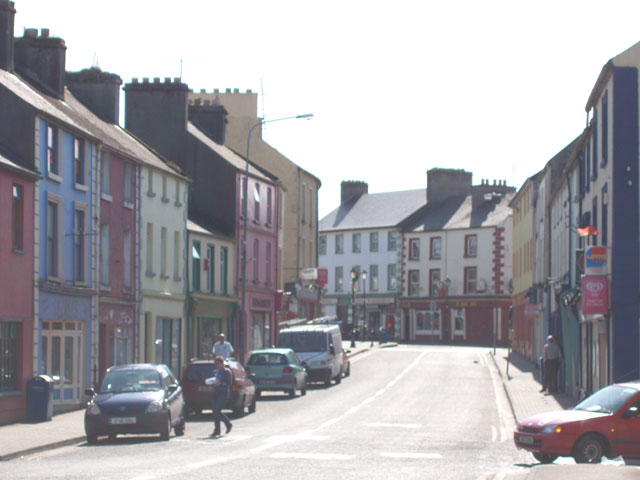
Swinford (Irish: Béal Átha na Muice, meaning 'ford-mouth of the pig')[2] is a town in County Mayo, Ireland. It is surrounded by a number of smaller villages, including Midfield and Meelick.[3] It is just off the N5 road, 18 km (11 mi) from Ireland West Airport. Situated on a tributary of the River Moy, Swinford is known for its fishing waters, including the Callow lakes and the lakes of Conn and Cullin. Swinford was bypassed in 1993 by the N5 route and was the first town in Mayo to be bypassed.

Key Information

Etymology

[edit]

The origins of the name "Swinford" are disputed. Two primary theories exist; the first suggests that the original name of the town was "Swineford", derived from a pig market held regularly in the town.[4] The official Irish language name for the town is "Béal Átha na Muice", which is "mouth of the ford of the pigs" in English. The second theory as to the origin of the Swinford name is that it has always been named Swinford, and that the name Swinford is derived from Swinford, Leicestershire. The Brabazon family, who founded the town, originally came to Ireland from Leicestershire in the 1700s.[5]

History

[edit]

Origins and early history

[edit]

Swinford was created as a planned town by the Anglo-Irish Brabazon family in the late 1700s. The Brabazons had originally resided in County Galway, but lost their estates there after fighting on the losing side in the Williamite War in Ireland.[6] Although their Galway estates were confiscated, they were granted new land in County Mayo as a consolation. In 1769, the Brabazons began granting leases; 40 people were given the right to build houses in a pre-planned pattern and layout in the area that would become Swinford. The then landlord, William Brabazon, encouraged good quality structures by donating lumber and slate towards construction, and the result was that many of the initial structures in Swinford were three stories tall.[5]

The Protestant church, which still stands today, was built in 1810, while a courthouse was constructed in 1840.[7] Shortly thereafter in 1842 a workhouse was built, and it immediately became a focal point of the town as the Irish Famine began in 1846. In 1847, the death toll around Swinford was so severe that 564 corpses had to be buried in a mass grave behind the workhouse.[5][7]

In 1855, the Sisters of Mercy established a presence in the town, building a convent near the parish church. They took over operations at the workhouse during the 1880s. In 1906 they established a primary school and a secondary school for girls in the town. In 1916 the Sisters of Mercy took over Brabazon estate house and converted it into a school.[5]

During the 1890s a bridge was constructed in Swinford to allow the entry of a railway through the town as well as the establishment of Swinford railway station.[5] It was also during the 1890s that a Catholic church was built.[7]

Swinford Revolt

[edit]

John Dillon was a long-serving Member of Parliament for East Mayo at Westminster. His major policy issue was the resolution of the Land Question. Dillon took an uncompromising position in favour of the smallholders (small farmers) who sought to gain ownership of the land which they held as tenants from the largely Anglo-Irish landlords. From the middle of the 19th century, ongoing attempts were made at Westminster by the Liberal Party under William Ewart Gladstone to resolve the issue by passing the Irish Land Acts. Irish opinion, while welcoming of the initiative to resolve the injustice, was divided between the moderates, led by William O'Brien, who favoured a conciliatory approach (known as the doctrine of conciliation) and the hardliners. The hardliners supported an aggressive agrarian struggle and sought to advance simultaneously the struggle for Home Rule.

On 25 August 1903, Dillon, addressing a meeting of his constituents at the Swinford Workhouse, spoke vehemently against the doctrine of conciliation. This divided the Party and led to the departure of William O'Brien. It became known as the "Swinford Revolt". Despite the turmoil, the Chief Secretary for Ireland, George Wyndham's Land Purchase (Ireland) Act 1903 passed at Westminster, resolving the Irish Land Question.[8]

War of Independence

[edit]
Catholic church in Swinford (built c. 1890)

Swinford, like other areas in the West of Ireland, was the site of a number of actions during the Irish War of Independence (1919–1921). According to one account, nationalists in East Mayo had a long running split dating back to the Parnell scandal, with relations between nationalist factions in Swinford and Meelick particularly poor.[9] The failure to organise in advance of the Easter Rebellion in 1916 paradoxically meant however that relatively few Swinford men were arrested and interned, meaning they were outside the network of republican leaders that developed in the internment camps and prisons. It was not until approx 1920 that the IRA was structured in Swinford, and from then, with the participation of a group of young volunteers, the activity increased, particularly in the sphere of Republican Courts.[9]

According to the Galway Observer of Saturday, 24 July 1920, in an article entitled "Shots in Swinford":

A military patrol of the Border regiment from Claremorris was fired at on Saturday night at Swinford and two soldiers were severely wounded. The soldiers halted at Swinford courthouse, from which four streets branch and immediately shots were fired at them by unknown parties. The lorry was riddled in several places with several bullets.

The military returned the fire, discharging as many as 500 rounds, with what result did not transpire. The wounded soldiers were conveyed to Claremorris, where their wounds were dressed prior to removal to the Curragh Hospital.[10]

On 19 August 1920, IRA members broke into the goods shed at Swinford Railway station and destroyed 10 tons of food and fuel belonging to British security forces.[11] Later that month, on 27 August 1920 IRA volunteers from Swinford and Bohola attacked and captured Ballyvary RIC Barracks,[12] and on 27 November 1920 two Swinford men, James Henry and Thomas Fraher were convicted at a military court in Galway of possessing weapons and intelligence on the RIC. Both were sentenced to periods of imprisonment.[13]

Local folklore has it that other British patrols were ambushed in rural areas outside the town, and that local Volunteers from the (Old) Irish Republican Army climbed onto the roof of the Royal Irish Constabulary barracks (now the site of the Gateway Hotel) and burnt it to the ground by breaking slates and pouring petrol into the building.

During this period British soldiers were also billeted in the town.

Transport

[edit]

Swinford railway station opened on 1 October 1895, closed for passenger traffic on 17 June 1963 and finally closed altogether on 3 November 1975.[14]

Culture

[edit]
Statue in Swinford focusing on the impact of emigration from the area in the mid-20th century

Swinford hosts one of County Mayo's largest summer festivals and has done since the mid-1980s: Siamsa Sráide Swinford, (Fun in the Streets of Swinford). This street festival of pageantry, céilí dancing, and heritage displays depicts the traditions of East Mayo. The five-day festival takes place in the first week of August and features live bands playing open-air concerts as well as a heritage day, history walks and an busking competition.[15]

Swinford is used for the filming of TV show Hardy Bucks, as the fictional town of Castletown.

Education

[edit]

Up to the mid-1980s the town had 3 second-level schools: St. Patrick's college, St. Mary's Convent and the vocational school. All three schools amalgamated in August 1992 to become Scoil Muire agus Padraig.[16] [17] There is also a national school called Scoil Maire Agus Treasa or Swinford National School.[citation needed]

People

[edit]

See also

[edit]

References

[edit]
Revisions and contributorsEdit on WikipediaRead on Wikipedia
from Grokipedia
Swinford is a in eastern , , located on the N5 and along a tributary of the River Moy. As of the 2022 census, it had a population of 1,459 residents. The town functions as a commercial center for East Mayo, featuring shops, services, and accommodation, while deriving economic significance from on the nearby Moy and proximity to Knock. Established in the late by the Brabazon family amid Cromwellian land settlements, Swinford developed as a key market hub in the region, though it suffered severe depopulation during the Great Famine, including the operation of a local to address . The town was bypassed by a new road alignment in 1993, preserving its core while maintaining accessibility. Culturally, it hosts the annual Siamsa Sraide festival, a celebration of Irish music, dance, poetry, and competitions that has drawn up to 30,000 visitors, underscoring its role in preserving local traditions. Designated as a self-sustaining growth town in , Swinford continues to support community-driven economic initiatives amid broader rural challenges in western .

Geography and Demographics

Location and Environment

Swinford is a town situated in , , at coordinates 53°56′30″N 8°57′00″W. It lies along the N5 national primary road, positioned between to the west and Charlestown to the east, approximately 17 miles east of and near the border with . The town is located on a tributary of the River Moy, with the main river flowing northward nearby, supporting local fishing activities. It is also about 10 miles from Knock. The surrounding terrain consists of low-lying land at an elevation of approximately 70 meters above , characteristic of the broader Mayo landscape in western . The (GWB), covering 34 km², features groundwater with a CaHCO₃ signature, exhibiting high , , and conductivity, indicative of the region's karst-influenced . Agricultural fields and rural settings predominate, with proximity to boglands and the Atlantic-influenced west coast environment shaping the local . Swinford experiences an (Köppen classification Cfb), marked by mild temperatures, high humidity, and significant annual precipitation typical of 's west. Average elevations and coastal proximity contribute to frequent rainfall, supporting lush vegetation but also challenging drainage in low-lying areas. The population of Swinford has remained relatively stable in recent decades, fluctuating around 1,400 to 1,500 residents, reflective of broader trends in rural western characterized by modest growth during economic booms followed by stagnation or decline amid recessions and emigration pressures. According to Central Statistics Office (CSO) census data, the town's population grew from 1,216 in 1991 to a peak of 1,502 in 2006, driven by 's economic expansion which attracted return migration and limited internal growth in small towns like Swinford. This period saw an approximate 23.6% increase over 15 years, aligning with national patterns of rapid urbanization and boosting peripheral regions. Post-2008 , the declined to 1,435 in and further to 1,394 in 2016, a net drop of about 7.2% from the 2006 high, attributable to heightened , youth out-migration to urban centers like or abroad, and limited local job opportunities in agriculture-dependent Mayo County. By the 2022 , however, numbers rebounded slightly to 1,459, representing a 0.77% annual growth rate from 2016, possibly influenced by post-COVID return migration, trends, and modest offsetting natural decrease in aging rural populations.
Census YearPopulation
19911,216
19961,386
20021,497
20061,502
20111,435
20161,394
20221,459
These figures pertain to the urban agglomeration as defined by CSO boundaries, encompassing the core town and immediate environs; broader electoral divisions may show variations due to dispersed rural settlement patterns in , where overall county population grew modestly to 137,231 in 2022 amid national increases but lagged behind due to persistent and low fertility rates. Historical data prior to 1991 is limited for Swinford specifically, but post-Great (1845–1852) depopulation severely impacted Mayo's small settlements, with national rural populations not recovering to pre-famine levels until the late ; Swinford's modern stability contrasts with earlier volatility tied to agricultural distress and transatlantic waves. Recent CSO vital statistics indicate Swinford's experienced near-zero natural increase in 2021–2022, underscoring reliance on net migration for any growth amid Ireland's uneven demographic recovery.

History

Etymology and Founding

The Irish name for Swinford is Béal Átha na Muice, which translates literally as "mouth of the ford of the pigs," referring to a historical crossing point on the Moy River where swine were driven. This etymology reflects the area's early agrarian use, with the ford serving as a key passage for . The anglicized form "Swineford" appears in 19th-century records, such as an description noting it as a in the of Kilconduff, before standardizing as Swinford. Swinford originated as a planned settlement in the late , developed by the Brabazon family, Anglo-Irish landowners who held estates in the region following the Cromwellian land confiscations of the . The Brabazons, tracing their lineage to Eastwell in , , initiated town-building around 1769 on a tributary of the River Moy, issuing 999-year leases to tenants to promote construction and economic activity. This deliberate founding transformed a rural ford site into a structured market hub, with Brabazon credited as a primary figure in establishing residency at Tullinacurra, the nucleus of the town. The naming likely drew from the English Swinford in , aligning with the family's heritage and the local pig-ford association.

18th and 19th Century Development

Swinford emerged as a planned town in the late under the auspices of the Anglo-Irish Brabazon family, who had acquired estates in the parish of Kilconduff, , during the Cromwellian land settlements of the 1650s. The Brabazons, originally from and displaced from earlier holdings in Galway following the Jacobean wars, initiated the town's layout to serve as an economic hub on their lands, granting long-term leases from 1769 for durations of 999 years to incentivize house construction and settlement. Brabazon House was constructed around 1780 as a focal point of the estate, reflecting the family's investment in infrastructural permanence. A for markets and fairs was secured during this period, establishing Swinford's role in regional trade. In the early 19th century, development accelerated under Sir William Brabazon, grandson of the estate's early proprietors George and Sarah Brabazon, who served as for . He oversaw the erection of key public buildings, including the Protestant church in 1810 (with its tower added in 1811), the Glebe House in 1819, the in 1840, the bridewell in 1842, and the in 1842 (which opened in 1846). Additional included the development of the Circular Road, alongside the establishment of a barracks and revenue police outpost, enhancing administrative and security functions. These initiatives transformed Swinford from a nascent settlement into a structured , with William Brabazon's efforts culminating before his death in 1840, after which the estate passed to his nephew Hugh Higgins. Economically, Swinford's growth centered on agricultural markets, with fairs held on dates including May 20, July 2, and December 18 for , pigs, grains, provisions, and corn, as documented in early 19th-century surveys. By 1802, it functioned as a trading node for local produce, and by 1846, it supported commerce in these commodities amid broader estate expansions. The Brabazons' strategic planning, including the integration of fairs and long leases, fostered steady population and commercial expansion, positioning the town as a vital inland center in eastern Mayo prior to mid-century disruptions.

Great Famine and Social Impacts

The Great Famine, triggered by potato blight () first reported in Ireland in September 1845, devastated Swinford and the surrounding , where small tenant farmers depended almost entirely on the crop for sustenance. By 1846-1847, the "Black '47" peak year, crop failure extended across the region, leading to widespread and among the rural poor in east Mayo unions like Swinford. 's plummeted from 388,887 in 1841 to 274,830 by 1851, a 29% decline attributed to approximately 1 million famine-related deaths nationwide and massive emigration, with Mayo suffering among the highest losses due to its marginal soils and export-oriented landlord system. Swinford's newly constructed , completed in 1842 on a 6-acre site east of the town and designed for 700 inmates under the Irish Poor Law system, became a central but overwhelmed relief hub during . In 1847, hundreds sought admission daily, resulting in severe overcrowding that fueled epidemics of , , and fever, with mortality rates so high that bodies were interred in unmarked mass graves adjacent to the facility. schemes, distributing minimal rations to the able-bodied outside the workhouse, were introduced in 1847 to curb admissions but proved inadequate amid ongoing evictions by landlords enforcing rent collection despite the . Socially, the famine eroded traditional family structures in Swinford, with widespread orphaning, , and the separation of families under rules that admitted only the destitute while prioritizing separation by gender and age. Emigration surged as a survival strategy, with Mayo recording high female-to-male ratios in outflows (120:100 between 1876-1885, reflecting earlier famine patterns), directing many from Swinford toward ports like Westport and eventual destinations in , fostering a that reshaped local demographics and land tenancy post-1852. Long-term, the crisis entrenched cycles of rural poverty and absentee landlordism in the area, contributing to delayed infrastructure development and a persistent legacy of that halved Ireland's overall population by century's end.

20th Century Conflicts and Independence

During the (1919–1921), Swinford experienced skirmishes typical of rural western Ireland, where (IRA) units targeted British forces patrolling key routes. On 17 July 1920, an IRA ambush on a patrol near the town wounded two soldiers from the , marking one of the early engagements in east . Local IRA activity intensified in the war's final months, with arrests of 36 suspects in Swinford and nearby amid heightened British efforts. The of December 1921, establishing the while partitioning , divided nationalists and sparked the (1922–1923), with Mayo emerging as an anti-Treaty stronghold favoring continued republican resistance over authority. In Swinford, located in the East Mayo Brigade area, irregular IRA forces launched attacks on Free State garrisons, reflecting broader guerrilla tactics of sabotage and hit-and-run operations against infrastructure and troops. A notable engagement occurred on 2 August 1922, when anti-Treaty units briefly captured the town from National Army defenders, seizing approximately 40 prisoners before reinforcements retook it that evening. Eyewitness accounts from the period describe intense street fighting between Republicans and Free Staters in Swinford, underscoring the localized bitterness of the conflict. County Mayo recorded 14 IRA fatalities and 45 National Army deaths during the Civil War, with most combat occurring in the initial phase through mid-1923, as anti-Treaty forces shifted to economic disruption like bridge demolitions and . Swinford's proximity to rail lines made it a focal point for such actions, contributing to the war's prolongation in the west until Free State dominance by late 1923. The conflict's resolution entrenched the Free State's sovereignty over 26 counties, including Mayo, though full republican independence awaited the 1937 Constitution and 1949 Republic declaration; locally, it left divisions from pre-war nationalist schisms, such as those tracing to the Parnell split.

Economy and Infrastructure

Traditional Economy and Markets

Swinford's traditional economy centered on , with farmers cultivating grains and rearing such as and pigs, which formed the backbone of local trade and sustenance in the 18th and 19th centuries. The Brabazon family, who developed the town in the late , subdivided estates like Deerpark among tenants under long-term leases, enabling small-scale farming operations that supported commodity production for markets. Weekly markets were established by the early , held every for trading , provisions, and corn, reflecting the town's agrarian output. Pigot’s Directory of 1824 described a prominent pig market, highlighting livestock's economic significance, while Slater’s Directory of 1846 reiterated the schedule for these commodities. Annual fairs supplemented these markets, facilitating larger-scale exchanges of , grains, and other , with patents for such events predating 1850. Records from the 1802 Statistical Survey noted fairs on May 20, July 2, and December 18, expanding by 1846 to include February 1, March 17, August 18, and October 29—five or more per year as per 1838 surveys. These gatherings reinforced Swinford's function as a regional trading hub amid Mayo's rural . Swinford lies at the junction of the N5 and N26 national primary roads, facilitating regional connectivity. The N5 national primary road traverses the town, linking it westward to Westport and eastward toward Dublin via Longford. The N26 branches northward from the N5 at Swinford, extending 29.8 km to Ballina via Foxford and connecting to the N59 and N58 roads, supporting access to the north coast and Sligo. Recent infrastructure enhancements include the 2022 completion of the N26 Cloongullane realignment, featuring 1.8 km of new roadway and a 83 m bridge over the River Moy to improve safety and reduce journey times. Public bus services are provided by , with routes connecting Swinford to Busáras every four hours, taking approximately 3 hours and 23 minutes. Additional services link the town to Knock, operating four times daily with a travel time of 26 minutes. Swinford formerly featured a station opened in 1895 on the Claremorris to Collooney line, but it closed and has been repurposed as a and cultural centre since discontinuation of services. The nearest operational rail stations are (31 km away) and (22 km), both on the Heuston to Westport line. Ireland West Airport Knock, located approximately 40 km southeast, serves as the closest airport, with bus connections available from Swinford.

Modern Developments and Projects

In October 2025, Mayo County Council announced €869,843 in Rural Regeneration and Development Fund allocation for Swinford, supporting a multifaceted town center enhancement project that includes the creation of a new public square and associated public realm improvements. This initiative aims to revitalize underutilized spaces, with €870,000 specifically directed toward the refurbishment and energy-efficient deep retrofit of a derelict former residential building originally associated with the Christian Brothers, transforming it into community-oriented facilities. The funding, part of a broader €2.3 million package for three Mayo projects, underscores efforts to address vacancy and promote sustainable in small towns. The Swinford Industrial Park has seen renewed activity, with municipal approval in April 2025 for the sale of two sites (17 and 18) to a local , enabling of a facility projected to create up to 30 jobs in or warehousing. This development follows earlier delays in site access for tenants, resolving prior limbo and facilitating expansion in an existing located approximately 0.5 km from the town center, designed for smaller-scale industrial and commercial operations. Residential construction has advanced with the 2023 sod-turning for the 27-unit scheme by Glenman Corporation, targeting family homes amid broader Mayo County Development Plan goals to increase zoned land for new builds by 480 acres county-wide through 2028. An Bord Pleanála also upheld planning for a three-house development in Swinford in August 2023, overriding a local council reduction, supporting incremental housing growth. Regional infrastructure upgrades include advanced works commencing in July 2024 on the North Connacht 110 kV Project by , installing a new underground cable circuit from Ballina to , enhancing electricity grid reliability and capacity for Swinford and surrounding east Mayo areas amid calls for broader public infrastructure investments.

Culture and Heritage

Historical Sites and Attractions

Swinford's historical sites reflect its monastic origins, Famine-era institutions, and ecclesiastical architecture, with key attractions centered on ancient ecclesiastical remains and 19th-century structures. The Meelick Round Tower, located approximately 6 km southwest of the town, stands as a prominent early medieval built between 923 and 1013 AD on the site of a monastic foundation attributed to Saint Broccaidh. Measuring about 21 meters in height, the incomplete tower is one of five such structures in and is situated within a , underscoring its role in a once-principal complex. The Swinford Workhouse, constructed between 1840 and 1842 on a 6-acre site east of the town center, was designed to accommodate 700 inmates amid the escalating Great Famine. Opened in 1846, it experienced severe overcrowding and high mortality, with 564 burials recorded in early 1847 alone, including mass pauper graves nearby. The facility housed notable figures such as young , future Land League founder, highlighting its role in local social history. The Catholic Church of Our Lady Help of Christians, dedicated in 1891 after design and construction began in 1889, features an eight-bay and represents late 19th-century ecclesiastical development in the area. A associated parochial house, built under Edward Henry Conington in the early 20th century, complements the site's architectural ensemble. Hennigan's Heritage Centre, situated 6.5 km from Swinford overlooking Creagaballa Lake, offers reconstructions of traditional cottages, family homes, and farming exhibits, providing insight into rural Mayo life proximate to the workhouse era. These sites, while not always featuring extensive modern facilities, attract visitors interested in Ireland's monastic and heritage, with the round tower and remnants emphasizing enduring archaeological and institutional legacies.

Local Traditions and Events

Síamsa Sráide, Swinford's premier street and , was established in to mark International Youth Year and has grown into one of Ireland's longest-running events of its kind, typically spanning the August bank holiday weekend. The festival celebrates East Mayo's through parades, traditional performances, live , arts and crafts displays, and community activities that promote , Gaeilge, sport, and local enterprise. By its 41st anniversary in 2025, it featured vibrant street performances and pageantry, drawing participants and visitors to highlight regional traditions. The Swinford Agricultural Show, an annual rural tradition reflecting the area's farming heritage, has been held since at least the late 1980s, with its 31st edition occurring in 2019 and the 2025 event scheduled for August 24. Competitions showcase pedigree , sheep, horse riding, and other , alongside family attractions such as pet farms, bouncy castles, and live music, positioning it as one of County Mayo's premier agricultural gatherings. Swinford Traditional Music Festival occurs over the October bank holiday weekend, emphasizing , culture, and community spirit with sessions starting on Friday evenings and continuing through the holiday. This event fosters local musical heritage amid the town's rural setting, complementing broader seasonal observances like parades tied to national customs but adapted locally.

Education and Community

Schools and Institutions

Swinford National School, officially Scoil Muire agus Treasa, serves as the primary co-educational Catholic primary school in the town, catering to local children from junior infants through sixth class. The school, designated as a DEIS (Delivering Equality of Opportunity in Schools) institution, enrolls approximately 200 pupils, with a focus on fostering lifelong learning in a Catholic ethos environment. Nearby rural national schools, such as Culmore National School and Killasser National School, supplement primary education for families in the surrounding townlands, each maintaining small class sizes typical of Mayo's countryside settings. Secondary education is provided by Scoil Muire Agus Padraig, a Catholic operated under the CEIST trust, which emphasizes partnership between staff, students, and the community to support holistic development. The school offers a standard Irish post-primary , including junior and senior cycle programs, with Principal Damien McGrath overseeing operations from its location in Swinford. Further education facilities include the Swinford Further Education Centre, managed by Mayo, Sligo and Leitrim Education and Training Board (MSLETB), which delivers programs such as literacy, numeracy tuition, Back to Education Initiative (BTEI) courses, apprenticeships, and classes. Additionally, the Swinford Hub of of Further Education and Training provides QQI Level 5 courses in areas like IT and skills, alongside apprenticeships in technician and roles. These offerings target learners and those pursuing vocational training or progression to higher education.

Notable Residents

Mary Davis (born 1954), a social entrepreneur and advocate for people with intellectual disabilities, was born in Swinford and later served as chief executive of Special Olympics Ireland from 1986 to 2011, during which time she expanded its programs significantly. She ran as an independent candidate in the , securing 2.9% of first-preference votes. John Feeney (1903–1967), dubbed the "Mayo Nightingale," was an Irish born in Swinford who emigrated to the in 1928 and built a career performing Irish folk songs and lieder in New York concert halls and on radio broadcasts for over three decades. His repertoire included arrangements of traditional Irish airs, earning acclaim among Irish-American audiences. Pádraig Carney (1928–2019), known as the "Flying Doctor," was a Gaelic footballer from Swinford who played midfield for Mayo, contributing to their victories in 1950 and 1951 with a scoring record of 8-99 across more than 30 inter-county appearances. After qualifying as a doctor, he practiced in the United States. Caitríona Ruane (born 1962), a politician born in Swinford, represented South Down in the from 2003 to 2017 and served as Minister of Education from 2007 to 2011, overseeing reforms to academic selection processes. Prior to politics, she worked in in . Thomas Martin Aloysius Burke (1840–1915), an Irish-American Catholic clergyman born in Swinford, was ordained a in 1866 and appointed of , in 1894, where he led the diocese until his death, focusing on immigrant welfare and church expansion.

Controversies and Challenges

Environmental and Development Disputes

The proposed construction of an agricultural biogas facility by Moy Valley Biogas Ltd. on lands at Lislackagh and Carrowbaun, southwest of Swinford, sparked significant local opposition and repeated planning refusals from 2023 onward. The project aimed to process into via , but faced over 400 objections submitted to Mayo County Council, primarily citing concerns over increased heavy goods vehicle (HGV) traffic on local roads, potential odors, and impacts on residential amenities. The Swinford Biogas Concern Group, a local campaign organization, highlighted risks to road safety and environmental quality in the rural area, which features low-quality farmland with rushes and undulating terrain unsuitable for intensive development. Mayo County Council rejected the initial application in August 2023 and a subsequent resubmission, pointing to inadequate road infrastructure, material contravention of the county , and insufficient protection of visual and residential amenities. An appeal to An Bord Pleanála resulted in final refusal on December 5, 2024, upholding the council's concerns including unsafe access routes and failure to demonstrate compatibility with zoning objectives. No was sought by the deadline in early 2025, effectively ending the multi-year dispute without the facility proceeding. These refusals underscore tensions between initiatives and localized environmental safeguards in rural Mayo, where proposals must balance agricultural innovation against infrastructure limitations and community impacts without overriding statutory criteria. Local stakeholders, including residents and the concern group, viewed the outcomes as validation of evidence-based objections over developer assurances, though proponents argued the project could have supported sustainable .

References

Add your contribution
Related Hubs
User Avatar
No comments yet.