


Community hub
Recent from talks
Contribute something
Nothing was collected or created yet.
Great Famine (Ireland)
View on Wikipedia
The Great Famine, also known as the Great Hunger (Irish: an Gorta Mór [ənˠ ˈɡɔɾˠt̪ˠə ˈmˠoːɾˠ]), the Famine and the Irish Potato Famine,[1][2] was a period of mass starvation and disease in Ireland lasting from 1845 to 1852 that constituted a historical social crisis and had a major impact on Irish society and history as a whole.[3] The most severely affected areas were in the western and southern parts of Ireland—where the Irish language was dominant—hence the period was contemporaneously known in Irish as an Drochshaol,[4] which literally translates to "the bad life" and loosely translates to "the hard times".
Key Information


The worst year of the famine was 1847, which became known as "Black '47".[5][6] The population of Ireland on the eve of the famine was about 8.5 million; by 1901, it was just 4.4 million.[7] During the Great Hunger, roughly one million people died and more than one million more fled the country,[8] causing the country's population to fall by 20–25% between 1841 and 1871, with some towns' populations falling by as much as 67%.[9][10][11] Between 1845 and 1855, at least 2.1 million people left Ireland, primarily on packet ships but also on steamboats and barques—one of the greatest exoduses from a single island in history.[12][13]
The proximate cause of the famine was the infection of potato crops by blight (Phytophthora infestans)[14] throughout Europe during the 1840s. Impact on food supply by blight infection caused 100,000 deaths outside Ireland, and influenced much of the unrest that culminated in European Revolutions of 1848.[15] Longer-term reasons for the massive impact of this particular famine included the system of absentee landlordism[16][17] and single-crop dependence.[18][19] Initial limited but constructive government actions to alleviate famine distress were ended by a new Whig administration in London, which pursued a laissez-faire economic doctrine, but also because some in power believed in divine providence or that the Irish lacked moral character,[20][21] with aid only resuming to some degree later. Large amounts of food were exported from Ireland during the famine and the refusal of London to bar such exports, as had been done on previous occasions, was an immediate and continuing source of controversy, contributing to anti-British sentiment and the campaign for independence. Additionally, the famine indirectly resulted in tens of thousands of households being evicted, exacerbated by a provision forbidding access to workhouse aid while in possession of more than one-quarter acre of land.
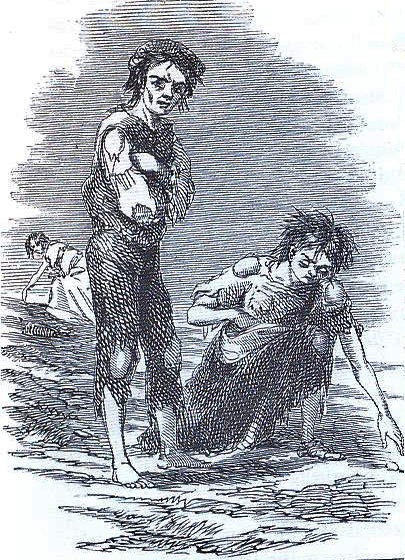
The famine was a defining moment in the history of Ireland,[3] which was part of the United Kingdom of Great Britain and Ireland from 1801 to 1922. The famine and its effects permanently changed the island's demographic, political, and cultural landscape, producing an estimated 2 million refugees and spurring a century-long population decline.[22][23][24][25] For both the native Irish and those in the resulting diaspora, the famine entered folk memory.[26] The strained relations between many Irish people and the then ruling British government worsened further because of the famine, heightening ethnic and sectarian tensions and boosting nationalism and republicanism both in Ireland and among Irish emigrants around the world. English documentary maker John Percival said that the famine "became part of the long story of betrayal and exploitation which led to the growing movement in Ireland for independence." Scholar Kirby Miller makes the same point.[27][28] Debate exists regarding nomenclature for the event, whether to use the term "Famine", "Potato Famine" or "Great Hunger", the last of which some believe most accurately captures the complicated history of the period.[29]
The potato blight returned to Europe in 1879 but, by this time, the Land War (one of the largest agrarian movements to take place in 19th-century Europe) had begun in Ireland.[30] The movement, organized by the Irish National Land League, continued the political campaign for the Three Fs which was issued in 1850 by the Tenant Right League during the Great Famine. When the potato blight returned to Ireland in the 1879 famine, the League boycotted "notorious landlords" and its members physically blocked the evictions of farmers; the consequent reduction in homelessness and house demolition resulted in a drastic reduction in the number of deaths.[31]
Causes and contributing factors
[edit]
Ireland was brought into the United Kingdom in January 1801 following the passage of the Acts of Union. Executive power lay in the hands of the Lord Lieutenant of Ireland and Chief Secretary for Ireland, who were appointed by the British government. Ireland sent 105 members of parliament to the House of Commons of the United Kingdom, and Irish representative peers elected 28 of their own number to sit for life in the House of Lords. Between 1832 and 1859, 70% of Irish representatives were landowners or the sons of landowners.[32]
In the 40 years that followed the union, successive British governments grappled with the problems of governing a country which had, as Benjamin Disraeli stated in 1844, "a starving population, an absentee aristocracy, an alien established Protestant church, and in addition, the weakest executive in the world".[33] One historian calculated that, between 1801 and 1845, there had been 114 commissions and 61 special committees inquiring into the state of Ireland, and that "without exception their findings prophesied disaster; Ireland was on the verge of starvation, her population rapidly increasing, three-quarters of her labourers unemployed, housing conditions appalling and the standard of living unbelievably low".[34]
Lectures printed in 1847 by John Hughes, Bishop of New York, are a contemporary exploration into the antecedent causes, particularly the political climate, in which the Irish famine occurred.[35][36]
Landlords and tenants
[edit]The "middleman system" for managing landed property was introduced in the 18th century. Rent collection was left in the hands of the landlords' agents, or middlemen. This assured the landlord of a regular income and relieved them of direct responsibility while leaving tenants open to exploitation by the middlemen.[37] The ability of middlemen was measured by the rent income they could contrive to extract from tenants.[37] Middlemen leased large tracts of land from the landlords on long leases with fixed rents and sublet to tenants, keeping any money raised in excess to the rent paid to the landlord. This system, coupled with minimal oversight of the middlemen, incentivised harsh exploitation of tenants. Middlemen would split a holding into smaller and smaller parcels so as to increase the amount of rent they could obtain. Tenants could be evicted for reasons such as non-payment of rents (which were high), or a landlord's decision to raise sheep instead of grain crops. Cottiers paid their rent by working for the landlord while the spalpeens (itinerant labourers) paid for short-term leases through temporary day work.[38][39]
A majority of Catholics, who constituted 80% of the Irish population, lived in conditions of poverty and insecurity. At the top of the social hierarchy was the Ascendancy class, composed of English and Anglo-Irish families who owned most of the land and held more or less unchecked power over their tenants. Some of their estates were vast; for example, the Earl of Lucan owned more than 60,000 acres (240 km2).[40] Many of these landowners lived in England and functioned as absentee landlords. The rent revenue was mostly sent to England.[17]
In 1800, the 1st Earl of Clare observed of landlords that "confiscation is their common title".[41][42] According to the historian Cecil Woodham-Smith, landlords regarded the land as a source of income, from which as much as possible was to be extracted. With the peasantry "brooding over their discontent in sullen indignation" (in the words of the Earl of Clare), the landlords largely viewed the countryside as a hostile place in which to live. Some landlords visited their property only once or twice in a lifetime, if ever.[41] The rents from Ireland were generally spent elsewhere; an estimated £6,000,000 was remitted out of Ireland in 1842.[41][a]
In 1843, the British Government recognized that the land management system in Ireland was the foundational cause of disaffection in the country. The Prime Minister established a Royal Commission, chaired by the Earl of Devon (Devon Commission), to enquire into the laws regarding the occupation of land. Irish politician Daniel O'Connell described this commission as "perfectly one-sided", being composed of landlords with no tenant representation.[43]
In February 1845, Devon reported:
It would be impossible adequately to describe the privations which they [the Irish labourer and his family] habitually and silently endure ... in many districts their only food is the potato, their only beverage water ... their cabins are seldom a protection against the weather ... a bed or a blanket is a rare luxury ... and nearly in all their pig and a manure heap constitute their only property.[44]
The Commissioners concluded they could not "forbear expressing our strong sense of the patient endurance which the labouring classes have exhibited under sufferings greater, we believe, than the people of any other country in Europe have to sustain".[44] The Commission stated that bad relations between landlord and tenant were principally responsible for this suffering. Landlords were described in evidence before the commission as "land sharks", "bloodsuckers", and "the most oppressive species of tyrant that ever lent assistance to the destruction of a country".[37]
As any improvement made on a holding by a tenant became the property of the landlord when the lease expired or was terminated, the incentive to make improvements was limited. Most tenants had no security of tenure on the land; as tenants "at will", they could be turned out whenever the landlord chose. The only exception to this arrangement was in Ulster where, under a practice known as "tenant right", a tenant was compensated for any improvement they made to their holding. According to Woodham-Smith, the commission stated that "the superior prosperity and tranquillity of Ulster, compared with the rest of Ireland, were due to tenant right".[37]
Landlords in Ireland often used their powers without compunction, and tenants lived in dread of them. Woodham-Smith writes that, in these circumstances, "industry and enterprise were extinguished and a peasantry created which was one of the most destitute in Europe".[44]
Tenants and subdivisions
[edit]
Immense population growth, from about 2 million in 1700 to 8 million by the time of the Great Famine, led to increased division of holdings and a consequent reduction in their average size. By 1845, 24% of all Irish tenant farms were of 0.4–2 hectares (1–5 acres) in size, while 40% were of 2–6 hectares (5–15 acres). Holdings were so small that no crop other than potatoes would suffice to feed a family. Shortly before the famine, the British government reported that poverty was so widespread that one-third of all Irish small holdings could not support the tenant families after rent was paid; the families survived only by earnings as seasonal migrant labour in England and Scotland.[45] Following the famine, reforms were implemented making it illegal to further divide land holdings.[46]
The 1841 census showed a population of just over eight million. Two-thirds of people depended on agriculture for their survival but rarely received a working wage. They had to work for their landlords in return for a small patch of land to farm. This forced Ireland's peasantry to practice continuous monoculture, as the potato was the only crop that could meet nutritional needs.[16]
Potato dependency
[edit]
The potato was first introduced in Ireland as a garden crop of the gentry. By the late 17th century, it had become widespread as a supplementary food, but the main Irish diet, at that time, was still based on butter, milk, and grain products.[18]
The Irish economy grew between 1760 and 1815 due to infrastructure expansion and the Napoleonic Wars (1805–1815), which had increased the demand for food in Britain. Tillage increased to such an extent that there was only a small amount of land available to small farmers to feed themselves. The potato was adopted as a primary food source because of its quick growth in a comparatively small space.[47] By 1800, the potato had become a staple food for one in three Irish people,[47] especially in winter. It eventually became a staple year-round for farmers.[48] A disproportionate share of the potatoes grown in Ireland were the Irish Lumper,[19] creating a lack of genetic variability among potato plants, which increased vulnerability to disease.[49]
Potatoes were essential to the expansion of the cottier system; they supported an extremely cheap workforce, but at the cost of lower living standards. For the labourer, "a potato wage" shaped the expanding agrarian economy.[48] The potato was also used extensively as a fodder crop for livestock immediately prior to the famine. Approximately 33% of production, amounting to 5,000,000 short tons (4,500,000 t), was typically used in this way.[50]
Blight in Ireland
[edit]
Prior to the arrival of Phytophthora infestans, commonly known as "blight", only two main potato plant diseases had been discovered.[51] One was called "dry rot" or "taint", and the other was a virus known popularly as "curl".[51][52] Phytophthora infestans is an oomycete (a variety of parasitic, non-photosynthetic organisms closely related to brown algae, and not a fungus).[53]
In 1851, the Census of Ireland Commissioners recorded 24 failures of the potato crop going back to 1728, of varying severity. General crop failures, through disease or frost, were recorded in 1739, 1740, 1770, 1800, and 1807. In 1821 and 1822, the potato crop failed in Munster and Connaught. In 1830 and 1831, counties Mayo, Donegal, and Galway suffered likewise. In 1832, 1833, 1834, and 1836, dry rot and curl caused serious losses, and in 1835 the potato failed in Ulster. Widespread failures throughout Ireland occurred in 1836, 1837, 1839, 1841, and 1844. According to Woodham-Smith, "the unreliability of the potato was an accepted fact in Ireland".[54]
Experts are still unsure of how and when blight arrived in Europe; it almost certainly was not present prior to 1842, and probably arrived in 1844.[55] The origin of the pathogen has been traced to the Toluca Valley in Mexico,[56][57] whence it spread within North America and then to Europe.[55] The 1845–1846 blight was caused by the HERB-1 strain of the blight.[58][59]

In 1844, Irish newspapers carried reports concerning a disease that had attacked the potato crops in America for two years.[61] In 1843 and 1844, blight largely destroyed the potato crops in the Eastern United States. Ships from Baltimore, Philadelphia, or New York City could have carried diseased potatoes from these areas to European ports.[62] American plant pathologist William C. Paddock[63] posited that the blight was transported via potatoes being carried to feed passengers on clipper ships sailing from America to Ireland.[53] Once introduced in Ireland and Europe, blight spread rapidly. By mid-August 1845, it had reached much of northern and central Europe; Belgium, The Netherlands, northern France, and southern England had all already been affected.[64]
On 16 August 1845, The Gardeners' Chronicle and Horticultural Gazette reported "a blight of unusual character" on the Isle of Wight. A week later, on 23 August, it reported that "A fearful malady has broken out among the potato crop ... In Belgium the fields are said to be completely desolated. There is hardly a sound sample in Covent Garden market ... As for cure for this distemper, there is none."[65] These reports were extensively covered in Irish newspapers.[66] On 11 September, the Freeman's Journal reported on "the appearance of what is called 'cholera' in potatoes in Ireland, especially in the north".[67] On 13 September,[fn 1] The Gardeners' Chronicle announced: "We stop the Press with very great regret to announce that the potato Murrain has unequivocally declared itself in Ireland."[65]
Nevertheless, the British government remained optimistic over the next few weeks, as it received conflicting reports. Only when the crop was harvested in October did the scale of destruction become apparent.[68] Prime Minister Sir Robert Peel wrote to Sir James Graham in mid-October that he found the reports "very alarming", but allayed his fears by claiming that there was "always a tendency to exaggeration in Irish news".[69]
Crop loss in 1845 has been estimated at anywhere from one-third[14] to one-half of cultivated acreage.[66] The Mansion House Committee in Dublin, to which hundreds of letters were directed from all over Ireland, claimed on 19 November 1845 to have ascertained beyond the shadow of a doubt that "considerably more than one-third of the entire of the potato crop ... has been already destroyed".[64]
In 1846, three-quarters of the harvest was lost to blight.[70] According to Cormac Ó Gráda, the first attack of potato blight caused considerable hardship in rural Ireland from the autumn of 1846, when the first deaths from starvation were recorded.[71] Seed potatoes were scarce in 1847. Few had been sown, so, despite average yields, hunger continued. 1848 yields were only two-thirds of normal. Since over three million Irish people were totally dependent on potatoes for food, hunger and famine were widespread.[70]
Reaction in Ireland
[edit]In early November 1845, a deputation from the citizens of Dublin, including the Duke of Leinster, Lord Cloncurry, Daniel O'Connell and the Lord Mayor, went to the Lord Lieutenant of Ireland, Lord Heytesbury to discuss the issue. They offered suggestions such as opening the ports to foreign corn, stopping distillation from grain, prohibiting the export of foodstuffs, and providing employment through public works.[72] Lord Heytesbury urged them not to be alarmed, that they "were premature", that scientists were enquiring into all those matters.[fn 2]
John Mitchel, one of the leading Irish nationalists, later wrote one of the first widely circulated tracts on the famine, The Last Conquest of Ireland (Perhaps), published in 1861. It proposed that British actions during the famine and their treatment of the Irish were a deliberate effort at genocide. It contained a sentence that has since become famous: "The Almighty, indeed, sent the potato blight, but the English created the Famine."[74] Mitchel was charged with sedition because of his writings, but this charge was dropped. He was convicted by a packed jury under the newly enacted Treason Felony Act and sentenced to 14 years transportation to Bermuda.[75]
According to Charles Gavan Duffy, The Nation insisted that the proper remedy, retaining in the country the food raised by her people until the people were fed,[76] was one which the rest of Europe had adopted, and one which even the parliaments of the Pale (i.e., before the union with Great Britain in 1801) had adopted in periods of distress.
Contemporaneously, as found in letters from the period and in particular later oral memory, the name for the event is in Irish: An Drochshaol, though with the earlier spelling standard of the era, which was Gaelic script, it is found written as in Droċ-Ṡaoġal.[77][78] In the modern era, this name, while loosely translated as "the hard-time", is always denoted with a capital letter to express its specific historic meaning.[79][5][80][81][82]
The period of the potato blight in Ireland from 1845 to 1851 was full of political confrontation.[83] A more radical Young Ireland group seceded from the Repeal movement in July 1846, and attempted an armed rebellion in 1848. It was unsuccessful.[84]
In 1847, William Smith O'Brien, leader of the Young Ireland party, became one of the founding members of the Irish Confederation.[85] The following year, he helped organise the short-lived Young Irelander Rebellion of 1848 in County Tipperary.[86]
Government response
[edit]Government responses to previous food shortages
[edit]When Ireland experienced food shortages in 1782–1783, ports were closed to exporting food, with the intention of keeping locally grown food in Ireland to feed the hungry. Irish food prices promptly dropped. Some merchants lobbied against the export ban, but the government in the 1780s overrode their protests.[87][88]
Tory government
[edit]Historian F. S. L. Lyons characterised the initial response of the British government to the early, less severe phase of the famine as "prompt and relatively successful".[89] Confronted by widespread crop failure in November 1845, the Prime Minister, Sir Robert Peel, purchased £100,000 worth of maize and cornmeal secretly from America[90] with Baring Brothers initially acting as his agents. The government hoped that they would not "stifle private enterprise" and that their actions would not act as a disincentive to local relief efforts. Due to poor weather conditions, the first shipment did not arrive in Ireland until the beginning of February 1846.[91] The initial shipments were of unground dried kernels, but the few Irish mills in operation were not equipped for milling maize and a long and complicated milling process had to be adopted before the meal could be distributed.[92] In addition, before the cornmeal could be consumed, it had to be "very much" cooked again, or eating it could result in severe bowel complaints.[91] Due to its yellow colour, and initial unpopularity, it became known as "Peel's brimstone".[93]
In October 1845, Peel moved to repeal the Corn Laws—tariffs on grain which kept the price of bread high—but the issue split his party and he had insufficient support from his own colleagues to push the measure through. He resigned the premiership in December, but the opposition was unable to form a government and he was re-appointed.[94] In March, Peel set up a programme of public works in Ireland, to include road improvement and the building of piers and fishing harbours,[95] but the famine situation worsened during 1846, and the repeal of the Corn Laws in that year did little to help the starving Irish; the measure split the Conservative Party, leading to the fall of Peel's ministry.[96] On 25 June, the second reading of the government's Irish Coercion Bill was defeated by 73 votes in the House of Commons by a combination of Whigs, Radicals, Irish Repealers, and protectionist Conservatives. Peel was forced to resign as prime minister on 29 June, and the Whig leader, Lord John Russell, became prime minister.[97]
Whig government
[edit].jpg)
The measures undertaken by Peel's successor, Russell, proved inadequate as the crisis deepened. The new Whig administration, influenced by the doctrine of laissez-faire,[98] believed that the market would provide the food needed. They refused to interfere with the movement of food to England, and then halted the previous government's food and relief works, leaving many hundreds of thousands of people without access to work, money, or food.[99] Russell's ministry introduced a new programme of public works that by December 1846 employed a third[100] or half[101] a million people but proved impossible to administer effectively.[101][95]

Charles Trevelyan, who was in charge of the administration of government relief, limited the Government's food aid programme, claiming that food would be readily imported into Ireland once people had more money to spend after wages were being paid on new public-works projects.[102]
In a private correspondence, Trevelyan explained how the famine could bring benefit to the English; As he wrote to Edward Twisleton:
"We must not complain of what we really want to obtain. If small farmers go, and their landlords are reduced to sell portions of their estates to persons who will invest capital we shall at last arrive at something like a satisfactory settlement of the country".[103]
In January 1847, the government abandoned its policy of noninterference, realising that it had failed, and turned to a mixture of "indoor" and "outdoor" direct relief; the former administered in workhouses through the Irish Poor Laws, the latter through soup kitchens. The costs of the Poor Law fell primarily on the local landlords, some of whom in turn attempted to reduce their liability by evicting their tenants[101] or providing some relief through the conversionist practice of Souperism.
On 1 March 1847, the Bank of England announced plans to raise a loan of £14 million to relieve the Irish crisis, and also for unfunded tax cuts. This led to the Panic of 1847, in which gold was withdrawn from circulation, so reducing the amount of bank notes that the Bank could legally circulate.[104] By 17 April 1847 the bullion reserve of the Bank of England had diminished from £15 million in January to some £9 million, and it was announced that the cost of famine relief would be transferred to local taxes in Ireland. The financial crisis temporarily improved, but the intended relief for Ireland did not materialise.[105]
In June 1847, the Poor Relief (Ireland) Act 1847 (10 & 11 Vict. c. 31) was passed which embodied the principle, popular in Britain, that Irish property must support Irish poverty. The landed proprietors in Ireland were held in Britain to have created the conditions that led to the famine.[106][107] However, it was asserted that, since the Acts of Union 1800, the British Parliament was partly to blame.[106] This point was raised in The Illustrated London News on 13 February 1847: "There was no law it would not pass at their request, and no abuse it would not defend for them." On 24 March, The Times reported that Britain had permitted in Ireland "a mass of poverty, disaffection, and degradation without a parallel in the world. It allowed proprietors to suck the very life-blood of that wretched race".[106]
The "Gregory clause" of the Poor Law, named after William H. Gregory, MP,[fn 3] prohibited anyone who held at least 1⁄4 acre (0.1 ha) from receiving relief.[101] In practice, this meant that the many farmers who had to sell all their produce to pay rent and taxes, would have to deliver up all their land to the landlord to qualify for public outdoor relief. These factors combined to drive thousands of people off the land: 90,000 in 1849, and 104,000 in 1850.[101]
The Incumbered Estates (Ireland) Act 1849 (12 & 13 Vict. c. 77) allowed landlord estates to be auctioned off upon the petition of creditors. Estates with debts were then auctioned off at low prices. Wealthy British speculators purchased the lands and "took a harsh view" of the tenant farmers who continued renting. The rents were raised, and tenants evicted to create large cattle grazing pastures. Between 1849 and 1854, some 50,000 families were evicted.[109][110]
Military response
[edit]The Royal Navy squadron stationed in Cork under the command of Rear-Admiral Hugh Pigot undertook significant relief operations from 1846 to 1847, transporting government relief into the port of Cork and other ports along the Irish coast, being ordered on 2 January 1846 to assist distressed regions. On 27 December 1846, Trevelyan ordered every available steamship to Ireland to assist in relief, and on 14 January 1847, Pigot received orders to also distribute supplies from the British Relief Association and treat them identically to government aid. In addition, some naval officers under Pigot oversaw the logistics of relief operations further inland from Cork. In February 1847, Trevelyan ordered Royal Navy surgeons dispatched to provide medical care for those suffering from illnesses that accompanied starvation, distribute medicines that were in short supply, and assist in proper, sanitary burials for the deceased. These efforts, although significant, were insufficient at preventing mass mortality from famine and disease.[111]
Food exports
[edit]| Year | Exports | Imports | Surplus | Maize imports |
|---|---|---|---|---|
| 1842 | 2,538 | 280 | +2,258 | 20 |
| 1843 | 3,206 | 74 | +3,132 | 3 |
| 1844 | 2,801 | 150 | +2,651 | 5 |
| 1845 | 3,252 | 147 | +3,105 | 34 |
| 1846 | 1,826 | 987 | +839 | 614 |
| 1847 | 970 | 4,519 | -3,549 | 3,287 |
| 1848 | 1,953 | 2,186 | -233 | 1,546 |
| 1849 | 1,437 | 2,908 | -1,471 | 1,897 |
| 1850 | 1,329 | 2,357 | -1,028 | 1,159 |
| 1851 | 1,325 | 3,158 | -1,833 | 1,745 |
_-_BL.jpg)
The historian Cecil Woodham-Smith wrote in The Great Hunger: Ireland 1845–1849 that no issue has provoked so much anger and embittered relations between England and Ireland "as the indisputable fact that huge quantities of food were exported from Ireland to England throughout the period when the people of Ireland were dying of starvation".[113] While in addition to the maize imports, four times as much wheat was imported into Ireland at the height of the famine as exported.[114][115] Woodham-Smith added that provision via the Poor law union workhouses by the Poor Relief (Ireland) Act 1838 (1 & 2 Vict. c. 56) had to be paid by rates levied on the local property owners, and in areas where the famine was worst, the tenants could not pay their rents to enable landlords to fund the rates and therefore the workhouses. Only by selling food, some of which would inevitably be exported, could a "virtuous circle" be created whereby the rents and rates would be paid, and the workhouses funded. Relief through the workhouse system was simply overwhelmed by the enormous scale and duration of the famine.[116] Nicolas McEvoy, parish priest of Kells, wrote in October 1845:
On my most minute personal inspection of the potato crop in this most fertile potato-growing locale is founded my inexpressibly painful conviction that one family in twenty of the people will not have a single potato left on Christmas day next. Many are the fields I have examined and testimony the most solemn can I tender, that in the great bulk of those fields all the potatoes sizable enough to be sent to table are irreparably damaged, while for the remaining comparatively sounder fields very little hopes are entertained in consequence of the daily rapid development of the deplorable disease.
With starvation at our doors, grimly staring us, vessels laden with our sole hopes of existence, our provisions, are hourly wafted from our every port. From one milling establishment I have last night seen not less than fifty dray loads of meal moving on to Drogheda, thence to go to feed the foreigner, leaving starvation and death the sure and certain fate of the toil and sweat that raised this food.
For their respective inhabitants England, Holland, Scotland, Germany, are taking early the necessary precautions—getting provisions from every possible part of the globe; and I ask are Irishmen alone unworthy the sympathies of a paternal gentry or a paternal Government?
Let Irishmen themselves take heed before the provisions are gone. Let those, too, who have sheep, and oxen, and haggards. Self-preservation is the first law of nature. The right of the starving to try and sustain existence is a right far and away paramount to every right that property confers.
Infinitely more precious in the eyes of reason in the adorable eye of the Omnipotent Creator, is the life of the last and least of human beings than the whole united property of the entire universe. The appalling character of the crisis renders delicacy but criminal and imperatively calls for the timely and explicit notice of principles that will not fail to prove terrible arms in the hands of a neglected, abandoned starving people.[117]
In the 5 May 2020, issue of the Dublin Review of Books, Editor Maurice Earls wrote:
Dr. McEvoy, in his grim forebodings and apocalyptic fear, was closer to the truth than the sanguine rationalists quoted in the newspapers, but McEvoy, like many others, overestimated the likelihood of mass rebellion, and even this great clerical friend of the poor could hardly have contemplated the depth of social, economic and cultural destruction which would persist and deepen over the following century and beyond. It was politics that turned a disease of potatoes and tomatoes into famine, and it was politics which ensured its disastrous aftereffects would disfigure numerous future generations.[118]
According to historian James Donnelly, "the picture of Irish people starving as food was exported was the most powerful image in the nationalist construct of the Famine".[119] Grain imports increased after the spring of 1847 and much of the debate "has been conducted within narrow parameters," focusing "almost exclusively on national estimates with little attempt to disaggregate the data by region or by product."[120]
Charity
[edit]
Total charitable donations for famine relief might have been about £1.5 million of which £856,500 came from outside Ireland. Donations within Ireland are harder to trace; £380,000 of donations were officially registered but once some allowance is made for less formal donations the Irish total probably exceeds that of Britain (£525,000). People of Irish descent also contributed to funds raised outside of Ireland and those donations would be included in the region where the donation was made. English Protestants donated more to Irish famine relief than any other source outside of Ireland.[121]: 224–227
| Region | Contribution |
|---|---|
| Britain | £525,000 |
| US | £170,000 |
| Indian Ocean | £50,000 |
| France | £26,000 |
| Canada | £22,000 |
| West Indies | £17,000 |
| Italy | £13,000 |
| Australia | £9,000 |
| The Netherlands, Belgium and Denmark | £5,000 |
| Germany and Switzerland | £4,500 |
| South Africa | £4,000 |
| Latin America | £3,500 |
| Russia | £2,500 |
| The Ottoman Empire | £2,000 |
| Other British Dependencies | £2,000 |
| Spain and Portugal | £1,000 |
| Total | £856,500 |
Large sums of money were donated by charities; the first foreign campaign in December 1845 included the Boston Repeal Association and the Catholic Church.[122] Calcutta is credited with making the first larger donations in 1846, summing up to around £14,000.[b] The money raised included contributions by Irish soldiers serving there and Irish people employed by the East India Company.[123] Russian Tsar Alexander II sent funds and Queen Victoria donated £2,000.[c] According to legend,[124][125][126] Sultan Abdülmecid I of the Ottoman Empire originally offered to send £10,000[d] but was asked either by British diplomats or his own ministers to reduce it to £1,000[e] to avoid donating more than the Queen.[127] U.S. President James K. Polk donated $50[f] and in 1847 Congressman Abraham Lincoln donated $10,[128][g] or £5.[129][h]
International fundraising activities received donations from locations as diverse as Venezuela, Australia, South Africa, Mexico, Russia and Italy.[130] In New Brunswick, which was at the time a British colony, the House of Assembly voted to donate 1,500 to the British Relief Association.[129][131]
Pope Pius IX also made a personal contribution of 1,000 Scudi (approximately £213) for famine relief in Ireland and authorized collections in Rome. Most significantly, on 25 March 1847, Pius IX issued the encyclical Praedecessores nostros, which called the whole Catholic world to contribute moneywise and spiritually to Irish relief. Major figures behind international Catholic fundraising for Ireland were the rector of the Pontifical Irish College, Paul Cullen, and the President of the Society of Saint Vincent de Paul, Jules Gossin.[132]
In addition to the religious, non-religious organisations came to the assistance of famine victims. The British Relief Association was the largest of these groups. Founded on 1 January 1847 by Lionel de Rothschild, Abel Smith, and other prominent bankers and aristocrats, the Association raised money throughout England, America, and Australia; their funding drive was benefited by a "Queen's Letter", a letter from Queen Victoria appealing for money to relieve the distress in Ireland.[133] With this initial letter, the Association raised £171,533.[i] A second, somewhat less successful "Queen's Letter" was issued in late 1847.[133] In total, the Association raised approximately £390,000 for Irish relief.[134][j]
Private initiatives such as the Central Relief Committee of the Society of Friends (Quakers) attempted to fill the gap caused by the end of government relief, and eventually, the government reinstated the relief works, although bureaucracy slowed the release of food supplies.[135] Thousands of dollars were raised in the United States, including $170 ($5,218 in 2019 value[136]) collected from a group of Native American Choctaws in 1847.[137] Judy Allen, editor of the Choctaw Nation of Oklahoma's newspaper Biskinik, wrote that "It had been just 16 years since the Choctaw people had experienced the Trail of Tears, and they had faced starvation ... It was an amazing gesture." To mark the 150th anniversary, eight Irish people retraced the Trail of Tears.[138]
Contributions by the United States during the famine were highlighted by Senator Henry Clay who said; "No imagination can conceive—no tongue express—no brush paint—the horrors of the scenes which are daily exhibited in Ireland." He called upon Americans to remind them that the practice of charity was the greatest act of humanity they could do. In total, 118 vessels sailed from the US to Ireland with relief goods valued at $545,145.[139][k] Specific states which provided aid include South Carolina and Philadelphia, Pennsylvania. Pennsylvania was the second most important state for famine relief in the US and the second-largest shipping port for aid to Ireland. The state hosted the Philadelphia Irish Famine Relief Committee. Catholics, Methodists, Quakers, Presbyterians, Episcopalians, Lutherans, Moravian and Jewish groups put aside their differences in the name of humanity to help the Irish.[140] South Carolina rallied around the efforts to help those experiencing the famine. They raised donations of money, food and clothing to help the victims of the famine—Irish immigrants made up 39% of the white population in the southern cities. Historian Harvey Strum claims that "The states ignored all their racial, religious, and political differences to support the cause for relief."[141]
Eviction
[edit]_-_3.JPG)

Landlords were responsible for paying the rates of every tenant whose yearly rent was £4 or less. Landlords whose land was crowded with poorer tenants were now faced with large bills. Many began clearing the poor tenants from their small plots and letting the land in larger plots for over £4 which then reduced their debts. In 1846, there had been some clearances, but the great mass of evictions came in 1847.[142] According to James S. Donnelly Jr., it is impossible to be sure how many people were evicted during the years of the famine and its immediate aftermath. It was only in 1849 that the police began to keep a count, and they recorded a total of almost 250,000 persons as officially evicted between 1849 and 1854.[143]
Donnelly considered this to be an underestimate, and if the figures were to include the number pressured into "voluntary" surrenders during the whole period (1846–1854), the figure would almost certainly exceed half a million persons.[144] While Helen Litton says there were also thousands of "voluntary" surrenders, she notes also that there was "precious little voluntary about them". In some cases, tenants were persuaded to accept a small sum of money to leave their homes, "cheated into believing the workhouse would take them in".[142]
West Clare was one of the worst areas for evictions, where landlords turned thousands of families out and demolished their derisory cabins. Captain Kennedy in April 1848 estimated that 1,000 houses, with an average of six people to each, had been levelled since November.[145] The Mahon family of Strokestown House evicted 3,000 people in 1847 and were still able to dine on lobster soup.[146]
After Clare, the worst area for evictions was County Mayo, accounting for 10% of all evictions between 1849 and 1854. George Bingham, 3rd Earl of Lucan, who owned over 60,000 acres (240 km2), was among the worst evicting landlords. He was quoted as saying that "he would not breed paupers to pay priests". Having turned out in the parish of Ballinrobe over 2,000 tenants alone, he then used the cleared land as grazing farms.[147] In 1848, the Marquis of Sligo owed £1,650 to Westport Union; he was also an evicting landlord, though he claimed to be selective, saying that he was only getting rid of the idle and dishonest. Altogether, he cleared about 25% of his tenants.[148]
In 1846 the future Prime Minister of the United Kingdom John Russell, 1st Earl Russell reported that in one year more than 50,000 Irish families had been "turned out of their wretched dwellings without pity and without refuge...we have made it the most degraded and most miserable country in the world...all the world is crying shame upon us."[149]
In 1847, Bishop of Meath, Thomas Nulty, described his personal recollection of the evictions in a pastoral letter to his clergy:
Seven hundred human beings were driven from their homes in one day and set adrift on the world, to gratify the caprice of one who, before God and man, probably deserved less consideration than the last and least of them ... The horrid scenes I then witnessed, I must remember all my life long. The wailing of women—the screams, the terror, the consternation of children—the speechless agony of honest industrious men—wrung tears of grief from all who saw them. I saw officers and men of a large police force, who were obliged to attend on the occasion, cry like children at beholding the cruel sufferings of the very people whom they would be obliged to butcher had they offered the least resistance. The landed proprietors in a circle all around—and for many miles in every direction—warned their tenantry, with threats of their direct vengeance, against the humanity of extending to any of them the hospitality of a single night's shelter ... and in little more than three years, nearly a fourth of them lay quietly in their graves.[150]
The population in Drumbaragh, a townland in County Meath, plummeted 67 per cent between 1841 and 1851; in neighbouring Springville, it fell 54 per cent. There were fifty houses in Springville in 1841 and only eleven left in 1871.[10][11]
According to Litton, evictions might have taken place earlier but for fear of the secret societies. However, they were now greatly weakened by the Famine. Revenge still occasionally took place, with seven landlords being shot, six fatally, during the autumn and winter of 1847. Ten other occupiers of land, though without tenants, were also murdered, she says.[151]
One such landlord reprisal occurred in West Roscommon. The "notorious" Major Denis Mahon enforced thousands of his tenants into eviction before the end of 1847, with an estimated 60 per cent decline in population in some parishes. He was shot dead in that year.[152] In East Roscommon, "where conditions were more benign", the estimated decline in population was under 10 percent.[152]
Lord Clarendon, alarmed at the number of landlords being shot and that this might mean rebellion, asked for special powers. Lord John Russell was not sympathetic to this appeal. Lord Clarendon believed that the landlords themselves were mostly responsible for the tragedy in the first place, saying that "It is quite true that landlords in England would not like to be shot like hares and partridges ... but neither does any landlord in England turn out fifty persons at once and burn their houses over their heads, giving them no provision for the future." The Crime and Outrage Act was passed in December 1847 as a compromise, and additional troops were sent to Ireland.[153]
The "Gregory clause", described by Donnelly as a "vicious amendment to the Irish poor law", had been a successful Tory amendment to the Whig poor-relief bill which became law in early June 1847, where its potential as an estate-clearing device was widely recognised in parliament, although not in advance.[108] At first, the poor law commissioners and inspectors viewed the clause as a valuable instrument for a more cost-effective administration of public relief, but the drawbacks soon became apparent, even from an administrative perspective. They would soon view them as little more than murderous from a humanitarian perspective. According to Donnelly, it became obvious that the quarter-acre clause was "indirectly a death-dealing instrument".[154]
Emigration
[edit]
At least a million people are thought to have emigrated as a result of the famine.[8] There were about 1 million long-distance emigrants between 1846 and 1851, mainly to North America. The total given in the 1851 census is 967,952.[155] Short-distance emigrants, mainly to Britain, may have numbered 200,000 or more.[156]
While the famine was responsible for a significant increase in emigration from Ireland, of anywhere from 45% to nearly 85% depending on the year and the county, it was not the sole cause. The beginning of mass emigration from Ireland can be traced to the mid-18th century, when some 250,000 people left Ireland over a period of 50 years to settle in the New World. Irish economist Cormac Ó Gráda estimates that between 1 million and 1.5 million people emigrated during the 30 years between 1815 (when Napoleon was defeated in Waterloo) and 1845 (when the Great Famine began).[157] However, during the worst of the famine, emigration reached somewhere around 250,000 in one year alone, with western Ireland seeing the most emigrants.[158]
Families did not migrate en masse, but younger members of families did, so much so that emigration almost became a rite of passage, as evidenced by the data that show that, unlike similar emigrations throughout world history, women emigrated just as often, just as early, and in the same numbers as men. The emigrants would send remittances (reaching a total of £1,404,000 by 1851) back to family in Ireland, which, in turn, allowed another member of their family to leave.[159]
Emigration during the famine years of 1845–1850 was primarily to England, Scotland, South Wales, North America, and Australia. Many of those fleeing to the Americas used the McCorkell Line.[160] One city that experienced a particularly strong influx of Irish immigrants was Liverpool, with at least one-quarter of the city's population being Irish-born by 1851.[161] This would heavily influence the city's identity and culture in the coming years, earning it the nickname of "Ireland's second capital".[162] Liverpool became the only place outside of Ireland to elect an Irish nationalist to parliament when it elected T. P. O'Connor in 1885, and continuously re-elected him unopposed until his death in 1929.[163] As of 2020, it is estimated that three quarters of people from the city have Irish ancestry.[164]
.jpg)
Of the more than 100,000 Irish that sailed to Canada in 1847, an estimated one out of five died from disease and malnutrition, including over 5,000 at Grosse Isle, Quebec, an island in the Saint Lawrence River used to quarantine ships near Quebec City.[165] Overcrowded, poorly maintained, and badly provisioned vessels known as coffin ships sailed from small, unregulated harbours in the West of Ireland in contravention of British safety requirements, and mortality rates were high.[166] The 1851 census reported that more than half the inhabitants of Toronto were Irish, and, in 1847 alone, 38,000 Irish flooded a city with fewer than 20,000 citizens. Other Canadian cities such as Quebec City, Montreal, Ottawa, Kingston, Hamilton, and Saint John also received large numbers. By 1871, 55% of Saint John residents were Irish natives or children of Irish-born parents.[167] Unlike the United States, Canada could not close its ports to Irish ships because it was part of the British Empire, so emigrants could obtain cheap passage in returning empty lumber holds.
In America, most Irish became city-dwellers; with little money, many had to settle in the cities that the ships they came on landed in.[168] By 1850, the Irish made up a quarter of the population in Boston, New York City, Philadelphia, and Baltimore.

The famine marked the beginning of the depopulation of Ireland in the 19th century. The population had increased by 13–14% in the first three decades of the 19th century; between 1831 and 1841, the population grew by 5%. Application of Thomas Malthus's idea of population expanding geometrically while resources increase arithmetically was popular during the famines of 1817 and 1822. By the 1830s, they were seen as overly simplistic, and Ireland's problems were seen "less as an excess of population than as a lack of capital investment".[169] The population of Ireland was increasing no faster than that of England, which suffered no equivalent catastrophe. By 1854, between 1.5 and 2 million Irish left their country due to evictions, starvation, and harsh living conditions.[170]
Death toll
[edit]
It is not known exactly how many people died during the period of the famine, although it is believed that more died from disease than from starvation.[171] State registration of births, marriages, or deaths had not yet begun, and records kept by the Catholic Church are incomplete.[fn 4] One possible estimate has been reached by comparing the expected population with the eventual numbers in the 1850s. A census taken in 1841 recorded a population of 8,175,124. A census immediately after the famine in 1851 counted 6,552,385, a drop of over 1.5 million in 10 years. The census commissioners estimated that, at the normal rate of population increase, the population in 1851 should have grown to just over 9 million if the famine had not occurred.[173]
On the in-development Great Irish Famine Online resource, produced by the Geography department of University College Cork, the population of Ireland section states, that together with the census figures being called low, before the famine it reads that "it is now generally believed" that over 8.75 million people populated the island of Ireland prior to it striking.[174]
In 1851, the census commissioners collected information on the number who died in each family since 1841, and the cause, season, and year of death. They recorded 21,770 total deaths from starvation in the previous decade and 400,720 deaths from diseases. Listed diseases were fever, diphtheria, dysentery, cholera, smallpox, and influenza, with the first two being the main killers (222,021 and 93,232). The commissioners acknowledged that their figures were incomplete and that the true number of deaths was probably higher:
The greater the amount of destitution of mortality ... the less will be the amount of recorded deaths derived through any household form;—for not only were whole families swept away by disease ... but whole villages were effaced from off the land.
Later historians agree that the 1851 death tables "were flawed and probably under-estimated the level of mortality".[175][176] The combination of institutional and figures provided by individuals gives "an incomplete and biased count" of fatalities during the famine.[177] Cormac Ó Gráda, referencing the work of W. A. MacArthur,[178] writes that specialists have long known that the Irish death tables were inaccurate,[179] and undercounted the number of deaths.[180]
S. H. Cousens's estimate of 800,000 deaths relied heavily on retrospective information contained in the 1851 census and elsewhere,[181] and is now regarded as too low.[182][47] Modern historian J. J. Lee says "at least 800,000",[183] and R. F. Foster estimates that "at least 775,000 died, mostly through disease, including cholera in the latter stages of the holocaust". He further notes that "a recent sophisticated computation estimates excess deaths from 1846 to 1851 as between 1,000,000 and 1,500,000 ... after a careful critique of this, other statisticians arrive at a figure of 1,000,000".[fn 5]
Joel Mokyr's estimates at an aggregated county level range from 1.1 million to 1.5 million deaths between 1846 and 1851. Mokyr produced two sets of data which contained an upper-bound and lower-bound estimate, which showed not much difference in regional patterns.[185][182] The true figure is likely to lie between the two extremes of half and one and a half million, and the most widely accepted estimate is one million.[186][187]
| Leinster | Munster | Ulster | Connacht | Ireland |
|---|---|---|---|---|
| 15.3 | 22.5 | 15.7 | 28.8 | 20 |

Another area of uncertainty lies in the descriptions of disease given by tenants as to the cause of their relatives' deaths.[182] Though the 1851 census has been rightly criticised as underestimating the true extent of mortality, it does provide a framework for the medical history of the Great Famine. The diseases that badly affected the population fell into two categories:[189] famine-induced diseases and diseases of nutritional deficiency. Of the nutritional deficiency diseases, the most commonly experienced were starvation and marasmus, as well as a condition at the time called dropsy. Dropsy (oedema) was a popular name given for the symptoms of several diseases, one of which, kwashiorkor, is associated with starvation.[189]
However, the greatest mortality was not from nutritional deficiency diseases, but from famine-induced ailments.[189][190] The malnourished are very vulnerable to infections; therefore, these were more severe when they occurred. Measles, diphtheria, diarrhoea, tuberculosis, most respiratory infections, whooping cough, many intestinal parasites, and cholera were all strongly conditioned by nutritional status. Potentially lethal diseases, such as smallpox and influenza, were so virulent that their spread was independent of nutrition. The best example of this phenomenon was fever, which exacted the greatest death toll. In the popular mind, as well as medical opinion, fever and famine were closely related.[191] Social dislocation—the congregation of the hungry at soup kitchens, food depots, and overcrowded workhouses—created conditions that were ideal for spreading infectious diseases such as typhus, typhoid, and relapsing fever.[190][189]
Diarrhoeal diseases were the result of poor hygiene, bad sanitation, and dietary changes. The concluding attack on a population incapacitated by famine was delivered by Asiatic cholera, which had visited Ireland briefly in the 1830s. In the following decade, it spread uncontrollably across Asia, through Europe, and into Britain, finally reaching Ireland in 1849.[189] Some scholars estimate that the population of Ireland was reduced by 20–25%.[9]
After the famine
[edit]Ireland's mean age of marriage in 1830 was 23.8 for women and 27.5 for men, where they had once been 21 for women and 25 for men, and those who never married numbered about 10% of the population;[192] in 1840, they had respectively risen to 24.4 and 27.7.[193][194] In the decades after the Famine, the age of marriage had risen to 28–29 for women and 33 for men, and as many as a third of Irishmen and a quarter of Irishwomen never married, due to low wages and chronic economic problems that discouraged early and universal marriage.[195]
One consequence of the increase in the number of orphaned children was that some young women turned to prostitution to provide for themselves.[196] Some of the women who became Wrens of the Curragh were famine orphans.[197]
The potato blight would return to Ireland in 1879, though by then the rural cottier tenant farmers and labourers of Ireland had begun the "Land War", described as one of the largest agrarian movements to take place in nineteenth-century Europe.[30]
By the time the potato blight returned in 1879, The Land League, which was led by Michael Davitt, who was born during the Great Famine and whose family had been evicted when Davitt was only 4 years old, encouraged the mass boycott of "notorious landlords" with some members also physically blocking evictions. The policy, however, would soon be suppressed. Close to 1000 people were interned under the 1881 Coercion Act for suspected membership. With the reduction in the rate of homelessness and the increased physical and political networks eroding the landlordism system, the severity of the following shorter famine would be limited.[31]
According to the linguist Erick Falc'her-Poyroux, surprisingly, for a country renowned for its rich musical heritage, only a small number of folk songs can be traced back to the demographic and cultural catastrophe brought about by the Great Famine, and he infers from this that the subject was generally avoided for decades among poorer people as it brought back too many sorrowful memories. Also, large areas of the country became uninhabited and the folk song collectors of the eighteenth and nineteenth centuries did not collect the songs they heard in the Irish language, as the language of the peasantry was often regarded as dead, or "not delicate enough for educated ears". Of the songs that have survived probably the best known is Skibbereen. Emigration has been an important source of inspiration for songs of the Irish during the 20th century.[150]
Analysis of the government's role
[edit]Contemporary analysis
[edit]Contemporary opinion was sharply critical of the Russell government's response to and management of the crisis. From the start, there were accusations that the government failed to grasp the magnitude of the disaster. Sir James Graham, who had served as Home Secretary in Sir Robert Peel's late government, wrote to Peel that, in his opinion, "the real extent and magnitude of the Irish difficulty are underestimated by the Government, and cannot be met by measures within the strict rule of economical science".[198]
This criticism was not confined to outside critics. The Lord-Lieutenant of Ireland, Lord Clarendon, wrote a letter to Russell on 26 April 1849, urging that the government propose additional relief measures: "I don't think there is another legislature in Europe that would disregard such suffering as now exists in the west of Ireland, or coldly persist in a policy of extermination."[199] Also in 1849, the Chief Poor Law Commissioner, Edward Twisleton, resigned in protest over the Rate-in-Aid Act, which provided additional funds for the Poor Law through a 6d in the pound levy on all rateable properties in Ireland.[200] Twisleton testified that "comparatively trifling sums were required for Britain to spare itself the deep disgrace of permitting its miserable fellow-subjects to die of starvation". According to Peter Gray in his book The Irish Famine, the government spent £7 million for relief in Ireland between 1845 and 1850, "representing less than half of one per cent of the British gross national product over five years. Contemporaries noted the sharp contrast with the £20 million compensation given to West Indian slave-owners in the 1830s."[169]
Other critics maintained that, even after the government recognised the scope of the crisis, it failed to take sufficient steps to address it. John Mitchel, one of the leaders of the Young Ireland Movement, wrote in 1860:
I have called it an artificial famine: that is to say, it was a famine which desolated a rich and fertile island that produced every year abundance and superabundance to sustain all her people and many more. The English, indeed, call the famine a "dispensation of Providence"; and ascribe it entirely to the blight on potatoes. But potatoes failed in like manner all over Europe, yet there was no famine save in Ireland. The British account of the matter, then, is first, a fraud; second, a blasphemy. The Almighty, indeed, sent the potato blight, but the English created the famine.[201]
Still, other critics saw reflected in the government's response its attitude to the so-called "Irish Question". Nassau Senior, an economics professor at Oxford University, wrote that the Famine "would not kill more than one million people, and that would scarcely be enough to do any good".[201] In 1848, Denis Shine Lawlor suggested that Russell was a student of the Elizabethan poet Edmund Spenser, who had calculated "how far English colonisation and English policy might be most effectively carried out by Irish starvation".[202] Charles Trevelyan, the civil servant with most direct responsibility for the government's handling of the famine, described it in 1848 as "a direct stroke of an all-wise and all-merciful Providence", which laid bare "the deep and inveterate root of social evil"; he affirmed that the Famine was "the sharp but effectual remedy by which the cure is likely to be effected. God grant that the generation to which this opportunity has been offered may rightly perform its part..."[203]
Historical analysis
[edit]Christine Kinealy has written that "the major tragedy of the Irish Famine of 1845–1852 marked a watershed in modern Irish history. Its occurrence, however, was neither inevitable nor unavoidable".[3] The underlying factors which combined to cause the famine were aggravated by an inadequate government response. Kinealy notes that the "government had to do something to help alleviate the suffering" but that "it became apparent that the government was using its information not merely to help it formulate its relief policies, but also as an opportunity to facilitate various long-desired changes within Ireland".[204]
Joel Mokyr writes that, "There is no doubt that Britain could have saved Ireland," and compares the £9.5 million the government spent on famine relief in Ireland to the £63.9 million it would spend a few years later on the "utterly futile" Crimean War.[205] Mokyr argues that, despite its formal integration into the United Kingdom, Ireland was effectively a foreign country to the British, who were therefore unwilling to spend resources that could have saved hundreds of thousands of lives.[205]
Some also pointed to the structure of the British Empire as a contributing factor. James Anthony Froude wrote that "England governed Ireland for what she deemed her own interest, making her calculations on the gross balance of her trade ledgers, and leaving moral obligations aside, as if right and wrong had been blotted out of the statute book of the Universe."[206] Dennis Clark, an Irish-American historian and critic of empire, claimed the famine was "the culmination of generations of neglect, misrule and repression. It was an epic of English colonial cruelty and inadequacy. For the landless cabin dwellers, it meant emigration or extinction..."[207]
Position of the British government
[edit]The British government has not expressly apologized for its role in the famine. But in 1997, at a commemoration event in County Cork, the actor Gabriel Byrne read out a message by Prime Minister Tony Blair that acknowledged the inadequacy of the government response. It asserted that "those who governed in London at the time failed their people through standing by while a crop failure turned into a massive human tragedy". The message was well received in Ireland, where it was understood as the long-sought-after British apology. Archive documents released in 2021 showed that the message was not in fact written or approved by Blair, who could not be reached by aides at the time. It was therefore approved by Blair's principal private secretary John Holmes on his own initiative.[208]
Genocide question
[edit]The vast majority of historians reject the claim that the British government's response to the famine constituted a genocide. Their position is partially based on the fact that, with regard to famine related deaths, there was a lack of intent to commit genocide. Although contemporary commentators blamed the mass death on the actions of the British government, rather than the blight,[209] for a mass-death atrocity to be defined as a genocide, it must include the intentional destruction of a people.[210][211]
In 1996, the U.S. state of New Jersey included the famine in the "Holocaust and Genocide Curriculum" of its secondary schools.[fn 6] In the 1990s, Irish-American lobbying groups campaigned vigorously to include the study of the Irish Famine in school curriculums, alongside studies of the Holocaust, slavery and other similar atrocities.[213] The New Jersey curriculum was pushed by such lobbying groups and was drafted by the librarian James Mullin. Following criticism, the New Jersey Holocaust Commission requested statements from two academics that the Irish famine was genocide, which was eventually provided by law professors Charles E. Rice and Francis Boyle, who had not been previously known for studying Irish history.[214] They concluded that the British government deliberately pursued a race- and ethnicity-based policy aimed at destroying the Irish people and that the policy of mass starvation amounted to genocide per retrospective application of article 2 of the Hague Convention of 1948.[fn 7][216]
Historian Donald Akenson, who has written 24 books on Ireland, stated that "When you see [the word Holocaust used with regard to the Great Famine], you know that you are encountering famine-porn. It is inevitably part of a presentation that is historically unbalanced and, like other kinds of pornography, is distinguished by a covert (and sometimes overt) appeal to misanthropy and almost always an incitement to hatred."[217]
Irish historian Cormac Ó Gráda rejected the claim that the British government's response to the famine was a genocide and he also stated that "no academic historian continues to take the claim of 'genocide' seriously".[210] He argued that "genocide includes murderous intent, and it must be said that not even the most bigoted and racist commentators of the day sought the extermination of the Irish", and he also stated that most people in Whitehall "hoped for better times for Ireland". Additionally, he stated that the claim of genocide overlooks "the enormous challenge facing relief agencies, both central and local, public and private".[218] Ó Gráda thinks that a case of neglect is easier to sustain than a case of genocide.[218]
John Leazer, professor of history at Carthage College, Wisconsin, wrote that the binary framing of the debate about the British government's, and particularly Trevelyan's, actions as being good or bad is "unsatisfactory" and that the entire debate surrounding the question of genocide serves to oversimplify and obfuscate complex factors behind the actions of the government as a whole and individuals within it.[219]
Writing in 2008, historian Robbie Mcveigh highlighted that while discussions around whether the Great Irish Famine was genocidal in nature have a long history, the tools of genocide analysis were never employed to assess such claims.[220] Scholars highlight the similarity of British policies around and in response to the Irish famine and other cases of famine and starvation in the British empire and colonial regimes,[221][222] with Mcveigh stating in the other cases they "appear not as horrendous imperial incompetence but rather a deliberate administrative policy of genocide", and calls for more rigorous investigation of the history of Ireland in genocide studies.[222] There have been later genocide scholars who support the description of the famine as a genocide.[223] Neysa King has characterised specifically the relief efforts of the Russell administration from late 1846 to 1849 as genocide, while acknowledging the roots of the famine lay elsewhere.[224] Nat Hill, director of research at Genocide Watch, has stated that "While the potato famine may not fit perfectly into the legal and political definitions of 'genocide', it should be given equal consideration in history as an egregious crime against humanity".[225]
Memorials
[edit]
Ireland's National Famine Memorial is situated in Murrisk Millennium Peace Park, a five-acre park overlooking the Atlantic Ocean in the village of Murrisk, County Mayo at the foot of Croagh Patrick mountain.[226][227] Designed by Irish artist John Behan, the memorial consists of a bronze sculpture of a coffin ship with skeletons interwoven through the rigging symbolising the many emigrants that did not survive the journey across the ocean to Britain, America and elsewhere. It was unveiled on 20 July 1997 by then-President Mary Robinson.[228] The Famine Commemoration Committee who led the project chose the site in Murrisk as they felt it was "...entirely fitting that the national famine memorial [..] be located in the west, which suffered most during the Famine with one in four of the population of Connaught dying in those terrible years."[229][230]
The National Famine Commemoration Day is observed annually in Ireland, usually on a Sunday in May.[231]
It is also memorialized in many locations throughout Ireland, especially in those regions of Ireland which suffered the greatest losses, and it is also memorialized overseas, particularly in cities with large populations which are descended from Irish immigrants, such as New York City.[232] Among the memorials in the US is the Irish Hunger Memorial near a section of the Manhattan waterfront.[232]
Kindred Spirits, a large stainless steel sculpture of nine eagle feathers by artist Alex Pentek was erected in 2017 in the Irish town of Midleton, County Cork, to thank the Choctaw people for its financial assistance during the famine.[233][234]
An annual Great Famine walk from Doolough to Louisburgh, County Mayo was inaugurated in 1988 and has been led by such notable personalities as Archbishop Desmond Tutu of South Africa and representatives of the Choctaw nation of Oklahoma.[235][236] The walk, organised by Afri, takes place on the first or second Saturday of May and links the memory of the famine with contemporary human rights issues.
In 1994, Sinead O'Connor released "Famine," about historical representations of the Famine and the role of the English government.[237] She performed the song on Later ... with Jools Holland in 1996.[238][239][240]
See also
[edit]- Great Famine's effect on the American economy
- Highland Potato Famine (an agrarian crisis which occurred in Scotland at the same time)
- Irish Famine (1740–1741)
- Irish Famine (1879)
- List of famines
- Charles Wood, 1st Viscount Halifax#Role in the Irish Famine
References
[edit]Informational notes
- ^ Kinealy put the date at the 16th.[66]
- ^ Lyon Playfair and John Lindley were sent from England to investigate with the local assistance of Robert Kane.[73]
- ^ William H. Gregory became the husband of Lady Gregory. He was heir to a substantial Galway estate in 1847, which he dissipated by gambling debts on the turf in the late 1840s and early 1850s.[108]
- ^ Civil registration of births and deaths in Ireland was not established by law until 1863.[172]
- ^ "Based on hitherto unpublished work by C. Ó Gráda and Phelim Hughes, 'Fertility trends, excess mortality and the Great Irish Famine' ... Also see Cormac Ó Gráda and Joel Mokyr, 'New developments in Irish Population History 1700–1850', Economic History Review, vol. xxxvii, no. 4 (November 1984), pp. 473–488."[184]
- ^ Approved by the New Jersey Commission on Holocaust Education on 10 September 1996, for inclusion in the Holocaust and Genocide Curriculum at the secondary level. Revision submitted 11/26/98.[212]
- ^ "Clearly, during the years 1845 to 1850, the British government pursued a policy of mass starvation in Ireland with intent to destroy in substantial part the national, ethnic and racial group commonly known as the Irish People ... Therefore, during the years 1845 to 1850 the British government knowingly pursued a policy of mass starvation in Ireland that constituted acts of genocide against the Irish people within the meaning of Article II (c) of the 1948 [Hague] Genocide Convention."[215]
Footnotes
- ^ About £710 million in 2023.
- ^ equivalent to £1,712,000 in 2023
- ^ equivalent to £244,637 in 2023
- ^ equivalent to £1,154,312 in 2023
- ^ equivalent to £115,431 in 2023
- ^ equivalent to $1,687 in 2024
- ^ equivalent to $337 in 2024
- ^ equivalent to £577 in 2023
- ^ equivalent to £20,982,000 in 2023
- ^ equivalent to £47,704,000 in 2023
- ^ equivalent to $19,078,000 in 2024
Citations
- ^ Kinealy 1994, p. 5.
- ^ O'Neill 2009, p. 1.
- ^ a b c Kinealy 1994, p. xv.
- ^ [1]Archived 12 May 2020 at the Wayback Machine The great famine (An Drochshaol). Dúchas.ie
- ^ a b Éamon Ó Cuív, [2]Archived 17 May 2020 at the Wayback Machine An Gorta Mór – the impact and legacy of the Great Irish Famine
- ^ An Fháinleog Archived 18 August 2020 at the Wayback Machine Chapter 6. "drochshaol, while it can mean a hard life, or hard times, also, with a capital letter, has a specific, historic meaning: Bliain an Drochshaoil means The Famine Year, particularly 1847; Aimsir an Drochshaoil means the time of the Great Famine (1847–52)."
- ^ "Black '47 Ireland's Great Famine and its after-effects - Department of Foreign Affairs". www.dfa.ie. Archived from the original on 1 July 2024. Retrieved 29 August 2024.
- ^ a b Ross 2002, p. 226.
- ^ a b Kinealy 1994, p. 357.
- ^ a b "Census of Ireland 1871: Part I, Area, Population, and Number of Houses; Occupations, Religion and Education volume I, Province of Leinster". HMSO. 11 March 1872. Retrieved 11 March 2023 – via Internet Archive.
- ^ a b Carolan, Michael. Éireann's Exiles: Reconciling generations of secrets and separations. Archived 30 January 2021 at the Wayback Machine 3 April 2020. Accessed 15 January 2021.
- ^ James S. Donnelly Jr., The Great Irish Potato Famine (Thrupp, Stroud: Sutton Publishing, 2001) p. 181.
- ^ Hollett, David. Passage to the New World: packet ships and Irish famine emigrants, 1845–1851. United Kingdom, P.M. Heaton, 1995, p. 103.
- ^ a b Ó Gráda 2006, p. 7.
- ^ Ó Gráda, Cormac; Vanhaute, Eric; Paping, Richard (August 2006). The European subsistence crisis of 1845–1850: a comparative perspective (PDF). XIV International Economic History Congress of the International Economic History Association: Session 123. Helsinki. Archived from the original (PDF) on 17 April 2017.
- ^ a b Laxton 1997, p. [page needed].
- ^ a b Litton 1994, p. [page needed].
- ^ a b Póirtéir 1995, pp. 19–20.
- ^ a b Fraser, Evan D. G. (30 October 2003). "Social vulnerability and ecological fragility: building bridges between social and natural sciences using the Irish Potato Famine as a case study". Conservation Ecology. 2 (7). Archived from the original on 14 February 2020. Retrieved 28 May 2019.
- ^ "British History in depth: The Irish Famine". BBC History. Retrieved 5 June 2023.
- ^ "Racism and Anti-Irish Prejudice in Victorian England". victorianweb.org. Retrieved 5 June 2023.
- ^ Kelly, M.; Fotheringham, A. Stewart (2011). "The online atlas of Irish population change 1841–2002: A new resource for analysing national trends and local variations in Irish population dynamics". Irish Geography. 44 (2–3): 215–244. doi:10.1080/00750778.2011.664806.
population declining dramatically from 8.2 million to 6.5 million between 1841 and 1851 and then declining gradually and almost continuously to 4.5 million in 1961
- ^ "The Vanishing Irish: Ireland's population from the Great Famine to the Great War". 28 January 2013. Archived from the original on 12 May 2020. Retrieved 3 September 2018.
- ^ K. H. Connell, The Population of Ireland 1750–1845 (Oxford, 1951).[page needed]
- ^ T. Guinnane, The Vanishing Irish: Households, Migration, and the Rural Economy in Ireland, 1850–1914 (Princeton, 1997)[page needed]
- ^ Kinealy 1994, p. 342.
- ^ Percival, John (1995). Great Famine: Ireland's Potato Famine 1845–51. Diane Publishing Company. ISBN 978-0-7881-6962-5. Archived from the original on 15 April 2021. Retrieved 29 July 2020 – via Google Books.
- ^ Miller, Kerby A. Ireland and Irish America: Culture, Class, and Transatlantic Migration. Ireland, Field Day, 2008, p. 49.
- ^ Egan, Casey. The Irish Potato Famine, the Great Hunger, genocide – what should we call it? Potato blight played a role, but there was much more at play in Ireland's Great Hunger of 1845–1852. What should it be called? IrishCentral.com Archived 11 February 2021 at the Wayback Machine. 31 May 2015. Accessed 29 January 2021.
- ^ a b Tebrake, Janet K. (May 1992). "Irish peasant women in revolt: The Land League years". Irish Historical Studies. 28 (109): 63–80. doi:10.1017/S0021121400018587. S2CID 156376321.
- ^ a b Curtis, L. Perry (Lewis Perry) (11 June 2007). "The Battering Ram and Irish Evictions, 1887–90". Irish-American Cultural Institute. 42 (3): 207–228. doi:10.1353/eir.2007.0039. S2CID 161069346. Archived from the original on 30 March 2019. Retrieved 2 September 2018 – via Project MUSE.
- ^ Póirtéir 1995, p. [page needed].
- ^ Blake 1967, p. 179.
- ^ Woodham-Smith 1991, p. 36.
- ^ "Irish Views of the Famine". 6 July 2016. Archived from the original on 6 July 2016.
- ^ Hughes, John (11 June 1847). "A Lecture on the Antecedent Causes of the Irish Famine in 1847: Delivered Under the Auspices of the General Committee for the Relief of the Suffering Poor of Ireland". E. Dunigan – via Google Books.
- ^ a b c d Woodham-Smith 1991, p. 22.
- ^ Litton 2006, pp. 9–10.
- ^ John., Kelly (2015), The graves are walking: the great famine and the saga of the Irish people, Tantor Media, ISBN 978-1-4526-2787-8, OCLC 915811247
- ^ "Bingham, George Charles". Dictionary of Irish Biography. Retrieved 18 July 2024.
- ^ a b c Woodham-Smith 1991, p. 21.
- ^ Butt, Isaac (29 March 1876). "Land Tenure (Ireland) Bill". Parliamentary Debates (Hansard). United Kingdom: House of Commons. col. 773.
- ^ Woodham-Smith 1991, pp. 20–21.
- ^ a b c Woodham-Smith 1991, p. 24.
- ^ Kee 1993, p. 15.
- ^ Uris & Uris 2003, p. 15.
- ^ a b c Ó Gráda 1993, pp. 138–144.
- ^ a b Póirtéir 1995, p. 20.
- ^ "The Irish potato famine". About Biodiversity. Archived from the original on 19 March 2012. Retrieved 26 December 2011.
- ^ Donnelly, James S. Jr. (2010). "XIII". In W. E. Vaughan (ed.). Production, prices and exports, 1846–51. A New History of Ireland. Vol. V. Oxford University Press. p. 289. ISBN 978-0-19-957867-2.
- ^ a b Donnelly 2005, p. 40.
- ^ Kinealy 1994, pp. 32–33.
- ^ a b Paddock 1992, pp. 197–222.
- ^ Woodham-Smith 1991, p. 38.
- ^ a b Bourke (1964). "The Emergence of Potato Blight 1843–1846". Nature. 203 (4947): 805–808. Bibcode:1964Natur.203..805A. doi:10.1038/203805a0. S2CID 4157856.
- ^ Neiderhauser, J. S. (1991). "Phytophthora infestans: the Mexican connection". In Lucas, J. A.; Shattock, R. C.; Shaw, D. S.; Cooke, L. R. (eds.). Symposium of the Mycological Society. Cambridge University Press. pp. 25–45.
- ^ Goss, Erica M.; Tabima, Javier F.; Cooke, David E. L.; Restrepo, Silvia; Fry, William E.; Forbes, Gregory A.; Fieland, Valerie J.; Cardenas, Martha; Grünwald, Niklaus J. (17 June 2014). "The Irish potato famine pathogen Phytophthora infestans originated in central Mexico rather than the Andes". Proceedings of the National Academy of Sciences. 111 (24): 8791–8796. Bibcode:2014PNAS..111.8791G. doi:10.1073/pnas.1401884111. ISSN 0027-8424. PMC 4066499. PMID 24889615.
- ^ "Cause Of The Irish Potato Famine Revealed". Redorbit.com. 21 May 2013. Archived from the original on 14 June 2017. Retrieved 17 April 2017.
- ^ Saville, Amanda C.; Martin, Michael D.; Ristaino, Jean B. (28 December 2016). "Historic Late Blight Outbreaks Caused by a Widespread Dominant Lineage of Phytophthora infestans (Mont.) de Bary". PLOS ONE. 11 (12) e0168381. Bibcode:2016PLoSO..1168381S. doi:10.1371/journal.pone.0168381. PMC 5193357. PMID 28030580.
- ^ Bourke, P. M. Austin (1960), "The Extent of the Potato Crop in Ireland at the time of the Famine" (PDF), Dublin: Journal of the Statistical and Social Inquiry Society of Ireland, XX, Part III, Dublin: Statistical and Social Inquiry Society of Ireland: 1–35, ISSN 0081-4776, archived (PDF) from the original on 14 May 2011, retrieved 10 April 2011
- ^ Kinealy 1994, p. 31.
- ^ Donnelly 2005, p. 41.
- ^ William Carson Paddock (1921 (Minneapolis, Minnesota) – 2008 (Antigua, Guatemala)), American plant pathologist:
- Holley, Joe (17 March 2008). "Obituary: William Paddock, 86; was leading plant pathologist". The Boston Globe (Boston, MA). Archived from the original on 13 May 2020. Retrieved 21 January 2019.
- "Paddock, William 1921–2008 (William C. Paddock, William Carson Paddock)" Encyclopedia.com Archived 11 May 2020 at the Wayback Machine
- "Obituary: William Carson Paddock" Legacy.com Archived 12 May 2020 at the Wayback Machine
- ^ a b Donnelly 2005, p. 42.
- ^ a b Woodham-Smith 1991, p. 40.
- ^ a b c Kinealy 1994, p. 32.
- ^ "Disease in the Potato". Freeman's Journal. Dublin. p. 2. Archived from the original on 9 October 2014. Retrieved 25 August 2014 – via Newspapers.com.

- ^ Woodham-Smith 1991, pp. 40–41, 43.
- ^ Woodham-Smith 1991, pp. 41–42.
- ^ a b Kennedy et al. 1999, p. 69.
- ^ Ó Gráda 2006, p. 9.
- ^ Woodham-Smith 1991, pp. 48–49.
- ^ Woodham-Smith 1991, p. 44–45.
- ^ Duffy 2007, p. 312.
- ^ Duffy 2007, p. 323.
- ^ Duffy 1888, pp. 277–278.
- ^ "The great famine". dúchas.ie. Archived from the original on 12 May 2020. Retrieved 28 July 2018.
- ^ Muinntear Ċiarraiḋe Roiṁ an Droċ-Ṡaoġal (Irish Edition)
- ^ "BBC - Irish - An Fháinleog Chapter 6". www.bbc.co.uk. BBC. Archived from the original on 2 October 2018. Retrieved 28 July 2018.
- ^ "Foclóir Gaeilge–Béarla (Ó Dónaill): Drochshaol". www.teanglann.ie. Archived from the original on 12 May 2020. Retrieved 28 July 2018.
- ^ "Donegal Historical Society - Indices". donegalhistory.com. Archived from the original on 28 July 2018. Retrieved 28 July 2018.
- ^ "An Droch shaol". 16 May 2017. Archived from the original on 11 May 2020. Retrieved 28 July 2018.
- ^ Póirtéir 1995, p. [page needed].
- ^ Woodham-Smith 1991, pp. 329–360.
- ^ Doheny 1951, p. [page needed].
- ^ O'Brien, William Smith (1998). The Rebel in His Family: Selected Papers of William Smith O'Brien. Cork University Press. ISBN 978-1-85918-181-2. Archived from the original on 12 May 2020. Retrieved 19 January 2018.
- ^ Irish Famine Curriculum Committee 1998, p. 11.
- ^ Kinealy 1994, p. 354.
- ^ Lyons 1973, p. 30.
- ^ Woodham-Smith 1991, pp. 54–56.
- ^ a b Kinealy 1994, p. 47.
- ^ Woodham-Smith 1991, pp. 64–65.
- ^ Woodham-Smith 1991, p. 73.
- ^ Woodham-Smith 1991, pp. 51–52.
- ^ a b Woodham-Smith 1991, p. 78.
- ^ Blake 1967, pp. 221–241.
- ^ Doheny 1951, p. 98.
- ^ Woodham-Smith 1991, pp. 410–411.
- ^ Ross 2002, pp. 224, 311.
- ^ Ross 2002, p. 311.
- ^ a b c d e Lyons 1973, pp. 30–34.
- ^ Woodham-Smith 1991, pp. 87, 106–108.
- ^ "Historical Notes: God and England made the Irish famine". The Independent. 3 December 1998. Retrieved 7 July 2023.
- ^ C. Read., Calming the Storms (Palgrave Macmillan, 2023) pp. 145-146
- ^ Read, C. (2022). The Great Famine in Ireland and Britain's Financial Crisis. London: The Boydell Press. pp. 148–149. ISBN 978-1-78327-727-8.
- ^ a b c Ranelagh 2000, p. 60.
- ^ Woodham-Smith 1991, pp. 296–297.
- ^ a b Póirtéir 1995, p. 159.
- ^ "A valuable resource for family research | Ballinrobe Local History: The Encumbered Estates Acts, 1848 and 1849 | Topics | Historical Ballinrobe". 7 January 2017. Archived from the original on 7 January 2017.
- ^ Miller, David W. (11 June 2008). "Ireland's Great Famine: Interdisciplinary Perspectives (review)". Journal of Interdisciplinary History. 39 (1): 114–115. doi:10.1162/jinh.2008.39.1.114. S2CID 195826785. Archived from the original on 30 March 2019. Retrieved 23 September 2018 – via Project MUSE.
- ^ Ó Gráda 1999, p. 123.
- ^ Woodham-Smith 1991, p. 75.
- ^ Woodham-Smith 1991, p. 76.
- ^ Ó Gráda 2000, p. 123.
- ^ Woodham-Smith 1991, p. 37.
- ^ [The Nation, 25 October 1845; repr. in P. S. O'Hegarty, A history of Ireland under the Union(London 1952) 293]
- ^ Earls, Maurice (5 May 2020). "Blighted". Dublin Review of Books.
- ^ Daly, Mary E. (1997). "Historians and the Famine: A Beleaguered Species?". Irish Historical Studies. 30 (120): 591–601. doi:10.1017/S002112140001347X. ISSN 0021-1214. JSTOR 60000023. S2CID 163627192.
[Donnelly] has noted that statistics for grain exports and imports were readily available during the second half of the nineteenth century 'and if honestly confronted, would at least have raised serious doubts about the accuracy of the nationalist perspective'. Modern scholars have even less of an excuse for prevarication. Peter Solar calculated that on the eve of the Famine Ireland produced sufficient food for 9.5 to 10m people; during the years 1846–50 it produced little more than half that amount. Austin Bourke showed that food imports were considerably in excess of exports during the Famine years, though a ban on exports during the autumn of 1846 might have eased food shortages. Food exports during the autumn and winter of 1846 were equivalent to one-tenth of the potatoes lost... [Kinealy] seems to imply that Mitchel's case is more credible than recent scholars suggest; few would agree.
- ^ Kinealy, Christine. Food Exports from Ireland 1846–47. History Ireland Archived 16 February 2021 at the Wayback Machine, Spring 1997.
- ^ a b Humanitarinism In The Modern World. Cambridge University Press. 2020. ISBN 978-1-108-65590-3.
- ^ Forbes, H. A. Crosby; Lee, Henry (1967). Massachusetts Help to Ireland during the Great Famine. Milton: Captain Robert Bennet Forbes House.
- ^ Woodham-Smith 1991, p. 156.
- ^ Akay, Latifa (29 January 2012). "Ottoman aid to the Irish to hit the big screen". Zaman. Archived from the original on 17 October 2013.
Legend has it ...
- ^ Kinealy, Christine (1997). "Potatoes, providence and philanthropy". In O'Sullivan, Patrick (ed.). The Meaning of the Famine. London: Leicester University Press. p. 151. ISBN 0-7185-1426-2.
According to a popular tradition, which dates back to 1853...
- ^ Ó Gráda 1999, pp. 197–198: "...populist myths..."
- ^ Kinealy, Christine (2013). Charity and the Great Hunger in Ireland: The Kindness of Strangers. London: Bloomsbury Academic. pp. 115, 118. ISBN 978-1-4411-1758-8. Archived from the original on 12 May 2020.
- ^ Brosnan, Sean (12 February 2021) [9 December 2014]. "Abraham Lincoln donated to Ireland during the Great Famine". IrishCentral. Archived from the original on 3 October 2024. Retrieved 3 October 2024.
- ^ a b Kinealy, Christine (1 September 2014). "The British Relief Association and the Great Famine in Ireland". French Journal of British Studies (Revue française de civilisation britannique). 19 (2). para. 27. doi:10.4000/rfcb.230. ISSN 2429-4373.
- ^ Kinealy, Christine (10 May 2010). "Irish Famine sparked international fundraising". Irish Central. Archived from the original on 23 December 2019. Retrieved 14 December 2019.
- ^ "An Act to appropriate a part of the Public Revenue for the services therein mentioned" (.pdf). British North American Legislative Database, 1758-1867. University of New Brunswick. 14 April 1847. Archived (PDF) from the original on 3 October 2024. Retrieved 3 October 2024.
- ^ Götz, Brewis & Werther 2020, pp. 82–87.
- ^ a b Kinealy 1994, p. 161.
- ^ Woodham-Smith 1991, pp. 169, 245.
- ^ Ross 2002.
- ^ 170 in 1847 → $5,218.42 in 2019 Archived 5 June 2020 at the Wayback Machine. Inflation Calculator. 3 March 2019.
- ^ Woodham-Smith 1991, p. 242.
- ^ Ward 2002.
- ^ Sarbaugh, Timothy J. (1996). "'Charity Begins at Home': The United States Government & Irish Famine Relief 1845–1849". History Ireland. 4 (2): 31–35. JSTOR 27724343.
- ^ Strum, Harvey. "Pennsylvania and Irish Famine Relief, 1846–1847." Pennsylvania History: A Journal of Mid-Atlantic Studies, vol. 81, no. 3, 2014, pp. 277–299. JSTOR 10.5325/pennhistory.81.3.0277.
- ^ Strum, Harvey (2002). "South Carolina and Irish Famine Relief, 1846–47". The South Carolina Historical Magazine. 103 (2): 130–152. JSTOR 27570563.
- ^ a b Litton 2006, p. 95.
- ^ Póirtéir 1995, p. 155.
- ^ Póirtéir 1995, p. 156.
- ^ Litton 2006, p. 96.
- ^ Gibney 2008, p. 55.
- ^ Litton 2006, p. 98.
- ^ Litton 2006, pp. 95–98.
- ^ Macardle, Dorothy (1965). The Irish Republic. New York: Farrar, Straus and Giroux. p. 45.
- ^ a b Falc'her-Poyroux, Erick (2014). "The Great Irish Famine in Songs". Revue Française de Civilisation Britannique. XIX (2): 157–172. doi:10.4000/rfcb.277. ISSN 2429-4373.
- ^ Litton 2006, p. 99.
- ^ a b McGreevy, Ronan. "Pioneering study charts population fall since Famine". The Irish Times. Archived from the original on 8 July 2020. Retrieved 4 September 2018.
- ^ Litton 2006, pp. 98–99.
- ^ Donnelly 2005, p. 110.
- ^ "Table XXXVI", The Census of Ireland for the Year 1851: Part VI General Report, 1856, p. lv, archived from the original on 12 July 2020, retrieved 27 June 2015
- ^ Boyle & Ó Gráda 1986, p. 560.
- ^ Ó Gráda 1975.
- ^ Library of Congress 2007.
- ^ Foster 1988, p. 371.
- ^ McCorkell 2010.
- ^ Foster 1988, p. 268.
- ^ "Irish Roots". 6 October 2017. Archived from the original on 15 April 2021. Retrieved 28 March 2021.
- ^ Miller, David W. (1973). Church, State and Nation in Ireland 1898–1921. Gill & Macmillan. p. 142. ISBN 0-7171-0645-4.
- ^ Bounds, Andy (19 March 2020). "Liverpool holds fast to its Irish identity through Brexit and beyond". Financial Times. Archived from the original on 10 December 2022.
- ^ Woodham-Smith 1991, p. 238.
- ^ Woodham-Smith 1991, pp. 216–217.
- ^ Winder, Gordon M. (2000). "Trouble in the North End: The Geography of Social Violence in Saint John 1840–1860". Acadiensis. XXIX (2 Spring): 27. Archived from the original on 9 July 2020. Retrieved 14 April 2017.
- ^ Woodham-Smith 1991, p. 267.
- ^ a b Gray 1995.
- ^ "The Great Irish Famine 1845-1851 – A Brief Overview – The Irish Story". The Irish History. Retrieved 7 October 2021.
- ^ Woodham-Smith 1991, p. 204.
- ^ The Register Office 2005, p. 1.
- ^ Woodham-Smith 1991, p. 411.
- ^ "Story Map Series". dahg.maps.arcgis.com. Archived from the original on 11 July 2020. Retrieved 3 September 2018.
- ^ Killen 1995, pp. 250–252.
- ^ Kinealy 1994, p. 167.
- ^ Ó Gráda 2006, p. 3.
- ^ MacArthur, Edwards & Williams 1957, pp. 308–312.
- ^ Ó Gráda 2006, p. 67.
- ^ Ó Gráda 2006, p. 71.
- ^ Cousens 1960, pp. 55–74.
- ^ a b c Kennedy et al. 1999, p. 36.
- ^ Lee 1973, p. 1.
- ^ Foster 1988, p. 234.
- ^ Mokyr 1983, pp. 266–267.
- ^ Boyle & Ó Gráda 1986, p. 554.
- ^ Kinealy 1994, p. 168.
- ^ Lee 1973, p. 2
- ^ a b c d e Kennedy et al. 1999, p. 104.
- ^ a b Livi-Bacci 1991, p. 38.
- ^ Woodham-Smith 1991, p. 196.
- ^ Lee, Joseph J. (2008). The Modernization of Irish Society, 1848–1918. p. 3.
- ^ Mokyr, Joel (2013). Why Ireland Starved: A Quantitative and Analytical History of the Irish Economy, 1800–1850. Routledge. p. 72.
- ^ O'Neill, Kevin (2003). Family and Farm in Pre-Famine Ireland: The Parish of Killashandra. University of Wisconsin Press. p. 180.
- ^ Nolan, Janet (1986). Ourselves Alone: Women's Emigration from Ireland, 1885–1920. University Press of Kentucky. pp. 74–75.
- ^ Luddy, Maria (2007). Prostitution and Irish society, 1800–1940. Cambridge: Cambridge University Press. ISBN 978-0-521-88241-5. OCLC 154706356.
- ^ Luddy, Maria (1992). "An outcast community: the 'wrens' of the curragh". Women's History Review. 1 (3): 341–355. doi:10.1080/09612029200200014. ISSN 0961-2025.
- ^ Kinealy 1994, p. 80.
- ^ Woodham-Smith 1991, p. 381.
- ^ Kinealy 1994, pp. 254–260.
- ^ a b Gallagher 1987.
- ^ Donnelly 1995.
- ^ Trevelyan 1848.
- ^ Kinealy 1994, p. 353.
- ^ a b Mokyr 1983, pp. 291–293.
- ^ MacManus 1921, p. 492.
- ^ Clark 1982.
- ^ Davies, Caroline (20 July 2021). "Tony Blair's apology for Irish famine written by aides, papers reveal". The Guardian. Archived from the original on 20 July 2021. Retrieved 20 July 2021.
- ^ Mcveigh 2008, p. 549.
- ^ a b Ó Gráda, Cormac (1995). The Great Irish famine. New Studies in Economic and Social History (illustrated, reprinted ed.). Cambridge University Press. pp. 4, 68. ISBN 978-0-521-55787-0. Archived from the original on 13 August 2020. Retrieved 7 August 2020.
[page 4] While no academic historian continues to take the claim of genocide seriously, the issue of blame remains controversial [page 68]. In sum, the Great Famine of the 1840s, instead of being inevitable and inherent in the potato economy, was a tragic ecological accident. Ireland's experience during these years supports neither the complacency exemplified by the Whig view of political economy nor the genocide theories formerly espoused by a few nationalist historians.
- ^
- Kenny 2003, p. 246: "And, while few, if any, historians in Ireland today would endorse the idea of British genocide (in the sense of conscious intent to slaughter), this does not mean that government policies, whether adopted or rejected, had no impact on starvation, disease, mortality and emigration."
- Kennedy 2016, p. 111: "Contrary to what might be surmised, modern Irish society is not particularly receptive to the doctrine of genocide. The fact that virtually all historians of Ireland have reached a verdict that eschews that position, be they Irish-born or scholars from Britain, North America or Australasia, has weakened the populist account."
- McGowan 2017, p. 88
- ^ Irish Famine Curriculum Committee 1998, p. 1.
- ^ Kennedy, Liam. "The Great Irish Famine and the Holocaust". Archived from the original on 13 February 2021. Retrieved 5 February 2021.
- ^ Kennedy 2016, pp. 100–101.
- ^ Ritschel 1996.
- ^ Mullin, James V. (Spring–Summer 2002). "The New Jersey Famine Curriculum: a report". Eire-Ireland: Journal of Irish Studies. 37 (1–2): 119–129. doi:10.1353/eir.2002.0008. Archived from the original on 9 July 2012.
- ^ Kennedy 2016, p. 104.
- ^ a b Ó Gráda 2000, p. 10.
- ^ Leazer, John (17 January 2022). "Politics as Usual: Charles Edward Trevelyan and the Irish and Scottish Fisheries Before and During the Great Famine". Irish Economic and Social History. 49 (1): 47–59. doi:10.1177/03324893211049539. S2CID 246022519. Retrieved 16 December 2022.
- ^ Mcveigh 2008, p. 553.
- ^ Conley & de Waal 2023, p. 139.
- ^ a b Mcveigh 2008, p. 556.
- ^ Jacobs 2023, pp. 94–97; Conley & de Waal 2023, p. 139
- ^ King, Neysa (15 April 2009), "Rethinking and Recognizing Genocide: The British and the Case of the Great Irish Potato Famine", Re-Imaging Death and Dying, Brill, pp. 123–132, ISBN 978-1-904710-82-0, retrieved 1 August 2025
- ^ Hill, Nat (13 October 2021). "An Gorta Mór: The Question of the Irish "Genocide"". Genocide Watch. Archived from the original on 11 February 2024.
- ^ "Murrisk, Co. Mayo in the West of Ireland". murrisk.com. Retrieved 13 August 2022.
- ^ McDonald 2010, p. [page needed].
- ^ "Murrisk, Co. Mayo (1997)". castlebar.ie. 1 January 2014. Retrieved 13 August 2022.
- ^ "Dáil Éireann debate – Wednesday, 26 Mar 1997. Vol. 477 No. 1". PQ Number [477/1]. Dáil Éireann. 26 March 1997. Retrieved 13 August 2022.
- ^ Bray, Allison (15 May 2010). "Minute's silence urged for victims of Famine". The Irish Independent. Retrieved 12 August 2022.
- ^ Wylie, Catherine (11 July 2011). "Minister denies postponing Famine event". The Irish Times. Archived from the original on 12 July 2011. Retrieved 10 February 2012.
- ^ a b Smith, Roberta (16 July 2002). "Critic's Notebook; A Memorial Remembers The Hungry". The New York Times. ISSN 0362-4331. Archived from the original on 29 September 2017. Retrieved 5 September 2017.
- ^ "Irish Town Builds Memorial to Thank Native Americans Who Helped During the Potato Famine". Good News Network. 17 March 2015. Archived from the original on 28 June 2020. Retrieved 18 March 2019.
- ^ "Choctaw chief to mark Midleton sculpture dedication". Irish Examiner. 7 June 2017. Archived from the original on 12 May 2020. Retrieved 18 March 2019.
- ^ Ryan, Áine (23 May 2011). "Annual Famine walk held in Mayo". The Irish Times. Archived from the original on 4 February 2018. Retrieved 5 September 2017.
- ^ Connelly, Charlie. "The black lake's secret". New Statesman. Archived from the original on 4 September 2017. Retrieved 5 September 2017.
- ^ Candaele, Kelly (27 August 1995). "IRELAND: The Power of History: The Famine and Peace". Los Angeles Times. Retrieved 18 August 2025.
- ^ "BBC Two - Later... with Jools Holland, Series 5, Episode 5". BBC. Retrieved 18 August 2025.
- ^ Hattenstone, Simon (29 May 2021). "Sinéad O'Connor: 'I'll always be a bit crazy, but that's OK'". The Guardian. ISSN 0261-3077. Retrieved 18 August 2025.
- ^ MacHattie, Callum (23 June 2025). "How Sinéad O'Connor criticised England in one brilliant joke". faroutmagazine.co.uk. Retrieved 18 August 2025.

Bibliography
- Blake, Robert (1967). Disraeli. University paperbacks. St. Martin's Press. LCCN 67011837. Archived from the original on 11 May 2020. Retrieved 27 June 2015.
- Boyle, Phelim P.; Ó Gráda, Cormac (November 1986). "Fertility Trends, Excess Mortality, and the Great Irish Famine" (PDF). Demography. 23 (4): 543–562. doi:10.2307/2061350. hdl:10197/401. JSTOR 2061350. PMID 3542599. S2CID 43621998. Archived (PDF) from the original on 16 May 2020. Retrieved 20 April 2018.
- Clark, Dennis (1982), "Dennis Clark: The Irish in Philadelphia", Temple University, ISBN 0-87722-227-4, retrieved 24 September 2010
- Conley, Bridget; de Waal, Alex (2023). "Genocide, Starvation and Famine". In Kiernan, Ben; Lemos, Tracy Maria; Taylor, Tristan S. (eds.). The Cambridge World History of Genocide. Vol. I: Genocide in the Ancient, Medieval and Premodern Worlds. Cambridge University Press. pp. 127–149. doi:10.1017/9781108493536 (inactive 12 July 2025). ISBN 978-1-108-49353-6.
{{cite book}}: CS1 maint: DOI inactive as of July 2025 (link) - Cousens, S. H. (1960). "Regional death rates in Ireland during the Great Famine from 1846 to 1851". Population Studies. 14.
- Doheny, Michael (1951). The Felon's Track. M.H. Gill & Son, LTD.
- Donnelly, James S. (2005). The Great Irish Potato Famine. Sutton Publishing. ISBN 0-7509-2632-5.
- Donnelly, James S. Jr. (1995). Poirteir, Cathal (ed.). Mass Eviction and the Irish Famine: The Clearances Revisited", from The Great Irish Famine. Dublin, Ireland: Mercier Press.
- Duffy, Peter (2007). The Killing of Major Denis Mahon. HarperCollins. ISBN 978-0-06-084050-1.
- Duffy, Charles Gavan (1888). Four Years of Irish History 1845–1849. Cassell, Petter, Galpin & Co.
- Foster, R. F. (1988). Modern Ireland 1600–1972. Penguin Group.
- Gallagher, Thomas (1987). Paddy's Lament, Ireland 1846–1847: Prelude to Hatred. Houghton Mifflin Harcourt. ISBN 978-0-15-670700-8. Archived from the original on 14 April 2021. Retrieved 24 September 2010.
- Gibney, John (November–December 2008). "TV Eye". History Ireland. 16 (6): 55. Archived from the original on 12 May 2020. Retrieved 31 January 2015.
- Gray, Peter (1995). The Irish Famine. New York: Harry N. Abrams, Inc.
- Götz, Norbert; Brewis, Georgina; Werther, Steffen (2020). Humanitarianism in the Modern World: The Moral Economy of Famine Relief. Cambridge: Cambridge University Press. doi:10.1017/9781108655903. ISBN 978-1-108-65590-3.
- Irish Famine Curriculum Committee (1998), The Great Irish Famine (PDF), archived (PDF) from the original on 19 March 2014, retrieved 1 July 2014
- Jacobs, Steven Leonard (2023). "The Religion–Genocide Nexus". In Kiernan, Ben; Lemos, Tracy Maria; Taylor, Tristan S. (eds.). The Cambridge World History of Genocide. Vol. I: Genocide in the Ancient, Medieval and Premodern Worlds. Cambridge University Press. pp. 86–102. doi:10.1017/9781108493536 (inactive 12 July 2025). ISBN 978-1-108-49353-6.
{{cite book}}: CS1 maint: DOI inactive as of July 2025 (link) - Kee, Robert (1993). The Laurel and the Ivy: The Story of Charles Stewart Parnell and Irish Nationalism. Hamish Hamilton. ISBN 978-0-241-12858-9.
- Kennedy, Liam; Ell, Paul S.; Crawford, E. M.; Clarkson, L. A (1999). Mapping The Great Irish Famine. Four Courts Press. ISBN 1-85182-353-0.
- Kennedy, Liam (2016). Unhappy the Land: The Most Oppressed People Ever, the Irish?. Dublin: Irish Academic Press. ISBN 978-1-78537-047-2.
- Kenny, Kevin (2003). New directions in Irish-American history. History of Ireland and the Irish diaspora (illustrated ed.). University of Wisconsin Press. ISBN 978-0-299-18714-9.
- Killen, John (1995). The Famine decade, contemporary accounts 1841–1851. Blackstaff.
- Kinealy, Christine (1994). This Great Calamity. Gill & Macmillan. ISBN 0-7171-1881-9.
- Laxton, Edward (1997). The Famine Ships: The Irish Exodus to America 1846–51. Bloomsbury. ISBN 0-7475-3500-0.
- Lee, Joseph (1973). The Modernisation of Irish Society. Gill and Macmillan. ISBN 978-0-7171-0567-0. Archived from the original on 14 April 2021. Retrieved 23 August 2020.
- Lengel, Edward G. (2002). The Irish through British eyes: perceptions of Ireland in the Famine era. Greenwood Publishing Group. pp. 12, 48, 104. ISBN 978-0-275-97634-7. Archived from the original on 15 April 2021. Retrieved 11 November 2020.
- Library of Congress (2007), Irish immigration to America, archived from the original on 11 May 2020, retrieved 22 April 2019
- Litton, Helen (1994). The Irish Famine: An Illustrated History. Wolfhound Press. ISBN 0-86327-912-0.
- ——— (2006). The Irish Famine: An Illustrated History. Wolfhound Press. ISBN 0-86327-912-0.
- Livi-Bacci, Massimo (1991). Population and Nutrition: An Essay on European Demographic History. Cambridge University Press. ISBN 978-0-521-36871-1.
- Lyons, Francis Stewart Leland (1973). Ireland since the famine. Fontana.
- MacArthur, William Porter; Edwards, Robert Dudley; Williams, Thomas Desmond (1957). Medical history of the famine. Russell & Russell.
- MacManus, Seumas (1921). The Story of the Irish Race. New York: The Irish Publishing Company. Retrieved 23 October 2017.
- McCorkell, John (2010), McCorkell Line, archived from the original on 4 September 2010, retrieved 20 September 2010
- McDonald, Brian (17 May 2010). "British fail to attend Famine ceremony". Irish Independent. Archived from the original on 28 November 2012. Retrieved 24 September 2010.
- McGowan, Mark G. (2017). "The Famine Plot Revisited: A Reassessment of the Great Irish Famine as Genocide". Genocide Studies International. 11 (1). University of Toronto Press: 87–104. doi:10.3138/gsi.11.1.04.
- Mcveigh, Robbie (2008). ""The balance of cruelty": Ireland, Britain and the logic of genocide". Journal of Genocide Research. 10 (4): 541–561. doi:10.1080/14623520802447792. S2CID 143655748.
- Mokyr, Joel (1983). "Why Ireland starved, A quantitative and analytical history of the Irish economy 1800–1850". Medical History. 28 (4): 447–448. PMC 1140027.
- Ó Gráda, Cormac (March 1975). "A Note on Nineteenth Emigration Statistics". Population Studies. 29 (1): 143–149. doi:10.2307/2173431. JSTOR 2173431. PMID 22091811.
- ——— (1993). Ireland before and after the Famine: Explorations in Economic History 1800–1925. Manchester University Press. ISBN 0-7190-4035-3. Archived from the original on 14 April 2021. Retrieved 11 November 2020.
- ——— (1999). Black '47 and Beyond. Princeton University Press. ISBN 0-691-01550-3.
- ——— (2000). "Black '47 and Beyond: The Great Irish Famine in History, Economy, and Memory". Medical History. 45 (1). Princeton University Press: 136–137. ISBN 978-0-691-07015-5. PMC 1044715. Archived from the original on 15 April 2021. Retrieved 11 November 2020.
- ——— (2006). Ireland's Great Famine: Interdisciplinary Perspectives. Dublin Press. ISBN 978-1-904558-57-6.
- O'Neill, Joseph R. (2009). The Irish Potato Famine. ABDO. ISBN 978-1-60453-514-3. Archived from the original on 24 July 2020. Retrieved 23 August 2020.
- O'Sullivan, T. F. (1945). Young Ireland. The Kerryman Ltd.
- Paddock, W. C. (1992). "Our Last Chance to Win the War on Hunger". Advances in Plant Pathology. 8: 197–222.
- Póirtéir, Cathal (1995). The Great Irish Famine. RTÉ/Mercier Press. ISBN 1-85635-111-4.
- Ranelagh, John O'Beirne (2000). Fearful Realities: New Perspectives on the Famine. Chris Morash & Richard Hayes, Colourbooks Ltd. ISBN 0-7165-2566-6.
- Rifkin, Jeremy (1993). Beyond Beef. Plume. ISBN 978-0-452-26952-1.
- Ritschel, Dan (1996), The Irish Famine: Interpretive & Historiographical Issues, Department of History, University of Maryland, archived from the original on 21 February 2009
- The Register Office (2005), History, archived from the original on 1 July 2010, retrieved 21 September 2010
- Ross, David (2002). Ireland: History of a Nation. New Lanark: Geddes & Grosset. ISBN 1-84205-164-4.
- Shaw, George Bernard (1903), "Act IV", Man and Superman
- Trevelyan, Charles E. (1848). The Irish Crisis. London.
- Uris, Jill; Uris, Leon (2003). Ireland: Terrible Beauty. Bantam Books. ISBN 978-0-553-01381-8.
- Ward, Mike (2002), Irish Repay Choctaw Famine Gift:March Traces Trail of Tears in Trek for Somalian Relief, American-Stateman Capitol, archived from the original on 11 May 2011, retrieved 20 September 2010
- Woodham-Smith, Cecil (1991) [1962]. The Great Hunger: Ireland 1845–1849. Penguin. ISBN 978-0-14-014515-1.
Further reading
- American University (1996), Irish Potato Famine and Trade, American University, archived from the original on 26 September 2010.
- Balch, William Stevens (1850). Ireland, As I Saw It: The Character, Condition and Prospects of the People. G. P. Putnam. OCLC 1047380580.
- Coogan, Tim Pat (2012). The Famine Plot: England's Role in Ireland's Greatest Tragedy. St. Martin's Press. ISBN 978-0-230-10952-0..
- Daly, Mary F. (1986). The Famine in Ireland. Dublin: Dundalgan Press. ISBN 978-0-85221-1083.
- Edwards, R. Dudley; Williams, T. Desmond; Ó Gráda, Cormac, eds. (1994). The Great Famine: Studies in Irish History 1845-52 (1997 Reprint ed.). Dublin: Lilliput Press. ISBN 978-0-946640-94-2.
- George, Henry (1881). Progress and Poverty: An Inquiry into the cause of industrial depressions, and of increase of want with increase of wealth. D. Appleton and Company. pp. 110–114. OCLC 680834714. – Discussion and analysis of the Irish famine within contemporary economic theory, particularly as a case study in disproving Malthusian theory.
- Kee, Robert (1982) [1980]. Ireland, A History (1st American ed.). Boston: Little, Brown and Company. ISBN 978-0-316-48506-7.
- Kelly, Mary C. (2014). Ireland's Great Famine in Irish-American History: Enshrining a Fateful Memory. Lanham, MD: Rowman and Littlefield. ISBN 978-1-4422-2608-1.
- Kelly, John (2012). The Graves are Walking, The Great Famine and the Saga of the Irish People. New York: Henry Holt and Company. ISBN 978-0-8050-9563-0.
- Mac Suibhne, Breandán (2017). Subjects Lacking Words?: The Gray Zone of the Great Famine. Hamden: Quinnipiac University Press. ISBN 978-0-9978374-7-6.
- McMahon, Cian T. (2021). The Coffin Ship: Life and Death at Sea during the Great Irish Famine. the Glucksman Irish Diaspora series. Vol. 4. New York: New York University Press. doi:10.18574/nyu/9781479808809.001.0001. ISBN 978-1-4798-0880-9. JSTOR j.ctv27ftvcg.
- O'Neill Peter D. (2019). "Famine Irish and the American Racial State." New York: Routledge. ISBN 978-0-367-34444-3
- Read, C. (2022). The Great Famine in Ireland and Britain's Financial Crisis. Woodbridge: Boydell & Brewer. ISBN 978-1-78327-727-8.
- O'Rourke, Canon John (1989) [1874]. The Great Irish Famine. Veritas Publications.
- George Poulett Scrope, Letters to Lord John Russell on the Further Measures for the Social Amelioration of Ireland|Letters to Lord John Russell on the Further Measures for the Social Amelioration of Ireland. James Ridgway, 1847.
- Scanlan, Padraic X. (2025). Rot: An Imperial History of the Irish Famine. Basic Books. ISBN 978-1-5416-0154-3.
- Society of Friends. Central Relief Committee (1852), Transactions of the Central Relief Committee of the Society of Friends during the Famine in Ireland in 1846 and 1847, Dublin
- Tóibín, Colm; Ferriter, Diarmaid (2001). The Irish Famine. Profile Books Limited. ISBN 978-1-86197-2491.
- The "Hungry Forties", an analysis of the Chrononym.
External links
[edit]
- Irish National Archives information on the Famine
- Cork Multitext Project article on the Famine, by Donnchadh Ó Corráin
- Historical society of Pennsylvania. Primary Sources. The Curtis Family Letters, Irish Immigrant Letters Home.
- "The Great Irish Famine", BBC In our time podcast, April 2019
- "When Ireland Starved", Radharc/RTE. The four part Irish documentary series from 1992.
- Radio Essay on 175th Commemoration of the Beginning of the Great Hunger. "Contagion In This Family's Past And Present." New England Public Media, 2021.
- The Great Irish Potato Famine Guest Contribution, History Cooperative, 31 October 2009,

| General | |
|---|---|
| Personalities |
|
| British laws | |


| International | |
|---|---|
| National | |
| Other | |

| |||||||||||||||||||||||||||||||
| |||||||||||||||||||||||||||||||
| |||||||||||||||||||||||||||||||
| |||||||||||||||||||||||||||||||
Great Famine (Ireland)
View on GrokipediaPre-Famine Irish Society
Demographic Growth and Malthusian Pressures
Ireland's population expanded dramatically in the century preceding the Great Famine, rising from approximately 2.5 million in 1730 to over 8 million by 1845, a more than threefold increase that strained land resources and agricultural capacity.[8] [9] This growth accelerated after 1780, with estimates placing the figure at around 4 million by 1790, 5 million by 1800, and 8.2 million by the 1841 census, driven by high fertility rates from early marriages, declining mortality, and the potato's role in supporting denser settlement on marginal lands.[10] [11] Such expansion reflected a classic Malthusian dynamic, where population growth geometrically outpaced food production under pre-industrial constraints, fostering widespread poverty and dependency on a single crop despite overall caloric abundance from potatoes.[12] Land subdivision exacerbated these pressures, as holdings were fragmented among heirs under customary practices like gavelkind or rundale systems, resulting in uneconomically small plots—often under one acre by the 1840s—that supported large families solely through potato cultivation.[13] [14] This fragmentation, tied to population surges, reduced incentives for soil improvement or diversification, leaving tenants vulnerable to yield fluctuations and reinforcing a cycle of subsistence living with minimal surplus.[15] Empirical measures of poverty, such as illiteracy rates and substandard housing, correlated positively with population density on the eve of the crisis, indicating that demographic expansion had eroded living standards even before the blight struck.[16] [11] While some analyses question strict Malthusian causation, attributing Irish poverty more to institutional factors like absentee landlordism, the raw demographic data underscores how unchecked growth on fixed arable land—without technological offsets—created systemic fragility, priming the island for catastrophe when the potato failed.[17] [18] Pre-famine Ireland thus exemplified Malthus's "positive checks," where population pressures manifested in chronic undernutrition and heightened famine risk, independent of political overlays.[19]Land Tenure and Subdivision Practices
Irish land tenure prior to the Great Famine was characterized by concentrated ownership among a small elite of primarily Protestant landlords, many of whom were absentees residing in Britain, a legacy of English confiscations dating back to the early 17th century under James I, which transferred over three million acres to English settlers.[14] These landlords typically leased large estates to intermediate "middlemen," who in turn sublet parcels to subtenants and cottiers under insecure arrangements such as tenancy at will, affecting approximately 80% of tenants with no legal protection against eviction for non-payment of rent.[14] [20] Common practices included rundale, a communal allocation of scattered strips of varying quality, and conacre, short-term rentals of small plots for a single potato crop in exchange for labor.[14] Rents were often 80-100% higher than in England, incentivizing landlords and middlemen to maximize short-term yields through extensive subdivision rather than long-term improvements.[14] Subdivision of holdings intensified from the late 18th century onward, driven primarily by rapid population growth—from 4.75 million in 1791 to 8.17 million by 1841—which exerted Malthusian pressure on finite arable land, compelling families to divide inheritances equally among sons in a partible system influenced by earlier customs and the Penal Laws' emphasis on equitable distribution among Catholic heirs.[14] [20] Larger tenant farmers sublet portions to accommodate growing numbers of landless laborers, while competition for plots in infertile western regions like Connaught further fragmented estates into uneconomically small units, often under one acre, sufficient only for potato-based subsistence.[20] [21] This process was exacerbated by the decline of supplementary industries like linen weaving due to mechanization, funneling more rural dwellers into agriculture and heightening land hunger without corresponding enclosure or consolidation reforms seen elsewhere in Europe.[21] The 1841 census revealed the extent of fragmentation: approximately 45% of tenant holdings were under five acres, with 596,000 cottiers and 408,000 smallholders recorded, including 65,000 with less than one acre; in total, there were 453,000 farmers alongside these precarious classes.[14] [20] Between 33% and 50% of proprietors were absentees, contributing to neglect of infrastructure and soil fertility, as subtenants lacked incentives or security to invest in sustainable practices.[20] Such minute divisions rendered holdings vulnerable to crop failure, as diversified farming was infeasible on plots too small for livestock or cash crops, locking occupants into monoculture dependency.[14]Nutritional Dependency on the Potato
The potato (Solanum tuberosum) was introduced to Ireland in the late 16th century, with the earliest feasible date around 1586 and widespread adoption by the early 17th century as a garden crop among the gentry before becoming a field crop for the peasantry.[22] Its rapid dissemination stemmed from its exceptionally high yield—averaging 6 to 7 tons per acre in pre-famine conditions—which far exceeded grains like wheat or oats on marginal soils, enabling caloric sufficiency on subdivided smallholdings typical of Irish tenant farming.[23] [24] By the 1840s, potatoes constituted the primary dietary staple for approximately 40% of Ireland's population, particularly among rural laborers and cottiers who lacked access to diverse agriculture.[25] [24] Adult males in these classes consumed 10 to 14 pounds of potatoes daily, supplying the bulk of their caloric needs—often around 3,000 to 4,000 calories—supplemented minimally by buttermilk, milk, or occasional oats, fish, or whiskey.[26] [27] This monotypic reliance was nutritionally viable under normal conditions, as the potato provided carbohydrates, vitamin C (preventing scurvy), and incomplete proteins that, when paired with dairy, met basic requirements for energy and macronutrients, though deficiencies in fats, iron, and certain vitamins were common without variety.[28] [29] The "lumper" variety, dominant by the early 19th century, exemplified this dependency: its high starch content and productivity supported dense populations on poor land, but its genetic uniformity heightened vulnerability to disease.[30] In 1845, potatoes occupied about 2 million acres, representing up to 25% of cropland in some counties and underscoring the crop's role as the caloric backbone for the laboring poor, whose diets derived 80-90% of energy from tubers in the absence of alternatives.[26] [31] This heavy nutritional dependence amplified the crisis when blight struck, as few households maintained diversified food sources amid land scarcity and export-oriented grazing.[25]Onset and Nature of the Crisis
Phytophthora infestans Blight Arrival
Phytophthora infestans, an oomycete pathogen responsible for late blight in potatoes, originated from the Americas but the epidemic strain reached Europe in 1845 via transatlantic shipments of infected tubers from northeastern North America, where outbreaks had occurred since 1843.[32] The HERB-1 clonal lineage, dominant during the initial European pandemic, likely entered via Belgium in early summer 1845, facilitated by cool, humid weather conducive to sporulation and dispersal of aerial zoospores.[33] From continental Europe, the pathogen spread northward and westward through trade networks and wind currents, affecting potato crops in the Netherlands, France, Germany, and Britain by August.[32] In Britain, initial sightings occurred on 16 August 1845 on the Isle of Wight, with rapid progression to mainland fields amid wet conditions.[34] The blight arrived in Ireland shortly thereafter, with first observations in early September 1845, as potato foliage blackened, curled, and emitted a foul odor indicative of mycelial decay.[34] Reports from the Dublin Botanical Gardens noted blighted plants by late August, escalating to widespread crop damage by mid-September, particularly in eastern counties.[35] This timing aligned with the harvest season, allowing latent infections in imported or domestically propagated tubers to manifest under Ireland's prevailing misty, temperate climate, which averaged cooler temperatures and higher humidity than typical, suppressing natural checks on pathogen proliferation.[36] The pathogen's arrival exploited Ireland's heavy reliance on susceptible potato varieties like the "lumper," lacking genetic resistance, and the practice of storing uncured tubers in damp pits, enabling overwintering and secondary infections.[2] Genetic analyses confirm the 1845 Irish isolates matched the HERB-1 genotype from North American sources, distinct from later US-1 strains, underscoring a singular migration event rather than multiple introductions.[33] By autumn's end, approximately one-third of Ireland's potato acreage showed symptoms, foreshadowing total crop devastation in subsequent years.[2]Crop Failure Timeline (1845-1849)
The potato blight, caused by the pathogen Phytophthora infestans, first appeared in Ireland in September 1845, with initial reports from the Dublin Botanical Gardens on August 20 and widespread observations by mid-September in areas like County Down and Wexford.[34] Cool, moist weather conditions facilitated rapid spread, leading to blackened leaves and rotting tubers; estimates indicate that approximately one-third of the crop was destroyed by harvest time, though the failure was uneven across regions.[36] This partial loss prompted early scientific investigations, including sample analysis by the British Association for the Advancement of Science, confirming a fungal origin.[37] In 1846, the blight struck more severely and earlier, emerging in late June and July, affecting virtually the entire potato crop nationwide by autumn; nearly 100% destruction was reported in many districts, exacerbating food shortages as the staple failed completely for millions dependent on it.[36] The pathogen's sporulation thrived under persistent wet conditions, rotting tubers in the ground before harvest, with government surveys documenting total crop loss in provinces like Munster and Connacht. Seed potato scarcity from the prior year limited replanting, compounding the crisis. The 1847 harvest showed partial recovery in some areas, with sound potatoes comprising up to one-third of yields where blight incidence was lower, but overall production was only about one-quarter of pre-famine norms due to reduced planting amid starvation and uncertainty.[38] However, lingering effects and disease hotspots prevented full restoration, as farmers sowed less acreage fearing recurrence.[2] Blight reemerged in 1848, causing another near-total failure similar to 1846, with rapid devastation in July and August destroying most emerging crops despite attempts at resistant varieties or diversified planting.[39] By 1849, the pathogen persisted but with somewhat reduced intensity, affecting harvests unevenly; while some regions harvested viable potatoes, overall yields remained critically low, prolonging famine conditions until 1850 stabilization.[39] These successive failures from 1845 to 1849, driven by the pathogen's airborne spores and Ireland's climatic suitability, underscored the vulnerability of monocrop dependency.[36]Government Relief Policies
Tory Administration Initial Responses
Upon receiving reports of potato blight in Ireland during September 1845, Prime Minister Sir Robert Peel convened an emergency cabinet meeting on 31 October 1845 to address the emerging crisis.[40] He directed the purchase of £100,000 worth of Indian corn (maize) and cornmeal from the United States, which was shipped to Queenstown (now Cobh) in County Cork, arriving in early 1846 to supplement local food supplies without disrupting market prices.[6] This importation totaled approximately 17,000 tons and was distributed through local relief committees at subsidized rates, prioritizing the able-bodied poor while requiring labor contributions where possible to avoid fostering dependency.[41] Peel established the Temporary Relief Commission in November 1845 to coordinate aid, empowering it to procure and distribute food via depots in affected areas, with instructions to sell meal at cost or slightly above to ensure self-sufficiency among recipients.[40] Complementing this, he initiated a scientific commission under Lyon Playfair and John Lindley to investigate the blight's causes and potential remedies, including offers of free chemicals for experimental treatments, though these efforts failed to halt the pathogen's spread.[41] Public works programs were expanded under the Board of Works, employing laborers on infrastructure projects like roads and drainage at wage rates tied to food costs, aiming to provide income rather than direct charity.[34] These measures reflected Peel's commitment to limited government intervention, influenced by free-market principles that prioritized preserving incentives for private enterprise and avoiding artificial price supports, even as he permitted continued grain exports from Ireland to Britain.[6] The approach mitigated widespread starvation during the 1845-1846 season, with survival of about half the potato crop and imported corn sustaining populations, though nutritional deficiencies contributed to emerging health issues.[34] Peel's advocacy for repealing the Corn Laws in June 1846, partly motivated by the famine's exposure of protectionist flaws, further aimed to lower food prices long-term but precipitated his government's resignation amid Tory party divisions.[40]Whig Government Measures and Ideology
The Whig administration under Prime Minister Lord John Russell, which assumed power on 30 June 1846, embraced laissez-faire economic doctrine, prioritizing market-driven solutions over direct state intervention to address the potato blight's fallout. This approach held that government-supplied food would distort prices, stifle private imports, and perpetuate Ireland's reliance on subsistence potato cultivation amid pre-famine population growth exceeding productive capacity. Influenced by classical economists like Adam Smith, officials such as Treasury Assistant Secretary Charles Trevelyan—who assumed effective control of relief operations—argued that aid risked "paralyzing all private enterprise" and advocated "Irish property must support Irish poverty" to foster self-reliance and structural agricultural reform. Malthusian ideas of population checks through scarcity further informed views that the crisis could compel necessary adjustments, including land consolidation to replace subdivided holdings with efficient farms.[42][43][42][44] Facing intensified starvation during the severe winter of 1846–47, the government expanded unproductive public works schemes inherited from the prior Tory regime, employing up to 700,000 workers by February–March 1847 at wages often too low to purchase food amid rising prices. These were supplemented by the Soup Kitchen Act of February 1847, which authorized temporary depots providing cooked meals—primarily stirabout from imported Indian corn and rice—to as many as 3 million people daily by summer, averting immediate mass deaths but straining logistics. Operations ceased by September 1847, as ideology dictated transitioning to permanent, self-funding mechanisms rather than indefinite charity.[42][42] The Irish Poor Law Extension Act of June 1847 marked a pivotal shift, extending workhouse relief to able-bodied paupers for the first time and mandating funding via local property rates, thereby capping central Treasury outlays at £10 million while distributing responsibility to Irish landowners. A contentious amendment, the Gregory Clause—proposed by MP William Henry Gregory and enacted in December 1847—barred outdoor relief for any tenant holding more than a quarter-acre of land, explicitly aiming to dismantle uneconomic subdivision practices that had fragmented holdings into potato-dependent plots averaging under one acre per person. This provision incentivized landlords to evict smallholders to access relief funds themselves, accelerating clearances amid workhouse overcrowding that reached 250,000 inmates by 1848.[39][45][46] Adhering to free-trade commitments post-Corn Laws repeal, the Whigs rejected bans on Irish food exports—totaling over 4,000 vessels of grain, livestock, and provisions in 1847—contending that interference would repel merchant imports, which rose to exceed exports in volume by 1847, though high market prices limited accessibility for the destitute. Trevelyan enforced closure of subsidized depots by mid-1847, prioritizing moral discipline via labor tests over unconditional aid, in line with beliefs that adversity would instill habits of industry and diversification from the blight-vulnerable potato, which had sustained Ireland's population surge to 8.5 million by 1845.[42][43][42]Public Works Schemes and Soup Kitchens
The public works schemes, initially expanded under the Tory administration in late 1845 and intensified by the Labour Rate Act of August 1846, aimed to relieve distress by employing able-bodied laborers on infrastructure projects such as roads, bridges, and drainage, with wages intended to enable food purchases.[47][48] The Labour Rate Act shifted funding to local property rates levied on landlords and tenants, allowing baronial committees to propose and oversee works, while the Board of Works provided technical supervision and loans totaling over £500,000 by mid-1846.[47] Employment surged amid the 1846 crop failure, reaching a peak of around 700,000 workers—or roughly one in twelve of Ireland's population—by spring 1847, concentrated in western counties like Mayo, Galway, Clare, and Cork.[49][50] Despite their scale, the schemes proved administratively burdensome and economically counterproductive, as task-based wages often fell below one shilling per day, insufficient against food prices that doubled or tripled, while projects frequently involved unproductive labor by emaciated workers unfit for strenuous activity, exacerbating disease and mortality.[51] Corruption, delays in approvals, and duplication of efforts led to over 5,000 separate works by early 1847, many deemed futile "roads to nowhere" by inspectors, prompting the Whig government under Lord John Russell to curtail them sharply by June 1847 in favor of less labor-intensive relief.[51] Charles Trevelyan, assistant secretary to the Treasury, defended the approach as promoting self-reliance over dependency but acknowledged its unsustainability as famine deepened.[51] In February 1847, the government passed the Temporary Relief Act (also known as the Soup Kitchen Act), authorizing direct provision of cooked meals to destitute persons regardless of ability to work, administered through local relief committees under Treasury guidelines to alleviate pressure on workhouses and residual public works.[52] Over 2,000 depots operated across Ireland by summer, distributing stirabout (a porridge of Indian corn meal, rice, and oatmeal) in rations calibrated at about one pound of meal per person daily, with the program peaking at 3 million recipients—nearly 40% of the population—in July 1847.[53][54] Total expenditure reached £140,000 monthly at its height, with meals costing under one penny each, making it a cost-effective expedient that contemporaries like Trevelyan credited with averting total collapse by sustaining life through the pre-harvest period.[54][55] The soup kitchens operated until late September 1847, when the act expired and relief shifted to the amended Poor Law system requiring indoor workhouse admission for able-bodied adults, though outdoor relief persisted for the infirm.[53][38] While effective in the short term—evidenced by a dip in fever and dysentery deaths during peak operation—the initiative drew criticism for inconsistent quality, occasional proselytizing by Protestant distributors (fueling "souperism" accusations), and its deliberate temporariness, which left millions vulnerable as the 1847 harvest yielded only partial recovery.[51][55] Overall, these measures reflected a policy pivot from wage labor to gratuitous aid but underscored the limitations of centralized, ideologically constrained responses amid systemic underfunding and local mismanagement.[51]Private and Charitable Initiatives
Quaker and British Relief Association Efforts
The Society of Friends, commonly known as Quakers, established a Central Relief Committee in Dublin in November 1846 to coordinate famine aid, focusing on direct provision of food and seeds in response to the widespread crop failure.[56] By early 1847, they imported and distributed cargoes of Indian corn meal and oatmeal, setting up soup kitchens equipped with large boilers in affected areas such as Cork, Limerick, and Galway, where daily rations fed thousands of destitute individuals.[56] Quakers emphasized practical interventions, including employment schemes for road repairs and skill training in alternative agriculture to reduce potato dependency, while distributing approximately 8,000 tons of food and 8 tons of seed by 1850, alongside grants totaling around £198,000 in value from November 1846 to July 1852.[56] [57] In parallel, the British Relief Association (BRA) was founded on 1 January 1847 by a committee of London-based philanthropists, including bankers like Lionel de Rothschild and aristocrats, to channel funds for Irish distress without government intermediation.[58] The BRA raised over £400,000 through subscriptions in Britain, received approximately £200,000 from two Queen's Letters issued by Queen Victoria (£170,000 from the first in March 1847 and £30,000 from the second in late 1847), with additional contributions from America and Australia, including a notable £2,000 personal donation from Queen Victoria in January 1847, which represented the single largest individual gift to any famine relief effort.[35] [59] [60] Funds were primarily used to purchase and ship bulk foodstuffs such as rice and meal to Irish ports, distributed via 648 local relief committees, often in coordination with Quaker agents who managed on-the-ground logistics to ensure aid reached small tenant farmers and laborers.[35] [61] Quaker and BRA efforts overlapped significantly, with the latter frequently employing the former's networks for efficient disbursement, enabling the provision of meals to an estimated 3 million people at peak in 1847, though scaled back after the British government declared the crisis abated in autumn 1847 and shifted responsibility to local Irish resources.[61] These initiatives mitigated starvation in targeted regions by prioritizing non-perishable imports over cash relief, yet their scope was constrained by Ireland's total population of about 8.5 million and the famine's underlying causes, including pre-existing poverty and land subdivision; private donations overall amounted to roughly £1.5 million, dwarfed by government expenditures but credited with preventing even higher mortality through unencumbered aid delivery.[62] [56]Local Irish and International Contributions
Local relief committees, established across Ireland from February 1846, coordinated employment schemes, food distribution, and aid appeals at the parish and town level, often in collaboration with clergy and surviving middle-class professionals.[63] These bodies, numbering over 100 by mid-1847, relied on subscriptions from local residents and forwarded applications for government matching funds, though chronic underfunding limited their scope amid widespread destitution.[64] Catholic priests, drawing on parish networks, administered much of the incoming charitable food and funds, establishing ad hoc soup kitchens and prioritizing the dying in regions like Connemara and Kerry where official efforts lagged.[65] Irish landlords and occupiers shouldered the bulk of Poor Law costs through rates and loans, contributing an estimated £8.5 million in local expenditures between 1845 and 1852, equivalent to the prior decade's British compensation to slaveowners, despite many estates facing bankruptcy from arrears and evictions.[35] International private donations supplemented British efforts, marking an early instance of transatlantic and global humanitarianism. In the United States, non-Irish groups including Protestants, Jews, and Baptists joined Irish diaspora donors to ship grain, clothing, and cash; New York alone raised $170,000 (about $5 million in modern terms) by late 1847 for direct relief voyages like the Jamestown, the first U.S. naval humanitarian mission.[66] Massachusetts merchants and citizens dispatched multiple cargoes of provisions in 1847, framing aid as moral solidarity rather than political intervention.[67] The Choctaw Nation, recently displaced via the Trail of Tears, collected and sent $170—over $5,000 today—to Irish committees in March 1847, a gesture rooted in shared experiences of dispossession despite their own poverty.[68] Further afield, Ottoman Sultan Abdülmecid I pledged £1,000 sterling in 1847, reportedly intending more but yielding to British diplomatic pressure to cap it below Queen Victoria's £2,000 personal donation; two ships laden with food aid reportedly reached Ireland covertly via Belgium to evade blockade rumors.[69] Italian networks, including Mazzinian exiles and Catholic orders, raised funds through public appeals in cities like Turin and Rome, channeling thousands of lire via the Society of St. Vincent de Paul for targeted distributions in western Ireland.[70] Funds from British India, including subscriptions by Anglo-Indian officials and Parsi merchants, totaled several thousand pounds by 1848, much directed to Connaught dioceses for seed and meal amid skepticism of Westminster's motives.[65] These efforts, while dwarfed by domestic famine mortality, underscored emerging norms of cross-cultural philanthropy unbound by imperial oversight.[71]Immediate Human Costs
Disease Epidemics and Mortality Patterns
The epidemics of infectious diseases during the Great Famine constituted the primary cause of excess mortality, far outstripping direct starvation, as malnutrition severely compromised immune responses and facilitated rapid spread through overcrowding, vagrancy, and inadequate sanitation. Between 1845 and 1852, these outbreaks accounted for over 1 million excess deaths in Ireland, with typhus (often termed "famine fever"), dysentery, and diarrhea emerging as the leading killers. Typhus, transmitted by body lice, peaked in 1846–1847, presenting with high fever, prostration, and a characteristic rash, and proved especially lethal due to secondary complications like heart failure around the fourteenth day of illness.[72][73] Dysentery and famine diarrhea, exacerbated by the consumption of unfamiliar foods like Indian meal without proper preparation, caused bloody evacuations, dehydration, and extreme debility, particularly in winter 1846–1847 in western counties such as Cork. Smallpox and relapsing fever also surged, the former airborne and marked by pustules and scarring in survivors, while cholera arrived as a pandemic in 1848–1849, contributing further to the toll. Temporary fever hospitals treated 332,462 patients from July 1847 to August 1850, recording 34,622 deaths at a 10.4% mortality rate, underscoring the strain on medical resources.[73][74] Analysis of 1851 census nosologies, adjusted for underreporting against pre-famine baselines, reveals that approximately half of excess deaths stemmed from directly nutrition-sensitive causes like dysentery and diarrhea (28%), with the remainder from indirectly related infections such as fever (28%). Starvation itself accounted for only about 9% of famine mortality. Regional patterns showed stark disparities, with Connacht experiencing the highest excess death rates per 1,000 population (386) driven by fever (87) and dysentery/diarrhea (72), followed by Munster (317 total, fever 69, dysentery/diarrhea 54), while eastern provinces like Leinster (201 total) fared relatively better due to less severe crop dependence and proximity to relief.[74]| Province | Total Excess Mortality Rate (per 1,000, 1846–1850) | Fever Rate | Dysentery/Diarrhea Rate |
|---|---|---|---|
| Connacht | 386.05 | 87.06 | 71.92 |
| Munster | 316.50 | 69.18 | 54.05 |
| Leinster | 201.06 | 35.32 | 21.88 |
| Ulster | 168.82 | 31.21 | 22.51 |
Evictions and Social Disruptions
During the Great Famine, evictions accelerated as landlords sought to reduce financial liabilities amid widespread tenant default on rents and rising poor law rates. The 1847 Poor Law Amendment Act shifted much of the relief burden to property owners, prompting many to clear uneconomic holdings valued under £4 annually, particularly in western counties like Mayo, Galway, and Clare. Estimates indicate that between 1846 and 1852, over 100,000 families—approximating 500,000 individuals—were evicted across Ireland, with the peak occurring in 1847-1849 when quarterly returns recorded tens of thousands of cases.[75][76][77] In Tipperary, evictions reached the highest national rate, exceeding those in other counties by factors of up to ten.[78] Eviction processes involved bailiffs, constabulary, and hired "wreckers" or "levellers" who dismantled cabins by removing roofs or setting fires to prevent reoccupation, a practice documented in contemporary newspapers and relief committee reports. Landlords, often absentee and encumbered by debt, rationalized clearances for consolidation into larger grazing farms, which yielded higher profits from cattle exports despite the subsistence crisis. This affected primarily small tenant farmers and laborers on subdivided plots, exacerbating overpopulation on marginal lands where potato dependency had sustained densities up to 40 persons per square mile in affected regions.[79][38] The resulting social disruptions included mass homelessness, with evicted groups sheltering in ditches, road-side fever camps, or ruined structures, accelerating disease transmission and mortality. Typhus and relapsing fever outbreaks intensified among these exposed populations, contributing an estimated additional 10-20% to famine-related deaths through exposure and malnutrition. Family units fragmented as able-bodied men sought work or emigrated, leaving women and children to beg or enter overcrowded workhouses; reports from 1847 note thousands of such separations in unions like Ballina and Westport. Begging hordes clogged roads, straining local resources and prompting sporadic unrest, including riots against food convoys, while weakened social norms led to documented increases in petty theft and vagrancy, though systematic crime data remains sparse.[76] These upheavals eroded traditional kinship networks, with some estates recording wholesale clearances of entire villages, as in Roscommon where hundreds were displaced in single operations. Relief efforts, including temporary bans on ejectments in select districts, proved inadequate, as legal loopholes and non-compliance persisted; by 1849, evictions resumed at scale, driving further emigration and consolidating land under fewer hands.[79][80]Economic Aspects
Food Exports Versus Imports Data
During the Great Famine, Ireland's food trade reflected a complex interplay of pre-existing agricultural patterns, market-driven exports, and emergency imports, particularly of maize for relief efforts. Grain exports, dominated by oats and wheat produced on tillage lands, continued substantially in the initial famine years despite potato crop failures, as tenants and landlords prioritized cash crops to meet rents and debts under British land tenure systems. However, from 1847 onward, imports—largely Indian corn (maize) procured by the British government and relief committees—surpassed exports, marking a shift to net importation of grain. This transition occurred amid ongoing exports of other foodstuffs, highlighting the famine's roots in the disproportionate reliance on potatoes among the rural poor, who lacked access to marketed commodities.[81] The following table summarizes Ireland's grain trade in thousands of quarters (a quarter equaling approximately 8 bushels or 280-300 pounds, varying by grain type), drawn from historical returns compiled in analyses of the period:| Year | Exports (1,000 quarters) | Imports (1,000 quarters) | Net (Exports - Imports) |
|---|---|---|---|
| 1845 | 3,252 | 147 | +3,105 |
| 1846 | 1,826 | 987 | +839 |
| 1847 | 970 | 4,519 | -3,549 |
| 1848 | 1,953 | 2,186 | -233 |
Market Disruptions and Price Dynamics
The potato blight Phytophthora infestans triggered an abrupt supply shock in Ireland's dominant staple crop, causing potato prices to surge as yields plummeted by approximately one-third in 1845 and nearly entirely in 1846.[49] In Cork markets, weekly potato prices rose sharply from pre-famine levels, with quantities delivered dropping correspondingly amid the crisis, reflecting a classic scarcity-driven dynamic where reduced supply intersected with inelastic demand from a population heavily reliant on potatoes for 80-90% of caloric intake among the poor.[86] This price escalation persisted into early 1847, exacerbating affordability issues for laborers earning wages often below 10 shillings weekly, as potato costs doubled or more in key markets like Dublin and Cork during the winter of 1845-1846—from around 16 pence to 36 pence per hundredweight.[87] Grain prices followed a similar trajectory, peaking in February-March 1847 at over twice the pre-famine average across Irish markets, fueled by broader European shortages and domestic substitution pressures as households shifted from potatoes to oats, wheat, and barley.[88] However, these elevations coexisted with continued exports of Irish grain and livestock products—totaling roughly 430,000 tons of grain in 1846-1847 alone—primarily to Britain, where prices commanded premiums under laissez-faire policies that rejected export bans to avoid distorting international trade.[89] Exports of butter, for instance, reached 56,557 firkins to Bristol and 34,852 to Liverpool in the first nine months of 1847, equivalent to substantial caloric volumes that could have fed hundreds of thousands but were diverted by market incentives.[83] Imports of maize (Indian corn) rose to offset gaps, averaging 5.5 million kcal/day from 1846-1850 versus negligible pre-famine levels, yet remained insufficient for the destitute due to high transport costs and retail markups, with Ireland only achieving net importer status post-1847 as export volumes finally declined.[49] Market disruptions manifested in uneven access, with evidence from Cork indicating middle-class buyers outbidding the poor for available grains and bacon, leading to "unusual" behaviors such as vanishing pig supplies (as farmers slaughtered for cash rather than feed) and potential Giffen good effects where low-income households increased potato consumption relative to pricier alternatives despite rising costs.[90] Food riots, such as the October 1846 unrest in Dungarvan, County Waterford, underscored these tensions, as crowds targeted merchants amid perceptions of hoarding and speculation, though wholesale markets largely functioned without total breakdown.[7] Prices began easing by summer 1847 as new harvests and imports stabilized supply, dropping grain values and signaling the acute phase's end, but the prior volatility had already amplified mortality by pricing out the laboring classes from substitutes.[51]Emigration and Population Shifts
Scale and Drivers of Out-Migration
Emigration from Ireland surged dramatically during the Great Famine period of 1845–1852, with estimates placing the number of emigrants at between 1 million and 2 million over the broader decade from 1845 to 1855.[91][92] This outflow contributed substantially to a population decline from 8,175,124 recorded in the 1841 census to 6,552,385 in the 1851 census, after accounting for approximately 1 million excess deaths from starvation and disease.[93] Emigration rates escalated from pre-famine levels of about 7 per 1,000 population annually to far higher figures during the crisis, peaking in the late 1840s and early 1850s as "coffin ships" carried tens of thousands across the Atlantic each year.[3] The immediate drivers of this mass out-migration were the repeated failures of the potato crop due to Phytophthora infestans blight, which destroyed the staple food source for nearly half of Ireland's population, leading to acute starvation, typhus epidemics, and dysentery that made survival in place increasingly improbable.[94] Insufficient alternative foodstuffs, combined with disrupted local economies and inadequate public relief efforts, propelled rural laborers and smallholders to seek escape from destitution.[95] Structural factors amplified these pressures, including the legacy of land subdivision into uneconomic holdings, high rents under absentee landlordism, and a pre-famine dependency on mono-crop potato cultivation for a rapidly growing population.[96] Widespread evictions, totaling up to 500,000 people displaced from homes between 1846 and 1852, further accelerated emigration; landlords, facing bankruptcy or seeking to consolidate estates and reduce poor-law burdens, often razed cottages and in some cases funded passages overseas to clear tenants.[76][97] This process transformed emigration from a pre-famine trickle of opportunity-seekers into a desperate exodus dominated by the impoverished and famine-weakened.[77]Primary Destinations and Survival Outcomes
The primary destinations for Irish emigrants fleeing the Great Famine between 1845 and 1852 were North America (chiefly the United States and Canada), Britain, and Australia, with over 1.5 million departing Ireland in total during this period. Approximately 72% of these emigrants headed to America, predominantly via ports like New York and Boston, while 20% went to Britain, mainly Liverpool and other industrial centers; the balance included around 340,000 to British North America (Canada) and 200,000–300,000 to Australia through assisted migration schemes.[3][98] These flows peaked in 1847, known as "Black '47," when nearly 200,000 left for North America alone amid the worst crop failure and disease outbreaks.[99] Survival outcomes varied sharply by destination and voyage conditions, with transatlantic routes earning the grim label "coffin ships" due to overcrowding, poor sanitation, and rampant typhus and cholera among famine-weakened passengers. Mortality rates on ships to North America reached 10–20% in 1847, with up to 30% on some vessels; for Canada specifically, over 5,000 Irish died at sea en route to Quebec, and 5,424 more were interred at the Grosse Île quarantine station after arrival, out of roughly 100,000 immigrants that year.[100][99] U.S.-bound ships fared somewhat better under stricter regulations post-1848, but initial mortality and post-arrival deaths in fever sheds still claimed thousands, exacerbated by emigrants' pre-existing malnutrition.[101] Emigration to Britain involved shorter sea crossings, yielding lower en-route deaths (under 1% typically), though arrivals confronted urban poverty, workhouse overcrowding, and disease epidemics in cities like Liverpool, where Irish mortality remained elevated through 1850.[101] Australian voyages, often government-subsidized with provisions for orphans and laborers under schemes like Earl Grey's, spanned 3–4 months but recorded minimal mortality (under 2% per voyage) due to healthier selections and oversight, enabling higher long-term settlement success.[102] Overall, while immediate survival hinged on voyage perils—claiming perhaps 15–20% of Famine-era emigrants en route or soon after—those who endured contributed to enduring Irish communities abroad, though many bore lifelong health scars from prior deprivation.[103][100]Demographic Consequences
Excess Death Toll Estimates
Estimates of excess mortality during the Great Irish Famine (1845–1852) are derived from demographic analyses comparing observed deaths to baseline rates extrapolated from pre-famine censuses and vital registration data, accounting for expected population growth absent the crisis.[3] These calculations incorporate poor law union records, burial registers, and the 1841 and 1851 censuses, which recorded Ireland's population at approximately 8.2 million in 1841 falling to 6.5 million by 1851, with the net decline of about 1.7 million attributed roughly equally to excess deaths and emigration after adjusting for suppressed births.[104] Incomplete civil registration prior to 1864 introduces uncertainty, leading scholars to rely on retrospective nosologies from the 1851 census and actuarial modeling of age-specific mortality rates.[105] Consensus among economic historians places excess deaths at approximately 1 million, representing deaths from starvation, typhus, dysentery, and relapsing fever that exceeded normal annual mortality of about 24 per 1,000.[106] Economist Cormac Ó Gráda, using fertility and mortality trends from 1841–1851 data, estimated 1 million excess deaths on the island of Ireland, excluding fatalities among emigrants en route or shortly after departure, with peak mortality in 1847 ("Black '47") when rates surged to over 50 per 1,000 in affected areas.[106] This figure aligns with analyses showing famine-related mortality concentrated in western counties like Mayo and Galway, where potato dependency was highest, and disproportionately affecting children under 5 and adults over 60 due to nutritional vulnerability.[107] Higher estimates, up to 1.5 million, emerge from broader inclusions of indirect effects like disease epidemics and workhouse overcrowding, as calculated by Joel Mokyr based on poor relief and emigration-adjusted baselines.[3] Lower bounds near 800,000 account for conservative assumptions on baseline fertility suppression and unreported rural burials, though most rigorous studies converge on 1–1.1 million when integrating 1851 census nosologies attributing 77% of decade deaths to famine years (1846–1851).[3] These deaths were predominantly disease-driven (e.g., fever accounting for over 40% in some unions), rather than direct starvation, underscoring famine's role in amplifying endemic pathogens via weakened immunity and sanitation collapse.[104]| Source/Author | Excess Death Estimate | Key Methodology | Citation |
|---|---|---|---|
| Cormac Ó Gráda (1986) | ~1 million | Age-specific rates from censuses and poor law data, excluding emigrant deaths | [106] |
| Joel Mokyr (1980) | 800,000–1.5 million | Baseline extrapolation with relief records | [3] |
| 1851 Census Nosologies (retrospective) | Over 1 million | Cause-of-death tabulations for 1841–1850 | [104] |