Hubbry Logo
Sympathetic trunkSympathetic trunkMain
Open search
Sympathetic trunk
Community hub
Sympathetic trunk
logo
8 pages, 0 posts
0 subscribers
Be the first to start a discussion here.
Sympathetic trunk
Sympathetic trunk
from Wikipedia
Sympathetic trunk
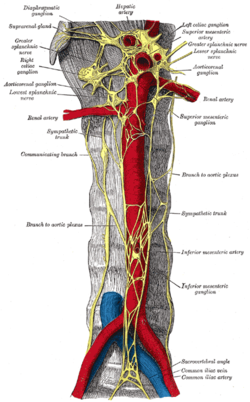
Abdominal portion of the sympathetic trunk, with the celiac plexus and hypogastric plexus. (Sympathetic trunk labeled at center left.)
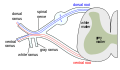
Scheme showing pathways (white/grey rami are spatially reversed, possibly for clarity?) of a typical spinal nerve.
1. Somatic efferent.
2. Somatic afferent.
3,4,5. Sympathetic efferent.
6,7. Autonomic afferent.
Details
Identifiers
Latintruncus sympathicus
TA98A14.3.01.002
TA26602
FMA6258
Anatomical terminology

The sympathetic trunk (sympathetic chain, gangliated cord) is a paired bundle of nerve fibers that run from the base of the skull to the coccyx. It is a major component of the sympathetic nervous system.

Structure

[edit]

The sympathetic trunk lies just lateral to the vertebral bodies for the entire length of the vertebral column. It interacts with the anterior rami of spinal nerves by way of rami communicantes. The sympathetic trunk permits preganglionic fibers of the sympathetic nervous system to ascend to spinal levels superior to T1 and descend to spinal levels inferior to L2/3.[1][2][3][4][5][6][7]

The superior end of it is continued upward through the carotid canal into the skull, and forms a plexus on the internal carotid artery; the inferior part travels in front of the coccyx, where it converges with the other trunk at a structure known as the ganglion impar.

Along the length of the sympathetic trunk are sympathetic ganglia known as paravertebral ganglia.

Relations

[edit]

In the cervical region, the sympathetic trunk is situated upon the prevertebral fascia posterior to the carotid sheath.[8]: 600 

Function

[edit]

The sympathetic trunk is a fundamental part of the sympathetic nervous system, and part of the autonomic nervous system. It allows nerve fibres to travel to spinal nerves that are superior and inferior to the one in which they originated. Also, a number of nerves, such as most of the splanchnic nerves, arise directly from the trunks.


Autonomic nervous system's jurisdiction to organs in the human body edit
Organ Nerves[9] Spinal column origin[9]
stomach T5, T6, T7, T8, T9, sometimes T10
duodenum T5, T6, T7, T8, T9, sometimes T10
jejunum and ileum T5, T6, T7, T8, T9
spleen T6, T7, T8
gallbladder and liver T6, T7, T8, T9
colon
pancreatic head T8, T9
appendix T10
bladder S2-S4
kidneys and ureters T11, T12

Additional images

[edit]

See also

[edit]

References

[edit]
[edit]
Revisions and contributorsEdit on WikipediaRead on Wikipedia
from Grokipedia
The sympathetic trunk, also known as the sympathetic chain or gangliated cord, is a paired bundle of interconnected neuronal cell bodies and nerve fibers that runs parallel to the vertebral column from the to the , forming the paravertebral component of the sympathetic division of the . It consists of 22 pairs of ganglia located anterolateral to the vertebral bodies in the paravertebral region, dividing into cervical, thoracic, , and sacral segments that converge anteriorly at the coccygeal level to form the unpaired ganglion impar. This structure enables the relay of efferent signals for involuntary functions such as , glandular secretion, and modulation in response to stress. The sympathetic trunk receives preganglionic fibers originating from the intermediolateral horn of the spinal cord at levels T1 to L2 (or L3), which enter via white rami communicantes and may synapse within the trunk's ganglia, ascend or descend along the chain, or pass through to prevertebral ganglia or the adrenal medulla. Postganglionic fibers, primarily noradrenergic, exit the trunk through gray rami communicantes to rejoin spinal nerves for distribution to target organs, or form splanchnic nerves that innervate visceral structures via plexuses such as the celiac and superior/inferior mesenteric. In the cervical region, the trunk features three main ganglia—the superior (largest, at the C2-C3 level), middle (smallest, often at C6), and inferior (frequently fused with the first thoracic ganglion as the stellate ganglion)—which supply the head, neck, and upper limbs. The thoracic portion typically includes 11 or 12 ganglia, the lumbar has four, and the sacral four or five, with variations in number and fusion occurring in up to 80% of individuals for certain ganglia. Embryologically derived from neural crest cells that migrate alongside the developing spinal cord, the sympathetic trunk's anatomical variations, such as altered ganglion positions or counts (e.g., 2-6 lumbar ganglia), can influence clinical interventions like sympathectomy for conditions including hyperhidrosis or peripheral vascular disease. Microscopically, it comprises sympathetic neurons, satellite glial cells, and small intensely fluorescent cells, with preganglionic synapses releasing acetylcholine onto nicotinic receptors.

Overview

Definition and role

The sympathetic trunk, also known as the sympathetic chain or great sympathetic nerve, is a paired paravertebral structure consisting of interconnected ganglia and nerve fibers that extends parallel to the from the to the . It forms a longitudinal chain on either side of the vertebral column, housing clusters of sympathetic neurons that receive preganglionic fibers from the thoracolumbar (T1-L2 segments) via white rami communicantes. These fibers within the ganglia or travel along the trunk to distally, with postganglionic fibers exiting via gray rami communicantes to join spinal nerves or directly innervating target organs. As the primary conduit for the sympathetic division of the , the sympathetic trunk plays a central role in mediating the "fight or flight" response, a rapid physiological activation that prepares the body for stress or emergency situations. It transmits signals that increase , dilate pupils, redirect blood flow to skeletal muscles, and promote the release of glucose and adrenaline, while simultaneously suppressing non-essential functions like . This innervation targets visceral organs, blood vessels, sweat glands, and piloerector muscles, ensuring coordinated systemic responses to maintain under duress. The structure was first systematically described in the by Danish anatomist Jacob Bénigne Winslow, who in 1732 termed it the "great sympathetic nerve" (nervus sympathicus magnus) due to its extensive interconnections and role in linking distant bodily parts through shared neural influences. Winslow's work in Exposition Anatomique de la Structure du Corps Humain highlighted its chain-like arrangement alongside the spine, distinguishing it from somatic nerves and establishing it as a key component of the involuntary . This foundational description influenced subsequent anatomical studies, solidifying the sympathetic trunk's recognition as the backbone of sympathetic outflow.

General organization

The sympathetic trunk, also known as the sympathetic chain, consists of two bilateral chains of interconnected ganglia that extend longitudinally along the anterolateral aspects of the vertebral column, one on each side of the body. These trunks form the primary paravertebral component of the , providing a continuous pathway for sympathetic fibers from the cervical region to the sacral levels. The trunks are segmented into distinct portions corresponding to the regions of the spinal column: cervical, thoracic, , and sacral. Each side typically features approximately 22-23 distributed as follows—three in the cervical portion (superior, middle, and inferior), 11 or 12 in the thoracic portion, four in the lumbar portion, and four or five in the sacral portion—with an additional unpaired (ganglion impar) formed by the fusion of the two sacral trunks at the midline near the . This segmentation allows for organized distribution of sympathetic outflow, with the number of ganglia varying slightly between individuals. Interconnections within each trunk include ascending and descending branches that link adjacent ganglia, facilitating longitudinal signal propagation along the chain. Additionally, white and gray communicating rami connect the ganglia to the corresponding spinal nerves, enabling preganglionic fibers to enter the trunk via the white rami and postganglionic fibers to exit via the gray rami. Midline anastomoses occur at specific levels, such as the intermesenteric plexus in the lumbar region, where branches from the bilateral trunks converge to form interconnected networks.

Anatomy

Location and extent

The sympathetic trunks are paired, longitudinally oriented chains of ganglia and interconnecting fibers that extend from the to the , positioned parallel and anterolateral to the vertebral column throughout their course. Superiorly, each trunk begins at the , which lies anterior to the transverse processes of the C2 and C3 vertebrae and posterior to the near the entry of the into the . Inferiorly, the bilateral trunks converge anterior to the sacrococcygeal junction to form the unpaired ganglion impar. In relation to the spine, the trunks maintain a consistent anterolateral position relative to the vertebral bodies and lie anterior to the intervertebral foramina at corresponding spinal levels, facilitating communication with spinal nerves. In the thoracic region, the sympathetic trunks descend along the posterior , lying directly on the heads of the and covered by a thin layer of parietal pleura. The left trunk is positioned medial to the descending , while the right trunk lies medial to the , both within the perivertebral space. Transitioning to the , the trunks continue anterolateral to the vertebral bodies, embedded within the prevertebral and deep to the medial aspect of the . In the pelvic region, the trunks pass posterior to the common iliac vessels as they cross over the sacral ala, remaining embedded in the and positioned medial to the internal iliac vessels before converging inferiorly. This arrangement ensures the trunks' proximity to major vascular structures while maintaining their paravertebral alignment.

Components and ganglia

The sympathetic trunk consists of paired chains of paravertebral ganglia and interconnecting fibers that extend longitudinally alongside the vertebral column. Paravertebral ganglia form the core of the sympathetic trunk and are interconnected by longitudinal trunks. In the cervical region, there are typically three ganglia per side: the , located at the level of the C2-C3 transverse processes; the middle cervical ganglion, situated near the C6 transverse process beneath the inferior thyroid artery and often small or absent; and the inferior cervical ganglion, which frequently fuses with the first thoracic ganglion to form the at the C7-T1 level in approximately 80% of cases. In the thoracic region, 10-12 pairs of smaller ganglia are present, positioned on the heads of the within the posterior and connected to the spinal nerves via rami communicantes. The lumbar region features 4-5 ganglia per side (varying from 2-6), often fused into 2-4 larger structures, located anterolateral to the lumbar vertebral bodies deep to the . In the sacral region, 4 ganglia per side are typical but commonly fuse into 1-2, extending inferiorly to the where the paired chains converge into the unpaired ganglion impar anterior to the sacrococcygeal junction. Prevertebral (or preaortic) ganglia are distinct from the paravertebral chain of the sympathetic trunk and receive preganglionic fibers via ; they are associated with major abdominal aortic branches and primarily located in the . The , the largest prevertebral ganglia, are paired structures at the T12-L1 level surrounding the celiac trunk, connected by short commissures and varying in number from 1-5 with diameters of 0.5-4.5 cm. The superior mesenteric ganglion lies along the origin of the from the , receiving inputs from thoracic and . The inferior mesenteric ganglion, often indistinct or incorporated into the intermesenteric , is positioned at the root of the and primarily receives fibers. The sympathetic trunk's nerve fibers include preganglionic fibers, which are myelinated axons originating from cell bodies in the lateral horn of the thoracolumbar (T1-L2) and entering the chain via white rami communicantes, and postganglionic fibers, which are unmyelinated axons arising from synapses in the ganglia and distributing via gray rami communicantes or direct branches. These fibers travel longitudinally within the interganglionic trunks, allowing for both ipsilateral and contralateral relays along the chain.

Relations and connections

The sympathetic trunk maintains intimate connections with the spinal nerves throughout its extent, receiving preganglionic sympathetic fibers via white rami communicantes from the lateral horn of the at levels T1 to L2, while distributing postganglionic fibers to all spinal nerves through gray rami communicantes for peripheral innervation. These white rami are myelinated and short, linking the ventral roots of thoracic and upper spinal nerves directly to the adjacent paravertebral ganglia, whereas the unmyelinated gray rami extend from the ganglia to all spinal nerves, ensuring widespread sympathetic distribution. Vascularly, the sympathetic trunk runs parallel to major arterial plexuses, with postganglionic branches forming networks around key vessels such as the , common iliac, internal and external iliac arteries, and carotid arteries, facilitating control. In the cervical region, fibers from the contribute to the internal and external carotid plexuses, while in the area, branches accompany the and iliac arteries to form subsidiary plexuses. Visceral outflows occur primarily through originating from the thoracic sympathetic trunk, including the greater splanchnic nerve (from T5-T9 ganglia) to the celiac and superior mesenteric plexuses, the lesser splanchnic (T10-T11) to the aorticorenal plexus, and the least splanchnic (T12) to the ; splanchnic nerves (from L1-L4) similarly target the celiac, intermesenteric, inferior mesenteric, and superior hypogastric plexuses. from S1-S2 ganglia connect to the for pelvic organ innervation. Cranially, the sympathetic trunks extend from the superior cervical ganglia to form the at the skull base, while caudally, the chains converge anterior to the sacrococcygeal junction and link with via the hypogastric . Adjacent structures vary regionally: in the , the trunks lie anterior to vertebral bodies and heads but posterior to the pleura and lungs; in the , they course posterolateral to the and deep to the ; and in the , they align medial to the sacral foramina near the and .

Development

Embryological origin

The sympathetic trunk originates from the trunk cells, a transient population of multipotent cells that emerge at the border between the and surface during early human embryogenesis. These cells delaminate from the dorsal and undergo epithelial-to-mesenchymal transition, migrating ventrolaterally toward the developing and dorsal aorta. In humans, this migration initiates between 10 and 15, corresponding to approximately weeks 4 to 5 post-fertilization (29–36 days), with neural crest cells appearing lateral to the dorsal aorta by stage 14 (around week 5). Upon reaching the vicinity of the , the migrating trunk cells aggregate into segmental primordia that align with the , establishing the metameric organization of the sympathetic chain. This segmentation is guided by inhibitory cues in the posterior halves, restricting migration to the anterior halves and ensuring precise positioning relative to vertebral levels. The process is heavily influenced by (BMP) signaling from the dorsal , which promotes cell survival and differentiation, in synergy with Wnt signaling pathways that maintain multipotency and direct lineage specification toward autonomic neurons. By late stage 14 (approximately week 5), these cells form longitudinal columns in the cervical and upper thoracic regions (C3–T8), setting the foundation for ganglionic clusters. Sympathetic ganglia begin to form as irregular agglomerates along cords of nerve fibers starting at Carnegie stage 18 (around week 6, 44 days post-fertilization), with the chain elongating cranially to the C1 level by stage 15 (week 5–6) and caudally to S5 by stage 16 (week 6), ultimately reaching the coccygeal region by stage 22 (week 8). This elongation occurs through differential growth of the embryonic trunk and progressive caudal addition of contributions. Developing sympathetic cells express key molecular markers, including the Phox2b, which is essential for autonomic specification and regulates noradrenergic differentiation, and , an enzyme indicative of catecholaminergic identity that appears as cells commit to the sympathetic lineage. By week 8, the basic architecture of the sympathetic trunk is established, mirroring the segmental pattern observed in the adult structure.

Formation and variations

Following embryonic development, the sympathetic trunk continues to mature postnatally through processes such as ganglion fusion and longitudinal growth aligned with vertebral column elongation during childhood and adolescence. This maturation ensures the trunk's extension from the base of the skull to the coccyx, paralleling the spine's growth to maintain its paravertebral position. A key aspect of this post-embryonic maturation is the fusion of adjacent ganglia, particularly in the cervical and thoracic regions. For instance, the inferior cervical ganglion fuses with the first thoracic ganglion to form the stellate (cervicothoracic) ganglion, a process typically completed by birth and observed in approximately 80% of individuals. This fusion creates a single enlarged structure at the C7-T1 level, facilitating efficient sympathetic outflow to the upper limb and head. In the lumbar region, fusions are also common, with the first and second lumbar ganglia often merging, contributing to a reduced number of distinct ganglia (typically 3-4 per chain, ranging from 2 to 6 with a mean of 3.9). The sympathetic trunks from both sides converge and fuse anterior to the sacrococcygeal junction, forming an unpaired ganglion impar. Anatomical variations in the sympathetic trunk are prevalent and can affect its overall structure and function. Common variations include the absence or fusion of specific , asymmetric chain lengths between sides, and the presence of accessory . In the cervical region, the middle cervical is variably present, observed in about 28-81% of cases depending on the population studied, and may appear as a double unilaterally in rare instances (2.9-10%). Absent or fused occur more frequently in the and sacral segments; for example, fusions reduce the ganglion count in 70-80% of chains, while sacral variations, such as unilateral absence of ganglia or irregular fusion, are more common on one side than bilaterally. Accessory , like the vertebral at C7, arise as small outpouchings in up to 20-30% of cervical trunks. These variations often stem from incomplete segmentation during development and can lead to asymmetric sympathetic innervation. Such anatomical variations have clinical relevance, particularly in procedures like sympathetic nerve blocks, where altered ganglion positions or fusions may complicate targeting and efficacy, potentially requiring imaging guidance for accurate intervention.

Physiology

Role in sympathetic nervous system

The sympathetic trunk serves as a central conduit in the sympathetic nervous system, facilitating the relay of preganglionic fibers originating from the thoracolumbar region of the spinal cord (segments T1 to L2 or L3) to postganglionic neurons that innervate various target organs. These preganglionic fibers exit the spinal cord via ventral roots and enter the sympathetic trunk through white rami communicantes, where most synapses occur within the paravertebral ganglia along the trunk. This arrangement allows for significant divergence, with a single preganglionic fiber typically synapsing with 20 or more postganglionic fibers, enabling a broad amplification of sympathetic signals across multiple effectors. Through this pathway, the sympathetic trunk contributes to the by directing postganglionic fibers to key visceral targets. For instance, cardiac innervation via the trunk increases and contractility, promoting enhanced circulation during stress. Pulmonary branches induce bronchodilation to facilitate greater oxygen intake, while vascular innervation generally causes in skin and beds to redirect flow to vital organs, though exceptions occur in coronary and vessels. Additionally, the trunk relays signals to the , stimulating the release of epinephrine into the bloodstream for systemic effects. The sympathetic trunk also integrates into reflex arcs essential for , such as the and chemoreflex, where sensory inputs from arterial or chemoreceptors are processed centrally and relayed back through the trunk's ganglia to modulate sympathetic outflow. In the , for example, trunk-mediated sympathetic activation adjusts vascular tone and in response to changes, while the chemoreflex similarly influences respiration and circulation via trunk relays in response to blood gas variations. These reflexes underscore the trunk's role in coordinating rapid, adaptive responses. In contrast to the , the sympathetic trunk's configuration features relatively short preganglionic fibers that synapse near the and long postganglionic fibers that extend to distant targets, allowing for diffuse and widespread physiological effects rather than localized control. This structural difference supports the sympathetic system's emphasis on global mobilization during acute demands, as opposed to the parasympathetic's targeted maintenance functions. The paravertebral ganglia of the trunk, as described in anatomical overviews, enable this efficient relay without extensive central processing.

Neurotransmitters and signal transmission

The sympathetic trunk facilitates signal transmission within the through a two-neuron chain involving preganglionic and postganglionic neurons. Preganglionic fibers, originating from the intermediolateral cell column of the , release (ACh) as their primary at synapses within the paravertebral or prevertebral ganglia of the trunk. This ACh binds to nicotinic acetylcholine receptors on postganglionic neurons, triggering fast excitatory postsynaptic potentials that propagate the signal via ionotropic mechanisms, including sodium and calcium influx. Postganglionic neurons in the sympathetic trunk primarily release norepinephrine (NE) at their neuroeffector junctions with target organs, such as smooth muscle, cardiac muscle, and glands. NE acts on adrenergic receptors, which are divided into alpha (α1, α2) and beta (β1, β2, β3) subtypes, eliciting excitatory or inhibitory responses depending on the receptor and tissue type—for instance, α1 receptors mediate via Gq-protein coupling, while β2 receptors promote bronchodilation through Gs-protein activation. An exception occurs in postganglionic fibers innervating sweat glands, where ACh is released onto muscarinic receptors, but this is not typical for the trunk's primary efferents. Signal transmission in the sympathetic trunk is modulated by co-transmitters and structural features that enhance or fine-tune sympathetic outflow. (NPY) and (ATP) are co-stored and co-released with NE from postganglionic terminals, particularly under high-frequency stimulation, to amplify vasoconstrictive and other effects; NPY acts via Y1 receptors to potentiate NE-induced contraction, while ATP binds P2X purinergic receptors for rapid . In some , gap junctions formed by proteins enable electrical coupling between satellite glial cells, allowing direct ion flow and synchronized activity that supports coordinated responses. Propagation along postganglionic fibers of the occurs via unmyelinated C-fibers, which have small diameters (0.2–1.5 μm) and exhibit slow conduction velocities of approximately 0.5–2 m/s, enabling diffuse but sustained sympathetic activation suited to stress responses. This contrasts with the faster, myelinated preganglionic B-fibers (3–15 m/s), emphasizing the trunk's role in integrating rapid central input with prolonged peripheral effects.

Clinical significance

Associated disorders

Horner's syndrome results from interruption of the oculosympathetic pathway, including damage to the cervical sympathetic trunk, leading to ipsilateral ptosis, , and anhidrosis. This condition often arises from trauma, tumors compressing the trunk, or iatrogenic injury during cervical spine surgery. In patients, particularly those with lateral medullary , Horner's syndrome manifests in up to 91% of cases due to involvement of central sympathetic pathways. Autonomic dysreflexia is a potentially life-threatening condition in individuals with at or above the T6 level, characterized by exaggerated sympathetic hyperactivity below the injury site. This involves unmodulated sympathetic reflexes along the trunk, triggered by noxious stimuli such as distension, resulting in acute and . The loss of descending supraspinal inhibition leads to massive sympathetic discharge from the isolated spinal segments, heightening risks like pulmonary complications. Pheochromocytoma comprises catecholamine-secreting tumors of the , derived from chromaffin cells within the , leading to episodic and via excessive norepinephrine and epinephrine release. These tumors mimic sympathetic trunk overactivity by hypersecreting hormones that act through postganglionic sympathetic pathways, often linked to genetic syndromes involving paraganglia along the sympathetic chain.

Diagnostic and therapeutic approaches

Diagnostic approaches to disorders involving the sympathetic trunk primarily rely on imaging and electrophysiological testing to assess structural integrity and functional autonomic activity. Computed tomography (CT) and (MRI) are commonly employed to visualize the sympathetic trunk in cases of tumors, such as paragangliomas, or trauma, providing detailed anatomical information about the chain of ganglia and potential compressions. For sympathetic-specific evaluation, particularly in catecholamine-secreting tumors like , metaiodobenzylguanidine (MIBG) is utilized due to its uptake by sympathetic nerve tissues, aiding in the detection and localization of abnormalities along the trunk. Electrophysiological tests offer insights into sympathetic function without invasive procedures. The sympathetic skin response (SSR) test measures activity by recording changes in skin electrical potential in response to stimuli, serving as an indicator of postganglionic sympathetic function relevant to trunk-mediated pathways. (HRV) analysis evaluates autonomic balance by quantifying fluctuations in inter-beat intervals, where reduced variability often signals sympathetic overactivity or imbalance influenced by the trunk's outflow. Therapeutic interventions target sympathetic hyperactivity or dysfunction along the trunk through localized or systemic means. block, involving injection of local anesthetics at the cervicothoracic junction, is applied to alleviate pain in conditions like (CRPS) or by temporarily interrupting sympathetic signals. Surgical sympathectomy, often performed endoscopically, ablates segments of the sympathetic trunk to treat severe , providing long-term relief by severing neural connections. Pharmacologically, beta-blockers modulate postganglionic sympathetic effects by antagonizing beta-adrenergic receptors, reducing and associated with trunk overactivity, while alpha-agonists like are used in hypotensive states, such as from autonomic failure, to enhance vascular tone via alpha-1 receptor stimulation. Clinical outcomes vary by approach but demonstrate efficacy in targeted applications. Stellate ganglion blocks achieve success rates of 70-80% for significant pain relief in CRPS, with many patients experiencing at least 50% reduction in visual analog scale scores immediately post-procedure. Endoscopic sympathectomy yields resolution rates exceeding 90% for palmar , though compensatory sweating occurs in about 20-30% of cases.

References

Add your contribution
Related Hubs
User Avatar
No comments yet.