


Community hub
Recent from talks
Contribute something
Nothing was collected or created yet.
Tal Afar
View on WikipediaTal Afar[1] (Arabic: تَلْعَفَر, romanized: Talʿafar, IPA: [talˈʕafar]; Turkish: Telafer, تلعفر) is a city in the Nineveh Governorate of northwestern Iraq, located 63 km (39 mi) west of Mosul,[2] 52 km (32 mi) east of Sinjar[2] and 200 km (120 mi) northwest of Kirkuk. Its local inhabitants are exclusively Turkmen.[3]
Key Information


While no official census data exists, the city, which had previously been estimated to have a population of approximately 200,000, had dropped to 80,000 as of 2007.[4] Tal Afar's population is about 55 percent Shia Turkmen, while 45 percent are Sunni Turkmen.[5] On 27 April 2025, Baghdad Today reported of an ongoing government initiative to convert Tel Afar District into the 20th governorate of Iraq. The proposed name of the new governorate is Jazira.[6]
History
[edit]Prehistory
[edit]10 kilometres (6.2 mi) southwest of the town of Tal Afar are the mounds of Yarim Tepe which yielded remains from the Halafian culture of the Hassuna, Halaf and Ubaid periods, between 7000 and 4500 BC.[7][8]
Assyrian Empire
[edit]From perhaps the 5th century BC through to the 7th century AD it was an integral part of Assyria.
Ottoman Empire
[edit]The British military officer and traveler Frederick Forbes, who journeyed through northern Mesopotamia in the early 19th century, described Tal Afar in his 1838 travel account:
There is no bazar or market-place in the town, and only a few shops, such as those of the blacksmith, carpenter, and tanner; the latter is the only Christian inhabitant, all the others being Musulmans, a mixture of Arabs and Kurds. The language generally spoken is Kurdish, but Arabic is also commonly understood.[8]
The English traveller, archaeologist, and future diplomat Austen Henry Layard—one day to become the United Kingdom's Ambassador to the Ottoman Empire—wrote in his book 1867 book Nineveh and Its Remains:
Tel Afer was once a town of some importance; it is mentioned by the early Arab geographers, and may perhaps be identified with the Telassar of Isaiah, referred to, as it is, in connection with Gozan and Haran. It has been three times besieged, within a few years, by Ali Pasha of Baghdad, Hafiz Pasha, and Injeh Bairakdar Mohammed Pasha. On each occasion the inhabitants offered a vigorous resistance. Mohammed Pasha took the place by assault. More than two-thirds of the inhabitants were put to the sword, and the property of the remainder was confiscated. Great wealth is said to have been discovered in the place, on its pillage by Mohammed Pasha, who took all the gold and silver, and distributed the remainder of the spoil amongst his soldiers.[9]
Nelida Fuccaro wrote "After Hafiz Pasha's expedition in 1837 Tall 'Afar was occupied permanently by Ottoman Turkish troops and started to be used as a base to control the movements of a number of the rebellious Yazidi tribes of the Sinjar region to the west. In the 1880s Tall 'Afar became an administrative unit depending on the Sinjar qadha."[10]
Sometime during the Ottoman Empire, the Ottoman Army founded the city as a sole military outpost constructed on top of a hill.[citation needed] Remains of the fortress can still be seen today. Also garrisoned at the fortress were Turkmen members of the Daloodi tribe who following the withdrawal of the Ottoman Army became the first civilian occupants of the town built around the fortress. Aylmer Haldane, the British General Officer Commanding Mesopotamia, described Tel Afar as "That town of ten thousand Turcoman inhabitants is picturesquely situated on four knolls, which stand two on each side of a deep gully, whence rises a stream which supplies the inhabitants with water."[11]
1920 Iraqi Revolt
[edit]After the fall of the Ottoman Empire, Tal Afar was included in Iraq. In 1920, Tal Afar was used as a base of operations for a planned revolt against the then ruling British.[12]

US Invasion and Occupation (2003-11)
[edit]Operation Black Typhoon
[edit]On September 9, 2004, a major military operation was launched against Tal Afar by the 3rd Brigade, 2nd Infantry Division (Stryker Brigade Combat Team) and Iraqi Security forces. Fighting continued until September 12, 2004, when the government of Turkey claimed that the fighting had taken the lives of approximately 58 ethnic Turkmen civilians and demanded an end to military operations at which time the civilians camped outside Tal Afar were allowed to return to their homes.[13]
Operation Restoring Rights
[edit]
In September 2005, Operation Restoring Rights was conducted in which approximately 5,000 soldiers from the 3rd Division of the Iraqi Security Force in conjunction with 3,500 troops (Bob Woodward cites the number 5,300 troops in his book The War Within[citation needed]) from the U.S. Army's 3rd Armored Cavalry Regiment and the 325th Airborne Infantry Regiment, 82nd Airborne Division entered the city. The operation resulted in 157 insurgents being killed and 683 captured. Iraqi Security Forces suffered 12 killed and 27 wounded.[14] The operation lasted until October and resulted in 10,000 pounds of explosives being uncovered and destroyed.[15] Abu Musab al-Zarqawi accused the American military of using "poisonous gases" on Tal Afar in an audiotape received and posted on an Islamic website. The United States denied using chemical weapons in Tal Afar saying such reports were propaganda created by al-Zarqawi, and were false and without merit.[16]
The operation tested a new strategy of "clear, hold, build", in which areas would be purged of insurgents and then occupied and then rebuilt to win support from local people before being handed over to the Iraqi security forces.[17]
In March 2006, U.S. President George W. Bush pointed to Tal Afar as a success story, where one could "see the outlines of the Iraq we've been fighting for".[18] The operation was considered one of the first successful counterinsurgency operations in Iraq. Colonel H.R. McMaster, commander of the operation became an advisor to General David Petraeus in the planning and execution of the 2007 troop surge. However, after years of intermittent violence, some commentators have said that the optimism expressed in 2005 was overstated.[19]
Post-invasion violence
[edit]Tal Afar has also been the scene of sectarian violence between Shiite and Sunni Muslims.
Before the invasion of Iraq sectarian violence between Turkmens had not been a problem. Their shared cultural background had united Sunni and Shia Turkmens. Political mobilisation in Tal Afar had until then been dominated by the Baath party. With no readily available movement to replace Saddam's Baathists, the collapse of the state disrupting everything from food to security and increasing distrust towards the Shia dominated Iraqi government, tensions started to arise. Grievances were stoked further when Sunni Islamists began to move into the town and Shia Iraqi security forces began purging Sunni's from the police force.[20]
In May 2005, clashes broke out between the two groups. In October 2006, a bombing in Tal Afar killed 14 people, of whom ten were civilians and four Iraqi soldiers.[citation needed] An additional bombing, outside a car dealership, on November 24, 2006, killed at least 22 and wounded at least 26.[citation needed]
On February 10, 2007, a suicide car bomber killed one Iraqi soldier and wounded five people, including three civilians, as it targeted an army checkpoint.[21] On February 22, 2007, four people were killed, including a policeman and a 12-year-old boy, and five were wounded, including two policemen, when two booby-trapped houses detonated while police were searching homes. During the search, a policeman shot and killed a suspect and wounded two others. Police had already reported the death of one policeman.[22] On March 24, 2007, a suicide bomber in a market in the town killed eight people and wounded ten.[23] On March 27, 2007, a truck bomb exploded in a market in a Shiite area. It was first reported to have killed 83 people and wounded 183, but the Iraqi Interior Ministry later raised the death toll to 152 and said that 347 were wounded, which would make it the deadliest single strike since the war started. The explosion, for which a terrorist group linked to ISI claimed responsibility, led to reprisal shootings by Shiite policemen and others against Sunnis, in which between 47 and 70 men were killed. Several Shiite policemen were arrested for taking part in the shootings.[24][25][26][27] On April 14, 2007, a sniper shot dead a woman.[28] On May 21, 2007, a roadside bomb exploded near a police patrol, wounding three policemen on the main road between the town of Sinjar and Tal Afar.[29] On May 31, 2007, a roadside bomb targeting a police patrol wounded four policemen on the road between Sinjar and Tal Afar. In a separate incident a roadside bomb targeting an Iraqi army patrol killed an officer and wounded another soldier in Tal Afar. In another separate incident a man was killed in a rocket attack.[30] On June 11, 2007, two people were killed and five wounded by a Katyusha rocket attack.[31] On June 19, 2007, a woman and a child were killed by a mortar attack in the town.[32] On July 12, 2007, seven guests celebrating the wedding of an Iraqi policeman were killed by a suicide bomber.[33] On July 15, 2007, two civilians were killed and three wounded by a roadside bomb.[34] On August 6, 2007, a car bomb killed 27 and wounded 28 people in the nearby village of al-Guba.[35] On August 22, 2007, a roadside bomb exploded near workers laying water pipes, killing two and wounding five.[36] On September 16, 2007, at least two policemen were wounded by a roadside bomb in the centre of the town.[37] On September 22, 2007, one insurgent was killed and another wounded when a bomb they were making exploded.[38] On September 24, 2007, a suicide truck bomb killed at least six people, including two policemen and a soldier, and wounded 17 in an attack on a checkpoint near a village between Tal Afar and Mosul.[39] On October 4, 2007, a suicide car bomber killed three people and wounded 57 in a market.[40] On October 10, 2007, a Katyusha rocket landed on a house, killing five members of the same family and wounding five others.[41] On December 29, 2007, police killed five insurgents and detained five others.[42]
On January 3, 2008, two civilians, including a child, died when U.S. forces returned fire after a roadside bomb struck a convoy that included the police chief.[43] On January 19, 2008, a rocket attack killed seven people and wounded 20.,[44][45] On February 15, 2008, at least three people were killed and 16 wounded in a double suicide bombing. After a police officer guarding a mosque prevented a bomber from entering the building, the attacker tried to throw a hand grenade and then detonated the explosive vest he was wearing. A few minutes later, another bomber ran towards a group of worshipers and blew himself up as police opened fire.[46] On February 20, 2008, a suicide car bomber killed a woman and a six-year-old girl, and wounded eight, in an attack on an identity cards office.[45] On March 2, 2008, clashes between gunmen and police killed 13 gunmen and two policemen in a village near the town.[47] On April 14, 2008, an attacker wearing a suicide vest blew himself up at a Shi'ite funeral, killing four civilians and wounding 22.[48] On May 27, 2008, four people were killed and 46 wounded, including two children, when a parked car bomb blew up in a market, the town's mayor, Najim Abdullah, said.[49] On July 8, 2008, gunmen killed a member of the Sunni Arab Iraqi Islamic party, police said.[50] On July 12, 2008, police found the bodies of seven people, including a woman and a child, the town's mayor said. They had been kidnapped two days earlier.[51] On July 17, 2008, a car bomb exploded in a street market killing 20 people, including nine children, and wounding 90.[52] On July 31, 2008, a roadside bomb killed a policeman, police said.[53] On August 8, 2008, a lone Sunni Turkman suicide bomber (initial reports said a parked car) exploded in a vegetable market killing 25 people and injuring about 70.[54][55] On August 29, 2008, policemen killed a would-be suicide bomber who tried to enter a mosque.[56] On September 6, 2008, a car bomb exploded near shops and cafes killing at least six people and wounding at least 50.[57] On September 17, 2008, a roadside bomb wounded four civilians.[58] On September 18, 2008, two roadside bombs wounded nine civilians.[59] On September 20, 2008, a suicide car bomb attack near a football playground killed two people and left 18 wounded.[60] On November 15, 2008, a car bomb exploded and killed 10 people and injured 31 more.[61] On December 2, 2008, a suicide car bomb exploded at a police checkpoint killing five people and wounding 30.[62]
On February 6, 2009, gunmen in a moving car opened fire and killed two civilians, police said.[63] On March 23, 2009, a suicide bomber killed an off-duty police officer and wounded five civilians, according to police.[64] On July 9, 2009, 33 people were killed by two suspected suicide bomb attacks. Police reported that more than 70 were injured.[65] On September 17, 2009, a suicide bomber drove a truck into a police checkpoint, killing three civilians and wounding three policeman.[66] On September 28, 2009, two suspected insurgents were killed and a third was wounded in an explosives accident.[67] On October 16, 2009, a gunman opened fire and then detonated a suicide belt, killing 15 and injuring 100 during Friday Prayer inside the Taqua Mosque, which is attended primarily by Sunni Muslims.[68]
Coming of ISIL
[edit]
On 14 May 2010, an attacker detonated explosives hidden inside a vehicle at the entrance to the football stadium, killing ten people and injuring 120 others. Earlier, the Islamic State of Iraq warned Shiites of "dark days soaked with blood". "What is happening to you nowadays is just a drizzle," said Abu Suleiman al-Naser, the group's "minister of war".[69] On March 7, 2012, at least 12 people were killed in a coordinated car- and suicide bombing attack.[citation needed]
ISIL captured Tal Afar on June 16, 2014, after a two-day battle.[70] In July it was reported that the Sheikh Jawad Al-Sadiq Mosque was destroyed by ISIL, using explosives.[71]
Battle of Tal Afar (2017)
[edit]On 20 August 2017, the Iraqi Army announced it had launched a new offensive to retake Tal Afar from the ISIL forces.[72] On the same day, it recaptured four neighborhoods in Tal Afar (Abra al-Najjar, Abra Hansh, al-Abra al-Kabira, and Abra al-Saghir) [73] The city itself was recaptured by Iraqi forces on August 27, 2017.[74] The remaining ISIS-held areas in Tal Afar district were then fully captured on August 31, 2017.
ISIS aftermath
[edit]Many of the Turkmen of Tal Afar have been displaced and moved to areas further south in Iraq ever since ISIL captured the area. Many have also joined Iraqi forces fighting ISIL.[75] [needs update]
Geography
[edit]
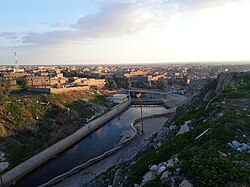
Tal Afar is located approximately 50 km west of Mosul and 60 km east of the Iraqi–Syrian border, at coordinate 36°23′N 42°27′E. According to map data, it has a total area of 15 km2.
Tal Afar is located in the gap between the anticlines of Jabal Zambar to the southeast and Jebel Sasan to the northwest.[76] The city is located in an open desert plain at the southern base of the Aedea Mountains. Much of the terrain surrounding the city is flat desert. A major east–west highway, which spans Nineveh Governorate and intersects Iraq's main central north–south highway near Mosul, runs through the city.
The city of Tal Afar is organized into eighteen neighborhoods or districts: Sa'ad, Qadisiyah, Todd A-O, Sara, Mohalemeen, Madlomin, Uruba, Wahada, Nida, A'a lot, Hassan Qoi, Mothana, Khadra, Jazeera, Taliha, Kifah, Malain and Qalah (Turkish: Kale).
Each neighborhood maintains its identity due to the tribal nature of the city. Several dozen extended families living in close proximity will typically identify with one local sheikh who takes it upon himself to serve as steward of the neighborhood's citizens and liaison to the local government. The layout of the town consists of densely packed buildings, often constructed so closely to each other that they share common load-bearing walls and supports. The city's streets further physically define each neighborhood by separating it from other groups of buildings, since they cut through the town in irregular patterns.
The United States Army and local government implemented a home address system to better identify specific locations and define jurisdiction for the Iraqi Police in the second half of the 2000s.
Economy
[edit]In January 2007, the largest single employer in the city was the Iraqi Ministry of the Interior, which had hired roughly 2,250 policemen. The second-largest employer was the United States government. The 101st Airborne 3rd Brigade was stationed at Tal Afar Airbase in 2003–04 and its 1st Battalion was stationed in the town proper.[77]
Landmarks
[edit]The Tal Afar Citadel, a ruined Ottoman fortress, is located in the center of the city.[78] Local history states that British administrators augmented the structure of the original fortress. During the 2003 invasion of Iraq, the fortress was further augmented and made to house the city's mayoral, municipal and police headquarters. The neighborhood including and surrounding the fortress is known as Qalah or "Castle".
Large parts of the citadel were blown up by the Islamic State of Iraq and the Levant in December 2014.[79]
Politics and government
[edit]Tal Afar's local government consists of a city council, local sheikhs and a mayor. The mayor is appointed by the council of sheikhs and confirmed by the provincial regional administrator. The mayor need not be originally from the city nor Iraqi Turkmen. The mayor from 2005 to 2008 was Najim Abdullah Abed al-Jabouri,[80] a Sunni Arab originally from Qayyarah.[81]
The Iraqi Turkmen demographic of Tal Afar and its geographic location have made it an important city in the argument for Iraqi federalism. Following a program of "Arabization" initiated by Saddam Hussein in the 1970s, large numbers of Sunni Arabs supportive of the Baathist government were moved into areas around Tal Afar. Geographically, the region the city is located in is a border area separating Kurdish lands to the north and Arab lands to the south in the Al Anbar governorate.
People from Tal Afar
[edit]- Abu Muslim al-Turkmani, ISIL deputy leader (c. 1959 – 18 August 2015)
- Abdul Nasser Qardash, ISIL official (born c. 1967)
- Abu Ibrahim al-Hashimi al-Qurashi, ISIL leader (1976 – 3 February 2022)
References
[edit]- ^ Also commonly romanized as Tel Afar or Tal'Afar
- ^ a b google maps, Tel Afar. Retrieved 8 May 2015.
- ^ "The Ba'ath Party and Insurgency in Tal Afar" (PDF).
- ^ The Real Surge Story (Washington Post)
- ^ "Irak'ta Direnen Bir Türkmen Kenti: Telafer". Dinç Ahmet,“Türkiye’nin Irak Başarısı Telafer’den Geçer”, Global Strateji, Sonbahar 2005, Yıl 1 Sayı 2, s. 105-106 (in Turkish). January 8, 2008. Retrieved April 22, 2011.
- ^ ""الجزيرة".. اسم جديد ينسج خريطة العراق الإدارية" (in Arabic). Baghdad Today.
- ^ Encyclopedia of Prehistory, by Peter N. Peregrine, Melvin Ember, Inc., Human Relations Area Files, Pg 149.
- ^ a b Forbes, Frederick (1839). "A Visit to the Sinjar Hills in 1838, with Some Account of the Sect of Yezidis, and of Various Places in the Mesopotamian Desert, between the Rivers Tigris and Khabur". Journal of the Royal Geographical Society of London. 9: 411. doi:10.2307/1797732.
- ^ Nineveh and Its Remains, by Austen Henry Layard, 1867, pgs 217–218.
- ^ The Other Kurds: Yazidis in Colonial Iraq, by Nelida Fuccaro, 1999, p. 33.
- ^ Haldane, James Aylmer Lowthorpe (1922). The Insurrection in Mesopotamia, 1920. Edinburgh and London: W. Blackwood and Sons.
- ^ A History of Iraq, by Charles Tripp, Pg. 40
- ^ "Operation Black Typhoon". GlobalSecurity.org.
- ^ "Northern Exposure - FDD's Long War Journal". www.longwarjournal.org. 23 September 2005.
- ^ "Operation Restoring Rights". GlobalSecurity.org.
- ^ U.S. Forces Not Using Chemical Weapons in Tall Afar, Iraq Archived 2010-04-26 at the Wayback Machine
- ^ Poole, Oliver (2005-12-19). "Iraqis in former rebel stronghold now cheer American soldiers". The Daily Telegraph. Retrieved 2012-05-09.
- ^ "President Discusses Democracy in Iraq with Freedom House". White House Office of the Press Secretary. 2006-03-29. Retrieved 2007-04-10.
- ^ "Police and Militants Gun Down Sunnis in Revenge Attacks". PBS. Archived from the original on October 7, 2008.
- ^ Fitzsimmons, Michael (March 2013). GOVERNANCE, IDENTITY, AND COUNTERINSURGENCY: EVIDENCE FROM RAMADI AND TAL AFAR (PDF). STRATEGIC STUDIES INSTITUTE and U.S. ARMY WAR COLLEGE PRESS. ISBN 978-1-58487-567-3. Archived from the original (PDF) on May 22, 2015. Retrieved 22 May 2015.
- ^ "FACTBOX-Security developments in Iraq, Feb 10". Reuters. 10 February 2007.
- ^ "FACTBOX: Security developments in Iraq, Feb 22". Reuters. 22 February 2007.
- ^ "FACTBOX-Security developments in Iraq, March 24". Reuters. 24 March 2007.
- ^ Iraq Raises Death Toll in Tal Afar Bomb, Guardian, April 1, 2007
- ^ Deadliest bomb in Iraq war kills 152, Reuters, April 1, 2007
- ^ Iraq Says Truck Bomb in North Killed 152, The New York Times, April 1, 2007
- ^ Police accused in sectarian revenge killings, CNN, March 29, 2007
- ^ "FACTBOX-Security developments in Iraq, April 14". Reuters. 14 April 2007.
- ^ "FACTBOX: Security developments in Iraq, May 21". Reuters. 21 May 2007.
- ^ "FACTBOX-Security developments in Iraq, May 31". Reuters. 31 May 2007.
- ^ "FACTBOX-Security developments in Iraq, June 11". Reuters. 11 June 2007.
- ^ "FACTBOX: Security developments in Iraq, June 19". Reuters. 19 June 2007.
- ^ "Seven killed by suicide bomber at Iraqi wedding". Reuters. 12 July 2007.
- ^ "FACTBOX: Security developments in Iraq, July 15". Reuters. 15 July 2007.
- ^ "Iraq Car Bombing Kills 27 Near Northwestern City of Tal Afar - Bloomberg". Bloomberg News. 2012-10-22. Archived from the original on 2012-10-22. Retrieved 2023-05-25.
- ^ "FACTBOX-Security developments in Iraq, Aug 22". Reuters. 22 August 2007.
- ^ "FACTBOX: Security developments in Iraq, Sept 16". Reuters. 16 September 2007.
- ^ "FACTBOX-Security developments in Iraq, Sept 22". Reuters. 22 September 2007.
- ^ "FACTBOX: Security developments in Iraq, Sept 24". Reuters. 24 September 2007.
- ^ "FACTBOX-Security developments in Iraq, Oct 4". Reuters. 4 October 2007.
- ^ "FACTBOX-Security developments in Iraq, Oct 10". Reuters. 10 October 2007.
- ^ "FACTBOX-Security developments in Iraq, Dec 29". Reuters. 29 December 2007.
- ^ "FACTBOX-Security developments in Iraq, Jan 3". Reuters. 3 January 2008.
- ^ "Breaking News, World News & Multimedia". The New York Times.
- ^ a b "Humanitarian - Thomson Reuters Foundation News". news.trust.org.
- ^ U.S. Forces Accused of Killing Relatives of Iraqi Ally
- ^ "FACTBOX-Security developments in Iraq, March 2". Reuters. 2 March 2008.
- ^ "Attacks kill up to 18 in northern Iraq". Reuters. 14 April 2008.
- ^ "FACTBOX - Security developments in Iraq". Reuters. 27 May 2008. Archived from the original on January 12, 2016.
- ^ "FACTBOX-Security developments in Iraq, July 8". Reuters. 8 July 2008.
- ^ "FACTBOX-Security developments in Iraq, July 12". Reuters. 12 July 2008.
- ^ Robertson, Campbell (17 July 2008). "Blast Kills 20 in Shiite Neighborhood of Northern Iraq City". The New York Times.
- ^ "FACTBOX: Security developments in Iraq, July 31". Reuters. 31 July 2008.
- ^ "Death toll rises to 25 from Iraqi market bombing". The Jerusalem Post. 2008-08-09.
- ^ "Car bomb kills 21 in Iraq market". BBC News. 8 August 2008.
- ^ "FACTBOX-Security developments in Iraq, Aug 29". Reuters. 29 August 2008.
- ^ Goode, Erica (6 September 2008). "Car Bomb Kills 6 in Northwestern Iraq". The New York Times.
- ^ "FACTBOX-Security developments in Iraq, Sept 17". Reuters. 17 September 2008.
- ^ "FACTBOX-Security developments in Iraq, Sept 18". Reuters. 18 September 2008.
- ^ Suicide bombing kills 2, wounds 18 in N Iraq (Xinhuanet) Archived 2008-09-22 at the Wayback Machine
- ^ "Seven Pakistanis killed as bus overturns in Iraq". Media Office of the Patriotic Union of Kurdistan. 2011-04-28. Archived from the original on 2011-10-03.
- ^ "AFP: Bombings in northern Iraq kill nine: Police". 2008-12-02. Archived from the original on 2012-09-22. Retrieved 2016-11-12.
- ^ "FACTBOX-Security developments in Iraq, Feb 7". Reuters. 7 February 2009.
- ^ "FACTBOX-Security developments in Iraq, March 23". Reuters. 23 March 2009.
- ^ "Scores killed in Iraqi bombings". Al Jazeera. 9 July 2009.
- ^ "FACTBOX-Security developments in Iraq, Sept 17". Reuters. 17 September 2009.
- ^ "FACTBOX: Security developments in Iraq, Sept 28". Reuters. 28 September 2009.
- ^ Williams, Timothy (16 October 2009). "Attacker Kills 15 in Iraqi Mosque". The New York Times.
- ^ "Deadly bombing hits Iraqi stadium". BBC News. May 14, 2010. Retrieved May 24, 2010.
- ^ Chulov, Martin (June 16, 2014). "Iraqi city of Tal Afar falls to Isis insurgents". The Guardian.
- ^ Hafiz, Yasmine (2014-07-07). "ISIS Destroys Shiite Mosques And Shrines In Iraq, Dangerously Fracturing Country (PHOTOS)". Huffington Post. Retrieved 2019-01-05.
- ^ "Iraq launches push to seize Tal Afar". BBC News. 20 August 2017.
- ^ "Exclusive: Federal Police recapture 4 neighborhoods in Tal Afar - Iraq News - Local News - Baghdadpost". www.thebaghdadpost.com. 20 August 2017. Archived from the original on 21 April 2019. Retrieved 27 January 2019.
- ^ "Iraqi forces recapture Isis stronghold Tal Afar". Financial Times. 27 August 2017.
- ^ Turkey Pulse article on situation of the Turkmen Archived 2016-03-27 at the Wayback Machine
- ^ Sitzungsberichte. Abt. 1, Biologie, Mineralogie, Erdkunde und verwandte Wissenschaften. 1953. p. 392.
- ^ "Tall ?Afar Airbase". GlobalSecurity.org.
- ^ Schlosser, Nicholas J. (August 2015). "The Pacification of Tal Afar". U.S. Army Center of Military History. Archived from the original on 5 September 2015.
- ^ "Extremist IS militants damage ancient citadel, two shrines in Iraq's Nineveh". Xinhua News Agency. 31 December 2014. Archived from the original on 13 January 2015.
- ^ Najim Abed al-Jabouri (28 October 2009). "For every Iraqi party, an army of its own". The New York Times. Retrieved 3 August 2016.
- ^ "بالصور...من سيقود عمليات الموصل ؟". Rudaw. Retrieved 2017-08-12.
External links
[edit]
- Iraq Image - Tal Afar Satellite Observation
- "Troops blitz Iraq's 'funnel of death'" (The Daily Telegraph, Sept. 11, 2005)
- "Bomber attacks 'model Iraqi city'" (BBC News, Oct. 7, 2006)
- Hondros, Chris (January 19, 2005). "A shooting after nightfall". Newsday.
- Packer, George (April 10, 2006). "The Lesson of Tal Afar". The New Yorker.
- TIME magazine Photo Essay of Operation Restoring Rights
- [1]
- Tall 'Afar at Global Security

| International | |
|---|---|
| National | |
| Geographic | |
| Other | |

Tal Afar
View on GrokipediaGeography
Location and Topography
Tal Afar is situated in the Tel Afar District of Nineveh Governorate in northwestern Iraq, approximately 69 kilometers northwest of Mosul and roughly 60 kilometers from the Syrian border.[9][10] Its geographic coordinates are approximately 36°23′ N latitude and 42°27′ E longitude.[11] The city occupies a strategic position along Highway 47, which connects Mosul to the Syrian border and facilitates regional trade and military movements.[5] Topographically, Tal Afar lies at an elevation of about 380 to 400 meters above sea level, on relatively flat steppe plains characteristic of the Al-Jazīrah region in northern Iraq.[12][13] The surrounding terrain consists primarily of arid, open desert and semi-arid grasslands with minimal relief, supporting limited agriculture through irrigation from local wadis and groundwater.[14] To the southwest, the landscape transitions toward the higher Sinjar Mountains, while the immediate vicinity features undulating plains with scattered low hills and dry riverbeds.[15] The city's historic citadel, a prominent mound rising above the plain, provides a local vantage point amid otherwise level ground.[16] This flat topography has influenced settlement patterns and military operations, offering few natural defensive barriers.Climate and Environmental Factors
Tal Afar lies in a semi-arid steppe climate zone (Köppen BSk), typical of northwestern Iraq, with extreme temperature variations and low precipitation. Annual rainfall averages around 48 mm, concentrated between October and April, supporting limited rain-fed agriculture during winter months. Summers are intensely hot, with average highs exceeding 40°C in July and August, while winters feature mild days and occasional frost, with lows dipping below 0°C in January.[17] Environmental challenges in the region stem from chronic water scarcity, driven by reduced river flows from upstream dams in Turkey and erratic precipitation patterns intensified by climate change. Groundwater depletion and poor irrigation practices contribute to soil salinization and degradation, affecting over 39% of Iraq's land, including areas around Tal Afar. Desertification processes, fueled by overgrazing, wind erosion, and rising temperatures, have expanded arid zones, with dust storms occurring up to 272 days per year in affected parts of the country.[18][19][20] Vegetation is sparse, dominated by drought-resistant shrubs and steppe grasses like Artemisia species, which provide limited fodder for pastoral activities. Agricultural productivity relies on hardy crops such as wheat and barley, but yields have declined due to prolonged droughts and soil erosion, prompting reliance on extension services for sustainable field crop cultivation. These factors compound vulnerability to food insecurity, with climate-induced displacements reported in Nineveh Governorate.[21]
Demographics
Ethnic and Religious Composition
Tal Afar is predominantly populated by ethnic Turkmen, who constitute the majority of residents, alongside smaller communities of Arabs and Kurds.[6][22] The Turkmen population reflects a historical settlement pattern in northern Iraq, with the city serving as a key hub for this group stretching from Tal Afar toward other northern areas.[23] Religiously, the inhabitants are almost entirely Muslim, with the Turkmen community divided primarily between Sunni and Shia sects. Pre-2003 estimates from U.S. occupation reports described the religious demographics as approximately 75% Sunni and 25% Shia, though other analyses of the district suggest 60-70% Sunni among Turkmen specifically.[24][25] Sunni Arabs and Kurds form additional subsets within the broader Sunni majority, while Shia elements are concentrated among Turkmen.[6] Non-Muslim minorities, such as Christians, are negligible or absent in documented accounts of the city's composition.[25]Population Shifts from Conflicts
Prior to the ISIS occupation in August 2014, Tal Afar had an estimated population of around 200,000 residents.[7] The rapid advance of ISIS forces prompted mass flight, particularly among Sunni Turkmen who formed up to 80% of the pre-conflict population and faced persecution or conscription risks.[26] By the time ISIS consolidated control, the city's population had dwindled to approximately 50,000, mostly Shia Turkmen who either remained under duress or had fewer viable escape routes.[7] The September 2017 Iraqi-led offensive to liberate Tal Afar triggered further displacements, with thousands of civilians fleeing westward toward Syria or eastward into safer areas before and during the fighting.[27] Aid organizations reported acute risks for those trapped inside, exacerbating outflows amid intense urban combat.[28] Post-liberation, return rates remained low due to widespread destruction, economic collapse, and security fears stemming from the entrenched presence of Shia-dominated Popular Mobilization Forces (PMF), which many Sunni residents viewed as a source of reprisals rather than protection. By 2020, over 60,000 Tal Afar-origin individuals remained internally displaced, primarily in camps or urban peripheries within Nineveh and neighboring governorates, with returns stalled by communal mistrust and militia dominance in local governance.[8] This has resulted in a de facto shift toward a smaller, more Shia-leaning demographic in the city, as Sunni returns lagged behind infrastructure rehabilitation efforts. Earlier post-2003 insurgencies, including the 2005–2006 U.S.-Iraqi battles against al-Qaeda affiliates, caused temporary evacuations of tens of thousands but saw partial repopulation by 2007, though exact figures are scarce and the net impact was less enduring than the ISIS-era exodus.[29] Overall, conflicts have halved the effective resident base since 2014, with ongoing barriers to full demographic recovery.History
Ancient and Pre-Modern Periods
Archaeological evidence indicates settlement at Tal Afar during the Assyrian period, with remains incorporated into the later citadel structure.[30] The site was reportedly known as Nimt Ashtar in ancient Assyrian sources, signifying a location of strategic importance in the region west of Mosul.[30] A master's thesis at the University of Mosul's College of Archaeology examines Tal Afar from prehistoric times through the end of the ancient Babylonian era, suggesting continuous human occupation amid Mesopotamian civilizations.[31] Some historical interpretations link Tal Afar to the biblical city of Telassar, referenced in Isaiah 37:12 and 2 Kings 19:12 as an Assyrian settlement from which deportees were brought during the reign of Sennacherib (r. 705–681 BCE).[32] However, this identification remains speculative without corroborating archaeological confirmation from peer-reviewed excavations. The area's position on trade and migration routes likely sustained its role through subsequent Parthian and Sassanid Persian dominance, though specific records for Tal Afar are sparse.[33] In pre-modern Islamic eras prior to Ottoman control, Tal Afar fell under Abbasid (750–1258 CE) and subsequent dynasties, with the region's Turkmen population emerging from migrations tied to Turkic invasions starting around the 11th century CE.[2] These waves, accompanying Seljuk and later Mongol incursions, integrated with local communities, establishing the area's enduring ethnic character amid feudal and tribal structures. Detailed annals of local governance or events in Tal Afar during this period are limited, reflecting the broader challenges of historical documentation in peripheral Mesopotamian settlements.[2]Ottoman Era and Early 20th Century
During the Ottoman Empire's administration of the Mosul Vilayet, Tal Afar emerged as a key garrison town, with its Sunni Turkmen population reflecting centuries of Turkic settlement tied to imperial military and protective roles against tribal incursions.[5][34] The city's strategic location facilitated Ottoman control over northwestern Iraq, including efforts to pacify local groups such as the Yazidis in adjacent Sinjar; by the 19th century, it hosted permanent troops following expeditions to assert central authority.[35] The Ottoman-constructed citadel atop a central hill reinforced this defensive and administrative function, underscoring Tal Afar's role in maintaining order amid nomadic threats and regional rivalries.[34] Following the Ottoman defeat in World War I, Tal Afar transitioned to British mandate control as part of the newly delineated Iraqi state in 1921, though local resistance persisted amid broader Arab nationalist stirrings.[34] In early June 1920, during the Iraqi Revolt, Turkmen and Arab nationalists ambushed a British patrol near the town, killing several officers and prompting a punitive column from Mosul that razed villages, looted properties, and imposed collective punishment on participants.[36] Tal Afar briefly served as a staging point for coordinated uprisings against mandate rule, highlighting ethnic and tribal alliances in challenging colonial boundaries, though British aerial and ground operations ultimately suppressed the local rebellion by mid-1920.[37]Ba'athist Period and 2003 Invasion
During the Ba'athist era under Saddam Hussein, Tal Afar, a predominantly ethnic Turkmen city, experienced co-optation by the regime through recruitment of local Turkmens into the Ba'ath Party and Iraqi Army, with incentives including land grants and housing in northern resettlement communities such as Hai al Sa’ad, Qadisiyah, and Hai al Bouri.[4][34] These settlements housed a significant number of military-age Turkmen males, estimated in the thousands, many of whom were Ba'athist loyalists, strategically positioned to oversee key routes like the Mosul-Sinjar Highway.[34] Sunni Turkmens in particular were favored, with elevated representation in the military and security services, reflecting the regime's reliance on loyal ethnic networks for control in northern Iraq.[26] Ba'athist policies enforced cultural assimilation, requiring Turkmens to Arabize their names—such as changing Jarjary to Hawday—to enlist in the army, as part of broader efforts to integrate minorities into Arab nationalist structures.[4] From 1993 onward, as part of Saddam Hussein's Faith Campaign, the regime sanctioned the introduction of Sunni imams promoting Wahhabi ideologies, which deepened sectarian divides by targeting Shia communities and eroding prior inter-sectarian tolerance among Turkmens.[4][34][38] This favoritism toward Sunni elements created latent tensions, positioning Tal Afar as a garrison-like outpost with regime-aligned militias, though overt persecution of Turkmens was less pronounced here compared to areas like Kirkuk. In the 2003 U.S.-led invasion of Iraq, which commenced on March 20, Tal Afar encountered minimal organized resistance as Ba'athist military structures rapidly disintegrated across northern Iraq, including nearby Mosul.[4] The city's strategic location near the Syrian border did not prompt significant defensive stands, with coalition forces advancing through the region by early April amid the collapse of central command.[39] Post-invasion, surviving Ba'athist networks in Tal Afar—leveraging pre-existing loyalist communities and weapons caches—transitioned into insurgency coordination, facilitating the influx of foreign fighters from Syria by late 2003 to early 2004, though the most significant influx occurred in mid-2004 with the formation of Al-Qaeda in Iraq.[4][34][40] This shift marked the onset of localized sectarian violence, as Ba'athist remnants exploited regime-era divisions to challenge the emerging order.[26]Insurgency and U.S.-Led Counteroperations (2003-2011)
Following the U.S.-led coalition invasion in March 2003, Tal Afar, located approximately 60 kilometers west of Mosul near the Syrian border, became a conduit for foreign fighters and insurgents entering Iraq. By August 2004, insurgent groups had seized control of much of the city, foiling ambushes against U.S. patrols and dominating local security forces, which proved unable or unwilling to resist.[41] This control enabled sustained attacks on coalition supply lines and nearby urban centers like Mosul.[41] In April 2005, the 3rd Armored Cavalry Regiment (3rd ACR), under Colonel H.R. McMaster, deployed to the Tal Afar region as part of Operation Iraqi Freedom. The regiment adopted a population-centric counterinsurgency strategy, beginning with operations to secure peripheral areas, establish combat outposts, and rebuild local police units from scratch after purging unreliable elements.[42] These efforts aimed to isolate insurgents from civilian support by integrating economic development and governance initiatives alongside kinetic actions.[42] Operation Restoring Rights, launched on September 1, 2005, marked the decisive urban clearance phase, involving the 3rd ACR alongside Iraqi Army and police units in a joint assault on insurgent strongholds. Supported by precision airstrikes and ground maneuvers, coalition forces methodically cleared neighborhoods, killing or capturing key insurgent leaders and fighters while minimizing civilian displacement through prior intelligence gathering and local cooperation.[29] The operation disrupted foreign fighter networks transiting from Syria, compelling survivors to relocate to Mosul.[43] Into 2006, follow-on stabilization under the "clear, hold, build" framework sustained these gains, with U.S. forces partnering Iraqi units to maintain checkpoints and conduct patrols. President George W. Bush referenced Tal Afar in March 2006 as a model for broader counterinsurgency success, highlighting reduced violence and revived local markets.[29] By September, authority transferred to the Iraqi Army's 3rd Division, though U.S. advisors remained to counter sporadic attacks.[44] From 2007 through the 2007-2008 surge, U.S. troop reinforcements facilitated joint operations that further marginalized insurgents, including al-Qaeda in Iraq elements, through targeted raids and tribal awakenings in Nineveh Province.[45] Violence ebbed as Iraqi security forces assumed primary roles, but underlying sectarian fractures persisted amid the coalition drawdown. By December 2011, with U.S. combat operations concluded under Operation New Dawn, Tal Afar experienced relative calm, though vulnerabilities to resurgence remained evident in incomplete local governance.[46]ISIS Rise and Control (2014-2017)
In mid-June 2014, amid the rapid advance following the fall of Mosul on June 10, ISIS militants seized Tal Afar with limited opposition from collapsing Iraqi security forces, capturing the city by June 16.[47][48] The takeover exploited the Iraqi army's disintegration, driven by low morale, corruption, and sectarian alienation in Sunni-majority areas, allowing ISIS to consolidate control over a predominantly Sunni Turkmen population that had numbered around 200,000 to 300,000 prior to the offensive.[26] Tal Afar's position as a border hub facilitated ISIS logistics, serving as a critical node on supply corridors linking Mosul to Syria and enabling cross-border movements of fighters and resources.[49] ISIS governance in Tal Afar mirrored its caliphate model elsewhere, imposing strict Sharia enforcement through religious police (hisba), public executions for infractions like smoking or music, and resource extraction via taxes on agriculture and extortion from remaining businesses.[8] The group recruited from local Sunni Turkmen by capitalizing on grievances against the Shia-dominated central government in Baghdad, including perceived discrimination and exclusion from power post-2003, though acquiescence often stemmed from coercion rather than ideology; some residents collaborated in administrative roles or auxiliary forces, while Shia Turkmen and other minorities faced expulsion or targeted killings, displacing thousands and homogenizing the area under Sunni ISIS loyalists.[8][50] Atrocities included mass executions of perceived opponents, such as Iraqi soldiers during the initial capture and later purges of suspected collaborators, contributing to an estimated several hundred civilian and military deaths in the early phase.[51] By 2015–2016, Tal Afar had become a fortified ISIS redoubt, with defenses including trenches, IEDs, and sniper positions, sustaining operations despite coalition airstrikes that degraded but did not dislodge the group's estimated 1,000–2,000 fighters there.[52] Internal ISIS infighting, including purges of Turkmen elements suspected of disloyalty, further entrenched foreign Arab commanders' dominance, while propaganda portrayed the city as a caliphate bastion.[6] Control eroded in 2017 as Iraqi forces, backed by coalition airpower, launched an offensive on August 20, encircling the city by August 24 and fully liberating it by August 31 after street fighting that killed hundreds of ISIS combatants and displaced over 80% of the remaining population.[53][54] This marked the effective end of ISIS territorial hold in western Nineveh Province, though sleeper cells persisted in rural pockets.[55]Liberation and Immediate Post-ISIS Phase
The Iraqi-led offensive to retake Tal Afar from ISIS control commenced on August 20, 2017, involving the Iraqi Army's 15th and 16th Divisions, Counter-Terrorism Service units, Federal Police, and Popular Mobilization Units (PMU), supported by Coalition air strikes and artillery.[55][56] Forces advanced from Sinjar to the south and Baaj to the west, encircling ISIS positions and capturing surrounding villages within days.[57] By August 27, Iraqi troops had entered the city center, facing lighter resistance than anticipated, with ISIS fighters largely withdrawing to rural areas rather than mounting a prolonged urban defense.[56][58] Prime Minister Haider al-Abadi declared Tal Afar fully liberated on August 31, 2017, after Iraqi forces neutralized remaining pockets of resistance, including over 2,000 ISIS militants killed and more than 50 suicide bombers eliminated during the eight-day operation.[59][60] The battle resulted in moderate destruction compared to Mosul, with key infrastructure like the citadel and historic districts damaged but the urban core largely intact due to ISIS's resource constraints and tactical retreat.[58] Iraqi casualties numbered in the low hundreds, primarily from improvised explosive devices and ambushes in peripheral areas.[57] In the immediate aftermath, thousands of displaced residents—predominantly Turkmen Sunnis who had fled ISIS rule—began returning amid ongoing clearance operations for booby-trapped buildings and ISIS sleeper cells.[58] Humanitarian needs focused on water, electricity restoration, and medical aid, with the United Nations estimating over 70% of the pre-conflict population of around 200,000 affected by displacement or infrastructure collapse.[6] Security stabilized under joint Iraqi-PMU patrols, but tensions arose from PMU dominance, particularly Shia factions, fueling Sunni Turkmen fears of marginalization and revenge killings against suspected ISIS collaborators.[6] ISIS remnants conducted sporadic attacks, including vehicle-borne improvised explosive devices, underscoring incomplete territorial defeat.[61] Governance transitioned to provisional local councils under federal oversight, prioritizing demining and basic services, though ethnic frictions between Sunni and Shia Turkmen groups—exacerbated by PMU integration—hindered unified reconstruction efforts in late 2017 and early 2018.[8] The U.S.-led Coalition shifted to advisory roles, emphasizing stabilization to prevent ISIS resurgence in the Syria-Iraq border region.[62]Government and Politics
Local Administration Structure
Tal Afar District operates within the administrative framework of Nineveh Governorate, where districts function as intermediate levels between the provincial government and sub-districts, handling local service delivery, infrastructure maintenance, and coordination with federal ministries.[63] The district's governance includes a mayor, appointed or elected under provincial oversight, who oversees executive functions such as budget allocation and public works, supported by a district council composed of representatives from local communities and sub-districts.[64] This structure, formalized post-2003 decentralization efforts, empowers councils to manage operating budgets—for instance, approving $29 million in expenditures in 2006—and investigate administrative issues like resource misuse.[64] Sub-districts within Tal Afar, including Tal Afar Center, Al-Ayadhiya, Zummar, and Rabia, each have administrative heads responsible for localized implementation of district policies, such as service provision and security liaison with federal forces.[7] Tribal and community leaders, particularly from Turkmen and Arab groups, play an informal but influential role in decision-making, often mediating disputes and endorsing agreements like the 2020 Tal Afar Covenant, signed by over 21 governmental, tribal, and community figures to promote stability and resource sharing.[65] Recent initiatives, such as proposals in 2025 to elevate villages like Abu Maria to sub-district status, aim to alleviate administrative burdens on the district center by decentralizing service management for infrastructure-challenged areas.[66] Ethnic and sectarian dynamics complicate administration, with Shia and Sunni Turkmen, alongside Sunni Arabs and Kurds, vying for council seats and patronage networks that shape aid distribution and project prioritization, as evidenced by entrenched power structures post-ISIS liberation in 2017.[6] District governance coordinates with Popular Mobilization Forces units, which maintain security presence, but this integration has fueled tensions over resource control, prompting local peace conferences sponsored by provincial authorities and international partners to reintegrate communities.[67] Efforts to form a separate Turkmen-majority governorate encompassing Tal Afar highlight ongoing debates over autonomy from Nineveh's administration, though federal constraints limit such changes.[68]Ethnic and Sectarian Political Dynamics
Tal Afar's population is predominantly ethnic Turkmen, comprising roughly 90% of residents, with Arabs accounting for the remaining 10%.[7] Within the Turkmen community, a sectarian split exists between Sunni and Shia Muslims, with Sunnis estimated at 60-70% and Shias at 30-40% before intensified conflicts displaced segments of the population.[25] This divide historically fostered unity against external threats, but post-2003 insurgencies and the 2014-2017 ISIS occupation exacerbated tensions by aligning communities with opposing militias and political factions.[8] The 2017 liberation from ISIS, led by Iraqi federal forces including Shia-dominated Popular Mobilization Units (PMU), shifted power toward Shia Turkmen groups, who leveraged PMU affiliations to secure local influence and resources.[6] Sunni Turkmen, comprising the pre-conflict majority, reported marginalization, including restricted access to services and arbitrary detentions by PMU elements, fostering resentment and sporadic clashes.[6] [7] Arab minorities, often Sunni, faced similar exclusion, amplifying calls for balanced representation in district governance.[5] Politically, Turkmen parties like the Iraqi Turkmen Front (ITF) mobilize along ethnic lines, advocating for proportional council seats and opposing perceived Shia overreach, though internal fragmentation limits unified action.[69] Local councils nominally rotate positions among ethnic groups—Turkmen, Arabs, and smaller Kurdish elements—but PMU veto power undermines Sunni and Arab participation, perpetuating zero-sum sectarian bargaining.[6] Demands for Tal Afar as a standalone Turkmen-majority province reflect these dynamics, aiming to insulate against Nineveh's broader Arab-Kurdish rivalries.[68] External actors, including Turkey's support for Sunni Turkmen against Kurdish encroachments and Iran's backing of Shia PMU, further politicize local fault lines without resolving underlying grievances.[70]