


Community hub
Recent from talks
Contribute something
Nothing was collected or created yet.
Tuz Khurmatu
View on Wikipedia
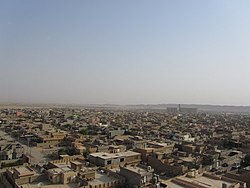
Tuz Khurmatu (Arabic: طوزخورماتو, Turkish: Tuzhurmatu,[1][2] Kurdish: دووز خورماتوو, romanized: Dûz Xurmatû,[3][4] also spelled as Tuz Khurma and Tuz Khormato) is the central city of Tooz District in Saladin Governorate, Iraq, located 55 miles (89 km) south of Kirkuk. Its inhabitants are predominantly Shia Turkmen, with a minority of Arabs and Sunni Kurds.[5][6][7]
Key Information


Etymology
[edit]The name of the city is in the local Iraqi Turkmen dialect, meaning salt and dates.[8][9]
History
[edit]
Naphtha, oil and asphalt was found in the town in the 18th century.[10]
The city was populated by both Kurds and Turkmens in the 19th century, during the era of Ottoman Iraq. Claudius Rich visited the town in 1820 and stated that the town had a population of 50,000. In 1882 Major General Gerard visited the town and stated that the town had a bazaar, 300 houses, 100 regulars and 30 zaptiyehs.[11]
John Gordon Lorimer visited Tuz Khurmatu in 1912, stating that the town consists of about 600 houses and around 3,000 inhabitants, and that some 20 households are Jews, with the rest being Turks who have been settled here from old.[12]
The town was captured by United Kingdom in May 1918 and were met with joy from the locals. The local Hamawand tribe would offer their assistance to secure the area.[13]
In 1925, Tuz Khurmatu’s population was entirely Turkmen, except for some Jewish families (35 out of 405 families).[14]
40% of the population was Kurdish in the 1947 census.[15]
In 1991, Tooz District was separated from Kirkuk Governorate and attached to Saladin Governorate for Arabization purposes. The population of the town was 75,737 the subsequent year, and decreased to 51,998 in 1987.[16] The town participated in the 1991 Iraqi uprising before being suppressed by the Ba'athist Iraqi army.[17]
Operation Iraqi Freedom
[edit]- On June 2, 2005, at least 12 people were killed and at least 40 wounded in an explosion targeting a restaurant.[18]
- On June 23, 2005, a car bomb detonated by remote control hit an Iraqi police patrol, killing one policeman and wounding 7 civilians.[19]
- On September 20, 2005, insurgents detonated a car bomb targeting Shiite worshippers as they were exiting the Hussainiyat al-Rasoul al-Azam mosque, killing at least 10 and wounding 21 others.[20]
- On March 14, 2007, a suicide bomber struck a market and killing 8 and wounding 25.[21]
Operation New Dawn
[edit]- On September 7, 2010, the first US casualties after President Barack Obama declared an end to US combat operations took place near the city when Iraqi insurgents killed 2 US military personnel.[22]
Post-U.S. withdrawal and Iraqi Civil War
[edit]- On October 27, 2012, a car bombing next to a building owned by a Shi'ite endowment killed two civilians and injured ten others.[23]
- On December 17, 2012, two consecutive car bombings hit a residential area near the city's General Hospital, killing 11 civilians and injuring 45 others. The attacks were part of a country-wide wave of violence that killed almost 100 people in a single day.[24]
- On January 16, 2013, a suicide car bombing at the offices of the Kurdistan Democratic Party killed 5 and injured 40 others.[25][26]
- On January 23, 2013, a suicide bomber blew himself up during a funeral for a politician's relative in the city, killing 42 and leaving 75 others wounded.[27][28]
- In November 2015, the town experienced clashes between the Kurdish Peshmerga and Shia Popular Mobilization Forces that claimed 11 lives, wounded over 20 people, and damaged over 200 houses through arson committed by both sides.[29] A truce was reached soon after.[30][31]
- On November 28, 2015, an IS suicide bomber bombed a town checkpoint, killing 6.[32]
See also
[edit]
References
[edit]- ^ "Tuzhurmatu'da Türkmen - Kürt dayanışması nasıl bozuldu?". BBC News. Archived from the original on 18 October 2020. Retrieved 13 October 2020.
- ^ "Tuzhurmatu'ya 15 yıl aradan sonra Türkmen kaymakam atandı". www.aa.com.tr (in Turkish). Archived from the original on 21 December 2019. Retrieved 21 December 2019.
- ^ "Gelê Duz Xurmatû: Em ê destûrê nedin dagirkeriyê". ANF News (in Kurdish). Archived from the original on 23 September 2020. Retrieved 21 December 2019.
- ^ "لیژنەی ناوچە كوردستانییهکانی دەرەوەی ئیدارەی ھەرێم لهگهڵ نوێنەرانی خهڵكی زیانلێکەتووی دووزخورماتوو كۆبووهوه". Parliament of Kurdistan (in Kurdish). Archived from the original on 11 June 2020. Retrieved 21 December 2019.
- ^ [1] Archived 2017-02-18 at the Wayback Machine Arab-Kurd conflict heats up after Tuz Khormato incidents
- ^ [2] Archived 2017-09-17 at the Wayback Machine Tuz Khurmatu: Atrocities against Iraqi Turkmen on the Rise
- ^ "Iraqi Turkmen". Minority Rights Group International. 19 June 2015. Archived from the original on 17 October 2020. Retrieved 17 October 2020.
- ^ "Iraq's Tuz Khurmatu: A town rich in history and conflict | Nermeen Mufti". AW. Archived from the original on 2020-10-08. Retrieved 2020-10-07.
- ^ "'REPORT ON A TOUR IN TURKISH ARABIA AND KURDISTAN APRIL-MAY 1910 BY J. G. LORIMER, ESQ., C.I.E., I.C.S., British Political Resident in Turkish Arabia and His Britannic Majesty's Consul-General at Baghdad.' [8r] (20/68)". Qatar Digital Library. 2015-06-30. Retrieved 2025-10-13.
- ^ Rasoul, Rasoul Muhammed (2017). "History of Kirkuk from the Beginning of the Nineteenth Century until Becoming Part of the Iraqi Monarchy in 1925" (PDF). University of Erfurt: 188. Archived (PDF) from the original on 2020-10-26. Retrieved 2020-11-15.
{{cite journal}}: Cite journal requires|journal=(help) - ^ Rasoul, Rasoul Muhammed (2017). "History of Kirkuk from the Beginning of the Nineteenth Century until Becoming Part of the Iraqi Monarchy in 1925" (PDF). University of Erfurt: 8. Archived (PDF) from the original on 2020-10-26. Retrieved 2020-11-15.
{{cite journal}}: Cite journal requires|journal=(help) - ^ "'REPORT ON A TOUR IN TURKISH ARABIA AND KURDISTAN APRIL-MAY 1910 BY J. G. LORIMER, ESQ., C.I.E., I.C.S., British Political Resident in Turkish Arabia and His Britannic Majesty's Consul-General at Baghdad.' [8r] (20/68)". Qatar Digital Library. 2015-06-30. Retrieved 2025-10-13.
- ^ Rasoul, Rasoul Muhammed (2017). "History of Kirkuk from the Beginning of the Nineteenth Century until Becoming Part of the Iraqi Monarchy in 1925" (PDF). University of Erfurt: 137. Archived (PDF) from the original on 2020-10-26. Retrieved 2020-11-15.
{{cite journal}}: Cite journal requires|journal=(help) - ^ "Question of the Frontier between Turkey and Iraq - League of Nations" (PDF). 20 August 1925. Archived (PDF) from the original on 10 January 2018. Retrieved 14 December 2020.
- ^ C. J. Edmonds (1957). Kurds, Turks and Arabs, Politics, Travel and Research in North-Eastern Iraq, 1919-1925. Oxford University Press. p. 438. Archived from the original on 13 October 2021. Retrieved 17 November 2019.
- ^ Ihsan, Mohammad, Administrative Changes in Kirkuk and Disputed Areas in Iraq 1968-2003, pp. 26–27
- ^ Goldstein, Eric (June 1992). Endless Torment: The 1991 Uprising in Iraq and Its Aftermath. U.S.: Human Rights Watch. p. 58. ISBN 1-56432-069-3. Archived from the original on 2010-06-15. Retrieved 2016-01-12.
- ^ "20 dead in Iraq bombings". The Guardian. 2 June 2005. Archived from the original on 13 October 2021. Retrieved 15 May 2016.
- ^ "Car bombs kill nearly 40 people in Baghdad – International Herald Tribune". Archived from the original on 2007-05-21. Retrieved 2007-03-14.
- ^ "Microsoft PowerPoint – Eye on Iraq Sep 20, 2005 – English" (PDF). Archived (PDF) from the original on March 15, 2007. Retrieved March 14, 2007.
- ^ "Iraqi president returns after treatment - Yahoo! News". Archived from the original on 2007-03-21. Retrieved 2017-01-15.
- ^ "Iraqi soldier fires on US troops, kills 2". Archived from the original on 2010-09-14. Retrieved 2017-01-15.
- ^ "Killing and wounding 12 civilians east of Tikrit (NINA News Agency)". Archived from the original on 2012-10-31. Retrieved 2013-01-24.
- ^ "BREAKING NEWS. 25 people killed and wounded in bombings series in Tuz district. (NINA News Agency)". Archived from the original on 2013-12-15. Retrieved 2013-01-24.
- ^ "Bombers kill more than 35 across Iraq". Trust.org. Reuters. 2013-01-15. Archived from the original on 2013-02-21. Retrieved 2013-01-15.
- ^ Margaret Griffis (2013-01-16). "Iraq Slaughter: 55 Killed, 288 Wounded". Antiwar.com. Archived from the original on 2013-01-21. Retrieved 2013-01-24.
- ^ Marwan Ibrahim (2013-01-23). "Iraq suicide bomb at Shiite mosque kills 42". Archived from the original on 2013-02-16. Retrieved 2013-01-24.
- ^ Margaret Griffis (2013-01-23). "At least 51 Killed, 98 Wounded in Iraq Attacks". Antiwar.com. Archived from the original on 2020-05-04. Retrieved 2013-01-24.
- ^ "Eleven dead as tensions flare in Tuz Khurmatu". Kurdistan24. 2015-11-15. Archived from the original on 2015-11-20. Retrieved 2016-01-11.
- ^ "Absent government, fragile truce holds in Tuz Khurmatu". Iraq Oil Report. 18 November 2015. Archived from the original on 5 May 2016. Retrieved 15 May 2016.
- ^ Joel Wing (20 January 2016). "MUSINGS ON IRAQ". Archived from the original on 10 April 2016. Retrieved 15 May 2016.
- ^ "Suicide bomber kills 6 in flashpoint town". Yahoo! News. 2015-11-28. Archived from the original on 2015-12-24. Retrieved 2016-01-11.
34°52′38″N 44°38′18″E / 34.87722°N 44.63833°E

Tuz Khurmatu
View on GrokipediaGeography and Environment
Location and Topography
Tuz Khurmatu serves as the administrative center of Tooz District in Saladin Governorate, Iraq, positioned at approximately 34°53′N 44°38′E.[3] The town lies roughly 89 kilometers south of Kirkuk and 175 kilometers north of Baghdad, placing it adjacent to the administrative boundary with Iraq's Kurdistan Region.[4][5] This positioning situates Tuz Khurmatu within the disputed territories referenced in Article 140 of the Iraqi Constitution, which mandates normalization processes for regions like parts of Saladin Governorate affected by prior administrative shifts.[6][7] The topography of Tuz Khurmatu consists primarily of flat, low-lying plains typical of the Mesopotamian region, with average elevations around 170 meters above sea level across Saladin Governorate.[8] Minor variations occur due to proximity to undulating terrain in adjacent areas, enhancing its role along historical routes linking northern oil-rich zones, such as those near Kirkuk, to central Iraq.[9]Climate and Natural Resources
Tuz Khurmatu experiences a semi-arid climate typical of central Iraq, marked by hot, dry summers and short, mild winters with sporadic rainfall. Average annual temperatures hover around 27.5°C, with summer highs frequently surpassing 40°C—reaching up to 44°C in August—and winter lows rarely dropping below 5°C. Precipitation is limited, averaging 274 mm annually based on data from 1991 to 2014, concentrated mainly between November and April, which underscores the region's aridity and dependence on seasonal water sources.[10][11][12] Geologically, the area is endowed with evaporitic formations, including salt domes and layers from the Miocene Fatha Formation, which contribute to subsurface salt plugs formed by tectonic pressure on halite beds. These features, reflected in the toponym "Tuz" meaning salt, include rock salt outcrops and associated saline groundwater, influencing local soil chemistry and hydrology. The proximity to the Tigris River provides essential surface water for irrigation, mitigating the effects of low rainfall on the alluvial plains.[13][14] Environmental pressures exacerbate vulnerabilities, including recurrent dust storms during dry seasons that degrade air quality and erode topsoil, alongside chronic water scarcity and rising salinity in rivers and aquifers due to evaporation and upstream damming. These factors heighten risks of drought and land degradation, straining natural resource sustainability in the district.[15]Demographics
Ethnic and Religious Composition
Tuz Khurmatu is characterized by a multi-ethnic population, with Turkmen forming the predominant group according to multiple reports and local claims, estimated at 60-70% in assessments from Turkmen advocacy sources. Arabs and Kurds constitute significant minorities, with proportions varying across estimates—Arabs around 10-25% and Kurds 20-25%—reflecting the absence of a recent uncontested census in the disputed area. Smaller communities, including Christians and other minorities, exist but represent negligible shares based on available demographic surveys.[16][17][2] Religiously, the district is overwhelmingly Muslim, with Shia Islam dominant due to the majority Turkmen affiliation, comprising the bulk of residents per IOM displacement tracking data on returnee households. Sunni Muslims form minorities among Arabs, Kurds, and a subset of Turkmen, accounting for over half of surveyed households in some reintegration contexts as Sunni Arabs. Sectarian divisions within ethnic groups, such as Shia and Sunni Turkmen, further diversify the religious landscape, though Shia predominance holds across broader estimates.[1][18] Disputes over composition persist, with Turkmen asserting an indigenous majority rooted in foundational settlement, Kurds referencing pre-existing numerical strength in adjacent areas, and Arabs highlighting integrated communities; these claims underscore source variability, as official Iraqi statistics for Kirkuk province remain contested and outdated. Empirical data from NGOs like IOM prioritize surveyed displacement profiles, which may skew toward vulnerable Sunni groups, while think tank analyses describe balanced tri-ethnic mixes without quantified dominance.[2][1]Population Dynamics and Displacement
The population dynamics of Tuz Khurmatu have been characterized by sharp fluctuations driven by ethnic clashes and security deteriorations, particularly since the 2014-2017 crisis period. In October 2017, amid the Iraqi-Kurdish conflict over disputed territories, nearly 35,000 civilians—predominantly Kurds—fled the district following indiscriminate shelling, arson, and looting that destroyed hundreds of homes and businesses.[19] This exodus contributed to a broader displacement wave from mixed areas, exacerbating prior movements triggered by ISIS incursions and local skirmishes, though ISIS failed to fully occupy Tuz Khurmatu itself.[1] Returns began post-2018 following the Iraqi federal forces' consolidation of control, but progress has been uneven due to ongoing security risks and property disputes. By late 2023, the return rate for those originally displaced from the district reached 65%, implying that over 33,000 individuals—approximately 35% of the total displaced cohort—remain outside Tuz Khurmatu, often in camps or urban host communities in the Kurdistan Region or elsewhere in Iraq.[1] These partial returns have not fully reversed demographic shifts, with the Kurdish proportion reportedly declining to around 30% amid sustained out-migration.[20] As of December 2023, Tuz Khurmatu hosts 17,646 internally displaced persons (IDPs), the highest IDP concentration in Salah al-Din Governorate, reflecting its role as both a source and destination for displacement.[1] The district also accommodates a significant returnee population, ranking fifth in the governorate for reintegration efforts, though challenges like damaged infrastructure and militia presence hinder full stabilization.[1] Preparations for Iraq's 2024 national census have heightened anxieties over population fluxes, with Kurdish and Turkmen communities voicing fears of undercounting minorities due to absentee IDPs and unresolved returns, potentially skewing data in this disputed area.[21][20] Such concerns stem from historical manipulations in prior censuses and the lack of agreed mechanisms for verifying displaced populations, complicating efforts to reflect true residency patterns.[21]Etymology and Historical Naming
Origins of the Name
The name Tuz Khurmatu originates from the Iraqi Turkmen dialect, with "Tuz" deriving from the Turkish word for "salt," a reference to the abundant salt deposits, domes, and historical mining activities in the surrounding region.[22][23] "Khurmatu" is interpreted as relating to "khurma," meaning dates in Turkmen and related Turkic-Persian linguistic influences, likely alluding to local date palm cultivation or trade in the area's fertile plains, though some sources extend it to include berries as a secondary connotation.[16][24] An alternative philological reading in Arabic renders the name as "salt pits" (ṭawz khurmatū), emphasizing the geological salt features rather than agricultural elements, though this lacks the dual specificity of the Turkmen etymology.[25] The term's Turkic roots align with the demographic presence of Turkmen communities in the district since at least the Ottoman period, when such place names reflected resource-based nomenclature in administrative divisions.[26] Early attestations appear in Ottoman records from the 19th century, often under phonetic variants such as Tūz Khūrmātū or Tooz, preserving the core elements amid scribal transliterations from Turkic to Arabic script.[26] These variations underscore the name's stability as a descriptor of local natural resources, without evidence of pre-Ottoman mythological or non-linguistic derivations in verifiable historical linguistics.Linguistic and Cultural Interpretations
The name Tuz Khurmatu is interpreted within Iraqi Turkmen linguistic traditions as deriving from dialectal terms denoting natural resources central to the region's economy: tuz signifying "salt," khurma meaning "dates," and in some accounts, an additional element for "berries" or local fruits, collectively evoking the area's saline deposits and fertile orchards. This breakdown aligns with Ottoman-era administrative records and local Turkmen historiography, which portray the name as a functional descriptor of environmental features that sustained early settlements through extraction and agriculture.[22][16][27] Turkmen cultural narratives emphasize the name's indigenous character to affirm long-standing ties to the land, with claims of foundational settlement dating to approximately 800 years ago by Turkmen groups engaged in salt harvesting and date trading along trade routes linking central Iraq to Anatolia. This interpretation serves to highlight a heritage of resource-based self-sufficiency, where salt's preservative qualities underpinned local exchange networks predating modern industrialization, though archaeological evidence for such trade specifics remains sparse and tied to broader Mesopotamian patterns rather than site-exclusive folklore. Kurdish perspectives, by contrast, tend to contextualize the locale within pre-Turkmen continuity of ancient Near Eastern habitations, viewing the name's adoption as a later overlay on enduring settlement layers without proposing alternative etymological deconstructions, thereby prioritizing geographic-historical claims over linguistic dissection.[22][16] The name's multicultural resonance influences contemporary identity assertions, as Turkmen advocates invoke its Turkic roots to counter external narratives of transience, while post-20th-century Arab administrative integrations have retained the form with minimal alteration, reflecting pragmatic continuity amid demographic shifts. This linguistic persistence underscores debates over cultural primacy, where interpretive emphasis on salt-derived prosperity symbolizes resilience in arid-zone adaptations, distinct from unsubstantiated mythic elements.[27][22]History
Pre-Modern Foundations
Tuz Khurmatu developed as a settlement in the medieval period, drawn by its prominent saline springs and naphtha deposits, which facilitated early resource extraction and trade along regional routes between Kirkuk and Kifri.[28] Ottoman-era records from the 19th century describe it as a modest village known for these natural features, with salt production central to local economy and nomenclature—"tuz" denoting salt in Turkish—reflecting Turkmen linguistic influence amid the area's geological attractions.[29] Turkmen oral traditions maintain that their forebears established the town around 800 years ago, positioning it as a hub for salt-related commerce in a landscape of mixed ethnic cohabitation, including Kurds who shared the territory through medieval migrations and pastoral activities.[22] Historical accounts confirm pre-Ottoman roots in resource-based settlement patterns, though archaeological documentation remains sparse, prioritizing textual references to trade networks over unsubstantiated claims.[30] Under Ottoman administration from the 16th century onward, Tuz Khurmatu operated as a nahiye subdistrict within the Kirkuk sanjak, governed at a local level with oversight from larger centers, and populated primarily by Turkmen and Kurdish communities engaged in agriculture and minor resource trades.[31] Turkmen influx during this era reinforced non-Arab majorities, with the area playing a peripheral role in imperial conflicts, focused instead on internal stability and connectivity to naphtha springs that drew occasional European expeditions by the early 1800s.[32][28] This ethnic balance persisted into the late 19th century, distinct from subsequent demographic shifts.[30]Baathist Era and Arabization Policies
During the Ba'athist regime under Saddam Hussein, Tuz Khurmatu was subjected to administrative reconfiguration as part of broader Arabization efforts aimed at altering the ethnic composition of oil-rich northern Iraq. On January 19, 1976, Republican Decree 41 detached Tuz Khurmatu district from Kirkuk governorate and reassigned it to Salah ad-Din province, a move designed to dilute Kurdish territorial claims by separating predominantly Turkmen areas from the disputed Kirkuk region and placing administration under Arab-dominated central control from Tikrit.[2][33] This separation facilitated targeted demographic engineering, including the forced relocation of Kurds and Turkmen from mixed areas like Tuz Khurmatu, where non-Arabs faced eviction, property confiscation, and denial of residency rights through mechanisms such as "nationality correction" programs that reclassified ethnic identities to favor Arabs.[33] Arabization policies intensified in the late 1970s and 1980s, involving incentives for Arab settlers from central and southern Iraq, such as free irrigated land, subsidized housing, and cash payments of up to 10,000 Iraqi dinars per family to relocate to northern districts including Tuz Khurmatu and Kirkuk.[33] These measures, coupled with the invalidation of non-Arab property deeds and the nationalization of farmland for redistribution to Arab lessees, aimed to create an Arab plurality in previously diverse areas; in Kirkuk province, which encompassed Tuz prior to 1976, such policies displaced tens of thousands of Kurds and Turkmen, replacing them with Arab families and shifting local demographics toward Arab majorities in urban and rural pockets.[33] Tuz Khurmatu, with its significant Turkmen population, experienced similar pressures, including restrictions on non-Arab business ownership and services, though enforcement varied due to the area's mixed Shia Turkmen-Arab-Kurd composition and resistance from local communities who maintained cultural and economic footholds despite relocations.[33] The Anfal campaign of 1988 further entrenched these efforts, with Tuz Khurmatu serving as a staging base for the Third Anfal offensive launched on April 7, targeting nearby Kurdish populations in the Germian region; Iraqi forces, including army units and pro-government Kurdish militias (jahsh), operated from Tuz to conduct village razings, chemical attacks, and mass displacements that spilled over into surrounding mixed areas.[34] While Anfal primarily exterminated rural Kurdish resistors—killing approximately 100,000 and destroying thousands of villages—it complemented Arabization by clearing land for Arab settlement and preventing non-Arab returns, with indirect effects on Tuz Khurmatu's locals through proximity to operations and heightened repression of suspected peshmerga sympathizers among Kurds and Turkmen.[33] Despite these coercive tactics, empirical outcomes in Tuz Khurmatu showed incomplete demographic dominance, as Turkmen and Kurdish resistance—through evasion, underground networks, and communal solidarity—limited the shift to full Arab plurality, preserving a contested ethnic balance amid ongoing Ba'athist controls.[33]1991 Uprisings and Early Conflicts
The 1991 Iraqi uprisings erupted in March following Iraq's defeat in the Gulf War, with Kurdish-led rebels, including Peshmerga forces, seizing control of several northern cities, including the strategically located Tuz Khurmatu on the Baghdad-Kirkuk road.[35] Tuz Khurmatu, a predominantly Turkmen town with mixed Arab and Kurdish populations, fell to the rebels between March 10 and 12, coordinated by Peshmerga fighters who recognized its importance for controlling key supply routes.[35] Iraqi government forces launched a counteroffensive from three directions, employing artillery, helicopter gunships, and missiles (including 105mm, 130mm, and 155mm calibers), overwhelming the Peshmerga defenders armed with mortars, RPGs, and captured tanks.[35] The Peshmerga mounted a fierce two-week defense, but Iraqi aircraft deployed napalm and phosphorus munitions, causing significant civilian casualties during the bombardment, which damaged approximately one-quarter of the town's houses.[35] By mid-March, the town was retaken by Iraqi forces, marking a government victory in this phase of the northern uprising.[35] Reprisals followed the recapture, with Iraqi troops demolishing homes in neighborhoods like Jumhouriyya and conducting arrests of residents suspected of rebel sympathies.[35] On April 1, Iraqi soldiers opened fire with automatic rifles on civilians in Tuz Khurmatu, killing scores in a targeted suppression of lingering unrest. Amid the fighting, approximately 85-90% of the population fled to nearby mountains around March 17, with some children drowning while crossing a river during the exodus; around 500 elderly individuals were later expelled by authorities.[35] The failure of the uprising in Tuz Khurmatu contributed to the broader collapse of the Kurdish revolt, triggering massive displacements across northern Iraq and prompting international intervention, including the establishment of safe havens and no-fly zones in April 1991 that facilitated eventual Kurdish autonomy in adjacent areas, though Tuz Khurmatu remained under central government control.[35]Post-2003 Invasion and U.S.-Led Operations
Following the U.S.-led invasion in March 2003, Tuz Khurmatu was secured by Kurdish Peshmerga forces in coordination with American special operations troops during April 2003 advances in northern Iraq, reversing Ba'athist control without major ground combat in the town itself.[16] This joint effort placed Peshmerga units as the primary local security presence under Coalition Provisional Authority (CPA) oversight, enabling Kurdish administrative influence in the disputed district amid the broader Operation Iraqi Freedom. U.S. forces established Forward Operating Base Bernstein and repurposed Tuz Khurmatu Air Base as key installations, hosting several hundred soldiers from the 25th Infantry Division's brigades between 2004 and 2010 for patrols, reconnaissance, and counterinsurgency operations.[37] [38] These units, including elements of the 2nd Battalion, 35th Infantry Regiment and 3rd Brigade, conducted raids detaining insurgents and seizing weapons caches in the surrounding Salah al-Din and Kirkuk border areas, targeting al-Qaeda in Iraq networks exploiting ethnic divisions.[39] [40] By 2008-2010, under Operation New Dawn, U.S. advisory roles supported transitioning Iraqi security forces while addressing improvised explosive device (IED) threats and indirect fire attacks on bases, though casualties included U.S. personnel from non-combat incidents like vehicle accidents.[41] The CPA's interim governance from 2003 to 2004 intensified multi-ethnic frictions, as Peshmerga expansions—viewed by Arabs and Turkmen as demographic overreach—clashed with local resistance to perceived Kurdish favoritism in appointments and resource allocation.[42] Arab tribes and Turkmen groups formed early self-defense militias in response to the power vacuum, precursors to later Popular Mobilization Forces, amid sporadic clashes over checkpoints and land disputes that U.S. mediators attempted to contain through tribal engagements.[43] These tensions, rooted in competing claims to the oil-rich district, persisted into the U.S. drawdown phase, with coalition transitions to Iraqi control by 2011 leaving unresolved territorial ambiguities.[44]ISIS Occupation and Liberation
In mid-2014, as the Islamic State (ISIS) rapidly expanded following the collapse of Iraqi Security Forces in northern Iraq, the group exploited longstanding ethnic divisions in Tuz Khurmatu—a town with a mixed population of Turkmen, Kurds, Arabs, and Shia Muslims—to launch incursions and attacks from surrounding territories under its control, such as Tikrit and areas in Salah ad-Din Governorate.[30][45] Although ISIS did not establish full territorial occupation over Tuz Khurmatu itself, its fighters conducted raids, massacres, and targeted killings, particularly against Shia Turkmen communities, killing dozens in sectarian attacks that aimed to terrorize and displace non-Sunni populations.[46] For instance, on March 23, 2016, ISIS militants massacred 40 Shia residents from Tuz Khurmatu and nearby villages, reflecting the group's broader strategy of executions and forced conversions to Sunni Islam in contested areas.[46][47] Kurdish Peshmerga forces responded to the ISIS advance by extending operations into disputed territories south of Kirkuk, including Tuz Khurmatu, filling the security vacuum left by retreating Iraqi troops and preventing deeper ISIS penetration; this move secured the town as a frontline base against the group's offensives from 2014 onward.[44] Popular Mobilization Forces (PMF), including Shia militia units, also joined anti-ISIS efforts in the region, conducting joint operations with Peshmerga and Iraqi federal forces to repel attacks and clear ISIS cells from villages around Tuz Khurmatu, though coordination was strained by competing ethnic loyalties.[48] Battles intensified in 2016–2017, with ISIS launching multiple assaults on Peshmerga positions, resulting in heavy casualties; for example, Iraqi and Kurdish forces repelled ISIS incursions in June 2017, killing scores of militants amid ongoing skirmishes that displaced thousands of civilians.[49] By early 2018, Iraqi security forces declared the ISIS threat to Tuz Khurmatu effectively neutralized through sustained operations, though sleeper cells persisted in conducting sporadic attacks.[50] Post-ISIS, Iranian-backed PMF factions, such as those under the Northern Axis led by figures loyal to Tehran, entrenched their presence in the town, displacing some Peshmerga influence and reshaping local power dynamics in favor of Shia militias amid the vacuum left by defeated ISIS forces.[51][52] This shift exacerbated intercommunal tensions, as PMF units asserted control over key areas previously contested with Kurdish forces, prioritizing militia patronage networks over unified national security.[53]Post-ISIS Clashes and Power Shifts
Following the territorial gains against ISIS in 2017, Tuz Khurmatu experienced intensified clashes as Iraqi federal forces sought to reassert control over disputed areas held by Kurdish Peshmerga units after the Kurdistan Region's independence referendum on September 25, 2017. Heavy fighting erupted in the town on October 16, 2017, pitting Iraqi army units alongside Popular Mobilization Forces (PMF) against Peshmerga fighters, resulting in the rapid withdrawal of Kurdish forces and the establishment of Iraqi dominance by October 20.[19] [54] These confrontations caused at least 10 civilian deaths from indiscriminate artillery and gunfire, with both sides exchanging blame for initiating hostilities.[54] The clashes triggered mass displacement, with estimates of 20,000 to 40,000 Kurds fleeing the town amid reports of arson, looting, and targeted destruction of Kurdish properties by advancing Iraqi forces and affiliated PMF militias. Amnesty International documented over 200 homes and businesses burned or looted in Kurdish neighborhoods, based on satellite imagery and witness accounts, while Human Rights Watch corroborated civilian casualties from crossfire in the multi-ethnic district.[19] [54] This shift marked a reversal of Peshmerga control established during the anti-ISIS campaign, consolidating federal authority but exacerbating ethnic tensions in a district long contested by Kurds, Turkmen, and Arabs. Post-clash power dynamics favored PMF units, particularly Shia Turkmen and Arab factions within the Northern Axis, which assumed de facto security roles under nominal Iraqi oversight. These groups, including those led by figures aligned with Iranian-backed networks such as Asa'ib Ahl al-Haq affiliates, extended influence through checkpoints and patrols, drawing criticisms for prioritizing sectarian interests over unified state control.[51] [52] Analysts noted Iranian ties via arms supplies and command structures, enabling these militias to marginalize remaining Peshmerga presence and enforce compliance among local populations.[30] To mitigate ongoing risks of intercommunal violence, Iraqi authorities reinforced concrete blast walls and barriers segregating Kurdish, Turkmen, and Arab neighborhoods, a measure that intensified physical divisions in the town's layout by late 2017. These fortifications, extending several kilometers, aimed to contain flare-ups but effectively entrenched ethnic enclaves, limiting mobility and fostering a siege-like environment in vulnerable areas.[4]Developments from 2018 to Present
In the years following intensified post-ISIS clashes, Tuz Khurmatu experienced limited stabilization through security measures, including fortified walls dividing ethnic enclaves to curb violence, though intercommunal tensions persisted amid demographic shifts favoring Arab and Shia-majority control via Popular Mobilization Forces (PMF) presence. Iraqi President Abdul Latif Jamal Rashid stated in April 2024 that the district's disputes required resolution in accordance with the Iraqi constitution, highlighting the need for legal mechanisms to address territorial and administrative ambiguities. Negotiations for forming a unified district administration advanced, with local leaders reporting an imminent agreement in March 2024 emphasizing coexistence over ethnic divisions, potentially integrating representatives from Kurdish, Arab, and Turkmen communities.[55][56] Security challenges from ISIS remnants endured, exemplified by an August 2024 ambush on a PMF checkpoint that killed one fighter, underscoring vulnerabilities in rural and border areas. Iraqi joint forces countered with operations killing seven ISIS militants in the district in June 2024, as part of broader efforts to dismantle sleeper cells exploiting post-conflict vacuums. A landmine explosion in September 2024, attributed to ISIS ordnance, injured a Peshmerga soldier, illustrating lingering explosive threats.[57][58][59] The November 2024 national census amplified Kurdish apprehensions over undercounting due to ongoing displacement, with authorities urging thousands of exiled families to return temporarily for enumeration to reflect pre-conflict demographics. An International Organization for Migration assessment in December 2024 identified limited return prospects for displaced Kurds in urban areas, citing security risks and property disputes as barriers, while noting partial infrastructure improvements like better water and electricity access. The Iraqi presidency condemned a November 2024 terrorist attack in the district, reaffirming commitments to eradicate such threats and bolster national stability.[20][6][60] In September 2024, the Kurdistan Democratic Party announced intentions to reestablish presence in Tuz Khurmatu after a seven-year absence, signaling potential shifts in local power dynamics.[61]Economy
Oil and Gas Exploitation
Tuz Khurmatu lies in close proximity to the Kirkuk oil fields, which constitute the primary hub for northern Iraq's hydrocarbon extraction, with production historically exceeding 1 million barrels per day before territorial disputes reduced output. The town's strategic location has positioned it near pipelines linking Kirkuk to export routes, including those extending toward Turkey, though maintenance and security challenges persist due to its placement in contested border areas between federal Iraqi forces and the Kurdistan Regional Government (KRG). Control over these assets remains divided, with Popular Mobilization Forces (PMF) holding southern sections of Tuz Khurmatu and KRG Peshmerga influencing northern approaches, leading to frequent standoffs that delay infrastructure upgrades and exploration.[62] In October 2025, Iraq's North Oil Company activated a technical service contract with BP to enhance recovery from four Kirkuk fields—Baba, Avana, Khurmala, and Jambas—aiming to boost extraction rates through advanced drilling and gas reinjection, but implementation faces hurdles from unresolved revenue-sharing disputes with the KRG. Local exploitation in Tuz Khurmatu itself is minimal, lacking major dedicated fields, yet spillover effects from Kirkuk operations provide potential indirect benefits; however, claims of corruption in federal and regional oil revenue distribution have resulted in scant economic trickle-down for residents, with funds largely centralized in Baghdad amid allegations of mismanagement. PMF-KRG frictions, exemplified by 2017 federal seizures of Tuz Khurmatu during the Kirkuk reclamation, exacerbate these issues, prioritizing militia influence over transparent development.[63][64][65] Regional security threats further impede reliable exploitation, as evidenced by drone strikes on nearby energy infrastructure; for instance, a February 2025 attack on the Khor Mor gas field in Sulaymaniyah province disrupted associated gas supplies that support Kirkuk-area processing, while July 2025 assaults on fields like Sarsang halted up to 200,000 barrels per day of Kurdistan production, signaling broader vulnerabilities for pipelines traversing disputed zones near Tuz Khurmatu. These incidents, linked to Iran-aligned militias defying federal directives, underscore how external sabotage exploits local power vacuums, deterring investment and limiting gas flaring capture or new drilling in the Tuz vicinity. Despite federal oil ministry announcements of progress in Kirkuk contracts, persistent intercommunal tensions and militia autonomy hinder equitable revenue allocation and infrastructure resilience.[66][67][68]Agriculture and Local Industries
Agriculture in Tuz Khurmatu district primarily consists of rain-fed and irrigated cultivation of wheat and barley, the dominant cereal crops, with production varying spatially due to soil quality and water availability.[69] Yields are constrained by the region's semi-arid climate, necessitating irrigation from local sources such as the Tigris River tributaries, though inconsistent water supply limits output.[70] Saline soils, prevalent in the Kirkuk Plain encompassing Tuz Khurmatu, exacerbate agricultural challenges through partial salinization, particularly in historically irrigated areas where leaching has been inadequate, reducing crop productivity and requiring salt-tolerant varieties for viable farming.[70] Soil salinity stems from natural salt domes underlying the area—reflected in the town's name, derived from "tuz" meaning salt—and compounded by evaporation in poorly drained fields, leading to accumulation that inhibits root growth and nutrient uptake in wheat and barley.[70] Local industries remain limited to small-scale salt extraction from surface deposits and domes, alongside rudimentary processing and trade in agricultural goods, though operations are frequently interrupted by infrastructural damage from recurrent clashes.[71] Unemployment rates in the district hover around 30-40%, driven by conflict-induced disruptions to farming and extraction activities, fostering dependence on family remittances from urban centers or abroad and humanitarian aid for internally displaced persons (IDPs), who constitute a significant portion of the population reliant on external support.[6][72]Government and Administration
Disputed Territorial Status
Article 140 of Iraq's 2005 Constitution mandates a process of normalization to reverse Ba'athist-era demographic changes, followed by a census and referendum, to determine the administrative affiliation of disputed territories, with implementation required by 31 December 2007. Tuz Khurmatu, the only district in Salah ad-Din Governorate designated for this procedure due to its history of Arabization and mixed Kurdish, Turkmen, and Arab populations, remains unresolved, perpetuating legal ambiguity over its status.[73][2][42] The federal government in Baghdad upholds Tuz Khurmatu's integration within Salah ad-Din Governorate, consolidating control after Iraqi forces, supported by Popular Mobilization Units, retook the district from Kurdistan Regional Government (KRG) Peshmerga on 16 October 2017, in response to the KRG's 25 September independence referendum that included disputed areas. The KRG, however, asserts historical rights predating Arabization, claiming the area as part of the Kurdistan Region based on Kurdish-majority demographics in earlier periods and viewing federal reclamation as a reversal of post-2003 administrative expansions.[42][73] The United Nations Assistance Mission for Iraq (UNAMI) has repeatedly urged Baghdad and Erbil to pursue dialogue for resolving disputed internal boundaries like Tuz Khurmatu through constitutional mechanisms, as outlined in reports profiling persistent competing claims and stalled Article 140 processes, though lacking enforcement authority to compel action.[42]Local Governance Structures
Tuz Khurmatu district operates under the administrative framework of Salah al-Din Governorate, with local governance centered on a district council intended to reflect the area's multi-ethnic composition of Arabs, Kurds, and Turkmen. The council typically includes seats allocated across these groups, such as configurations with seven members each from the three communities or smaller bodies with proportional representation, though actual implementation often favors Shia-majority factions due to on-ground power dynamics.[74][75] In May 2024, the Salah al-Din Provincial Council formalized the distribution of district administrative positions, granting the largest share to Shia Arabs, followed by Turkmen, with Kurds receiving a limited allocation consistent with their single seat in the 15-member provincial council—approximately 7% representation. This skewed apportionment stems from the dominant influence of Popular Mobilization Forces (PMF) units, particularly Shia Turkmen brigades like those in the Northern Axis, which control key areas and integrate militia loyalists into bureaucratic roles, overriding ethnic quotas.[76][77][51] Operational challenges persist, including widespread corruption in resource allocation and service delivery, exacerbated by PMF interference that prioritizes militia-affiliated networks over formal institutions. Local PMF commanders, tied to national Shia political entities, frequently dictate appointments and budgets, leading to inefficiencies and favoritism that undermine council efficacy. In a notable development, a Kurdish engineer, Hiwa Ghalib Majid, was appointed acting mayor in April 2025 by the Salah al-Din governor, signaling potential adjustments amid ongoing negotiations but not altering the broader militia dominance.[78][79][77]Ethnic Conflicts and Security Issues
Intercommunal Grievances and Claims
The Turkmen community in Tuz Khurmatu maintains that their ancestors established and built the town approximately 800 years ago, asserting indigenous roots predating significant Arab or Kurdish presence.[22] They further claim that post-2003 Kurdish political and military influence, particularly through the Patriotic Union of Kurdistan (PUK), imposed domination, including unresolved land expropriations where Turkmen filed over 4,900 compensation claims by 2014-2015 without restitution.[80] Kurdish representatives counter that Tuz Khurmatu was historically a Kurdish-majority area before mid-20th-century Ba'athist policies systematically reversed this through forced displacements and resettlement of Arabs, altering the ethnic composition via state-orchestrated demographic engineering rather than organic migration.[30] Following the 2017 Iraqi forces' retaking of disputed areas, Kurds have characterized subsequent expulsions and restrictions on their return as deliberate ethnic cleansing by Popular Mobilization Forces (PMF) units dominated by Shi'a Turkmen and Arabs, aimed at consolidating non-Kurdish control.[81] Arab residents, largely settled during the Ba'ath era as part of broader integration and development initiatives in northern Iraq, assert their presence reflects legitimate economic and administrative ties to the land, now threatened by exclusionary demands from Kurdish and Turkmen groups seeking to reverse prior state policies through retroactive ethnic homogenization.[73] These competing narratives lack empirical consensus, with historical demographic data obscured by regime-driven manipulations—such as Ba'athist Arabization and post-2003 partisan reallocations—rather than verifiable natural population movements, complicating neutral adjudication.[1] Sources advancing Kurdish claims often originate from regional advocacy outlets with incentives to highlight past victimization, while Turkmen assertions appear in community-focused reports potentially overlooking pre-2003 intergroup tensions.[30]Major Clashes and Violence
In January 2016, clashes escalated between Kurdish Peshmerga forces and Shiite militias in Tuz Khurmatu after initial exchanges of fire, with Peshmerga shelling militia-held areas using heavy weapons that killed and injured civilians. Peshmerga operations also involved mass arrests of Arabs suspected of Islamic State ties, including documented cases of torture and extrajudicial killings that displaced Arab families.[48] In April 2016, renewed fighting broke out between Peshmerga and Shiite forces, including Popular Mobilization Forces (PMF) affiliates, resulting in multiple fatalities among combatants and civilians despite subsequent agreements to withdraw forces and enforce a ceasefire. Both sides accused the other of initiating mortar and rocket attacks on residential zones.[82][83] October 2017 saw the most severe violence when Iraqi federal forces, backed by PMF units comprising Arab and Turkmen militias, clashed with retreating Peshmerga following the recapture of disputed areas after the Kurdish independence referendum. Indiscriminate shelling and gunfire from PMF positions killed at least 11 civilians, while Peshmerga counterfire contributed to the chaos; tens of thousands of residents, predominantly Kurds, fled amid widespread looting, arson, and targeted destruction of over 200 Kurdish homes and businesses by PMF elements. Iraqi forces subsequently permitted unchecked civilian looting of abandoned properties for a day before intervening.[19][54]Physical Barriers and Segregation
In Tuz Khurmatu, concrete barriers and walls, erected primarily between 2014 and 2016, delineate ethnic enclaves inhabited by Kurds, Shiite Turkmen, and Arabs, fragmenting the urban landscape into segregated zones.[4][9] These structures, initially installed to shield neighborhoods from ISIS incursions and vehicle-borne improvised explosive devices during the group's territorial advances, evolved into permanent dividers amid recurring intercommunal clashes.[9] By 2018, the barriers spanned multiple districts, with iron fences and gates further isolating Turkmen-majority areas from Kurdish ones, restricting resident mobility to designated checkpoints manned by local militias.[84][9] The proliferation of these fortifications has transformed Tuz Khurmatu into what observers describe as a "city of walls," confining populations to ethnically homogeneous "ghettos" and exacerbating isolation.[9] Residents report severe limitations on daily activities, such as accessing markets or medical services across lines, with walls blocking streets and creating parallel service infrastructures like separate schools and clinics in divided sectors.[4][85] While these measures have demonstrably curtailed large-scale bombings—reducing explosive incidents in walled areas compared to pre-2014 levels—they perpetuate de facto segregation, hindering economic integration and social cohesion by institutionalizing mistrust.[9] Critics argue that the barriers, though born of necessity against ISIS threats, now entrench divisions without addressing underlying grievances, fostering a cycle of dependency on militia-controlled access points.[4] Efforts to dismantle select barriers, such as those in Turkmen neighborhoods proposed in 2017 demilitarization talks, have stalled amid security concerns, leaving the city partitioned as of 2024 reports.[2] This physical segregation underscores the long-term security trade-offs in multi-ethnic disputed territories, where fortifications mitigate immediate violence but impede normalization.[9]Ongoing Security Challenges
Despite the physical segregation measures implemented in Tuz Khurmatu, ISIS remnants continue to pose a significant threat through sporadic attacks on security forces. On August 10, 2024, ISIS militants targeted a Popular Mobilization Forces (PMF) checkpoint in the district, resulting in the death of one PMF member.[57] In June 2024, Iraqi forces conducted operations eliminating seven ISIS militants in the area, highlighting ongoing counterterrorism efforts amid persistent hideouts.[58] Additionally, a landmine explosion on November 17, 2024, near the village of Palkana killed three members of a joint Peshmerga-Iraqi army patrol, underscoring the risk of improvised explosive devices in rural peripheries.[86] These incidents reflect a broader uptick in ISIS activity across Iraq, with the group claiming 153 attacks in Iraq and Syria from January to June 2024 alone.[87] Militia rivalries and overlapping security presences further complicate stabilization, as competing PMF factions and joint forces navigate ethnic enclaves. The district's militia-saturated environment, including PMF units aligned with various Shia political entities, fosters intra-PMF tensions that occasionally spill into localized clashes, deterring coordinated anti-ISIS operations.[88] Such dynamics exacerbate vulnerabilities in disputed border zones, where Kurdish Peshmerga and federal forces maintain parallel patrols, limiting unified control. Efforts at repopulation since 2023 have faced persistent tensions, hindering full returns despite some progress. As of December 2023, Tuz Khurmatu hosted over 17,000 internally displaced persons (IDPs) alongside a significant returnee population, yet revenge acts and clashes have impeded broader reintegration in certain sub-districts.[1] While a decrease in violence contributed to modest improvements by mid-2024, underlying ethnic grievances and security vacuums continue to restrict sustainable returns, particularly for minority groups in contested villages.[89] Drug trafficking routes traversing the district amplify instability, serving as a revenue stream for criminal networks and insurgents. Reports indicate clandestine methamphetamine production facilities operating in Tuz Khurmatu and nearby Kirkuk, with Iraq positioned at the nexus of regional methamphetamine and captagon flows as per UNODC analysis of 2019–2023 trends.[90][91] These activities exploit conflict-altered smuggling paths, funding non-state actors and eroding local governance amid weak interdiction.[92]References
- https://www.amnesty.org/en/documents/mde14/005/[1991](/page/1991)/en/