


Community hub
Recent from talks
Contribute something
Nothing was collected or created yet.
Tatra 97
View on Wikipedia| Tatra 97 | |
|---|---|
 1938 Tatra 97 at Petworth railway station, West Sussex, November 2022 | |
| Overview | |
| Manufacturer | Tatra |
| Production |
|
| Designer | Hans Ledwinka, Erich Ledwinka, Erich Übelacker |
| Body and chassis | |
| Class | Compact to mid-size car |
| Body style | Fastback sedan |
| Layout | RR layout |
| Powertrain | |
| Engine | 1.8L Tatra 97 F4 |
| Transmission | 4-speed manual[1] |
| Dimensions | |
| Wheelbase | 2,600 mm (102.4 in)[1] |
| Length | 4,270 mm (168.1 in)[1] |
| Width | 1,610 mm (63.4 in)[1] |
| Height | 1,450 mm (57.1 in)[1] |
| Curb weight | 1,150 kg (2,540 lb)[1] |
| Chronology | |
| Predecessor | Tatra 75 |
| Successor | Tatra 600 |
The Tatra 97 (T97) is a Czechoslovak mid-size car built by Tatra in Kopřivnice, Moravia, from 1936 to 1939.
History
[edit]The Tatra 97 was designed to complement two full-size cars in the Tatra range: the Tatra 77 launched in 1934[2] and the Tatra 87 launched in 1936[3] along with the Type 97. Each of the three models has an air-cooled rear engine and share similar aerodynamic fastback four-door sedan bodies. But whereas types 77 and 87 each have a large V8 engine, Type 97 has a flat-four engine. The Type 97 is distinguished by having two headlights and a one-piece windscreen, whereas the 77 and 87 have three headlights and a three-piece windscreen. The Type 97's flat-four engine displaces 1,759 cc and produces 40 horsepower (30 kW),[4] giving it top speed of 130 km/h (81 mph).[1]
Tatra already had a mid-size car in the same class, the more conventional 1,688 cc Tatra 75 that it had launched in 1933. Tatra continued to produce the Type 75 alongside the futuristic Type 97. In fact production of the Type 75 outlived that of the Type 97 and continued until 1942.
Kopřivnice is in a part of northern Moravia that Nazi Germany annexed after the Munich Agreement in September 1938. Production of the Type 97 was terminated in 1939, possibly to avoid comparison with the KdF-Wagen (see below). Production of the Type 97 was 508 cars in total. In 1946 Tatra resumed car production, and replaced the Type 97 with the larger and more modern Tatra 600 "Tatraplan".
Resemblance to Volkswagen KdF-Wagen
[edit]According to some authors, in both streamlined design and technical specifications, especially the engine design and position, the Type 97 has a striking resemblance to Volkswagen's KdF-Wagen.[5] However Tatra 97 itself does not appear original, as it has resemblance to sketches[6] by Hungarian engineer Bela Barenyi, conceived in the 1920s and published in 1934. In any case Adolf Hitler is reported to have encountered and said of Tatra's cars; "This is the car for my roads".[7][8] Ferdinand Porsche was accused of using Tatra designs to design the Volkswagen quickly and cheaply.[9] In Porsche's words; "Well, sometimes Ledwinka looked over my shoulder and sometimes I looked over his". [10]
Tatra sued Porsche for damages, and Porsche was willing to settle. But Hitler cancelled this, saying he "would settle the matter".[1] Soon after Germany occupied the Sudetenland, Tatra stopped production of the Type 97 and the lawsuit was discontinued. After the Second World War Tatra resumed its lawsuit. In 1965 Volkswagen settled it by paying Tatra DM 1,000,000 in compensation.[11]
Gallery (selected)
[edit]-
 Company badge
 -
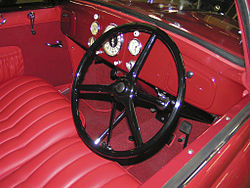 Tatra 97 interior
 -
 Tatra 97 rear quarter view
 -
 Air-cooled, rear-mounted flat-four engine
 -
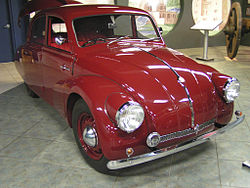 Tatra 97 front
 -
 Type 97 in the Tatra museum at Kopřivnice
.jpg)


References
[edit].JPG)
Streamlined Tatras
- Tatra V570 1931, 1933
- Tatra 77 1933–38
- Tatra 87 1936–50
- Tatra 97 1936–39
- Tatra 600 Tatraplan 1946–52
- Tatra 603 1956–75
- ^ a b c d e f g h i "Cars & History: Tatra 97 (1936–1939)". International Streamlined Tatra Site. Archived from the original on 24 March 2008. Retrieved 12 March 2008.
- ^ Tuček 2017, p. 289.
- ^ Tuček 2017, p. 292.
- ^ Tuček 2017, p. 294.
- ^ Tuček 2017, p. 295.
- ^ McHUGH, DAVID (2019-07-09). "From Nazis to hippies: End of the road for Volkswagen Beetle". AP NEWS. Retrieved 2019-07-09.
- ^ Mantle 1995, p. 18.
- ^ Margolius & Henry 2015, p. 100.
- ^ Mantle 1995, pp. 17–19.
- ^ Margolius & Henry 2015, p. 98.
- ^ Schmarbeck 1997, p. 174.
Bibliography
[edit]- Mantle, Jonathan (1995). Car Wars: Fifty Years of Greed, Treachery and Skulduggery in the Global Marketplace. New York: Arcade Publishing. ISBN 1-55970-333-4.
- Margolius, Ivan; Henry, John G (2015). Tatra – The Legacy of Hans Ledwinka. Poundbury: Veloce Publishing Ltd. ISBN 978-1-845847-99-9.
- Schmarbeck, Wolfgang (1997). Hans Ledwinka: Seine Autos Sein Leben (in German). Graz: H Weishaupt Verlag. p. 174. ISBN 3-900310-56-4.
- Tuček, Jan (2017). Auta první republiky 1918–1938 (in Czech). Prague: Grada Publishing. pp. 294–295. ISBN 978-80-271-0466-6.
External links
[edit]
Tatra 97
View on GrokipediaDevelopment and Design
Origins and Conceptual Foundations
The Tatra 97 originated within the innovative engineering tradition of the Czechoslovak firm Tatra, which had established its reputation for advanced automotive design with the introduction of the T77 luxury sedan in 1934, featuring pioneering aerodynamic bodywork and a rear-mounted air-cooled V8 engine. Building on this heritage, Tatra sought to develop a more compact mid-size vehicle that would make similar technological features accessible to a broader market, reflecting the company's ambition to expand beyond elite clientele amid interwar economic pressures and industrial growth in Czechoslovakia.[7][8] Central to the T97's conceptual foundations were the design principles championed by chief engineer Hans Ledwinka, who had earlier developed the central tubular backbone chassis—a lightweight, rigid structure that facilitated independent suspension and rear-engine layouts—in Tatra models from the 1920s onward. Ledwinka's emphasis on aerodynamics, efficiency, and simplicity, combined with contributions from his son Erich Ledwinka and designer Erich Übelacker, shaped the project's focus on integrating these elements into a smaller form factor without compromising performance or safety.[7][9] Development traces back to the early 1930s, with preliminary work on a small-car prototype known as the V570 initiated around 1931 under the direction of Erich Ledwinka and Erich Übelacker, aiming to create an affordable yet sophisticated automobile suitable for mass production techniques emerging in Europe. This prototype laid the groundwork for the T97, which entered production in 1936 as Czechoslovakia pursued technological self-sufficiency and export-oriented manufacturing in the face of escalating European tensions preceding World War II. The effort underscored Tatra's commitment to first-mover innovations in vehicle architecture, driven by empirical testing of drag reduction and structural integrity rather than prevailing orthodoxies.[7][10][2]Key Engineering Innovations
The Tatra 97 incorporated a streamlined body design emphasizing reduced wind resistance, featuring smooth, rounded contours, recessed door handles, fender skirts over the rear wheels, and a prominent dorsal fin to minimize turbulence.[11] This approach built on Tatra's earlier aerodynamic experiments, achieving a drag coefficient of 0.36, which was exceptionally low for mid-1930s production vehicles and contributed to efficient high-speed stability.[2] Central to the vehicle's engineering was the rear-mounted, air-cooled flat-four boxer engine, displacing 1,759 cc and delivering 40 horsepower, positioned to optimize weight distribution with approximately 40% over the front axle for enhanced traction and handling.[10] [1] The engine's horizontal-opposed configuration reduced vibration and height, integrating seamlessly with a rigid backbone chassis that supported the body structure for improved rigidity and reduced weight compared to fully separate frame designs common elsewhere.[6] Complementing these features, the Tatra 97 employed four-wheel independent suspension with swing axles at the rear, providing superior ride comfort and roadholding over contemporary rigid axle systems, while hydraulic drum brakes ensured effective stopping power.[10] This combination of rear-engine layout, aerodynamic optimization, and advanced suspension represented a scaled-down application of Tatra's innovative principles, prioritizing efficiency and performance in a compact mid-size format.[8]Technical Specifications
Engine and Drivetrain
The Tatra 97 featured a rear-mounted, air-cooled flat-four boxer engine with a displacement of 1,749 cc, delivering 40 horsepower at 3,500 RPM and 100 Nm of torque.[12][5] This horizontally opposed configuration contributed to a low center of gravity and balanced weight distribution.[10] The engine employed air cooling, eschewing liquid systems and thereby reducing vulnerability to coolant shortages or freezing in varied climates, while simplifying maintenance through fewer components like radiators or pumps.[1] Paired with a four-speed manual transmission and rear-wheel drive, the drivetrain transmitted power to the rear wheels via a backbone chassis-integrated setup.[4][12] Performance metrics included a top speed of 78-81 mph, with reliable cruising at 68 mph, reflecting efficient power delivery for the era's small-displacement standards.[1][5] Fuel consumption was modest, benefiting from the air-cooled design's thermal efficiency and the vehicle's lightweight construction.[4]Chassis, Body, and Aerodynamics
The Tatra 97 utilized a rigid central backbone tube chassis, which formed the core structural element and facilitated the integration of independent suspension systems at both axles. This design enhanced torsional rigidity and weight distribution, outperforming the rigid axle setups common in 1930s automobiles by minimizing wheel hop and improving traction on uneven surfaces. The suspension incorporated swinging half-axles with leaf springs, providing four-wheel independence that contributed to stable handling and a compliant ride, as the half-axles allowed each wheel to articulate independently without affecting the opposite side.[10][13][1] The body was configured as a four-door sedan built on a self-supporting pressed steel platform reinforced by the central tube, seating four passengers with a wheelbase measuring 102.4 inches and an overall length of 168.1 inches. This compact layout balanced interior space with exterior dimensions, enabling agile maneuverability while maintaining a luxurious cabin feel through integrated coachwork that eliminated separate frame mounting. The steel construction reduced weight relative to wood-framed bodies of the era, aiding overall efficiency without compromising occupant protection.[5] Aerodynamic shaping of the body, drawing from Tatra's prior empirical wind tunnel and road testing protocols established with models like the T77, yielded a drag coefficient of 0.36, substantially lower than typical sedans of the period exceeding 0.5. This reduction in frontal resistance directly lowered wind-induced forces, promoting better stability at highway speeds above 60 mph and conserving energy for extended range, as drag scales quadratically with velocity in fluid dynamics principles applied to vehicle design. The teardrop-inspired profile, with faired headlights and smooth underbody panels, exemplified causal engineering where form optimized airflow separation to minimize pressure drag.[2]Production and Commercial Aspects
Manufacturing Process
The Tatra 97 was assembled at the Tatra company's primary facility in Kopřivnice, Moravia, then part of Czechoslovakia, where production emphasized skilled hand-assembly for critical precision components including the rear-mounted air-cooled flat-four engine and central backbone chassis.[1] This approach aligned with Tatra's tradition of engineering-focused manufacturing, prioritizing component quality and integration of light alloys such as aluminum in engine castings over high-volume output.[11] Emerging semi-mass production elements were incorporated for chassis fabrication and bodywork mounting, facilitating efficient construction of the streamlined steel body onto the tubular frame while maintaining rigorous quality controls to enhance durability for international export markets.[14] Geopolitical tensions disrupted operations, beginning with the German annexation of the Sudetenland region—including the Kopřivnice plant—following the Munich Agreement on September 30, 1938, which imposed immediate constraints on civilian vehicle production.[15] Full-scale output was further curtailed by the German occupation of the remaining Czechoslovakia on March 15, 1939, as the occupying forces redirected industrial capacity toward military needs, effectively halting Tatra 97 assembly.[1]Output, Variants, and Market Positioning
Production of the Tatra 97 totaled 508 units between 1936 and 1939, reflecting its status as a low-volume specialty vehicle rather than a mass-market offering.[1][16] No significant variants were produced; the model featured only minor trim adjustments, such as simplified interior fittings, to differentiate it as a more accessible entry compared to Tatra's upscale T77A and T87 siblings.[4] The Tatra 97 occupied a niche as a premium compact sedan targeted at affluent European buyers seeking advanced engineering in a smaller package, positioned against luxury small cars rather than economy models like the emerging Volkswagen Beetle.[1] Its pricing, though not mass-affordable, undercut the costlier larger Tatras while emphasizing superior aerodynamics and ride quality for a discerning clientele amid the 1930s economic constraints.[4] Sales emphasized domestic Czechoslovak markets with limited exports to select Western European countries, including the United Kingdom and Netherlands, where examples remain exceedingly rare today.[1] Overall commercialization was curtailed by the Great Depression's lingering effects and the onset of World War II in 1939, preventing broader penetration and scaling beyond the initial run.[16]Relationship to Volkswagen KdF-Wagen
Observed Design Parallels
The Tatra 97 and Volkswagen KdF-Wagen both utilized a rear-mounted, air-cooled flat-four engine layout driving the rear wheels, positioning the powertrain aft of the passenger compartment to optimize weight distribution and space utilization.[17][18] This configuration allowed for a flat floor in the passenger area and contributed to compact overall dimensions. Both models accommodated four passengers in a four-door sedan body style, with the Tatra 97 measuring approximately 186 inches in length and the KdF-Wagen prototypes targeting similar compact proportions for mass accessibility.[4][2] Visually, the vehicles shared a rounded, beetle-like silhouette emphasizing aerodynamic efficiency, featuring smooth, curved bodywork with a fastback rear profile to reduce drag.[17] The Tatra 97's streamlined fastback design, introduced in production models from 1936, paralleled the KdF-Wagen's 1930s prototypes, which exhibited comparable bulbous fenders and tapered tail sections.[1] Both incorporated independent suspension systems, including swing-axle rear setups, to enhance ride quality and handling over uneven surfaces.[18][2] Prototyping timelines overlapped in the mid-1930s, with Tatra's T97 development yielding drivable examples by 1936, predating the KdF-Wagen's finalized production design in 1938, during which empirical observations noted resemblances in overall form and functional elements like the central backbone chassis structure supporting the rear drivetrain.[17][1]