Hubbry Logo
Team 10Team 10Main
Open search
Team 10
Community hub
Team 10
logo
8 pages, 0 posts
0 subscribers
Be the first to start a discussion here.
Team 10
Team 10
from Wikipedia
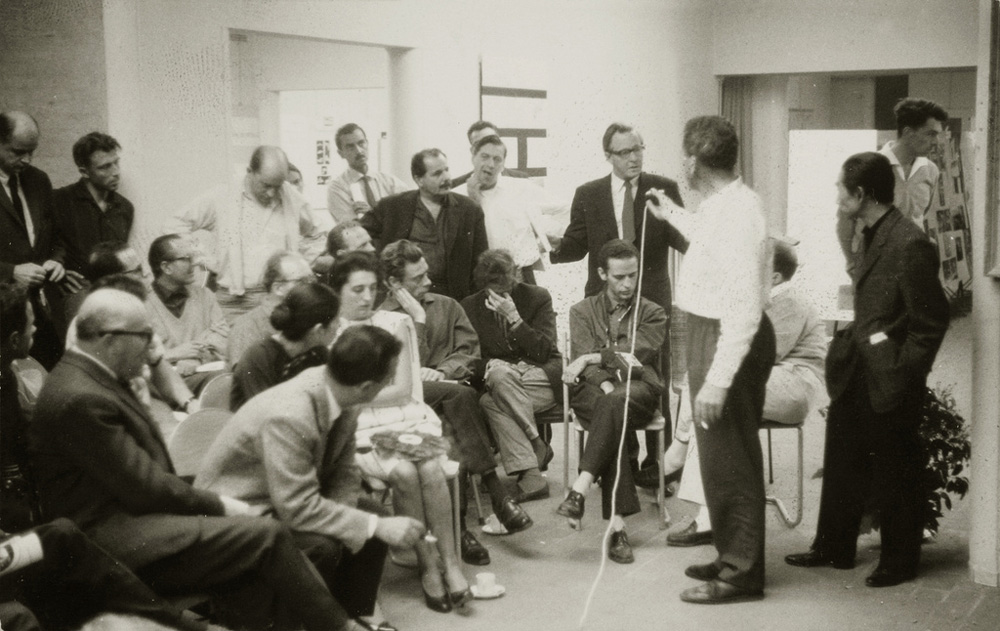
Otterlo Meeting 1959 (also CIAM '59), organized by Team 10, 43 participants. Meeting place: Kröller-Müller Museum, located in the Hoge Veluwe National Park. Dissolution of the organization CIAM.

Team 10 – just as often referred to as Team X or Team Ten – was a group of architects and other invited participants who assembled starting in July 1953 at the 9th Congress of the International Congresses of Modern Architecture (CIAM) and created a schism within CIAM by challenging its doctrinaire approach to urbanism.

Membership

[edit]

The group's first formal meeting under the name of Team 10 took place in Bagnols-sur-Cèze in 1960. The last, with only four members present, was in Lisbon in 1981.

Team 10 had a fluid membership, yet a core group actively organized the various meetings, which consisted of Alison and Peter Smithson, Jaap Bakema, Aldo van Eyck, Georges Candilis, Shadrach Woods, and Giancarlo De Carlo.[1] Other members included Ralph Erskine, Daniel van Ginkel, Pancho Guedes, Geir Grung, Oskar Hansen, Reima Pietilä, Charles Polonyi, Brian Richards, Jerzy Sołtan, Oswald Mathias Ungers, John Voelcker, and Stefan Wewerka.[1]

They referred to themselves as "a small family group of architects who have sought each other out because each has found the help of the others necessary to the development and understanding of their own individual work."[2] Team 10's theoretical framework, disseminated primarily through teaching and publications, had a profound influence on the development of architectural thought in the second half of the 20th century, primarily in Europe and the United States.[citation needed]

Two different movements were associated with Team 10: the New Brutalism of the British members (Alison and Peter Smithson) and the Structuralism of the Dutch members (Aldo van Eyck and Jaap Bakema).

History

[edit]

Team 10's core group started meeting within the context of CIAM, the international platform for modern architects founded in 1928.[3] Their views often opposed the philosophies put forward by CIAM, and following founder Le Corbusier's exit in 1955, CIAM dissolved in 1959 to give way to Team 10 as the centralized, authoritative think tank concerning Brutalism, Structuralism, and related urban planning.

When Jaap Bakema, one of Team 10's core members, died in 1981, the other members used this as an occasion to end their collaboration as Team 10.[4]

References

[edit]
[edit]
Revisions and contributorsEdit on WikipediaRead on Wikipedia
from Grokipedia
Team 10, also known as Team X or Team Ten, was a collective of architects and urban theorists active primarily from the to the , renowned for challenging the dogmatic functionalism and principles of the (CIAM) and advocating for more humane, context-sensitive approaches to . The group emerged as a response to the perceived failures of postwar reconstruction efforts, emphasizing social and cultural dimensions over rigid zoning and , and it played a pivotal role in shifting architectural discourse toward themes of identity, , and flexibility in urban environments. The origins of Team 10 trace back to the 9th CIAM congress held in , , in July 1953, where a subgroup of younger architects began coalescing around critiques of CIAM's established leadership and its adherence to the 1933 Athens Charter's principles of functional zoning and high-rise developments. This informal formalized during preparations for the 10th CIAM congress in , , in 1956, where members presented alternative visions that effectively marked the end of CIAM as an organization; the group's subsequent meeting at , , in 1959, solidified their independence from CIAM. Team 10 continued to convene at irregular intervals across , with their first independent meeting in Bagnols-sur-Cèze, , in 1960, and their final gathering in in 1981, though the collective gradually disbanded amid internal disagreements by the mid-1980s. At its core, Team 10 comprised architects from diverse European backgrounds, including the British duo , Dutch designers and Jacob B. Bakema (often called Jaap Bakema), French-Greek architect Georges Candilis, American-born Shadrach Woods based in France, and Italian Giancarlo De Carlo, with additional participants such as Spanish architect José Antonio Coderch, Swedish Ralph Erskine, and Polish Jerzy Soltan. These members, often in their 30s and 40s during the group's formative years, brought varied experiences from postwar urban projects, such as van Eyck's playground designs in and the Smithsons' "" concept for London's . Team 10's intellectual contributions centered on three interlocking principles: association, which prioritized human interactions and social clusters over isolated functional zones; identity, stressing the importance of cultural and in design; and flexibility, promoting adaptable structures that accommodate evolving needs rather than fixed utopias. Their ideas were disseminated through publications like the Team 10 Primer (first edition ), which compiled conference notes and project sketches, influencing later movements in and while prefiguring critiques in works like Jane Jacobs's The Death and Life of Great American Cities (1961). Although the group never produced a unified , their rejection of CIAM's "" approach to —favoring instead layered, diverse cityscapes—left a lasting impact on and practice into the postmodern era.

Formation and Context

Roots in CIAM

The (CIAM), founded in 1928, served as the primary international forum for advancing modernist architecture and principles, emphasizing functional zoning, standardization, and rational urban organization as outlined in the of 1933. By the late 1940s and early 1950s, postwar reconstruction in Europe highlighted limitations in CIAM's rigid doctrines, prompting younger architects to seek more flexible approaches within the organization. Team 10, also known as Team X, originated as an informal alliance of these dissenting voices, evolving from CIAM's internal debates rather than a singular founding moment. The roots of Team 10 trace to the CIAM congresses of the early 1950s, where core figures such as , Jacob Bakema, and began coalescing around shared concerns. At the 1951 congress in , emerging discussions on "" as a holistic integration of living environments foreshadowed critiques of CIAM's compartmentalized urbanism. This momentum intensified at the 1953 CIAM congress in , , where a subgroup of younger delegates met separately to challenge the dominance of older leaders like and Cornelis van Eesteren, marking the first informal gathering of what would become Team 10. These meetings highlighted tensions over CIAM's bureaucratic structure and its failure to address social and cultural contexts in [urban design](/page/urban design). Team 10's foundational ideas stemmed from a of CIAM's universalist functionalism, which they viewed as producing alienating, machine-like cities disconnected from human needs and local identities. Influenced by sociological insights, members advocated for centered on human associations, continuity in built environments, and contextual , as evident in early manifestos like the 1954 Doorn Manifesto. Concepts such as the "cluster" for flexible housing groupings and opposition to strict functional separation began to take shape, laying the groundwork for Team 10's post-CIAM independence after the organization's dissolution in 1959. This shift represented not a complete rejection of but a reformulation to prioritize social and cultural dimensions over abstract rationality.

Establishment at Aix-en-Provence (1953)

The ninth congress of the (CIAM), held from 19 to 26 July 1953 in , , under the theme "La Charte de l’Habitat" (The Charter of Habitat), served as the pivotal event in the establishment of Team 10. Organized by the French architectural group ASCORAL, the congress attracted over 3,000 delegates and observers, making it the largest CIAM gathering to date and the first dominated by younger members who sought to inject fresh perspectives into modernist discourse. These emerging architects, including from , Jaap Bakema and from the , Georges Candilis from , and Shadrach Woods, began to articulate critiques of CIAM's rigid functionalism, emphasizing instead the social, cultural, and environmental dimensions of . At , the younger faction convened informal sessions that Alison Smithson later identified as the inaugural Team 10 meeting, where participants challenged the Charter's compartmentalized zoning of urban functions—such as dwelling, work, recreation, and circulation—as overly simplistic and disconnected from lived realities. Georges Candilis, a key organizer, described the need for renewal in CIAM as essential, stating that "like any organism that wanted to remain alive . . . [it] needed new blood," reflecting the generational tension that fueled Team 10's formation. Presentations, such as the Smithsons' " Overlay" from 1952, illustrated alternative visions for dense, community-oriented housing that integrated cultural context over abstract ideals. The congress's failure to produce a unified "Charter of Habitat" underscored the irreconcilable divides between the old guard and the younger members, propelling the latter to organize independently as Team 10 (or Team X). Tasked informally with preparing the thematic agenda for CIAM X, Team 10's core group solidified their commitment to a more humane, context-sensitive urbanism, laying the groundwork for their subsequent critiques and independent activities. This establishment at Aix-en-Provence marked a turning point, transitioning from CIAM's orthodoxy toward a collaborative network focused on the "habitat" as an environment for holistic human fulfillment.

Membership

Core Members

The core members of Team 10, often described as the group's "inner circle," were a tight-knit group of architects who initiated and sustained its activities from the early 1950s onward, driving discussions on , , and architectural . These individuals, drawn primarily from and the , included , , Jaap Bakema, Georges Candilis, Shadrach Woods, and Giancarlo De Carlo. They met regularly at conferences such as those in (1953), (1954), and (1959), where they shaped the collective's rejection of CIAM's functionalist dogmas in favor of context-sensitive, community-oriented design. Alison and Peter Smithson (Alison: 1928–1993; Peter: 1923–2003), British architects who married in 1949, were pivotal in Team 10's formation, having proposed the group's name during preparations for CIAM 10 in 1956. Working collaboratively, they critiqued the Athens Charter's emphasis on zoned planning, advocating instead for "human associations" and mobility as central to urban structure, as seen in their Roads Study (1959) and Cluster City concept (1952–1953). Their ideas, expressed through diagrams in the Team 10 Primer (1962), promoted "stem-to-cluster" growth patterns that prioritized ease of communication and social interaction over abstract zoning, influencing projects like the (1950s). The Smithsons organized early meetings, including the 1954 gathering, and continued contributing to Team 10 publications into the 1960s. Aldo van Eyck (1918–1999), a Dutch , joined Team 10 at its inception and became a leading voice for structuralist principles, emphasizing "labyrinthine clarity" and the human scale in built environments. As chief of 's Municipal Department of (1947–1973), he designed over 700 playgrounds in the , using modular elements to foster play and social bonds, which informed his broader critique of modernism's "twin curse" of uniformity and functional separation. In Team 10 contexts, van Eyck hosted the 1974 Loenen meeting and contributed ideograms to the Primer, arguing for architecture as a "built homecoming" that reconciles opposites like individual and collective, space and time. His Orphanage (1955–1960) exemplified these ideas through clustered forms that encouraged relational dynamics. Jaap Bakema (1914–1981), another Dutch architect, was among the original four members identified at the 1953 meeting and served as a key organizer, including the pivotal 1959 conference where CIAM dissolved. Collaborating with the Smithsons and others, Bakema focused on as an expression of societal evolution, promoting "open form" designs that integrated housing with urban infrastructure, as in his Lijnbaan in (1953). His Primer contributions highlighted transforming "fear of total space" into respect through articulated quantity, influencing post-war reconstruction plans like those for Kennemerland (1960). Bakema's death in 1981 marked the formal end of Team 10's collaborative phase. Georges Candilis (1913–1995), a French of Greek origin who trained under , brought expertise in social housing to Team 10, co-founding the Candilis-Josic-Woods office in 1953. He advocated for flexible, multi-level urban complexes that blurred indoor-outdoor boundaries, as demonstrated in his ATBAT-Afrique projects in (1951–1952), which adapted modernist principles to local climates and cultures. In the Primer, Candilis outlined "stem development" for accommodating growth while preserving community, applied in works like the Bagnols-sur-Céze housing (1960) and (1963, with Woods and Josic). Active in early Team 10 meetings, he emphasized housing "for the greatest number" with qualitative spatial variety. Shadrach Woods (1923–1973), an American architect based in , collaborated closely with Candilis on North African projects and co-developed the "backbone" urban model, envisioning linear infrastructure as a scaffold for organic expansion. Woods contributed to Team 10's discussions on mobility and integration, notably through the Carré Bleu article (1961) and designs like the Caen-Hérouville plan (1961), which used stem-to-cluster logic to link housing with services. His Primer input stressed diagnostic tools for that prioritize human needs over vehicular dominance. Woods remained active until his death, participating in meetings like Royaumont (1962). Giancarlo De Carlo (1919–2005), an Italian and urbanist, joined Team 10 early and hosted the 1966 Urbino meeting, focusing on and the integration of historical contexts with modern needs. Through his work at the (1962–1970s), he demonstrated user-involved processes that challenged top-down planning, aligning with Team 10's emphasis on architecture as a "way of life." De Carlo's Primer contributions urged confronting ideological biases in design, promoting collective environments over isolated functions, and he organized informal "family" gatherings to sustain the group's discourse into the 1970s. As the last surviving core member, his passing in 2005 closed a chapter on Team 10's legacy.

Extended and Invited Participants

In addition to the core members who drove Team 10's ongoing activities, the group frequently included extended participants—architects and who attended multiple meetings and contributed substantively to discussions—and invited guests who participated in specific gatherings to enrich debates on and . These individuals, often from diverse international backgrounds, helped broaden the group's of modernist by introducing regional perspectives and specialized expertise, though they did not commit to the same level of sustained involvement as the core. Key extended participants included José Antonio Coderch from , who emphasized ethical dimensions in design and attended early meetings like in 1954 and later ones in in 1962; Ralph Erskine from , known for his work on human-scale environments in harsh climates, such as his Arctic city concepts presented at the Stockholm meeting in 1967; and Oswald Mathias Ungers from , who contributed to discussions on and typology, notably at the meeting in 1961 and in 1965. Other notable figures were Jerzy Soltan from , who addressed challenges in post-war reconstruction; Stefan Wewerka from , involved in Berlin-focused sessions in 1965 and 1967 on projects like Markisches Viertel; and Brian Richards from , a frequent attendee at and meetings from 1961 to 1967, focusing on mobility and habitat. These architects, along with Charles Polonyi from and John Voelcker from , participated in at least three to four meetings, qualifying them as extended members under Team 10's informal criteria. Invited participants were selectively brought in for particular conferences to provide fresh insights or represent underrepresented regions, often without prior affiliation. For instance, at the meeting in 1959, invitees included Ignazio Gardella from , André Wogensky from , and Alvar Aalto's associate Aulis Blomstedt from , who debated the integration of tradition with . The Bagnols-sur-Cèze gathering featured Oskar Hansen from with his "open form" theory and Hans Hollein from , influencing conversations on dynamic urban growth. Later meetings, such as Royaumont in 1962, invited Louis Kahn from the and Balkrishna Doshi from to discuss cross-cultural , while the 1965 session included Fumihiko Maki from and Peter Polonyi from on high-density housing. These invitations, totaling over 50 individuals across meetings from 1953 to 1981, ensured Team 10's ideas remained pluralistic and globally informed, though records show varying levels of documentation for their contributions.
MeetingDateSelected Invited ParticipantsKey Contributions Discussed
1954Blanche Lemco van Ginkel (Canada/Netherlands), Daniel van Ginkel (Netherlands/), Rolf Gutmann ()Early on clustered habitats and international collaboration.
1959Geir Grung (), Ignazio Gardella (), Aulis Blomstedt ()Critique of functionalism and emphasis on human associations.
Bagnols-sur-Cèze1960Oskar Hansen (), ()Theories of form and participation in .
Royaumont1962 (USA), Balkrishna Doshi (), (USA/UK)Monumentality, climate-responsive design, and pattern languages.
1965 (), Peter Polonyi () influences and Eastern European reconstruction.
This table highlights representative examples from major meetings, illustrating how invitations fostered interdisciplinary exchange without formal membership. Overall, the extended and invited participants expanded Team 10's scope beyond its European core, influencing its evolution into a network of critical voices in mid-20th-century .

Core Ideas and Principles

Critique of Modernist Orthodoxy

Team 10's critique of modernist orthodoxy centered on the perceived failures of the (CIAM) to address the human dimensions of and , particularly its rigid adherence to functional and universalist principles outlined in the of 1933. Members argued that CIAM's emphasis on separating dwelling, work, recreation, and circulation into isolated zones resulted in dehumanizing environments that ignored social interactions and contextual specificities. This approach, rooted in a technocratic , prioritized abstract efficiency over the lived experiences of inhabitants, leading to sterile, machine-like urban forms that alienated communities. A pivotal expression of this critique emerged in the Doorn Manifesto of 1954, drafted during a meeting in the by , , Jacob Bakema, John Voelcker, Sandy van Ginkel, and Hans Hovens-Greve. The manifesto rejected the isolated study of housing in favor of viewing it as part of a broader "," defined by scales of human association—from rural farm clusters to dense urban multifunctional cities. It proposed that architectural solutions should derive from understanding community dynamics and environmental relationships, rather than imposing codified functional elements, thus advocating for a shift from CIAM's mechanistic to designs fostering vital social bonds and human-scale interactions. This document marked an "internal critique" of , calling for "an action towards humanization" to reconcile technological progress with cultural and everyday realities. Key figures like the Smithsons further refined this position by substituting terms such as "function" with "use" to emphasize practical, user-driven adaptation over dogmatic classification, while van Eyck stressed the integration of patterns and to counter 's universal abstractions. Bakema highlighted the variability of communities based on , opposing uniform solutions that disregarded local ecologies. Collectively, these ideas challenged the orthodoxy's faith in progress through , promoting instead a "situated " attuned to and site-specific invention, influencing subsequent movements like .

Human-Centered Urbanism and Key Concepts

Team 10's approach to urbanism marked a pivotal departure from the functionalist orthodoxy of the (CIAM), emphasizing human-centered principles that prioritized social relations, cultural context, and everyday experiences over abstract and large-scale . This shift was articulated in their collective works, where was reconceived as a responsive framework for , fostering adaptability and community cohesion rather than rigid separation of functions like dwelling, work, recreation, and circulation. Central to this was a critique of CIAM's reductive , which Team 10 viewed as alienating and insensitive to the complexities of lived urban life, advocating instead for designs that integrated with social and environmental dynamics. A foundational concept was , which encapsulated the idea of urban environments as multifaceted living systems tailored to human needs, blending physical structures with social and psychological dimensions. Coined and developed by members like during discussions at the 1952 meeting, habitat rejected monolithic urban forms in favor of diverse, clustered arrangements that supported varied lifestyles and interactions, as seen in van Eyck's Amsterdam (1955–1960), where small-scale units created intimate social thresholds. Similarly, human association emerged as a core principle, positing that should begin at the "doorstep" level—focusing on immediate social bonds and groupings—before scaling to larger collectives, a notion championed by in their "doorstep philosophy," which emphasized tenant participation and relational networks over imposed hierarchies. This concept was formalized in the 1954 Doorn Manifesto, where associations were scaled from family to neighborhood, promoting polycentric urban fabrics that encouraged organic community formation. Complementing these ideas was the stem concept, introduced by Georges Candilis, Alexis Josic, and Shadrach Woods, which envisioned urban infrastructure as flexible, branching systems akin to natural growth, integrating circulation, services, and habitation in a non-hierarchical manner to enhance human mobility and adaptability. Exemplified in projects like the plan for the Toulouse-Le Mirail neighborhood (), the stem allowed for incremental development and contextual responsiveness, countering the static grids of modernist planning. Team 10 further critiqued functionalism by introducing notions like "in-betweens" (van Eyck), which highlighted transitional spaces for social ambiguity and play, and "mat-building" (Candilis, Josic, Woods), promoting continuous, adaptable urban matrices over isolated objects. These principles collectively aimed to restore urbanism's poetic and empathetic core, influencing subsequent movements by underscoring the architect's role in mediating human-scale experiences within evolving cities.

Major Meetings and Developments

Early Conferences (1954–1956)

The early conferences of Team 10, emerging from the group's informal formation at Aix-en-Provence in 1953, centered on preparations for the 10th Congress of the International Congresses of Modern Architecture (CIAM X), held in Dubrovnik, Yugoslavia. These meetings marked a pivotal shift among younger architects toward critiquing CIAM's rigid functionalist doctrines, emphasizing human-scale urbanism and associative planning concepts. The discussions laid the groundwork for Team 10's independent identity, with key gatherings occurring in 1954 and 1955 to define the congress theme of "Habitat" and interrelationships in urban design. In January 1954, a study weekend at , , organized by Jaap Bakema and Sandy van Ginkel, brought together Bakema, , van Ginkel, Hovens Greve, Peter Smithson, and John Voelcker. This session produced the influential "Statement on Habitat," which proposed new planning criteria focused on social associations and included the "Scale of Association" diagram to visualize human interactions at varying urban scales. Subsequent CIAM Council meetings in on 30 1954, attended by figures like , , , José Luis Sert, and Team 10 precursors such as Bakema, van Eyck, Georges Candilis, and the Smithsons, formalized the CIAM X Committee comprising Bakema, Candilis, Peter Smithson, and Rolf Gutmann to steer the congress agenda. Further refinement occurred at committee meetings in (28-29 August 1954) and (14 September 1954, at Le Corbusier's office), where the term "Team X" (later Team 10) was first used explicitly. These sessions expanded the committee to include participants like Bill Howell, Alison Smithson, and Shadrach Woods, and emphasized grids as analytical tools for urban patterns, foreshadowing critiques of large-scale . By September 1955, a gathering at La Sarraz, , involving Bakema, van Eyck, Giedion, the Smithsons, Woods, and others, finalized the CIAM X program under the title "The Habitat: Problem of Inter-relationships," highlighting relational dynamics over isolated functions. The culmination arrived with CIAM X in from 3-13 August 1956, where Team 10—now comprising Bakema, Candilis, van Eyck, Gutmann, Geir Grung, Howell, Reima Pietilä, the Smithsons, Jerzy Soltan, Voelcker, and Woods—presented 35 grids, seven of which articulated their vision of clustered, community-oriented . Discussions under the theme "Scales of Association" developed the "Charter of Habitat," advocating for flexible urban forms responsive to social needs, and addressed CIAM's reorganization amid tensions with elder leaders like Giedion and Sert. Outcomes included the decision for CIAM's council and CIRPAC to resign by year's end, paving the way for Team 10's autonomy through a new reorganization committee led by Bakema, the Smithsons, and Woods.

Otterlo and Later Gatherings (1959–1981)

The Otterlo meeting, held from 7 to 15 September 1959 at the in , , served as the final congress of the (CIAM) and a pivotal transition for Team 10. Organized by an ad hoc committee including John Voelcker, André Wogenscky, Alfred Roth, Ernesto Rogers, and core Team 10 members such as Jaap Bakema and Georges Candilis, it attracted 43 architects from 20 countries, among them , , Shadrach Woods, Giancarlo De Carlo, Kenzo Tange, and . Unlike previous CIAM gatherings structured around national delegations, participation was individual, fostering a more democratic format with plenary sessions replacing committees and chairmen. The six days of presentations showcased diverse projects on in challenging contexts, such as Herman Haan's work in the Algerian Sahara and Ralph Erskine's sub-Arctic designs, alongside urban studies like the Smithsons' London Roads study and Kahn's plan, emphasizing integration of modern forms with existing urban fabrics. Discussions at highlighted Team 10's emerging critique of CIAM's rigid functionalism, with debates on formalism, history, and reconciliation of old and new—exemplified by Van Eyck's keynote "Is Going to Reconcile Basic Values?" advocating to "gather the old into the new," and Kahn's address on modern monumentality. Tensions arose, such as Alison Smithson's criticism of Rogers' as regressive, underscoring the group's push toward human-centered, context-responsive design over orthodox modernism. The congress formally dissolved CIAM, marking the triumph of Team 10's approach, and ended its formative phase by establishing theoretical foundations without formal organization. Outcomes included Bakema's launch of the newsletter Boîte Postale pour le développement de l'Habitat (1959–1971, 18 issues), which disseminated ideas, and the 1961 publication CIAM '59 in , edited by Oscar Newman, documenting the proceedings. Following , Team 10 continued through informal, invitation-only gatherings that emphasized project critiques, site visits, and evolving themes like urban growth, participation, and the architect's societal role, without rigid structure or publications beyond occasional records. The 1960 meeting in Bagnols-sur-Cèze, (25–30 July), organized by Candilis-Josic-Woods, focused on their completed project, debating integration of modern habitats with regional contexts, identity versus uniformity, and Team 10's organizational direction, with participants including Bakema, Van Eyck, the Smithsons, Yona Friedman, and . In 1962 at Royaumont , (12–16 ), prepared by Bakema, Alison Smithson, Voelcker, and Woods, over 40 attendees, including and Tange, explored urban infrastructure and building clusters for adaptability, critiquing projects like Bakema's Bochum University and the Smithsons' interventions. The 1965 informal gathering in (25–29 ), hosted by Woods, involved 15 members discussing growth and change through projects such as the Free University, Hollein's candle shop, and Van Eyck's church, highlighting tensions between understatement and overdesign. By the mid-1960s, meetings reflected internal identity crises and broadening inclusivity. The 1966 conference (7–13 September), organized by De Carlo, with about 30 participants including Bakema, Van Eyck, and historian Joseph Rykwert, centered on the automobile's impact on architecture and the of movement and stasis in , sparking debates on Team 10's exclusivity versus openness. Subsequent gatherings shifted toward practical assessments amid social changes: 1971 in (9–12 April), hosted by Candilis, evaluated the Le Mirail project's participation models and industrialized building limits, with attendees like Tange, Ungers, and Pietilä reaffirming the core group. In 1973 (2–4 April), organized by the Smithsons, discussions on grid/matrix principles critiqued Woods' Free University and Candilis' project, shortly before Woods' . The 1974 meeting (4–11 April), led by Bakema, reflected on Woods' legacy, consumer society, and collaborations, visiting town hall and Van Eyck's church. Later meetings grew more intimate and reflective. The 1976 Spoleto gathering (2–6 June), organized by De Carlo with eight participants including Coderch and the Smithsons, examined user participation in the Matteotti housing via site visits, debating architects' roles amid market and construction constraints, with no formal records produced. An informal gathering in in 1977 involved a small core group. The final meeting occurred in in 1981, attended by only four members including and Giancarlo De Carlo, after Bakema's death earlier that year on February 21, underscoring Team 10's evolution from critique to sustained, albeit unstructured, dialogue on humane .

Legacy and Influence

Impact on Architectural Theory and Practice

Team 10 profoundly reshaped by challenging the rigid functionalism and universalism of CIAM, advocating instead for a relational approach that emphasized associations, cultural context, and social interactions in . Their critique, articulated in the of 1954, integrated ecological, social, and individual factors into habitat planning, moving away from CIAM's emphasis on isolated functional zones toward interconnected "scales of association" that prioritized community over geography. This shift influenced mid-20th-century discourse, promoting concepts like "doorstep philosophy" and "mat-building," which viewed as a flexible framework for user participation and adaptability rather than fixed forms. For instance, Alison and Peter Smithson's in (1950s) exemplified this through multi-level "streets-in-the-air" that fostered social cohesion at scale, countering the alienation of modernist high-rises. In practice, Team 10's ideas manifested in seminal projects that embedded theory into built environments, such as Aldo van Eyck's Orphanage (1955–1960), which used modular, polycentric layouts to express "the configuration of 1001 relationships," blending play, identity, and to critique sterile . Similarly, the (1963–1973) by Candilis, Josic, Woods, and Schiedhelm adopted "web-building" principles, creating adaptable spaces that encouraged interdisciplinary exchanges and challenged hierarchical planning. These works influenced European urbanism, notably in the , where van Eyck's approximately 700 playgrounds integrated social into public spaces, inspiring in post-war reconstruction. By the 1970s, their emphasis on "open form" and tenant initiative extended to critiques of welfare-state housing, promoting "dressable" buildings that users could personalize, as seen in Guillermo Jullian de la Fuente's Venice Hospital (1964–1972), which wove into the urban fabric through horizontal, osmotic structures. The group's legacy extended to broader theoretical developments, contributing to a cultural critique of that paved the way for and aspects of , though they rejected superficial in favor of evolving . Publications like the Team 10 Primer (1962) and Meaning in Architecture (1969) disseminated these ideas, impacting architectural education across —e.g., through Bakema's and van Eyck's teachings—and informing 1980s urban reforms in , where public space prioritization echoed Team 10's focus on "in-between" realms. Their insistence on architecture as a moral tool for influenced contemporary practices, such as flexible, context-responsive planning in diverse cultural settings, underscoring a transition from dogmatic to humane, reciprocal .

Dissolution and Post-Team 10 Contributions

Team 10's formal activities waned in the late 1970s, with the last official meeting occurring in 1977, after which the group held only informal gatherings. The core group's dissolution is generally marked by the of Jaap Bakema in , who was regarded as the primary binding force; his passing, combined with longstanding internal disputes—such as tensions between and the Smithsons—led to the loss of cohesion and the end of organized efforts. Although the group had already shifted from collective projects to individual pursuits by the mid-1960s, Bakema's absence eliminated any remaining momentum for collaboration. Following the group's decline, core members pursued independent architectural practices that extended Team 10's human-centered and contextual principles into later decades. continued their exploration of urban housing and institutional design, completing the social housing complex in in 1972, which emphasized street-deck access and community integration amid Brutalist forms. They also realized the Garden Building extension at , between 1968 and 1970, incorporating modular elements responsive to the site's historic landscape. Alison Smithson passed away in 1993, after which Peter continued lecturing and writing on until his death in 2003. Aldo van Eyck, who died in 1999, advanced structuralist ideas through public and institutional commissions, including the design of Tripolis Park in (1989–1994), an office complex featuring clustered pavilions that balanced openness with intimate spatial configurations; this project was renovated in 2024 by to enhance sustainability while preserving its original design. His earlier designs for , numbering over 700 from 1947 to 1978, influenced ongoing urban play theory. Giancarlo De Carlo, active until his death in 2005, emphasized participatory processes in educational architecture, notably transforming the starting in 1980 by involving users in of historic structures to foster democratic spatial practices; he also directed the journal Spazio e Società from 1978 to 2001, disseminating critiques of institutional rigidity. Georges Candilis, passing in 1995, extended his urbanism expertise internationally after the 1969 dissolution of his partnership with Josic and Woods, contributing to the master plan and initial buildings for Bu Ali Sina University in (1973–1978), which integrated modular housing with cultural contexts. Shadrach Woods, who died in 1973 before the group's full end, shifted to teaching and in New York after 1969, advocating for "stem" and "web" city models in lectures that influenced American discourse on flexible urban growth. Bakema's firm, Van den Broek en Bakema, carried forward his legacy in Rotterdam-based projects until the 1980s, though his personal contributions ceased with his 1981 death. These individual trajectories sustained Team 10's critique of modernist orthodoxy, prioritizing social responsiveness in amid evolving global challenges.

References

Add your contribution
Related Hubs
User Avatar
No comments yet.