


Community hub
Recent from talks
Contribute something
Nothing was collected or created yet.
Sigtuna
View on WikipediaSigtuna[a] is a locality situated in the eponymous Sigtuna Municipality, in Stockholm County, Sweden with 9,689 inhabitants in 2020.[1] It is the namesake even though the seat of the municipality is in another locality, Märsta. Sigtuna is for historical reasons still often referred to as a stad.
Key Information


Sigtuna is situated at the bay Skarven, stretching around Upplands-Bro and a part of Lake Mälaren. Present-day Sigtuna, a harbour town that was established around 980, developed about 4 kilometres (2.5 mi) east of Old Sigtuna, which, according to Old Norse religion, was previously the home of the widely revered god Odin.[3]
Etymology
[edit]The name of Sigtuna was moved from what is presently called Signhildsberg. The meaning of Sigtuna is contested. According to one theory, it is a compound name where the second element is -tuna and the first one is either of two closely related dialectal words, viz. sig meaning "seeping water" or "swamp" or sik meaning "swamp". As a basis for this interpretation, a brook south of Signhildsberg has been mentioned, or the fact that the estate was surrounded by marshy terrain.[4]
Another theory considers the name to be an ancient prestigious "wander toponym", meaning "strong fortress", like the Celtic toponym Segodunum,[4] from Proto-Germanic *sigatūna, Old Norse Sigtún, cf. Proto-Germanic *segaz ~ *sigiz- "victory": Gothic sigis, Old Norse sigr, Old English sigor, Old Frisian sige, sīge, Old High German sigi, sigu.[5]
History
[edit]Sigtuna was founded on what was then the shore of Lake Mälaren just over 1,000 years ago. It took its name from an ancient royal estate (see Uppsala öd) several kilometers to the west (see Fornsigtuna). Various sources claim King Eric the Victorious as founder while others claim King Olof Skötkonung.[6]
It operated as a royal and commercial centre for some 250 years, and was one of the most important cities of Sweden. During a brief period at the end of the 10th and beginning of the 11th century, Sweden's first coins were minted here. St. Mary's Church, built in the 13th century by the Dominican order as a monastery church, still remains largely intact. The Dominican monastery played an important role in the Swedish Middle Ages and produced many important church officials, among them many Swedish archbishops. Many church and monastery ruins still stand, including St. Pers Church (S:t Pers kyrkoruin) dating the 1100s, St. Olof Church (S:t Olofs kyrkoruin) dated from around the middle of the 11th century, and St. Lars Church (S:t Lars kyrkoruin) dating from the middle of the 13th century.[7]
In 1187, Sigtuna was attacked and pillaged by raiders from across the Baltic Sea, possibly from Curonia, or Estonians from the island of Saaremaa (Oeselians),[8][9] or Karelians and Novgorodians,[10] Archaeological excavations have not verified the traditions of destruction of the town. Normal life in Sigtuna continued until the town started to slowly lose its importance during the 13th century due to navigability problems caused by post-glacial rebound.[9]
The current coat of arms can be traced to the town's first known seal, dating from 1311. According to a legend (possibly inspired by the town arms), Sigtuna was once the Royal seat, but this cannot be confirmed. The crown may also symbolize the large royal mint which was located in the town. Since 1971 the coat of arms has been valid for the much larger Sigtuna Municipality.
In the late 19th century Sigtuna still hosted only about 600 people, and was the smallest town in Sweden. The town remained insignificant until the second half of the 20th century. Much of the population growth can be related to Stockholm Arlanda Airport (IATA: ARN), situated some 10 km from Sigtuna. [11]
Tourist attractions
[edit]Sigtuna has a medieval-style town centre with restaurants, cafes and small shops. The old church ruins, Viking runestones and the old main street (Stora gatan) are popular attractions for tourists, especially in the summertime. The small streets with low-built wooden houses lead up to several handicrafts shops and the old tiny town hall (Sigtuna Rådhus). There are restaurants and Sigtuna Stadshotell, a hotel in the town centre.[12]
Gallery
[edit]-
 Sigtuna as it looked around 1700. Engraving from Suecia antiqua et hodierna
 -
 St. Mary's Church (Mariakyrkan) is a fine example of Brick Gothic architecture in Sweden
 -
 Sigtuna old town hall in early winter
 -
 St Olof's Church ruin (S:t Olofs kyrkoruin)
 -
 Sigtuna vicarage and St Per's Church ruin (S:t Pers kyrkoruin)
 -
 St Lars Church ruin (S:t Lars kyrkoruin)
 -
 Sigtuna Stadshotell, the traditional town hotel overlooking lake Mälaren
 -
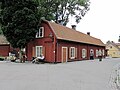 Sigtuna Museum
 -
 Sigtunaskolan Humanistiska Läroverket (boarding school)
 -
 The Sigtuna foundation (Sigtunastiftelsen), a private cultural foundation established in 1917


_(66004171).jpg)


Sports
[edit]- Sigtuna IF, sports club
Notable people
[edit]- Christer Fant, actor
- Gustav Levin, actor
- Jennifer Palm Lundberg, pageant contestant, Miss World Sweden 2008
- Sam Weihagen, travel group executive
Twin towns – sister cities
[edit]
See also
[edit]- Sigtunaskolan Humanistiska Läroverket, a famous boarding school.
- Luodian is a replica of Sigtuna located in Shanghai
Notes
[edit]- ^ Swedish pronunciation: [ˈsɪ̂kːˌtʉːna][2]
References
[edit]- ^ a b c "Tätorternas landareal, folkmängd och invånare per km2 2005 och 2010" (in Swedish). Statistics Sweden. 14 December 2011. Archived from the original on 27 January 2012. Retrieved 10 January 2012.
- ^ Jöran Sahlgren; Gösta Bergman (1979). Svenska ortnamn med uttalsuppgifter (in Swedish). p. 21.
- ^ Jonas Ros. "Sigtuna och folklanden : den tidiga Sigtunamyntningen och den politiska" (PDF). Fornvännen 2002(97):3, s. [161]-175. Archived from the original (PDF) on December 19, 2018. Retrieved December 1, 2018.
- ^ a b Entry Sigtuna in Svenskt ortnamnslexikon. Ed. Mats Wahlberg. Institutet för språk och folkminnen, Uppsala 2003.
- ^ Koch, John T. (2020). CELTO-GERMANIC Later Prehistory and Post-Proto-Indo-European vocabulary in the North and West Archived 2021-11-25 at the Wayback Machine.
- ^ Barbara Højlund & Frederik Schildt Nabe-Nielsen. "Sigtuna in Sweden". vikingeskibsmuseet.dk. Retrieved December 1, 2018.
- ^ "Sigtuna". stockholmslansmuseum.se. Archived from the original on October 1, 2023. Retrieved December 1, 2018.
- ^ "Till frågan om Sigtunas
combustering år 1187" "Archived copy" (PDF). Archived (PDF) from the original on 2012-04-26. Retrieved 2011-12-25.
{{cite web}}: CS1 maint: archived copy as title (link) - ^ a b Enn Tarvel (2007). Sigtuna hukkumine. Archived 2017-10-11 at the Wayback Machine Haridus, 2007 (7-8), p 38–41
- ^ Schück, Adolf (1953). "Sigtunas förhärjning 1187". Fornvänner. Archived from the original on 4 March 2016. Retrieved 27 April 2018.
- ^ "Historisk satsning på Arlanda". swedavia.se. Archived from the original on April 26, 2015. Retrieved December 1, 2018.
- ^ "Sigtuna town". destinationsigtuna.se. Archived from the original on December 19, 2018. Retrieved December 1, 2018.
- (in Swedish) "Sigtuna" from Nordisk familjebok
Related reading
[edit]- Tesch, Sten; Jacques Vincent (2003) Vyer från medeltidens Sigtuna (Sigtuna Museum) ISBN 9789197112802
- Hjorth, Agnete; Edéus, Anne-Marie (2006) Sigtunabilder : hus och människor i gamla Sigtuna (Svartsjö: Förlag Agnete Hjorth) ISBN 9177988639
External links
[edit]

- Sigtuna Municipality official website
- Sigtuna museum website Archived 2020-02-08 at the Wayback Machine
| Localities |
|  |
|---|---|---|
| Landmarks | ||
| Education | ||
| History |  | ||
|---|---|---|---|
| Expansion |
| ||
| Paganism and mythology | |||
| Cosmology | |||
| Rituals and worship | |||
| Society | |||
| Events | |||
| Sources | |||
| Settlements | |||
| International | |
|---|---|
| National | |
| Geographic | |
| Other | |

Sigtuna
View on GrokipediaGeography
Location and Setting
Sigtuna is located approximately 40 kilometers northwest of Stockholm, on the shores of Lake Mälaren, within the Uppland region of Stockholm County, Sweden.[7][8] This positioning places it in a strategic inland area connected to broader waterway networks, facilitating historical trade routes across the lake.[8] The topography of Sigtuna features predominantly flat lowlands, with an average elevation of around 16 meters above sea level, characteristic of the broader Central Swedish lowland extending toward the Baltic Sea.[9] Its lakeside setting on Lake Mälaren, Sweden's third-largest lake, underscores the area's suitability for early settlement and commerce due to accessible water transport.[8] The town lies in proximity to the Roslagen archipelago, a coastal region to the east along the Baltic Sea, blending inland and maritime influences.[10] Surrounding Sigtuna are diverse natural features, including expansive woodlands and old forests that provide recreational spaces and ecological diversity.[11] The area encompasses meadows, sparkling lakes, and streams, contributing to its varied terrain.[8] Nearby, the archaeological site of Birka on Björkö Island in Lake Mälaren highlights the region's prehistoric significance, located across the water from Sigtuna.[12] This strategic lakeside location tied to Sigtuna's founding as Sweden's earliest urban center.[7]Climate
Sigtuna experiences a humid continental climate classified as Dfb under the Köppen system, characterized by warm summers and cold, snowy winters.[13] The average mean temperature in winter, particularly during January, is approximately -3°C, with daily highs around -1°C and lows near -6°C. Summers are mild, with July means reaching about 17°C, featuring highs of 22°C and lows of 13°C.[14] Annual precipitation totals around 550 mm, distributed relatively evenly but with the highest amounts occurring in summer due to convective showers and thunderstorms, averaging about 60 mm in July alone. The nearby Lake Mälaren plays a moderating role, helping to temper extreme temperature fluctuations by providing a thermal buffer that slightly warms winters and cools summers compared to inland areas further from water bodies.[14][15] Extreme weather events are infrequent but notable; temperatures rarely drop below -16°C or exceed 27°C, though historical records indicate occasional dips to around -25°C in severe winters and peaks near 33°C during heatwaves. In recent years, such as the 2018 heatwave, highs approached 32°C in July.[14][16] Climate change is impacting the region through rising surface water temperatures in Lake Mälaren, exacerbating eutrophication and altering water quality, while projections suggest variable water level fluctuations due to increased precipitation variability and upstream sea level rise influences on the lake's regulated outflow.[17][18]History
Founding and Viking Age
Sigtuna was established around 970–980 AD by King Eric the Victorious (Erik Segersäll), who selected its strategic location on the northwestern shore of Lake Mälaren as a planned royal residence and administrative center, marking it as Sweden's first urban settlement with a regular grid layout of fixed plots measuring approximately 7–8 meters wide and 30–40 meters long along the main street, Stora gatan. This founding succeeded the earlier Viking trade center of Birka on nearby Björkö island, which had declined by the late 10th century, allowing Sigtuna to inherit and expand upon Birka's role in regional commerce while integrating Christian influences amid ongoing pagan practices.[19] Archaeological excavations reveal that construction began as early as 981 AD, confirmed by dendrochronological dating of timber structures, underscoring the town's rapid development under royal patronage.[20] As Sweden's inaugural Christian town, Sigtuna served as the primary ecclesiastical hub during the late Viking Age, with early Christian burials appearing from the town's inception around 980 AD, including over 1,000 graves in at least 25 cemeteries that blend pagan and Christian elements. Sigtuna became an episcopal see by the mid-11th century, functioning as a residence from around 1050 AD, as noted in contemporary accounts by Adam of Bremen, and formalized around 1060 under Bishop Adalvard the Younger, whose cathedral was likely a wooden precursor to the later stone churches.[19] Initial Christian worship took place in private halls before the construction of the first stone church in the early 12th century, possibly dedicated to St. Peter or St. Olaf, with St. Mary's Church emerging later in the 13th century as a Dominican convent but rooted in this early tradition.[20] These developments positioned Sigtuna as the epicenter for the Christianization of Sweden, contrasting with the pagan strongholds elsewhere in the region.[21] During the Viking Age, Sigtuna functioned as a vital trade hub, facilitating exchanges along eastern Baltic routes to Kiev and Byzantium, as evidenced by archaeological finds of exotic artifacts, including Baltic Ware pottery from around 1010 AD and silver dirhams from Islamic regions, which highlight its connections to Birka's legacy of international commerce. The town's mint, operational from the late 10th century, produced Sweden's inaugural coins under King Olof Skötkonung (r. 995–1022), with the first issues—imitations of English pennies—struck around 995 AD using silver likely derived from Danegeld payments, and inscriptions like "Situne Dei" affirming its religious significance.[22] Excavations at sites such as Urmakaren and Humlegården have uncovered lead dies and hundreds of these silver pennies, totaling millions in production until the early 1030s, which circulated widely and symbolized the integration of monetary economy in Viking Age Scandinavia.[21]Medieval Development
During the 12th and 13th centuries, Sigtuna experienced significant expansion as both a commercial hub and a religious center, leveraging its strategic location near Lake Mälaren for trade routes connecting inland Sweden to the Baltic Sea. Merchant guilds and affluent residents funded the construction of up to seven large stone churches, reflecting the town's growing prosperity and Christian influence. Key examples include the ruins of St. Peter's Church (S:t Pers kyrka), erected in the early 12th century as the diocesan cathedral with a transept and central tower, and nearby structures like St. Lawrence's Church (S:t Lars kyrka) and St. Olaf's Church (S:t Olofs kyrka), both dating to the same period and showcasing Romanesque architecture.[1][23] Religious development intensified in the mid-13th century with the establishment of a Dominican convent at St. Mary's Church (Mariakyrkan), the only medieval church in Sigtuna to survive intact, blending Romanesque and early Gothic styles. This convent underscored Sigtuna's role in monastic life, serving as a center for preaching and education until the Reformation. The town received formal privileges around this time, enhancing its administrative autonomy and attracting further commerce, while its population peaked at approximately 1,000 residents, supporting a dense urban layout with workshops, markets, and ecclesiastical institutions.[1][24][25] Sigtuna's fortunes waned beginning in the late 12th century after it was pillaged and burned in 1187 by raiders from the Eastern Baltic, who killed the bishop and caused widespread destruction, initiating a period of decline. This was compounded by the Black Death (1349–1350), which killed up to a third of Sweden's population and disrupted trade and labor in the town. Further decline occurred as residents relocated to more secure sites like Stockholm, and by the 16th century, the town center lay largely deserted, marking the end of Sigtuna's medieval prominence.[1][26]Modern Era
Following its medieval decline due to shifting trade routes and land uplift, Sigtuna experienced a gradual resettlement in the 17th and 18th centuries around the remnants of its ancient ruins, transitioning from a commercial hub to a rural settlement centered on agriculture and localized trade. Wooden houses along the historic Stora Gatan, Sweden's oldest preserved main street, date primarily to this era, illustrating the town's modest revival as a farming community with small-scale mercantile activities supporting local needs.[27] In the 19th century, renewed scholarly interest sparked archaeological efforts that highlighted Sigtuna's foundational role in Swedish history, with prominent antiquarian Hans Hildebrand advancing the study of Viking Age coinage produced at the town's early mint, thereby fostering heritage preservation initiatives. These investigations, building on earlier antiquarian collections, elevated Sigtuna's status as a key site for understanding Sweden's transition to Christianity and state formation, leading to the protection of ruins and runestones as cultural assets.[28] The 20th and 21st centuries marked Sigtuna's transformation into a burgeoning suburb of Stockholm, with its population expanding from approximately 600 residents in the late 19th century to 9,689 in the locality as of 2020 and 10,407 as of 2023, continuing to grow beyond 10,000 as of 2025 amid ongoing urban spillover. This growth accelerated post-World War II through improved infrastructure and commuter access, integrating Sigtuna into contemporary Swedish society while balancing modern residential development with its preserved historical core; the 1917 founding of the Sigtuna Foundation further reinforced this by promoting education, arts, and cultural heritage as pillars of community identity.[29][30][8]Governance and Demographics
Administration
Sigtuna is a locality and the namesake of Sigtuna Municipality in Stockholm County, Sweden, though the municipal administrative seat is located in the nearby town of Märsta. The municipality was established on January 1, 1971, as part of Sweden's municipal reform, merging the former City of Sigtuna (a small urban entity with roots in medieval times) with Märsta köping and several surrounding rural municipalities including Hammarby, Lunda, Skepptuna, Vidbo, and others to form a unified administrative unit covering 325 square kilometers.[31][32][33] The local government operates under Sweden's Local Government Act (2017:725), with the municipal council (kommunfullmäktige) serving as the primary decision-making body, elected every four years. Following the 2022 elections—the most recent as of November 2025—the 61-seat council features the Moderate Party with 19 seats, the Social Democrats with 18, the Sweden Democrats with 8, the Left Party with 4, the Liberals with 3, the Christian Democrats with 3, the Centre Party with 2, the Green Party with 2, and the local Sigtuna Party with 2. A governing coalition comprising the Moderate Party, Sweden Democrats, Christian Democrats, and Sigtuna Party holds a slim majority of 32 seats, overseeing executive functions through committees and the municipal executive board.[34][35] Key municipal responsibilities include urban planning and heritage protection, integral to balancing development with preservation in a region blending modern suburbs and historical sites. The municipality develops comprehensive plans (översiktsplaner) and detailed development plans (detaljplaner) to regulate land use, building permits, and infrastructure, ensuring sustainable growth around areas like Arlanda Airport while mitigating environmental impacts such as flooding and noise. Heritage protection falls under local implementation of national laws like the Planning and Building Act (2010:900), where the municipality safeguards Sigtuna's medieval structures, runestones, and archaeological sites through zoning restrictions, conservation guidelines, and collaboration with the Swedish National Heritage Board to prevent urban encroachment on Viking Age and Christian-era remnants. Historically, Sigtuna's administration traces back to medieval structures within Uppland's hundred system, where it functioned as a key center in the Färentuna hundred for local justice, taxation, and ecclesiastical affairs from the 11th century onward, before evolving through 19th-century urban reforms and the 1952 city status until the 1971 consolidation into the present municipality.[36]Population and Demographics
As of September 2025, the locality of Sigtuna has approximately 10,400 residents, while Sigtuna Municipality encompasses about 53,100 people across its urban and rural areas.[37][38] The municipality's population has experienced steady growth, increasing from roughly 40,000 in 2010 to the current level, reflecting an average annual growth rate of about 2% driven by net migration and natural increase.[39][40] The demographic structure features a relatively young population, with 24% under 18 years old, 61.5% in working age (18–64 years), and 14.5% aged 65 and older, contributing to a median age of 38.9 years.[41] Ethnic diversity is prominent, as nearly 39% of residents are foreign-born, with major origins including the Middle East (notably Syria and Iraq), South Asia (particularly Pakistan), and EU countries.[42][41] This composition underscores Sigtuna's role as a multicultural hub influenced by its proximity to Stockholm and Arlanda Airport. Housing trends highlight suburban expansion to support population growth, including plans for around 2,200 new dwellings in the near future, focusing on family-oriented developments in areas like Märsta and Sigtuna proper.[41] The average disposable income per capita stands at approximately 334,000 SEK annually, indicative of a prosperous community with strong ties to regional employment sectors.[43]Economy and Infrastructure
Economy
Sigtuna's economy features a robust labor market bolstered by the proximity to Stockholm Arlanda Airport, the largest airport in Sweden, which drives employment in transport and logistics. The municipality supports a vibrant business environment dominated by small and medium-sized enterprises, with services, retail, and a burgeoning tourism sector playing central roles. As of 2023, the employment rate for individuals aged 20-65 stood at 82%, with unemployment rising to 9.2% as of August 2025.[44][45] As of 2022, key economic sectors include transport and storage, which account for 27% of employment, followed by business services at 14% and retail at 11%. The hotel and restaurant sector, tied to tourism, contributes 6% of jobs, underscoring the role of visitor-related services in the local economy. Education and public services also serve as significant employers, with institutions like Sigtunaskolan Humanistiska Läroverket (SSHL) supporting broader community development through international programs. Other major employers include Arlanda Airport operations and local heritage sites that attract tourists, fostering ancillary service jobs. Historically, Sigtuna transitioned from an agrarian and Viking-era trading hub to a modern service-oriented economy, with agriculture now minimal amid urbanization and infrastructure growth.[46][47] A substantial portion of the workforce operates as commuters, with 27% (14,174 individuals) traveling outside the municipality for work as of 2022, mostly to Stockholm. This commuter dynamic integrates Sigtuna into the greater Stockholm economic sphere, where residents benefit from urban opportunities while contributing to local stability through inbound commuting (16,917 workers). Recent developments highlight entrepreneurial vitality, with 446 new firms established in 2023 and 396 in 2024, alongside a 90% net revenue increase for businesses from 2012 to 2022. The Arlanda area has seen expansions like Airport City Stockholm, an 800-hectare development aimed at attracting logistics, aviation, and innovative businesses, including potential tech ventures. Post-2020, sustainable tourism efforts have gained momentum, with local entities like Sigtunahöjden aligning operations with UN Sustainable Development Goals to promote eco-friendly visitor experiences and reduce environmental impact. Population growth has further fueled economic expansion by increasing demand for services and housing.[46][48][49][50]Transportation
Sigtuna is located approximately 12 kilometers from Stockholm Arlanda Airport, serving as a convenient gateway for air travelers with direct bus connections via line 579 operated by SL (Storstockholms Lokaltrafik). This route runs hourly from Sigtuna busstation to Arlanda Sky City Terminal 5, taking about 30 minutes and covered under standard SL tickets.[51][52][53] The town's road network integrates with major highways, including the E4, which provides efficient access north toward Uppsala and south to Stockholm, while the E18 runs parallel nearby for regional connectivity. Local roads like route 263 link Sigtuna directly to these arterials, facilitating short drives of around 15 minutes to Arlanda. Cycling infrastructure includes well-maintained paths along the shores of Lake Mälaren, part of the broader Mälardalsleden trail network, promoting sustainable local mobility and recreation.[8][54][11] Public transportation relies on SL's integrated system, where access cards enable seamless travel on buses and commuter trains. Residents and visitors typically take the Pendeltåg commuter train from Stockholm Central Station to Märsta station (about 35-40 minutes), followed by a short bus ride on lines 570 or 575 to Sigtuna (10-15 minutes), with frequent services throughout the day. Direct buses to central Stockholm operate but take longer (around 50 minutes via Arlanda), underscoring Sigtuna's role as a commuter hub tied to regional employment.[55][56][57]Culture and Heritage
Tourist Attractions
Sigtuna's tourist attractions blend its rich historical legacy with natural beauty and contemporary vibrancy, drawing visitors to explore the town's compact, walkable core along Lake Mälaren.[8] Mariakyrkan, or St. Mary's Church, stands as Sweden's oldest surviving brick church, constructed around 1230 by the Dominican order as a convent church, featuring a Romanesque chancel and Gothic nave with preserved medieval frescoes on its walls.[1] This architectural gem appeals to history enthusiasts for its serene interior and central location near Stora Torget, offering easy access via pedestrian paths and serving as a key stop on the Ingegerd Trail hiking route.[8] The ruins of medieval monasteries, including St. Peter's, St. Lawrence's, and St. Olof's churches, provide evocative remnants of Sigtuna's 11th- and 12th-century ecclesiastical past, with visible stone foundations and walls scattered just a short walk from the town center.[8] These open-air attractions are freely accessible year-round, ideal for self-guided tours that highlight the town's transition from Viking to Christian eras. Sigtuna Museum showcases an array of Viking artifacts, including rune stones and excavated relics that illustrate the town's role as a major trading and minting center around 1000 AD. Housed in a historic building on Stora Gatan, the museum offers interactive exhibits and a rune stone map for visitors, making it a compact yet immersive draw for those interested in Scandinavia's pre-medieval heritage, with free entry to its tourist information area.[8][58] For a modern contrast, the Sigtuna Boardwalk provides a scenic, stroller-friendly wooden path along Lake Mälaren's shoreline, stretching near the marina with benches for relaxation and views of the water and surrounding greenery.[59] This accessible waterfront promenade, roughly 1 km long, appeals to families and nature lovers seeking a leisurely escape integrated with the town's historical backdrop. Annual events organized by the Sigtuna Foundation, founded in 1917, include concerts, art exhibitions, and author talks held in summer months, attracting cultural tourists to the foundation's lakeside grounds.[8][60]Museums and Cultural Sites
Sigtuna Museum houses a collection of archaeological finds that illuminate the town's ancient past, with key exhibits focusing on Viking-era artifacts including coins from extensive hoards discovered in the region and numerous runic stones that highlight Sigtuna's role as a center of early Scandinavian literacy and trade.[61][62] The museum's displays also cover the broader history of Sigtuna from its founding around 980 AD through the medieval period, featuring items like everyday tools and religious relics that demonstrate the transition to Christianity.[1] Nearby Rosersberg Palace, situated about 16 kilometers southeast of Sigtuna along Lake Mälaren, serves as a prime example of 18th-century Swedish royal architecture and is managed by the National Property Board of Sweden.[63][64][65] The palace preserves original interiors from the late 18th and early 19th centuries, showcasing royal artifacts such as period furniture, porcelain, and decorative arts used by monarchs like Karl XIII and Queen Desideria. Guided tours allow visitors to explore these opulent rooms, which remain largely unchanged since their last royal occupancy in 1860.[66] Sigtuna's cultural preservation efforts emphasize the protection of its medieval heritage, including the ruins of three stone churches—St. Olof, St. Peter, and St. Lars—that date to the 12th and 13th centuries and reflect the town's early ecclesiastical importance.[67] Local initiatives, coordinated through the municipality and the museum, involve ongoing archaeological monitoring and restoration to safeguard these sites from environmental degradation.[68] Additionally, digital archiving projects have advanced since 2015, with Sigtuna Museum maintaining an online eMuseum database that provides public access to digitized artifacts, photographs, and historical records to support research and education.[69]Society and Recreation
Education
Sigtunaskolan Humanistiska Läroverket (SSHL), established in 1924 as Sweden's first boarding school in Sigtuna and merged with another institution in 1980, is a prominent co-educational independent boarding school offering both the Swedish national curriculum and International Baccalaureate programs.[70] SSHL is highly regarded as one of Sweden's premier boarding schools, known for its academic excellence, humanistic educational approach, international student body, and IB Diploma program. It enjoys a strong reputation within Sweden and the Nordic region for its traditional values, beautiful campus, and preparation for higher education. However, in the broader context of European boarding schools, it is not typically ranked among the absolute elite institutions such as Le Rosey in Switzerland or Eton in the UK, but is respected as a solid, high-quality option, particularly for students seeking a Scandinavian education with international elements. The school emphasizes a humanistic educational philosophy, blending Swedish traditions with an international perspective to foster personal development, academic excellence, and global awareness among its students.[47] With approximately 570 students, including around 210 boarders from Sweden and around 30 countries, SSHL serves as a key educational hub in Sigtuna, attracting families seeking a rigorous yet holistic learning environment.[71] Notable alumni of the school include King Carl XVI Gustaf of Sweden.[72] Local primary and lower secondary education in Sigtuna municipality is provided through 13 municipal grundskolor, collectively serving about 5,640 students across grades F-9.[73] In the historic town of Sigtuna itself, institutions such as Centralskolan (covering preschool class through grade 9) and S:t Olofs skola (grades 7-9, with 440 students) deliver the national curriculum, focusing on core subjects while integrating the town's rich historical context into learning experiences.[74] Upper secondary education options include municipal gymnasieskolor and independent providers like SSHL, ensuring continuity from compulsory schooling to advanced studies. Adult education in Sigtuna is supported by the municipal komvux system and Sigtuna folkhögskola, a folk high school offering non-formal courses in general education, arts, personal development, and conversation leadership for adults seeking skill enhancement.[75] These programs often incorporate elements of cultural heritage, reflecting Sigtuna's status as Sweden's oldest surviving town, alongside language instruction through Swedish for Immigrants (SFI) classes tailored to diverse learners.[76] Sigtuna maintains strong ties to higher education through its archaeological significance, with Uppsala University—Sweden's oldest university—conducting research and field programs on the town's Viking Age sites, including studies of early urban development and mortuary practices from c. 980–1100 AD.[77] These collaborations provide opportunities for advanced students and researchers to engage in hands-on excavation and analysis, contributing to broader understandings of medieval Scandinavian history.[78]Sports and Leisure
Sigtuna IF, a prominent local sports club founded in the early 20th century, fields a men's football team that competes in Division 6 of the Uppland southern league, participating in regional matches and youth development programs.[79] The club emphasizes community involvement, hosting training sessions and cup events like the Upplandscupen, where it has achieved competitive placements in lower-tier tournaments.[80] Ice hockey is supported through the municipal ice halls, where clubs such as Wings Arlanda Hockey Club and Sigtuna Skridskoklubb operate youth leagues and recreational programs, fostering skills in skating and team play during the winter season.[81] Leisure activities in Sigtuna revolve around its natural surroundings, with sailing on Lake Mälaren offering opportunities for boat tours, kayaking, and windsurfing along the calm waters accessible from the town's boardwalk.[59] Hiking trails wind through the area's 10 nature reserves, such as Lillsjön-Örnässjön, providing scenic paths for birdwatching, picnics, and moderate walks amid forests and lakesides that highlight the region's biodiversity.[82] Community events enhance recreational engagement, including the annual Sigtuna Stadslopp, a charity running race organized by Lions Club with 5 km and 10 km distances that draws local participants to support educational initiatives abroad, which was paused in 2024 and 2025 due to roadworks but is planned to resume in 2026.[83] Key facilities include Sigtuna Fritidscenter, a multi-purpose venue with indoor pools for swimming, aqua aerobics, and family activities, alongside adjacent sports halls like Steningehöjdens Sporthall for indoor sports such as basketball and volleyball.[84] The Sigtuna Bike Arena serves as a dedicated outdoor site for mountain biking, featuring trails and skills areas open to the public for free training and events.[85] These amenities host regional tournaments and promote active lifestyles, with the mild climate supporting year-round outdoor pursuits like cycling along Mälaren shores.[11]References
- https://commons.wikimedia.org/wiki/Category:Sigtuna_Municipality