Hubbry Logo
logo
Telecine
Community hub

Telecine

logo
0 subscribers
Read side by side
from Wikipedia

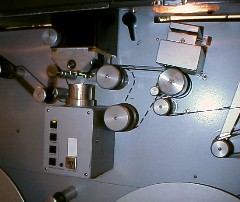
Spirit DataCine 4K with the doors open

Telecine (/ˈtɛləsɪn/ or /ˌtɛləˈsɪn/), or TK, is the process of transferring film into video and is performed in a color suite. The term is also used to refer to the equipment used in this post-production process.[1]

Telecine enables a motion picture, captured originally on film stock, to be viewed with standard video equipment, such as television sets, video cassette recorders (VCR), DVD, Blu-ray or computers. Initially, this allowed television broadcasters to produce programs using film, usually 16-mm stock, but transmit them in the same format, and quality, as other forms of television production.[2] Furthermore, telecine allows film producers, television producers and film distributors working in the film industry to release their productions on video and allows producers to use video production equipment to complete their filmmaking projects.

Within the film industry, it is also referred to as a TK, TC having already been used to designate timecode. Motion picture film scanners are similar to telecines.

History

[edit]

With the advent of popular broadcast television, producers realized they needed more than live television programming. By turning to film-originated material, they would have access to the wealth of films made for the cinema in addition to recorded television programming on film that could be aired at different times. However, the difference in frame rates between film (generally 24 frames per second) and television (30 or 25 frames per second, interlaced) meant that simply playing a film into a television camera would result in flickering.

The kinescope was used to record the image from a television display to film, synchronized to the TV scan rate. The film could then be shown directly into a video camera for retransmission.[3] Non-live programming could also be filmed using the kinescope, edited mechanically as normal, and then played back for TV. As the film was run at the same speed as the television, the flickering was eliminated. Various displays, including projectors for these video rate films, slide projectors and film cameras were often combined into a film chain, allowing the broadcaster to cue up various forms of media and switch between them by moving a mirror or prism. Color was supported by using a multi-tube video camera, prisms, and filters to separate the original color signal and feed the red, green and blue to individual tubes.

However, this still left film shot at cinema frame rates as a problem. The obvious solution is to simply speed up the film to match the television frame rates, but this, at least in the case of NTSC, requires a change that is rather obvious to the eye and ear. The simple solution is to periodically play a selected frame twice. For NTSC, the difference in frame rates can be corrected by showing every fourth frame of film twice. This solution does require the sound to be handled separately. A more advanced technique is to use 2:3 pulldown, discussed below, which turns every second frame of the film into three fields of video, which results in a slightly smoother display. PAL uses a similar system, 2:2 pulldown. However, during the analog broadcasting period, the 24 frames per second film was shown at a slightly faster 25 frames per second rate, to match the PAL video signal. This resulted in a fractionally higher-pitched audio soundtrack, and resulted in feature films having a slightly shorter duration, by being shown 1 frame per second faster.

In recent decades, telecine has primarily been a film-to-storage process, as opposed to film-to-air. Changes since the 1950s have primarily been in terms of equipment and physical formats; the basic concept remains the same. Home movies originally on film may be transferred to video tape using this technique.

Frame rate differences

[edit]

The most complex part of telecine is the synchronization of the mechanical film motion and the electronic video signal. Every time the video (tele) part of the telecine samples the light electronically, the film (cine) part of the telecine must have a frame in perfect registration and ready to photograph. This is relatively easy when the film is photographed at the same frame rate as the video camera will sample, but when video and film frame rates differ, a sophisticated procedure is required.

2:2 pulldown

[edit]
2:2 pulldown diagram (A-B to A-A-B-B)

In countries that use the PAL or SECAM video standards, film destined for television is photographed at 25 frames per second. The PAL video standard broadcasts at 25 frames per second, so the transfer from film to video is simple; for every film frame, one video frame is captured.

Theatrical features originally photographed at 24 frames per second are shown at 25 frames per second. While this is usually not noticed in the picture, the 4% increase in playback speed causes a slightly noticeable increase in audio pitch by about 0.707 semitones. This can be corrected using time stretching algorithms, which speed up audio while preserving pitch.

2:2 pulldown is also used to transfer shows and films photographed at 30 frames per second, like Friends and Oklahoma! (1955),[4] to NTSC video, which has ≈59.94 Hz scanning rate. This requires playback speed to be slowed by a tenth of a percent.

2:3 pulldown

[edit]
2:3 pulldown diagram (A-B-C-D to A-A-B-B-B-C-C-D-D-D)

In the United States and other countries where television uses the 59.94 Hz vertical scanning frequency, video is broadcast at ≈29.97 frames/s. For the film's motion to be accurately rendered on the video signal, a telecine must use a technique called the 2:3 pulldown, also known as 3:2 pulldown, to convert from 24 to ≈29.97 frames/s.

The term pulldown comes from the mechanical process of pulling (physically moving) the film downward within the film portion of the transport mechanism, to advance it from one frame to the next at a given rate (nominally 24 frames/s). This is accomplished in two steps. The first step is to slow down the film motion by NTSC's 10001001 ratio to 24,0001001 (≈23.976) frames/s. The difference in speed is imperceptible to the viewer. For a two-hour film, play time is extended by 7.2 seconds. If the total playback time must be kept exact, a single frame can be dropped every 1000 frames.

The second step of the 2:3 pulldown is distributing cinema frames into video fields. At 23.976 frames/s, there are four frames of film for every five frames of 29.97 frame/s video:

These four film frames are stretched into five video frames by exploiting the interlaced nature of 60 Hz video. For every video frame, there are actually two incomplete images or fields, one for the odd-numbered lines of the image, and one for the even-numbered lines. There are, therefore, ten fields for every four film frames, which are called A, B, C, and D. The telecine alternately places frame A across two fields, frame B across three fields, frame C across two fields and frame D across three fields. This can be written as A-A-B-B-B-C-C-D-D-D or 2-3-2-3 or simply 2–3. The cycle repeats itself completely after four film frames.

3:2 pulldown diagram (A-B-C-D to A-A-A-B-B-C-C-C-D-D)

A 3:2 pulldown pattern is identical to the one described above except that it is shifted by one frame. For instance, a cycle that starts with film frame B yields a 3:2 pattern: B-B-B-C-C-D-D-D-A-A or 3-2-3-2 or simply 3–2. In other words, there is no difference between the 2-3 and 3-2 patterns. In fact, the 3-2 notation is misleading because according to SMPTE standards for every four-frame film sequence the first frame is scanned twice, not three times.[5]

The above method is a classic 2:3, which was used before frame buffers allowed for holding more than one frame. The preferred method for doing a 2:3 creates only one dirty frame in every five (i.e. 3:3:2:2 or 2:3:3:2 or 2:2:3:3); while this method has slightly more judder, it allows for easier upconversion (the dirty frame can be dropped without losing information) and a better overall compression when encoding. The 2:3:3:2 pattern is supported by the Panasonic DVX-100B video camera under the name "Advanced Pulldown". Note that just fields are displayed—no frames hence no dirty frames—in interlaced display such as on a CRT. Dirty frames may appear in other methods of displaying the interlaced video.

Euro pulldown

[edit]

A new[when?] method called 2:2:2:2:2:2:2:2:2:2:2:3, Euro, 12:1 or 24:1 pulldown,[6][7][8] can be used in order to convert 24 frame/s material to 25 frame/s.[9][10] Usually, this involves a film to PAL transfer without the aforementioned 4% speedup. For film at 24 frames/s, there are 24 frames of film for every 25 frames of PAL video. In order to accommodate this mismatch in frame rate, 24 frames of film have to be distributed over 50 PAL fields. This can be accomplished by inserting a pulldown field every 12 frames, thus effectively spreading 12 frames of film over 25 fields (or 12.5 frames) of PAL video.

This method was born out of a frustration with the faster, higher-pitched soundtracks that traditionally accompanied films transferred for PAL and SECAM audiences. A few motion pictures are beginning to be telecined this way[citation needed]. It is particularly suited for films where the soundtrack is of special importance.

Other pulldown patterns

[edit]

Similar techniques must be used for films shot at silent speeds of less than 24 frames/s, which includes home movie formats (the standard for Standard 8 mm film was 16 fps, and 18 fps for Super 8 mm film) as well as silent film (which in 35 mm format usually was 16 fps, 12 fps, or even lower).

  • 16 frames/s (actually 15.984) to NTSC 30 frames/s (actually 29.97): pulldown should be 3:4:4:4 or the film may be run at 15 (actually 14.985) frames/s then pulldown should be 4:4. As motion pictures shot at this framerate are silent, there is no audio that is affected.
  • 16 frames/s to PAL 25: pulldown should be 3:3:3:3:3:3:3:4 (if the film playback rate is increased to 16+23 frames/s [1,000 frames per minute)] pulldown is simplified to 3:3)
  • 18 frames/s (slowed to 17.982) to NTSC 30: pulldown should be 3:3:4
  • 20 frames/s (slowed to 19.98) to NTSC 30: pulldown should be 3:3
  • 20 frames/s to PAL 25: pulldown should be 3:2
  • 27.5 frames/s to NTSC 30: pulldown should be 3:2:2:2:2
  • 27.5 frames/s to PAL 25: pulldown should be 1:2:2:2:2

Also, other patterns have been described that refer to the progressive frame rate conversion required to display 24 frame/s video (e.g., from a DVD player) on a progressive display (e.g., LCD or plasma):[11]

  • 24 frames/s to 96 frames/s (4× frame repetition): pulldown is 4:4
  • 24 frames/s to 120 frames/s (5× frame repetition): pulldown is 5:5
  • 24 frames/s to 120 frames/s (3:2 pulldown followed by 2× deinterlacing): pulldown is 6:4

Mainframe Entertainment used a novel process for its TV shows. They are rendered at exactly 25.000 frames per second; then, for PAL/SECAM distribution, ordinary 2:2 pulldown is applied, but for NTSC distribution, 199 fields out of every 1001 are repeated. This brings the refresh rate from 25 frames/s to exactly 60,0001001, or ≈59.94, fields per second, with no change whatsoever in speed, duration, or audio pitch.

Telecine judder

[edit]

The 2:3 pulldown telecine process creates a slight error in the video signal compared to the original film frames that can be seen in the 2:3 pulldown diagram above. This is one reason why films viewed on typical NTSC home equipment may not appear as smooth as when viewed in a cinema and PAL home equipment. The effect is particularly apparent in scenes that feature slow, steady camera movements. These appear slightly jerky when viewed in material that has been through the telecine process. The phenomenon is commonly referred to as telecine judder. Reversing the 2:3 pulldown telecine is discussed below.

PAL material in which 2:3 (Euro) pulldown has been applied suffers from a similar lack of smoothness, though this effect is not usually called telecine judder. Effectively, every 12th film frame is displayed for the duration of three PAL fields (60 milliseconds), whereas the other 11 frames are each displayed for the duration of two PAL fields (40 milliseconds). This causes a slight hiccup in the video about twice a second.

Reverse telecine

[edit]

Some DVD players, line doublers, and personal video recorders are designed to detect and remove 2:3 pulldown from telecined video sources, thereby reconstructing the original 24 frame/s film frames. Many video editing programs such as AviSynth also have this ability. This technique is known as reverse telecine, inverse telecine, reverse pulldown or detelecine. Benefits of reverse telecine include high-quality non-interlaced display on compatible display devices and the elimination of redundant data.

Reverse telecine is crucial when acquiring film material into a digital non-linear editing system since these machines produce edit decision lists which refer to specific frames in the original film material. When video from a telecine is ingested into these systems, the operator usually has available a telecine trace, in the form of a text file, which gives the correspondence between the video material and film original. Alternatively, the video transfer may include telecine sequence markers burned in to the video image along with other identifying information such as time code.

It is also possible, but more difficult, to perform reverse telecine without prior knowledge of where each field of video lies in the 2:3 pulldown pattern. This is the task faced by most consumer equipment such as line doublers and personal video recorders. Ideally, only a single field needs to be identified, the rest following the pattern in lock-step. However, the 2:3 pulldown pattern does not necessarily remain consistent throughout an entire program. Edits performed on film material after it undergoes 2:3 pulldown, e.g. in NTSC format, can introduce jumps in the pattern if care is not taken to preserve the original frame sequence. Most reverse telecine algorithms attempt to follow the 2:3 pattern using image analysis techniques, e.g. by searching for repeated fields.

Algorithms that perform 2:3 pulldown removal also usually perform the task of deinterlacing. It is possible to algorithmically determine whether video contains a 2:3 pulldown pattern or not, and selectively do either reverse telecine (in the case of film-sourced video) or simpler deinterlacing (in the case of native video sources).

Telecine hardware

[edit]

Flying spot scanner

[edit]
The parts of a flying spot scanner: (A) cathode-ray tube (CRT); (B) film plane; (C) & (D) dichroic mirrors; (E), (F) & (G) red-, green- and blue-sensitive photomultipliers

In the United Kingdom, Rank Precision Industries was experimenting with the flying-spot scanner (FSS), which inverted the cathode-ray tube (CRT) concept of scanning using a television screen. Rank Precision-Cintel introduced the Mark series of FSS telecines. In 1950 the first Rank flying spot monochrome telecine was installed at the BBC's Lime Grove Studios.[12] The CRT in the FSS emits a pixel-sized electron beam which excites phosphors coating the envelope, causing them to glow in red, green, and blue. This dot of light is then focused by a lens onto the film's emulsion and finally collected by a special type of photo-electric cell known as a photomultiplier which converts the light into an electrical signal. This can be accomplished in real time, 24 frames per second (or in some cases faster). An advantage of the FSS is that color analysis is done after scanning, so there can be no registration errors as can be produced by vidicon tubes where scanning is done after color separation—it also allows simpler dichroics to be used.

The problem with flying-spot scanners was the difference in frequencies between television field rates and film frame rates. This was solved first by the Mark I Polygonal Prism system, which was optically synchronized to the television frame rate by the rotating prism and could be run at any frame rate. This was replaced by the Mark II Twin Lens, and then around 1975, by the Mark III Hopping Patch (jump scan). The Mark III series progressed from the original jump scan interlace scan to the Mark IIIB which used a progressive scan and included a digital scan converter (Digiscan) to output interlaced video. The Mark IIIC was the most popular of the series and used a next-generation Digiscan plus other improvements.

The Mark series was then replaced by the Ursa (1989), the first in their line of telecines capable of producing digital data in 4:2:2 color space. The Ursa Gold (1993) stepped this up to 4:4:4 and then the Ursa Diamond (1997), which incorporated many third-party improvements on the Ursa system.[13]

Line array CCD

[edit]
The parts of a CCD scanner: (A) Xenon bulb; (B) film plane; (C) & (D) prisms and dichroic mirrors; (E), (F) & (G) red-, green- and blue-sensitive CCDs.

The Robert Bosch GmbH, Fernseh division[a] introduced the world's first charge-coupled device (CCD) telecine (1979), the FDL 60. The FDL 60 designed and made in Darmstadt, West Germany, was the first all solid state telecine. Rank Cintel (ADS telecine 1982) and Marconi Company (1985) both made CCD Telecines for a short time. The Marconi model B3410 telecine sold 84 units over a three-year period.[14]

In a line array CCD telecine, a white light is shone through the exposed film image into a prism, which separates out the image into the three primary colors, red, green and blue. Each beam of colored light is then projected at a different CCD, one for each color. The CCD converts the light into electrical impulses which the telecine electronics modulate into a video signal which can then be recorded onto video tape or broadcast.

Shadow telecine system, produced by Grass Valley (formerly Thomson, originated from Bosch-Fernseh's inventions), installed at DR, Denmark

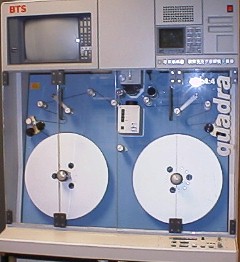
Philips-BTS eventually evolved the FDL 60 into the FDL 90 (1989) and Quadra (1993). In 1996 Philips, working with Kodak, introduced the Spirit DataCine (SDC 2000), which was capable of scanning the film image at HDTV resolutions and approaching 2K (1920 Luminance and 960 Chrominace RGB) × 1556 RGB. With the data option, the Spirit DataCine can be used as a motion picture film scanner outputting 2K DPX data files as 2048 × 1556 RGB. In 2000 Philips introduced the Shadow Telecine (STE), a low-cost version of the Spirit with no Kodak parts. The Spirit DataCine, Cintel's C-Reality and ITK's Millennium opened the door to the technology of digital intermediates, wherein telecine tools were not just used for video outputs, but could now be used for high-resolution data that would later be recorded back out to film.[13] The DFT Digital Film Technology Spirit 4K/2K/HD (2004) replaced the Spirit 1 Datacine and uses both 2K and 4K line array CCDs.[b] DFT revealed its new scanner, Scanity, at the 2009 NAB Show.[15] The Scanity uses time delay integration (TDI) sensor technology for extremely fast and sensitive film scans.[c]

Pulsed LED/triggered three CCD camera system

[edit]

With the manufacturing of new high-power LEDs came pulsed LED/triggered three-CCD camera systems. Flashing the LED light source for a very short time gives the full-frame CCD camera a stop action of the film, allowing continuous film motion. With CCD video cameras that have a trigger input, the camera can be electronically synced to the film transport framing.

An array of high-power multiple red, green and blue LEDs is pulsed just as the film frame is positioned in front of the optical lens. The camera sends the single, non-interlaced image of the film frame to a digital frame store, where the electronic picture is clocked out at the selected TV frame rate for PAL or NTSC or other standards. More advanced systems replace the sprocket wheel with laser or camera-based perf detection and image stabilization system.

Digital intermediate systems and virtual telecines

[edit]

Telecine technology is increasingly merging with that of motion picture film scanners; high-resolution telecines, such as those mentioned above, can be regarded as film scanners that operate in real time.

As digital intermediate post-production becomes more common, the need to combine the traditional telecine functions of input devices, standards converters, and color grading systems is becoming less important as the post-production chain changes to tapeless and filmless operation.

However, the parts of the workflow associated with telecines still remain and are being pushed to the end, rather than the beginning, of the post-production chain, in the form of real-time digital grading systems and digital intermediate mastering systems, increasingly running in software on commodity computer systems. These are sometimes called virtual telecine systems.[citation needed]

Video cameras

[edit]

Some video cameras and consumer camcorders are able to record in progressive 24 (or 23.976) frames/s. Such a video has cinema-like motion characteristics and is the major component of the so-called film look.

For most 24 frame/s cameras, the virtual 2:3 pulldown process is happening inside the camera. Although the camera is capturing a progressive frame at the CCD, just like a film camera, it is then imposing an interlacing on the image to record it to tape so that it can be played back on any standard television. Not every camera handles 24 frame/s this way, but the majority of them do.[16][needs update]

Cameras that record 25 frames/s (PAL) or 29.97 frames/s (NTSC) do not need to employ 2:3 pulldown, because every progressive frame occupies exactly two video fields. In the video industry, this type of encoding is called progressive segmented frame (PsF). PsF is conceptually identical to 2:2 pulldown, only there is no film original to transfer from.

Digital television and high definition

[edit]

Digital television and high-definition standards provide several methods for encoding film material. Fifty field/s formats such as 576i50 and 1080i50 can accommodate film content using a 4% speed-up like PAL. 59.94 field/s interlaced formats such as 480i60 and 1080i60 use the same 2:3 pulldown technique as NTSC. In 59.94 frame/s progressive formats such as 480p60 and 720p60, entire frames (rather than fields) are repeated in a 2:3 pattern, accomplishing the frame rate conversion without interlacing and its associated artifacts. Other formats such as 1080p24 can decode film material at its native rate of 24 or 23.976 frames/s.

All of these coding methods are in use to some extent. In PAL countries, 25 frame/s formats remain the norm. In NTSC countries, most digital broadcasts of 24 frame/s progressive material, both standard and high definition, continue to use interlaced formats with 2:3 pulldown, even though ATSC allows native 24 and 23.976 frame/s progressive formats which offer the greatest image quality and coding efficiency, and are widely used in motion picture and high definition video production.

Gate weave

[edit]

Gate weave, known in this context as telecine weave or telecine wobble, is caused by the movement of the film in the telecine machine gate. It is a characteristic artifact of real-time telecine scanning. Numerous techniques have been devised to minimize gate weave, using both improvements in mechanical film handling and electronic post-processing. Line-scan telecines are less vulnerable to frame-to-frame alignment issues than machines with mechanical gates, and non-real-time machines are also less vulnerable to gate weave than real-time machines. Some gate weave is inherent in film cinematography, as it was introduced by the film handling within the original film camera. Modern digital image stabilization techniques can remove both this and telecine gate weave.

Soft and hard telecine

[edit]

On DVDs, telecined material may be either hard telecined, or soft telecined. In the hard-telecined case, video is stored on the DVD at the playback framerate (29.97 frames/s for NTSC, 25 frames/s for PAL), using the telecined frames as shown above. In the soft-telecined case, the material is stored on the DVD at the film rate (24 or 23.976 frames/s) in the original progressive format, with special flags inserted into the MPEG-2 video stream that instruct the DVD player to repeat certain fields so as to accomplish the required pulldown during playback.[17] Progressive scan DVD players additionally offer output at 480p by using these flags to duplicate frames rather than fields, or if the TV supports it, to play the disc back at the native 24p rate.

NTSC DVDs are often soft telecined, although lower-quality hard-telecined DVDs exist. In the case of PAL DVDs using 2:2 pulldown, the difference between soft and hard telecine vanishes, and the two may be regarded as equal. In the case of PAL DVDs using 2:3 pulldown, either soft or hard telecining may be applied.

Blu-ray offers native 24 frame/s support, allowing 5:5 cadence on most modern televisions.

[edit]

See also

[edit]

Notes

[edit]

References

[edit]
[edit]
Revisions and contributorsEdit on WikipediaRead on Wikipedia
from Grokipedia
Telecine is the process of converting motion picture film into a video signal suitable for television broadcast or digital storage, typically involving the optical scanning of film frames to produce an electronic representation that preserves the original image quality and color fidelity.[1] This technique, also known as TK, has been essential in bridging analog film production with electronic video distribution since the early days of television.[2] Historically, telecine emerged in the mid-20th century as broadcasters needed to air cinematic content on TV, evolving from rudimentary film projectors paired with early video cameras to sophisticated machines that addressed synchronization and image distortion challenges.[2] Key early systems included the flying spot scanner, which used a cathode ray tube to project a scanning light spot onto the film, capturing modulated light via photoelectric cells to generate the video signal, and the Vidicon storage system, which exposed film frames to a photosensitive tube for sequential readout.[2] By the 1960s and 1970s, equipment from manufacturers like Rank Cintel and EMI became standard in broadcast facilities, handling both 35mm and 16mm film formats for documentaries, dramas, and feature films.[1][2] The telecine process involves loading film reels into a specialized machine, where operators adjust parameters such as light intensity, color balance, gamma response, and saturation—often using computer-assisted grading tools—to optimize the transfer before scanning the footage to videotape or digital files, with real-time monitoring to ensure accuracy across reel sections.[1] In digital workflows, this produced formats like Digibeta tape, while color correction played a critical role in matching the film's dynamic range to video limitations.[1][3] Technological advancements in the 1980s and 1990s shifted telecine toward digital integration, beginning with formats like Sony's D-1 tape and evolving into data scanning for digital intermediates (DI), which allow high-resolution file-based workflows using look-up tables (LUTs) for precise adjustments to elements like skin tones or skies.[3] Today, while digital-native production has reduced the need for traditional telecine in broadcasting, it remains vital for restoring and archiving legacy film content, with modern systems emphasizing high-definition and 4K resolutions to support streaming and preservation efforts.[1][3]

Overview and Fundamentals

Definition and Process

Telecine is the process of transferring analog motion picture film footage into video formats, encompassing both analog and digital outputs, to facilitate compatibility with television, storage media, and digital workflows.[4][5] This conversion bridges the gap between traditional film production and electronic video systems, allowing cinematic content to be adapted for modern distribution channels.[1] The primary purposes include preparing films for television broadcast, authoring physical media such as DVDs and Blu-ray discs, digitizing archives for long-term preservation, and integrating film elements into post-production pipelines for commercials, music videos, and television programs.[4][6] The basic workflow begins with loading the film reel into a telecine machine, where the film advances continuously or frame by frame through a gate mechanism.[1] Each frame is then optically scanned or captured using light-sensitive sensors to generate a video image, during which operators apply real-time adjustments for color balance, contrast, exposure, and overall timing to achieve the intended aesthetic and technical standards.[4][1] Audio from the film's optical or magnetic tracks is synchronized and transferred concurrently, with the final output produced as an analog video signal (such as composite or component) or a digital file/stream via interfaces like serial digital interface (SDI).[4] This process ensures the film's visual and auditory integrity is maintained while conforming to video specifications.[5] Motion picture film is standardly captured at 24 frames per second (fps), whereas common video broadcast standards include NTSC at 29.97 fps and PAL at 25 fps, requiring specialized rate conversion to align the temporal structure without significant distortion.[7][8][9] These frame rate differences necessitate synchronization techniques, such as pulldown patterns, to map film frames to video fields effectively.[8]

Key Concepts and Terminology

Pulldown is a fundamental technique in telecine that involves repeating frames from 24 frames-per-second (fps) motion picture film to conform to the higher frame rates of video formats, such as 30 fps or 60 fields per second, ensuring synchronization between film and video playback speeds.[10] This process typically employs patterns like 3:2 pulldown, where film frames are duplicated across video fields to fill the temporal gap without altering the original motion timing.[11] Judder describes the perceived stuttering or uneven motion in video resulting from the irregular frame repetition inherent in pulldown sequences, particularly when 24 fps content is adapted to 60 Hz displays, creating a wobbling effect during panning or fast movement.[12] Gate weave refers to the subtle lateral oscillation or instability of the film strip as it passes through the mechanical gate of a telecine machine or projector, caused by imperfections in perforation alignment or transport mechanics, which can introduce horizontal shifts in the scanned image.[13] Film grain emulation involves digitally simulating the random, textured noise characteristic of photochemical film stock in video outputs from telecine transfers, using algorithmic models derived from scanned film data to replicate the organic variation in silver halide particles for a more authentic cinematic appearance.[14] These models prioritize perceptual fidelity over exact replication, often applying probabilistic distributions to avoid repetitive patterns. Aspect ratio matching in telecine ensures the proportional dimensions of the original film image—such as the 1.66:1 of Super-16mm or 1.85:1 of Academy 35mm—are adapted to video standards like 4:3 (1.33:1) or 16:9 (1.78:1), involving precise gate alignment and potential cropping or letterboxing to preserve compositional intent without distortion.[15] Color space conversion transforms the logarithmic (Log) encoding of film's wide dynamic range and spectral response into the linear gamma and narrower gamut of video signals, often applying matrix transformations from film's RGB-like primaries to standards like Rec. 709, to maintain color accuracy during the transfer process. Analog signals in telecine, such as component YPbPr, transmit luminance (Y) and chrominance (PbPr) as continuous waveforms, offering high fidelity for early broadcast but susceptible to noise degradation over distance. In contrast, digital signals like HDMI or codec-wrapped formats such as ProRes deliver discrete pixel data with embedded metadata, enabling lossless compression and easier integration into modern workflows. Progressive scanning captures and displays the entire frame in sequential order, ideal for film-originated content to avoid artifacts, while interlaced scanning alternates odd and even lines across fields, doubling perceived temporal resolution in legacy video but potentially introducing combing during motion.[11] In telecine, the choice depends on the target format, with progressive preferred for high-definition outputs to match film's native structure.

Historical Development

Early Innovations

Before the development of dedicated telecine systems, television archiving in the 1940s relied on kinescope recording, a process that captured live broadcasts by filming the output of a cathode-ray tube (CRT) monitor directly onto film stock. This method, also known as telerecording, was pioneered by the BBC, which achieved its first successful recording on October 7, 1947, with the program Variety in Sepia. Kinescopes preserved ephemeral live content, such as the 1947 Cenotaph ceremony, and enabled international distribution, as seen in the 1953 recording of Queen Elizabeth II's Coronation at Alexandra Palace, which was flown to Canada for rebroadcast. While effective for archiving, kinescopes suffered from generational loss and lower quality compared to original signals, highlighting the need for more efficient film-to-video transfer technologies.[16] The origins of telecine trace back to the 1930s with mechanical scanning systems, particularly the flying-spot scanner developed by Scottish inventor John Logie Baird. Baird adapted his rotating Nipkow disc-based scanner—using a 30-hole disc illuminated by a powerful lamp and paired with selenium photocells—to broadcast movie film, creating the earliest telecine apparatus around 1934. This innovation addressed the low sensitivity of early photoelectric cells and allowed for the transmission of 240-line images at 25 frames per second, demonstrating mechanical scanning's potential for film integration into television broadcasts. Baird's work laid foundational principles for subsequent systems, though it remained experimental amid the transition to electronic television.[17] By the late 1940s and early 1950s, telecine evolved to meet growing broadcast demands, with the BBC adopting advanced flying-spot technology in 1950 at its newly opened Lime Grove Studios in London. The first such system, produced by Cintel (originally founded by Baird in 1927 and later acquired by the Rank Organisation), scanned 35mm and 16mm film using a cathode-ray tube's electron beam to generate a scanning spot, capturing light variations via photomultiplier tubes for real-time video output. This marked a shift toward integrating pre-recorded film content into live television schedules, as broadcasters moved from predominantly live productions—over 80% of U.S. shows in 1952—to incorporating more filmed material for efficiency and syndication. Concurrently, synchronization techniques emerged to adapt cinema's standard 24 frames per second to television's 30 frames per second, using early pulldown methods to minimize motion artifacts during transfer.[18][19] A notable milestone in this era was the DuMont Television Network's Electronicam, a hybrid system introduced in the early 1950s that combined a live television camera with a synchronized 35mm or 16mm film camera sharing a common lens. Developed by Allen B. DuMont Laboratories to streamline production, Electronicam allowed simultaneous live airing and high-quality film recording, bypassing kinescope limitations for reruns and post-production editing. It was prominently used for CBS's The Honeymooners in 1955, capturing 39 episodes in a single season, though its impact was curtailed by the advent of magnetic videotape recording in 1956. These innovations underscored telecine's role in bridging film and broadcast mediums during television's formative decade.[20]

Evolution Through the Analog Era

In the 1960s and 1970s, telecine technology advanced to address practical challenges in film transfer, particularly the visibility of scratches and dust on aging prints. Wet-gate processing emerged as a key innovation, submerging the film in a refractive liquid—typically a perfluorinated solvent—during scanning to optically mask surface imperfections without altering the image content. This technique, adapted from optical printing workflows, significantly improved the quality of broadcasts and archival transfers by reducing artifacts that plagued earlier dry-gate systems.[21] By the mid-1970s, manufacturers like Rank Cintel introduced the Mark III flying spot telecine in 1975, which employed a jump-scan analog system for continuous film motion and high-resolution output supporting both 16mm and 35mm formats at 525/625-line standards.[22] A digital upgrade followed in 1978 with the addition of Digiscan, the first digital image store featuring dual frame buffers, enabling precise frame matching and early standards conversion for international distribution.[22] The 1980s marked a pivotal transition toward solid-state imaging in telecine, driven by the integration of charge-coupled device (CCD) sensors that offered superior stability and reduced maintenance compared to vacuum-tube systems. Bosch Fernseh led this shift with the FDL 60 in 1979, the world's first line-array CCD telecine, utilizing a 1,000-pixel sensor array to capture film progressively line by line, eliminating the geometric distortions common in flying-spot scanners.[23] This design supported real-time color correction and improved signal-to-noise ratios, making it ideal for broadcast applications. Rank Cintel complemented this with the 1987 Digiscan 4:2:2 upgrade to the Mark III, providing digital video outputs that facilitated integration with emerging nonlinear editing workflows.[22] These CCD-based systems reduced downtime and enhanced image fidelity, paving the way for telecine's expansion beyond live television playout. By the 1990s, telecine evolved further into data-driven systems capable of higher resolutions, reflecting the demands of high-definition television (HDTV) and post-production archiving. The Spirit DataCine, introduced in 1996 by Philips in collaboration with Kodak, represented a breakthrough as the first telecine to scan at 2K resolution (2,048 pixels per color channel) in real time, supporting HDTV formats like 1920x1080 at 50/60 Hz in RGB or YUV.[24] This machine used a 2K RGB CCD line array for native scanning up to 30 frames per second, with features like real-time scaling, panning, and rotation, enabling seamless film-to-digital workflows for restoration and effects integration.[25] These technical advancements coincided with an industry shift from telecine's primary role in broadcast playout to its centrality in post-production pipelines during the 1970s and 1980s. As video tape recording became affordable, film transfers moved from on-air synchronization to offline editing and distribution preparation, allowing studios to create tape masters for global syndication. This evolution highlighted telecine's growing importance in commercial post-production. By the late 1980s, with CCD and digital intermediates, telecine machines were routinely used for color grading and conforming in feature film workflows, solidifying their place in the analog-to-digital bridge.[1]

Frame Rate Synchronization

Pulldown Techniques

Pulldown techniques in telecine address the mismatch between motion picture film's standard frame rate of 24 frames per second (fps) and video broadcast standards, such as 25 fps for PAL systems or 29.97 fps for NTSC, by duplicating or interpolating frames or fields to achieve synchronization without substantial alterations to playback speed or duration. This method preserves the original motion's temporal integrity while adapting to the higher field rates of interlaced video, typically 50 fields per second for PAL or 59.94 fields per second for NTSC.[26][27] In NTSC conversions, the predominant 2:3 pulldown process transforms 24 film frames into 60 video fields by applying a repeating sequence where film frames alternate between contributing two and three fields, over four film frames yielding five video frames—for example, the pattern A-B-B-C-C in video frame notation, with A, B, C, and D denoting successive film frames and hybrid fields blending adjacent frames. This duplication ensures the content fills the required video duration exactly, averaging 2.5 fields per film frame.[28][29] The underlying mathematics derives the video field rate as the product of the film fps, 2 (to account for interlacing), and the pulldown ratio; for 2:3 pulldown, the 5:4 ratio (reflecting five fields over two film frames in the basic cycle, averaging 2.5 fields per film frame) computes as
24×2×54=60 24 \times 2 \times \frac{5}{4} = 60
fields per second, matching NTSC requirements.[28] Variations in pulldown include even-field dominant and odd-field dominant types, which specify whether the even or odd field precedes in video frame construction to optimize sync and reduce motion artifacts from field blending. These approaches maintain temporal alignment between film and video, preventing drift or judder by ensuring consistent field ordering across the sequence.[30]

Specific Pulldown Patterns

The 2:2 pulldown pattern is employed in telecine transfers for PAL and SECAM video standards operating at 25 frames per second, where each 24 fps film frame is duplicated into two interlaced video fields, yielding 50 fields per second overall.[31] This simple repetition accommodates the frame rate mismatch without complex field allocation, though it requires a 4% speedup of the film to align durations precisely.[32] In contrast, the 2:3 pulldown (also termed 3:2 pulldown) serves NTSC broadcasts at 29.97 frames per second by alternating the representation of film frames: one frame spans two video fields, the next spans three, repeating over a five-field cycle to fit 24 fps content into 60 fields per second.[26] This technique originated in the 1950s alongside the introduction of compatible color NTSC standards, enabling theatrical films to air on television without prohibitive speed adjustments.[33] The Euro pulldown variant applies a more elaborate sequence—2:2:2:2:2:2:2:2:2:2:2:3—specifically for PAL transfers, inserting an extra field once every 12 film frames to convert 24 fps to 25 fps while preserving the original playback speed and avoiding the traditional 4% acceleration.[34] Developed in the late 1990s during the rise of digital distribution formats like DVD, it minimizes motion inconsistencies in European broadcasts.[35] Other specialized patterns for standard rates include the 2:2:2:4 pulldown for 24 fps to 29.97 fps NTSC conversions, where frames are repeated in groups of two, two, two, and four fields to bridge to video without excessive blending.[36] In high-definition contexts, 24p-native telecine eliminates traditional pulldown altogether by capturing and processing film directly at 24 progressive frames per second, aligning with modern HD workflows and displays that support this rate for seamless post-production.

Artifacts and Mitigation

One prominent artifact in telecine conversion is judder, which arises from the uneven frame repetition in pulldown processes such as 2:3 pulldown, resulting in stuttered motion where some film frames are held for longer durations than others, often perceived as 3:2 judder.[37] This motion inconsistency becomes particularly noticeable in scenes with rapid panning or complex movement, as the frame rate mismatch between 24 fps film and 29.97 fps video disrupts smooth playback.[37] Gate weave represents another common issue, characterized by the lateral oscillation of the film strip within the scanning gate, leading to image instability and horizontal shifts that degrade perceived sharpness.[38] This artifact stems from mechanical tolerances in film transport mechanisms, where even minor deviations cause the projected image to waver unsteadily across the frame.[38] To mitigate judder, reverse telecine (IVTC) techniques reconstruct the original 24 fps progressive sequence by detecting and removing repeated fields from pulldown patterns, effectively eliminating redundant frames. In DVD playback, IVTC often relies on MPEG-2 flags embedded in the stream to identify telecine cadence, enabling decoders to perform automated field matching and frame reconstruction without manual intervention.[39] For gate weave, digital stabilization software applies motion estimation and compensation algorithms to track and correct lateral shifts post-scan, restoring image steadiness while preserving original content.[38] Combing artifacts, visible as jagged "teeth" along high-contrast edges in interlaced video outputs from telecine, occur when mismatched fields are combined into frames, exacerbating motion rendering issues.[40] De-interlacing algorithms address this by adaptively interpolating missing lines based on spatial and temporal neighbors, with motion-adaptive methods selectively blending fields to minimize aliasing in static areas while weaving in dynamic scenes.[40] Advanced implementations, such as those using deep learning, further refine comb removal by learning from training data to predict progressive frames, reducing residual artifacts in telecine-derived content.[41]

Telecine Hardware and Systems

Analog Scanning Technologies

Analog scanning technologies in telecine relied on light-based methods to convert motion picture film into video signals, focusing on hardware that scanned film frames using controlled illumination and photosensitive detectors. These systems were essential for broadcast and post-production in the mid-20th century, emphasizing high-fidelity analog output while accommodating differences in film and video frame rates. The flying-spot scanner represented a foundational analog approach, employing a cathode ray tube (CRT) to project a rapidly scanning spot of light onto the film. As the spot traversed the frame line by line, transmitted light passed through color filters or dichroic mirrors to photomultiplier tubes, generating electrical signals for red, green, and blue channels. This post-scanning color separation eliminated registration errors inherent in tube-based cameras.[42] Rank Cintel led the development of commercial flying-spot telecines starting in the late 1940s. The first twin-lens design for 35mm film was prototyped in 1947, with installations at the BBC's Alexandra Palace by 1950, marking the debut of practical broadcast systems. By the 1950s, 16mm variants addressed growing demand for smaller formats, while 1960s models like the Mark III supported dual-gauge operation (16mm and 35mm). The MkIIIC, introduced in the 1970s, featured varispeed control, X-Y zoom, and automatic scene detection, becoming a staple in professional facilities. These machines typically used continuous film transport at 24 frames per second, with optical or electronic adjustments for television standards like 25 or 30 fps.[43] Flying-spot systems excelled in delivering high luminance transfer and minimal aperture losses, achieving signal-to-noise ratios exceeding 45 dB and horizontal resolution up to 5 MHz with proper calibration. Their analog nature preserved film's dynamic range effectively for broadcast. However, CRT afterglow necessitated complex correction circuits to prevent image trailing, and sequential scanning could introduce fixed-pattern noise above 55 dB below peak signal if not mitigated. Mechanical complexity and phosphor decay also limited longevity and maintenance ease.[42] Transitioning from CRT illumination, line-array charge-coupled device (CCD) scanners introduced solid-state reliability in the late 1970s. The Bosch FDL 60, launched in 1979, pioneered this technology with three parallel CCD line arrays—one each for red, green, and blue—capturing 1,024 pixels per line under steady white light illumination. The film advanced continuously or in steps, with the arrays building complete frames progressively via prism-separated light paths. This design supported both 16mm and 35mm formats at standard frame rates.[23] Line-array CCD telecines provided advantages including low noise floors (targeting over 45 dB), high sensitivity without blooming or smear, and inherent geometric stability, outperforming flying-spot in resolution and aliasing control. Digital preprocessing allowed for element-to-element shading correction, enhancing uniformity. Limitations involved compensating for fixed sensitivity variations across the array, which, if incomplete, produced visible vertical striping; early models also faced challenges with dark current and highlight handling, though refinements like hole-accumulation diode (HAD) sensors in the 1980s mitigated these. Film transport mechanisms, often stop-start, contributed to wear and potential unsteadiness below 0.1% of frame height.[42][44] In the late 1990s and 2000s, pulsed LED illumination paired with triggered three-CCD area sensors advanced analog capture by enabling precise exposure control. High-intensity LEDs flashed briefly to light the stationary film frame, synchronizing with the electronic shutter of three separate CCD cameras dedicated to RGB channels via beam splitters. This minimized blur from residual motion and allowed variable speeds without flicker. These systems provided enhanced color fidelity. Advantages encompassed sharper images from short exposures (reducing motion artifacts in stop-start operation) and stable LED output for consistent illumination, supporting analog outputs with improved signal-to-noise over continuous lighting. Drawbacks included the need for high-power LEDs to match film densities, potential color imbalance from LED spectral shifts, and added synchronization complexity, though these supported high-fidelity transfers until digital dominance.

Digital Capture Methods

Digital capture methods in telecine utilize solid-state image sensors to convert motion picture film into high-resolution digital data, enabling precise frame-by-frame transfer without the limitations of analog video outputs. Primarily employing charge-coupled device (CCD) line-array sensors, these systems scan the film image as it transports continuously through the imaging gate, with each line of the sensor capturing a horizontal slice synchronized to the film's vertical motion. This approach, distinct from earlier analog scanning, supports data rates starting at 2K resolution (approximately 2048 pixels horizontally) and allows for real-time or near-real-time processing. The Spirit DataCine, developed by Philips in collaboration with Kodak and introduced in 1996, pioneered this technology by integrating three separate linear CCD arrays—one for each RGB channel—via a beam-splitter prism to achieve accurate color separation and HDTV-compatible scanning.[45][46] In three-chip configurations, light from the film is divided into red, green, and blue components, each directed to a dedicated CCD line array for independent capture, which minimizes color crosstalk and enhances fidelity compared to single-sensor Bayer-filtered alternatives. These systems typically use constant illumination from xenon or LED sources, with the line-scan mechanism inherently compensating for film motion to produce blur-free images; however, some variants incorporate pulsed lighting synchronized to the sensor readout, effectively freezing subtle movements during exposure for even greater sharpness. Data output from these scanners is provided in uncompressed RGB formats, often encoded in logarithmic (log) space to preserve the film's dynamic range—commonly as 10-bit or 16-bit DPX files—facilitating downstream color grading and archiving. For instance, the Spirit 2K model supports scan speeds up to 30 frames per second at 2K resolution, generating data streams suitable for professional post-production workflows.[25][47] While CCD sensors dominated early digital telecines due to their superior uniformity and low noise, complementary metal-oxide-semiconductor (CMOS) sensors have emerged in later hardware for advantages in readout speed and power efficiency, though retaining line-array designs for compatibility with continuous film transport. The evolution of resolution progressed from sub-2K (around 1K effective) in initial HD datacines of the mid-1990s to standardized 2K in systems like the Spirit DataCine, and culminated in 4K capabilities with the Spirit 4K released in 2004, which features dual line arrays per color channel (2048 pixels for 2K and 4096 for 4K) and scans at up to 7.5 frames per second in native 4K mode. This advancement enabled uncompressed capture of finer film grain and detail, setting the standard for digital intermediates in cinema restoration and distribution.[48][46]

Modern Virtual and Software-Based Systems

Modern virtual telecine systems have largely supplanted traditional hardware-based setups by leveraging software to simulate real-time film playback, color grading, and transfer processes in file-based workflows. These systems enable colorists to manipulate high-resolution digital scans of film negatives or prints without physical telecine machines, allowing for non-linear editing and iterative adjustments directly within digital environments. For instance, DaVinci Resolve from Blackmagic Design provides virtual grading tools that emulate the look and controls of classic telecine sessions, supporting real-time playback and color correction on ingested film scans for broadcast, streaming, and theatrical outputs.[49] Similarly, FilmLight's Baselight software offers advanced simulation of telecine operations, including primary grading, secondary corrections, and integration with storage area networks (SAN) for seamless file handling in post-production pipelines.[50] A cornerstone of these software-based approaches is the digital intermediate (DI) workflow, where original film is scanned once at high resolution—typically to 16-bit logarithmic files such as DPX or TIFF formats—and then conformed to various deliverables without repeated physical transfers. This method preserves the full dynamic range and grain structure of the source material, enabling multiple versions (e.g., 4K for cinema, HD for television) to be derived from a single master file set through software tools that handle frame rate conversion, aspect ratio adjustments, and color space mapping. The efficiency of DI reduces costs and turnaround times compared to analog telecine, as files can be archived indefinitely and reprocessed as technology evolves.[51] Post-2010 advancements have integrated artificial intelligence (AI) into virtual telecine for enhanced color matching and stabilization, automating tedious manual tasks while maintaining artistic control. Tools like Colourlab Ai employ machine learning algorithms to analyze and match color palettes across shots, achieving consistent grading with minimal intervention and supporting workflows from dailies to final mastering. AI-driven stabilization in software such as Adobe After Effects or integrated Resolve plugins corrects motion artifacts in scanned footage by predicting frame interpolation, particularly useful for archival restorations where original film may exhibit instability. These AI features, emerging prominently in the mid-2010s, have accelerated post-production by up to 50% in complex projects, focusing on perceptual quality rather than pixel-perfect reconstruction.[52] Cloud-based processing further modernizes virtual telecine by distributing computational demands for film scans across remote servers, facilitating streaming-ready outputs without on-premises hardware. Platforms like AWS Elemental MediaConvert apply inverse telecine and frame rate adjustments to uploaded DI files in the cloud, enabling scalable processing for high-volume streaming services. Similarly, Dolby Hybrik integrates tools like Cinnafilm's Tachyon for cloud-native frame rate conversion and motion retiming, allowing VFX teams to incorporate stabilized, graded film elements into digital compositing pipelines for projects requiring 8K resolution. Scanners such as DFT's Scanity and ARRI's ARRISCAN, while hardware-based, generate these high-res files (up to 8K) optimized for direct ingestion into cloud software ecosystems, streamlining integration with VFX software like Nuke or Houdini.[53][54][55][56]

Technical Challenges and Solutions

Film-to-Video Conversion Issues

One of the primary challenges in film-to-video conversion arises from the mismatch in dynamic range between analog film and digital video formats. Photographic film, particularly color negative stock, typically captures a dynamic range of 9-10 stops or more, allowing for rich detail in both shadows and highlights.[57] In contrast, standard dynamic range (SDR) video formats like Rec.709 typically support approximately 7-10 stops depending on bit depth (8-10 bits) and implementation, due to the constraints of electronic sensors and display capabilities.[58] To address this disparity during telecine transfers, lookup tables (LUTs) are employed to map film's wider gamut and latitude into video color spaces, such as transforming log-encoded film scans to Rec.709 for broadcast compatibility, thereby preserving tonal gradations without excessive clipping.[59] Resolution loss further complicates the process, as 35mm film's effective resolution—often equivalent to 4K or higher when scanned—far exceeds that of early video formats like 480i NTSC, which samples at roughly 720x480 pixels with interlaced fields.[60] This discrepancy leads to aliasing artifacts when high-frequency film details are undersampled during transfer, manifesting as moiré patterns or jagged edges unless mitigated by optical low-pass filters or higher-resolution digital capture.[61] Modern telecine systems aim to minimize such losses by scanning at 4K or beyond before downconversion, but inherent sampling limitations in analog video pipelines still impose quality trade-offs.[62] Aspect ratio and framing decisions introduce additional hurdles, requiring choices between letterboxing—which preserves the original widescreen composition (e.g., 2.39:1) by adding black bars on 4:3 or 16:9 displays, albeit reducing effective vertical resolution—and pan-scan, which crops and repositions the frame to fill the video aspect, often altering the director's intent through lost peripheral information.[63] Compounding these is gate weave, a mechanical instability in the film's transport through the telecine gate, caused by sprocket hole wear, film shrinkage, or imprecise pin registration, resulting in unsteady horizontal and vertical shifts that degrade image steadiness.[64] Finally, data rate constraints highlight the bandwidth limitations of analog telecine systems, where video signals are confined to narrow frequency bands (e.g., 4.2 MHz for NTSC luminance), restricting detail transfer compared to digital workflows that support higher rates, such as approximately 1 Gbps for uncompressed 1080p 24fps 4:2:2 10-bit HD outputs.[65] These limitations necessitate compression or selective filtering, potentially introducing further quality degradation during the conversion.

Soft vs. Hard Telecine

In hard telecine, the conversion from 24 frames per second (fps) film to 29.97 fps NTSC video is performed during encoding, permanently duplicating frames according to a 3:2 pulldown pattern to create an interlaced output stream at the target rate.[66] This results in a fixed video file where the duplicated frames are baked in, such as those used in NTSC DVDs compliant with the 1996 DVD-Video specification.[67] For example, every fifth frame in a sequence of five original frames is repeated, yielding 60 fields per second without reliance on playback hardware for adjustment.[68] In contrast, soft telecine encodes the video at the native 23.976 fps as progressive frames, embedding metadata flags—such as Repeat First Field (RFF) and Top Field First (TFF)—within the MPEG-2 stream to instruct compatible decoders to apply pulldown on-the-fly during playback.[69] These flags signal which fields to repeat, effectively converting to 29.97 fps without altering the underlying frame content, as supported in the DVD-Video standard for efficient storage of film-sourced material.[68] This approach leverages the decoder's capability to handle the 3:2 pattern dynamically, preserving the original frame sequence in the file itself.[66] Hard telecine offers simplicity and universality, as it requires no special player features and ensures consistent 29.97 fps output for broadcast or legacy systems, but it is irreversible—duplicated frames cannot be removed without re-encoding, potentially increasing file size by about 25% due to redundancies and complicating downstream editing or remastering.[69] Soft telecine, however, maintains higher efficiency and quality by avoiding baked-in duplicates, allowing easier inverse telecine (IVTC) recovery of the 24 fps original for high-definition upgrades or nonlinear editing, though it demands compatible hardware or software that interprets the flags correctly, which was standardized in DVD players from 1996 onward.[68][67] In applications, hard telecine is prevalent in traditional broadcast television workflows where immediate NTSC compatibility is prioritized without metadata dependencies.[66] Soft telecine finds use in DVD authoring for film content, post-production editing suites, and modern HD remastering processes, enabling flexible playback modes like progressive scan on capable displays while adhering to pulldown techniques for standard video output.[69]

Contemporary Applications

High-Definition and Ultra-High Resolution

The advent of high-definition (HD) television in the early 2000s prompted significant adaptations in telecine processes to support 1080p24 native encoding, aligning film frame rates with progressive scan formats for broadcast and post-production workflows. This shift enabled direct transfer of 35mm film at 24 frames per second (fps) to 1920x1080 resolution without the need for extensive frame duplication, preserving motion fidelity while facilitating integration into digital editing pipelines. For compatibility with interlaced broadcast standards like 1080i60, telecine systems employed 3:2 pulldown to convert the 24fps source into 60 fields per second, minimizing judder artifacts during transmission.[70] Advancements from the late 2000s and 2010s extended telecine capabilities to ultra-high resolutions, with digital film scanners such as the FilmLight Northlight 2 (introduced in 2006) achieving native 8K scans (up to 8192x4320) for 35mm film, operating at speeds of approximately 0.8 seconds per frame for 4K output. These systems replaced traditional flying-spot telecines with CCD or CMOS sensors, supporting uncompressed data rates reaching 1 Gbps to capture the full dynamic range of negative film stocks. For 4K workflows, representative examples include scans at 4096x2160 resolution, which became standard for archival and restoration projects, often requiring specialized RAID storage arrays to handle the volume.[71][72] Key standards guiding these high-resolution telecine transfers include the Digital Cinema Initiatives (DCI) specification, which defines 4K as 4096x2160 pixels at 24fps for theatrical distribution, ensuring compatibility with digital projectors while maintaining film's aspect ratios. Integration of high dynamic range (HDR) technologies, such as Dolby Vision, further enhanced these processes by leveraging original film scans at 4K or higher to generate metadata-driven mastering, allowing for expanded contrast and color gamut in deliverables. For first-run theatrical releases, Dolby recommends using high-resolution film scans as the source material to achieve optimal HDR performance, with resolutions up to 8K preserving subtle tonal details from the original negative.[73][74] High-resolution telecine introduces challenges like exponentially increased storage demands, where a single hour of uncompressed 4K scan (12-bit RGB at 24 fps) requires approximately 2 TB, necessitating efficient compression schemes such as JPEG 2000 without compromising quality. Backward compatibility with standard-definition (SD) and HD formats requires precise downconversion algorithms to avoid aliasing or loss of detail, often achieved through multi-pass workflows that generate proxy versions alongside full-resolution masters. These adaptations ensure seamless delivery across legacy and modern platforms while prioritizing the preservation of film's inherent resolution potential.[75][76]

Integration with Digital Media and Streaming

In modern digital workflows, telecine processes provide high-quality scans that serve as foundational assets for non-linear editing (NLE) systems, enabling seamless integration into post-production pipelines. For instance, telecine footage is imported into Adobe Premiere Pro, where timelines are configured to handle frame rates and interlacing specific to film transfers, facilitating audio synchronization and initial color grading for multi-camera or multi-day shoots.[77] Similarly, Avid Media Composer supports telecine inputs through shared storage and asset management integrations, allowing editors to access and manipulate digitized film material alongside native digital footage for collaborative editing.[78] These workflows have evolved in the 2020s to support virtual production environments, where LED walls simulate film-like aesthetics in real-time, often drawing on telecine-derived digital assets to achieve consistent visual textures during on-set rendering.[79] For streaming platforms, telecine masters form the basis for delivering 4K HDR content, with cloud-based processing ensuring compatibility with adaptive bitrate streaming protocols. AWS Elemental MediaConvert, for example, applies telecine conversions—such as transforming 23.976 fps progressive sources to 29.97 fps interlaced outputs using hard or soft methods—to prepare film-originated material for broadcast and OTT distribution, while inverse telecine removes pulldown artifacts for progressive streaming formats.[53] Platforms like Netflix leverage these masters to encode HDR titles, incorporating film grain synthesis tools within AV1 codecs to preserve the organic texture of analog film during compression, achieving up to 36% bitrate savings without visual degradation.[80] This approach supports dynamic optimization for varying network conditions, ensuring high-fidelity playback of legacy and new content on devices ranging from smart TVs to mobile screens.[81] Advancements in the 2020s have introduced AI-driven enhancements to telecine, particularly in machine learning for film grain synthesis and upscaling of archival material. Neural network-based models, such as FGA-NN (introduced in 2025), analyze grain patterns to generate parameters compatible with traditional synthesis tools, improving the authenticity of digitized film for modern applications while reducing compression artifacts in AI upscaling pipelines. Cloud telecine services, exemplified by AWS-based scanning and encoding, further streamline these processes by offloading hardware-intensive transfers to scalable infrastructure, allowing archives to process vast libraries of legacy film without on-premises equipment.[82][53] Looking ahead, real-time telecine techniques are emerging for live events, utilizing projector-camera setups to transfer film projections directly to video feeds, enabling hybrid analog-digital experiences such as synchronized live orchestras with classic footage.[83] Additionally, telecine digitization of film archives supports integration with VR and AR ecosystems, converting historical reels into immersive assets for virtual reconstructions of cinematic environments, thereby extending access to cultural heritage through interactive platforms.[84]

References

User Avatar
No comments yet.