Hubbry Logo
Telescoping seriesTelescoping seriesMain
Open search
Telescoping series
Community hub
Telescoping series
logo
7 pages, 0 posts
0 subscribers
Be the first to start a discussion here.
Telescoping series
Telescoping series
from Wikipedia

In mathematics, a telescoping series is a series whose general term is of the form , i.e. the difference of two consecutive terms of a sequence . As a consequence the partial sums of the series only consists of two terms of after cancellation.[1][2]


The cancellation technique, with part of each term cancelling with part of the next term, is known as the method of differences.

An early statement of the formula for the sum or partial sums of a telescoping series can be found in a 1644 work by Evangelista Torricelli, De dimensione parabolae.[3]

Definition

[edit]
A telescoping series of powers. Note in the summation sign, , the index n goes from 1 to m. There is no relationship between n and m beyond the fact that both are natural numbers.

Telescoping sums are finite sums in which pairs of consecutive terms partly cancel each other, leaving only parts of the initial and final terms.[1][4] Let be the elements of a sequence of numbers. Then If converges to a limit , the telescoping series gives:

Every series is a telescoping series of its own partial sums.[5]

Examples

[edit]
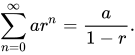
  • The product of a geometric series with initial term and common ratio by the factor yields a telescoping sum, which allows for a direct calculation of its limit:[6]when so when
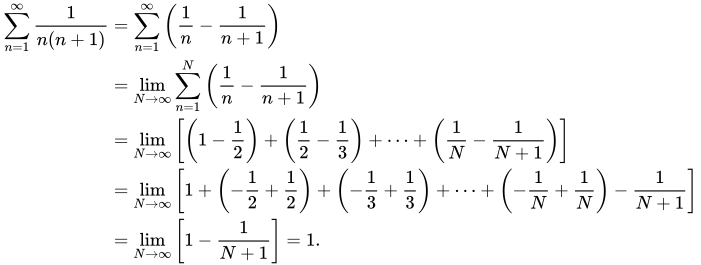
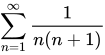
  • The seriesis the series of reciprocals of pronic numbers, and it is recognizable as a telescoping series once rewritten in partial fraction form[1]
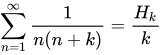
  • Let k be a positive integer. Then where Hk is the kth harmonic number.
  • Let k and m with k m be positive integers. Then where denotes the factorial operation.
  • Many trigonometric functions also admit representation as differences, which may reveal telescopic canceling between the consecutive terms. Using the angle addition identity for a product of sines, which does not converge as

Applications

[edit]

In probability theory, a Poisson process is a stochastic process of which the simplest case involves "occurrences" at random times, the waiting time until the next occurrence having a memoryless exponential distribution, and the number of "occurrences" in any time interval having a Poisson distribution whose expected value is proportional to the length of the time interval. Let Xt be the number of "occurrences" before time t, and let Tx be the waiting time until the xth "occurrence". We seek the probability density function of the random variable Tx. We use the probability mass function for the Poisson distribution, which tells us that
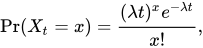
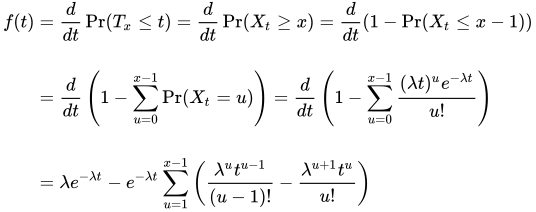
where λ is the average number of occurrences in any time interval of length 1. Observe that the event {Xt ≥ x} is the same as the event {Txt}, and thus they have the same probability. Intuitively, if something occurs at least times before time , we have to wait at most for the occurrence. The density function we seek is therefore

The sum telescopes, leaving
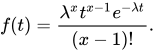
For other applications, see:

[edit]

A telescoping product is a finite product (or the partial product of an infinite product) that can be canceled by the method of quotients to be eventually only a finite number of factors.[7][8] It is the finite products in which consecutive terms cancel denominator with numerator, leaving only the initial and final terms. Let be a sequence of numbers. Then, If converges to 1, the resulting product gives:

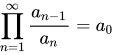
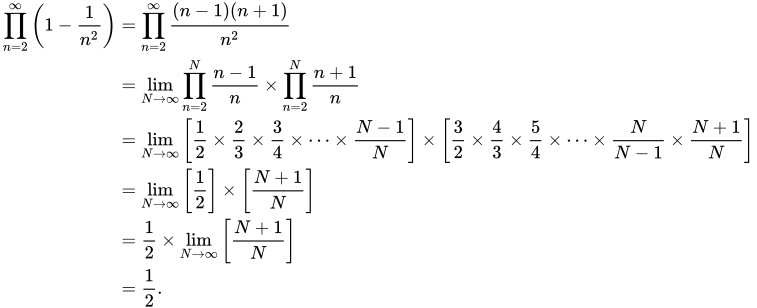
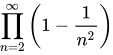
For example, the infinite product[7] simplifies as
References

[edit]
Revisions and contributorsEdit on WikipediaRead on Wikipedia
from Grokipedia
A telescoping series is an infinite series in whose partial sums simplify dramatically due to the cancellation of most intermediate terms, typically leaving only a finite number of non-canceling terms that determine the sum's behavior. This cancellation often arises when the general term is expressed as a difference, such as unun+1u_n - u_{n+1}, where unu_n is a . The partial sum sn=k=1n(ukuk+1)=u1un+1s_n = \sum_{k=1}^n (u_k - u_{k+1}) = u_1 - u_{n+1}, and the series converges if and only if limnun+1\lim_{n \to \infty} u_{n+1} exists and is finite. Telescoping series are a special class of series studied in , distinct from geometric or p-series, as they lack a fixed form but are identifiable by rewriting terms via partial fractions or other decompositions to reveal the telescoping structure. Not all series amenable to partial fractions are telescoping; cancellation must occur across consecutive terms for the partial sums to collapse effectively. The convergence of such a series is straightforward once the partial sum is found, as it reduces to evaluating the limit of the remaining terms, providing an exact sum without relying on tests like the or test. A classic example is the series n=11n(n+1)\sum_{n=1}^\infty \frac{1}{n(n+1)}, which decomposes via partial fractions as n=1(1n1n+1)\sum_{n=1}^\infty \left( \frac{1}{n} - \frac{1}{n+1} \right). The partial sum is sn=11n+1s_n = 1 - \frac{1}{n+1}, so the infinite sum converges to 1. Another example is n=1(1n1n+2)\sum_{n=1}^\infty \left( \frac{1}{n} - \frac{1}{n+2} \right), where the partial sum sn=1+121n+11n+2s_n = 1 + \frac{1}{2} - \frac{1}{n+1} - \frac{1}{n+2} converges to 32\frac{3}{2}. Divergent cases, like n=1(n(n+1))=n=1(1)\sum_{n=1}^\infty (n - (n+1)) = \sum_{n=1}^\infty (-1), show partial sums sn=ns_n = -n that grow without bound. These series are valuable in for computing exact values of sums that might otherwise require more advanced techniques, and they extend to applications in , such as estimating remainders in approximations, and in systems through methods like creative telescoping for evaluating definite sums of rational functions. The concept, with roots in 17th-century Italian , underscores the power of algebraic manipulation in series .

Definition and Properties

Formal Definition

A telescoping series is a type of infinite series in where the general term is expressed as the difference of two consecutive terms from an auxiliary , enabling extensive cancellation when forming partial sums. This structure arises naturally in various contexts, such as partial fraction decompositions or differences of functions, and is fundamental to simplifying the evaluation of certain series sums. Formally, a telescoping series is given by k=1uk\sum_{k=1}^\infty u_k, where each term satisfies uk=bkbk+1u_k = b_k - b_{k+1} for some {bk}k=1\{b_k\}_{k=1}^\infty. This representation assumes familiarity with standard infinite series notation, where the series is the limit of partial sums as the number of terms approaches . The distinguishing feature of such a series is its cancellation property, which contrasts with arbitrary infinite series by allowing the partial sum up to nn terms to reduce to b1bn+1b_1 - b_{n+1}, leaving only the initial and final terms uncanceled. This telescoping effect highlights the series' utility in , though the explicit simplification of partial sums is explored further in related discussions.

Partial Sum Simplification

In a telescoping series, the general term takes the form uk=bkbk+1u_k = b_k - b_{k+1}, as established in the formal definition. The partial sum Sn=k=1nukS_n = \sum_{k=1}^n u_k simplifies dramatically through term cancellation, yielding a that reveals the series' structure. To derive this, expand the sum explicitly: Sn=(b1b2)+(b2b3)+(b3b4)++(bnbn+1).S_n = (b_1 - b_2) + (b_2 - b_3) + (b_3 - b_4) + \cdots + (b_n - b_{n+1}). Each positive bkb_k for k2k \geq 2 cancels with the preceding negative bk-b_k, leaving only the uncanceled terms b1b_1 and bn+1-b_{n+1}. Thus, Sn=b1bn+1.S_n = b_1 - b_{n+1}. This cancellation illustrates the telescoping effect: writing out the first few partial sums shows the pattern clearly, S1=b1b2,S2=b1b3,S3=b1b4,S_1 = b_1 - b_2, \quad S_2 = b_1 - b_3, \quad S_3 = b_1 - b_4, where each subsequent sum drops an additional intermediate term, progressively exposing the remainder. The term bn+1b_{n+1} serves as the non-canceled tail or remainder in the partial sum, representing the contribution from terms beyond nn. For the infinite series, if limmbm=L\lim_{m \to \infty} b_m = L exists as a finite value, the sum is given by k=1uk=b1L.\sum_{k=1}^\infty u_k = b_1 - L. This follows directly from taking the limit of the partial sum formula as nn \to \infty.

Examples

Finite Cases

A fundamental example of a finite telescoping series is the sum of the first n natural numbers, k=1nk=n(n+1)2.\sum_{k=1}^n k = \frac{n(n+1)}{2}. This can be expressed in telescoping form using binomial coefficients, since (k+12)(k2)=k.\binom{k+1}{2} - \binom{k}{2} = k. Thus, the sum becomes k=1n((k+12)(k2))=(n+12)(12)=n(n+1)2,\sum_{k=1}^n \left( \binom{k+1}{2} - \binom{k}{2} \right) = \binom{n+1}{2} - \binom{1}{2} = \frac{n(n+1)}{2}, where (12)=0.\binom{1}{2} = 0. This derivation follows from the hockey-stick identity, k=rn(kr)=(n+1r+1),\sum_{k=r}^n \binom{k}{r} = \binom{n+1}{r+1}, applied with r=1. To demonstrate exact cancellation, consider the basic arithmetic example for n=5: k=15k=k=15((k+12)(k2))=((22)(12))+((32)(22))+((42)(32))+((52)(42))+((62)(52))=(62)(12)=150=15.\sum_{k=1}^5 k = \sum_{k=1}^5 \left( \binom{k+1}{2} - \binom{k}{2} \right) = \left( \binom{2}{2} - \binom{1}{2} \right) + \left( \binom{3}{2} - \binom{2}{2} \right) + \left( \binom{4}{2} - \binom{3}{2} \right) + \left( \binom{5}{2} - \binom{4}{2} \right) + \left( \binom{6}{2} - \binom{5}{2} \right) = \binom{6}{2} - \binom{1}{2} = 15 - 0 = 15. The intermediate terms cancel completely, yielding the closed form. Another illustrative example is the finite geometric series, k=0n1rk=1rn1r\sum_{k=0}^{n-1} r^k = \frac{1 - r^n}{1 - r} for r1r \neq 1. To view it as telescoping, note that rk=rkrk+11r,r^k = \frac{r^k - r^{k+1}}{1 - r}, so the sum is 11rk=0n1(rkrk+1)=1rn1r,\frac{1}{1 - r} \sum_{k=0}^{n-1} (r^k - r^{k+1}) = \frac{1 - r^n}{1 - r}, where most terms cancel, leaving the first term 1 and the negative of the last term -r^n.

Infinite Cases

In infinite telescoping series, the partial sums often simplify to a finite number of terms plus a remainder that vanishes in the limit as the number of terms approaches , allowing evaluation of the infinite sum through limiting processes. A classic example is the series k=1(1k1k+1)\sum_{k=1}^{\infty} \left( \frac{1}{k} - \frac{1}{k+1} \right). The partial sum up to nn terms is sn=11n+1s_n = 1 - \frac{1}{n+1}, which telescopes by cancellation of intermediate terms, and the infinite sum is limnsn=1\lim_{n \to \infty} s_n = 1. Another example is n=1(1n1n+2)\sum_{n=1}^\infty \left( \frac{1}{n} - \frac{1}{n+2} \right), where the partial sum sn=1+121n+11n+2s_n = 1 + \frac{1}{2} - \frac{1}{n+1} - \frac{1}{n+2} converges to 32\frac{3}{2}. A divergent case is n=1(n(n+1))=n=1(1)\sum_{n=1}^\infty (n - (n+1)) = \sum_{n=1}^\infty (-1), where the partial sums are sn=ns_n = -n, which diverge to -\infty. For the , the partial sums of k=11k2\sum_{k=1}^{\infty} \frac{1}{k^2} can be evaluated using a telescoping series derived from partial fraction decompositions involving , leading to the sum π26\frac{\pi^2}{6}, though the full proof relies on additional .

Convergence Analysis

Convergence Criteria

A telescoping series of the form k=1(bkbk+1)\sum_{k=1}^\infty (b_k - b_{k+1}) converges if and only if the sequence {bk}\{b_k\} converges to a finite limit LL. The partial sum of the series is given by sn=k=1n(bkbk+1)=b1bn+1s_n = \sum_{k=1}^n (b_k - b_{k+1}) = b_1 - b_{n+1}. Taking the limit as nn \to \infty, if limnbn=L\lim_{n \to \infty} b_n = L, then limnsn=b1L\lim_{n \to \infty} s_n = b_1 - L, establishing the sum of the series. This follows directly from the definition of convergence of the partial sums. More generally, for telescoping series where partial sums leave a fixed finite number of non-canceling terms (e.g., initial terms minus a fixed number of tail terms), the series converges if and only if the limit of those tail terms exists and is finite. Regarding , the series bkbk+1\sum |b_k - b_{k+1}| converges if the bkbk+1\sum |b_k - b_{k+1}| is finite, which implies the original series converges but requires a stronger condition on the sequence {bk}\{b_k\}. Many telescoping series converge conditionally, meaning they converge due to cancellations in the partial sums, but the absolute series bkbk+1\sum |b_k - b_{k+1}| diverges, often behaving like a divergent p-series with p=1. If the limit limkbk\lim_{k \to \infty} b_k does not exist or is infinite, the series diverges. For instance, when bk=lnkb_k = \ln k, which diverges to \infty, the partial sum sn=ln1ln(n+1)=ln(n+1)s_n = \ln 1 - \ln (n+1) = -\ln (n+1) tends to -\infty, confirming divergence, analogous to the harmonic series.

Sum Evaluation Techniques

One primary technique for evaluating telescoping series involves , which rewrites terms as differences that facilitate cancellation in partial sums. For instance, consider the general term 1k(k+1)\frac{1}{k(k+1)}, which decomposes as 1k1k+1\frac{1}{k} - \frac{1}{k+1}. The partial sum then simplifies to k=1n(1k1k+1)=11n+1\sum_{k=1}^n \left( \frac{1}{k} - \frac{1}{k+1} \right) = 1 - \frac{1}{n+1}, and for the infinite series, the sum is 1 provided the limit of the remainder vanishes. This method extends to higher-degree s, such as 1k(k+1)(k+2)\frac{1}{k(k+1)(k+2)}, by decomposing into partial fractions like 12(1k(k+1)1(k+1)(k+2))\frac{1}{2} \left( \frac{1}{k(k+1)} - \frac{1}{(k+1)(k+2)} \right), yielding a telescoping form after repeated application. For series involving powers, a related approach uses differences of powers or approximations derived from them to create telescoping structures, particularly for bounding or exact evaluation in select cases. Specifically, for the Basel problem series 1k2\sum \frac{1}{k^2}, note that 1k(k1)=1k11k\frac{1}{k(k-1)} = \frac{1}{k-1} - \frac{1}{k} for k2k \geq 2, which telescopes to provide an upper bound: k=21k2<k=21k(k1)=1\sum_{k=2}^\infty \frac{1}{k^2} < \sum_{k=2}^\infty \frac{1}{k(k-1)} = 1, so the full sum is less than 2; exact evaluation requires additional methods like Fourier series, but this difference highlights the telescoping utility for rational approximations to power terms. Exact telescoping occurs in cases like geometric series variants, where terms like rkr^k can be expressed as differences such as rkrk+m1rm\frac{r^k - r^{k+m}}{1 - r^m} for integer mm, collapsing the sum directly. Integral representations offer another strategy to express series terms as differences, enabling summation by interchanging sums and when justified. A fundamental identity is 1k=01xk1dx\frac{1}{k} = \int_0^1 x^{k-1} \, dx for positive integers kk, which can be adapted for telescoping by writing differences like 1k(k+1)=01xk1(1x)dx\frac{1}{k(k+1)} = \int_0^1 x^{k-1} (1 - x) \, dx, transforming the series into an of a that evaluates explicitly. This approach is particularly useful for harmonic-like terms, where the partial sum becomes k=1n01(xk1xk)dx=011xn1xdx\sum_{k=1}^n \int_0^1 (x^{k-1} - x^k) \, dx = \int_0^1 \frac{1 - x^n}{1 - x} \, dx, simplifying to a logarithmic form in the limit. To systematically rewrite a series as telescoping, follow an algorithmic process akin to finding a discrete antiderivative bkb_k such that ak=bkbk+1a_k = b_k - b_{k+1}. First, inspect the general term aka_k; for rational functions, apply to express it as a sum of simpler differences. If not immediately apparent, attempt , treating the series like a discrete where bkb_k is the "antidifference," verified by differencing: compute bkbk+1b_k - b_{k+1} and match to aka_k. For the partial sum, this yields k=1nak=b1bn+1\sum_{k=1}^n a_k = b_1 - b_{n+1}; the infinite sum is b1limnbn+1b_1 - \lim_{n \to \infty} b_{n+1} if the limit exists. These techniques assume convergence, as non-vanishing limits would prevent finite summation.

Applications

In Calculus

In calculus, telescoping series play a key role in approximating sums through integrals and analyzing remainders in series expansions. One prominent application is in the Euler-Maclaurin formula, which relates definite integrals to sums by incorporating telescoping differences derived from antiderivatives and Bernoulli polynomials. The formula expresses a sum k=abf(k)\sum_{k=a}^{b} f(k) as abf(x)dx+f(a)+f(b)2+k=1mB2k(2k)!(f(2k1)(b)f(2k1)(a))+R\int_a^b f(x) \, dx + \frac{f(a) + f(b)}{2} + \sum_{k=1}^m \frac{B_{2k}}{(2k)!} (f^{(2k-1)}(b) - f^{(2k-1)}(a)) + R, where the Bernoulli numbers B2kB_{2k} arise from expansions that telescope higher-order corrections, enabling precise sum-integral approximations for smooth functions ff. This telescoping structure in the boundary terms simplifies error estimation and is derived by integrating by parts repeatedly, yielding a series of differences that cancel intermediate contributions. Telescoping series also appear in the analysis of remainders for Taylor series expansions, particularly for functions like the exponential and sine. Proofs of Taylor's theorem often use auxiliary functions and Rolle's theorem to isolate and bound the remainder Rn(x)R_n(x). For the exponential function exe^x, the Taylor series k=0xkk!\sum_{k=0}^\infty \frac{x^k}{k!} has a remainder that confirms convergence for all xx with Rn(x)ex(n+1)!xn+1|R_n(x)| \leq \frac{e^{|x|}}{(n+1)!} |x|^{n+1}. Similarly, for sinx=k=0(1)kx2k+1(2k+1)!\sin x = \sum_{k=0}^\infty (-1)^k \frac{x^{2k+1}}{(2k+1)!}, the remainder is bounded, ensuring the series equals sinx\sin x everywhere. Improper integrals over infinite domains can be represented as limits of telescoping sums via the fundamental theorem of calculus. Consider 1f(x)dx=limb1bf(x)dx\int_1^\infty f(x) \, dx = \lim_{b \to \infty} \int_1^b f(x) \, dx; if F(x)=f(x)F'(x) = f(x), then 1bf(x)dx=F(b)F(1)\int_1^b f(x) \, dx = F(b) - F(1). Discretizing the interval into unit lengths yields 1bf(x)dx=k=1n1kk+1f(x)dx=k=1n1(F(k+1)F(k))\int_1^b f(x) \, dx = \sum_{k=1}^{n-1} \int_k^{k+1} f(x) \, dx = \sum_{k=1}^{n-1} (F(k+1) - F(k)) for b=nb = n, a telescoping sum simplifying to F(n)F(1)F(n) - F(1). Taking the limit as nn \to \infty thus equates the improper integral to limn(F(n)F(1))\lim_{n \to \infty} (F(n) - F(1)), provided the limit exists, directly linking continuous integration to discrete telescoping structures. A notable application involves the , where telescoping series aid in evaluating n=11n2=π26\sum_{n=1}^\infty \frac{1}{n^2} = \frac{\pi^2}{6} through partial fraction decompositions in . The of x2x^2 on [π,π][-\pi, \pi] leads to coefficients involving 1n2\sum \frac{1}{n^2}, and applying yields the sum; however, an elementary approach uses on integrals involving powers of cosine to express the partial sum as k=1n1k2=π262Bn/An\sum_{k=1}^n \frac{1}{k^2} = \frac{\pi^2}{6} - 2B_n/A_n, where the remainder term telescopes and is bounded by π2/(4(n+1))\pi^2/(4(n+1)), confirming the infinite sum equals π26\frac{\pi^2}{6}.

In Discrete Structures

Telescoping series find significant applications in , particularly in and algorithm , where they simplify sums arising from recursive structures and counting problems. In these contexts, telescoping often leverages identities derived from binomial coefficients or recurrence relations to evaluate partial sums efficiently without exhaustive computation. In , telescoping series are instrumental in proving identities involving , such as the hockey-stick identity, which states that the sum of along a diagonal in equals another : k=rn(kr)=(n+1r+1).\sum_{k=r}^{n} \binom{k}{r} = \binom{n+1}{r+1}. This identity arises from the telescoping nature of Pascal's recurrence (kr)=(k1r)+(k1r1)\binom{k}{r} = \binom{k-1}{r} + \binom{k-1}{r-1}, rearranged as (kr)(k1r)=(k1r1)\binom{k}{r} - \binom{k-1}{r} = \binom{k-1}{r-1}. Summing from k=rk = r to nn yields a telescoping series where most terms cancel, leaving the right-hand side. The proof relies on this cancellation, providing a direct algebraic verification of combinatorial equalities without induction. For solving recurrence relations in discrete structures, telescoping series offer closed-form solutions to linear recurrences. A classic example is the sum of the first nn numbers, defined by F1=1F_1 = 1, F2=1F_2 = 1, and Fm=Fm1+Fm2F_m = F_{m-1} + F_{m-2} for m3m \geq 3. Using the recurrence, Fk=Fk+2Fk+1F_k = F_{k+2} - F_{k+1}, the sum k=1nFk\sum_{k=1}^n F_k becomes a telescoping series: k=1nFk=k=1n(Fk+2Fk+1)=Fn+2F2=Fn+21.\sum_{k=1}^n F_k = \sum_{k=1}^n (F_{k+2} - F_{k+1}) = F_{n+2} - F_2 = F_{n+2} - 1. This telescoping form simplifies the evaluation, revealing the sum as Fn+21F_{n+2} - 1, which is essential for analyzing sequences in combinatorial problems and dynamic programming. In , telescoping differences facilitate path counting in grid graphs, where vertices represent lattice points and edges connect adjacent points. The number of paths from the origin to a point (n,m)(n, m) in an n×mn \times m grid equals (n+mn)\binom{n+m}{n}, but summing paths across levels or avoiding barriers often requires telescoping sums of binomial coefficients. The hockey-stick identity applies here, as the total paths to points on a diagonal sum to the paths to the next level, enabling efficient computation of path aggregates in grid-based graphs without enumerating each route. For instance, the cumulative paths up to row kk telescope via the identity to (k+1r+1)\binom{k+1}{r+1}, aiding analysis of connectivity and routing in discrete grid structures. Algorithmic efficiency in divide-and-conquer paradigms, such as merge sort, relies on telescoping sums to bound recurrence costs. The merge sort recurrence is T(n)=2T(n/2)+Θ(n)T(n) = 2T(n/2) + \Theta(n), with T(1)=Θ(1)T(1) = \Theta(1). Dividing by nn yields T(n)/n=T(n/2)/(n/2)+1T(n)/n = T(n/2)/(n/2) + 1, forming a telescoping sum over logn\log n levels: T(n)n=1+T(n/2)n/2=1+1+T(n/4)n/4==i=0logn11=Θ(logn).\frac{T(n)}{n} = 1 + \frac{T(n/2)}{n/2} = 1 + 1 + \frac{T(n/4)}{n/4} = \cdots = \sum_{i=0}^{\log n - 1} 1 = \Theta(\log n). Thus, T(n)=Θ(nlogn)T(n) = \Theta(n \log n), quantifying the sorting cost through cancellation in the summed terms, which extends to analyzing other recursive algorithms like binary search trees.

Partial Fraction Decomposition

Partial fraction decomposition is a fundamental algebraic technique for expressing a , defined as the quotient of two polynomials P(x)/Q(x)P(x)/Q(x) where the degree of P(x)P(x) is less than that of Q(x)Q(x), as a sum of simpler fractions with linear or quadratic denominators. This decomposition is essential for evaluating sums of series involving rational terms, as it breaks down complex expressions into forms amenable to summation. In the context of telescoping series, reveals structures where the general term can be written as a difference, such as AxkAxk1\frac{A}{x - k} - \frac{A}{x - k - 1}, allowing most intermediate terms to cancel in the partial sum, leaving only boundary terms. This cancellation property simplifies the computation of both finite and infinite sums, particularly for hyperharmonic series derived from rational functions. A representative example illustrates this connection: consider the rational term 1k(k+m)\frac{1}{k(k + m)} for positive integer mm. Its partial fraction decomposition yields 1k(k+m)=1m(1k1k+m).\frac{1}{k(k + m)} = \frac{1}{m} \left( \frac{1}{k} - \frac{1}{k + m} \right). Summing from k=1k = 1 to nn, the series telescopes to k=1n1k(k+m)=1mk=1n(1k1k+m)=1m(k=1m1kk=n+1n+m1k),\sum_{k=1}^n \frac{1}{k(k + m)} = \frac{1}{m} \sum_{k=1}^n \left( \frac{1}{k} - \frac{1}{k + m} \right) = \frac{1}{m} \left( \sum_{k=1}^m \frac{1}{k} - \sum_{k=n+1}^{n+m} \frac{1}{k} \right), which approaches Hmm\frac{H_m}{m} as nn \to \infty, where HmH_m is the mm-th harmonic number, highlighting the link to harmonic-like sums. The method originated in the early 18th century, independently developed by and in 1702 primarily for integrating rational functions, and later adapted for discrete summation in series analysis.

Generating Functions and Series

Ordinary generating functions encode sequences into , facilitating manipulations that reveal structural properties, with telescoping series enabling efficient coefficient extraction. The ordinary generating function for a {an}n=0\{a_n\}_{n=0}^\infty is defined as G(x)=n=0anxnG(x) = \sum_{n=0}^\infty a_n x^n, where the determines the domain of analyticity. Telescoping series contribute by simplifying the partial sums Sn=k=0nakS_n = \sum_{k=0}^n a_k, often reducing them to boundary terms like Sn=bnb0S_n = b_n - b_0, which corresponds to operations on G(x)G(x) such as division by 1x1 - x to obtain the generating function for the cumulative sums. This interplay allows for algebraic resolution of recurrence relations embedded in the series. The difference operator Δf(n)=f(n+1)f(n)\Delta f(n) = f(n+1) - f(n) bridges telescoping sums directly to s, as the for the sequence {Δan}\{\Delta a_n\} is G(x)a0xG(x)\frac{G(x) - a_0}{x} - G(x). Applying the operator to differences yields telescoping behavior: k=mn1Δf(k)=f(n)f(m)\sum_{k=m}^{n-1} \Delta f(k) = f(n) - f(m), providing closed forms for indefinite sums analogous to integration in continuous . In the framework, repeated applications of Δ\Delta (higher-order differences) produce polynomial sequences whose s are rational, aiding in the inversion and manipulation of for combinatorial identities. An illustrative example arises in enumerating permutations via exponential s, where telescoping inclusions via the inclusion-exclusion principle simplify the count of derangements (permutations with no fixed points). The exponential for derangements is n=0dnxnn!=ex1x\sum_{n=0}^\infty d_n \frac{x^n}{n!} = \frac{e^{-x}}{1-x}, derived from the inclusion-exclusion formula dn=n!k=0n(1)kk!d_n = n! \sum_{k=0}^n \frac{(-1)^k}{k!}, which telescopes by successively adding and subtracting contributions from permutations with specified fixed points, collapsing the alternating sum into the exponential form. This approach highlights how telescoping resolves overcounting in set partitions underlying permutation structures. Telescoping series generalize to infinite products as limits of finite products with canceling factors, particularly in representing entire functions via Weierstrass products. For instance, the sine function admits the infinite product sin(πx)=πxn=1(1x2n2)\sin(\pi x) = \pi x \prod_{n=1}^\infty \left(1 - \frac{x^2}{n^2}\right), where partial products k=1n(1x2k2)=Γ(n+1+x)Γ(n+1x)Γ(n+1)2 Γ(1+x)Γ(1x)\prod_{k=1}^n \left(1 - \frac{x^2}{k^2}\right) = \frac{\Gamma(n+1+x) \Gamma(n+1-x)}{\Gamma(n+1)^2 \ \Gamma(1+x) \Gamma(1-x)} exhibit telescoping cancellation in the gamma function ratios, converging to the canonical form as nn \to \infty since Γ(n+1+x)Γ(n+1x)Γ(n+1)21\frac{\Gamma(n+1+x) \Gamma(n+1-x)}{\Gamma(n+1)^2} \to 1.

References

Add your contribution
Related Hubs
User Avatar
No comments yet.