Hubbry Logo
Pre-Pottery Neolithic APre-Pottery Neolithic AMain
Open search
Pre-Pottery Neolithic A
Community hub
Pre-Pottery Neolithic A
logo
8 pages, 0 posts
0 subscribers
Be the first to start a discussion here.
Pre-Pottery Neolithic A
from Wikipedia

Pre-Pottery Neolithic A
The ruins of Göbekli Tepe, c. 9,000 BCE
Geographical rangeNear East
PeriodPre-Pottery Neolithic
Datesc. 10,000 – c. 8,800 BCE[1]
Type siteJericho
Preceded byKhiamian, Harifian
Followed byPre-Pottery Neolithic B, Neolithic Greece, Faiyum A culture

Pre-Pottery Neolithic A (PPNA) denotes the first stage of the Pre-Pottery Neolithic, in early Levantine and Anatolian Neolithic culture, dating to c. 12,000 – c. 10,800 years ago, that is, 10,000–8800 BCE.[1][2][3] Archaeological remains are located in the Levantine and Upper Mesopotamian region of the Fertile Crescent.

The time period is characterized by tiny circular mud-brick dwellings, the cultivation of crops, the hunting of wild game, and unique burial customs in which bodies were buried below the floors of dwellings.[4]

The Pre-Pottery Neolithic A and the following Pre-Pottery Neolithic B (PPNB) were originally defined by Kathleen Kenyon in the type site of Jericho, State of Palestine. During this time, pottery was not yet in use. They precede the ceramic Neolithic Yarmukian culture. PPNA succeeds the Natufian culture of the Epipalaeolithic Near East.

Settlements

[edit]
Evolution of temperatures in the Post-Glacial period according to Greenland ice cores. The Pre-Pottery Neolithic corresponds to the period of warming of the Holocene.[5]
Calibrated Carbon 14 dates for Gesher, the earliest known Neolithic site as of 2013.[6]
Reliefs of animals, Göbekli Tepe Layer III (Pre-Pottery Neolithic A), c. 9000 BCE.

PPNA archaeological sites are much larger than those of the preceding Natufian hunter-gatherer culture, and contain traces of communal structures, such as the famous Tower of Jericho. PPNA settlements are characterized by round, semi-subterranean houses with stone foundations and terrazzo-floors.[7] The upper walls were constructed of unbaked clay mudbricks with plano-convex cross-sections. The hearths were small and covered with cobbles. Heated rocks were used in cooking, which led to an accumulation of fire-cracked rock in the buildings, and almost every settlement contained storage bins made of either stones or mud-brick.

As of 2013, Gesher, modern Israel, became the earliest known of all known Neolithic sites (PPNA), with a calibrated Carbon 14 date of 10,459 BCE ± 348 years, analysis suggesting that it may have been the starting point of a Neolithic Revolution.[8] A contemporary site is Mureybet in modern Syria.[8]

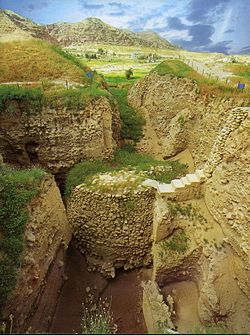
One of the most notable PPNA settlements is Jericho, thought to be the world's first town (c. 9,000 BCE).[9] The PPNA town contained a population of up to 2–3000 people and was protected by a massive stone wall and tower. There is much debate over the function of the wall, for there is no evidence of any serious warfare at this time.[10] One possibility is the wall was built to protect the salt resources of Jericho.[11] It has also been proposed that the tower caught the shadow of the largest nearby mountain on summer solstice in order to create a sense of power in support of whatever hierarchy ruled the town's inhabitants.[12]

Burial practices

[edit]

PPNA cultures are unique for their burial practices, and Kenyon (who excavated the PPNA level of Jericho) characterized them as "living with their dead". Kenyon found no fewer than 279 burials, below floors, under household foundations, and in between walls.[16] In the PPNB period, skulls were often dug up and reburied, or mottled with clay and (presumably) displayed.

Lithics

[edit]

The lithic industry is based on blades struck from regular cores. Sickle-blades and arrowheads continue traditions from the late Natufian culture, transverse-blow axes and polished adzes appear for the first time.[17]

Crop cultivation and granaries

[edit]
Map of the world showing approximate centers of the Neolithic Revolution and the spread of agriculture in prehistory: the Fertile Crescent (c. 11,000 BP), the Yangtze and Yellow River basins (c. 9,000 BP), the New Guinea Highlands (c. 9,000 – c. 6,000 BP), Central Mexico (c. 5,000 – c. 4,000 BP), Northern South America (c. 5,000 – c. 4,000 BP), sub-Saharan Africa (c. 5,000 – c. 4,000 BP, exact location unknown), eastern North America (c. 4,000 – c. 3,000 BP).[18]

Sedentism of this time allowed for the cultivation of local grains, such as barley and wild oats, and for storage in granaries. Sites such as Dhra′ and Jericho retained a hunting lifestyle until the PPNB period, but granaries allowed for year-round occupation.[19]

This period of cultivation is considered "pre-domestication", but may have begun to develop plant species into the domesticated forms they are today. Deliberate, extended-period storage was made possible by the use of "suspended floors for air circulation and protection from rodents". This practice "precedes the emergence of domestication and large-scale sedentary communities by at least 1,000 years".[2]

Granaries are positioned in places between other buildings early on c. 11,500 BP, however, beginning around 10,500 BP, they were moved inside houses, and by 9,500 BP, storage occurred in special rooms.[2] This change might reflect changing systems of ownership and property as granaries shifted from communal use and ownership to become under the control of households or individuals.[2]

It has been observed of these granaries that their "sophisticated storage systems with subfloor ventilation are a precocious development that precedes the emergence of almost all of the other elements of the Near Eastern Neolithic package—domestication, large scale sedentary communities, and the entrenchment of some degree of social differentiation". Moreover, "building granaries may [...] have been the most important feature in increasing sedentism that required active community participation in new life-ways".[2]

Regional variants

[edit]

Göbekli Tepe animal sculpture, c. 9000 BCE

With more sites becoming known, archaeologists have defined a number of regional variants of Pre-Pottery Neolithic A:

Relative chronology

[edit]

See also

[edit]

References

[edit]

Further reading

[edit]
Revisions and contributorsEdit on WikipediaRead on Wikipedia
from Grokipedia
The Pre-Pottery Neolithic A (PPNA) represents the initial phase of the period in Southwest Asia, spanning approximately 9600 to 8500 BCE, and is defined by the transition from mobile Epipaleolithic lifeways to sedentary village communities without the use of pottery. This era, succeeding the , is marked by early experiments in plant cultivation, intensive wild resource exploitation, and the development of permanent architecture using mud-brick and stone. Centered primarily in the , with extensions into northern and southeastern , the PPNA laid foundational elements for later expansions, including social complexity and symbolic behaviors evident in monumental constructions and burial practices. Key PPNA settlements, such as in the , demonstrate advanced communal efforts through features like a 8.5-meter-high stone tower and enclosing wall, likely serving defensive or ritual purposes, alongside round houses built from mud-brick on stone foundations. Other prominent sites include Netiv Hagdud and I in the heartland, where evidence of granaries points to organized storage of harvested wild cereals, and in southeastern , renowned for its large T-shaped pillars arranged in circular enclosures, suggesting early ritual or ceremonial activities predating widespread . These sites reveal a of regional variations, with lithic industries featuring microliths, blades for harvesting, and naviform cores for blade production, reflecting adaptations to diverse environments from riverine oases to arid steppes. Economically, PPNA societies relied on a mixed subsistence strategy, emphasizing the gathering and possible low-level cultivation of wild emmer wheat, , and , supplemented by , deer, and other game, with no clear evidence of animal until later phases. was sophisticated for its time, including ground stone tools for processing plants, for floors and early vessels, and rare clay or stone figurines possibly linked to or symbolism. customs, such as subfloor inhumations and skull removal for potential , hint at emerging social structures and beliefs in ancestor veneration, underscoring the PPNA's role as a pivotal bridge between and farming societies.

Chronology and Overview

Definition and Characteristics

The (PPNA) constitutes the initial phase of the in the , spanning approximately 9,600–8,500 cal BCE, and is defined by the onset of , rudimentary plant cultivation, and the complete absence of vessels for storage or cooking. This period marks a pivotal shift in societies from the economies of the late Epipaleolithic to more stable, village-based communities reliant on managed resources. from multiple Levantine sites, calibrated against dendrochronological sequences, establishes these temporal limits, with early dates clustering around 10,500 cal BCE at northern sites like and later ones in the southern Levant approaching 8,500 cal BCE. Central characteristics of the PPNA include the development of semi-sedentary villages, where populations transitioned from seasonal mobility to year-round occupation, supported by intensive gathering of wild cereals and early cultivation efforts involving species such as wild and emmer . Subsistence emphasized exploitation of wild and , with emerging evidence of , such as grinding tools for processing seeds, though full remained incipient. Monumental also appeared, featuring large communal structures that suggest organized labor and possible functions, distinguishing PPNA communities from their more dispersed predecessors. The PPNA differs from the preceding Natufian culture (ca. 12,500–9,500 cal BCE) through larger, more permanent settlements and the widespread adoption of ground stone tools for food processing, reflecting heightened reliance on plant resources. In contrast to the succeeding Pre-Pottery Neolithic B (ca. 8,800–6,500 cal BCE), the PPNA lacks ceramic technology, exhibits fewer signs of animal domestication, and displays simpler social organization without the rectangular multi-room houses or advanced symbolic systems of later phases. These traits highlight the PPNA as a foundational stage in the Neolithic transition, bridging foraging and farming lifeways.

Relative Chronology

The Pre-Pottery Neolithic A (PPNA) follows the (ca. 12,500–9,500 BCE) and precedes the (PPNB, ca. 8,800–6,500 BCE), marking a transitional phase in Near Eastern prehistory during the early and the recovery from the climatic event. This positioning is established through stratigraphic sequences at key sites and calibrated radiocarbon dates, which indicate an onset around 10,500 BCE in and northern areas, with the southern Levant around 9,600 BCE. Internally, the PPNA is often divided into an Early phase (sometimes termed Khiamian, ca. 10,500–10,000 BCE) and a Late phase (Sultanian, ca. 10,000–9,500 BCE), primarily based on lithic typologies and site reflecting evolutionary changes in tool production. The Early phase features higher frequencies of microliths and El-Khiam points, as seen in assemblages from sites like El-Khiam and Nahal Oren, while the Late phase shows a shift toward increased core tools, fewer microliths, and the appearance of bidirectional blade production, evident in Jericho's stratified layers. These distinctions arise from comparative analyses of and retouched tools, though stratigraphic integrity varies, with some sites like Netiv Hagdud exhibiting mixed traits that blur phase boundaries. Absolute chronology for the PPNA relies on (AMS) of short-lived organic materials, such as seeds and , calibrated using curves like IntCal20 to account for atmospheric variations. At Mureybet in northern , for instance, PPNA levels (Phases IB–IIA) yield calibrated dates of 10,200–9,800 BCE, confirming early sedentary occupation with round houses and providing a northern Levantine benchmark. Similarly, Tell Qaramel's horizons H2–H4 in date to 10,670–8,780 cal BCE, supporting a continuous sequence from proto-Neolithic precursors. Correlations across regions highlight the PPNA's role in the broader transition, with lithic similarities linking Levantine sites like to Mesopotamian ones like Nemrik 9 (ca. 10,150–10,000 BP), suggesting during post-Younger Dryas warming. However, debates persist on synchronicity, as radiocarbon plateaus around 10,000–9,500 BCE compress timelines and hinder precise phasing, particularly in the southern Levant where site abandonment gaps appear between PPNA and early PPNB. Bayesian statistical modeling, applied to datasets from sites like WF16 in , refines these chronologies by incorporating stratigraphic priors and old-wood effects, estimating occupation spans of 200–300 years and reducing uncertainties to ±50 years for key transitions. Such approaches underscore regional asynchronies, with northern sites like Mureybet potentially predating southern ones by 200–400 years.

Environmental and Geographical Context

Climate Changes

The onset of the Pre-Pottery Neolithic A (PPNA) coincided with the post- warming period, beginning around 9,600 BCE (11,600 cal ), which brought a marked increase in temperature and precipitation across the . This climatic shift transitioned the region from the cold, arid conditions of the Younger Dryas to warmer, moister environments, fostering the expansion of woodlands and wetlands that supported greater ecological productivity. Paleoenvironmental evidence from pollen cores in the Dead Sea, Lake Hula, and the Ghab Valley corroborates this warming, revealing a significant expansion of indicative of elevated rainfall and milder temperatures during the early . For instance, pollen records from Lake Hula and the Ghab show rising percentages of (Quercus) and (Pistacia) pollen starting around 11,000 cal , signaling the recovery and spread of open woodlands in previously stressed landscapes. Complementing this botanical data, faunal remains from PPNA contexts, such as waterfowl and freshwater gastropods in the , point to the development of wetlands and wetter local conditions that enhanced resource availability. These environmental improvements facilitated human adaptations by increasing the abundance of wild resources, which in turn enabled the emergence of and the proliferation of settlements around 9600 BCE (11,600 cal BP), marking the onset of the PPNA. The enhanced predictability of food plants and game in expanded riparian and zones reduced mobility needs, allowing communities to invest in permanent structures and early experimentation with cultivation. Regional variations in climate response were notable, with the northern Levant experiencing more consistent humidity and woodland expansion due to proximity to Mediterranean influences, while the southern Levant faced intermittent aridity despite overall wetting, as evidenced by fluctuating levels and sparser pollen signals. This gradient influenced the distribution of adaptive strategies, with northern areas supporting denser site clusters earlier in the PPNA.

Geographical Distribution

The Pre-Pottery Neolithic A (PPNA) period is primarily associated with the core region of the , encompassing the , , and coastal plains, where the majority of known sites are concentrated along the —a transitional zone between Mediterranean woodlands and steppic environments. This area, spanning modern-day , , , , and western , served as the heartland for early sedentary communities transitioning from Natufian traditions. Key PPNA sites in this core include and Netiv Hagdud in the , Nahal Oren along the coastal plains, and Gesher in the , reflecting a focus on resource-rich lowlands and riverine settings. Extensions of PPNA occupation radiate northward and eastward from this Levantine core, reaching the upper Valley in (e.g., Mureybet and Jerf el Ahmar) and southeast in (e.g., ), as well as isolated evidence in northern (e.g., Qermez Dere) and northwestern . Key environmental niches include oasis-like settlements in semi-arid zones such as the Jordanian highlands (e.g., el-Hemmeh and Kharaysin), riverine locations along the Jordan and rivers that supported early cultivation, and marginal upland areas in the hilly flanks of the . These distributions highlight adaptations to varied microenvironments, with sites often positioned near perennial water sources and fertile soils to facilitate plant and resource exploitation. Expansion patterns during the PPNA trace a northward and eastward dispersal from Natufian heartlands in the southern Levant, covering an approximate radius of 500 kilometers by the late phase, linking the Mediterranean zone to the Zagros foothills and n highlands. This spread, evident in the increasing number of sites from ca. 9600 to 8500 BCE, reflects movements and along natural corridors like river valleys, rather than uniform . Recent archaeological surveys, incorporating GIS mapping, have revealed higher site densities within the Fertile Crescent's core fertile zones—such as the and upper —contrasted with sparser evidence in arid peripheries like the Jordanian Badia and southeast n steppes, underscoring the role of environmental suitability in settlement placement. For instance, predictive GIS models in southeast identify clustered potential PPNA sites near water and , with lower densities in drier margins.

Settlements and Architecture

Major Settlements

The Pre-Pottery Neolithic A (PPNA) period is exemplified by several key settlements that provide critical evidence for the transition to in the and . Among these, at in the stands out as one of the earliest known proto-urban centers, dating to approximately 9600 BCE. The site features monumental defensive structures, including a massive stone tower and enclosing wall, which suggest organized communal labor and a defensive posture possibly linked to resource protection amid growing population pressures. Excavations began in the early , with John Garstang's campaigns from 1930 to 1936 uncovering Neolithic layers, though initial interpretations were limited by stratigraphic challenges; Kathleen Kenyon's systematic digs in the 1950s clarified the PPNA sequence, revealing dense clusters of round or oval houses built from mud-brick and stone. Population estimates for Jericho's PPNA phase, derived from house counts and refuse deposits, range from 200 to 3,000 inhabitants, indicating a shift from mobile hunter-gatherer bands to more permanent communities. These findings underscore Jericho's significance as a hub for early agricultural experimentation and social complexity. Further north, in southeastern represents a monumental ritual complex rather than a typical village, occupied from around 9500 BCE during the PPNA. The site is renowned for its circular enclosures containing large T-shaped limestone pillars, some up to 5.5 meters tall and adorned with anthropomorphic carvings of animals and abstract symbols, pointing to a focus on ceremonial gatherings that may have facilitated social cohesion among dispersed groups. Discovered in but systematically excavated starting in 1995 by Klaus Schmidt of the , the project has revealed at least 20 such enclosures, with ongoing work emphasizing the site's role in pre-domestic ritual practices. While not a residential settlement, population inferences from construction scale suggest seasonal assemblies of 100 to 500 individuals, based on labor requirements for pillar erection and maintenance. Recent geophysical surveys in the 2020s, including , have detected previously unexcavated rectangular structures interpreted as possible dwellings adjacent to the main enclosures; October 2025 surveys confirmed these as likely domestic structures, expanding our understanding of the site's multifunctional nature. In the Valley of northern , Mureybet serves as the type-site for the Mureybetian facies of the PPNA, with multi-phase occupation spanning circa 10,200 to 8600 BCE. This tell site illustrates a progression from Natufian encampments to more structured villages, evidenced by round-to-rectangular mud-brick houses and communal storage features that reflect emerging food management strategies. Excavations occurred between 1964 and 1974, initially directed by Maurits van Loon and later by Jacques Cauvin, whose work before the site's inundation by preserved a detailed stratigraphic record of the transition to . sizes are estimated at 100 to 300 residents during peak PPNA phases, inferred from the extent of domestic architecture and faunal remains indicating localized resource exploitation. Mureybet's significance lies in its documentation of regional cultural variability, bridging Levantine and Mesopotamian traditions through evidence of early wild cereal processing and .

Architectural Features

The architecture of the Pre-Pottery Neolithic A (PPNA) featured primarily round or oval houses built using mud-brick or pisé (tauf) materials, marking an early innovation in permanent construction. These dwellings were typically semisubterranean or at ground level, with internal diameters ranging from 5 to 10 meters, as exemplified by structures at where mud-brick walls formed freestanding enclosures. At , subterranean rooms adopted similar circular plans but incorporated larger-scale elements, with enclosures sunk into bedrock to depths exceeding 2 meters. This form allowed for stable, insulated interiors suited to the region's variable climate. Monumental elements distinguished PPNA architecture, including the earliest known freestanding tower at , which reached a height of 8.5 meters with a basal of 9 meters and dates to circa 8300 BCE. Constructed from undressed stone, the tower featured an internal for access, representing a significant labor in vertical . At , circular enclosures integrated megalithic T-shaped pillars, some over 5 meters tall and weighing up to 10 tons, arranged in rings within the subterranean spaces to define communal areas. These features highlight a capacity for large-scale stone quarrying and erection, predating similar developments elsewhere. Construction techniques emphasized layered mud-based materials for efficiency and durability. Walls were formed by applying pisé—a wet mud mixture of clay, , , and plant temper—in 10- to 15-centimeter layers over stone foundations, achieving thicknesses of about 20 centimeters and heights up to 1.6 meters above ground. Roofs consisted of timber rafters, reed matting, and mud overlay, while floors received multiple applications of mud-plaster, approximately 5 centimeters thick, to create smooth, waterproof surfaces resistant to moisture. Sun-dried mud-bricks, prefabricated for uniformity, further enabled this shift from earlier ephemeral structures to more robust forms. Spatial organization in PPNA settlements reflected emerging communal planning, with houses clustering around central monumental features over areas spanning or more. This arrangement, observed at sites like WF16, included diverse functional zones such as workshops and storage integrated into the layout, promoting social cohesion. Evidence of rebuilding cycles is evident in layered deposits and renewed floors, indicating sustained occupation and maintenance over generations, with each phase requiring substantial communal labor estimated at hundreds of person-hours per structure.

Subsistence Economy

Crop Cultivation and Storage

In the Pre-Pottery Neolithic A (PPNA), evidence for crop cultivation centers on the intensive management of wild cereals and legumes, marking a transitional phase toward . Key cultigens included wild wheat (Triticum dicoccoides), wild (Hordeum spontaneum), and wild lentils (Lens culinaris subsp. orientalis), with archaeobotanical remains from Levantine sites showing initial morphological changes such as slightly increased grain size and reduced natural shattering, indicative of pre- cultivation pressures. These changes suggest purposeful human intervention, such as protecting stands from competitors and harvesting at optimal times to encourage reseeding, rather than full domestication, which occurred later in the PPNB. Cultivation techniques in PPNA communities likely involved low-intensity methods like selective weeding and of natural wild stands, complemented by the use of s for harvesting. Microwear analysis on flint blades from sites like Nahal Hemar and Mureybet reveals gloss patterns consistent with cutting wild stems in semi-ripe stages, allowing for efficient collection from dense stands without uprooting. This approach facilitated intensive gathering, transitioning from opportunistic to managed exploitation, as evidenced by the abundance of remains exceeding what passive collection could yield. Storage innovations were crucial to this economic shift, enabling surplus retention and supporting sedentary lifestyles. At PPNA sites such as I and Dhra', subterranean pits and mud-plastered preserved wild , with I yielding over 260,000 wild grains in structures capable of holding substantial quantities—estimated at tens of kilograms per based on . These facilities, often circular and elevated on wooden frames to deter rodents, reflect organized measures. and starch analyses from grinding stones at Jerf el Ahmar further demonstrate processing intensity, with high concentrations (up to 940,000 phytoliths per gram) of barley silica bodies indicating repeated pounding and production, underscoring the role of plant resources in daily subsistence.

Animal Management and Hunting

In the Pre-Pottery Neolithic A (PPNA), faunal exploitation centered on hunting wild ungulates, with (Gazella gazella) emerging as the dominant prey species across Levantine sites. Deer (Dama mesopotamica) and (Bos primigenius) were also significant, reflecting a broad-spectrum adapted to oak-pistachio woodlands and environments. Age profiles from bones suggest opportunistic year-round procurement. Early signals of animal management appear in PPNA faunal records, particularly at the Turkish site of Hallan Çemi, where bone accumulation patterns—including clusters of articulated (Sus scrofa) carcasses and high densities of remains in specific activity areas—point to possible corralling or penning of wild progenitors. These patterns suggest an intermediate exploitation strategy between intensive and nascent , aimed at reducing resource unpredictability through localized control of pigs, though full remained absent in the PPNA. Similar evidence for wild goats (Capra aegagrus) is scarcer but inferred from dense bone deposits at other PPNA settlements, indicating experimental containment practices integrated into sedentary lifestyles. Hunting methods during the PPNA likely involved communal drive techniques, as evidenced by aggregated gazelle bone assemblages indicating coordinated group efforts using landscape features to channel prey. These strategies complemented gathering economies, providing bulk protein and hides while allowing flexibility amid environmental shifts. Specialized structures such as desert kites, though more securely dated to the subsequent PPNB, may represent an evolution of PPNA drive hunting for gazelle in arid peripheries. Recent stable nitrogen isotope analyses of faunal from PPNA contexts, such as Nachcharini Cave in , reveal diets consistent with wild herbivores foraging on C3 plants in montane zones, with δ¹⁵N values (around 5-7‰) indicating no significant herding-induced dietary shifts typical of managed animals. By the late PPNA, however, some assemblages show subtle variations in isotopic signatures suggestive of mixed wild and proximally managed populations, particularly for ovicaprids, hinting at proto-domestic practices before widespread herding in the PPNB.

Technology and Material Culture

Lithic Industry

The lithic industry of the Pre-Pottery Neolithic A (PPNA) represents a pivotal technological development in the , marking a shift from the microlithic traditions of the preceding Epipaleolithic to larger blade-based toolkits adapted to emerging sedentary lifestyles and early . This transition is evident in the production of elongated blades and points suitable for diverse functions, reflecting increased specialization in tool manufacture. Assemblages from PPNA sites typically comprise over 80% , with tools forming a smaller but diagnostically significant portion, emphasizing efficient exploitation. Core preparation in PPNA lithics centered on the naviform core technology, a boat-shaped reduction method that facilitated bidirectional blade removal from opposed platforms. This technique involved initial bifacial shaping of the core to create a crested ridge, followed by systematic blade detachment to yield straight-edged blanks up to 10-15 cm long. Pressure flaking, using a or tool to apply precise force, was a key innovation in this sequence, allowing for controlled removal of blades without direct percussion and minimizing platform damage. Naviform cores, often exhausted after producing 20-50 blades, indicate a focus on maximizing yield from high-quality nodules, with core trimming flakes comprising a notable portion of waste. Diagnostic tools include El-Khiam points, small tanged arrowheads retouched on both edges and the tang, measuring 2-4 cm in length and primarily used as hunting . These points, named after the type-site El-Khiam, appear in up to 5-10% of tool assemblages and signify the PPNA's emphasis on composite weaponry. Other projectile forms, such as points with bifacial retouch, occasionally co-occur but are less common in early PPNA contexts. Raw materials were predominantly fine-grained flint sourced from local outcrops within 10-20 km of settlements, selected for their properties ideal for production. Cortex analysis of nodules reveals primarily Levantine coastal and inland flint varieties, with rare non-local imports (less than 5% of assemblages) suggesting limited exchange networks rather than widespread . , when present, derives from Anatolian sources but constitutes under 1% of PPNA lithics, highlighting flint's dominance. Functional categories of PPNA tools underscore their role in subsistence and craft activities, with projectiles accounting for approximately 30% of retouched pieces across Levantine sites, often exhibiting impact fractures consistent with use. Sickle blades, featuring glossy sheen from silica-rich contact, represent 15-20% of tools and indicate harvesting of wild cereals, with backed edges for in wooden handles. Domestic implements like burins, comprising 10-15% of assemblages, show chisel-like removals for or , while scrapers and denticulates served in hide processing and manipulation.

Other Artifacts and Tools

In the Pre-Pottery Neolithic A (PPNA), ground stone tools represented a key advancement in food processing, particularly for handling wild cereals and other plant resources as communities transitioned toward sedentism. At sites like Gilgal I in the Jordan Valley, the assemblage included 187 pestles made from basalt and limestone, alongside mortars with cupholes and saddle querns, primarily used for pounding and grinding grains such as barley and wheat. These tools, often found in domestic contexts, show evidence of intensive use through polish and secondary modifications, indicating repeated processing activities that supported larger group sizes. Similarly, at Bestansur in Iraqi Kurdistan, PPNA layers yielded mortars (10 examples), pestles (28), and grinding slabs (32) with associated handstones, crafted from local limestone and basalt, facilitating coarse and fine flour production from einkorn and emmer wheat. Lime plaster technology emerged as a significant innovation in PPNA , involving the heating of to produce quicklime, which was then slaked and mixed with water and aggregates to create durable coatings. This pyrotechnological process, requiring temperatures of 700–900°C in simple kilns or hearths, was used for flooring and wall coatings in settlements like and 'Ain Mallaha (Eynan), where white surfaces facilitated hygiene and possibly symbolic purity in communal spaces. Early vessels, formed over baskets or gourds, served as pre-ceramic containers for liquids and grains, while in ritual contexts, was applied to model human skulls, as seen at , suggesting practices of ancestor veneration. This technology marked an early mastery of chemical transformations and contributed to architectural permanence and cultural symbolism across PPNA sites in the . Limestone vessels also emerged as important non-lithic artifacts in PPNA , especially at in southeastern , where over 600 stone vessels, including large troughs and basins, were recovered from early layers dating to the 10th millennium BCE. These vessels, some exceeding 160 liters in capacity, exhibit residues of cereals like and , suggesting their role in communal cooking or feasting events rather than individual use. Approximately 80 fragments of thinner and greenstone vessels were noted across strata, often repaired or repurposed, highlighting their and cultural value in PPNA societies. Bone and shell tools, though less abundant due to perishable materials, provide evidence of diverse crafting activities in PPNA sites. At the complex in , worked bone artifacts included awls and needles fashioned from and goat metapodials, used for perforating hides and possibly plant fibers into mats or baskets. Shell tools, such as spatulas from freshwater and marine sources, complemented these, with use-wear indicating scraping or smoothing functions. Evidence of working appears in limited forms, such as handles or points hafted to lithic blades, sourced from local deer at sites like Netiv Hagdud, where traces suggest and cutting techniques to shape tines. Ornamentation in PPNA artifacts reflects emerging social exchanges and symbolic practices, with shell beads prominent among finds. At WF16 in southern Jordan, an assemblage of 577 shells included marine species like Fusaria and Nerita from the Red Sea, over 200 km distant, perforated for beads and indicating long-distance trade networks for personal adornment. Early figurines, rare but significant, often depicted human-animal hybrids; for instance, ceramic human-bird forms from Gilgal I and Netiv Hagdud featured beak-like heads, incised feathers, and bipedal bodies (e.g., 70x26 mm examples), crafted from clay or limestone to blend anthropomorphic and avian traits. Preservation challenges severely limit the recovery of organic PPNA artifacts, as acidic soils and exposure in open-air sites promote rapid decay of bone, antler, and shell, resulting in fragmented or absent assemblages at many locations like Jericho. Surviving examples benefit from recent analytical advances, including ancient DNA (aDNA) extraction from bone tools to identify species origins (e.g., confirming gazelle metapodials for awls) and microscopic use-wear studies revealing polish from hide-working or fiber processing. These methods have illuminated functional details on sparse finds, such as shell beads showing drill marks from Red Sea sourcing, despite overall organic scarcity.

Social and Cultural Practices

Burial Practices

Burial practices in the Pre-Pottery Neolithic A (PPNA) were characterized by simple, intramural interments, primarily consisting of sub-floor pit burials excavated beneath the floors of residential structures, reflecting a close integration of the living and the dead within domestic spaces. At sites such as in the , numerous individuals were interred in these pits, often in primary burials that were later disturbed for secondary treatments. These grave types lacked formal cemeteries, suggesting that mortuary rituals were household-centered rather than communal. Body treatment typically involved primary inhumation in flexed or extended positions, with evidence of post-burial manipulation including skull removal after decomposition to facilitate secondary burial practices. At , for instance, intact bodies were initially buried under floors, after which skulls and mandibles were carefully extracted and sometimes cached separately, indicating deliberate intervention to separate crania from post-cranial remains. Similar practices are attested at other PPNA sites like Mureybet in northern . plastering, involving lime to model facial features, emerged later in the PPNB period as a more elaborate tradition. Grave goods were minimal and utilitarian, consisting occasionally of stone tools, beads, or ground stone fragments, which were placed with the deceased without evidence of elaborate offerings that might denote social differentiation. Secondary burials, involving the rearticulation or relocation of bones, further highlight a focus on ongoing interaction with the remains rather than final deposition. Demographic patterns in PPNA burials show a mix of age groups, with evidence suggesting possible underrepresentation of infants and children due to off-site disposal practices, alongside adults; this may reflect the challenges of early sedentary life and dietary transitions. At , sub-floor pits contained individuals across age groups, with uniform treatment suggesting an egalitarian where status was not markedly expressed through mortuary variability. Recent bioarchaeological analyses of PPNA skeletal remains, including those from Levantine sites, document the presence of stress markers such as porotic on cranial vaults, linked to nutritional deficiencies and arising from the initial shifts toward plant domestication and reduced dietary diversity. These osteological indicators, observed in subadults at and comparable assemblages, underscore the physiological challenges of the Neolithic transition without implying widespread pathology.

Symbolic Expressions

In the Pre-Pottery Neolithic A (PPNA), is prominently featured in monumental , particularly at sites like in southeastern , where T-shaped limestone pillars are adorned with detailed carvings of animals such as foxes, snakes, boars, and birds. These zoomorphic representations, often arranged in enclosures, suggest a symbolic emphasis on predatory and dangerous species, potentially embodying totemic or protective elements central to communal rituals. For instance, foxes and appear frequently on pillar surfaces, with snakes depicted in coiled or linear forms emanating from animal figures, indicating a complex visual narrative that may reflect environmental awareness or mythological themes. Anthropomorphic figures, though rarer, include stylized human forms integrated with animal motifs, hinting at shamanistic practices where human-animal transformations played a role in spiritual mediation. Ritual practices in PPNA communities are evidenced by feasting activities, as indicated by large accumulations of animal bones in structured deposits near architectural features, such as the enclosures at . These bone dumps, comprising remains of , , and equids, point to organized communal events involving the consumption of hunted game, possibly serving to reinforce social bonds or mark seasonal gatherings. Totemic symbols integrated into , like the animal reliefs on pillars, further suggest that these feasts were embedded in a worldview where structures functioned as ritual arenas, blending domestic and ceremonial spheres to symbolize group identity and cosmological order. Material symbols in PPNA contexts include , an iron-rich , which appears in ritual deposits across PPNA sites, such as red-stained flint tools at Gesher, , where its application on artifacts suggests symbolic enhancement for ceremonial use, possibly linked to or offerings that signified transformation or vitality. Skull removal practices, as seen at , hint at emerging symbolic treatments of ancestors, though more elaborate modifications like plastering developed in the subsequent PPNB period. Interpretive debates surrounding PPNA symbolic expressions center on whether they represent continuity from traditions or signal emerging social hierarchies, with sites like illustrating both egalitarian communal labor and potential elite control over ritual knowledge. Scholars argue that the shamanistic undertones in anthropomorphic-animal , such as hybrid figures, align with neuropsychological models positing trance-induced visions as sources of symbolism, as explored in studies applying entoptic phenomena to Neolithic art. These interpretations contrast views of symbolic continuity, where animal motifs echo foraging cosmologies, against evidence of hierarchical differentiation through specialized ritual spaces that may have concentrated power among ritual specialists.

Regional Variants

Levantine Core

The Levantine core of the Pre-Pottery Neolithic A (PPNA) encompasses the and adjacent highlands, where dense clusters of settlements mark the heartland of early sedentary communities. Notable concentrations of sites, including , Netiv Hagdud, Dhra', and Gilgal I, reflect intensive occupation in this fertile Mediterranean zone, supporting populations through proximity to reliable water sources and wild resources. These clusters indicate a focused exploitation of the local landscape, with villages typically spanning 1–6 hectares and housing 50–200 individuals. Subsistence centered on intensive gathering of wild cereals, particularly (Hordeum spontaneum), supplemented by hunting and harvesting pulses and fruits, as evidenced by abundant charred remains and processing tools. Round or subcircular houses, often semisubterranean with stone foundations, mud-brick or pisé walls, and lime-plaster floors, formed the standard architectural template, promoting communal living in clustered layouts. Key innovations in the Levantine core highlight emerging social organization and resource management. At , the earliest known monumental constructions include a 3.6 m wide encircling the settlement and an adjacent 8.5 m tall tower with an internal staircase, built through coordinated labor involving hundreds of workers and thousands of tons of material. These structures, dated to around 8300–7800 cal BCE, likely served defensive or symbolic purposes, protecting against floods or signaling communal investment. Lithic assemblages across core sites display striking uniformity, dominated by El-Khiam points—small, tanged arrowheads with paired bilateral notches for —as the hallmark tool for hunting and use in harvesting. This standardization suggests shared technological traditions transmitted among nearby villages. Social practices in the Levantine core emphasized , with villages structured around shared subsistence and minimal . Communal facilities, such as large extramural granaries at Dhra' (3 × 3 m, elevated on posts to deter ), stored wild cereals collectively, enforcing resource sharing and curbing individual hoarding. Standardized house sizes and forms, coupled with mortuary treatments like secondary burials with few , further indicate uniform status and labor. Evidence for interregional remains limited, confined to local exchanges of flint and shells, with no widespread importation of exotic materials like until later periods. Recent archaeobotanical analyses from Dhra' excavations underscore diversity in early storage strategies, revealing not only wild cereal silos but also evidence of processing tree fruits, pulses, and early cultivated forms through grinding and parching. These findings, integrating and data, illustrate adaptive intensification in plant management predating full . Major sites like and Dhra' anchor the core's chronology around 9500–8500 cal BCE, bridging Natufian foragers to more complex societies.

Peripheral Regions

In the northern extensions of the Pre-Pottery Neolithic A (PPNA) along the Euphrates River, sites such as Mureybet and Jerf el Ahmar exemplify adaptations to riverine environments, featuring a transition from round to rectangular houses that reflect evolving architectural practices and resource exploitation strategies focused on floodplain agriculture and fishing. At Mureybet, early structures include semi-subterranean round houses, progressing to rectangular buildings with rounded corners and fully rectilinear forms by the late PPNA, indicating increased permanence tied to the fertile valley's seasonal flooding and wild cereal gathering. Similarly, Jerf el Ahmar displays standardized rectangular architecture, including multi-roomed communal buildings with lime-plastered floors, organized around a central tower-like structure that suggests communal storage and social organization adapted to the Euphrates' hydrological rhythms. Further north in , outlier sites like represent a divergence emphasizing over domestic , with large T-shaped pillars arranged in circular enclosures interpreted as monumental complexes rather than habitual residences. These enclosures, dating to the early PPNA around 9600–8800 BCE, feature anthropomorphic carvings of animals and abstract symbols, pointing to gatherings for ceremonial purposes that may have drawn mobile groups from surrounding regions, contrasting with the more settlement-focused sites. In southern and marginal areas, PPNA presence is sparser and more mobile, as seen in arid zone sites like Abu Madi I in the , where ephemeral occupations around 11,700–11,150 cal indicate short-term camps with lithic tools suited to rather than full . Evidence from , including the site of Klimonas dated to approximately 10,600 cal , reveals early maritime colonization involving boat voyages across the 70–100 km sea gap, with assemblages of remains and ground stone tools suggesting initial adaptations to isolation. Regional variations include a slower adoption of in these peripheral zones, where structures often remain semi-subterranean or temporary compared to core areas, reflecting environmental constraints like or insularity that limited population aggregation. Faunal assemblages show distinct emphases, such as a higher proportion of in northern and Anatolian sites like Mureybet, where Sus remains align with unmanaged wild populations exploited through seasonal in riverine forests. Connectivity across these regions is evidenced by obsidian trade networks sourcing material from central and eastern Anatolian deposits, with artifacts appearing in small quantities at PPNA Levantine and sites, indicating long-distance exchange systems that facilitated the movement of ideas and goods over 500–800 km.

References

Add your contribution
Related Hubs
User Avatar
No comments yet.