


Community hub
Recent from talks
Contribute something
Nothing was collected or created yet.
Tracy Lawrence
View on Wikipedia
Key Information


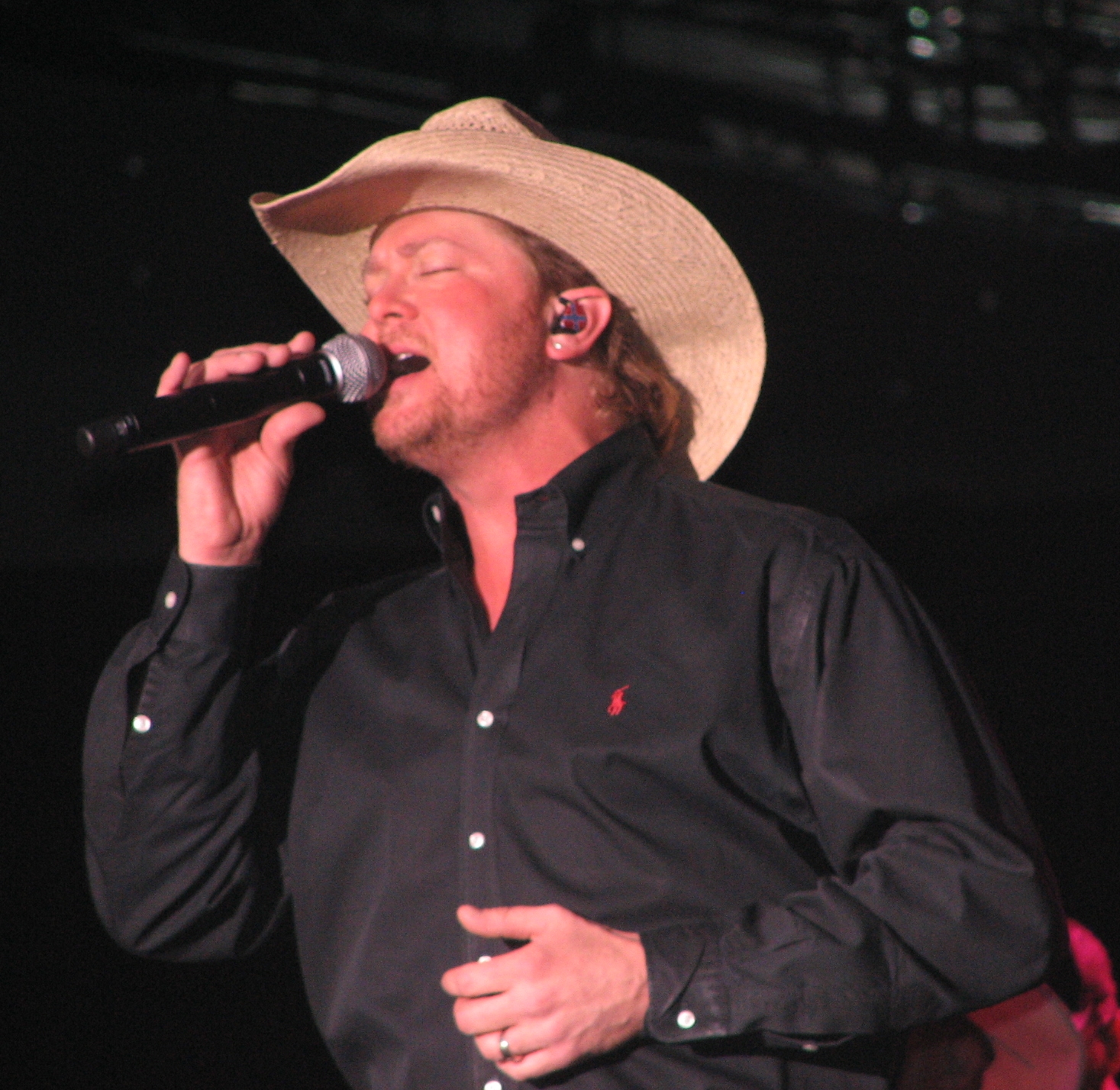
Tracy Lee Lawrence (born January 27, 1968) is an American country music singer, songwriter, and record producer. Born in Atlanta, Texas, and raised in Foreman, Arkansas, Lawrence began performing at age 15 and moved to Nashville, Tennessee in 1990 to begin his country music career. He signed to Atlantic Records Nashville in 1991 and made his debut late that year with the album Sticks and Stones. Five more studio albums, as well as a live album and a compilation album, followed throughout the 1990s and into 2000 on Atlantic before the label's country division was closed in 2001. Afterward, he recorded for Warner Bros. Records, DreamWorks Records, Mercury Records Nashville, and his own labels, Rocky Comfort Records and Lawrence Music Group.
Lawrence has released a total of 14 studio albums. His most commercially successful albums are Alibis (1993) and Time Marches On (1996), both certified double-platinum by the Recording Industry Association of America (RIAA). He has charted more than forty singles on the Billboard Hot Country Songs charts, including eight songs that reached the number one position: "Sticks and Stones", "Alibis", "Can't Break It to My Heart", "My Second Home", "If the Good Die Young", "Texas Tornado", "Time Marches On", and "Find Out Who Your Friends Are". Of these, "Time Marches On" is his longest-lasting at three weeks, while "Find Out Who Your Friends Are" set a record at the time for the slowest ascent to the top of that chart. His musical style is defined mainly by neotraditional country and honky-tonk influences, although he has also recorded Christmas music and Christian country music. He has won Top New Male Vocalist from Billboard in 1992 and from Academy of Country Music in 1993, and Vocal Event of the Year from the Country Music Association in 2007.
Biography
[edit]Tracy Lee Lawrence was born in Atlanta, Texas, on January 27, 1968.[1][3] He was raised by his stay-at-home mother JoAnn Dickens and stepfather Duane Dickens. He has two brothers and three sisters. When Lawrence was four years old, his family moved to Foreman, Arkansas. Growing up there, Lawrence sang in the local Methodist church choir and learned to play guitar. His mother had wanted him to grow up to be a minister, but he wanted to pursue a musical career instead.[1] Regarding his upbringing, Lawrence told Country Weekly magazine in 1996, "I was hell-bent on doing things my way. I bucked my stepfather. He thought I was risking too much chasing this crazy music dream."[4] Lawrence began performing publicly in local clubs at age 15.[5] By age 17, he had joined a local honky-tonk band.[2] He attended Southern Arkansas University in 1986 to study mass communications, where he also became a brother of Sigma Pi, but dropped out two years later to sing for a band based out of Louisiana. When the band broke up, Lawrence moved to Nashville, Tennessee, in 1990, supporting himself through odd jobs.[1] He also became a regular performer at several different Nashville nightclubs and bars, and further supported himself through winning local talent competitions.[5] After performing at an artist showcase at Nashville's Bluebird Café in January 1991, Lawrence was discovered by talent manager Wayne Edwards, who helped him sign to Atlantic Records' Nashville division.[1] This signing took place only seven months after his move to Nashville.[6]
Musical career
[edit]1991–1993: Sticks and Stones
[edit]After signing to Atlantic Nashville, Lawrence began recording his debut album Sticks and Stones. On May 31, 1991, after he had completed the album's vocal tracks,[6] Lawrence was injured when walking a high school friend named Sonja Wilkerson to the door of her hotel room at a Quality Inn in downtown Nashville.[7] He was confronted by three men who intended to rape Wilkerson and rob both of them.[4] Lawrence resisted and was shot four times, allowing his friend to escape. Two of the wounds were major and necessitated surgery at Nashville's Vanderbilt University Medical Center,[7] and one bullet remained embedded in his hip. The shooting and subsequent surgery also delayed the release of the album so that he would have time to recover before promoting it.[2]
Sticks and Stones, upon its late-1991 release, accounted for four singles on the Billboard Hot Country Songs charts. First was the album's title track, which reached the number-one position on that chart in January 1992.[3] Following it were three additional top-ten hits: "Today's Lonely Fool", "Runnin' Behind", and "Somebody Paints the Wall."[3] The last of these was originally released by Josh Logan, whose version had made the lower regions of the same chart in 1989.[8] Contributing songwriters to the album included John Scott Sherrill, Mark D. Sanders, Tim Menzies, Bob DiPiero, Lawrence himself, and Kenny Beard, who would go on to write many of Lawrence's other singles as well.[9][10] Another cut from the album, "Paris, Tennessee", was also recorded by co-writer Dennis Robbins on his 1992 album Man with a Plan,[11] and by Kenny Chesney on his 1995 album All I Need to Know.[12] Musicians on the album included Bruce Bouton, Mark Casstevens, and Milton Sledge of Garth Brooks' studio band The G-Men, along with session musicians Brent Rowan and Glenn Worf. James Stroud produced the album, and played drums on the track "Between Us".[9] Sticks and Stones was certified platinum by the Recording Industry Association of America (RIAA) for shipments of one million copies.[1][13] The album received an "A−" from Entertainment Weekly, whose writer Alanna Nash said that he "pairs a poised and confident baritone with witty and well-crafted songs that shed soft light in the dark corners of the human condition."[14] In 1992, Billboard magazine named him Top New Male Vocalist.[1]
1993–1994: Alibis
[edit]In 1993, Lawrence released his second album, Alibis,[2] which earned a double-platinum RIAA certification for shipments of two million copies.[13] All four of its singles reached the number-one position on the Hot Country Songs charts between early 1993 and early 1994: the title track, "Can't Break It to My Heart", "My Second Home", and "If the Good Die Young". The title track also accounted for his first entry on the Billboard Hot 100, reaching number 72 there.[3] Also produced by Stroud, the album contained songs co-written by Don Schlitz, Randy Boudreaux, and Craig Wiseman. Lawrence himself co-wrote "Can't Break It to My Heart" with "Sticks and Stones" co-writer Elbert West, and "My Second Home" with Beard.[15] Lawrence told the blog Taste of Country in 2018 that he "fought" with Atlantic executives over recording "Can't Break It to My Heart", because the label wanted him to record more ballads akin to those of then-labelmate John Michael Montgomery instead.[16] A review of Alibis in Cash Box magazine praised the title track, "I Threw the Rest Away", and "It Only Takes One Bar (To Make a Prison)" as the strongest cuts, while noting the "conviction and authenticity" in Lawrence's voice.[17] Nash was less positive, writing in Entertainment Weekly that Lawrence "settles for clichéd themes and mawkish delivery".[18] Lawrence promoted the album through a tour with George Jones, and signed a deal with the Stetson hat company to advertise a new line of hats.[19] Also in 1993, he was awarded as Top New Male Vocalist by the Academy of Country Music.[20]
1994–1995: I See It Now and Tracy Lawrence Live
[edit]Lawrence's 1994 album I See It Now had its title track serve as the lead single. Co-written by Larry Boone, Paul Nelson, and Woody Lee (who also recorded for Atlantic Nashville at the time), it peaked at number two on the country charts and 84 on the Hot 100.[3] Followup "As Any Fool Can See" also went to number two on the former,[3] while the Bobby Braddock-penned "Texas Tornado" became his sixth number-one hit on Hot Country Songs in mid-1995 and its B-side "If the World Had a Front Porch" also reached number two afterward.[3] Also included on the album were the John Anderson duet "Hillbilly with a Heartache",[21] previously found on Anderson's 1994 album Country 'til I Die,[22] and the song "I Got a Feelin'", co-written by Joe Diffie and later recorded by him on his 1997 album Twice Upon a Time.[23] I See It Now had seven of its tracks produced by Stroud, while three others accounted for Lawrence's first co-production credits:[21][24] he produced "Texas Tornado" by himself, "As Any Fool Can See" with Flip Anderson of his touring band, and "Hillbilly with a Heartache" with both Flip Anderson and Stroud.[25] Lawrence promoted I See It Now throughout 1995 with a tour consisting of over 200 shows.[26] Nash found I See It Now superior to its predecessor, stating that Lawrence "returns to the honky-tonk sound of his debut, balancing melodic ballads of regret with kick-butt rhythms and lively wordplay."[27] Allmusic rated the album 4 out of 5 stars, with an uncredited review praising the album's honky-tonk sound, along with the "cute lyrical twists for which country music is famous".[28] An also uncredited review in People praised the title track and closing track "I’d Give Anything to Be Your Everything Again" as "lovely, bittersweet accounts of romance lost", but criticized the lyrics of "If the World Had a Front Porch".[29] I See It Now received RIAA platinum certification.[13]
Also in 1995, he released a live acoustic album, Tracy Lawrence Live.[2] The album included live recordings of nine previous singles, plus the album track "I Threw the Rest Away" from Alibis.[30] Lawrence compiled the album from 40 different live shows from the six months prior to the disc's release, and once again produced with Flip Anderson.[24] The album was originally to have been titled Tracy Lawrence Live and Unplugged, but it was retitled due to MTV claiming a copyright on the term "unplugged".[31]
1995–1997: Time Marches On
[edit]Time Marches On, his fourth album, was released in January 1996.[2] It became his second double-platinum album in 2000.[13] The lead single was "If You Loved Me", a number four entry on the Hot Country Songs charts.[3] Lawrence said of the song that "it’s a typical Tracy Lawrence ballad about love gone wrong", and that he felt that it was one of his strongest singles.[4] Following this song was the album's title track; also written by Braddock, it became Lawrence's longest-lasting number-one single on Hot Country Songs, holding that position for three weeks.[3] It was also nominated by the Country Music Association as Single of the Year.[32] After this song came "Stars over Texas" (which Lawrence co-wrote with Boone) and "Is That a Tear", both peaking at number two.[3] The album's production duties were split, with Don Cook (best known for his work with Brooks & Dunn) handling five tracks, and Lawrence and Anderson on the other five.[33] Brian Wahlert of Country Standard Time noted that the tracks produced by Lawrence and Anderson were more traditional country in their sound than the tracks Cook produced, highlighting "Is That a Tear" and "Somewhere Between the Moon and You" as the strongest and most country-sounding cuts.[34] Stephen Thomas Erlewine of Allmusic wrote that the album was "another crowd-pleasing set of contemporary country. Like his previous albums, the song selection is a hit-or-miss affair, with about half of the songs failing to make much of an impression. The remainder, however, proves why Lawrence is one of the most popular singers in Nashville."[35] In 1996, Billboard ranked Lawrence as the tenth most-played radio artist in any genre that year.[32]
1997–1998: The Coast Is Clear
[edit]Lawrence's fifth studio album, The Coast Is Clear, was issued in March 1997 and achieved an RIAA gold certification two months later.[13] Like its predecessor, it featured some songs produced by Cook, and others by Lawrence and Anderson.[36] This album's first two singles "Better Man, Better Off" and "How a Cowgirl Says Goodbye" both made top five on Hot Country Songs, but the followups were less successful: the title track became his first single to miss the top 10 when it peaked at number 26, and "While You Sleep" fell outside the top 40.[3] Tom Roland of The Tennessean noted that the album had a theme of "attempts to undo what's done", but criticized the sound as "restrained" and "middle-of-the-road".[37] Sarah Rodman of Country Standard Time shared a similar opinion of the production, calling "While You Sleep" the "most emotive and touching song" while also referring to "How a Cowgirl Says Goodbye" as "lively".[38] Atlantic issued a greatest-hits package, The Best of Tracy Lawrence, in 1998. This disc included thirteen previous singles and the new song "Her Old Stompin' Ground".[39] Three years after its release, this compilation received RIAA gold certification.[13]
1999–2002: Lessons Learned and Tracy Lawrence
[edit].jpg)
In late 1999, Lawrence returned to the charts with "Lessons Learned".[2] This was the lead single to his 2000 album of the same name,[2] which he and Anderson produced with audio engineer Butch Carr.[40] The song reached number three on the country charts in 2000, and accounted for his highest Hot 100 peak of number 40.[3] The album charted two more singles in "Lonely" and "Unforgiven".[3] Tom Roland gave Lessons Learned three out of five stars in a review for The Tennessean, noting that Lawrence "repeatedly sings of flaws and errors and the challenges in overcoming them."[41] Erlewine wrote of the album in Allmusic that it is "certainly pleasant, yet it tends to fade into the background".[42] Jeffrey B. Remz of Country Standard Time thought that the album maintained a constantly country sound, and had well-written songs.[43]
In late 2000, Atlantic Records closed its Nashville division and moved all artists, including Lawrence, to the Nashville branch of parent company Warner Bros. Records.[1][2][44] His only release for that label, Tracy Lawrence, accounted for two low-charting singles in "Life Don't Have to Be So Hard" and "What a Memory".[2] Lawrence and Anderson produced the album and wrote several songs on it, with other contributing writers including Michael White, Casey Beathard, Billy Yates, and frequent collaborator Larry Boone.[45] Both Country Standard Time and Allmusic praised the album for having a more consistent and traditional sound than its predecessors, with the former's Scott Homewood calling it "quite possibly his best album",[46] and the latter's Liana Jonas complimenting the lyrics of both singles along with the "scaled down" production.[47] Allmusic biographer Steve Huey wrote of the album that "Despite some good reviews, it failed to halt his downward commercial momentum."[2] Lawrence also said that he felt that the label did not invest in promotion of the album due to a lack of interest in his musical style and direction. As a result, he began seeking out new producers in an attempt to "reinvent [him]self". He considered Buddy Cannon, Byron Gallimore, and Billy Joe Walker Jr. before choosing to reunite with Stroud. The two began recording for what would have been a second album for Warner Bros. in 2002, but Lawrence was dropped from the label's roster.[44]
2003–2004: Strong
[edit]After being dropped from Warner Bros., Lawrence began seeking a new record deal. He had considered RCA Records Nashville, but instead chose DreamWorks Records Nashville, of which Stroud was then the president,[44] and signed a deal with them in October 2003.[48] His first release for the label was "Paint Me a Birmingham", which had been concurrently released by Ken Mellons on an independent label.[48] Lawrence's version overtook Mellons's in terms of airplay, reaching number four on Hot Country Songs and number 42 on the Hot 100 in early 2004.[3] The corresponding album, Strong, came out in 2004,[2] and it consisted largely of material from the unreleased second project for Warner Bros. Nashville.[44] The album's follow-up singles, "It's All How You Look at It" and "Sawdust on Her Halo", were less successful at country radio.[3] Lawrence noted that he had writer's block when attempting to come up with material for the album, and thus sought outside writers instead of his usual collaborators. He described the title track, about a divorced woman moving on with her life, a "different than anything I've done in the past", while calling "Stones" the "most traditional" song, and noting the presence of "story songs" throughout. He also noted that the album was almost titled Stones, but was renamed to avoid confusion with his debut album Sticks and Stones.[44]
Erlewine wrote in Allmusic that Strong "ranks among his smoothest albums, a record dominated by ballads and where up-tempo songs are as polished as the slow ones."[49] Peter Cooper of The Tennessean thought that the album had better-written songs than its predecessors, highlighting "Paint Me a Birmingham" and "Sawdust on Her Halo" in particular, but criticizing the application of Auto-Tune to Lawrence's singing voice.[50] Robert Woolridge of Country Standard Time thought that Lawrence's singing was stronger on the ballads such as "Paint Me a Birmingham" as opposed to the more upbeat material, but criticized the "mainstream production".[51]
2005–2006: Then and Now: The Hits Collection
[edit]Following the closure of DreamWorks Nashville in 2005, Lawrence transferred to Mercury Nashville that same year.[52] There, he released the compilation Then & Now: The Hits Collection, which included fifteen of his previous hits, all of which (except "Paint Me a Birmingham") had to be newly recorded as the label did not own the rights to the original recordings made while he was on Atlantic.[53] Two new tracks were included as well, both of which were released as singles: a cover of Mark Nesler's 1998 single "Used to the Pain", and "If I Don't Make It Back", which was co-written by Bobby Pinson.[3] Of this compilation, Erlewine wrote, "These new versions are a little more laid-back than the originals, and they're a little slicker too. And while that doesn't necessarily suit Lawrence's voice, which has grown a little thinner over the years, that doesn't make Then and Now a bad listen."[54]
2006–2008: For the Love and All Wrapped Up in Christmas
[edit]

In 2006, Lawrence started his own record label, Rocky Comfort Records, in partnership with his brother Laney.[55] The first act signed to the label besides Lawrence himself was Chad Brock.[52] Lawrence's first single for the label was "Find Out Who Your Friends Are", which was released in August 2006 from the studio album For the Love. The song initially lingered below the Top 40 of the Hot Country Songs charts, but following the album's release, it gained in radio interest due to the album containing as a bonus track an alternate version with Tim McGraw and Kenny Chesney on guest vocals.[56] Thanks to the success of the alternate version, "Find Out Who Your Friends Are" became a number-one single on that chart in 2007.[3][57] The song reached that position in its 41st week on the chart, setting a new record at the time for the slowest ascent to the top of the country charts, and the second-slowest on any Billboard chart.[58] The re-recorded version received Musical Event of the Year honors at the 2007 Country Music Association (CMA) Awards, Lawrence's first award from that association,[59] along with the Academy of Country Music (ACM) Vocal Event of the Year award.[3] Following this song were "Til I Was a Daddy Too" and "You Can't Hide Redneck".[3] The album's title track was a duet with Brad Arnold of the rock band 3 Doors Down, while the track "Speed of Flight" was the first song in his career that Lawrence wrote entirely by himself.[52] Michael Sudhalter wrote in Country Standard Time that "the music on the 11-track debut matches the label's traditional-sounding name."[60]
Later in 2007, Lawrence issued a Christmas album entitled All Wrapped Up in Christmas, the title track of which peaked at number 57 based on Christmas season airplay.[3] In 2008, both Zona Jones and Michael Scott signed deals with Rocky Comfort.[61] Jones released the album Prove Me Right through the label in 2009.[62]
2009–2011: The Rock and The Singer
[edit]Lawrence made his last Hot Country Songs chart appearance with the single "Up to Him" in early 2009.[3] It is the first single for a studio album entitled The Rock, a Christian country album which was released in June 2009. It received 3.5 out of 5 from Country Weekly magazine, whose review noted that it "emphasizes at all turns the shared imperfections that we all strive to overcome in order to be good people".[63] Allmusic reviewer Todd Sterling thought that Lawrence "sounds as comfortable singing songs about the Lord as he does singing straight country", calling it "a positive collection that will appeal to people of all faiths."[64] Country Standard Time reviewer Jessica Phillips also thought that the lyrics of the album were "positive" and "uplifting", comparing the disc favorably to Randy Travis's gospel albums.[65] The album got a 2009 Grammy Award nomination for Grammy Award for Best Southern, Country or Bluegrass Gospel Album.[66]
Due to financial difficulties, Lawrence closed the Rocky Comfort label after The Rock and established a second personal label, Lawrence Music Group, in 2011.[67] His first release for this label was The Singer that same year. It was initially available solely from his website and digital music distributors, a decision that Lawrence made to test the viability of online distribution instead of physical sales.[68] The album features only acoustic instruments, and includes acoustic re-recordings of "Paint Me a Birmingham" and "Find Out Who Your Friends Are".[69] Of the album, Lawrence said that he included more songs that he had written himself, because he felt that he had become more confident in his own songwriting skills.[70] He also said that the album was "different" due to the increased presence of songs that he had written and the acoustic sound.[68]
2013–: Further releases on Lawrence Music Group
[edit]Lawrence released the single "Stop, Drop & Roll" to country radio in October 2012.[71] It was the first single from the album Headlights, Taillights and Radios, released on August 20, 2013.[72] Lawrence funded the album through Kickstarter. Contributing songwriters included Kurt Allison (of Jason Aldean's road band and the production team New Voice Entertainment) and Kip Moore.[73] Erlewine noted that the album was more country pop than Lawrence's existing body of work, but stated that "he sounds comfortable, assured, and quite charming on this enjoyable record."[74] Michael Rampa of Country Standard Time also thought that the album was more country-pop, but praised the lyrics and Lawrence's singing, saying of the content that "Lawrence is both looking back at his two decades-plus career in country music while also taking a significant step toward the future."[73] Lawrence promoted the album through a tour of the same name, which consisted of 28 shows throughout the year 2014, beginning with a concert at the Holmes Theater in Detroit Lakes, Minnesota.[75]
In 2017, Lawrence released Good Ole Days, a compilation album which features nine of his hit singles re-recorded as duets with other country singers, including Tim McGraw, Luke Bryan, Justin Moore, Jason Aldean, and Luke Combs. It also features two original songs: the title track, which features both Brad Arnold and Big & Rich, and the Craig Morgan duet "Finally Home", whose proceeds were donated to Operation Finally Home, an organization that assists in housing for injured soldiers.[76][77] A second Christmas album, Frozen in Time, was released in October 2018. The album includes a mix of original compositions and covers of Christmas standards.[78] In May 2019, he announced the August 2019 release of a new studio album titled Made in America, whose title track is also the lead single. He called the album "possibly the most personal album I have ever released." Lawrence co-wrote most of the album, with other songwriters including Chris Stapleton, Mark Nesler, and Carson Chamberlain.[79]
Lawrence's next project is a three-disc album called Hindsight 2020. In February 2021, he confirmed that each of the three discs would be released throughout 2021, starting with Volume 1: Stairway to Heaven Highway to Hell on April 23. Its first single is the title track, which Lawrence co-wrote with Craig Wiseman.[80] When completed, the three albums will include a mix of original songs and re-recordings of existing songs.[81] The second disc in this project, Volume 2: Price of Fame, was released in August. Included on it were re-recordings of "I See It Now", "Somebody Paints the Wall", and "If the World Had a Front Porch", and duets with Montgomery Gentry member Eddie Montgomery and Tracy Byrd.[82] The third installment, Volume 3: Angelina, was released in January 2022. The title track of the project was released as a single that same month; in addition, Lawrence stated that he would be touring in 2022 with Clay Walker, Randall King, and Alexandra Kay.[83]
Additional work
[edit]Lawrence has contributed to multiple collaborative works in his career. The first was George Jones' 1992 single "I Don't Need Your Rockin' Chair", which featured him as one of several artists performing on the song's final chorus, and received the Country Music Association Vocal Event of the Year for all artists involved.[84] In 1994, Lawrence recorded "Renegades, Rebels, and Rogues" for the soundtrack of the film Maverick.[2] This song was released to country radio as a single in mid-1994 after "If the Good Die Young" had peaked, and it went on to reach top 10 on Hot Country Songs.[3] The soundtrack also featured him in a multi-artist rendition of "Amazing Grace".[85] Later in the same year, he covered Keith Whitley's late-1989 single "I'm Over You" on Keith Whitley: A Tribute Album.[86] In May 1996, Lawrence was one of many artists featured on the charity single "Hope: Country Music's Quest for a Cure", whose proceeds were donated to the T.J. Martell foundation for cancer research. The song made an appearance on Hot Country Songs,[87] and received a Grammy Award nomination that year for all artists involved in the category of Best Country Collaboration with Vocals.[66] In 1997, he recorded a cover of The Rolling Stones's "Paint It Black" on the multi-artist tribute album Stone Country: Country Artists Perform the Songs of the Rolling Stones.[88][89] Lawrence also began working as a producer for other artists in 1997, including Rich McCready's 1997 album That Just About Covers It and the soundtrack to the musical The Civil War.[20] The latter also featured him singing "I'll Never Pass This Way Again", which was issued as a single in October 1998.[90]
Music videos
[edit]Many of Lawrence's singles featured music videos that received rotation on CMT and the defunct TNN (The Nashville Network). In 1996, his videos were aired on CMT more than those of any other artist.[32] Among his videos were several directed by Marc Ball which linked to each other through a time travel storyline, where Lawrence is transported to a different time period and scenario at the beginning of each video, and appears in clothing appropriate to the time period.[91] The concept started with the video for "If the Good Die Young", and continued for those of "Renegades, Rebels, and Rogues", "I See It Now", "As Any Fool Can See", "Texas Tornado", "If the World Had a Front Porch", "Is That a Tear", "One Step Ahead of the Storm" (an album cut from The Coast Is Clear), and "Life Don't Have to Be So Hard".[92]
Musical style
[edit]Steve Huey wrote of Lawrence's musical style that he was "[o]ne of a number of rock-tinged honky-tonk singers who rose to fame in the early '90s" and "gained a loyal audience for his mix of modern and traditional country sounds".[2] Erlewine described Lawrence's musical style as "polished, modern-day honky-tonk",[42] and said that he "has never been among the most adventurous country singers and of all the post-Garth Brooks new traditionalists; he often avoids honky-tonk grit, even though he has a nice twang in his voice that would work well on rowdier material."[49] In a review of Sticks and Stones, Alanna Nash noted that Lawrence had a physical and musical resemblance to Alan Jackson.[14] His singing voice has also been described as a "smooth baritone"[38] and a "warm baritone" with "effortless, emotional delivery".[65] Lawrence cites Merle Haggard, Keith Whitley, and George Strait as his primary musical influences.[5]
Personal life
[edit]In April 1994, Lawrence was charged with reckless endangerment and possession of an unlicensed firearm after confronting and following home two teenagers on a highway in Wilson County, Tennessee.[4][93] Although he was put on probation for a year, the charges were later cleared.[20]
Lawrence has been married three times. His first wife was former rodeo star Frances Weatherford, whom he married in 1993.[1] Weatherford was injured by broken glass and suffered a miscarriage after a gas fireplace explosion, and the two divorced in 1996.[4] In March 1997 he married his second wife, Stephenie "Stacie" Drew, a former member of the Dallas Cowboys Cheerleaders.[1] Their wedding included over 500 guests, along with performances by Toby Keith, Tracy Byrd, and Kenny Chesney.[94] In October 1997, Lawrence underwent investigation after allegations that he had abused Drew following a concert at Buffalo Bill's hotel and casino in Primm, Nevada. This incident occurred one month after the couple had filed for divorce.[95] Lawrence was convicted of a misdemeanor for battery,[96] and was ordered by Las Vegas courts to donate $500 to a Nevada-based women's shelter.[97] Billboard also reported that Atlantic Nashville's president had suspended Lawrence from recording any new material until he agreed to undergo counseling,[97] but he later denied these claims.[98] He married his third wife, Becca, in a secret wedding ceremony just after Christmas 2000. The couple had a child named Skylar the following June.[99] Two years later, they had a second daughter, Mary Keagan.[100]
Discography
[edit]- Studio albums
- Sticks and Stones (1991)
- Alibis (1993)
- I See It Now (1994)
- Time Marches On (1996)
- The Coast Is Clear (1997)
- Lessons Learned (2000)
- Tracy Lawrence (2001)
- Strong (2004)
- For the Love (2007)
- The Rock (2009)
- The Singer (2011)
- Headlights, Taillights and Radios (2013)
- Good Ole Days (2017)
- Frozen in Time (2018)
- Made in America (2019)
- Hindsight 2020 Volume 1: Stairway to Heaven Highway to Hell (2021)
- Hindsight 2020 Volume 2: Price of Fame (2021)
- Hindsight 2020 Volume 3: Angelina (2022)
- Christmas albums
- All Wrapped Up in Christmas (2007)
- Frozen in Time (2018)
- Compilations
- Tracy Lawrence Live (1995)
- The Best of Tracy Lawrence (1998)
- Then & Now: The Hits Collection (2005)
- The Very Best of Tracy Lawrence (2007)
Billboard number-one hits
[edit]- "Sticks and Stones" (1 week, 1992)
- "Alibis" (2 weeks, 1993)
- "Can't Break It to My Heart" (1 week, 1993)
- "My Second Home" (1 week, 1993)
- "If the Good Die Young" (2 weeks, 1994)
- "Texas Tornado" (1 week, 1995)
- "Time Marches On" (3 weeks, 1996)
- "Find Out Who Your Friends Are" (1 week, 2007)
Awards and nominations
[edit]Grammy Awards
[edit]| Year | Nominee / work | Award | Result |
|---|---|---|---|
| 1997 | "Hope: Country Music's Quest for a Cure" | Best Country Collaboration with Vocals | Nominated |
Academy of Country Music Awards
[edit]| Year | Nominee / work | Award | Result |
|---|---|---|---|
| 1993 | Tracy Lawrence | Top New Male Vocalist | Won |
| 1994 | "Can't Break It to My Heart" | Single Record of the Year | Shortlisted |
| Tracy Lawrence | Top Male Vocalist of the Year | Shortlisted | |
| 1995 | Shortlisted | ||
| John Anderson and Tracy Lawrence | Top Vocal Duo of the Year | Nominated | |
| 1997 | "Time Marches On" | Single Record of the Year | Nominated |
| Song of the Year | Nominated | ||
| Time Marches On | Album of the Year | Nominated | |
| 2008 | "Find Out Who Your Friends Are" | Vocal Event of the Year | Won |
Country Music Association Awards
[edit]| Year | Nominee / work | Award | Result |
|---|---|---|---|
| 1993 | Tracy Lawrence | Horizon Award | Nominated |
| 1996 | "Time Marches On" | Single of the Year | Nominated |
| 2007 | "Find Out Who Your Friends Are" | Vocal Event of the Year | Won |
References
[edit]- ^ a b c d e f g h i j "Tracy Lee Lawrence (1968–)". The Encyclopedia of Arkansas History and Culture. Retrieved November 12, 2018.
- ^ a b c d e f g h i j k l m n o p Huey, Steve. "Tracy Lawrence biography". Allmusic. Retrieved December 29, 2010.
- ^ a b c d e f g h i j k l m n o p q r s t u v Whitburn, Joel (2012). Hot Country Songs 1944 to 2012. Record Research, Inc. pp. 188–189. ISBN 978-0-89820-203-8.
- ^ a b c d e Larry Holden (January 23, 1996). "How Tracy Lawrence Is Beating Tough Times". Country Weekly. Retrieved November 12, 2018.
- ^ a b c Robert K. Oermann (February 8, 1992). "Tracy Lawrence aims sky high". The Tennessean. pp. D1. Retrieved June 1, 2019.
- ^ a b Debbie Holley (November 16, 1991). "New on the charts" (PDF). Billboard. p. 39.
- ^ a b Steve Dougherty (February 3, 1992). "No. 1, with Four Bullets". People. Retrieved November 12, 2018.
- ^ Whitburn, p. 197
- ^ a b Sticks and Stones (CD insert). Tracy Lawrence. Atlantic Records. 1991. 7 82326-2.
{{cite AV media notes}}: CS1 maint: others in cite AV media (notes) (link) - ^ "Songwriter Kenny Beard dies". MusicRow. October 3, 2017. Retrieved November 21, 2018.
- ^ Brian Mansfield. "Man with a Plan". Allmusic. Retrieved November 12, 2018.
- ^ Stephen Thomas Erlewine. "All I Need to Know". Allmusic. Retrieved November 12, 2018.
- ^ a b c d e f "Search results for Tracy Lawrence". Recording Industry Association of America. Retrieved November 12, 2018.
- ^ a b Alanna Nash (December 13, 1991). "Sticks and Stones". Entertainment Weekly. Retrieved November 12, 2018.
- ^ Alibis (cassette liner notes). Tracy Lawrence. Atlantic Records. 1993. 7 82483-4.
{{cite AV media notes}}: CS1 maint: others in cite AV media (notes) (link) - ^ Billy Dukes (November 14, 2017). "With 'Good Ole Days', Tracy Lawrence finds friends, fights, and the future". Taste of Country. Retrieved November 15, 2018.
- ^ Brad Hogue (April 17, 1993). "Reviews" (PDF). Cash Box. Retrieved November 12, 2018.
- ^ Alanna Nash (March 19, 1993). "Alibis". Entertainment Weekly. Retrieved November 12, 2018.
- ^ Lorie Hollabaugh (February 5, 1993). "Sophomores Dominate Spring Releases" (PDF). Radio & Records: 40.
- ^ a b c The Encyclopedia of Country Music. Oxford University Press. 2004. pp. 291–292. ISBN 9780199770557.
- ^ a b Lorie Hollabaugh (August 5, 1994). "Fall Brings Flood Of Country Albums" (PDF). Radio & Records: 26.
- ^ "Country 'til I Die". Allmusic. Retrieved November 12, 2018.
- ^ Thom Owens. "Twice Upon a Time". Allmusic. Retrieved November 12, 2018.
- ^ a b Bonna M. de la Cruz (September 18, 1995). "Tracy Lawrence plugs in". The Tennessean. pp. P1, P2. Retrieved November 12, 2018.
- ^ I See It Now (cassette). Tracy Lawrence. Atlantic Records. 1994. 82656.
{{cite AV media notes}}: CS1 maint: others in cite AV media (notes) (link) - ^ Vicki Jo Radovsky (December 23, 1994). "Tracy Lawrence refuses to go pop". Entertainment Weekly. Retrieved November 12, 2018.
- ^ Alanna Nash (December 2, 1994). "I See It Now". Entertainment Weekly. Retrieved November 12, 2018.
- ^ "I See It Now". Allmusic. Retrieved November 12, 2018.
- ^ "Picks and Pans Review: I See It Now". People. September 26, 1994. Retrieved November 12, 2018.
- ^ "Tracy Lawrence Live and Unplugged". Allmusic. Retrieved November 12, 2018.
- ^ Brad Schmitt (September 8, 1995). "Brad About You". The Tennessean. pp. 3A. Retrieved December 9, 2018.
- ^ a b c Robert K. Oermann (May 3, 1997). "Keeping up with Tracy Lawrence". The Tennessean. pp. 1D, 4D. Retrieved November 21, 2018.
- ^ Time Marches On (Media notes). Tracy Lawrence. Atlantic Records. 1996. 82866-2.
{{cite AV media notes}}: CS1 maint: others in cite AV media (notes) (link) - ^ Brian Wahlert. "Time Marches On review". Country Standard Time. Retrieved November 12, 2018.
- ^ Stephen Thomas Erlewine. "Time Marches On". Allmusic. Retrieved November 12, 2018.
- ^ The Coast Is Clear (Media notes). Tracy Lawrence. Atlantic Records. 1997. 82985-2.
{{cite AV media notes}}: CS1 maint: others in cite AV media (notes) (link) - ^ Tom Roland (April 14, 1997). "Woodruff's 'Desire Road' a joy ride". The Tennessean. pp. 6D. Retrieved November 12, 2018.
- ^ a b Sarah Rodman. "The Coast Is Clear". Country Standard Time. Retrieved November 12, 2018.
- ^ James Christopher Monger. "The Best of Tracy Lawrence". Allmusic. Retrieved November 12, 2018.
- ^ Lessons Learned (CD). Tracy Lawrence. Atlantic Records. 2000. 83269.
{{cite AV media notes}}: CS1 maint: others in cite AV media (notes) (link) - ^ Tom Roland (January 31, 2000). "Living and learning". The Tennessean. pp. 5D. Retrieved November 12, 2018.
- ^ a b Stephen Thomas Erlewine. "Lessons Learned". Allmusic. Retrieved November 12, 2018.
- ^ Jeffrey B. Remz. "Lessons Learned review". Country Standard Time. Retrieved November 12, 2018.
- ^ a b c d e Jeffrey B. Remz. "Tracy Lawrence feels strong". Country Standard Time. Retrieved December 9, 2018. Page 1 Page 2 Page 3
- ^ Tracy Lawrence (Media notes). Tracy Lawrence. Atlantic Records/Warner Bros. Records. 2001. 9 48187-2.
{{cite AV media notes}}: CS1 maint: others in cite AV media (notes) (link) - ^ Scott Homewood. "Tracy Lawrence". Country Standard Time. Retrieved November 12, 2018.
- ^ Liana Jonas. "Tracy Lawrence". Allmusic. Retrieved November 12, 2018.
- ^ a b Phyllis Stark (October 11, 2003). "Nashville Scene" (PDF). Billboard.
- ^ a b Stephen Thomas Erlewine. "Strong". Allmusic. Retrieved November 12, 2018.
- ^ Peter Cooper (April 12, 2004). "'Strong' songs and strange vocals from Tracy Lawrence". The Tennessean. pp. 5D. Retrieved November 12, 2018.
- ^ Robert Woolridge. "Strong". Country Standard Time. Retrieved November 12, 2018.
- ^ a b c Ken Tucker (December 9, 2006). "Tracy Lawrence cooks up turkeys, new album". Billboard. p. 86.
- ^ Patterson, Rob (June 30, 2006). "CMA Close Up: Tracy Lawrence: Loving Life". Great American Country. Archived from the original on February 27, 2009. Retrieved January 26, 2009.
- ^ Stephen Thomas Erlewine. "Then & Now: The Hits Collection". Allmusic. Retrieved November 12, 2018.
- ^ Ryan Underwood (July 31, 2006). "Music Notes". The Tennessean. pp. 2E. Retrieved November 12, 2018.
- ^ Cindy Watts (August 10, 2007). "Lawrence gets lift from 'Friends'". The Tennessean. pp. 3E. Retrieved November 12, 2018.
- ^ "Tracy Lawrence finds out he's number one". Country Standard Time. June 12, 2007. Retrieved January 26, 2009.
- ^ Fred Bronson (June 15, 2007). "Chart Beat Chat". Billboard. Archived from the original on September 29, 2007. Retrieved January 26, 2009.
- ^ "41st Annual CMA Awards". Country Music Association. Retrieved January 26, 2009.
- ^ Michael Sudhalter. "For the Love". Country Standard Time. Retrieved November 12, 2018.
- ^ "Zona Jones signs with Tracy Lawrence's label". Country Standard Time. July 2, 2008. Retrieved October 17, 2009.
- ^ Matt Bjorke (July 9, 2009). "Zona Jones – Prove Me Right". Roughstock. Retrieved November 13, 2018.
- ^ "The Rock review". Country Weekly: 50. June 16, 2009. ISSN 1074-3235.
- ^ "The Rock". Allmusic. Retrieved November 12, 2018.
- ^ a b Jessica Phillips. "The Rock". Country Standard Time. Retrieved November 12, 2018.
- ^ a b "Tracy Lawrence". Grammy.com. Retrieved November 12, 2018.
- ^ Cathalena E. Burch (June 30, 2011). "Tracy Lawrence seizes reins of his career". Tucson.com. Retrieved November 13, 2018.
- ^ a b "Lawrence ready to come home for fair concert". Texarkana Gazette. September 9, 2011. Retrieved November 13, 2018.
- ^ David Burke (June 15, 2011). "Tracy Lawrence goes online with his new album". Quad City Times. Retrieved November 13, 2018.
- ^ Tilly Dillehay (December 27, 2011). "Tracy Lawrence Wears Lots of Hats". Wilson Living. Retrieved November 12, 2018.
- ^ Wyland, Sarah (October 25, 2012). "Stop, Drop and Listen to Tracy Lawrence's New Single". Great American Country. Retrieved February 5, 2013.
- ^ Nicholson, Jessica (May 20, 2013). "Artist Updates (5-30-13)". MusicRow. Retrieved June 6, 2013.
- ^ a b Michael Rampa. "Headlights, Taillights and Radios". Country Standard Time. Retrieved November 12, 2018.
- ^ Stephen Thomas Erlewine. "Headlights, Taillights and Radios". Allmusic. Retrieved November 12, 2018.
- ^ Alanna Conaway (January 17, 2014). "Tracy Lawrence Announces Headlights, Taillights and Radios Tour 2014". Roughstock. Retrieved November 13, 2018.
- ^ Gayle Thompson (September 9, 2017). "Tracy Lawrence teams with fellow stars for Good Ole Days album". The Boot. Retrieved November 12, 2018.
- ^ Mark Deming. "Good Ole Days". Allmusic. Retrieved November 12, 2018.
- ^ "The Boot news roundup". The Boot. October 15, 2018. Retrieved November 21, 2018.
- ^ Bobbie Jean Sawyer (May 28, 2019). "Tracy Lawrence Shares 'Made in America' Title Track and Track Listing". Wide Open Country. Retrieved May 30, 2019.
- ^ "Tracy Lawrence announces career-spanning Hindsight 2020 collection". Taste of Country. February 21, 2021. Retrieved February 21, 2021.
- ^ "Tracy Lawrence Marks 30 Years In Country With 'Hindsight 2020'". Music Row. February 21, 2021. Retrieved February 21, 2021.
- ^ "Tracy Lawrence Releases 'Hindsight 2020 Volume 2: Price of Fame' Project". CMT. August 13, 2021. Archived from the original on August 13, 2021. Retrieved November 6, 2021.
- ^ Lydia Farthing (January 7, 2022). "Tracy Lawrence To Release Final Installment Of 'Hindsight 2020' Project". MusicRow. Retrieved January 26, 2022.
- ^ Whitburn, p. 187
- ^ Maverick (CD booklet). Various artists. Atlantic Records. 1994. 82595.
{{cite AV media notes}}: CS1 maint: others in cite AV media (notes) (link) - ^ "Keith Whitley: A Tribute Album review". Allmusic. Retrieved November 12, 2018.
- ^ Whitburn, p. 156
- ^ "Stone Country". Allmusic. Retrieved November 12, 2018.
- ^ Harrington, Richard (September 28, 1997). "Country and Blues Tributes to the Stones". The Washington Post.
- ^ "Singles". Billboard. October 17, 1998. p. 27.
- ^ Deborah Russell (May 13, 1995). "Tracy Lawrence's leap through time". Billboard. p. 62.
- ^ Erin Duvall. "Do You Remember When Tracy Lawrence Was a Time Traveler?". One Country. Retrieved November 16, 2018.
- ^ Ellen Margulies, Tom Roland (June 21, 1994). "Lawrence treated 'like anybody else'". The Tennessean. pp. 1B, 2B. Retrieved December 9, 2018.
- ^ "Pom-Poms and Circumstance". People. March 31, 1997. Retrieved November 12, 2018.
- ^ "Country singer Tracy Lawrence facing battery charges". Las Vegas Sun. October 9, 1997. Retrieved November 12, 2018.
- ^ Tom Roland (January 30, 1998). "Lawrence now admits battering". The Tennessean. pp. 6B. Retrieved November 12, 2018.
- ^ a b Chet Flippo (February 14, 1998). "Atlantic suspends Tracy Lawrence; Brooks donates money for kids' zoo". Billboard. p. 26.
- ^ Brad Schmitt (June 16, 1998). "Brad about you". The Tennessean. pp. 3A. Retrieved November 12, 2018.
- ^ Brad Schmitt (June 29, 2001). "Brad about you". The Tennessean. pp. 3A. Retrieved November 12, 2018.
- ^ "It's a Girl for Tracy Lawrence". CMT. April 16, 2003. Archived from the original on June 2, 2019. Retrieved June 1, 2019.
External links
[edit]
| International | |
|---|---|
| National | |
| Artists | |
| People | |
| Other | |

Tracy Lawrence
View on GrokipediaEarly life
Childhood and family background
Tracy Lee Lawrence was born on January 27, 1968, in Atlanta, Texas.[2] He was raised primarily by his mother, JoAnn Dickens, a stay-at-home parent, and his stepfather, Duane Dickens, who worked as a banker.[5] Lawrence grew up with five siblings, including two brothers and three sisters, in a modest small-town environment that shaped his early years.[2][6] In 1972, when Lawrence was four years old, his family relocated from Texas to Foreman, a rural community in Little River County, Arkansas, where he spent the remainder of his childhood.[2] Foreman provided a close-knit, working-class setting typical of the region's agricultural and small-business economy, fostering Lawrence's connection to Southern traditions and community life.[7] The move immersed him in the everyday rhythms of Arkansas rural life, including family-oriented activities that emphasized values of hard work and resilience.[3] Lawrence's upbringing was influenced by the local Methodist church, where he participated in the choir as a child, reflecting the strong religious foundation in his household—his mother had aspirations for him to become a Methodist minister.[2] This environment, combined with the familial support in Foreman, laid the groundwork for his later interests, though his early years were marked by a self-described rough-and-tumble nature amid the town's unpretentious backdrop.[8]Musical beginnings and influences
Lawrence received his first guitar during his childhood in Foreman, Arkansas, where he taught himself to play while singing in the local Methodist church choir.[2] He began writing songs during high school, honing his skills through self-directed practice and local talent shows, including a performance at age 14 where he played a Merle Haggard cover and an original composition.[9][10] By age 15, Lawrence started performing in local Arkansas clubs and bars, joining a honky-tonk band by 17 and covering classic tracks by artists such as George Jones and Merle Haggard to build his repertoire and stage presence.[10][2] These early gigs in Texas, Louisiana, and Arkansas clubs sharpened his traditional country style before he pursued opportunities beyond the region.[11] In 1990, at age 22, Lawrence moved to Nashville in a beat-up Toyota after his band disbanded, taking odd jobs while performing at venues like Tootsie's Orchid Lounge and recording demo tapes that caught the attention of industry professionals.[2][11] Within months, he won talent contests and secured a publishing deal, marking his transition to professional music. His sound was profoundly shaped by traditional country icons, including George Strait, Conway Twitty, and Hank Williams Jr., whose honky-tonk and neotraditional elements influenced Lawrence's emphasis on heartfelt storytelling and classic instrumentation in his own work.[2] He also drew from George Jones and Merle Haggard, incorporating their raw emotional delivery into his early covers and originals.[11]Musical career
1991–1995: Debut albums and breakthrough hits
Tracy Lawrence signed a recording contract with Atlantic Records on May 21, 1991, marking his entry into the major-label country music scene after years of performing in clubs across the South.[12] His debut album, Sticks and Stones, was released later that year on November 12, produced by James Stroud, and featured a blend of traditional country sounds with Lawrence's baritone vocals. The title track, "Sticks and Stones," became his first No. 1 hit on the Billboard Hot Country Songs chart, holding the top spot for one week in January 1992 and helping the album peak at No. 10 on the Top Country Albums chart and No. 71 on the Billboard 200.[13][14] Other singles from the album, including "Runnin' Behind" (No. 4) and "Somebody Paints the Wall" (No. 8), contributed to its platinum certification by the RIAA for shipments exceeding one million copies.) (Note: Using as secondary confirmation; primary from RIAA via official label bio)[1] Building on his initial success, Lawrence released his sophomore album Alibis on March 9, 1993, which solidified his status as a rising star in 1990s country music. The album, also produced by Stroud, achieved double-platinum status from the RIAA, selling over two million copies and peaking at No. 6 on the Top Country Albums chart.[1] Its lead single, "Alibis," topped the Billboard Hot Country Songs chart for two weeks in May 1993, while follow-up "Can't Break It to My Heart" reached No. 1 for one week in August 1993.[15][16] Additional hits like "My Second Home" (No. 1) and "If the Good Die Young" (No. 1) extended the album's chart dominance, with four singles overall reaching the top five. Alibis showcased Lawrence's songwriting contributions and thematic focus on heartfelt narratives, contributing to his growing fanbase. Lawrence's third studio album, I See It Now, arrived on September 20, 1994, continuing his streak of commercial releases under Atlantic. Produced once again by Stroud, the album peaked at No. 2 on the Top Country Albums chart and earned platinum certification from the RIAA for over one million shipments.[1] The title track, "I See It Now," climbed to No. 2 on the Billboard Hot Country Songs chart in late 1994, while other singles such as "As Any Fool Can See" (No. 2) and "Texas Tornado" (No. 1 in 1995) further boosted its performance. In 1995, Lawrence complemented this with his first live album, Tracy Lawrence Live, a collection of acoustic and band performances recorded at his concerts, which peaked at No. 24 on the Top Country Albums chart. The combined efforts of these early releases generated over four million album sales by the mid-1990s, establishing Lawrence as a consistent chart presence with eight top-10 singles during this period.[17] During this breakthrough phase, Lawrence honed his stage presence through opening slots on major tours, including dates with Reba McEntire and George Strait, which exposed him to large audiences and built his reputation as a dynamic live performer alongside established country icons.[18]1996–2002: Mid-career albums and commercial peak
In 1996, Tracy Lawrence released his fourth studio album, Time Marches On, which marked a significant escalation in his commercial success within the country music landscape. The album debuted at No. 31 on the Billboard 200 chart and achieved double platinum certification from the RIAA, reflecting sales of over two million units in the United States.[19][12] Its title track became Lawrence's biggest hit to date, topping the Billboard Hot Country Songs chart for three consecutive weeks and establishing his dominance in mainstream country radio during the mid-1990s.[20] The follow-up single, "If You Loved Me," further solidified the album's impact by reaching No. 4 on the same chart, contributing to Lawrence's growing reputation for delivering heartfelt, chart-topping ballads. Building on this momentum, Lawrence issued The Coast Is Clear in 1997, an album that continued his streak of strong performances on country charts while showcasing a more polished production style. The lead single, "Better Man, Better Off," peaked at No. 2 on the Billboard Hot Country Songs chart, highlighting themes of personal growth and resilience that resonated with fans and earned widespread radio play. Although the album itself reached No. 22 on the Billboard Top Country Albums chart, it reinforced Lawrence's mid-career stability amid a competitive field of emerging artists.[21] This period saw Lawrence expand his live presence through headlining tours, including high-profile appearances that boosted his visibility in major markets and arenas across the U.S. By 2000, Lawrence returned with Lessons Learned, his sixth studio album, which captured a reflective phase in his artistry while maintaining commercial viability. The introspective title track climbed to No. 3 on the Billboard Hot Country Songs chart, underscoring Lawrence's ability to blend traditional country storytelling with contemporary appeal and marking one of his highest-charting singles of the era. The album's success was amplified by subsequent singles like "Lonely," which reached No. 18, contributing to sustained radio rotation and fan engagement.[22] Lawrence capped this prolific phase with his self-titled seventh album in 2001, a project that emphasized collaborations and raw energy to sustain his mainstream momentum. Notable among its tracks was the duet "Crawlin' Again" with Kenny Chesney, a lively honky-tonk number that exemplified Lawrence's collaborative spirit and added to the album's dynamic tracklist.[23] Overall, the 1996–2002 era represented Lawrence's commercial zenith, with multiple top-10 singles, platinum-level sales, and CMA nominations—including a nod for Single of the Year for "Time Marches On"—alongside increased media exposure through television performances and national tours that cemented his status as a leading figure in country music.[12][24]2003–2011: Later major-label releases
In 2003, following the closure of Warner Bros. Nashville's country division, Tracy Lawrence signed with DreamWorks Records, reuniting with longtime producer James Stroud, who had helmed his debut album over a decade earlier.[25] Their collaboration resulted in the album Strong, released in April 2004, which debuted at No. 17 on the Billboard 200 and No. 3 on the Top Country Albums chart.[26] The lead single, "Paint Me a Birmingham," became one of Lawrence's biggest hits of the era, peaking at No. 4 on the Billboard Hot Country Songs chart and earning gold certification for over 500,000 units sold.[27] The album's blend of traditional country with contemporary production reflected Lawrence's efforts to navigate shifting industry trends toward pop-infused sounds, though sales totaled around 371,000 copies amid DreamWorks' impending shutdown.[28] When Universal Music Group closed DreamWorks Nashville in September 2005, Lawrence transitioned to Mercury Records for the compilation Then and Now: The Hits Collection, released that October.[29] The project revisited his career highlights while including newer tracks like a re-recorded "If the World Had a Front Porch," underscoring his adaptation to major-label expectations during a period of consolidation in the country music business. Seeking greater creative control, Lawrence founded Rocky Comfort Records in 2006 as a joint venture with CO5 Music, securing distribution through a major retail partner to maintain industry access.[30] Under Rocky Comfort, Lawrence released For the Love in January 2007, an album infused with gospel elements produced by Flip Anderson, Julian King, and Lawrence himself.[31] It debuted at No. 6 on the Top Country Albums chart, driven by the title track's moderate success and the slow-burning "Find Out Who Your Friends Are," which reached No. 1 on the Hot Country Songs chart after 41 weeks—the longest climb to the top in Billboard history at the time.[32] Follow-up single "'Til I Was a Daddy Too" peaked at No. 32, highlighting themes of fatherhood amid the album's spiritual leanings.[17] In 2009, Lawrence self-produced The Rock, his first full Christian album on Rocky Comfort, which earned a Grammy nomination for Best Southern, Country or Bluegrass Gospel Album despite limited commercial airplay.[33] Lawrence's final major-label-affiliated release of the period, The Singer in June 2011 on his newly restructured Lawrence Music Group (with distribution ties), was a covers collection paying homage to country legends, including tracks like "The Man in Black" and interpretations of George Jones and Merle Haggard songs.[12] Produced by Lawrence and his band, it received positive critical notice for its reverence to traditional roots but charted modestly outside the Top 40 on country airplay, signaling the challenges of sustaining radio presence as the genre shifted toward younger artists and digital platforms.[34]2012–present: Independent era, recent projects, and tours
In 2012, Tracy Lawrence fully embraced his independent career trajectory by operating through his self-founded Lawrence Music Group, which he established the previous year following the closure of his earlier Rocky Comfort Records imprint due to financial challenges. This shift allowed Lawrence greater creative control and direct involvement in production and distribution, marking a departure from major-label constraints and enabling him to focus on traditional country sounds tailored to his established fanbase. The label's debut release under this banner came shortly after, setting the stage for a series of self-produced projects that emphasized storytelling and live-performance appeal.[2] Lawrence's first independent album, Headlights, Taillights and Radios, arrived in August 2013 via Lawrence Music Group, featuring 11 original tracks that revisited themes of small-town life and heartfelt reflection, with production handled by Lawrence alongside Rick Huckaby. The project received positive reviews for its raw, road-tested energy, though it achieved modest chart performance, peaking outside the Billboard Top 40. Building on this momentum, Lawrence released Good Ole Days in November 2017, a duets album pairing re-recorded versions of his '90s hits with contemporary artists, including Tim McGraw on "Time Marches On" and Luke Bryan on "Sticks and Stones." The collection celebrated his career longevity while introducing his catalog to newer listeners, with independent sales estimated in the range of 20,000 to 40,000 units—figures Lawrence equated to major-label gold status in terms of personal impact.[35][36] The 2019 album Made in America, also through Lawrence Music Group, further solidified Lawrence's independent output with 12 tracks honoring American patriotism and resilience, led by the title single co-written by Lawrence, Rick Huckaby, and Adam Sanders. Released in August, the album blended classic country instrumentation with introspective lyrics, earning acclaim for its timely cultural resonance amid national conversations on heritage. Lawrence promoted it through targeted radio play and fan events, achieving streaming traction that introduced his work to younger demographics via platforms like Spotify.[37] In June 2024, Lawrence returned with the EP Out Here In It, a six-track project distributed by Lawrence Music Group and Stem, capturing the spirit of everyday rural adventures with the upbeat title track as its lead single. Recorded in Nashville, the EP featured contributions from emerging songwriters and highlighted Lawrence's adaptability, incorporating subtle modern production elements while staying true to his honky-tonk roots. Tracks like "Honky Tonk Up" emphasized live-wire energy suited for his ongoing performances.[38] Lawrence has maintained a robust touring schedule throughout his independent era, adapting to the post-pandemic landscape with a mix of headline shows and festival appearances that prioritize intimate venues and regional circuits. In 2025, key dates include a headlining performance at Nashville's Ryman Auditorium on May 18, announced on his January 27 birthday as a celebratory milestone event; a one-night-only concert at Las Vegas' Resorts World Theatre on December 5 alongside Easton Corbin and Dalton Davis; and a home-state show in El Dorado, Arkansas, at First Financial Music Hall on May 23. These tours often integrate elements from his recent releases, fostering direct fan connections in an era dominated by streaming and social media.[39][40][41] Complementing his live work, Lawrence launched the podcast TL's Road House in 2022, where episodes are recorded aboard his tour bus, blending interviews with fellow artists like Kip Moore and Charles Kelley with discussions on road life and industry evolution. This format seamlessly weaves podcast content into performances, with guests occasionally joining onstage, enhancing fan engagement during tours. Lawrence has navigated the streaming era by leveraging platforms like TikTok for viral resurgence of his '90s catalog, noting how younger fans discover deep cuts and attend shows as a result, which has revitalized interest in his independent projects without diluting his traditional style.[42][43] Notable collaborations during this period include a 2017 duet with Easton Corbin on "Paint Me a Birmingham" from Good Ole Days, which showcased Corbin's smooth baritone alongside Lawrence's signature twang and later extended to joint tours, such as their 2025 Las Vegas pairing. These partnerships bridge generational gaps in country music, allowing Lawrence to mentor emerging talents while expanding his independent reach through shared billing and co-promotions.[44]Philanthropy and activism
Founding of Mission:Possible
In 2006, country music artist Tracy Lawrence launched Mission:Possible, a nonprofit organization dedicated to addressing homelessness and hunger in Nashville and surrounding areas of Middle Tennessee.[45] The initiative began with a focus on providing immediate relief through meals and awareness-raising efforts for the local homeless population, stemming from Lawrence's recognition of the vulnerabilities faced by those in need.[46] Lawrence's personal motivation for founding the organization drew from his own past hardships, including a period seven years prior when he hit a low point in his life and narrowly avoided homelessness himself; he credited recovery support for turning his situation around and sought to extend similar opportunities to others.[46] He partnered closely with his wife, Becca Lawrence, along with a core group of early volunteers, to organize the effort and build community involvement from the outset.[47] Established as a 501(c)(3) nonprofit, Mission:Possible was structured to deliver direct services such as hot meals, temporary shelter access, and ongoing support programs in collaboration with local charities like the Nashville Rescue Mission.[48] The organization's inaugural major event, the Mission:Possible Turkey Fry, occurred that same year in 2006, where volunteers fried turkeys to distribute thousands of meals while raising initial funds to bolster resources for homeless individuals and families in the community.[45][49] Over the ensuing two decades, Mission:Possible expanded its reach through recurring annual events, including the Turkey Fry and later additions like the Celebrity Golf Classic, transforming a single act of service into a sustained philanthropic platform.[48] By 2025, the organization celebrated its 20th anniversary of the Turkey Fry event, highlighting its evolution into a key supporter of anti-homelessness initiatives across the region.[50]Key initiatives and impacts
Mission:Possible has conducted annual turkey fry events since 2006, providing hot meals to thousands of individuals experiencing homelessness in Middle Tennessee, with the 2024 event alone distributing 25,000 meals through over 1,600 cooked turkeys and additional frozen ones to food shelters. In September 2025, the organization donated $85,000 to Nashville-area groups including Second Harvest Food Bank, Monroe Harding (a youth services provider), Dream Streets, Aloe Family, and Shower Up!, bringing cumulative contributions to nearly $3 million since inception.[51][52][53] The initiative has expanded beyond immediate meal distribution to support food banks, youth development programs, and disaster relief efforts, such as a $15,000 contribution to tornado recovery funds following severe weather events in the region. Collaborations with fellow country artists, including Russell Dickerson, Lee Brice, and Priscilla Block at benefit concerts, have amplified fundraising, with the 2024 event raising $250,000 for anti-homelessness causes. Overall, Mission:Possible has served more than 100,000 meals and supported organizations addressing hunger and housing instability across eight surrounding counties.[53][52][51] These efforts earned Tracy Lawrence the 2023 Country Radio Seminar (CRS) Artist Humanitarian Award, recognizing the foundation's role in raising over $2 million for homelessness prevention by that point. In 2025, marking the 20th anniversary, the organization will host a milestone turkey fry and concert on November 25, aiming to provide meals to over 32,000 people while outlining goals for further geographic expansion and program scaling to enhance long-term community support.[54][55][56]Other professional activities
Podcast and media ventures
In 2022, Tracy Lawrence launched his podcast TL's Road House, an interview series featuring conversations with country music artists and industry figures conducted from the confines of his tour bus.[57] The inaugural episode, released on September 28, 2022, spotlighted rapper and country artist Jelly Roll, setting the tone for unfiltered discussions on career trajectories and personal experiences.[58] Episodes are released weekly on Wednesdays, distributed across platforms including Spotify, Apple Podcasts, Amazon Music, and Lawrence's YouTube channel.[59] The podcast's format emphasizes intimate, behind-the-scenes storytelling, covering music industry anecdotes, songwriting philosophies, and reflections on tour life. Guests share insights on contrasts between traditional and modern approaches to country music, as seen in the September 17, 2025, episode with Rodney Atkins, who discussed evolving writing styles and career longevity.[60] Similarly, the October 1, 2025, installment with Kip Moore explored rapid career breakthroughs and personal growth in the genre.[61] These sessions, often lasting around 45-60 minutes, highlight Lawrence's role as a veteran host facilitating candid exchanges that connect his touring experiences with guests' narratives.[62] By 2025, TL's Road House had garnered a 4.8 out of 5 rating on Apple Podcasts based on 163 reviews, reflecting strong listener approval for its authentic content.[62] YouTube episodes from 2025, such as the Kip Moore interview, amassed over 15,000 views within weeks of release, indicating growing engagement among country music fans.[61] Lawrence also hosts the nationally syndicated radio program Honky Tonkin' with Tracy Lawrence, a weekly show blending classic and contemporary country tracks with artist interviews. The program earned a nomination for National Weekly On-Air Personality of the Year at the 2022 ACM Radio Awards, recognizing its appeal and syndication reach.[63]Collaborations and production work
Tracy Lawrence has earned numerous songwriting credits throughout his career, often co-authoring tracks that became significant hits on the country charts. Notable examples include "Lessons Learned," which reached No. 1 in 2000 and was co-written with Larry Boone and Paul Nelson; "Can't Break It to My Heart," peaking at No. 1 in 1993 and co-authored with Earl Clark, Kirk Roth, and Elbert West; "My Second Home," a No. 1 hit from 1993 co-written with Kenny Beard and Paul Nelson; "If the World Had a Front Porch," which hit No. 2 in 1995 and was co-penned with Kenny Beard and Paul Nelson; and "Stars Over Texas," a No. 2 single from 1996 co-written with Larry Boone and Paul Nelson.[64] His songwriting typically emphasizes heartfelt, narrative-driven themes rooted in everyday country life, personal reflection, and emotional storytelling, as seen in these autobiographical-leaning compositions.[64] In addition to his own material, Lawrence has contributed as a producer for other artists, notably on select tracks from Rich McCready's debut album That Just About Covers It (1997), where he handled production for tracks 1-4 and 9 alongside co-producers Flip Anderson and Brian Dean Maher.[65] This work marked an early foray into production outside his solo projects, supporting emerging talent in the country genre during the late 1990s. Lawrence's collaborations frequently involve high-profile duets and guest features that highlight his connections within the industry. His 2017 album Good Ole Days is a collection of re-recorded classics featuring guest vocalists such as Tim McGraw on "Time Marches On," Luke Bryan on "Alibis," Jason Aldean on "Paint Me a Birmingham," and Luke Combs on "Sticks and Stones," among others including Big & Rich, Easton Corbin, and Dustin Lynch.[44] He also participated in a remix of his 2006 No. 1 hit "Find Out Who Your Friends Are," incorporating guest vocals from Tim McGraw and Kenny Chesney, which extended the song's chart success and thematic emphasis on loyalty.[66] Other notable pairings include a 2007 track "For The Love" featuring Brad Arnold of 3 Doors Down, blending country with rock elements; "Price of Fame" (2021) with Eddie Montgomery of Montgomery Gentry; a charity duet with Craig Morgan on "Finally Home" (2017) benefiting wounded veterans; and a 2025 reissue collaboration with Lorrie Morgan on "After the Fire Is Gone" from the album A Moment in Time.[67][68][69][70] These efforts showcase Lawrence's versatility in partnering with peers to revisit and reinterpret country standards while supporting causes.Artistic style and influences
Musical genre and themes
Tracy Lawrence's music is primarily rooted in neotraditional country, characterized by honky-tonk influences, fiddle-driven arrangements, and prominent steel guitar that evoke the traditional sounds of the genre.[1][71][72] His style aligns with the 1990s country revival, blending heartfelt narratives with upbeat rhythms typical of honky-tonk traditions, while occasionally incorporating country pop elements for broader appeal.[1][71] Lyrically, Lawrence's songs often explore themes of small-town life, heartbreak, faith, and resilience, drawing from everyday Southern experiences to create relatable storytelling.[1] In tracks like "Alibis," he delves into infidelity and the pain of deception, portraying a man's futile attempts to cover his lies in a failing relationship.[73] Nostalgia and lost love feature prominently in "Paint Me a Birmingham," where the protagonist imagines an idealized past that never materialized, reflecting on regret and what could have been.[74] Songs such as "Find Out Who Your Friends Are" highlight resilience through loyalty and support during hardship, emphasizing human endurance in tough times.[1] Faith appears in his Christian country recordings, underscoring themes of spiritual strength and personal growth amid adversity.[1] Lawrence delivers his narratives with a smooth baritone voice, known for its warm, sincere tone that enhances the emotional depth of his storytelling.[6][75][76] This vocal approach, influenced by country legends like George Jones, George Strait, Keith Whitley, and Merle Haggard whom he cites as musical heroes, prioritizes authenticity over flashy technique, allowing lyrics to resonate through straightforward, emotive phrasing.[1][77] His sound shares similarities with contemporaries like Alan Jackson, both embodying the neotraditional 1990s aesthetic with traditional instrumentation and narrative-driven songs about rural life and relationships.[1][71]Evolution of sound
Tracy Lawrence's early career in the 1990s was characterized by a pure honky-tonk sound, featuring upbeat tempos and neo-traditional country elements that emphasized twangy guitars and lively rhythms in hits like "Sticks and Stones."[78] This style positioned him as a key figure in the era's neotraditional movement, delivering energetic tracks rooted in classic country barroom vibes. Entering the 2000s, Lawrence began incorporating pop-country elements into his music, as evident in his 2004 album Strong, which blended contemporary production with smoother melodies and broader appeal while retaining his signature vocal delivery.[79] Tracks like "Paint Me a Birmingham" showcased this shift, combining heartfelt storytelling with polished, radio-friendly arrangements that reflected the era's pop-infused country trends.[79] In the 2010s and beyond, Lawrence returned to his traditional roots through independent releases, such as the 2017 album Good Ole Days, a collection of re-recorded classics that celebrated neotraditional country with duet collaborations emphasizing authentic honky-tonk instrumentation.[80] He also explored gospel influences in The Rock (2009), his first full Christian country project, which fused spiritual themes with country gospel arrangements and earned critical acclaim, including a Grammy nomination for Best Southern, Country or Bluegrass Gospel Album.[81][33] By the 2020s, Lawrence's sound evolved further with contemporary touches in the 2024 EP Out Here in It, featuring driving rhythms and modern production while preserving his traditional country core in songs like the title track.[38][82] Critics have praised these adaptations for bridging his honky-tonk foundations with fresh influences, noting the Grammy-nominated gospel work as a pivotal moment in broadening his stylistic range.[33]Personal life
Marriages and family
Lawrence was first married to rodeo barrel racer Frances Weatherford from September 1993 until their divorce in 1996; the couple did not have children.[2] His second marriage was to Stephenie "Stacie" Drew, a former Dallas Cowboys cheerleader, on March 15, 1997, ending in divorce in 1998 with no children from the union.[2][83] Lawrence married Becca Lawrence in 2000, and the couple has remained together since.[83][84] They have two daughters: Skylar JoAnn (born June 27, 2001) and Mary Keagan (born April 2003).[83][85][86] The family resides on a farm in Mount Juliet, just outside Nashville, Tennessee, where Lawrence has been based since moving to the city in 1990.[9][87] Becca plays an integral role in Lawrence's personal and professional life, co-organizing and supporting his annual Mission:Possible Turkey Fry charity event, which aids Middle Tennessee communities facing hunger and homelessness.[88][89] Lawrence often reflects on the joys and responsibilities of fatherhood in his music, notably in the 2007 single "'Til I Was a Daddy Too" from the album For the Love, which explores his experiences as a parent.Legal and health challenges
In the early 1990s, Tracy Lawrence faced several legal challenges that tested his rising career in country music. On April 3, 1994, he was arrested in Lebanon, Tennessee, on charges of two counts of aggravated assault, carrying a prohibited weapon without a permit, and impersonating a government officer after allegedly firing a .357 Magnum pistol into the air during an argument outside a residence.[90] His brother, Stewart Lawrence, was also arrested as an accomplice in the incident. The charges were later dismissed, but Lawrence was required to perform community service as part of the resolution.[75] Lawrence's legal difficulties continued in 1997 amid personal turmoil in his marriage to second wife Stephenie "Stacie" Drew, whom he had wed in March of that year. In October 1997, he was charged with domestic battery after Stacie accused him of striking her on the head with a lit cigarette during an argument at their home.[91] Lawrence filed for divorce the following month, and the couple's union ended with a finalized divorce in June 1998. In January 1998, he was convicted on misdemeanor charges stemming from the incident, resulting in a $500 fine, one year of probation, anger management counseling, and 90 days of home incarceration.[92] These events led to a temporary suspension from his record label, Atlantic Records, contributing to a pause in his professional momentum during a period of peak popularity.[93] Health challenges compounded Lawrence's adversities, most dramatically in a violent incident on May 31, 1991, shortly after he completed background vocals for his debut album. While leaving a Nashville hotel with a female acquaintance, Lawrence intervened during an armed robbery by three assailants who had taken their belongings and forced them toward the building; fearing for her safety, he grappled with one gunman, leading to him being shot four times in the finger, hip, right arm, and knee.[94] The injuries required immediate surgery and three days of hospitalization, with full recovery taking nearly a year; a bullet in his hip narrowly missed a major artery. No charges were filed against Lawrence, as he was deemed the victim, and the case remains unsolved with no arrests of the perpetrators.[95] Later health issues included vocal strain from extensive touring, which forced Lawrence to take a break from performing in 1999 after years of rigorous road schedules. In interviews, he has reflected on these ordeals as catalysts for personal growth, describing the 1991 shooting as a profound reminder of life's fragility that left him "angry for a long time" but ultimately grateful for survival and second chances, shaping a more resilient outlook on his career and faith. Family support, particularly from his third wife Becca—whom he married in 2000—played a key role in his recovery from both physical injuries and emotional strain during these periods.[96]Legacy and honors
Awards and nominations
Tracy Lawrence earned early recognition in the country music industry with his win for Top New Male Vocalist at the 28th Academy of Country Music (ACM) Awards in 1993, honoring his debut album Sticks and Stones and its chart-topping single of the same name. This accolade marked him as a rising star following his breakthrough in 1991–1992. He also received Billboard's Best New Male Artist award in 1992.[97][3] The following year, he was nominated for the CMA Horizon Award, which celebrates emerging artists, though the honor went to Mark Chesnutt. These nominations underscored Lawrence's rapid ascent in Nashville during the early 1990s.[98] In the gospel genre, Lawrence received a Grammy nomination in 2010 for Best Southern, Country, or Bluegrass Gospel Album for his album The Rock, his first foray into Christian music; he did not win the award.[33] Later in his career, Lawrence expanded into radio hosting and earned an ACM nomination for On-Air Personality of the Year in 2022 for his syndicated show Honky Tonkin' with Tracy Lawrence. This recognition highlighted his influence beyond recording artistry. In 2007, he won the CMA Vocal Event of the Year for "Find Out Who Your Friends Are."[99][3]Hall of Fame inductions and recognitions
Tracy Lawrence was inducted into the Texas Country Music Hall of Fame in August 2024 during a ceremony in Carthage, Texas, recognizing his lifelong contributions to country music as a native East Texan with eight number-one singles and over 7 million albums sold worldwide.[100][10] This honor places him alongside icons like Roy Orbison and the Mandrell Sisters, highlighting his enduring influence on the genre's traditional sound and his role in bridging 1990s commercial success with ongoing artistic relevance.[101] Earlier, in 2020, Lawrence became a charter inductee into the Arkansas Entertainers Hall of Fame in Pine Bluff, Arkansas, celebrating his roots in the state where he spent much of his formative years and launched his career from small-town beginnings.[102] This induction underscores his status as one of Arkansas's most prominent musical exports, alongside figures like Johnny Cash and Glen Campbell, and reflects the retrospective acknowledgment of his multi-platinum albums, including Alibis (1993) and Time Marches On (1996), both certified double-platinum by the RIAA.[1] In 2023, Lawrence received the Country Radio Seminar (CRS) Artist Humanitarian Award from Country Radio Broadcasters, honoring his integration of philanthropy with his music career and marking him as the first 1990s-era artist to earn this distinction in over a decade.[103] Complementing this, he was named Philanthropist of the Year in 2016 by the Nashville chapter of the Association of Fundraising Professionals (AFP), recognizing his sustained efforts in community support through music-related initiatives.[104] These lifetime achievements solidify Lawrence's legacy as a cornerstone of country music, with his eight chart-topping hits and over 7 million units sold providing the commercial foundation for his hall of fame status and ongoing influence on the industry.[105]Discography
Studio albums and EPs
Tracy Lawrence has released 14 studio albums between 1991 and 2019, along with one EP in 2024, marking his primary output of original material in country music. These releases, primarily issued through major labels like Atlantic Records early in his career and later through independent outlets, have collectively sold more than 13 million copies in the United States.[106] His early albums achieved notable commercial success on the Billboard Top Country Albums chart and earned RIAA certifications, with Alibis (1993) peaking at No. 5 and certified double platinum for two million units shipped.[107] [1] Later works shifted toward independent production while maintaining his traditional country sound. The table below lists his studio albums and EP chronologically, including available RIAA certifications based on U.S. sales and shipments.| Title | Year | Label | RIAA Certification |
|---|---|---|---|
| Sticks and Stones | 1991 | Atlantic Records | Platinum |
| Alibis | 1993 | Atlantic Records | 2× Platinum |
| I See It Now | 1994 | Atlantic Records | Platinum |
| Time Marches On | 1996 | Atlantic Records | 2× Platinum |
| The Coast Is Clear | 1997 | Atlantic Records | — |
| Lessons Learned | 2000 | Atlantic Records | — |
| Tracy Lawrence | 2001 | Warner Bros. Records | — |
| Strong | 2004 | DreamWorks Records | — |
| For the Love | 2007 | Rocky Comfort Records | — |
| The Rock | 2009 | Lawrence Music Group | — |
| The Singer | 2011 | Lawrence Music Group | — |
| Headlights, Taillights and Radios | 2013 | Lawrence Music Group | — |
| Good Ole Days | 2017 | Lawrence Music Group | — |
| Made in America | 2019 | Lawrence Music Group | — |
| Out Here In It (EP) | 2024 | Lawrence Music Group | — |
Compilation and live albums
Tracy Lawrence's compilation and live albums provide retrospectives of his career highlights, gathering popular tracks from his studio work and capturing live performances for fans. These releases often include re-recorded versions of hits or new material to complement the collections, emphasizing his enduring appeal in country music. His first live album, Live, was released in 1995 by Atlantic Records. Recorded at a fan club party, it features 10 tracks drawn from his early hits, offering an intimate showcase of his stage presence and audience interaction during the mid-1990s peak of his popularity. In 1998, Atlantic issued The Best of Tracy Lawrence, a 14-track compilation spanning his debut through his 1997 album The Coast Is Clear. The collection highlights signature songs like "Time Marches On" and "Texas Tornado," serving as an accessible entry point for new listeners to his traditional country sound. Then & Now: The Hits Collection, released in 2005 on Rocky Comfort Records, updates his greatest hits with re-recorded versions of 14 classics alongside three new tracks, including "Used to the Pain." This 17-song set reflects on two decades of his career while introducing fresh content.[109] Later compilations continued this tradition. Greatest Hits: Evolution, issued in 2014 by Lawrence Music Group, compiles 12 key tracks such as "Paint Me a Birmingham" and "Find Out Who Your Friends Are," illustrating the progression of his songwriting and vocal style. In 2019, Texas Tornado was released by Lawrence Music Group as a 25-track overview, encompassing early successes like "Sticks and Stones" and later cuts, positioned as a comprehensive career anthology.[110] That same year, Real Gone Music put out The Complete Albums 1991-2001, a box set reissuing his first seven studio albums in their original form, aimed at collectors seeking his foundational work in one package.[111]Number-one singles
Tracy Lawrence has secured eight number-one hits on the Billboard Hot Country Songs chart throughout his career, spanning from his debut in the early 1990s to a comeback in the mid-2000s. These singles, drawn primarily from his early Atlantic Records releases, showcased his signature blend of traditional country storytelling and heartfelt ballads, helping drive sales of over 13 million albums worldwide.[112][27] His chart-toppers often held the summit for brief but impactful runs, with "Time Marches On" marking his longest stay at three weeks and "Find Out Who Your Friends Are" achieving five weeks while setting a record for the slowest climb to number one at the time.[20][32] The following table lists his number-one singles, including the year they reached the top, duration at number one, and associated album:| Single Title | Year | Weeks at No. 1 | Album |
|---|---|---|---|
| Sticks and Stones | 1992 | 1 | Sticks and Stones |
| Alibis | 1993 | 2 | Alibis |
| Can't Break It to My Heart | 1993 | 1 | Alibis |
| My Second Home | 1993 | 1 | Alibis |
| If the Good Die Young | 1994 | 1 | Alibis |
| Texas Tornado | 1995 | 1 | I See It Now |
| Time Marches On | 1996 | 3 | Time Marches On |
| Find Out Who Your Friends Are | 2007 | 5 | For the Love |