Hubbry Logo
TroopshipTroopshipMain
Open search
Troopship
Community hub
Troopship
logo
8 pages, 0 posts
0 subscribers
Be the first to start a discussion here.
Troopship
Troopship
from Wikipedia
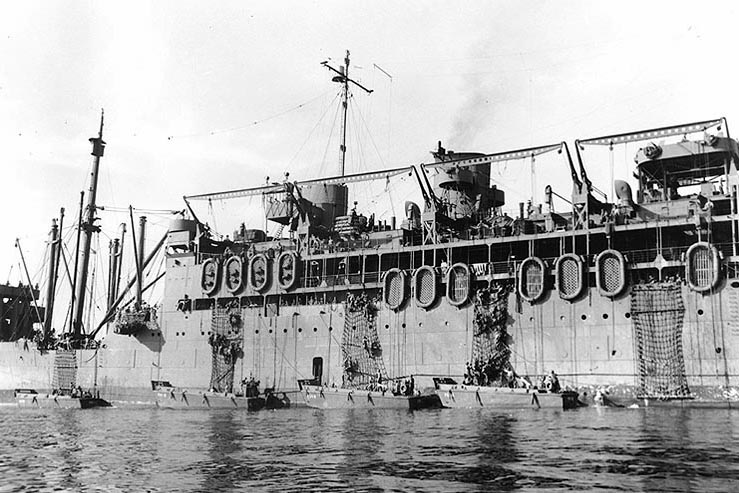
Soldiers climb down netting on the sides of the attack transport USS McCawley on 14 June 1943, rehearsing for landings on New Georgia.
USS DuPage, a Bayfield-class attack transport underway with its complement of landing craft

A troopship (also troop ship or troop transport or trooper) is a ship used to carry soldiers, either in peacetime or wartime. Troopships were often drafted from commercial shipping fleets, and were unable to land troops directly on shore, typically loading and unloading at a seaport or onto smaller vessels, either tenders or barges.

Attack transports,[1] a variant of ocean-going troopship adapted to transporting invasion forces ashore, carry their own fleet of landing craft. Landing ships beach themselves and bring their troops directly ashore.

History

[edit]

Ships to transport troops were used in antiquity. Ancient Rome used the navis lusoria, a small vessel powered by rowers and sail, to move soldiers on the Rhine and Danube.[2]

Nicknamed the "Grey Ghost", RMS Queen Mary holds the all-time record for most troops on one passage, 15,740 on a late July 1943 run from the U.S. to Europe.[3]

The modern troopship has as long a history as passenger ships do, as most maritime nations enlisted their support in military operations (either by leasing the vessels or by impressing them into service) when their normal naval forces were deemed insufficient for the task. In the 19th century, navies frequently chartered civilian ocean liners, and from the start of the 20th century painted them gray and added a degree of armament; their speed, originally intended to minimize passage time for civilian user, proved valuable for outrunning submarines and enemy cruisers in war. HMT Olympic even rammed and sank a U-boat during one of its wartime crossings. Individual liners capable of exceptionally high speed transited without escorts; smaller or older liners with poorer performance were protected by operating in convoys.

Most major naval powers in the late 19th and early 20th centuries provided their domestic shipping lines with subsidies to build fast ocean liners capable of conversions to auxiliary cruisers during wartime. The British government, for example, aided both Cunard and the White Star Line in constructing the liners RMS Mauretania, RMS Aquitania, RMS Olympic and RMS Britannic. However, when the vulnerability of these ships to return fire was realized during World War I most were used instead as troopships or hospital ships.

Soldiers were crowded onto troopships far exceeding normal capacity. SS Leviathan carried 14,416 troops on one World War I trip, setting a record for the most humans on one vessel up to then.[4] RMS Queen Mary and RMS Queen Elizabeth were two of the most famous converted liners of World War II. When they were fully converted, each could carry well over 10,000 troops per trip. Queen Mary holds the all-time record, with 15,740 troops on a single passage in late July 1943, transporting 765,429 military personnel during the war.[3]

World War II

[edit]
A U.S. General G. O. Squier-class troop transport
Aiken Victory, a Victory ship troop ship conversion, arriving in Boston with 1,958 troops from Europe, 26 July 1945[5]

Large numbers of troopships were employed during World War II, including 220 "Limited Capacity" Liberty ship conversions, 30 Type C4 ship-based General G. O. Squier-class, a class of 84 Victory ship conversions, and a small number of Type-C3-S-A2 ship-based dedicated transports, and 15 classes of attack transports, of which some 400 alone were built.

  • The modified Liberties were capable of transporting up to 450,[6] 550,[7] or 650[8] (sources vary) troops or prisoners-of-war. Modifications included installation of bunks stacked five deep on the forward tweendeck, additional shower and head facilities, two additional diesel-powered generators,[7] and installation of two more Oerlikon 20-mm automatic cannons.[6][7][9][10]
  • 30 Type C4 ship-based General G. O. Squier-class, the largest carrying over 6,000 passengers.
  • A class of Victory ship-based dedicated troopship was developed late in World War II. A total of 84 such VC2-S-AP2 hull conversions was completed.[11][12][13][14][15]
  • A class of Type C3 ship – comprising mainly C3-S-A2 and C3-S-A3 hulls – was also converted to dedicated troopships, capable of carrying 2,100 troops,[16] was also developed.
  • At least 15 classes of attack transport, consisting of at least 400 ships specially equipped for landing invasion forces rather than general troop movement.

Designation

[edit]

The designation HMT (Her/His Majesty's Transport) would normally replace RMS (Royal Mail Ship), MV (Motor Vessel) or SS (Steamship) for ships converted to troopship duty with the United Kingdom's Royal Navy. The United States used two designations: WSA for troopships operated by the War Shipping Administration using Merchant Marine crews, and USS (United States Ship) for vessels accepted into and operated by the United States Navy. Initially, troopships adapted as attack transports were designated AP; starting in 1942 keel-up attack transports received the designation APA.

"HMT" was also used, for a while, to designate "Hired Military Transport."[17]

Post-World War II

[edit]

In the era of the Cold War, the United States designed the United States ship so that she could easily be converted from a liner to a troopship, in case of war. More recently, Queen Elizabeth 2 and Canberra were requisitioned by the Royal Navy to carry British soldiers to the Falklands War.[18] By the end of the twentieth century, nearly all long-distance personnel transfer was done by airlift in military transport aircraft.

Some notable troopships

[edit]

See also

[edit]

Notes

[edit]

Bibliography

[edit]
[edit]
Revisions and contributorsEdit on WikipediaRead on Wikipedia
from Grokipedia
A troopship is a vessel, often a converted passenger liner or purpose-built transport, designed to carry large numbers of across oceans during peacetime rotations or wartime deployments, typically loading and unloading at ports rather than directly on shorelines. These ships played a pivotal role in naval , enabling the rapid movement of armies over vast distances, with capacities ranging from 2,000 to over 8,000 troops depending on the vessel's size and era. The concept of troopships traces its origins to the 17th century, when European powers like Britain began using chartered merchant vessels to ferry soldiers to colonial garrisons, such as the fleet that transported The First Tangier Regiment to in 1662 under King Charles II. By the , advancements in steam propulsion revolutionized trooping, with the Enterprise becoming the first steam troopship in 1825, followed by larger vessels like the P&O's Himalaya in 1854, which served in the and could accommodate up to 3,000 troops at speeds of 12 knots. The transition from sail to steam, exemplified by the five Indian troopships (, , Jumna, Malabar, and Seraphis) built in 1866, allowed for more reliable and faster transoceanic voyages, supporting British imperial operations until the . In the 20th century, troopships became indispensable for global conflicts, particularly during World War I, when the U.S. Navy converted numerous liners, including the Leviathan (formerly the German Vaterland), which alone transported over 119,000 troops, as part of the overall effort to ferry more than 2 million American Expeditionary Forces to Europe, often under convoy escort to evade submarines. World War II marked the peak of their use, with over 90 U.S. Navy AP-type troopships, including the General-class (capacity: 5,500 troops) and Admiral-class (4,500 troops), ferrying more than 300,000 personnel in unescorted runs across the Atlantic and Pacific; the USS West Point alone carried over 350,000 troops, the highest capacity of any WWII Navy troopship. Postwar, these vessels supported the Korean War, including evacuations from Hungnam in 1950, and the Vietnam War, where they delivered over 500,000 troops across 2.5 million nautical miles, with two-thirds of U.S. forces arriving by sea in 1965–1966. The traditional troopship era waned in the 1970s with the rise of capabilities, culminating in the retirement of the last U.S. troopship, USNS Upshur, in 1973 after transporting troops for rotational duties. Today, while dedicated large-scale troopships are obsolete, modern equivalents like the U.S. Navy's Spearhead-class Expeditionary Fast Transports (EPFs) provide high-speed personnel movement for up to 312 troops at 43 knots, supporting rapid deployments in expeditionary operations.

Overview

Definition and Purpose

A troopship is a vessel, typically a converted liner or purpose-built ship, designed primarily for the of large numbers of and their equipment across seas or oceans during wartime mobilizations or deployments. These ships prioritize the safe and efficient carriage of troops, often accommodating thousands of soldiers with basic facilities for berthing, messing, and medical care, while featuring minimal defensive armament to deter threats without engaging in combat. The primary purpose of a troopship is to enable the rapid deployment of ground forces to distant theaters of operation, supporting amphibious operations through initial positioning and subsequent or of personnel. By facilitating the movement of expeditionary units over extended distances, troopships ensure the timely arrival of combat-ready troops, integrating with broader chains to sustain military campaigns. Strategically, troopships have been essential for projecting military power globally, particularly before the dominance of air transport, by allowing nations to mobilize and reposition efficiently across oceans, thereby underpinning the of major conflicts and imperial expansions. This capability underscores their role in enabling overseas operations where are critical for force sustainment. Key to their function is the distinction from cargo ships, which focus on materiel and supplies rather than personnel, and from amphibious assault ships, which emphasize direct landing support through embarked aircraft, landing craft, and well decks for shore-to-objective maneuvers.

Design and Operational Features

Troopships were engineered with specialized accommodations to maximize the transport of personnel over long distances, prioritizing density over comfort. Berth arrangements typically featured stacked bunks or hammocks in converted holds and decks, often in three- or four-tier configurations to accommodate high occupancy while allowing for gear storage. Mess halls were designed for communal feeding, with large galleys serving standardized meals to thousands simultaneously on mess decks, ensuring efficient ration distribution during voyages. Medical facilities included onboard sick bays and treatment areas for en-route care, equipped to handle common ailments among troops, while lifeboat provisions were scaled up—often steel-hulled with patent davits—to support evacuation of the full passenger load in emergencies. Capacity varied by vessel size and type, with typical troopships carrying 2,000 to 15,000 personnel; for instance, converted ocean liners like the USS West Point accommodated up to 7,678 troops, while purpose-built classes such as the C4-S-A1 held 3,000 to 3,800. Speed was a critical design priority for evasion of threats, with many achieving 17 to 19 knots; General-class ships reached 19 knots, enabling faster transits and reduced exposure time. Operational adaptations emphasized defensive utility over combat role, including minimal offensive armament such as anti-aircraft guns like the 40-mm for protection against aerial attacks. Troopships often sailed in convoys for mutual defense, though faster vessels operated independently when possible. Conversions from merchant liners involved stripping luxury fittings—such as passenger cabins and salons—to install additional troop decks and bunks, transforming vessels like the SS America into efficient transports. Safety and efficiency measures addressed overcrowding challenges, with enhanced ventilation systems mitigating risks of seasickness, spread, and poor air quality in densely packed spaces. Fuel provisioning supported extended ranges of up to 9,000 miles, allowing for transoceanic voyages without frequent resupply.

Historical Development

Early Troopships (Pre-20th Century)

The origins of dedicated troopships trace back to the during the reign of King Charles II (1660–1685), when the British Navy began using vessels to transport troops to overseas garrisons, such as the movement of the First Regiment to Tangiers in 1662 aboard a fleet of chartered ships. Initially, these transports evolved from repurposed warships and merchant vessels, which lacked specialized accommodations and often exposed soldiers to unhygienic conditions during long voyages. This marked the shift from ad hoc naval deployments to more organized carriage of military personnel for colonial defense and expansion. In the 18th and 19th centuries, East Indiamen—large, armed merchant ships operated by the —played a central role in ferrying British troops to colonies like and , with convoys of five to six vessels providing capacity for around 250 passengers each on three-month journeys via stops at or St. Helena. These ships, typically displacing 1,100 to 1,400 tons, combined commercial trade with military transport, offering spacious decks and armament for protection against privateers. By the mid-19th century, ships supplemented this role, prized for their speed in rapid deployments, such as during the Indian Mutiny of 1857 when Australian clippers carried reinforcements to . The introduction of steam propulsion in the 1850s further transformed troopship operations, with vessels like the iron-hulled HMS Himalaya (3,438 tons, launched 1854) achieving 12 knots and reducing voyage times, thereby enhancing reliability over sail-dependent ships. Troopships were pivotal in major conflicts, including the (1799–1815), where East Indiamen and frigates (around 1,200 tons with 40 guns) supported British troop movements to theaters like the Mediterranean and , often in escorted convoys to evade French raiders. The (1853–1856) highlighted the transition to iron-hulled steamers, with HMS Himalaya chartered as a troop transport to convey soldiers to the , marking a departure from wooden sailing vessels toward more durable and efficient designs. Early troopships faced severe challenges, including high mortality rates from diseases like and due to , poor ventilation, and inadequate medical care, with voyages sometimes resulting in dozens of deaths and hundreds of invalids per ship. Storms posed additional risks, exacerbating instability on sail-powered vessels and limiting capacities to a few hundred troops per ship, which often split regiments and hindered discipline. These limitations underscored the era's reliance on rudimentary berthing arrangements, briefly referencing basic principles like hammock-based sleeping to maximize space amid .

World War I Troopships

During World War I, the Allied powers extensively requisitioned civilian ocean liners to augment their troop transport capabilities, converting luxury vessels into efficient military assets capable of moving vast numbers of soldiers across long distances. The British government, in particular, took control of prominent ships such as the RMS Olympic of the White Star Line and the RMS Aquitania of the Cunard Line, which were repurposed from peacetime passenger service to carry troops to Europe and other fronts. These conversions allowed for the rapid mobilization of forces on an unprecedented scale, with British vessels alone transporting approximately half of the American troops to France. Between April 1917 and November 1918, troopships ferried over 2 million U.S. personnel across the Atlantic, enabling the buildup of the American Expeditionary Forces (AEF) at a peak rate of more than 300,000 troops per month by mid-1918. Troopship operations emphasized security against German threats, primarily through organized s that traversed the Atlantic from U.S. East Coast ports like New York to French destinations such as and Brest. The inaugural U.S. troop , departing on June 14, 1917, consisted of 14 steamships and three transports carrying 14,000 soldiers and , escorted by four cruisers, 13 destroyers, two armed yachts, and fuel tankers to detect and deter submarines via zigzag sailing patterns, , and darkened ships at night. Additional destroyers from bases in Ireland joined mid-ocean for enhanced protection, a tactic that minimized losses despite near-misses from torpedoes. Earlier in the war, troopships supported the ANZAC deployments to the , transporting Australian and New Zealand forces from their home ports to and then to staging areas like Lemnos Island, where vessels including the destroyer HMS Ribble ferried battalions for the April 25, 1915, landings. Key innovations in troopship design and operations included temporary modifications to luxury liners, enabling each to accommodate over 5,000 troops by installing additional bunks, mess facilities, and lifeboats while retaining high speeds for evasion. Anti-submarine defenses were bolstered by the convoy system itself, which grouped ships under escorts equipped with early hydrophones for underwater detection and depth charges for attack, drastically reducing effectiveness against troop movements. Post-armistice, these vessels shifted to duties, returning approximately 2 million Allied troops home at rates exceeding 300,000 per month, utilizing expanded fleets that included converted ships and seized German liners to alleviate and risks. The impacts of WWI troopships were profound, though not without tragedy; for instance, the RMS Leinster, a converted mail and troop transport, was torpedoed by German submarine UB-123 on , 1918, in the , resulting in more than 500 fatalities—the greatest single loss of life from a attack in the conflict. Overall, the ability of troopships to deliver rapid reinforcements, particularly the influx of fresh American divisions in 1918, proved decisive in countering German offensives and securing Allied victory on the Western Front by overwhelming enemy resources.

World War II Troopships

During , troopships reached their zenith in scale and importance, forming the backbone of Allied amphibious operations across multiple theaters. The designated dedicated troop transports as AP (Auxiliary Personnel transport) for general ocean-going vessels and APA (Auxiliary Personnel Attack transport) for those equipped to deploy troops directly onto hostile beaches via , with over 130 APA-class ships commissioned to support invasions. These vessels, alongside hundreds of converted merchant ships including and types, enabled the movement of millions of personnel; U.S. Army ports alone embarked more than 7.6 million troops between 1941 and 1945, while the broader effort, including naval and merchant marine operations, facilitated the overseas deployment of millions of American service members, with U.S. Army ports alone embarking more than 7.3 million troops between 1941 and 1945, as part of supporting the approximately 11.7 million who served abroad. Troopship operations spanned the Atlantic and Pacific, underscoring their global reach. In the Atlantic, they supported convoys to Europe, such as those for in November 1942, where over 100,000 Allied troops landed in aboard a vast armada protected by escorts against Axis threats. For the Normandy invasion on June 6, 1944, more than 1,200 warships and transports, including APA-class vessels, delivered over 132,000 troops to the beaches in the largest amphibious assault in history. In the Pacific, the island-hopping campaign relied on converted Liberty ships—over 220 of which were adapted to carry up to 450 troops each—facilitating rapid advances from to Okinawa by shuttling and units between atolls. Troopships faced severe challenges, including U-boat attacks, overcrowding, and harsh conditions that tested their crews and passengers. German submarines sank numerous Allied transports, with at least eight U.S. troopships lost in the European theater alone, such as the HMT Rohna in , where a glide-bomb attack killed over 1,100 American troops en route to . Overcrowding was rampant, as ships like the —repurposed as a "Queen ship"—carried up to 15,000 troops per voyage, far exceeding her peacetime capacity of 2,000 passengers, leading to triple bunks, limited rations, and disease risks during crossings that could last weeks. These pressures were compounded by the need for speed and secrecy, often forcing zigzagging routes and blackouts. The contributions of WWII troopships were pivotal to Allied victory and postwar recovery. They directly enabled key invasions, including , where APA transports offloaded the U.S. 4th Infantry Division at , and in February 1945, supporting 70,000 in seizing the island's airfields amid fierce resistance. Postwar, utilized hundreds of , , and dedicated troopships to repatriate over eight million American personnel from and between October 1945 and September 1946, marking the largest sealift in history and allowing rapid demobilization.

Post-World War II Troopships

Following , surplus liners and converted vessels from wartime service were repurposed by the U.S. Military Sea Transportation Service (MSTS), established in 1949, to support troop rotations and occupation duties, including deployments to through the . These ships, such as the General-class transports, facilitated the movement of personnel for ongoing Pacific commitments, building on wartime infrastructure to maintain garrisons amid and early tensions. During the , sea transport remained essential for major conflicts. In the (1950–1953), MSTS troopships, particularly the USNS General class, were critical, transporting nearly 5 million personnel across the Pacific, including rotations and support personnel, with the majority of service members arriving by sea due to the theater's isolation and limited capacity at the time. These vessels, modernized in 1953 with air conditioning and enhanced safety features, had capacities up to 5,000 troops and provided improved amenities like better billeting to boost morale during long voyages. Similarly, in the (1965–1973), reliance on ships like the USNS General class persisted, with MSTS/ (MSC) vessels deploying over 500,000 troops and handling 95% of supplies and vehicles, exemplified by the transport of the 1st Cavalry Division's 15,000 soldiers and 98,000 tons of equipment in 1965. Operation Big Lift in 1963, an of 15,000 troops to , signaled the growing role of aviation as a precursor to rapid deployment, yet sea transport continued to dominate for heavy logistics and sustained rotations. By the 1970s, dedicated troopships faced obsolescence as enabled faster personnel airlifts, leading to the deactivation of most General-class vessels and a halving of the MSC fleet from 965 ships in 1965 to 517 by 1975. This shift prioritized (RO-RO) vessels for efficient mixed cargo and troop movement, with the Department of Defense acquiring Large Medium-Speed RO-RO ships to support prepositioned equipment and amphibious operations. In the up to 2025, dedicated liners have become rare, with troop transport integrated into versatile platforms like the U.S. Navy's (ESD) and Expeditionary Sea Base (ESB) classes, operated by MSC. These vessels, derived from commercial oil carriers with reconfigurable decks for 25,000 square feet of stowage and berthing, support amphibious ready groups by staging equipment and personnel for Marine expeditionary units, as seen in exercises like Alligator Dagger, rather than functioning as traditional passenger ships.

Notable Examples

Iconic Pre-WWII Vessels

The , launched in 1914 by the , exemplified the transition of luxury ocean liners into versatile troopships during . Originally designed for transatlantic passenger service with elegant interiors and a top speed of 23 knots, she was requisitioned in early 1915 and converted for military use, serving initially as an armed merchant cruiser before becoming a troop transport to the campaign. Her design innovations included reinforced decks for additional berthing and efficient loading systems that allowed her to carry up to 7,400 troops per voyage, enabling unescorted high-speed crossings to evade submarines. Nicknamed the "Ship Beautiful" for her graceful aesthetics, Aquitania completed multiple runs to the Mediterranean, transporting thousands of Allied soldiers, and later in 1918 ferried 47,867 American troops across nine voyages to Europe. After the war, she underwent refitting to restore her luxury features and resumed passenger service in 1919, highlighting the adaptability of pre-WWII liners. The RMS Olympic, launched in 1911 as the lead ship of the White Star Line's Olympic-class liners and sister to the Titanic, demonstrated remarkable durability and innovation in wartime conversions. Requisitioned in September 1915, she was refitted with hammock berths in repurposed passenger areas to accommodate up to 6,000 troops per voyage, while her 21-knot speed allowed independent operations across the Atlantic and Mediterranean. To counter submarine threats, Olympic received anti-submarine modifications in 1917, including six 6-inch naval guns for offensive capability and to confuse commanders; these enhancements enabled her to ram and sink the German submarine U-103 in May 1918, the only such feat by a troopship in the war. Over her WWI service, she transported approximately 201,000 troops, including significant numbers of and , on routes from to Halifax and Mudros, before being decommissioned in 1919 and scrapped in 1935 after returning to civilian duties. HMT Neuralia, a 1912-built vessel originally for the , represented early hybrid conversions of merchant ships into combined troop and hospital transports for the . Requisitioned in 1915, she was adapted with medical facilities alongside troop berths, achieving a capacity of around 2,500 personnel, and played a critical role in evacuating wounded from the beaches, as depicted in wartime sketches of her loading casualties from smaller vessels. Her design emphasized rapid deployment with modular wards and deck space for stretchers, allowing efficient dual operations in the harsh Aegean conditions. She survived the war and continued service into the 1940s. Among Allied examples, the SS Kaiser Wilhelm II, a pre-war German liner seized by the United States in 1917 and renamed USS Agamemnon, illustrated the repurposing of enemy assets for troop transport. Built in 1903 with a speed of 20 knots and spacious holds, she was refitted at the with additional lifeboats and troop accommodations before commissioning in August 1917. As part of the Cruiser and Transport Force, Agamemnon completed 6 transatlantic voyages during the war between Hoboken and Brest, carrying 37,979 troops to while returning with 41,944 personnel, despite incidents like a collision with her USS Von Steuben and a near-miss attack. Decommissioned in 1919, her service highlighted the strategic value of fast liners in sustaining Allied reinforcements before 1939.

World War II and Later Conversions

The RMS Queen Mary, launched in 1936 as a luxury , was requisitioned by the British government at the outset of and converted into a troopship, stripping away much of its opulent interiors to accommodate . During the war, she transported over 810,000 troops across the Atlantic and other routes, setting a record in by carrying 16,683 people (15,740 troops and 943 crew) on a single voyage from New York to , the highest number ever aboard a floating vessel at the time. Her high speed, which had earned her the for the fastest in 1938 at an average of 30.99 knots, made her invaluable for evading threats while ferrying Allied forces to and beyond. After the war, the Queen Mary was refitted for passenger service and operated as a until 1967, when she was retired and permanently docked in , to serve as a , , and . Similarly, the RMS Queen Elizabeth, completed in 1940 amid the war, bypassed civilian service to become a troop transport, capable of carrying over 15,000 troops per voyage after modifications that maximized berthing space. She played a key role in Allied logistics, transporting more than 750,000 troops across approximately 500,000 miles during the conflict, often in high-speed convoys that shortened transit times and reduced vulnerability to attack. , the Queen Elizabeth resumed transatlantic passenger duties for until 1968, after which she was sold for conversion into a floating university but tragically caught fire and capsized in Harbor on January 9, 1972, rendering her a despite efforts. On the American side, the USS West Point (AP-23), originally the SS America launched in 1939, was transferred to the U.S. Navy in 1941 and rapidly converted into a troopship with a capacity of 7,678 passengers, later increased for overload conditions. She served extensively in both the Atlantic and Pacific theaters, transporting troops to the , , , , , and the , while also evacuating refugees from in early 1942; in total, she carried over 350,000 service members, making her the largest-capacity U.S. Navy troopship of the war. Decommissioned in 1946, she was returned to civilian use as the SS America and continued in commercial service until 1957. The SS United States, launched in 1952 as a record-breaking with a top speed exceeding 35 knots, was designed with military conversion in mind, capable of carrying up to 14,000 troops over 10,000 miles without refueling, though her troopship role remained unrealized amid the due to shifting priorities toward airlift. Modern equivalents include the USNS class of large, medium-speed (LMSR) ships, operated by the since the late 1990s, which provide surge for vehicles, equipment, and limited troop support in contingency operations, enhancing rapid deployment capabilities for joint forces.

References

Add your contribution
Related Hubs
User Avatar
No comments yet.