Hubbry Logo
SS DorchesterSS DorchesterMain
Open search
SS Dorchester
Community hub
SS Dorchester
logo
8 pages, 0 posts
0 subscribers
Be the first to start a discussion here.
Contribute something
SS Dorchester
SS Dorchester
from Wikipedia

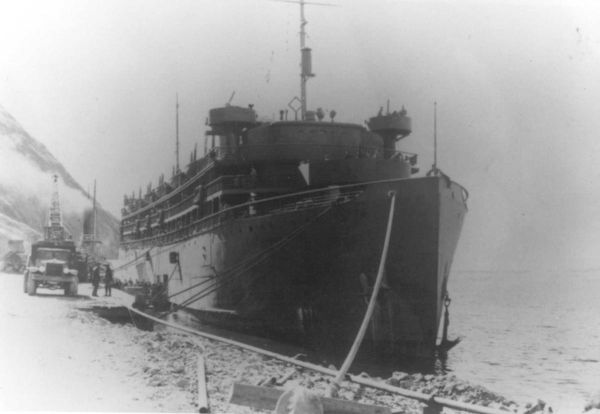
SS Dorchester
History
NameDorchester
NamesakeDorchester, Boston
OperatorMerchants and Miners Transportation Company
RouteMiami–Boston
BuilderNewport News Shipbuilding and Dry Dock Company
Yard number289
Laid downSeptember 10, 1925[1]
LaunchedMarch 20, 1926[1]
AcquiredDelivered July 17, 1926.[2]
NameSS Dorchester (troop transport)
OwnerControl: War Shipping Administration
OperatorAtlantic, Gulf & West Indies Steamship Lines (Agwilines)
AcquiredJanuary 24, 1942
FateTorpedoed and sunk, February 3, 1943
General characteristics
TypePassenger ship / Troopship
Tonnage5,649 GRT[3]
Length368 ft (112 m)[3]
Beam52 ft (16 m)[3]
Draft19 ft (5.8 m)[3]
PropulsionTriple expansion engine[3]
Speed12 knots (22 km/h; 14 mph)[3]
Capacity
  • SS Dorchester : 314 passengers
  • as troop ship Dorchester : 751 troops
Complement
Armament

Dorchester was a coastal passenger steamship requisitioned and operated by the War Shipping Administration (WSA) in January 1942 for wartime use as a troop ship allocated to United States Army requirements. The ship was operated for WSA by its agent Atlantic, Gulf & West Indies Steamship Lines (Agwilines). The ship was in convoy SG 19 from New York to Greenland transiting the Labrador Sea when it was torpedoed by a German U-boat on February 3, 1943. The ship sank with loss of 674 of the 904 on board with one of the 230 survivors lost after rescue. The story of four Army chaplains, known as the "Four Chaplains" or the "Immortal Chaplains," who all gave away their life jackets to save others before they died, gained fame and led to many memorials.

Commercial service

[edit]

Dorchester, one of three identical ships, the first being Chatham (torpedoed and sunk August 27, 1942) and the last being Fairfax, was built for the Merchants and Miners Transportation Company by the Newport News Shipbuilding and Dry Dock Company.[4] Keel laying was September 10, 1925 with launching on March 20, 1926, and delivery on July 17, 1926.[1][2] The ship was designed for the coastwise trade with a capacity for 302 first class and 12 steerage passengers for a total of 314 with a crew of 90 along the East coast between Miami and Boston.[4][5] Propulsion was by a 3,000 horsepower, triple expansion steam engine supplied by four oil fired Scotch boilers with steam at 220 pounds pressure driving a single propeller for a speed of 13.5 knots (15.5 mph; 25.0 km/h).[6]

Passengers were provided three decks, two promenade decks and the boat deck, with four suites having private baths and thirty rooms with beds, ninety-eight with double berths and eight with single berths with most opening onto both the corridor and deck and all had "European style" telephones with receiver and transmitter in one handset.[6] Public spaces included a dance pavilion and sun parlor in addition to the typical lounge and smoking rooms.[6] Cargo of about 3,300 tons was all handled through side ports rather than deck hatches.[6] Refrigerated spaces of 1,873 cubic feet (53.0 m3) for provisions, including ice cream storage, was provided to six compartments cooled by a 4-ton Brunswick compressor. A separate chilled pantry had 210 cubic feet (5.9 m3) of storage.[6]

World War II

[edit]

The ship was delivered by Merchants and Miners Transportation Company to the War Shipping Administration (WSA) at Baltimore on January 24, 1942, for operation by Atlantic, Gulf & West Indies Steamship Lines (Agwilines) as agent for WSA and allocated to United States Army requirements.[7][8] Dorchester was converted to a troopship by Agwilines in New York, and fitted with additional lifeboats and life rafts, as well as four 20 mm guns, a 3"/50 caliber gun fore, and a 4"/50 caliber gun aft.[5]

Dorchester entered service in February 1942, crewed by many of her former officers, including her master initially, and a contingent of Navy Armed Guards to man the guns and to handle communications.[5] The ship was neither owned nor bareboat chartered by the Army and thus not officially designated a United States Army Transport (USAT).[9] The allocation to Army requirements, transport of Army personnel and presence of the Army administrative staff under the Transport Commander in command of embarked troops, led some to assume the ship was an Army transport.

Loss

[edit]
Coast Guard cutter Escanaba rescues Dorchester survivors, February 3, 1943.

On January 23, 1943, Dorchester left New York harbor, bound for the Army Command Base at Narsarsuaq in southern Greenland. SG-19 consisted of six ships: SS Dorchester, two merchant ships (SS Lutz and SS Biscaya) that were leased by the United States from the Norwegian government-in-exile, and their escorts, the small United States Coast Guard cutters Comanche, Escanaba (both 165 feet), and Tampa (240 feet).[10]

During the early morning hours of February 3, 1943, at 12:55, Dorchester was torpedoed by German submarine U-223. The damage was severe, boiler power was lost, and there was inadequate steam to sound the full 6-whistle signal to abandon ship, and Dorchester sank by the bow in about 20 minutes. Loss of power prevented the crew from sending a radio distress signal, and no rockets or flares were launched to alert the escorts. A severe list prevented launch of some port side lifeboats, and some lifeboats capsized through overcrowding. Survivors in the water were so stiff from cold they could not even grasp the cargo nets on rescue vessels. The crew of Escanaba employed a new "retriever" rescue technique whereby swimmers clad in wet suits swam to victims in the water and secured a line to them so they could be hauled onto the ship. By this method, Escanaba saved 133 men (one died later) and Comanche saved 97 men of the 904 aboard Dorchester.[11] The sinking of Dorchester was the worst single loss of American personnel of any American convoy during World War II.[12]

Life jackets offered little protection from hypothermia, which killed most men in the water. Water temperature was 34 °F (1 °C) and air temperature was 36 °F (2 °C). When additional rescue ships arrived on February 4 "hundreds of dead bodies were seen floating on the water, kept up by their life jackets."[13]

The Four Chaplains

[edit]

The Four Chaplains were four of the Army officers among the military personnel being transported overseas for duty: they died because they gave up their life jackets to save others. These chaplains included Methodist minister George L. Fox, Reformed Church in America minister Clark V. Poling, Catholic Church priest John P. Washington and Rabbi Alexander B. Goode.[14] Congress established February 3 as "Four Chaplains Day" to commemorate this act of heroism, and on July 14, 1960, created the Chaplain's Medal for Heroism, presented posthumously to the next of kin of each of the chaplains by Secretary of the Army Wilber M. Brucker at Fort Myer, Virginia on January 18, 1961.[14][15]

Commemoration on US postage

[edit]
The Immortal Chaplains
Issue of 1948

In 1948 the U.S. Post Office issued a commemorative stamp in honor of the heroism and sacrifice of the chaplains.[16] It was designed by Louis Schwimmer, the head of the Art Department of the New York branch of the Post Office.[17] This stamp was highly unusual, because until 2011, U.S. stamps were not normally issued in honor of someone other than a President of the United States until at least ten years after their death.[18][19]

The stamp went through three revisions before the final design was chosen.[20] None of the names of the chaplains were included on the stamp, nor were their faiths (although the faiths had been listed on one of the earlier designs): instead, the words on the stamp were "These Immortal Chaplains...Interfaith in Action."[20] Another phrase included in an earlier design that was not part of the final stamp was "died to save men of all faiths."[20] By the omission of their names, the stamp commemorated the event, rather than the individuals per se, thus obfuscating the ten-year rule in the same way as later did stamps honoring Neil Armstrong in 1969[21] and Buzz Aldrin in 1994,[22] both of whom were still alive.

Notable passengers and crew

[edit]

The American writer Jack Kerouac served on Dorchester, where he befriended an African-American cook named "Old Glory," who died when the ship sank after the torpedo attack. Kerouac would have also been on the ship during the attack, but for a telegram he received from coach Lou Little, asking him to return to Columbia University to play football.[23]

See also

[edit]

References

[edit]
[edit]
Revisions and contributorsEdit on WikipediaRead on Wikipedia
from Grokipedia
The SS Dorchester was an American troop transport ship torpedoed and sunk by the German submarine U-223 on February 3, 1943, during , resulting in the deaths of 675 of the 904 people aboard, including four military chaplains who sacrificed their life jackets to aid survivors in the frigid North Atlantic waters. Originally built as a luxury passenger liner in 1926 by the and Dry Dock Company for the Merchants and Miners Transportation Company, the vessel operated coastal routes between and before being requisitioned by the U.S. government in February 1942 and converted into the USAT Dorchester to ferry troops and supplies. At the time of its sinking, the ship was part of SG-19, en route from St. John's, Newfoundland, to , , carrying approximately 750 troops and passengers (including 597 soldiers and 171 civilian workers), 130 crew members, 23 armed guards, and 1,069 tons of cargo including lumber and mail. The attack occurred at approximately 00:55 hours about 150 miles west of , when U-223 fired five torpedoes, one of which struck the starboard machinery spaces below the , causing a massive explosion that disabled the engines and power systems, leading to the ship's rapid sinking within 25 to 30 minutes. Chaos ensued in the subzero temperatures, with many lifeboats damaged or overcrowded; of the 14 lifeboats aboard, only two were successfully launched, while most survivors clung to rafts or debris in waters around 28°F (-2°C). Rescue efforts by U.S. cutters—USCGC Escanaba, Comanche, and Tampa—saved 230 men, though the Escanaba sank four months later on June 13, 1943, during convoy duty in the North Atlantic. The tragedy is most notably remembered for the heroism of the —Lieutenant George L. Fox (Methodist), Lieutenant Alexander D. Goode (Jewish), Lieutenant Clark V. Poling (Dutch Reformed), and Lieutenant John P. Washington (Catholic)—who, after helping passengers don life preservers amid the panic, gave away their own jackets to those without, standing arm-in-arm in prayer as the ship went down. Their selfless actions, witnessed by numerous survivors, led to nominations for the ; they were instead posthumously awarded and Distinguished Service Cross on December 19, 1944, and Congress established the Four Chaplains' Medal in 1960 (presented in 1961), the only such medal given outside the armed services. The event has been commemorated through memorials, including a in and a stained-glass window in the Pentagon Chapel, symbolizing interfaith unity and sacrifice during wartime.

Construction and Specifications

Building History

The SS Dorchester was constructed at the in , for the Merchants and Miners Transportation Company of , . As a purpose-built coastal passenger vessel, she was designed to provide luxury service on routes connecting major East Coast ports, including a regular itinerary from to , accommodating up to 314 passengers in comfortable accommodations. Launched on March 20, 1926, amid a multiple-ship at the shipyard, the Dorchester held the distinction of being the largest vessel ever built on the up to that point. She was one of three identical sister ships constructed that year for the Merchants and Miners fleet, alongside the Chatham and Fairfax, to expand the company's capacity in the competitive coastal trade. The Dorchester was completed and delivered to her owners on July 17, 1926, entering civilian service shortly thereafter as a of the line's operations. This timely addition reflected the post-World War I resurgence in American coastal shipping, where vessels like her emphasized reliability, speed, and passenger amenities to serve growing demand for leisure and along the Atlantic seaboard.

Design and Technical Details

The SS Dorchester was a coastal designed for efficient service along the eastern seaboard of the , emphasizing comfort for leisure travelers between ports like , , and . Built by the and Dry Dock Company, she featured a steel hull with modern amenities tailored for short cruises, including cabin accommodations with telephones in every room, oscillating electric fans, and an onboard freezer to provide luxuries such as even at sea. Additional facilities included a dance pavilion, music room, social hall for afternoon tea, a circulating , barber shop, and provisions for religious services, deck games, and messaging, all supporting a relaxed voyage atmosphere. In her original configuration, measured 368 feet in length, with a beam of 52 feet and a draft of 19 feet, giving her a of 5,649 tons. was provided by a . This setup was optimized for reliable coastal operations rather than high-speed transoceanic travel, achieving a service speed of 12 knots and allowing for economical fuel use on routes serving both passengers and limited cargo, including automobiles. The ship accommodated up to 314 passengers in comfortable cabins, supported by a crew of 90, for a total complement of around 404. Safety features included lifeboats sufficient for over 400 persons, in line with contemporary maritime regulations for vessels, though she carried no armament during commercial service. The Dorchester shared an identical design with her two sister ships, SS Chatham and SS Fairfax, all constructed in for the Merchants and Miners Transportation Company to standardize operations and reduce costs in the competitive East trade. This class of vessels represented a shift toward more luxurious coastal liners, enhancing appeal with hotel-like services while maintaining practical dimensions for navigating shallow harbors.

Commercial Service

Passenger Operations

The SS Dorchester was operated by the Merchants and Miners Transportation Company as a coastal passenger liner from its launch in until its requisition by the U.S. government in 1942. During this period, the vessel provided comfortable transportation for leisure passengers on short coastal voyages, often featuring overnight accommodations to enhance the travel experience. The ship's crew consisted of 90 members, including dedicated stewards who delivered luxury services such as three daily meals, a nighttime lunch buffet, and access to amenities like a dance pavilion, music room, circulating library, barber shop, and onboard entertainment options. These features underscored the Dorchester's emphasis on passenger comfort, with staterooms equipped with oscillating electric fans, telephones, and even an onboard freezer for serving . As part of the Merchants and Miners fleet, the Dorchester played an economic role in facilitating passenger travel alongside limited cargo transport along the U.S. East Coast, contributing to regional commerce and tourism in the interwar years. The vessel underwent routine maintenance during this time to ensure operational reliability, though no major peacetime incidents were recorded.

Routes and Capacity

The SS Dorchester primarily operated on a coastal passenger route connecting Miami, Florida, to Boston, Massachusetts, serving as a key link in the Merchants and Miners Transportation Company's network along the eastern seaboard. The itinerary included intermediate stops at Jacksonville, Savannah, , Baltimore, and , allowing for efficient regional connectivity and often extending to New York in variations of the schedule. This route catered to tourists and business travelers, emphasizing reliable overnight voyages with a focus on comfort and speed. Seasonal patterns shaped the ship's operations, with winter schedules emphasizing southward cruises from northern ports to Florida's warmer climates, attracting vacationers escaping harsh weather. In summer, the vessel shifted to northward runs, supporting return travel and regional as demand fluctuated with weather and leisure trends. These adjustments aligned with broader coastal steamer practices, optimizing passenger flow between seasonal destinations. The Dorchester had a passenger capacity of 314, divided into 302 first-class and 12 berths, supported by a of 90. Voyages typically utilized this space partially, alongside limited . To maximize efficiency on these mixed passenger-cargo runs, some lower-class accommodations featured bunk beds or tiered berths, though upper classes maintained private staterooms with amenities like electric fans and telephones. Economically, the ship bolstered the 1920s-1930s surge along the U.S. East Coast, facilitating affordable that stimulated Florida's winter industry and northern ports' . The prompted reductions in service frequency and passenger loads across the Merchants and Miners fleet, reflecting broader declines in leisure amid economic hardship. Despite these challenges, the Dorchester remained a vital for regional economic ties until its wartime requisition in 1942.

World War II Service

Requisition and Conversion

Following the ' entry into , the SS Dorchester was requisitioned by the War Shipping Administration (WSA) on January 24, 1942, and placed under the operation of Agwilines, Inc., a subsidiary of the Atlantic, Gulf & Steamship Lines. This marked the end of its civilian passenger service and initiated its transformation into a military asset amid urgent demands for troop transport capabilities in the Atlantic theater. The conversion process began immediately after requisition, with the ship undergoing a rapid refit by Agwilines, Inc. in New York to adapt it for wartime duties. Luxury fittings from its commercial era, such as passenger cabins and amenities, were stripped away to make for utilitarian modifications, including the installation of multi-tiered bunks to accommodate up to 751 troops. Armament was added for defensive purposes, consisting of one 4-inch gun, one 3-inch anti-aircraft gun, and four 20 mm anti-aircraft guns, operated by a Armed Guard detachment. The vessel was officially redesignated as the Transport (USAT) Dorchester, with its crew expanded to include 130 merchant seamen for navigation and operations, supplemented by 23 gunners to man the defensive weapons. By early February 1942, the conversion was complete, allowing the USAT to commence initial shakedown voyages along the U.S. East Coast to test its new configuration and ensure seaworthiness before deployment to combat zones. These early trips helped familiarize the expanded crew with the ship's altered handling and capacity under military protocols. However, the haste of the refit, driven by wartime pressures, resulted in design limitations that contributed to overcrowding and discomfort during subsequent transports, as the vessel often carried passengers beyond optimal levels in response to operational needs.

Troop Transport Voyages

Following its conversion to a troop transport in early , the USAT Dorchester commenced military operations with multiple round-trip voyages across the North Atlantic, primarily departing from New York or to St. John's, Newfoundland, and onward to U.S. bases in . The ship completed five such voyages to in under Captain L. B. Kendrick, who retired afterward; the sixth and final voyage was under Captain Hans Danielsen. These trips supported the Allied effort by delivering personnel and to strategic outposts amid the ongoing . The vessel transported U.S. Army troops, engineers, and essential supplies for establishing and maintaining North Atlantic weather stations and airbases, such as those at Narsarssuak, Ivigut, and Sondre Stromfjord. A typical voyage carried 500 to 700 soldiers, supplemented by vehicles, construction equipment, and up to 1,000 tons of food and other cargo, reflecting the ship's refitted capacity of around 750 troops plus crew. For instance, one early 1942 itinerary involved departure from New York in March to Kungnait Bay, Greenland, with return in late April, while a May voyage from Boston targeted multiple Greenland sites before looping back in June. To mitigate U-boat threats, the Dorchester sailed in protected convoys escorted by U.S. cutters, navigating hazardous waters without incident on these prior journeys despite frequent encounters with severe storms. The trips faced operational difficulties, including overcrowding that strained berthing and facilities—often exceeding the original passenger liner's design—combined with extreme cold in the routes, which tested endurance during passages lasting weeks. Morale among troops was challenged by the monotonous, uncomfortable conditions, though the ship's role in bolstering vital and networks underscored its importance to the .

Final Voyage and Sinking

Convoy SG 19

The USAT Dorchester departed on January 23, 1943, as part of preparations for its final voyage to support Allied operations in . The ship stopped at St. John's, Newfoundland, where it joined Convoy SG 19 on January 29, bound for the U.S. Army airbase at (also known as Bluie West One) in southern . This small convoy consisted of three merchant vessels: the Dorchester, the Norwegian-owned SS Biscaya, and the SS Lutz, all leased by the for wartime transport. Escorting the group were three U.S. cutters—the USCGC (WPG-76), USCGC Escanaba (WPG-77), and USCGC Tampa (WPG-48)—tasked with protecting against German threats in the hazardous North Atlantic. The Dorchester carried a total of 904 personnel, including 597 U.S. Army troops destined for base construction and operations, 171 civilians such as war workers and technicians, 130 crew members, and 23 armed guards. Its cargo included over 1,000 tons of essential supplies—such as , , for building infrastructure, and 60 bags of mail—to bolster the remote facilities critical for transatlantic routes. The convoy's path traversed the frigid , where the ships encountered brutal winter conditions, including gale-force winds, towering waves, and extensive ice fields that slowed progress and heightened the dangers of navigation. Aboard the Dorchester, the troops were largely confined below decks in cramped bunks, many suffering from severe seasickness amid the relentless storm-tossed voyage. The four Army chaplains—Lieutenant George L. Fox (Methodist), Lieutenant Alexander D. Goode (Jewish), Lieutenant John P. Washington (Catholic), and Lieutenant Clark V. Poling (Dutch Reformed)—moved among the men, offering prayers, distributing soda crackers to ease , and providing emotional support to alleviate fears in the tense atmosphere. Their presence helped maintain as the convoy pressed on through the perilous waters known as "Torpedo Junction."

Torpedo Attack and Immediate Response

On the early morning of February 3, 1943, at approximately 12:55 a.m., the USAT Dorchester was torpedoed by the German submarine U-223 while sailing as part of convoy SG-19 in the Labrador Sea. The attack occurred at position 59°22′N 48°42′W, about 150 miles west of Cape Farewell, Greenland. The struck the starboard side in the machinery spaces near the , causing a massive that instantly killed dozens of members and passengers in the lower decks. The blast severed the ship's power supply, plunging the vessel into darkness as lights and communications failed, while cold seawater flooded in rapidly. Within moments, the Dorchester developed a severe 30-degree list to starboard, halting the engines and leaving the ship adrift. The vessel ultimately sank just 27 minutes after the hit, its bow rising dramatically before slipping beneath the waves. Captain Hans J. Danielsen immediately ordered the crew to abandon ship, sounding six blasts on the whistle to signal the . Evacuation efforts began amid , with soldiers and sailors scrambling for life preservers and warm clothing in the pitch-black conditions. Of the ship's 14 lifeboats, only two were successfully launched due to the heavy list and ice accumulation; many others were damaged by the explosion or capsized from overcrowding or rough handling in the chaos. Compounding the disaster were the harsh environmental conditions: a moonless night with temperatures near freezing, high seas from recent storms, and water at approximately 34°F (1°C), which would cause rapid hypothermia for anyone immersed. The darkness and swells made navigation to lifeboats nearly impossible for many below decks, trapping hundreds as the ship tilted further and began to founder.

Rescue Operations

Following the sinking of the USAT Dorchester on February 3, 1943, rescue operations were primarily conducted by the two U.S. Coast Guard cutters escorting Convoy SG 19, the USCGC Escanaba and USCGC Comanche. These vessels, positioned nearby during the torpedo attack, immediately reversed course to the scene despite the risk of further U-boat activity. The Escanaba arrived first and began pulling survivors from the 34°F (1°C) waters of the Labrador Sea, where hundreds floated amid oil slicks, debris, and overturned lifeboats. Using a pioneering "retriever" technique developed by the cutter's crew, swimmers clad in rubber exposure suits tethered themselves to lines and swam out to victims, securing ropes around unresponsive men or rafts before hauling them to the ship's side via cargo nets. Blankets and hot coffee were then administered to combat severe hypothermia, which had already claimed many lives by rendering survivors immobile with frozen limbs. In total, the Escanaba rescued 133 men, though the operation continued for several hours under blackout conditions and heavy seas. The USCGC Comanche joined the effort shortly after, employing similar retriever methods alongside initial attempts with lowered cargo nets, though many survivors were too weakened by exposure to climb aboard unaided. Crew members, including mess attendant Charles Walter David Jr., repeatedly entered the frigid to assist, ultimately saving 97 individuals from the scattered debris field. Challenges persisted as caused rapid unconsciousness, with rescuers often finding men dead in their life jackets; the search extended until around 9:30 a.m., when no further survivors were located. One rescued man succumbed to exposure-related injuries despite medical efforts aboard the Comanche. The third escort vessel, USCGC Tampa, provided minimal direct assistance, prioritizing the safety of the remaining ships. Overall, 230 men were saved out of the 904 aboard the Dorchester, a figure underscoring the devastating impact of the cold Atlantic waters. The German submarine U-223, responsible for the attack, evaded immediate pursuit but was later sunk on March 30, 1944, in the Mediterranean Sea by depth charges from British destroyers including HMS Laforey and HMS Tumult.

The Four Chaplains

Background of the Chaplains

The four chaplains aboard the USAT Dorchester—Lieutenant George L. Fox (Methodist), Lieutenant Alexander D. Goode (Jewish), Lieutenant John P. Washington (Catholic), and Lieutenant Clark V. Poling (Dutch Reformed)—were commissioned U.S. Army officers tasked with providing spiritual guidance and morale support to troops during World War II. They met in November 1942 at Camp Myles Standish in Massachusetts while awaiting overseas assignment, where they formed a close interfaith bond through shared discussions and preparations. Assigned together to the Dorchester in late January 1943, they offered counseling, led religious services, organized games and talent contests, and fostered unity among the soldiers during the voyage. George L. Fox, the eldest of the group, was born on March 15, 1900, in , and raised in Altoona by a strict Catholic family amid a challenging childhood. At age 17, he enlisted in the U.S. Army during by falsifying his age, serving as a assistant on the Western Front, where he was wounded and awarded the , , and . After the war, Fox worked as an accountant, married Isadore, and fathered two children—a son and daughter—before experiencing a religious calling that led him to the , (BA, 1929), and Boston University School of Theology, where he was ordained as a Methodist minister in 1934. He pastored small congregations in , emphasizing community service, until his commissioning as an Army chaplain on July 10, 1942, following basic training at . In September 2024, a memorial service with full military honors was conducted for Fox at , where a marker was dedicated in his honor. Alexander D. Goode was born on May 10, 1911, in Brooklyn, New York, to Rabbi H. David Goodekowitz, later moving to Washington, D.C., where he excelled in academics and athletics at Eastern High School. He earned a BA from the University of Cincinnati in 1934, was ordained a Reform rabbi at Hebrew Union College in 1937, and completed a PhD at Dropsie College in 1940. Goode married his childhood sweetheart, Theresa F. Flax, in 1935, and they had a daughter, Deborah, in 1940; he served as rabbi at Temple Beth Israel in York, Pennsylvania, from 1938, promoting interfaith dialogue with local Christian leaders. Motivated by the Pearl Harbor attack, he was commissioned as an Army Air Forces chaplain on August 9, 1942, after training at Harvard, and initially served at bases in North Carolina and Massachusetts. John P. Washington, born on July 18, 1908, in , was the eldest of seven children in an Irish immigrant family, growing up in a working-class neighborhood where he worked as a newsboy and clerk to support his household. A devout youth and altar boy, he discerned a to the priesthood at age 19 after encountering wounded veterans, leading him to study at , , and Immaculate Conception Seminary in Darlington, , where he was ordained on June 15, 1935. Assigned to parishes in , including St. Genevieve in Elizabeth, Washington was known for his musical talents as a and saxophonist, organizing choirs, sports teams, and youth programs to build community. He volunteered for in May 1942 after being rejected by the , completing chaplain training at Harvard before joining the 76th Infantry Division at and later Camp Myles Standish. Clark V. Poling, the youngest chaplain, was born on August 7, 1910, in , into a seventh-generation ministerial family; his father, Daniel A. Poling, was a prominent evangelical pastor who had lost a son in . Raised in Auburndale, , Poling attended , , and (BD, 1936), where he was ordained in the . He married Elizabeth Greisdorf in 1933, and they had a young daughter, Marjorie; Poling pastored congregations in , and , focusing on evangelism and youth ministry until the Japanese prompted his enlistment as an Army chaplain on June 10, 1942, despite his father's reluctance. After Harvard training, he served with the 131st Truck Regiment before the group assignment.

Act of Sacrifice

As the USAT Dorchester rapidly filled with and listed to one side following the strike at approximately 12:55 a.m. on , 1943, the —Lieutenant George L. Fox (Methodist), Lieutenant Alexander D. Goode (Jewish), Lieutenant Clark V. Poling (Dutch Reformed), and Lieutenant John P. Washington (Catholic)—responded with remarkable composure amid the ensuing panic. They moved through the chaos on the tilting decks, helping to calm terrified soldiers by offering words of encouragement and prayers, while directing disoriented troops toward the lifeboats and rafts. Eyewitness Private William B. Bednar, floating in the oil-slicked s, later recalled hearing the chaplains' voices preaching courage above the cries of the wounded and , which sustained him during his ordeal. The chaplains then accessed storage lockers to distribute life preservers to scrambling for safety, working with the efficiency of a practiced boat drill despite the ship's violent shuddering. As the supply of jackets dwindled, the four men removed their own life vests and handed them to four young who had none, an act of selflessness witnessed by survivors including Engineer Grady Clark and Private John Ladd from a nearby . Ladd described it as "the finest thing I have seen or hope to see this side of heaven," emphasizing their disregard for personal survival in favor of aiding others. Survivor Walter Miller specifically remembered Chaplain Fox pressing a life jacket into his hands with the words, "Here’s one, ," before the chaplain himself went without. In their final moments, as the Dorchester sank stern-first after just 27 minutes, the chaplains were last seen on the slanting deck with arms linked together, bracing against the railing and reciting that reflected their interfaith —drawing from English, Hebrew, and Latin traditions to invoke solace for all aboard. Survivors in the water and on rafts observed this tableau of , where the Protestant ministers, , and stood as one, their collective symbolizing selfless across religious divides in the face of certain . This profound display of brotherhood amid crisis left an indelible impression on the 230 men who survived out of the 904 aboard.

Legacy and Commemoration

Memorials and Honors

The heroism of the aboard the SS Dorchester has been commemorated through various official awards and physical memorials. In 1948, the issued a 3-cent depicting the chaplains, marking the first U.S. to honor an interfaith religious event of sacrifice. This stamp, released on May 28, 1948, symbolizes their selfless act and has been collected and referenced in postal history as a tribute to unity across faiths. A prominent physical memorial is the Chapel of the , an interfaith structure located at the Navy Yard, dedicated on February 3, 1951, by President . Funded by contributions from over 10,000 donors of diverse backgrounds, the chapel serves as a space for worship, , and reflection on themes of and , hosting annual services and events. Its architecture, featuring elements from multiple religions, underscores the chaplains' legacy of interfaith solidarity. In recognition of their extraordinary actions, authorized the ' Medal in 1960 as a one-time special award for heroism, distinct from the due to military policies prohibiting posthumous awards to chaplains and non-combatants in that category. The medals were struck and presented posthumously to the chaplains' next of kin on January 18, 1961, by Secretary of the Army Wilber M. Brucker at , . The chaplains are also memorialized at Arlington National Cemetery's Chaplains Hill in Section 2, where four monuments honor chaplains killed in the line of duty across wars, including sacrifices like those on the Dorchester. In September 2024, a memorial service with full military honors was held for Chaplain George L. Fox, including the dedication of a memorial marker, further emphasizing the site's role in perpetuating their memory. February 3 is observed annually as Day, first designated by in 1948 and reaffirmed through resolutions, with commemorative events held by military branches and veterans' groups nationwide. Several states, including and , have passed proclamations recognizing the date, while the U.S. and Coast Guard conduct ceremonies at memorials like the chapel and Navy Yard sites. Memorials specific to the SS Dorchester include plaques and dedications on vessels involved in the rescue, such as the USCGC Comanche and its successors, acknowledging the convoy's role in saving 230 survivors. The ship's wreck site, located at approximately 59°22′N 48°42′W in the Labrador Sea, remains undisturbed as a protected war grave, with its coordinates documented by naval archives to preserve the historical site without disturbance.

Cultural Impact

The story of the Four Chaplains aboard the SS Dorchester has significantly influenced in the United States, particularly in promoting in the post-World War II era. Their act of selfless sacrifice, uniting chaplains from Protestant, Catholic, and Jewish traditions, served as an early model for ecumenical , inspiring organizations to foster unity across faiths long before "interfaith" became a common term. The Chapel of the , dedicated in , explicitly encourages interfaith by sharing their story as a testament to selfless service and diversity, influencing efforts to bridge religious divides. This legacy continues through initiatives like those of the Memorial Foundation, which promotes ideals of interfaith unity and has been recognized as a paragon of such in Jewish reflections. The narrative has permeated and media, amplifying its message of heroism and . Dan Kurzman's 2004 book No Greater Glory: The Four Immortal Chaplains and the Sinking of the Dorchester in provides a detailed account of their bonds and bravery, drawing on survivor testimonies to highlight their interfaith friendship and sacrifice. Documentaries such as The Four Chaplains: Sacrifice at Sea (2004) and Sacrifice at Sea: Heroic Story of the Four Chaplains have further popularized the story, using military footage and eyewitness accounts to emphasize themes of unity and service for broader audiences. The ' example has underscored the need for multi-faith support within the U.S. military , exemplifying diversity and spiritual leadership amid crisis. Their representation of Catholic, Jewish, and Protestant faiths highlighted the chaplaincy's role in serving troops of varied beliefs, resonating as a core lesson in fellowship and devotion for the Army Chaplain Corps. This has reinforced the emphasis on inclusive religious accommodation in the armed forces, aligning with broader efforts to address the religious diversity of service members. Annual commemorations, such as the 75th anniversary events in 2018 organized by the and the U.S. Navy Memorial, have involved wreath-laying ceremonies and dedications to honor their sacrifice. The 80th anniversary in 2023 featured observances by the , the , and local parishes, including memorial services that drew participation from military branches and foundations to reflect on their enduring impact. Educationally, the story is integrated into U.S. history curricula as an exemplar of wartime heroism and , often taught to illustrate interfaith solidarity and service. The Memorial Foundation plays a central role in preservation and outreach, offering educational programs since the through the chapel's initiatives to teach younger generations about .

References

Add your contribution
Related Hubs
Contribute something
User Avatar
No comments yet.