Hubbry Logo
TrunyanTrunyanMain
Open search
Trunyan
Community hub
Trunyan
logo
8 pages, 0 posts
0 subscribers
Be the first to start a discussion here.
Trunyan
Trunyan
from Wikipedia
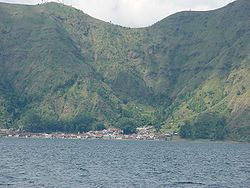
The isolated Bali Aga village of Trunyan on the eastern shore of Lake Batur at the foot of Mount Abang.

Trunyan (Balinese: ᬢ᭄ᬭᬸᬜᬦ᭄) or Terunyan is a Balinese village (banjar) located on the eastern shore of Lake Batur, a caldera lake in Bangli Regency, central Bali, Indonesia. The village is one of the most notable homes of the Bali Aga people, the others being the villages of Tenganan and Sambiran. Trunyan is notable for its peculiar treatment of dead bodies, in which they are placed openly on the ground, simply covered with cloth and bamboo canopies, and left to decompose. The influence of a nearby tree is said to remove the putrid smell of the corpses.

Description

[edit]

Trunyan is one of the culturally isolated Bali Aga villages in Bali. Trunyan village is located on the isolated eastern shore of the crescent-shaped Lake Batur, at the foot of Mount Abang, a peak on the eastern rim of the large caldera. The village is most easily accessible by boat.

The people of Trunyan are generally considered to be Bali Aga people, the mountain Balinese. Unlike the lowland Balinese, Bali Aga people practice ancient rituals that predate the arrival of Hinduism or Buddhism. The Bali Aga of Trunyan is noted for its unique traditions, even among the Bali Aga.[1] The earliest copper plate inscriptions known (A.D. 882-914) concerning Bali mention the foundation of a temple for Bhatara da Tonta at Trunyan

According to copperplate inscriptions found in one of the shrines of the main temple of Trunyan, the temple dates back to at least the 10th century AD (833 saka).[2]

The village is believed to be much older than the temple.[1] Some lithic tools found at Trunyan indicate a culture of hunters-gatherers.[3]

Society

[edit]

Trunyan society consists of two main "castes", the banjar jero and the banjar jaba. The castes are based on bloodlines dating back to the Gelgel dynasty. The banjar jero are descendants of the Trunyanese who went out of the village to be appointed by the kings of Gelgel to rule; whereas the banjar jaba are descendants of people who were ruled by the banjar jero. This caste system is one of few examples of outside society affecting life in the most isolated Trunyan.[4] Another example of outside influence on the Trunyanese is the requirement for young men to travel through lowland Bali for some time to live as beggars. This practice is similar to the monks of Thailand and is derived from a strong Buddhist tradition of the 10th century.[5]

Similar to other Balinese people, the Trunyanese place emphasis on prestige. Major ceremonies should be held as lavishly as possible. For example, wedding ceremonies are expected to be impressive, or not to be held at all. Since the Trunyanese economy is based on small-scale agriculture, accumulating money and possessions is relatively difficult. Many married couples with children in Trunyan perpetually postpone their wedding ceremonies just because of the high costs involved.[4]

Funeral rites

[edit]

The people of Trunyan practice customs found nowhere else in Bali, many even unique among the Bali Aga people. Among the unique customs of the Trunyanese is their treatment of dead bodies. Instead of cremations, the funeral rite for dead bodies in Trunyanese society is for them to be simply laid on the ground, covered by cloth and a bamboo cage, and left to decompose. The influence of an ancient banyan tree (known as taru menyan, literally "nice smelling tree") near the burial ground is thought to keep the corpses from smelling putrid. It is said that the tree emits a scent that neutralizes the smell of rotting bodies. It is also said that from this tree the name trunyan is derived. When a corpse has fully decomposed, the skull is placed on a stair-shaped stone altar which is located 500 meters north of the Banjar Kuban, a special place that can only be reached by boat. Only the bodies of married couples are allowed to be treated like this. If the deceased is not married, the body is buried at a cemetery.[1]

These Trunyanese funeral rites date back to the Neolithic Agama Bayu sect, one of the six most important religious-spiritual sects during the pre-Hindu period in Bali. The Agama Bayu worshipped the stars and the wind (angin ngelinus).[1]

Volcano god Bhatara Da Tonta

[edit]

The Trunyanese worship a local god and patron of the village known as Ratu Gede Pancering Jagat, known by the Trunyanese as Bhatara Da Tonta. The local god is connected with the Batur volcano. Bhatara Da Tonta is rendered as a four-meter-tall Neolithic effigy. The giant statue is housed in an underground chamber and is still regularly cleansed with rainwater, bedecked with flowers and anointed with special oil. The manner of worship is based on an ancient bronze tablet from 911 AD which was found in the Pura Tegeh Koripan, a temple built in the form of a Neolithic pyramid at Mount Penulisan, the second-highest point of the caldera of the Batur volcano.[1][5] The effigy of Bhatara Da Tonta is brought out once a year during the Brutuk festival, which is held on the full moon of the fourth month (Purnamaning Sasih Kapat), which falls around October on the Gregorian Calendar.

Barong Brutuk

[edit]

The Brutuk dance or Barong Brutuk dance is both a performance and a religious ritual. Brutuk dance performers wear sacred masks and two aprons of dried banana leaf fiber, tied around the neck, waist, and torso. The dance is performed with no music. The Berutuk dance is performed by a selected group of unmarried men who must undergo a purification ritual and isolation before the performance. During the isolation period, the men have to sleep in the temple, abstain from sexual contact, and learn the prayers for the ceremony from the temple priest.[1]

See also

[edit]

References

[edit]

Bibliography

[edit]
[edit]
Revisions and contributorsEdit on WikipediaRead on Wikipedia
from Grokipedia
Trunyan is a remote village in the Kintamani district of , , , situated on the eastern shore of at the foot of , and is renowned for its distinctive Hindu-Balinese funerary practices that eschew the island's typical cremations in favor of open-air decomposition under a sacred tree. Inhabited primarily by the —the indigenous, pre-Hindu inhabitants of —Trunyan maintains ancient traditions that predate the 14th-century Empire's influence on the island's culture, including animistic elements blended with . The village's name derives from the Taru Menyan tree, a massive species central to its identity, believed to emit a purifying fragrance that neutralizes the odors of decay and safeguards the living from harm during the process. These practices, known as mepasah, involve placing the bodies of married adults or children who have lost their baby teeth in semi-open enclosures or platforms within the Setra Yadnya cemetery, allowing natural without burial or burning; only up to 11 such bodies are accommodated at once, with the oldest remains later cleaned and skulls arranged on stone platforms. In contrast, infants, the unmarried, and those who die unnaturally (such as by accident or illness) are buried in the ground to prevent spiritual impurities. The village's cultural life revolves around this sacred site and the adjacent Pura Pancering Jagat temple, where rituals honor the tree as an embodiment of a sky goddess who married a Javanese prince, founding the community over 1,000 years ago. Trunyan's isolation—accessible only by boat across , though a road to the lakeside was built in the —has helped preserve its distinct social structure, including a unique system and performances like the Brutuk dance by unmarried men in traditional attire. Today, the site draws tourists interested in "dark tourism," though access to the cemetery is guided and respectful, with women permitted except during funerals, emphasizing the community's emphasis on humility and ancestral reverence.

Geography

Location and Setting

Trunyan is situated on the eastern shore of , at approximately 8°13′30″S 115°21′30″E, on the northeastern slopes of in central , . Administratively, it falls under Kecamatan Kintamani in , Province, forming a remote banjar within the broader Kintamani area. Access to Trunyan is intentionally limited to preserve its isolation, primarily via a 20- to 30-minute boat ride across from Kedisan village on the western shore, where visitors can hire local wooden boats from a jetty. Limited road access exists through steep, winding paths, but these are restricted and not promoted for tourism to maintain the village's seclusion. The village features a compact layout, with traditional thatched-roof houses clustered along the lakeshore in a small desa arrangement, centered around a quaint temple and surrounded by forested volcanic terrain. These dwellings reflect architectural styles, emphasizing communal spacing near the water's edge. The name Trunyan derives from "Taru Menyan," where "taru" means in Balinese and "menyan" refers to a fragrant incense-like aroma, honoring the sacred Taru Menyan integral to local traditions.

Lake Batur and Environment

Lake Batur is a crescent-shaped lake situated at an elevation of 1,031 meters above sea level, formed through volcanic activity around 20,000 to 29,000 years ago as part of the Batur Caldera complex in , . The lake covers a surface area of about 16 square kilometers and reaches a maximum depth of approximately 88 meters, with its waters primarily sourced from rainfall and underground springs, contributing to the region's hydrological balance. Trunyan village lies on the lake's eastern shore, where the surrounding landscape features steep walls rising up to 200 meters high. The lake is adjacent to the active , which stands at 1,717 meters and occupies the northern-central portion of the ; this has a history of eruptions dating back to at least the early , with significant events in and that deposited nutrient-rich ash, enhancing local for . The 1926 eruption, in particular, involved explosive activity and lava flows that reshaped parts of the floor without major loss of life in the immediate Trunyan area, though it underscored the ongoing volcanic hazards. These geological processes continue to influence the environment, fostering fertile volcanic soils that support terraced farming around the lake. The local flora is dominated by the Taru Menyan tree (a fragrant variety of tree), which grows prominently near Trunyan and is believed to neutralize odors during traditional rites by emitting a masking fragrance. Surrounding the lake are subtropical montane forests featuring a mix of native trees, shrubs, and undergrowth adapted to the volcanic terrain, interspersed with agricultural terraces cultivating crops like and vegetables. Fauna includes introduced species in the lake, such as and , alongside birds and small mammals in the forested slopes, though is moderated by the high and periodic disturbances. Environmental challenges in the Lake Batur area include frequent seismic activity from the underlying volcanic system, which poses risks of tremors and potential eruptions, as well as tourism-related from increased foot traffic and infrastructure development along the shores. Additional pressures come from agricultural runoff introducing pollutants like pesticides and nutrients, leading to degradation and . In response, local communities and the Batur Global Geopark initiative have implemented conservation measures, such as projects, programs, and guidelines to mitigate and preserve ecological integrity; as of 2024, ongoing monitoring addresses levels.

History

Origins of the Bali Aga

The people, also known as Bali Mula or "original Balinese," represent the indigenous inhabitants of , tracing their ancestry to the settlers who arrived around 2500–1500 BCE as part of the broader Austronesian expansion into Island . These early migrants, originating from via the and other islands, introduced rice agriculture, advanced boatbuilding techniques, and mixed economies that supported settlement across the . In contrast to the later arrivals from the kingdom in the , who brought stratified social structures and Indianized rituals, the maintained a distinct ethnic identity rooted in pre-Hindu egalitarian communities. Prior to Hindu influences, traditions centered on animistic beliefs and megalithic practices, emphasizing harmony with nature and reverence for ancestral spirits. These included the erection of stone monuments such as taulan (upright stones) and gaingan (sarcophagi) to honor deities and forebears, reflecting a worldview where the natural landscape served as a conduit for spiritual forces. Ancestor worship formed a core element, with rituals involving offerings at family shrines and the use of umah taksu (sacred houses for guardian spirits), practices that persisted as markers of cultural continuity. Archaeological evidence among communities reveals megalithic relics like stone sarcophagi dating to the period, underscoring the longevity of these customs in Bali's volcanic landscapes. To preserve their autonomy amid expanding Hindu polities in the lowlands, communities migrated to isolated mountainous interiors, establishing settlements that resisted external assimilation. , situated on the slopes of , emerged as one of the oldest continuously inhabited villages, with oral traditions linking its founding to migrations from other indigenous sites in northern . Local legend attributes the village's origins over 1,000 years ago to a sky goddess who married a Javanese prince, establishing the community. This strategic relocation allowed the retention of precolonial rituals and social structures, distinguishing upland from the caste-based Hindu society that dominated coastal and southern regions. Linguistically, the Bali Aga employ a dialect that preserves archaic elements of Old Balinese, serving as a conservative variant with phonetic and lexical features not found in modern lowland Balinese. This dialect, spoken in villages like Trunyan, features unique vocabulary tied to rituals and daily crafts, such as ngulat for weaving processes in ceremonial contexts and mucuin for preparing bamboo elements used in Hindu-derived but adapted rites. These terms highlight the dialect's role in maintaining cultural specificity, with high usage in traditional domains like agriculture and artisanship.

Development of Trunyan

During the 14th century, Trunyan exemplified medieval isolation amid the Empire's expansion into , where the invading forces from sought to impose a structured form of across the island. The inhabitants of Trunyan resisted this Hinduization, preserving their pre-existing animist traditions while selectively adopting certain Hindu elements, such as temple worship, to create a syncretic belief system. This resistance was rooted in the village's remote location on the eastern shore of , which allowed the community to maintain autonomy from the empire's cultural and political influences. The remote highland villages of , including those like Trunyan, experienced limited direct interference during the Dutch colonial period (1906–1945), as colonial authorities primarily focused on coastal and southern regions. Following Indonesia's in 1945, Trunyan integrated into the new republic, aligning with national structures while continuing to safeguard its distinct identity. In the , Trunyan faced environmental challenges from the 1963–1964 eruption of , which involved lava flows and ashfall, causing crop destruction and some displacement in nearby villages, though no loss of life was reported; the community was relatively spared major direct devastation due to its position along the lake's edge. This event highlighted the village's resilience in the face of common to the volcanic region. Preservation efforts in Trunyan have centered on the establishment and strengthening of banjar, the traditional community councils that organize social, ritual, and economic activities to uphold ancestral customs against external pressures. These banjar ensure collective decision-making on matters like ritual performances and land use, fostering continuity in the face of modernization while adapting to broader Indonesian . This structure has been instrumental in maintaining Trunyan's unique cultural fabric, including its influence on contemporary religious practices that blend with selective Hindu rites.

Society and Demographics

Bali Aga People

The , often referred to as the "mountain Balinese" or Bali Mula, represent the indigenous ethnic group of , descending from the island's earliest inhabitants who predated the 14th-century influx of Hindu-Javanese culture. Comprising an estimated 1-2% of Bali's total , or roughly 64,000 individuals, they primarily reside in remote highland villages across the island's central and eastern regions. Trunyan stands as a prominent Bali Aga settlement on the eastern shore of . Distinctive cultural traits of the include their retention of pre-Hindu animistic practices and a preference for simpler, functional that eschews the elaborate stone carvings and tiered roofs common in lowland Balinese designs, opting instead for modest wood-and-bamboo structures aligned with natural and spiritual harmony. Socially, they exhibit more egalitarian norms than their lowland counterparts, operating under a unique, residence-based system through banjar jero (descendants of former chiefs) and banjar jaba, which is less rigid than the birth-based stratification in lowland Balinese society, fostering community decisions through elder councils. These traits underscore their isolation in mountainous terrains, which has preserved a unique identity amid broader Balinese Hindu influences. The Bali Aga speak variants of the Balinese language, particularly the Highland Bali dialect, which features phonetic and lexical differences from the standard form used in urban and coastal areas. They self-identify as the original custodians of Bali's spiritual landscape, positioning themselves as guardians of ancient sacred sites and traditions tied to the island's volcanic and mountainous domains—a role rooted in their historical precedence over later migrants. This sense of custodianship reinforces their cultural resilience against modernization. Traditional gender roles in communities, including Trunyan, often reflect a division of labor adapted to the local environment, with men handling certain religious and duties and women managing and crafts. The trace their origins to ancient highland communities that maintained autonomy amid Bali's evolving demographic landscape.

Community Structure and Daily Life

The community of Trunyan operates under a traditional banjar system, where social organization is divided into subgroups such as banjar jero—descendants of former chiefs—and banjar jaba, the broader populace, reflecting a historical caste-like structure that influences roles and interactions. Elected leaders, known as kelian, manage daily administrative and social matters within these banjars, ensuring adherence to customary norms. Communal is facilitated through regular village meetings called sangkep, attended by the entire assembly to deliberate on community issues and maintain harmony. Family and kinship in Trunyan emphasize extended households residing in enclosed compounds, often following a virilocal marriage system where newlyweds join the husband's group. This structure fosters strong intergenerational ties, with communal labor known as gotong royong playing a central role in collective tasks like agricultural maintenance and village upkeep, reinforcing social cohesion among the inhabitants. Daily routines in Trunyan revolve around the natural environment of , beginning with morning fishing expeditions using traditional canoes to harvest and other freshwater species from the lake. Afternoons are dedicated to terraced farming on the surrounding volcanic slopes, cultivating , , and through labor-intensive methods adapted to the highland terrain. Evenings typically involve family gatherings centered on , passing down ancestral knowledge and reinforcing community bonds. Education in Trunyan is supported by local schools offering instruction up to the elementary level, integrating indigenous Bali Aga values into the curriculum to preserve cultural identity alongside basic literacy and numeracy skills. Literacy rates in remote highland areas like Trunyan have historically been low and remain a challenge, especially for girls, though broader Indonesian efforts have raised national adult literacy from around 87% to over 96% as of the mid-2010s. Health care combines traditional healers, or balian, who use herbal remedies and spiritual practices for common ailments, with access to modern community clinics (puskesmas) in the Kintamani region for vaccinations and basic medical services.

Culture and Religion

Funeral Rites

The funeral rites of Trunyan, practiced by the people, center on the mepasah tradition, where bodies of adults who die from natural causes are exposed to the elements in an open-air cemetery known as Sema Wayah, rather than being buried or cremated. These corpses are placed on the ground or low platforms under the sacred Taru Menyan trees, which are believed to release a fragrant that neutralizes odors, allowing the body to return naturally to the earth over a period of three to six months. The remains are protected from animals by arched cages or baskets, with space limited to eleven such enclosures; when full, the oldest is removed, and its bones are transferred to a stone platform or open for storage. Variations in the rites depend on the circumstances of and the deceased's status. Children, stillborns, unmarried adults, and pregnant women are interred in the Sema Muda section, wrapped in white cloth and buried conventionally to honor their incomplete life cycles. Suicides, victims, or those dying from are isolated in the Sema Bantas area, also buried separately to contain any spiritual impurity. The ritual process begins with preparing the body at home, where it is cleaned, dressed in a white shroud symbolizing purity, and kept until an auspicious day for transport, sometimes using to preserve it temporarily. A then carries the body by canoe across to the , accompanied by prayers and members, emphasizing and spiritual transition. Families observe a period of approximately 42 days, during which they perform purification rites to guide the soul, after which the bones may be scattered in the lake or stored in the as part of ongoing ancestral . This practice stems from a cultural in the body's natural dissolution as a harmonious return to the , facilitated by the Taru Menyan tree's mystical properties, contrasting sharply with the elaborate ceremonies () common in mainstream . The rites underscore the Bali Aga's animistic roots, viewing death as an ecological and spiritual integration rather than a separation, with the tree's essence providing protection during decomposition.

Deities and Worship

The religious practices of Trunyan, home to the people, center on a syncretic blend of indigenous and Hindu elements, where local deities hold primacy over imported pantheons. At the core is Bhatara Da Tonta, the volcano god associated with , revered as the village's protector and a manifestation of ancestral power descended from the sky. This deity, also known as Ratu Sakti Pancering Jagat, is embodied in a roughly carved, 4-meter-tall stone statue symbolizing male potency (purusa) and fertility. Worship of Bhatara Da Tonta involves regular offerings of food, flowers, and at the Pura Pancering Jagat, the village's main temple, to ensure safety from volcanic threats and agricultural abundance. Biennial ceremonies, such as the Brutuk ritual, invoke the god's blessings for community prosperity, featuring processions and communal prayers that reinforce social harmony. Ancestor veneration forms a foundational aspect of Trunyan's spirituality, with daily rituals conducted at village temples to honor forebears as enduring spirits that inhabit the surrounding landscape. The believe these ancestors, including those linked to Bhatara Da Tonta, continue to influence daily life and natural forces, such as the waters of and the slopes of . Offerings are placed at household shrines and communal sites to maintain balance between the living and the spiritual realm, reflecting an animist worldview where natural elements are seen as spirit abodes. This practice underscores the community's emphasis on continuity and protection from malevolent forces. Trunyan's faith integrates Hindu deities like into its framework but prioritizes indigenous figures, resulting in a distinct syncretic without the rigid hierarchy found in lowland Balinese traditions. Unlike mainstream Balinese , which follows varna divisions, Trunyan society operates without formal castes, emphasizing communal equality in religious duties and leadership. The Pura Pancering Jagat serves as the primary sacred site for these observances, housing the central statue and hosting key rituals. Access to certain temple areas is restricted during women's menstrual cycles, viewed as a period of impurity (cuntaka) that could disrupt sacred energies, aligning with broader Balinese Hindu taboos adapted to local .

Traditional Arts and Rituals

The Barong Brutuk stands as a central performative tradition in Trunyan, embodying the community's ancient spiritual practices. This , distinct from the more theatrical Barong performances of lowland , involves groups of young, unmarried men—typically 12 or more—donning masks carved from coconut shells and skirts woven from dried banana leaves sourced from nearby Pinggan village. The dancers, selected by village elders, undergo a rigorous 42-day purification period involving isolation, fasting, meditation, and learning ancient songs before encircling the walls of Pura Pancering Jagat temple three times while wielding whips to symbolically purify spectators and ward off negative energies. Performed biennially during the Ngusaba Kapat ceremony on the full moon of the fourth lunar month (Purnama Sasih Kapat, around October), the ritual symbolizes the protective spirit of ancestors, fostering communal blessings, prosperity, and healing without the accompaniment of music, emphasizing raw, unadorned spiritual discipline. Complementing these dances, the Ngusaba ceremony serves as a key ritual of gratitude following the harvest, where villagers offer communal tributes to deities for protection and abundance, reinforcing ties to the land and ancestral spirits. This event integrates artistic expressions such as the recitation of oral epics in the Bali Aga dialect, narrating the community's migration legends from eastern Bali Aga settlements, often shared during temple gatherings to preserve historical narratives and cultural identity. Wood carvings also feature prominently, adorning shrine structures with motifs depicting ancestral figures and protective symbols, crafted using local timber to invoke harmony between the human realm and natural forces. These elements, aligned with the lunar-solar Saka calendar, underscore the Bali Aga's commitment to balancing spiritual and environmental equilibrium, predating Hindu influences on the island. In daily and ceremonial contexts, simpler musical traditions accompany rituals, drawing on bamboo percussion and vocal chants rather than the elaborate bronze ensembles of southern Bali, highlighting Trunyan's austere aesthetic. Weaving practices contribute through the creation of ceremonial sarongs from natural fibers, used in processions to symbolize purity and continuity with ancestral customs. These arts collectively integrate with deity worship during temple odalan (anniversaries), where performances and crafts channel protective energies to sustain village harmony.

Economy and Modern Life

Traditional Economy

The traditional economy of Trunyan, a village on the eastern shore of , revolved around subsistence activities that leveraged the local volcanic landscape for . formed the backbone, with communities practicing terraced farming on fertile volcanic soils to cultivate dry , corn, , and mixed horticultural crops in communal gardens containing diverse plant species. These practices ensured through rather than monocrops. Fishing in complemented agricultural output by providing essential protein, with villagers engaging in daily net fishing to harvest species such as (Oreochromis niloticus) and common carp ( carpio), which were integral to the diet and local exchange. Small-scale herding of and pigs supported needs, as these animals were reared communally for offerings in ceremonies rather than large-scale production, reflecting the village's emphasis on cultural obligations over commercial gain. The community's environmental reliance on extended to these practices, where the lake's waters facilitated both fisheries in a balanced . Crafts like weaving produced household items such as baskets and mats, while limited bartering with nearby villages exchanged surplus goods for essentials like cloth, maintaining economic ties without heavy dependence on outsiders. Historically, Trunyan achieved self-sufficiency through communal sharing and reciprocal gift exchanges (baang-ngidih), minimizing external and fostering resilience amid the isolation of the highland setting. This system prioritized collective welfare and over accumulation, aligning with values of harmony with nature.

Impact of Tourism

Tourism in Trunyan has seen significant growth since the late , primarily driven by the fame of its unique open-air practices, attracting cultural enthusiasts and adventure seekers. Visitors, numbering over 12,000 annually as recorded in 2016, typically arrive via tours from the nearby Kintamani area, allowing access to the remote lakeside village on the eastern shore of . With Bali's reaching record levels—6.3 million international visitors in 2024 and continued growth into 2025—numbers to Trunyan have likely increased, supplementing traditional livelihoods through homestays, guided tours, and sales of traditional souvenirs and crafts, while funding community projects such as temple maintenance. Despite these economic gains, tourism has introduced cultural challenges, particularly around the sensitive funeral rites that serve as the village's main attraction. To protect sacred sites, access to the cemetery is guided, with tourists permitted close-up viewing under supervision, though photography of the remains is prohibited and touching artifacts is forbidden to maintain reverence and prevent exploitation. Community leaders have expressed concerns over the potential commercialization of traditions, including fears of staged rituals or erosion of authentic practices amid increasing visitor numbers, which can strain social norms and lead to conflicts between preservation and profit. In response, preservation initiatives have gained momentum since the 2010s, bolstered by the designation of the Batur Caldera as a UNESCO Global Geopark in 2012, which encompasses Trunyan and emphasizes sustainable development. Village regulations enforce limits on photography and disrespectful behavior, while efforts to promote eco-tourism focus on environmental protection and cultural education, aiming to balance economic benefits with the authenticity of Bali Aga heritage. These measures, supported by local governance and international recognition, help mitigate over-tourism's risks and ensure long-term sustainability.

References

Add your contribution
Related Hubs
User Avatar
No comments yet.