


Community hub
Recent from talks
Contribute something
Nothing was collected or created yet.
Air turborocket
View on Wikipedia
The air turborocket is a form of combined-cycle jet engine. The basic layout includes a gas generator, which produces high pressure gas, that drives a turbine/compressor assembly which compresses atmospheric air into a combustion chamber. This mixture is then combusted before leaving the device through a nozzle and creating thrust.
There are many different types of air turborockets. The various types generally differ in how the gas generator section of the engine functions.
Air turborockets are often referred to as turboramjets, turboramjet rockets, turborocket expanders, and many others. As there is no consensus on which names apply to which specific concepts, various sources may use the same name for two different concepts.[1]
Benefits
[edit]The benefit of this setup is increased specific impulse over that of a rocket. For the same carried mass of propellant as a rocket motor, the overall output of the air turborocket is much higher. In addition, it provides thrust throughout a much wider speed range than a ramjet, yet is much cheaper and easier to control than a gas turbine engine. The air turborocket fills a niche (in terms of cost, reliability, ruggedness, and duration of thrust) between the solid-fuel rocket motor and gas turbine engine for missile applications.
Types
[edit]Turborocket
[edit]A turborocket is a type of aircraft engine combining elements of a jet engine and a rocket. It typically comprises a multi-stage fan driven by a turbine, which is driven by the hot gases exhausting from a series of small rocket-like motors mounted around the turbine inlet. The turbine exhaust gases mix with the fan discharge air, and combust with the air from the compressor before exhausting through a convergent-divergent propelling nozzle.
Background
[edit]Once a jet engine goes high enough in an atmosphere, there is insufficient oxygen to burn the jet fuel. The idea behind a turborocket is to supplement the atmospheric oxygen with an onboard supply. This allows operation at a much higher altitude than a normal engine would allow.
The turborocket design offers a mixture of benefits with drawbacks. It is not a true rocket, so it cannot operate in space. Cooling the engine is not a problem because the burner and its hot exhaust gases are located behind the turbine blades.
Air turboramjet
[edit]

The air turboramjet engine is a combined cycle engine that merges aspects of turbojet and ramjet engines.[2][3] The turboramjet is a hybrid engine that essentially consists of a turbojet mounted inside a ramjet.[4] The turbojet core is mounted inside a duct that contains a combustion chamber downstream of the turbojet nozzle. The turboramjet can be run in turbojet mode at takeoff and during low-speed flight but then switch to ramjet mode to accelerate to high Mach numbers.[5]
The operation of the engine is controlled using bypass flaps located just downstream of the diffuser. During low-speed flight, controllable flaps close the bypass duct and force air directly into the compressor section of the turbojet. During high-speed flight, the flaps block the flow into the turbojet, and the engine operates like a ramjet using the aft combustion chamber to produce thrust. The engine would start out operating as a turbojet during takeoff and while climbing to altitude. Upon reaching high subsonic speed, the portion of the engine downstream of the turbojet would be used as an afterburner to accelerate the plane above the speed of sound.[6]
At lower speeds, air passes through an inlet and is then compressed by an axial compressor. That compressor is driven by a turbine, which is powered by hot, high-pressure gas from a combustion chamber.[7] These initial aspects are very similar to how a turbojet operates, however, there are several differences. The first is that the combustor in the turboramjet is often separate from the main airflow. Instead of combining air from the compressor with fuel to combust, the turboramjet combustor may use hydrogen and oxygen, carried on the aircraft, as its fuel for the combustor.[8]
The air compressed by the compressor bypasses the combustor and turbine section of the engine, where it is mixed with the turbine exhaust. The turbine exhaust can be designed to be fuel-rich (i.e., the combustor does not burn all the fuel) which, when mixed with the compressed air, creates a hot fuel-air mixture which is ready to burn again. More fuel is injected into this air where it is again combusted. The exhaust is ejected through a propelling nozzle, generating thrust.[9]
Picture shown lacks required bypass ducting around the compressor for ramjet operation. Shown is a low bypass turbojet with re-heat.
Conditions for usage of turboramjet
[edit]The turboramjet engine is used when space is constrained, as it takes up less space than separate ramjet and turbojet engines. Since a ramjet must already be traveling at high speeds before it will start working, a ramjet-powered aircraft is incapable of taking off from a runway under its own power; that is the advantage of the turbojet, which is a member of the gas turbine family of engines. A turbojet does not rely purely on the motion of the engine to compress the incoming air flow; instead, the turbojet contains some additional rotating machinery that compresses incoming air and allows the engine to function during takeoff and at slow speeds. For flow between Mach 3 and 3.5 during cruise flight, speeds at which the turbojet could not function because of the temperature limitations of its turbine blades, this design provides the ability to operate from zero speed to over Mach 3 using the best features of both the turbojet and ramjet combined into a single engine.[6]
Air turborocket vs. standard rocket motor
[edit]In applications which stay relatively in the atmosphere and require longer durations of lower thrust over a specific speed range the air turborocket can have a weight advantage over the standard solid fuel rocket motor. In terms of volumetric requirements, the rocket motor has the advantage due to the lack of inlet ducts and other air management devices.
See also
[edit]- Index of aviation articles
- Pratt & Whitney J58
- Brandner E-300
- ATREX
- SABRE (rocket engine)
- LACE separates oxygen from the air
- Air-augmented rocket normally uses some external air, but can operate without it
- Rocket engine uses no external air
- Turbojet uses the combustion products with the air to drive the turbine
- Ramjet needs no turbine for a compressor
References
[edit]Notes
[edit]- ^ Heiser and Pratt, p. 457
- ^ "The heart of the SR-71 "Blackbird" : The mighty J-58 engine" (PDF). aerostories2.free.fr.
- ^ "Turbojet to hypersonic ramjet: Hybrid Chimera engine shows its range". newatlas.com.
- ^ "J58/SR-71 Propulsion integration" (PDF). www.firebirdv8.com.
- ^ Study-General Arrangement-Supersonic Carrier Based Attack-Reconnaissance Airplane, Date 3/6/61, SD-61-15010
- ^ a b Experimental and Design Studies for Turbo-ramjet Combination Engine Volume Vi - Combustion Tests at Les Gatines. Defense Technical Information Center. 1966-01-01.
- ^ Heiser and Pratt, pp. 457–8.
- ^ Kerrebrock, pp. 443–4.
- ^ Heiser and Pratt, p. 458.
Bibliography
[edit]- Kerrebrock, Jack L. (1992). Aircraft Engines and Gas Turbines (2nd ed.). Cambridge, MA: The MIT Press. ISBN 978-0-262-11162-1.
- Heiser, William H.; Pratt, David T. (1994). Hypersonic Airbreathing Propulsion. AIAA Education Series. Washington D.C.: American Institute of Aeronautics and Astronautics. ISBN 1-56347-035-7.
External links
[edit]- Air Force Evaluation of Rex I, Part II : 1950–1957, 7. New Initiatives in High-Altitude Aircraft, LIQUID HYDROGEN AS A PROPULSION FUEL,1945–1959
- Turboengines Archived 2007-10-11 at the Wayback Machine, EARTH-TO-ORBIT TRANSPORTATION BIBLIOGRAPHY, September 23, 2006
Air turborocket
View on GrokipediaIntroduction
Definition
An air turborocket is a hybrid jet engine that functions as an airbreathing propulsion system by using atmospheric oxygen for the primary combustion process while employing a separate gas generator to produce hot gases that drive the engine's turbomachinery. This configuration distinguishes it from pure rocket engines, which require onboard oxidizer for all combustion, and from turbojets, where the turbine is powered directly by the core exhaust flow rather than an independent gas generator.[7][8] As a combined-cycle engine, the air turborocket integrates rocket-like gas generation for turbine drive with airbreathing compression and combustion, enabling high-thrust operation across subsonic to supersonic speeds without the need for separate engine stages. The gas generator typically burns fuel with a limited amount of onboard oxidizer to create a fuel-rich exhaust that powers the turbine, which in turn drives the air compressor.[9][8] The basic layout consists of an air intake to capture and initially compress atmospheric air, a compressor to further pressurize the airflow, a turbine connected to the compressor (often via a shaft or gearbox), a main combustor where the compressed air mixes with fuel for burning, and an exhaust nozzle to accelerate the combustion products for thrust generation. The onboard oxidizer is used exclusively in the gas generator to sustain turbine operation, allowing the main combustor to rely on ambient air, which enhances efficiency in atmospheric flight.[7][8]Historical Background
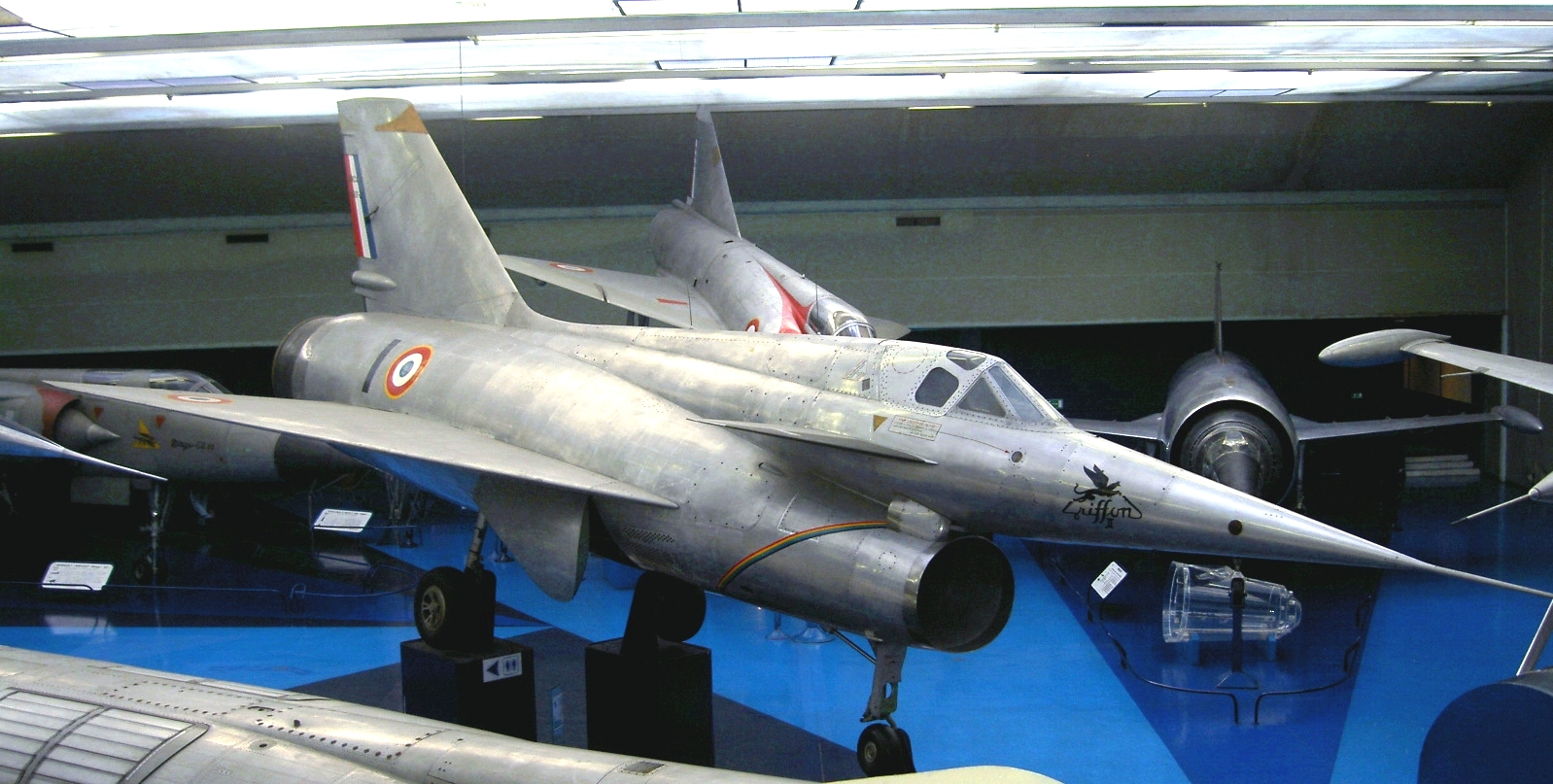
The development of air turborocket (ATR) technology traces its roots to the mid-20th century, when engineers sought advanced propulsion systems for high-speed flight. Early conceptual work on ATR began in the United States during the 1950s, with NACA (later NASA) studies at the Lewis Flight Propulsion Laboratory analyzing the engine for supersonic interceptor applications. A 1956 report by Luidens and Weber examined ATR performance, estimating specific impulses up to 1500 seconds at Mach 2.3 using propellants like gasoline and nitric acid, and highlighting its potential for high thrust-to-weight ratios compared to turbojets.[7] In parallel, efforts in combined-cycle airbreathing engines advanced through turbojet-ramjet integrations. In France, Nord Aviation's Nord 1500 Griffon program in the early 1950s explored such systems. The Griffon I prototype achieved its maiden flight on September 20, 1955, powered by an SNECMA Atar 101G21 turbojet. The Griffon II variant, with an Atar 101E3 turbojet and integral ramjet, first flew on January 23, 1957. Over more than 200 test flights ending in 1959, it reached a maximum Mach number of 2.19 and set a speed record of 1,638 km/h on October 27, 1958, demonstrating turbo-ramjet performance in supersonic flight.[10] Concurrently in the United States during the 1960s, the Pratt & Whitney J58 engine for the SR-71 Blackbird featured advanced turbomachinery with a compressor bleed bypass, transitioning from turbojet to ramjet-like operation at Mach 3+, supporting sustained high-speed reconnaissance.[11] Following the Cold War, research on ATR shifted toward applications in reusable space access and hypersonic vehicles, with NASA leading analytical studies in the 1990s. A 1990 NASA investigation proposed combining ATR propulsion with rocket stages for horizontal-takeoff single-stage-to-orbit (SSTO) vehicles, estimating vehicle weights, engine characteristics, and performance trades to achieve orbital insertion. This built on broader hypersonic air-breathing efforts at NASA Langley Research Center, where ATR was evaluated alongside other combined-cycle options like turboramjets for low-to-mid supersonic acceleration in SSTO concepts. By 1993, an off-design performance analysis of a representative LOX-LH2-fed ATR engine assessed full- and part-power operations across flight speeds, highlighting its potential for efficient transatmospheric propulsion.[12][13][14] Advancements continued into the 2000s, focusing on practical engineering challenges. A 2004 ASME study examined the integration of turbomachinery into ATR engines for reusable space launch vehicles, analyzing issues such as component sizing, thermal management, and thrust augmentation to support hypersonic trajectories. In the 2020s, attention has turned to hydrocarbon-fueled ATR variants, offering improved fuel handling and density for operations from Mach 0 to 4. Thermodynamic analyses of these engines have demonstrated enhanced specific impulse and thrust stability in the subsonic-to-supersonic range, positioning them as viable options for next-generation hypersonic cruise vehicles.[15][16]Operating Principles
Basic Cycle
The air turborocket (ATR) operates on a modified Brayton cycle that integrates rocket propulsion elements to enhance performance in air-breathing regimes. Atmospheric air is ingested through an inlet, compressed by a turbine-driven compressor to elevate its pressure and temperature, and then directed to a main combustor where fuel is added and ignited using the oxygen in the compressed air. The resulting high-energy gas mixture expands through a turbine, which extracts work to drive the compressor, before further expansion in a nozzle to generate thrust.[17][18] Central to the ATR cycle is the gas generator, a separate rocket-like combustor that burns fuel with an onboard oxidizer to produce high-pressure, fuel-rich gases. These gases power the turbine independently of the main airflow, decoupling the turbine inlet temperature from the rising inlet air temperature at high speeds and enabling operation up to Mach 6 without thermal limitations on the turbine.[18][17] The cycle exhibits mode transitions based on flight speed: at low speeds (subsonic to low supersonic), compression is dominated by mechanical work from the compressor, resembling a turbojet; at higher speeds (Mach 2–4), ram compression from the vehicle's motion increasingly supplements mechanical compression, shifting toward ramjet-like operation while the gas generator maintains turbine drive.[18][17] Thrust in the ATR is derived from the conservation of momentum across the engine, applied to the control volume enclosing the flow path. Consider the net axial force on the fluid as the difference in momentum influx and outflux plus unbalanced pressure forces at the boundaries. The incoming momentum flux is , where is the total mass flow rate (primarily air plus fuel) and is the inlet (free-stream) velocity. The outgoing momentum flux is , with the exhaust velocity. The pressure term arises from the exit nozzle, contributing , where is the exhaust pressure, the ambient pressure, and the exit area (inlet pressure effects are typically balanced or negligible in simplified models). By Newton's second law, this net momentum change equals the thrust force , yielding: In the ATR cycle, includes the air mass flow augmented by fuel from both the gas generator and main combustor, is determined by the nozzle expansion of the hot gases from the main combustor (often after mixing), and the equation captures the hybrid nature by emphasizing air-breathing mass addition while the gas generator enables high through efficient compression. The pressure term is particularly relevant at off-design conditions, such as during mode transitions, where incomplete expansion may occur.[19][18] For efficiency, the fuel-rich exhaust from the turbine is typically mixed with the compressed air upstream of the main combustor, preheating the airflow, distributing residual fuel, and recovering energy that would otherwise be lost, thereby improving overall cycle thermal efficiency.[17][18]Key Components
The air turborocket engine integrates several core hardware elements to facilitate its hybrid operation, drawing atmospheric air for combustion while employing a rocket-derived power source for turbomachinery drive. These components enable efficient performance across subsonic to supersonic regimes, with designs emphasizing storable propellants and variable flow management.[7][20] The gas generator serves as the primary power source, functioning as a compact rocket motor that combusts fuel and oxidizer to produce high-temperature, high-pressure gas for driving the turbine. It typically employs storable bipropellants such as gasoline and nitric acid, operating at chamber pressures around 32 atm and temperatures up to 2100°R, with a variable nozzle throat to modulate flow. Alternative configurations use monopropellants like hydrazine, which decomposes to yield fuel-rich gases at approximately 1188 K, or hydrogen in expander cycles where heat is recovered from the engine exhaust via a regenerator. Efficiencies reach 0.92 in well-designed units, ensuring reliable turbine drive independent of flight conditions.[7][18][21] The turbine and compressor form a coupled turbomachinery assembly, often in a single-shaft configuration where the turbine extracts energy from the gas generator's hot gases to power the compressor, which pressurizes incoming air. Turbines are typically bladed axial types with two stages, achieving adiabatic efficiencies of 0.60 and tip speeds around 1400 ft/s, sometimes incorporating reduction gearing to match compressor speeds; free-turbine setups decouple them for better off-design performance. Compressors are axial-flow designs with 1-3 stages, delivering pressure ratios up to 3.05 at low speeds for enhanced efficiency, with overall efficiencies of 0.88; in advanced variants like the ATREX, counter-rotating configurations achieve ratios up to 3.2 using hydrogen-driven expansion. These elements support compressor ratios generally limited to 10:1 to optimize low-speed operation while accommodating windmilling at supersonic speeds.[7][18][21] The combustor and nozzle handle the main energy release and exhaust expansion, with the combustor—often an afterburner-style annular chamber—mixing compressed air from the compressor with additional fuel and residual turbine exhaust for combustion at temperatures up to 3500°R and efficiencies of 0.90. It features a cylindrical liner for cooling and variable geometry to maintain stable burning across fuel-air ratios. The nozzle, typically a convergent-divergent type with adjustable iris or throat area, compensates for altitude and speed changes, achieving force coefficients of 0.96; in integrated designs, it may be airframe-mounted with dual annuli for combined air and core flows. Materials like titanium and steel are common, with refractory alloys addressing high-heat exposure.[7][20] Bypass flaps or valves regulate airflow by diverting excess captured air around the compressor core during high-speed flight, transitioning toward ram-dominated operation and preventing compressor stall or choking. These mechanisms, positioned downstream of the inlet diffuser, include controllable flaps or blow-in doors that close at low speeds to direct air through the compressor and open to bypass up to 35% of flow at Mach 2, re-injecting it into the nozzle for augmented thrust. This enables seamless mode shifts without excessive drag.[7][21] Integration of these components presents challenges, particularly in sizing turbomachinery for operation across a wide Mach range (0-4), where varying airflow and pressure demands require advanced compressors tolerant of large flow variations to avoid control issues and maintain efficiency.[22][21]Engine Variants
Turborocket
The turborocket, also known as the air turborocket (ATR), is a hybrid propulsion system that employs an onboard oxidizer in the main combustor to generate air-augmented thrust, effectively operating as a rocket engine enhanced by airbreathing capabilities for improved efficiency in the atmosphere.[1] In this configuration, atmospheric air is compressed and introduced into the combustor, where it mixes with fuel and the stored oxidizer—such as liquid oxygen (LOX)—to produce high-temperature combustion products that expand through a nozzle for thrust generation.[5] This design leverages the rocket's ability to carry its own oxidizer while utilizing ambient air to dilute the exhaust and increase mass flow, thereby boosting specific impulse (Isp) compared to pure rocket operation.[18] Operationally, the turborocket features a compressor driven by a turbine powered by a fuel-rich gas generator, which supplies hot gases to spin the turbine without requiring extensive air preheat.[7] The compressed air flows into the main combustor, where fuel and oxidizer are injected and ignited, enabling sustained high-thrust output suitable for short-duration missions such as missile boosts or rapid ascent vehicles. At higher altitudes or speeds where air intake is insufficient, additional onboard oxidizer is injected into the main combustor, allowing seamless operation as a pure rocket engine.[1] [2] This cycle is particularly advantageous for applications demanding rocket-level thrust-to-weight ratios of 10-20:1, augmented by an airbreathing Isp increase to 1200-1700 seconds, which reduces propellant consumption by up to 25% relative to equivalent pure-rocket systems.[18][5] While air augmentation diminishes above approximately 40 km due to low air density, the engine can transition to rocket-only mode using onboard oxidizer for continued operation at higher altitudes and in vacuum. Historically, the turborocket has been explored primarily through conceptual designs in 1990s missile studies by organizations like NASA, focusing on analytical performance modeling rather than flight testing, due to challenges in integrating the oxidizer storage and high-temperature components.[1]Performance and Efficiency
Specific Impulse and Thrust Metrics
The specific impulse (Isp) of an air turborocket engine typically ranges from 700 to 1500 seconds when operating in the atmosphere, reflecting its hybrid nature that leverages both airbreathing and rocket propulsion modes. In the airbreathing phase, the engine achieves higher Isp values up to approximately 1500 seconds by incorporating atmospheric air as the primary oxidizer, significantly reducing propellant consumption compared to pure rocket operation. Conversely, in pure rocket mode, Isp drops to 300-500 seconds, as the engine relies solely on onboard oxidizer. This dual-mode capability allows the air turborocket to maintain efficient performance across a transitional flight regime. Isp varies with fuel type; for example, hydrogen-fueled variants achieve higher values (up to 1100 seconds) compared to hydrocarbons.[18][1][23] Specific impulse is defined by the equation where is the effective exhaust velocity and is standard gravitational acceleration (9.80665 m/s²). In air turborocket operation, the effective exhaust velocity incorporates the contribution of atmospheric air mass flow (), augmenting the thrust equation as , with as the inlet velocity. This air augmentation increases relative to a pure rocket by effectively boosting the total mass flow through the nozzle while minimizing propellant usage, thereby elevating Isp in atmospheric conditions. Derivations in engine cycle analyses confirm that the air mass flow term dominates at lower altitudes and speeds, transitioning smoothly to rocket-like exhaust as air density decreases.[7][24] The thrust-to-weight ratio of air turborocket engines is typically 10-20:1, providing rocket-comparable power density while benefiting from air augmentation for enhanced effective thrust at low altitudes. This high ratio stems from the compact design, where the turbomachinery drives both air compression and propellant pumping without excessive structural mass.[23][25] Part-power operation of air turborocket engines has been analyzed in detail, demonstrating a throttle range of 10-100% with minimal efficiency loss through adjustments in fuel flow and compressor bleed. This capability enables precise control during ascent or maneuvering without significant penalties to overall performance.[1] Thermodynamic efficiency in air turborocket cycles reaches up to 40% overall, as evaluated in recent analyses of hydrocarbon-fueled variants, balancing combustion heat addition with cycle losses in the gas generator and afterburner.[16]Speed and Altitude Range
The air turborocket demonstrates a broad operational envelope, enabling flight from static takeoff at Mach 0 to speeds exceeding Mach 4, with capabilities extending to Mach 5 in advanced variants, across altitudes from sea level up to approximately 30 km.[26][21] In the turboramjet variant, a mode transition typically occurs around Mach 1, shifting from turbomachinery-dominated compression to ram compression for sustained high-speed performance.[25] At low speeds, the engine functions in turbojet mode, delivering efficient thrust for subsonic cruise and initial acceleration phases. As speeds increase into the supersonic and hypersonic regimes, it transitions to ram mode, where incoming air is compressed by vehicle velocity to support combustion and thrust generation.[21] Specific impulse varies across this speed spectrum, generally rising from around 600 seconds at low Mach numbers to around 1100 seconds at high speeds.[25] Altitude capabilities are constrained by atmospheric air density, which provides the oxygen essential for the air-breathing cycle; performance degrades significantly above 25-30 km, rendering the engine ineffective beyond approximately 50 km due to insufficient oxygen availability.[27][28] Air turborockets are particularly suited for boost-glide trajectories in hypersonic vehicles, where flowpath extensions enable efficient acceleration within this envelope, as demonstrated in turbomachinery integration studies.[29] These engines excel in scenarios requiring rapid acceleration from sea level to high Mach numbers, often achieving such profiles in under 100 seconds for tactical boost phases.[26]Advantages and Limitations
Benefits
The air turborocket offers a significant advantage in specific impulse over pure rocket engines, achieving 2-3 times higher values in the atmosphere through its airbreathing mode, which incorporates ambient oxygen to minimize onboard oxidizer mass and reduce overall propellant requirements.[30] This results in Isp levels of 1200-1700 seconds, enabling more efficient fuel use during atmospheric operations.[18] Consequently, the engine supports extended operational durations in the atmosphere while maintaining high-thrust capability for acceleration phases, bridging the performance gap between solid rockets and turbojets.[7] Unlike ramjets, which require supersonic speeds for efficient operation, the air turborocket provides thrust across a broader velocity envelope, from static conditions at takeoff to hypersonic regimes up to Mach 6, offering operational flexibility without the need for auxiliary boost systems.[30] Its design, relying on a gas generator rather than a full axial compressor and turbine, simplifies control mechanisms compared to conventional gas turbine engines, reducing complexity in variable-speed environments.[18] The engine's compact configuration, featuring a reduced-volume combustor with a low length-to-diameter ratio, makes it particularly suitable for volume-limited applications such as missiles, where space constraints are critical, while delivering higher thrust per inlet area than turbojets.[18] Additionally, its lightweight construction contributes to thrust-to-weight ratios of 18-22, enhancing overall vehicle performance without the developmental intricacies of more advanced hypersonic engines.[30]Challenges
One of the primary challenges in air turborocket design stems from integrating turbomachinery capable of operating across a wide Mach number range from 0 to 4, which necessitates scaling components to handle varying airflow and pressure conditions. This scaling leads to exceptionally high rotational speeds, often exceeding 80,000 RPM in turbine designs, placing significant stress on materials and requiring advanced alloys to prevent fatigue and failure.[31][7] The turbine, in particular, emerges as a critical bottleneck due to the need for high-pressure ratios and partial admission of rocket gases, which complicates efficiency and structural integrity compared to conventional turbojet components.[7] Mode transitions from air-breathing to pure rocket operation pose substantial difficulties, particularly in the reliability of mechanisms that manage airflow and oxidizer addition during acceleration. These transitions can induce aerodynamic instabilities and potential inlet unstarts, with uncertainty propagation across the airframe-propulsion system risking safety constraints and temporary efficiency losses of up to several percent in thrust output.[32] Optimizing control schedules for thrust augmentation during these shifts remains technically demanding, as perturbations in component positioning can amplify performance variability.[32] Propellant selection introduces further compatibility issues, with hydrogen's cryogenic storage requirements complicating vehicle integration due to low density, boil-off losses, and risks like hydrogen embrittlement in metallic components.[33] While hydrocarbons offer simpler storage, they exhibit reduced performance at high Mach numbers owing to lower specific heat and incomplete endothermic reactions in heat exchangers, limiting specific impulse compared to hydrogen-fueled variants.[33] Development of air turborockets incurs high costs primarily from extensive ground and flight testing needed to validate complex interactions, such as propellant-turbomachinery interfaces and combustion stability.[34] Recent industry collaborations, such as the 2025 Cummings Aerospace and ATRX partnership for hypersonic drones and JAXA's ATRIUM engine research (as of 2024), aim to address these barriers through targeted advancements.[35][36] These expenses have historically deterred widespread adoption in tactical applications, where iterative experiments on fuel gas flow and secondary combustion under cold inflow conditions demand significant resources.[34] Thermal management represents a core hurdle, as combustor temperatures routinely surpass 2000 K during ram combustion, necessitating sophisticated cooling strategies like regenerative fuel circuits or film cooling to protect turbine blades and nozzles from exceeding material limits around 2100 K.[37][38] At sustained Mach 4+ speeds, aerodynamic heating further isolates hot sections, requiring up to 15% of captured air for cooling and advanced endothermic fuels to maintain structural integrity over multiple flights.[38]Comparisons with Other Propulsion Systems
Versus Rocket Engines
Air turborockets offer significant weight savings compared to conventional rocket engines for low-thrust, long-duration missions within the atmosphere, as they utilize ambient air as an oxidizer, thereby reducing the need to carry heavy onboard oxidizer supplies.[18] In contrast, rocket engines must transport both fuel and oxidizer, resulting in denser propellant loads optimized for space environments where no atmospheric oxygen is available.[7] This makes air turborockets particularly advantageous for sustained atmospheric operations, such as tactical missile boosts, by eliminating the requirement for a separate rocket booster stage.[18] In terms of efficiency, air turborockets achieve specific impulses of 1200-1700 seconds in the atmosphere, far exceeding the 300-450 seconds typical of liquid rocket engines operating under similar conditions.[18][39] However, rocket engines outperform air turborockets in vacuum environments, where their specific impulses can reach up to 450 seconds without the limitations of air intake.[39] Air turborockets introduce greater complexity than rocket engines due to the integration of air intake systems, compressors, and turbines, which can increase drag from inlet momentum and require variable geometry for optimal performance across speeds.[7] Rocket engines, lacking these air management components, are generally simpler in design and exhibit higher reliability for short-duration, high-thrust applications.[7] While air turborockets face volumetric disadvantages in compact missile designs owing to the space required for air ducts and turbo-machinery, they provide superior performance for extended boost phases in the atmosphere compared to rockets.[7]| Parameter | Air Turborocket | Rocket Engine |
|---|---|---|
| Specific Impulse (s) | 1200-1700 (atmosphere) | 300-450 (atmosphere); up to 450 (vacuum) |
| Thrust-to-Weight Ratio | Rocket-like (e.g., 2.2-3.4 times that of a comparable turbojet at Mach 2.3) | High (e.g., 141:1 for SpaceX Raptor 2) |
| Operational Environment | Atmosphere (sea level to ~Mach 6) | Vacuum/space; adaptable to atmosphere |
Versus Airbreathing Engines
Air turborockets (ATRs) offer a hybrid approach that bridges the operational envelopes of traditional airbreathing engines, providing enhanced performance in the transonic to hypersonic regime while inheriting some complexities from both turbojet and rocket architectures. Compared to turbojets, ATRs achieve higher top speeds, typically up to Mach 4, versus the Mach 2-3 limit of conventional turbojets, due to reduced thermal constraints on the compressor rather than the turbine.[40] However, this comes at the cost of increased complexity from the integrated gas generator, though ATRs demonstrate superior thrust-to-weight ratios, delivering approximately twice the thrust of an afterburning turbojet of similar size.[5] The Pratt & Whitney J58, a benchmark turboramjet hybrid used in the SR-71 Blackbird, exemplifies efficient transition between turbojet and ramjet modes, achieving sustained Mach 3+ operation with optimized fuel consumption that informs ATR design goals for similar hybrid efficiency. In contrast to ramjets, ATRs maintain operability from static conditions through their turbine-driven compressor powered by the gas generator, eliminating the need for the Mach 2+ startup velocity required by ramjets to achieve sufficient ram compression.[40] This wide operational range enables ATRs to provide consistent thrust across subsonic to supersonic speeds, where ramjets suffer inefficiencies below Mach 2.8 due to thermal choking and low compression.[40] For missile applications, ATRs are noted for lower overall costs compared to full gas turbine systems, leveraging simpler fuel handling in dedicated roles without the broad versatility demands of aircraft engines. Relative to scramjets, ATRs provide a broader low-speed operational envelope and reduced development costs, as they avoid the extreme material challenges of sustained supersonic combustion above Mach 5, where scramjets excel in efficiency and speed.[21] While scramjets offer superior performance for hypersonic vehicles beyond Mach 5, ATRs' hybrid design yields better thrust density and fuel economy in the Mach 0-4 regime, with 25% lower propellant consumption than equivalent pure rocket systems.[5]| Engine Type | Startup Speed | Max Mach | Complexity | Cost Relative to ATR |
|---|---|---|---|---|
| Turbojet | Static (Mach 0) | 2-3.5 | High (compressor, turbine) | Comparable (gas turbine baseline) |
| Air Turborocket | Static (Mach 0) | 4+ | Very High (gas generator + turbine) | Baseline |
| Ramjet | Mach 2+ | 6 | Low (no moving parts) | Lower |
| Scramjet | Mach 4+ | 10+ | Medium-High (high-temp materials) | Higher |