Hubbry Logo
Turning Stone Resort CasinoTurning Stone Resort CasinoMain
Open search
Turning Stone Resort Casino
Community hub
Turning Stone Resort Casino
logo
8 pages, 0 posts
0 subscribers
Be the first to start a discussion here.
Turning Stone Resort Casino
from Wikipedia

Turning Stone Resort Casino
Turning Stone Resort Casino is located in New York
Turning Stone Resort Casino
Location in central New York
Map
Interactive map of Turning Stone Resort Casino
Location Verona, New York
Address 5218 Patrick Road
Opening dateJuly 16, 1993; 32 years ago (1993-07-16)
No. of rooms709 (across four hotels)[1]
Total gaming space125,000 square foot Las Vegas-style gaming floor
Signature attractionsPGA-quality golf course, spa, showroom, and 5,000-seat arena
Notable restaurantsTS Steakhouse, Tin Rooster
Casino typeLand-based
OwnerOneida Nation Enterprises
Renovated in1997 (addition of hotel)
2004 (second hotel tower)
2010-2012 (renovation of existing hotel building)
Coordinates43°06′54″N 75°35′20″W / 43.115°N 75.589°W / 43.115; -75.589
Websiteturningstone.com

Turning Stone Resort Casino is a Native American resort casino owned and operated by the Oneida Indian Nation of New York (OIN) in Verona, New York.

The facility opened on July 20, 1993, and offers golf amenities (on- and off-site golf courses, one of PGA Tour quality, and an indoor golf dome), an RV park, trails for walking, an amusement arcade, many restaurants, spas, Bingo, Keno, table games, and many types of reel and video slot machines. Until the Seneca Niagara Casino opened in 2002, it was the only land-based casino in New York. Adjacent to exit 33 of the New York State Thruway, the resort is a popular tourist destination in central New York State and has received numerous awards in the industry.

Construction and expansion

[edit]

The casino, and associated hotel for visitors and conventions, was conceived as a revenue-generating enterprise to aid in economic and social development of the OIN. It was developed at a time when Native American sovereignty and the right to establish gaming casinos on reservations had survived court challenges. Development of the casino was opposed from within and outside the OIN. As a fall-back plan, the OIN had the casino designed so that it could be adapted as a small shopping mall, if necessary. Ultimately, the OIN decided not to add a shopping mall because online shopping has diminished patronage to shopping malls.[2]

The land upon which the casino is located was acquired from Ibrahim Batca and his family in two transactions in 1992 and 1993.[3] Construction of an on-site hotel and a bingo hall began in 1994. The Bingo Hall's construction was completed in 1995. Disagreements over the hotel plans delayed its construction for a year.[4] The hotel's original design plans had the hotel and casino separate, connected only by an outdoor walkway. Because of the delay, the hotel plans were re-designed to combine the hotel and casino into one structure. This new design allowed the Oneida Indian Nation to offer more services, including a pool, a spa, and a gym. Additionally, the combination created a larger and more formal lobby to serve both the hotel and casino to be one structure.

In 1997, the OIN paid for construction of a water tower near the casino and donated it to the Town of Verona, as one of their community contributions. The water tower has a capacity to hold 1,000,000 gallons of water. In 2005 the OIN consumed 600,000 gallons per day, which was four times the amount guaranteed to them under an agreement with the Town of Verona. In about July 2005 the Town of Verona notified the OIN that after 5:00 p.m. on August 2, 2005, the water would be shut off after the tribe had used the 150,000 gallons of water that is guaranteed under the agreement. Just hours before this deadline, the OIN began paying for a new water pump to be installed to provide the needed water capacity for the casino and resort.[5]

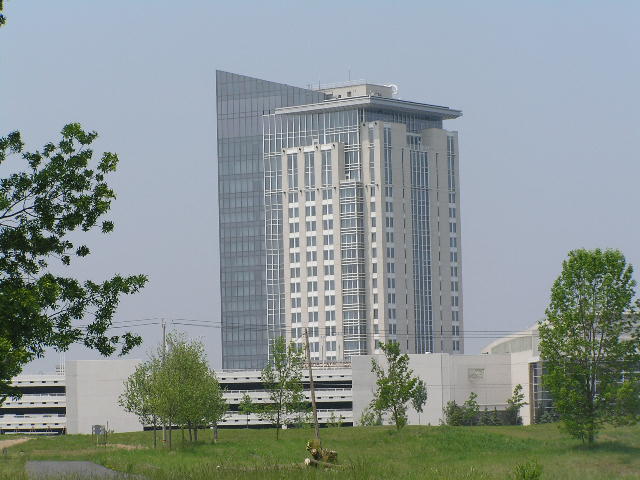
In 2002, construction of a gaming expansion and showroom were completed to provide the only Ticketmaster-approved venue in the area.[6] The popularity of the casino provided sufficient revenue for the OIN to build second and third hotels at the site to satisfy demand. Construction of the new hotel was finished in late 2004. One of the hotels is the tallest structure between Syracuse and Albany to serve the common guest; the other hotel is a luxury resort that caters to golf customers and fans.[7] DeSimone Consulting Engineers is the structural engineering firm for the project.[8]

Entertainment

[edit]

The Turning Stone Casino and Resort hosted NESN and YES Network's Boston vs. New York Poker Challenge for two seasons.

The casino hosts several shows throughout the year, featuring musicians (KISS, Kelly Clarkson, Carrie Underwood, Fergie, Mariah Carey, Gwen Stefani, No Doubt, Jordin Sparks, Alicia Keys & Wayne Newton), comedians and other entertainment groups (Purrrfect Angels). The Irish Rovers played their two 2014 St Patrick's Day Concerts at the resort.

The resort's Atunyote Golf Club, located on tribal land, hosted the Turning Stone Resort Championship, a PGA Tour event, from 2007 through 2010. It was dropped from the tour schedule over a 2011 scheduling dispute.[9] In 2006, it hosted the B.C. Open on the PGA Tour in July and the PGA Professional National Championship, which returns in 2016.[10]

[edit]

The casino's early success met opposition from New York State, Oneida County, Madison County, Vernon town government, and a now-defunct citizens' group called Upstate Citizens for Equality (UCE). Several lawsuits were commenced that challenged the casino's legal authority to operate.

The tribal-state gaming compact

[edit]

Until the November 5, 2013, election that amended the New York State Constitution, state law prohibited gambling, particularly class III gaming. The OIN wanted to take advantage of expanding the original bingo hall into a full casino, which would include Class III gaming. To do so, OIN negotiated a gaming compact with then Governor Mario Cuomo in 1993; a prerequisite to creating an Indian casino pursuant to the Indian Gaming Regulatory Act (IGRA). UCE challenged the compact's validity because the state legislature failed to approve the compact, pursuant to the New York State Constitution.[11] In Pataki, the New York State Supreme Court held that despite Cuomo's representation and belief that legislative approval was unnecessary, the compact was not valid because the state legislature had not approved the same. The OIN appealed this decision to the Appellate Division, which affirmed the lower court. The Appellate Division granted leave to appeal to the Court of Appeals, which affirmed the Appellate Division's decision. After the Court of Appeals decision, the OIN petitioned the US Supreme Court to review the decision, but the high court denied certiori.

The OIN argued that the US Secretary of the Interior approved the compact and that removed the need for the state legislature's approval. The IGRA incorporates state laws into federal law. Specifically, 18 U.S.C. § 1166 provides "for purposes of Federal law, all State laws pertaining to the licensing, regulation, or prohibition of gambling, . . . shall apply in Indian country in the same manner and to the same extent as such laws apply elsewhere in the State."[12] The Tenth Circuit held that the Secretary of the Interior's approval of a gaming compact has no impact on its validity because state law controls whether a gaming compact is valid."[13] However, to date, the Second Circuit has not adopted this view in regards to the validity of a compact.[14] The Pataki case was a state court action, and did not receive review in the Second Circuit.

The OIN then sought relief with the U.S. Department of the Interior (DOI) Bureau of Indian Affairs (BIA). After many failed attempts to negotiate a settlement by an April 2007 deadline, the Department of the Interior launched its own investigation into the compact's validity. On June 13, 2007, when the Associate Deputy Secretary of the Interior declined to reconsider its approval of the compact, Mr. Cason stated, "the 1993 Compact continues to be in effect for purposes of the IGRA".[15] In UCE's lawsuit against the DOI, UCE challenged the DOI's decision regarding the compact's validity in addition to its challenge of the DOI's decision to take land into trust for the OIN.[16] The US Interior Department's position was that the June 13, 2007, correspondence was not the end of it reconsidering the validity of the tribal-state compact, but merely a suspension of its reconsideration.[17]

On August 7, 2007, in an action between New York State and the OIN, U.S. District Court Judge Kahn upheld Magistrate Treece's order directing the depositions of high-ranking officials and denying the State's motions. The decision also dismissed the Amended Complaint pleading, which attacked the Board's authority to amend the Compact due to Peterman and Seneca, on subject matter jurisdiction grounds. The fact that the amended complaint was dismissed on jurisdictional grounds deprived the court of the opportunity to address, directly, the compact's validity at the federal level. If the compact was invalid, then the Oneida Indian Nation would be violating federal law (operating a gaming facility without a tribal-state compact).[18] Such a violation of federal law would have provided the requisite subject matter jurisdiction (federal question) to address the amended complaint. Even though the State sought to enjoin the Nation from operating Instant Multi Game ("IMG") based on its failure to adhere to the procedures in the Compact,[19] the state has since dropped this case.[20]

In 2013, the OIN, New York State, and Madison and Oneida Counties reached a landmark agreement that resolved the ongoing issues regarding the tribal-state compact, taxing issues, and the land upon which the resort casino is built.[21] The agreement also ended all litigation pending between the three entities at the time of the agreement.[21]

Casino location site legality

[edit]

In addition to whether the tribe-state gaming compact was valid, the other issue was whether the location chosen to conduct the gaming was legal. New York State Law forbade Class III gaming on lands within New York State. The casino was located on Indian Territory as defined in the IGRA. However, the issue was compounded in light of the City of Sherrill v Oneida Indian Nation US Supreme Court decision.[22] The DOI stated "compact does not specifically refer to the site where ... the Nation has built a major new facility in anticipation of being able to conduct gaming in the future. Since the compact tracks the [IGRA's definition of 'Indian lands'], we ... take no position with regard to whether this new facility is on 'Indian land' as that term is used in IGRA".[23] Justice Ginsburg opined that although the land was part of the original tribal land grant of the 1796 Treaty of Canadagua, 200+ years in non-Indian control was too long a time for the Oneida Indian Nation to re-establish its immunity over those lands once it re-acquired the ownership of those lands. As directed in the Sherrill decision, the OIN applied to the DOI to have this land taken into trust, which was approved and formalized on September 4, 2014.[24]

Gaming issues resolved

[edit]

In May 2013, the OIN, New York State, and Madison and Oneida Counties reached a landmark agreement that resolved the gaming compact issue, among other issues needing resolution. As part of the agreement, the state held a referendum to amend the New York State Constitution to allow for full gambling casinos to operate within the state, which passed on November 5, 2013.[25] The agreement paved the way for the OIN to open two more casinos within its 10-county area of exclusivity.

Liquor license

[edit]

The casino applied for several liquor licenses with the New York State Liquor Authority in 2007 that were denied on October 3, 2007.[26][27] After delaying a decision for a month, the liquor board told the OIN it cannot issue permits while unsettled sovereignty issues between the OIN and the state (related to land issues) are being litigated in court. "The Liquor Authority said the applications were disapproved without prejudice, and the Nation can reapply for the licenses after the reservation issue is solved."[27] The licenses would have allowed the casino to serve alcohol on the gaming floor and at its several restaurants.

While the applications were pending before the Liquor Authority, the resort did not allow any kind of alcohol on the premises, as part of their application.[28] Since the Liquor Authority's denial on the applications, the OIN lifted the alcohol ban in the resort. In response, the casino reached an agreement with the Beeches Hotel And Catering Service which received multiple one-day permits to sell alcohol at the premises.[26] This generated much controversy because the Beech's owner's wife, Roan Destito sits on the committee governing liquor laws.[29] In May 2010, the casino leased portions of the property to a subsidiary of the Beech's which in turn was awarded a full license to sell liquor and other alcohol.[30][31] This allowed the casino to offer alcohol to its patrons at all the restaurants and the gaming floor, in addition to the private nightclub.

Smoking

[edit]

Smoking is allowed around the resort; non-smoking sections have been established and expanded in all areas. In 2016, the casino and resort underwent a $20 million upgrade and renovation project to provide better smoke-free areas on the gambling floor, and improve ventilation facilities to enhance all non-smoking zones within the resort and casino.[32]

Awards and recognitions

[edit]

Since 2001, Turning Stone has received more than 480 different awards and recognitions.[33]

In 2018, Forbes Travel Guide awarded the resort with three Four Star ratings for The Lodge hotel, Wildflowers restaurant, and Skana spa. The year before, AAA awarded three of its prestigious AAA Four Diamond Awards, to the resort's The Lodge and Tower hotels, as well as Wildflowers restaurant, making Turning Stone the only resort in the Northeastern United States to earn both three AAA and Forbes awards.[34][33]

In 2017, the resort was named Best Overall Gaming Resort in New York by Casino Player magazine.[35]

All three of Turning Stone's championship-caliber golf courses were included in Golfweek magazine's list of Best Golf Courses you Can Play in New York,[36] and two of the courses were included in Golf Digest's 100 Greatest Public Courses in America.[37]

The Nation's Atunyote Golf Course hosts both the Turning Stone Resort Championship and the annual Notah Begay III Foundation Challenge charity event.

[edit]
  • American metal band Bible of the Devil recorded a song about the casino, titled "The Turning Stone". It appears on their 2008 album Freedom Metal.

See also

[edit]

References

[edit]
[edit]
Revisions and contributorsEdit on WikipediaRead on Wikipedia
from Grokipedia
Turning Stone Resort Casino is a premier Native American resort casino owned and operated by the Oneida Indian Nation, situated in Verona, New York, approximately 30 miles east of Syracuse. Established on July 20, 1993, as the first legal casino in New York State, it occupies a sprawling 3,400-acre property that has evolved into a comprehensive destination blending gaming, hospitality, and recreation. The casino floor hosts over 2,000 slot machines, 66 Vegas-style table games, the largest poker room in New York, and one of the world's premier bingo halls, drawing significant regional patronage. Complementing these are multiple luxury hotels including The Tower and The Lodge, PGA-caliber golf courses designed by renowned architects, two four-star spas, diverse upscale dining options, and expansive event venues supporting conferences and entertainment. Turning Stone has earned consistent accolades, such as being named the #1 Best Overall Gaming Resort in New York for ten consecutive years by Casino Player Magazine as of 2025, reflecting its operational excellence and visitor satisfaction. In 2023, the Oneida Indian Nation committed $370 million to the largest expansion in the resort's history, aimed at doubling conference space and adding new hotel and outdoor event facilities to further enhance its appeal.

Overview

Ownership and Location

The Turning Stone Resort Casino is situated at 5218 Patrick Road in , ZIP code 13478, within the sovereign territory of the in state. This location places it approximately 30 minutes east of Syracuse, facilitating accessibility for regional visitors while operating under tribal , which exempts it from certain state regulations applicable to non-tribal . The resort is owned and operated by the Oneida Indian Nation, a federally recognized tribe whose ancestral lands encompass the site, with operations managed through Turning Stone Enterprises, the Nation's economic development arm. The Nation maintains full control as a sovereign entity, funding expansions and investments—such as the $370 million project announced in July 2023—directly from tribal revenues without external corporate ownership. Leadership, including Representative Ray Halbritter as CEO of Turning Stone Enterprises, oversees these activities on behalf of the Nation.

Facilities and Amenities

Turning Stone Resort Casino provides a range of accommodations, including The Inn for budget-friendly overnight stays, The Lodge offering luxury all-suite options, The Brook with deluxe rooms featuring high-speed , in-room safes, and access to fitness facilities, and premium towers with upscale amenities. Additional lodging at Salmon Acres includes waterfront access to the River and proximity to wooded trails. The resort features three pools: an adults-only pool at The Tower Fitness Club, and guest-specific pools at The Brook and The Lodge. Skȃ:ná: The Spa, recognized as the best spa in New York, includes steam rooms, saunas, hot tubs, a coed mineral pool, relaxation lounges, and a café, alongside treatments such as massages, facials, body scrubs, and salon services. Recreational facilities encompass five golf courses, with three 18-hole championship layouts—Shenendoah, Kaluhyat (designed by Robert Trent Jones Jr.), and Atunyote (a Tom Fazio design formerly hosting PGA Tour events, stretching to 7,315 yards from the back tees)—plus two nine-hole options and indoor/outdoor practice areas. The Sportsplex offers four indoor Decoturf tennis courts (medium-paced surfaces used at the US Open), two racquetball courts with complimentary equipment, and two golf virtual simulators for year-round play. The Tower Fitness Club provides state-of-the-art , a central lounge with plasma TV, hand towels, fresh , and bottled beverages, available via day passes or memberships. Other on-site amenities include a full-service auto repair with shuttle service and access to outdoor activities such as and on 3,000 acres managed for deer.

History

Establishment and Opening

The Turning Stone Resort Casino was developed by the on their sovereign lands in , as a gaming and . Enabled by the of 1988 and a tribal-state compact with New York, it opened to the public on July 21, 1993, becoming the state's first legal . The initial facility occupied 40,000 square feet on approximately 400 acres, resembling a modest shopping mall interior with a focus on bingo halls and basic gaming offerings that drew hundreds of visitors in its opening days. Slot machines were not introduced until two years later, reflecting the phased regulatory approvals under the compact. This establishment served as a pivotal step in the Nation's efforts, generating early and reinvested into tribal , , and services in .

Phases of Construction and Expansion

The Turning Stone Resort Casino began in the early as an initiative by the Oneida Indian Nation to generate through gaming on their lands near , evolving from prior bingo operations in the . The phase culminated in the casino's opening on , , featuring basic gaming facilities including slots and table games, marking New York's first commercial casino. Subsequent expansions in the mid-1990s addressed growing , with the first major phase in adding a tower, restaurants, and retail shops to transform the site into a destination. This was followed by further developments in , which expanded gaming and amenities, increasing and capacity. A significant phase occurred between and , incorporating square feet of new , including two additional courses, event venues, and further accommodations, solidifying the resort's regional prominence. These additions built on prior investments exceeding $1 billion since , focusing on diversification beyond gaming. The most recent and largest expansion, dubbed the "Turning Stone Evolution," was announced in July 2023 with a $370 million investment, representing the biggest reinvestment in the resort's 30-year history. Construction commenced in early 2024, encompassing phased additions such as a 77,000-square-foot conference center, 258-room Crescent Hotel (with topping-off ceremony in April 2025), expo hall, outdoor event spaces, and a parking garage, aimed at doubling convention capacity and targeting completion in 2027. This multi-year project, including a final phase launched in November 2024, is projected to create over 3,600 temporary jobs and enhance economic output by more than $600 million.

Recent Developments and Future Plans

In 2023, the Oneida Indian Nation announced a $370 million expansion project dubbed the Turning Stone Evolution, marking the largest capital investment in the resort's history and aimed at enhancing its conference and events capabilities. This initiative seeks to position Turning Stone as the premier conference destination in Upstate New York by doubling existing conference and events space to include a 165,000-square-foot Grand Expo hall, alongside new meeting and ballroom facilities. Key components of the expansion include the Crescent Hotel, a new 258-room property, expanded outdoor event spaces, a dedicated parking garage, and additional amenities such as new dining options to support increased tourism and conferencing. Construction progress advanced with steel deliveries commencing in November 2024 and a topping-out ceremony for the Crescent Hotel held on April 23, 2025, involving local officials and partners. To bolster local involvement, the Nation selected 32 new New York State businesses in March 2025 for contracts supporting the project, emphasizing regional economic integration. Animated renderings of the were publicly unveiled on , , ahead of a hosted by the on , , which provided updates on and growth opportunities. The is for completion in , with some phases potentially extending to , the to host larger-scale and accommodate growing for meetings and conventions. No additional major expansions beyond the Evolution have been publicly detailed as of October , though ongoing operational enhancements, such as expanded internship programs for , support workforce development tied to these developments.

Operations

Gaming Offerings

The gaming offerings at Turning Stone Resort Casino encompass a 120,000-square-foot featuring over 2,000 slot machines, including slots, reels, video slots, and high-limit options with progressive jackpots. Machines span themes from traditional symbols to modern video formats, with denominations varying to accommodate diverse bettors. Table games total 66 Vegas-style options, emphasizing staples like blackjack (including variants such as Blazing 777 Blackjack and Spanish 21), craps, roulette (standard and European), baccarat (mini and midi styles), and sic bo. Poker-derived games include Caribbean Stud Poker, Let It Ride, Three Card Poker, Four Card Poker, Mississippi Stud, Pai Gow Poker, Texas Hold'em Bonus, and Casino War, alongside novelty wheels like The Big Six and Beat the Dealer. Tournaments occur regularly, such as $25,000 blackjack events and $5,000 Let It Ride competitions with entry fees starting at $55 or equivalent loyalty points. The poker operates 32 tables, positioning it as New York State's largest, with live , no-limit Hold'em tournaments, high-hand promotions, and dealing. A keno lounge supplements these with electronic draw . Bingo sessions run daily in a hall ranked among the world's top three, with matinee and evening draws at 12:45 p.m. and 7:00 p.m., plus warm-ups, early birds, and superminis; stakes range from $14 for $250 payouts to $33 for $1,000 prizes, featuring progressive jackpots like MP Bingo up to $177,410 and specials such as Superball bonuses. Sports betting via TS Sports includes wagers on NFL, college football, baseball playoffs, player props, teasers, same-game parlays, and live in-game options across 60 HD screens in the NY Rec & Social Club area, with custom "Bring Your Own Bet" via mobile QR codes and VIP viewing caves. The setup extends to affiliated sites like YBR Casino, claimed as New York's largest sportsbook.

Entertainment and Events

The Event Center at Turning Stone Resort Casino serves as the primary venue for large-scale , accommodating up to 5,000 patrons in a state-of-the-art equipped with LED screens and advanced production capabilities. It hosts headlining concerts across genres such as rock and , matches, performances, and theatrical events. The Showroom provides a more intimate setting with capacities including a main stage for approximately 1,000 seats, alongside cabaret and lounge spaces for 350 and 450 attendees, respectively. This venue features tribute bands, stand-up comedy, and smaller rock or country concerts, emphasizing interactive and close-proximity experiences. Additional nightlife options include Exit 33, which offers live , DJ sets, and themed tailored to casino patrons seeking casual evening . The resort's event programming draws regional audiences, with schedules regularly featuring touring acts like rock bands and comedians, though specific lineups vary seasonally.

Hospitality, Dining, and Recreation

Turning Stone Resort Casino provides multiple accommodation options across five hotels, totaling approximately 700 guestrooms, ranging from budget-friendly stays to luxury suites. The Tower features deluxe rooms and suites with panoramic views of central New York, including king and queen bed configurations and allergen-friendly options. The Lodge offers all-suite accommodations, including spacious villas with multiple bedrooms, fireplaces, home theaters, and private hot tubs, earning a four-star rating. Additional properties like The Brook provide 268 rooms with convenient access to gaming and dining, while the Inn caters to more casual overnight stays. Amenities such as fitness centers, indoor pools, and on-site spas enhance the hospitality experience across properties. The resort operates over 20 dining venues, encompassing fine dining, casual eateries, and a recently introduced food hall. Standout establishments include TS Steakhouse and Wildflowers, both awarded four stars by Forbes Travel Guide for their use of local, seasonal ingredients in steakhouse and floral-ambiance settings, respectively. The Upstate Tavern serves hearty American dishes, while Pino Bianco offers Italian cuisine; both receive positive reviews for accessibility and quality. The 7 Kitchens Food Hall, unveiled in recent years, features six specialized outlets for burgers, Mexican, Asian, deli, pizza, and other quick-service options. In 2024, Turning Stone was ranked number one for overall dining in New York by Casino Player magazine, reflecting broad acclaim for its diverse offerings. Recreational facilities emphasize golf, spa services, and sports activities. The resort boasts three PGA-level public golf courses—Shenendoah, Kaluhyat, and Atunyote—ranked among the top 10 casino courses by Golfweek. Shenendoah comprises 18 holes designed for challenging play, complemented by the Sportsplex Golf Dome with 36 indoor driving range stations and short-game practice areas. Skana The Spa provides luxury treatments including massages, facials, and couples' packages, integrated with fitness centers and pools at properties like The Lodge. Additional options include tennis and racquetball courts, jogging trails, and an on-site game room, supporting year-round recreation.

Economic Impact

Benefits to the Oneida Indian Nation

Turning Stone Resort Casino serves as the enterprise of the , generating substantial that funds the tribe's operations and , including , healthcare, elder care, and cultural preservation programs, thereby promoting tribal self-sufficiency without reliance on federal . In 2024, the Nation's enterprises, led by Turning Stone, contributed to a total economic impact exceeding $700 million, with revenues reinvested directly into supporting Oneida citizens through wages, healthcare benefits, plans, and community initiatives. The casino employs over 4,500 individuals, positioning it as the largest private employer in Madison and Oneida Counties, with a significant portion of positions filled by tribal members who benefit from advancement opportunities such as tuition , scholarships, and specialized programs. , healthcare, and 401(k) expenditures reached $306.7 million in 2024, an increase of $37 million from the prior year, directly enhancing economic stability for members. Additionally, revenues have supported developments like The Villages at Stoney Creek, providing affordable apartments with complimentary transportation services tailored to tribal needs. Reinvestments from Turning Stone operations have driven major capital projects that bolster long-term tribal prosperity, including a $370 million expansion announced in July 2023—the largest in the resort's history—which incorporates new hotel towers, conference facilities, and event spaces to sustain revenue growth. This initiative is to create 3,600 temporary jobs while generating ongoing funds for , such as the Wáhta’ Maple Farm, and broader cultural programs in arts and technology. Overall, these benefits have enabled the Nation to increase capital investments by 23% and payroll spending by 18% in 2023, fostering individual and collective .

Regional and Broader Economic Contributions

Turning Stone Resort Casino serves as a major economic driver for , generating more than $1 billion in annual economic impact through direct operations, visitor expenditures, and supply chain effects in Madison and Oneida counties. As the largest employer in these areas, it sustains thousands of jobs and stimulates local commerce via and . A 2022 analysis reported a total economic footprint of $1.06 billion, encompassing operational spending and induced regional activity. These activities yield substantial fiscal returns, including $89.1 million in combined state and local tax revenues from the $1.06 billion impact, with breakdowns such as $50 million in state taxes, $5 million in state taxes, and $2 million in local taxes. Vendor partnerships amplify this, as 2024 expenditures with New York suppliers reached $263.9 million, alongside $306.7 million in employee compensation as part of overall investments exceeding $700 million. Such outflows support ancillary sectors like , , and retail beyond the resort's immediate footprint. Expansion initiatives, including the $370 million Turning Stone Evolution launched in 2023, project a $616 million one-time boost, creating 3,600 temporary jobs and contributing $22.1 million in state and taxes. By enhancing amenities and event capabilities, these upgrades draw interstate visitors, fostering multiplier effects in Upstate New York's and positioning the region as a competitive destination for conventions and .

Tribal-State Gaming Compact

The Tribal-State Gaming Compact between the and the State of New York, approved by the U.S. Department of the Interior on June 4, 1993, enables Class III gaming under the at facilities on Nation lands, including the Turning Stone Resort Casino located on a 32-acre tract in Madison County. The compact authorizes specific such as (using 1-8 decks), , , , , and electronic gaming devices like , bingo, and lotto variants, with the Nation setting minimum and maximum wagers displayed conspicuously at gaming areas. Operational standards mandate internal controls for , surveillance systems, and employee licensing with background checks, while prohibiting not explicitly listed in the compact's appendices. Regulatory authority is divided, with the Oneida Indian Nation Gaming Commission holding primary responsibility for game integrity, equipment standards, and audits, subject to oversight by the New York State Racing and Wagering Board to ensure compliance with compact terms. The Nation reimburses the state quarterly for actual regulatory costs, including personnel, travel, and equipment expenses documented via time sheets and receipts, with annual independent CPA-certified financial statements required within 90 days of fiscal year-end. The original compact contains no broad revenue-sharing provisions beyond these reimbursements and remains in effect indefinitely unless mutually terminated in writing. A 2013 settlement agreement, executed on May 16 between the Oneida Indian Nation, New York State, Oneida County, and Madison County, amended the compact to resolve disputes over land claims, taxation, and gaming exclusivity. Under the amendment, the Nation shares 25 percent of net slot machine gaming revenues with the state and specified surrounding counties, in exchange for perpetual exclusivity rights for Class III gaming within a defined ten-county region in Central New York, protecting Turning Stone from non-tribal commercial casino competition. The agreement, which incorporated prior compact amendments such as those for instant multi-game devices, received New York State legislative approval on June 22, 2013, and federal court ratification, establishing a long-term framework without a fixed expiration. This arrangement has facilitated Turning Stone's expansions while channeling revenues toward local infrastructure, education, and economic development initiatives.

Site Legality and Operational Disputes

The Turning Stone Resort Casino operates on sovereign lands of the in , qualifying as Indian lands under the (IGRA) of 1988, which authorizes Class III gaming activities such as slot machines and table games following negotiation of a Tribal-State compact. The facility's gaming commenced in 1993 pursuant to a compact executed between the and New York State, satisfying IGRA's procedural requirements for lawful operation without state taxation or direct regulation beyond compact terms. While the site's foundational legality has not faced successful existential challenges, operational aspects have prompted disputes centered on compact interpretation, regulatory jurisdiction, and competitive exclusivity. A notable operational dispute arose in 1995 when New York State sued the Oneida Indian Nation, alleging that the introduction of Instant Multi-Game machines at Turning Stone violated the 1993 compact by circumventing required approvals from the New York State Racing and Wagering Board. The U.S. District Court for the Northern District of New York, in a December 1999 ruling, denied the Nation's motion to dismiss, holding that the compact's sovereign immunity waiver (Section 14(a)) and IGRA provisions (25 U.S.C. § 2710(d)(7)(A)(ii)) conferred federal jurisdiction over the dispute, rejecting arguments for deferral to the National Indian Gaming Commission. The ambiguity in the compact regarding the Board's approval authority necessitated further proceedings, though the case ultimately did not halt casino operations. Federal regulatory overreach surfaced in a 2004 Occupational Safety and Health Administration (OSHA) inspection of Turning Stone's kitchen facilities, resulting in citations for hand-protection and documentation violations. The Nation contested OSHA's jurisdiction, invoking tribal treaties like the 1794 and self-governance principles to argue exemption from the Occupational Safety and Health Act on reservation lands employing over 3,000 workers (more than 85% non-Indian). An initially dismissed the citations, but the Occupational Safety and Health Review Commission reversed this in April 2005, finding no treaty abrogation and remanding for merits review, underscoring tensions between tribal and federal safety enforcement. In December 2015, Turning Stone initiated litigation against the New York State Gaming Commission, challenging the approval of the competing Lago Resort and Casino in nearby Seneca County on grounds that it would divert revenue from existing tribal operations, contradicting assurances of net economic growth and implicit compact exclusivity in Central New York. The suit sought judicial review of the Commission's decision, citing ignored concerns about market saturation and projected cannibalization of up to 50% of Lago's revenue from regional facilities like Turning Stone. This dispute resolved in 2017 through legislative approval of an amended agreement granting the Oneida Nation exclusivity for commercial gaming in a defined upstate region (Region Four), in exchange for enhanced revenue sharing with the state and termination of related litigation. Tribal , a common-law recognized by the U.S. , shields federally recognized Indian tribes from unconsented lawsuits, extending to their commercial activities off-reservation unless abrogates it or the tribe explicitly waives it. This applies to the Oneida Indian Nation's operation of Turning Stone Resort , treated as an arm of the tribe. Courts have consistently dismissed suits against the casino on immunity grounds absent , reinforcing the tribe's to manage litigation risks in gaming and . In Frazier v. Turning Stone Casino (N.D.N.Y. 2003), plaintiffs alleging personal injuries from a slip-and-fall at the casino sued the and , but the U.S. for the Northern of New York dismissed the claims, holding that tribal immunity barred federal jurisdiction and that no congressional abrogation applied to such actions. The court emphasized Congress's to limit immunity but found none in the Indian or related statutes for this . A similar outcome occurred in Laake v. Turning Stone Resort (2d Cir. 2018), where a who purchased a booth at a casino event sued for and after a dispute over booth assignment; the district court dismissed for lack of subject-matter jurisdiction due to tribal immunity, affirmed on appeal as Turning Stone qualified as a tribal enterprise immune from suit. The Second Circuit rejected arguments distinguishing commercial arms from the tribe itself, citing precedent like Kiowa Tribe of Oklahoma v. Manufacturing Technologies, Inc. (523 U.S. 751, 1998). Employment-related claims have also invoked immunity, as in Johnson v. Oneida Nation Enterprises, LLC (N.D.N.Y. 2019), where a former Turning Stone employee alleged discrimination and retaliation; the court dismissed, ruling the enterprise—an LLC managing casino operations—shared the tribe's immunity as its instrumentality, with no waiver in tribal or federal law. In Oneida Indian Nation v. Phillips (2d Cir. 2020), the tribe successfully asserted immunity against a contractor's lien foreclosure on casino property, with the court rejecting an "immovable property exception" to immunity. Tribes may waive immunity contractually, as demonstrated in Oneida Indian Nation v. Hunt Construction Group, Inc. (N.Y. App. Div. 2009), where the tribe's agreement with a contractor for casino expansion work included a limited waiver for specified disputes, allowing certain counterclaims to proceed while dismissing others beyond the waiver's scope. More recently, in March 2025, Turning Stone invoked immunity to seek dismissal of a class-action suit alleging excessive fees in its 401(k) plan, arguing the plan's formation under tribal law rendered it immune as a tribal entity. These cases illustrate courts' deference to tribal immunity in diverse contexts—torts, contracts, , and benefits—while permitting waivers where explicitly granted, enabling the Oneida Nation to litigate selectively over Turning Stone operations. A 2019 petition for certiorari in the U.S. Supreme Court regarding the Laake dismissal highlighted debates over applying immunity to off-reservation commercial harms but was denied, preserving the doctrine's breadth.

Policies and Controversies

Smoking Policy Implementation

Turning Stone Resort Casino, operated by the on sovereign tribal , has maintained the to establish its own policies, exempt from New York's Clean Indoor due to federal recognition of tribal . This exemption has periodically led to tensions with state and officials seeking of broader measures. In 2005, Oneida health cited the for violations after receiving three complaints about indoor , prompting an investigation under the state act, though jurisdictional limits prevented direct . Similarly, in 2005, inspectors observed on the , resulting in a formal violation notice, but the Oneida Nation did not attend a subsequent county hearing on the matter in February 2006, underscoring the practical barriers to off-reservation regulatory oversight. By May 2010, amid ongoing state efforts to expand non-smoking mandates, Turning Stone continued to permit smoking indoors, with county executives acknowledging the inability to impose penalties due to lack of jurisdiction over tribal operations. Responding to guest feedback on air quality, the casino implemented a significant policy shift in November 2016, designating the main gaming floor as smoke-free while opening Casino Blu—a dedicated 30,000-square-foot smoking-permitted annex with enhanced ventilation systems—as part of a $20 million expansion project. This bifurcation addressed demands from both non-smokers seeking cleaner environments and smokers preferring unrestricted access, effectively ending pervasive secondhand smoke exposure across the primary 125,000-square-foot casino floor after 23 years of operation. Temporary modifications occurred during the ; in , the banned on all gaming floors, including Blu, to consistent mask-wearing for , confining it to outdoor designated areas only. This restriction was lifted post-reopening under updated protocols, restoring indoor to Blu. As of the latest available , the remains in effect: is prohibited throughout the main and areas, permitted solely within Blu and exterior lounges, with value cigarettes available for purchase on-site to accommodate patrons. This segmented approach balances economic incentives— correlates with higher in some studies—against concerns, though critics argue it perpetuates avoidable exposure in a confined tribal venue exempt from state parity.

Criticisms of Tribal Sovereignty and External Impacts

Critics contend that , as exercised by the in operating , facilitates development under reduced regulatory oversight, prioritizing commercial profits over traditional cultural preservation. This framework allows tribes to invoke to operations from certain state and civil liabilities, as demonstrated in multiple federal cases where dismissed lawsuits against Turning Stone, including those alleging by non-tribal workers, on grounds that the functions as an of the . Such immunity, while rooted in federal recognition of , has drawn for potentially limiting for operational harms, with opponents arguing it creates an uneven playing field compared to non-tribal businesses subject to full state . The Oneida Nation's use of revenues—generated since the casino's opening—to over 17,000 acres of in for potential expansion has fueled opposition, viewing it as an extraterritorial extension of tribal funded by gaming. In , the U.S. ruled in City of Sherrill v. Oneida Indian Nation that these purchases did not restore status to the lands absent congressional approval, rejecting the tribe's "reacquisition" claims and preserving state and taxing . Critics, including adjacent municipalities, highlight how exemptions from taxes exacerbate fiscal pressures on non-tribal areas, despite the casino's economic spanning and Madison counties. External impacts of Turning Stone's operations include elevated social costs from expanded gambling access, with New York State's casino proliferation—pioneered by Turning Stone—contributing to its 2018 ranking as the 17th most gambling-addicted state per capita, based on metrics like search volume for gambling help and per capita losses. An economic analysis of Turning Stone notes that while it employs over 5,000 workers and generates substantial payroll taxes (97% from non-tribal employees), the resultant increase in gambling activity correlates with higher crime rates, bankruptcies, and other unquantified societal burdens, such as problem gambling prevalence estimated at 2-3% regionally. Tribal sovereignty's insulation from uniform state gambling regulations has been faulted for inconsistent responsible gaming enforcement, potentially amplifying addiction risks without the oversight applied to commercial casinos. Sovereignty also enables market protections that disadvantage competitors, as evidenced by the Oneida Nation's 2016 lawsuit against the New York Gaming Commission to block a commercial in nearby Syracuse, arguing oversaturation despite Turning Stone's $1.5 billion gross gaming . This stance underscores criticisms that tribal compacts, like New York's 2002 agreement with the Oneidas, grant exclusivity zones—such as a 25-mile around Turning Stone—fostering monopolistic dynamics that stifle broader economic diversification and heighten inter-jurisdictional tensions. Local governments report strains from casino-induced traffic surges and infrastructure demands, with precluding proportional contributions to public services beyond voluntary payments.

Recognition and Cultural References

Awards and Accolades

Turning Stone Resort Casino has received numerous recognitions from gaming industry publications and hospitality rating organizations, primarily for its facilities, dining, and overall guest experience. In the 2025 Casino Player Magazine Best of Gaming Awards, the resort was named the #1 Best Overall Gaming Resort in New York for the tenth consecutive year, securing 13 first-place honors and 31 total awards, surpassing all other New York casinos. These included top rankings for Best Hotel, Best Pool, Best Golf Course (Kaluhyat Golf Club), Best Hotel Casino, Best Video Poker, Best Local's Casino, Best Promotions, Best Locals' Promotions, Best Non-Smoking Casino, Best Players Card, Best Slot Tournaments, and Best Table Games. In dining-specific categories from the same publication's 2025 Best of Dining & Nightlife Awards, Turning Stone earned #1 Best Overall Dining in New York State, along with first-place wins for Best Variety of Restaurants, Best Steakhouse (TS Steakhouse), Best Food Hall, Best Sushi, Best Breakfast, Best Coffee Shop, and Best Buffet. Hospitality accolades include three AAA Four Diamond Awards for The Lodge at Turning Stone, The Tower at Turning Stone, and Wildflowers restaurant, distinguishing it as the only Northeast resort with multiple such honors for both lodging and dining venues. Forbes Travel Guide awarded Four-Star ratings in 2025 to The Lodge, Skʌ:nʌ́: Spa, TS Steakhouse, and Wildflowers, recognizing exceptional service and amenities; these followed similar 2024 honors, with TS Steakhouse and Wildflowers noted as the only New York restaurants outside Manhattan to achieve this in their categories. Additional national gaming recognitions from 500 Nations include Runner-up for Best Casino Hotel in 2022, #10 Best Casino Hotel in 2021, Runner-up for Best Casino Outside Las Vegas in 2020, and #9 in an unspecified category in 2019. The Turning Stone Resort Casino is referenced in the song "The Turning Stone" by the American heavy metal band Bible of the Devil, from their 2008 album Freedom Metal. The track portrays the casino as a tribal enterprise built "out of sin" to achieve economic victory, attracting thousands in pursuit of wealth, with lyrics stating: "Build a place out of sin / Finally the tribe may win / They'll come by the thousands seeking cash." A music video for the song was released to promote the album. No notable depictions or mentions of the resort appear in films, television series, or other major media productions.

References

Add your contribution
Related Hubs
User Avatar
No comments yet.