


Community hub
Recent from talks
Contribute something
Nothing was collected or created yet.
Tyrone, Pennsylvania
View on Wikipedia
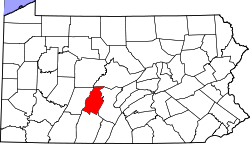
Tyrone is a borough in Blair County, Pennsylvania, United States, located 15 miles (24 km) northeast of Altoona, on the Little Juniata River. Tyrone was of considerable commercial importance in the twentieth century. It was an outlet for the Clearfield coal fields and was noted for manufacturing paper products. There were planing mills and chemical and candy factories. In 1900, 5,847 people lived here; in 1910, 7,176; and in 1940, 8,845 people resided here. The population was 5,477 at the 2010 census. It is part of the Altoona, PA Metropolitan Statistical Area. It was named after County Tyrone in Ireland.[4]
Key Information


Located along the main lines of the Norfolk Southern and Nittany and Bald Eagle railroads, and U.S. Route 220, Pennsylvania Route 453, and Interstate 99 highways, Tyrone was at one time known as "The Hub of the Highways". In those days, four railroads [Pennsylvania, Tyrone and Clearfield, Tyrone and Lock Haven, Lewisburg, and Tyrone] and three main highways [US-220, PA-350, PA-453] converged there.
History
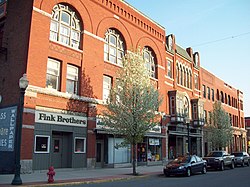
[edit]The Tyrone Borough Historic District was added to the National Register of Historic Places in 1993.[5]
Circus Train Derailment
[edit]On May 30, 1893, a train carrying employees and animals belonging to the Walter L. Main Circus derailed at an embankment resulting in the deaths of five circus employees, plus many animal casualties. Many unharmed animals escaped from the wreck and were reported across the countryside for months after the wreck, most notably, a woman who escaped a Bengal tiger, but lost her cow in the attack. A memorial now stands at the site.[6]
Tornado
[edit]On June 2, 1998, an F1 tornado moved southeast along Pennsylvania Route 453 northwest of Tyrone. Significant tree damage was noted in several locations along a four-mile path, beginning approximately five miles northwest of Tyrone. No significant damage was reported in Tyrone, although eyewitnesses reported seeing clouds rotating as they crossed the city. This tornado was part of the 1998 Eastern Tornado Outbreak. [7]
Industry
[edit]The largest employers in Tyrone are the Tyrone Area School District and the Tyrone Hospital. Tyrone is also the home to American Eagle Paper Mills[8] and Gardners Candies. Founded in 1897, Gardners Candies has ten retail stores in the area and is known regionally for its peanut butter meltaway candy.[9]
Geography
[edit]According to the United States Census Bureau, the borough has a total area of 2.0 square miles (5.2 km2), all land.
Tyrone is situated in the Bald Eagle Valley at the base of Bald Eagle Mountain along Bald Eagle Creek at the Little Juniata River water gap.
Demographics
[edit]| Census | Pop. | Note | %± |
|---|---|---|---|
| 1860 | 741 | — | |
| 1870 | 1,840 | 148.3% | |
| 1880 | 2,678 | 45.5% | |
| 1890 | 4,705 | 75.7% | |
| 1900 | 5,847 | 24.3% | |
| 1910 | 7,176 | 22.7% | |
| 1920 | 9,084 | 26.6% | |
| 1930 | 9,042 | −0.5% | |
| 1940 | 8,845 | −2.2% | |
| 1950 | 8,214 | −7.1% | |
| 1960 | 7,792 | −5.1% | |
| 1970 | 7,072 | −9.2% | |
| 1980 | 6,346 | −10.3% | |
| 1990 | 5,743 | −9.5% | |
| 2000 | 5,528 | −3.7% | |
| 2010 | 5,477 | −0.9% | |
| 2020 | 5,480 | 0.1% | |
| U.S. Decennial Census[10] | |||
As of the census[11] of 2010, there were 5,477 people, 2,275 households, and 1,422 families residing in the borough. The population density was 2,711.4 inhabitants per square mile (1,046.9/km2). There were 2,472 housing units at an average density of 1,223.8 per square mile (472.5/km2). The racial makeup of the borough was 97.3% White, 0.7% Black or African American, 0.3% Native American, 0.3% Asian, 0.2% from other races, and 1.2% from two or more races. Hispanic or Latino of any race were 1.0% of the population.
There were 2,275 households, out of which 30.9% had children under the age of 18 living with them, 43.0% were married couples living together, 4.8% had a male householder with no wife present, 14.7% had a female householder with no husband present, and 37.5% were non-families. 33.0% of all households were made up of individuals, and 14.8% had someone who was 65 years or older living alone. The average household size was 2.34, and the average family size was 2.93.
In the borough, the population was spread out, with 22.6% under 18, 8.2% from 18 to 24, 25.6% from 25 to 44, 25.3% from 45 to 64, and 18.3% who were 65 years of age or older. The median age was 40 years. For every 100 females, there were 88.8 males. For every 100 females aged 18 and over, there were 85.8 males.
The median income for a household in the borough was $34,850, and the median income for a family was $43,851. The per capita income for the borough was $18,664. About 10.7% of families and 14.0% of the population were below the poverty line, including 23.0% of those under age 18 and 10.9% of those aged 65 or over.

Transportation
[edit]Amtrak’s Pennsylvanian stops at the Tyrone station, which has one daily train in each direction. Greyhound buses going between Pittsburgh and Philadelphia also make a stop in Tyrone. The Nittany and Bald Eagle Railroad interchanges with Norfolk Southern just south of the station. Three major highways, U.S. Route 220, Pennsylvania Route 453, and Interstate 99 all pass through the town. The closest commercial airport to Tyrone is State College Regional Airport, located 27.5 miles away.
Education
[edit]The school district is the Tyrone Area School District.[12]
Film
[edit]In October 2009, several scenes for the Tony Scott film Unstoppable (with Denzel Washington, Chris Pine, and Rosario Dawson) were filmed in and around Tyrone, mostly at the 14th street crossing and the north end of the rail yard. Several hundred residents were employed as background extras. The film was released on November 12, 2010.

Media
[edit]Since 1887, the Tyrone Daily Herald has been the newspaper of record for Tyrone. WTRN, the local radio station in Tyrone, has been on the air since 1955, when Tyrone resident Cary Simpson founded it. The station broadcasts at 1340 AM and simulcasts over 100.7 FM, with a format of adult contemporary music, local news, and high school sports.
Notable people
[edit]- Seward Hiltner (1909–1984), prominent professor, author, and pastoral theologian
- Vernon E. James (1929–2010), US Army major general[13]
- Dylan Lane (born 1977), game show host (born in Tyrone, spent whole childhood in Huntingdon)
- Emme Rylan (born 1980), film and television actress (graduated from Tyrone High School
- D. Brooks Smith (born 1951), a federal judge - the United States Third Circuit Court of Appeals
- Ethan Stiefel (born 1973), former principal dancer with the American Ballet Theatre
- Fred Waring (1900–1984), musician and radio-television personality
- Farran Zerbe (1871–1949) prominent numismatist
References
[edit]- ^ "ArcGIS REST Services Directory". United States Census Bureau. Retrieved October 16, 2022.
- ^ a b U.S. Geological Survey Geographic Names Information System: Tyrone, Pennsylvania
- ^ "Census Population API". United States Census Bureau. Retrieved October 12, 2022.
- ^ "History". Retrieved December 4, 2016.
Irish immigrants brought the name of their home county, Tyrone, with them to America.
- ^ "National Register Information System". National Register of Historic Places. National Park Service. July 9, 2010.
- ^ Gannon, Megan (May 2014). "19th-Century Circus Train Crash Mystery: Where's the Animal Graveyard?". Live Science. Retrieved February 3, 2024.
- ^ NCEI. "Storm Events Database - Event Details - National Centers for Environmental Information". Retrieved December 4, 2016.
- ^ "American Eagle Paper Mills: Our Story". Retrieved July 14, 2019.
- ^ "About Gardners Candies". Retrieved July 14, 2019.
- ^ "Census of Population and Housing". Census.gov. Retrieved June 4, 2016.
- ^ "U.S. Census website". United States Census Bureau. Retrieved January 31, 2008.
- ^ "2020 CENSUS - SCHOOL DISTRICT REFERENCE MAP: Blair County, PA" (PDF). U.S. Census Bureau. Retrieved December 22, 2024. - Text list
- ^ "Obituary, Lt. General (Ret.) Vernon E. James". Centre Daily Times. State College, Pennsylvania. April 24, 2010. p. A4 – via Newspapers.com.
External links
[edit]- Official website
- Tyrone community website
- Tyrone, Pennsylvania (PA) Detailed Profile
- Tyrone Historical Society website(Community links)
| International | |
|---|---|
| National | |

Tyrone, Pennsylvania
View on GrokipediaGeography
Location and Topography
Tyrone is a borough in Blair County, Pennsylvania, and forms part of the Altoona Metropolitan Statistical Area, which encompasses all of Blair County. The borough is situated approximately 15 miles northeast of the city of Altoona, placing it within the broader Appalachian Ridge and Valley physiographic province. Its geographic coordinates are roughly 40.676° N latitude and 78.246° W longitude. The community occupies a position along the Little Juniata River, within the scenic Bald Eagle Valley, and rests at the base of Bald Eagle Mountain, contributing to its sheltered valley setting. According to U.S. Census Bureau data, Tyrone covers a total land area of 2.03 square miles, with no incorporated water bodies. The average elevation in the borough is around 1,100 feet above sea level, varying slightly due to the undulating terrain near the river and mountain base.[5] Surrounding the borough are diverse natural features, including expansive forested areas characteristic of the region's mixed hardwood stands and proximity to larger protected lands. Tyrone lies near Bald Eagle State Forest, which borders adjacent counties and offers extensive woodlands, while Raymond B. Winter State Park is accessible about 60 miles to the east in Union County, providing additional opportunities for exploration of the Ridge and Valley landscape.Climate
Tyrone, Pennsylvania, features a humid continental climate (Köppen Dfb) with distinct seasons, including warm, humid summers and cold, snowy winters. The average annual temperature is approximately 50°F, reflecting the temperate conditions typical of central Pennsylvania. This climate supports a mix of agricultural activities and forested landscapes in the surrounding Blair County area.[8][9] Summer temperatures peak in July, with average highs reaching around 82°F, while winter lows in January average about 20°F, often accompanied by freezing conditions. Annual precipitation totals approximately 45 inches, distributed relatively evenly across the months, contributing to lush vegetation and reliable water resources. Winter snowfall averages about 39 inches, primarily occurring from December through March, which influences local transportation and outdoor recreation.[8][10] The area's location amid the Appalachian Mountains exposes it to occasional severe weather, such as thunderstorms capable of producing tornadoes, as the regional topography can enhance storm development and intensity. These events, though not frequent, underscore the need for preparedness in this inland setting.[11][12]History
Founding and Early Settlement
The settlement of Tyrone began on Christmas Day, 1850, when Jacob Burley and his family established the area's first permanent residence in a modest story-and-a-half frame building that doubled as a dwelling and general store, located at what is now the site of Study's business block.[13] This pioneer effort marked the initial human habitation in a previously undeveloped wilderness along the Little Bald Eagle Creek, where the valley's geography provided fertile ground for early agriculture and resource extraction.[5] Burley, a merchant, partnered with Rev. John Stewart to expand local commerce, including the operation of lumber yards that capitalized on the surrounding forests.[13] Originally known as Eagleville in reference to the nearby Little Bald Eagle Creek, the community was soon renamed Shorbsville to honor the Lyon, Shorb & Company, a key early business interest in the area.[5] By 1852, it adopted the name Tyrone City, drawing from County Tyrone in Ireland to reflect the Irish heritage of many settlers who were among the pioneers.[13][14] This naming choice underscored the influence of Irish immigrants, who were increasingly drawn to central Pennsylvania's emerging opportunities in resource-based trades during the mid-19th century.[15] On July 27, 1857, the growing village was incorporated as the Borough of Tyrone by court order, with an initial population of approximately 700 residents and forming part of Snyder Township.[5] Early growth was propelled by the lumber trade, nascent iron production, and the anticipated arrival of railroads, including the Pennsylvania Railroad's extensions that promised to connect the isolated valley to broader markets.[13] These industries fostered the construction of additional homes and merchant establishments, laying the foundation for Tyrone's expansion as a hub in Blair County.[5]Major Historical Events
One of the most tragic incidents in Tyrone's history occurred on May 30, 1893, when the Walter L. Main Circus train derailed at McCann's Crossing while traveling from Houtzdale to Lewistown on the Tyrone and Clearfield Railroad.[16] The derailment, which happened around 5:30 a.m., was caused by a combination of the train's excessive length, human error, and insufficient braking power, leading it to plummet down a 30-foot embankment after the bridge collapsed under the weight.[17] Five crew members, including engineer "Red" Cresswell, were killed, and numerous circus animals perished, with others escaping into the surrounding woods; local residents quickly mobilized to provide aid, capturing escaped animals and assisting the injured in a display of community solidarity.[18] The aftermath included the burial of animal remains in a mass grave near the site, and the event left a lasting mark on Tyrone's collective memory, commemorated annually.[19] Over a century later, on June 2, 1998, an F1 tornado touched down northwest of Tyrone in northern Blair County, moving southeast along Route 453 for approximately 4 miles.[20] With peak winds estimated at 90 mph, the tornado caused significant property damage, primarily snapping and uprooting trees in dense forested areas, but resulted in no fatalities or injuries.[21] This event was part of a larger outbreak of 37 tornadoes across Pennsylvania, Maryland, and West Virginia that day.[22] In 1993, the Tyrone Borough Historic District was added to the National Register of Historic Places on January 21, recognizing its architectural and commercial significance spanning from 1850 to 1949.[23] The district, roughly bounded by West 14th Street, Logan Avenue, Bald Eagle Avenue, the Little Juniata River, West 8th Street, and Jefferson Avenue, encompasses 349 contributing buildings that exemplify Late Victorian and Late 19th- and 20th-Century Revival styles, including two- to three-story brick commercial blocks and residential structures that preserve the borough's Victorian-era heritage.[24][25] Tyrone's population reached its historical peak of 8,845 residents in 1940, fueled by the railroad industry's prominence in the region.[26] However, by 1950, the figure had declined to 8,200—a 7.3% drop—reflecting broader industrial shifts, particularly the transition from steam to diesel locomotives after World War II, which reduced employment in rail-dependent communities like Tyrone.[26] This trend continued, contributing to ongoing population decreases tied to deindustrialization in central Pennsylvania's transportation sector.[27]Demographics
Population Trends
Tyrone's population experienced robust growth during the early 20th century, driven by industrial expansion, before entering a period of prolonged decline. The 1900 U.S. Census recorded 5,847 residents, which rose to 7,176 by 1910 and peaked at 8,845 in 1940.[28][29] Following this peak, the population began to contract amid broader regional shifts. The 2010 U.S. Census counted 5,477 residents, a significant drop from the mid-century high, and this figure edged slightly higher to 5,480 by the 2020 Census.[30] The most recent estimate places the population at 5,421 in 2023, based on the American Community Survey 5-year estimates.[3]| Year | Population |
|---|---|
| 1900 | 5,847 |
| 1910 | 7,176 |
| 1940 | 8,845 |
| 2010 | 5,477 |
| 2020 | 5,480 |
| 2023 (est.) | 5,421 |