


Community hub
Recent from talks
Contribute something
Nothing was collected or created yet.
Ukrainian Orthodox Church – Kyiv Patriarchate
View on Wikipedia
| Ukrainian Orthodox Church – Kyiv Patriarchate | |
|---|---|
  | |
| Abbreviation | UOC-KP |
| Type | Eastern Orthodox |
| Classification |
|
| Primate | Patriarch Filaret |
| Language | Ukrainian, Church Slavonic |
| Headquarters |  Kyiv, Ukraine Kyiv, Ukraine |
| Territory | Ukraine |
| Founder | Metropolitan Filaret (Denysenko) |
| Independence | 1992 |
| Separated from | |
| Merged into | Orthodox Church of Ukraine (2018) |
| Defunct | 15 December 2018 (Reneged and re-established since 2019) |
| Members | Reported as 25 percent of religious Ukrainian population by Razumkov Centre (2016); less than 100,000 (2019) |
| Official website | Ukrainian Orthodox Church |
The Ukrainian Orthodox Church – Kyiv Patriarchate (UOC-KP; Ukrainian: Украї́нська Правосла́вна Це́рква – Ки́ївський Патріарха́т (УПЦ-КП), romanized: Ukrainska Pravoslavna Tserkva — Kyivskyi Patriarkhat (UPTs-KP)) was an Orthodox church in Ukraine, in existence from 1992 to 2018. Its patriarchal cathedral was St Volodymyr's Cathedral in Kyiv.
After its unilateral declaration of autocephaly in 1992, the UOC-KP was not recognised by the other Eastern Orthodox churches, and was considered a "schismatic group" by the Moscow Patriarchate and Ecumenical Patriarchate.[1][2][3] Patriarch Filaret (Denysenko) was enthroned in 1995 and excommunicated by the Russian Orthodox Church in 1997,[4][5] an action not recognized by the UOC-KP synod.[6] In 2018, the Ecumenical Patriarchate of Constantinople moved unilaterally and against canonical norms to facilitate a "unification council", in contradiction to his previous statement "recognizing the fullness of the Russian Orthodox Church's exclusive competence on this issue".[7] The canonical Ukrainian Orthodox Church rejected these overtures, noting its universal recognition as sole canonical authority on the territory of Ukraine and the political nature of the proposed council.[8] Constantinople ignored this, "reinstated" Filaret as a bishop and facilitated the convening of a unification council.[9][10][11][12][13] In December 2018, the unification council of the Eastern Orthodox churches of Ukraine decided to unite the UOC-KP with the Ukrainian Autocephalous Orthodox Church (UAOC), creating the Orthodox Church of Ukraine (OCU) which was subsequently granted autocephaly by the Ecumenical Patriarch of Constantinople in January 2019.
A conflict between Filaret and Epiphanius, the Metropolitan of the OCU following the December 2018 unification council, erupted and resulted in Filaret claiming continuation of the UOC-KP on 20 June 2019. The UOC-KP is not currently recognized by, or in communion with any of the mainstream Orthodox churches that are members of Eastern Orthodoxy. The OCU is recognized by only three of the fourteen universally recognized autocephalous churches.
History
[edit]The Kyiv Patriarchate considers itself an independent church,[14] a successor of the Metropolis of Kyiv and all Rus[14] which existed under the Ecumenical Patriarchate until 1686 (when Constantinople transferred it to the Moscow Patriarchate of the Russian Orthodox Church). In January 1992, after Ukraine became an independent state during the dissolution of the Soviet Union, the Moscow Patriarchate was able to freely elect a new Patriarch. Filaret was passed over in favor of Alexius II. Embroiled in scandal, Metropolitan of Kyiv Filaret promised the Synod of Ukraine to resign his position.[15] Before this could occur, he convened a small assembly of bishops from western Ukraine at the Kyiv Pechersk Lavra which submitted a request for Ukrainian autocephaly to the Moscow Patriarch.[16] The Synod of the Moscow Patriarchate responded that it would grant autocephaly if the request were made by an official request of the Synod of the Ukrainian Orthodox Church, and the appeal were addressed to the people of Ukraine, to allow them the opportunity to make their desires known.[17][16]
| Part of a series on the |
| Eastern Orthodox Church |
|---|
 |
| Overview |
In June 1992, the Synod of the Ukrainian Orthodox Church defrocked Filaret Denysenko, citing his refusal to honor his oath to step down as primate of Ukraine, his slander of the council's decisions against him, illegal services, and inciting of schism.[18] That same month, Filaret helped establish the UOC-KP. Its nominal primate was the émigré Mstyslav (Skrypnyk), primate of the Ukrainian Autocephalous Orthodox Church. Mstyslav never approved the union of the UAOC and UOC-KP.[19] Although Metropolitan Filaret had been the driving force of the Kyiv Patriarchate, it was not until the sudden death of Patriarch Volodymyr (Romaniuk) in July 1995 that he was elected the Patriarch of Kyiv and All Rus-Ukraine in October of that year. Filaret had been defrocked by the Moscow Patriarchate (in which he had been ordained and served as bishop from February 1962 to spring 1992) and was excommunicated in February 1997.[5]
After the 2014 Russian annexation of Crimea, 38 of the church's 46 parishes in Crimea ceased to exist; three churches were seized by Russian authorities.[20] The Kyiv Patriarchate is unrecognised by any other Orthodox churches. In April 2018, the Ecumenical Patriarchate began to consider a request by the Ukrainian Parliament and US Government to grant canonical status to the UOC-KP in Ukraine.[21][9]
11 October 2018 Ecumenical Patriarchate decision
[edit]In early September 2018, Ecumenical Patriarch of Constantinople Bartholomew announced his desire to abolish Constantinople's 1686 transfer of "the region of today's Metropolis of Kyiv" to the Moscow Patriarchate.[22] On 11 October 2018, after a synod, the Patriarchate of Constantinople renewed an earlier decision to move towards granting autocephaly to the Ukrainian Orthodox Church.[23][24][25] The synod also withdrew Constantinople's 332-year qualified acceptance of the Russian Orthodox Church's jurisdiction over the Ukrainian Church, contained in a 1686 letter — a move unprecedented in the history of the Orthodox Church.[24][25] It lifted the excommunications of Patriarch Filaret of the Ukrainian Orthodox Church – Kyiv Patriarchate (UOC-KP) and Metropolitan Makariy of the Ukrainian Autocephalous Orthodox Church (UAOC); both bishops were "canonically reinstated to their hierarchical or priestly rank, and their faithful ... restored to communion with the Church."[26][27][28] These moves were widely condemned across the Orthodox world. Virtually every Orthodox Primate protested these decisions, and even Greek bishops wrote rebukes of Constantinople's actions.[29][30]
The following day, the UOC-KP declared that the decision restored the canonical recognition of the episcopate and clergy of the Kyiv Patriarchate.[31][32] It was later clarified that the Ecumenical Patriarchate considered Filaret "the former metropolitan of Kyiv"[33][34][35][36] and Makariy "the former Archbishop of Lviv"[34][35] and, on 2 November 2018, the Ecumenical Patriarchate did not recognise the UAOC or the UOC-KP and their leaders.[37][38] The Ecumenical Patriarchate declared that it recognised sacraments performed by the UOC-KP and the UAOC as valid.[39][40]
On 20 October 2018, the UOC-KP changed the title of its leader to "His Holiness and Beatitude (name), Archbishop and Metropolitan of Kyiv – Mother of the Rus Cities and of Galicia, Patriarch of All Rus-Ukraine, Holy Archimandrite of the Holy Assumption Kyiv-Pechersk and Pochayiv Lavra".[41][42][43] The abridged form is "His Holiness (name), Patriarch of Kyiv and All Rus’-Ukraine", and the form for interchurch relations is "Archbishop, Metropolitan of Kyiv and All Rus'-Ukraine".[41][42][44][45][46][47] The full title and the interchurch-relations version's mention of "archbishop" and "metropolitan" and the abridged form's mention of "patriarch" have caused confusion.[42][43]
Dissolution and merger with the UAOC into the OCU
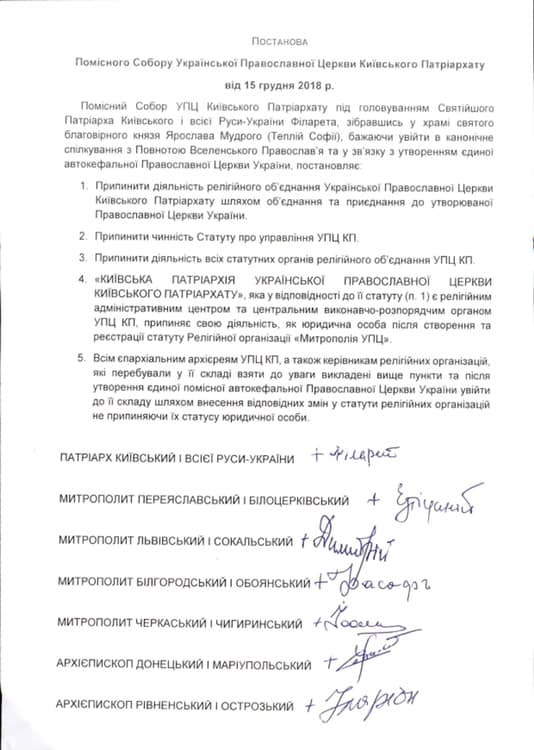
[edit]On 15 December 2018, the Ukrainian Autocephalous Orthodox Church and UOC-KP hierarchies decided to dissolve the churches. That day, the UAOC, the UOC–KP and two members of the Ukrainian Orthodox Church (Moscow Patriarchate) were going to merge to form the Orthodox Church of Ukraine after a unification council.[48]
According to Filaret, "the Kyiv Patriarchate has not been liquidated. It is not liquidated. They want to present the situation as if it was liquidated. The Kyiv Patriarchate can be liquidated by the one who created it".[49][50][51] The Ukrainian Ministry of Culture, "in response to a widely circulated statement by the media, alleging that the Ukrainian Orthodox Church of the Kyivan Patriarchate still exists or is being restored in Ukraine", published a report that the UOC-KP had "actually and legally ceased its activities".[52] Filaret said, "The Ukrainian Orthodox Church of the Kyiv Patriarchate (UOC-KP) remains registered with state bodies. In particular, the Kyiv Patriarchate remains registered. This means the Kyiv Patriarchate continues to legally exist."[53] According to the Ukrainian Ministry of Justice, the UOC-KP still existed.[54][55]
Separation from the OCU and reestablishment of the UOC–KP
[edit]The local council of the UOC-KP (convened by Filaret) decided to cancel the decisions of the unification council of the Orthodox churches of Ukraine on 20 June 2019,[56][57] during the conflict between Filaret and Epiphanius.
On 31 July 2019, the Ukrainian Ministry of Culture said the UOC-KP had ceased to exist.[58][59] However, on 4 September 2019, the District Administrative Court of Kyiv suspended the liquidation of the UOC-KP at the request of the UOC-KP.[60][61] On 11 September, another decision of the same court blocked "the Justice Ministry of Ukraine, the Culture Ministry of Ukraine, its structural sub-units, central-government and local authorities, and notaries public from performing any registration regarding the Kyiv Patriarchate, the Ukrainian Orthodox Church of the Kyiv Patriarchate [UOC-KP], and their assets"[62][63] On 11 November 2019, the Court of Appeal of the District Administrative Court of Kyiv confirmed legality of the process of liquidation of the UOC-KP.[64][65]
On 14 December 2019, after the meeting of the enlarged Bishops' Council, held on 14 December in Kyiv on the occasion of the anniversary of the creation of the OCU, Epiphanius declared that the procedure of liquidation of the UAOC as well as the UOC-KP had been completed the day before. He added: "Such structures no longer exist. In confirmation of that, in the State Register there is marked 'activity DISCONTINUED'".[66] In the same month, the UOC-KP stated it did not recognize the liquidation.[67]
In January 2020, the UOC-KP announced that Filaret had officially withdrawn his signature from 15 December 2018 act of dissolution of the UOC-KP.[68][69]
Statistics
[edit]The Kyiv Patriarchate has 44 percent of Orthodox Christians, compared to 12.8 percent for the UOC of the Moscow Patriarchate. Although the Russian Orthodox Church in Ukraine (UOC-MP) has twice as many parishes, the UOC-KP had three times as many members. The former had 38 percent of all Orthodox and 25 percent of the population in 2016, and the Russian Orthodox had 23 percent of the Orthodox and 15 percent of the population. The UOC-KP had 34 dioceses worldwide, and over 5,100 parishes in Ukraine. Its United States vicariate consisted of 15 parishes, with its main cathedral St. Andrew's in Bloomingdale, Illinois.[70] The church had six parishes in Australia, and over 40 in western Europe. The Russian government's reported negative influence on the Moscow Patriarchate and claims that it is using the patriarchate as a "tool of influence over Ukraine" led to a renewed April 2018 drive to recognise an independent Ukrainian Orthodox church which, according to Ukrainian President Petro Poroshenko, would help "eliminate internal strife and conflicts within the state."[21][71]
UOC-KP adherents in Ukraine, excluding Crimea and breakaway areas of Donbas:
| Date | Percentage | Source |
|---|---|---|
| May–June 2016 | 33 | [72] |
| June–July 2017 | 44 | [73] |
| May–June 2018 | 36 | [74] |
Primates
[edit]
In November 1991 the all-Ukrainian sobor of the Ukrainian Orthodox Church, called by Metropolitan Filaret Denysenko, issued a request to the patriarch of Moscow for the autocephaly of the Ukrainian church.[75] The sobor of the ROC held in April 1992 refused that request and decided to replace Metropolitan Filaret with Volodymyr Sabodan. In response to this, at the all-Ukrainian sobor in June 1992 one part of the Ukrainian Orthodox church, led by Metropolitan Filaret, decided to separate from the ROC and unite with the Ukrainian Autocephalous Orthodox Church (UAOC) to form the Ukrainian Orthodox Church-Kyiv Patriarchate under Patriarch Mstyslav.[75] Mstyslav never approved of the union of the UAOC and the UOC-KP.[75]
Patriarch Mstyslav (Stepan Ivanovych Skrypnyk) was Patriarch of Kyiv and all Rus’-Ukraine and primate of the Ukrainian Autocephalous Orthodox Church (UAOC) and Ukrainian Orthodox Church – Kyiv Patriarchate (UOC–KP) from 1991 to 1993. After Mstyslav's death in 1993, the temporary union ended and the Ukrainian Orthodox Church – Kyiv Patriarchate and the Ukrainian Autocephalous Orthodox Church separated. The primates of the Ukrainian Orthodox Church–Kyiv Patriarchate continued to hold the title of patriarch:
- Metropolitan Filaret (Filaret Denysenko) (1990–1992)
- Patriarch Mstyslav (Mstyslav Skrypnyk) (1992–1993)
- Patriarch Volodymyr (Volodomyr Romaniuk) (1993–1995)
- Patriarch Filaret (Filaret Denysenko), (1995–2018)
- Patriarch Filaret (Filaret Denysenko), (2019–present)
On 20 October 2018, the UOC-KP changed the title of its primate to "His Holiness and Beatitude (name), Archbishop and Metropolitan of Kyiv – Mother of the Rus Cities and of Galicia, Patriarch of All Rus-Ukraine, Holy Archimandrite of the Holy Assumption Kyiv-Pechersk and Pochayiv Lavra".[42][43][76] The abridged form is "His Holiness (name), Patriarch of Kyiv and All Russia-Ukraine", and the form for inter-church relations is "Archbishop, Metropolitan of Kyiv and All Rus'-Ukraine".[42][44][45][46][47][76] Metropolitan Hilarion called the bestowal of title a "farce".[2][77]
Administration
[edit]Before the first disestablishment:[78]
Dioceses
[edit]- Belgorod
- Bogorodsk
- Cherkasy[79]
- Chernihiv
- Chernivtsi[80]
- Crimea
- Dnipropetrovsk
- Donetsk
- Drohobych-Sambir
- Ivano-Frankivsk
- Kharkiv
- Kherson[81]
- Khmelnytskyi
- Kitsman
- Kolomyia
- Kropyvnytskyi
- Kyiv
- Luhansk
- Lviv
- Mykolaiv
- Odesa
- Pereiaslav
- Poltava
- Rivne
- Sumy
- Ternopil-Buchach[82]
- Ternopil-Terebovlya
- Vinnytsia
- Volyn
- Volodymyr-Volynskyi
- Zakarpattia Oblast
- Zaporizhzhia
- Zhytomyr
- Deanery of Germany[83]
- Eastern Moldavia
- Paris
Exarchates and vicariates
[edit]- Exarchate in Greece
- Ukrainian Orthodox Vicarate of the UOC-KP in the US and Canada[84]
- Vicariate in Australia
- European Exarchate
- Russian Exarchate
See also
[edit]References
[edit]- ^ РПЦ: вмешательство Константинополя в ситуацию на Украине может породить новые расколы [Russian Orthodox Church: Constantinople's intervention in the situation in Ukraine could give rise to new schisms]. TASS (Interview with Metropolitan Hilarion (Alfeyev)) (in Russian). 1 September 2018. Retrieved 2 December 2018.
- ^ a b "Metropolitan Hilarion: Filaret Denisenko was and remains a schismatic". mospat.ru. 22 October 2018. Retrieved 29 October 2018.
- ^ Archontonis, Bartholomew I. "Official History of the Defrocking and Anathematization of Philaret Denisenko". Orthodox Christianity. Retrieved 11 June 2025.
- ^ Акт об отлучении от Церкви монаха Филарета (Денисенко) [Act of excommunication from the Church of the monk Filaret (Denisenko)]. sobor-2008.ru. Archived from the original on 29 August 2014. Retrieved 1 December 2018.
- ^ a b "Official History of the Defrocking and Anathematization of Philaret Denisenko. Documents of the June 1992, 1994, and 1997 Bishops' Councils of the Russian Orthodox Church". OrthoChristian.com. 17 October 2018. Retrieved 1 December 2018.
- ^ Патріархії, Прес-центр Київської. "X. The So-Called 'Anathematization' Of Patriarch Filaret (part 2)". archive.cerkva.info. Ukrainian Orthodox Church – Kyiv Patriarchate (UOC-KP). Retrieved 1 December 2018.
{{cite web}}: CS1 maint: url-status (link) - ^ Patriarch Bartholomew I of Constantinople. "Official History of the Defrocking and Anathematization of Philaret Denisenko". Orthodox Christianity. Retrieved 11 June 2025.
- ^ "Resolution of the Council of Bishops of the Ukrainian Orthodox Church of November 13, 2018". Synodal Information and Education Department of the Ukrainian Orthodox Church. 13 November 2018. Retrieved 11 June 2025.
- ^ a b Ecumenical Patriarchate of Constantinople (11 October 2018). "Announcement (11/10/2018)". Retrieved 17 October 2018.
- ^ Petrasiuk, Oleg (14 October 2018). "Ukraine thanks Ecumenical Patriarchate for supporting independence of Ukrainian Orthodox Church". KyivPost. KyivPost. Retrieved 17 October 2018.
- ^ "The Ecumenical Synod lifted the anathema on the leaders of the UOC-KP and the UAOC | The Koz Times". koztimes.com. 11 October 2018. Archived from the original on 12 October 2018. Retrieved 12 October 2018.
- ^ "Announcement of the Ecumenical Patriarchate of Constantinople". Ecumenical Patriarchate. 11 October 2018. Retrieved 12 October 2018.
- ^ "Ecumenical Patriarchate To Recognize Ukrainian Church's Autocephaly Despite Moscow's Disagreement | Greek Reporter Europe". eu.greekreporter.com. 7 September 2018. Retrieved 16 October 2018.
- ^ a b СТАТУТ ПРО УПРАВЛІННЯ УКРАЇНСЬКОЇ ПРАВОСЛАВНОЇ ЦЕРКВИ КИЇВСЬКОГО ПАТРІАРХАТУ See Chapter I, § 1 and 7.
- ^ Synod of Ukrainian Orthodox Church (11 June 1992). "Statement of the episcopate of the Ukrainian Orthodox Church". Russian Orthodox Church. Retrieved 11 June 2025.
- ^ a b After autocephaly, The Ukrainian Week (26 October 2018)
(in Ukrainian) The Ecumenical Patriarchate unveiled documents in support of Ukrainian autocephaly, Gazeta.ua (14 September 2018) - ^ "Ruling on the appeal of the episcopate of the Ukrainian Orthodox Church regarding the granting of autocephaly to her". Russian Orthodox Church. 2 April 1992. Retrieved 11 June 2025.
{{cite web}}:|first=missing|last=(help) - ^ Synod of the Ukrainian Orthodox Church (11 June 1992). "Statement of the episcopate of the Ukrainian Orthodox Church". Russian Orthodox Church. Retrieved 11 June 2025.
- ^ "Ukrainian Orthodox church". www.encyclopediaofukraine.com. Retrieved 9 January 2019.
- ^ Russia seeks to crush the Ukrainian Orthodox Church in Crimea for helping resist Russification, UNIAN (11 October 2018)
- ^ a b Coyle, James J. (24 April 2018). "Ukraine May Be Getting Its Own Church, but Not as Fast as Poroshenko Thinks". Atlantic Council. According to the Razumkov Center, among the 27.8 million Ukrainian members of Orthodox churches, allegiance to the Kyiv Patriarchate has grown from 12% in 2000 to 25% in 2016. Much of the growth has come from believers who previously did not associate with either patriarchate.
- ^ Synaxis of Hierarchs of The Ecumenical Patriarchate of Constantinople Ukrainian Orthodox Church of the USA
- ^ Polityuk, Pavel; Dikmen, Yesim (11 October 2018). "Ukraine wins approval for historic split from Russian church". Reuters. Retrieved 16 October 2018.
- ^ a b "Announcement (11/10/2018). - Announcements - The Ecumenical Patriarchate". www.patriarchate.org. Ecumenical Patriarchate. 11 October 2018. Retrieved 12 October 2018.
The Holy Synod discussed in particular and at length the ecclesiastical matter of Ukraine, in the presence of His Excellency Archbishop Daniel of Pamphilon and His Grace Bishop Hilarion of Edmonton, Patriarchal Exarchs to Ukraine, and following extensive deliberations decreed:
1) To renew the decision already made that the Ecumenical Patriarchate proceed to the granting of Autocephaly to the Church of Ukraine. [...]
4) To revoke the legal binding of the Synodal Letter of the year 1686 [...] - ^ a b Tomos ante portas: a short guide to Ukrainian church independence. Euromaidan Press. 14 October 2018. Retrieved 16 October 2018.
the Synod ... of the Ecumenical Patriarchate ... gave further confirmation that Ukraine is on the path to receiving church independence from Moscow. ... Although President Poroshenko triumphantly announced that as a result of the meeting Ukraine had received the long-awaited Tomos, or decree of Church independence – a claim circulated in Ukraine with great enthusiasm, this is not true ... Constantinople's decision will benefit other jurisdictions in Ukraine – the UOC KP and UAOC, which will have to effectively dismantle their own administrative structures and set up a new Church, which will receive the Tomos of autocephaly ... Right now it's unclear which part of the UOC MP will join the new Church. 10 out of 90 UOC MP bishops signed the appeal for autocephaly to the Ecumenical Patriarch – only 11%. But separate priests could join even if their bishops don't, says Zuiev.
- ^ "Announcement (11/10/2018). - Announcements - The Ecumenical Patriarchate". www.patriarchate.org. 11 October 2018. Retrieved 30 October 2018.
- ^ "Announcement (11/10/2018). - Announcements - The Ecumenical Patriarchate". www.patriarchate.org. Retrieved 27 October 2018.
3) To accept and review the petitions of appeal of Filaret Denisenko, Makariy Maletych and their followers, who found themselves in schism not for dogmatic reasons, in accordance with the canonical prerogatives of the Patriarch of Constantinople to receive such petitions by hierarchs and other clergy from all of the Autocephalous Churches. Thus, the above-mentioned have been canonically reinstated to their hierarchical or priestly rank, and their faithful have been restored to communion with the Church.
- ^ "Constantinople recognizes Kyiv Patriarch Filaret as church bishop". KyivPost. 11 October 2018. Retrieved 17 October 2018.
The Kyiv Patriarchate and the Ukrainian Autocephalous Orthodox Church are planning to merge with pro-independence bishops of the Moscow Patriarchate into an independent (autocephalous) Ukrainian church, which is expected to get a Tomos — a Synod decree recognizing the independence of the Ukrainian church from the Constantinople church. "This decision gives us the opportunity to unite with bishops of the Moscow Patriarchate who are willing (to join)," Filaret said on Oct. 11.
- ^ Abp. Anastasios of Tirana (11 March 2019). "Letter (on behalf of the Holy Synod of the Albanian Church) of Archbishop Anastasios of Tirana and All Albania to Patriarch Bartholomew of Constantinople, January 14, 2019". Orthodox Christianity. Retrieved 11 June 2025.
- ^ Kykkotis, Met. Nikiforos (1 June 2021). The Ecclesial Crisis in Ukraine and its Solutions According to the Sacred Canons (1st ed.). New York, USA: Holy Trinity Seminary Press (published 2020). ISBN 9781942699415.
- ^ "Заява Прес-центру Київської Патріархії про рішення Священного Синоду Константинопольської Матері-Церкви та їхнє значення для Церкви в Україні". www.cerkva.info. 12 October 2018. Retrieved 1 December 2018.
- ^ "Kiev Patriarchate declines to implement the Phanar's decision on Filaret". spzh.news. 12 October 2018. Retrieved 1 December 2018.[permanent dead link]
- ^ "Phanar considers Filaret an ordinary bishop without an episcopal see". spzh.news. 14 October 2018. Archived from the original on 29 October 2018. Retrieved 29 October 2018.
- ^ a b "ΑΠΟΚΛΕΙΣΤΙΚΟ | Βαρθολομαίος σε Ονούφριο: Δεν μπορείτε να έχετε πλέον τον τίτλο Κιέβου". ROMFEA (in Greek). 7 December 2018. Retrieved 8 December 2018.
- ^ a b "Patriarch Bartholomew explains Metropolitan Onufriy reasons for Ukraine church's autocephaly (Letter)". unian.info. 7 December 2018. Retrieved 29 December 2018.
- ^ "Kyiv Patriarchate does not exist, never existed - Patriarch Bartholomew". www.interfax-religion.com. 3 June 2019. Retrieved 3 June 2019.
- ^ "Константинополь: "Надеемся, Москва обратится к разуму". Подробности беседы". BBC News Русская служба. 2 November 2018. Retrieved 3 November 2018.
- ^ Cazabonne, Emma (6 November 2018). "BBC interview with Archbishop Job of Telmessos on the Ukrainian question". orthodoxie.com. Retrieved 7 November 2018.
- ^ "Exarch: Constantinople recognizes all clergy of KP and UAOC as canonical". spzh.news. 16 October 2018. Archived from the original on 18 December 2018. Retrieved 18 December 2018.
- ^ "Constantinople recognized all clergy of KP and UAOC as canonical—Patriarchal Exarch". OrthoChristian.Com. 16 October 2018. Retrieved 22 December 2018.
- ^ a b "ЖУРНАЛ №17 ЗАСІДАННЯ СВЯЩЕННОГО СИНОДУ УКРАЇНСЬКОЇ ПРАВОСЛАВНОЇ ЦЕРКВИ КИЇВСЬКОГО ПАТРІАРХАТУ". www.cerkva.info. Українська Православна Церква Київський Патріархат (УПЦ КП). 20 October 2018. Retrieved 27 October 2018.
- ^ a b c d e ""Metropolitan" and "patriarch" rolled into one: KP changes its head's title". spzh.news. 20 October 2018. Retrieved 29 October 2018.
- ^ a b c "UOC KP Spokesman: Our Primate is archbishop, metropolitan, and patriarch". spzh.news. 27 October 2018. Archived from the original on 29 October 2018. Retrieved 29 October 2018.
- ^ a b Wozniak, Hanna (26 October 2018). "Is the Ecumenical Patriarchate Fine with St. Andrew's Church in Kyiv?". moderndiplomacy.eu. Retrieved 27 October 2018.
On October 20, the UOC KP Synod changed the title of its head [Filaret]. Now the Church's Primate will also be called the Archimandrite of Kyiv-Pechersk and Pochayiv Lavras, which seemingly reflects Filaret's desire to get them at his disposal. At the moment both Lavras belong to the UOC MP [the Ukrainian Orthodox Church (Moscow Patriarchate)], so it looks like the "Archimandrite" doesn't want to comply with the fifth point of the Constantinople Synod decree in which the Patriarchate appeals to all sides involved that they avoid appropriation of Churches, Monasteries and other properties.
- ^ a b Укрінформ (26 October 2018), Українська церква на шляху утвердження автокефалії, archived from the original on 12 December 2021, retrieved 29 October 2018 (Press conference)
- ^ a b "UOC KP Spokesman: Our Primate is archbishop, metropolitan, and patriarch". spzh.news. 27 October 2018. Archived from the original on 29 October 2018. Retrieved 29 October 2018.
Filaret is an "archbishop", a "metropolitan", and a "patriarch". This was announced on October 26 by Spokesman of the UOC KP Eustratiy Zoria during the press conference of Ukrinform "Ukrainian Church on the road to establishing autocephaly".
- ^ a b "Zoria explains why Filaret's title includes references to UOC Lavras". spzh.news. 22 October 2018. Archived from the original on 25 November 2018. Retrieved 24 November 2018.
- ^ Киевский патриархат и УАПЦ самораспустились перед Собором. РБК-Украина (in Russian). 15 December 2018. Retrieved 16 December 2018.
- ^ "Split is looming in the newly formed Orthodox Church of Ukraine". risu.org.ua. 10 May 2019. Retrieved 12 May 2019.
- ^ ""Київський Патріархат не ліквідовано" — владика Філарет" [The Kyiv Patriarchate has not been liquidated — Bishop Filaret]. risu.org.ua. 9 May 2019. Retrieved 12 May 2019.
- ^ Cazabonne, Emma (10 May 2019). ""Patriarch" Filaret considers that the "Kyiv Patriarchate has never been liquidated"". Orthodoxie.com. Retrieved 11 May 2019.
- ^ "УПЦ КП "фактично й юридично припинила свою діяльність", — заява Міністерства культури". risu.org.ua. 11 May 2019. Retrieved 12 May 2019.
- ^ "Patriarch Filaret talks of split, schools Metropolitan Epifaniy". www.unian.info. 15 May 2019. Retrieved 15 May 2019.
- ^ "Filaret's "Kiev Patriarchate" still exists—Ukrainian Ministry of Justice". OrthoChristian.Com. 21 May 2019. Retrieved 21 May 2019.
- ^ "В Минюсте сообщили, что решение о роспуске УПЦ КП может принять только Поместный собор Киевского патриархата или суд". gordonua.com. Retrieved 21 May 2019.
- ^ "Filaret's 'Council' restores UOC-KP with all its structure, property and criticizes Tomos". RISU - Religious Information Service of Ukraine. 20 June 2019. Retrieved 20 June 2019.
- ^ ""Kyiv Patriarchate" cancels its dissolution". Interfax. 20 June 2019. Retrieved 21 June 2019.
- ^ "Ministry of Culture confirms liquidation of Kyiv Patriarchate". risu.org.ua. 31 July 2019. Retrieved 1 August 2019.
- ^ "Міністерство культури України :: Заява Міністерства культури України щодо особливостей державної реєстрації низки православних релігійних організацій після проведення Помісного Об'єднавчого Собору 15 грудня 2018 року". mincult.kmu.gov.ua. 31 July 2019. Archived from the original on 31 July 2019. Retrieved 1 August 2019.
- ^ "УПЦ КП подала судовий позов щодо незаконності утворення ліквідаційної комісії Київської патріархії". Інформаційне агентство Українські Національні Новини (УНН). Всі онлайн новини дня в Україні за сьогодні - найсвіжіші, останні, головні. (in Ukrainian). 4 September 2019. Retrieved 6 September 2019.
- ^ "District Administrative Court suspends liquidation of UOC-KP". risu.org. 5 September 2019.
- ^ "Ukrainian court freezes "Kyiv Patriarchate" liquidation". www.interfax-religion.com. 12 September 2019. Retrieved 13 September 2019.
- ^ "Окружний суд заборонив ПЦУ розпоряджатись майном ліквідованого Київського патріархату". espreso.tv. 12 September 2019. Retrieved 15 September 2019.
- ^ "Суд в Киеве разрешил продолжить ликвидацию УПЦ-КП". www.interfax-religion.ru. 11 November 2019. Retrieved 12 November 2019.
- ^ "Court of Appeal allows liquidation of UOC-KP". risu.org.ua. 11 November 2019. Retrieved 12 November 2019.
- ^ "Митрополит Епіфаній оголосив про юридичне припинення існування УПЦ КП та УАПЦ". risu.org.ua. 14 December 2019. Retrieved 14 December 2019.
- ^ "Filaret's supporters plan to hold a forum in Brussels in defense of UOC-KP". risu.org.ua. 24 December 2019. Retrieved 26 December 2019.
- ^ "Filaret recalls signature under UOC-KP liquidation". www.interfax-religion.com. 13 January 2020. Retrieved 15 January 2020.
- ^ "Філарет відкликав свій підпис під постановою про ліквідацію УПЦ КП". risu.org.ua. 10 January 2020. Retrieved 10 January 2020.
- ^ "Home". en.standrewuoc.com. Retrieved 10 December 2018.
- ^ Daniel, McLaughlin (24 April 2018). "Ukraine seeks church independence to bolster stand against Russia". Irish Times.
"Ukrainian Lawmakers Back President's Move To Obtain Autocephalous Status For Orthodox Church". Radio Free Europe. 19 April 2018. - ^ "Public Opinion Survey: Residents of Ukraine May 28–June 14, 2016" (PDF). International Republican Institute. 8 July 2016. p. 62.
- ^ "Public Opinion Survey of Residents of Ukraine June 9 – July 7, 2017" (PDF). iri.org. 22 August 2017. p. 77. Archived from the original (PDF) on 22 August 2017.
- ^ "Public Opinion Survey: Residents of Ukraine May 26 – June 10, 2018" (PDF). International Republican Institute. 2018. p. 85.
- ^ a b c "Ukrainian Orthodox church". encyclopediaofukraine.com. Retrieved 9 January 2019.
- ^ a b "ЖУРНАЛ №17 ЗАСІДАННЯ СВЯЩЕННОГО СИНОДУ УКРАЇНСЬКОЇ ПРАВОСЛАВНОЇ ЦЕРКВИ КИЇВСЬКОГО ПАТРІАРХАТУ". www.cerkva.info. Українська Православна Церква Київський Патріархат (УПЦ КП). Retrieved 27 October 2018.
- ^ "Metropolitan Hilarion: Awarding new titles to Filaret is farce". spzh.news. 23 October 2018. Archived from the original on 29 October 2018. Retrieved 29 October 2018.
- ^ "Resources- Links". Ukrainian Orthodox Church – Kyivan Patriarchate in the United States and Canada. Retrieved 8 December 2018.
- ^ "Культурно-просветительский центр "Cherkas". Христианство в искусстве: иконы, фрески, мозаики". cherkas.org.ua. Archived from the original on 7 December 2018. Retrieved 8 December 2018.
- ^ "ГОЛОВНА — Чернігівські єпархіальні відомості". www.cerkva.in.ua. Retrieved 8 December 2018.
- ^ "pravoslav.tv". pravoslav.tv/. Retrieved 8 December 2018.
- ^ "cerkva.te.ua". Тернопільська єпархія Української Првославної Церкви Київського патріархату (in Ukrainian). Retrieved 8 December 2018.
- ^ "www.ukrainian-church.de/". Ukrainische Orthodoxe Kirche (in German). Retrieved 8 December 2018.
- ^ "Home". uockpusa.org. Archived from the original on 2 June 2021. Retrieved 15 February 2021.
Further reading
[edit]- Goreev, Dmitry (23 January 2020). "Філарет та його новий Київський патріархат" [Filaret and his new Kyiv Patriarchate]. risu.org.ua. Retrieved 28 January 2020.
External links
[edit]- "Ukrainian Orthodox Church of the Kyivan Patriarchate". www.cerkva.info (in Ukrainian, Russian, and English).
- "The Canons of the Eastern Orthodox Church".
- Canonical status of the Ukrainian Orthodox Church – Kyiv Patriarchate Archived 4 May 2019 at the Wayback Machine
- Decision of the UOC-KP to dissolve itself (in Ukrainian)
External links
[edit] Media related to Ukrainian Orthodox Church – Kyiv Patriarchate at Wikimedia Commons


| International | |
|---|---|
| National | |

Ukrainian Orthodox Church – Kyiv Patriarchate
View on GrokipediaOrigins and Early Schism
Historical Context Prior to 1992
The Orthodox faith was introduced to the territory of modern Ukraine in 988 AD, when Prince Volodymyr the Great of Kyivan Rus' adopted Christianity as the state religion through baptism in the Dnieper River, establishing the Metropolis of Kyiv under the jurisdiction of the Ecumenical Patriarchate of Constantinople.[9] This event marked the foundation of Eastern Orthodox Christianity in the region, with Kyiv serving as a major ecclesiastical center predating the rise of Moscow by centuries.[9] Following the Mongol invasions in the 13th century and subsequent political fragmentation, the Metropolis of Kyiv faced pressures from regional powers, including the Grand Duchy of Lithuania and the Kingdom of Poland. In 1686, amid geopolitical maneuvering by Muscovite Russia—including diplomatic pressure and financial incentives on the Ottoman-controlled Ecumenical Patriarch Dionysius IV—the Metropolis was transferred to the jurisdiction of the Moscow Patriarchate, though this act was later contested as uncanonical due to its conditional nature and lack of full cession of authority.[10] Under the Russian Empire from the 18th century onward, the church in Ukrainian territories remained subordinated to Moscow, with efforts to promote Ukrainian-language liturgy and cultural distinctiveness often suppressed in favor of Russification policies.[9] The 1917 Russian Revolution spurred brief attempts at ecclesiastical independence, culminating in the proclamation of the Ukrainian Autocephalous Orthodox Church (UAOC) on 14 October 1921 at the All-Ukrainian Orthodox Church Council in Kyiv, which sought full autocephaly amid Ukraine's short-lived independence struggles.[9] However, Soviet consolidation of power led to the UAOC's dissolution by the mid-1920s, with its leaders arrested, exiled, or executed during Stalinist purges that decimated independent religious movements.[9] In the Soviet era, the Orthodox Church in Ukraine operated as an exarchate under strict Moscow Patriarchate control, re-established post-World War II in 1946 to align with state ideology; Stalin instrumentalized it to legitimize Soviet rule, suppressing Ukrainian national elements while allowing limited revival under Communist oversight.[11] By the late 1980s, during Mikhail Gorbachev's perestroika, Metropolitan Filaret (Mykhailo Denysenko), appointed as Permanent Representative (Exarch) of the Moscow Patriarchate to Ukraine in 1989, oversaw a resurgence in church activity amid glasnost reforms, including the registration of over 1,000 parishes.[12] Filaret, who had risen through the ranks of the Russian Orthodox Church since his ordination in 1962, advocated for greater autonomy for the Ukrainian exarchate, reflecting growing nationalist sentiments as Ukraine moved toward independence from the USSR.[12] This period saw tensions with Moscow intensify, as the Ukrainian church's structure—comprising around 8,000 parishes by 1991—remained canonically tied to the Patriarchate in Moscow despite local demands for self-governance.[9]Formation in 1992 and Initial Schism from Moscow
Following Ukraine's declaration of independence on August 24, 1991, demands grew within the Ukrainian Orthodox Church (UOC), then under the Moscow Patriarchate, for autocephaly to align ecclesiastical structures with the new state. On November 1, 1991, the UOC's Bishops' Council appealed to Patriarch Alexy II of Moscow and All Russia to grant independence to the Ukrainian church.[13] This was reinforced by the All-Ukrainian Sobor convened by Metropolitan Filaret (Denysenko) of Kyiv and Halych later that month, which issued a formal request for autocephaly, emphasizing the historical and canonical basis for a self-governing Ukrainian church separate from Moscow's jurisdiction.[14] Moscow's response came at the Russian Orthodox Church's Hierarchical Council from March 31 to April 4, 1992, which denied the autocephaly petition and instructed Filaret to submit his resignation as Metropolitan of Kyiv, citing unspecified pressures and allegations against him.[15] Filaret refused, retracting an earlier provisional agreement to resign and arguing it contradicted the expressed will of Ukrainian clergy and laity for independence. The Moscow Patriarchate's Holy Synod suspended him on May 27, 1992, and deposed him on June 11, 1992, accusing him of violating canonical obedience and fueling division.[16] This escalation prompted several bishops loyal to Filaret to break from the UOC-Moscow Patriarchate, marking the onset of the schism as they rejected Moscow's authority over Ukrainian dioceses. The schism culminated in the Unification Congress held June 25–26, 1992, where delegates from Filaret's faction—comprising around 10 bishops and numerous parishes—and the Ukrainian Autocephalous Orthodox Church (UAOC), a smaller body revived in 1989 tracing roots to 1921, merged to form the Ukrainian Orthodox Church – Kyiv Patriarchate (UOC-KP).[17] The congress proclaimed autocephaly, elected UAOC Patriarch Mstyslav (Skrypnyk), who resided in the United States, as the new Primate of Kyiv and All Ukraine, and appointed Filaret as his deputy patriarch to lead operations in Ukraine.[18] Moscow immediately condemned the UOC-KP as a schismatic entity for disregarding canonical deposition procedures and usurping titles without broader Orthodox consensus, while the new structure claimed continuity with Ukraine's historical Kyivan church tradition predating Moscow's influence.[19] This formation split Ukraine's Orthodox faithful, with the UOC-Moscow Patriarchate retaining the majority of parishes under a new Metropolitan, Volodymyr (Sabodan), and the UOC-KP positioning itself as the national alternative amid post-Soviet national revival.[20]Leadership and Institutional Development (1992–2018)
Role and Controversies of Patriarch Filaret
Mykhailo Antonovych Denysenko, known as Patriarch Filaret, born on January 23, 1929, emerged as the central figure in the establishment and leadership of the Ukrainian Orthodox Church – Kyiv Patriarchate (UOC-KP) from 1992 to 2018.[21] As Metropolitan of Kyiv and Halych under the Russian Orthodox Church (ROC), he petitioned for autocephaly amid Ukraine's 1991 independence, but faced dismissal by an ROC synod in May 1992 for refusing to step down.[20] On June 11, 1992, the ROC defrocked him, citing his orchestration of a schism and violation of an oath to resign if autocephaly was denied.[22] Denysenko, supported by three bishops, then merged with the Ukrainian Autocephalous Orthodox Church (UAOC) on June 25, 1992, forming the UOC-KP and serving initially as deputy patriarch under Mstyslav Skrypnyk. Following Skrypnyk's death in 1993 and a brief leadership by Volodymyr Romaniuk, Filaret was elected patriarch at a UOC-KP sobor on October 20, 1995, securing 160 out of 165 votes.[23] He led the church's institutional development, ordaining over 50 bishops and expanding parishes from a few dozen in 1992 to approximately 5,000 by 2018, positioning the UOC-KP as a key advocate for ecclesiastical independence from Moscow amid geopolitical tensions.[24] Filaret's tenure emphasized Ukrainian liturgical language and national identity, fostering growth despite lacking canonical recognition from most Orthodox churches until 2018.[12] Filaret's actions sparked major controversies, primarily centered on the schism with the ROC, which excommunicated him in 1997, declaring the UOC-KP graceless and its sacraments invalid—a stance upheld by Moscow-aligned bodies but rejected by Filaret as politically motivated retaliation.[25] Critics, including ROC synods, accused him of canonical violations, such as coercing bishops to defect and ignoring ecumenical norms, leading to several initial supporters returning to Moscow under pressure.[26] Allegations of Soviet-era KGB collaboration further fueled disputes; in 1992, Russian Orthodox priest and dissident Gleb Yakunin claimed access to files identifying Denysenko as agent "Antonov," alleging he informed on clergy.[21] Denysenko denied active collaboration, while UOC-KP representatives, like spokesman Eustratiy Zoria, argued any contacts served church preservation under repression, a common survival tactic in Soviet Orthodoxy not unique to Filaret.[27] Archival studies have questioned the specificity of such claims, noting widespread ROC-KGB ties but limited direct evidence against Filaret beyond opponent testimonies.[28] Personal scandals included charges of breaching monastic celibacy; opponents alleged Filaret fathered a son, Andriy, during his episcopate in the 1970s, with the child later integrated into church roles, violating Orthodox canons for bishops.[29] [26] These 1992 accusations, amplified by ROC critics, were dismissed by UOC-KP faithful as unsubstantiated smears to discredit his independence drive, though they contributed to his defrocking rationale. Filaret's authoritative style, including threats against dissenters, drew internal critiques for prioritizing personal power over conciliarity.[30]Expansion and Conflicts with the Ukrainian Orthodox Church (Moscow Patriarchate)
The Ukrainian Orthodox Church – Kyiv Patriarchate (UOC-KP) expanded gradually from its 1992 inception, initially comprising a modest number of parishes primarily drawn from dissenting clergy and communities within the Ukrainian Orthodox Church (Moscow Patriarchate) (UOC-MP) and the Ukrainian Autocephalous Orthodox Church. By the mid-1990s, it had established around 1,000 parishes, concentrated in central and western Ukraine, reflecting appeals to national independence amid post-Soviet transitions. This growth relied on voluntary affiliations, bolstered by Patriarch Filaret's emphasis on Ukrainian sovereignty, though it remained significantly smaller than the UOC-MP's network of over 10,000 parishes at the time.[17] Expansion accelerated after the 2014 Revolution of Dignity, Russia's annexation of Crimea, and the outbreak of conflict in Donbas, as perceptions of the UOC-MP's alignment with Moscow—evidenced by its leadership's reluctance to unequivocally condemn Russian actions—prompted defections. The UOC-KP's parish count rose to approximately 4,877 by 2016, with notable increases in western regions where pro-independence sentiments were strongest; surveys indicated shifting lay support, with UOC-KP affiliation growing amid broader religiosity spikes post-Maidan.[31] By 2018, it claimed over 5,000 parishes and 3,500 priests, still dwarfed by the UOC-MP's 12,000+ but representing a tripling since the early 2000s through organic recruitment and parish transitions.[17][32] Conflicts with the UOC-MP intensified over canonical authority, with the Moscow Patriarchate declaring the UOC-KP schismatic and anathematizing Filaret in 1997, framing its expansion as illegitimate poaching. Parish transfers often sparked disputes: communities voting to join the UOC-KP faced UOC-MP resistance, leading to legal battles under Ukrainian law allowing majority decisions on affiliation, though enforcement sometimes involved local authorities or standoffs. Pre-2014 incidents were sporadic, mostly in the 1990s when initial schisms caused property claims, but post-2014 tensions escalated with over 100 reported transition attempts annually in western oblasts, occasionally resulting in blocked access or minor violence, as UOC-MP clergy alleged coercion while UOC-KP proponents cited democratic processes.[33] The UOC-MP maintained administrative control over most disputed sites via courts, limiting UOC-KP gains to about 10-15% of attempted switches, underscoring deeper geopolitical divides where Moscow viewed Kyiv's tolerance of the UOC-KP as state-sponsored schism.[34][35]Path to Autocephaly and 2018 Unification Efforts
Engagement with the Ecumenical Patriarchate
The Ukrainian Orthodox Church – Kyiv Patriarchate (UOC-KP), established in 1992 following Metropolitan Filaret Denisenko's schism from the Russian Orthodox Church, repeatedly appealed to the Ecumenical Patriarchate of Constantinople for canonical recognition and autocephaly as an alternative to subordination to Moscow. These efforts, spanning from the mid-1990s onward, initially met with rejection; for instance, after Filaret's deposition by the Moscow Patriarchate in 1992 and subsequent anathema in 1997, Constantinople upheld the anathema in 1998, deeming it valid under Orthodox canonical norms and refusing to reinstate him or recognize the UOC-KP's structures.[36] Similar appeals during President Viktor Yushchenko's tenure (2005–2010), including direct lobbying for UOC-KP recognition, yielded no substantive progress, as the Ecumenical Patriarchate maintained its non-intervention stance amid broader jurisdictional claims over Kyiv as historically canonical territory dating to the 10th–17th centuries.[37][38] Engagement intensified in the mid-2010s amid Ukraine's post-Maidan political shifts and appeals from the Verkhovna Rada, with Filaret discussing autocephaly recognition with Constantinople hierarchs as early as November 2016.[36] By 2018, under President Petro Poroshenko's active diplomacy—including multiple visits to Patriarch Bartholomew—the UOC-KP submitted formal canonical appeals for lifting its leaders' excommunications. On October 11, 2018, the Ecumenical Patriarchate's Holy Synod responded affirmatively, announcing its intent to grant autocephaly to a unified Ukrainian Orthodox Church; it accepted and reviewed Filaret's and Archbishop Makariy Maletych's petitions, effectively lifting the 1997 anathemas and prior schism declarations against their followers, while establishing an exarchate in Kyiv to oversee the process.[7][39] This decision, justified by Constantinople as reclaiming historical jurisdictional rights and addressing schismatics' appeals under canons 9 and 17 of the Fourth Ecumenical Council, enabled UOC-KP participation in unification efforts but sparked immediate rupture with the Moscow Patriarchate, which condemned it as invalid interference.[38][40] The 2018 actions marked a pivotal shift, transitioning from decades of rebuffed petitions to provisional rehabilitation of UOC-KP clergy for the autocephaly process, though full canonical status hinged on the subsequent unification council and tomos issuance. Filaret publicly hailed the October decision as restoring UOC-KP's legitimacy, positioning it as a key beneficiary, yet underlying tensions persisted, with critics from Moscow-aligned sources arguing the move disregarded prior synodal condemnations and lacked broader Orthodox consensus.[41][42] This engagement underscored Constantinople's asserted primatial role in resolving Orthodox disputes, contrasting with the UOC-KP's prior isolation from mainstream canonical communion.[7]The Unification Council and Dissolution into the Orthodox Church of Ukraine
The Unification Council, also known as the Council of the Local Orthodox Churches of Ukraine, convened on December 15, 2018, at Saint Sophia's Cathedral in Kyiv under the auspices of the Ecumenical Patriarchate of Constantinople.[43] It brought together representatives from the Ukrainian Orthodox Church–Kyiv Patriarchate (UOC–KP), the Ukrainian Autocephalous Orthodox Church (UAOC), and a limited number of bishops from the Ukrainian Orthodox Church of the Moscow Patriarchate (UOC–MP).[43] Patriarch Filaret of the UOC–KP played a prominent role in organizing and opening the proceedings, though he declined to seek the position of primate to facilitate broader acceptance of the new structure.[44] The council's primary decisions included the formal unification of the participating jurisdictions into a single autocephalous entity named the Orthodox Church of Ukraine (OCU), the adoption of a statute aligned with canonical norms as proposed by the Ecumenical Patriarchate, and the election of Metropolitan Epiphanius (Serhiy Dumenko), a 39-year-old hierarch from the UOC–KP, as the first primate of the OCU.[43][45] Approximately 83 bishops attended, predominantly from the UOC–KP and UAOC, with only two from the UOC–MP, whose participation led to their subsequent deposition by the Moscow-aligned synod.[46] The event occurred amid heightened political support from Ukrainian authorities, including President Petro Poroshenko, who advocated for ecclesiastical independence from Moscow.[43] Following the council, the UOC–KP and UAOC initiated processes to dissolve their independent structures, transferring parishes, clergy, and assets to the newly formed OCU.[47] OCU Primate Epiphanius later affirmed that the Kyiv Patriarchate no longer existed as a distinct entity, though some legal formalities regarding liquidation persisted due to administrative hurdles.[47] This dissolution marked the effective end of the UOC–KP's separate canonical and administrative operations, integrating its network—estimated at over 4,000 parishes—into the OCU framework, subject to the tomos of autocephaly granted by Constantinople on January 6, 2019.[48] Critics, including the Russian Orthodox Church, contested the council's legitimacy, citing insufficient representation and procedural irregularities, but the Ecumenical Patriarchate recognized the OCU as the canonical heir to Kyiv's metropolitanate.[46]Post-2018 Revival and Separation from the OCU
Filaret's Withdrawal of Support and Reestablishment Claims (2019–2020)
In May 2019, tensions escalated between Filaret (Denysenko) and the leadership of the newly formed Orthodox Church of Ukraine (OCU), with Filaret publicly asserting on May 9 that the Ukrainian Orthodox Church–Kyiv Patriarchate (UOC–KP) had not been liquidated and continued to exist as an independent entity.[49] On May 13, Filaret warned of a potential split within the OCU, claiming authority to convene bodies that could address perceived leadership failures under Metropolitan Epiphanius.[50] These statements culminated in Filaret convening a local council of the UOC–KP on June 20, 2019, attended by two bishops and a dozen priests, which revoked the decisions of the December 15, 2018, Unification Council that had dissolved the UOC–KP into the OCU. The council declared the 2018 dissolution invalid, effectively withdrawing Filaret's support from the OCU and reasserting the UOC–KP's autonomy under his patriarchate, though the OCU's Holy Synod immediately deemed these actions canonically invalid and stripped Filaret of administrative rights over the Kyiv diocese.[51] Filaret and his supporters formalized their departure from the OCU by June 24, 2019, with the OCU Synod confirming the schism and refusing recognition of the council's resolutions.[52] Filaret's reestablishment efforts persisted into 2020, marked by his formal withdrawal on January 10 of his signature from the 2018 dissolution decree, which he argued had been coerced and lacked canonical validity.[53] [54] This act, announced publicly on January 12, reinforced claims of the UOC–KP's revival, attracting a small number of OCU clergy—reportedly several priests—who joined Filaret's structure amid ongoing disputes over authority and resources.[55] The OCU maintained that these moves held no legal or ecclesiastical weight, viewing them as personal initiatives by Filaret rather than a restoration of a dissolved entity.[53]Ongoing Legal and Canonical Disputes (2021–Present)
In February 2022, the Holy Synod of the Orthodox Church of Ukraine (OCU) declared invalid all ordinations performed by Filaret Denisenko (Patriarch Filaret) since June 2019, when he announced the revival of the Ukrainian Orthodox Church – Kyiv Patriarchate (UOC-KP), and resolved to defrock those clergy, citing violations of canonical order and the OCU's statutes following the 2018 unification.[56] This decision stemmed from Filaret's rejection of the OCU's hierarchical structure, where Metropolitan Epiphanius serves as primate rather than Filaret as "patriarch," exacerbating tensions over ecclesiastical authority and clerical legitimacy within former UOC-KP communities.[56] Legal efforts to restore the UOC-KP's state registration in Ukraine have faltered, with the Ministry of Culture's 2019 cancellation of its statutes upheld administratively, though Filaret has contested this as unlawful, arguing that only a local council or court could dissolve the entity.[57] By 2021, the UOC-KP operated without formal registration, leading to claims of operating as a "persecuted and underground" church amid broader governmental scrutiny of Orthodox groups amid the Russia-Ukraine war, though specific court challenges to its dissolution remained unresolved in Ukrainian courts as of 2023.[58] Property disputes persisted, exemplified by the Ukrainian Supreme Court's reversal of a lower court's decision to transfer the Sretensky Church in Konstantynivka from the Ukrainian Orthodox Church (Moscow Patriarchate to the UOC-KP, favoring OCU claims under post-unification re-registrations.[59] Canonically, the Ecumenical Patriarchate has not recognized Filaret's 2019 revival of the UOC-KP, viewing it as contrary to the 2018 tomos granting autocephaly to the OCU, which incorporated the UOC-KP's statutes and assets; Filaret's actions, including forming a separate synod of five bishops, were deemed schismatic by OCU authorities, perpetuating invalidity of its sacraments in aligned jurisdictions.[60] Filaret maintained operations through irregular synods and ordinations, but by 2024, he publicly endorsed Ukraine's Law No. 8371 banning religious organizations linked to Russia—targeting the Moscow Patriarchate affiliate—while calling for unification under his patriarchal claims, a stance rejected by the OCU as inconsistent with its established primacy.[61] These positions highlight ongoing canonical fragmentation, with no broader Orthodox recognition of the UOC-KP's revived status, amid Ukraine's prioritization of OCU consolidation for national security.[62]Canonical Status and International Recognition
Perspective of the Ecumenical Patriarchate and Tomos Grant
The Ecumenical Patriarchate of Constantinople, invoking its canonical authority as the historical mother church of the Kyivan Rus' metropolia, affirmed its right to grant autocephaly to Orthodox churches in Ukraine independent of the Russian Orthodox Church's jurisdiction. On October 11, 2018, the Patriarchal Synod lifted the 1997 anathemas imposed by Moscow on Filaret Denisenko and Makariy Maliarchuk, former leaders of the Ukrainian Orthodox Church–Kyiv Patriarchate (UOC–KP) and Ukrainian Autocephalous Orthodox Church (UAOC), respectively, to enable their participation in unification efforts without reinstating prior titles or structures. This decision facilitated the dissolution of the UOC–KP and UAOC into a single entity, as the Ecumenical Patriarchate conditioned autocephaly on canonical unity rather than perpetuating schismatic bodies.[63] Following the Unification Council of December 15, 2018, where delegates from the UOC–KP, UAOC, and select bishops from the Ukrainian Orthodox Church–Moscow Patriarchate elected Metropolitan Epiphanius I as primate, Patriarch Bartholomew I signed the Tomos of autocephaly on January 5, 2019, formally bestowing ecclesiastical independence on the resulting Orthodox Church of Ukraine (OCU). The Tomos explicitly recognizes the OCU as the canonical successor to the ancient Metropolis of Kyiv, free from subordination to any external patriarchate, and mandates its primate as "Metropolitan of Kyiv and all Ukraine" with authority over dioceses within Ukraine's 1991 borders, while requiring appeals in disputes to be directed to Constantinople. It makes no provision for the continued existence of the UOC–KP as a distinct jurisdiction, viewing the unification as the resolution of prior divisions.[64] From the Ecumenical Patriarchate's standpoint, the Tomos irrevocably establishes the OCU's canonical status, rendering parallel entities like a revived UOC–KP invalid, as autocephaly was granted to the unified body alone to consolidate Orthodoxy in Ukraine under one autocephalous church. Filaret Denisenko's June 20, 2019, "Local Council" declaration reestablishing the UOC–KP—citing grievances over OCU governance, diaspora rights, and his demotion to honorary patriarch—received no endorsement from Constantinople, which has consistently upheld the unification's finality and Epiphanius's primacy without altering the Tomos's terms. The Patriarchate has reiterated that deviations from this structure lack canonical validity, prioritizing the OCU's integrity amid ongoing internal tensions.[65][16]Russian Orthodox Church's View and Declarations of Schism
The Russian Orthodox Church (ROC) has viewed the Ukrainian Orthodox Church – Kyiv Patriarchate (UOC-KP), established in June 1992 by the defrocked Metropolitan Filaret (Denisenko), as a schismatic entity from its inception, arising from Denisenko's violation of canonical oaths and refusal to submit to ROC hierarchical decisions. On May 27, 1992, the ROC Holy Synod suspended Denisenko for defying instructions to convene a council for electing his successor as Metropolitan of Kyiv and inciting division; this was followed by the Bishops' Council on June 11, 1992, which formally defrocked him, citing his perjury, schismatic agitation, and threats against bishops.[25][66] The ROC emphasized that Denisenko's actions undermined the unity of the Ukrainian Exarchate under Moscow, which it regarded as the sole canonical Orthodox jurisdiction in Ukraine. Denisenko's persistence in leading the UOC-KP prompted further ROC measures, culminating in an anathema pronounced by the Bishops' Council in February 1997 for grave offenses including schism, immorality, false accusations against hierarchs, and public defiance of ecclesiastical authority.[25] This sanction, endorsed contemporaneously by the Ecumenical Patriarchate via a letter from Patriarch Bartholomew on April 7, 1997, rendered Denisenko and his followers outside the Orthodox communion, with the ROC declaring UOC-KP ordinations and sacraments invalid due to their origin in canonical rupture.[67] The ROC has consistently argued that the UOC-KP's self-proclaimed patriarchal status lacks recognition from any autocephalous Orthodox church, positioning it as a nationalist-driven faction rather than a legitimate ecclesial body. The 2018 Ecumenical Patriarchate decisions to reinstate Denisenko, absorb UOC-KP structures into the Orthodox Church of Ukraine, and grant autocephaly prompted the ROC Holy Synod to sever Eucharistic communion with Constantinople on October 15, 2018, labeling these interventions as encroachments on Moscow's canonical territory and invalidations of prior anathemas.[68] The ROC declared the unified Ukrainian entity schismatic by association, reiterating that Filaret's leadership perpetuated uncanonical activity.[69] Following Filaret's 2019 withdrawal from the Orthodox Church of Ukraine and revival of UOC-KP claims, the ROC upholds its original declarations, viewing the entity as an ongoing schism without grace or authority, and urges repentance for reintegration.[66]Positions of Other Orthodox Jurisdictions
No autocephalous Orthodox Church outside the Ecumenical Patriarchate and the Russian Orthodox Church has recognized the Ukrainian Orthodox Church – Kyiv Patriarchate, either in its original form prior to 2018 or following its claimed reestablishment by Patriarch Filaret Denisenko on June 20, 2019, through a self-convened "Local Council." This non-recognition stems from the UOC-KP's origins in the 1992 schism, which involved defiance of canonical hierarchies, and its post-2019 separation from the Orthodox Church of Ukraine (OCU), which itself enjoys limited acknowledgment among the 14 universally recognized autocephalous churches. Jurisdictions aligned with the Ecumenical Patriarchate's 2019 tomos for the OCU, such as the Church of Greece—which formally recognized the OCU on October 12, 2019—have not commented on or validated the UOC-KP revival, implicitly treating Filaret's unilateral dissolution claims as invalid and exacerbating fragmentation.[70] Churches maintaining neutrality or opposition to the OCU's autocephaly, including the Serbian, Polish, Romanian, Bulgarian, Georgian, and Antiochian Orthodox Churches, view the UOC-KP as persistently schismatic and without jurisdictional legitimacy. For example, the Holy Synod of the Polish Orthodox Church declared on November 16, 2018, that it would not enter eucharistic communion with new Ukrainian church structures emerging from the Constantinople-Moscow dispute, a stance extending to schisms like the UOC-KP due to their perceived violation of conciliar norms and oaths of obedience.[71] The Serbian Orthodox Church, in statements from 2018–2019, affirmed support for the canonical order under the Moscow Patriarchate in Ukraine and urged reconsideration of Constantinople's interventions, framing figures like Filaret as contributors to disorder rather than legitimate primates.[72][73] This uniform lack of recognition underscores the UOC-KP's isolation within global Orthodoxy, where even pro-OCU churches prioritize the 2018 unification's framework over subsequent splintering, while anti-OCU jurisdictions cite historical anathemas against Filaret (upheld by Moscow in 1997 and echoed in broader canonical critiques) as disqualifying. Sources from jurisdictions withholding OCU recognition, such as Serbian and Polish synodal communiqués, often emphasize fidelity to pre-2018 canonical territories, highlighting the UOC-KP's formation as a politically motivated break from the Ukrainian Exarchate of the Russian Orthodox Church. No inter-Orthodox synod or bilateral dialogue has reversed this consensus as of 2025, rendering the UOC-KP's claims to patriarchal authority ineffective beyond its limited Ukrainian adherents.Administrative Structure
Primates and Succession
The Ukrainian Orthodox Church – Kyiv Patriarchate (UOC-KP) has had three recognized primates since its formation in 1990, selected through elections by the church's Holy Synod or local sobors (councils) comprising bishops, clergy, and lay delegates, in line with Eastern Orthodox traditions for filling patriarchal sees upon vacancy. This elective process emphasizes consensus among hierarchs, often amid internal and external pressures from canonical disputes with the Russian Orthodox Church.[74] The first primate was Patriarch Mstyslav (Stepan Skrypnyk), enthroned on November 6, 1990, in Saint Sophia Cathedral, Kyiv, following the church's proclamation of autocephaly.[75] Born in 1898, Skrypnyk had previously led the Ukrainian Orthodox Church of the USA and was elected to unify diaspora and domestic efforts for independence from Moscow. His tenure, marked by limited presence in Ukraine due to age and exile, ended with his death on June 14, 1993, in Canada.[75] Succession passed to Patriarch Volodymyr (Vasyl Romaniuk), elected on October 14, 1993, by a sobor in Kyiv.[76] A former dissident priest imprisoned by Soviet authorities, Romaniuk focused on human rights and church autonomy, serving until his sudden death on July 14, 1995.[76] His funeral drew large crowds but also clashes, highlighting tensions.[77] Patriarch Filaret (Mykhailo Denysenko) was elected on October 20, 1995, assuming leadership after serving as a key organizer since 1990 and as Metropolitan of Kyiv.[78] Born in 1929, Denysenko's long tenure, extending beyond the UOC-KP's formal dissolution into the Orthodox Church of Ukraine in 2018, has centered on advocating Ukrainian ecclesiastical independence, though contested by Moscow as schismatic. He continues to claim the patriarchal title in post-2018 revival efforts.[78]| Primate | Secular Name | Tenure | Key Events |
|---|---|---|---|
| Mstyslav I | Stepan Skrypnyk | 1990–1993 | Enthroned 1990; died 1993[75] |
| Volodymyr I | Vasyl Romaniuk | 1993–1995 | Elected 1993; died 1995[76] |
| Filaret | Mykhailo Denysenko | 1995–present (claimed) | Elected 1995; ongoing leadership claims[78] |