Hubbry Logo
Odisha DayOdisha DayMain
Open search
Odisha Day
Community hub
Odisha Day
logo
8 pages, 0 posts
0 subscribers
Be the first to start a discussion here.
Odisha Day
Odisha Day
from Wikipedia

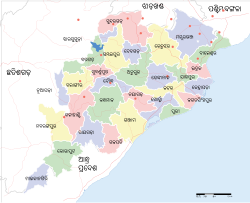
Map of Odisha

Odisha Day, also Utkal Dibasa, is celebrated on 1 April in the Indian state of Odisha in memory of the formation of the state as a separate state out of Bihar and Orissa Province with addition of undivided Koraput District and Ganjam District from the Madras Presidency on 1 April 1936.[1][2] After losing its political identity completely in 1568 following the defeat and demise of the last king Mukunda Dev, efforts resulted in the formation of a politically separate state under British rule on a linguistic basis on 1 April 1936.[3]

State history

[edit]

The main revolution in this separate state continued for three decades from the very day of formation of Utkal Sammilani that led to the foundation of a separate Odisha Province. The movement turned more intense under the leadership of Utkala Gouraba Madhusudan Das, Utkala mani Gopabandhu Das, Maharaja SriRam Chandra Bhanj Deo, Braja Sundar Das, Maharaja Krushna Chandra Gajapati, Pandit Nilkantha Das, Fakir Mohan Senapati, Dewan Athar Mohammad, Gangadhar Meher, Basudeba Sudhaladeba, Radhanath Ray, Sayeed Mohammed, Bhubanananda Das, A. P. Patro and many others with the support of the public. The newly formed Odisha consisted of six districts namely Cuttack, Puri, Baleswar, Sambalpur, Koraput and Ganjam with its capital at Cuttack. John Austin Hubback took the oath of office and became the first Governor of Odisha Province.[3][4][5]

As of 1 April 2019, Odisha has 30 districts.[6][7][8]

Celebration

[edit]

Odisha Dibasa or Utkala Dibasa is celebrated every year on 1 April all over Odisha. Thousands of stores and Jhankis make this festival more beautiful. There are competitions arranged by popular local politicians like fireworks competition. One can enjoy these fireworks displays, which make the sky all the more stunning. On that day all across the country, the family of Odia arranges various cultural programs like a sing-song program. Utkala Dibasa is the day of remembrance for all Odia people who helped everybody to be united.

See also

[edit]

References

[edit]
Revisions and contributorsEdit on WikipediaRead on Wikipedia
from Grokipedia
Odisha Day, also known as Utkal Divas or Utkala Dibasa, is an annual observed on 1 April in the Indian state of to commemorate its establishment as a separate province under British rule. The observance marks the bifurcation of the on that date in 1936, creating Orissa Province—later renamed in 2011—as the first administrative unit in British delineated primarily on linguistic lines to consolidate Odia-speaking territories. This formation followed sustained regional advocacy for administrative amid colonial , with Sir John Austen Hubback appointed as the inaugural governor. Celebrations typically include flag-hoisting ceremonies at government offices and educational institutions, cultural performances highlighting Odia traditions such as classical dance forms like and folk arts, and public events fostering state pride in historical resilience, linguistic identity, and contributions to India's independence movement. The day underscores Odisha's distinct heritage, encompassing ancient sites like the and a coastline along the , while serving as a platform for reflecting on post-independence developments in , economy, and mineral-rich resources that position the state as a key player in eastern India's growth.

Historical Background

Linguistic and Regional Demands Prior to 1936

Odia-speaking populations were dispersed across the and Orissa Division (initially under until 1912), parts of the , and the , resulting in administrative subordination to non-Odia linguistic majorities and consequent neglect of in education, courts, and governance. This fragmentation fostered cultural dilution, as Odia speakers faced imposition of Bengali, , or Telugu in official spheres, eroding local identity and exacerbating economic exploitation through distant bureaucratic control. Demands for a unified Odia administrative territory crystallized in the late , driven by linguistic affinity as the primary basis for reorganization rather than ethnic or religious lines. In , a linguistic revolt erupted in —transferred to the in 1905—against the imposition of over Odia in schools and administration, galvanizing petitions to British officials for linguistic autonomy. These early agitations highlighted inefficiencies, such as delayed famine relief and inadequate infrastructure, underscoring the need for localized governance attuned to Odia needs. The , formed on December 30, 1903, in , formalized these regional demands by resolving to consolidate all Odia-speaking tracts into a single under British . The organization's inaugural session, attended by Odia leaders and attended by over 62 members, submitted memorials to the colonial government advocating separation from , , and Madras on grounds of linguistic unity and administrative efficacy. Such petitions emphasized empirical grievances, including the marginalization of Odia in revenue collection and judicial proceedings, positioning language as a causal of effective self-rule.

Key Movements and Figures in the Statehood Struggle

The , founded in 1903 by , emerged as the central body coordinating the demand for a unified Odia province by amalgamating scattered Odia-speaking areas under British , Madras, and administrations. Its first conference, convened in on December 30, 1903, with 62 permanent members, explicitly resolved to pursue separation to safeguard Odia linguistic and cultural interests against dominance by Bengali and Telugu influences. Prominent leaders drove this advocacy: , dubbed Utkal Gaurav, advocated industrialization, legal reforms, and petitions to British authorities, including early representations for Odia autonomy dating to the 1880s; reinforced ethnic identity through pioneering Odia novels that critiqued social stagnation and promoted linguistic pride; , known as Utkalmani, integrated Gandhian non-violence with statehood campaigns, founding institutions like the Satyabadi Vana Vidyalaya to foster educated Odia leadership. During the 1920s, the struggle intensified through localized adaptations of the Non-Cooperation Movement, featuring mass meetings, boycotts of non-Odia officials, and delegations to the 1928 emphasizing administrative unification based on linguistic lines. These sustained pressures, documented in over a of annual Sammilani conferences and public memoranda, contributed causally to British policy shifts, as evidenced by the Government of India Act 1935's provisions for Odisha's demarcation as a distinct effective April 1, 1936. While the campaign prioritized petitions and conferences over widespread violence, participants endured personal hardships, including professional ostracism and repeated travel for advocacy amid colonial restrictions, underscoring the incremental agitation that compelled legislative concessions without recorded mass fatalities specific to statehood demands.

Formal Separation and Province Formation on April 1, 1936

The Government of India Act 1935 provided the constitutional framework for provincial reorganization in British India, including the bifurcation of the existing Bihar and Orissa Province into separate entities of Bihar and Orissa. Clause 289 of the Act specifically enabled the creation of a distinct Orissa Province, reflecting recommendations from prior inquiries into linguistic and administrative viability. This legislative measure formalized the separation effective from April 1, 1936, through His Majesty's Order-in-Council dated March 3, 1936, which delineated the new province's administrative structure. On April 1, 1936, was inaugurated as the first linguistic-based province in British India, comprising six districts transferred primarily from the and the : , Puri, Balasore, Sambalpur, , and . These boundaries prioritized areas with a predominant Odia-speaking population, as identified through linguistic surveys, though Ganjam included contested Telugu-speaking tracts that later influenced boundary adjustments. Sir John Austen Hubback assumed office as the first governor on that date, overseeing the initial provincial administration with established as the capital due to its established infrastructure and central location. The formation emphasized administrative efficiency for Odia-majority regions, drawing on 1931 census data highlighting concentrated Odia linguistic demographics across the included districts, which justified the separation from Hindi-dominant and multilingual Madras areas. This setup included provisional governance under the Act's dyarchy provisions at the provincial level, pending full implementation of elected ministries.

Significance

Pioneering Linguistic Reorganization in British India

The formation of on 1 April 1936 represented the inaugural explicit reorganization of a British Indian province along linguistic lines, detaching Odia-speaking districts from the multilingual , which had encompassed territories previously administered under , , and Madras Presidencies. This division contrasted sharply with earlier provincial configurations, such as the 1912 bifurcation of into and Orissa alongside , where boundaries followed administrative expediency rather than linguistic affinity, leaving Odia speakers as a numerical minority amid , , and Bengali dominances. Empirical data from pre-1936 assemblies underscored the resultant underrepresentation: Odia delegates held limited sway in policy formulation, with administrative records and often conducted in non-Odia scripts, exacerbating cultural erosion and governance inefficiencies. By prioritizing linguistic cohesion, the (Constitution of Orissa) Order 1936 enabled verifiable advancements in , including the adoption of Odia as the operative medium for provincial administration and , which curbed assimilation risks from adjacent linguistic majorities and facilitated localized decision-making. Population figures from the 1931 census highlighted the stakes: approximately 8.7 million Odia speakers were consolidated into a compact unit of six districts (, , , , , and ), reducing inter-lingual frictions that had previously fueled petitions and unrest in mixed legislatures. Causally, this reorganization demonstrated the stabilizing effects of aligning administrative units with predominant language groups, preempting escalatory demands for by empirically validating linguistic two decades before the 1956 States Reorganisation Act, which drew upon Orissa's outcomes to redraw boundaries for 14 states and 6 union territories on similar principles. The precedent underscored how such demarcations mitigated representational deficits—evident in Orissa's post-1936 legislative functionality—and promoted administrative coherence, informing later commissions that linguistic homogeneity enhanced policy efficacy and reduced centrifugal pressures in a multi-ethnic .

Contributions to Odia Cultural and National Identity

The establishment of as a linguistically delineated province on April 1, 1936, enabled the consolidation of Odia-speaking regions previously fragmented across , , and , thereby fostering administrative and educational policies centered on the as a core element of cultural continuity. This separation countered prior dilutions of Odia identity under non-Odia dominant administrations, where Bengali influences in schools and in courts had threatened linguistic erosion; the province's formation prioritized Odia in usage, serving as a structural barrier against assimilation into broader - or Bengali-centric frameworks. In the realm of and scripts, the post-1936 era witnessed a resurgence aligned with regional , building on pre-existing movements but amplified by state-level that promoted Odia as the medium for publications and . Vernacular presses, which had mobilized for identity assertion during colonial rule, expanded their output in Odia, with periodicals and books reinforcing narratives of historical continuity from medieval texts like Sarala Das's adaptations. This revival emphasized the language's distinct script—evolved since the 10th century—as a of resistance to centralized linguistic homogenization, evidenced by sustained agitations that preserved Odia against reformist pressures from neighboring linguistic blocs. Educational enrollment in Odia-medium institutions grew amid this cultural reinforcement, with middle schools—focusing on Odia instruction—expanding to support primary stages and countering the limited pre-1936 access in dispersed regions; by the late , secondary education in government institutions increasingly incorporated Odia curricula, laying groundwork for higher in the native tongue before independence. Traditional festivals such as and , intertwined with Odia literary and performative traditions, gained renewed institutional backing through provincial resources, embedding regional pride without subsuming it under pan-Indian motifs. Odisha's integration into post-1936 exemplified a balanced regionalism, where Odia cultural markers bolstered participation in national causes without forfeiting distinctiveness; during the of 1942, Odias mounted widespread uprisings, from student-led actions in to tribal mobilizations in , resulting in over 150 martyrdoms and underscoring language-based identity as a motivator for anti-colonial solidarity rather than a divisive force. This dynamic refuted claims of regionalism as antithetical to unity, as Odia pride—anchored in linguistic —channeled into mass resistance against British overreach, mirroring causal patterns where devolved governance preserved subnational vigor amid federal aspirations.

Long-Term Impacts on State Development and Federal Structure

Following India's independence on August 15, 1947, the province of Orissa integrated seamlessly into the Union of India as one of its constituent provinces, retaining its administrative boundaries while undergoing further consolidation through the merger of 26 princely states by December 1947, which expanded its territory and population under the oversight of Sardar Vallabhbhai Patel's integration efforts. This process aligned Orissa with the federal framework of the Constitution of India adopted in 1950, where it functioned as a full state with linguistic homogeneity as a foundational principle. In 2011, Parliament enacted the Orissa (Alteration of Name) Act, renaming the state Odisha effective from November 1, 2011, to better reflect the phonetic pronunciation of the Odia language and cultural identity, without altering its territorial or administrative structure. Odisha's statehood has facilitated measurable advancements in human development indicators, exemplified by rates rising from approximately 5-10% in the 1931 era—marked by rates as low as 1.59% for females in certain divisions—to 72.9% overall by the 2011 , with male at 81.6% and female at 64.0%. Recent estimates place the rate above 75% in the 2020s, driven by expanded infrastructure and state initiatives, though rural-urban gaps persist. Economically, the state has leveraged its mineral resources, contributing 57% of India's production and supporting industrial growth, with gross state domestic product (GSDP) averaging 7.1% annual expansion from 2012-2020, outpacing national averages in certain periods and accounting for 2.4% of India's GDP through and metallurgy sectors. Infrastructure development, including roads, ports like Paradip, and power projects, has bolstered connectivity and export capabilities, enabling Odisha to transition from agrarian dependency to a mineral-driven post-1950s. Despite these gains, uneven development has characterized Odisha's , with persistent tribal disparities evident in lower socio-economic outcomes in indigenous-majority , where seven of eight such areas lag in growth metrics compared to non-tribal regions over three decades. High distress migration affects an estimated 1.75 million people annually as of 2023, primarily from poor, low-education tribal households seeking elsewhere due to limited local opportunities and agricultural vulnerabilities. Mineral exploitation, while revenue-generating, has yielded , , and minimal local gains, often benefiting external corporations over indigenous communities and exacerbating displacement without proportional reinvestment in affected areas. In the broader federal structure, Odisha's 1936 formation as British India's first linguistically delineated province set a for the States Reorganisation Act of , which restructured into 14 states and 6 union territories primarily on linguistic lines, accommodating ethno-linguistic identities while balancing administrative efficiency and national unity. This model reinforced federalism's emphasis on subnational autonomy, yet Odisha's experience highlights ongoing tensions, including bureaucratic hurdles in and center-state fiscal dependencies, where mineral royalties often flow disproportionately to the national level, limiting state-level developmental leverage. Such dynamics underscore causal links between early linguistic statehood and sustained, albeit uneven, integration into India's federal polity, prioritizing empirical regional viability over uniform centralization.

Observance and Celebrations

Core Traditions and Annual Rituals

The core traditions of Odisha Day revolve around solemn commemorations of the province's formation on April 1, 1936, emphasizing historical fidelity through structured public and community observances. Flag hoisting occurs at government buildings, schools, and community centers, typically involving the national tricolor to underscore the integration of regional identity within India's federal framework. These ceremonies are invariably paired with the rendition of Bande Utkala Janani, the Odia state anthem penned by Laxmikanta Mohapatra in 1912, which articulates the linguistic and cultural aspirations that culminated in the 1936 bifurcation from Bihar. The anthem's lyrics, invoking maternal reverence for Utkala (ancient Odisha), serve as a ritual anchor, performed collectively to reinforce collective memory of the administrative separation enacted via the Government of India Act 1935. Homage to protagonists of the statehood movement features prominently through floral offerings and wreath-laying at memorials, such as those honoring Odia leaders involved in pre-1936 advocacy for linguistic provinces; cultural bodies like conduct these tributes annually, focusing on documented figures whose efforts yielded the province encompassing 36,714 square miles and a population of approximately 8.2 million as per 1931 data. Community rituals extend to prayers in households and temples seeking the state's welfare, a practice rooted in the day's origin as a marker of provincial rather than festivity. Parallel educational sessions in local assemblies and institutions deliver fact-based recitals of the 1936 delineation—drawing from British parliamentary records separating Odia tracts from and Telugu regions—prioritizing causal sequences of administrative reform over symbolic excess.

Official and Community Events

Official celebrations of Odisha Day, also known as Utkal Divas, typically feature addresses by the in , emphasizing the state's historical formation and cultural heritage. In 2025, Mohan Charan Majhi delivered a message highlighting ongoing 'Odia Pakhya' festivities extending to Maha Vishuba , with events at Satyabhamapur, the birthplace of Utkal Gourav . Cultural parades and performances are organized statewide, including in the capital, to showcase Odia traditions through dances, music, and processions. Schools and educational institutions across conduct competitions on Odia history, such as essays, debates, and quizzes, to foster awareness among students about the state's linguistic and regional identity. These activities align with broader state efforts to instill pride in the provincial separation. Community events extend to Odia diaspora hubs, particularly , where organizations like the Delhi Odia Students' Association host cultural programs, seminars, and performances on the eve of 1. In 2025, the government announced annual Utkal Divas observances to honor Odisha's heritage, signaling institutionalized recognition beyond the state. Participation has grown, with events drawing Odia expatriates for discussions on state contributions to national identity. Outreach includes events in tribal and border regions, such as Kotia, a disputed area with , where celebrations aim to educate historically isolated Odia-speaking tribals. In 2025, an Odisha Divas program in Kotia attracted thousands of residents, many previously unaware of the observance, through cultural displays and historical awareness drives. Such initiatives target marginalized communities to reinforce Odia linguistic ties.

Evolution and Recent Developments

Following India's independence in 1947, Odisha Day observances initially emphasized integration of princely states and administrative consolidation, evolving into formalized state-wide holidays by the late 20th century to honor the formation amid socio-economic expansions. By the 2020s, celebrations scaled up with enhanced cultural programming, reflecting adaptive commemorations that preserve traditions while incorporating modern outreach. A notable development occurred in 2025, marking the 90th anniversary, when the Odisha government initiated "Odia Pakhya," a 14-day event from (Odisha Day) to (Odia ), featuring heritage showcases, promotion campaigns, and signboard initiatives in Odia across offices and businesses. This extension from a single-day focus to a fortnight-long series underscores efforts to deepen public engagement with Odia identity, including dedicated websites for event coordination. Trends indicate rising digital amplification, with social media platforms like , , and facilitating youth-led content on cultural preservation, boosting virtual participation alongside in-person events. Presentations remain politically neutral in substance, emphasizing collective pride and development commitments despite announcements from ruling BJP and opposition BJD, while linking statehood legacy to aspirations for economic through industrial hubs and local initiatives.

References

Add your contribution
Related Hubs
User Avatar
No comments yet.