


Community hub
Recent from talks
Contribute something
Nothing was collected or created yet.
Vanguard 2
View on Wikipedia
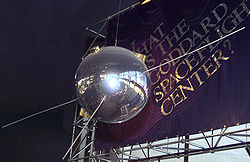
 A model of the Vanguard 2 satellite in front of the Goddard Space Flight Center. | |
| Names | Vanguard Space Launch Vehicle-4 |
|---|---|
| Mission type | Weather satellite Air Density Experiment |
| Operator | Naval Research Laboratory |
| Harvard designation | 1959 Alpha 1 |
| COSPAR ID | 1959-001A |
| SATCAT no. | 00011 |
| Mission duration | Weather observation: 19 days (achieved) 66 years, 8 months and 1 day (in orbit) |
| Spacecraft properties | |
| Spacecraft type | Vanguard 2E |
| Bus | Vanguard |
| Manufacturer | Naval Research Laboratory |
| Launch mass | 10.75 kg (23.7 lb) |
| Dimensions | 508 mm (20.0 in) of diameter |
| Start of mission | |
| Launch date | 17 February 1959, 15:55:02 GMT[1] |
| Rocket | Vanguard SLV-4 |
| Launch site | Cape Canaveral, LC-18A |
| Contractor | Glenn L. Martin Company |
| End of mission | |
| Last contact | 15 March 1959 |
| Decay date | 2259 (estimated) ~ 300 years orbital lifetime[2] |
| Orbital parameters | |
| Reference system | Geocentric orbit[3] |
| Regime | Medium Earth orbit |
| Perigee altitude | 559 km (347 mi) |
| Apogee altitude | 3,320 km (2,060 mi) |
| Inclination | 32.88° |
| Period | 125.80 minutes |
| Instruments | |
| Optical scanner Radio beacon | |

Vanguard 2 (or Vanguard 2E before launch) is an Earth-orbiting satellite launched 17 February 1959 at 15:55:02 GMT, aboard a Vanguard SLV-4 rocket as part of the United States Navy's Project Vanguard.[4] The satellite was designed to measure cloud cover distribution over the daylight portion of its orbit, for a period of 19 days, and to provide information on the density of the atmosphere for the lifetime of its orbit (about 300 years).[5][6] As the first weather satellite and one of the first orbital space missions, the launch of Vanguard 2 was an important milestone in the Space Race between the United States and the Soviet Union.[7][8][5] Vanguard 2 remains in orbit.

Previous satellites
[edit]Before the successful 1959 launch of the satellite that became known as Vanguard 2, multiple attempted launches of satellites named "Vanguard 2" were made in 1958. All of these launches failed to reach orbit. The satellites that failed to reach orbit were:[9]
- Vanguard 2A: launched 29 April 1958, by the Vanguard TV-5 rocket
- Vanguard 2B: launched 28 May 1958, by the Vanguard SLV-1 rocket
- Vanguard 2C: launched 26 June 1958, by the Vanguard SLV-2 rocket
- Vanguard 2D: launched 26 September 1958, by the Vanguard SLV-3 rocket
The satellite whose launch was successful and that became known as the Vanguard 2 was the Vanguard 2E.
Spacecraft
[edit]The spacecraft is a magnesium sphere 508 mm (20.0 in) in diameter. It contains two optical telescopes with two photocells. The sphere was internally gold-plated, and externally covered with an aluminum deposit coated with silicon oxide of sufficient thickness to provide thermal control for the instrumentation.
Radio communication was provided by a 1 watt, 108.03 MHz telemetry transmitter and a 10 mW, 108 MHz beacon transmitter that sent a continuous signal for tracking purposes. A command receiver was used to activate a tape recorder that relayed telescope experiment data to the telemetry transmitter.
The power supply for the instrumentation was provided by mercury batteries.[2][10][11]
Instruments
[edit]Optical scanner
[edit]The optical scanner experiment was designed to obtain cloud cover data between the equator and 35° to 45° N latitude. As the satellite circled Earth, two photocells, located at the focus of two optical telescopes aimed in diametrically opposite directions, measured the intensity of sunlight reflected from clouds (about 80%), from land masses (15 to 20%), and from sea areas (5%). The satellite motion and rotation caused the photocells to scan the Earth in successive "lines" (akin to a whisk broom scanner). Separate solar batteries turned on a recorder only when the Earth beneath the satellite was in sunlight and about 50 minutes of data per orbit were obtained. The measured reflection intensities were stored on tape. Ground stations interrogated the satellite by signaling its command receiver, which caused the entire tape to be played back in 60 seconds. The tape was then erased and rewound. For the planned 19 days of the weather experiment, the equipment functioned normally. The satellite was spin-stabilized at 50 rpm, but the optical instrument's data was poor because of an unsatisfactory orientation of the spin axis.[12]
Satellite drag atmospheric density
[edit]Because of its symmetrical shape, Vanguard 2 was selected by the experimenters for use in determining upper atmospheric densities as a function of altitude, latitude, season, and solar activity.[13] As the spacecraft continuously orbited, it would lead its predicted positions slightly, accumulating greater and greater advance as it spiraled lower and faster due to the drag of the residual atmosphere. By measuring the rate and timing of orbital shifts, the relevant atmosphere's parameters could be back-calculated knowing the body's drag properties. It was determined that atmospheric pressures, and thus drag and orbital decay, were higher than anticipated, as Earth's upper atmosphere gradually tapered into space.[14]
This experiment was planned in great detail prior to launch. Initial Naval Research Laboratory (NRL) proposals for Project Vanguard included conical satellite bodies; this eliminated the need for a separate fairing and ejection mechanisms, and their associated weight and failure modes. Radio tracking would gather data and establish a position. Early in the program, optical tracking (with a Baker-Nunn camera network and human spotters) was added. A panel of scientists proposed changing the design to spheres, at least 508 mm (20.0 in) in diameter and hopefully 760 mm (30 in). A sphere would have a constant optical reflection, and constant coefficient of drag, based on size alone, while a cone would vary with orientation. James Van Allen proposed a cylinder, which eventually flew. The Naval Research Lab finally accepted 160 mm (6.3 in) spheres as a "test vehicle", with 508 mm (20.0 in) for follow-on satellites. The payload weight savings, from reduced size as well as decreased instrumentation in the early satellites, was considered acceptable for the initial launches. Afterwards, the later Vanguard rockets had some test instrumentation removed, lightening them enough for the 508 mm bodies.[15][14]
Post mission
[edit]After the scientific mission ended, both Vanguard 2 and the upper stage of the rocket used to launch the satellite became derelict objects that would continue to orbit Earth for many years. Both objects remain in orbit. As Vanguard 1, Vanguard 2, and Vanguard 3 are still orbiting with their drag properties essentially unchanged, they form a baseline data set on the atmosphere of Earth that is over 60 years old and continuing. Vanguard 2 has an expected orbital lifetime of 300 years.[2]
See also
[edit]
References
[edit]- ^ McDowell, Jonathan. "Launch Log". Jonathan's Space Report. Archived from the original on 13 November 2009. Retrieved 3 February 2021.
- ^ a b c "Vanguard 2 1959-001A". NASA. 14 May 2020. Archived from the original on 9 March 2021. Retrieved 3 February 2021.
 This article incorporates text from this source, which is in the public domain.
- ^ "VANGUARD 2 Satellite details 1959-001A NORAD 11". N2YO. 24 January 2015. Archived from the original on 27 January 2021. Retrieved 3 February 2021.
- ^ "VANGUARD – A HISTORY, CHAPTER 12, SUCCESS – AND AFTER". NASA. Archived from the original on 9 May 2008. Retrieved 12 July 2017. This article incorporates text from this source, which is in the public domain.
- ^ a b "Vanguard Project". U.S. Naval Research Laboratory. 1 February 2010. Archived from the original on 23 December 2015. Retrieved 9 February 2016. This article incorporates text from this source, which is in the public domain.
- ^ NASA, History, Chapter two, SATELLITES Archived 4 November 2004 at the Wayback Machine This article incorporates text from this source, which is in the public domain.
- ^ Brian Dunbar. "Interesting Goddard Facts and Firsts". NASA (Goddard). Archived from the original on 25 December 2015. Retrieved 9 February 2016. This article incorporates text from this source, which is in the public domain.
- ^ Janice Hill (1991). Weather From Above: America's Meteorological Satellites. Smithsonian Institution. pp. 4–7. ISBN 0-87474-394-X.
- ^ McLaughlin Green, Constance; Lomask, Milton (1970). Vanguard: A History (PDF). The NASA Historical Series. NASA. pp. 282–287. Archived (PDF) from the original on 7 October 2021. Retrieved 15 February 2022.
- ^ Vanguard 2, astronautix.com Archived 2016-02-10 at the Wayback Machine
- ^ Project Vanguard: The NASA History, By Constance McLaughlin Green, Milton Lomask
- ^ "Experiment 1: Optical scanner 1959-001A". NASA. 14 May 2020. Archived from the original on 9 March 2021. Retrieved 3 February 2021. This article incorporates text from this source, which is in the public domain.
- ^ "Satellite Drag Atmospheric Density". NASA (Goddard). 14 May 2020. Archived from the original on 7 February 2021. Retrieved 3 February 2021. This article incorporates text from this source, which is in the public domain.
- ^ a b "Atmospheric Density Values from Satellite Drag Measurements". NASA. 14 May 2020. Archived from the original on 8 March 2021. Retrieved 3 February 2021. This article incorporates text from this source, which is in the public domain.
- ^ C. McLaughlin Green, M. Lomask, "Vanguard, A History Archived 20 December 2017 at the Wayback Machine", Chapter 5, Battle over Vehicle Specifications NASA SP-4202 This article incorporates text from this source, which is in the public domain.

External links
[edit]Vanguard 2
View on GrokipediaVanguard 2 is an American Earth-orbiting satellite launched on February 17, 1959, aboard a Vanguard SLV-4 rocket as part of NASA's early space efforts during the International Geophysical Year.[1][2] Developed by the U.S. Naval Research Laboratory, the approximately 10-kilogram spherical satellite was designed as the world's first meteorological satellite to measure global cloud cover by scanning reflected light from Earth's daylight hemisphere using two photocells and infrared telescopes.[1] Although successfully injected into an elliptical low Earth orbit with a perigee of 559 kilometers and apogee of 3,320 kilometers, the mission's primary objective failed due to precession and improper attitude stabilization caused by the launch vehicle's third-stage burn, which prevented usable cloud cover data from being obtained.[1][3] Despite this, Vanguard 2 marked NASA's first successful orbital insertion under its new administration, provided data on satellite drag and upper atmosphere density via radio beacons, and remains in orbit today as one of the oldest human-made objects in space.[2][1]
Background and Development
Project Vanguard Context
Project Vanguard originated in 1955 as a U.S. Naval Research Laboratory (NRL) initiative under Navy oversight to develop a dedicated satellite launch vehicle for the International Geophysical Year (IGY), an 18-month global scientific collaboration from July 1957 to December 1958 focused on geophysical phenomena.[2][4] The NRL proposal, building on existing high-altitude sounding rockets like Viking and Aerobee, emphasized a non-missile-derived system to align with IGY's civilian scientific ethos.[5] On September 9, 1955, the Department of Defense selected Vanguard over competing proposals, including the U.S. Army's Jupiter-C (a modified Redstone ballistic missile under Wernher von Braun), primarily to project a non-militaristic image that avoided linking satellite efforts to intercontinental ballistic missile (ICBM) development amid Cold War sensitivities.[6][5] This choice prioritized international optics and scientific purity, delegating management to the National Academy of Sciences' Rocket and Satellite Research Panel, with NRL handling spacecraft and vehicle integration, though it introduced technical risks from unproven upper stages.[4] The Soviet Union's Sputnik 1 launch on October 4, 1957—the first artificial satellite—exposed U.S. delays, sparking national alarm over technological inferiority and amplifying Cold War competition for space leadership.[7][8] Vanguard's objectives centered on orbiting satellites with instruments for upper atmospheric research, geomagnetic mapping, and solar radiation studies to advance geophysical understanding, distinct from military-derived alternatives like Explorer that repurposed existing missiles for expedited response.[5][4] This framework underscored Vanguard's role in establishing foundational Earth orbital science amid accelerating superpower rivalry.[7]Prior Launch Attempts
The Vanguard 2 satellite, designed to measure cloud cover and atmospheric density, faced multiple failed launch attempts following the success of the smaller Vanguard 1 mission in March 1958. These efforts, designated as Vanguard 2A through 2D, utilized the liquid-fueled Vanguard rocket, which suffered from persistent reliability issues compared to solid-propellant alternatives like the Army's Jupiter-C used for Explorer 1.[2][9] The first attempt, Vanguard 2A on TV-5, lifted off on April 28, 1958 (02:53 GMT), but failed to achieve orbit when the third stage did not separate and ignite due to a propulsion malfunction, resulting in a suborbital trajectory.[10] This 10 kg satellite prototype was recovered from the Atlantic Ocean, providing data on upper-stage performance shortcomings. The subsequent Vanguard 2B launch on SLV-1 occurred on May 27, 1958, but encountered a third-stage ignition failure stemming from inadequate separation sequencing, again preventing orbital insertion.[11] Vanguard 2C, attempted on SLV-2 on June 26, 1958, reached space but suffered a control system malfunction that failed to arm the coasting flight sequence, blocking third-stage separation and firing.[12] The final pre-success try, Vanguard 2D on SLV-3 on September 26, 1958, saw the second stage underperform due to incomplete propellant expulsion, leading to insufficient velocity for orbit despite a nominally functioning upper stage.[13] These failures highlighted systemic challenges in the Vanguard's liquid-propellant engines and guidance systems, contrasting with the higher success rate of solid-fuel rockets in early U.S. efforts.[14] Earlier program setbacks, including the spectacular pad explosion of TV-3 on December 6, 1957—which destroyed the first Vanguard satellite attempt—and the TV-3 backup failure on February 5, 1958, underscored the rocket's developmental immaturity amid International Geophysical Year pressures.[14] Post-failure analyses drove refinements in propulsion reliability, stage separation mechanisms, and inertial guidance, culminating in the successful SLV-5 configuration by addressing third-stage arming and second-stage efficiency deficits.[12][2]Launch Details
Mission Timeline
Vanguard 2 was launched on February 17, 1959, at 15:55 GMT (10:55 AM EST) from Launch Complex 18A at Cape Canaveral, Florida, aboard the SLV-4 three-stage rocket, marking the first successful orbital insertion achieved by the Vanguard program following three prior failures.[5][9] The countdown proceeded nominally, with satellite power-up at T-255 minutes, liquid oxygen loading at T-95 minutes, and final umbilicals dropped at T-30 seconds, culminating in liftoff approximately six seconds after the fire switch closure at T+0.[5] The first stage burned out at T+144 seconds, followed by second-stage ignition and burnout at T+315 seconds; the third stage then ignited, achieving burnout between T+600 and T+720 seconds while reaching a velocity of approximately 25,000 feet per second.[5] Satellite separation from the third stage occurred at T+335 seconds, with third-stage separation from the second stage around T+600 seconds.[5] Immediate post-launch telemetry from Minitrack stations confirmed orbital insertion into an initial ellipse of approximately 557 km by 3,319 km at 32.9° inclination, with preliminary calculations available during third-stage burnout and definitive parameters (perigee 557 km, apogee 3,320 km, period 125.9 minutes) computed seven to nine hours later using IBM 704 processing.[5][9] Telemetry indicated the satellite had achieved spin for attitude control, though partial stabilization failure occurred due to tumbling induced by third-stage propellant remnants igniting post-separation, with early signals showing initiation of cloud cover scanning despite the instability.[5][9]Launch Vehicle and Site
The Vanguard SLV-4 was a three-stage liquid-propellant launch vehicle, with the first stage employing kerosene (RP-1) and liquid oxygen for propulsion, generating approximately 134 kN of vacuum thrust from its Aerojet X-405 engine.[15] The second and third stages utilized hydrogen peroxide as oxidizer and unsymmetrical dimethylhydrazine (UDMH) as fuel in their respective Allied Chemical engines, enabling precise velocity increments for orbital insertion of small payloads like the 32.5 kg Vanguard 2 satellite.[16] Overall, the vehicle measured about 22 meters in height and was engineered for efficiency in payload delivery to low Earth orbit, reflecting Project Vanguard's emphasis on scientific instrumentation over the higher thrust margins prioritized in military-derived boosters.[13] Launched from Launch Complex 18A at Cape Canaveral, Florida—adjacent to Patrick Air Force Base—the site was selected for its eastward over-ocean trajectory, facilitating downrange telemetry and tracking via naval stations in the Atlantic, including ship-based receivers.[9] This infrastructure supported the U.S. Navy's oversight of the program through the Naval Research Laboratory, contrasting with the U.S. Army's parallel efforts using modified Redstone missiles with solid-propellant upper stages, which allowed for faster integration and testing cycles at similar facilities.[17] Post-failure analyses from prior SLV attempts, such as the SLV-1 pad explosion due to liquid oxygen tank depressurization and SLV-3's second-stage guidance malfunction, prompted modifications for SLV-4, including recalibrated bearing assemblies and enhanced gyroscopic guidance systems to maintain attitude control under varying tank pressures and dynamic loads.[15] These upgrades addressed vulnerabilities in the liquid-fueled architecture, which, while offering throttling potential, introduced risks of combustion instability absent in the Army's hybrid liquid-solid Jupiter-C configuration that succeeded with Explorer 1.[18]Spacecraft Design
Physical Specifications
Vanguard 2 consisted of a spherical magnesium shell with a diameter of 50.8 centimeters and a launch mass of 10.8 kilograms. [9] [19] The shell featured internal gold plating to regulate temperature and external coatings for environmental protection. [9] Four rod antennas extended from the sphere to support Minitrack radio tracking and data transmission to ground stations. [20]
The power subsystem combined silicon solar cells, inheriting the pioneering approach from Vanguard 1, with mercury batteries to provide electricity during the initial mission phase and extended operations. [5] [21] This minimalist design emphasized structural simplicity and payload accommodation within the technological and budgetary constraints of the late 1950s Vanguard program, forgoing extensive redundancy in favor of core functionality. [5]