Hubbry Logo
Television studioTelevision studioMain
Open search
Television studio
Community hub
Television studio
logo
8 pages, 0 posts
0 subscribers
Be the first to start a discussion here.
Television studio
Television studio
from Wikipedia
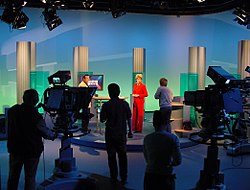
A television studio during a production of Kripo Live in Studio 1 of the Mitteldeutscher Rundfunk (MDR)

A television studio, also called a television production studio, is an installation room in which video productions take place, either for the production of live television and its recording onto video tape or other media such as SSDs, or for the acquisition of raw footage for post-production. The design of a studio is similar to, and derived from, movie studios, with a few amendments for the special requirements of television production. A professional television studio generally has several rooms, which are kept separate for noise and practicality reasons. These rooms are connected via 'talkback' or an intercom, and personnel will be divided among these workplaces.

Studio floor

[edit]

The studio floor is the actual stage on which the actions that will be recorded and viewed take place. A typical studio floor has the following characteristics and installations:

While a production is in progress, people composing a television crew work on the studio floor.

Production control room

[edit]
A gallery control room in Celebro Studios London

The production control room is the place in a television studio in which the composition of the outgoing program takes place. The production control room is occasionally also called a studio control room (SCR) or a gallery – the latter name comes from the original placement of the director on an ornately carved bridge spanning the BBC's first studio at Alexandra Palace, which was once referred to as like a minstrels' gallery.[1]

The vast majority of devices in a PCR are interfaces for rack-mounted equipment that is located in the Central Apparatus Room (CAR).

Central apparatus room

[edit]

The central apparatus room (CAR) houses equipment that is too noisy or runs too hot to be located in the production control room (PCR). It also makes sure that coax cable, SDI cable, fibre-optic cable or other wire lengths and installation requirements keep within manageable lengths, since most high-quality wiring runs only between devices in this room. This can include the actual circuitry and connections between:

Master control room

[edit]

Master control is the technical hub of a broadcast operation common among most over-the-air television stations and television networks. Master control is distinct from a PCR in television studios where the activities such as switching from camera to camera are coordinated. A transmission control room (TCR) is usually smaller in size and is a scaled-down version of centralcasting.

The master control room in a US television station is the place where the on-air signal is controlled. It may include controls to playout pre-recorded television programs and television commercials, switch local or television network feeds, record satellite feeds and monitor the transmitter(s), or these items may be in an adjacent equipment rack room. If the program is broadcast live, the signal goes from the PCR to MCR and then out to the transmitter.

Other facilities

[edit]
A make-up room at the Theatre Royal in Wexford, Ireland (October 2002).

A television studio usually has other rooms with no technical requirements beyond video monitors and studio monitors for audio. Among them are:[2]

See also

[edit]

References

[edit]
[edit]
Revisions and contributorsEdit on WikipediaRead on Wikipedia
from Grokipedia
A television studio is a specialized facility dedicated to the production, recording, and broadcasting of television programs, typically comprising a soundproofed studio floor for sets, cameras, and performers, and an adjacent production control room for directing and technical coordination. The core components of a television studio include the studio floor, an expansive open area equipped with multiple studio cameras mounted on pedestals for pan, tilt, dolly, truck, and pedestal movements, along with lighting grids featuring traditional and LED instruments to illuminate sets such as newscast tables or elaborate scenery. Adjacent to this is the production control room (also known as the gallery), which houses essential equipment like video switchers for selecting camera feeds and applying transitions such as cuts, dissolves, and wipes; audio consoles for mixing microphone and playback inputs; character generators for on-screen graphics and text; teleprompters for script delivery; lighting consoles; and digital recorders or players for media handling. Additional support areas often encompass audio booths, dressing rooms, and scenery workshops to facilitate seamless operations. Television studios trace their origins to experimental setups in the early , with Scottish inventor establishing the world's first dedicated television studio in in 1929, marking the shift from rudimentary broadcasts to structured production environments. By the mid-, advancements in technology led to more sophisticated facilities; for instance, the BBC's Television Centre, opened in 1960, became a landmark as one of the world's first purpose-built production hubs, featuring eight studios ranging from 110 m² to 995 m², integrated technical galleries, and a circular "doughnut" layout to optimize workflow. These studios have evolved to support diverse formats, from live news and variety shows to scripted dramas, with modern iterations incorporating digital video effects units for real-time manipulations like zooms and systems for efficiency. Today, while many traditional studios persist in broadcasting centers, the rise of remote and virtual production has supplemented but not supplanted their role in high-quality content creation.

Overview and History

Definition and Purpose

A television studio is a specialized facility designed as a controlled environment for the production of video content, equipped with professional-grade tools for capturing, processing, and transmitting audio and visual signals to achieve broadcast-quality output. Unlike home or mobile production setups, which often rely on consumer-grade equipment and lack integrated infrastructure, a television studio provides a dedicated space optimized for multi-camera operations and crew coordination to ensure consistency and professionalism in content creation. The primary purposes of a television studio include facilitating live of events such as programs and coverage, producing pre-recorded shows like talk shows and scripted series, and supporting production through real-time scripting and delivery. Additionally, these studios often integrate elements, allowing for immediate and enhancement of footage before distribution across traditional broadcast or digital platforms. This versatility enables broadcasters to create content tailored for diverse audiences, from national networks to local affiliates. Key functions of a television studio revolve around maintaining optimal conditions for high-quality production, including controlled to eliminate external variables and ensure visual clarity, to isolate audio from ambient noise, and expansive areas for constructing sets, positioning cameras, and accommodating crews. These elements collectively enable the seamless execution of complex shoots, minimizing disruptions and maximizing creative control to deliver polished content suitable for airing. The purpose of television studios has evolved from adaptations of early radio facilities, which emphasized audio-only performances in live settings, to modern hubs that support visual and multi-platform distribution, incorporating digital streaming and on-demand content creation alongside traditional .

Historical Evolution

The origins of television studios trace back to the 1920s and 1930s, when experimental setups emerged primarily in laboratories and facilities. Key early pioneers included Scottish inventor , who demonstrated transmissions in 1926 and opened the first dedicated television studio in London in 1929. American inventor developed the tube in 1927, enabling the first fully electronic television transmission and shifting away from mechanical scanning systems toward practical studio-based production. These early experiments often repurposed radio station spaces for live demonstrations, as seen in Farnsworth's laboratory where he demonstrated image capture and display in 1928. By the mid-1930s, the advanced the field by converting part of in London into dedicated television studios, launching the world's first regular high-definition public service on November 2, 1936, alternating between John Logie Baird's 240-line mechanical system and the EMI-Marconi 405-line electronic system. This facility included two main studios adapted from existing exhibition halls, with integrated control rooms and apparatus areas, establishing a model for combining transmission towers and production spaces. Post-World War II, the marked a period of rapid studio expansion driven by surging television adoption and the introduction of color broadcasting. In the United States, over 50 million television sets were in use by the end of the decade, necessitating larger, purpose-built studios to handle increased programming demands and the transition to color, with the standard finalized in 1953 for compatible color signals. RCA and led efforts to standardize studio equipment for color production, including calibrated lighting and cameras, which required redesigning facilities for multi-camera live shows like variety programs. In Europe, similar growth occurred, with the reopening post-war studios at Lime Grove and expanding to support black-and-white and emerging color formats by the late 1950s, reflecting a focus on public service broadcasting that influenced compact, multifunctional designs. This era standardized studio layouts across regions, incorporating soundproofed floors, walls, and centralized control galleries to streamline live and taped productions. Key technological milestones further shaped studio evolution. The 1960s adoption of two-inch , commercialized by in 1956 and widely implemented by broadcasters like by 1957, allowed studios to record, edit, and replay footage instantly, reducing reliance on film and kinescopes for archiving live shows. In the 1980s, (ENG) technologies, including portable camcorders and , transformed news production by enabling on-location shooting that bypassed traditional studio setups, though core studios adapted with integrated editing suites. The digital transition digitized workflows, with studios shifting to systems and high-definition formats around 2005, enhancing flexibility and reducing physical tape handling. Influential events like the U.S. Cable Communications Policy Act of 1984 deregulated cable rates and franchise rules, spurring the creation of hundreds of new channels and proliferating independent production studios to meet demand for original content. Regionally, U.S. studios emphasized multi-camera formats for sitcoms, rooted in live theater influences and efficient audience taping, while European productions favored single-camera approaches for dramas, prioritizing location filming and cinematic depth over studio-bound multi-angle coverage.

Physical Components

Studio Floor

The studio floor serves as the area in a television studio, designed as an open, adaptable space to accommodate filming, recording, and live performances. It typically features a seamless wall, often curved to meet the floor, creating an infinite background that eliminates visible edges and facilitates effects for virtual environments. This layout includes raised platforms constructed from materials like medium-density fiberboard (MDF) over leveled wood strips to support dynamic sets, while an overhead grid system—usually spaced 10 to 12 feet apart with a load capacity of 25 pounds per —allows for the suspension of fixtures and . These elements ensure flexibility for camera movements and scene changes, with the floor itself maintained level to within 0.25 inches over 50 feet to prevent equipment instability. Acoustic treatments are integral to the studio floor to maintain high-quality audio capture by minimizing unwanted noise. Soundproofing materials, such as high-STC-rated doors and windows, isolate the space from external sounds like or HVAC vibrations, while floating floors with isolation pads decouple the structure from mechanical noise transmission. To reduce and flutter, fabric-wrapped panels on walls and ceilings achieve high noise reduction coefficients (NRC), supplemented by ceiling-mounted acoustic clouds and effective down to 40 Hz for low-frequency control. walls and absorbent materials like further deaden the space, preventing reflections that could interfere with or music recording. Safety features on the studio floor prioritize occupant protection and operational continuity in line with broadcast and fire codes. , including automatic sprinklers compliant with NFPA 140 standards for motion picture and television production facilities, provide rapid response to potential hazards like electrical faults or set materials. Non-slip vinyl , such as specialized TV studio tiles, ensures safe movement for crew and talent amid cables and props, while exits—requiring at least two per OSHA guidelines, with widths of at least 28 inches and fire-resistant separations—facilitate quick egress, often integrated via sound locks or oversized "elephant doors" measuring 10 by 6 feet minimum. Studio floor sizes vary significantly based on production type, balancing space needs for equipment, sets, and audiences. Smaller setups for talk shows or segments typically range from 1,500 to 4,000 square feet, allowing compact layouts with minimal scenery, whereas larger variety programs require 15,000 to 20,000 square feet or more to incorporate elaborate staging and live crowds, as seen in historic venues like Television City's 15,500-square-foot stages. Heights from floor to grid also scale accordingly, from 15 feet in small studios to 35 feet in expansive ones, influencing and options. Set construction on the studio floor emphasizes and versatility to support diverse productions. Modular scenery systems, including configurable panels and free-standing elements, enable quick assembly and reconfiguration for multiple scenes within a single shoot. Green screens integrated into walls or dedicated areas facilitate compositing, allowing digital backgrounds to replace solid colors in post-production for effects-heavy content. For audience-inclusive formats like variety shows, seating is often integrated via retractable risers or accommodating up to 175 viewers in mid-sized floors, ensuring clear sightlines while preserving production flow. The studio floor's design integrates with monitoring to allow real-time adjustments during shoots.

Support Spaces

Support spaces in television studios encompass auxiliary areas designed to handle production logistics, talent preparation, and crew requirements, ensuring seamless operations without disrupting the primary filming environment. These spaces are typically located adjacent to the studio floor, connected via designated entry points such as wide doorways that accommodate equipment movement. Green rooms provide a comfortable waiting area for performers and guests, equipped with seating, mirrors, and refreshments to allow relaxation before appearances; for instance, facilities like CBC Studios feature multiple green rooms, including lounges with kitchenettes and televisions for extended stays. Makeup and wardrobe rooms facilitate talent preparation, with dedicated bays for hair styling, cosmetic application, and costume changes; CBC's setup includes four hair and makeup rooms, each supporting up to six individuals, alongside 12 rooms for storage and alterations. Storage areas for props, sets, and equipment are essential for organizing production materials, often including secure cages to protect valuable items, as seen in broadcast facilities where space allocation matches production scale, such as larger allocations for ongoing series. Utility areas support daily crew needs and logistics, promoting efficiency during high-intensity shoots. Restrooms are provisioned in greater numbers than standard office spaces to manage peak usage from large crews and talent, with private facilities often integrated into dressing rooms for convenience. Break rooms and craft services areas offer spaces for meals and rest, equipped with refrigerators, microwaves, sinks, and counters; CBC Toronto Studios, for example, provides five craft rooms, two with stoves, to accommodate catering demands. Loading docks enable the transport of heavy equipment and sets, featuring oversized "elephant doors" at least 10 feet wide by 6 feet high—ideally 12 by 8 feet—to facilitate truck access and minimize setup disruptions, a standard in facilities like those operated by Broadcast Management Group. Accessibility features in support spaces ensure compliance with the Americans with Disabilities Act (ADA), promoting inclusivity for all personnel. Doorways must provide at least 32 inches of clear width when open to 90 degrees, allowing passage and accommodating camera dollies. Ramps are installed where elevation changes occur, with a maximum of 1:12 and landings at least 60 inches by 60 inches for safe navigation, as required under ADA Standards for Accessible Design. These elements extend to restrooms with grab bars and adequate turning space, and pathways free of obstructions to support diverse crew members. Environmental controls in support spaces prioritize both equipment longevity and human comfort through specialized HVAC systems. These systems maintain precise temperature (typically 68-72°F) and humidity levels (40-60%) to prevent damage to humidity-sensitive gear like cameras and props, while ensuring low and even airflow to avoid disruptions. In broadcast facilities, 24-hour cooling with high-efficiency units addresses constant heat loads from and , as implemented in TV studios with capacities exceeding 750 kW for zoned control. Security measures safeguard high-value sets, equipment, and in these areas. Access controls, including keycard or badge systems, restrict entry to authorized personnel only, often integrated with ID verification at loading docks and room doors. cameras monitor perimeters and internal zones, deterring unauthorized access and providing footage for incident review, while on-site personnel enforce protocols in facilities like film studios where NDAs and perimeter fencing complement electronic systems.

Technical Infrastructure

Production Control Room

The (PCR), also known as the studio control room, serves as the nerve center for directing live or taped television productions, where creative and technical decisions are made in real-time to shape the outgoing program. Core functions include switching between multiple camera feeds using a video switcher, cueing talent through teleprompters or verbal instructions, and coordinating with the floor crew via an system to ensure synchronized execution of the production. These operations allow the team to integrate live action, pre-recorded segments, graphics, and audio seamlessly for broadcast. The layout of the PCR typically centers on a console with arrays of video monitors displaying preview and program feeds, an audio mixing console for balancing sound sources, and a director's desk equipped with intercom headsets, script stands, and master clocks for timing. A multi-viewer monitor consolidates multiple sources—such as camera shots and —into a single display for efficient monitoring and selection. The room is often designed with a large, soundproof window providing an overlook to the studio floor, enabling the director to visually monitor performers and set actions without entering the space. Video and audio signals processed in the PCR are routed to the Central Apparatus Room for amplification and distribution. Staffing during a production revolves around the director, who oversees creative choices and issues shot calls via ; the , who operates the video switcher to execute cuts, transitions, and effects like dissolves or ; and the producer, who manages the show's overall vision, schedule, and quality while collaborating from the control area. Supporting roles include audio operators handling and playback mixing, graphics technicians cueing titles and overlays, and script supervisors tracking timing to prevent overruns. This team structure facilitates rapid communication and adjustments, with the director's commands driving the technical execution. Workflow in the PCR emphasizes script timing via synchronized clocks to align segments with broadcast slots, insertion of graphics such as lower thirds or animations through character generators at precise cues, and real-time emergency overrides for live events, where the director can instantly switch to alternate feeds or safe shots to address technical glitches or on-set incidents. During live shows, the process involves continuous collaboration: the director selects shots, the technical director applies transitions, and audio and graphics operators synchronize elements, all while monitoring for seamless output. This dynamic flow ensures adaptability, with pre-rehearsed cues minimizing disruptions. The PCR has evolved from 1940s film chain rooms, where projectors were aligned to television cameras to broadcast pre-recorded 16mm films as part of live programming, to contemporary digital setups incorporating multi-viewer systems that display dozens of feeds on flat-panel screens for enhanced oversight. coordination, initially based on adapted switchboards for basic crew communication in large studios, progressed to digital four-wire and IP-based wireless systems by the and beyond, supporting complex, multi-camera productions with greater reliability.

Central Apparatus Room

The Central Apparatus Room (CAR) serves as the primary backend hub in a television studio, housing and managing the core technical infrastructure for , , and storage to ensure reliable broadcast operations. It acts as a centralized for mission-critical equipment that handles the , manipulation, and distribution of audio and video signals, supporting both live production and workflows without direct involvement in creative decision-making. This setup allows for efficient technical oversight, including monitoring and troubleshooting to maintain throughout the facility. Key equipment in the CAR includes rack-mounted servers for video and audio storage and playback, routers for directing signal traffic across network segments, and patch panels for facilitating connections and reconfiguration of wiring. Additional components encompass encoders and decoders for converting signals between formats such as SD to HD or 4K using standards like MPEG compression, as well as synchronizers including frame synchronizers and reference clocks to align timing. Multiviewers, embedders, de-embedders, and distributors further enable signal monitoring, conversion, and amplification, often integrated into frames. As of 2025, many facilities have transitioned to IP-based systems adhering to modern SMPTE standards such as ST 2110 for and audio over networks, supplementing or replacing legacy SDI protocols. Connectivity in the CAR relies on fiber optic cabling as the primary medium for high-speed, low-latency transmission between the studio floor, rooms, and other areas, with built in through backup systems and multiple network paths to enable during disruptions. These connections support seamless integration with editing suites and distribution platforms, including terrestrial, , and IP-based outputs. Power and signal is achieved via uninterruptible power supplies (UPS) and duplicate network operations centers (NOCs) for geographic reliability. The CAR feeds processed signals to the for real-time integration into broadcasts. Maintenance in the CAR emphasizes environmental controls, such as advanced ventilation and cooling systems to prevent overheating and of sensitive rack-mounted gear, alongside UPS for continuous power during outages. Access is strictly protocol-driven, limited to authorized technicians with measures to protect from unauthorized handling. Regular upkeep includes upgrades to combat and signal degradation, supported by staff training on hardware . The adheres to SMPTE guidelines for , including legacy standards like SMPTE 259M for (SDI) transmission and SMPTE 305M for serial data transport, as well as contemporary IP-focused standards such as ST 2110, ensuring , quality, and consistency across broadcast systems. These standards promote compatibility among equipment from various manufacturers, minimizing errors in signal routing and processing.

Master Control Room

The master control room (MCR) serves as the final oversight hub in a television facility, where broadcast signals are monitored, assembled, and transmitted to ensure seamless delivery to viewers via transmitters, satellites, or cable systems. Key functions include continuous monitoring of output quality for technical standards such as signal integrity and audio levels, automated insertion of commercials and promotional interstitials, and precise scheduling of program feeds according to traffic logs to maintain broadcast continuity. Additionally, the MCR manages compliance with regulatory mandates, including the integration of closed captioning, descriptive video services (DVS), Emergency Alert System (EAS) alerts, V-chip ratings, and Program and System Information Protocol (PSIP) data for digital television. Typical setups in the MCR feature large video walls composed of multiviewer monitors displaying multiple channels simultaneously for real-time oversight, alongside software that handles from video servers and switchers. Compliance logging systems record signal parameters, EAS activations, and other metrics to meet (FCC) requirements, such as those outlined in 47 CFR Part 73 for broadcast station operations, enabling audits and proof of adherence to standards like loudness control under CALM (ATSC A/85). These rooms receive processed signals from upstream areas like the central apparatus room for final assembly before transmission. In network-affiliated or major market studios, MCR operations run 24/7 with shift-based staffing, typically involving teams of operators who rotate through day, evening, and overnight shifts to oversee continuous broadcasting and respond to any disruptions. Automation reduces manual intervention, but human oversight ensures fault detection and quick resolution, supporting round-the-clock playout for live events, syndicated content, and archived material stored on integrated servers. The MCR integrates multiple channels or feeds, managing syndication by routing national programming alongside local insertions and archiving complete broadcasts for legal retention or rebroadcast, often using unified systems that combine overlays, character generators, and effects. Redundancy features, such as backup configurations, allow to secondary paths during faults, ensuring minimal downtime across diverse outputs. Emergency protocols in the MCR include standardized blackout procedures, where operators switch to backup power supplies and pre-recorded loops or test patterns to maintain signal presence during outages, as guided by FCC disaster recovery frameworks. Routine signal testing, including periodic EAS verifications and failover drills, is conducted to validate these protocols, with documentation logged for regulatory compliance.

Equipment and Operations

Video and Audio Systems

In television studios, video systems rely on multi-camera setups to capture dynamic scenes from multiple angles simultaneously, enabling seamless live production. Common configurations include pedestal-mounted cameras, which provide stable, adjustable height and pan-tilt-zoom capabilities for studio hosts or interviews, and cameras that offer sweeping overhead shots for dramatic transitions in variety shows or events. These setups typically involve 4 to 8 cameras synchronized to a central signal, allowing directors to select feeds in real-time. Video switchers serve as the core of , facilitating smooth transitions between camera feeds or graphics through effects like cuts, dissolves, wipes, and effects (DVE) for zooms or flips. Modern switchers, such as those supporting SDI or IP inputs, handle up to 40 channels with built-in chroma keying and multi-view monitoring to preview multiple sources. Frame synchronizers ensure timing alignment by buffering incoming video signals to match the studio's reference clock, preventing or dropouts in multi-source environments. Audio systems in television studios capture and process sound to complement visual elements, starting with microphones tailored to on-set needs. Lavalier microphones, clipped to performers, provide discreet, hands-free audio for in interviews or scripted segments, while boom microphones mounted on poles offer directional capture for ambient or off-camera sounds in dramatic productions. These feeds route to mixing consoles that blend multiple channels, apply equalization, and enable feeds to prevent echo during remote communications. processors, such as dynamic suppressors or DSP-based filters, minimize unwanted hum, wind, or room reverb by analyzing and attenuating low-level signals without distorting primary audio. Synchronization between video and audio is critical for lip-sync accuracy and , achieved through , which locks all devices to a common timing reference like black burst for SD or for HD/4K. This aligns frame rates across cameras, switchers, and audio embedders, ensuring no drift during long broadcasts. Historical standards like (used in at 29.97 fps) and PAL (25 fps in ) have evolved to HD (1080i/p) and 4K UHD (2160p), with transitions facilitated by upconverters and format converters to maintain compatibility in mixed environments. Digital workflows have shifted toward IP-based transmission, replacing traditional SDI cabling with Ethernet networks for flexible routing and scalability in studios. The protocol enables low-latency, and audio distribution over standard IP , supporting streams for multi-camera feeds and remote collaboration without dedicated hardware. These systems often install in the central apparatus room for centralized and distribution. Quality metrics emphasize resolution standards like for standard HD broadcasts and 4K for premium content, with bit rates of 3–8 Mbps for and 15–50 Mbps for 4K (as of 2025) to achieve high-quality compression without visible artifacts using codecs like H.264 or HEVC.

Lighting and Set Design

In television studios, rigs are essential for providing precise illumination, typically consisting of overhead grids or trusses that support a variety of fixtures including LED panels, key lights, and fill lights. These grids allow for flexible positioning of lights above the set, enabling technicians to create depth and separation in shots while minimizing shadows on the studio floor. boards, often digitally controlled, adjust the intensity of individual lights or groups to fine-tune moods, from neutral broadcasts to dramatic narratives, ensuring seamless transitions during live or taped productions. Design principles in studio lighting emphasize balanced exposure and color accuracy, with the three-point setup serving as a foundational technique: a positioned at a 45-degree angle to the subject provides primary illumination, a on the opposite side softens shadows at a ratio of about 2:1 or 3:1 relative to the key, and a behind the subject adds dimension by rimming edges against the background. Color temperature matching is critical to avoid unnatural tones on camera, where sources operate at 3200K for warm, flattering skin rendering, while daylight-balanced LEDs align with 5600K to mimic outdoor conditions or match modern video displays. Gels or bi-color fixtures further refine this, converting to daylight with CTB filters or vice versa with CTO, prioritizing high CRI values for accurate color reproduction in workflows. Set design complements through lightweight, versatile materials that enhance visual realism without interfering with rig adjustments. Foam core boards form modular walls and platforms, easily sculpted and painted to simulate textures like or , while painted backdrops—often on or seamless paper—provide expansive scenic illusions, such as cityscapes or abstract patterns, stretched across cycloramas for skies. Practical props, including furniture and set dressing made from durable fabrics or molded plastics, interact dynamically with to ground the scene, ensuring they reflect intended highlights and shadows for believable on-air presentation. The shift to LED fixtures from incandescent has revolutionized studio operations by improving energy efficiency, with LEDs consuming up to eight times less power than tungsten-halogen equivalents while producing minimal heat, thereby reducing cooling demands and extending equipment lifespan in continuous-use environments. This transition lowers operational costs—incandescent bulbs waste about 90% of energy as heat—without compromising output, allowing studios to maintain high lumen levels on lower wattage circuits. Safety standards in studio prioritize , including reduction through diffused filters on overhead fixtures to prevent on cameras and for crew, alongside mandatory protective eyewear like polarized glasses during or adjustments. Protocols require secure fastening of lights to grids to avoid falls, regular inspections of systems for electrical faults, and controlled intensity to limit UV exposure, aligning with occupational guidelines that emphasize clear sightlines and emergency shutoffs for personnel working below elevated rigs.

Modern and Specialized Studios

Virtual and Remote Studios

Virtual studios represent a significant evolution in television production, leveraging digital technologies to create immersive environments without relying on extensive physical sets. Traditional green screen techniques involve filming talent against a chroma-key backdrop, which is later composited with (CGI) in to simulate locations or effects. However, modern increasingly employ LED volume walls—large arrays of high-resolution LED panels that display dynamic, real-time 3D backgrounds rendered by engines like , allowing actors to interact with photorealistic environments during live shoots. This approach, popularized in productions such as Disney's , integrates CGI directly in-camera, reducing time and enhancing lighting accuracy by reflecting virtual elements onto performers. For instance, launched a 5,130-square-foot LED virtual production studio in 2022, powered by 25 instances for 4K rendering, enabling multicamera AR overlays during NFL broadcasts. In September 2025, further advanced this with a new LED-fueled XR/AR stage for NFL Kickoff, featuring extensive LED walls and floors powered by 24 high-powered real-time render nodes using for enhanced immersion. Remote production complements virtual setups by decentralizing operations, where live content is captured at off-site locations using IP cameras and transmitted to central or cloud-based facilities for editing and control. IP cameras, often PTZ (pan-tilt-zoom) models, connect via Ethernet or cellular networks to stream high-quality feeds with minimal on-site infrastructure, facilitating workflows from field events to studio integration. Cloud-based platforms handle encoding, switching, and collaboration, allowing producers to manage multiple feeds in real time without physical proximity to the action. These innovations offer substantial advantages, including cost reductions by eliminating the need for large crews, equipment transport, and dedicated physical spaces, with 43% of broadcasters citing enabling remote production as their top priority in the 2025 Haivision Broadcast Transformation Report. They also provide flexibility for global teams, enabling distributed editing and remote control across time zones, which supports scalable content creation for live events. A notable example is , which has utilized virtual sets since the late 2010s; starting with pre-recorded immersive mixed reality (IMR) segments in 2018 on topics like tornadoes and wildfires, it transitioned to daily live IMR broadcasts in 2020 using for dynamic 3D weather visualizations. Key technologies driving these studios include (AR) overlays, which superimpose digital graphics onto live video feeds for enhanced storytelling, as seen in The Weather Channel's integration of real-time weather data into virtual environments via Zero Density's Reality Engine. Additionally, networks enable low-latency remote control for IP camera operation and cloud processing, transforming live sports and news production by supporting high-bandwidth, reliable transmission over cellular bonds. Despite these benefits, virtual and remote studios face challenges, particularly high bandwidth demands that can lead to stream interruptions during , necessitating solutions like network bonding to combine multiple connections for stability. Latency remains a critical issue in implementations, where delays in video can disrupt live timing, though via protocols like SRT and 5G's ultra-reliable low-latency communication (URLLC) has made low end-to-end delays feasible in optimized setups, such as 80 ms as of 2024.

News and Sports Facilities

News and sports facilities in television studios are specialized environments designed to support high-paced, real-time production workflows, integrating advanced video, audio, and systems to deliver timely content to audiences. These facilities typically feature modular sets that allow for quick reconfiguration, high-resolution video walls for displaying live feeds or data visualizations, and integrated control rooms for seamless coordination between on-site and remote elements. For news production, studios emphasize compact, anchor-focused layouts with teleprompters, multiple camera angles, and direct links to newsrooms for breaking story integration, enabling 24/7 operations as seen in facilities like the CBC's Production Center, which includes 10 studio floors managed by four automated control rooms for continuous news output. In news studios, equipment such as robotic cameras, LED lighting grids, and IP-based routing systems facilitate efficient multicamera shoots and rapid content assembly. The / facility in , exemplifies this with its fully SMPTE ST 2110-compliant design, utilizing redundant RTP networks to handle approximately 700 video and 800 audio flows across 500 endpoints, including ST 2110 switchers with at least 60 inputs and studio cameras upgraded for IP transmission. This setup supports origination by enabling virtual switching in and SDI-to-IP converters for legacy devices, with (PTP) grandmaster clocks ensuring sub-frame synchronization essential for live broadcasts. Audio processing occurs via dedicated ST 2110 consoles connected through leaf switches, allowing operators to manage multiple inputs and effects in real time. Sports facilities, by contrast, prioritize expansive sets with dynamic elements like curved video walls and augmented reality overlays to enhance viewer engagement during analysis segments or highlight replays. These studios often incorporate high-definition PTZ (pan-tilt-zoom) cameras, advanced graphics processors for real-time statistics, and audio systems optimized for commentator booths with isolated mixing. The NAB's media production facility at its Washington, D.C., headquarters features a 15-foot curved interactive LED video wall from Planar, paired with robotic cameras, energy-efficient LED lighting, and an 8K-capable edit suite, supporting sports-related content like award programs and PSAs through a PESA router switching system and Magis Media video servers. Modern news and studios increasingly adopt IP integration and remote production models to reduce costs and improve scalability. The Center in , a 500,000-square-foot IP broadcast facility launched in 2018, includes 15 production studios up to 8,000 square feet and seven control rooms as of 2024, supporting news and sports via SMPTE ST 2110 with over 12,000 HD sources and 150,000 streams across dual single-tier networks featuring more than 2,000 10-GigE ports. This enables uncompressed signal distribution for both broadcast and digital platforms, with audio integration and PTP via four grandmaster clocks. Remote integration, particularly the REMI (Remote Integration Model), allows sports events to be produced from centralized studios rather than on-site trucks, cutting expenses by up to 70% and minimizing on-site personnel. In REMI setups, field units like the LiveU LU800 transmit up to four 1080p60 feeds with 16 audio channels over IP, integrating with studio control rooms via tools such as IP Pipe for video return and tally lights for remote operation, as implemented in various live sports coverages to streamline multi-camera workflows. For news, similar cloud-based systems enhance story-centered production with AI-driven metadata and automated content acquisition from or field reporters, ensuring high-availability architectures across studio, remote, or hybrid environments. These facilities also emphasize for , as in the CBC's deployment of agentless IT tools for network provisioning and management, which orchestrate media-over-IP flows in multi-functional studios dedicated to and . Overall, such advancements in IP workflows and remote capabilities enable broadcasters to maintain high production quality while adapting to diverse distribution platforms, from traditional to streaming services.

References

Add your contribution
Related Hubs
User Avatar
No comments yet.