Hubbry Logo
search
logo
2228579

Violin concerto

logo
Community Hub0 Subscribers
Read side by side
from Wikipedia
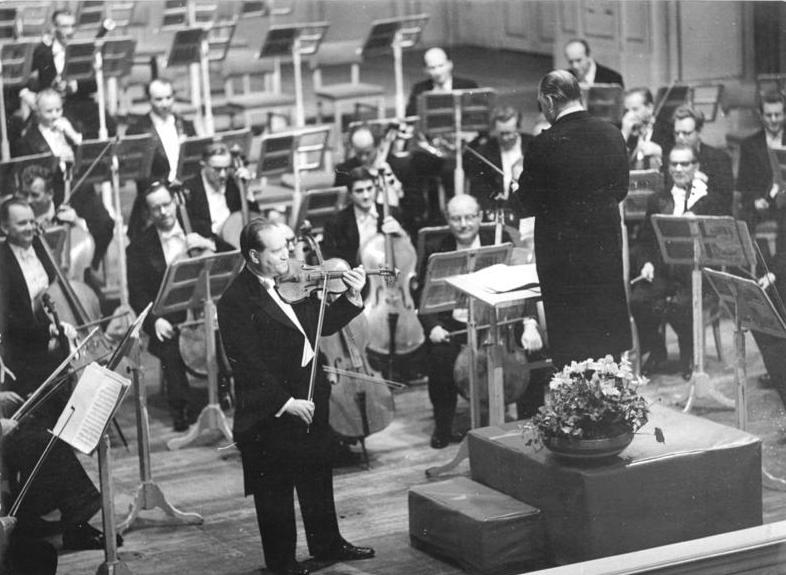
David Oistrakh playing a violin concerto, 1960

A violin concerto is a concerto for solo violin (occasionally, two or more violins) and instrumental ensemble (customarily orchestra). Such works have been written since the Baroque period, when the solo concerto form was first developed, up through the present day. Many major composers have contributed to the violin concerto repertoire.

Traditionally a three-movement work, the violin concerto has been structured in four movements by a number of modern composers, including Dmitri Shostakovich, Igor Stravinsky, and Alban Berg.[a] In some violin concertos, especially from the Baroque and modern eras, the violin (or group of violins) is accompanied by a chamber ensemble rather than an orchestra—for instance, in Vivaldi's L'estro armonico, originally scored for four violins, two violas, cello, and continuo, and in Allan Pettersson's first concerto, for violin and string quartet.

List of violin concertos

[edit]

The following concertos are presently found near the center of the mainstream Western repertoire.

List of other works for violin and orchestra

[edit]

See also

[edit]

Notes

[edit]
Revisions and contributorsEdit on WikipediaRead on Wikipedia
from Grokipedia
A violin concerto is a musical composition in the concerto genre featuring a solo violin as the primary instrument, accompanied by an orchestra, typically structured in three movements following a fast–slow–fast pattern to highlight the soloist's virtuosity and expressive capabilities.[1][2] The genre originated in the Baroque era (c. 1600–1750), evolving from earlier forms like the concerto grosso, with early examples by composers such as Arcangelo Corelli and Giuseppe Torelli establishing the solo violin as a focal point against orchestral tuttis using ritornello form.[3] Antonio Vivaldi composed over 230 violin concertos, including his famous The Four Seasons, which exemplify the period's emphasis on technical display and idiomatic violin writing, while Johann Sebastian Bach contributed two surviving concertos (in A minor and E major) that adapted Italian influences into his polyphonic style.[3][4] In the Classical period (c. 1750–1820), the form simplified into sonata structure, prioritizing balance between soloist and orchestra, as seen in Wolfgang Amadeus Mozart's five violin concertos (K. 207–211), written around 1775, which blend lyrical melodies with structural clarity.[3][5] Giovanni Battista Viotti produced 29 violin concertos, further standardizing the genre for public concerts.[3] The Romantic era (c. 1820–1900) elevated the violin concerto's emotional depth and technical demands, incorporating cadenzas and expanded orchestration; Ludwig van Beethoven's Violin Concerto in D major (Op. 61, 1806) bridges Classical and Romantic styles with its heroic themes, influencing later works like those of Felix Mendelssohn and Johannes Brahms.[3][6] Pyotr Ilyich Tchaikovsky's Violin Concerto in D major (Op. 35, 1878) and Max Bruch's in G minor (Op. 26, 1866) became staples for their melodic richness and virtuosic passages.[6][7] The 20th century and beyond saw continued innovation, with neoclassical approaches in Igor Stravinsky's Violin Concerto (1931) and modernist expansions in Alban Berg's (1935), alongside lyrical masterpieces like Jean Sibelius's in D minor (Op. 47, 1904), reflecting diverse stylistic evolutions while preserving the core contrast between soloist and ensemble.[6][7]

Definition and Origins

Definition

A violin concerto is a musical composition written for a solo violin, or occasionally multiple violins, accompanied by an orchestra or ensemble, typically consisting of three movements in a fast-slow-fast structure.[2] This form highlights the virtuosity of the soloist through demanding technical passages, contrasted with orchestral sections known as tuttis or ripieno, which provide a recurring thematic framework often in ritornello form.[2] A key feature is the cadenza, an extended solo passage where the orchestra pauses, allowing the violinist to improvise or perform a composed ornamental display, typically near the end of the first or final movement.[8] The violin concerto emerged in the Baroque period from Italian roots, evolving as a distinct genre in the late 17th and early 18th centuries, with early examples dating to around 1698 in Giuseppe Torelli's works, though it gained prominence in the 1710s through collections like Antonio Vivaldi's L'estro armonico.[2] Unlike the concerto grosso, which features a small group of soloists (concertino) alternating with the full orchestra (ripieno), the violin concerto focuses on a single soloist to emphasize individual expression and technical prowess.[9] It also differs from a violin sonata, which is a chamber work for solo violin accompanied only by a keyboard instrument like piano, without the full orchestral texture.[10]

Early Development

The violin concerto emerged in the late 17th century from precursors in Italian violin sonatas and sinfonias, which emphasized the solo violin's expressive and technical capabilities within small ensembles. Early solo violin works by Biagio Marini, such as those in his Affetti musicali Op. 1 (1617) and subsequent publications in the 1620s, laid foundational groundwork by exploring idiomatic violin techniques like double stops and scordatura tuning, influencing the development of concerted forms. Claudio Monteverdi's integration of violins in operas like L'Orfeo (1607) further highlighted the instrument's soloistic role, with passages featuring prominent violin lines amid vocal and ensemble textures, bridging toward more independent instrumental writing. The first true violin concertos appeared around the 1690s, attributed to Giuseppe Torelli, whose Concerti musicali Op. 6 (1698) introduced the characteristic contrast between solo violin (concertino) and orchestral tutti sections, establishing a rhythmic and textural alternation that defined the genre's early structure. Tommaso Albinoni built on this in his 12 Concerti a cinque Op. 5 (1707), where select movements spotlight a principal violin against strings and continuo, refining the solo-tutti dynamic while incorporating lyrical Venetian melodic styles. Venetian composers, led by Antonio Vivaldi, played a pivotal role in popularizing the violin concerto through innovative publications and prolific output. Vivaldi's L'estro armonico Op. 3 (1711), a collection of 12 concertos for various violin configurations, exemplified bold experimentation with multiple soloists, rapid passaggi, and ritornello form, captivating European audiences and printers. Over his career, Vivaldi composed approximately 230 violin concertos, many tailored for the virtuoso violinists at Venice's Ospedale della Pietà, where he served as maestro.[11] The form's spread beyond Italy reached Germany via Johann Sebastian Bach, who during his Weimar tenure (1708–1717) transcribed several of Vivaldi's violin concertos—such as the Concerto in D major RV 230 (BWV 972 for harpsichord)—adapting them for keyboard instruments to study and assimilate Italian concerto principles into his own contrapuntal style.[12]

Historical Evolution

Baroque Era

The violin concerto reached its maturation during the Baroque era (approximately 1710s–1750s), evolving from earlier experimental forms into a structured genre that highlighted the soloist's virtuosity against the orchestral ensemble. Antonio Vivaldi played a pivotal role in this development, composing over 230 violin concertos that standardized the three-movement form of fast-slow-fast, with the outer movements typically in ritornello structure. In ritornello form, the orchestra introduces and repeatedly returns to a thematic refrain (ritornello), framing episodes where the solo violin explores new material, creating a dynamic contrast between tutti and solo sections.[13][14][15] Vivaldi's innovations, particularly evident in collections like L'estro armonico (Op. 3, 1711), influenced subsequent composers across Europe, establishing the violin concerto as a showcase for technical prowess and expressive depth. Johann Sebastian Bach adapted this model in his Violin Concerto in A minor, BWV 1041, and Violin Concerto in E major, BWV 1042, both composed around 1730, incorporating Vivaldi-inspired ritornello elements while integrating contrapuntal textures typical of German Baroque style. These works demonstrate Bach's modifications, such as blending ritornello with fugal passages, to emphasize the violin's melodic independence within the ensemble. Georg Philipp Telemann contributed prolifically to the genre, writing dozens of violin concertos, including programmatic ones like the Concerto in G major, TWV 51:G8 ("The Frogs"), which employ ritornello form to evoke vivid imagery through rhythmic and melodic motifs.[16][17][18] Baroque violin concertos emphasized virtuosic demands on the soloist, featuring techniques such as double stops—simultaneous bowing of two or more strings—to achieve harmonic richness and polyphonic effects, as seen in Vivaldi's rapid scalar passages and chordal writing. Scordatura tuning, where strings are retuned to facilitate complex double stops or alter timbre, appeared in Baroque violin concertos such as Vivaldi's Op. 9 No. 6 in A major and Op. 20 No. 2 in A major, allowing for expanded resonance and easier execution of thirds and sixths.[19][20] Some concertos incorporated programmatic elements, such as bird-like trills or storm depictions, enhancing the violin's expressive range beyond abstract forms.[19] This era's rise in violin concertos was supported by advancements in instrument making and the patronage system prevalent in Italy and Germany. Luthiers like Antonio Stradivari (1644–1737) refined violin construction during his "Golden Period" (c. 1700–1720), producing instruments with flatter arching and longer bass bars for greater projection and tonal power, ideal for concerto soloists performing in larger halls. In Italy, aristocratic and ecclesiastical patrons, such as Venetian nobles and the Ospedale institutions, commissioned works from composers like Vivaldi, fostering innovation through dedicated ensembles. In Germany, court patronage under figures like Frederick the Great and Protestant church sponsors enabled composers such as Bach and Telemann to experiment with violin writing, blending Italian influences with local chorale traditions.[21][22][15]

Classical and Romantic Eras

In the Classical era, the violin concerto evolved from the repetitive ritornello structures of the Baroque period toward greater formal balance and lyrical expression, adopting sonata form for the first movement to foster a more equitable dialogue between soloist and orchestra.[23] Wolfgang Amadeus Mozart's five violin concertos, composed in 1775 during his tenure in Salzburg, represent the pinnacle of this development, showcasing elegant, operatically influenced melodies and a compact orchestration that highlights the violin's singing quality.[3] These works, such as the Concerto No. 3 in G major, K. 216, employ sonata form with clear exposition, development, and recapitulation, where the solo violin introduces secondary themes and engages in thematic interplay with the orchestra, emphasizing melodic grace over virtuosic display.[24] This Classical foundation transitioned into the Romantic era through expanded emotional depth and orchestral scale, as composers sought to convey personal narrative and dramatic intensity. Ludwig van Beethoven's Violin Concerto in D major, Op. 61, premiered in 1806, bridges these periods with its expansive first movement, featuring a lengthy orchestral introduction—over 200 measures—that establishes multiple themes before the soloist's entry, and innovative use of timpani to punctuate rhythmic motifs, elevating the orchestra's role beyond mere accompaniment.[25] The work's largo second movement further introduces a meditative, hymn-like dialogue, reflecting Beethoven's middle-period emphasis on heroic struggle and introspection.[26] Romantic violin concertos amplified virtuosity and expressiveness, drawing inspiration from Niccolò Paganini's 24 Caprices, Op. 1 (1802–1817), which pushed technical boundaries with polyphonic textures, harmonics, and rapid passagework, influencing composers to integrate such elements into concerto writing for heightened dramatic effect.[27] Felix Mendelssohn's Violin Concerto in E minor, Op. 64, completed in 1844 and premiered in 1845, exemplifies lyrical Romanticism with its seamless transitions between movements and soaring, song-like themes for the soloist, supported by a fuller orchestra including clarinets and bassoons for richer color.[28] Similarly, Max Bruch's Violin Concerto No. 1 in G minor, Op. 26, composed in 1866 and revised in 1867–1868, establishes itself as a standard through its passionate, folk-inflected melodies and balanced structure, where the violin dominates with extended cadenzas amid orchestral turbulence.[29] Pyotr Ilyich Tchaikovsky's Violin Concerto in D major, Op. 35, from 1878, extends this tradition with a brilliant, narrative-driven form, including a dramatic finale that combines rondo elements with virtuosic flourishes, premiered amid initial controversy but quickly embraced for its emotional sweep.[24] These developments coincided with cultural shifts toward celebrating the virtuoso performer, epitomized by Paganini, whose legendary concerts from the 1810s onward popularized the violin as a vehicle for individual genius and theatricality, while Romantic composers increasingly incorporated national styles—such as Mendelssohn's Germanic lyricism or Tchaikovsky's Russian melodic inflections—to infuse concertos with cultural identity.[30]

20th and 21st Centuries

The 20th century marked a profound shift in the violin concerto genre, departing from the tonal lyricism of the Romantic era to embrace modernism, atonality, and experimental techniques while building on dramatic precedents like those in Tchaikovsky's works.[31] Sergei Prokofiev's Violin Concerto No. 1, Op. 19 (1917), exemplifies early modernist experimentation with its bold juxtaposition of lyrical melodies and dissonant harmonies, reflecting the composer's youthful avant-garde style amid the Russian Revolution.[32] His Violin Concerto No. 2, Op. 63 (1935), further blends classical structures with modern harmonic tensions, toccata-like passages, and grotesque elements, showcasing a more mature synthesis of lyricism and dissonance influenced by his return to the Soviet Union.[32] Béla Bartók's Violin Concerto No. 2 (1938), commissioned by Zoltán Székely, integrates Hungarian and Romanian folk influences through modal scales and rhythmic asymmetries, while incorporating "night music" effects—evocative, atmospheric textures mimicking nocturnal sounds—to evoke emotional depth and cultural roots.[33][34] Mid-century developments intensified these innovations, often intertwining personal expression with political contexts. Alban Berg's Violin Concerto (1935), his final completed work, employs a modified 12-tone technique derived from Arnold Schoenberg's serialism, yet retains tonal allusions for accessibility; dedicated "to the memory of an angel," it serves as a memorial to Manon Gropius, Alma Mahler's daughter, who died at age 18, transforming grief into a poignant dialogue between soloist and orchestra.[35] Dmitri Shostakovich's Violin Concerto No. 1, Op. 99 (1948, premiered 1955), composed during the post-World War II Stalinist era, conveys underlying tension through a passacaglia finale and cryptic motifs, including the composer's musical monogram (D-S-C-H), reflecting the oppressive Soviet cultural climate while maintaining surface optimism to evade censorship.[36][37] In the late 20th and early 21st centuries, composers explored minimalism, spatiality, and rhythmic vitality, often paying homage to earlier forms while incorporating contemporary idioms. Philip Glass's The American Four Seasons (1999), for violin and string orchestra, reimagines Vivaldi's The Four Seasons through minimalist repetition and gradual harmonic shifts, creating a modern tribute that blends Baroque structure with American experimentalism.[38] Sofia Gubaidulina's Offertorium (1980–1986), dedicated to Gidon Kremer, employs spatial effects by positioning the solo violin to interact dynamically with orchestral sections, evoking ritualistic offering through dissonant textures and Bach-inspired counterpoint, amid her spiritual explorations in Soviet-era composition.[39] John Adams's Violin Concerto (1993), premiered by the St. Louis Symphony, draws on post-minimalist influences akin to his piano concerto Century Rolls (1996), featuring layered counterpoint, driving rhythms, and eclectic polyphony that fuse Baroque vitality with 20th-century American idioms.[40] For example, Jennifer Higdon's Violin Concerto (2008), which won the 2010 Pulitzer Prize for Music, integrates rhythmic drive and lyrical accessibility, highlighting the soloist's virtuosity in a post-minimalist style.[41] Broader trends in 21st-century violin concertos include the integration of electronics for extended timbres, shorter single-movement forms to suit modern attention spans, and cross-genre fusions blending classical with jazz, folk, or popular elements, as seen in works extending the violin's expressive range through amplification and digital processing.[42] Additionally, there has been growing emphasis on gender diversity, with composers like Unsuk Chin— a leading South Korean-born figure in contemporary music—contributing innovative works such as her Violin Concerto (2001), which combines spectral techniques, rhythmic complexity, and cultural hybridity to challenge traditional concerto paradigms.[43]

Form and Structure

Standard Movements and Forms

The violin concerto typically follows a three-movement archetype, consisting of a fast opening movement, a slow lyrical middle movement, and a brisk finale, a convention that emerged in the Baroque era and solidified in the Classical period.[3] The first movement is usually an allegro in sonata form or ritornello form, where the orchestra introduces principal themes in the exposition, followed by the soloist's elaborations and modulations that highlight virtuosic display.[24] The second movement adopts a slower tempo for expressive lyricism, often structured in ABA form or theme and variations, emphasizing the solo violin's cantabile qualities against subdued orchestral accompaniment.[3] The third movement returns to a fast tempo, commonly in rondo or sonata-rondo form, providing a lively conclusion with rhythmic vitality and thematic returns that integrate solo and ensemble elements.[24] Cadenzas, extended solo passages, are conventionally placed in the first movement, often at the conclusion of the development section or just before the recapitulation, serving as a platform for the soloist to demonstrate technical prowess and interpretive freedom.[44] These can be improvised, adhering to guidelines for brevity and thematic relevance as outlined in 18th-century treatises, or fully written out by the composer to ensure structural coherence.[45] In later examples, cadenzas may appear in other movements or serve transitional roles, but their primary function remains to disrupt the balanced dialogue momentarily, amplifying the soloist's prominence.[44] While the three-movement model predominates, variations exist, including one-movement forms that condense the fast-slow-fast progression into a continuous structure with sectional divisions, as seen in Alexander Glazunov's Violin Concerto in A minor, Op. 82, which unfolds as a single entity blending developmental and lyrical episodes.[46] Four-movement structures occasionally appear, particularly in 20th-century works influenced by Beethoven's symphonic expansions, incorporating an additional dance-like or scherzo movement to heighten dramatic contrast, for example, Dmitri Shostakovich's Violin Concerto No. 1, Op. 99 (1948).[47] Thematic integration across movements is another variation, where motifs from the first movement recur subtly in later ones, fostering unity beyond formal boundaries.[24] In formal analysis, the exposition establishes dual thematic material—often orchestral in the primary key and soloistic in the secondary—setting up the concerto's core contrast between collective and individual voices.[3] The development section explores harmonic instability and textural interplay, with the soloist navigating modulations and ornamental passages while the orchestra provides supportive or confrontational responses.[24] The recapitulation resolves these tensions by restating themes in the tonic key, often with enriched solo contributions that assert dominance, thereby achieving a balanced equilibrium between the violinist's expressivity and the orchestra's foundational role.[3]

Orchestration and Accompaniment

In the Baroque era, violin concertos were typically scored for a small ensemble of strings and basso continuo, often performed with one player per part in a chamber music setting rather than with a large orchestra. This intimate scoring emphasized textural contrast between the solo violin and the tutti sections, achieved through dynamic shifts and the addition or subtraction of instruments rather than sheer volume. The continuo, usually realized on harpsichord or organ, provided harmonic foundation and rhythmic drive, supporting the soloist's ornamental flourishes while the string choir—comprising first violins, second violins, violas, and bass—offered contrapuntal interplay.[48] The Classical and Romantic periods saw a significant expansion in orchestration, incorporating a full symphony orchestra with woodwinds, brass, and percussion to elevate the ensemble as an active partner to the solo violin. Standard scoring included pairs of flutes, oboes, clarinets, and bassoons for melodic color and harmonic filling, along with horns and trumpets for fanfares and structural punctuation, supported by timpani and an enlarged string section. In Beethoven's Violin Concerto in D major, Op. 61 (1806), the orchestra comprises solo violin, one flute, two each of oboes, clarinets, bassoons, horns, and trumpets, timpani, and strings; the timpani's solo opening strokes not only initiate the rhythmic motif but also underscore the orchestra's dramatic equality with the soloist throughout.[49][50] This development continued in Romantic works, where added brass and percussion enhanced emotional depth and textural variety, allowing the orchestra to function as a symphonic counterpart rather than mere accompaniment. In the 20th and 21st centuries, orchestration for violin concertos diversified, with composers occasionally reducing ensembles to chamber proportions for heightened intimacy or experimenting with extended techniques like prepared piano and electronics to expand timbral possibilities. Chamber concertos, such as Michael Hersch's Violin Concerto (2015), employ scaled-down forces—strings, select winds, and percussion—to foster close dialogue between soloist and ensemble, contrasting the expansive Romantic model. Accompaniment dynamics often feature obbligato wind parts that engage in intricate counterpoint with the violin, evoking orchestral "choir" effects through sectional unisons or homophonic support; however, balancing the solo violin's projection against denser textures remains a persistent challenge, demanding precise dynamic grading and venue acoustics to ensure clarity.[51][52][53]

Notable Examples

By Major Composers

Antonio Vivaldi composed nearly 500 concertos during his lifetime, with over 230 dedicated to the violin, showcasing the Baroque era's emphasis on virtuosic display and structural variety in the genre.[54] His most renowned contribution is The Four Seasons (Le quattro stagioni), a set of four violin concertos published in Amsterdam in 1725 as part of his Op. 8 collection.[55] This programmatic work depicts the cycles of nature through vivid musical imagery—spring's blooming with birdsong trills, summer's storms via rapid string tremolos, autumn's hunts with horn-like motifs, and winter's chill with pizzicato snow effects—accompanied by sonnets that Vivaldi likely authored to guide interpretation. Premiered in Venice around 1720-1721, the concertos exemplify Vivaldi's innovative fusion of technical demands on the solo violin with orchestral color, influencing the concerto form's evolution toward expressive narrative.[55] Wolfgang Amadeus Mozart produced five violin concertos, all composed in Salzburg between 1773 and 1775, blending the galant style's elegance with his emerging mastery of operatic expressiveness.[56] Among them, the Violin Concerto No. 3 in G major, K. 216, completed on October 12, 1775, stands out for its lyrical charm and dramatic flair, with the opening theme borrowed directly from an aria in Mozart's unfinished opera Zaide.[57] Likely premiered by Mozart himself as concertmaster in Salzburg that same year, the work features a graceful Allegro in sonata form, a poignant Adagio evoking vocal recitative, and a spirited Rondeau finale incorporating folk-like variations. Its operatic quality is evident in the soloist's melodic lines, which mimic singing, while the orchestra provides supportive yet colorful dialogue, marking a pivotal step in Mozart's instrumental writing toward theatrical depth.[57] Ludwig van Beethoven wrote a single violin concerto, the Violin Concerto in D major, Op. 61, composed in 1806 amid his "heroic" middle period and reflecting the composer's personal struggles with deafness.[58] Dedicated to his patron Stephan von Breuning, it premiered unsuccessfully on December 23, 1806, in Vienna, with violinist Franz Clement sight-reading the challenging solo part at the last minute.[59] Clocking in at around 40-45 minutes—nearly 15 minutes longer than Mozart's equivalents—the concerto innovates through its expansive structure, noble themes, and heroic character, beginning with extended orchestral timpani flourishes that integrate the soloist seamlessly into a symphonic dialogue. The Largo movement offers profound lyricism, while the Rondo finale pulses with rhythmic vitality, establishing the work as a cornerstone of Romantic violin literature despite its initial neglect.[60] Jean Sibelius crafted his sole violin concerto, in D minor, Op. 47, in 1903-1904, drawing from his own frustrated violin ambitions to create a work of intense emotional depth.[61] Originally dedicated to violinist Victor Nováček, who gave a disastrous Helsinki premiere on December 8, 1904, Sibelius revised it substantially in 1905 to temper its extreme technical demands, including high positions and rapid passages. The revised version debuted on October 19, 1905, in Berlin, with Karel Halíř as soloist and Richard Strauss conducting the Berlin Philharmonic.[62] At about 30 minutes, the concerto's elemental quality evokes Nordic landscapes through its brooding, concise orchestration and seamless transitions—played attacca between movements—imparting a single-movement-like continuity despite its traditional three-part form. The opening Allegro moderato unleashes virtuosic drama, the Adagio di molto introduces haunting melancholy, and the Allegro, ma non tanto finale surges with triumphant energy, cementing its status as a 20th-century masterpiece.[61]

By Historical Period

Baroque Era The Baroque era laid the foundation for the violin concerto, with works selected for their pioneering role in establishing the genre's structure and the soloist's prominence. Antonio Vivaldi's L'estro armonico, Op. 3, a collection of twelve concertos published in 1711, marked a pivotal moment by introducing the three-movement form and ritornello structure that became standard, emphasizing virtuosic violin writing and harmonic contrast between solo and ensemble.[63] These concertos, including several for violin, influenced subsequent composers through their innovative use of multiple soloists and dynamic interplay, remaining staples in the repertoire for their rhythmic vitality and expressive range. Johann Sebastian Bach's Violin Concerto in A minor, BWV 1041, composed around 1730, exemplifies the era's synthesis of Italian concerto style with German polyphony, featuring a lyrical slow movement and energetic outer movements that highlight the violin's melodic capabilities while integrating contrapuntal elements.[64] Bach's work, though less frequently performed than Vivaldi's in modern programs, endures for its emotional depth and technical demands, often adapted for other instruments to broaden its reach. Classical Era In the Classical period, violin concertos emphasized balance, clarity, and galant style, with selections based on their frequent performance and contributions to formal elegance. Wolfgang Amadeus Mozart's Violin Concerto No. 3 in G major, K. 216, premiered in 1775 in Salzburg, showcases the composer's youthful ingenuity through its operatic solo writing and symmetrical phrasing, where the violin engages in dialogue with the orchestra in a manner that prioritizes melodic grace over virtuosity.[65] This concerto's high repertoire frequency stems from its accessibility and charm, often programmed alongside Mozart's symphonies for its embodiment of Classical poise. Joseph Haydn's Violin Concerto No. 1 in C major, Hob. VIIa:1, likely composed around 1765 for Luigi Tomasini, the concertmaster of Haydn's Esterházy orchestra, features brilliant cadenzas and a minuet finale that reflect the era's courtly refinement and the violin's role as a conversational partner in the ensemble.[66] Though less ubiquitous than Mozart's, it influences studies of early Classical orchestration for its light orchestration and structural innovation. Romantic Era Romantic violin concertos expanded emotional expression and symphonic scale, chosen here for their enduring popularity, technical innovation, and integration of solo and orchestra. Felix Mendelssohn's Violin Concerto in E minor, Op. 64, premiered in 1845 in Leipzig with Ferdinand David as soloist, innovates by eliminating pauses between movements and launching the solo violin immediately without orchestral introduction, creating a seamless narrative driven by lyrical themes and virtuosic passages.[67] Its frequent inclusion in concert programs—often rivaling Beethoven's—highlights its melodic accessibility and emotional intensity, influencing later Romantic works through its formal fluidity. Johannes Brahms's Violin Concerto in D major, Op. 77, premiered on January 1, 1879, in Leipzig with Joseph Joachim, stands out for its symphonic integration, treating the violin as an equal voice in a large orchestral texture rather than a display vehicle, with expansive themes and a demanding yet songful solo part.[68] This approach, blending concerto and symphony, underscores its influence on 20th-century composers and its status as a repertoire cornerstone. Max Bruch's Violin Concerto No. 1 in G minor, Op. 26, composed between 1865 and 1867, premiered on January 7, 1868, in Bremen with Joseph Joachim as soloist under Karl Martin Rheinhaler, is renowned for its soaring melodies, particularly in the expansive first movement and the lyrical slow movement, balancing virtuosity with emotional depth. Its immediate success established it as a Romantic staple, frequently performed for its accessible yet demanding violin writing. Pyotr Ilyich Tchaikovsky's Violin Concerto in D major, Op. 35, completed in 1878 and premiered on December 4, 1881, in Vienna with Adolph Brodsky and the Vienna Philharmonic under Hans Richter, features brilliant technical displays and unforgettable tunes, including the famous first-movement theme. Despite a notoriously harsh initial review, it became one of the most beloved works in the violin repertoire for its passionate lyricism and dramatic flair. Camille Saint-Saëns's Violin Concerto No. 3 in B minor, Op. 61, premiered on October 15, 1880, in Hamburg with Pablo de Sarasate as soloist, exemplifies French elegance with its concise, one-movement structure divided into three sections, featuring sparkling runs and a poignant cadenza that balance virtuosity with restraint.[69] Valued for its brevity and charm, it appears regularly in recitals for introducing Romantic lyricism without excess. 20th and 21st Centuries Modern violin concertos reflect diverse innovations in harmony, rhythm, and form, selected for their groundbreaking styles and lasting impact on contemporary repertoire. Sergei Prokofiev's Violin Concerto No. 1 in D major, Op. 19, premiered on October 18, 1923, in Paris, blends neoclassical clarity with lyrical melancholy and motoric rhythms, marking an early 20th-century shift toward modernist irony while retaining tonal centers.[70] Its influence lies in bridging Romantic tradition and avant-garde, with frequent performances appreciating its deceptive simplicity and emotional subtlety. Alban Berg's Violin Concerto, composed in 1935 and premiered posthumously on April 19, 1936, in Barcelona, innovates through twelve-tone technique tempered by tonal allusions and a Bach chorale quote, creating a poignant meditation on loss amid dodecaphonic complexity.[35] As a high-impact Second Viennese School work, it expanded the genre's expressive scope and remains a repertoire essential for its humanistic depth. John Adams's Violin Concerto, world premiere on January 19, 1994, by the Minnesota Orchestra with violinist Jorja Fleezanis, conducted by Edo de Waart (composed in 1993), embodies minimalist propulsion with chaconne-like patterns, blues inflections, and expansive orchestration, pushing the soloist through relentless energy and vast emotional arcs. Its innovation in post-minimalist scale has elevated its frequency in programs, influencing American orchestral music by integrating classical form with contemporary pulse. Thomas Adès's Violin Concerto, composed in 2005 and premiered on September 4, 2005, at the Berlin Festival with Carolin Widmann and the Berlin Philharmonic under Simon Rattle, explores concentric paths of musical ideas through intricate rhythms and vivid orchestration, blending neoclassical clarity with modernist complexity.[71] Championed by violinists like Leila Josefowicz, it represents a significant 21st-century contribution, noted for its structural ingenuity and emotional depth in contemporary repertoire.

Performance and Interpretation

Technical Demands on the Soloist

Performing a violin concerto places extraordinary technical demands on the soloist, encompassing virtuosic elements that push the instrument's capabilities to their limits. These include extended passages in high positions on the fingerboard, rapid scalar and arpeggiated runs requiring exceptional speed and accuracy, complex double and triple stops that demand simultaneous control of multiple strings, and the production of harmonics for ethereal tone colors.[72] Endurance forms a core challenge, as full performances typically span 25 to 40 minutes of continuous exposure, necessitating sustained physical stamina for frequent left-hand position shifts, precise bow control under varying dynamics, and maintenance of intonation amid orchestral interplay.[73] The evolution of these demands reflects historical shifts in compositional priorities. In the Baroque era, concertos prioritized agility, featuring quick repeated notes, arpeggios, and rhythmic passagework to showcase the soloist's dexterity, as exemplified in Vivaldi's L'estro armonico.[13] The Romantic period intensified this with an emphasis on lush tone production and dramatic expression, incorporating Paganini-inspired feats such as left-hand pizzicato, octave and tenth shifts, and high-velocity spiccato bowing to evoke heroic individualism.[72][3] In the 20th and 21st centuries, composers expanded the palette further through innovations like scordatura tuning to alter timbre and facilitate microtonal inflections, as in Ligeti's Violin Concerto, alongside extended techniques such as sul ponticello bowing for metallic scrapes and hyper-pressure for percussive effects.[74] These additions not only heighten physical and technical rigor but also require the soloist to balance novel sonorities against the orchestra's full texture.

Historical and Modern Approaches

In the Baroque era, violin concertos were performed using period instruments featuring gut strings and tuned to a lower pitch, typically A=415 Hz, which produced a softer, more resonant tone suited to the era's acoustics and ensemble sizes. This approach, informed by historical treatises and iconography, emphasized selective vibrato as an ornament rather than a constant effect, along with articulated bowing and continuo accompaniment to highlight the soloist's rhetorical expression in works by composers like Vivaldi and Bach.[75][76] By the Classical period, as seen in Mozart's concertos, practices retained gut strings and transitional bows for agility, with minimal vibrato and flexible tempos derived from dance rhythms, contrasting later developments.[77][78] The 19th-century Romantic approach shifted toward greater expressivity, with vibrato primarily ornamental in the early period but increasingly continuous on long notes by the late century, alongside rubato for emotional depth, particularly in concertos by Mendelssohn and Bruch, where soloists used portamento slides to enhance melodic lyricism.[79][80][81] These techniques, evident in early recordings from the 1920s, allowed for tempo flexibility and rhythmic unevenness to convey passion.[82] In the 20th century, interpretations evolved toward fidelity to the score, with recordings by Jascha Heifetz and Yehudi Menuhin standardizing precise rhythms, reduced portamento, and broader dynamics, as Heifetz's mid-century renditions of Bach and Romantic concertos demonstrated a move from personal inflection to objective literalism.[83][84] Menuhin's later works similarly reflected this homogenization, influencing global teaching and performance norms.[83] Modern approaches blend these traditions through the Historically Informed Performance (HIP) movement, which revives Baroque practices like gut strings and lower pitch for even 19th- and 20th-century repertoire, fostering authenticity while adapting to contemporary sensibilities.[85][86] Diversity among soloists has grown, with artists like Hilary Hahn promoting inclusive interpretations across genres and advocating for underrepresented voices in classical music.[87] Digital enhancements in recordings, such as advanced audio processing, enable precise capture of subtle articulations and balances, enriching interpretive nuances in studio and live settings.[84] Culturally, violin concertos drive competitions like the International Tchaikovsky Competition, where staples such as Tchaikovsky's own Op. 35 test virtuosity and are frequently programmed by orchestras for their crowd appeal and collaborative potential between composers and soloists in new works.[88][89][90]

References

User Avatar
No comments yet.