Hubbry Logo
WaltzWaltzMain
Open search
Waltz
Community hub
Waltz
logo
8 pages, 0 posts
0 subscribers
Be the first to start a discussion here.
Waltz
Waltz
from Wikipedia
Waltz
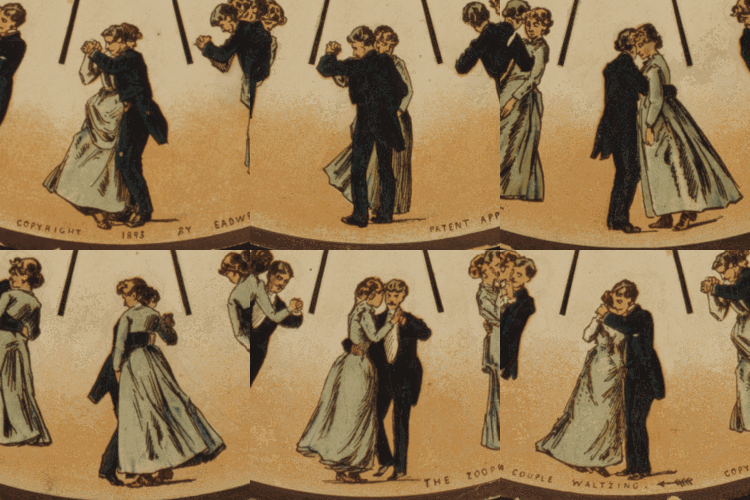
A phenakistoscope animation by Eadweard Muybridge demonstrating the waltz
GenreBallroom dance
Time signature3
4
Year17th century
Detail from frontispiece to Thomas Wilson Correct Method of German and French Waltzing (1816), showing nine positions of the waltz, clockwise from the left (the musicians are at far left). At that time, the waltz was a relatively new dance in England, and the fact that it was a couples dance (as opposed to the traditional group dances), and that the gentleman clasped his arm around the lady's waist, gave it a dubious moral status.

The waltz (from German Walzer [ˈvaltsɐ] , meaning "to roll or revolve")[1] is a ballroom and folk dance, in triple (3
4
) time, performed primarily in closed position. Along with the ländler and allemande, the waltz was sometimes referred to by the generic term German Dance in publications during the late 18th and early 19th centuries.[2]

History

[edit]
Waltz

There are many references to a sliding or gliding dance, including the volta, that would evolve into the waltz that date from 16th-century Europe, including the representations of the printmaker Hans Sebald Beham. The French philosopher Michel de Montaigne wrote of a dance he saw in 1580 in Augsburg, where the dancers held each other so closely that their faces touched. Kunz Haas (of approximately the same period) wrote, "Now they are dancing the godless Weller or Spinner."[3] "The vigorous peasant dancer, following an instinctive knowledge of the weight of fall, uses his surplus energy to press all his strength into the proper beat of the bar, thus intensifying his personal enjoyment in dancing."[3] Around 1750, the lower classes in the regions of Bavaria, Tyrol, and Styria began dancing a couples dance called Walzer.[4] The Ländler, also known as the Schleifer, a country dance in 3
4
time, was popular in Bohemia, Austria, and Bavaria, and spread from the countryside to the suburbs of the city. While the eighteenth-century upper classes continued to dance the minuets (such as those by Mozart, Haydn and Handel), bored noblemen slipped away to the balls of their servants.[5]

In the 1771 German novel Geschichte des Fräuleins von Sternheim by Sophie von La Roche, a high-minded character complains about the newly introduced waltz among aristocrats thus: "But when he put his arm around her, pressed her to his breast, cavorted with her in the shameless, indecent whirling-dance of the Germans and engaged in a familiarity that broke all the bounds of good breeding—then my silent misery turned into burning rage."[6]

Describing life in Vienna (dated at either 1776 or 1786[7]), Don Curzio wrote, "The people were dancing mad ... The ladies of Vienna are particularly celebrated for their grace and movements of waltzing of which they never tire." There is a waltz in the second act finale of the 1786 opera Una Cosa Rara by Martin y Soler. Soler's waltz was marked andante con moto, or "at a walking pace with motion", but the flow of the dance was sped-up in Vienna leading to the Geschwindwalzer, and the Galloppwalzer.[8][9]

In the 19th century, the word primarily indicated that the dance was a turning one; one would "waltz" in the polka to indicate rotating rather than going straight forward without turning.

Shocking many when it was first introduced,[10] the waltz became fashionable in Vienna around the 1780s, spreading to many other countries in the years to follow. According to contemporary singer Michael Kelly, it reached England in 1791.[11] During the Napoleonic Wars, infantry soldiers of the King's German Legion introduced the dance to the people of Bexhill, Sussex, from 1804.[12]

It became fashionable in Britain during the Regency period, having been made respectable by the endorsement of Dorothea Lieven, wife of the Russian ambassador.[13] Diarist Thomas Raikes later recounted that "No event ever produced so great a sensation in English society as the introduction of the waltz in 1813."[14] In the same year, a sardonic tribute to the dance by Lord Byron was anonymously published (written the previous autumn).[15][16] Influential dance master and author of instruction manuals, Thomas Wilson published A Description of the Correct Method of Waltzing in 1816.[17] Almack's, the most exclusive club in London, permitted the waltz, though the entry in the Oxford English Dictionary shows that it was considered "riotous and indecent" as late as 1825. In The Tenant of Wildfell Hall, by Anne Brontë, in a scene set in 1827, the local vicar Reverend Milward tolerates quadrilles and country dances but intervenes decisively when a waltz is called for, declaring "No, no, I don't allow that! Come, it's time to be going home."[18]

The waltz, especially its closed position, became the example for the creation of many other ballroom dances. Subsequently, new types of waltz have developed, including many folk and several ballroom dances.

Variants

[edit]
Waltz rhythm[19]
Jazz waltz rhythm[19]
The Waltz, by Camille Claudel (cast in 1905)
A waltz following a contra dance in Massachusetts, U.S.

In the 19th and early 20th century, numerous different waltz forms existed, including versions performed in 3
4
, 3
8
or 6
8
(sauteuse), and 5
4
time (5
4
waltz, half and half).

In the 1910s, a form called the Hesitation Waltz was introduced by Vernon and Irene Castle.[20] It incorporated "hesitations" and was danced to fast music. A hesitation is basically a halt on the standing foot during the full waltz bar, with the moving foot suspended in the air or slowly dragged. Similar figures (Hesitation Change, Drag Hesitation, and Cross Hesitation) are incorporated in the International Standard Waltz Syllabus.

The Country Western Waltz is mostly progressive, moving counter clock wise around the dance floor. Both the posture and frame are relaxed, with posture bordering on a slouch. The exaggerated hand and arm gestures of some ballroom styles are not part of this style. Couples may frequently dance in the promenade position, depending on local preferences. Within Country Western waltz, there is the Spanish Waltz and the more modern (for the late 1930s- early 1950s) Pursuit Waltz. At one time it was considered ill treatment for a man to make the woman walk backwards in some locations.[21]

In California, the waltz was banned by Mission priests until 1834 because of the "closed" dance position.[22] Thereafter a Spanish Waltz was danced. This Spanish Waltz was a combination of dancing around the room in closed position, and a "formation" dance of two couples facing each other and performing a sequence of steps.[22] "Valse a Trois Temps" was the "earliest" waltz step, and the Rye Waltz was preferred as a couple dance.[23]

  • In contemporary ballroom dance, the fast versions of the waltz are called Viennese waltz as opposed to the Slow waltz.[24]
  • In traditional Irish music, the waltz was taught by travelling dancing masters to those who could afford their lessons during the 19th century. By the end of that century, the dance spread to the middle and lower classes of Irish society and traditional triple-tune tunes and songs were altered to fit the waltz rhythm. During the 20th century, the waltz found a distinctively Irish playing style in the hands of Céilidh musicians at dances.[25][26]
  • International Standard Waltz has only closed figures; that is, the couple never breaks the embrace.
  • The American Style Waltz, part of the American Smooth ballroom dance syllabus, in contrast to the International Standard Waltz, involves breaking contact almost entirely in some figures. For example, the Syncopated Side-by-Side with Spin includes a free spin for both partners. Open rolls are another good example of an open dance figure, in which the follower alternates between the lead's left and right sides, with the lead's left or right arm (alone) providing the lead. Waltzes were the staple of many American musicals and films, including "Waltz in Swing Time" sung by Fred Astaire.[citation needed]
  • The Valse Musette, a form of waltz popular in France, started in the late 19th century.[citation needed]
  • The cross-step waltz (French Valse Boston) developed in France in the early 20th century and is popular in social waltz groups today.[citation needed]
  • In folk dance from the Alsace region, waltzes in odd metres such as 5
    4
    , 8
    4
    and 11
    4
    are found. In modern bal folk, waltzes in even higher metres are played and danced.
  • Estonian folk dance Labajalavalss (flat of the foot waltz) performed in 3
    4
    time.[27]
  • Sama'i (also known as usul semai) is a vocal piece of Ottoman Turkish music composed in 6
    8
    metres. This form and metre (usul in Turkish) is often confused with the completely different Saz Semaisi, an instrumental form consisting of three to four sections, in 10/8 metre, or usul aksak semai (broken semai in Turkish). Semai is one of the most important forms in Ottoman Turkish Sufi music.[28][29]
  • The Tsamikos (Greek: Τσάμικος, Tsamikos) or Kleftikos (Greek: Κλέφτικος) is a popular traditional folk dance of Greece, done to music of 3
    4
    metre.[30]

References

[edit]
[edit]
Revisions and contributorsEdit on WikipediaRead on Wikipedia
from Grokipedia
The waltz is a performed to music in three-four time, characterized by smooth, gliding steps, a rise-and-fall action, and continuous turning between partners in a closed hold. It originated in the late from folk dances such as the in the rural regions of and southern Germany, where peasants danced in close proximity, which later evolved into the formalized partner rotations central to the style. Initially met with scandal for its intimate embrace and face-to-face positioning—deemed immodest by contemporary European aristocracy—the waltz rapidly gained popularity in Viennese ballrooms by the early , transforming norms. The dance's evolution produced distinct variants, including the fast-paced Viennese waltz, emphasizing rapid rotations at around 180 beats per minute, and the slower English or international standard waltz, which prioritizes elegant sway and floor coverage for competitive and social settings. Composers like the Strauss family elevated waltz music through orchestral works that captured its whirling elegance, embedding the form in classical repertoire and cultural events such as the annual Vienna New Year's Concert. Despite early moral controversies, the waltz's enduring appeal lies in its blend of romance and technical precision, influencing modern ballroom competitions, folk traditions, and even adaptations in jazz and American social dancing.

Historical Development

Early Origins in Folk Traditions

The waltz traces its roots to 16th-century peasant dances in the rural alpine regions of , , and , where couples performed turning steps in triple meter as part of communal festivities. These early forms, characterized by gliding rotations and close partner holds, evolved from dances like the volta—a vigorous Italian-influenced step documented in European records from the 1550s onward, involving lifts and spins that emphasized physical proximity between dancers. By the late , such movements had diffused into Germanic folk practices, adapting to local terrains and social customs without the formalized elegance of later variants. Historical accounts of village assemblies in these areas, often tied to harvest cycles or seasonal breaks from agrarian labor, describe pair dances fostering direct interaction amid sparse populations, with rhythms mirroring the repetitive of fieldwork. Instrumentation typically involved portable folk tools like fiddles for melodic leads and rudimentary percussion from clappers or stamped feet, enabling performances at outdoor gatherings recorded in regional chronicles from the 1600s. These elements—triple beats for energetic propulsion and rotational patterns for spatial navigation—arose causally from the need for efficient, engaging social rituals in isolated hamlets, where served as a low-barrier mechanism for alliance-building and reproductive , unmediated by institutional oversight. Empirical traces persist in 17th-century depictions of Bohemian and Bavarian rustics executing similar dreitaktige (three-beat) steps at fairs, predating urban refinements and highlighting the waltz's emergence as an organic adaptation of human locomotor patterns to musical periodicity, rather than contrived innovation. Such practices, preserved through oral transmission and occasional notated fragments in church or estate logs, underscore a continuity from medieval circle dances to these proto-waltzes, driven by the biomechanical advantages of turning in pairs for balance and mutual support on uneven ground.

Evolution and Popularization in Europe

The waltz emerged as a distinct form in the late , evolving from the , a prevalent in rural and since the mid-1700s, characterized by its triple meter and gliding steps. In , this transition from peasant gatherings to urban elite settings occurred between 1740 and 1790, driven by the city's expanding public balls and the ’s emulation of courtly entertainments amid Enlightenment-era social fluidity. The dance's rotary motion and couple-oriented hold marked a departure from the linear formations of earlier dances, appealing to participants seeking more intimate and dynamic expressions in salon environments. By the 1790s, waltz music appeared in printed collections across central Europe, signaling its standardization as performers adapted folk rhythms to refined orchestral accompaniments suitable for assembly rooms. In Vienna and Paris, dancing masters refined step patterns during this period, with early notations emphasizing smooth turns and basic box formations that ensured accessibility for amateur dancers at court events and private soirees. These developments aligned with Enlightenment ideals of rational recreation, as the waltz's mechanical simplicity—relying on consistent triple-time phrasing—contrasted the intricate figures of quadrilles, facilitating its integration into mixed-class gatherings. The spread of waltz notation through expanding print networks and improved overland travel routes enabled cross-regional uniformity by the early 1810s, as and manuals circulated from to Parisian and circles. This mechanical facilitation of , via woodblock and early lithographic printing, allowed dancers to replicate steps without direct instruction, accelerating adoption amid post-Revolutionary mobility and the of Vienna's diplomatic balls in 1814–1815. Empirical evidence from surviving publications confirms this consistency, with triple-meter pieces labeled "waltz" proliferating in European conservatories and theaters, underscoring the 's causal reliance on infrastructural advancements for elite popularization.

19th-Century Standardization and Global Spread

In the mid-19th century, the waltz solidified its position in European social dancing through increased popularity and refinement, particularly as a revolutionary triple-meter couples' dance that supplanted quadrilles in assembly halls. , often called the "Waltz King," played a pivotal role in this elevation by composing over 150 waltzes and more than 500 pieces total between the 1840s and his death in 1899, transforming the form into sophisticated concert repertoire performed in Vienna's venues like the . His works, such as premiered in 1866, captured Vienna's imperial splendor and drew enthusiastic public response, fostering the waltz's transition from ballroom novelty to cultural emblem amid economic growth in entertainment sectors. Standardization efforts emerged through dance instruction manuals and masters who codified steps and posture, addressing earlier criticisms of the waltz's intimacy by promoting structured rotary movements suitable for crowded floors. Precursors to formal academies, including Victorian-era teachers in London, influenced the development of consistent techniques, with organizations like the Imperial Society of Teachers of Dancing—founded in 1904—building on these 19th-century practices to establish the ballroom branch by 1924. These codifications emphasized balance, rise-and-fall action, and closed-hold positions, enabling the waltz's adaptation to diverse social contexts while preserving its core 3/4 rhythm. The waltz's global dissemination accelerated post-1850 via European immigration waves, particularly German and Austrian migrants introducing it to urban centers in the , where it gained traction in U.S. social gatherings by the 1840s. In , economic booms in cities like New York facilitated its integration into assembly and theater dances, with over 12 million immigrants arriving between 1870 and 1900 contributing cultural exports including the waltz. By century's end, colonial outposts and circuits further propagated variants, driven by demand in public dance halls that hosted thousands weekly, underscoring the dance's appeal as an accessible activity amid industrialization.

Musical Foundations

Rhythm, Time Signature, and Structure

The waltz employs a strict , consisting of three quarter-note beats per measure, with the primary metric accent placed on the first beat to establish a hierarchical that drives forward momentum. This accentuation, often rendered as a strong followed by weaker secondary beats, produces a measurable rhythmic quantifiable via beat duration analysis in scores, where the first beat typically sustains longer acoustically to reinforce gravitational stability in motion. Empirical verification from 19th-century markings in waltzes confirms this pattern, with deviations rare and non-normative in canonical . Tempos are calibrated precisely for physical feasibility, with the slow waltz standard at 28–30 measures per minute (84–90 beats per minute), as codified in international ballroom standards derived from orchestral playback data and competition guidelines. In contrast, the Viennese waltz accelerates to 58–60 measures per minute (174–180 beats per minute), a rate supported by time-motion analyses of elite performers showing sustained angular velocity without fatigue-induced deceleration. These velocities reflect causal constraints from inertia: slower paces conserve linear momentum for linear sway, while higher speeds leverage centrifugal force for rotational continuity, as modeled in biomechanical studies equating beat intervals to centripetal acceleration thresholds. Waltz phrasing adheres to 8-bar units as a foundational structural module, yielding 24 beats per and enabling periodic energy cycles that mirror oscillatory physics, such as pendulum-like rise-fall patterns governed by minima at phrase cadences. progressions within these units—often I-IV-V resolutions—facilitate momentum buildup and release, with spectral analysis of recordings confirming peak amplitudes aligning to bar 8 for maximal kinetic transfer efficiency. Variations, such as extensions to 16 bars in later Romantic works, preserve this binary subdivision but maintain the empirical 8-bar core for temporal predictability, as evidenced in corpus analyses of over 200 waltz scores from the genre's standardization era.

Compositional Styles and Notable Examples

In the classical era, precursors to the formalized waltz appeared in Wolfgang Amadeus Mozart's German dances (Teutsche), composed between 1787 and 1791, such as the sets K. 509, K. 600, and K. 605, which featured lively 3/8 rhythms and simple harmonic structures derived from folk traditions like the , emphasizing diatonic progressions in major keys over orchestral ensembles. These works, scored for winds, strings, and percussion, laid groundwork for the waltz's and buoyant pulse, though performed at faster tempos than later variants, prioritizing concert vitality over dance utility. The Romantic period elevated the waltz through Frédéric Chopin's solo piano compositions, notably the three Waltzes Op. 64 published in 1847, including the (No. 1, "Minute Waltz") and (No. 2), which decoupled the form from strict dance functionality by incorporating expressive rubato, chromatic modulations, and harmonic shifts like i-VI progressions for emotional depth amid the standard of bass note on beat one followed by chordal off-beats. Chopin's innovations, totaling 19 preserved waltzes, favored lyrical and subtle pedal effects, transforming the genre into autonomous pieces with over 200 manuscript measures per set showcasing varied thematic reprises. Johann Strauss II dominated 19th-century waltz composition from 1844 until his death in 1899, producing over 500 dance works including approximately 150 waltzes such as "The Blue Danube" (Op. 314, 1866) and "Tales from the Vienna Woods" (Op. 325, 1868), structured in five-strain formats with introductory fanfares, codas, and orchestral coloration via harp glissandi and string tremolos for euphoric momentum. The Strauss family's output, spanning Johann Sr. (from 1825), Josef, and Eduard, embedded waltzes in Viennese concert life, evidenced by the Vienna Philharmonic's New Year's Concerts initiating in 1939 with Strauss selections comprising up to 70% of programs, sustaining annual attendance exceeding 50,000 live and global broadcasts. In the 20th century, Maurice Ravel's La Valse (composed 1906–1920, premiered December 12, 1920) exemplified stylistic evolution toward modernism, framing a choreographic poem as an "apotheosis of the Viennese waltz" through layered orchestration, dissonant intrusions, and accelerating tempos that evoke societal disintegration rather than pure dance, scored for full symphony with piano and percussion accents across 12 minutes. This shift paralleled technological advances like electrical recording from 1925, enabling waltz preservation via phonographs and radio, decoupling compositions from ephemeral live orchestras and fostering replayable concert autonomy, as seen in over 1,000 commercial Strauss recordings by 1930.

Technical Elements of the Dance

Posture, Hold, and Basic Mechanics

In the standard closed hold of the , the leader positions the right hand on the follower's back between the shoulder blades, while the left hand clasps the follower's right hand at height with arms extended and slightly curved. The follower's left hand rests on the leader's right upper , creating five points of contact that maintain body proximity without restricting lower-body movement. This frame aligns the partners' torsos in opposition—leader's left side offset from follower's right—generating rotational for turns, as the twisted connection transmits forces efficiently across the partnership. Proper posture requires an erect spine to stack the head, shoulders, ribcage, and hips vertically, ensuring balance and poise. Shoulders remain relaxed and down to minimize upper-body tension, while body weight centers over the balls of the feet, facilitating rise and fall actions and quick directional changes. These alignments enhance biomechanical stability by distributing load through the kinetic chain, promoting efficient energy transfer from core to extremities during swings and pivots. Lead-follow dynamics rely on the leader initiating via micro-adjustments in rotation and pressure through the frame, conveying directional intent without arm dominance. The follower interprets these cues through proprioceptive awareness of partner contact, responding with complementary alignment to sustain . This draws on average physiological differences, with leaders leveraging greater upper-body strength for while followers emphasize responsive sensitivity, reducing miscommunication and supporting fluid execution. Such mechanics, codified in competition standards by the early , prioritize frame integrity for scoring in poise and connection. Adhering to these principles mitigates injury risks, as misaligned posture increases shear forces on the spine and joints, whereas correct hold and weight distribution optimize load-bearing and prevent compensatory strains observed in dance physiology analyses.

Core Steps and Movement Principles

The foundational pattern of the waltz is the box step, executed in closed position where partners maintain contact via the leader's right hand on the follower's back and the follower's left hand in the leader's left. For the leader, this consists of stepping forward with the left foot on beat 1, side with the right foot on beat 2, and closing the left foot to the right on beat 3; then backing with the right foot on beat 1, side with the left foot on beat 2, and closing the right foot to the left on beat 3, forming a rectangular "box" outline on the floor. The follower mirrors inversely: backing right on 1, side left on 2, close right on 3; then forward left on 1, side right on 2, close left on 3. This pattern aligns with the 3/4 time signature, with each step occupying one beat, emphasizing smooth progression rather than staccato hops. Movement incorporates rise and fall dynamics, where the dancers rise onto the balls of the feet through beats 2 and 3 of the forward half (promoting elongation and swing), then lower through the heel on beat 1 of the backward half, creating undulating body height that leverages for fluid momentum transfer. Sway, a lateral body inclination generated by side stretch of the and hips, counters sideways momentum on the second step, facilitating foot closure and directional control; it tilts the upper body opposite the step direction to maintain equilibrium under rotational influences. Contra-body movement (CBM) initiates turns by rotating the opposite side of the torso toward the stepping leg—e.g., right shoulder forward as the left leg steps forward—aligning the body's axis for efficient torque generation without excess arm swing. In rotational figures like the natural turn, a 180-degree pivot for the leader commencing from a closed change, the right foot steps forward and across on beat 1 (toe pivoting rightward), left foot sides on 2 with continued rotation, and right foot closes on 3, achieving approximately 3/8 turn per step while the follower's mirroring yields a full half-turn per bar; foot placement metrics emphasize a 45-degree offset from line of dance (e.g., leader's right foot at diagonal center against wall) to enable floorcraft in crowded ballrooms, minimizing collision risk via compact 1-1.5 foot strides. These rotations rely on centripetal force, supplied by mutual frame compression and extended arms, directing inward acceleration toward the shared center of mass to sustain circular paths without linear deviation, as body separation would dissipate angular momentum. Early 20th-century instructional films, such as those from the 1920s, demonstrate these principles through observable heel compression on lowers and torso counter-rotation, confirming biomechanical efficiency in pre-standardized executions.

Stylistic Nuances and Execution

In the waltz, stylistic execution hinges on modulating the rise and fall action to align with , where the of vertical displacement—typically peaking midway through the bar—increases during crescendo phrases to amplify sway and propulsion while diminishing in quieter passages for subtlety. This variation, observed in competitive performances, derives from the dance's inherent swing mechanics, with rise initiating at the conclusion of the first beat, cresting across the second and third, and descending thereafter to facilitate continuous forward travel. Key execution principles emphasize seamless transitions between figures, achieved through body-initiated movement where the torso drives directional changes and the head maintains poised alignment to counterbalance sway without leading independently. Standards from bodies like the Imperial of Teachers of Dancing (ISTD), codified in early 20th-century technique manuals, prescribe avoiding staccato interruptions, favoring legato flow via extended leg lines and gradual weight transfers to preserve momentum across steps. A prevalent fault in waltz execution is over-rotation during turning figures, where excessive generates centrifugal forces exceeding the centripetal counterforce provided by partner connection and grounded stance, resulting in observable imbalance such as outward drifting or loss of center. Biomechanical analyses confirm this stems from violating conservation of principles, as rapid pivots over a fixed base amplify demands beyond typical human coordination limits, frequently documented in time-motion studies of turns where higher speeds correlate with reduced stability.

Variants and Regional Adaptations

Viennese Waltz

The developed as a fast-rotary variant of the waltz form in early 19th-century , gaining prominence during the (1814–1815), when diplomatic balls showcased its lively, turning style derived from the and volta dances. Performed in 3/4 time at a standard of 180 beats per minute (58–60 measures per minute), it features continuous natural and reverse turns that prioritize rotational momentum and centrifugal sway over the progressive, gliding paths common in slower waltzes. This brisk pace and emphasis on unbroken rotation demand exceptional balance and stamina from dancers, distinguishing it from more linear or lyrical forms through its biomechanical focus on sustained . Joseph Lanner and the Strauss dynasty, especially Johann Strauss II (1825–1899), composed waltzes optimized for the dance's demands, with Strauss II producing over 150 waltzes—including "The Blue Danube" (1866)—that incorporate accelerating rhythms and melodic phrasing to support extended turning sequences without pauses. These works, performed at events like Vienna's Redoutensäle, reinforced the style's cultural centrality, where the music's lilting accelerations mirror the physical torque of pivots, often spanning 20–30 bars of uninterrupted rotation per sequence. The physiological rigors of arise from its rotary nature, where repeated full-body turns overload the of the , inducing vestibular mismatch and potential akin to motion-induced vertigo, particularly for novices unaccustomed to the cumulative . Dancers mitigate this through techniques like head spotting and frame rigidity to stabilize gaze and reduce endolymph fluid shear in the vestibular apparatus. In contemporary competitions under World Federation guidelines, prioritizes speed and rotational fluency, with syllabus figures limited to natural/reverse turns, change steps, hesitations, contra checks, and fleckerls executed in closed hold to cover the floor efficiently at 180 bpm, underscoring partnerships' amid high-velocity spins rather than the amplitude variations of slow waltz. Elite performances, as seen in events like the , measure success by metrics such as turn density (up to 12–15 rotations per minute) and minimal sway deviation, enforcing a compact, aesthetic.

Slow or English Waltz

The Slow Waltz, also known as the English Waltz, emerged in the during the early as a deliberate adaptation of the faster , emphasizing restraint, elegance, and controlled gliding motion over rapid rotation. This evolution occurred primarily between and the , transforming the Victorian-era rotary style into a modern form suitable for formal settings, with influences from social and stylistic shifts in London's dance halls. The dance's slower tempo, typically 28-30 measures per minute (84-90 beats per minute in 3/4 time), facilitated longer, smoother steps and fewer turns, allowing for sustained poise and linear progression across larger dance floors common in English s. A key technical innovation was the incorporation of contra-body movement (CBM), where the dancer twists the upper body opposite to the stepping foot, creating extended lines and enhanced sway for aesthetic flow without excessive speed. This positioned the dance for compatibility with formal attire, such as tailcoats and gowns, which demanded balanced, elongated postures rather than the whirl of earlier variants. The adaptation prioritized causal practicality: the reduced velocity minimized collisions on expansive floors and promoted endurance in prolonged social dancing, aligning with post-World War I preferences for refined intimacy over exuberant energy. Standardization advanced through the Imperial Society of Teachers of Dancing (ISTD, now ISTD), which began codifying figures in the early 1900s, culminating in a structured by the that defined the Slow Waltz as a cornerstone of dancing. Bronze-level figures include the , executed in promenade position with a side step and cross behind for directional change, and the from promenade position, involving a sliding chase step to maintain momentum. These elements, verified in ISTD outlines, ensured uniformity in teaching and competition, emphasizing rise and fall through heel-toe actions for rhythmic undulation. Higher syllabus progressions build on these with variations like the closed impetus, reinforcing the dance's focus on precise footwork and body alignment for competitive elegance.

Folk and Non-Ballroom Forms

The varsovienne, a 19th-century waltz variant originating around 1853–1854 from Spanish composer Francisco Alonso's and music, persisted in folk contexts with open couple holds and sequence steps allowing improvisational turns, diverging from closed embraces through its emphasis on regional adaptations during European migrations. Ethnographic accounts document its performance in rural American and European communities into the , often to tunes like "Put Your ," prioritizing social flow over rigid patterns. In , the vals mexicano emerged in the late as a folk adaptation of European waltz forms introduced via migration and trade, retaining triple meter while incorporating local rhythms and open-hand holds for partner improvisation, as seen in dances accompanying pieces like Juventino Rosas's 1888 composition "." This form spread through communities, emphasizing communal gatherings rather than elite salons, with steps allowing fluid turns and regional stylistic variations verified in mid-20th-century U.S. notations. Appalachian waltz traditions, documented ethnographically since the 19th century, maintain continuity through couple dancing at square and round dance events, featuring simple box steps and turns in open or loose holds suited to fiddle and acoustic accompaniment, fostering intergenerational community bonds amid multicultural influences from Scottish, African, and Native American sources. Cajun waltzes in , similarly rooted in 19th-century Acadian migrations, employ accordion-driven for partner circling and basic sway steps in 3/4 time, prioritizing participatory endurance over precision, as observed in social dance settings where couples rotate freely without fixed figures. Post-1940s adaptations in U.S. country-western contexts integrated waltz into barn dances and honky-tonks, blending it with line and two-step forms while preserving the core triple , as evidenced by the rise of organized western dance halls from the 1930s onward that popularized hybrid routines for working-class audiences. These variants, sustained through oral transmission and regional festivals, underscore waltz's resilience in non-elite environments, where ethnographic studies highlight their role in social cohesion via accessible, improvisational mechanics rather than codified technique.

Cultural and Social Dimensions

Initial Controversies and Moral Resistance

The waltz, introduced to English ballrooms around 1812, provoked immediate moral outrage due to its closed hold, which positioned partners in close physical contact, diverging sharply from the line formations and group configurations of prior dances like the . Critics argued this intimacy undermined chaperonage and invited unchaperoned familiarity, with fears that the rotational movement induced dizziness and moral laxity. In 1813, published his satirical poem The Waltz, anonymously critiquing the dance as a German import that encouraged reckless abandon and improper embraces among the English elite. Contemporary periodicals amplified these concerns; The Times in 1816 described the waltz as an "obscene display" previously confined to "prostitutes and adulteresses," warning it corrupted respectable society by promoting sensual proximity. Similar resistance echoed in the United States, where Puritan-influenced sensibilities viewed the couple's embrace as a threat to communal oversight and , leading to informal bans at many social assemblies into the . Such objections reflected disrupted traditional norms, where dances maintained spatial separation to enforce group discipline, rather than any intrinsic immorality of the waltz itself. Despite vehement opposition, empirical historical outcomes reveal no causal connection between waltzing and societal moral decay; by the mid-1820s, the dance had gained acceptance in elite venues like London's —sanctioned from 1814 onward—and proliferated across without precipitating widespread ethical collapse. Instead, the structured partner hold and rhythmic progression imposed a form of disciplined interaction, contrasting with less regulated social alternatives and ultimately reinforcing in formalized settings. This integration suggests prudential resistance arose from normative disruption, not verifiable vice.

Acceptance, Symbolism, and Social Functions

By the mid-19th century, the waltz had transitioned from early moral controversies to broad acceptance in European ballroom culture, particularly following its endorsement at events like the 1816 , where it symbolized diplomatic harmony among elites. This integration reflected a refinement of its folk origins into a structured form suitable for aristocratic and bourgeois gatherings, with manuals from the era emphasizing its role in polite society. Etiquette guides of the 1850s and later Victorian publications positioned the waltz as an emblem of romantic , advising couples to use its intimate hold and rhythmic turns to foster emotional connections under supervised social conditions. These manuals, such as those detailing protocols, prescribed the dance for facilitating introductions and alliances, thereby embedding it in the courtship rituals that reinforced pair stability and familial alliances. In social functions, the waltz enabled limited class mixing at public and private balls, where participants from varied backgrounds could engage through shared proficiency in its steps, yet the inherent lead-follow structure upheld traditional hierarchies of and . Historical accounts of Viennese and assemblies indicate its prevalence in events attended by hundreds, serving to display social cohesion while channeling interactions into ordered pairs, countering the perceived chaos of unstructured folk dances. The symbolism of the waltz during this period centered on elegance and restrained passion, aligning with Victorian emphases on moral propriety and domestic order by transforming energetic rural movements into graceful, controlled expressions that mirrored ideals of stable partnerships. This causal link to is evident in its promotion as a of refinement, distinct from lower-class excesses, thereby legitimizing it as a tool for social elevation and relational permanence.

Gender Roles and Etiquette in Practice

In the practice of waltz and broader ballroom dancing, the traditional lead-follow dynamic assigns the male partner the role of leader, responsible for initiating and directing movements through a firm frame and body signals, while the female partner follows by interpreting and responding to these cues. This convention stems from biological differences in physical strength, with men on average possessing greater upper body power—correlating with enhanced perceptions of dancing assertiveness and attractiveness—which supports the demands of maintaining posture, propulsion, and partner elevation during rises and turns. Studies indicate that male strength influences gender identification and movement efficacy in dance, underscoring how these roles leverage complementary physical attributes for stable partnering over attempts at reversal, which face inherent challenges due to average strength disparities. Etiquette in waltz enforces these roles through structured social norms, including the expectation that men initiate invitations with polite phrases like "May I have this dance?" to uphold and in partner selection. On the floor, dancers maintain the counterclockwise line of dance, yielding right-of-way to oncoming couples and avoiding disruptions to preserve and safety for all participants. Dress codes further delineate roles, requiring men in formal competitions to wear tailcoats—a standard adopted by the early for and international events—to project elegance and discipline, while women don flowing gowns that facilitate movement without impeding the lead's guidance. Criticisms portraying these roles as rigid overlook their basis in empirical partnering success, where defined responsibilities cultivate specialized skills—strategic direction from the lead and adaptive poise from the follow—fostering interdependence and mutual respect rather than hierarchy. In competitive contexts governed by organizations like the , adherence to this model yields superior synchronization and execution, as evidenced by the consistent dominance of male-lead pairs in championships, contrasting with less prevalent reversed configurations that struggle with frame integrity under physical loads. This approach prioritizes functional realism over ideological symmetry, enhancing overall dance quality and participant satisfaction.

Modern Practice and Legacy

Competitions and Professional Standards

The (WDSF) and World Dance Council (WDC) establish professional standards for waltz competitions within the International Standard category, emphasizing closed-hold technique, syllabus-defined figures, and relative adjudication since the formalization of rules in the mid-20th century. WDSF governs amateur and youth events, requiring adherence to anti-doping protocols aligned with the and uniform regulations, while WDC oversees professional titles with open competitions that recognize achievements through ranked placements. Scoring prioritizes subjective criteria such as timing (28 bars per minute for waltz), poise, footwork, and partnership harmony, assessed by panels of international judges without absolute metrics like distance covered. Prominent annual events include the , originating in 1920 as a sequence dance competition and evolving into the premier international ballroom showcase with professional and amateur divisions featuring waltz routines. Competitions divide participants by proficiency—juvenile, junior, adult amateur, and professional—and by style: mandates continuous closed frame and figures from the WDC syllabus (e.g., outside change, impetus turns), whereas American Smooth allows open positions and excludes slow , accommodating four dances including waltz at variable tempos. In the U.S., national championships under USA Dance feature syllabus-bound performances, with 2024 winners in amateur categories demonstrating precise rise-and-fall action and body contact in waltz heats. Into the 2020s, core adjudication remains judge-centric with multi-round eliminations, though some events incorporate digital scrutineering for placement verification and limited video review to resolve disputes, preserving emphasis on live execution over technological overrides. WDSF calendars list over 100 annual competitions worldwide, maintaining syllabus fidelity to delineate skill hierarchies from novice syllabus rounds to open professional finals.

Teaching, Social Dancing, and Health Benefits

Dance studios employ structured pedagogical approaches to teach waltz, progressing learners from foundational steps such as the , natural turn, and reverse turn to more complex patterns. Studios, established in 1912, exemplify this method through their interrelated system of learning, which organizes instruction from beginner/pre-bronze levels to advanced gold, emphasizing repetitive practice for coordination and balance. Group classes within these curricula promote accessibility by enabling participants to practice in pairs, facilitating social interaction alongside technical skill development. Social waltz dancing endures in venues like weddings and cruises, maintaining popularity into the mid-2020s despite early pandemic interruptions, with cruise lines such as Cunard providing dedicated dance hosts and ballrooms for nightly sessions. These settings encourage casual partner dancing, where rhythmic entrainment synchronizes movements between dancers, contributing to social bonding and reduced stress through physical exertion. Empirical studies affirm waltz's health benefits, including enhanced balance, coordination, and ; for instance, regular practice improves parameters and reaction times, particularly among experienced dancers. A 30-minute waltz session burns approximately 200 to 400 calories, supporting and countering sedentary tendencies by integrating low-impact cardio with full-body engagement. The waltz's portrayal in Hollywood musicals, particularly through ' partnership, established it as an emblem of refined glamour and escapist romance amid economic hardship. Their Top Hat (1935), featuring the waltz-infused "Cheek to Cheek" sequence, achieved commercial success with a gross of approximately $3 million, one of the year's top earners and a benchmark for musical profitability. These performances, blending precise footwork with narrative intimacy, influenced generations of filmmakers and dancers by elevating the waltz from to cinematic spectacle. Contemporary television has further amplified the waltz's visibility, notably via the BBC's (2004–present), where weekly routines expose millions to its rotational elegance and emotional depth. The series has driven renewed public engagement with ballroom forms, sparking increased interest and participation at dance studios, as evidenced by post-performance surges in adult learners seeking classes in traditional styles like the Viennese and English waltz. Averaging over 10 million viewers per episode, the show verifies its cultural impact through sustained viewership and ancillary effects on leisure dancing trends. Digital platforms represent a more fluid evolution, with hosting waltz adaptations fused to modern tracks, amassing over 125 million related posts by 2024 and enabling viral routines that blend classical steps with casual improvisation. Such content democratizes access but often prioritizes brevity over the sustained poise and frame prized in competitive standards, reflecting broader tensions between and accessible reinvention. The waltz endures as a to ephemeral trends, symbolizing coordinated elegance in media landscapes dominated by solo expression.

References

Add your contribution
Related Hubs
User Avatar
No comments yet.