Hubbry Logo
Wilhelm RaabeWilhelm RaabeMain
Open search
Wilhelm Raabe
Community hub
Wilhelm Raabe
logo
8 pages, 0 posts
0 subscribers
Be the first to start a discussion here.
Wilhelm Raabe
Wilhelm Raabe
from Wikipedia
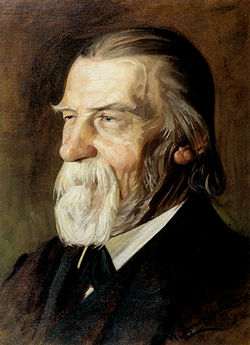
Wilhelm Raabe (1911), by Wilhelm Immenkamp [de]

Wilhelm Raabe (German pronunciation: [ˈvɪlhɛlm ˈʁaːbə] ; September 8, 1831 – November 15, 1910) was a German novelist. His early works were published under the pseudonym of Jakob Corvinus.[1]

Biography

[edit]

He was born in Eschershausen (then in the Duchy of Brunswick, now in the Holzminden District). After attending gymnasia in Holzminden and Wolfenbüttel, he entered a bookstore in Magdeburg as apprentice in 1849. He used this opportunity for wide reading and enriched himself with the tales and folklore of his own and other countries.[2] He remained an apprentice until 1854.[3]

Tiring of the routine of business, he then studied philosophy at Berlin (1855–1857). While a student at that university, under his pseudonym he published his first work, The Chronicle of Sparrow Lane (1857) (German: Die Chronik der Sperlingsgasse).[1] This book, which contains sketches of life among the German bourgeoisie,[2] quickly became popular.

With this encouragement, Raabe gave up his studies and devoted himself entirely to literary work.[2] He returned to Wolfenbüttel, and then lived (1862–1870) in Stuttgart.[1] Then he again returned to Brunswick and remained active until the end of the century, publishing upwards of 30 novels and a number of short stories and sketches. He died in 1910 and was buried in Braunschweig Main Cemetery.[2]

Work

[edit]
Painting by Wilhelm Immelkamp, 1909

Raabe's life work may be divided into three periods. During the first, he wrote with a light touch, producing a series of pictures of German life from the abundance of his imagination and experience, among which are:[2]

  • Die Chronik der Sperlingsgasse (1856)
  • Die Kinder von Finkenrode (1859)
  • Unser Herrgotts Kanzlei (1862)

The influence of the pessimism of Schopenhauer is evident during the second period. Representative works of this period are:[2]

  • Der Hungerpastor (1864)
  • Abu Telfan (1867)
  • Der Schüdderump (1870)

These three works are sometimes referred to as a trilogy. While they are independent of each other in substance, they do represent a distinct epoch in the life of Raabe.[2]

During the third period of the novelist's life his works no longer show this pessimistic strain. A genial humor pervades them, reminiscent of Dickens, though they frequently deal with serious subjects. Horacker (1876) perhaps best represents this tendency, and has been cited as his masterpiece. Der Dräumling (1872), and Deutscher Mondschein (1873), also come under this head. Of his numerous later works Das Odfeld (1889) and Die Akten des Vogelsangs (1895) seemed to be most read.[2] Kloster Lugau (1894) and Hastenbeck (1899) also belong to this period.[1]

Raabe's early works were influenced to some extent by Jean Paul. Later he shows evidences of having read Dickens and Thackeray.[2]

His estimation by the German people was especially shown at the celebration of his 70th birthday in 1901.[2] Beginning in 1965, the critical edition of Raabe's complete works was published as Sämtliche Werke (Braunschweiger Ausgabe) commissioned by the Braunschweigischen Wissenschaftlichen Gesellschaft and edited by Karl Hoppe.

Works

[edit]
  • Die Chronik der Sperlingsgasse, 1856
  • Ein Frühling, Der Weg zum Lachen, 1857
  • Die alte Universität, Der Student von Wittenberg, Weihnachtsgeister, Lorenz Scheibenhart, Einer aus der Menge, 1858
  • Die Kinder von Finkenrode, Der Junker von Denow, Wer kann es wenden? 1859
  • Aus dem Lebensbuch des Schulmeisterleins Michel Haas, Ein Geheimnis, 1860
  • Auf dunkelm Grunde, Die schwarze Galeere, Der heilige Born, Nach dem großen Kriege, 1861
  • Unseres Herrgotts Kanzlei, Das letzte Recht, 1862
  • Eine Grabrede aus dem Jahre 1609, Die Leute aus dem Walde, Holunderblüte, Die Hämelschen Kinder, 1863
  • Der Hungerpastor, Keltische Knochen, 1864
  • Else von der Tanne, Drei Federn, 1865
  • Die Gänse von Bützow, Sankt Thomas, Gedelöcke, 1866
  • Abu Telfan; oder Heimkehr aus dem Mondgebirge, 1867
  • Theklas Erbschaft, 1868
  • Im Siegeskranze, 1869
  • Der Schüdderump, Der Marsch nach Hause, Des Reiches Krone, 1870
  • Der Dräumling, 1872
  • Deutscher Mondschein, Christoph Pechlin, 1873
  • Meister Autor oder Die Geschichten vom versunkenen Garten, Höxter und Corvey, 1874
  • Frau Salome, Vom alten Proteus, Eulenpfingsten, 1875
  • Die Innerste, Der gute Tag, Horacker, 1876
  • Auf dem Altenteil, 1878
  • Alte Nester, Wunnigel, 1879
  • Deutscher Adel, 1880
  • Das Horn von Wanza, 1881
  • Fabian und Sebastian, 1882
  • Prinzessin Fisch, 1883
  • Villa Schönow, Pfisters Mühle, Zum wilden Mann, Ein Besuch, 1884
  • Unruhige Gäste, 1885
  • Im alten Eisen, 1887
  • Das Odfeld, 1888
  • Der Lar, 1889
  • Stopfkuchen, 1891
  • Gutmanns Reisen, 1892
  • Kloster Lugau, 1894
  • Die Akten des Vogelsangs, 1896
  • Hastenbeck, 1899
  • Altershausen (fragment, 1902; published 1911)

Raabe the painter

[edit]
Farmer's cottage in a heath landscape, oil, 37.0 × 23.2 cm.[4]

Raabe also had a less known talent for painting.[5] Approximately 600 of his works exist, partially in private ownership of his descendants or with the Braunschweig Museum.

Notes

[edit]
[edit]
Revisions and contributorsEdit on WikipediaRead on Wikipedia
from Grokipedia
Wilhelm Raabe is a German novelist known for his prolific output of realistic fiction that vividly depicts middle-class life, small-town communities, and social transformations in 19th-century Germany. Born on September 8, 1831, in Eschershausen in Lower Saxony, he briefly studied literature and philosophy at the University of Berlin but left without a degree to pursue writing, supporting himself initially as a bookseller before becoming a full-time freelance author in Berlin from 1855. His early breakthrough came with Die Chronik der Sperlingsgasse (1857), which brought popular acclaim, followed by major works such as Der Hungerpastor (1864), Abu Telfan (1868), Horacker, and Stopfkuchen (1891), many of which explore themes of morality, friendship, personal integrity, social mobility, and the everyday struggles of ordinary people. Raabe lived in various cities throughout his career, including Stuttgart and Wolfenbüttel, before settling in Braunschweig in 1870, where he remained until his death on November 15, 1910. His extensive body of work—encompassing dozens of novels, novellas, and short stories—reflects a grounded yet richly detailed style influenced by German Romanticism and attuned to the social changes of the Bismarckian era, including industrialization and unification. He sustained himself entirely through writing, an uncommon achievement among his contemporaries, and his narratives often serve as microcosms of broader societal tensions and human resilience. Raabe's fiction earned him recognition as one of the most productive and significant German prose writers of the nineteenth century, though later works did not always match the commercial success of his early novels. His legacy endures in German literature for its nuanced portrayal of bourgeois life, moral dilemmas, and the complexities of community in a changing world.

Early Life and Education

Childhood in Eschershausen

Wilhelm Raabe was born on September 8, 1831, in Eschershausen, a small town in the Duchy of Brunswick (now part of Lower Saxony, Germany). As the son of Gustav Karl Maximilian Raabe, a mid-ranking judicial officer serving as an actuary in the local administration, he came from a modest civil service family background. His mother was Auguste Johanne Frederike Jeep. The family relocated to the nearby town of Holzminden shortly after his birth, where Raabe spent much of his early childhood amid the regional rural and small-town setting of the Weser district. Raabe received his initial education in Holzminden's local schools and attended gymnasium in Holzminden and later in Wolfenbüttel, where he encountered classical literature and history, shaping his early intellectual development. Following the death of his father in 1845, when Raabe was fourteen, the family moved to Wolfenbüttel, and he continued his education there until leaving school in 1849 without completing the Abitur. These early years in the Brunswick region established the provincial North German context of his formative period before his later professional training.

Apprenticeship in Magdeburg

In 1849, Wilhelm Raabe began an apprenticeship as a bookseller in the Creutzschen Buchhandlung in Magdeburg, following his departure from school in Wolfenbüttel. This practical training in the book trade lasted until 1854, when he moved to Berlin. The position provided him with extensive access to the bookstore's library and antiquarian section, enabling intensive self-directed reading that exposed him to a wide array of world literature. During these years, Raabe immersed himself in the works of major authors, including Heinrich Heine, E. T. A. Hoffmann, and Ferdinand Freiligrath, as well as novels by Honoré de Balzac, Laurence Sterne, and Charles Dickens. This broad engagement with literary texts, facilitated by his daily surroundings in the book trade, deepened his intellectual development and fueled his emerging ambition to pursue writing as a vocation. The apprenticeship thus marked a crucial phase of independent literary exploration before he moved to Berlin for further studies.

Studies in Berlin

Wilhelm Raabe moved to Berlin in 1854 and enrolled as a Gasthörer (non-matriculated auditor) at the Friedrich-Wilhelms-Universität zu Berlin (now Humboldt-Universität), where he attended lectures in philology and related subjects without completing a degree. This period marked a transitional phase after his apprenticeship in Magdeburg, during which he pursued broader intellectual interests while beginning to develop his literary ambitions. While in Berlin, Raabe completed and published his first major work, Die Chronik der Sperlingsgasse, under the pseudonym Jakob Corvinus. The novel appeared in 1856, though the first edition was dated 1857, and it quickly gained popularity. The book's success prompted Raabe to leave his studies and devote himself entirely to a literary career. He subsequently returned to Wolfenbüttel.

Literary Career

Breakthrough and Early Works

Raabe's literary career began with publications under the pseudonym Jakob Corvinus from 1856 to 1861, a name derived from the Latin word for raven to reflect his own surname. His first novel, Die Chronik der Sperlingsgasse, which he started writing on November 15, 1854, appeared in 1856 under this pseudonym (with a title page imprint of 1857) and brought him positive critical reception along with broad public success that enabled him to pursue writing full-time. The work presents a framed narrative in which an elderly scholar chronicles the interconnected lives and memories of residents in a modest Berlin alley across generations, offering a detailed portrayal of bourgeois existence and everyday human relationships in mid-19th-century Germany. Raabe's early imaginative and self-reflexive style drew significant influence from Jean Paul, with traces of Jean Paul's symbolic coding, witty imagination, and self-aware narrative techniques already visible in Die Chronik der Sperlingsgasse. Subsequent early works built on this foundation, including Die Kinder von Finkenrode (1859), which showed emerging socio-critical awareness amid sentimental elements, and Unseres Herrgotts Kanzlei (1862), a historical narrative. In 1862 Raabe relocated to Stuttgart, marking the transition to a new phase in his career.

Stuttgart Period and Thematic Trilogy

Wilhelm Raabe relocated to Stuttgart in 1862 following his marriage to Bertha Leiste, residing there until 1870 in a period marked by intensive literary output and commercial popularity. This phase saw him produce several major novels amid a more stimulating cultural environment that facilitated serialization and publication. The central works of these years are Der Hungerpastor (1864), Abu Telfan (1868), and Der Schüdderump (1870), which scholars conventionally group as a thematic trilogy focused on individual struggles against overwhelming social, moral, and existential forces. These novels display an increasingly pronounced pessimism, reflecting a dark view of human life and suffering that aligns with Schopenhauerian influences. Der Hungerpastor, in particular, achieved lasting fame and provided Raabe with significant financial stability over subsequent decades, though it has faced criticism (including contemporary accusations) for its portrayal of Jewish characters. Although frequently termed a trilogy in Raabe scholarship for their essential thematic unity, the grouping is a critical construct rather than a deliberate plan by the author himself. The deepening pessimism evident across these works ultimately contributed to discouragement, leading to his relocation to Braunschweig in 1870.

Braunschweig Period and Mature Style

In 1870 Wilhelm Raabe moved permanently to Braunschweig, where he resided until his death in 1910. This final phase of his life, spanning four decades, marked his mature period as a writer, during which he shifted toward more intricate shorter novels and stories after initially living obscurely in the city before gaining local recognition. Raabe's mature style in Braunschweig exhibited a remarkably modern sensibility, with greater originality in form and narrative technique, often featuring quirky outsiders and isolated characters confronting a rapidly changing world. Influenced by Charles Dickens, his later works incorporated genial humor and compassionate humanity, even when addressing serious themes, marking a turn toward more humorous and balanced portrayals compared to earlier phases. Key masterpieces from this period include Horacker (1876), Das Odfeld (1888), Stopfkuchen (1891), Die Akten des Vogelsangs (1896), and Hastenbeck (1899). These works, regarded as his most original and artistically accomplished, highlight rich character studies and a compassionate view of humanity, with Stopfkuchen frequently cited as a high point of his achievement. Through these narratives Raabe explored themes of societal transformation and individual adaptation, often with a forgiving, humorous perspective that reflected acceptance of change amid the complexities of modern life.

Personal Life

Marriage and Family

Wilhelm Raabe married Berta Emilie Wilhelmine Leiste on July 24, 1862. This union coincided with his relocation to Stuttgart that year. The marriage produced four children. His wife survived him following his death in 1910.

Residences and Travels

After his time as a guest student in Berlin ended in 1856, Wilhelm Raabe returned to Wolfenbüttel, where he resided and worked as a freelance writer until 1862. During these years in Wolfenbüttel, his early career included several travels across Germany and into the Austrian Empire, notably an educational journey in 1859 that took him to Prague and Vienna, as well as trips to Coburg in 1860 and Heidelberg in 1861 to attend meetings of the Deutscher Nationalverein as a delegate. In 1862 Raabe moved to Stuttgart, residing in the city until 1870. In 1870 he relocated to Braunschweig, settling in the house at Leonhardstraße 29a that became his permanent home for the next forty years until his death there in 1910.

Other Pursuits

Painting

Wilhelm Raabe was an enthusiastic amateur painter who produced more than 550 watercolors and drawings, along with some oil paintings, over the course of his life. These works served as a personal hobby alongside his primary career as a writer and were often created in private or for family and friends. Many of Raabe's surviving paintings and drawings are landscapes and figurative motifs, often executed in watercolor, pen, pencil, or occasionally oil, sometimes in a humorous or caricatural style. Some are held in public collections in Braunschweig, including those archived by the Stadtarchiv Braunschweig and exhibited at the Städtisches Museum Braunschweig, while others remain with his descendants or in private hands. Raabe continued this artistic pursuit until late in his life during his Braunschweig period. His painting activity remained largely separate from his literary output, though it reflected a lifelong interest in visual expression.

Death

Legacy

Literary Reception

Wilhelm Raabe enjoyed considerable popularity among German readers during his lifetime, particularly through works such as Die Chronik der Sperlingsgasse (1857), which brought him initial financial success and acclaim. While some later works achieved more modest sales, his ability to sustain himself entirely through writing reflected sustained reader interest across his career. Public appreciation for Raabe often outpaced contemporary critical acclaim, as his narrative style and focus on everyday German life resonated widely with general audiences, though scholarly recognition was more gradual. This high esteem among the German public was especially evident in the national celebration of his 70th birthday in 1901, an event that highlighted his standing as a beloved author. Following his death in 1910, Raabe's reputation solidified over time, with posthumous scholarship affirming his place as a major figure in 19th-century German realism through detailed studies of his narrative techniques and social observations. The critical edition of his complete works, known as the Braunschweiger Ausgabe, began publication in 1965 under the auspices of the Braunschweigische Wissenschaftliche Gesellschaft and has served as the standard scholarly reference, supporting ongoing analysis of his contributions to literary realism.

Posthumous Adaptations in Film and Television

Several of Wilhelm Raabe's works have been adapted into film and television productions after his death in 1910, though such adaptations remain relatively few and primarily credit him as the original author or novelist without any direct involvement on his part. The 1962 East German DEFA feature film Die schwarze Galeere, directed by Martin Hellberg, is based on Raabe's novella of the same name and represents one of the more prominent cinematic treatments of his fiction. Raabe's historical Erzählung Die Gänse von Bützow has been adapted twice: first as a 1960 television movie and later as a 1985 DEFA feature film directed by Frank Vogel, both drawing directly from his original story. The 1978 television movie Wunnigel, directed by Oswald Döpke, adapts Raabe's novel of the same title. These posthumous adaptations reflect the enduring interest in Raabe's fiction across different eras and media formats.

References

Add your contribution
Related Hubs
User Avatar
No comments yet.