


Community hub
Recent from talks
Contribute something
Nothing was collected or created yet.
Wingspread
View on Wikipedia
Herbert F. Johnson House | |
 | |
   | |
| Nearest city | 33 East Four Mile Road, Wind Point, Wisconsin, U.S. |
|---|---|
| Coordinates | 42°46′49″N 87°46′15″W / 42.78028°N 87.77083°W |
| Area | 30 acres (12 ha) |
| Built | 1938–1939 |
| Architect | Frank Lloyd Wright |
| Architectural style | Prairie School |
| NRHP reference No. | 75000076 |
| Significant dates | |
| Added to NRHP | January 8, 1975[1] |
| Designated NHL | June 29, 1989[2] |
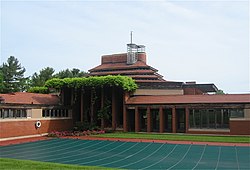
Wingspread (also known as the Herbert F. Johnson House) is a conference center and house in Wind Point, Wisconsin, United States. Designed by Frank Lloyd Wright, it was built between 1938 and 1939 for the businessman Herbert Fisk Johnson Jr., the president of S.C. Johnson. With a floor area of 14,000 square feet (1,300 m2), it is one of the largest residences designed by Wright, who also called the building the last of his Prairie style houses. Since 1960, the property has been a conference center operated by the Johnson Foundation. The property is listed on the National Register of Historic Places and is designated a National Historic Landmark.
Wingspread stands near the center of the Wind Point peninsula on Lake Michigan north of the city of Racine. The facade is largely made of brick, with stucco and sandstone courses and red roof tiles. It consists of a central hub, from which four wings radiate. The living room at the center is a domed structure, with clerestory windows on the sides, a central elliptical chimney, and a viewing platform at the top. There are separate wings for the master bedrooms, children's rooms, service rooms, and guest bedrooms. All of the wings are one story tall, except for the master bedroom wing, which has a mezzanine level.
The house was built between 1938 and 1939. The Johnson family donated the property to the Johnson Foundation in 1960 as an international educational conference facility, which is also open to the public for tours. The conference center was dedicated on June 24, 1961, several months after hosting its first conferences in November 1960. It was hosting 100 conferences a year by the 1980s, with meetings focusing on education, family affairs, society, and international relations. The roof was repaired in the 1990s following deterioration.
Site
[edit]Wingspread (also the Herbert F. Johnson House[3]), built for the family of businessman Herbert Fisk Johnson Jr., is at 33 East Four Mile Road in Wind Point, Wisconsin, United States.[4] It occupies a peninsula extending into Lake Michigan north of the city of Racine.[5][6][7] The grounds cover 30 acres (12 ha).[5][8][9][a] The house is surrounded by green space and a ravine,[5][6][7] overlooking a series of ponds.[12] Some parts of the estate are lawns that are mowed frequently, while other sections are left as wild marshland to attract migratory birds.[7] When the house was built, a stream separated the site from the surrounding farms.[13] There are also numerous ponds and a stream draining into Lake Michigan.[7]
The estate includes several pieces of sculpture by artists such as David Aronson, Robert Cook, Jose de Creeft, Emilio Greco, Milton Hebald, Berto Lardera, Carl Milles, and Abbott Pattison.[14][15] Hebald's sculpture Amanti (1964) is a 6-foot-tall (1.8 m) depiction of two young lovers.[16] Within the garden is Primavera (1966) by Greco, which consists of a 47-inch-tall (1.2 m) bronze figure of a woman surrounded by three limbs. Quartet (1966) by Cook, located on the house's cypress terrace, is a larger bronze sculpture with four abstract figures.[17] Other works include Lardera's Amour des Etoiles (1964)[18] and Pattison's Homage to Van Gogh (1971).[15]
The grounds also include a building called The House, an office building, and structures for storage and maintenance.[4] In 2002, a 40-room hotel called the Guest House was built for people attending conferences at Wingspread. The Guest House, containing about 40,000 square feet (3,700 m2) over two stories, was designed to complement the architecture of Wingspread.[19] As of 2018[update], the Guest House is operated by Benchmark Resorts & Hotels.[20]
Architecture
[edit]The house was designed by Frank Lloyd Wright, who called the building the last of his Prairie style houses.[5][6][21] According to the writer Brendan Gill, this comment was likely facetious, since the architect was known to compliment his own work and then downplay the remark "in seeming modesty".[21] The house's first story is mostly located near the ground, except for the eastern portion, where Wingspread overlooks a pond.[5] Wright said the building enhanced the appearance of the otherwise "undistinguished" site.[5][22] The house is one of five buildings that Wright designed around Racine, the others being the Johnson Wax Headquarters' Administration Building and Research Tower, the Keland House, and the Hardy House.[23]
Exterior
[edit]The house's shape prompted Wright to nickname it Wingspread;[24][25][26] as he wrote, "We called the house 'Wingspread' because spread its wings it did."[9][27] The floor plan consists of a central octagonal hub, the living room, from which four wings radiate in a pinwheel configuration.[24][28][29] The radiating wings contrasted with the layout of the Johnson Wax Headquarters (built for Johnson's firm S. C. Johnson & Son), in which the interiors were arranged tightly around a core.[30] Wingspread's wings are perpendicular to each other, extending off the corners of the living room.[28] Each wing has a similar length,[28] and, except for the double-story master-bedroom wing to the north, are all one story high.[31][32][33] To allow each wing to receive sunlight, the entire building is rotated slightly from due north.[34]
The facade is largely built of Cherokee red brick,[24][27] which was made in Illinois.[35] The brick is slightly concave, creating small shadows throughout the day.[13] The facade also includes horizontal courses made of stucco and sandstone, and the roof tiles are painted red.[24][27] There are siding boards and vine-covered pergolas made of cypress.[24][36] Red cypress from Tidewater was used because it was more resistant to rotting than other types of wood.[37] Wingspread has about 500 windows on its facade,[38] which were positioned to maximize views of the surrounding landscape.[26] Among these are 16-foot-tall (4.9 m) windows on the living room's exterior, interspersed with alternating narrow and wide brick piers.[9][39] There are three levels of clerestory windows on the roof,[40][41][42] which have a total of 190 window panes.[43] These clerestory windows divide the roof into three tiers.[8][44] The rest of the facade has windows with thick wooden frames.[31] Since a restoration in the 1990s, one-quarter of the roof beams are made of carbon fiber,[25] a material that had not existed when Wright built the house.[45][46]

The entrance to the house is hidden, like in many of Wright's houses. It is also smaller than the primary living spaces inside, an example of the compression-and-release principle that Wright espoused.[47] The house's chimney is elliptical[6][48] and rises 30 feet (9.1 m).[41][49][10] The shape of the chimney differs from the chimney stacks in Wright's other houses, which tended to have angles.[38] There is a "crow's nest",[50] a glass observatory above the chimney, which was used by Johnson's children.[9][24][51] In addition, there is a swimming pool next to the house,[13][52] which has an outdoor fireplace.[52][53] The pool measures 125 by 25 feet (38.1 by 7.6 m) across[52] and have pink walls that give the appearance of disappearing into the pool.[54] Wright, who considered swimming pools to be "outdoor bathtubs", reluctantly included the pool at the Johnson family's request.[52]
Interior
[edit]The house has a floor area of 14,000 square feet (1,300 m2),[22][55][56] making it among Wright's largest house designs.[38][11] The interiors are decorated with Cherokee-red brick and pink sandstone;[28] the mortar between the brick is deeply rusticated.[9] The plaster walls have a wax finish, which was then colored rust-rose. Parts of the ceiling are also made of plaster with a mustard-yellow wax finish.[57] The house includes furniture from Gillen Woodworking,[57][58] which also manufactured furniture for Fallingwater, the residence of Edgar J. Kaufmann in Pennsylvania.[58] The woodwork in the house is made of American oak and is oriented horizontally to emphasize the architectural details.[57][36] There are notches carved into the wood. In addition, there are sandstone and stucco walls within each wing.[9]
The four wings originally had separate functions,[13] creating distinct zones.[8][59][60] The zoned plan had been Johnson's idea;[12] it contrasted with Wright's earlier Prairie-style houses, in which separate rooms appeared to blend with one another.[61] One wing each was devoted to the master bedroom, service rooms, guest rooms, and children's rooms.[56][60][62] As designed, the entrance doorway is only about 6 feet (1.8 m) high,[9][63][41] and there are seven fireplaces.[38] Wright also designed furniture for the house, such as lamps, some of which were built in.[43] One of the house's pieces of furniture, a barrel-shaped chair, was sold for $33,000 in 1988.[64] In addition, replicas of the house's rhombus-shaped cocktail tables have been sold over the years.[65]
Living room
[edit]
At the center of the building is the living room, sometimes known as the Great Hall.[66] The living room may have been inspired in part by the Palm Room in Chicago's Drake Hotel, with which Johnson had been impressed.[13] The living area measures 40 by 60 feet (12 by 18 m).[9][32][34][b] It has a concrete floor and originally had a radiant heating system embedded underneath the floor slab.[34] The floor is covered with Cherokee red tiles measuring 4 by 4 feet (1.2 by 1.2 m).[9][38] Glass doors on all four sides of the living room lead to outdoor terraces.[36] When the house was built, the living room had a phonograph system produced by the Seeburg Corporation, which could accommodate 200 records.[52] The living room also has several built-in couches, as well as octagonal pieces of furniture that are not built in.[9][41] There are some barrel-shaped chairs, similar to those built for the Darwin D. Martin House in Buffalo, New York.[67]
The spaces surround the chimney, with five fireplaces extending off it on two levels,[24][32][41] a layout partially derived from the design for the unbuilt Nakoma Country Club in Madison, Wisconsin.[12] There are fireplaces on all four sides of the chimney at ground level, while the fifth fireplace is on the mezzanine level.[8][36][57] The fireplace mantels are made of Kasota stone from Minnesota, and Wright also added a hanging kettle next to the fireplace, in case visitors wanted hot beverages.[68] Wright referred to the living room as a "wigwam", given how the chimney's rooftop opening resembled the smokestack of a Native American wigwam.[24][32] Next to the chimney is a spiral staircase, which was not included in the original plan and leads to the building's glass observatory.[31][34] Within the observatory, Johnson's children could watch their father work, or they could observe the surrounding landscape and Lake Michigan.[52]

Low partitions divide the living room into multiple zones,[34] which surround the chimney.[12] The house's original dining area, within a portion of the living room, adjoins the servants' wing;[57][36] it has a movable table that can be slid back into the kitchen, although this feature was impractical because it required the servants and occupants to coordinate with each other.[9][43] The mezzanine extends off one side of the living room, leading to the master bedroom wing;[62][36] it is clad with sculpted oak.[9] In addition, Wright included several smaller spaces, which he described as "different holes to crawl into".[57] For example, underneath the mezzanine is a sitting room with a low ceiling, which includes an alcove with a library.[36][57][8] Also under the mezzanine is a set of doors leading to a terrace where the house's occupants could plug hot plates into the wall.[57] The ceiling of the living room is domed[6][40] and is 30 feet (9.1 m) high.[28]
Wings
[edit]The master bedroom wing runs north[9][33] between the living room's mezzanine and a porch cantilevered off the building.[62][36] This wing has five rooms.[9] Johnson slept in the master-bedroom wing, and his daughter Karen slept on the mezzanine-level balcony.[13][69] Sources disagree on whether Karen had requested that the balcony be added after visiting Wright's Taliesin studio,[69] or whether Johnson requested the balcony for his daughter.[70] Wright's apprentice Edgar Tafel added a storage vault underneath the mezzanine, allowing him to conceal a support beam.[69] The mezzanine itself has a wooden floor.[26][33] The portion of the mezzanine in the living room functions as a sitting room with a fireplace.[57] The fireplace could accommodate one 12-foot-long (3.7 m) log, which had to be hung vertically; the logs tended to fall over after their bottoms had burned.[71] A staircase leads to the mezzanine from the living area.[9][33]
The guest wing to the west adjoins the house's garage or carport,[9][72] since virtually all visitors arrived via automobile.[13] The garage could fit four[72] or five cars.[73] A servants' wing extends to the south, along the west side of the house's swimming pool;[9][72] it has a kitchen, servants' bedrooms, and a porch for servants.[13] The east wing, north of the swimming pool, was originally used by the Johnson children[62][36] and has a playroom or terrace room.[9][72]
After the building was converted into a conference center in 1960, two wings were turned into offices for the foundation, while the other two wings were used as conference space.[74] The portion of the south (kitchen) wing next to the living room is still used as a kitchen, though the rest of the wing is used as offices. The west wing is also used as offices.[72] The east wing is used for plenary sessions during conferences,[72] while the north wing is used as meeting rooms.[33] The conference center also includes dining areas, a library, exhibition space, and a theater.[75] In addition, the raised basement below the living areas has cloakrooms and restrooms; that space had been used as storage when the Johnson family lived there.[33]
History
[edit]Wingspread was built for the businessman Herbert F. Johnson Jr., who in 1935 commissioned Frank Lloyd Wright to design the nearby Johnson Wax Headquarters' Administration Building in Racine.[76][77] Wright reportedly offered to build Johnson a house after the businessman told Wright that he wanted to live in the Administration Building because it was "so beautiful and attractive".[78] Johnson married Jane Roach the next year.[32] The Johnson–Roach stepfamily had four children:[32][78] Johnson's daughter Karen, his son Sam, and Roach's two sons.[79] They quickly outgrew the Johnson house at 1739 Wisconsin Avenue in Racine.[80]
Private residence
[edit]
As the Administration Building was being completed, Johnson asked Wright to design a mansion on the Wind Point site.[81][82] Johnson owned 50 acres (20 ha) at Wind Point near Lake Michigan,[13] and he and Roach gave Wright a tour of the site in late 1936.[32][78] During this visit, Johnson showed Wright a sketch of his ideal house, which consisted of several "zones"; the architect went on to refine these plans.[12] Wright designed the house from his Taliesin studio in Spring Green, Wisconsin.[83] Work on the house began in May 1938.[32] Ben Wiltscheck, who had built the Johnson Wax Administration Building, was also hired to construct the house,[14][32] while Edgar Tafel supervised construction.[69][84] After Roach died partway through construction, Johnson nearly canceled the project, but he ultimately decided to finish it.[22][56] Legend has it that a white dove perched on the house before flying away, foreshadowing the fact that "the young mistress will never live in this house".[9][56]
The house was finished in 1939.[63] The completion of the Herbert F. Johnson House and the Johnson Wax Headquarters were among several that helped revive Wright's career, which had stalled in the 1930s.[85] Johnson's children were initially hesitant to move to the house but eventually became fond of it; Sam likened it to a spaceship.[52] Sam Johnson recalled that, after the family moved to Wind Point, "I thought my friends would never find me, but they would all get on their bikes and come out here and we'd have a wonderful time."[86] The domed observatory and Karen Johnson's balcony-level sleeping area were added at the request of Johnson's children.[69] In 1941, Johnson married his third wife Irene Purcell,[79][87] who moved into the house.[87][88] After the Johnson House was completed, it suffered from leaks. According to Sam Johnson, his father was once entertaining guests at the house when the roof started to leak.[89] When Herbert Johnson called Wright to complain, the architect reportedly told him to move his chair.[25][43][90][c] The radiant heating system beneath the floor slabs also did not work and had to be removed.[9]
The Johnson family lived at Wingspread for two decades.[63] Among their guests were the ballet dancers Alicia Markova and Anton Dolin, who visited the Johnsons in 1947.[91] By the late 1940s, the Johnsons lived at Palm Springs, California during the winter, while their friends in California sometimes stayed at the Johnson House.[92] Purcell redecorated the house because she did not like its original design. According to one account, on one visit to the house, Wright woke up in the very early morning to remove the decorations.[88][93][94] Sam Johnson wrote that he did not recall Wright and Purcell communicating much after that incident.[88] Wright visited the Johnson House again in 1954 whereupon, after a bout of indigestion that he thought was a heart attack, he told Johnson's daughter Karen to "come and watch how a great man dies"[73] (he lived for five more years).[95] The Johnson family moved out of Wingspread in 1959, relocating to a neighboring house that better reflected Purcell's design ideals.[47]
Conference center
[edit]1960s to 1980s
[edit]
The Johnson family donated the property in 1960 to the Johnson Foundation,[36][96] led by Leslie Paffrath.[97][98] Very few major changes were required.[31][36] Among the modifications that did take place were the addition of restrooms,[31][33] the conversion of the garage into offices, and the conversion of the playroom into a conference room.[73] Some of the interior walls were also demolished.[33] Initially, there were five conference rooms, and the house was closed to the public aside from conferences.[59] Although Wingspread was the only structure on the estate, the foundation planned to add other buildings such as an auditorium and overnight sleeping quarters.[99] The Johnson Foundation hosted its first major conference, a Midwest Regional American Assembly meeting, at Wingspread on November 17, 1960.[100] The conference center was formally dedicated June 24, 1961,[63][96][101] with a ceremony attended by Wright's widow Olgivanna.[102] At this point, the house had already hosted 50 events.[103]
Most of the house's earliest conferences attracted no more than 75 to 100 attendees,[99] and the foundation had to issue timed-entry tickets for some events due to relatively limited capacity.[104] During the house's first two years as a conference center, it hosted discussions on such topics as China–United States relations, arms control, and higher education careers.[105] Several colleges held events at the house, including orientations for new teachers, retirement parties, and briefings for college students.[106] The conference center's earliest visitors included former U.S. first lady Eleanor Roosevelt; former United Nations General Assembly president Frederick Boland; and poets Archibald MacLeish, Karl Shapiro, and Mark Van Doren.[107][105] The National Endowment for the Arts and National Public Radio were also established during meetings at Wingspread in the early 1960s.[25][108] Wingspread started hosting opera performances in 1964,[109] and it also hosted visual art exhibits[75] and the annual Wingspread Conference on foreign policy.[110]
Johnson's widow Irene Purcell donated eight sculptures to Wingspread in the 1960s and early 1970s.[15][111] In 1963, Milton Hebald was hired to create a sculpture named Amanti for the estate;[16] this artwork was dedicated the next year.[112] By then, the building was hosting up to 150 events a year, and 50,000 people had attended conferences at Wingspread in the conference center's first six years.[75] Berto Lardera's sculpture Amour des Etoiles (Love of the Stars) was dedicated in 1965,[18][113] and two more sculptures, Emilio Greco's Primavera and Robert Cook's Quartet, were added to the estate the next year.[112][114] By the late 1960s, the Johnson Foundation was considering expanding the conference center.[115] Another sculpture on the estate, Homage to Van Gogh by Abbott Pattison, was dedicated in 1971.[15] During this decade, the house attracted between 3,500 and 5,000 conference attendees every year.[116]
Paffrath continued to lead Wingspread and the Johnson Foundation until 1980,[117] at which point University of Oregon president William Boyd became the foundation's president.[118][119] By then, Wingspread hosted up to 100 conferences a year,[117][9] including 75 three-day-long conferences and 25 one-day-long conferences.[120] These events generally attracted 25 to 50 people each, and the foundation spent $2 million annually to host these conferences.[9] During a particularly contentious meeting in 1985 that attracted protests,[121] Wingspread's grounds were closed to non-attendees for the first time in the conference center's history.[122] Boyd retired as Wingspread's president in 1988[119] and was succeeded that year by Charles William Bray, a former U.S. ambassador to Senegal.[123]
1990s to present
[edit]
By the 1990s, the Johnson Foundation spent $3 million annually to organize conferences at Wingspread.[124] The living room's roof began to sag by up to 3 inches (76 mm) during 1993 and 1994 after particularly severe winter weather caused ice accumulations.[25] The roof joints had already begun to crack, and the ice buildups exacerbated these issues. After learning of the roof problems in May 1994, the Johnson Foundation restricted access to the living room.[42] The condition of the roof prompted the Johnson Foundation to announce in July 1994 that the house would be closed for the rest of the year.[42][125] Foundation employees were allowed to continue using their offices in the building, while visitors could use the rooms in each wing, but conferences were moved to an outbuilding called the House.[125]
The roof was repaired in the late 1990s.[66][25] To avoid altering the building's historic design features, workers could not remove parts of the roof and add steel beams to replace the existing, weakened ones.[25] Instead, the existing roof tiles were removed temporarily so a waterproof membrane or flashing could be installed.[25][126] The new membrane, composed of carbon fiber, epoxy resin, and fiberglass, was then covered with slate tiles.[127] The old skylight panels were also replaced with insulated panels.[126] About one-quarter of the wooden roof beams were replaced with carbon fiber beams,[25] each weighing 200 pounds (91 kg).[128] Although carbon fiber had not existed when the house was built, restoration architect Robert Silman decided to use it after a Taliesin director said that Wright would have used the material if it had been invented during his lifetime.[46] Copper tubes were installed to replace lead tubes that were toxic.[25] After the roof above the house's east wing was finished in March 1996, a temporary wooden shell was built above the living room to protect the original roof.[44] Wingspread reopened in June 1997 after the repairs were completed.[129]
Bray served as Wingspread's president until November 1997, being succeeded by Boyd Gibbons.[130][131] Under Gibbons's leadership, the Johnson Foundation began planning the Guest House, a 40-room hotel on the Wingspread campus for conference attendees.[131][19] At the time, people visiting Wingspread had to book hotel rooms nearby instead of staying on the campus.[132] Plans for the hotel were announced in 2000,[132] and the Guest House was opened in January 2002.[19][133] Gibbons retired as Wingspread's president in 2006[131] and was succeeded by Roger Dower the next year.[134][135] By then, the foundation employed 15 people at the house.[135] The Johnson Foundation appointed Marcus White as its president in 2020, following Dower's retirement.[136] In 2023, SC Johnson bought 13 acres (5.3 ha) next to Wingspread.[137]
Management
[edit]
Wingspread is operated by the Johnson Foundation, a philanthropic organization that maintains Wingspread as a forum for meetings and debates.[119][138] The foundation was established in January 1959 for "charitable, educational or religious purposes", with Leslie Paffrath as its first president[97][98] and Barbara Sargent as its only other employee.[139] The Johnson Foundation replaced a Wisconsin-based foundation of the same name; the newer foundation was incorporated in New York state, which had more permissive laws regarding philanthropic organizations than Wisconsin did.[140] The new foundation was initially headquartered in Racine, but from the outset, there were plans to set up permanent headquarters at the Herbert F. Johnson House.[97] It receives income from S. C. Johnson & Son, members of the Johnson family, and its endowment fund.[141][120]
Conferences
[edit]The Johnson Foundation has helped plan conferences and meetings at the house, including organizing transportation and lodging for visitors.[142] Conferences are restricted to a small number of topics, including education, society, and international relations.[124][143] Topics for conferences are either solicited through mail, chosen by organizations already affiliated with the foundation, or selected directly by the foundation's board of trustees.[120] Events are organized by a board of trustees with nine members.[124] The foundation does not take an official stance on any of the topics discussed during meetings.[138][143] Dignitaries from around the world have attended meetings there.[108] Wingspread's in-house kitchen staff prepares American cuisine for events at the house, though they could also accommodate dietary requests, such as requests for kosher and vegetarian food.[144] The conference center has also hosted concerts, exhibits, and lectures for the local community.[145]
Highlights from meetings at Wingspread are published in a quarterly newsletter called the Wingspread Journal.[142][146] The foundation also distributed grants for conferences at Wingspread or for other projects,[107] though this was no longer done by the late 1980s.[119] From 1972 to c. 1987–1988, the Johnson Foundation hosted a radio series called Conversations from Wingspread,[147][148] which included recordings of conferences at Wingspread.[149] The foundation received the Peabody Award for Conversations from Wingspread in 1975,[150] as well as the George Washington Honor Medal Award in 1977 and the Ohio State Award in 1978.[151] A revival of Conversations from Wingspread was launched in 1998.[147]
Tours
[edit]The house is also open to the public for tours.[152][153] In the late 20th century, anyone could tour the house if they booked in advance;[154][71] if a conference was taking place, only the grounds were open to the public.[9] Guides showed some notable features of the house to guests before allowing them to take self-guided tours.[71] Reservations were still required for tours in the 21st century;[56][90] starting in 2014, tours of Wingspread could be booked from the Johnson Wax Headquarters.[11][155] As of 2023[update], free tours of the Wingspread complex were given three times a day, five days a week, if no other events were being hosted there.[56]
Impact
[edit]Reception
[edit]
Shortly after the house was completed, a writer for Town and Country magazine wrote that Wingspread "is timeless architecture, standing on its own native nobility, owing nothing to what [Wright] calls borrowings from the nobility of little England".[13][156] Another news source wrote that "there is nothing static about the design of Wingspread", highlighting the layout of its arms.[156] The Post-Crescent wrote that Japanese visitors tended to liken Wingspread to Wright's Imperial Hotel, Tokyo.[26] Several sources likened Wingspread to a maritime vessel. For instance, Henry-Russell Hitchcock characterized Wingspread as "floating on waves",[141][157] the La Crosse Tribune compared the building to an ocean liner gliding on the prairie,[36] and The Globe and Mail likened the building to "ship on a sea of small hills".[158] Conversely, in his biography of Wright, the writer Brendan Gill regarded the house critically, saying: "A true folly, it imposes itself upon its site instead of accommodating to it," despite Wright's claim that Wingspread's presence improved the site.[22]
The Miami Herald said that the "wood is used structurally and sculpturally", blending in with the red brick.[31] The writer Richard Kinch stated in 1981 that "the visitor to Wingspread may feel awed, or delighted, perhaps charmed—but indifferent the visitor cannot be."[159] A 1986 article for the Journal Times said that "nature and structure seem to have been living in perfect harmony" at Wingspread, despite its brick-and-masonry construction.[120] A writer for the Journal Times said in 1993 that Wingspread and the Johnson Wax Headquarters "overshadow the rest of the architecture in Racine County" because they were so well-known.[160] The next year, a writer for The Wilson Quarterly said that "Wingspread is probably the grandest Wright country house" besides Wright's own houses, Taliesin North in Wisconsin and Taliesin West in Arizona.[161] A writer for The New York Times called the building "a prime example of Wright's organic architecture",[90] while the Financial Times called it "a pharaonic ornament cast in Cherokee red".[162] The Weekend Australian said in 2011 that "On a bright and warm autumn day, it is a delight", but that the house was cold and drafty during the winters.[163]
Of the building's function as a conference center, the Racine Journal-Times Sunday Bulletin wrote in 1961 that Wingspread could be "more than a monument to the genius of Frank Lloyd Wright, and more than a monument to the generosity of Herbert F. Johnson".[164] A reporter for The Baltimore Sun said in 1982 that the house "nonetheless has made the transition [to a conference center] with apparent ease and only minor alteration" and that conference attendees could still feel at home in Wingspread's various rooms.[9] A 1994 article in the Journal Times described the house as a tranquil place where "even in the midst of the most heated controversies, opponents may find common ground".[124]
Media and landmark designations
[edit]The building is detailed in several books, including the Johnson Foundation's 1981 book Wingspread–The Building;[165] Jonathan Lipman's 1986 book Frank Lloyd Wright and the Johnson Wax Buildings,[85][166] and M. Caren Connolly and Louis Wasserman's 2010 book Wisconsin's Own: Twenty Remarkable Homes.[167] The structure is also the subject of Frank Lloyd Wright's Wingspread, a 47-minute documentary by PBS.[168] Its hearth and oversized chimney inspired that in another house on Kiawah Island, South Carolina.[169] and the Museum of Modern Art in New York owns an architectural model of the building.[170] The property was listed on the National Register of Historic Places in 1975,[1] and was designated a National Historic Landmark in 1989.[11][171] Wingspread is also part of the Frank Lloyd Wright Trail, a collection of sites in Wisconsin designed by Wright, which was established in 2017.[153][172]
See also
[edit]References
[edit]Notes
[edit]- ^ A 1981 publication from the building's owner, the Johnson Foundation, cites the site as covering 12 acres (4.9 ha).[6] Other sources have given figures as high as 36 acres (15 ha).[10][11]
- ^ One source gives a conflicting figure of 38 by 50 feet (12 by 15 m).[60]
- ^ Gill 1987, p. 271, cites a slightly different version of this anecdote in which Wright reportedly told Johnson to move a table.
Citations
[edit]- ^ a b "National Register Information System". National Register of Historic Places. National Park Service. January 23, 2007.
- ^ "Herbert F. Johnson House". National Historic Landmark summary listing. National Park Service. Archived from the original on April 3, 2009. Retrieved December 31, 2007.
- ^ "AD Classics: Wingspread / Frank Lloyd Wright". ArchDaily. February 25, 2011. Archived from the original on May 13, 2025. Retrieved February 17, 2025.
- ^ a b "Wingspread's aura encourages collaboration". The Journal Times. December 9, 1996. pp. 1B, 4B. Retrieved February 16, 2025 – via newspapers.com.
- ^ a b c d e f Kinch 1981, p. 7.
- ^ a b c d e f National Park Service 1989, p. 2.
- ^ a b c d "Wingspread grounds are beautiful". Times Press. October 22, 1981. p. 33. Archived from the original on April 26, 2025. Retrieved February 17, 2025 – via newspapers.com.
- ^ a b c d e National Park Service 1989, p. 3.
- ^ a b c d e f g h i j k l m n o p q r s t u v w x Benjamin, Robert (April 11, 1982). "Wingspread A house of two lives". The Baltimore Sun. pp. T1, T2. ISSN 1930-8965. ProQuest 538094656. Archived from the original on April 26, 2025. Retrieved February 17, 2025 – via newspapers.com.
- ^ a b "Wisconsin tour offers compelling look at Wright's architecture". The Central New Jersey Home News. March 7, 2004. p. 61. Archived from the original on April 27, 2025. Retrieved February 18, 2025 – via newspapers.com.
- ^ a b c d "Wingspread". Portage Daily Register. September 27, 2014. pp. B1, B2. Archived from the original on May 29, 2025. Retrieved February 20, 2025 – via newspapers.com.
- ^ a b c d e Hertzberg 2004, p. 40.
- ^ a b c d e f g h i j Patterson 1940, p. 52.
- ^ a b National Park Service 1989, p. 6.
- ^ a b c d "Wingspread Adds Eighth Sculpture". The Journal Times. January 12, 1971. p. 7. Archived from the original on April 26, 2025. Retrieved February 16, 2025 – via newspapers.com.
- ^ a b "Wingspread Commissions Sculptor". The Journal Times. December 23, 1963. p. 5. Archived from the original on April 26, 2025. Retrieved February 16, 2025 – via newspapers.com.
- ^ "Wingspread Adds Outdoor Sculpture". The Journal Times. November 1, 1966. p. 5. Retrieved February 16, 2025 – via newspapers.com.
- ^ a b "Unveil Work by Lardera on Wingspread Grounds". The Journal Times. August 25, 1965. p. 8. Retrieved February 16, 2025 – via newspapers.com.
- ^ a b c Tunkieicz, Jennie (January 6, 2002). "Wingspread participants can spread out and relax". Milwaukee Journal Sentinel. p. 4. ProQuest 261533374.
- ^ "Benchmark, a global hospitality company, Announces Wingspread Retreat & Executive Conference Center Open for Collaborative Corporate Meetings". Hospitality Net (Press release). January 24, 2018. Archived from the original on April 26, 2025. Retrieved February 18, 2025.
- ^ a b Gill 1987, pp. 373–374.
- ^ a b c d Gill 1987, p. 374.
- ^ Sides, Phyllis (October 22, 2001). "The Disciples". The Journal Times. p. 57. Retrieved December 30, 2024 – via newspapers.com.
- ^ a b c d e f g h Gill 1987, p. 373.
- ^ a b c d e f g h i j Gould, Whitney (October 13, 1996). "Getting it Wright; Repairing Wingspread's roof no ordinary project". Milwaukee Journal Sentinel. p. 1. ProQuest 260440014.
- ^ a b c d Zaferos, William D. (April 6, 1986). "Wingspread: Magical setting for a think tank". The Post-Crescent. pp. B1, B8. Archived from the original on April 26, 2025. Retrieved February 17, 2025 – via newspapers.com.
- ^ a b c Krause, Joy (September 20, 1998). "Racine tour looks at industry scions' architectural legacies". Milwaukee Journal Sentinel. p. 1. ProQuest 260776572.
- ^ a b c d e Kinch 1981, p. 13.
- ^ James, Howard (December 31, 1964). "Fine Architecture Helps Conferences: Wings Radiate Outward". The Christian Science Monitor. p. 11. ISSN 0882-7729. ProQuest 510737908.
- ^ Lipman 1986, p. 177.
- ^ a b c d e f Anderson, Marie (March 26, 1972). "Wingspread: Last of Frank Wright's Prairie Homes". The Miami Herald. p. 196. Archived from the original on April 26, 2025. Retrieved February 17, 2025 – via newspapers.com.
- ^ a b c d e f g h i Lipman 1986, p. 175.
- ^ a b c d e f g h Kinch 1981, p. 24.
- ^ a b c d e Kinch 1981, p. 15.
- ^ Kinch 1981, p. 20.
- ^ a b c d e f g h i j k l "Wright-designed Structure Houses Wingspread Conference". The La Crosse Tribune. March 26, 1961. p. 8. Retrieved February 15, 2025 – via newspapers.com.
- ^ Hansen 2023, p. 47.
- ^ a b c d e Hansen 2023, p. 47.
- ^ Kinch 1981, p. 16.
- ^ a b Kinch 1981, p. 8.
- ^ a b c d e Hertzberg 2004, p. 41.
- ^ a b c Auer, James (July 1, 1994). "Dome problems shut Wingspread". Milwaukee Journal. p. B1. ProQuest 333691452.
- ^ a b c d Hansen 2023, p. 49.
- ^ a b Blaustein, Elizabeth (June 21, 1996). "Wingspread roof gets updated". The Journal Times. pp. 1A, 11A. Archived from the original on April 27, 2025. Retrieved February 17, 2025 – via newspapers.com.
- ^ Wald, Matthew L. (September 2, 2001). "Rescuing a World-Famous but Fragile House". The New York Times. ISSN 0362-4331. Archived from the original on January 17, 2025. Retrieved February 18, 2025.
- ^ a b Pearson, Clifford A. (November 2001). "Robert Silman: Reengineering the historical" (PDF). Architectural Record. Vol. 189, no. 11. p. 248. ProQuest 222142104. Archived (PDF) from the original on October 30, 2022. Retrieved February 18, 2025.
- ^ a b Hansen 2023, p. 47.
- ^ Patterson 1940, pp. 52–53.
- ^ Woodward, Richard B. (April 2, 2004). "Driving; On the Road To Modern America". The New York Times. ISSN 0362-4331. Archived from the original on July 2, 2024. Retrieved February 18, 2025.
- ^ "Wingspread". Portage Daily Register. September 27, 2014. pp. B1, B2. Archived from the original on May 29, 2025. Retrieved February 20, 2025 – via newspapers.com.
- ^ Woodward, Richard B. (April 2, 2004). "Driving; On the Road To Modern America". The New York Times. ISSN 0362-4331. Archived from the original on July 2, 2024. Retrieved February 18, 2025.
- ^ a b c d e f g Hansen 2023, p. 48.
- ^ Patterson 1940, pp. 53–54.
- ^ Larson, Evelyn (August 28, 1978). "Turbulence marks Wright's life". The South Bend Tribune. p. 14. Retrieved February 17, 2025 – via newspapers.com.
- ^ "Wingspread: Frank Lloyd Wright's Largest Prairie-Style House was Home to the Johnsons". SC Johnson. Archived from the original on January 14, 2025. Retrieved February 15, 2025.
- ^ a b c d e f Hansen 2023, p. 46.
- ^ a b c d e f g h i Patterson 1940, p. 53.
- ^ a b Lipman 1986, p. 87.
- ^ a b "Johnsons Give Wingspread for a Conference Center". The Journal Times. November 6, 1960. pp. 2.1, 2.2. Retrieved February 16, 2025 – via newspapers.com.
- ^ a b c Hoffmann, Donald L. (May 7, 1964). "Notable Homes a Result of Boldness". The Kansas City Times. p. 46. Archived from the original on April 26, 2025. Retrieved February 17, 2025 – via newspapers.com.
- ^ Hertzberg 2004, p. 39.
- ^ a b c d National Park Service 1989, pp. 2–3.
- ^ a b c d James, Howard (December 31, 1964). "Fine Architecture Helps Conferences: Wings Radiate Outward". The Christian Science Monitor. p. 11. ISSN 0882-7729. ProQuest 510737908.
- ^ Solis-Cohen, Lita (June 26, 1988). "Designs by Frank Lloyd Wright Bring Record Prices at Auction". Philadelphia Inquirer. p. J.6. ProQuest 1832739017. Archived from the original on April 26, 2025. Retrieved February 17, 2025 – via newspapers.com.
- ^ Klages, Karen E. (September 4, 1994). "Finding Mr. Wright the Search is Over: Here Are the Men Bringing Frank Lloyd Wright Furniture to the Masses". Chicago Tribune. p. 1. ISSN 1085-6706. ProQuest 283944292.
- ^ a b Post, Nadine M. (August 18, 1997). "To Cure Roof Spread at Wing Spread, They Called in the Marine Industry: Fix for sagging clerestories also borrows from aerospace". Engineering News-Record. Vol. 239, no. 7. p. 76. ProQuest 235662895.
- ^ Hertzberg 2004, pp. 41–42.
- ^ Hansen 2023, pp. 47–48.
- ^ a b c d e Hansen 2023, pp. 48–49.
- ^ Woodward, Richard B. (April 2, 2004). "Driving; On the Road To Modern America". The New York Times. ISSN 0362-4331. Archived from the original on July 2, 2024. Retrieved February 18, 2025.
- ^ a b c Horowitz, Rick (April 19, 1998). "Northern Exposure Snapshots of Southeastern Wisconsin From 'the New Guy in Town'". Chicago Tribune. p. 1. ISSN 1085-6706. ProQuest 418550901.
- ^ a b c d e f Kinch 1981, p. 22.
- ^ a b c Gill 1987, p. 375.
- ^ "Mrs. Karl H. Doege at 4-Day 1960 Midwest Assembly Meet". Marshfield News-Herald. November 21, 1960. p. 8. Retrieved February 16, 2025 – via newspapers.com.
- ^ a b c "Wingspread Soars to New Heights as Intellectual and Cultural Center". The Journal Times. October 9, 1966. p. 95. Archived from the original on April 26, 2025. Retrieved February 16, 2025 – via newspapers.com.
- ^ Hertzberg, Mark (May 12, 2002). "Two men, two visions". Journal Times. pp. 1A, 9A. Archived from the original on December 25, 2024. Retrieved December 25, 2024.
- ^ Lipman 1986, p. 12.
- ^ a b c Hertzberg 2004, p. 38.
- ^ a b "Irene Purcell, Actress, Weds H. F. Johnson Jr". Chicago Daily Tribune. October 7, 1941. p. 15. ISSN 1085-6706. ProQuest 176659386.
- ^ Hertzberg 2004, pp. 38–39.
- ^ Lipman 1986, p. 45.
- ^ Jacobs, Herb (March 19, 1957). "Big Business Clients Find Wright 'Good Investment'". The Capital Times. p. 6. Retrieved December 29, 2024 – via newspapers.com.
- ^ Kneiszel, Jim (June 11, 1995). "Wright at home". The Journal Times. pp. E1, E2. Archived from the original on April 26, 2025. Retrieved February 17, 2025 – via newspapers.com.
- ^ "Americans may deify the architect they defied". The Anniston Star. July 10, 1974. p. 14. Archived from the original on April 26, 2025. Retrieved February 17, 2025 – via newspapers.com.
- ^ a b "Exhibit, Book Wax Wright Designs". Chicago Tribune. Associated Press. August 17, 1986. p. 8A. ISSN 1085-6706. ProQuest 290943086.
- ^ Lamke, Kenneth R. (June 6, 1999). "Lighting up the lake Wind Point is home to landmark, business luminary". Milwaukee Journal Sentinel. p. 1. ProQuest 260982219.
- ^ a b "Actress Irene Purcell Weds Herbert Johnson". The La Crosse Tribune. Associated Press. October 7, 1941. p. 5. Retrieved February 16, 2025 – via newspapers.com.
- ^ a b c Secrest, Meryle (June 8, 1992). "The uneclipsed Frank Lloyd Wright". Chicago Tribune. p. 8. ISSN 1085-6706. ProQuest 283298674.
- ^ Witt, Linda (November 18, 1985). "Coat of Family Philosophy Keeps Johnson Shining". Chicago Tribune. p. 1. ISSN 1085-6706. ProQuest 290882135.
- ^ a b c Billard, Mary (November 30, 2007). "On Lake Michigan, a Port of Call for Art". The New York Times. ISSN 0362-4331. Archived from the original on April 5, 2023. Retrieved February 18, 2025.
- ^ "Herbert Johnsons Play Host to Noted Ballet Artists". The Journal Times. August 18, 1947. p. 8. Retrieved February 16, 2025 – via newspapers.com.
- ^ Wratten, Harriet (November 7, 1949). "Panorama". The Journal Times. p. 11. Retrieved February 16, 2025 – via newspapers.com.
- ^ "Everyone has their ups and downs". The Journal Times. October 9, 1992. p. 13. Retrieved February 16, 2025 – via newspapers.com.
- ^ Hansen 2023, pp. 46–47.
- ^ Gill 1987, p. 499.
- ^ a b "Make Wright Home Center for Meetings". Chicago Daily Tribune. June 25, 1961. p. 10. ISSN 1085-6706. ProQuest 182935632.
- ^ a b c "Incorporate New Johnson Foundation for Charity, Education and Religion". The Journal Times. January 26, 1959. p. 4. Retrieved February 16, 2025 – via newspapers.com.
- ^ a b "Group Formed for Charity". The Post-Crescent. January 28, 1959. p. 63. Retrieved February 16, 2025 – via newspapers.com.
- ^ a b Ager, Trygve M. (November 26, 1961). "Wright's 'Wingspread' Gives Lift to Thoughts". Star Tribune. p. 64. Archived from the original on April 26, 2025. Retrieved February 16, 2025 – via newspapers.com.
- ^ "Wright-Designed Center Opened for Conferences". Wisconsin State Journal. November 12, 1960. p. 7. Retrieved February 16, 2025 – via newspapers.com; "Secretary of State Topic of Wingspread Meeting". The Journal Times. November 17, 1960. p. 6. Retrieved February 16, 2025 – via newspapers.com.
- ^ Dose, Emmert (June 25, 1961). "Educational, Civic, Political Leaders Share in Wingspread Dedication". The Journal Times. p. 6. Archived from the original on April 27, 2025. Retrieved February 16, 2025 – via newspapers.com; "Dedicate Johnson Foundation as Study Center". The Capital Times. June 28, 1961. p. 19. Archived from the original on April 26, 2025. Retrieved February 16, 2025 – via newspapers.com.
- ^ "Time Will Enhance Wright's Genius". The Racine Journal-Times Sunday Bulletin. November 15, 1964. p. 6. Archived from the original on April 28, 2025. Retrieved February 16, 2025 – via newspapers.com.
- ^ "Formal Dedication Set for Johnson Foundation". The Journal Times. June 19, 1961. p. 4. Retrieved February 16, 2025 – via newspapers.com.
- ^ "Cards to Wingspread Available for Eight Dates". The Journal Times. December 20, 1961. p. 29. Archived from the original on April 26, 2025. Retrieved February 16, 2025 – via newspapers.com.
- ^ a b "Johnson Foundation's 1st Report". The Journal Times. May 31, 1963. p. 8. Archived from the original on April 25, 2025. Retrieved February 16, 2025 – via newspapers.com.
- ^ "Wingspread, a Clearing House for Ideas in Education". The Racine Journal-Times Sunday Bulletin. August 16, 1964. p. 19. Retrieved February 16, 2025 – via newspapers.com.
- ^ a b "Private Right Is Distinctive". Portage Daily Register. United Press International. June 11, 1963. p. 6. Archived from the original on April 26, 2025. Retrieved February 16, 2025 – via newspapers.com.
- ^ a b Coon, Laura Sumner (May 22, 1994). "Influential Johnson Foundation turns 35". The Journal Times. pp. 1A, 4A. Retrieved February 16, 2025 – via newspapers.com.
- ^ "'Double Feature' of Opera". Kenosha News. July 30, 1964. p. 8. Archived from the original on April 27, 2025. Retrieved February 16, 2025 – via newspapers.com.
- ^ "To Attend LWV Seminar". Traverse City Record-Eagle. March 20, 1969. p. 2. Archived from the original on April 27, 2025. Retrieved February 16, 2025 – via newspapers.com.
- ^ Bishop, Elinor (July 21, 1972). "Late arts patron was once a star..." Daily News-Post. p. 11. Archived from the original on April 26, 2025. Retrieved February 17, 2025 – via newspapers.com.
- ^ a b "Outdoor sculpture given". Kenosha News. November 10, 1966. p. 9. Archived from the original on April 26, 2025. Retrieved February 16, 2025 – via newspapers.com.
- ^ "Unveil Lardera sculpture today". Kenosha News. August 25, 1965. p. 10. Retrieved February 16, 2025 – via newspapers.com; "Notes on Art and Artists". Chicago Tribune. August 26, 1965. p. 84. Archived from the original on April 26, 2025. Retrieved February 16, 2025 – via newspapers.com.
- ^ "Will Open Wingspread to Public for Art Exhibition on Dec. 22". The Journal Times. December 17, 1966. p. 3. Archived from the original on April 27, 2025. Retrieved February 16, 2025 – via newspapers.com.
- ^ Wyngaard, Tim (May 7, 1967). "3rd Candidate Expected to Join Nelson-La Follette Team in '68". The La Crosse Tribune. p. 26. Archived from the original on April 26, 2025. Retrieved February 16, 2025 – via newspapers.com.
- ^ "Wingspread dividends". The Capital Times. December 14, 1976. p. 40. Archived from the original on April 27, 2025. Retrieved February 17, 2025 – via newspapers.com.
- ^ a b "Johnson Foundation chief retires". Wisconsin State Journal. Associated Press. June 19, 1979. p. 2. Retrieved February 17, 2025 – via newspapers.com.
- ^ Eals, Clay (June 22, 1980). "Boyd hopes thirst for academe quenches stigma of scandal". The Sunday Oregonian. p. 38. Archived from the original on April 27, 2025. Retrieved February 17, 2025 – via newspapers.com; "University of Oregon head to lead Johnson Foundation". Wisconsin State Journal. May 14, 1980. p. 34. Retrieved February 17, 2025 – via newspapers.com.
- ^ a b c d Taylor, Barbara (September 18, 1988). "Johnson Foundation retirees treasure ideas nurtured there". The Journal Times. p. 3. Retrieved February 16, 2025 – via newspapers.com.
- ^ a b c d Kraft, Kevin (September 21, 1986). "Wingspread: Words defy description". The Journal Times. p. 74. Retrieved February 17, 2025 – via newspapers.com.
- ^ Thome, David (September 10, 1985). "Protesters picket Wingspread". The Journal Times. p. 1. Archived from the original on April 26, 2025. Retrieved February 17, 2025 – via newspapers.com.
- ^ Geyer, Georgie Anne (September 30, 1985). "Discussion of cults passionate, bitter". The Charlotte News. p. 4. Archived from the original on April 26, 2025. Retrieved February 17, 2025 – via newspapers.com.
- ^ "Bray New Johnson Foundation chief". The Journal Times. May 2, 1988. p. 3. Archived from the original on April 26, 2025. Retrieved February 17, 2025 – via newspapers.com.
- ^ a b c d Coon, Laura Sumner (May 22, 1994). "Wright-designed building welcomes with its spirit". The Journal Times. p. 4. Retrieved February 16, 2025 – via newspapers.com.
- ^ a b McGowan, Elizabeth H. (July 6, 1994). "No estimate available yet for repairs on Wingspread". The Journal Times. p. 11. Retrieved February 16, 2025 – via newspapers.com.
- ^ a b "Wingspread Racine, Wisconsin" (PDF). Architectural Record. Vol. 182, no. 4. April 1994. p. 29. ProQuest 222097636.
- ^ "Wright roof under repair". Wisconsin State Journal. October 17, 1995. p. 5. Archived from the original on April 26, 2025. Retrieved February 17, 2025 – via newspapers.com.
- ^ "Facelift for Frank Lloyd Wright building". The Post-Crescent. December 10, 1996. p. 14. Archived from the original on April 29, 2025. Retrieved February 17, 2025 – via newspapers.com.
- ^ "Unwrapping Wingspread". The Journal Times. June 21, 1997. p. 21. Archived from the original on April 26, 2025. Retrieved February 17, 2025 – via newspapers.com; "Spreading its wings again". Leader-Telegram. June 28, 1997. p. 2. Archived from the original on April 26, 2025. Retrieved February 17, 2025 – via newspapers.com.
- ^ Backmann, Dave (October 19, 1997). "Bulletin Board". Sunday News. p. 43. Archived from the original on April 26, 2025. Retrieved February 17, 2025 – via newspapers.com.
- ^ a b c "Johnson Foundation seeks new president". The Journal Times. May 6, 2006. p. 9. Archived from the original on April 26, 2025. Retrieved February 17, 2025 – via newspapers.com.
- ^ a b Buttweiler, Joe (February 29, 2000). "Wingspread expands its reach". The Journal Times. pp. 1C, 3C. Archived from the original on April 26, 2025. Retrieved February 17, 2025 – via newspapers.com.
- ^ "Guests Are Welcome". The Journal Times. January 14, 2002. p. 13. Archived from the original on April 26, 2025. Retrieved February 18, 2025 – via newspapers.com.
- ^ Kubik, Rachel (February 12, 2025). "'A gentleman's gentleman:' The extraordinary life of the late Dr. Bill Boyd". La Crosse Tribune. Archived from the original on April 26, 2025. Retrieved February 18, 2025.
- ^ a b Tunkieicz, Jennie (May 26, 2007). "Johnson Foundation aspires to elevate Wingspread's profile". Milwaukee Journal Sentinel. p. D1. ProQuest 263650516.
- ^ "The Johnson Foundation at Wingspread Appoints Marcus White, President". Racine County Eye. December 12, 2019. Retrieved February 18, 2025; Burke, Michael (February 12, 2025). "Johnson Foundation at Wingspread appoints new president". Journal Times. Archived from the original on April 26, 2025. Retrieved February 18, 2025.
- ^ "SC Johnson buys land in Wind Point near Wingspread conference center". Milwaukee Business Journal. July 6, 2023. Archived from the original on April 26, 2025. Retrieved February 18, 2025.
- ^ a b Monson, Norman T. (July 6, 1969). "Oppose Severe Restrictions on Foundations". The Racine Journal-Times Sunday Bulletin. p. 14. Retrieved February 16, 2025 – via newspapers.com.
- ^ "Wingspread Reception Honors Mrs. Sargent". The Journal Times. October 1, 1962. p. 8. Retrieved February 16, 2025 – via newspapers.com.
- ^ "Attends Wingspread Conference on National Goals". The La Crosse Tribune. March 19, 1961. p. 7. Retrieved February 16, 2025 – via newspapers.com.
- ^ a b "Wingspread". Dramatics. Vol. 54, no. 8. April 1983. pp. 27–28. ProQuest 192931048.
- ^ a b "Johnson Foundation supports Wingspread". The Journal Times. September 21, 1986. p. 81. Retrieved February 16, 2025 – via newspapers.com.
- ^ a b Rolark, Calvin W. (June 14, 1979). "Let's Talk". Washington Informer. Vol. 13, no. 40. p. 3. ProQuest 375995942.
- ^ French, Rod (May 5, 1981). "Wingspread: empty plates are a trademark". The Journal Times. pp. 1D, 2D. Retrieved February 17, 2025 – via newspapers.com.
- ^ James, Howard (December 31, 1964). "Fine Architecture Helps Conferences: Wings Radiate Outward". The Christian Science Monitor. p. 11. ISSN 0882-7729. ProQuest 510737908.
- ^ "A mission with a global vision". The Post-Crescent. April 6, 1986. p. 17. Archived from the original on April 28, 2025. Retrieved February 17, 2025 – via newspapers.com.
- ^ a b Burke, Michael (September 19, 1998). "Noted radio show back on the air". The Journal Times. pp. 1C, 3C. Archived from the original on April 26, 2025. Retrieved February 17, 2025 – via newspapers.com.
- ^ "Prod". Johnson Foundation. January 23, 2025. Retrieved February 17, 2025.
- ^ "Johnson Foundation receives 'Freedom' award". The Journal Times. March 3, 1977. p. 18. Archived from the original on April 26, 2025. Retrieved February 17, 2025 – via newspapers.com.
- ^ "Wingspread series in UW-P collection". Kenosha News. November 19, 1975. p. 26. Archived from the original on April 26, 2025. Retrieved February 17, 2025 – via newspapers.com; "Johnson Foundation gets Peabody Award". The Journal Times. March 25, 1975. p. 3. Archived from the original on April 26, 2025. Retrieved February 17, 2025 – via newspapers.com.
- ^ Scolaro, Joseph A. (September 1, 1998). "Johnson Foundation to revive public affairs radio show". The Journal Times. p. 7. Retrieved February 17, 2025 – via newspapers.com.
- ^ "Visiting". SC Johnson. Retrieved July 9, 2015.
- ^ a b Lewis, Chelsey (May 21, 2017). "The Wright Stuff: New 200-mile Frank Lloyd Wright Trail showcases the architect's diverse works in his home state". Wausau Daily Herald. p. B.16. ProQuest 1901521087.
- ^ Sommers, Carl (October 6, 1991). "Q and A". The New York Times. ISSN 0362-4331. Archived from the original on May 25, 2015. Retrieved February 16, 2025.
- ^ Burke, Michael (February 12, 2025). "SC Johnson adds acclaimed Wingspread to tours". Journal Times. Retrieved February 18, 2025.
- ^ a b "Magazine Has Modern Homes". The Charlotte Observer. February 11, 1940. p. 57. Archived from the original on May 29, 2025. Retrieved February 20, 2025 – via newspapers.com.
- ^ Apple, R. W. Jr. (November 20, 1998). "On the Road; Beer Made the City Famous; Revival Keeps It Bubbling". The New York Times. ISSN 0362-4331. Archived from the original on January 11, 2023. Retrieved February 17, 2025.
- ^ Weber, Sandra J. (September 2, 1989). "Wisconsin is a showcase for innovators". The Globe and Mail. p. F.16. ProQuest 385730626.
- ^ Kinch 1981, p. 10.
- ^ "Local architects feel the influence". The Journal Times. May 23, 1993. p. 61. Retrieved February 17, 2025 – via newspapers.com.
- ^ Rybczynski, Witold (Spring 1994). "Why Wright endures". The Wilson Quarterly. No. 2. p. 36. ProQuest 197241841.
- ^ Jansson, Eric (March 8, 2008). "Modernism's leaky roof". Financial Times. Retrieved February 18, 2025.
- ^ Matchett, Stephen (January 22, 2011). "The Wright way to go". Weekend Australian. p. 7. ProQuest 845807952.
- ^ "Impact of Wingspread". The Racine Journal-Times Sunday Bulletin. November 13, 1960. p. 18. Retrieved February 16, 2025 – via newspapers.com.
- ^ Holtz Kay, Jane (August 6, 1982). "From Treat to Treatise". The Christian Science Monitor. ISSN 0882-7729. ProQuest 1038377756.
- ^ Tancill, Karen B. (April 27, 1986). "Johnson building focus of exhibit". The Journal Times. p. 37. Retrieved December 30, 2024 – via newspapers.com.
- ^ Martell, Chris (February 20, 2025). "Still standing: Book details the remarkable journey of 20 old Wisconsin homes". Wisconsin State Journal. Retrieved February 20, 2025.
- ^ Tunkieicz, Jennie (May 11, 2004). "Museum Has Designs on Fund Raising". Milwaukee Journal Sentinel. p. 5B. ProQuest 263397892.
- ^ Chen, Stefanos (July 18, 2012). "Turning to Wright in South Carolina; This home on an island near Charleston, S.C., draws on Frank Lloyd Wright's architecture to create a modern twist on Southern living". The Wall Street Journal. ISSN 0099-9660. ProQuest 1026628348.
- ^ Pogrebin, Robin (September 4, 2012). "A Vast Frank Lloyd Wright Archive Is Moving to New York". The New York Times. ISSN 0362-4331. Archived from the original on October 8, 2020. Retrieved February 20, 2025.
- ^ "NHLs Associated with Frank Lloyd Wright". U.S. National Park Service. March 29, 2007. Retrieved February 20, 2025.
- ^ Rackl, Lori (May 2, 2017). "Hitting the highlights on Wisconsin's new 200-mile Frank Lloyd Wright trail". Chicago Tribune. ISSN 1085-6706. Retrieved December 3, 2024; Lewis, Chelsey (May 12, 2017). "New 200-mile Frank Lloyd Wright Trail showcases the architect's diverse works in his home state". Milwaukee Journal Sentinel. Retrieved December 3, 2024.
Sources
[edit]- Gill, Brendan (1987). Many Masks: A Life of Frank Lloyd Wright. New York: G.P. Putnam's Sons. ISBN 978-0-399-13232-2.
- Hansen, Kristine (2023). Frank Lloyd Wright's Wisconsin: How America's Most Famous Architect Found Inspiration in His Home State. Globe Pequot. ISBN 978-1-4930-6915-6.
- Hertzberg, Mark (2004). Wright in Racine: The Architect's Vision for One American City. Pomegranate catalog. Pomegranate. ISBN 978-0-7649-2890-1.
- Johnson, Herbert, House (PDF) (Report). National Register of Historic Places, National Park Service. June 25, 1989.
- Kinch, Richard (1981). Wingspread – the Building. Racine, Wis.: Johnson Foundation. OCLC 8593959.
- Lipman, Jonathan (1986). Frank Lloyd Wright and the Johnson Wax Buildings. Mineola, NY: Courier Corporation. ISBN 978-0-486-42748-5.
- Patterson, Augusta Owen (February 1940). "3 Modern Houses". Town & Country. Vol. 95, no. 4209. pp. 52–63. ProQuest 2130747288.
Further reading
[edit]- Storrer, William Allin (1993). The Frank Lloyd Wright Companion. Chicago: University of Chicago Press. ISBN 978-0-226-77624-8. OCLC 28676420. (S.239)
External links
[edit]


