



Community hub
Recent from talks
Contribute something
Nothing was collected or created yet.
Witt vector
View on WikipediaIn mathematics, a Witt vector is an infinite sequence of elements of a commutative ring. Ernst Witt showed how to put a ring structure on the set of Witt vectors, in such a way that the ring of Witt vectors over the finite field of prime order p is isomorphic to , the ring of p-adic integers. They have a highly non-intuitive structure[1] upon first glance because their additive and multiplicative structure depends on an infinite set of recursive formulas which do not behave like addition and multiplication formulas for standard p-adic integers.


The main idea[1] behind Witt vectors is that instead of using the standard p-adic expansion

to represent an element in , an expansion using the Teichmüller character can be considered instead;
,

which is a group morphism sending each element in the solution set of in to an element in the solution set of in . That is, the elements in can be expanded out in terms of roots of unity instead of as profinite elements in . We also set , which defines an injective multiplicative map sending elements of to roots of in . A p-adic integer can then be expressed as an infinite sum


,

which gives a Witt vector
.

Then, the non-trivial additive and multiplicative structure in Witt vectors comes from using this map to give an additive and multiplicative structure such that induces a commutative ring homomorphism.

History
[edit]In the 19th century, Ernst Eduard Kummer studied cyclic extensions of fields as part of his work on Fermat's Last Theorem. This led to the subject known as Kummer theory. Let be a field containing a primitive -th root of unity. Kummer theory classifies degree cyclic field extensions of . Such fields are in bijection with order cyclic groups , where corresponds to .


![{\displaystyle K=k({\sqrt[{n}]{\Delta }}\,)}](https://wikimedia.org/api/rest_v1/media/math/render/svg/751061046e496a22dc4bd6f0d42e997163e558a1)
But suppose that has characteristic . The problem of studying degree extensions of , or more generally degree extensions, may appear superficially similar to Kummer theory. However, in this situation, cannot contain a primitive -th root of unity. If is a -th root of unity in , then it satisfies . But consider the expression . By expanding using binomial coefficients, the operation of raising to the -th power, known here as the Frobenius homomorphism, introduces the factor to every coefficient except the first and the last, and so modulo these equations are the same. Therefore . Consequently, Kummer theory is never applicable to extensions whose degree is divisible by the characteristic.


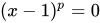

The case where the characteristic divides the degree is today called Artin–Schreier theory because the first progress was made by Artin and Schreier. Their initial motivation was the Artin–Schreier theorem, which characterizes the real closed fields as those whose absolute Galois group has order two.[2] This inspired them to ask what other fields had finite absolute Galois groups. In the midst of proving that no other such fields exist, they proved that degree extensions of a field of characteristic were the same as splitting fields of Artin–Schreier polynomials. These are by definition of the form By repeating their construction, they described degree extensions. Abraham Adrian Albert used this idea to describe degree extensions. Each repetition entailed complicated algebraic conditions to ensure that the field extension was normal.[3]


Schmid[4] generalized further to non-commutative cyclic algebras of degree . In the process of doing so, certain polynomials related to the addition of -adic integers appeared. Witt seized on these polynomials. By using them systematically, he was able to give simple and unified constructions of degree field extensions and cyclic algebras. Specifically, he introduced a ring now called , the ring of -truncated -typical Witt vectors. This ring has as a quotient, and it comes with an operator which is called the Frobenius operator since it reduces to the Frobenius operator on . Witt observed that the degree analog of Artin–Schreier polynomials is


- ,

where . To complete the analogy with Kummer theory, define to be the operator Then the degree extensions of are in bijective correspondence with cyclic subgroups of order , where corresponds to the field .





Motivation
[edit]Any -adic integer (an element of , not to be confused with ) can be written as a power series , where the are usually taken from the integer interval . It can be difficult to provide an algebraic expression for addition and multiplication using this representation, as one faces the problem of carrying between digits. However, taking representative coefficients is only one of many choices, and Hensel himself (the creator of -adic numbers) suggested the roots of unity in the field as representatives. These representatives are therefore the number together with the roots of unity; that is, the solutions of in , so that . This choice extends naturally to ring extensions of in which the residue field is enlarged to with , some power of . Indeed, it is these fields (the fields of fractions of the rings) that motivated Hensel's choice. Now the representatives are the solutions in the field to . Call the field , with an appropriate primitive root of unity (over ). The representatives are then and for . Since these representatives form a multiplicative set they can be thought of as characters. Some thirty years after Hensel's works, Teichmüller studied these characters, which now bear his name, and this led him to a characterisation of the structure of the whole field in terms of the residue field. These Teichmüller representatives can be identified with the elements of the finite field of order by taking residues modulo in , and elements of are taken to their representatives by the Teichmüller character . This operation identifies the set of integers in with infinite sequences of elements of .



![{\displaystyle [0,p-1]=\{0,1,2,\ldots ,p-1\}}](https://wikimedia.org/api/rest_v1/media/math/render/svg/c510ab0686a570349f3d05d60a42dccdeed3ca15)
![{\displaystyle a_{i}\in [0,p-1]}](https://wikimedia.org/api/rest_v1/media/math/render/svg/4a1c9af12193f243aad75dc3ae4207b9654bc7e9)






Taking those representatives, the expressions for addition and multiplication can be written in closed form. The following problem (stated for the simplest case: ): given two infinite sequences of elements of , describe their sum and product as p-adic integers explicitly. This problem was solved by Witt using Witt vectors.[citation needed]


Detailed motivational sketch
[edit]The ring of -adic integers is derived from the finite field using a construction which naturally generalizes to the Witt vector construction.

The ring of p-adic integers can be understood as the inverse limit of the rings taken along the projections. Specifically, it consists of the sequences with , such that for . That is, each successive element of the sequence is equal to the previous elements modulo a lower power of p; this is the inverse limit of the projections .


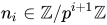



The elements of can be expanded as (formal) power series in
- ,
where the coefficients are taken from the integer interval . This power series usually will not converge in using the standard metric on the reals, but it will converge in with the p-adic metric.
![{\displaystyle [0,p-1]=\{0,1,\ldots ,p-1\}}](https://wikimedia.org/api/rest_v1/media/math/render/svg/5bef06d51db4ec1d2da631d04771f5b0ddcc9dd5)

Letting be denoted by , the following definition can be considered for addition:



and a similar definition for multiplication can be made. However, this is not a closed formula, since the new coefficients are not in the allowed set .
![{\displaystyle [0,p-1]}](https://wikimedia.org/api/rest_v1/media/math/render/svg/6458180d4c95388214661333a13f6d1287d3b690)
Representing elements in Fp as elements in the ring of Witt vectors W(Fp)
[edit]There is a coefficient subset of which does yield closed formulas, the Teichmüller representatives: zero together with the roots of unity. They can be explicitly calculated (in terms of the original coefficient representatives ) as roots of through Hensel lifting, the p-adic version of Newton's method. For example, in , to calculate the representative of 2, one starts by finding the unique solution of in with ; one gets 7. Repeating this in , with the conditions and , gives 57, and so on; the resulting Teichmüller representative of 2, denoted , is the sequence

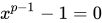




.

The existence of a lift in each step is guaranteed by the greatest common divisor in every .


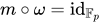
This algorithm shows that for every , there is one Teichmüller representative with , which is denoted . This defines the Teichmüller character as a (multiplicative) group homomorphism, which moreover satisfies if one lets denote the canonical projection. Note however that is not additive, as the sum need not be a representative. Despite this, if in then in
![{\displaystyle j\in [0,p-1]}](https://wikimedia.org/api/rest_v1/media/math/render/svg/14dbc0a70dbdd36817722ffae2c1fab03788f4e6)






Representing elements in Zp as elements in the ring of Witt vectors W(Fp)
[edit]Because of this one-to-one correspondence given by , one can expand every p-adic integer as a power series in p with coefficients taken from the Teichmüller representatives. An explicit algorithm can be given, as follows. Write the Teichmüller representative as . Then, if one has some arbitrary p-adic integer of the form , one takes the difference , leaving a value divisible by . Hence, . The process is then repeated, subtracting and proceed likewise. This yields a sequence of congruences




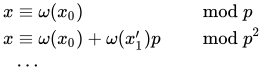
so that
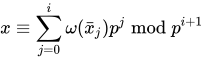
and implies

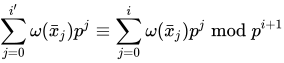
for
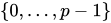
- .

This obtains a power series for each residue of modulo powers of , but with coefficients in the Teichmüller representatives rather than .
- ,

since
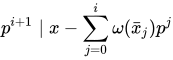
for all as , so the difference tends to 0 with respect to the p-adic metric. The resulting coefficients will typically differ from the modulo except the first one.


Additional properties of elements in the ring of Witt vectors motivating general definition
[edit]The Teichmüller coefficients have the key additional property that which is missing for the numbers in . This can be used to describe addition, as follows. Consider the equation in and let the coefficients now be as in the Teichmüller expansion. Since the Teichmüller character is not additive, is not true in , but it holds in , as the first congruence implies. In particular,



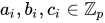


and thus
- .

Since the binomial coefficient is divisible by , this gives

- .

This completely determines by the lift. Moreover, the congruence modulo indicates that the calculation can actually be done in satisfying the basic aim of defining a simple additive structure.


For this step can be cumbersome. Write

- .

Just as for , a single th power is not enough: one must take


However, is not in general divisible by , but it is divisible when , in which case combined with similar monomials in will make a multiple of .




At this step, one works with addition of the form

This motivates the definition of Witt vectors.
Construction of Witt rings
[edit]Fix a prime number p. A Witt vector[5] over a commutative ring (relative to the prime ) is a sequence of elements of . The Witt polynomials can be defined by




and in general
- .

The are called the ghost components of the Witt vector , and are usually denoted by ; taken together, the define the ghost map to . If is p-torsionfree, then the ghost map is injective and the ghost components can be thought of as an alternative coordinate system for the -module of sequences (though note that the ghost map is not surjective unless is p-divisible).


The ring of (p-typical) Witt vectors is defined by componentwise addition and multiplication of the ghost components. That is, that there is a unique way to make the set of Witt vectors over any commutative ring into a ring such that:

- the sum and product are given by polynomials with integer coefficients that do not depend on , and
- projection to each ghost component is a ring homomorphism from the Witt vectors over , to .
In other words,
- and are given by polynomials with integer coefficients that do not depend on R, and


- and


The first few polynomials giving the sum and product of Witt vectors can be written down explicitly. For example,


These are to be understood as shortcuts for the actual formulas: if for example the ring has characteristic , the division by in the first formula above, the one by that would appear in the next component and so forth, do not make sense. However, if the -power of the sum is developed, the terms are cancelled with the previous ones and the remaining ones are simplified by , no division by remains and the formula makes sense. The same consideration applies to the ensuing components.

Examples of addition and multiplication
[edit]As would be expected, the identity element in the ring of Witt vectors is the element

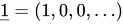
Adding this element to itself gives a non-trivial sequence, for example in ,


since

which is not the expected behavior, since it doesn't equal . But, when the map is reduced with, one gets . Note if there is an element and an element , then





showing that multiplication also behaves in a highly non-trivial manner.
Examples
[edit]- The Witt ring of any commutative ring in which is invertible, is isomorphic to (the product of a countable number of copies of ). The Witt polynomials always give a homomorphism from the ring of Witt vectors to , and if is invertible this homomorphism is an isomorphism.

- The Witt ring of the finite field of order is the ring of -adic integers written in terms of the Teichmüller representatives, as demonstrated above.

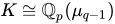
- The Witt ring of a finite field of order is the ring of integers of the unique unramified extension of degree of the ring of -adic numbers . Note for the -st root of unity, hence .
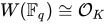



![{\displaystyle W(\mathbb {F} _{q})\cong \mathbb {Z} _{p}[\mu _{q-1}]}](https://wikimedia.org/api/rest_v1/media/math/render/svg/5f8de6200ea486269e1c802756ff8bc6e2b33d38)
- The truncated Witt ring can be described as[6]
![{\displaystyle W_{n+1}(\mathbb {F} _{p}[t])}](https://wikimedia.org/api/rest_v1/media/math/render/svg/818f76f8a834fef300a5778c21687b880fb979ab)
![{\displaystyle {\begin{array}{rcl}W_{n+1}(\mathbb {F} _{p}[t])&\cong &\left\{\sum a_{i}t^{i/p^{n}}\in (\mathbb {Z} /p^{n+1})[t^{1/p^{n}}]\ :\ pia_{i}=0\ {\textrm {mod}}\ p^{n+1}\right\}\\&=&(\mathbb {Z} /p^{n})[t]+p(\mathbb {Z} /p^{n})[t^{1/p}]+p^{2}(\mathbb {Z} /p^{n})[t^{1/p^{2}}]+\dots +p^{n}(\mathbb {Z} /p^{n})[t^{1/p^{n}}]\end{array}}}](https://wikimedia.org/api/rest_v1/media/math/render/svg/55fd0b797ecdbf1c9da3b5d5670385b13123e8cf)
The Witt vectors are the inverse limit along the canonical projections
![{\displaystyle W(\mathbb {F} _{p}[t])=\lim(\dots \to W_{n+1}(\mathbb {F} _{p}[t])\to W_{n}(\mathbb {F} _{p}[t])\to \dots \to W_{1}(\mathbb {F} _{p}[t])=\mathbb {F} _{p}[t]).}](https://wikimedia.org/api/rest_v1/media/math/render/svg/e4bf0366f981375423a8d9ada9fbe47a440db23d)
Here the transition homomorphisms are induced by reduction .
![{\displaystyle (\mathbb {Z} /p^{n+1})[t^{1/p^{n}}]\to (\mathbb {Z} /p^{n})[t^{1/p^{n}}]}](https://wikimedia.org/api/rest_v1/media/math/render/svg/ab201f346ef12a67a4d2b92784186a50eb8302e8)
Universal Witt vectors
[edit]The Witt polynomials for different primes are special cases of universal Witt polynomials, which can be used to form a universal Witt ring (not depending on a choice of prime ). Define the universal Witt polynomials for by





and in general
- .

Again, is called the vector of ghost components of the Witt vector , and is usually denoted by .



These polynomials can be used to define the ring of universal Witt vectors or big Witt ring of any commutative ring in much the same way as above (so the universal Witt polynomials are all homomorphisms to the ring ).
Generating functions
[edit]Witt also provided another approach using generating functions.[7]
Definition
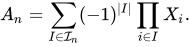
[edit]Let be a Witt vector and define


For let denote the collection of subsets of whose elements add up to . Then


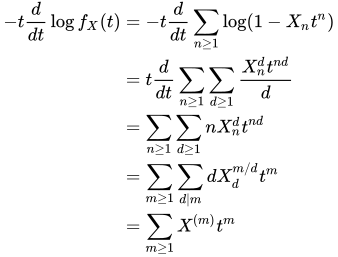
One can get the ghost components by taking the logarithmic derivative:
Sum
[edit]Now one can see if . So that



if are the respective coefficients in the power series . Then



Since is a polynomial in and likewise for , one can show by induction that is a polynomial in



Product
[edit]If is set, then

- .

but
- .

Now 3-tuples with are in bijection with 3-tuples with , via ( is the least common multiple), the series becomes


![{\displaystyle n=m/[d,e]}](https://wikimedia.org/api/rest_v1/media/math/render/svg/b2566bf0acf29526347b69053f20186840c97cb8)
![{\displaystyle [d,e]}](https://wikimedia.org/api/rest_v1/media/math/render/svg/6ecb48b178a295953189f9b8caead936eab58d13)
![{\displaystyle \sum _{d,e\geq 1}de\sum _{n\geq 1}\left(X_{d}^{\frac {[d,e]}{d}}Y_{e}^{\frac {[d,e]}{e}}t^{[d,e]}\right)^{n}=-t{\frac {d}{dt}}\log \prod _{d,e\geq 1}\left(1-X_{d}^{\frac {[d,e]}{d}}Y_{e}^{\frac {[d,e]}{e}}t^{[d,e]}\right)^{\frac {de}{[d,e]}}}](https://wikimedia.org/api/rest_v1/media/math/render/svg/768c5828582ae9d466d18fb2986406f56f1e4fea)
so that
- ,
![{\displaystyle f_{W}(t)=\prod _{d,e\geq 1}\left(1-X_{d}^{\frac {[d,e]}{d}}Y_{e}^{\frac {[d,e]}{e}}t^{[d,e]}\right)^{\frac {de}{[d,e]}}=\sum _{n\geq 0}D_{n}t^{n}}](https://wikimedia.org/api/rest_v1/media/math/render/svg/f53137d09c9d900a1572296a7153333c0598f702)
where are polynomials of So by similar induction,

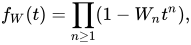
then can be solved as polynomials of .

Ring schemes
[edit]The map taking a commutative ring to the ring of Witt vectors over (for a fixed prime ) is a functor from commutative rings to commutative rings, and is also representable, so it can be thought of as a ring scheme, called the Witt scheme, over The Witt scheme can be canonically identified with the spectrum of the ring of symmetric functions.

Similarly, the rings of truncated Witt vectors, and the rings of universal Witt vectors correspond to ring schemes, called the truncated Witt schemes and the universal Witt scheme.
Moreover, the functor taking the commutative ring to the set is represented by the affine space , and the ring structure on makes into a ring scheme denoted . From the construction of truncated Witt vectors, it follows that their associated ring scheme is the scheme with the unique ring structure such that the morphism given by the Witt polynomials is a morphism of ring schemes.


Commutative unipotent algebraic groups
[edit]Over an algebraically closed field of characteristic 0, any unipotent abelian connected algebraic group is isomorphic to a product of copies of the additive group . The analogue of this for fields of characteristic is false: the truncated Witt schemes are counterexamples. (They are made into algebraic groups by using the additive structure instead of multiplication.) However, these are essentially the only counterexamples: over an algebraically closed field of characteristic , any unipotent abelian connected algebraic group is isogenous to a product of truncated Witt group schemes.

Universal property
[edit]André Joyal explicated the universal property of the (p-typical) Witt vectors.[8] The basic intuition is that the formation of Witt vectors is the universal way to deform a characteristic p ring to characteristic 0 together with a lift of its Frobenius endomorphism.[9] To make this precise, define a -ring to consist of a commutative ring together with a map of sets that is a p-derivation, so that satisfies the relations


- ;
- ;
- .



The definition is such that given a -ring , if one defines the map by the formula , then is a ring homomorphism lifting Frobenius on . Conversely, if is p-torsionfree, then this formula uniquely defines the structure of a -ring on from that of a Frobenius lift. One may thus regard the notion of -ring as a suitable replacement for a Frobenius lift in the non-p-torsionfree case.




The collection of -rings and ring homomorphisms thereof respecting the -structure assembles to a category . One then has a forgetful functorwhose right adjoint identifies with the functor of Witt vectors. The functor creates limits and colimits and admits an explicitly describable left adjoint as a type of free functor; from this, it can be shown that inherits local presentability from so that one can construct the functor by appealing to the adjoint functor theorem.




One further has that restricts to a fully faithful functor on the full subcategory of perfect rings of characteristic p. Its image then consists of those -rings that are perfect (in the sense that the associated map is an isomorphism) and whose underlying ring is p-adically complete.[10]
See also
[edit]References
[edit]- ^ a b Fisher, Benji (1999). "Notes on Witt Vectors: a motivated approach" (PDF). Archived (PDF) from the original on 12 January 2019.
- ^ Artin, Emil and Schreier, Otto, Über eine Kennzeichnung der reell abgeschlossenen Körper, Abh. Math. Sem. Hamburg 3 (1924).
- ^ A. A. Albert, Cyclic fields of degree over of characteristic , Bull. Amer. Math. Soc. 40 (1934).
- ^ Schmid, H. L., Zyklische algebraische Funktionenkörper vom Grad pn über endlichen Konstantenkörper der Charakteristik p, Crelle 175 (1936).
- ^ Illusie, Luc (1979). "Complexe de de Rham-Witt et cohomologie cristalline". Annales scientifiques de l'École Normale Supérieure (in French). 12 (4): 501–661. doi:10.24033/asens.1374.
- ^ Illusie, Luc (1979). "Complexe de de Rham-Witt et cohomologie cristalline". Annales scientifiques de l'École Normale Supérieure (in French). 12 (4). Section I.2.B: 501–661. doi:10.24033/asens.1374.
{{cite journal}}: CS1 maint: location (link) - ^ Lang, Serge (September 19, 2005). "Chapter VI: Galois Theory". Algebra (3rd ed.). Springer. pp. 330. ISBN 978-0-387-95385-4.
- ^ Joyal, André (1985). "δ-anneaux et vecteurs de Witt". C.R. Math. Rep. Acad. Sci. Canada. 7 (3): 177–182.
- ^ "Is there a universal property for Witt vectors?". MathOverflow. Retrieved 2022-09-06.
- ^ Bhatt, Bhargav (October 8, 2018). "Lecture II: Delta rings" (PDF). Archived (PDF) from the original on September 6, 2022.
Introductory
[edit]- Notes on Witt vectors: a motivated approach - Basic notes giving the main ideas and intuition. Best to start here!
- The Theory of Witt Vectors - Elementary introduction to the theory.
- Complexe de de Rham-Witt et cohomologie cristalline - Note he uses a different but equivalent convention as in this article. Also, the main points in the introduction are still valid.
Applications
[edit]- Mumford, David (1966-08-21), Lectures on Curves on an Algebraic Surface, Annals of Mathematics Studies, vol. 59, Princeton, NJ: Princeton University Press, ISBN 978-0-691-07993-6
- Serre, Jean-Pierre (1979), Local fields, Graduate Texts in Mathematics, vol. 67, Berlin, New York: Springer-Verlag, ISBN 978-0-387-90424-5, MR 0554237, section II.6
- Serre, Jean-Pierre (1988), Algebraic groups and class fields, Graduate Texts in Mathematics, vol. 117, Berlin, New York: Springer-Verlag, doi:10.1007/978-1-4612-1035-1, ISBN 978-0-387-96648-9, MR 0918564
- Greenberg, Marvin J. (1969). Lectures on Forms in Many Variables. New York and Amsterdam: Benjamin. ASIN B0006BX17M. MR 0241358.
References
[edit]- Dolgachev, Igor V. (2001) [1994], "Witt vector", Encyclopedia of Mathematics, EMS Press
- Hazewinkel, Michiel (2009), "Witt vectors. I.", Handbook of algebra. Vol. 6, Amsterdam: Elsevier/North-Holland, pp. 319–472, arXiv:0804.3888, doi:10.1016/S1570-7954(08)00207-6, ISBN 978-0-444-53257-2, MR 2553661
- Witt, Ernst (1936), "Zyklische Körper und Algebren der Characteristik p vom Grad pn. Struktur diskret bewerteter perfekter Körper mit vollkommenem Restklassenkörper der Charakteristik pn", Journal für die Reine und Angewandte Mathematik (in German), 1937 (176): 126–140, doi:10.1515/crll.1937.176.126