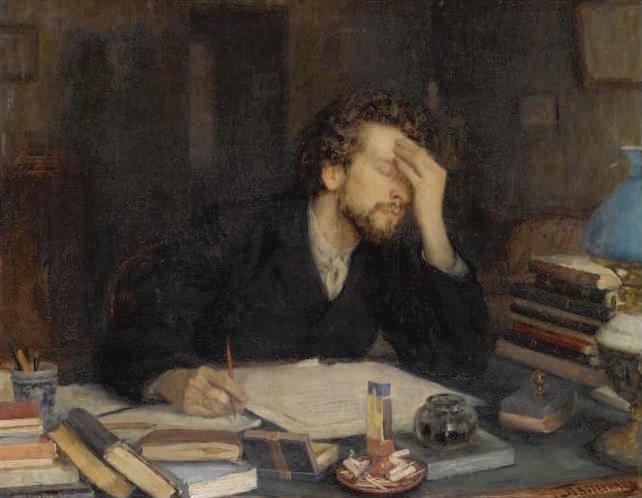

Writer's block
View on Wikipedia

Writer's block is a non-medical condition, primarily associated with writing, in which an author is either unable to produce new work or experiences a creative slowdown.
Writer's block has various degrees of severity, from difficulty in coming up with original ideas to being unable to produce work for years. This condition is not solely measured by time passing without writing; it is measured by time passing without productivity in the task at hand.[1] Writer's block has been an acknowledged problem throughout recorded history and many experience it.[2]
However, not until 1947 was the term writer's block coined by the Austrian psychiatrist Edmund Bergler. All types of writers, including full-time professionals, academics, workers on creative projects, and those trying to finish written assignments, can experience writer's block.[3] The condition has many causes, some that are even unrelated to writing. The majority of writer's block researchers agree that most causes of writer's block have an affective/physiological, motivational, and cognitive component.[4]
Studies have found effective coping strategies to deal with writer's block. These strategies aim to remove the anxiety about writing and range from ideas such as free writing and brainstorming to talking to a professional.[5]
History
[edit]![[icon]](https://en.wikipedia.org/wiki/File:Wiki_letter_w_cropped.svg) | This section needs expansion. You can help by adding to it. (November 2024) |
"My novel is going very badly for the moment. That fact added to the deaths of which I have heard; of Cormenin (a friend of twenty-five years' standing), of Gavarni, and then all the rest, but that will pass. You don't know what it is to stay a whole day with your head in your hands trying to squeeze your unfortunate brain so as to find a word. Ideas come very easily to you, incessantly, like a stream. With me it is a tiny thread of water. Hard labor at art is necessary for me before obtaining a waterfall. Ah! I certainly know the agonies of style."
The affliction now known as writer's block has been recognized throughout history.[2] Writers who are known to have struggled with it include authors F. Scott Fitzgerald[7] and Joseph Mitchell,[8] Joseph Conrad,[9] composer Sergei Rachmaninoff,[10] and songwriter Adele.[11] Another example is Herman Melville[dubious – discuss], who stopped writing novels a few years after writing Moby-Dick.[12]
Early Romantic writers tended to attribute writer's block (whether seriously or merely poetically) to a power that no longer wanted them to write. Its interpretation became less mystical during the time of the French Symbolism. During this age, renowned poets would give up writing early in their careers on the grounds that they were unable to find the language to convey their messages. Such was the case for Arthur Rimbaud, who, after producing the bulk of his literary output during his late teenage years, completely stopped writing at the age of twenty. Though still, during the Great American Novel period (mid-18th to mid-19th century), the affliction was construed as something that stopped writers and caused them emotional instability.[13]
The condition was first clinically described in 1947 by Austrian psychoanalyst Edmund Bergler,[14] who identified it as being caused by oral masochism, mothers that bottle fed, and an unstable private love life.[13] The growing reputation of psychiatry in the United States made the term gain more recognition.[15] Research concerning this topic was done in the late 1970s and 1980s. During this time, researchers were influenced by the Process and Post-Process movements and therefore focused specifically on the writer's processes.[citation needed]
Causes
[edit]Writer's block may have several causes. Some are creative problems that originate within an author's work itself. A writer may run out of inspiration or be distracted by other events. The writer Elizabeth Gilbert, reflecting on her post-bestseller prospects, proposed that such pressure might be released by interpreting creative writers as "having" genius rather than "being" a genius.[16]
A fictional example can be found in George Orwell's novel Keep the Aspidistra Flying, in which the protagonist Gordon Comstock struggles in vain to complete an epic poem describing a day in London: "It was too big for him, that was the truth. It had never really progressed, it had simply fallen apart into a series of fragments."[17]
Physiological and neurological basis
[edit]Physiological and neurological bases of writer's block have been suggested. Under stress, a human brain will "shift control from the cerebral cortex to the limbic system".[18] The limbic system is associated with the instinctual processes, such as "fight or flight" response; and behavior that is based on "deeply engrained training". The limited input from the cerebral cortex hinders a person's creative processes, which is replaced by the behaviors associated with the limbic system. The person is often unaware of the change, which may lead them to believe they are creatively "blocked".[18] [unreliable source?]
In her 2004 book The Midnight Disease: The Drive to Write, Writer's Block, and the Creative Brain, the writer and neurologist Alice W. Flaherty has argued that literary creativity is a function of specific areas of the brain, and that block may be the result of brain activity being disrupted in those areas.[19] Flaherty suggested in her writing that there are many diseases that may impact one's ability to write. One of which she refers to is hypergraphia, or the intensive desire to write. She points out that in this condition, the patient's temporal lobe is afflicted, usually by damage, and it may be the same changes in this area of the brain that can contribute to writer's-blocking behaviors.[20] Not to be confused with writer's block, agraphia is a neurological disorder caused by trauma or stroke causing difficulty in communicating through writing. Agraphia cannot be treated directly, but it is possible to relearn certain writing abilities.[21]
Brain trauma
[edit]Other research identifies neurological malfunctions as a cause. Malcolm T. Cunningham showed how these malfunctions can be linked to trauma both mental and physical.[22]
Physical damage can produce writer's block. If a person experiences tissue damage in the brain, i.e. a stroke, it is likely to lead to other complications apart from the lesion itself. This damage causes an extreme form of writer's block known as agraphia.[15] With agraphia, the inability to write is due to issues with the cerebral cortex; this disables the brain's process of translating thoughts into writing. Brain injuries are an example of a physical illness that can cause a writer to be blocked. Other brain-related disorders and neurological disorders such as epilepsy have been known to cause the problem of writer's block and hypergraphia, the strong urge to write.[21]
Writer anxiety and inhibition
[edit]Another cause of writer's block has been due to writer's anxiety. Writer's anxiety is defined as being worried about one's words or thoughts, thus experiencing writer's block.[23]
From a composition perspective, Lawrence Oliver said in his article "Helping Students Overcome Writer's Block": "Students receive little or no advice on how to generate ideas or explore their thoughts, and they usually must proceed through the writing process without guidance or corrective feedback from the teacher, who withholds comments and criticism until grading the final product."[24] He said that students "learn to write by writing", and often they are insecure or paralyzed by rules.[24]
Phyllis Koestenbaum wrote in her article "The Secret Climate the Year I Stopped Writing" about her trepidation toward writing, claiming it was tied directly to her instructor's response.[25] She said, "I needed to write to feel, but without feeling I couldn't write."[25] In contrast to Koestenbaum's experience, Nancy Sommers stated that papers do not end when students finish writing and that neither should instructors' comments.[26] She urges a "partnership" between writers and instructors so that responses become a conversation.[26]
Student motivation
[edit]Herman A. Estrin in his article "Motivation in Composition Writing" writes: "When freshmen are assigned such topics for a research paper as ... they have no real background of the subject for an in-depth paper ... they prepare a mechanical, lifeless paper with no creativity, imagination, or originality".[27] According to him, freshman students write well about topics they are passionate about. Moore, Marshall in his article “Articulate Walls: Writer’s Block and the Academic Creative.” thinks similarly by writing: "...his or her practice is paralysingly out of sync with the syllabus; and teaching from a state of creative depletion may engender a cascade of self-doubt. This paper will look at the process by which these practitioners attempt to navigate this zone of creative disconnect.". Saying having assigned, planned out, and required papers is contributing to loss of motivation.[28]
Aline Alves-Wold, in her article "Assessing Writing Motivation: a Systematic Review of K-5 Students' Self-Reports" states that there is a general lack of research on the motivation of students to write in the first few years of education, which is problematic when one considers how important initial experiences are in motivating students to write. Success generally enhances one's belief in their efficacy, whereas failure weakens them. "These mechanisms are particularly evident in early phases of skill development where failure typically occurs before a sense of efficacy has been firmly established. This implies that children in their first years in school have writer self-beliefs that are particularly malleable and dynamic".[29] Writing development is therefore both enhanced and endangered during the first years in school.[29]
Negative self-beliefs and feeling of incompetence
[edit]Mike Rose stated that writer's block can be caused by a writer's history in writing, rules, and restrictions from the past. Writers can be hesitant about what they write based on how it will be perceived by the audience.[30] Guangming Ling states that there is a negative correlation between self-efficacy and avoidance goals in studies on writing apprehension and writer's block, which suggests that having hesitations about writing may lead to less effort and thus less success.[31]
Similarly to Ling, Dana Driscoll and Jennifer Wells explain writing dispositions in their essay "Beyond Knowledge and Skills". Driscoll and Wells argue that dispositions toward writing play crucial roles in determining whether writers are able to transfer their knowledge of writing into other contexts of life.[32] Related to self-efficacy, Driscoll and Wells suggest that writers who have a positive self-belief are more likely to produce work than some with a negative self-belief.[32] Self-efficacy is especially important for a writer when it comes to an unfamiliar learning or writing setting because it may seem overwhelming.
James Adams noted in his book Conceptual Blockbusting that various reasons blocks occur include fear of taking a risk, "chaos" in the pre-writing stage, judging versus generating ideas, an inability to incubate ideas, or a lack of motivation.[33]
In "Motivation in the Writing Centre: A Peer Tutor's Experience", Leonie Kirchoff states that "The concept of 'amotivation' describes a lack of motivation due to an individual's feeling of incompetence and helplessness."[34] Demotivation is the process of reducing or diminishing motivational basis for behavior or ongoing actions through external influences. An external factor such as feedback may affect demotivation, whereas an internal factor, such as pessimistic expectations, may cause amotivation. Even so, both concepts have similar effects on writers.[34]
For tutors to provide students with the most appropriate feedback, scholars like Jared Featherstone from James Madison University suggest that tutors should be well educated in mindfulness strategies to combat a student's fixed mindset.[35] He argues that tutors or instructors should be mindful enough to be grounded and focused solely on their student so they can pick up on the feelings, stress, or fixed mindsets their student might have.[35] An unmindful tutor might accidentally reinforce a student's negative thinking patterns.
Coping strategies
[edit]Irene Clark describes the following strategies for coping with writer's block: class and group discussion, journaling, free writing and brainstorming, clustering, list making, and engaging with the text.[2] To overcome writing blocks, Oliver suggests asking writers questions to uncover their writing process.[24] He then recommends solutions such as systematic questioning, free writing, and encouragement.[24] A recent study of 2,500 writers aimed to find techniques that writers themselves use to overcome writer's block.[citation needed] The research discovered a range of solutions from altering the time of day to write and setting deadlines to lowering expectations and using mindfulness meditation.
Mindfulness meditation has proved to increase awareness and improve writing skills. Kate Chaterdon, an English professor at Marist College, suggests that mindfulness not only improves writing skills but also allows writers to transfer their knowledge of writing into other contexts of life.[36] Chaterdon recommends meditation as a grounding exercise to help people become more metacognitively aware. Chaterdon had conducted a study in her two writing classes at Marist College and concluded that practicing mindfulness at least once a week is essential in developing higher levels of metacognition.[36]
Right-brain involvement
[edit]Garbriele Lusser Rico's concern with the mind links to brain lateralisation, also explored by Rose and Linda Flowers and John R. Hayes, among others. Rico's book Writing the Natural Way looks into invention strategies, such as clustering, which has been noted to be an invention strategy used to help writers overcome their blocks,[37] and further emphasizes the solutions presented in works by Rose, Oliver, and Clark. Similar to Rico, James Adams discusses "right-brain" involvement in writing.[33] While Bill Downey proposes that he is basing his approach in practical concerns,[38] his concentration on "right-brain" techniques speaks to cognitive theory approach similar to Rico's and a more practical advice for writers to approach their writer's block.[38] Mike Rose mentions that peer tutors provide supportive feedback so that blocked writers can feel secure in sharing their problems and experimenting with new ideas about writing.[39]
Writing environment
[edit]It is also important to evaluate the environment in which the writing is being produced to determine what is the best condition to work in. One must look into these different factors to determine whether it is a good or bad environment to work in.[5] Psychologists who have studied writer's block have concluded that it is a treatable condition once the writer finds a way to remove anxiety and build confidence in themselves.[40] Sarah Ahmed and Dominik Güss state that solutions for coping with writer's block include using more efficient writing strategies during the composing process, more effective goal-setting strategies, and even brainstorming ideas with others.[41]
Splitting the writing into smaller pieces
[edit]Research has also shown that it is highly effective if one breaks their work into pieces rather than doing all of their writing in one sitting, in order to produce good quality work. While it can be helpful to split up the writing process into pieces, Patricia Huston suggests that starting with different sections of a paper, rather than trying to start with an introduction, can be a useful strategy to cope with writer's block. She points out that if a person is stuck on the introduction, they can try moving on to a different section, like a body paragraph. Huston states: "There is no need to begin at the beginning and write an article in sequence".[5]
Free writing and brainstorming
[edit]Free writing is a widely accepted technique for overcoming writer's block.[42] Taught by Peter Elbow, free writing is similar to brainstorming but is written in prose form without stopping.[43] To free-write, one writes without pausing to think or edit, and one pours raw ideas onto paper.[44] Author Benjamin Solomon described the rationale for the technique: "Writer's block is a rut, a ditch, a trap, a swampy mire, and in order to lift yourself out, you need to do something—anything!—to jog yourself into motion."[45] Cherryl Armstrong, who worked with the South Coast Writing Project, stated that one can free-write about anything, even a completely different subject than one was going to write about: "any writing will do".[46]
Lawrence J. Oliver claims that after free writing the writer is able to analyze many ideas that might not have been generated before and develop a clearer sense of what theme is trying to be communicated throughout the writing.[24] Oliver suggests that freewriting is an effective method that has helped people deal with writer's block. Freewriting does not focus on grammar or style. There is only one rule for this method, and that is to keep on writing. Educators should also never read students' freewriting unless asked to do so.[47]
Mind mapping
[edit]Mind mapping is suggested as another potential solution to writer's block.[5] The technique involves writing a stream of consciousness on a horizontal piece of paper and connecting any similar or linked thoughts. This exercise is intended to help a writer suffering from writer's block to bypass the analytical or critical functioning of their brain and access the creative functioning more directly, stimulating the flow of ideas.[5] Other techniques similar to clustering and mind mapping are the writing of notes on cards in a card file,[48][49] and nonlinear electronic writing using hypertext.[50]
Positive self-beliefs and encouragement
[edit]Camacho, Alves, and Boscolo wrote about enhancing students' writing motivation in the classroom. They say that to foster students' positive self-beliefs and beliefs about writing, teachers must nurture their self-beliefs, as well as their beliefs about the writing task.[51]
Other techniques
[edit]Other ways to cope come from ideas such as The Brand Emotions Scale for Writers (BESW).[52] Using the framework of the Differential Emotions Scale, the BESW works with grouping emotions into either states or traits and then classifying them as positive, negative passive, or negative active. Researchers can assess subjects, giving writers a chance to get more work done if left in the right emotional state, since data suggests that writers with positive emotions tend to express more than writers with negative passive or negative active.[52] Scholars and researchers such as Mandy Bamber suggest practicing meditation to reduce negative moods like stress and anxiety. Bamber's team conducted a study on 40 university students who showed signs of anxiety. After practicing mindfulness and meditation exercises, 33 out of the 40 showed significant decreases in stress and anxiety levels.[53]
Anne Johnstone suggests a couple of strategies to help with writer's block. When one finds oneself unable to generate content, Johnstone suggests "recopying a well-liked piece" of one's own to help generate ideas.[54] Johnstone states that individuals who are articulate orally but struggle with writing and forming their ideas into sentences on paper should try tape-recording themselves and later transcribing it onto paper.[54]
Relation to procrastination
[edit]Writer's block and procrastination are two similar issues that people struggle with when it comes to writing. Writer's block is an issue that can cause people to delay their goals and may prevent them from finishing writing projects. Although writer's block and procrastination are not the exact same issue, they can end up leading to one another. Writer's block is not continuing to do a task, and procrastination is delaying starting the task. In her 1987 Ph.D. thesis (published in 2012), Karen E. Peterson posited two different scenarios on how procrastination and writer's block can lead to each other.[55] One scenario is that a person will procrastinate due to having the fear of past experiences of getting writer's block when doing a task. The other scenario is that a person will have writer's block because of the feeling of being overwhelmed about needing to do a task at the last minute after procrastinating for a long period of time.[55]
According to some scholars like Claire Kervin, procrastination is usually a result of a negative mood and is a "short-term mood regulator". Unlike previous beliefs that procrastination is poor time management, Kervin suggests procrastination is a way individuals cope with negative emotions.[56] Kervin's suggestion makes a connection to one of Peterson's scenarios, specifically when someone procrastinates due to fear of past experiences and begins to feel judgmental toward themselves. Kervin recommends taking a mindful approach to combating procrastination in order to become more grounded and improve self-regulation.[56]
See also
[edit]
References
[edit]- ^ Rose, Mike (1984). Writer's Block: The Cognitive Dimension. Foreword by Marilyn S. Sternglass. Carbondale: Published for Conference on College Composition and Communication by Southern Illinois University Press. ISBN 0-8093-1141-0. OCLC 9392424.
- ^ a b c Clark, Irene (2012). "Invention". Concepts in Composition: Theory and Practice in the Teaching of Writing (2nd ed.). New York: Routledge. ISBN 9780415885164. OCLC 703871383.[page needed]
- ^ "Symptoms and Cures for Writer's Block - Purdue OWL® - Purdue University". owl.purdue.edu. Retrieved 18 March 2023.
- ^ Ahmed, Sarah (1 January 2019). "An Analysis of Writer's Block: Causes, Characteristics, and Solutions". UNF Graduate Theses and Dissertations.
- ^ a b c d e Huston, Patricia (January 1998). "Resolving writer's block". Canadian Family Physician. 44: 92–96. PMC 2277565. PMID 9481467.
- ^ "Letter XXXII". The George Sand–Gustave Flaubert Letters (1922), p. 29. Trans. Aimee L. McKenzie.
- ^ Rienzi, Greg (28 September 2009). "Great Scott: Fitzgerald's Baltimore". The JHU Gazette. Johns F Kennedy University.[verification needed]
- ^ Maher, Michael (7 May 2015). The New Yorker writer who didn't publish for 30 years. BBC News (Video).
- ^ Warodell, Johan Adam (2022). Conrad's Decentered Fiction. p. 31. ISBN 9781316512197.
- ^ Winston, Robert (27 July 2010). "How great artists have fought creative block". BBC News.
- ^ "Adele Opens Up About Writer's Block". Sky News UK via Huffington Post. 24 October 2015. Archived from the original on 20 November 2015.
- ^ Miller, John J. (23 May 2016). "Wordsmiths Without Words". National Review. Vol. 68, no. 9. pp. 23–24.
- ^ a b Acocella, J (14 June 2004). "Blocked Why do writers stop writing?". The New Yorker. Retrieved 28 October 2019.
- ^ Akhtar, Salman (2009). Comprehensive dictionary of psychoanalysis. Karnac Books. p. 310. ISBN 978-1855758605. Retrieved 17 October 2011.
- ^ a b Castillo, M. (5 September 2013). "Writer's Block". American Journal of Neuroradiology. 35 (6): 1043–1044. doi:10.3174/ajnr.a3729. ISSN 0195-6108. PMC 7965145. PMID 24008169.
- ^ Elizabeth Gilbert on nurturing creativity , a TED talk in 2009
- ^ George Orwell, Keep The Aspidistra Flying, Chapter 2.
- ^ a b Bane, Rosanne (February 2010). "The Writer's Brain: What Neurology Tells Us about Teaching Creative Writing" (PDF). S2CID 146850178. Archived from the original (PDF) on 28 June 2018. Retrieved 4 December 2014.
- ^ Acolella, Joan (14 June 2004). "Blocked: why do writers stop writing?". The New Yorker.
- ^ Flaherty, Alice Weaver (2015). The Midnight Disease: The Drive to Write, Writer's Block, and the Creative Brain. Houghton Mifflin Harcourt. ISBN 978-0547525099. OCLC 1037196899.
- ^ a b Oppenheim, Lois (June 2005). "Book Reviews: The midnight disease: The drive to write, writer's block, and the creative brain. By Alice W. Flaherty. Boston: Houghton Mifflin, 2004, 320 pp". Journal of the American Psychoanalytic Association. 53 (2): 630–634. doi:10.1177/00030651050530022401. ISSN 0003-0651. S2CID 143529086.
- ^ Cunningham, Malcolm T. (17 April 2007). "Writer's block: failures of the neurological network and comparisons with business networks". Journal of Business & Industrial Marketing. 22 (3): 154–160. doi:10.1108/08858620710741850. ISSN 0885-8624.
- ^ Kaufman, Scott Barry; Kaufman, James C, eds. (2009). The Psychology of Creative Writing edited by Scott Barry Kaufman. Cambridge Core. doi:10.1017/CBO9780511627101. ISBN 978-0511627101. Retrieved 28 October 2019.
- ^ a b c d e Oliver Jr., Lawrence J. (1982). "Helping Students Overcome Writer's Block". Journal of Reading. 26 (2): 162–168. JSTOR 40029248.[verification needed]
- ^ a b Koestenbaum, Phyllis (Summer 2007). "The Secret Climate the Year I Stopped Writing". The Massachusetts Review. 48 (2): 278–308. JSTOR 25091203.
- ^ a b Somers, Nancy (2012). "Across the Drafts". Concepts in Composition: Theory and Practice in the Teaching of Writing (2nd ed.). New York: Routledge. ISBN 9780415885164. OCLC 703871383.[page needed]
- ^ Estrin, Herman A. (1973). "Motivation in Composition Writing". Improving College and University Teaching. 21 (2): 132–134. doi:10.1080/00193089.1973.10533389. ISSN 0019-3089. JSTOR 27564516.
- ^ Moore, Marshall (3 July 2018). "Articulate walls: writer's block and the academic creative". New Writing. 15 (3): 348–359. doi:10.1080/14790726.2017.1384025. ISSN 1479-0726.
- ^ a b Alves-Wold, Aline; Walgermo, Bente Rigmor; McTigue, Erin; Uppstad, Per Henning (2023). "Assessing Writing Motivation: a Systematic Review of K-5 Students' Self-Reports". Educational Psychology Review. 35 (1): 24. doi:10.1007/s10648-023-09732-6. ISSN 1040-726X. PMC 9947433. PMID 36852261.
- ^ Rose, Mike (1980). "Rigid Rules, Inflexible Plans, and the Stifling of Language: A Cognitivist Analysis of Writer's Block". College Composition and Communication. 31 (4): 389–401. doi:10.2307/356589. ISSN 0010-096X. JSTOR 356589. S2CID 26780594.
- ^ Ling, Guangming; Elliot, Norbert; Burstein, Jill C.; McCaffrey, Daniel F.; MacArthur, Charles A.; Holtzman, Steven (1 April 2021). "Writing motivation: A validation study of self-judgment and performance". Assessing Writing. 48 100509. doi:10.1016/j.asw.2020.100509. ISSN 1075-2935. S2CID 233567231.
- ^ a b "CF 26: Beyond Knowledge and Skills by Dana Lynn Driscoll and Jennifer Wells". compositionforum.com. Retrieved 28 February 2024.
- ^ a b Adams, James L. (2019) [1974]. Conceptual Blockbusting: A Guide to Better Ideas (5th ed.). New York: Basic Books. pp. 25–133. ISBN 978-1-5416-7404-2. OCLC 1084631918.
- ^ a b Kirchhoff, Leonie (24 January 2022). "Motivation in the Writing Centre: A Peer Tutor's Experience". Journal of Academic Writing. 6 (1): 31–40. doi:10.18552/joaw.v6i1.282.
- ^ a b Featherstone, Jared (2018). "The Mindful Tutor".
- ^ a b "CF 50: Mindful Practice & Metacognitive Awareness by Kate Chaterdon". compositionforum.com. Retrieved 28 February 2024.
- ^ Rico, Gabriele Lusser (2000) [1987]. Writing the Natural Way: Using Right-Brain Techniques to Release Your Expressive Powers (Revised ed.). New York: Tarcher/Putnam. ISBN 0874779618. OCLC 42592844.
- ^ a b Downey, Bill (1984). Right Brain – Write ON!: Overcoming Writer's Block and Achieving Your Creative Potential. Englewood Cliffs, NJ: Prentice-Hall.
- ^ Rose, Mike (1980). "Rigid Rules, Inflexible Plans, and the Stifling of Language: A Cognitivist Analysis of Writer's Block". College Composition and Communication. 31 (4): 389–401. doi:10.2307/356589. ISSN 0010-096X. JSTOR 356589.
- ^ Huston, Patricia (September 2001). "Taking the Helm; Combining Responsibilities". Canadian Journal of Public Health. 92 (5): 325–327. doi:10.1007/bf03404972. ISSN 0008-4263. PMC 6979793. PMID 11702481.
- ^ Ahmed, Sarah J.; Güss, C. Dominik (3 July 2022). "An Analysis of Writer's Block: Causes and Solutions". Creativity Research Journal. 34 (3): 339–354. doi:10.1080/10400419.2022.2031436. ISSN 1040-0419. S2CID 246367048.
- ^ "Overcome Writer's Block". Nonprofit Communications Report. 15 (1): 1. 14 December 2016. doi:10.1002/npcr.30569. ISSN 1549-778X.
- ^ Kwame Harrison, Anthony (24 May 2018). Writing Up Research Findings. Vol. 1. Oxford University Press. doi:10.1093/oso/9780199371785.003.0004. ISBN 978-0-19-937178-5.
- ^ Jackson, Michael (2013). "24. Writing in Search of Lost Time". The Other Shore: Essays on Writers and Writing. Berkeley: University of California Press. pp. 150–154. doi:10.1525/9780520954823-025. ISBN 9780520275249. OCLC 808007361. S2CID 226887120.
- ^ "The midnight disease: the drive to write, writer's block, and the creative brain". Choice Reviews Online. 42 (1): 42–0127–42–0127. 1 September 2004. doi:10.5860/choice.42-0127 (inactive 1 July 2025). ISSN 0009-4978.
{{cite journal}}: CS1 maint: DOI inactive as of July 2025 (link) - ^ Armstrong, Cherryl (January 1983). "There's no such thing as writer's block; (or if there is, some suggestions for dissolving it)". The Quarterly of the National Writing Project. 5 (1): 14–15, 18. Archived from the original on 6 December 2023.
- ^ Oliver, Lawrence J. (1982). "Helping Students Overcome Writer's Block". Journal of Reading. 26 (2): 162–168. ISSN 0022-4103. JSTOR 40029248.
- ^ Lopeke, Linda (December 1984). "Breaking through writer's block". ACM SIGDOC Asterisk Journal of Computer Documentation. 10 (4): 22–24. doi:10.1145/1111174.1111177. S2CID 29780705.
- ^ Boice, Robert (1985). "Psychotherapies for writing blocks". In Rose, Mike (ed.). When a Writer Can't Write: Studies in Writer's Block and Other Composing-Process Problems. Perspectives in Writing Research. New York: Guilford Press. pp. 182–218 (202). ISBN 0898622514. OCLC 11211866.
- ^ Kish, Judith Mara (Fall 2000). "Breaking the block: basic writers in the electronic classroom". Journal of Basic Writing. 19 (2): 141–159 (148). doi:10.37514/JBW-J.2000.19.2.08. JSTOR 43741068.
It is through the use of hypertext itself and an understanding of hypertext theories that instructors can begin to help students to use computers to break through writing difficulties such as writer's block.
- ^ Camacho, Ana; Alves, Rui A.; Boscolo, Pietro (1 March 2021). "Writing Motivation in School: a Systematic Review of Empirical Research in the Early Twenty-First Century". Educational Psychology Review. 33 (1): 213–247. doi:10.1007/s10648-020-09530-4. hdl:10216/131704. ISSN 1573-336X. S2CID 254465022.
- ^ a b Brand, Alice G.; Powell, Jack L. (1 May 1986). "Emotions and the Writing Process: A Description of Apprentice Writers". The Journal of Educational Research. 79 (5): 280–285. doi:10.1080/00220671.1986.10885692. ISSN 0022-0671.
- ^ Bamber, Mandy D.; Kraenzle Schneider, Joanne (1 May 2016). "Mindfulness-based meditation to decrease stress and anxiety in college students: A narrative synthesis of the research". Educational Research Review. 18: 1–32. doi:10.1016/j.edurev.2015.12.004. ISSN 1747-938X.
- ^ a b Johnstone, Anne (Fall 1983). "The writer's hell: Approaches to writer's block". Journal of Teaching Writing. 2 (2): 155–165.
- ^ a b Peterson, Karen Eileen (1987). Relationships Among Measures Of Writer's Block, Writing Anxiety, And Procrastination (Ph.D. thesis). Columbus, Ohio: Ohio State University.
- ^ a b Kervin, Claire E.; Barrett, Heather E. (1 May 2018). "Emotional Management over Time Management: Using Mindfulness to Address Student Procrastination". WLN: A Journal of Writing Center Scholarship. 42 (9–10): 10–18. doi:10.37514/WLN-J.2018.42.9.03.
Further reading
[edit]
- Upper, Dennis (Fall 1974). "The unsuccessful self-treatment of a case of "writer's block"". Journal of Applied Behavior Analysis. 7 (3): 497. doi:10.1901/jaba.1974.7-497a. ISSN 0021-8855. PMC 1311997. PMID 16795475.
| International | |
|---|---|
| National | |
| Other | |
