


Community hub
Recent from talks
Contribute something
Nothing was collected or created yet.
Boeing X-32
View on Wikipedia
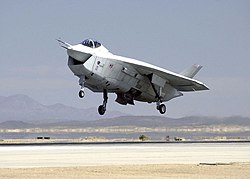
The Boeing X-32 is a concept demonstrator aircraft that was designed for the Joint Strike Fighter competition. It lost to the Lockheed Martin X-35 demonstrator, which was further developed into the Lockheed Martin F-35 Lightning II.
Key Information


Development
[edit]Background
[edit]In 1993, the Defense Advanced Research Projects Agency (DARPA) launched the Common Affordable Lightweight Fighter project (CALF).[1] The project's purpose was to develop a stealth-enabled design to replace all of United States Department of Defense lighter weight fighter and attack aircraft, including the F-16 Fighting Falcon, McDonnell Douglas F/A-18 Hornet, and vertical/short takeoff / vertical landing (V/STOL) AV-8B Harrier II.[2][3] Around the same time, the Joint Advanced Strike Technology (JAST) project was started and in 1994, the U.S. Congress ordered the two to be merged into one program under the JAST name, which was renamed the Joint Strike Fighter (JSF) program in 1995.[4][5]
Many companies took part in the first phase of this project, which involved drafting concept aircraft designs for submission to the Department of Defense. On 16 November 1996, Boeing and Lockheed Martin were awarded contracts for them to produce two of their concept demonstrator aircraft (CDA) each.[6] Under the contract, these fighters were required to demonstrate conventional take-off and landing (CTOL), carrier take-off and landing (CV version), and short take-off and vertical landing (STOVL). They were also expected to include ground demonstrations of a production representative aircraft's systems, such as the Preferred Weapon System Concept (PWSC).[citation needed]
One major departure from previous projects was the prohibition of the companies from using their own money to finance development. Each was awarded $750 million to produce their two aircraft – including avionics, software and hardware. This limitation promoted the adoption of low cost manufacturing and assembly techniques, and also prevented either Boeing or Lockheed Martin from bankrupting themselves in an effort to win such an important contest.[citation needed]
Designing the X-32
[edit]Boeing's strategy for a competitive advantage was to offer substantially lower manufacturing and life-cycle costs by minimizing variations between the different JSF versions. The X-32 therefore was designed around a large one piece carbon fiber composite delta wing. The wing had a span of 9.15 meters, with a 55-degree leading edge sweep, and could hold up to 20,000 pounds (9,000 kg) of fuel. The purpose of the high sweep angle was to allow for a thick wing section to be used while still providing limited transonic aerodynamic drag, and to provide a good angle for wing-installed conformal antenna equipment.[7] The wing would prove a challenge to fabricate.[8][9]
The compete-on-cost strategy also led Boeing to pick a direct-lift thrust vectoring system, for the Marines' short take-off and vertical landing (STOVL) requirement, as this would only necessitate the addition of a thrust vectoring module around the main engine.[8] However, this choice required the engine to be mounted directly behind the cockpit, and moved the center of gravity forward from its usual position in jet fighters (towards the rear of the airplane) to enable a neutral-attitude hover. Boeing had proposed, in the 1960s, a similar supersonic fighter with a mid-center-of-gravity mounted engine with vectored thrust nozzles, but this never proceeded beyond pictures published in Aviation Week.[citation needed] By comparison, the Lockheed entry looked like, if anything, a smaller version of the F-22 Raptor stealth fighter.[10] Yet another effect of the selection of the direct-lift system was the large chin-mounted air intake. This was required to feed sufficient air to the main engine (to provide the thrust necessary to hover) during the zero horizontal velocity phase, when it could not exploit ram-air pressure. A knock-on effect of this large intake was the potential direct visibility of the compressor blades to radar (see radar cross-section). Mitigation possibilities included variable baffles designed to block incoming radio waves without adversely affecting airflow.[7]
Design changes
[edit]The two X-32 aircraft featured a delta wing design. However, eight months into construction of the concept demonstrator aircraft, the JSF's maneuverability and payload requirements were refined at the request of the Navy and Boeing's delta wing design fell short of the new targets. Engineers altered the aircraft's design with a conventional canted twin tail that reduced weight and improved agility, but it was too late to change the demonstrator aircraft. It was judged that they would be sufficient to demonstrate Boeing's technology.[8]
On 14 December 1999, Boeing unveiled both its concept demonstrators at its plant in Palmdale, California, in front of 5,500 attendees. While the X-32A was expected to make an appearance, the roll out of the X-32B was a surprise, as construction of the latter aircraft had started some three months after the former and was completed six weeks after the X-32A.[11] Boeing attributed the rapid construction of the STOVL version to the use of digital design and assembly methods.[12] After having the Pratt & Whitney F119 engine installed in April 2000, the X-32A commenced low- and medium-speed taxi tests, which had been completed by late May.[13][14]
Flight testing
[edit]Due to the heavy delta wing design of the X-32, Boeing demonstrated STOVL and supersonic flight in separate configurations, with the STOVL configuration requiring that some parts be removed from the fighter. The company promised that their conventional tail design for production models would not require separate configurations. By contrast, the Lockheed Martin X-35 concept demonstrator aircraft were capable of transitioning between their STOVL and supersonic configurations in mid-flight.[8]
The first flight of the X-32A (designed for CTOL and carrier trials) took place on 18 September 2000, from Boeing's Palmdale plant to Edwards Air Force Base. The aircraft, piloted by Boeing test pilot Fred Knox, took 2,200 feet (670 m) of runway before becoming airborne at 150 knots (280 km/h; 170 mph) at around 8:00 am.[15] Shortly after takeoff, a minor hydraulic leak was discovered and the flight was shortened to 20 minutes from the expected 30–40 minutes.[16] According to Knox, the F/A-18 chase plane required "a lot of afterburner" to keep up with the X-32 during the initial stages. During the flight, the aircraft reached 10,000 feet (3,000 m), attained a speed of 200 knots (370 km/h; 230 mph), and attained an angle of attack of 13°. Despite the shortened flight, about 80% of the planned test points were accomplished.[15] It was powered by a conventional derivative of the F-22 afterburning turbofan, designated F119-PW-614C.[citation needed]
On 29 March 2001, the X-32B STOVL version made its first flight. The flight lasted 50 minutes as the aircraft flew from Palmdale to Edwards AFB. The flight had originally been scheduled for the third quarter of 2000.[17][18] A modified version of the -614C engine, known as the F119-PW-614S, powered the STOVL aircraft.[19] In normal flight, the -614S was configured as a conventional afterburning turbofan. However, in the STOVL mode a butterfly valve diverted the core stream exhaust gases to a pair of thrust vectoring nozzles located close to the aircraft's center-of-gravity. Forward of these nozzles, a jet screen nozzle provided a sheet of cool bypass air to minimise hot gas recirculation. There was also a pair of ducts leading to roll nozzles near the wing tips. Two pairs of ducts fed the aft-pitch yaw nozzles and the forward-pitch nozzles.[20] The afterburner was unlit, with no gas flow during lift. The X-32B achieved STOVL flight in much the same way as the AV-8B Harrier II with thrust vectoring of the jet exhaust. A smooth transition (between STOVL and normal modes) was obtained by maintaining a constant engine match, facilitated by the control system algorithm maintaining a fixed total nozzle effective area. Thus the engine was unaware of various nozzles being opened up and closed off to complete the transition.[citation needed]
The F119-PW-614S was a direct lift engine, whereas the Lockheed Martin STOVL team used a more complex and riskier alternative, known as the F119-PW-611, which comprised a remote shaft-driven lift fan powered by the main engine. However, this generated more lift thrust than possible with only direct exhaust gases. A successful design would have greater payload, and thus longer range than a simple thrust vectored turbofan.[21] Flight testing of both companies' aircraft continued until July 2001.[citation needed]
JSF competition
[edit]
On 26 October 2001, the Department of Defense announced that the Lockheed Martin X-35 had won the JSF competition. The X-35 would be developed into the production Lockheed Martin F-35 Lightning II.[8]
The loss of the JSF contract to Lockheed Martin in 2001 was a major blow to Boeing, as it represented the most important international fighter aircraft project since the Lightweight Fighter program competition of the 1960s and 1970s, which had led to the F-16 Fighting Falcon and F/A-18 Hornet. At the time, the production run of the JSF was estimated at anywhere between 3,000 and 5,000.[22] Prior to the awarding of the contract, many lawmakers pushed the idea of retaining the losing competitor as a sub-contractor; however, the "winner takes all" principle was not changed. Nonetheless, Boeing views its work on the X-32 as a strategic investment, yielding important technologies which it has been able to adopt in the Boeing F/A-18E/F Super Hornet and other studies.[23]
Surviving aircraft
[edit]
In 2005, the Boeing X-32A was transferred to the National Museum of the United States Air Force near Dayton, Ohio. Its condition deteriorated due to being outside for several years following the end of the JSF competition.[24] In December 2023, the museum completed a three-month-long restoration of the aircraft.[25] On 31 May 2024, the X-32A was moved into the R&D gallery as a display, parked close to the similarly ill-fated YF-23 "Black Widow II".[26]
In 2005, the X-32B was transferred to the Patuxent River Naval Air Museum adjacent to NAS Patuxent River in St. Mary's County, Maryland.[27]
Gallery
[edit]Restoration of X-32A
[edit]-
 2005 restoration work
 -
 2007
2007 -
 State of the aircraft in 2019 before beginning of complete restoration
 -
 Engine removed


X-32A post restoration
[edit]-
 Towing for display
 -

-

-

-

-

-

-


Specifications
[edit]
Data from Frawley[28]
General characteristics
- Crew: 1
- Length: 45 ft 0.1 in (13.72 m)
- Wingspan: 36 ft 0 in (10.97 m)
- Height: 17 ft 3.8 in (5.28 m)
- Wing area: 590 sq ft (54.8 m2)
- Empty weight: 24,030 lb (10,900 kg)
- Max takeoff weight: 38,000 lb (17,200 kg)
- Powerplant: 1 × Pratt & Whitney YF119-PW-614 afterburning turbofan, 28,000 lbf (120 kN) thrust dry, 43,000[29] lbf (190 kN) with afterburner
Performance
- Maximum speed: 1,200 mph (1,931 km/h, 1,000 kn) at altitude
- Maximum speed: Mach 1.6
- Range on USAF mission profile: 850 nmi (1,574 km)
- Range on USN mission profile: 750 nmi (1,389 km)
- Range on USMC/RN mission profile: 600 nmi (1,112 km)
Armament
- 20 mm M61A2 cannon, or 27 mm Mauser BK-27 cannon
- Internal: 6 AMRAAM air-air missiles or 2 AMRAAM air-air missiles and 2 x 2,000 lb (900 kg) class guided bombs
- External: Approx. 15,000 lb (6,800 kg) of full range of external stores including guided weapons, anti-radiation missile, air-to-surface weapons, auxiliary fuel tanks
See also
[edit]
Aircraft of comparable role, configuration, and era
Related lists
References
[edit]- Notes
- ^ "This Stealth Fighter May be Ugly, but the X-32 Nearly Was the F-35". 15 August 2021.
- ^ DARPA / "Navy Common Affordable Lightweight Fighter (CALF) 1993-1994." globalsecurity.org. Retrieved: 13 September 2009.
- ^ "History > Pre-JAST". United States Defense Department/JSF.mil. Archived from the original on 6 December 2019. Retrieved 15 July 2013.
- ^ "Joint Advanced Strike Technology (JAST)." globalsecurity.org. Retrieved: 13 September 2009.
- ^ "History > JAST". United States Defense Department/JSF.mil. Archived from the original on 25 January 2020. Retrieved 15 July 2013.
- ^ Greg Schneider (27 October 2001). "Lockheed Martin Beats Boeing for Fighter Contract". The Washington Post. Washington, D.C. ISSN 0190-8286. OCLC 1330888409.
- ^ a b Sweetman, Bill. Lockheed Stealth. St. Paul, Minnesota: MBI, 2001. ISBN 0760308527.
- ^ a b c d e "Battle of the X-Planes." NOVA, NOVA (TV series), airdate: 4 February 2003.
- ^ "Battle of the X-Planes." NOVA (TV series) transcripts. Retrieved: 30 June 2011.
- ^ Aviation History magazine, 9 March 2011. Retrieved: 27 May 2012.
- ^ Burgess, Richard R. (1 February 2000). "Boeing rolls out JSF demonstrators". Sea Power. Archived from the original on 11 September 2016.
- ^ Norris, Guy (22 December 1999 – 3 January 2000). "Boeing unveils X-32 demonstrators". Flight International. London, UK: Reed Business Information: 15. ISSN 0015-3710.
- ^ "Boeing Installs Engine into X-32A Joint Strike Fighter". Defense Daily. 12 April 2000. Archived from the original on 11 September 2016.
- ^ "Boeing JSF Demonstrator Completes Low- and Medium-Speed Taxi Test". Defense Daily. 25 May 2000. Archived from the original on 11 September 2016.
- ^ a b "Boeing's X-32A Joint Strike Fighter shows' outstanding flying qualities". Flight International. 158 (4748). London, UK: Reed Business Information: 5. ISSN 0015-3710. Retrieved 7 July 2016.
- ^ Wolfe, Frank (19 September 2000). "Boeing JSF Demonstrator Has First Flight; Small Hydraulics Leak Found.(Joint Strike Fighter)(Brief Article)". Defense Daily. Archived from the original on 11 September 2016.
- ^ "Fighter's first flight sticks with convention". Flight International. London, UK: Reed Business Information: 8. 3–9 April 2001. ISSN 0015-3710.
- ^ Warwick, Graham (7–13 March 2000). "Technical challenges' delay Boeing JSF demonstrator". Flight International. London, UK: Reed Business Information: 18. ISSN 0015-3710.
- ^ "Joint Strike Fighter".
- ^ Originals. Image s-media-cache-ak0.pinimg.com
- ^ "lockheed martin | boeing | 2001 | 2278 | Flight Archive". www.flightglobal.com. Archived from the original on 6 July 2010.
- ^ 'Lockheed Martin Wins JSF Contract." allbusiness.com, 1 December 2001. Retrieved: 13 September 2009.
- ^ "Historical Snapshot: X-32 Joint Strike Fighter". Boeing. 2015. Retrieved 17 July 2015.
- ^ "National Museum of the US Air Force" Published 5 June 2015; Retrieved: 23 August 2017.
- ^ Rogoway, Tyler (11 December 2023). "X-32's Makeover: Before And After". The Drive. Retrieved 12 December 2023.
- ^ National Museum of the U.S. Air Force (31 May 2024). Boeing X-32A Joins R&D Gallery(Short Drone View). Retrieved 2 June 2024 – via YouTube.
- ^ "Patuxent River Naval Air Museum". history.navy.mil. Retrieved: 30 June 2011.
- ^ Frawley 2000, p. 31.
- ^ "Pratt & Whitney F135 Engine Characteristics for the JSF engine competition." Archived 4 November 2015 at the Wayback Machine f135engine.com. Retrieved: 30 June 2011.
- Bibliography
- Frawley, Gerard (2000). "Boeing X-32 JSF". Combat Aircraft since 1945. London: Aerospace Publications, 2000. ISBN 1875671501.
- Jenkins, Dennis R. et al. "SP-2003-4531: American X-Vehicles, An Inventory – X-1 to X-50." NASA, June 2003.
- Jenkins, Dennis R. and Tony R. Landis. Experimental & Prototype U.S. Air Force Jet Fighters. North Branch, Minnesota: Specialty Press, 2008. ISBN 978-1580071116.
- Keijsper, Gerald. Lockheed F-35 Joint Strike Fighter. London: Pen & Sword Aviation, 2007. ISBN 978-1844156313.
External links
[edit]
- Boeing X-32 history page
- X-32 page on GlobalSecurity.org
- PBS Documentary. NOVA: JSF Selection
- Joint Strike Fighter on Federation of American Scientists site
| National | |
|---|---|
| Other | |


Boeing X-32
View on GrokipediaProgram Origins
Joint Strike Fighter Program Background
The Joint Strike Fighter (JSF) program originated in the early 1990s as the U.S. Department of Defense (DoD) sought to address the need for next-generation strike aircraft amid post-Cold War fiscal constraints and the obsolescence of legacy platforms such as the F-16, A-10, F/A-18, and AV-8B Harrier. Initial concepts drew from separate service initiatives, including the Air Force's Multi-Role Fighter (canceled in 1992) and the Navy's Common Affordable Lightweight Fighter, but these evolved into the unified Joint Advanced Strike Technology (JAST) effort in 1994, emphasizing affordable, stealthy, multi-role designs with high commonality across variants to minimize costs.[7][8] In November 1996, the DoD formally restructured JAST into the JSF program, selecting Boeing and Lockheed Martin from five competing teams to build and test flying demonstrators during the Concept Demonstration Phase, with a focus on proving technologies like short take-off/vertical landing (STOVL) for Marine Corps requirements, supercruise, and reduced radar cross-section. This phase, running from 1997 to 2000, involved $1.2 billion in government funding split between the two contractors to evaluate affordability, maintainability, and combat effectiveness against evolving threats, while incorporating input from international partners such as the United Kingdom to distribute development burdens.[9][10] The program's structure prioritized a single-engine, family-of-systems approach to achieve 80-90% parts commonality across conventional takeoff/landing (CTOL), carrier variant (CV), and STOVL models, aiming for lifecycle costs 30-40% lower than legacy aircraft through reduced production variants and streamlined logistics. By design, JSF targeted fifth-generation capabilities including advanced avionics, internal weapons bays for stealth, and network-centric warfare integration, with operational suitability tested via over 5,000 simulated sorties during early evaluations.[11][12]Boeing's Entry and Concept Selection
Boeing entered the Joint Strike Fighter (JSF) program through its participation in the preceding Joint Advanced Strike Technology (JAST) phase, submitting a proposal that advanced to the formal Concept Demonstration Phase (CDP) competition. The U.S. Department of Defense evaluated submissions from Boeing, Lockheed Martin, Northrop Grumman, and McDonnell Douglas based on criteria including technological feasibility, cost-effectiveness, and ability to meet multi-service requirements for stealth, supercruise, and short takeoff/vertical landing (STOVL) capabilities. Boeing's proposal highlighted a design family with high structural commonality—aiming for over 85% shared components across variants—to minimize lifecycle costs and streamline production for the U.S. Air Force, Navy, and Marine Corps.[13] On November 16, 1996, the Department of Defense announced the downselect, awarding Boeing and Lockheed Martin contracts to develop and flight-test JSF demonstrators, with each company tasked to build one conventional takeoff and landing (CTOL) prototype and one STOVL prototype. Boeing received a $662 million fixed-price contract for the CDP, which ran from 1997 to 2000 and focused on risk reduction for key technologies rather than full-scale development. The selection favored Boeing's approach for its emphasis on leveraging mature technologies, such as derivative engines from the F-22's Pratt & Whitney F119, and innovative STOVL solutions initially centered on direct-lift engine exhaust redirection via large, pivoting nozzles integrated into a delta-wing airframe without conventional horizontal stabilizers. This configuration promised enhanced stealth through reduced radar cross-section and simplified manufacturing, though it traded some maneuverability for broadband low-observability.[14][15][16] Following the award, Boeing refined its concept amid internal reviews, ultimately adopting a shaft-driven lift fan for the STOVL demonstrator (designated X-32B) to address limitations in direct-lift efficiency during high-speed flight, a decision validated in the final design review completed on December 2, 1998. Collaboration with McDonnell Douglas, formalized in February 1997 and solidified by their August 1997 merger, integrated expertise from the F/A-18 Hornet program to enhance naval variant prospects. These adjustments positioned Boeing's entry as a pragmatic bid prioritizing empirical validation of trade-offs between STOVL performance and conventional fighter roles, though evaluators noted risks in the unproven fan integration compared to competitors' shaft-driven alternatives.[17][15]Design and Engineering
Core Design Features
The Boeing X-32 featured a compact fuselage with a deep profile and high-mounted delta wing configuration, emphasizing structural efficiency and internal volume for fuel and weapons carriage. This tailless or minimally tailed delta planform provided a large wing area of approximately 590 square feet in the prototype, supporting multirole capabilities across Air Force, Navy, and Marine Corps requirements through shared design elements.[18] [2] Propulsion centered on a single Pratt & Whitney F119 derivative turbofan engine, delivering up to 35,000 pounds of thrust in dry configuration and augmented to higher levels with afterburner, enabling supersonic performance while minimizing complexity compared to twin-engine alternatives. The engine fed through a chin-mounted serpentine inlet beneath the cockpit, incorporating a diverterless supersonic inlet design with a movable cowl that extended forward and downward to augment low-speed airflow via an auxiliary slot, enhancing stealth by obscuring compressor faces from radar.[18] [1] Airframe construction utilized advanced composites, including a single-unit carbon fiber wing skin for the delta wing, reducing manufacturing steps and weight while Boeing employed 3D solid modeling and virtual reality tools to streamline design and assembly processes. Stealth shaping integrated sharp angles and radar-absorbent materials, with the overall dimensions approximating 47 feet in length, 36-foot wingspan, and weights supporting a maximum takeoff around 38,000 pounds, prioritizing commonality for cost-effective production across variants.[17] [18] [2]Variants and STOVL System
The Boeing X-32 program developed two distinct prototype variants to address differing operational requirements within the Joint Strike Fighter competition: the X-32A for conventional takeoff and landing (CTOL) missions primarily supporting U.S. Air Force needs, and the X-32B for short takeoff and vertical landing (STOVL) operations targeted at U.S. Marine Corps and Royal Navy carrier-based roles.[1][18] The X-32A conducted its maiden flight on September 18, 2000, from Boeing's Palmdale facility, completing over 60 flights focused on aerodynamic performance, systems validation, and simulated carrier approaches.[18][19] It featured a Pratt & Whitney F119-PW-614 engine with limited thrust vectoring for enhanced maneuverability but lacked full STOVL hardware.[1] In contrast, the X-32B first flew on March 29, 2001, and emphasized STOVL demonstrations, including hover, transition to wingborne flight, and low-speed takeoffs.[18] It incorporated airframe modifications such as reduced wingspan (approximately 30 feet versus 36 feet on the X-32A) and ventral intakes to support vertical lift operations, while sharing the core delta wing and chin-mounted intake design.[18] The STOVL system on the X-32B employed Boeing's direct-lift concept powered by a modified Pratt & Whitney F119-PW-614 turbofan engine producing up to 35,000 lbf of thrust, augmented by a shaft-driven lift fan in the forward fuselage and a two-dimensional thrust-vectoring nozzle capable of 90-degree deflection for downward exhaust direction.[18][20] This configuration drew partial inspiration from Harrier-style vectoring but added the mechanically linked lift fan to increase vertical thrust beyond exhaust gases alone, aiming for simpler integration and lower weight penalties compared to rivals.[21][22] Key testing milestones included maximum-thrust engine runs and three STOVL-mode takeoffs at low speeds (under 50 knots) on July 1, 2001, at Naval Air Station Patuxent River, validating hover stability and hot gas management in denser air conditions.[21] The system also supported supersonic dashes post-STOVL configuration to assess mode transitions, though challenges like exhaust recirculation and pitch control in hover were noted during evaluations.[20]Innovations, Trade-offs, and Early Challenges
The Boeing X-32 incorporated a one-piece carbon-fiber composite delta wing with a span of 9.15 meters and initial area of approximately 55 square meters, designed to reduce manufacturing complexity and lifecycle costs through simplified production techniques.[23][24] This wing configuration provided high internal volume for fuel and weapons integration, supporting the program's emphasis on commonality across Air Force, Navy, and Marine Corps variants.[18] The aircraft featured a single serpentine inlet positioned beneath the cockpit to feed a Pratt & Whitney F119-614C turbofan engine producing 35,000 pounds of thrust, with variable geometry to enhance low-speed airflow for carrier operations.[18] For short takeoff and vertical landing (STOVL) capability in the X-32B variant, Boeing adopted a direct-lift thrust-vectoring system akin to the Harrier, utilizing three movable nozzles: a primary swivel nozzle at the rear and auxiliary roll-control posts on the wingtips, all driven by the single main engine without additional lift fans.[6][25] This approach prioritized mechanical simplicity and reduced maintenance demands over more complex alternatives, aiming for lower operational costs and easier transitions between flight regimes.[25] Trade-offs in the X-32's design stemmed from the heavy delta wing, which enhanced fuel capacity but imposed penalties in high-angle-of-attack maneuverability and agility compared to conventional tailed configurations.[26] The STOVL system's reliance on engine thrust redirection precluded simultaneous supersonic performance, necessitating ground reconfiguration—such as nozzle adjustments—between STOVL demonstrations and high-speed tests, unlike competitors capable of in-flight mode transitions.[6][23] Boeing's emphasis on cost-effective commonality and rapid prototyping deferred optimizations like stealth shaping and inlet efficiency, potentially compromising radar cross-section and supercruise potential in the demonstrator phase.[6] Early challenges emerged prominently in STOVL testing for the X-32B, where hot exhaust gases recirculated into the intake during hover due to ground effect, leading to thrust degradation, engine overheating, and structural hot-spot risks from impinging plumes.[6][27] These issues necessitated relocation of vertical takeoff and landing trials from the thinner air at Edwards Air Force Base to the denser atmosphere at sea-level Patuxent River Naval Air Station in 2001 to achieve required performance margins.[6][25] The demonstrator's delta-wing layout, while innovative for volume, diverged from the production proposal's planned conventional tail and refined aerodynamics, requiring mid-program redesigns that highlighted integration risks and delayed validation of carrier suitability.[6]Flight Testing
Prototype Construction and First Flights
Boeing initiated assembly of the X-32A conventional takeoff and landing (CTOL) prototype's forward fuselage in St. Louis, Missouri, ahead of schedule in July 1998, followed by mid-fuselage construction two months early in August 1998.[28] By December 1998, the X-32A's forebody structure was complete, with subsystems installation underway in St. Louis, while the X-32B short takeoff and vertical landing (STOVL) variant's forebody assembly had begun.[17] The prototypes were constructed primarily at Boeing's facilities in Palmdale, California, and both were unveiled during a rollout ceremony there on December 14, 1999.[29] The X-32A achieved its first flight on September 18, 2000, departing from Palmdale and landing at Edwards Air Force Base, California, under the control of Boeing test pilot Fred Knox; this initial sortie demonstrated basic handling qualities during a four-month test program encompassing 66 flights.[1] [30] The X-32B followed with its maiden flight on March 29, 2001, also originating from Palmdale to Edwards in a 50-minute duration, validating the direct-lift STOVL system's initial performance envelope.[20] These flights focused on proving the aircraft's supersonic capabilities, stability, and subsystem integration as required for the Joint Strike Fighter demonstration phase.[20]Testing Milestones and Data Collection
The X-32A conventional takeoff and landing (CTOL) prototype initiated flight testing on September 18, 2000, with its maiden flight from Boeing's Palmdale facility to Edwards Air Force Base, covering approximately 30 minutes and validating initial aerodynamic predictions.[31] Over the subsequent four months, the aircraft accumulated 66 flights and 50.4 flight hours, involving six Boeing and government pilots, to gather empirical data on handling qualities, stability, and conventional operations relevant to Air Force requirements.[31] Key milestones included the first aerial refueling in December 2000 at 20,000 feet and 235 knots, which provided data on formation flying and fuel transfer dynamics, and weapons bay door actuation tests in January 2001 to assess drag and structural loads during simulated ordnance deployment.[32][33] These efforts focused on collecting sensor and telemetry data to confirm the delta-wing configuration's subsonic performance and control authority, achieving over 80% of planned test points despite program constraints.[31] The X-32B short takeoff and vertical landing (STOVL) variant began testing with ground-based maximum-thrust engine runs in early March 2001, followed by its first flight on March 29, 2001, a 50-minute transit from Palmdale to Edwards that captured baseline lift system data.[22][20] Spanning four months, the program encompassed 78 flights to evaluate the direct-lift STOVL mechanism, including structural mode interaction tests completed in December 2000 and over 100 rapid transitions between conventional and STOVL modes to measure thrust vectoring response times and engine integration.[34][20] On July 1, 2001, the aircraft performed three low-speed STOVL-mode takeoffs at Edwards, fulfilling the final government validation requirement for vertical lift capabilities and generating comparative data against pre-flight simulations for Navy and Marine Corps applications.[21] Testing concluded on July 30, 2001, with supersonic dashes exceeding Mach 1, yielding performance metrics on high-speed stability, drag divergence, and reconfiguration needs between STOVL and supersonic setups, all instrumented to quantify deviations from modeled behaviors.[20][21]Performance Validations and Limitations
The Boeing X-32 prototypes underwent extensive flight testing at Edwards Air Force Base, California, validating key aerodynamic and operational capabilities. The X-32A conventional takeoff and landing variant completed its first flight on September 18, 2000, accumulating 66 flights over four months to demonstrate handling qualities, high-angle-of-attack maneuvers, and supersonic dash performance.[1] The X-32B short takeoff and vertical landing variant initiated testing on March 29, 2001, achieving milestones including its first STOVL-mode landing on June 29, initial hover on July 2, supersonic flight on July 26, and a shipboard STOVL landing aboard USS Essex on August 16.[20] These tests confirmed the aircraft's ability to perform low-speed takeoffs, carrier approach precision, and basic STOVL operations, with pre-flight simulations predicting actual performance within 2 percent accuracy.[35][6] Despite these achievements, testing revealed significant limitations, particularly in the STOVL system. The X-32B experienced hot gas reingestion during hovers and vertical landings, where engine exhaust recirculated into the intake, reducing thrust output, elevating engine temperatures, and triggering pop stalls—issues exacerbated at low altitudes and requiring denser sea-level air for mitigation.[36][6][37] This direct-lift approach, akin to the Harrier's, provided minimal reserve thrust and demanded separate configurations for STOVL and supersonic modes, unlike competitors capable of integrating both in a single airframe.[6] The delta-wing design further constrained high-speed pitch authority due to the absence of stabilators, contributing to handling shortfalls in transonic regimes and overall hover efficacy below program thresholds.[6] These deficiencies, rooted in the prototype's emphasis on manufacturing commonality over optimized aerodynamics, underscored validation gaps in sustained STOVL reliability and multi-role versatility.[38]JSF Competition and Evaluation
Head-to-Head Demonstrations
The head-to-head demonstrations in the Joint Strike Fighter (JSF) competition involved parallel flight testing of Boeing's X-32 prototypes and Lockheed Martin's X-35 variants at NAS Patuxent River, Maryland, and Edwards Air Force Base, California, during late 2000 and early 2001, allowing military evaluators from the U.S. Air Force, Navy, and Marine Corps to assess fulfillment of common requirements for conventional takeoff/landing (CTOL), short takeoff/vertical landing (STOVL), and carrier variants (CV).[6][4] These evaluations emphasized STOVL performance, supersonic dash capability, handling qualities, and design commonality across variants, with both competitors logging dozens of flights to demonstrate maneuvers such as hovers, transitions to forward flight, carrier approaches, and high-speed profiles.[36] Boeing's X-32A CTOL demonstrator, which first flew on September 18, 2000, executed up-and-away flights, field carrier landing practices simulating F/A-18-like approaches, and conventional operations, validating stability and control for Air Force and Navy missions but revealing limitations in weight management and thrust-to-weight ratio due to its heavier direct-lift STOVL architecture carried over into testing.[4] The X-32B STOVL variant, rolled out in October 2000 and achieving its first hover on March 29, 2001, demonstrated short takeoffs and vertical landings using a swiveling Pratt & Whitney F119 engine for direct lift, but encountered hot gas re-ingestion during hovers, causing engine overheating and thrust degradation that necessitated denser air conditions at Patuxent River for reliable performance, unlike thinner-air tests at Edwards.[6][4] In contrast, Lockheed's X-35A CTOL variant first flew on October 24, 2000, followed by STOVL and CV demonstrations that highlighted a unified airframe design with modular changes, enabling the X-35B to perform vertical takeoffs, supersonic dashes exceeding Mach 1, and vertical landings in the same configuration via a shaft-driven lift fan and shaft-powered roll-control posts derived from Yak-141 technology, without the reconfiguration penalties faced by the X-32's separate STOVL prototype.[6] This integration allowed the X-35 to showcase seamless transitions between STOVL modes and high-speed conventional flight during evaluations, providing evaluators with evidence of greater operational flexibility and reduced lifecycle costs through 80-90% parts commonality across variants.[4] Comparative assessments revealed Boeing's delta-wing demonstrator—intended as a risk-reduction tool rather than a production facsimile—lagged in STOVL efficiency and aesthetics, with test pilot Philip "Rowdy" Yates noting that the X-32's inability to replicate the proposed canted twin-tail production design undermined confidence in its scalability, while Lockheed's more conventional appearance and proven supercruise-STOVL duality aligned better with service priorities for a multirole successor to the F-16, F/A-18, and AV-8B.[6] Overall, the demonstrations underscored trade-offs in Boeing's simpler but heavier lift system versus Lockheed's complex yet versatile approach, influencing the Source Selection Evaluation Board's qualitative scoring on technical risk and performance.[4]Assessment Criteria
The Joint Strike Fighter (JSF) competition's source selection process, culminating in the October 26, 2001, decision, evaluated proposals from Boeing and Lockheed Martin across multiple weighted factors, with technical superiority and cost-effectiveness as primary considerations. The Department of Defense emphasized a balanced assessment of each competitor's ability to deliver an aircraft meeting operational requirements for stealth, multirole capabilities, short takeoff and vertical landing (STOVL) performance, and variant commonality (targeting 70-90% parts commonality across conventional takeoff and landing [CTOL], carrier variant [CV], and STOVL models). Technical factors included demonstrated flight performance, such as STOVL transition efficiency and supersonic dash capability without reconfiguration, alongside low-observability (stealth) design integration and mission systems avionics maturity.[39][7] Cost criteria focused on unit recurring flyaway (URF) costs—targeted at approximately $28 million for CTOL, $30-35 million for STOVL, and $31-38 million for CV variants (in FY1994 dollars)—as well as non-recurring development expenses, production scaling, and life-cycle operations and support (O&S) costs, which were projected to constitute a significant portion of the program's $300 billion acquisition value. Evaluators scrutinized lifecycle affordability, including manufacturing processes and sustainment logistics, with an emphasis on reducing cost growth through competition-driven innovation. Program risk assessments weighed technical uncertainties, such as STOVL propulsion reliability (e.g., exhaust re-ingestion in Boeing's direct-lift system versus Lockheed's shaft-driven lift-fan approach) and schedule adherence, informed by prototype flight data from 2000-2001.[39][40] Additional factors included industrial base impacts, such as supplier integration and potential for international participation (e.g., U.K. involvement for up to 3,000 export aircraft), and the overall likelihood of achieving required cost reductions via build-to-print or form-fit-function subcontracting. The "winner-take-all" strategy prioritized a single contractor for engineering and manufacturing development (EMD), rejecting dual-sourcing to minimize near-term risks, though analyses noted potential long-term benefits from competitive mission system upgrades. Source selection was deemed rigorous and comprehensive, with Lockheed's X-35 ultimately scoring higher due to lower perceived risks in STOVL commonality and stealth integration.[39][7][40]Selection Outcome and Boeing's Disqualification
On October 26, 2001, the United States Department of Defense announced the selection of Lockheed Martin's X-35 design as the winner of the Joint Strike Fighter (JSF) competition, advancing it to the System Development and Demonstration phase.[41][16] Boeing's X-32, despite demonstrating capabilities in conventional takeoff and landing (CTOL) and carrier variants (CV), failed to secure the contract, effectively ending its role in the program.[1] The decision followed a rigorous evaluation of flight demonstrations, simulations, and projected manufacturing costs, with Lockheed's proposal deemed superior in meeting the program's multi-service requirements.[7] The primary technical shortcoming of the X-32 was its short takeoff and vertical landing (STOVL) system, which relied on a direct-lift engine with a swiveling nozzle rather than a separate lift fan. This approach generated excessive exhaust heat—reaching temperatures that damaged test deck coatings and posed risks to shipboard operations—while struggling with hover stability and excess weight in STOVL configuration.[6] In contrast, the X-35's shaft-driven lift fan enabled cooler, more controlled vertical operations, better aligning with U.S. Marine Corps and Royal Navy needs for austere-field deployments.[6] STOVL performance carried significant weight in the assessment criteria, as it was essential for replacing legacy aircraft like the AV-8B Harrier and supporting amphibious operations.[4] Boeing's delta-wing design, intended to simplify production through variant commonality, also drew criticism for reduced agility, suboptimal stealth profiles due to its larger radar cross-section, and challenges in supersonic performance while maintaining STOVL trim.[6][4] Although Boeing had invested heavily—exceeding $1 billion in self-funded development—the evaluators favored Lockheed's more adaptable airframe, which promised lower lifecycle costs and easier integration of avionics and sensors.[1] Post-selection, Boeing protested the decision internally but ultimately conceded, shifting focus to other programs amid the program's emphasis on risk reduction over bold innovations.[6]Post-Competition Fate and Legacy
Aircraft Decommissioning
The flight testing phase of the Boeing X-32 prototypes concluded in mid-2001, marking the formal decommissioning from active demonstration duties within the Joint Strike Fighter (JSF) program. The X-32A, configured for conventional takeoff and landing, completed its test flights on February 5, 2001, after logging 50.4 hours across 50 sorties with multiple pilots.[31] The X-32B, the short takeoff/vertical landing variant, finalized its evaluations—including supersonic dashes—on July 28, 2001, contributing to a total of approximately 66 flights for the program since the first X-32A sortie in September 2000.[20] [42] Boeing's exit from the JSF competition, announced on October 26, 2001, when Lockheed Martin's X-35 was selected, rendered further X-32 operations unnecessary, as the prototypes had fulfilled their role in risk reduction and capability validation but failed to advance to production refinement.[4] The aircraft were subsequently grounded permanently, with engines removed and airframes prepared for long-term storage rather than cannibalization or scrapping, reflecting Boeing's strategic decision to retain technological insights for subsequent programs like the F/A-18E/F Super Hornet upgrades.[4] No additional flight hours were accrued post-July 2001, transitioning the X-32 from experimental asset to historical relic.[20]Preservation of Surviving Prototypes
The two Boeing X-32 prototypes, the X-32A conventional takeoff and landing variant and the X-32B short takeoff and vertical landing variant, represent the sole surviving aircraft from the Joint Strike Fighter demonstration program. Following the program's conclusion in 2001, both were decommissioned and transferred to museums for preservation in 2005.[1] [43] The X-32A was donated to the National Museum of the United States Air Force in Dayton, Ohio, where it was initially placed in storage. Exposed to the elements for years, the aircraft deteriorated until restoration efforts commenced in 2023. The museum's restoration team completed the work by December 2023, after which the X-32A was rolled out for static display on the grounds of Wright-Patterson Air Force Base, marking its public exhibition as of May 2024.[1] [44] [45] In contrast, the X-32B was transferred to the Patuxent River Naval Air Museum adjacent to Naval Air Station Patuxent River in Maryland. Inducted into the museum's outdoor display area, the aircraft has remained exposed to weather, resulting in significant deterioration observed as of October 2023 and continuing into 2025. No comprehensive restoration has been undertaken, leaving the prototype in a faded and weathered state despite its historical significance in demonstrating STOVL capabilities.[46] [43] [47]Long-Term Impact and Retrospective Analyses
The Boeing X-32 program's termination in 2001 following the Joint Strike Fighter (JSF) competition loss prompted Boeing to redirect resources toward tanker and legacy fighter sustainment efforts, including the KC-46 Pegasus and F/A-18E/F Super Hornet upgrades, where lessons in rapid prototyping and STOVL integration informed risk mitigation strategies.[4] This shift contributed to Boeing's diminished role in developing next-generation tactical aircraft, as the company ceased pursuit of new fighter contracts post-X-32, ceding dominance in stealth multirole platforms to Lockheed Martin.[6] Retrospective evaluations highlight the X-32's direct-lift STOVL system as a high-risk choice that demonstrated vertical performance but required extensive redesign for production, eroding confidence compared to the X-35's more incremental lift-fan approach aligned with tri-service needs.[48] The demonstrator's divergence from the proposed delta-wing production variant—intended to refine aerodynamics and stealth—signaled integration challenges, particularly for carrier operations, where the X-32's configuration yielded higher approach speeds and reduced adaptability.[48] X-32 lead test pilot Fred Knox noted the aircraft's flight qualities exceeded expectations in agility and handling, yet late Navy requirement shifts for enhanced short-field performance disadvantaged Boeing's baseline design without sufficient maturation time.[6] Analyses of the selection process emphasize causal factors like Boeing's optimistic cost projections and perceived program execution risks, which contrasted with Lockheed Martin's demonstrated commonality across variants, influencing long-term procurement efficiency debates.[49] While the X-32 advanced composite fabrication and digital engineering techniques applicable to subsequent Boeing projects, its legacy underscores the premium placed on modular scalability over bold STOVL innovation in multirole fighters.[49] Some defense commentators argue the X-32's simpler engine integration might have mitigated F-35 sustainment complexities, though empirical data from JSF evaluations prioritized the winner's balanced stealth and operational flexibility.[50]Technical Specifications
The Boeing X-32 demonstrator aircraft were single-seat, single-engine prototypes built to validate Boeing's proposed design for the Joint Strike Fighter program, with the X-32A configured for conventional takeoff and landing (CTOL) and the X-32B for short takeoff and vertical landing (STOVL) using a shaft-driven lift fan.[21][1] Key technical specifications for the prototypes included the following:| Parameter | X-32A (CTOL) | X-32B (STOVL) |
|---|---|---|
| Crew | 1 | 1 |
| Length | 43 ft 6 in (13.3 m) | 51 ft 1 in (15.6 m) |
| Wingspan | 36 ft (11.0 m) | 36 ft (11.0 m) |
| Height | 13 ft 4 in (4.1 m) | 17 ft 3 in (5.3 m) |
| Wing area | 590 sq ft (55 m²) | 590 sq ft (55 m²) |
| Empty weight | 22,500 lb (10,200 kg) | 25,500 lb (11,600 kg) |
| Max takeoff weight | 37,000 lb (16,800 kg) | 37,000 lb (16,800 kg) |
| Powerplant | 1 × Pratt & Whitney F119-PW-614 afterburning turbofan | 1 × Pratt & Whitney F119-PW-614 afterburning turbofan with Rolls-Royce shaft-driven lift fan |
| Thrust (engine) | 27,000 lbf (120 kN) dry; 35,000 lbf (156 kN) with afterburner | Same, with additional lift thrust from fan system |