


Community hub
0 subscribers8 pages, 0 posts
Recent from talks
All channels
Be the first to start a discussion here.
Be the first to start a discussion here.
Be the first to start a discussion here.
Be the first to start a discussion here.
Contribute something
Welcome to the community hub built to collect knowledge and have discussions related to 799.
Nothing was collected or created yet.
from Wikipedia
 | This article needs additional citations for verification. (August 2023) |
| Years |
|---|
| Millennium |
| 1st millennium |
| Centuries |
| Decades |
| Years |
| 799 by topic |
|---|
| Leaders |
| Categories |
| Gregorian calendar | 799 DCCXCIX |
| Ab urbe condita | 1552 |
| Armenian calendar | 248 ԹՎ ՄԽԸ |
| Assyrian calendar | 5549 |
| Balinese saka calendar | 720–721 |
| Bengali calendar | 205–206 |
| Berber calendar | 1749 |
| Buddhist calendar | 1343 |
| Burmese calendar | 161 |
| Byzantine calendar | 6307–6308 |
| Chinese calendar | 戊寅年 (Earth Tiger) 3496 or 3289 — to — 己卯年 (Earth Rabbit) 3497 or 3290 |
| Coptic calendar | 515–516 |
| Discordian calendar | 1965 |
| Ethiopian calendar | 791–792 |
| Hebrew calendar | 4559–4560 |
| Hindu calendars | |
| - Vikram Samvat | 855–856 |
| - Shaka Samvat | 720–721 |
| - Kali Yuga | 3899–3900 |
| Holocene calendar | 10799 |
| Iranian calendar | 177–178 |
| Islamic calendar | 182–183 |
| Japanese calendar | Enryaku 18 (延暦18年) |
| Javanese calendar | 694–695 |
| Julian calendar | 799 DCCXCIX |
| Korean calendar | 3132 |
| Minguo calendar | 1113 before ROC 民前1113年 |
| Nanakshahi calendar | −669 |
| Seleucid era | 1110/1111 AG |
| Thai solar calendar | 1341–1342 |
| Tibetan calendar | ས་ཕོ་སྟག་ལོ་ (male Earth-Tiger) 925 or 544 or −228 — to — ས་མོ་ཡོས་ལོ་ (female Earth-Hare) 926 or 545 or −227 |

Year 799 (DCCXCIX) was a common year starting on Tuesday of the Julian calendar. The denomination 799 for this year has been used since the early medieval period, when the Anno Domini calendar era became the prevalent method in Europe for naming years.
Events
[edit]By place
[edit]Europe
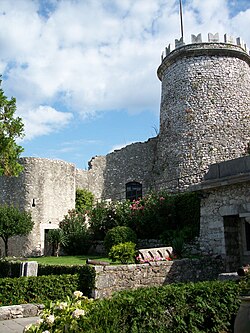
[edit]- Autumn – Siege of Trsat: Višeslav, prince or duke of Dalmatian Croatia, decisively defeats an invading Frankish army under Eric of Friuli, during the siege at the fortress city of Trsat (Rijeka).
- The Vikings raid the island of Noirmoutier, and attack the monastery of Saint Philibert of Jumièges.[1]
Britain
[edit]- King Eardwulf of Northumbria, worried about further rivals, has ealdorman Moll killed. Former king Osbald dies as an abbot in exile. He is buried in an unmarked grave in York Minster.
By topic
[edit]Religion
[edit]- April 25 – Pope Leo III is physically attacked by a band of aristocratic conspirators, under the leadership of a public official who is a nephew of the late Pope Adrian I. After mistreatment and attempted disfigurement by the citizens of Rome, Leo flees to the court of King Charlemagne at Paderborn (modern Germany) to seek protection. He sends him back with Frankish agents, and restores him to the papal throne.
Births
[edit]- Jiang Shen, chancellor of the Tang Dynasty (d. 881)
- Langdarma, emperor of Tibet (approximate date)
- Zhang Yichao, Chinese general (approximate date)
Deaths
[edit]- April 13 – Paul the Deacon, Lombard monk and historian
- September 4 – Musa al-Kadhim, seventh Twelver Shī‘ah Imam (b. 745)
- Eric, duke of Friuli
- Gerold, Alamannian nobleman
- Huaisu, Chinese Buddhist monk (b. 737)
- Osbald, king of Northumbria
References
[edit]- ^ Sawyer, Peter. "The Viking Expansion." The Cambridge History of Scandinavia, Volume 1: Prehistory to 1520. 105.
from Grokipedia
AD 799 marked a year of notable reversals for Frankish ambitions under Charlemagne and a turning point for papal authority, as Pope Leo III endured a brutal assault by Roman adversaries on April 25 during a public procession, who sought to blind him and sever his tongue to disqualify him from office; Leo survived and fled north to the court of Charlemagne at Paderborn for protection, an event that precipitated the king's intervention in Roman affairs and his subsequent coronation as emperor in 800.[1][2] In the autumn, Dalmatian Croatian forces led by Duke Višeslav inflicted a rare defeat on the Franks at the Siege of Trsat near modern Rijeka, where invading troops under Friulian margrave Eric were repulsed, resulting in Eric's death and stalling Carolingian expansion into Slavic territories.[3][4] These incidents underscored the limits of Frankish military reach and the interdependent dynamics between the papacy and the Carolingian monarchy amid the fragmented post-Roman landscape.